
Puck, 1877-08-29 · page 2 of 16
Puck — August 29, 1877 — page 2: what you’re looking at
What you’re looking at
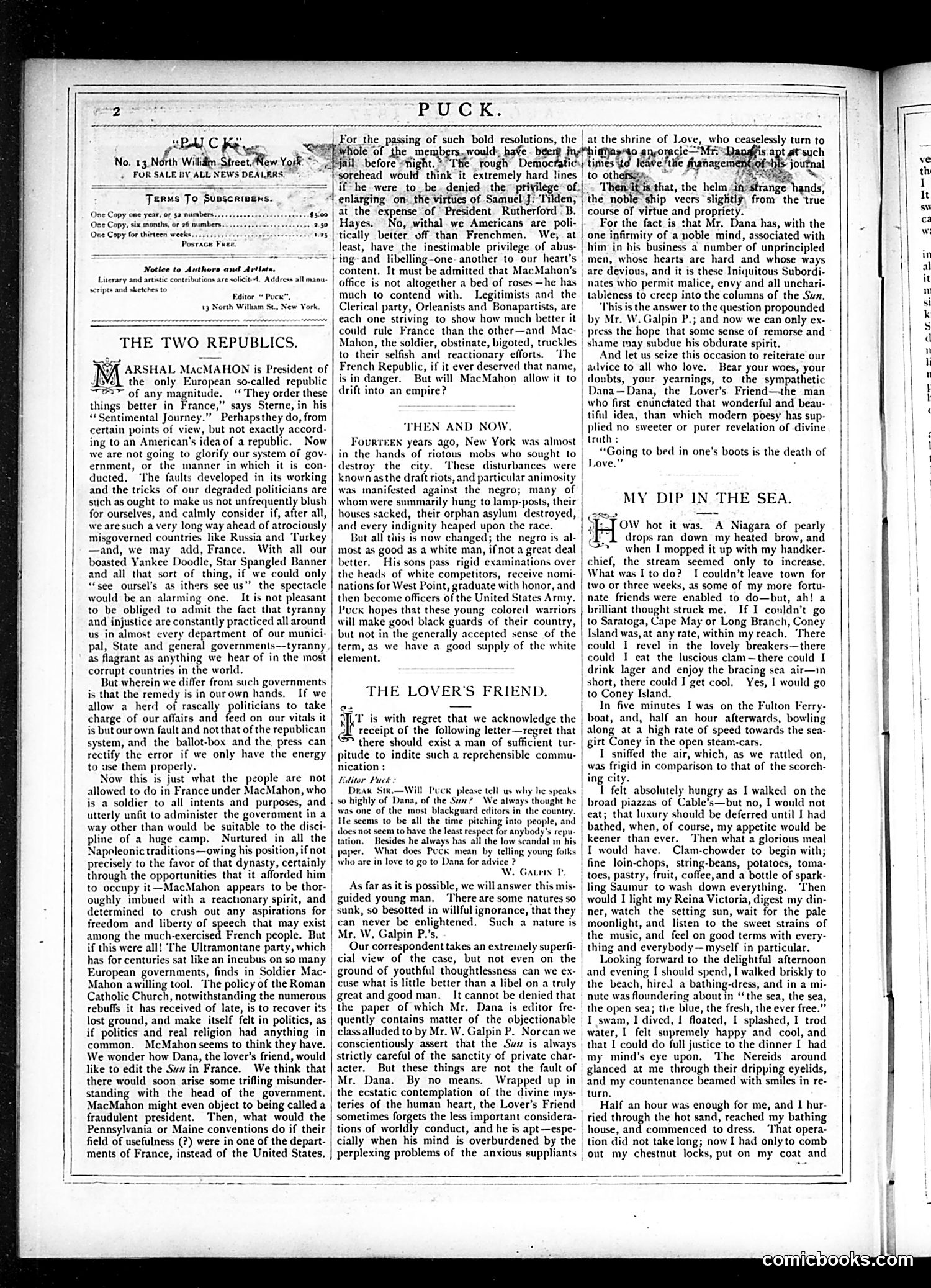
This page contains three distinct pieces: "The Two Republics" (editorial commentary on France and America), "Then and Now" (comparing New York's past race riots to present conditions), and "My Dip in the Sea" (a humorous personal narrative about a seaside trip). The political content criticizes Marshal MacMahon, President of the French Republic, arguing he represents authoritarian tendencies despite republican title. The piece contrasts American and French governance, suggesting both nations struggle with their stated ideals—America with racial justice, France with genuine democracy. "Then and Now" uses contemporary race relations to satirize social progress claims. The cartoons likely illustrate these contrasts visually, though specific caricatures aren't clearly identifiable in the image provided.
📄 Transcribed text from this page (OCR, searchable)
Machine-transcribed from the original scan — historical spelling and the odd misread are preserved.
PUCK. No. 13. néth Willidin Stree Terms To Sunscripens. ‘One Copy one year, oF $2 numbers. One Copy, six anonths, oF 26 jail’ before “i For the passing of such bold hole of the membe sorehead woul if- he were to_be. denied the. privilege” of.) enlarging. on: the virtues of Samuel'J:“Iilden; | at the ‘expense of President Rutherford :B. | Hayes. | tically better off than Frenchmen. No, withal. we Americans are poli. We, at | least, have the inestimable privilege of abus- Notice to Authors and Artintn. Literary and artistic contributions are solicited. Address all manu scripts and sketches to Editor Puc 13 North Witham Se, THE TWO REPUBLICS. ARSHAL MacMAHON is President of the only European so-called republic of any magnitude. ‘ They order these things better in France,” says Sterne, in his “Sentimental Journey.” Perhapsthey do, from certain points of view, but not exactly accord- ing to an American's ideaof a republic. Now we are not going to glorify our system of gov- ernment, or the manner in which it is con- ducted. ‘The faults developed in its working and the tricks of our degraded politicians are such as ought to make us not unfrequently blush for ourselves, and calmly consider if, after all, we are such a very long way ahead of atrociously misgoverned countries like Russia and ‘Turkey —and, we may add, France. With all our | boasted Yankee Doodle, Star Spangled Banner and all that sort of thing, if we could only | “see oursel’s as ithers see us” the spectacle would be an alarming one. It is not pleasant to be obliged to admit the fact that tyranny and injustice are constantly practiced all around us in almost every department of our munici- pal, State and general governments—tyranny as flagrant as anything we hear of in the most corrupt countries in the world. But wherein we differ from such governments | is that the remedy is in ourown hands. If we allow a herd of rascally politicians to take | charge of our affairs and feed on our vitals it | is but our own fault and not that of the republican system, and the ballot-box and the. press can | rectify the error if we only have the energy to use them properly. Now this is just what the people are not | allowed to do in France under MacMahon, who is a soldier to all intents and purposes, and ; utterly unfit to administer the government in a way other than would be suitable to the disci. pline of a huge camp. Nurtured in all the Napoleonic traditions—owing his position, if not | precisely to the favor of that dynasty, certainly through the opportunities that it afforded him to occupy it—MacMahon appears to be thor- oughly imbued with a reactionary spirit, and determined to crush out any aspirations for | freedom and liberty of speech that may exist among the much-exercised French people. But | if this were all! ‘The Ultramontane party, which has for centuries sat like an incubus on so many | European governments, finds in Soldier Mac- Mahon awilling tool. ‘The policy of the Roman Catholic Church, notwithstanding the numerous rebuffs it has received of late, is to recover its | lost ground, and make itself felt in politics, as if politics and real religion had anything in | common. McMahon seems to think they have. We wonder how Dana, the lover's friend, would like to edit the Suz in France. We think that there would soon arise some trifling misunder- standing with the head of the government. MacMahon might even object to being called a | fraudulent president. Then, what would the | Pennsylvania or Maine conventions do if their | field of usefulness (?) were in one of the depart- ments of France, instead of the United States. | much to contend with. Clerical party, Orleanists and Bonapattists, are | + ing-and libelling-one- another to our heart's content. It must be admitted that MacMahon’s | office is not altogether a bed of roses —he has Legitimists and the each one striving to show how much better it could rule France than the other—and Mac- Mahon, the soldier, obstinate, bigoted, truckles to their selfish and reactionary efforts. ‘The French Republic, if it ever deserved that name, isin danger. But will MacMahon allow it to drift into’ an empire? ‘THEN AND NOW. Fourrren years ago, New York was almost in the hands of riotous mobs who sought to destroy the city. These disturbances were known asthe draft riots, and particular animosity was manifested against the negro; many of whom were summarily hung to lamp-posts, their houses sacked, their orphan asylum destroyed, and every indignity heaped upon the race. But all this is now changed; the negro is al- most as good as a white man, ifnot a great deal better, His sons pass rigid examinations ove the heads of white competitors, i i nations for West Point, graduate with honor, and then become officers of the United States Arm: Puck hopes that these young colored warriors will make good black guards of their country, but not in the generally accepted sense of the term, as we have a good supply of the white element. THE LOVER'S FRIEND. es — Sie is with regret that we acknowledge the © there should exist a man of sufficient tur- pitude to indite such a reprehensible commu- nication ; ditor Puck: Deak Stx.—Will Peck please tellus why he speaks so highly of Dana, of the Suz? We always thought he was one of the most blackguard editors in the country. | Ie seems to be all the time pitching into people, and does not seem to have the least respect for anybody's repu- tation, Besides he always has all the low scandal in his paper. What does Puck mean by telling young folks who are in love to go to Dana for advice ? W. Garis P As far as it is possible, we will answer this mis- guided young man. ‘There are some natures so sunk, so besotted in willful ignorance, that they can never be enlightened. Such a. nature is Mr, W. Galpin P.’s. Our correspondent takes an extremely superfi- cial view of the case, but not even on the ground of youthful thoughtlessness can we ex- cuse what is little better than a libel on a truly great and good man, It cannot be denied that the paper of which Mr. Dana is editor fre- quently contains matter of the objectionable class alluded to by Mr. W. Galpin P. Norcan we conscientiously assert that the Sux is always strictly careful of the sanctity of private char- acter. But these things are not the fault of Mr. Dana. By no means. Wrapped up in the ecstatic contemplation of the divine mys- teries of the human heart, the Lover’s Friend sometimes forgets the less important considera- tions of worldly conduct, and he is apt—espe- cially when his mind is overburdened by the receipt of the following letter—regret that | resolutions, the | at the shrine of Lov rs.,would:, have La inhi anoraclé—Mr ‘THe’ tough Democfatics; times to leate'ftlie fhahag: think it extremely hard tines | to others. ~~ 7 | who ceaselessly turn to is. apt at sych joufnal een ©. Then itis that, the helm inzstrange hands, the noble~ship vecrs “slightly, from the true course of virtue and propriety. For the fact is that Mr. Dana has, with the one infirmity of a noble mind, associated with him in his business a number of unprincipled men, whose hearts are hard and whee ways are devious, and it is these Iniquitous Subordi- nates who permit malice, envy and all unchari- tableness to creep into the columns of the Sun. ‘his is the answer to the question propounded by Mr. W. Galpin P.; and now we can only ex- press the hope that some sense of remorse and shame may subdue his obdurate spirit. And let us seize this occasion to reiterate our advice to all who love. Bear your woes, your doubts, your yearnings, to the sympathetic Dana—Dana, the Lover's Friend—the man who first enunctated that wonderful and beau- tiful idea, than which modern poesy has sup- plied no sweeter or purer revelation of divine truth : “Going to bed in one’s boots is the death of Love.” MY DIP IN THE SEA. OW hot it was. A Niagara of pearly drops ran down my heated brow, and when I mopped it up with my handker- chief, the stream seemed only to increase. What was Ito do? I couldn’t leave town for wo or three weeks, as some of my more fortu- nate friends were enabled to do—but, ah! a Drilliant thought struck me. If I conldn’t go to Saratoga, Cape May or Long Branch, Coney Island was, at any rate, within my reach, There could I revel in the lovely breakers—there could I cat the luscious clam—there could I drink lager and enjoy the bracing sea air—in short, there could I get cool. Yes, I would go to Coney Island. In five minutes I was on the Fulton Ferry- boat, and, half an hour afterwards, bowling along at a high rate of speed towards the sea girt Coney in the open steam-cars. I sniffed the air, which, as we rattled on, was frigid in comparison to that of the scorch- ing city. 1 felt absolutely hungry as I walked on the broad piazzas of Cable’s—but no, I would not eat; that luxury should be deferred until 1 had | bathed, when, of course, my appetite would be keener than ever. ‘Then what a glorious meal I would have. Clam-chowder to begin with; | fine loin-chops, string-beans, potatoes, toma- perplexing problems of the anxious suppliants | toes, pastry, fruit, coffee, and a bottle of spark- ling Saumur to wash down everything. ‘Then would I light my Reina Victoria, digest my din- ner, watch the setting sun, wait for the pale moonlight, and listen to the sweet strains of the music, and feel on good terms with every- thing and everybody—myself in particular. Looking forward to the delightful afternoon and evening I should spend, I walked briskly to the beach, hired a bathing-dress, and in a mi- nute was floundering about in “the sea, the sea, the open sea; the blue, the fresh, the ever free.” I swam, I dived, I floated, I splashed, I trod water, I' felt supremely happy and cool, and that I could do full justice to the dinner I had my mind’s eye upon, ‘The Nereids around glanced at me through their dripping eyelids, and my countenance beamed with smiles in re- turn. Half an hour was enough for me, and I hur- ried through the hot sand, reached my bathing house, and commenced to dress. ‘That opera- tion did not take long; now I had only to comb out my chestnut locks, put on my coat and