
Puck, 1877-08-29 · page 10 of 16
Puck — August 29, 1877 — page 10: what you’re looking at
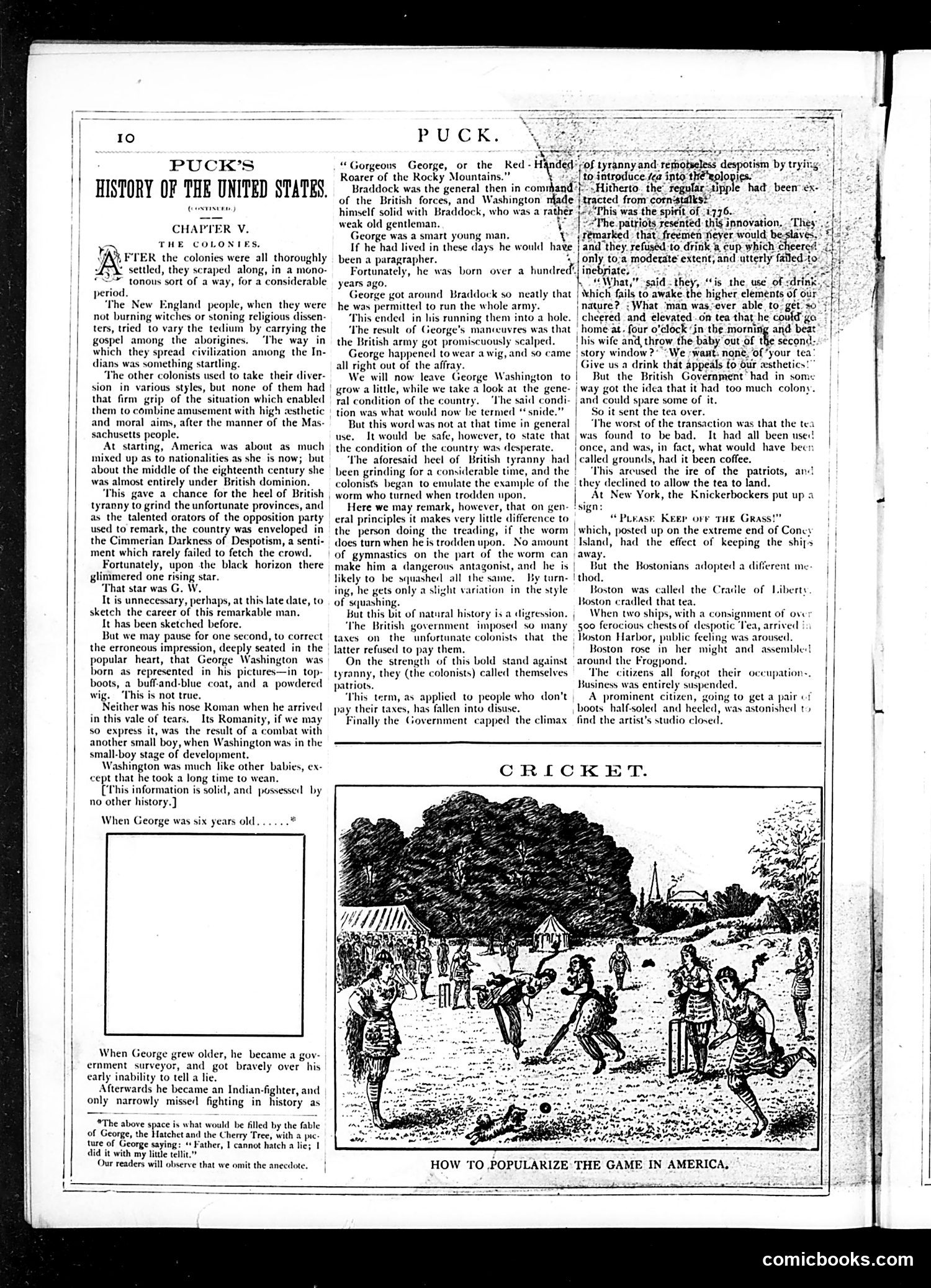
What you’re looking at
This is a satirical illustration about cricket, the British sport. The engraving shows people playing cricket in an American pastoral setting, with the caption suggesting how to make cricket popular in America. The satire likely mocks either: (1) British attempts to impose their cultural practices on Americans, or (2) American unfamiliarity with cricket as a "foreign" sport. The illustration depicts what appears to be civilized, leisure-class players in a genteel English countryside scene—incongruous with rougher American attitudes toward sports. The adjacent text discusses George Washington and colonial independence, suggesting the cartoon implies cricket represents residual British cultural influence that Americans had rejected along with political independence. The satire undermines cricket's refinement by presenting it as an absurd transplant to American soil.
📄 Transcribed text from this page (OCR, searchable)
Machine-transcribed from the original scan — historical spelling and the odd misread are preserved.
PUCK’S HISTORY OF THE UNITED STATES. CHAPTER V. THE COLONIES, R the colonies were all thoroughly settled, they scraped along, in a mono- * tonous sort of a way, for a considerable eriod. ‘The New England people, when they were not burning witches or stoning religious dissen ters, tried to vary the tedium by carrying the gospel among the aborigines. ‘The way in which they spread civilization among the In- dians was something startling. ‘The other colonists used to take their diver- sion in various styles, but none of them had that firm grip of the situation which enabled them to combine amusement with high cesthetic and moral aims, after the manner of the Mas- sachusetts people. At starting, America was about as much mixed up as to nationalities as she is now; but about the middle of the eighteenth century she was almost entirely under British dominion. ‘This gave a chance for the heel of British tyranny to grind the unfortunate provinces, and as the talented orators of the opposition party used to remark, the country was enveloped the Cimmerian Darkness of Despotism, a senti- ment which rarely failed to fetch the crowd, Fortunately, upon the black horizon there glimmered one rising star. ‘That star was G. W, It is unnecessary, perhaps, at this late date, to sketch the career of this remarkable man. It has been sketched before. But we may pause for one second, to correct the erroneous impression, deeply seated in the popular heart, that George Washington was born as represented in his pictures—in top- boots, a buff-and-blue coat, and a powdered wig. ‘This is not true. Neither was his nose Roman when he arrived in this vale of tears. Its Romanity, if we may so express it, was the result of a combat with another small boy, when Washington was in the small-boy stage of development. Washington was much like other babies, ex- cept that he took a long time to wean. [This information is solid, and possessed by no other history.) When George was six years old. ..... When George grew older, he became a gov- ernment surveyor, and got bravely over his early inability to tell a lie. Afterwards he became an Indian-fighter, and only narrowly missed fighting in history as *The above space is what would be filled by the fable of George, the Hatchet and the Cherry Tree, with a pic- ture of George saying: ‘Father, I cannot hatch a lie; I did it with my litte tellit.” Our readers will observe that we omit the anecdote. PUCK, { | “ Gorgeous George, or the Red -H nded f tyranny and: remotseless despotism by trying: | Roarer of the Rocky Mountains.” +] to introduce fea into thé eolopi¢s. aia! Braddock was the general then in command’}--Hitherto. the’ regular-tipple had been ex- of the British forces, and Washington nfade | tracted from corn-stdlks?” himself solid with Braddock, who was a rather 4+ ¢“Phis was the spirit of 1776. e ei weak old gentleman. 4 “The. patriots resénted this innovation, “They George was a smart young man, remarked that. freemen Neyer would be-slaves. If he had lived in these days he would have | and they. refuséd:to drink a cup which ‘cheer been a paragrapher. + [only to:a moderate extent, and utterly failed to Fortunately, he was born over a hundred’ inebyiate, 5 years ago. “What,” “said they, “isthe use of <drink.< |! George got around Braddock so neatly that | xhich fails to awake. the higher elements of our f | s permitted to run the whole army. jRature? ; What ‘man was-ever able to: geét’+0\j is ended in his running them into a hole. | cheered and elevated .on tea that he could ga fhe result of George’s manccuvres was that | home at. four o'clock ‘in. the mori a the British army got promiscuously scalped. | his wife and throw the baby out of the second. George happened to wear awig, and so came | story window?” “We -want: none, of ‘your tea all right out of the affray. Give us a drink that appeals fo Our wsthetic: We will now leave George Washington to | But the British Government’ had in so grow a little, while we take a look at the gene- | way got the idea that it had too much colony ral condition of the country, ‘The said condi- | and could spare some of it. tion was what would now be termed ‘ snid So it sent the tea over. But this word was not at that time in general ‘he worst of the transaction was that the tea | use. It would be safe, however, to state that was found to be bad. It had all been used the condition of the country was desperate. | once, and was, in fact, what would have becn ‘The aforesaid heel of British tyranny had | called grounds, had it been coffee. been grinding for a considerable time, and the | ‘This areused the ire of the patriots, an: colonists began to emulate the example of the | they declined to allow the tea to land. worm who turned when trodden upon, | New York, the Knickerbockers put up « Here we may remark, however, that on gen eral principles it makes very little difference to the person doing the treading, if the worm does turn when he is trodden upon, No amount of gymnastics on the part of the worm can make him a dangerous antagonist, and he is likely to be squashed all the'same. By turn- ing, he yets only a slight variation in the style of squashing. but this bit of natural history is a digression. ; ‘The British government imposed so many taxes on the unfortunate colonists that the latter refused to pay them, On the strength of this bold stand against tyranny, they (the colonists) called themselves patriots. ‘This term, as applied to people who don't pay their taxes, has fallen into disuse. Finally the Government capped the climax he “PLEASE KEEP ore THE Grass which, posted up on the extreme end of Coney | | Island, had the effect of keeping the shits | away. H But the Bostonians adopted a different me 'thod. Boston was called the Cradle of Liberty | Boston cradled that te | When two ships, with a consignment of ove 500 ferocious chests of despotic Tea, arrived Koston Harbor, public feeling was aroused. Boston rose in her might and assemble around the Frogpond. ‘The citizens all forgot their occupation-. Business was entirely suspended. A prominent citizen, going to geta pair of | boots half-soled and heeled, was astonished ty find the artist's studio closed. CRICKET. HOW TO POPULARIZE THE GAME IN AMERICA, So comicbooks.com