
Puck, 1877-08-29 · page 6 of 16
Puck — August 29, 1877 — page 6: what you’re looking at
What you’re looking at
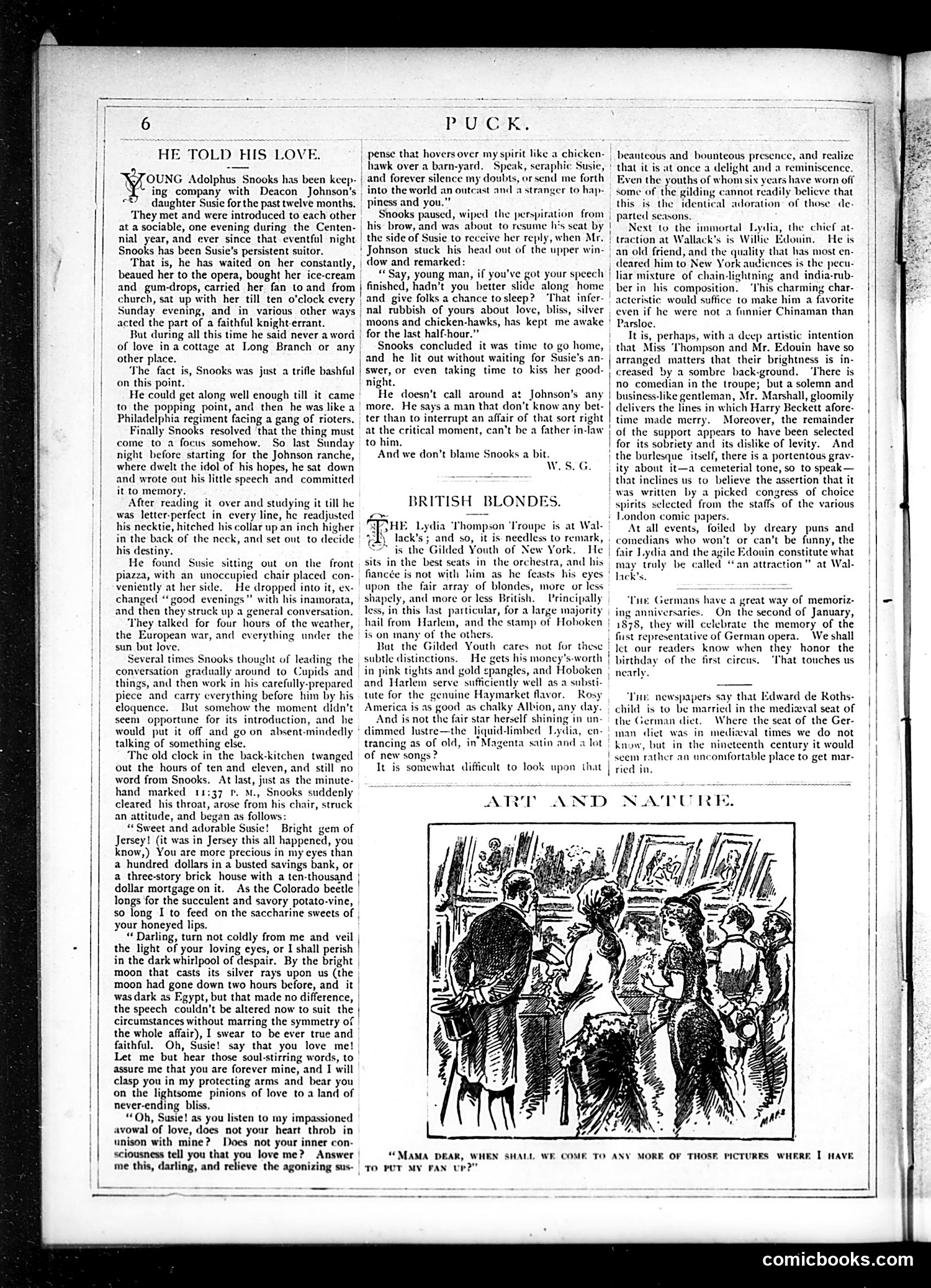
The page contains three distinct sections: **"He Told His Love"** (top left): A short story about a man named Snooks pursuing his love interest Susie, culminating in a romantic speech ending with "Sweet and adorable Susie!" **"British Blondes"** (middle): A theater review discussing the "Gilded Youth of New York" and comparing British and American performers, mentioning specific actors and theaters. **"Art and Nature"** (bottom): A cartoon showing what appears to be a well-dressed man and woman at what looks like an art gallery or museum. The caption reads: "MAMA DEAR, WHEN SHALL WE COME TO ANY MORE OF THOSE PICTURES WHERE I HAVE TO PUT MY FAN UP?" The cartoon humorously depicts a child asking about seeing more artwork of an embarrassing or scandalous nature, suggesting social commentary on propriety and changing artistic standards of the era.
📄 Transcribed text from this page (OCR, searchable)
Machine-transcribed from the original scan — historical spelling and the odd misread are preserved.
HE TOLD HIS LOVE. XJ OUNG Adolphus Snooks has been keep: \{ ing company with Deacon Johnson's «© — daughter Susic for the past twelve months. They met and were introduced to each other at a sociable, one evening during the Centen- nial year, and ever since that eventful night. Snooks has been Susie's persistent suitor. That is, he has waited on her constantly, beaued her to the opera, bought her ice-cream and gum-drops, carried her fan to and from urch, sat up with her till ten o'clock every Sunday evening, and in various other ways acted the part of a faithful knight-errant. But during all this time he said never a word of love in a cottage at Long Branch or any | other place. The fact i on this point. He could get along well enough till it came to the popping point, and then he was like a Philadelphia regiment facing a gang of rioters. Finally Snooks resolved that the thing must come to a focus somehow. So last Sunday night before starting for the Johnson ranche, where dwelt the idol of his hopes, he sat down and wrote out his little speech and committed it to memory. After reading it over and studying it till he was letter-perfect in every line, he readjusted his necktie, hitched his coliar up an inch higher in the back of the neck, and set out to decide his destiny. He found Susie sitting out on the front piazza, with an unoccupied chair placed con- veniently at her side. He dropped into it, ex- changed “good evenings” with his inamorata, and then they struck up a general conversation. ‘They talked for four hours of the weather, the European war, and everything under the sun but love. Several times Snooks thought of leading the conversation gradually around to Cupids and things, and then work in his carefully-prepared piece and erything before him by his eloquence. But somehow the moment didn’t seem opportune for its introduction, and he would put it off and go on absent-mindedly talking of something else. The old clock in the back-kitchen twanged out the hours of ten and eleven, and still no word from Snooks. At last, just as the minute- hand marked 11:37 P. M., Snooks suddenly cleared his throat, arose from his chair, struck an attitude, and began as follows: “Sweet and adorable Susie! Bright gem of Jersey! (it was in Jersey this all happened, you know,) You are more precious in my eyes than a hundred dollars in a busted savings bank, or a three-story brick house with a ten-thousand | dollar mortgage on it. As the Colorado beetle longs for the succulent and savory potato-vine, so long I to feed on the saccharine sweets of , your honeyed lips. “ Darling, turn not coldly from me and veil the light of your loving eyes, or I shall perish in the dark whirlpool of despair. By the bright moon that casts its silver rays upon us (the moon had gone down two hours before, and it was dark as Egypt, but that made no difference, nooks was just a trifle bashful the speech couldn’t be altered now to suit the | circumstances without marring the symmetry of the whole affair), I swear to be ever true and faithful. Oh, Susie! say that you love me! Let me but hear those soul-stirring words, to assure me that you are forever mine, and I will clasp you in my protecting arms and bear you on the lightsome pinions of love to a land of never-ending bliss. “Oh, Susie! as you listen to my impassioned avowal of love, does not your heart throb in unison with mine? Does not your inner con- jousness tell you that you love me? Answer me this, darling, and relieve the agonizing sus- PUCK. pense that hovers over my spi hawk over a barn-yard. Speak, seraphic $ and forever silence my doubts, or send me forth into the world an outcast and a stranger to hap- piness and you.” Shooks paused, wiped the perspiration from his brow, and was about to resume his seat by the side of Susie to receive her reply, when Mr. ‘Johnson stuck his head out of the upper win- dow and remarked: “ Say, young man, if you've got your speech | finished, hadn't you better slide along home and give folks a chance tosleep? ‘That infer- nal rubbish of yours about love, bliss, silver moons and chicken-hawks, has kept me awake for the last half-hour.” Snooks concluded it was time to go home, and he lit out without waiting for Susie's an- swer, or even taking time to kiss her good- night. He doesn’t call around at Johnson's any more. He says a man that don’t know any bet- ter than to interrupt an affair of that sort right at the critical moment, can’t be a father in-law to him. And we don’t blame Snooks a bit. 7 BRITISH BLOND HE Lydia ‘Thompson ‘lroupe is at Wal- lack’s ; and so, it is needless to remark, is the Gilded Youth of New York. He sits in the best seats in the orchestra, and his fiancée is not with him as he feasts his eyes upon the fair array of blondes, more or less shapely, and more or less British. Principally less, in this last particular, for a large majority hail from Harlem, and the stamp of Hoboken is on many of the others. But the Gilded Youth cares not for these subtle distinctions. He gets his moncy’s-worth in pink tights and gold spangles, and Hoboken and Harlem serve sufficiently well as a substi- tute for the genuine Haymarket flavor. Rosy America is as good as chalky Albion, any day. And is not the fair star herself shining in un. dimmed lustre—the liquid-limbed Lydia, en- trancing as of old, in’Magenta satin and a lot of new songs ? Tt is somewhat difficult to look upon that beauteous and bounteous presence, ‘that it is at once a delight and a reminiscenc: Even the youths of whom six years have worn off some of the gilding cannot readily believe that this is the identical adoration: of those de- parted seasons. Next to the immortal Lydia, the chief at- traction at Wallack’'s is Willie Edouin. He is an old friend, and the quality that has most en- deared him to New York audiences is the pecu- liar mixture of chain-lightning and india-rub- ber in his composition. ‘This charming char- acteristic would suffice to make him a favorite even if he were not a funnier Chinaman than Parsloe. It is, perhaps, with a deep artistic intention that Miss ‘Thompson and Mr. Edouin have so arranged matters that their brightness is in- creased by a sombre back-ground. ‘There | no comedian in the troupe; but a solemn and | business-like gentleman, Mr. Marshall, gloomily delivers the lines in which Harry Beckett afore- time made merry. Moreover, the remainder of the support appears to have been selected for its sobriety and its dislike of levity. And the burlesque itself, there is a portentous grav- ity about it—a cemeterial tone, so to speak— | that inclines us to believe the assertion that it as written by a picked congress of choice spirits selected from the staffs of the various London comic pap At all events, foiled by dreary puns and comedians who won't or can’t be funny, the fair J.ydia and the agile Edouin constitute what truly be called “an attraction” at Wal- ‘Lave Germans have a great way of memoriz- ing anniversaries. On the second of January, 1878, they will celebrate the memory of the fist representative of German opera. We shall | Ict our readers know when they honor the Dirthday of the first circus. ‘That touches us nearly ‘Tie newspapers say that Edward de Roths- child is to be married in the mediwval seat of the German diet. Where the seat of the Ger- man diet was in medieval times we do not know, but in the nineteenth century it would | seem rather an uncomfortable place to get mar- | ried in. ART AND NATURE, TO PUT MY PAN UP?” comicbooks.com