
A complete issue · 48 pages · 1929
Life — July 12, 1929
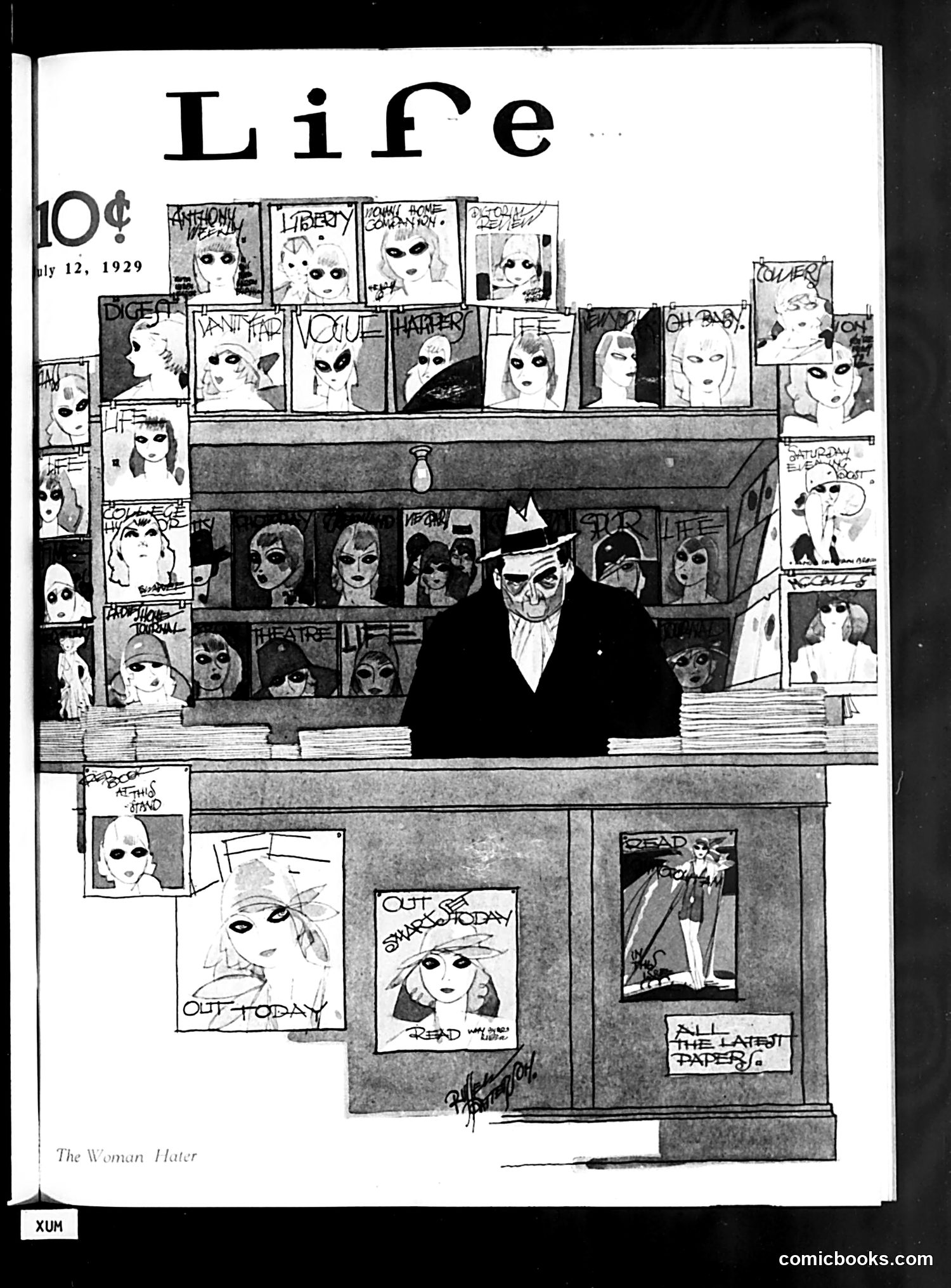
This satirical cartoon depicts a theater showing "The Woman Hater"—likely a film or play from that era. The central figure, a man with exaggerated skeletal/death-like features wearing a suit and hat, sits amid an audience of glamorous women's faces lining the walls and windows of the theater. The satire appears to mock the contradiction between a film titled "The Woman Hater" playing in a theater filled exclusively with female patrons. The grotesque depiction of the male character suggests irony about masculine misogyny being entertainment for women, or perhaps commentary on the absurdity of such entertainment choices. This reflects 1920s attitudes toward gender relations and film marketing during the silent/early sound era.
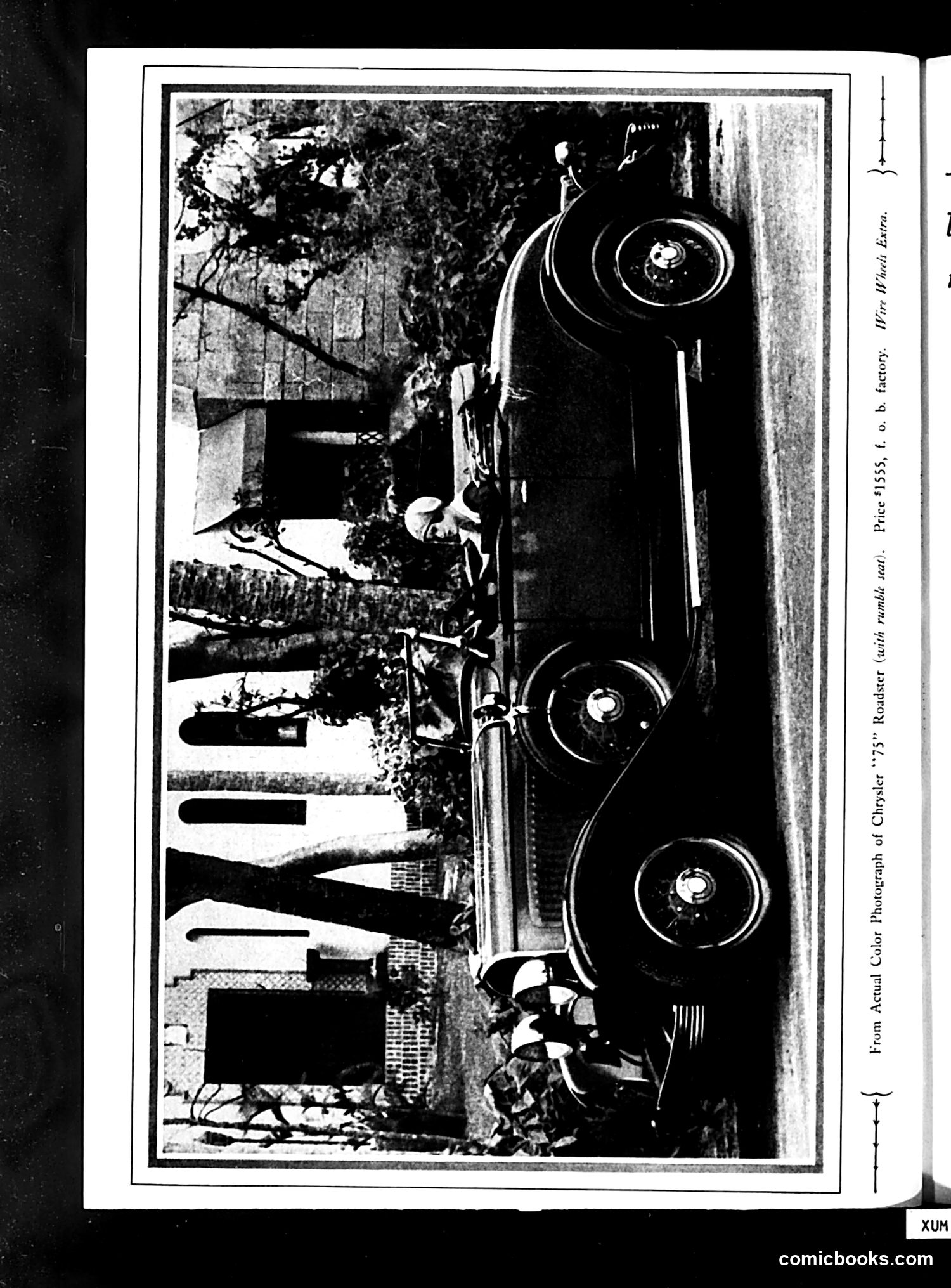
The image shows a 1955 Chrysler automobile photographed from the side, displayed in what appears to be a garden or landscaped setting. The caption indicates this is "From Actual Color Photograph of Chrysler '75' Roadster (avid metalwork). Price 1955, o.b. factory, Five World Events." However, **I cannot identify any satirical content, political cartoon, or commentary in this image.** It appears to be a straightforward advertisement or product photograph from Life magazine, showcasing the automobile's design features in an outdoor setting. The page seems primarily promotional rather than satirical in nature. Without additional context or visible caricatures, I cannot provide analysis of political or social satire as requested.
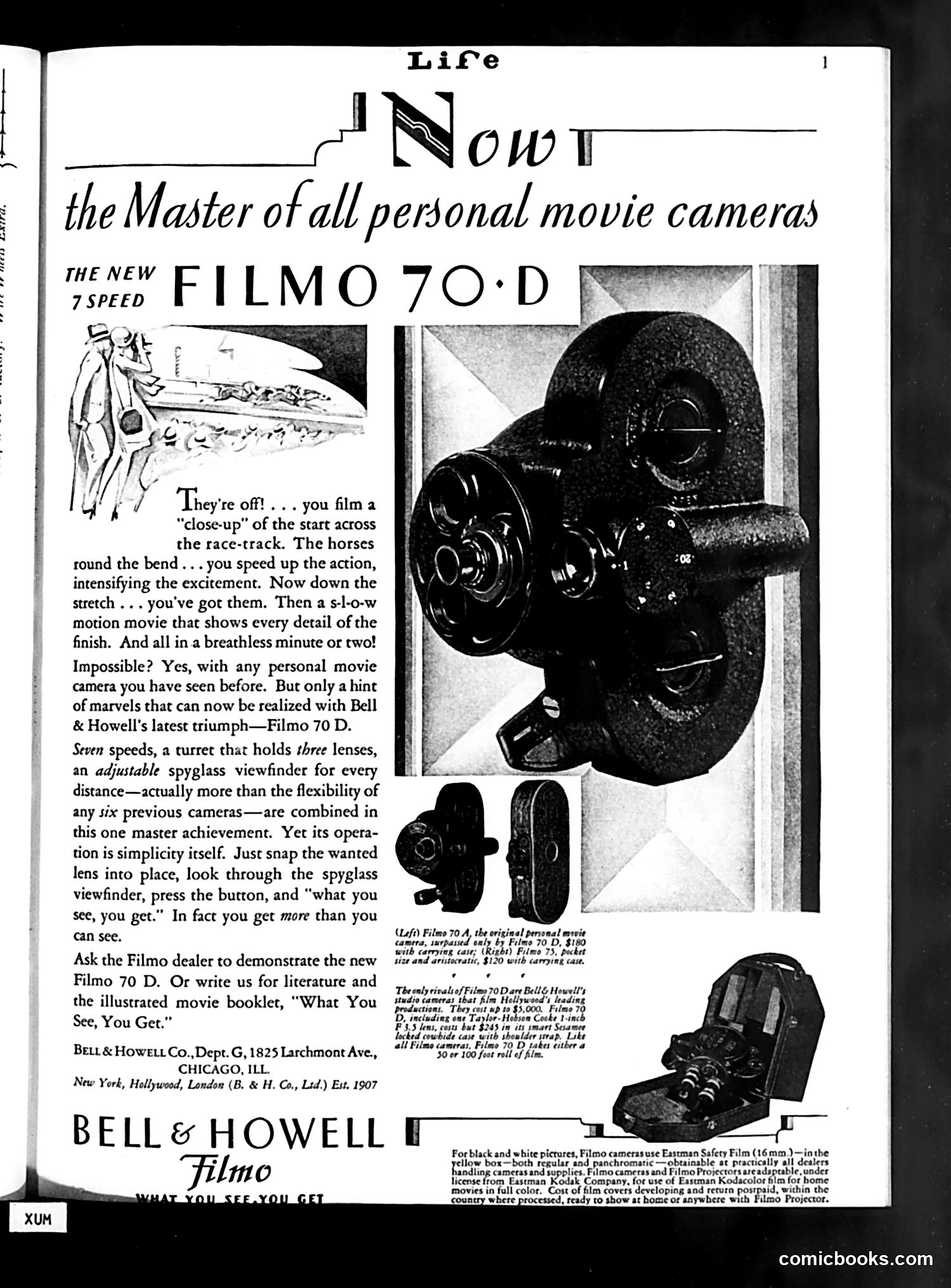
This page is **primarily an advertisement**, not satire or political commentary. It promotes the Filmo 70-D, a personal movie camera made by Bell & Howell. The ad emphasizes the camera's technical capabilities: seven speeds, three lenses, adjustable viewfinder, and simplicity of use. The illustrated scenario—filming a horse race with close-ups and slow-motion—demonstrates how the camera captures action impossible with previous models. The sketch on the left shows a woman operating the camera; the large photograph displays the Filmo 70-D itself with its distinctive lens turret. Small images at bottom show the camera's portability and included accessories. The tagline "What You See, You Get" promises straightforward product functionality. This represents typical consumer advertising from the era, targeting amateur filmmakers rather than satirizing current events or figures.
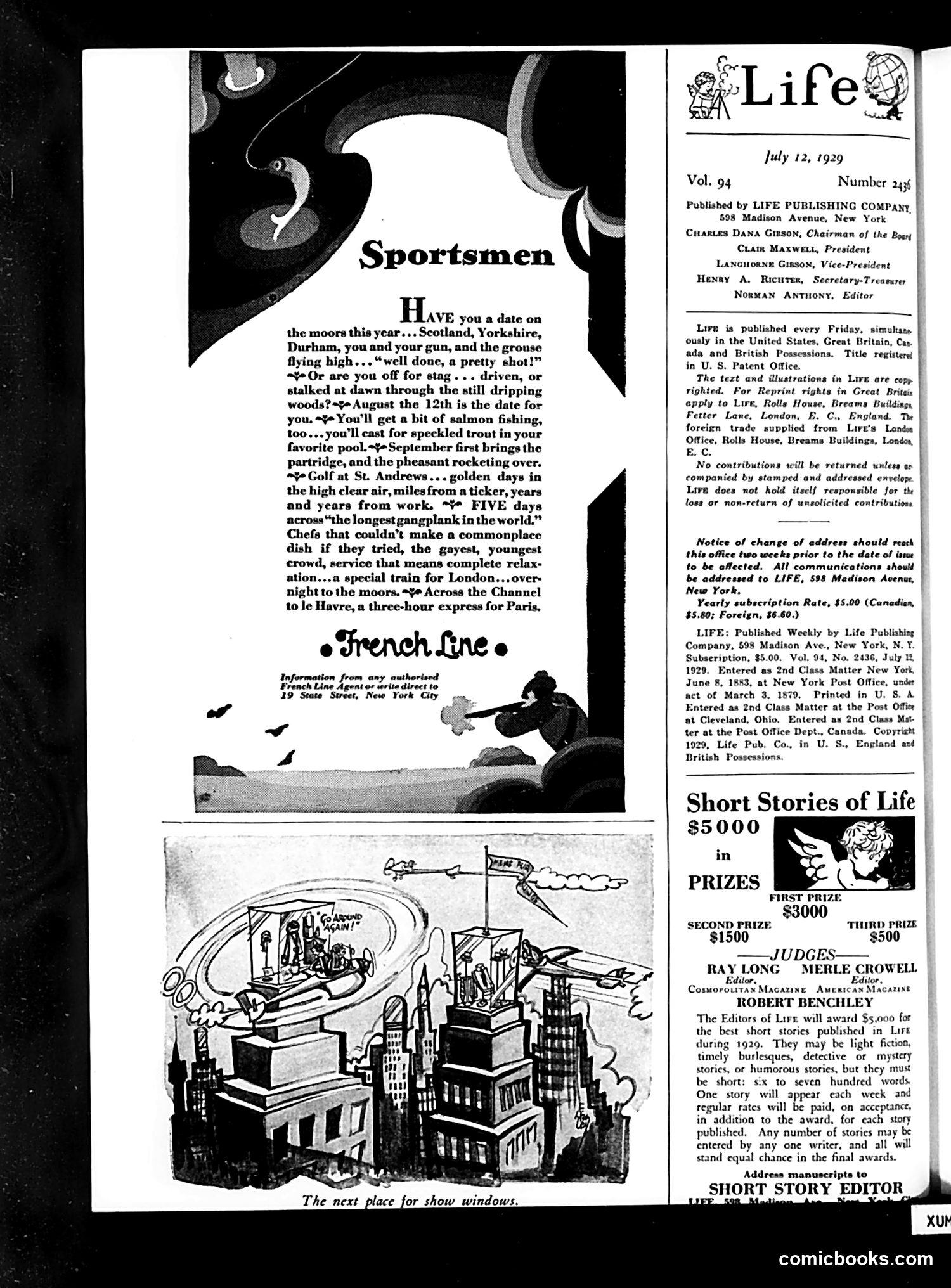
This page combines advertisements with content promoting Life's "Short Stories of Life" contest offering $5,000 in prizes. The "Sportsmen" advertisement references seasonal British activities (Scottish Yuletide hunting, salmon fishing, partridge shooting, golf at St. Andrews, grouse hunting, and Channel crossing to Paris). It appeals to wealthy readers with leisure time and disposable income for travel and field sports. The cartoon below depicts "The next place for show windows"—an aerial view of New York City skyscrapers reimagined as display windows for commercial goods. This appears to satirize urban commercialism and the growing dominance of advertising in American city life during the 1920s economic boom, suggesting that even architectural landmarks were becoming vessels for consumerism.
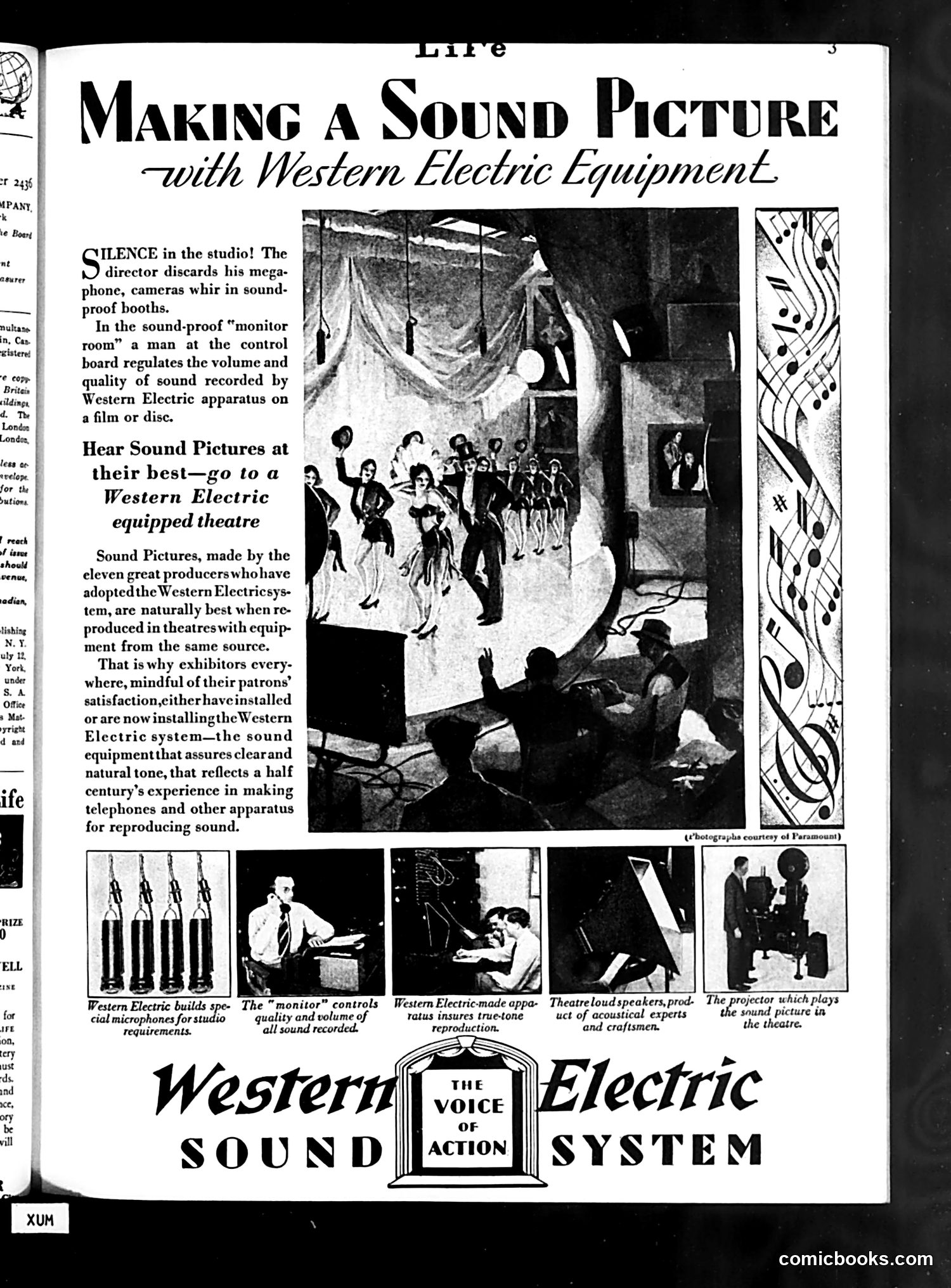
This is **not a political cartoon or satire**—it's a straightforward **advertisement for Western Electric sound equipment**, disguised as editorial content in the style of Life magazine. The page promotes Western Electric's "Sound System" for movie theaters during the early sound-film era (likely late 1920s). It explains how sound recording and playback technology works: microphones capture actors' voices in soundproof studios, a control operator monitors quality, speakers reproduce audio in theaters, and projectors synchronize sound with film. The accompanying photographs demonstrate the equipment and studio setup. This represents corporate advertising masquerading as informational content—a common early twentieth-century marketing practice. There is no satire or political commentary intended.
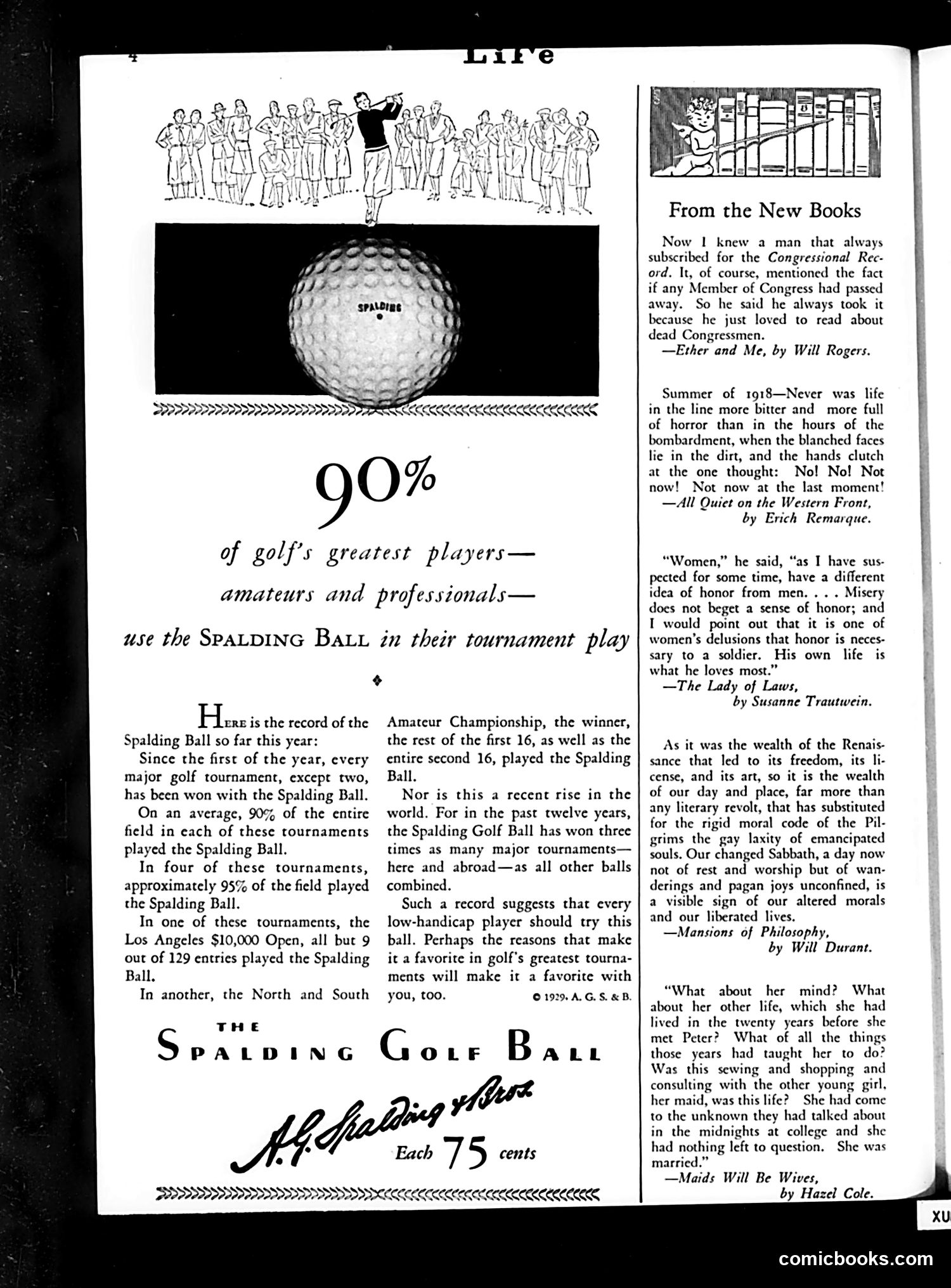
This page is primarily **advertising content**, not political satire. The main image shows a Spalding golf ball surrounded by golfers, with text claiming that "90% of golf's greatest players—amateurs and professionals—use the SPALDING BALL in their tournament play." The advertisement cites tournament records as evidence: the ball allegedly dominated major competitions including the Los Angeles $10,000 Open and the North and South Championship. The price listed is 75 cents each. The right column contains brief literary excerpts ("From the New Books") promoting various publications, unrelated to the golf advertisement. There is no political satire or social commentary visible on this page—it is a straightforward commercial promotion typical of early 20th-century magazine advertising.
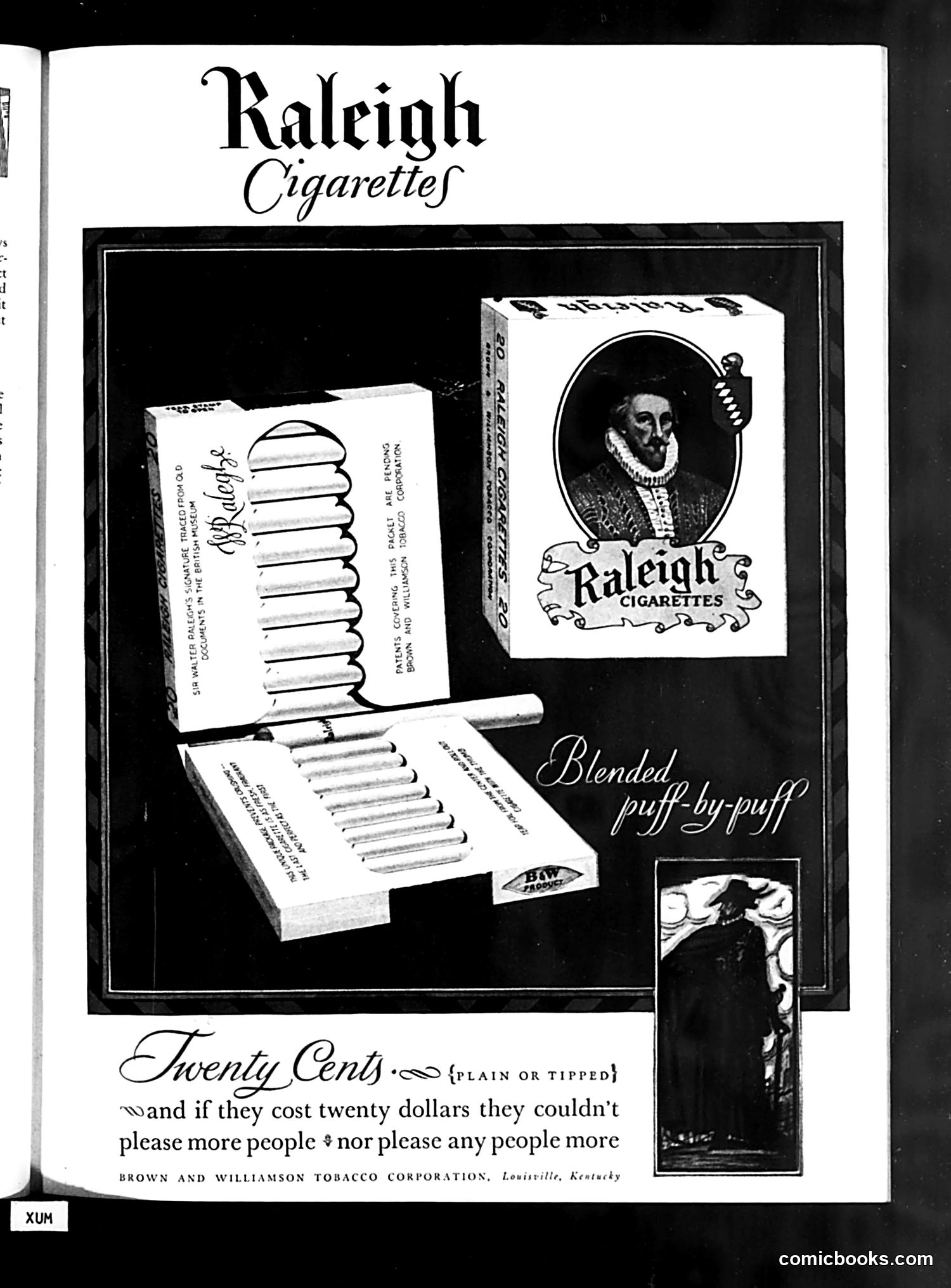
This is a **cigarette advertisement**, not political satire. It shows Raleigh brand cigarettes with packaging displayed and an Elizabethan-era portrait (likely Sir Walter Raleigh, the cigarette brand's namesake) featured on the box. The ad's tagline—"Blended puff-by-puff"—emphasizes the product's tobacco blend quality. The bottom copy reads "Twenty Cents {PLAIN OR TIPPED}" and includes a tongue-in-cheek line: "and if they cost twenty dollars they couldn't please more people $ nor please any people more." This is straightforward product marketing from the Brown and Williamson Tobacco Corporation (Louisville, Kentucky), using historical imagery to brand the cigarettes with an air of prestige and tradition. There is no political commentary or satirical intent here.
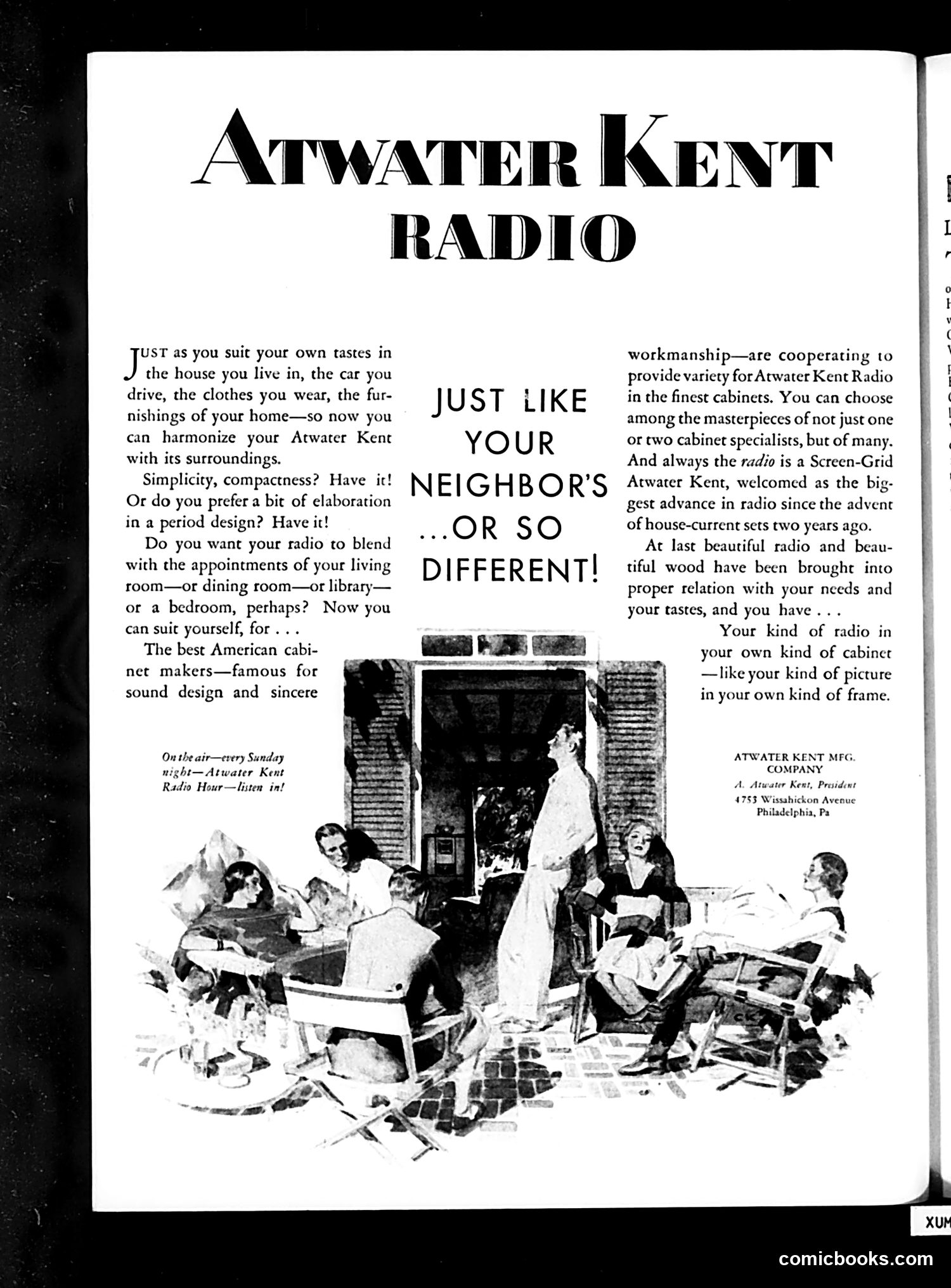
This is a **full-page advertisement** for Atwater Kent radios, not political satire or comics. The ad uses a lifestyle appeal rather than humor. The central illustration depicts a 1920s-era social gathering where a radio (the cabinet unit visible in the background) is the focal point of entertainment for well-dressed guests. The ad's pitch emphasizes **personal choice and customization**: just as people select their own home furnishings and clothing, they can choose an Atwater Kent radio to match their aesthetic preferences and living spaces. The headline "Just Like Your Neighbor's...Or So Different!" suggests that Atwater Kent offers both conformity and individuality—multiple cabinet styles and designs to suit varying tastes, positioning radio ownership as aspirational yet accessible to middle-class consumers.
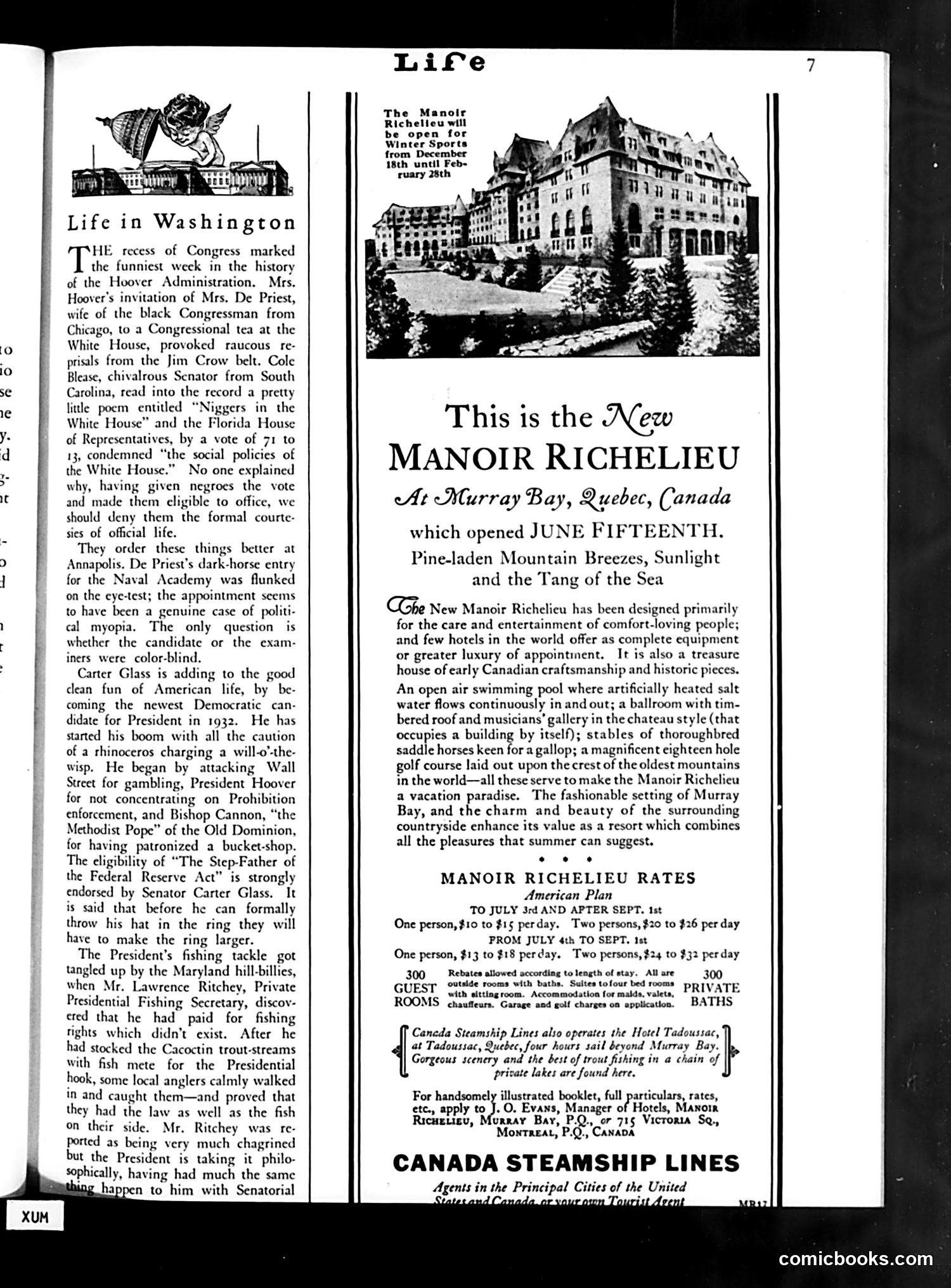
This page is primarily **advertising for Manoir Richelieu**, a Canadian resort hotel opening June 15th at Murray Bay, Quebec. The top portion contains a "Life in Washington" column discussing Congressional controversy. The column describes a racial incident where Mrs. Hoover invited a Black Congressman's wife to tea, prompting segregationist Southern senators—including Cole Blease—to enter racist poetry into the Congressional record opposing "Negroes in the White House." The piece satirizes this overreaction, noting the irony that giving Black voters political eligibility shouldn't require denying them "formal courtesies of official life." The column also mocks President Hoover for attacking Wall Street while facing Prohibition enforcement questions, and discusses a fabricated fishing anecdote about the Presidential Fishing Secretary. The page is otherwise dominated by the resort advertisement.
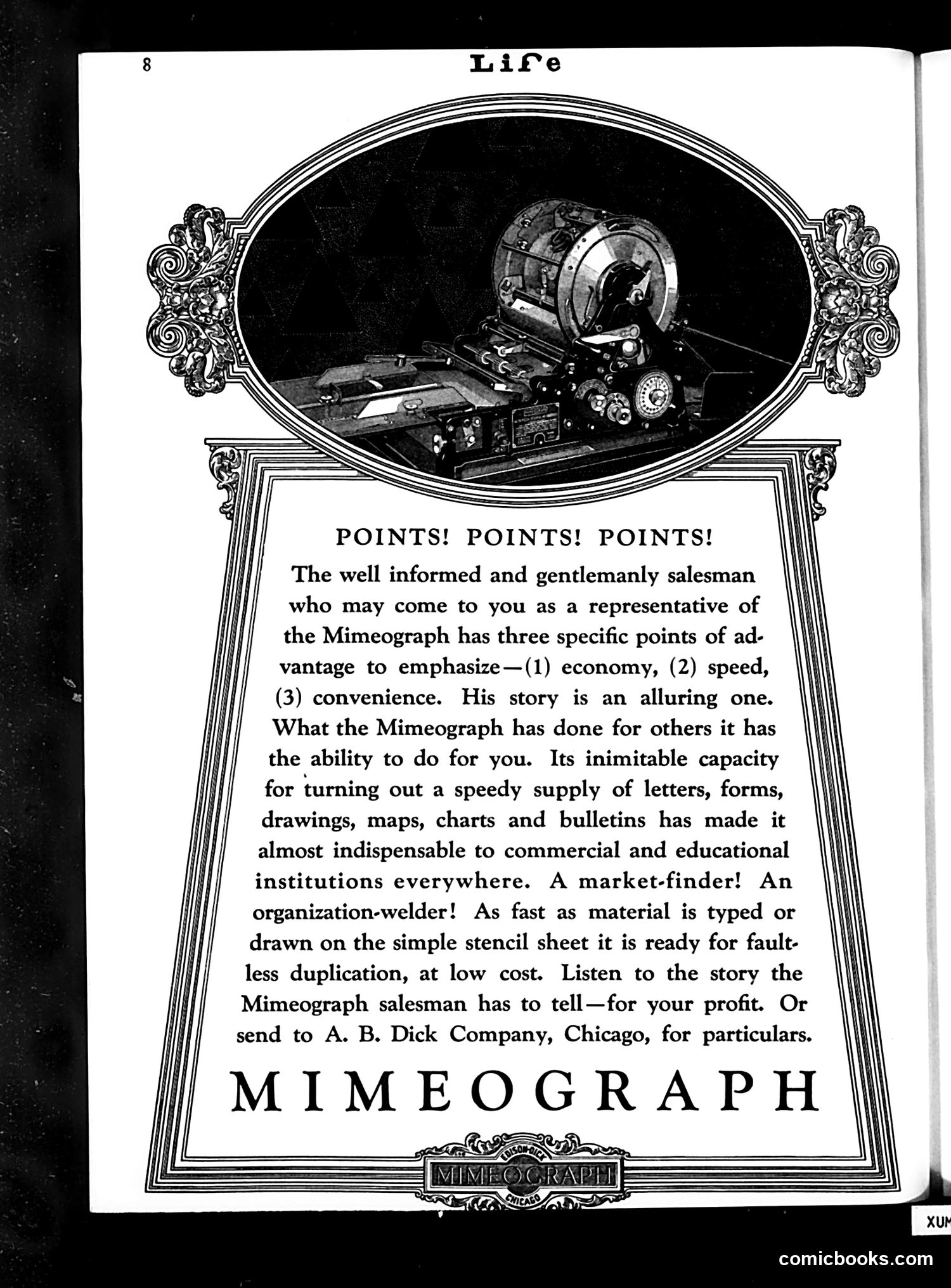
This is a **full-page advertisement**, not satire or editorial content. It promotes the Mimeograph, a document reproduction machine. The ad appeals to business professionals by highlighting three selling points: economy, speed, and convenience. The image shows the mimeograph machine itself—an early 20th-century duplicating device that used stencils to rapidly produce copies of letters, forms, drawings, and maps. The language emphasizes how the technology became "almost indispensable to commercial and educational institutions everywhere"—positioning it as essential business equipment that saves time and money compared to manual copying. The ad directs readers to contact the A.B. Dick Company in Chicago for more details. This is straightforward product marketing typical of Life magazine's advertising content from this era.
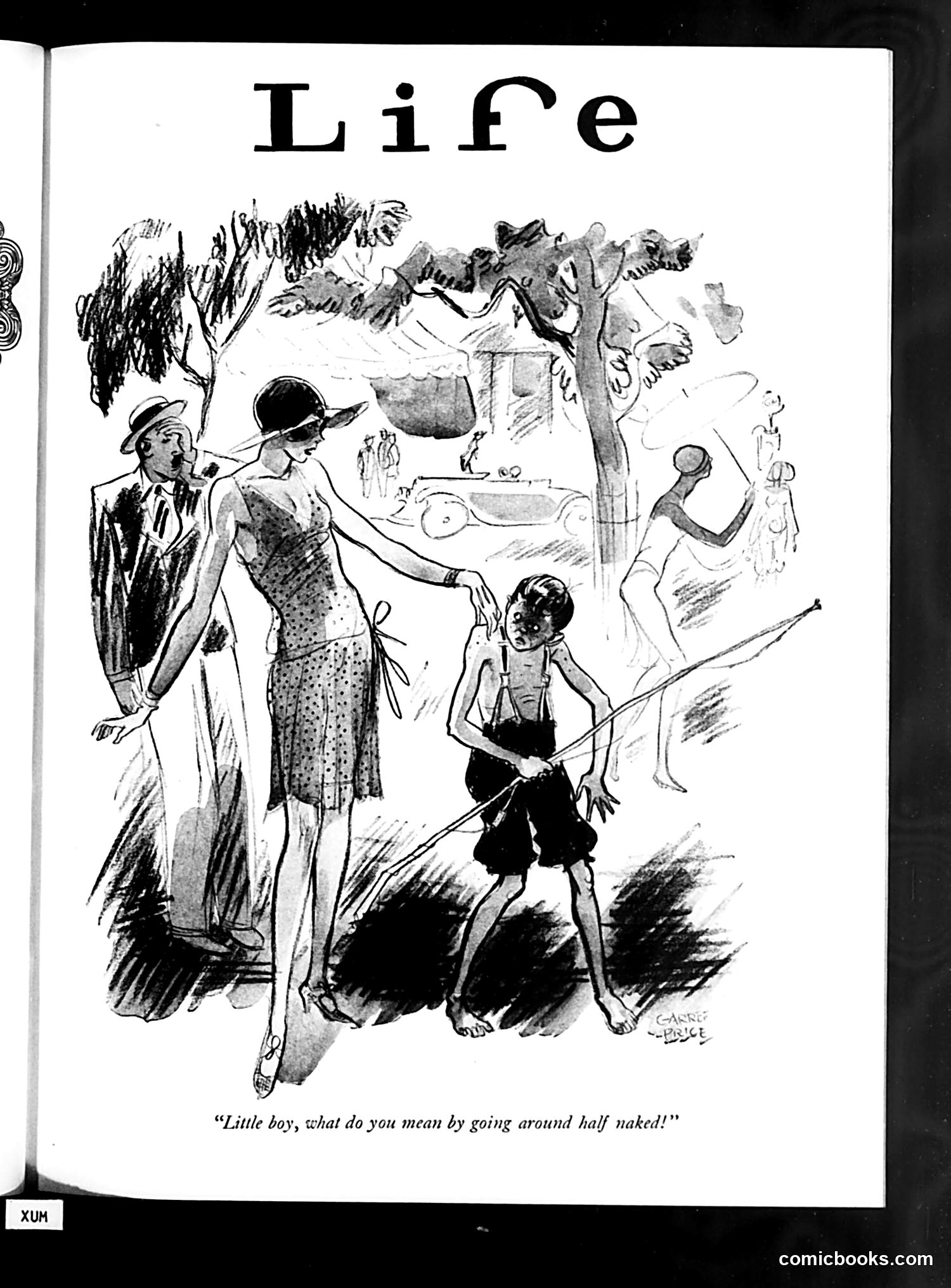
This is a satirical cartoon from *Life* magazine's "Life" section, depicting a domestic scene at what appears to be a beach or recreational area. The cartoon shows three adults—a man and woman in formal 1920s-30s attire, and what appears to be a boy in minimal clothing—with the woman saying, "Little boy, what do you mean by going around half naked!" The satire likely criticizes adult hypocrisy regarding social propriety and dress codes. The formally-dressed adults, representing conventional society's moral standards, scold a child for underdressing while they themselves maintain rigid, formal appearance even in a casual recreational setting. The joke underscores the absurdity of enforcing strict social conventions in inappropriate contexts. The artist's signature appears to read "Garro" or similar, dated 1926.
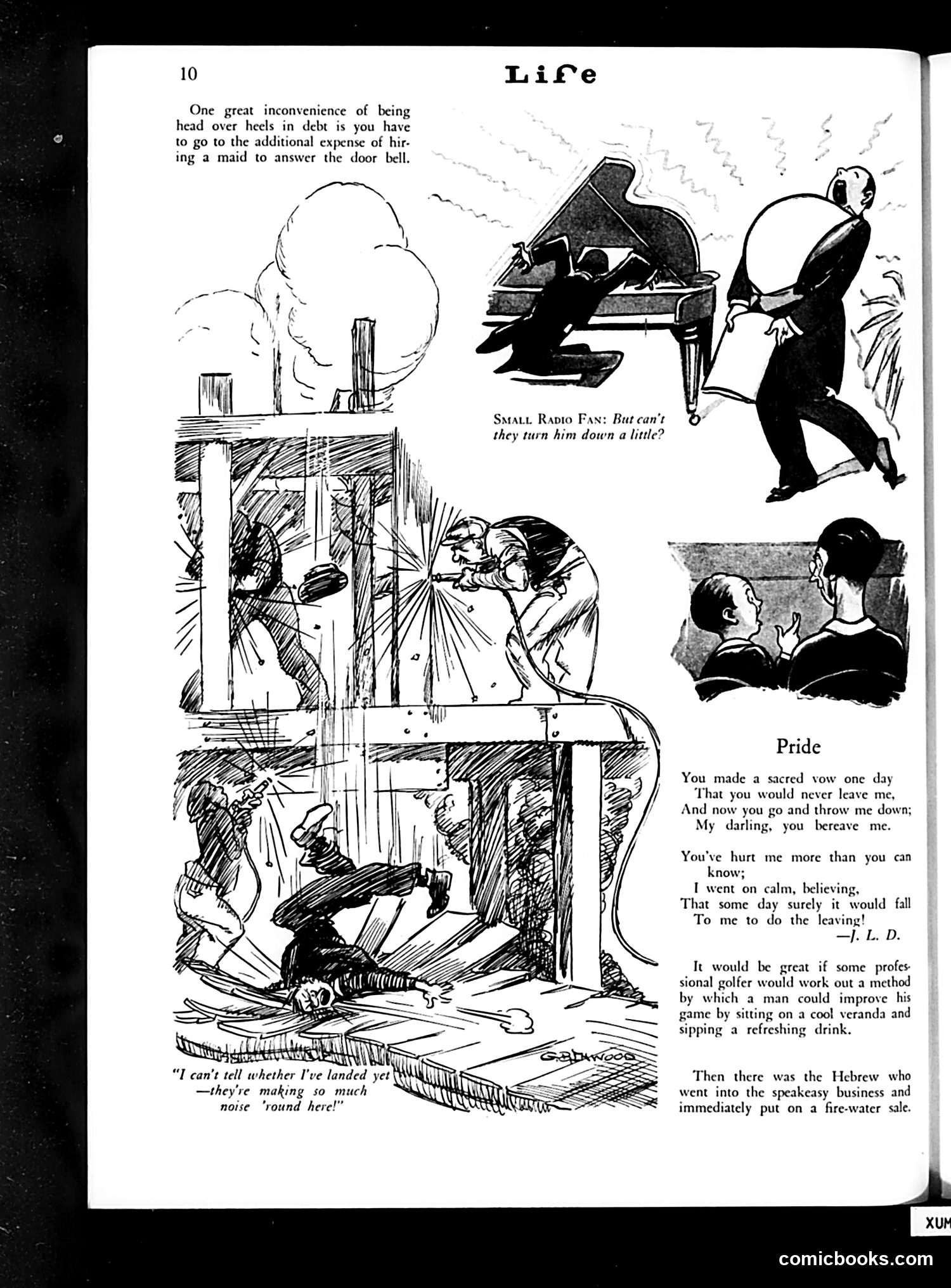
This page contains two distinct pieces of satire: **Left cartoon**: Shows a chaotic construction or demolition scene where workers struggle amid noise and confusion. The caption jokes about being unable to tell if construction has finished—they're making so much noise "round here." This satirizes the general inconvenience and disruption of urban construction work. **Right section**: Features three separate items: a "Small Radio Fan" cartoon mocking radio volume complaints; a "Pride" poem about romantic betrayal (attributed to "I. L. D."); and brief anecdotes about a professional golfer improving his game and a Hebrew speakeasy operator during Prohibition. These appear to be miscellaneous humorous observations on contemporary American life and social behavior.
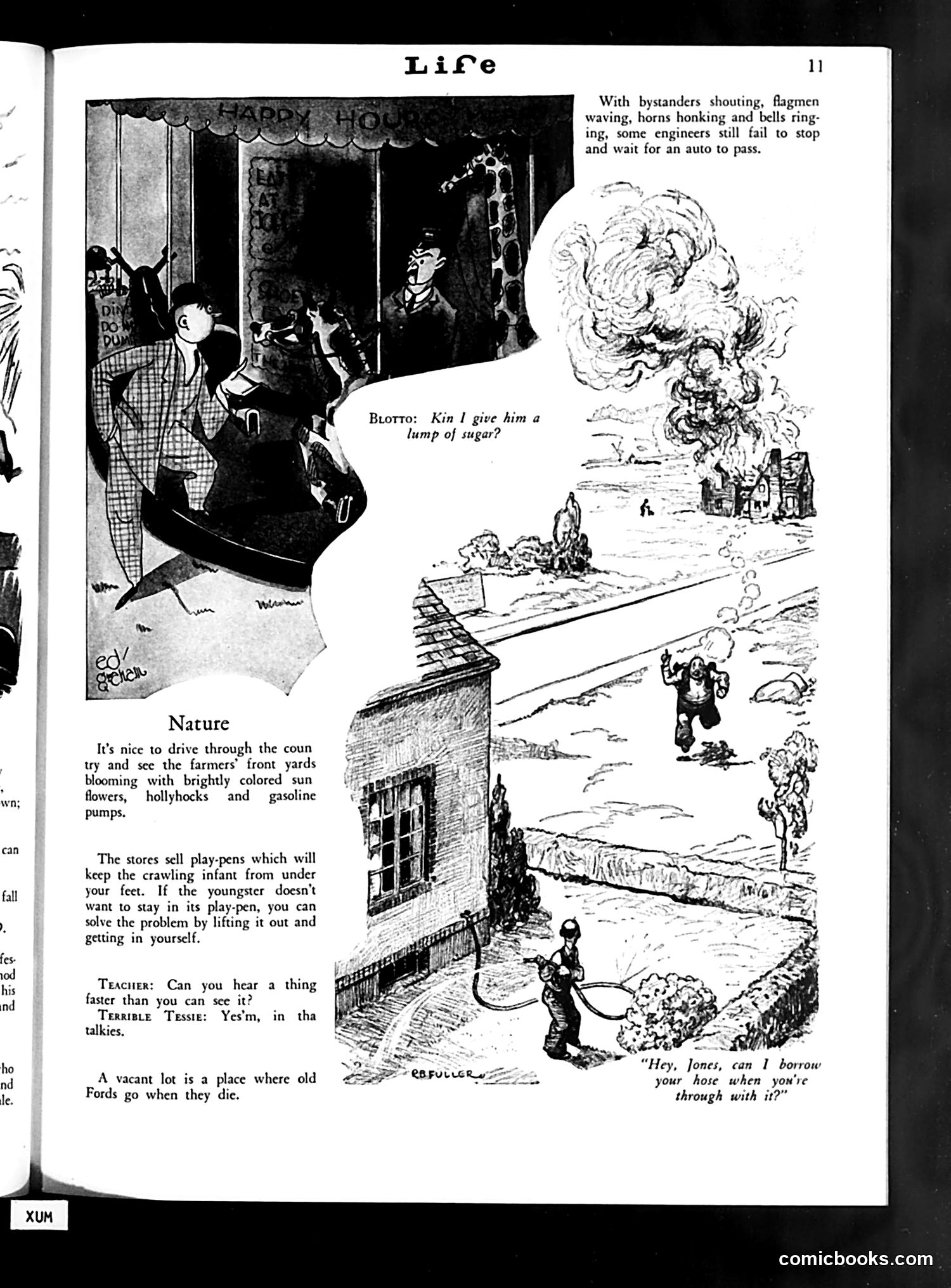
This page from *Life* magazine contains humorous observations about American rural and suburban life, likely from the 1920s-30s era based on the style. The left cartoon depicts a store scene with a dialogue joke about giving "a lump of sugar" to a child—appearing to reference old-fashioned parenting practices. The larger right illustration satirizes rural/country life with multiple vignettes: farmers' yards with automobiles, play-pens for infants, stores selling play-pens, a "vacant lot" where old Ford cars go "to die." The humor targets the modernization of American countryside—the intrusion of automobiles, suburban conveniences, and commercialism into traditionally rural spaces. The final caption about a borrowed hoe suggests tension between traditional rural neighborliness and newer transient suburban culture where people no longer know their neighbors well enough to share tools.
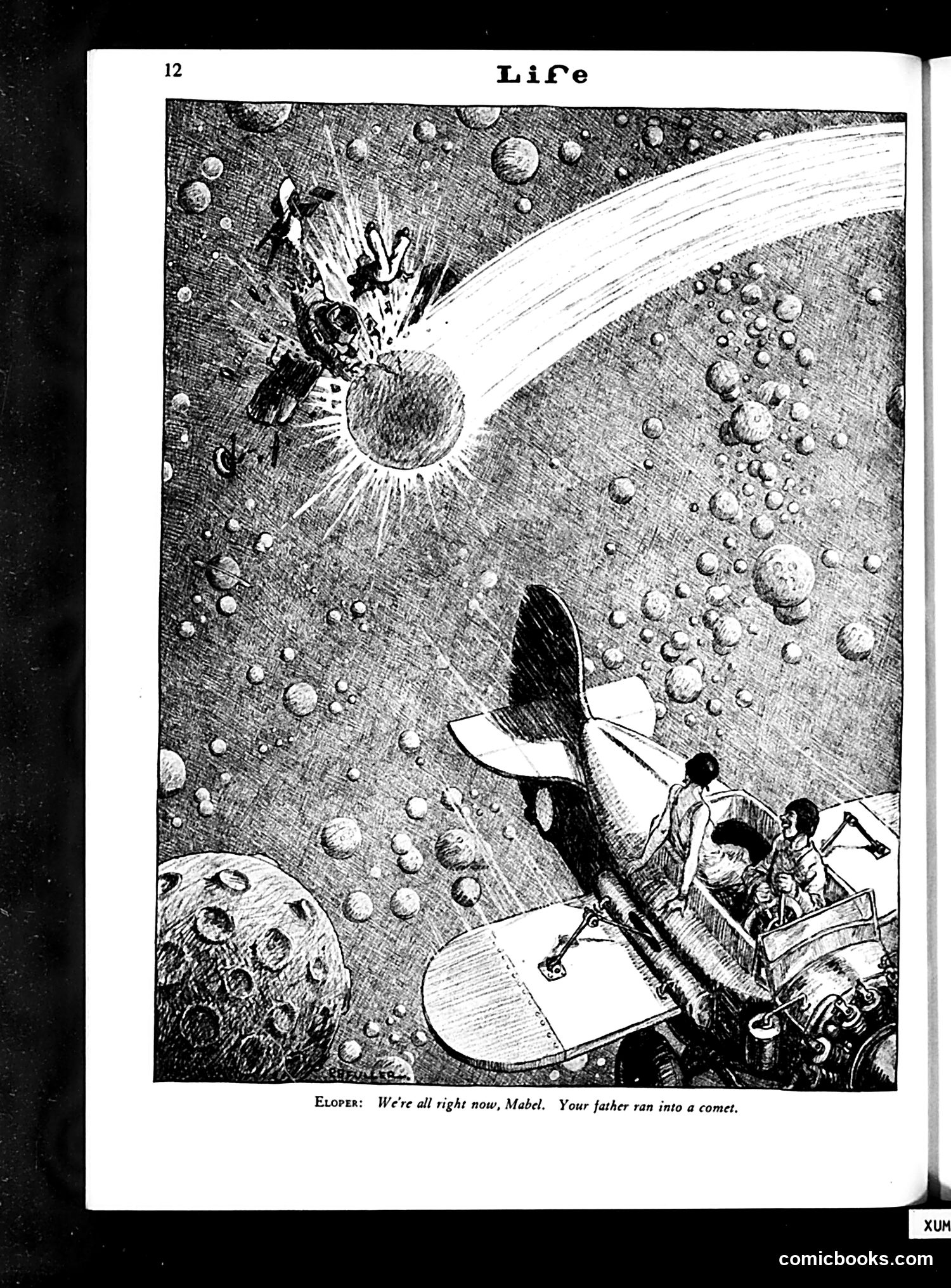
This science fiction illustration depicts a space scene with celestial bodies (planets, moons, asteroids) and a spacecraft carrying passengers. The caption reads: "ELOPE: We're all right now, Mabel. Your father ran into a comet." The cartoon satirizes elopement—young couples fleeing parental disapproval to marry secretly. The joke plays on the phrase "ran into" by literalizing it: the father has collided with a comet, removing the obstacle to the couple's escape. By setting this domestic drama in outer space with futuristic technology, Life mocks both romantic elopement narratives and contemporary anxieties about modern science and cosmic exploration. The humor relies on deadpan understatement—casually mentioning a catastrophic cosmic collision as if it's merely convenient.
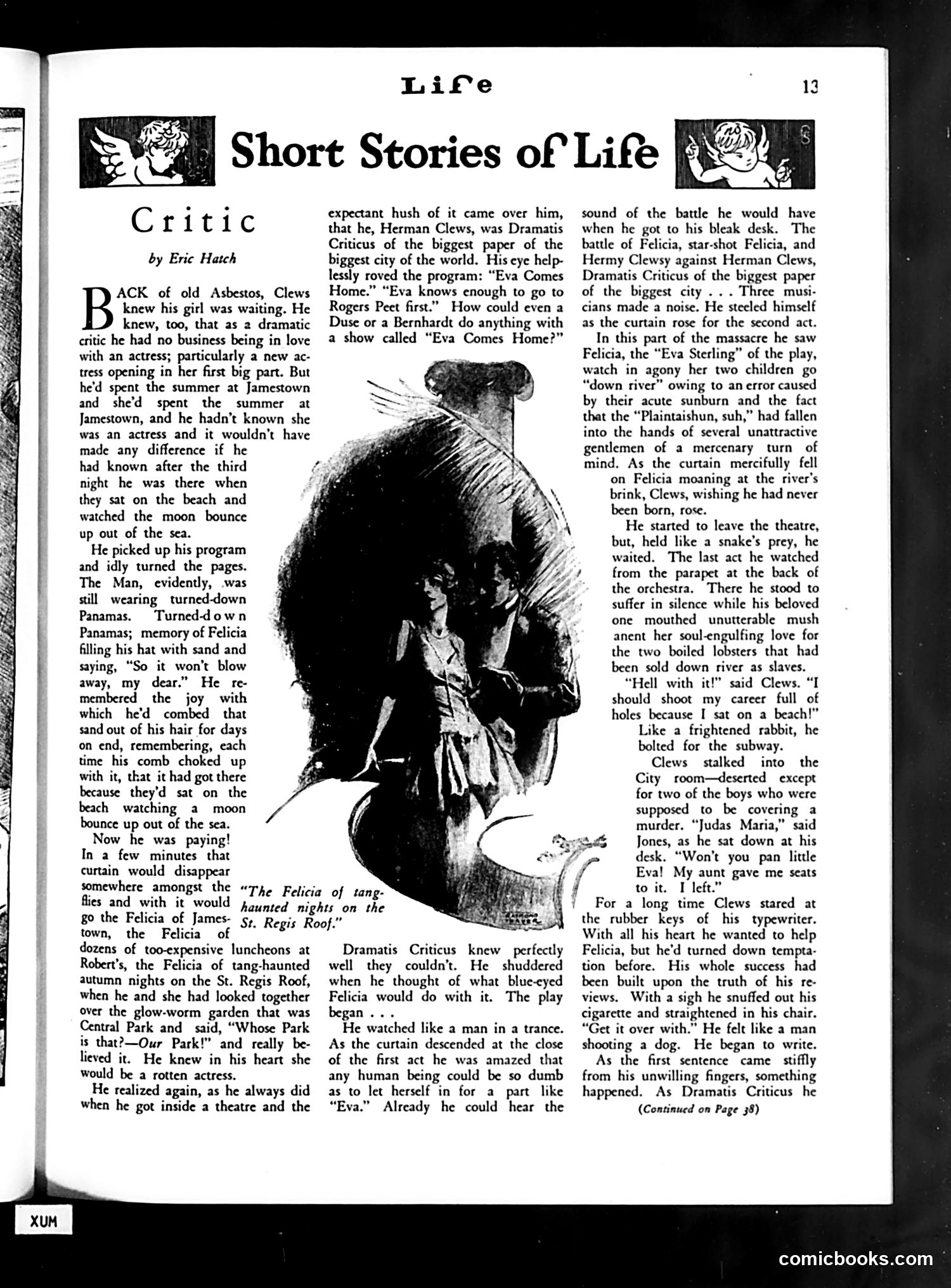
This is a short story rather than a political cartoon. The narrative follows Back Asbestos Clews, a dramatic critic who dismisses a new actress in her debut theater role. Upon seeing the program, he learns she is "Eva," prompting him to recall a summer romance with a woman by that name from Jamestown. The story satirizes theater critics—their pretension, poor memory, and capacity for self-deception. Clews initially judges the performance harshly while emotionally conflicted, eventually realizing he cannot remain objective. The illustration depicts the actress (captioned as haunted by memories) in a dramatic theatrical pose, emphasizing the emotional stakes underlying critical judgment and nostalgia.
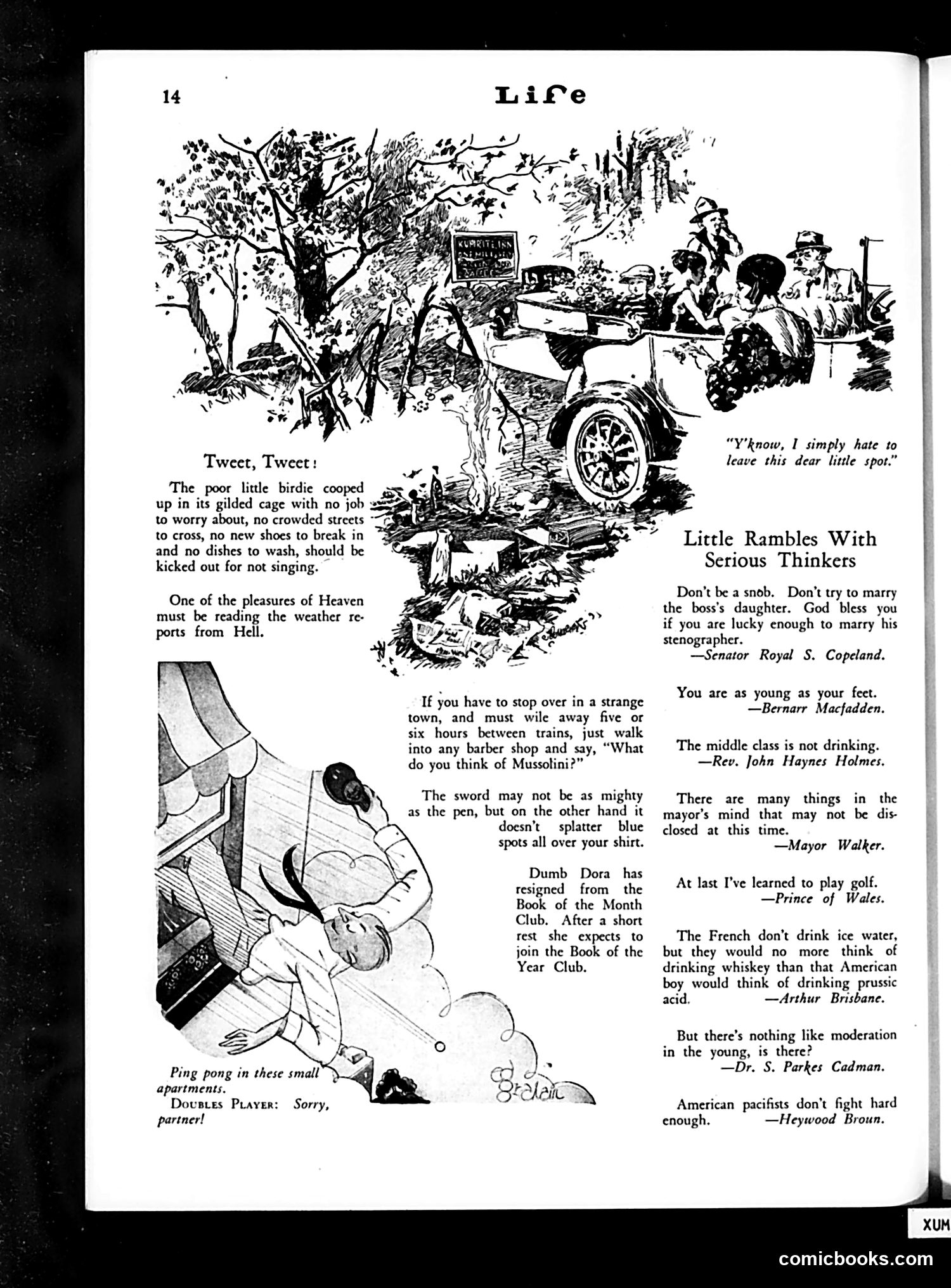
This page contains two satirical pieces: **"Tweet, Tweet"** (top): A joke about a caged bird with "no job to worry about" and "no new shoes to break in"—satirizing modern anxieties and consumerism. The heaven joke mocks reading "weather reports from Hell," suggesting infernal bureaucracy. **"Little Rambles With Serious Thinkers"** (right): A collection of satirical quotes attributed to named public figures (Senator Royal S. Copeland, Bernard Macfadden, etc.). These mock various social attitudes: snobbery, class drinking habits, French culture, youth excess, and pacifism. The quotes appear designed to ridicule these figures' actual or perceived positions. **"Ping Pong" cartoon** (bottom left): Two men playing table tennis in cramped quarters, captioned "Sorry, partner!"—satirizing the tight living conditions of modern apartment life. The overall theme critiques early 20th-century American social pretensions and modern discomforts.
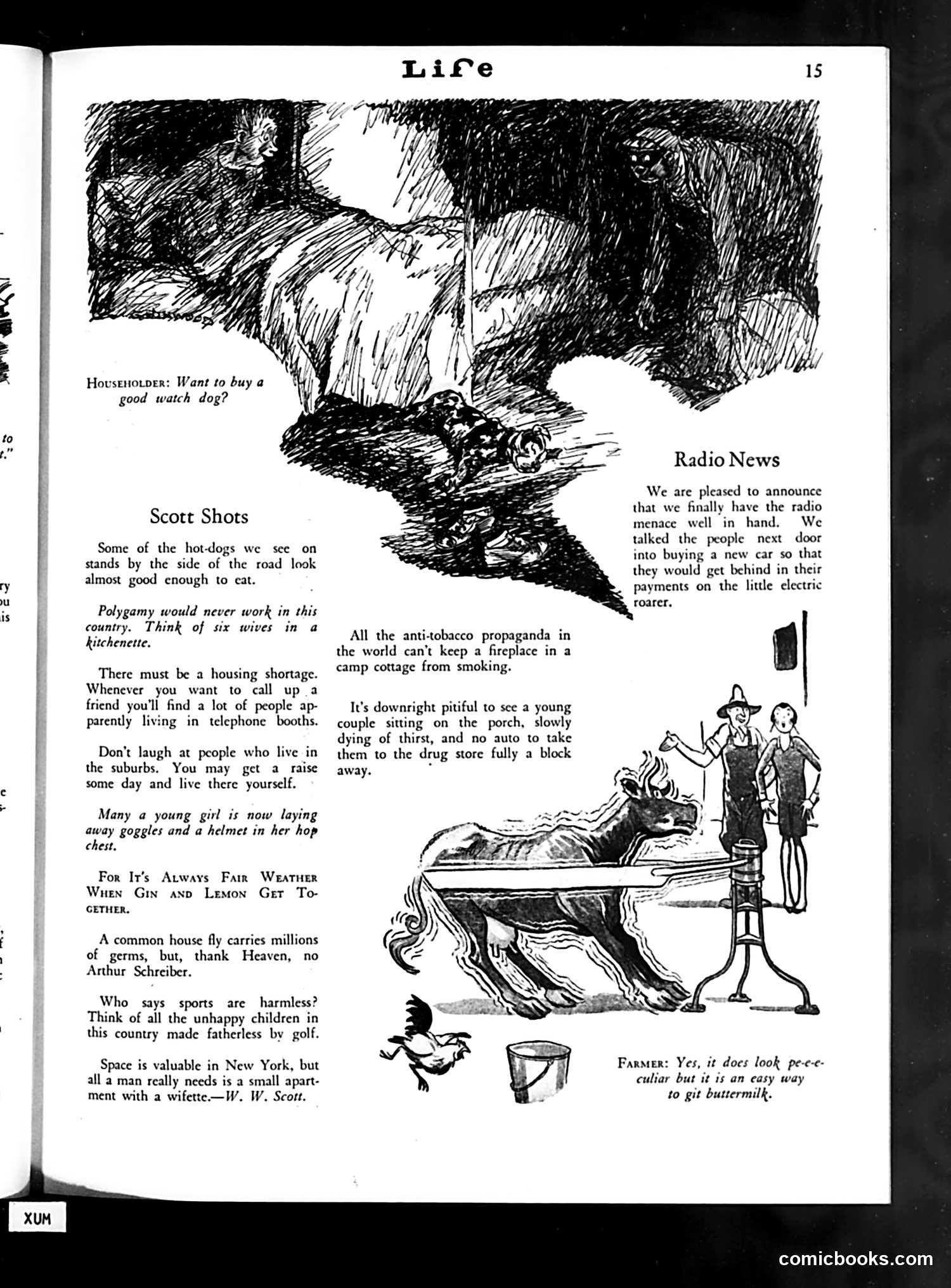
This page contains **Scott Shots**, a humor column with various one-liners about American life, alongside **Radio News**, describing efforts to combat radio interference from electrical devices. The main cartoon depicts a bathtub scene where someone lies ill inside while two figures stand outside. The caption reads: "Farmer: Yet, it does look peculiar but it is an easy way to get buttermilk." The joke plays on the absurdity of using a bathtub to make buttermilk—suggesting someone has literally filled a bathtub with dairy product, which the farmer ironically endorses as "easy." It's satirizing rural/agricultural practices and efficiency, treating an obviously ridiculous situation as matter-of-fact. The column's other quips mock contemporary concerns: housing shortages, telephone booth living, suburban life, young women wearing aviator goggles, and urban space constraints—reflecting post-WWI American anxieties.
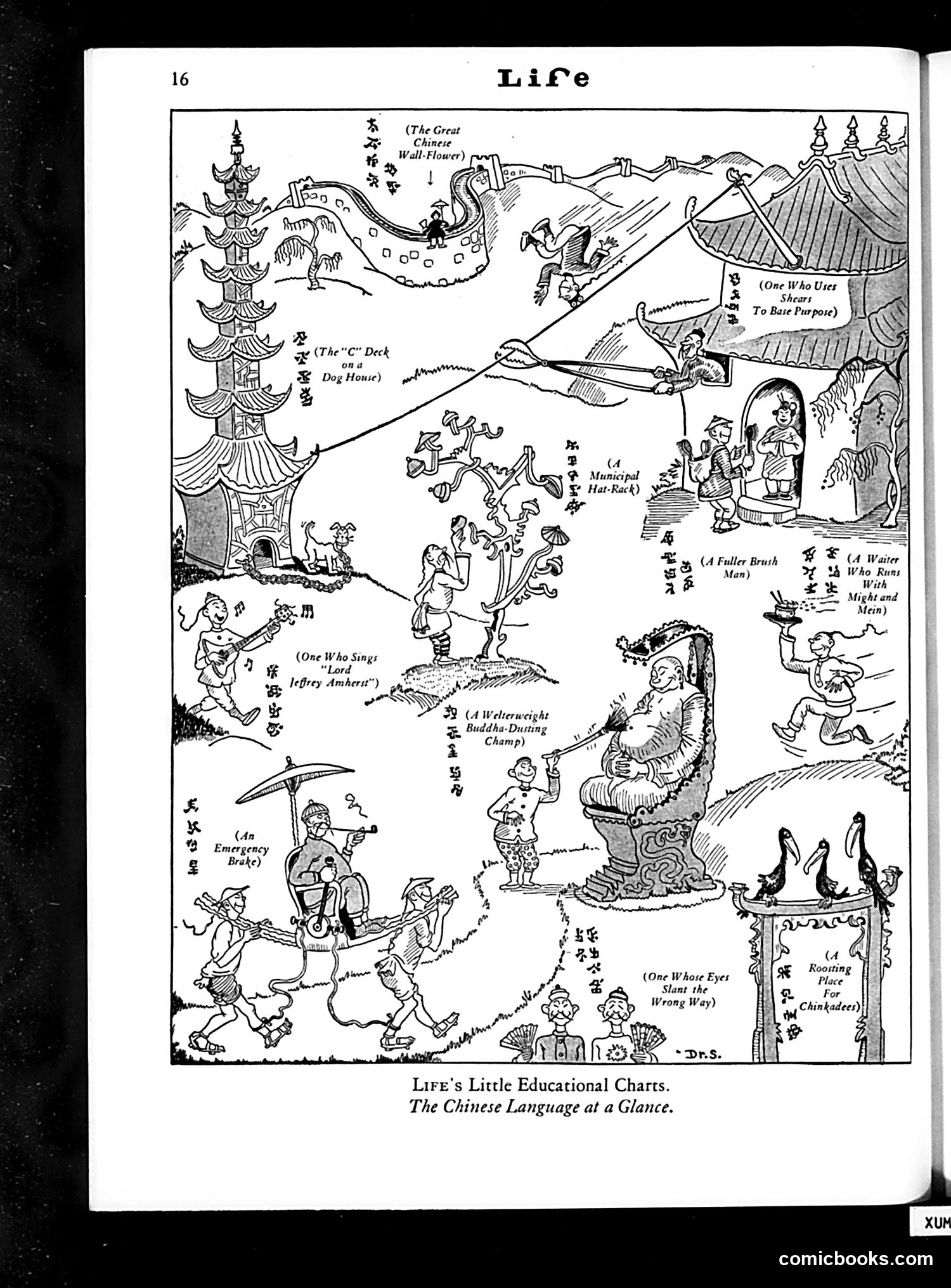
This is a satirical educational chart mocking Chinese language and culture for American readers. The illustration depicts various Chinese figures and activities labeled with English descriptions in parentheses—such as "One Who Sings 'Land O' Grey Ambers'" and "A Fuller Brush Man"—paired with Chinese characters. The humor relies on the period's Western stereotype of Chinese as incomprehensible and exotic. By juxtaposing mundane American concepts (brush salesmen, emergency boats) with Chinese script and traditional architecture (pagodas, formal dress), the cartoon suggests Chinese culture is simultaneously foreign and absurd to English speakers. The chart presents Chinese language learning as impossible or ridiculous rather than a legitimate linguistic system—a common early-20th-century American attitude toward non-Western languages.
This page contains a "Life at Home" section with humorous brief news items from various American cities, followed by a "Life Abroad" section. The content satirizes everyday absurdities and social contradictions of the Prohibition era (evident from references to "Federal Prohibition agents"). Notable items include: - A New York passenger attempting to import Napoleon brandy duty-free as an antique - Chicago's International Association of Display Men debating whether wax figures in store windows should wear the latest fashions - A Detroit bootlegger caught shipping marbles to disguise illegal liquor - A man in St. Louis billing himself as a "habily dressed man" for rides The humor stems from people creatively circumventing laws and social norms, exposing the gap between stated rules and actual behavior during Prohibition.
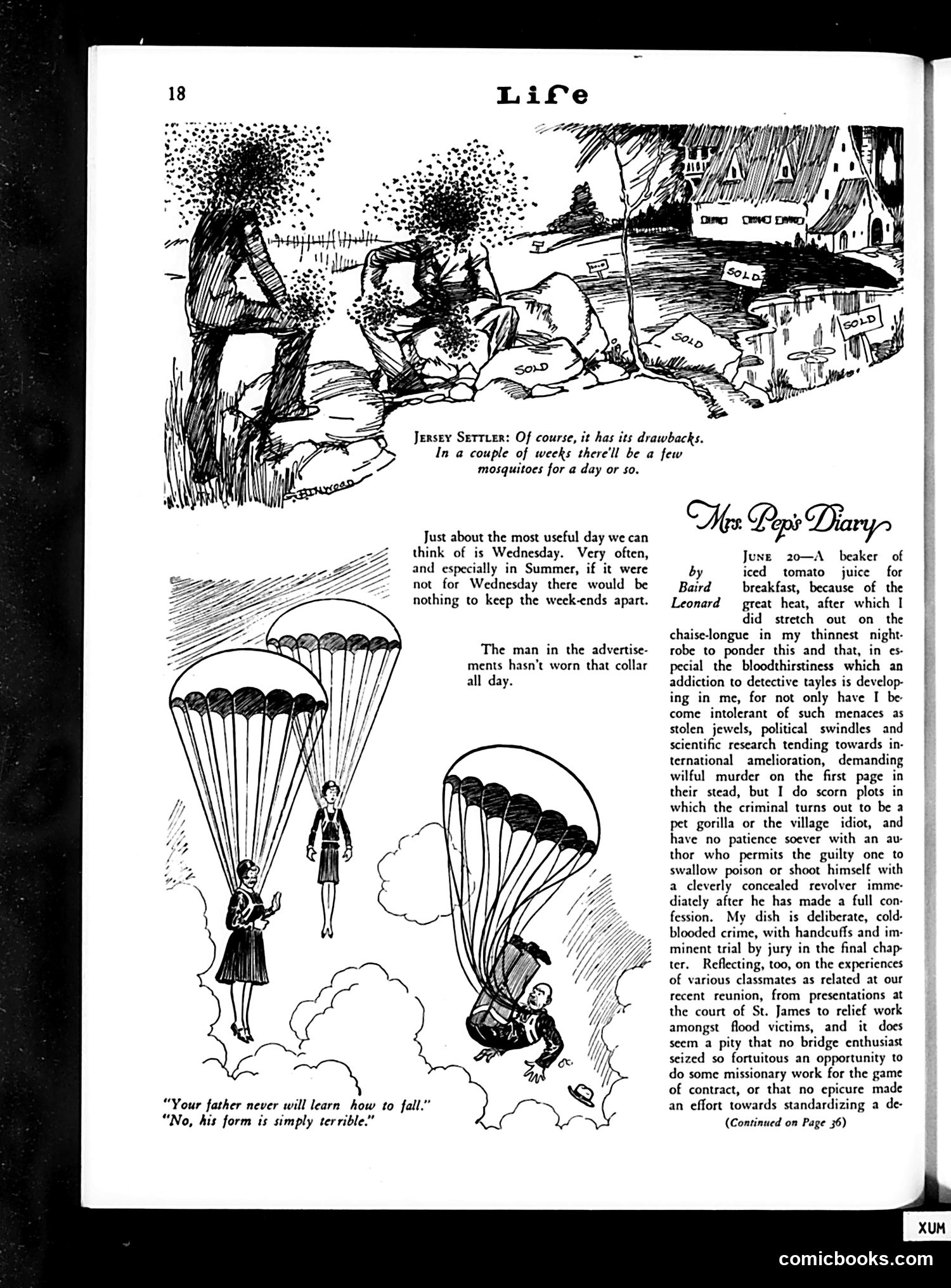
This page contains two distinct pieces: **Top cartoon**: A "Jersey Settler" caption explains the drawback of settling new land—mosquitoes will appear within weeks. The humor is straightforward: settling undeveloped areas has practical inconveniences. **Bottom cartoon**: Shows people parachuting, with dialogue "Your father never will learn how to fall" / "No, his form is simply terrible." This appears to satirize parachuting as a novelty or sport, mocking someone's lack of skill at the new activity. **"Mrs. Pep's Diary"** (right): A gossipy column by Baird Leonard discussing social observations—iced tomato juice, detective fiction addiction, intolerance for crime fiction tropes. It's light satire of contemporary middle-class concerns and literary tastes. The page reflects 1920s-era humor about modern conveniences, emerging technologies (parachuting), and social pretensions.
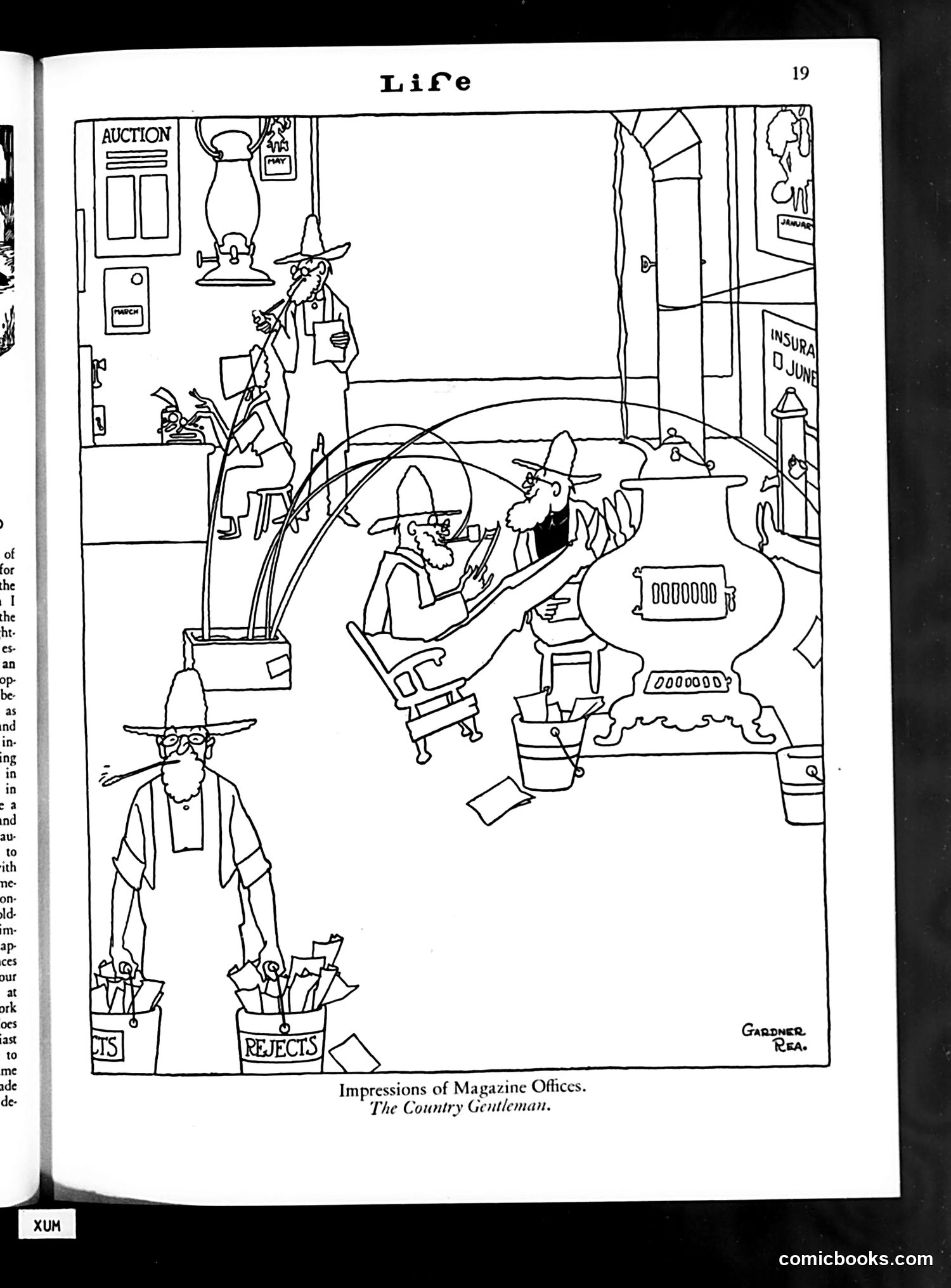
This satirical cartoon depicts the chaotic environment of a magazine office, likely *Life* magazine itself. The scene shows editors and staff in various states of activity: some seated at desks reviewing manuscripts, others standing with papers, and a prominent figure in the foreground wearing a cowboy hat holding buckets labeled "REJECTS" and "ACCEPTS." The humor targets the editorial process—particularly the rejection of submitted work. The buckets suggest that sorting manuscripts is routine, mechanical work. The casual, disorganized atmosphere and the diverse characters (including what appears to be a Native American figure) satirize the editorial staff's sometimes arbitrary decision-making about which stories merit publication. The cartoonist is Gardner Rea.
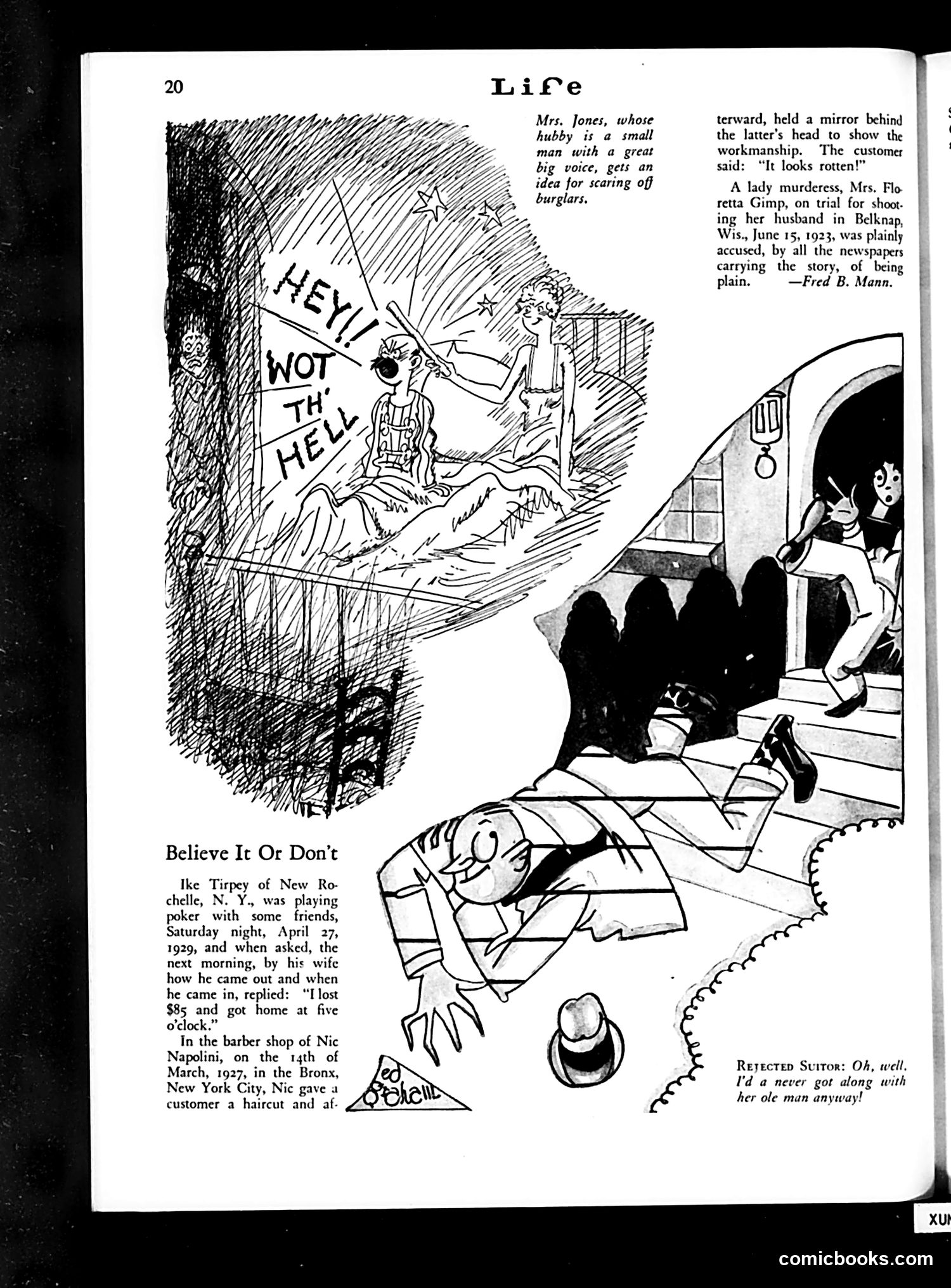
This page contains two humor sections typical of Life's satirical format: **"Believe It Or Don't"** presents oddly specific anecdotes meant to amuse through their mundane absurdity—a man losing $85 at poker and arriving home at 5 a.m., a barber's customer complaining about a haircut, and a murder trial where newspapers emphasized the defendant's plainness rather than the crime itself. The humor relies on the reader finding these real (or purportedly real) situations ironically funny. **The cartoon above** depicts a domestic scene where a small man with a disproportionately loud voice apparently frightens away burglars by his mere presence/noise—his wife's humorous solution to home security. The "rejected suitor" caption at bottom suggests editorial commentary rejecting a submitted cartoon idea about a woman who couldn't get along with her husband anyway. The overall tone is light domestic and crime-related humor typical of 1920s American magazines, relying on social observation and exaggeration rather than political commentary.
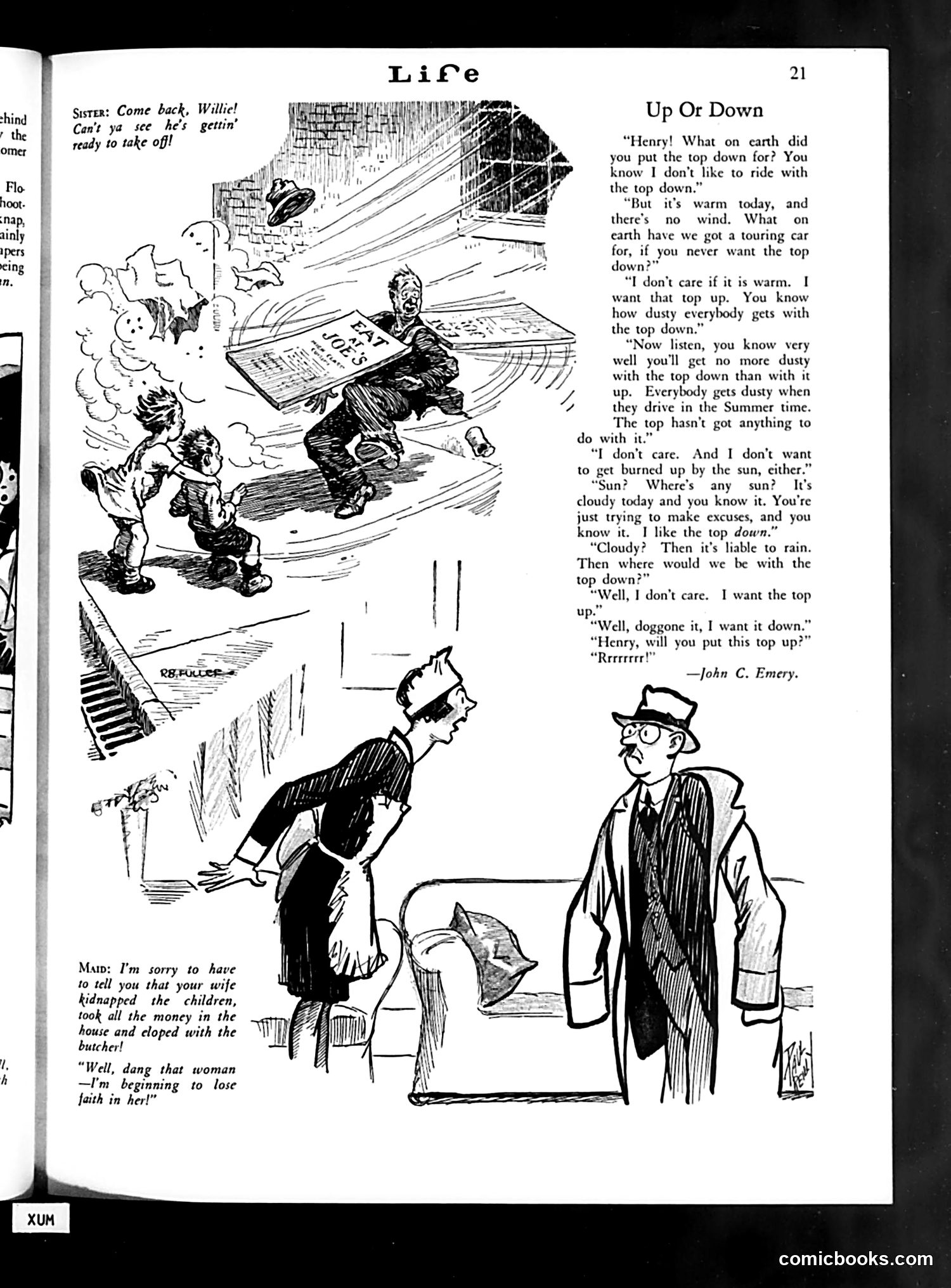
This page contains two separate jokes reflecting early 20th-century domestic humor. **Upper cartoon/story**: A couple argues about whether to keep a touring car's convertible top up or down. The husband wants it down (for warmth and ventilation); the wife refuses, citing dust, sun, and rain concerns. The satire mocks marital disputes over trivial matters—a common theme in period humor—and the wife's contradictory excuses ("it's cloudy, so it might rain"). The exasperated husband's final "Reereeer!" expresses masculine frustration with female "illogic." **Lower cartoon**: A man learns his wife has run off with the butcher, taking money and children. His response—losing faith in *her* rather than questioning his own relationship—satirizes either male obliviousness or the absurdity of domestic betrayal prioritized below financial loss. Both jokes target marriage tensions and gender dynamics common to era-appropriate "Life" humor.
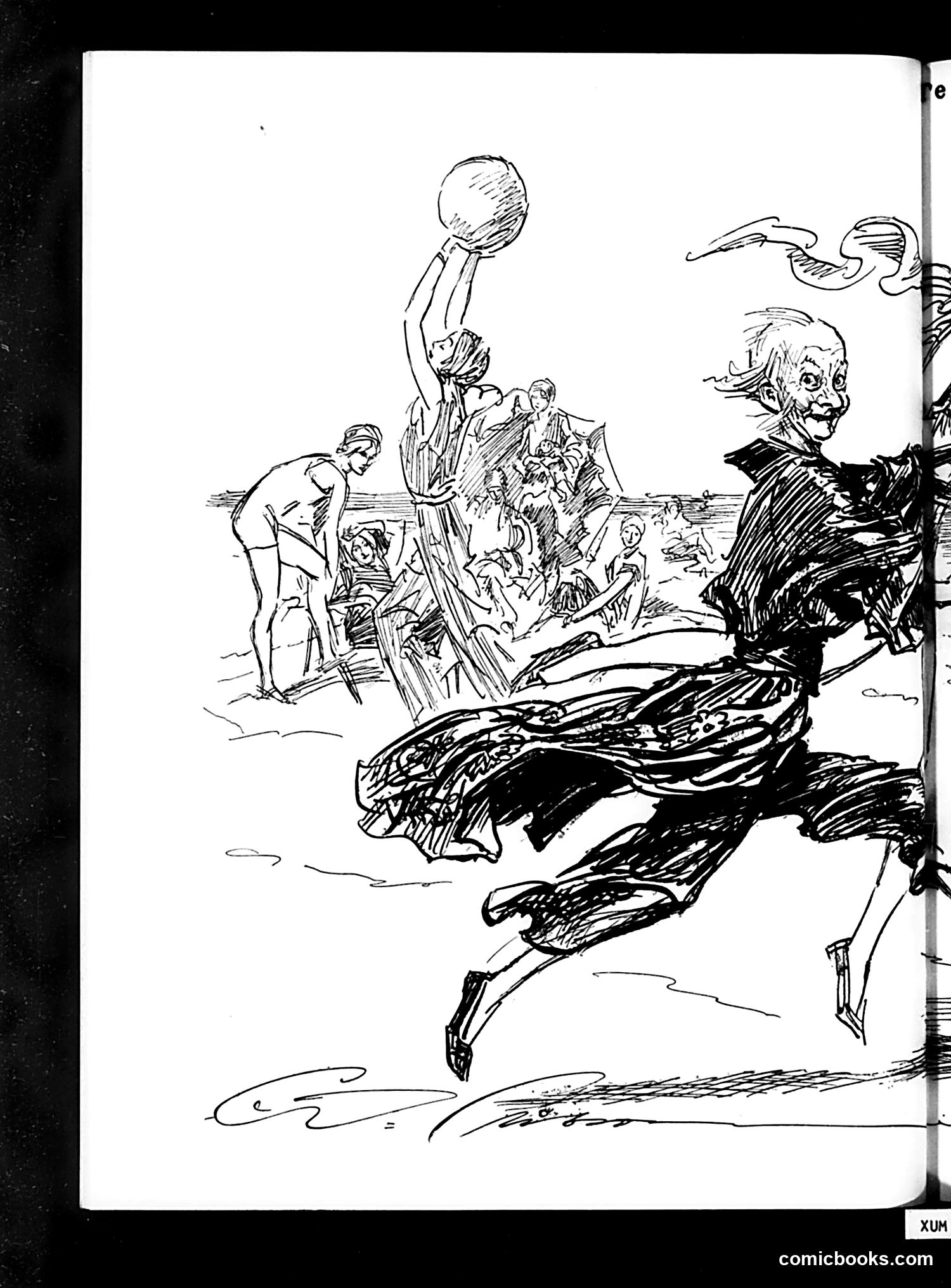
The OCR text is too corrupted to read clearly. Based on the **image alone**: This appears to be an early 20th-century satirical cartoon showing a caricatured figure (right foreground) in formal dress observing a beach or seaside scene. In the background, people engage in recreational activities including what appears to be a ball game. The exaggerated facial features and dynamic composition suggest social satire, possibly commentary on class distinctions, leisure activities, or changing social norms around public recreation. Without legible text identifying the publication date, specific figures, or satirical targets, I cannot reliably explain the cartoon's particular political or social reference for a modern reader. The style and subject matter suggest American satirical commentary from roughly 1900-1920s, but the specific meaning remains unclear.
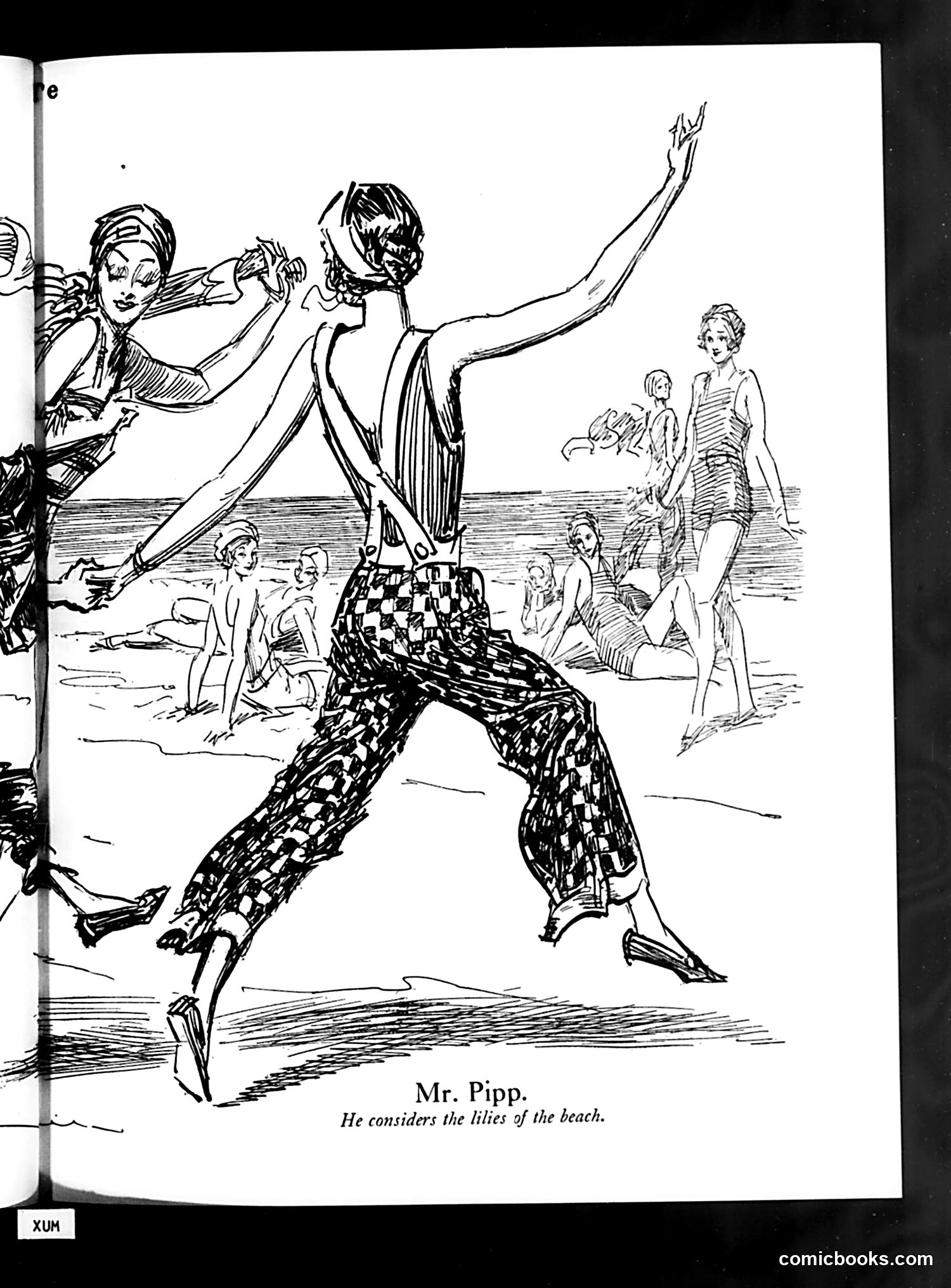
This illustration depicts a fashionably dressed man in patterned pants striking an exaggerated, theatrical pose on a beach while surrounded by swimming and sunbathing figures. The caption references the biblical phrase "consider the lilies of the field," inverting it to "lilies of the beach"—likely mocking the character's vain, affected posture and self-absorbed behavior in a public setting. The satire appears to target male vanity and performative fashionability at the beach. "Mr. Pipp" seems to be a character type—a dandy or show-off more concerned with displaying himself than genuine leisure. The illustration's exaggerated linework emphasizes his theatrical gesture, contrasting with the ordinary beachgoers around him, suggesting mockery of excessive male preening and attention-seeking behavior in early-to-mid 20th century American leisure culture.
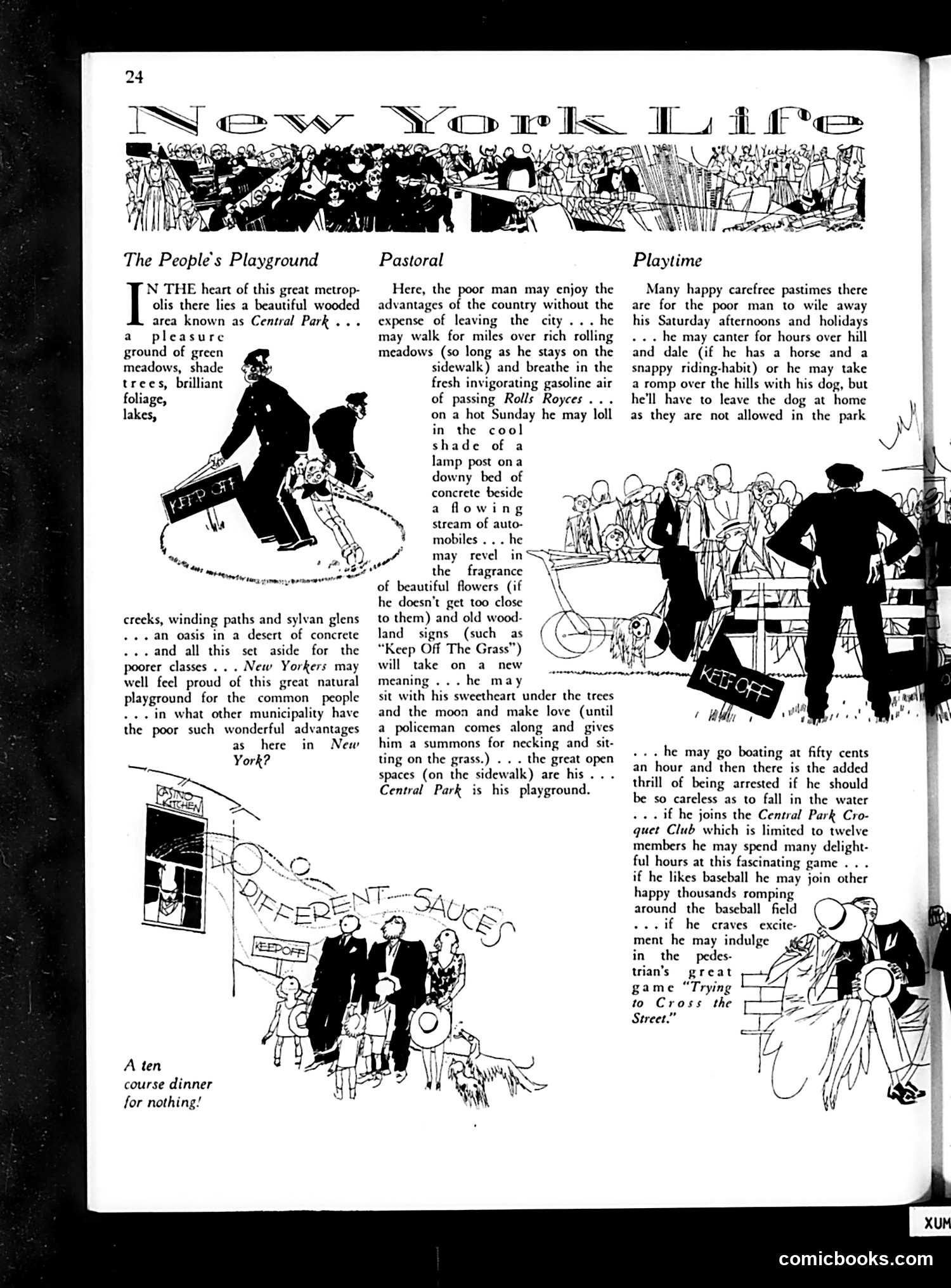
This satirical 1920s article mocks the hypocrisy of celebrating Central Park as a public benefit for poor New Yorkers while describing numerous restrictions and humiliations they face there. The three sections ("The People's Playground," "Pastoral," "Playtime") use heavy irony. While claiming the park offers poor people wonderful free recreation, the text reveals the reality: they can only walk on sidewalks, breathe car exhaust from "Rolls Royces," sit on concrete, face arrest for kissing or falling in water, can't bring dogs, and risk fines for stepping on grass. The opening illustration shows well-dressed people in the park. The "Different Sauce" cartoon depicts an elegant restaurant, sarcastically captioning it "A ten course dinner for nothing!"—implying the park's "benefits" are equally illusory. The satire critiques wealthy New Yorkers' self-congratulation about providing public space while the actual experience for poor citizens involves police harassment, exclusions, and degradation. It's social commentary on class inequality masked as generosity.
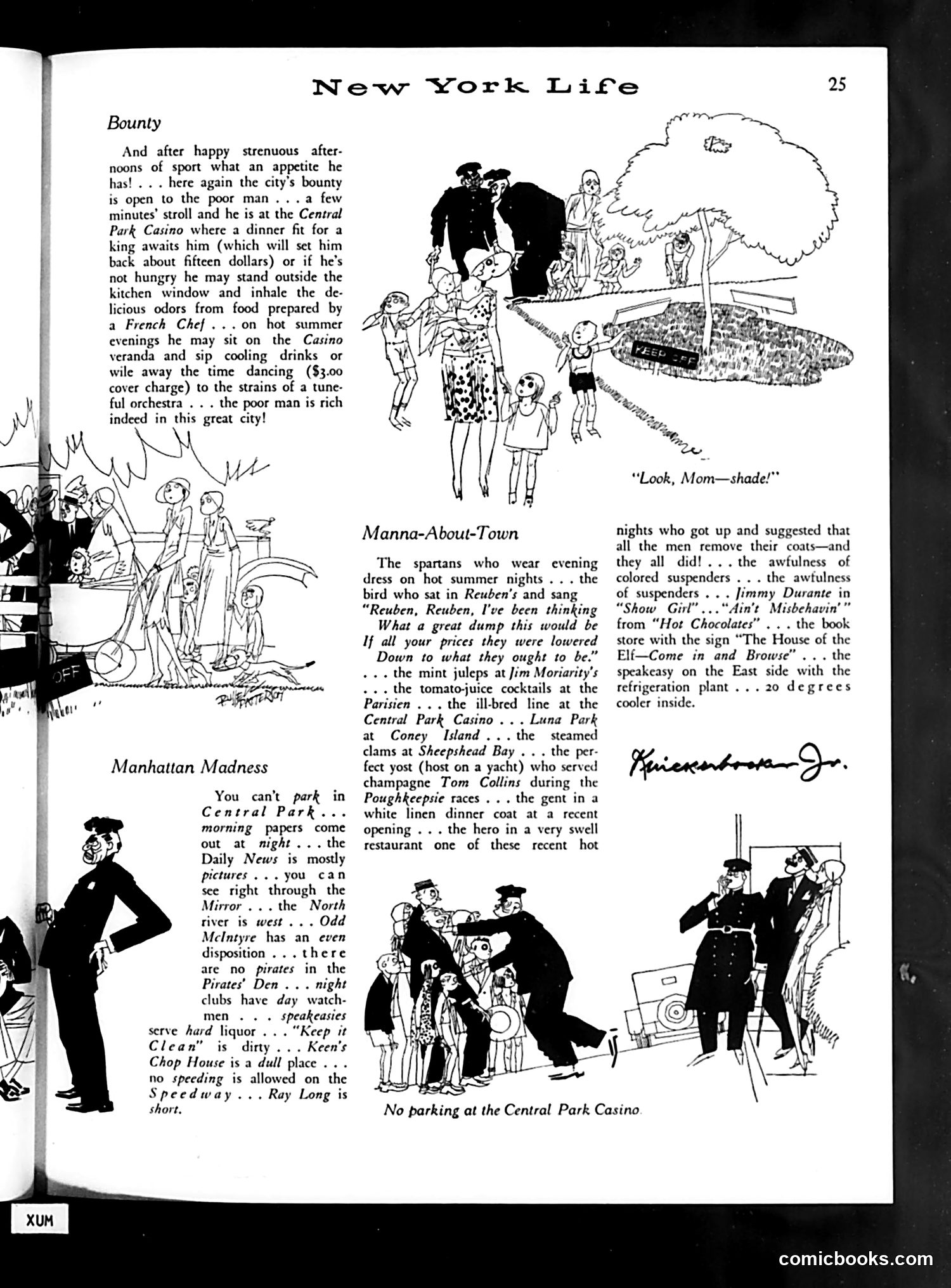
This page satirizes 1920s New York City life through three sections: **"Bounty"** mocks the hypocrisy of wealthy New Yorkers' claims about democratic access. It sarcastically suggests poor men can enjoy the Central Park Casino—glossing over that a $15 dinner (substantial money then) excludes actual poor people. **"Manhattan Madness"** offers absurdist one-liners exposing NYC contradictions: newspapers published at night, you can't park in Central Park, speakeasies (illegal during Prohibition) openly operate. The humor relies on recognizing how these contradictions define city life. **"Manna-About-Town"** catalogs trendy nightlife spots and fashionable absurdities—mint juleps, the speakeasy with 20-degree cooling, Jimmy Durante performances. The section celebrates and gently mocks the social pretensions of wealthy New Yorkers during the Jazz Age. Overall, the page satirizes wealth disparity and the city's contradictions while celebrating its vibrant nightlife culture—typical Life magazine content targeting educated, affluent readers.
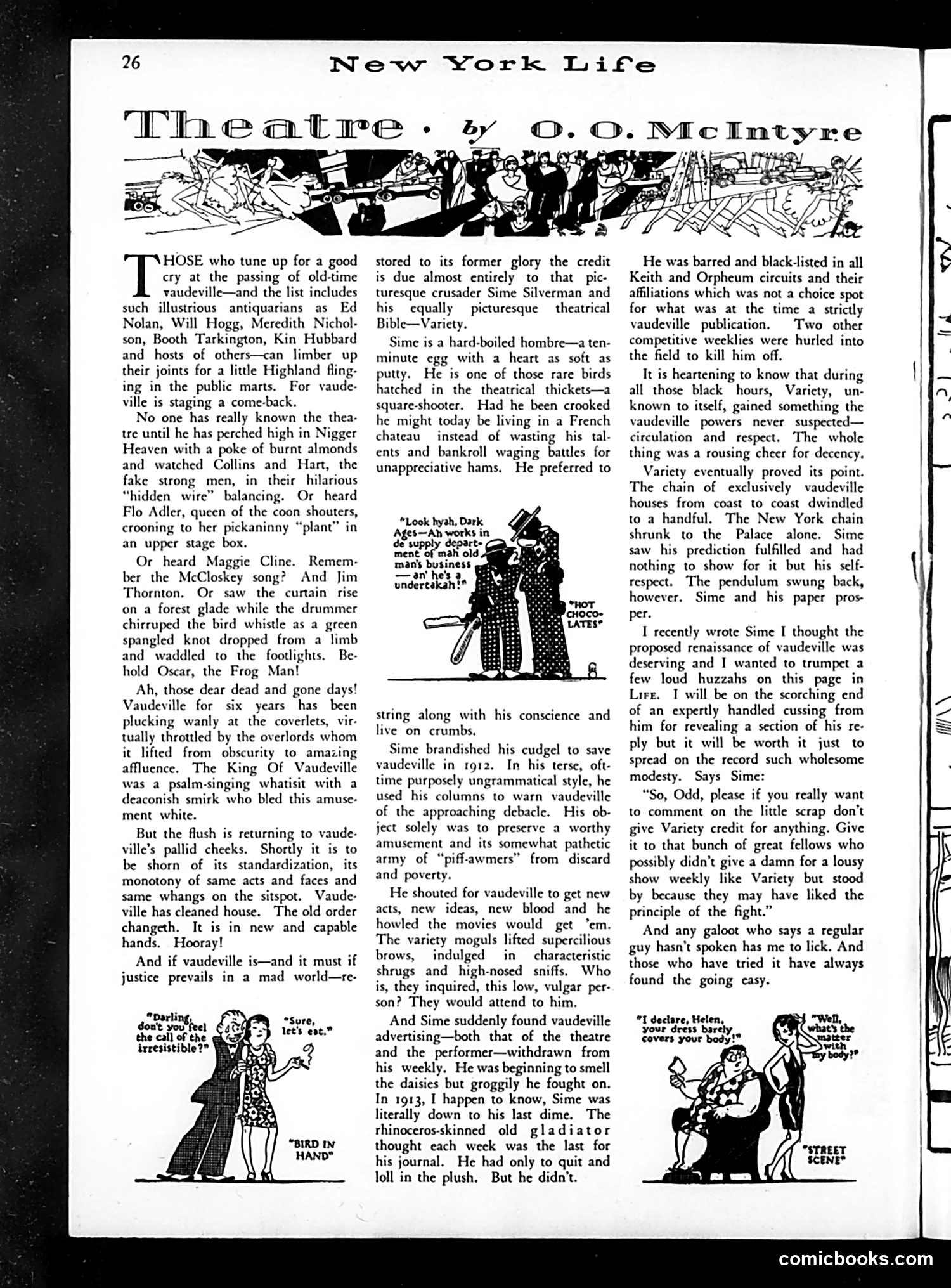
This page celebrates **Sime Silverman**, founder of *Variety* magazine, as a crusader who saved vaudeville from decline. The article argues that vaudeville—a popular theatrical entertainment form featuring diverse acts (comedians, singers, acrobats)—nearly died due to mismanagement by theater circuit owners ("overlords"). Silverman used *Variety* to expose problems and warn of competition from movies, despite facing retaliation: his publication was barred from major theater circuits (Keith and Orpheum), advertisers withdrew support, and competitors were launched to undercut him. Yet he persisted through personal financial hardship. The cartoons illustrate old vaudeville acts and stereotypical characters. The satire targets theater moguls who ignored Silverman's prescient warnings about the industry's future, treating his low-status warnings with disdain ("Who is, they inquired, this low, vulgar person?"). The piece celebrates principled journalism and warns against dismissing uncomfortable truths. *Note: The page uses offensive racial language reflecting 1910s-era attitudes.*
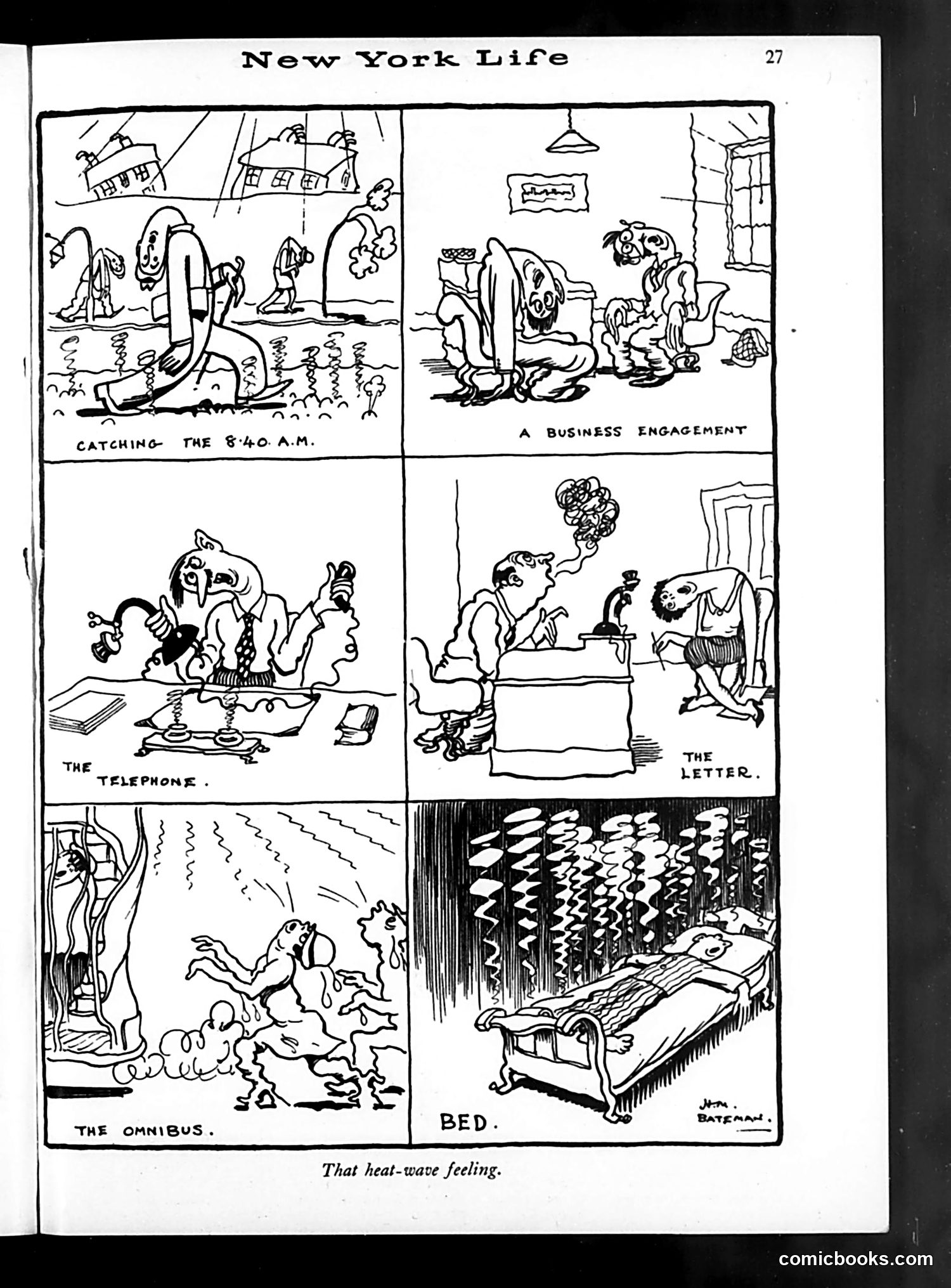
This satirical comic strip depicts the discomforts of a summer heat wave affecting various aspects of urban life. Each panel shows exaggerated chaos: - **Catching the 8:40 A.M.** depicts crowded commuters scrambling aboard a ship-like vessel, suggesting desperation and disorder. - **A Business Engagement** shows office workers in disheveled, overheated states. - **The Telephone** portrays someone agitated during a call. - **The Letter** depicts a messenger sweating profusely. - **The Omnibus** (streetcar) shows passengers overcome by heat. - **Bed** displays tangled, restless sleep. The title "That heat-wave feeling" anchors the humor in the universal experience of extreme summer temperatures in a crowded city, likely New York, causing irritability, exhaustion, and social breakdown in everyday activities.
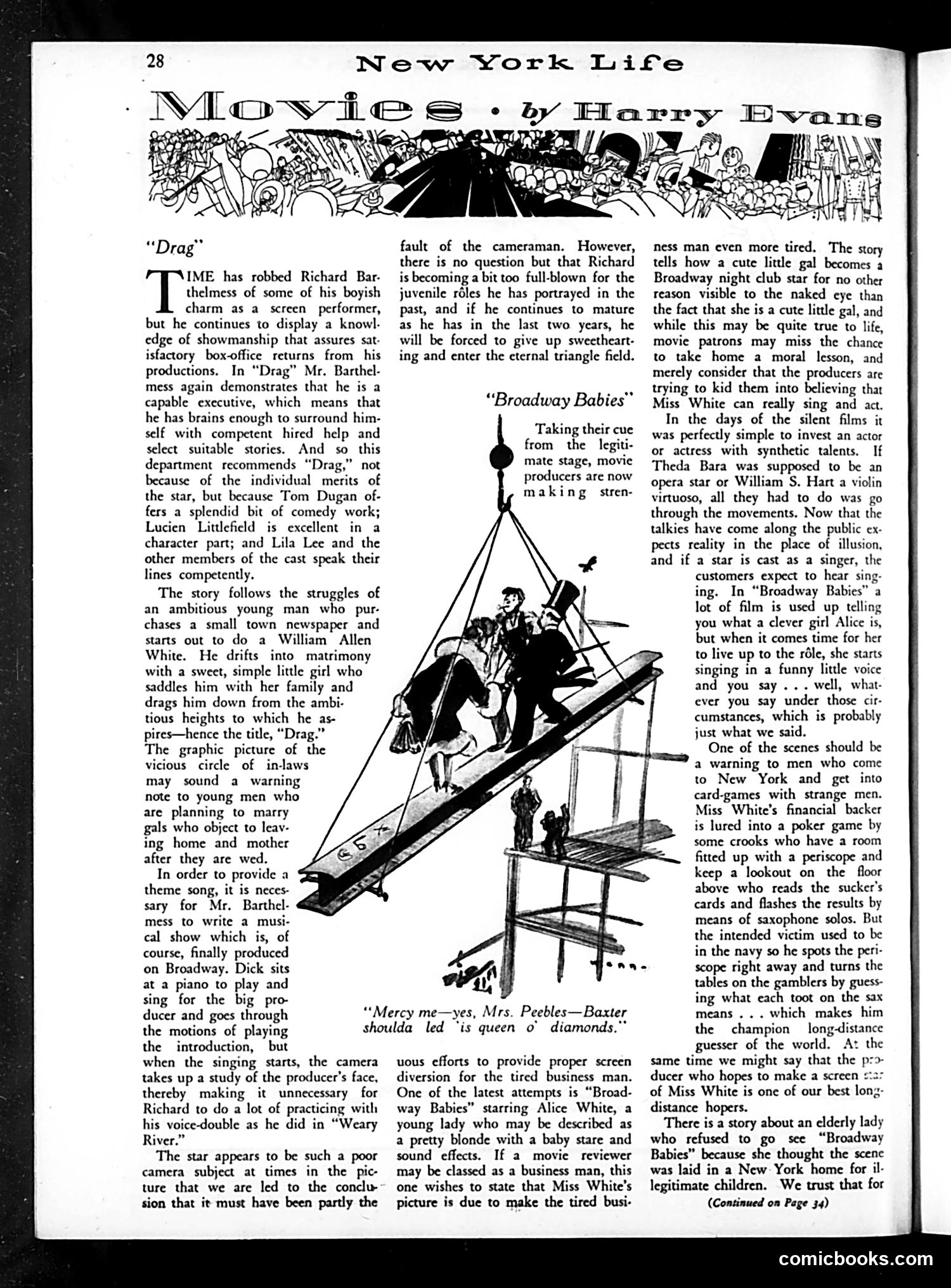
This page contains film reviews by Harry Evans for Life magazine's "Movies" column. The reviews discuss two 1920s films: **"Drag"** stars Richard Barthelmess as an ambitious young man whose wife and her family drag down his ambitions—hence the title. The reviewer praises supporting actors Tom Dugan and Lucien Littlefield but suggests Barthelmess is aging out of juvenile roles. The cartoon depicts a man weighed down by in-laws, warning young men against marrying women unwilling to leave their families. **"Broadway Babies"** stars Alice White as a nightclub performer. The reviewer critiques the film's plot as thin and White's acting as relying on her appearance rather than talent. The reviewer notes that unlike silent films, "talkies" require genuine singing ability—audiences expect to actually hear performers sing, not merely pantomime. Both reviews reflect 1920s concerns about cinema's transition to sound and evolving audience expectations.
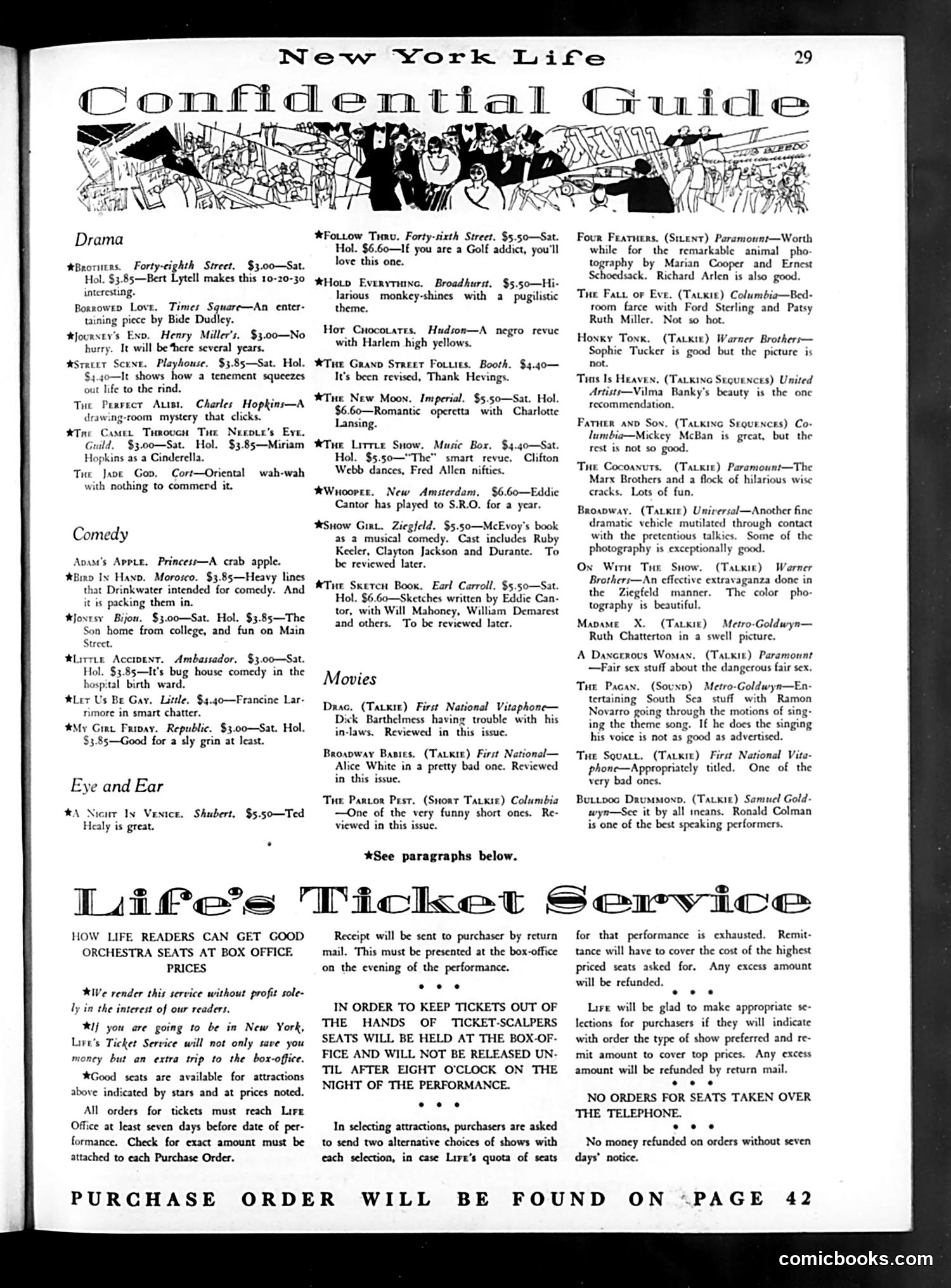
This is a theater and film listing page from Life magazine, not a political cartoon. It provides reviews and showtimes for Broadway plays, comedies, musical revues, and motion pictures—both silent and "talkie" (sound) films, which were still relatively new technology in the late 1920s. The page includes brief critical assessments of popular entertainments: dramatic works like "Journey's End," comedies featuring stars like Bert Lytell and Miriam Hopkins, and films starring contemporary celebrities including Eddie Cantor, the Marx Brothers, Sophie Tucker, and Vilma Banky. The bottom section advertises Life's ticket service, explaining how readers could purchase orchestra seats at box-office prices without profit markup—a reader benefit the magazine emphasized. The "Tatkie" and "Silent" designations indicate films' sound capabilities, reflecting entertainment's technological transition during this era.
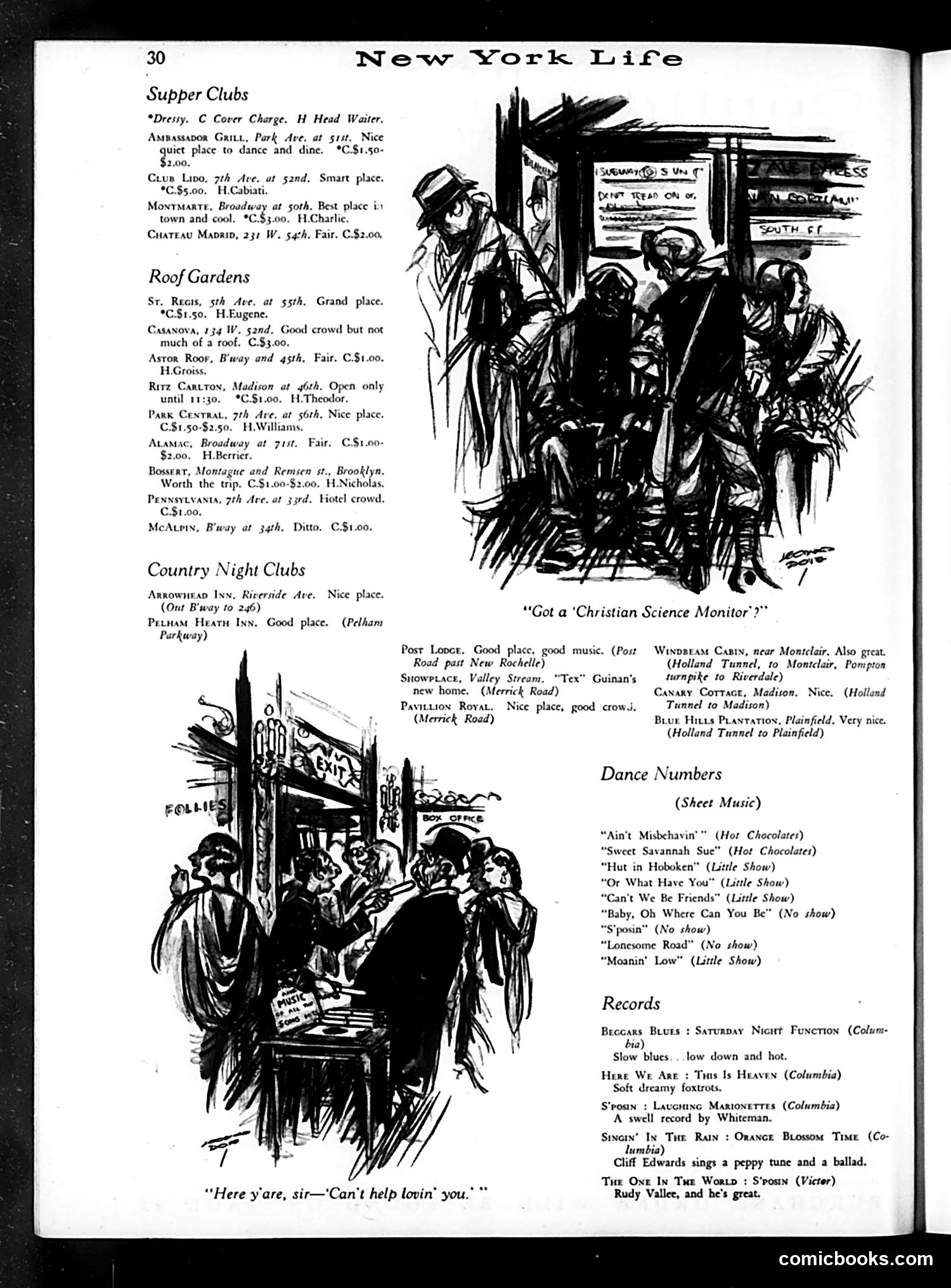
This page is primarily a **leisure guide** listing New York nightclubs and entertainment venues during the Jazz Age/Prohibition era, not political satire. The two cartoons serve as illustrations: 1. **Top cartoon** ("Got a 'Christian Science Monitor'?") shows a doorman or attendant at a nightclub entrance accosting patrons. The joke appears to reference the *Christian Science Monitor* newspaper—likely mocking the incongruity of encountering such wholesome, respectable reading material at a speakeasy or dance club, institutions often associated with moral disapproval during Prohibition. 2. **Bottom cartoon** ("Here y'are, sir—'Can't help lovin' you'") depicts a crowded nightclub entrance with a doorman serving patrons, illustrating the era's popular social venues. The page reflects 1920s entertainment culture: supper clubs with cover charges, roof gardens, country night clubs, plus popular dance numbers and records (featuring artists like Rudy Vallee and Cliff Edwards). This is primarily a **lifestyle/entertainment guide** rather than political commentary.
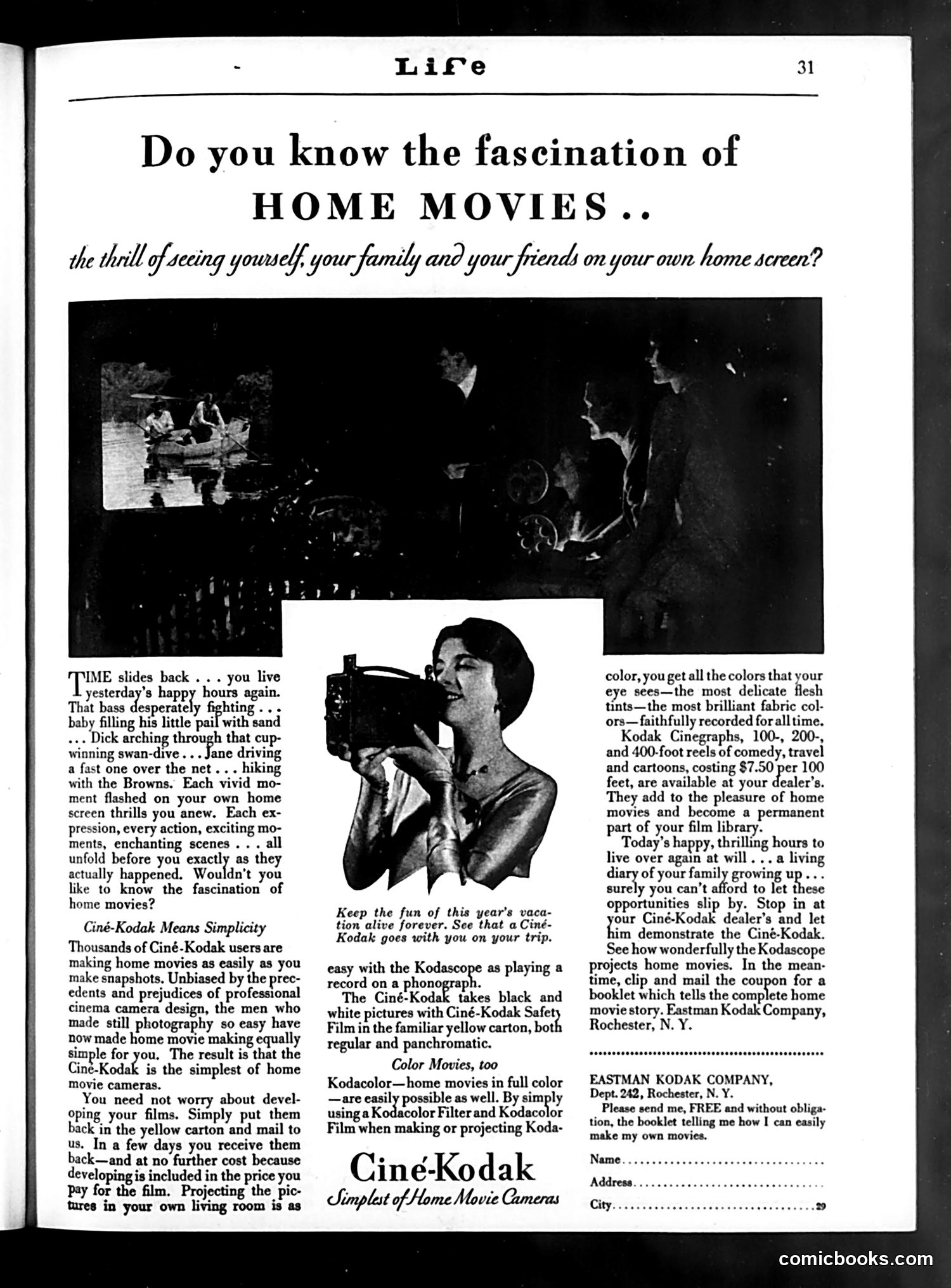
This is **not a cartoon or satire**—it's a full-page **advertisement for Ciné-Kodak home movie cameras**, placed in Life magazine. The page promotes home movie-making as an accessible, consumer-friendly hobby. It emphasizes the appeal of recording family moments (children playing, swimming, hiking) and reliving them on a home screen. The ad highlights Kodak's simplification of the process: users simply mail film back to Kodak for developing (included in the price) and project results using the "Kodascope" projector, "as easy as playing a record." The ad also markets color film ("Kodacolor") and pre-made content reels (comedies, travel footage, cartoons at $7.50 per 100 feet). For modern readers: this represents the democratization of film technology—what home video would later become. The nostalgic framing ("living diary of your family growing up") and emphasis on ease and affordability reflect mid-20th-century marketing of personal recording technology as aspirational middle-class entertainment.
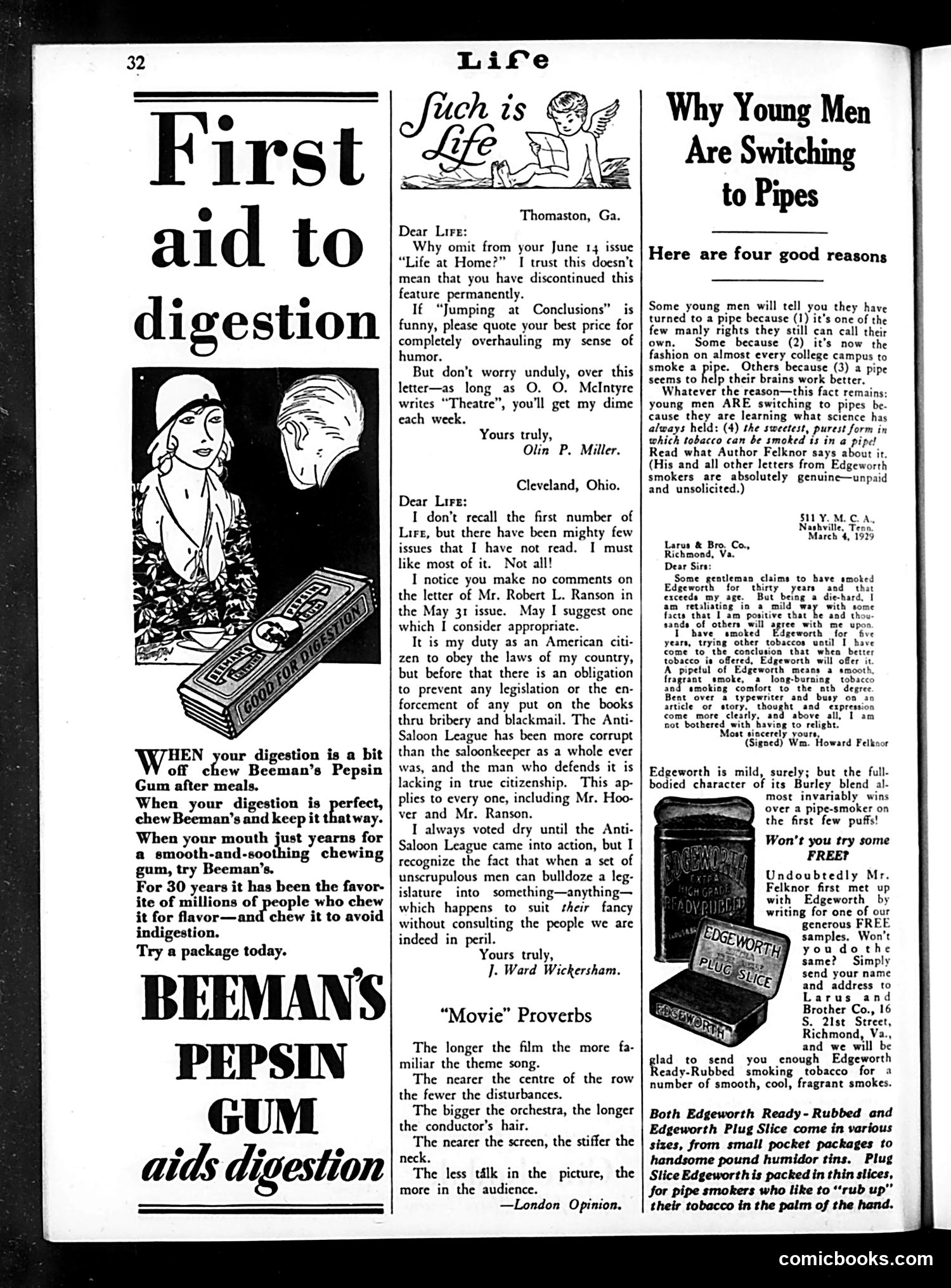
This page is primarily **advertising and reader letters**, not satirical content. **Left side:** A Beeman's Pepsin Gum advertisement claims the product aids digestion, targeting consumers concerned about digestive health—a common early 20th-century marketing pitch. **Center:** The "Such is Life" section contains three reader letters discussing Life magazine's content (complaints about missing features, praise for the publication, and a heated political letter attacking the Anti-Saloon League and Prohibition enforcement as corrupt). **Right side:** An advertisement for Edgeworth pipe tobacco targeting young men, citing four reasons they're "switching to pipes": personal liberty, campus fashion, mental clarity, and the claim that pipes deliver tobacco in its "purest form." **The satire, if any:** The "Movie Proverbs" section offers mild humor observing cinema conventions (longer films have more familiar songs, the conductor's hair correlates to orchestra size, etc.). The page reflects 1920s concerns: Prohibition debates, emerging youth culture around smoking, and digestive anxieties.
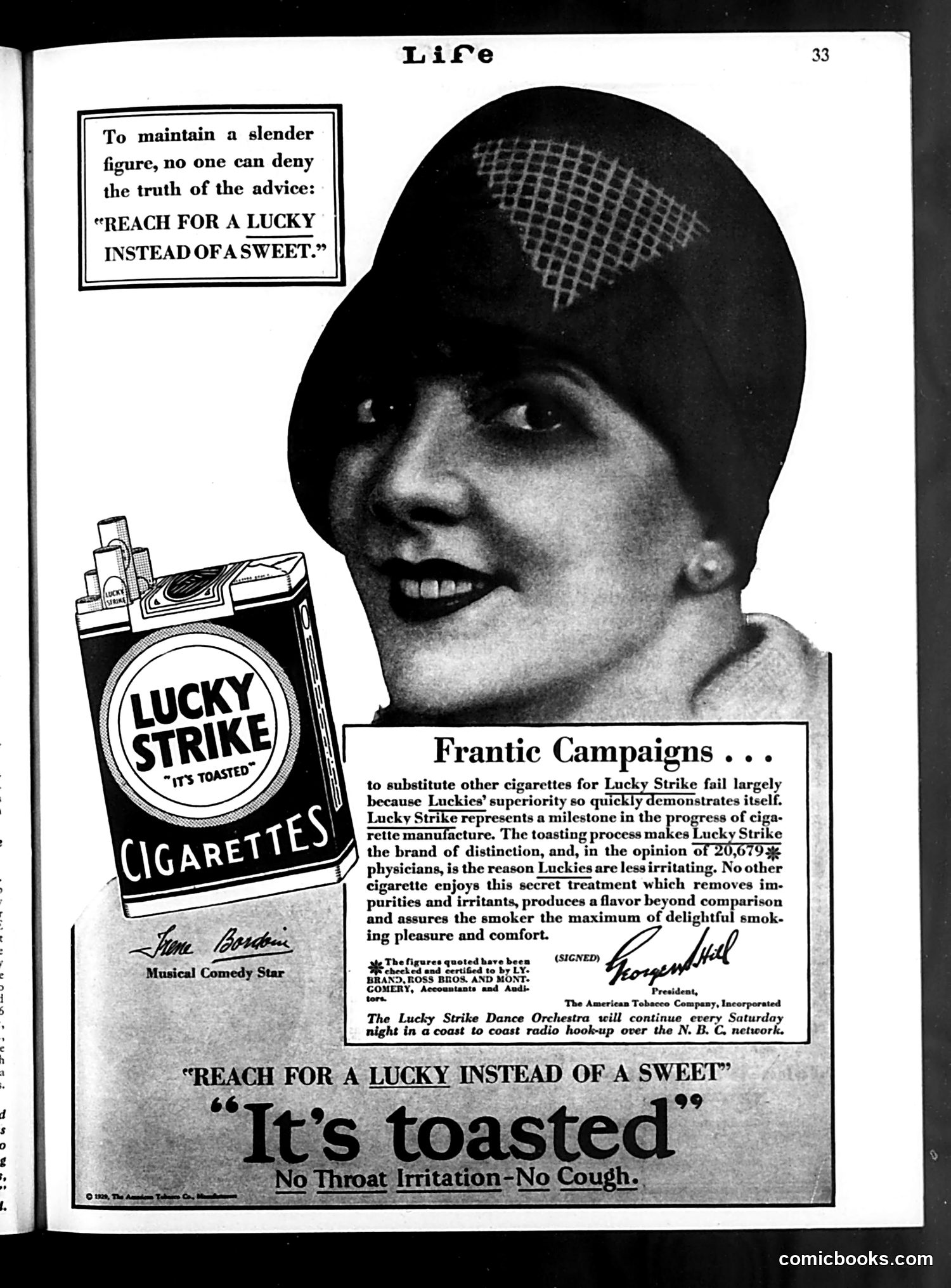
This is a cigarette advertisement, not political satire. It features a woman (identified as "Jim" Bradshaw, a musical comedy star) promoting Lucky Strike cigarettes. The ad's central message—"Reach for a Lucky instead of a sweet"—targets weight-conscious consumers, particularly women, by suggesting cigarettes suppress appetite and maintain slenderness. This was a common marketing tactic in early 20th-century tobacco advertising. The text makes health claims typical of the era: Lucky Strikes use a special "toasting process" that removes impurities, makes cigarettes "less irritating," and reduces cough. It cites "20,679 physicians" as endorsement (a frequently used but unverified statistic in tobacco ads of this period). The accompanying product shot and endorsement by a celebrity performer were standard advertising techniques. By modern standards, the health claims are misleading, and marketing cigarettes as appetite suppressants to women—implying weight control benefits—would be considered predatory advertising.
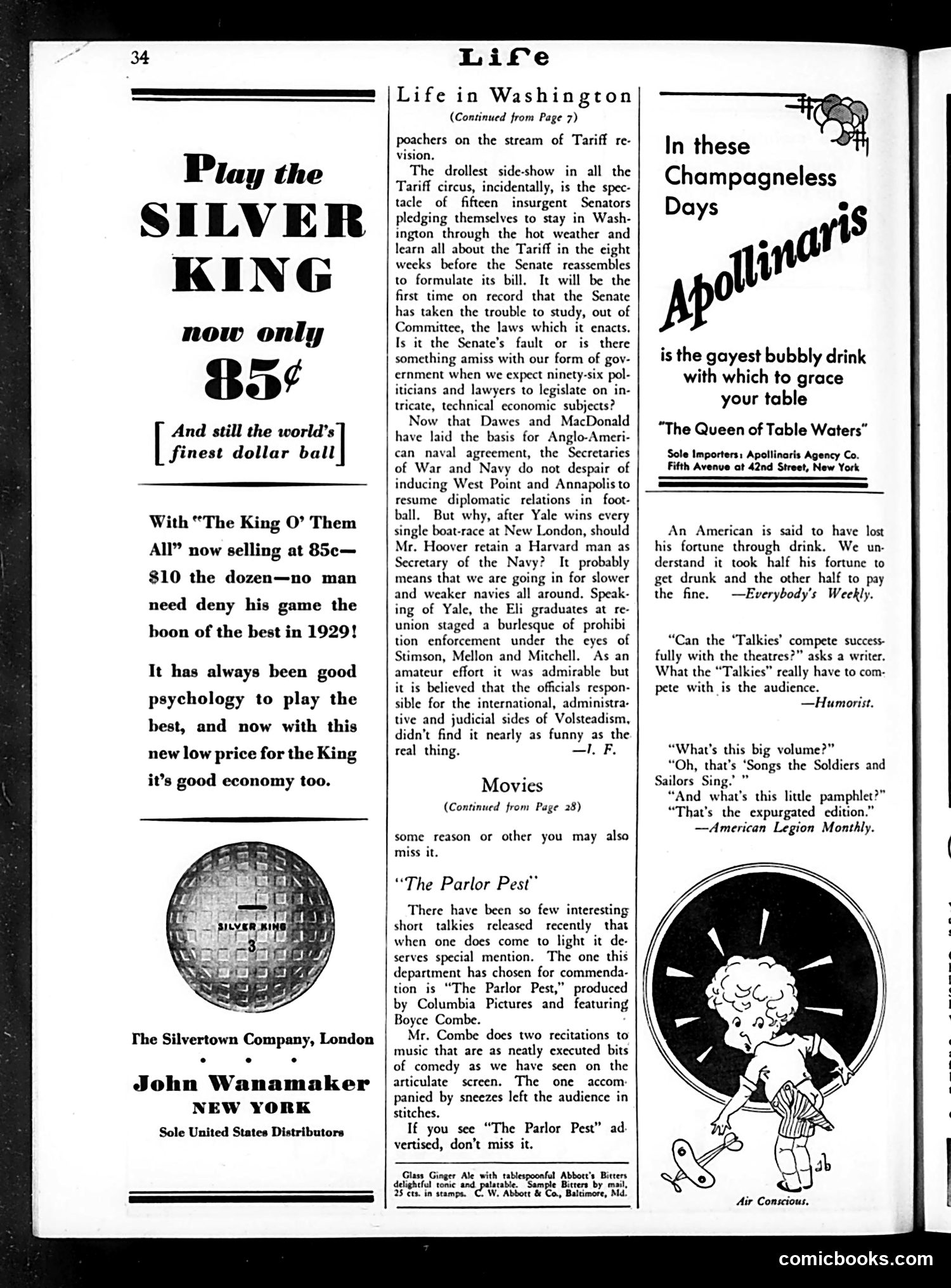
This page contains satirical commentary on contemporary issues, primarily focused on Washington politics and Prohibition enforcement. The main political piece critiques the U.S. Senate's tariff revision debates, mocking fifteen "insurgent Senators" who pledged to stay in Washington during summer to study tariff law—portrayed as absurdly unprecedented. The author sardonically questions whether ninety-six politicians and lawyers are competent to legislate on "intricate, technical economic subjects." Additional jabs target: the Navy Secretary choice (a Harvard man retained despite Yale's athletic dominance), and Yale's burlesque of Prohibition enforcement at their reunion—which the author suggests actual Prohibition enforcers (Stimson, Mellon, Mitchell) found less amusing than the Yale students did. The remaining content includes movie reviews and period advertisements unrelated to political satire.
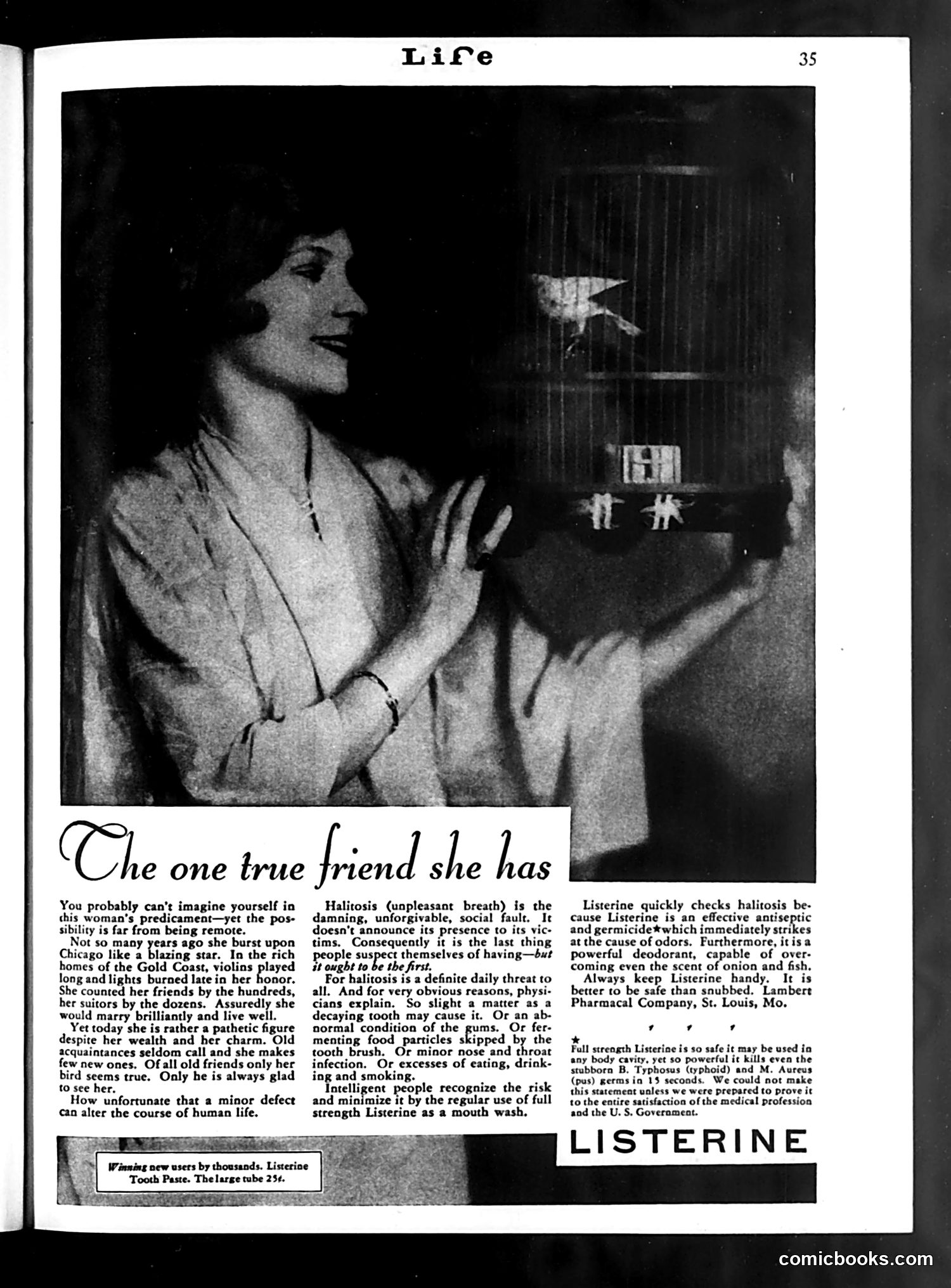
This is a **Listerine advertisement disguised as social commentary**. The page depicts a wealthy, formerly popular woman from Chicago's elite Gold Coast neighborhood who has mysteriously become socially isolated despite her wealth and charm. Her only loyal companion is her pet bird. The "minor defect" causing her downfall is **halitosis** (bad breath). The ad argues that this single social failing—invisible to the sufferer but obvious to everyone else—has destroyed her reputation and romantic prospects. The implicit message: even the richest, most beautiful woman becomes a pariah without fresh breath. This reflects early 20th-century advertising strategy: manufacturing social anxiety to sell products. The ad presents halitosis not as a medical concern but as a catastrophic **social shame**, suggesting Listerine mouthwash is essential for maintaining one's place in society. The narrative is melodramatic and somewhat cruel—the woman's isolation serves as a cautionary tale for readers.
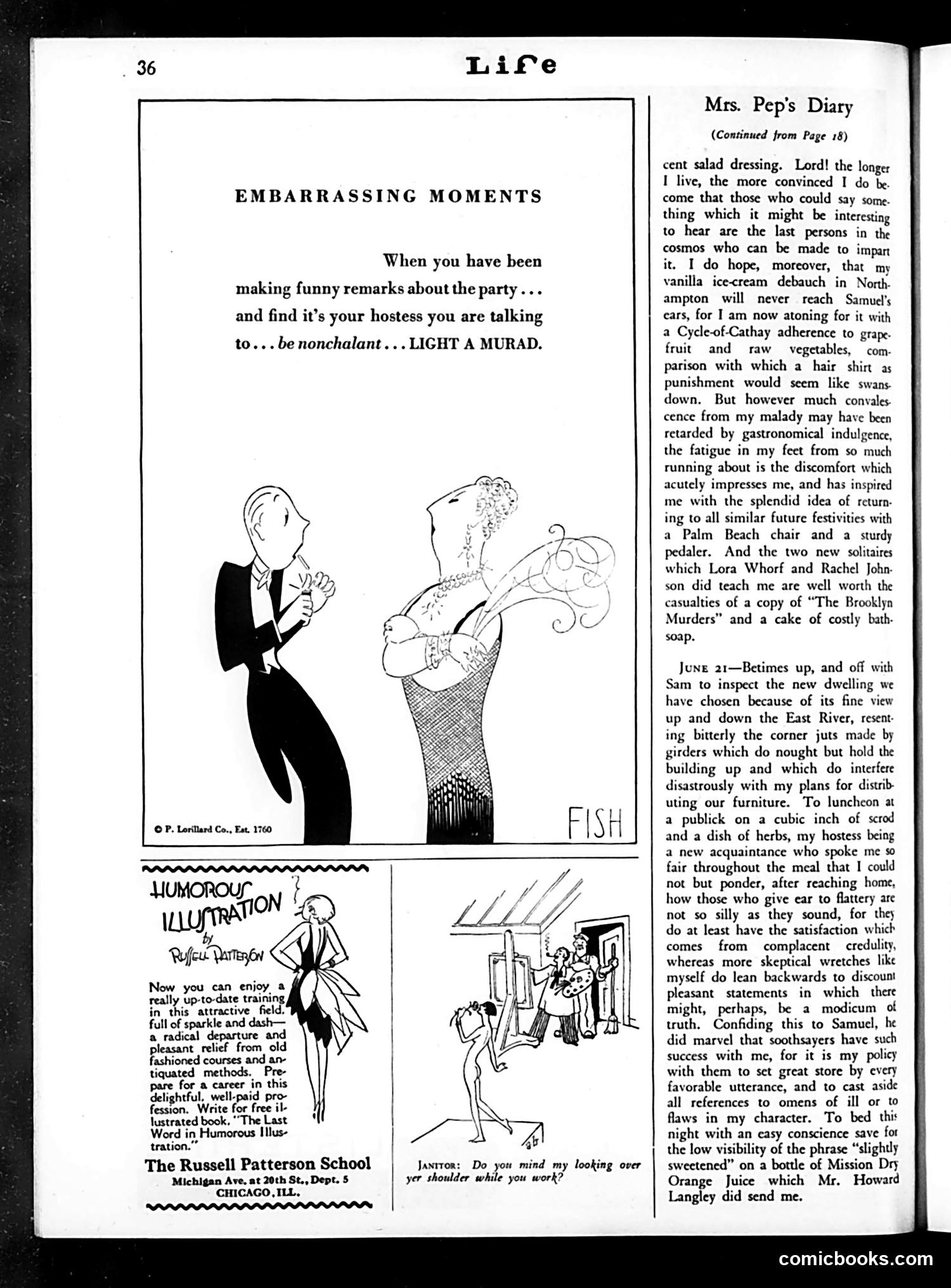
The main cartoon depicts a social etiquette scenario: a man at a party has been making disparaging remarks about the gathering, only to realize he's been speaking to the hostess herself. The joke's resolution—"be nonchalant...LIGHT A MURAD"—is an advertisement for Murad cigarettes, suggesting that smoking provides a face-saving escape from social awkwardness. The cartoon satirizes early 20th-century social anxieties about maintaining composure in embarrassing situations. The "solution" of lighting a cigarette reflects period advertising that positioned smoking as a sophisticated, calming social ritual—a way to regain composure and dignity when caught in a faux pas. The accompanying advertisement for the Russell Patterson School promises training in humorous illustration as a "delightful, well-paid profession," targeting aspiring commercial artists. The page also includes "Mrs. Pep's Diary," a serialized humor column documenting mundane social observations and domestic life.
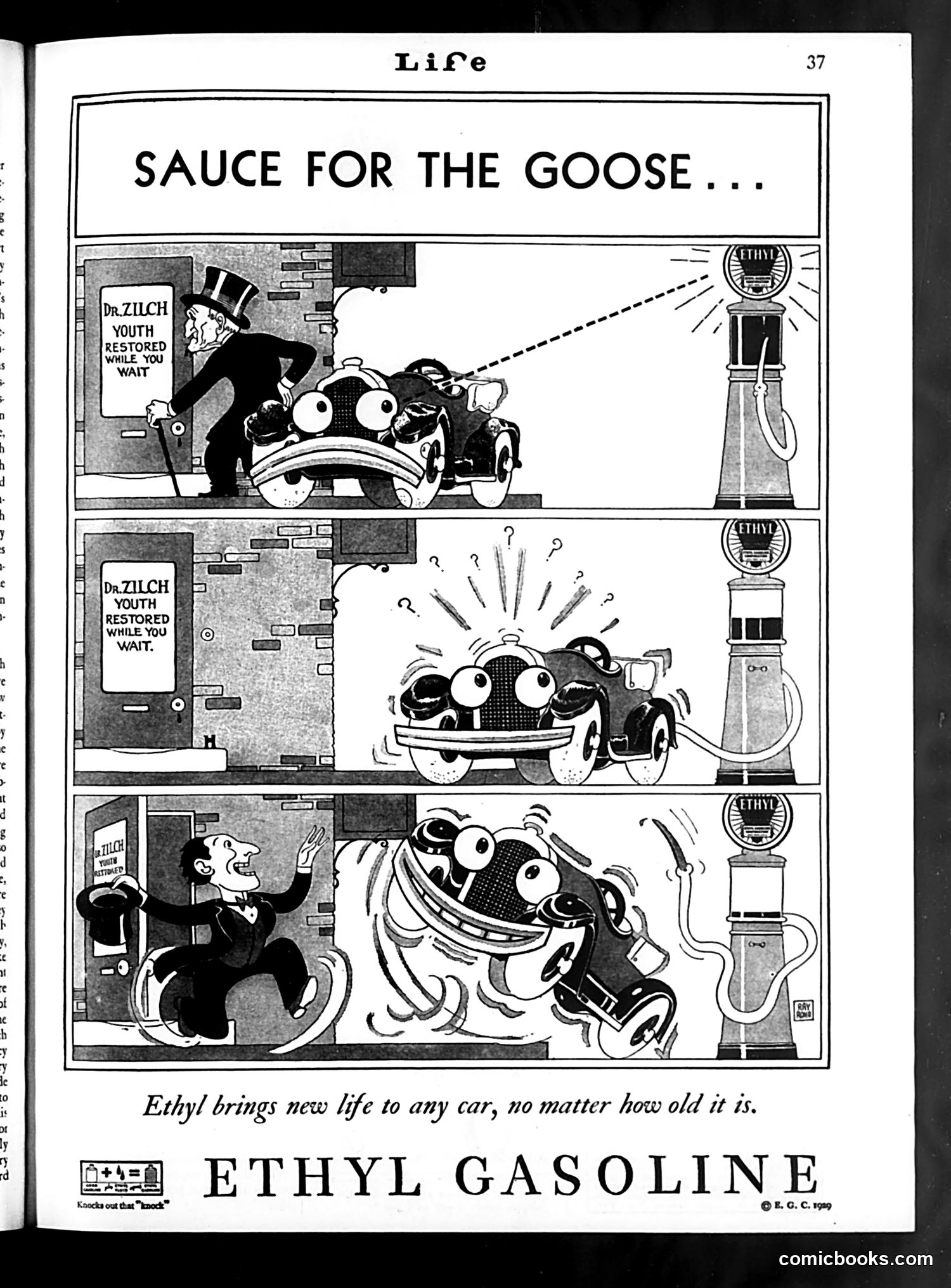
This is a three-panel advertisement for Ethyl gasoline from Life magazine (circa 1920s-1930s). The comic depicts a humorous scenario: A man visits "Dr. Zilch" (a quack doctor advertising "Youth Restored While You Wait") seeking rejuvenation. Instead of treating the man, the doctor appears to redirect him to use Ethyl gasoline on his old automobile. The joke plays on the phrase "sauce for the goose"—suggesting what works for one thing works for another. The ad claims Ethyl fuel restores vitality to aging cars just as the fake doctor promises to restore youth to people. The anthropomorphized car's exaggerated facial expressions (bulging eyes, wide grin) humorously suggest the vehicle is "revitalized" by the superior gasoline. This represents early automotive advertising using humor and satire to sell premium fuel.
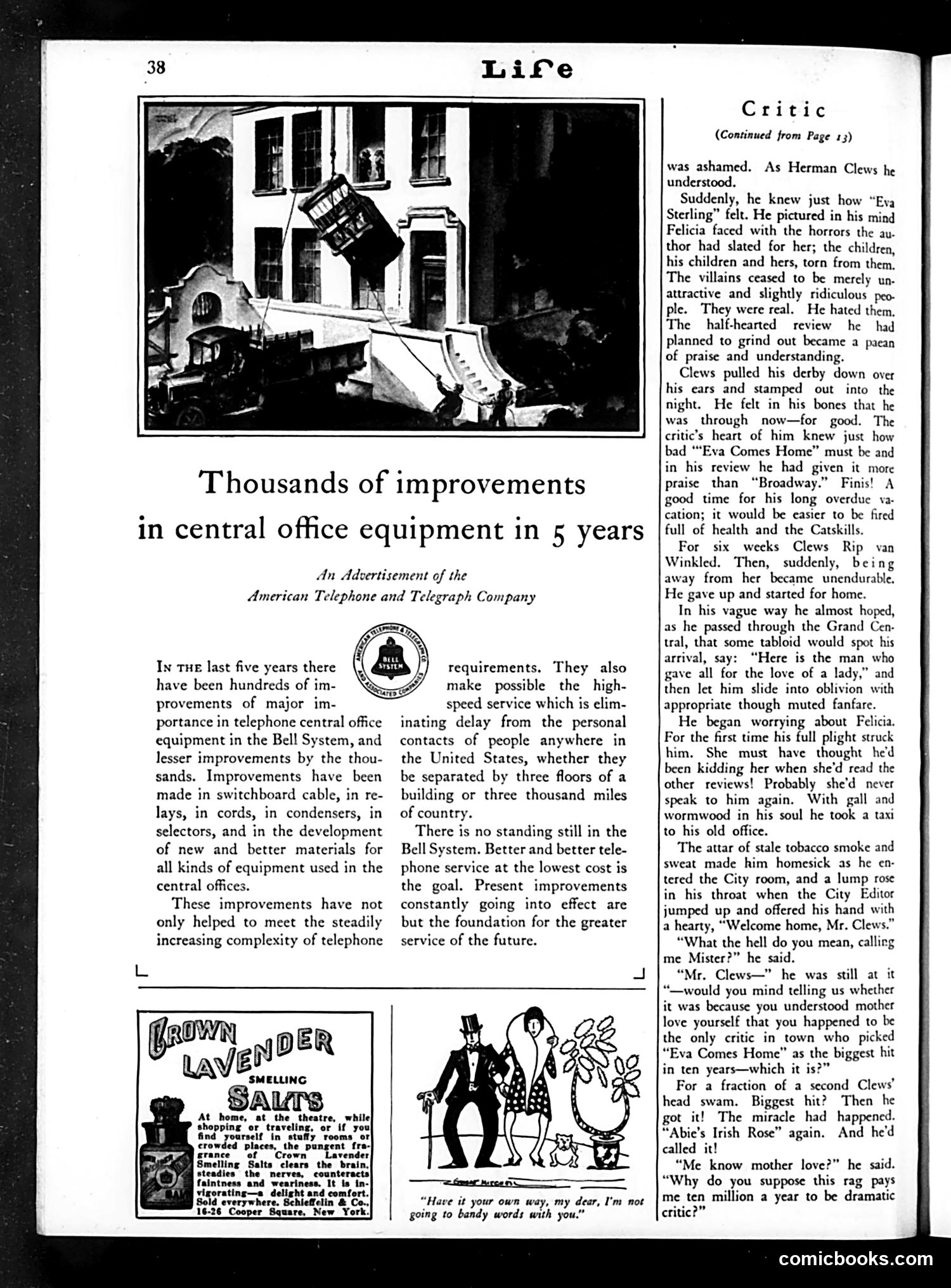
This page contains a **Bell Telephone Company advertisement** (top) promoting technical improvements in telephone infrastructure, alongside **two unrelated items**: a small ad for smelling salts and a serialized short story titled "Critic." The main advertisement emphasizes Bell System's modernization over five years—improvements in switchboard cables, relays, and equipment—enabling faster service across distances. This reflects early-20th-century corporate boosterism about technological progress. Below, a cartoon shows a formally dressed man and woman with text: "Have it your own way, my dear, I'm not going to bandy words with you"—a domestic humor joke about marital disagreement. The "Critic" story concerns a theater critic named Herman Clews who compromises his professional integrity by praising a play ("Eva Comes Home") because he sympathizes with the actress playing the lead role. The narrative explores tension between honest criticism and personal emotion, culminating when Clews returns to his newspaper office, uncertain whether the actress will forgive his inflated review.
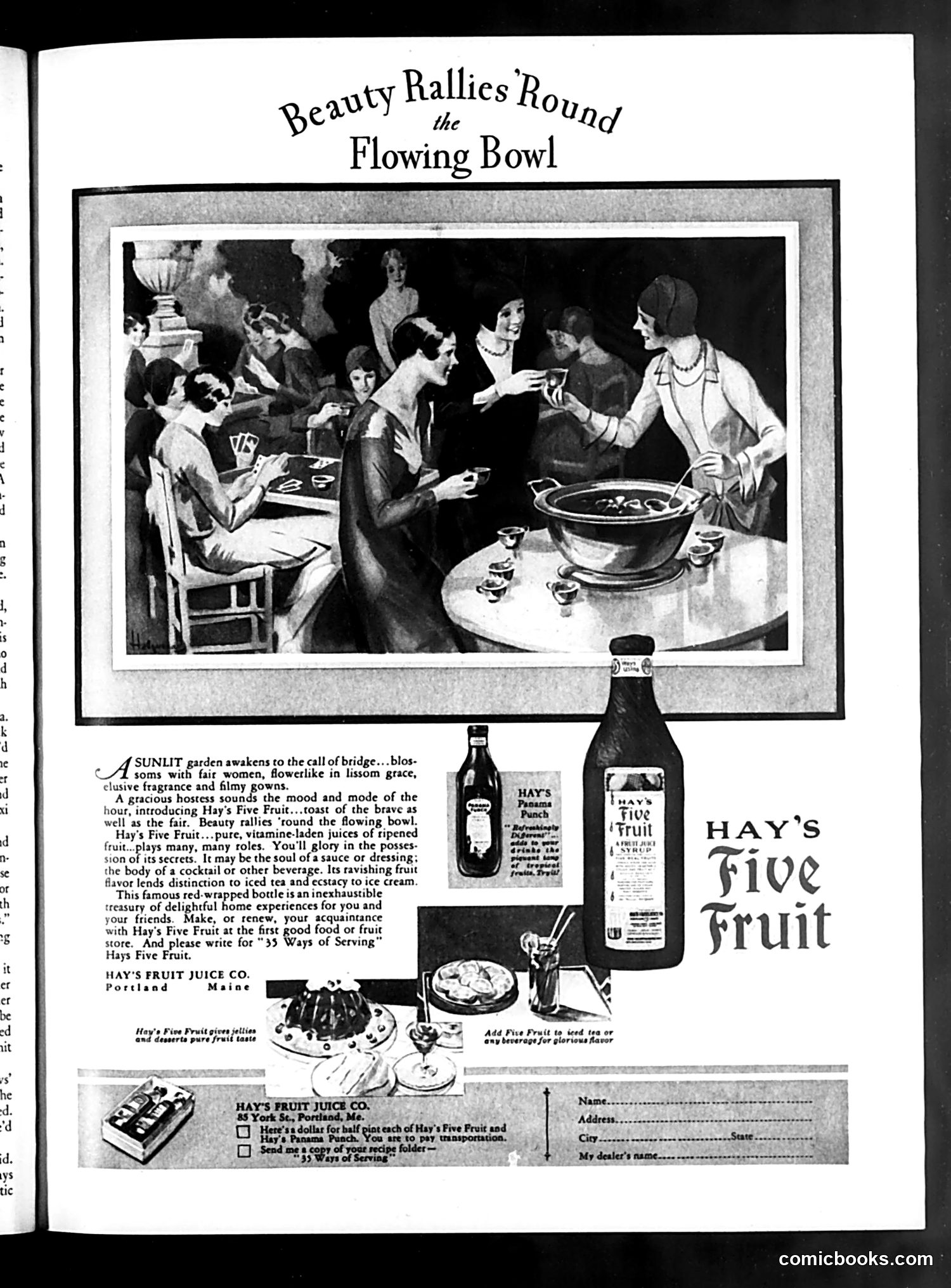
This is a **Hay's Five Fruit advertisement**, not satire or political commentary. It depicts a glamorous 1920s garden party where well-dressed women gather around a decorative bowl—the "flowing bowl" of the title—suggesting refined hospitality and social grace. The ad emphasizes the product's versatility: it can be used in cocktails, iced tea, desserts, and sauces. The "beauty rallies" around the fruit juice, positioning the product as essential to elegant entertaining. The accompanying images show serving suggestions and a mail-order coupon for recipe ideas ("33 Ways of Serving"). This reflects 1920s marketing that associated consumer products with aspirational lifestyles and leisure—particularly targeting women as hostesses responsible for sophisticated home experiences. The language ("lissom grace," "ravishing") and imagery romanticize both the product and the women consuming it.
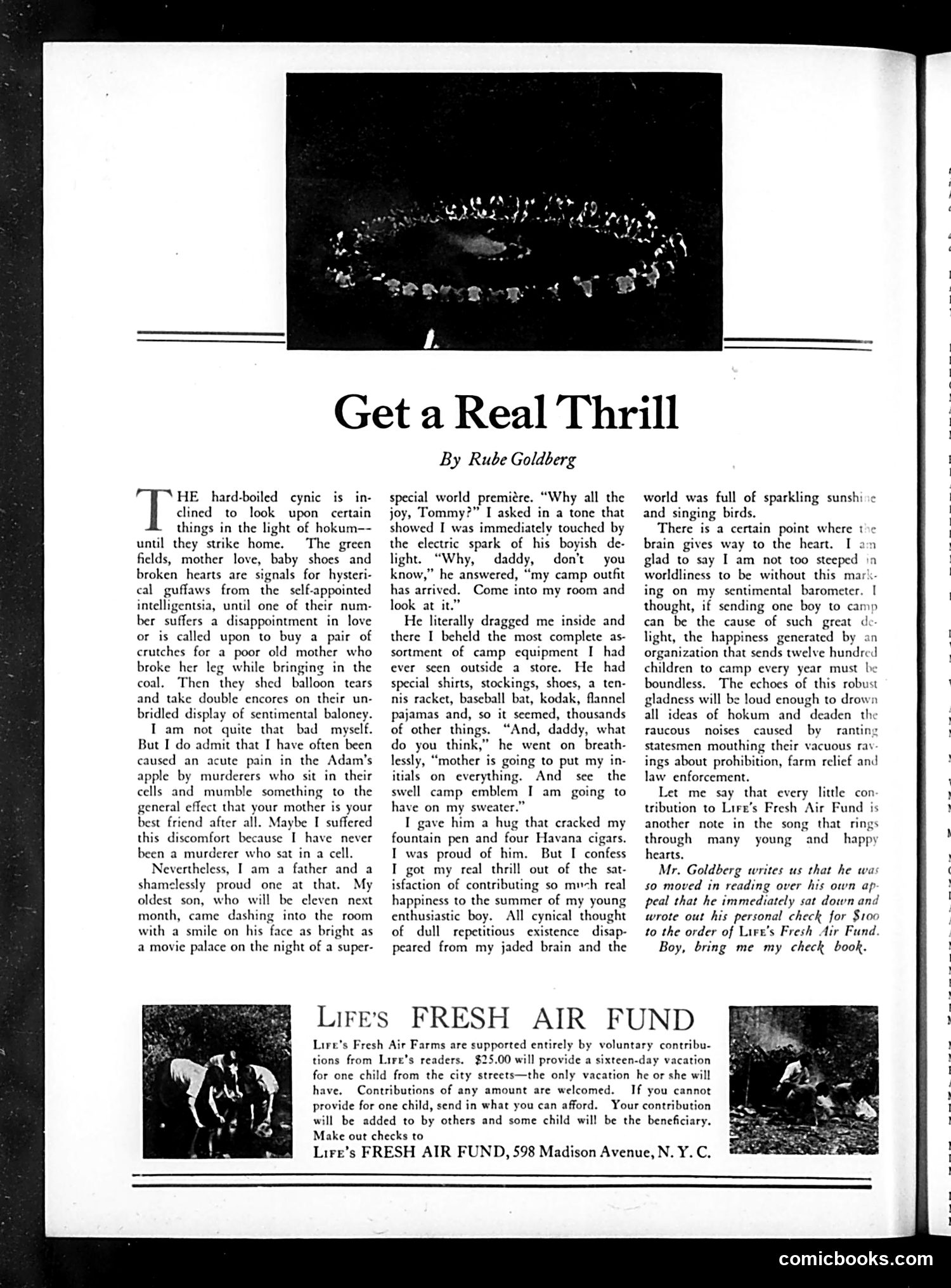
This is a sentimental essay by cartoonist Rube Goldberg promoting Life magazine's **Fresh Air Fund**, which provided summer camp vacations for poor urban children. Goldberg describes how his young son's excitement about camp gear broke through his own cynical worldview, making him realize the genuine joy such experiences create. He argues that if one boy's happiness matters so much, imagine the impact on 1,200 children annually sent to camp by the organization. The essay functions as fundraising propaganda: Goldberg claims his own emotional response moved him to donate $100 personally, hoping to inspire readers to contribute. The "satire" is gentle—mocking cynicism itself rather than punching at any particular target. The point: wealth and privilege shouldn't blind us to children's simple needs. By framing camp as a "thrill" for deprived city kids, Goldberg appeals to readers' sentimentality and paternalism to open their wallets for charitable giving. The accompanying photographs (now illegible) likely showed happy campers or poverty-stricken children to strengthen the emotional appeal.
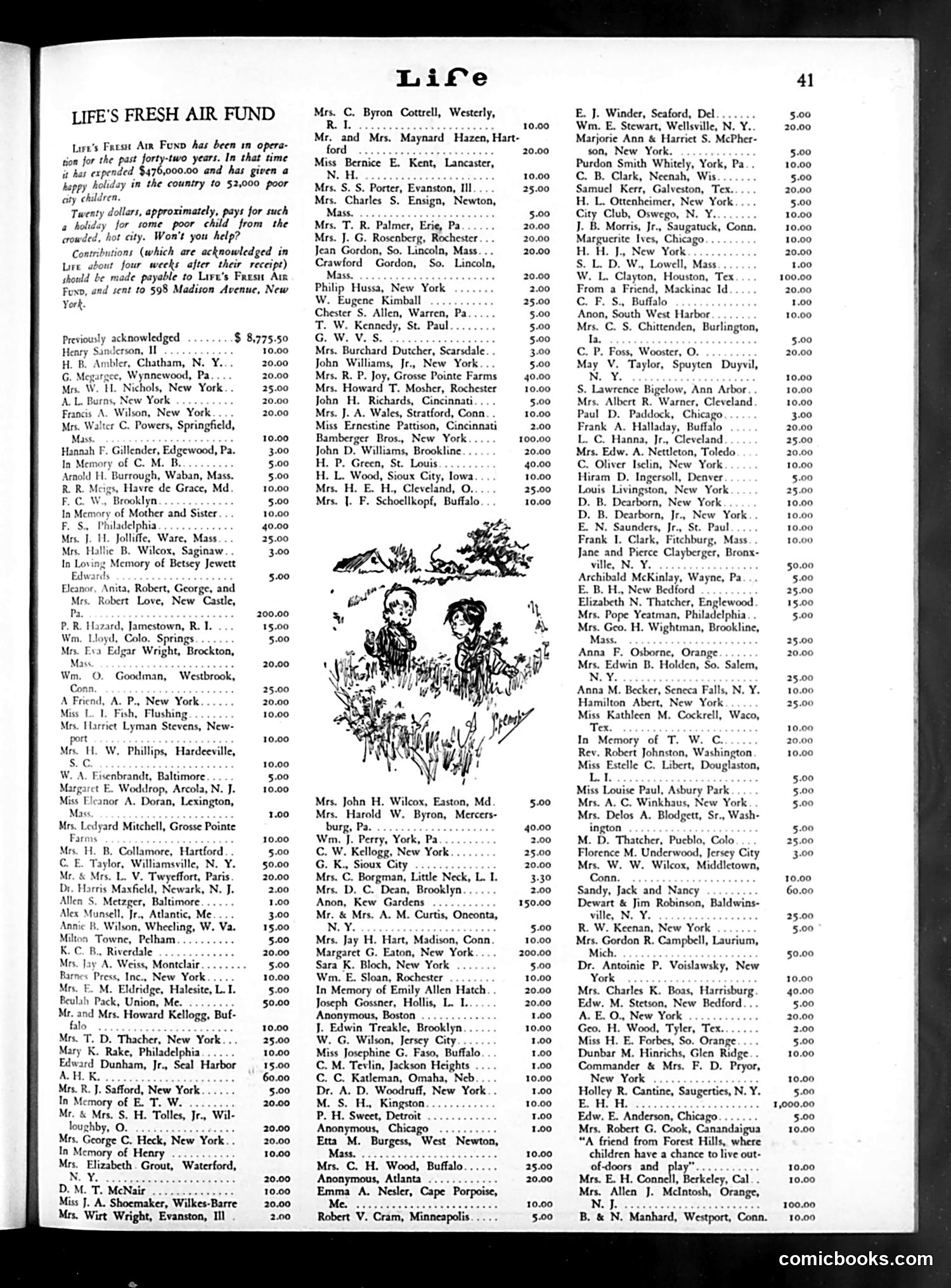
This page is primarily a charitable fundraising list, not political satire. It shows contributions to **Life magazine's Fresh Air Fund**, a real philanthropic program that sent poor urban children on countryside holidays. The illustrated vignette (center) depicts two children in a pastoral setting—the intended beneficiaries of the fund. The accompanying text explains that $20 provides one child a holiday from crowded city conditions. Below this is an extensive list of donors and their contribution amounts, ranging from $1 to $150. These appear to be wealthy individuals and families from across the United States, making tax-deductible charitable donations. This reflects early 20th-century Progressive Era concern for urban poverty and "child welfare," positioning the wealthy as benevolent. The page serves as both advertisement and public acknowledgment of contributors—a common magazine practice of the era.
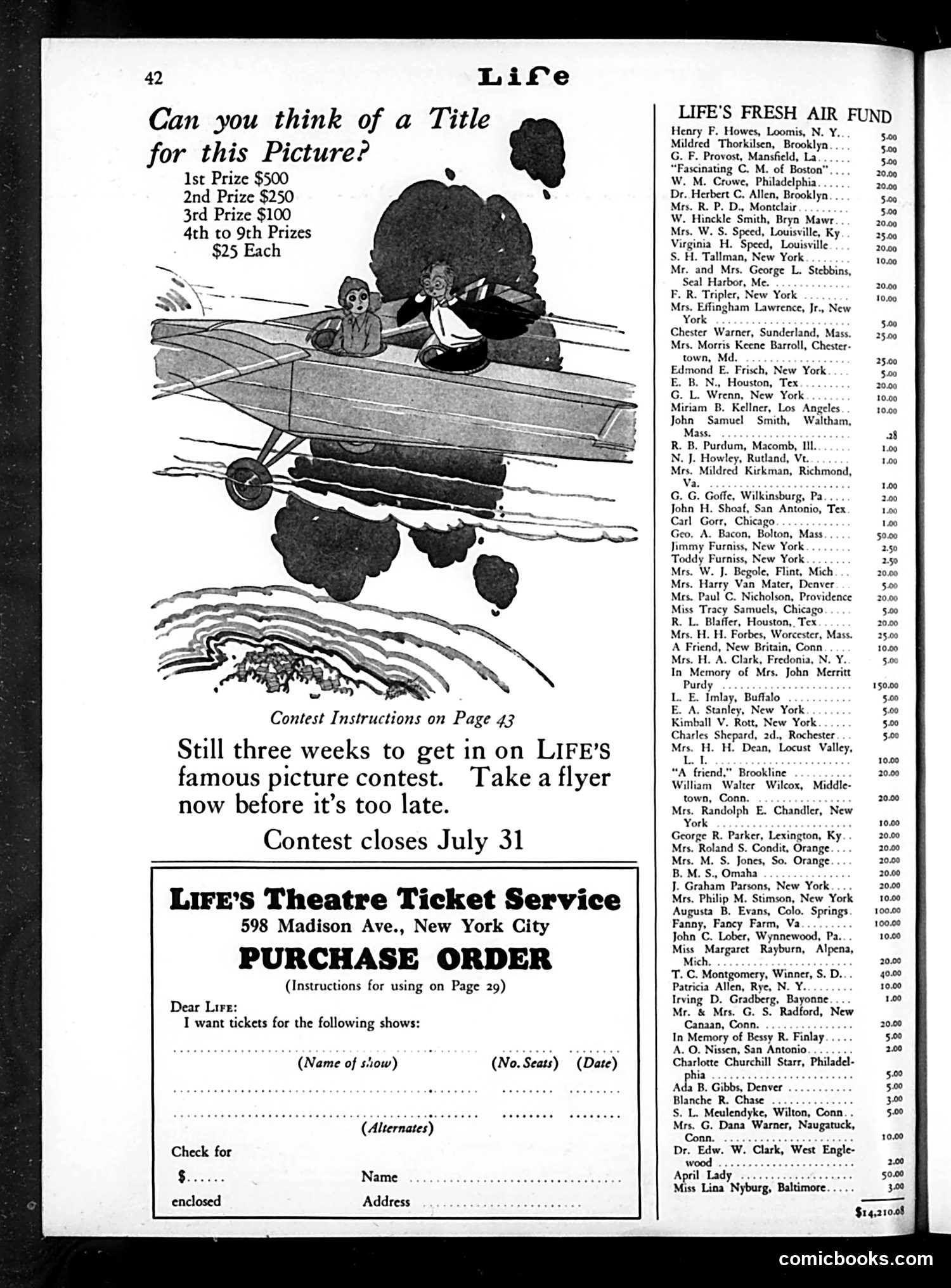
This page presents **Life magazine's famous picture-titling contest**—a popular interactive feature where readers submitted humorous captions for a cartoon illustration. The prize structure ($500 first prize down to $25 for places 4-9) incentivized participation. The cartoon depicts a large woman in an airplane with two small children, suggesting domestic or family-themed humor typical of 1920s-30s Life satire. The page also advertises **Life's Fresh Air Fund**, a legitimate charitable initiative providing summer assistance to urban residents. The extensive donor list demonstrates the magazine's philanthropic reach and middle/upper-class readership base across America. The **Theatre Ticket Service** purchase order reflects Life's commercial diversification—selling Broadway tickets through their offices—a service catering to affluent urban subscribers. Together, these elements showcase Life as both entertainer and community institution.
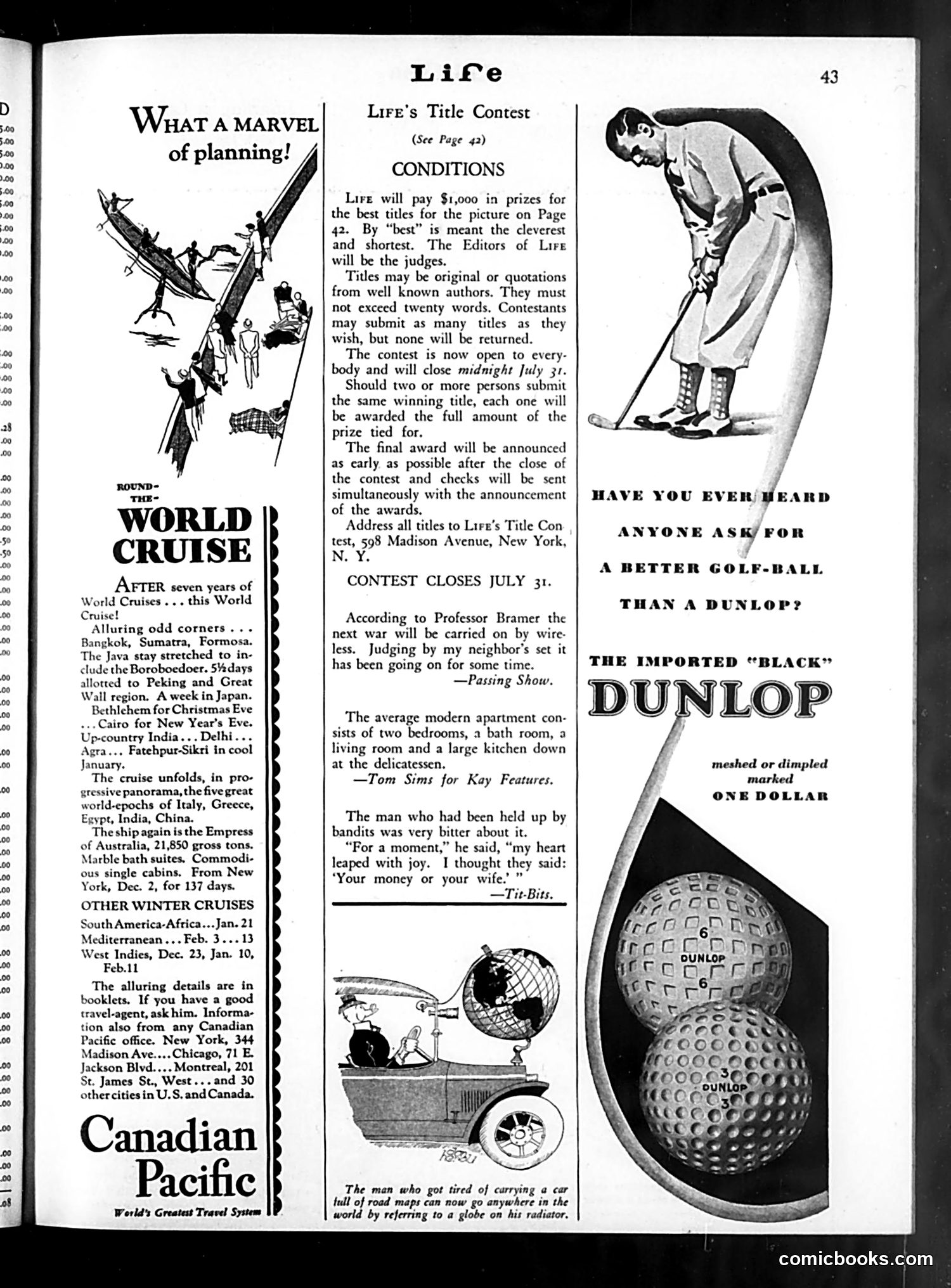
This page mixes advertising with humor content typical of 1920s *Life* magazine. **Left side:** A Canadian Pacific cruise advertisement emphasizes luxury travel planning, promoting a 137-day world cruise aboard the Empress of Australia, visiting exotic locations (Bangkok, Peking, Cairo, India). The illustration shows travelers with luggage and globes, celebrating elaborate itinerary planning. **Center:** A title-writing contest offering $1,000 in prizes for clever, short captions (max 20 words) for an unnamed picture on page 42. Standard contest rules apply. **Right side:** Brief humorous quips satirize modern life—wireless warfare, cramped apartments with kitchens only at delicatessens, and a robbery victim's dark joke about preferring "your money or your wife" punchlines. **Bottom right:** A Dunlop golf ball advertisement promoting their imported "black" dimpled balls at one dollar, using the rhetorical question format common in period advertising to suggest superior quality. The page reflects 1920s consumer culture, leisure travel aspirations, and gentle domestic humor.
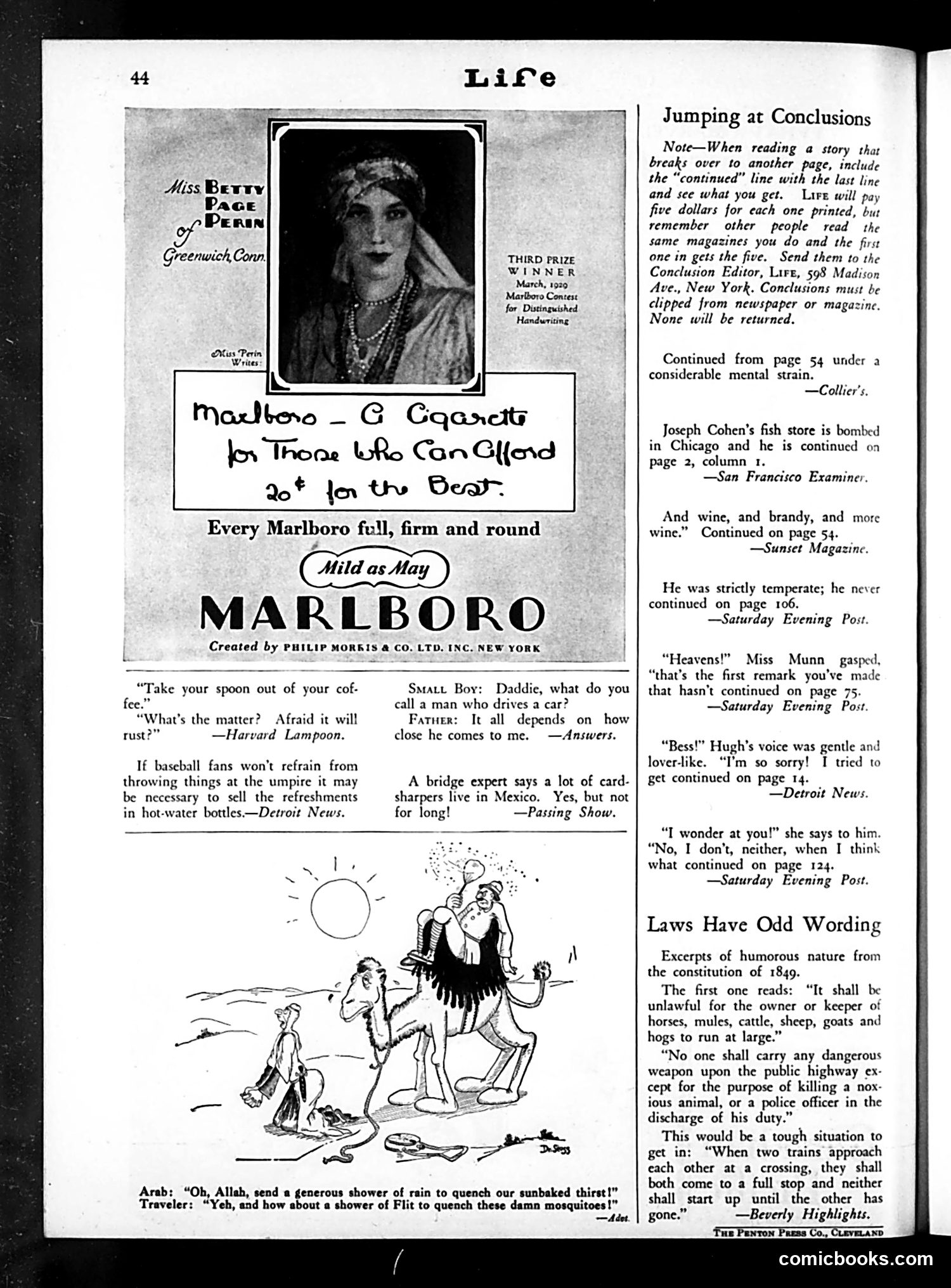
**Main Advertisement:** A Marlboro cigarettes ad features Miss Betty Page Peren of Greenwich, Connecticut, who won third prize in a March 1929 Marlboro contest for "Distinguished Handwriting." The ad emphasizes cigarette quality ("Every Marlboro full, firm and round"). **Political/Social Cartoons & Humor:** The bottom cartoon depicts an Arab and Western traveler in a desert. The Arab prays for rain to end their thirst; the traveler cynically asks for Flit (an insecticide brand) to kill mosquitoes instead—satirizing Western materialism and priorities over genuine hardship. **"Jumping at Conclusions" Section:** A humor feature inviting readers to find absurd sentence fragments where magazine articles continue to other pages. Examples include: "Joseph Cohen's fish store is bombed in Chicago and he is continued on page 2"—creating dark comedy through accidental juxtaposition. **"Laws Have Odd Wording":** Excerpts from an 1849 constitution highlight accidentally ambiguous legal language, particularly one permitting weapons "except for the purpose of killing...a police officer"—presumably meant to exclude officers but grammatically problematic.
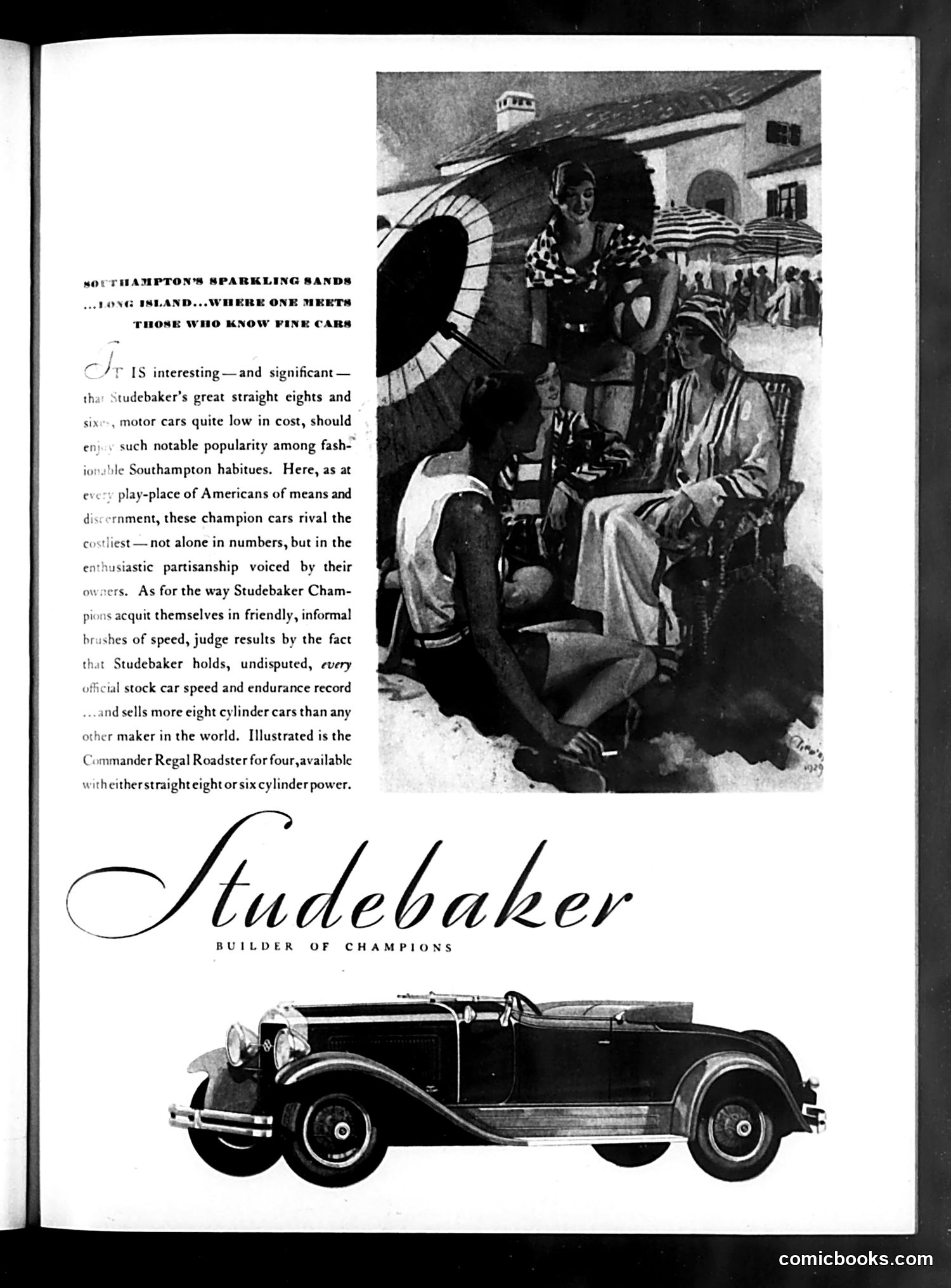
This is primarily a **Studebaker automobile advertisement**, not political satire. The page uses aspirational imagery to market cars to wealthy Americans. The text emphasizes that Studebaker's affordable eight-cylinder and six-cylinder cars enjoy surprising popularity among wealthy Southampton (Long Island) residents—traditionally associated with luxury vehicles. The ad's "point" is that Studebaker holds official speed records and outsells competitors in eight-cylinder cars, yet costs less than competing luxury brands. The photograph shows fashionably dressed people at what appears to be a Southampton social gathering, with a Studebaker roadster prominently featured. The visual strategy suggests that even the wealthy and discerning prefer Studebaker—a selling point for middle-class readers. The slogan "Builder of Champions" reinforces performance credentials. This is commercial persuasion leveraging social status and proven engineering, not satire or political commentary.
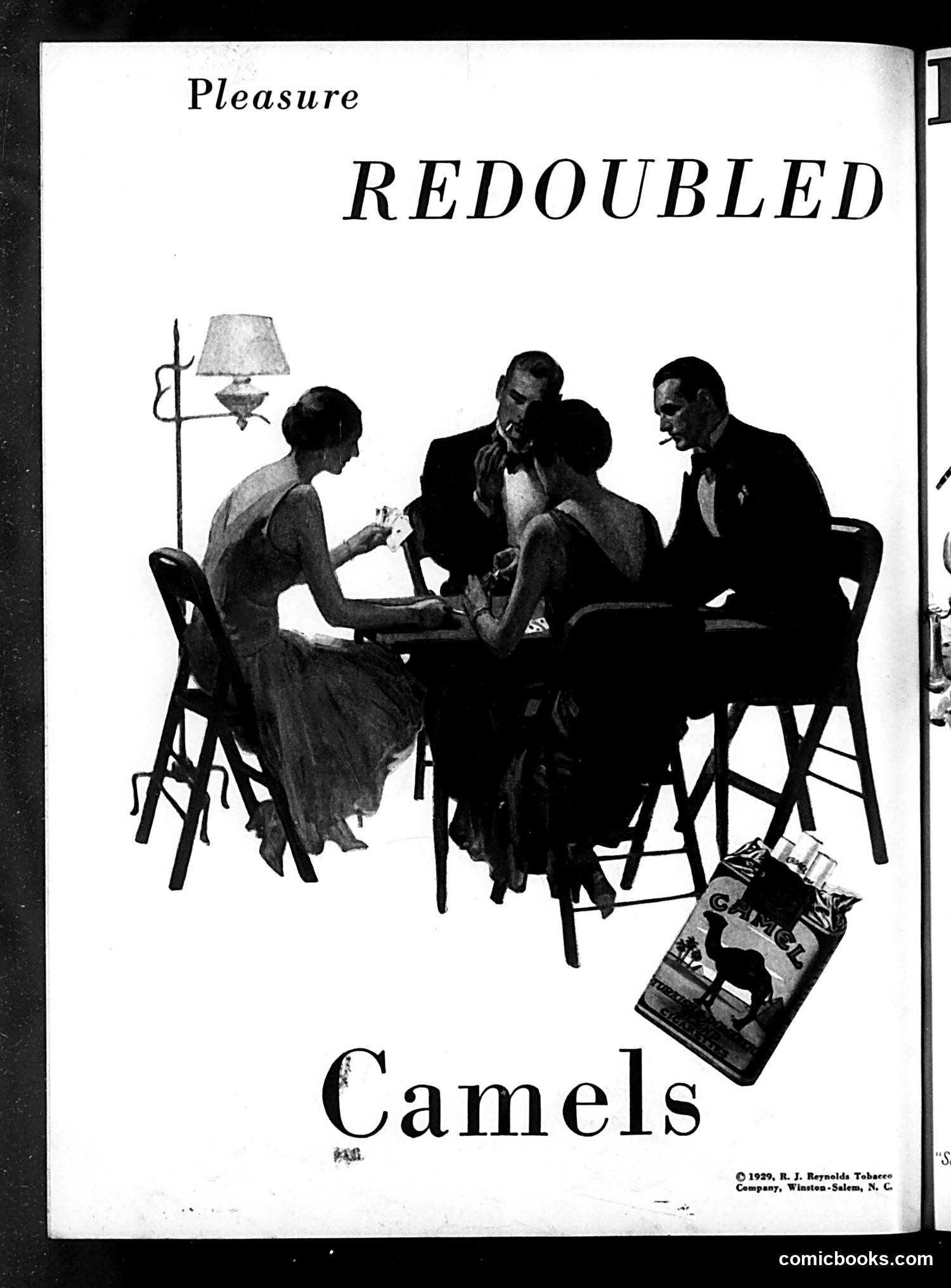
This is a Camel cigarette advertisement from Life magazine (copyright 1929, per the footer). The ad depicts four well-dressed people in formal evening wear gathered around a small table under a decorative lamp, appearing to socialize pleasantly. The headline "Pleasure Redoubled" suggests that smoking Camels enhances social enjoyment. The advertisement associates the cigarettes with sophistication, leisure, and convivial company—appealing to aspirational consumers during the prosperous 1920s. For modern readers, this reflects how cigarettes were then openly marketed as enhancing social pleasure and status, before widespread knowledge of health dangers and subsequent advertising restrictions. The gendered dynamics (woman among three men) and upscale setting were typical of period advertising targeting affluent consumers.