
Life, 1929-07-12 · page 26 of 48
Life — July 12, 1929 — page 26: what you’re looking at
What you’re looking at
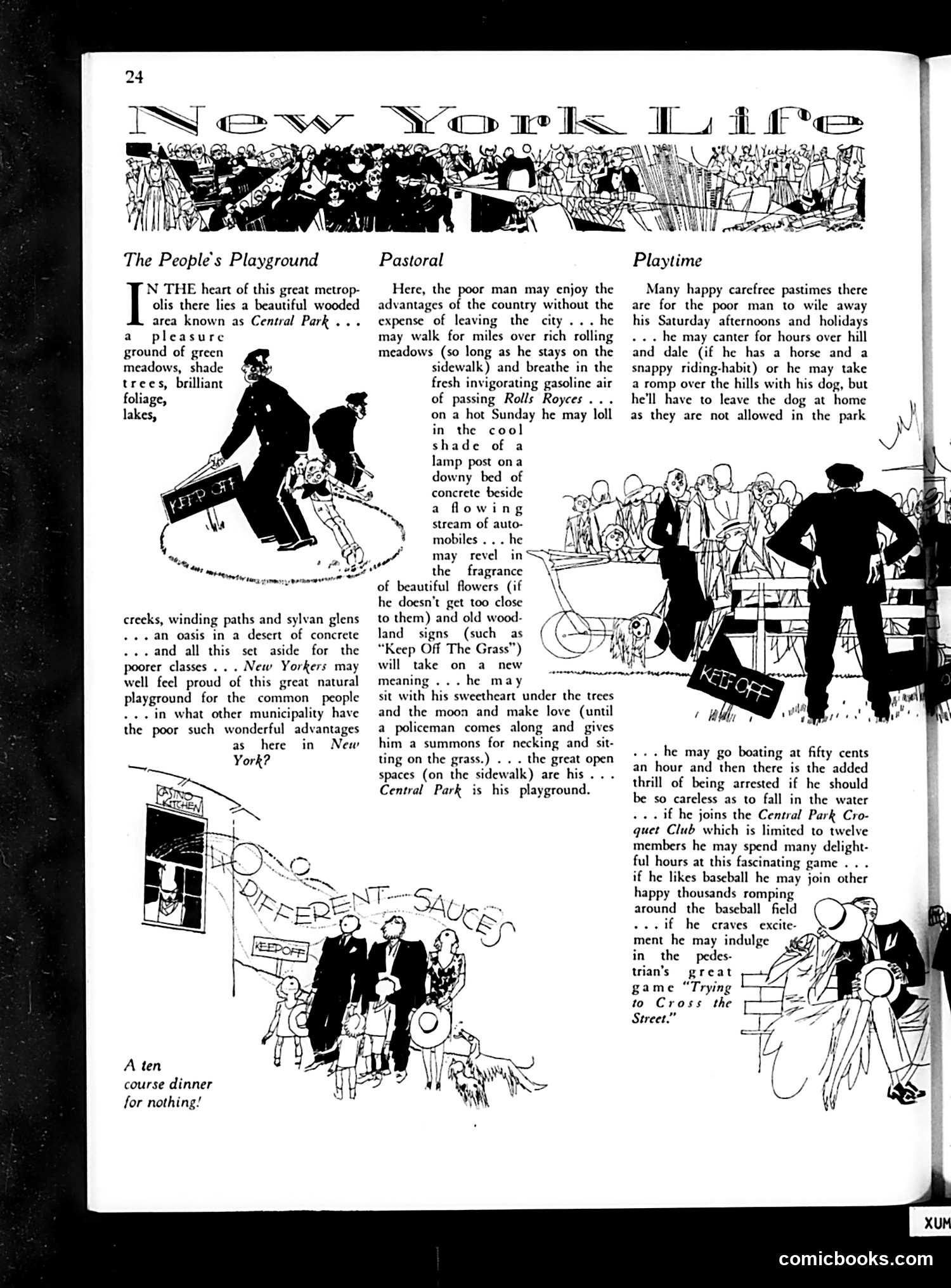
This satirical 1920s article mocks the hypocrisy of celebrating Central Park as a public benefit for poor New Yorkers while describing numerous restrictions and humiliations they face there. The three sections ("The People's Playground," "Pastoral," "Playtime") use heavy irony. While claiming the park offers poor people wonderful free recreation, the text reveals the reality: they can only walk on sidewalks, breathe car exhaust from "Rolls Royces," sit on concrete, face arrest for kissing or falling in water, can't bring dogs, and risk fines for stepping on grass. The opening illustration shows well-dressed people in the park. The "Different Sauce" cartoon depicts an elegant restaurant, sarcastically captioning it "A ten course dinner for nothing!"—implying the park's "benefits" are equally illusory. The satire critiques wealthy New Yorkers' self-congratulation about providing public space while the actual experience for poor citizens involves police harassment, exclusions, and degradation. It's social commentary on class inequality masked as generosity.
📄 Transcribed text from this page (OCR, searchable)
Machine-transcribed from the original scan — historical spelling and the odd misread are preserved.
24 The People’s Playground [: THE heart of this great metrop- olis there lies a beautiful wooded area known as Central Park... a pleasure ground of green meadows, shade trees, brilliant creeks, winding paths and sylvan glens +++ an oasis in a desert of concrete «and all this set aside for the poorer classes... New Yorkers may well feel proud of this great natural playground for the common people . in what other municipality have the poor such wonderful advantages as here in New York? A ten course dinner for nothing! Pastoral Here, the poor man may enjoy the advantages of the country without the expense of leaving the city... he may walk for miles over rich rolling meadows (so long as he stays on the sidewalk) and breathe in the fresh invigorating gasoline air of passing Rolls Royces ... on a hot Sunday he may loll in the cool shade of a lamp post ona downy bed of concrete beside a flowing stream of auto- mobiles . . . he may revel ini the _ fragrance of beautiful flowers (if he doesn’t get too close to them) and old wood- land signs (such as ( “Keep Off The Grass”) \ will take on a new meaning ... he may sit with his sweetheart under the trees and the moon and make love (until a policeman comes along and gives him a summons for necking and sit- ting on the grass.) . . . the great open spaces (on the sidewalk) are his... Central Park is his playground. Playtime | Many happy carefree pastimes there are for the poor man to wile away his Saturday afternoons and holidays +. he may canter for hours over hill | and dale (if he has a horse and a snappy riding-habit) or he may take a romp over the hills with his dog, but he'll have to leave the dog at home Wi as they are not allowed in the park ' «+. he may go boating at fifty cents ' an hour and then there is the added | thrill of being arrested if he should | be so careless as to fall in the water « if he joins the Central Park Cro- quet Club which is limited to twelve members he may spend many delight- ful hours at this fascinating game . . . if he likes baseball he may join other happy thousands romping around the baseball field ++. if he craves excite- ment he may indulge in the pedes- trian’s great game “Trying to Cross the Street.” XUM comicbooks.com