
Life, 1929-07-12 · page 28 of 48
Life — July 12, 1929 — page 28: what you’re looking at
What you’re looking at
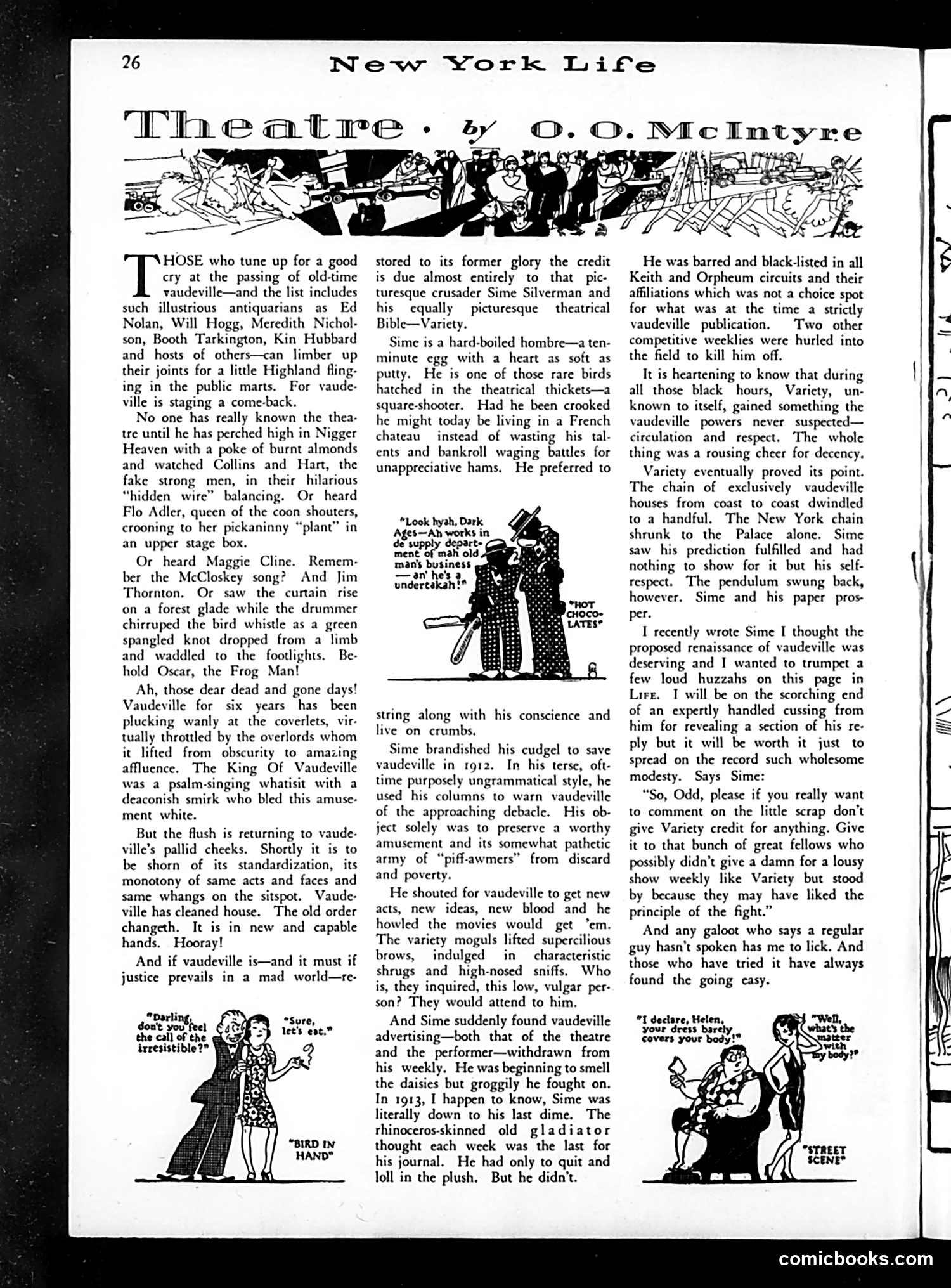
This page celebrates **Sime Silverman**, founder of *Variety* magazine, as a crusader who saved vaudeville from decline. The article argues that vaudeville—a popular theatrical entertainment form featuring diverse acts (comedians, singers, acrobats)—nearly died due to mismanagement by theater circuit owners ("overlords"). Silverman used *Variety* to expose problems and warn of competition from movies, despite facing retaliation: his publication was barred from major theater circuits (Keith and Orpheum), advertisers withdrew support, and competitors were launched to undercut him. Yet he persisted through personal financial hardship. The cartoons illustrate old vaudeville acts and stereotypical characters. The satire targets theater moguls who ignored Silverman's prescient warnings about the industry's future, treating his low-status warnings with disdain ("Who is, they inquired, this low, vulgar person?"). The piece celebrates principled journalism and warns against dismissing uncomfortable truths. *Note: The page uses offensive racial language reflecting 1910s-era attitudes.*
📄 Transcribed text from this page (OCR, searchable)
Machine-transcribed from the original scan — historical spelling and the odd misread are preserved.
26 New York Life HOSE who tune up for a good cry at the passing of old-time vaudeville—and the list includes such illustrious antiquarians as Ed Nolan, Will Hogg, Meredith Nichol- son, Booth Tarkington, Kin Hubbard and hosts of others—can limber up their joints for a little Highland fling- ing in the public marts. For vaude- ville is staging a come-back. No one has really known the thea- tre until he has perched high in Nigger Heaven with a poke of burnt almonds and watched Collins and Hart, the fake strong men, in their hilarious “hidden wire” balancing. Or heard Flo Adler, queen of the coon shouters, crooning to her pickaninny “plant” in an upper stage box. Or heard Maggie Cline. Remem- ber the McCloskey song? And Jim Thornton. Or saw the curtain rise on a forest glade while the drummer chirruped the bird whistle as a green spangled knot dropped from a limb and waddled to the footlights. Be- hold Oscar, the Frog Man! Ah, those dear dead and gone days! Vaudeville for six years has been plucking wanly at the coverlets, vir- tually throttled by the overlords whom it lifted from obscurity to amazing affluence. The King Of Vaudeville was a psalm-singing whatisit with a deaconish smirk who bled this amuse- ment white. But the flush is returning to vaude- ville’s pallid cheeks. Shortly it is to be shorn of its standardization, its monotony of same acts and faces and same whangs on the sitspot. Vaude- ville has cleaned house. The old order changeth. It is in new and capable hands. Hooray! And if vaudeville is—and it must if justice prevails in a mad world—re- “Sure, let's eat.” stored to its former glory the credit is due almost entirely to that pic- turesque crusader Sime Silverman and his equally picturesque theatrical Bible—Variety. Sime is a hard-boiled hombre—a ten- minute egg with a heart as soft as putty. He is one of those rare birds hatched in the theatrical thickets—a square-shooter. Had he been crooked he might today be living in a French chateau instead of wasting his tal- ents and bankroll waging battles for unappreciative hams. He preferred to “Look hyah, Dark. Piped sont in je supply depart- mene or mak old Aa man’s business —an'he's a. undertakah!* string along with his conscience and live on crumbs. Sime brandished his cudgel to save vaudeville in 1912. In his terse, oft- time purposely ungrammatical style, he used his columns to warn vaudeville of the approaching debacle. His ob- ject solely was to preserve a worthy amusement and its somewhat pathetic army of “piff-awmers” from discard and poverty. He shouted for vaudeville to get new acts, new ideas, new blood and he howled the movies would get ’em. The variety moguls lifted supercilious brows, indulged in characteristic shrugs and high-nosed sniffs. Who is, they inquired, this low, vulgar per- son? They would attend to him. And Sime suddenly found vaudeville advertising—both that of the theatre and the performer—withdrawn from his weekly. He was beginning to smell the daisies but groggily he fought on. In 1913, I happen to know, Sime was literally down to his last dime. The thinoceros-skinned old gladiator thought each week was the last for his journal. He had only to quit and loll in the plush. But he didn’t. He was barred and black-listed in all Keith and Orpheum circuits and their affiliations which was not a choice spot for what was at the time a strictly vaudeville publication. Two other competitive weeklies were hurled into the field to kill him off. It is heartening to know that during all those black hours, Variety, un- known to itself, gained something the vaudeville powers never suspected— circulation and respect. The whole thing was a rousing cheer for decency. Variety eventually proved its point. The chain of exclusively vaudeville houses from coast to coast dwindled to a handful. The New York chain shrunk to the Palace alone. Sime saw his prediction fulfilled and had nothing to show for it but his self- respect. The pendulum swung back, however. Sime and his paper pros- per. I recently wrote Sime I thought the proposed renaissance of vaudeville was deserving and I wanted to trumpet a few loud huzzahs on this page in Lire. I will be on the scorching end of an expertly handled cussing from him for revealing a section of his re- ply but it will be worth it just to spread on the record such wholesome modesty. Says Sime: “So, Odd, please if you really want to comment on the little scrap don’t give Variety credit for anything. Give it to that bunch of great fellows who possibly didn’t give a damn for a lousy show weekly like Variety but stood by because they may have liked the principle of the fight.” And any galoot who says a regular guy hasn't spoken has me to lick. And those who have tried it have always found the going easy. “T declare, Helen, your dress bare! covers your body!* comicbooks.com