
Life, 1929-07-12 · page 15 of 48
Life — July 12, 1929 — page 15: what you’re looking at
What you’re looking at
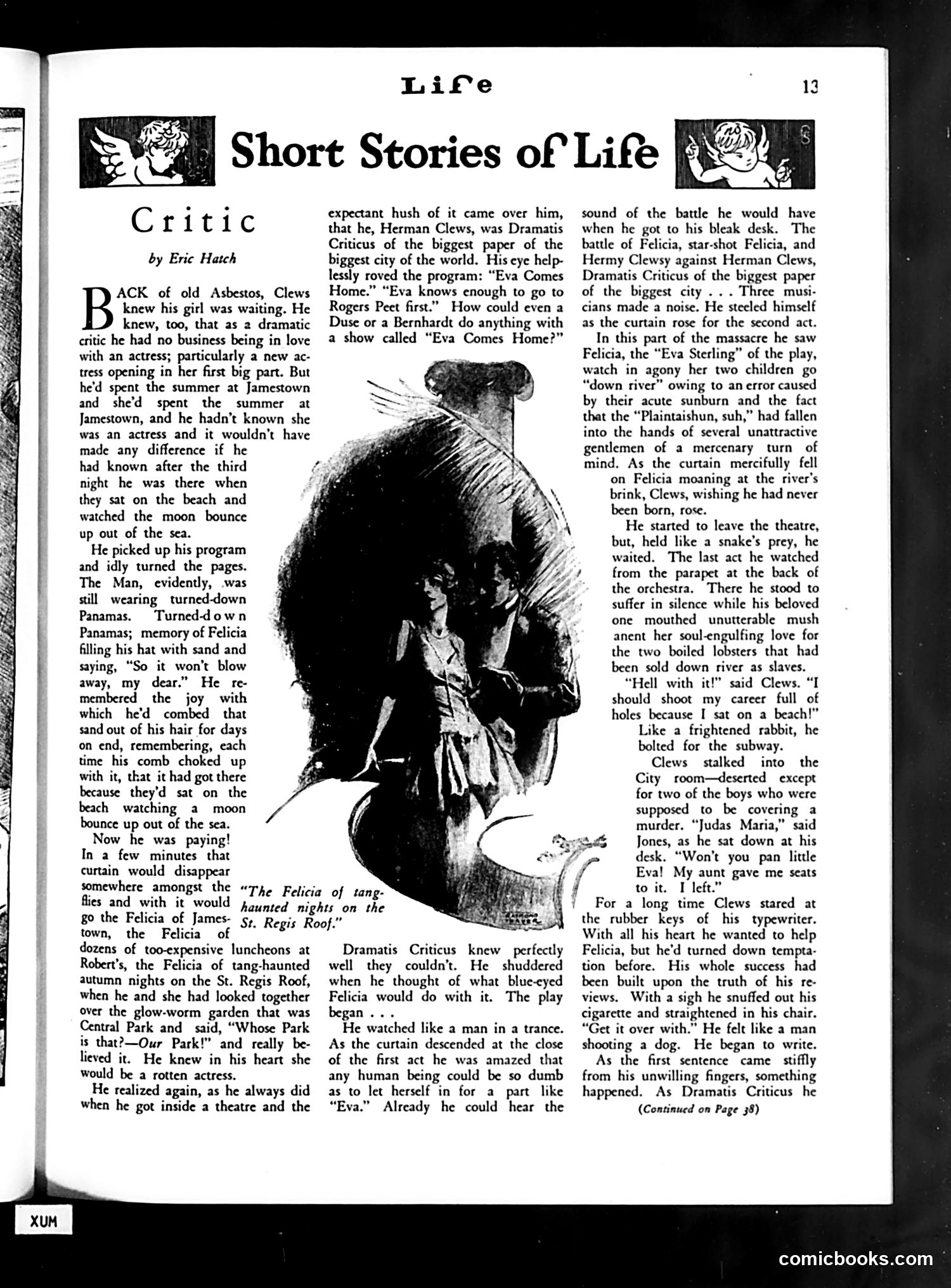
This is a short story rather than a political cartoon. The narrative follows Back Asbestos Clews, a dramatic critic who dismisses a new actress in her debut theater role. Upon seeing the program, he learns she is "Eva," prompting him to recall a summer romance with a woman by that name from Jamestown. The story satirizes theater critics—their pretension, poor memory, and capacity for self-deception. Clews initially judges the performance harshly while emotionally conflicted, eventually realizing he cannot remain objective. The illustration depicts the actress (captioned as haunted by memories) in a dramatic theatrical pose, emphasizing the emotional stakes underlying critical judgment and nostalgia.
📄 Transcribed text from this page (OCR, searchable)
Machine-transcribed from the original scan — historical spelling and the odd misread are preserved.
Life Short Stories of Life by Eric Hatch ACK of old Asbestos, Clews knew his girl was waiting. He knew, too, that as 2 dramatic critic he had no business being in love with an actress; particularly a new ac- tress opening in her first big part. But he'd spent the summer at Jamestown and she’d spent the summer at Jamestown, and he hadn’t known she was an actress and it wouldn't have made any difference if he had known after the third night he was there when they sat on the beach and watched the moon bounce up out of the sea. He picked up his program and idly turned the pages. The Man, evidently, .was sill wearing turned-down Panamas. Turned-down Panamas; memory of Felicia filling his hat with sand and saying, “So it won't blow away, my dear.” He re- membered the joy with which he'd combed that sand out of his hair for days on end, remembering, each time his comb choked up with it, that it had got there because they'd sat on the beach watching a moon bounce up out of the sea. Now he was paying! In a few minutes that curtain would disappear somewhere amongst the « flies and with it would go the Felicia of James- town, the Felicia of dozens of too-expensive luncheons at Robert's, the Felicia of tang-haunted autumn nights on the St. Regis Roof, when he and she had looked together over the glow-worm garden that was Central Park and said, “Whose Park is that?—Our Park!” and really be- lieved it. He knew in his heart she would be a rotten actress. He realized again, as he always did when he got inside a theatre and the expectant hush of it came over him, that he, Herman Clews, was Dramatis Criticus of the biggest paper of the biggest city of the world. His eye help- lessly roved the program: “Eva Comes Home.” “Eva knows enough to go to Rogers Peet first.” How could even a Duse or a Bernhardt do anything with a show called “Eva Comes Home?” The Felicia of tang- haunted nights on the St. Regis Roof.” Dramatis Criticus knew perfectly well they couldn't. He shuddered when he thought of what blue-cyed Felicia would do with it. The play began... He watched like a man in a trance. As the curtain descended at the close of the first act he was amazed that any human being could be so dumb as to let herself in for a part like “Eva.” Already he could hear the sound of the battle he would have when he got to his bleak desk. The battle of Felicia, star-shot Felicia, and Hermy Clewsy against Herman Clews, Dramatis Criticus of the biggest paper of the biggest city ... Three musi- cians made a noise. He steeled himself as the curtain rose for the second act. In this part of the massacre he saw Felicia, the “Eva Sterling” of the play, watch in agony her two children go “down river” owing to an error caused by their acute sunburn and the fact that the “Plaintaishun, suh,” had fallen into the hands of several unattractive gentlemen of a mercenary turn of mind. As the curtain mercifully fell on Felicia moaning at the river's brink, Clews, wishing he had never been born, rose. He started to leave the theatre, but, held like a snake’s prey, he waited. The last act he watched from the parapet at the back of the orchestra. There he stood to suffer in silence while his beloved one mouthed unutterable mush anent her soul-engulfing love for the two boiled lobsters that had been sold down river as slaves. “Hell with it!” said Clews. “I should shoot my career full of holes because I sat on a beach!” Like a frightened rabbit, he bolted for the subway. Clews stalked into the City room—deserted except for two of the boys who were supposed to be covering a murder, “Judas Maria,” said Jones, as he sat down at his desk. “Won't you pan little Eva! My aunt gave me seats to it. I left.” For a long time Clews stared at the rubber keys of his typewriter. With all his heart he wanted to help Felicia, but he'd turned down tempta- tion before. His whole success had been built upon the truth of his re- views. With a sigh he snuffed out his cigarette and straightened in his chair. “Get it over with.” He felt like a man shooting a dog. He began to write. As the first sentence came stiffly from his unwilling fingers, something happened. As Dramatis Criticus he (Continued on Page 38) comicbooks.com