
A complete issue · 36 pages · 1929
Life — May 24, 1929
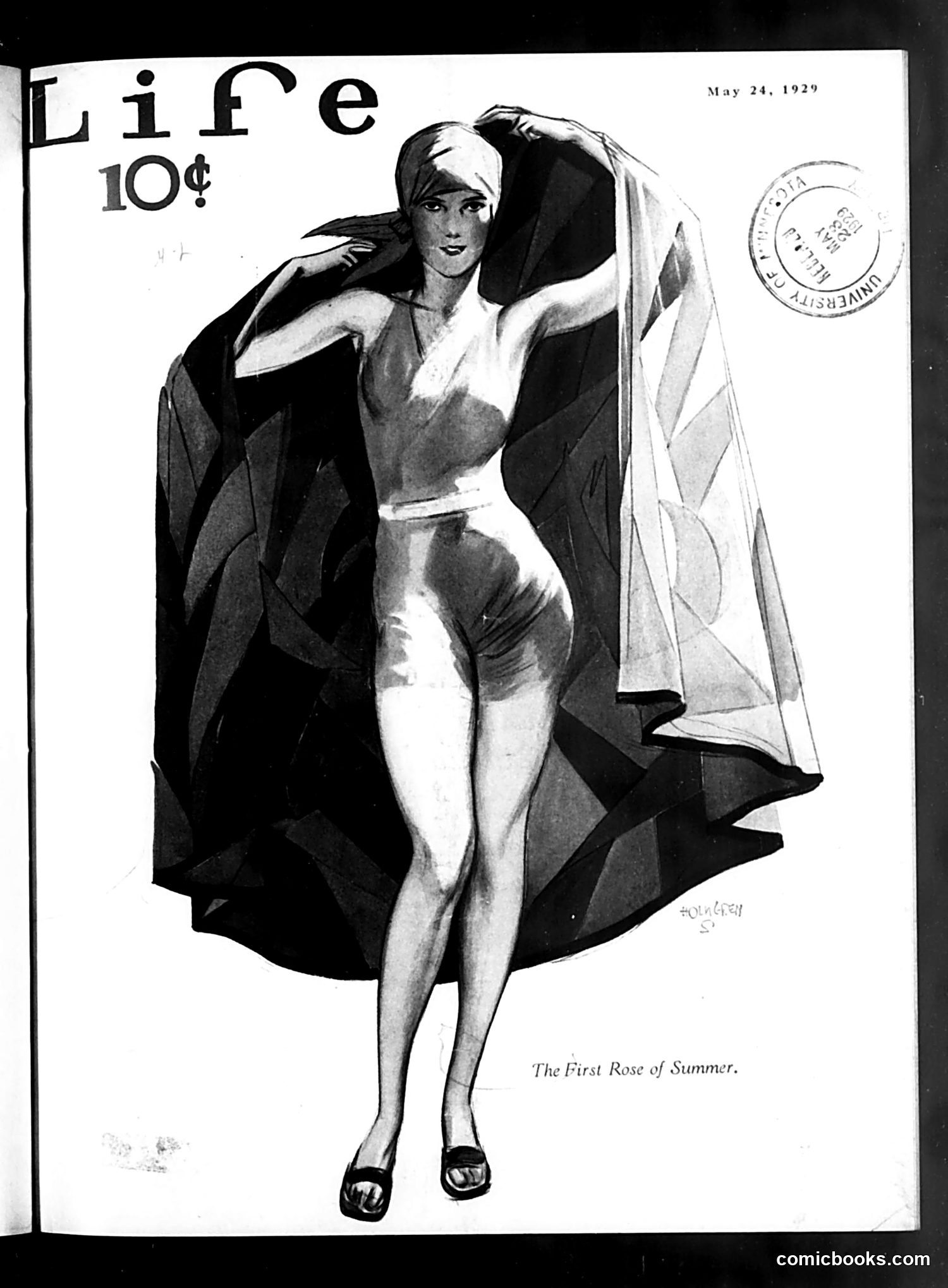
This May 24, 1929 Life magazine cover features an illustration titled "The First Rose of Summer." The image depicts a stylishly dressed woman in 1920s fashion—short cloche hat, form-fitting dress with decorative sash, and dramatic flowing cape or coat. She strikes a confident, theatrical pose with hands raised to her head. The caption's reference to "the first rose of summer" appears to be a playful literary allusion (likely to the Irish song "The Last Rose of Summer"), suggesting themes of springtime renewal and femininity. The illustration celebrates contemporary women's fashion and the glamorous "modern woman" aesthetic of the Jazz Age, reflecting 1920s cultural attitudes toward female beauty, style, and confidence. This is primarily a fashion-focused cover illustration rather than political satire.
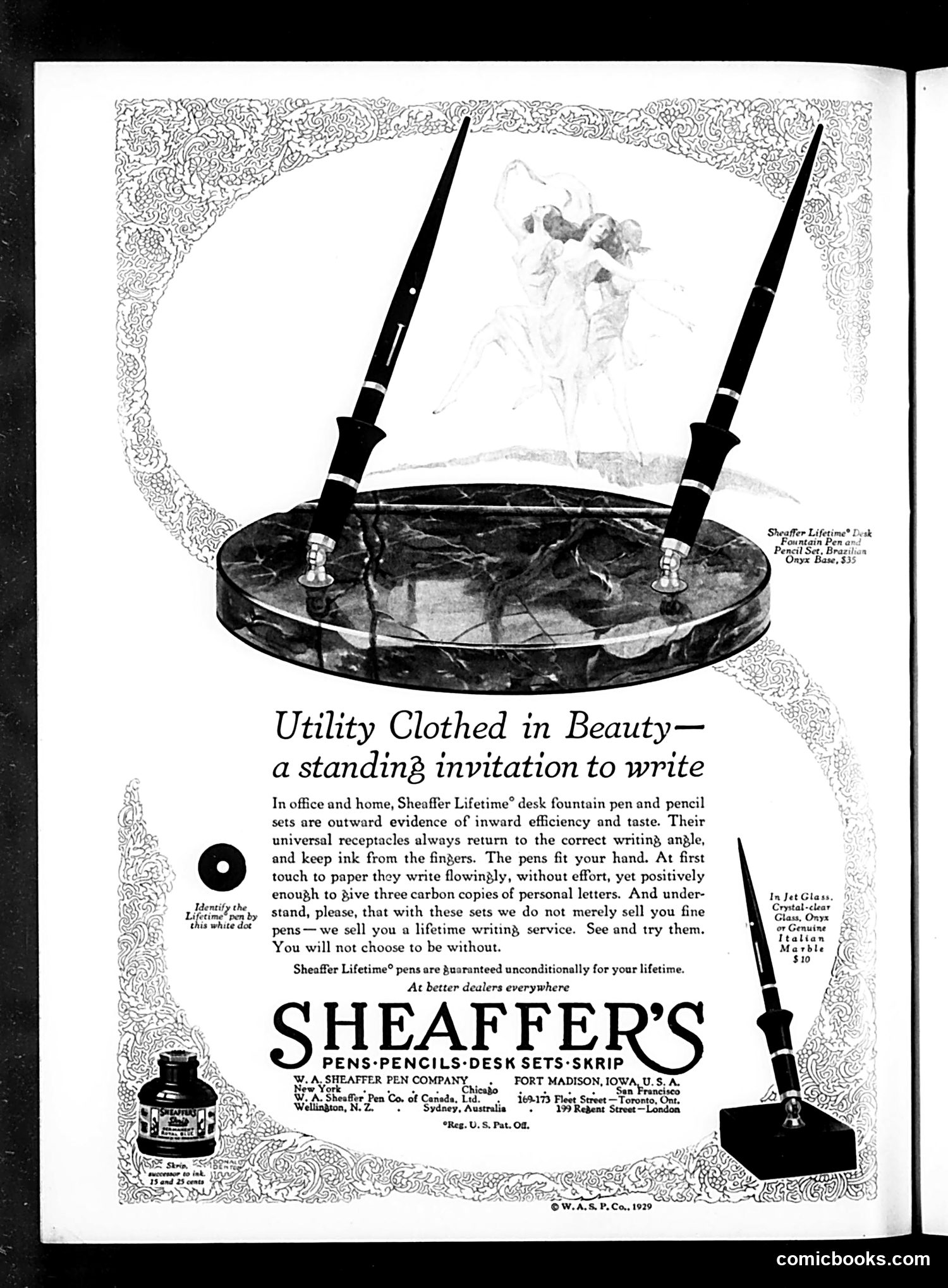
This page is primarily **advertising, not editorial content or satire**. It's a Sheaffer pen and pencil advertisement from 1929, emphasizing the lifetime guarantee and quality of their writing instruments. The ad uses decorative Art Deco border design and displays a marble desk set with two black fountain pens. The sketch above shows a portrait (unclear who), likely meant to suggest that sophisticated, cultured people use Sheaffer products. The tagline "Utility Clothed in Beauty" appeals to consumers seeking both functionality and aesthetic refinement. The copy emphasizes practical benefits: correct writing angle, preventing ink smudges, and a lifetime warranty. **This is not political satire**—it's a straightforward vintage advertisement targeting educated professionals and affluent consumers.
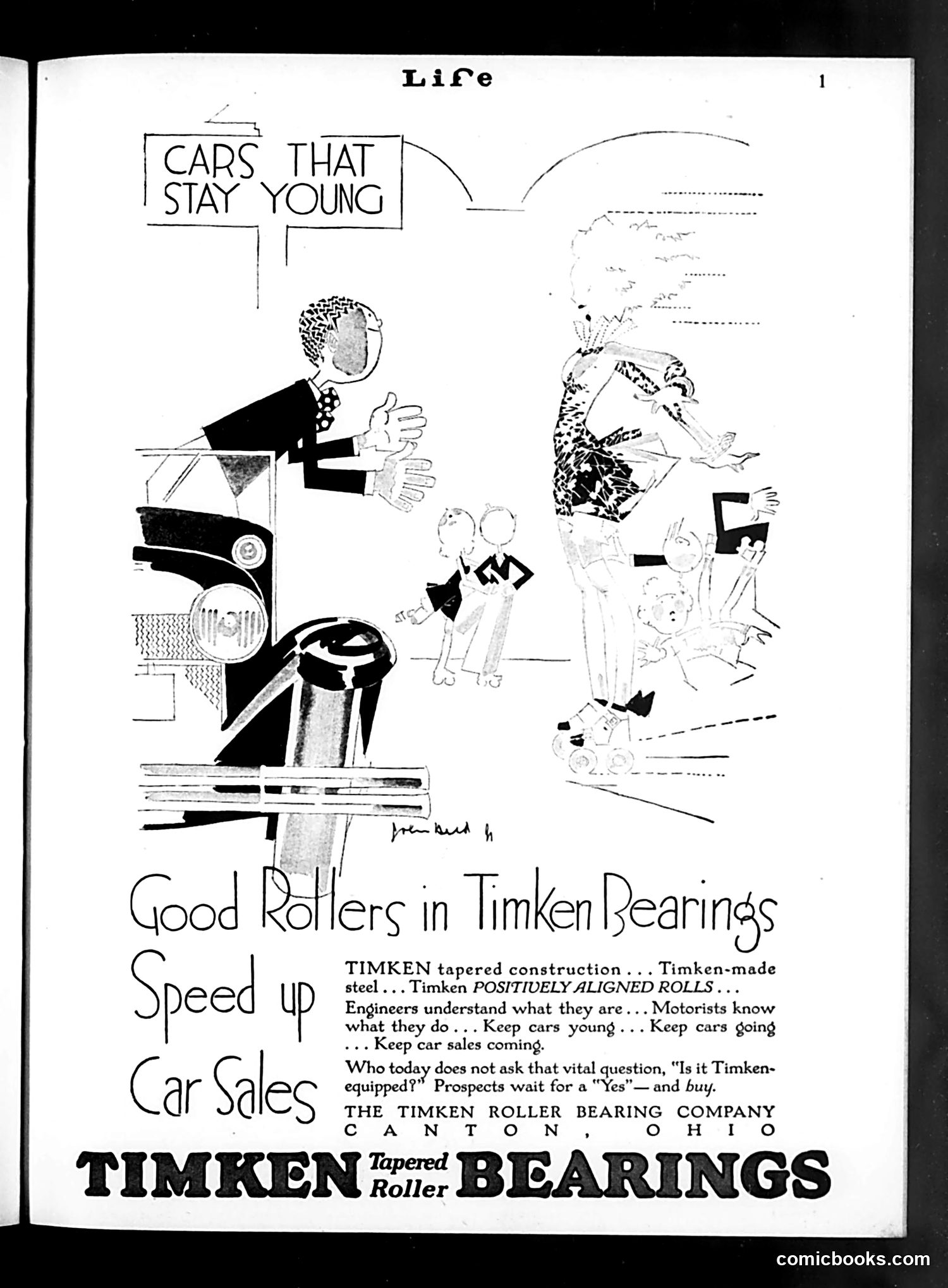
This is primarily a **Timken Roller Bearings advertisement**, not political satire. The page illustrates the company's marketing slogan "Cars That Stay Young" through cartoon imagery. The visual shows stylized figures representing different car owners and vehicles, with the text emphasizing that Timken bearings keep automobiles running longer and performing better—thus keeping "car sales coming" through repeat purchases and customer satisfaction. The advertisement targets engineers and motorists by claiming Timken's "positively aligned rolls" and "tapered construction" represent superior engineering. The cartoon style was typical 1920s-30s commercial art, using whimsical characters to communicate industrial/mechanical concepts to general audiences. This is commercial messaging, not political commentary.
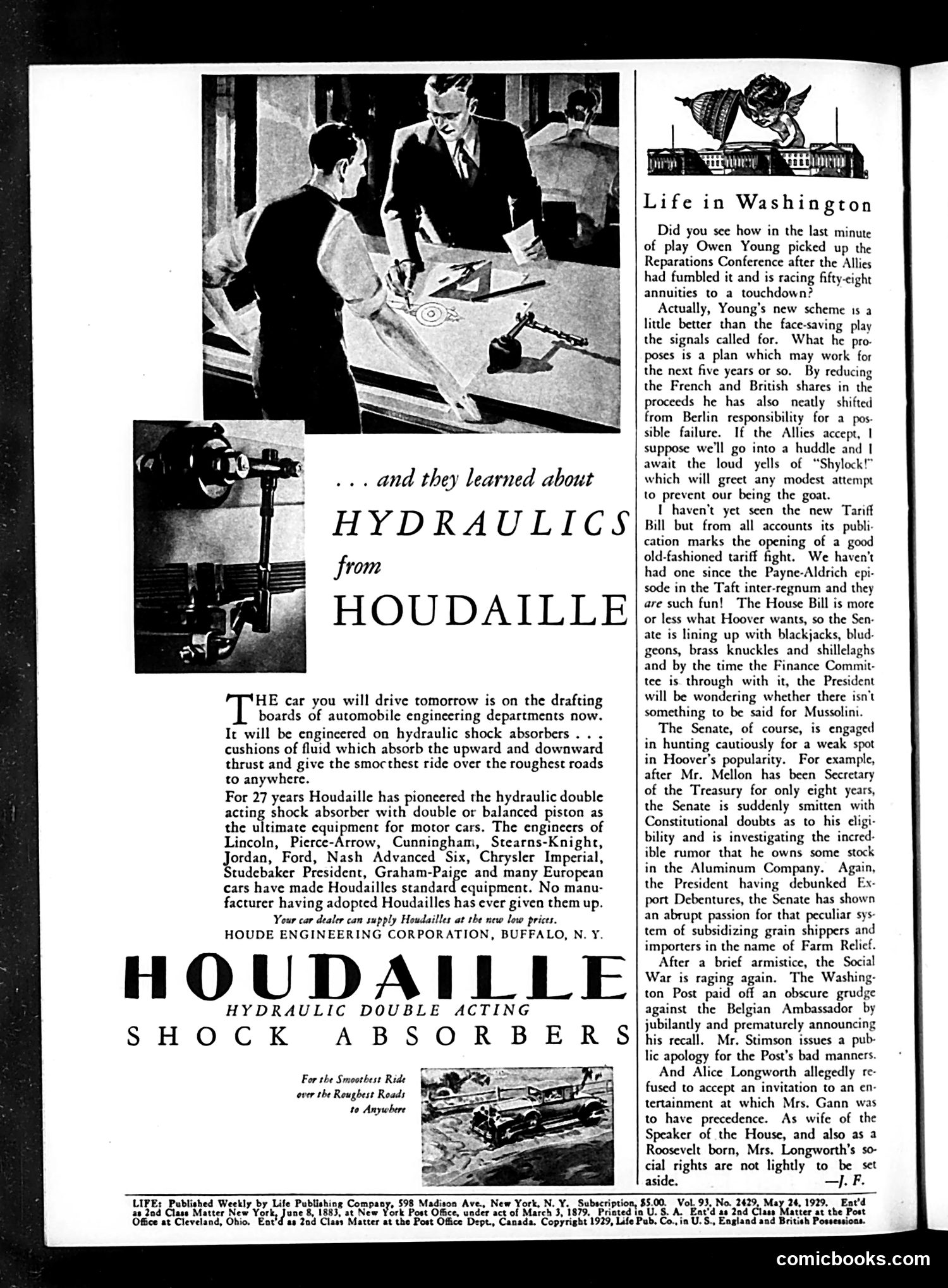
This page is primarily a **Houdaille automotive advertisement** for hydraulic shock absorbers, occupying roughly two-thirds of the content. The ad features technical diagrams and photographs of car components, claiming Houdaille technology has been adopted by Lincoln, Pierce-Arrow, and other manufacturers. The remaining third contains a "Life in Washington" column by J.F., which satirizes contemporary political matters: Owen Young's reparations proposal, tariff debates, the Senate's scrutiny of Treasury Secretary Mellon, and social tensions involving Alice Longworth (Theodore Roosevelt's daughter and House Speaker's wife). The commentary is political gossip rather than visual satire—mocking Washington's infighting and political maneuvers during what appears to be the late 1920s economic and political tensions.
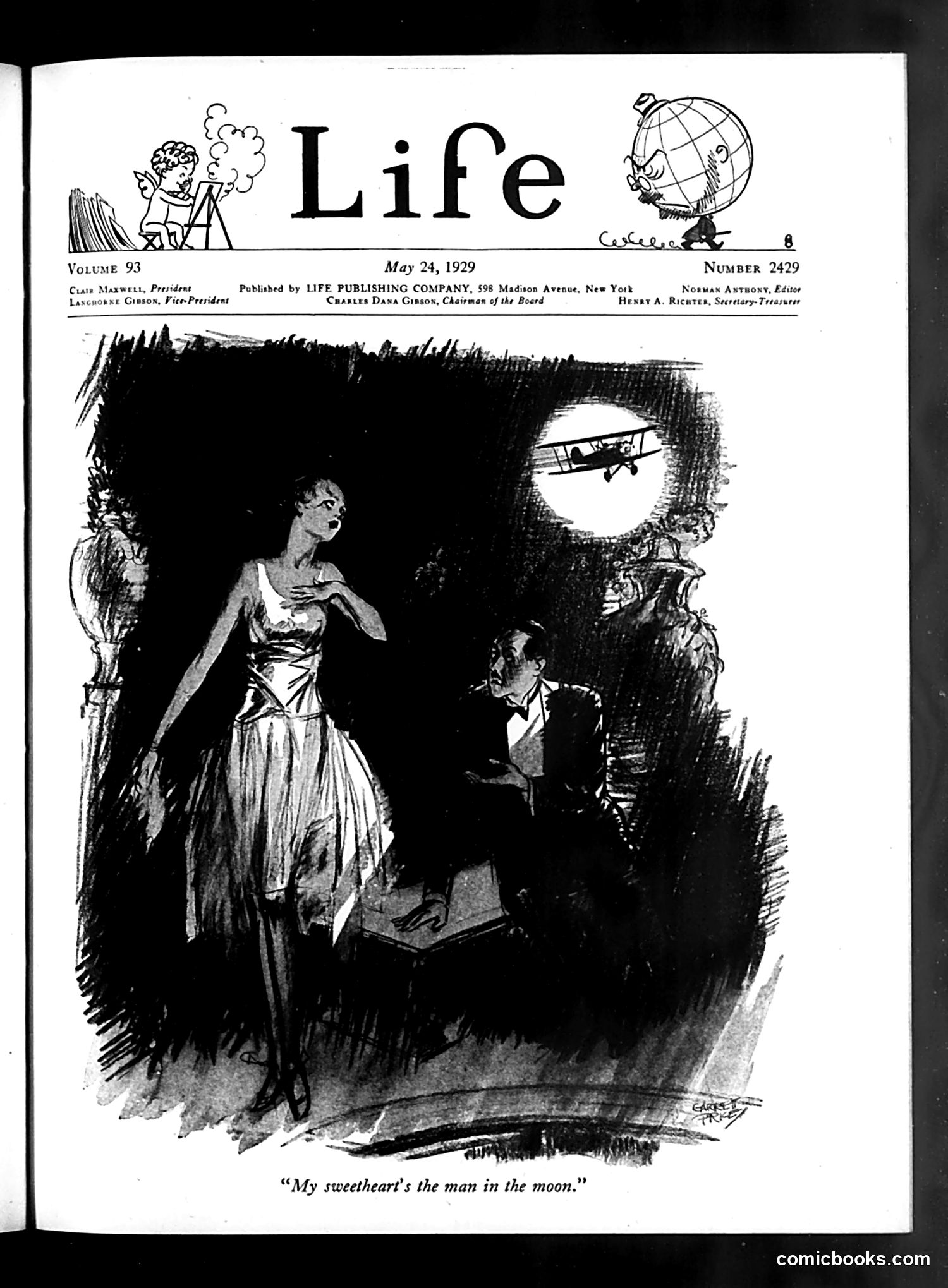
This is a romantic illustration rather than political satire. The cartoon depicts a woman in an evening gown gazing upward while a man in formal attire looks at her. An airplane flies across the moon in the background. The caption reads: "My sweetheart's the man in the moon." This is a sentimental love joke playing on the common 1920s romantic phrase "man in the moon"—but literalizes it by showing an actual airplane pilot flying across the lunar disk. The humor derives from the contrast between poetic romantic language and the era's fascination with modern aviation technology. It reflects how aviation had captured public imagination by the late 1920s, becoming incorporated even into traditional romance tropes.
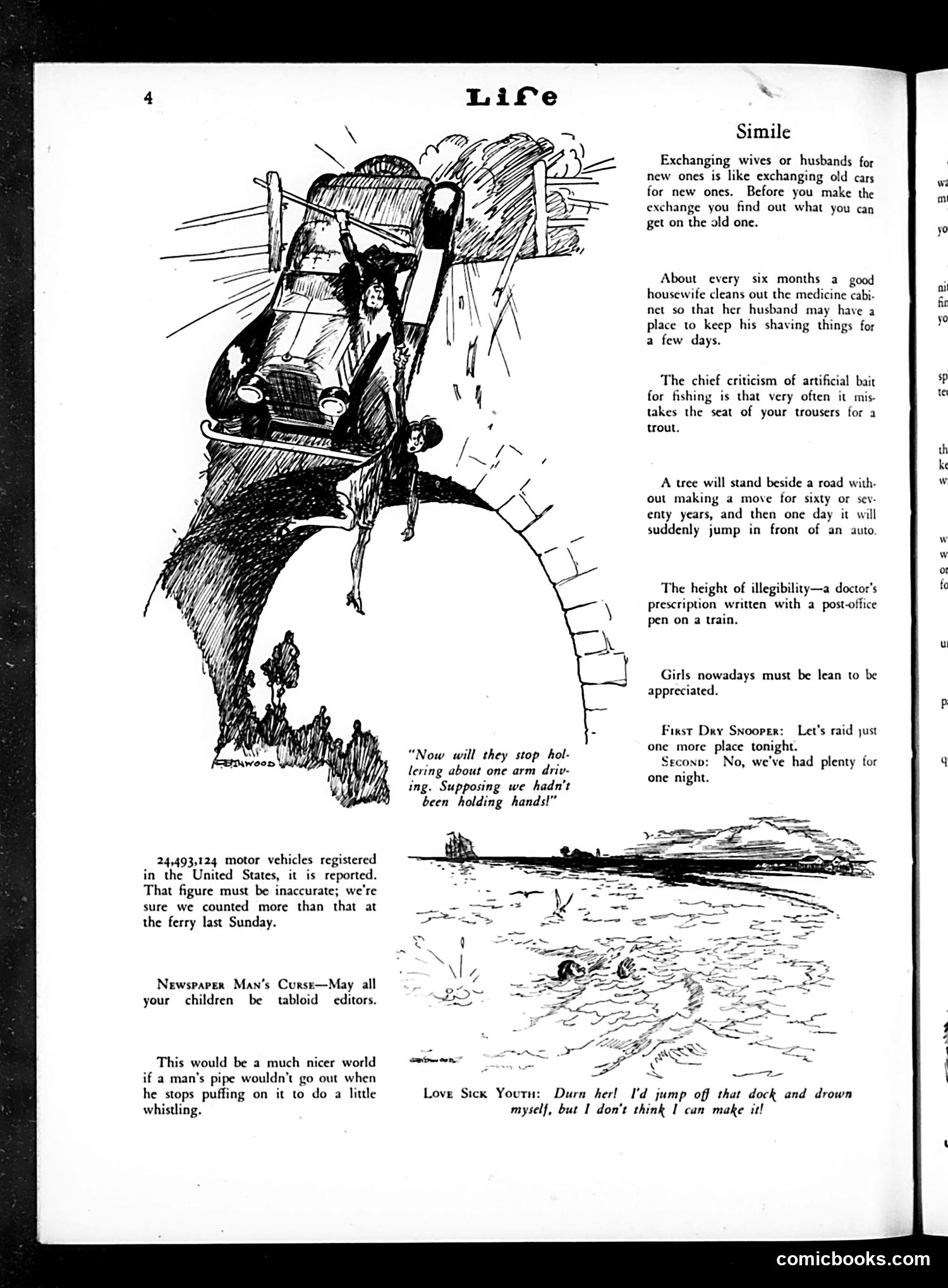
This page contains humor rather than political cartooning. The main cartoon depicts a car precariously balanced on a cliff edge, with the caption suggesting the occupants are worried about "one-arm driving" while in genuine danger of plunging off. The "Similes" section offers satirical social commentary on 1920s-30s American life: jokes about exchanging husbands like old cars, housewives cleaning medicine cabinets, artificial fishing bait, and trees jumping in front of automobiles. The bottom illustration shows a "Love Sick Youth" on a dock, threatening to jump—a melodramatic romantic reference typical of period humor. Overall, this represents Life's satirical commentary on contemporary domestic life, automobiles (then novel), and romantic sentimentality—not political satire.
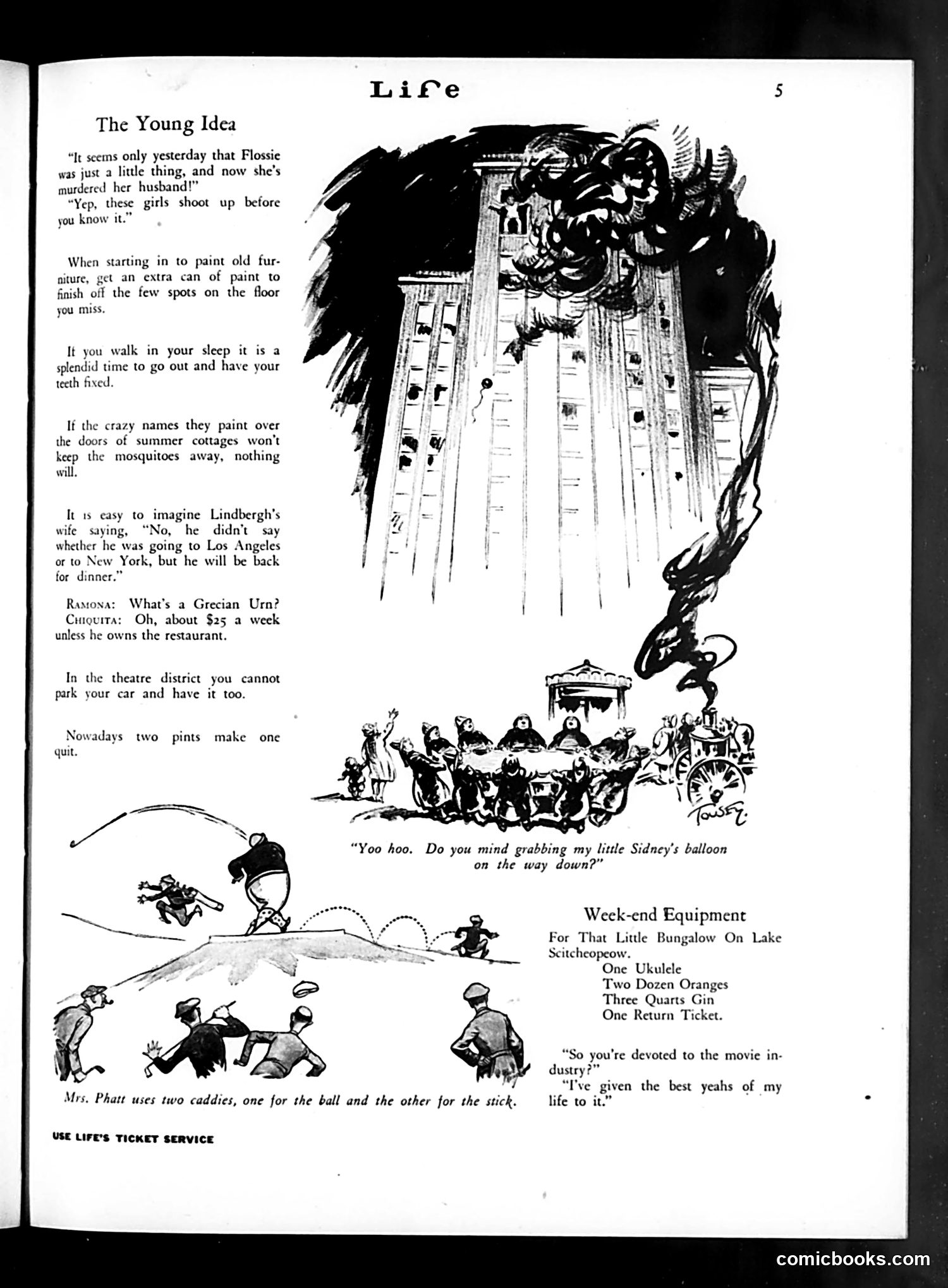
This page contains humorous observations and cartoons about everyday life rather than political satire. **"The Young Idea"** section offers satirical tips: painting furniture, sleepwalking to get teeth fixed, painting cottage doors to repel mosquitoes, and commentary on Lindbergh's wife (likely referencing Charles Lindbergh's famous aviator status and his wife's expectation he'd return home for dinner despite travels). **"Week-end Equipment"** lists ironically minimal supplies for a lake bungalow: one ukulele, oranges, gin, and a return ticket—mocking middle-class leisure culture's pretenses. The cartoons show domestic and recreational scenes: children playing, fishing, and beach activities. The text beneath references "Mrs. Phatt uses two caddies"—satirizing golf culture and social status markers. The overall theme mocks 1920s-30s American middle-class aspirations and leisure activities through gentle, observational humor.
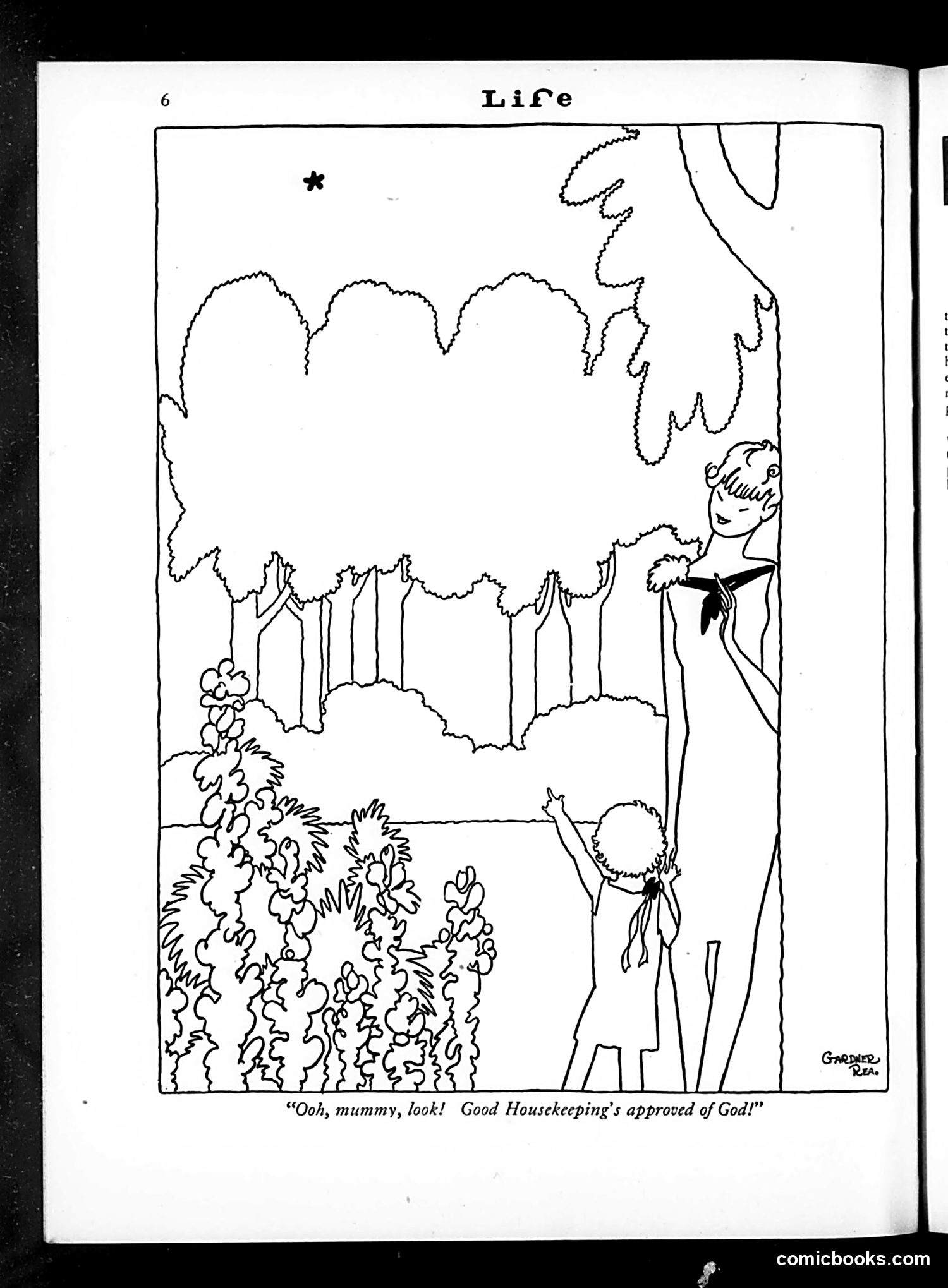
This single-panel cartoon shows a mother and child in a garden viewing attractive flowering plants. The child exclaims: "Ooh, mummy, look! Good Housekeeping's approved of God!" The satire targets **Good Housekeeping magazine's "Seal of Approval"** — a real endorsement label the magazine used to certify products as trustworthy. The joke transposes this commercial certification onto nature itself, suggesting that Good Housekeeping's approval has become so ubiquitous and influential that it now apparently validates even divine creation. This mocks both the magazine's marketing power and consumer culture's reliance on such branded endorsements. The humor lies in the absurdity of needing corporate approval for naturally occurring beauty — a critique of commercialism's infiltration into everyday life and perception.
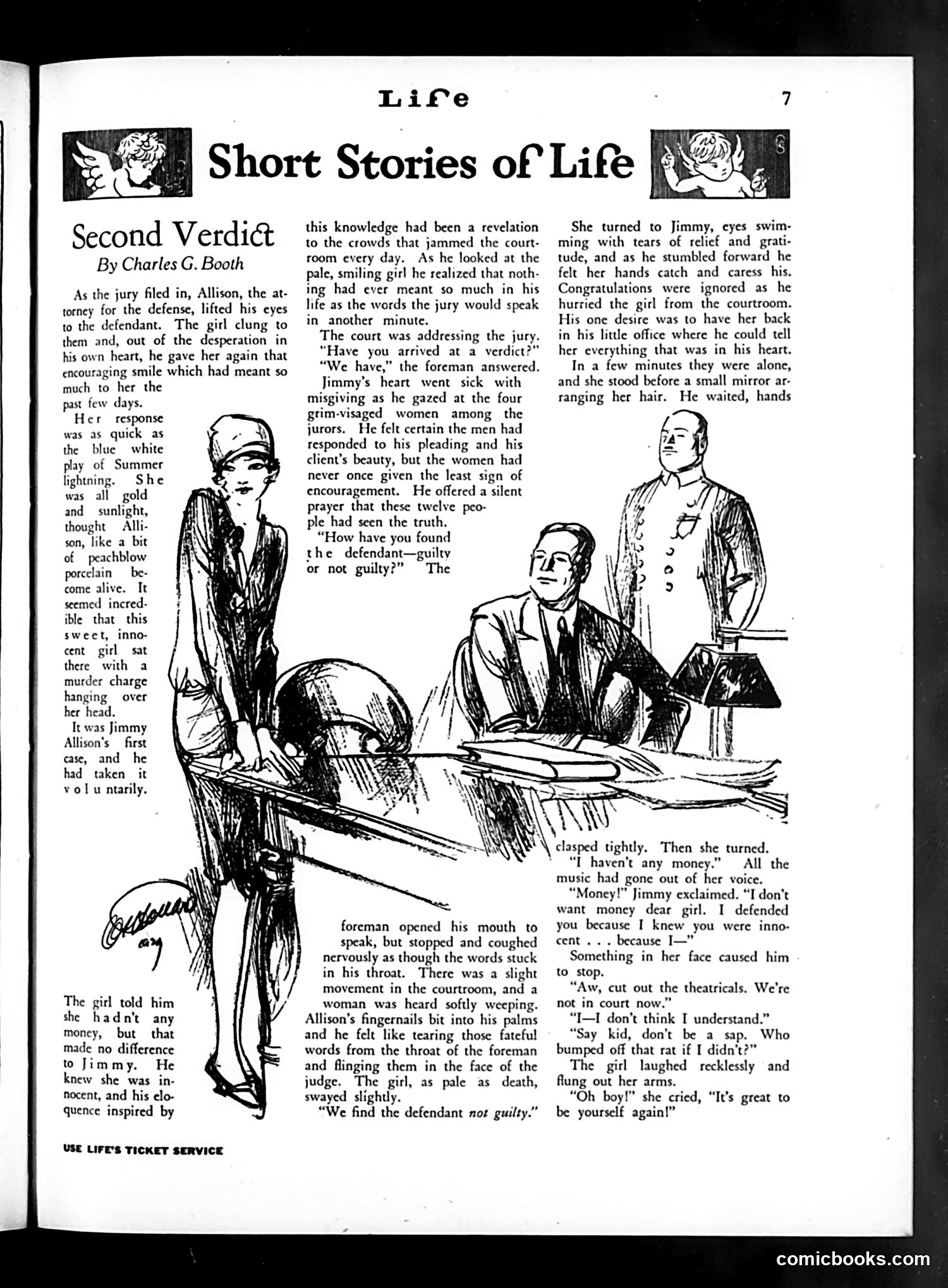
This is a short story, not a political cartoon. It depicts a courtroom scene where Jimmy Allison, a defense attorney, has just won an acquittal for a young woman accused of murder. The narrative focuses on the emotional irony of the verdict: though legally found "not guilty," Jimmy realizes the woman *is* actually guilty—a revelation that troubles him deeply. The story explores the gap between legal innocence and moral truth, and Jimmy's conflicted feelings about having successfully defended someone he now knows committed the crime. The illustrations show the courtroom setting, the young woman's reactions, and Jimmy's internal struggle with this uncomfortable "second verdict" of conscience versus law.
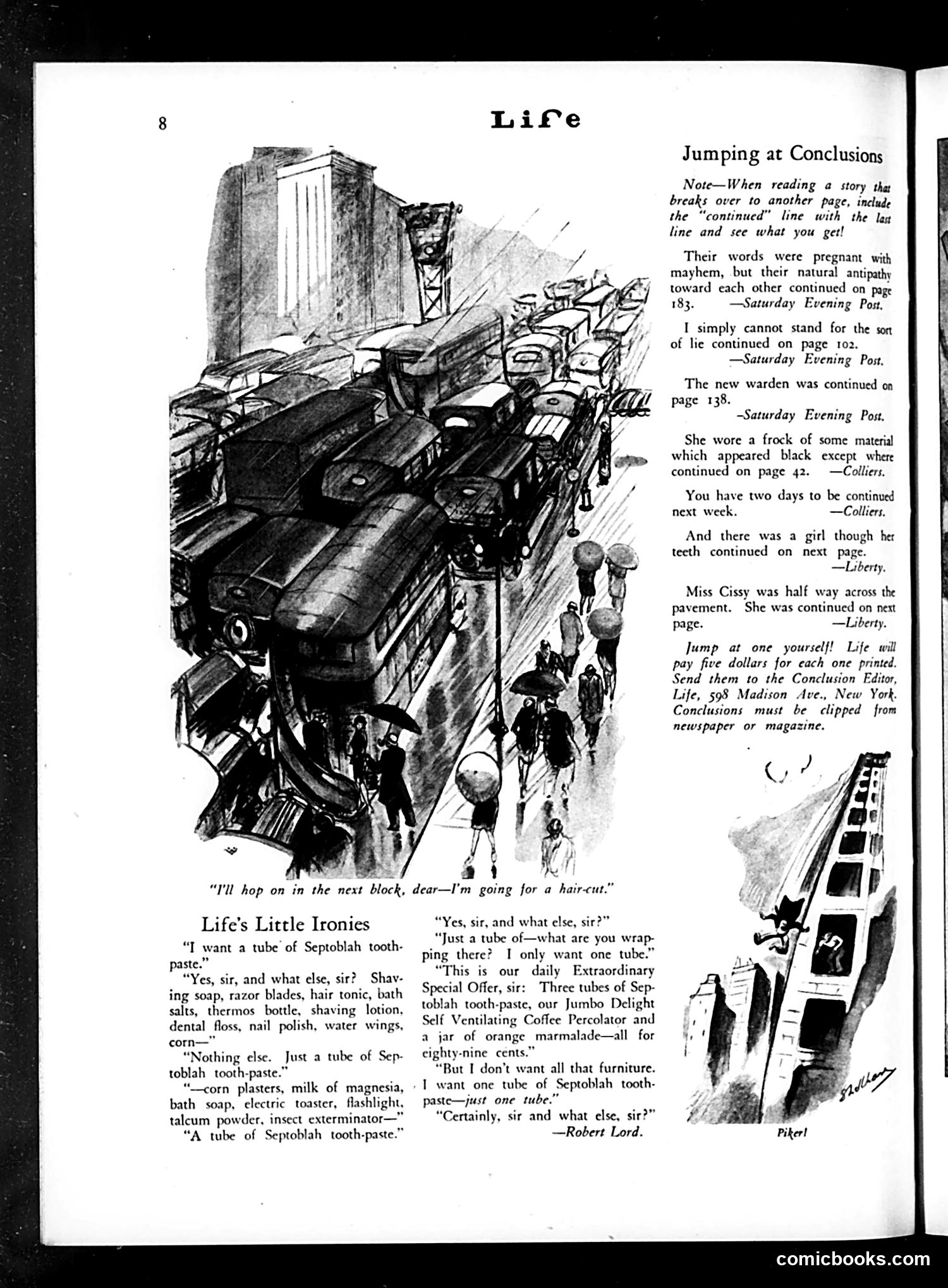
This page satirizes aggressive advertising and consumer culture through a fake product called "Septoblah toothpaste." The humor works by showing an increasingly absurd sales pitch: a customer asks for toothpaste, but the salesman keeps adding ridiculous bonus items (shaving soap, bath salts, corn plasters, talc powder, etc.) — all supposedly included for just one tube. The satire mocks both deceptive marketing tactics of the era that bundled unwanted items with purchases, and consumer gullibility. The customer's final desperate plea — wanting *just* toothpaste — underscores how corporations exploited "special offers" to sell surplus inventory. The byline attribution to "Robert Lord" suggests this is humorous fiction rather than actual advertising.
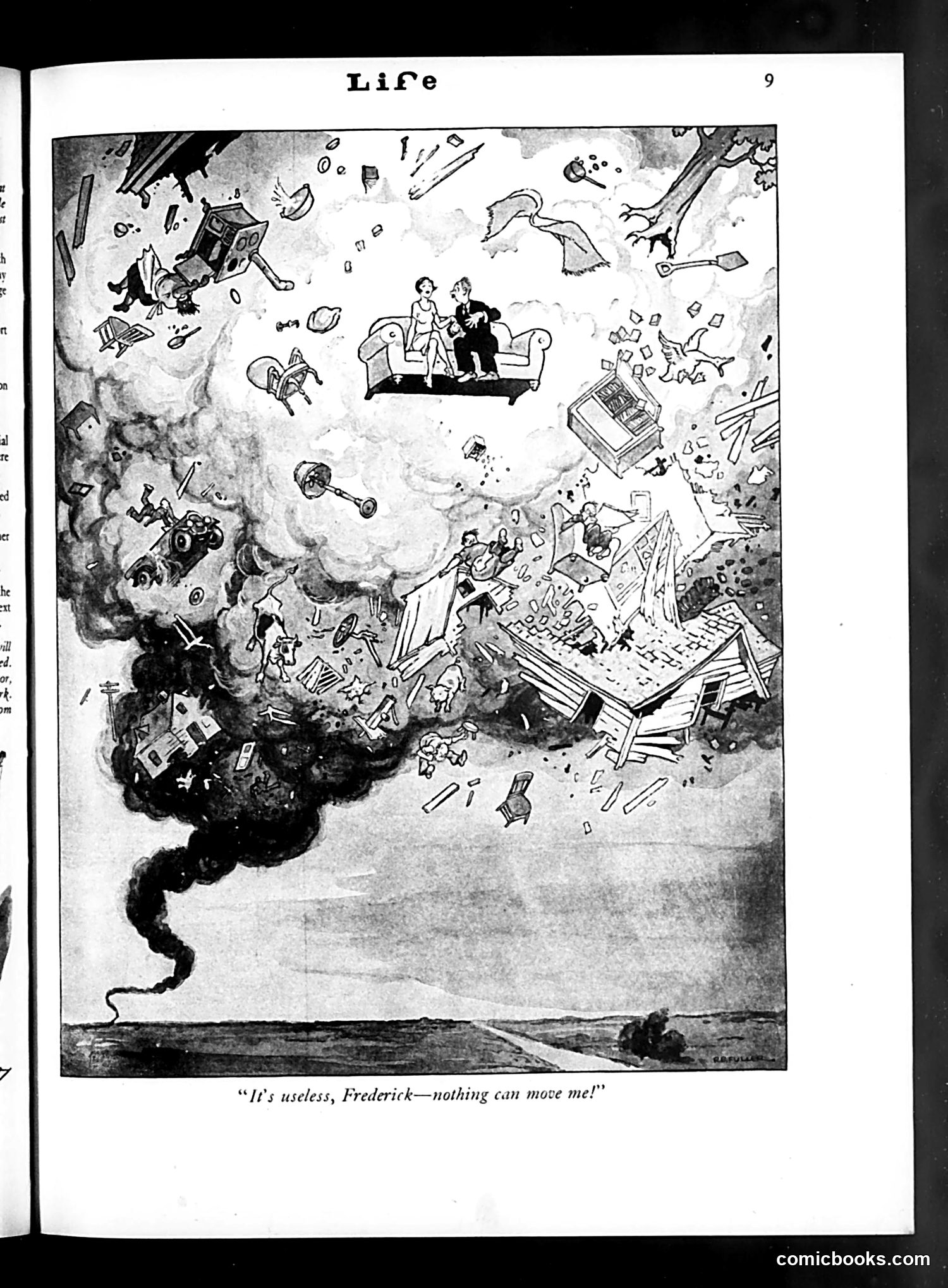
This satirical cartoon depicts chaos erupting from a massive explosion or catastrophe at ground level. Debris—furniture, books, toys, and household items—swirls upward in a violent tornado. At the calm center floats a couple on a couch, seemingly unaffected by the destruction surrounding them. The caption reads: **"It's useless, Frederick—nothing can move me!"** The satire targets domestic complacency or marital indifference. The joke suggests that even catastrophic upheaval cannot disturb this couple's apathetic relationship—they remain stubbornly unmoved by chaos itself. It's a commentary on emotional numbness or resignation, particularly within marriage, using hyperbolic visual contrast between total destruction and utter passivity to emphasize the absurdity of their detachment.
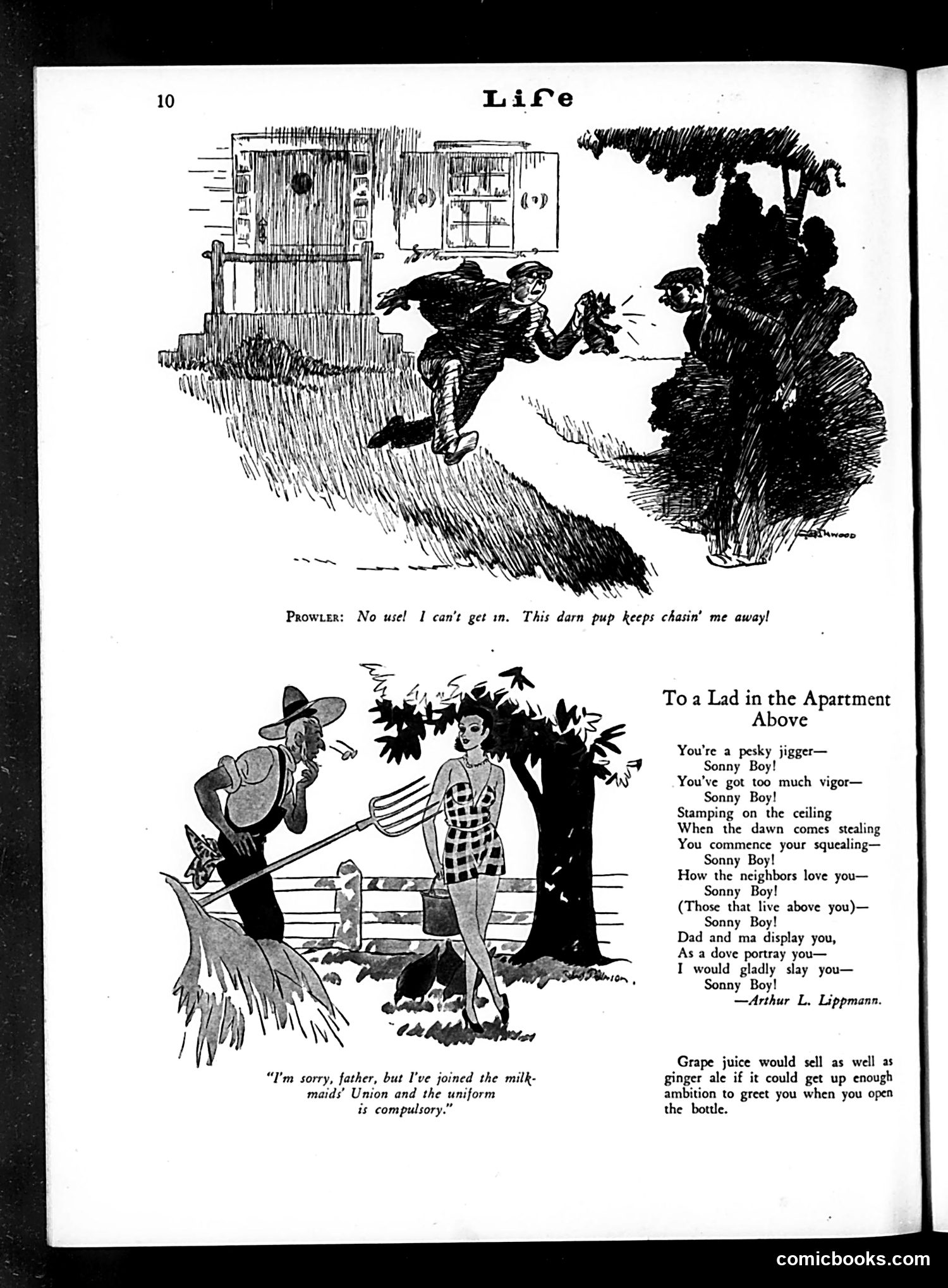
**Top Cartoon:** A man kicks a small dog while trying to enter a building. The caption reads "No use! I can't get in. This darn pup keeps chasin' me away!" This appears to be satirizing apartment life—specifically the frustration of dealing with hostile dogs when trying to visit or enter buildings. **Bottom Cartoon:** A man in old-fashioned clothing confronts a young woman in swimwear near a tree. She responds: "I'm sorry, father, but I've joined the milk-maids' Union and the uniform is compulsory." This satirizes labor unions and their newfound power, using absurdist humor by placing union membership in an unlikely rural context. **Right Column:** A humorous poem mocking a noisy neighbor ("Sonny Boy") in an apartment above, capturing urban apartment frustrations.
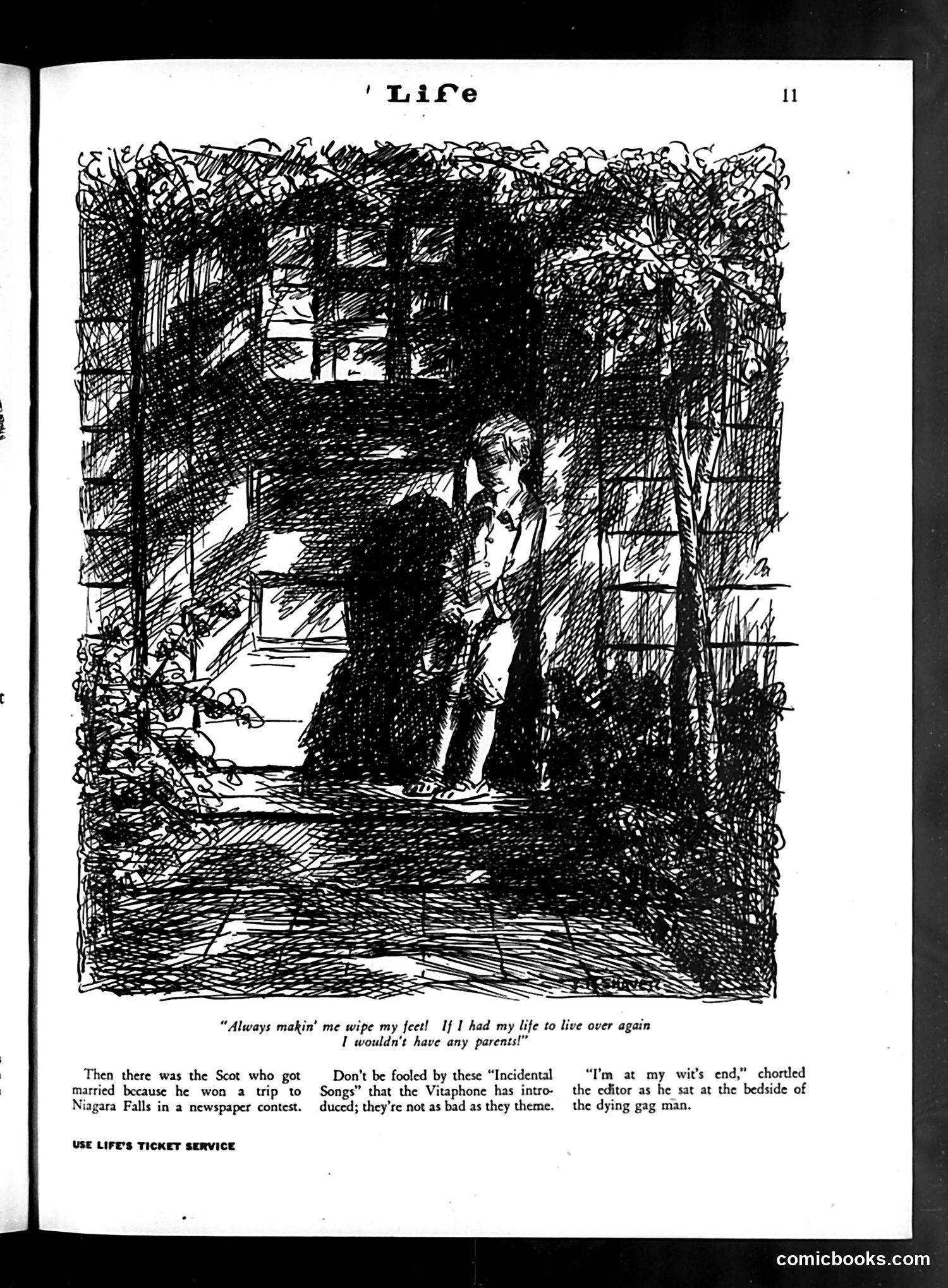
This page features a humorous illustration of a domestic scene in a vine-covered garden or porch. A man sits reading while a woman stands nearby, with the caption: "Always makin' me wipe my feet! If I had my life to live over again I wouldn't have any parents!" Below are three brief satirical anecdotes about marriage, including references to a Scotsman who won a trip to Niagara Falls through a newspaper contest, and a dismissive editorial comment about "Incidental Songs" on the Vitaphone (an early sound film technology). The humor targets domestic routine, parental authority, and marital frustration—common themes in early 20th-century American comedy. The Vitaphone reference dates this to the late 1920s when synchronized sound was still novel.
This page from *Life* magazine presents a collection of brief satirical news items rather than political cartoons. The header illustration shows a row of caricatured figures in period dress standing before a house, establishing a "domestic life" theme. The content mocks various social absurdities of the era: - A Pennsylvania man jailed for Sunday fishing (blue law violation) - A New York scientist's claim that mechanics are the nation's most intelligent class - Prohibition-era intoxication arrests and enforcement efforts - A woman seeking a prison sentence delay for a permanent wave hairdo - Motorists objecting to religious highway signs - An "insulter" profession hired to humiliate film rivals The satire targets legal inconsistencies, social pretension, and Prohibition's enforcement, reflecting 1920s American anxieties about changing morality and government overreach.
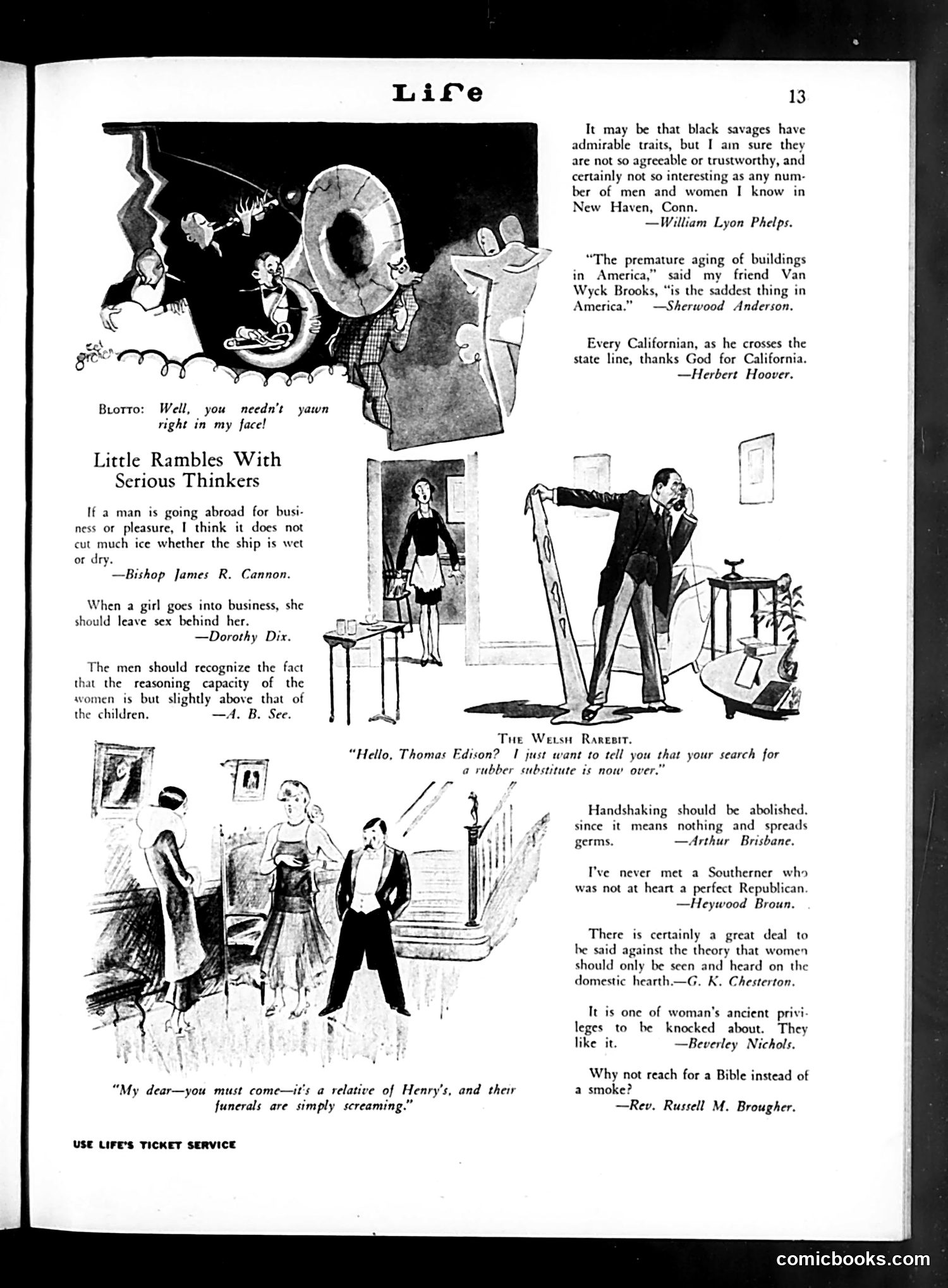
This page collects satirical quotes attributed to famous figures (William Lyon Phelps, Sherwood Anderson, Herbert Hoover, etc.) on contemporary social issues. The cartoons illustrate these quotes with humor: 1. **Top cartoon**: A man yawning while someone plays a large horn in his face—illustrating a quote about not needing to yawn. 2. **"The Welsh Rabbit"**: A man searching for a rubber substitute, referencing post-WWI material shortages and industrial innovation. 3. **Bottom cartoon**: A domestic crisis scene where a woman announces a relative's arrival, with "heraldry screaming"—likely satirizing social pretension or domestic chaos. The page mocks contemporary opinions on business, gender roles, and manners through humorous visual-text pairings typical of 1920s satirical magazines.
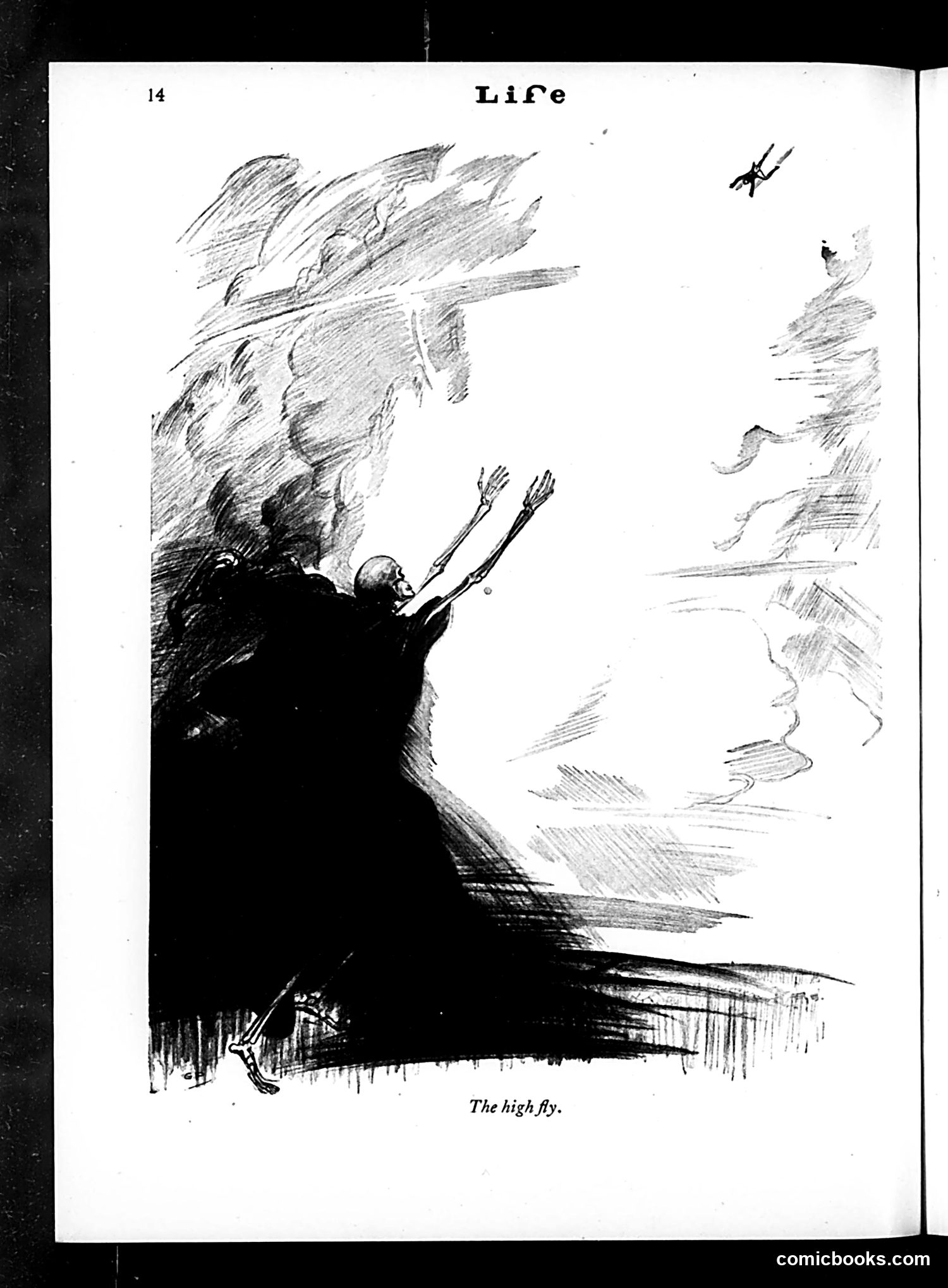
This political cartoon depicts a silhouetted figure in dark clothing struggling against powerful winds while attempting to fly. The figure holds ski poles and appears to be fighting against elements suggesting an uncontrollable force or disaster. Two birds fly above in the turbulent sky. The title "The High Fly" appears to be satirical commentary on ambition or overreach. The figure's apparent struggle suggests someone attempting something beyond their capability or control—likely referencing a political figure or public personality attempting an ambitious goal that backfired or proved disastrous. Without additional context about the specific publication date or political events referenced, the exact target of the satire remains unclear, though the imagery emphasizes the futility and danger of the endeavor depicted.
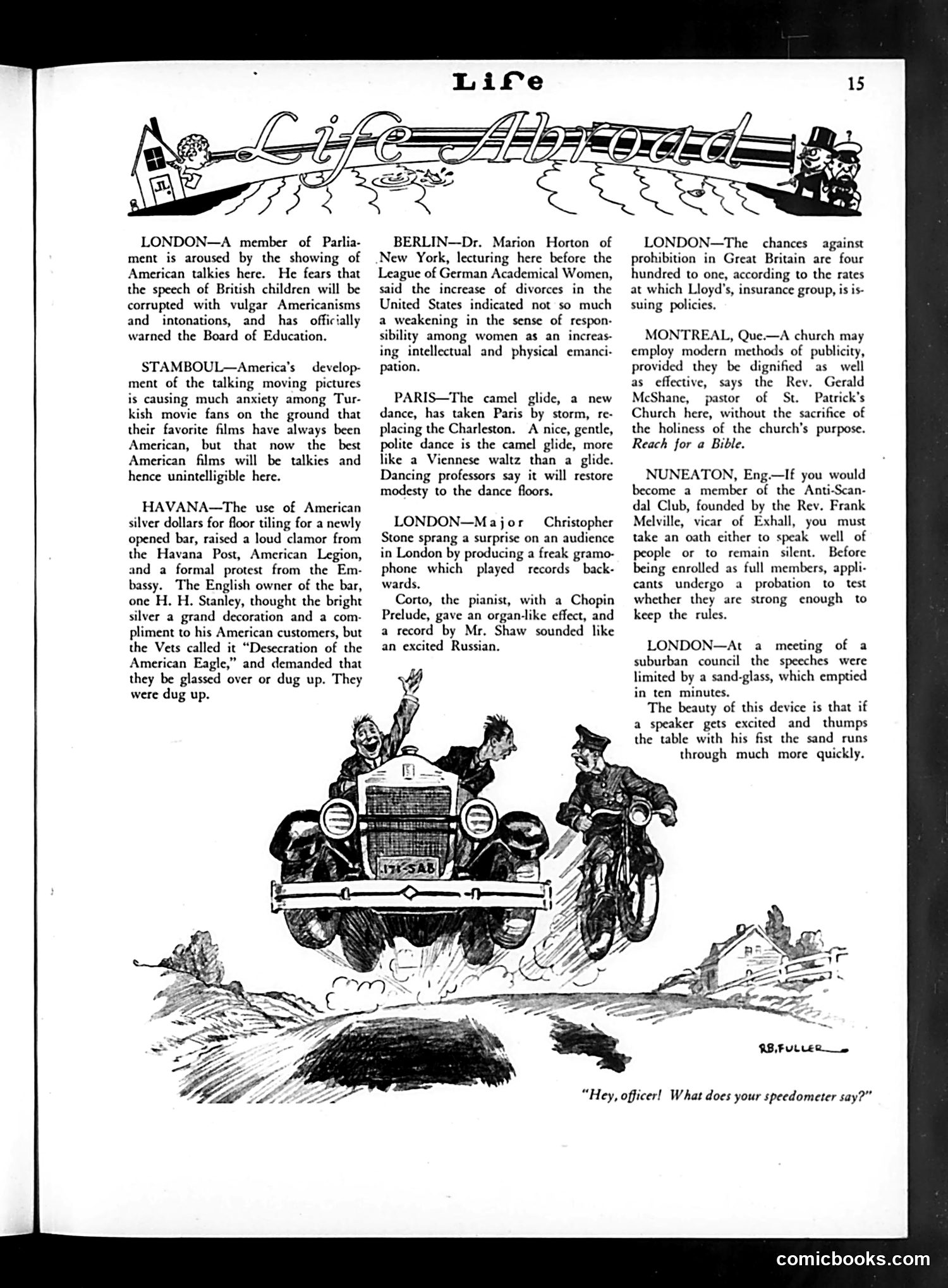
This page contains brief international news items with social commentary rather than a traditional political cartoon. The main illustration depicts a car airborne after hitting a pothole, with the caption "Hey, officer! What does your speedometer say?"—satirizing the contradiction between speed limits and dangerously poor road conditions. The news briefs mock various contemporary concerns: American "talkies" (talking pictures) corrupting British children with slang; Turkish anxiety about American cultural influence; and a bar in Havana that decorated itself to honor American patrons, only to be snubbed by them. The items together suggest anxieties about American cultural dominance and changing social values in the 1920s-30s era.
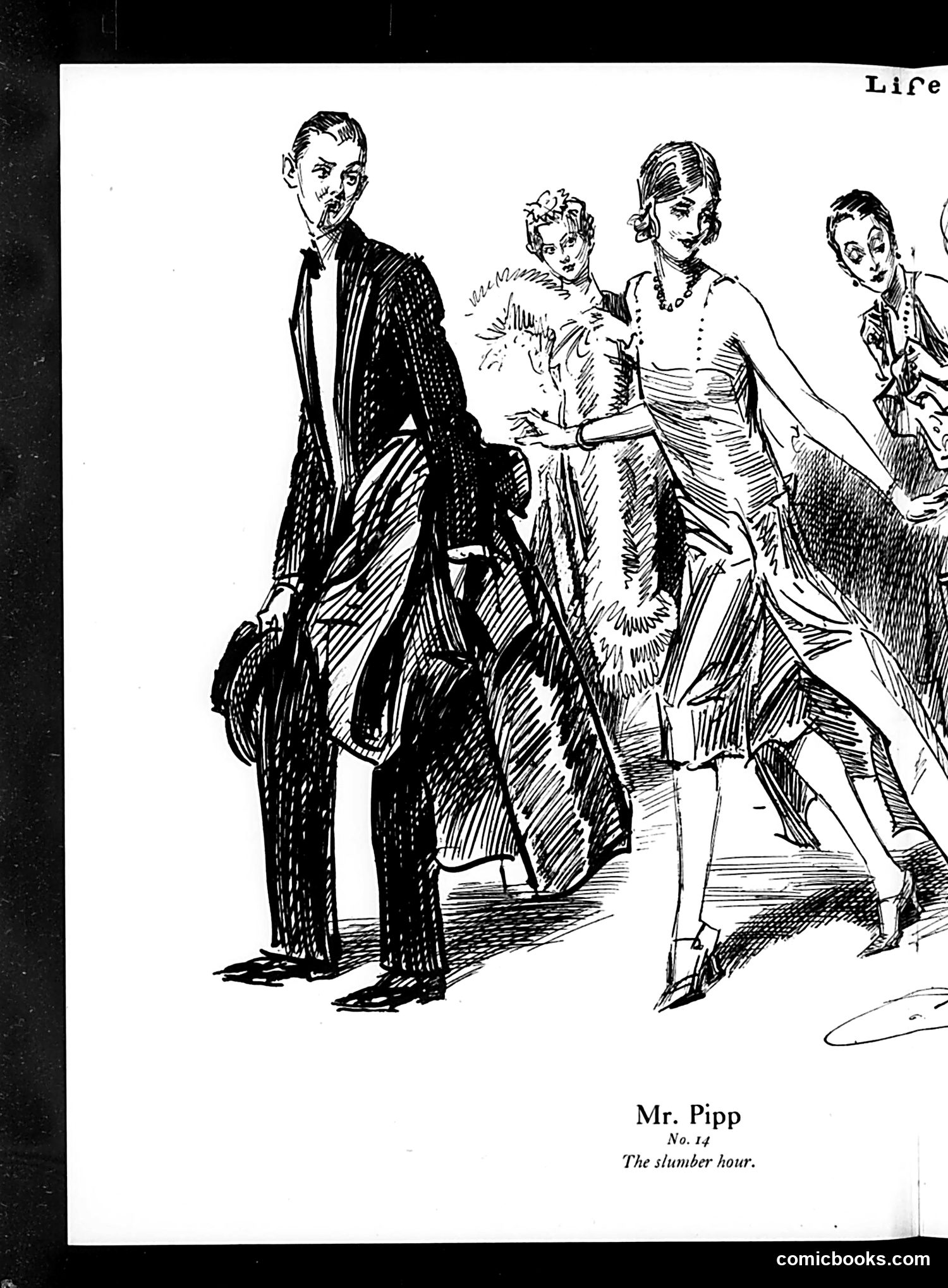
This appears to be a satirical illustration from *Life* magazine depicting a social scene labeled "Mr. Pipp, No. 14: The slumber hour." The drawing shows a well-dressed man in formal evening wear (tuxedo) standing somewhat stiffly among fashionably dressed women in 1920s-style evening gowns. The title "The slumber hour" likely contains ironic humor—the phrase suggests drowsiness or boredom, perhaps satirizing the social experience of formal evening gatherings or the character Mr. Pipp's demeanor at such events. The exaggerated, caricatured facial expressions and postures typical of *Life's* satirical style suggest this is mocking either social conventions of the era or a particular recognizable public figure. Without additional context identifying who "Mr. Pipp" represents, the specific target remains unclear.
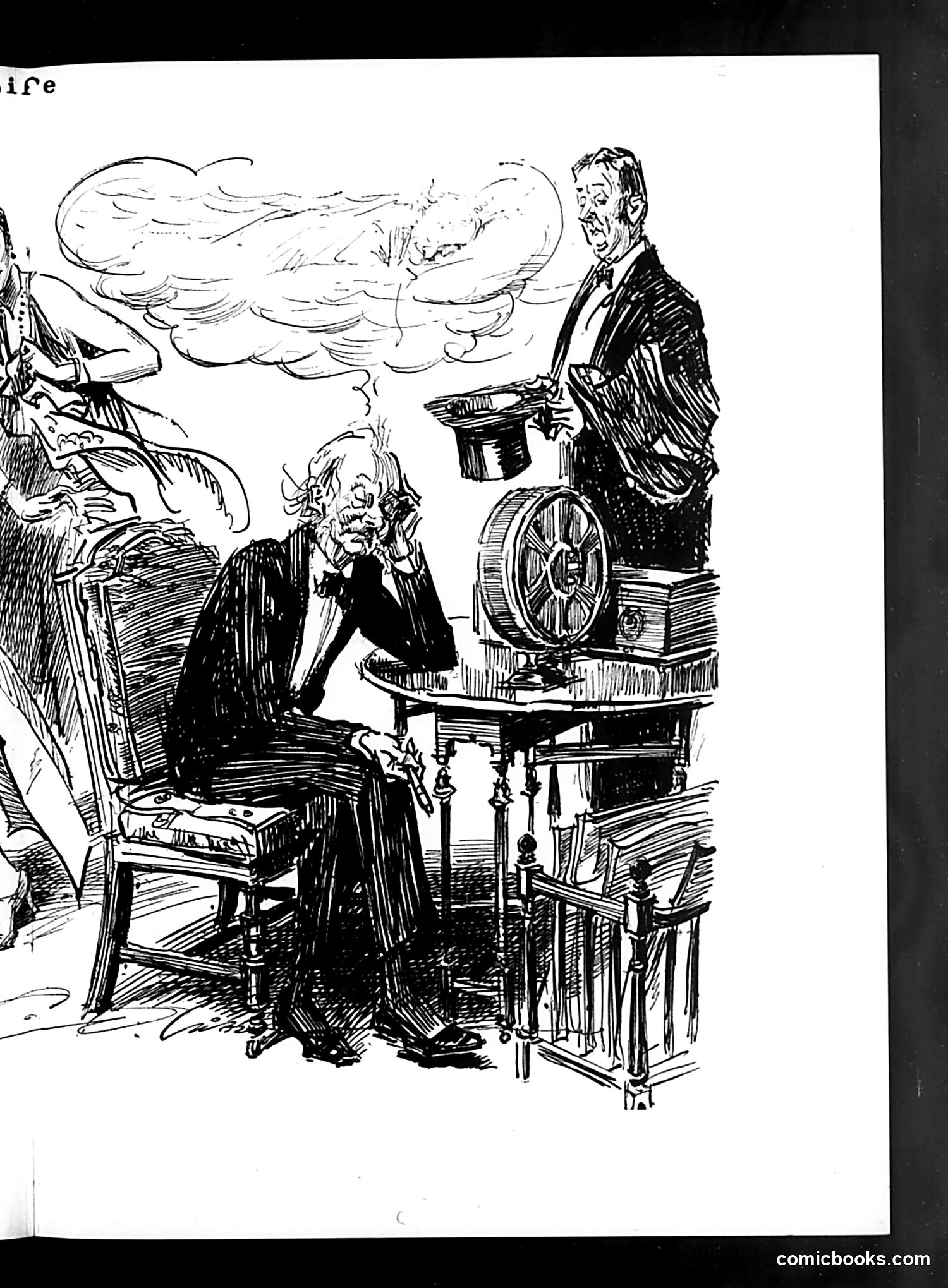
This appears to be a satirical illustration from *Life* magazine depicting a magician or illusionist performing a trick. The well-dressed man on the right holds a top hat and wand, while a smaller, older-looking figure (possibly representing a politician or public figure) sits at a table below, appearing distressed or confused. A large cloud of smoke emerges from the hat—the classic "magic" visual. The cartoon likely satirizes political deception or misdirection: a powerful figure using illusion or rhetoric to confuse or deceive the public. The "magic trick" serves as metaphor for propaganda or false promises. Without visible text identifying specific figures or dates, the exact political target remains unclear, though the formal dress and theatrical setup suggest commentary on high-level political manipulation during the early 20th century.
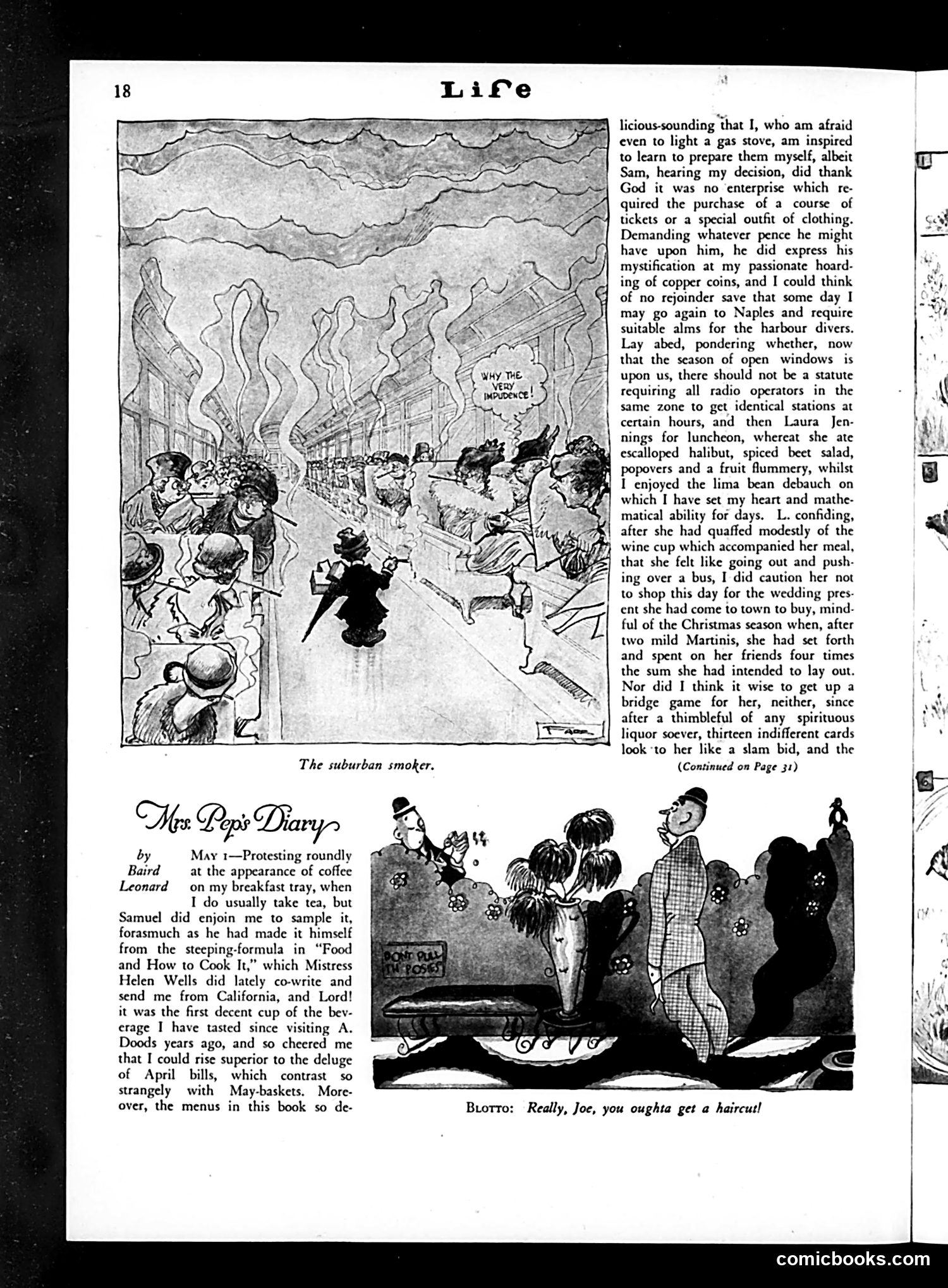
**Top Cartoon - "The Suburban Smoker":** This depicts a commuter on a train platform surrounded by smoke, with a speech bubble saying "WHY THE DICKENS?" The satire targets the nuisance of smoking in public spaces—specifically suburban rail commuters exposed to secondhand smoke. The exaggerated smoke clouds and the commuter's bewildered reaction mock the widespread inconsiderateness of smokers in shared transit environments. **Bottom Section - "Mrs. Pep's Diary":** By Baird Leonard, this diary entry (dated May 1) humorously describes household domestic observations. The accompanying cartoon shows what appears to be a barber shop scene with the caption "Really, Joe, you oughta get a haircut!"—a comedic domestic jab at poor grooming habits. Both pieces use gentle, everyday satire typical of Life's humor style.
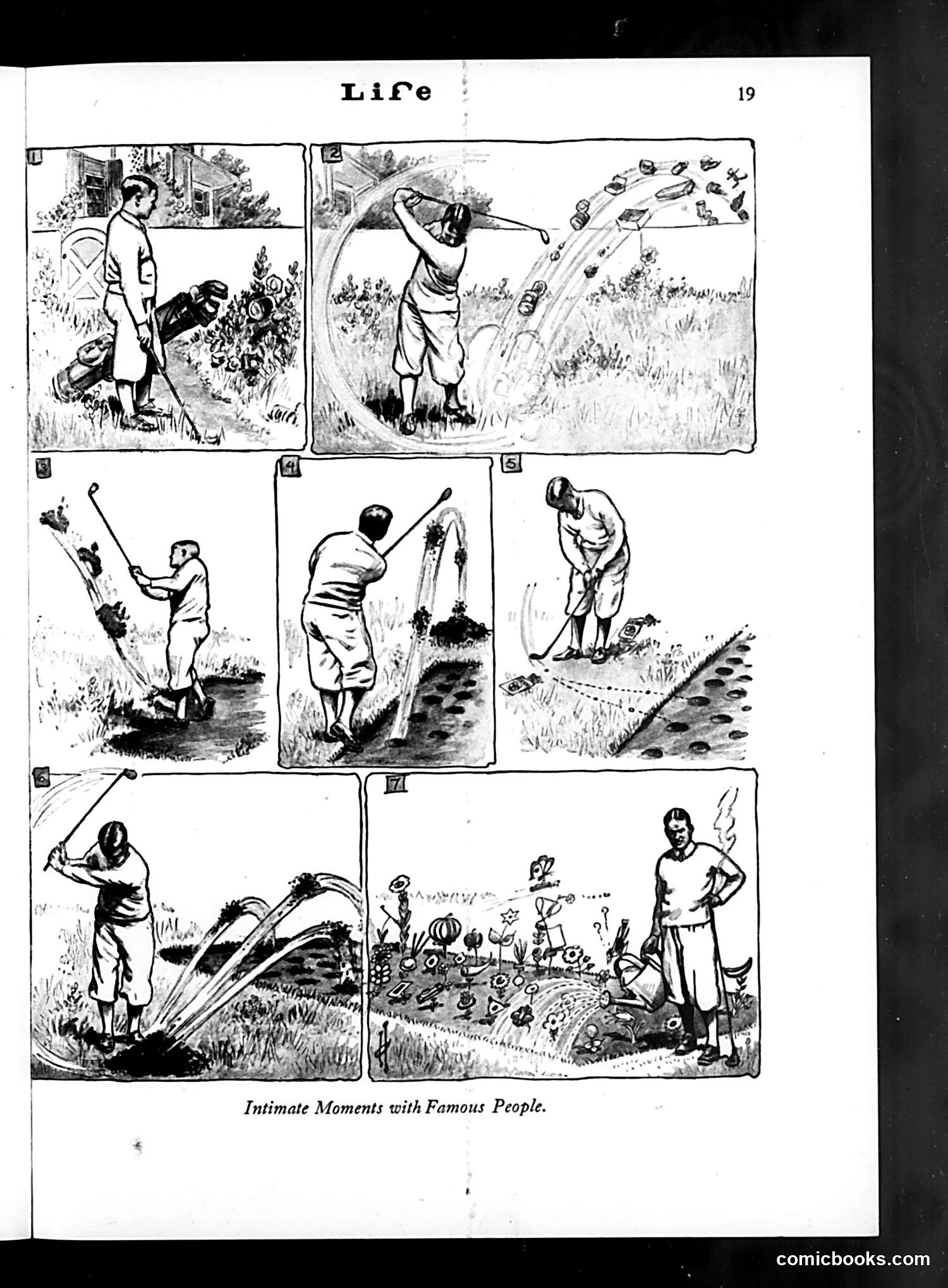
This is a satirical comic strip showing a golfer throughout a round, presumably depicting a famous public figure (likely a politician or celebrity of the era). The sequence humorously tracks the golfer's emotional arc: starting confident, taking his swing, experiencing various mishaps and frustrations in the water hazard and rough terrain, and ending visibly exasperated amid scattered golf balls and equipment. The satire mocks both golf culture and the pretensions of famous people—suggesting that despite their public status, they're subject to the same ordinary humiliations as anyone else on the course. The title's promise of "intimate moments" is ironic; instead of glamorous revelations, we see undignified struggle. This appeals to readers' schadenfreude toward the famous.
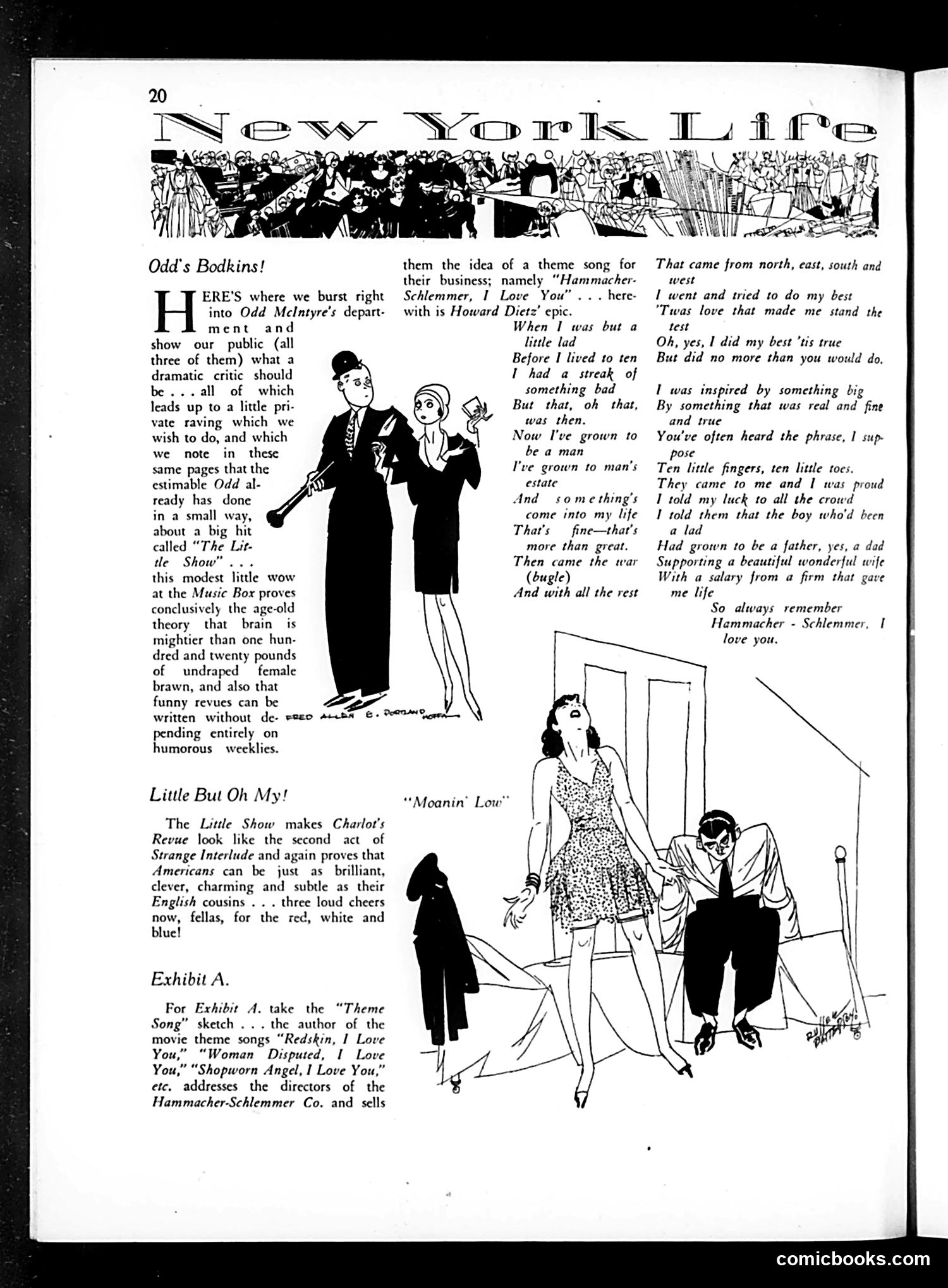
This page satirizes the theatrical world of 1920s New York. "The Little Show" is a real Broadway revue that the critic praises for being intellectually clever rather than relying on "undraped female brawn"—mocking the era's tendency toward spectacle over substance. The main joke is "Exhibit A": a sketch where a songwriter pitches a theme song to Hammacher-Schlemmer (a real luxury goods company) called "Hammacher-Schlemmer, I Love You." The parody song is intentionally overwrought and absurd—transforming a commercial jingle into an epic life story about war, fatherhood, and corporate loyalty. The satire targets both advertising's pretensions and Tin Pan Alley's saccharine songwriting. By taking a mundane business pitch and expanding it into grandiose emotional territory, the sketch mocks how advertising tries to create artificial sentiment around commercial products. The cartoons illustrate the composer pitching this ridiculous idea to confused businessmen.
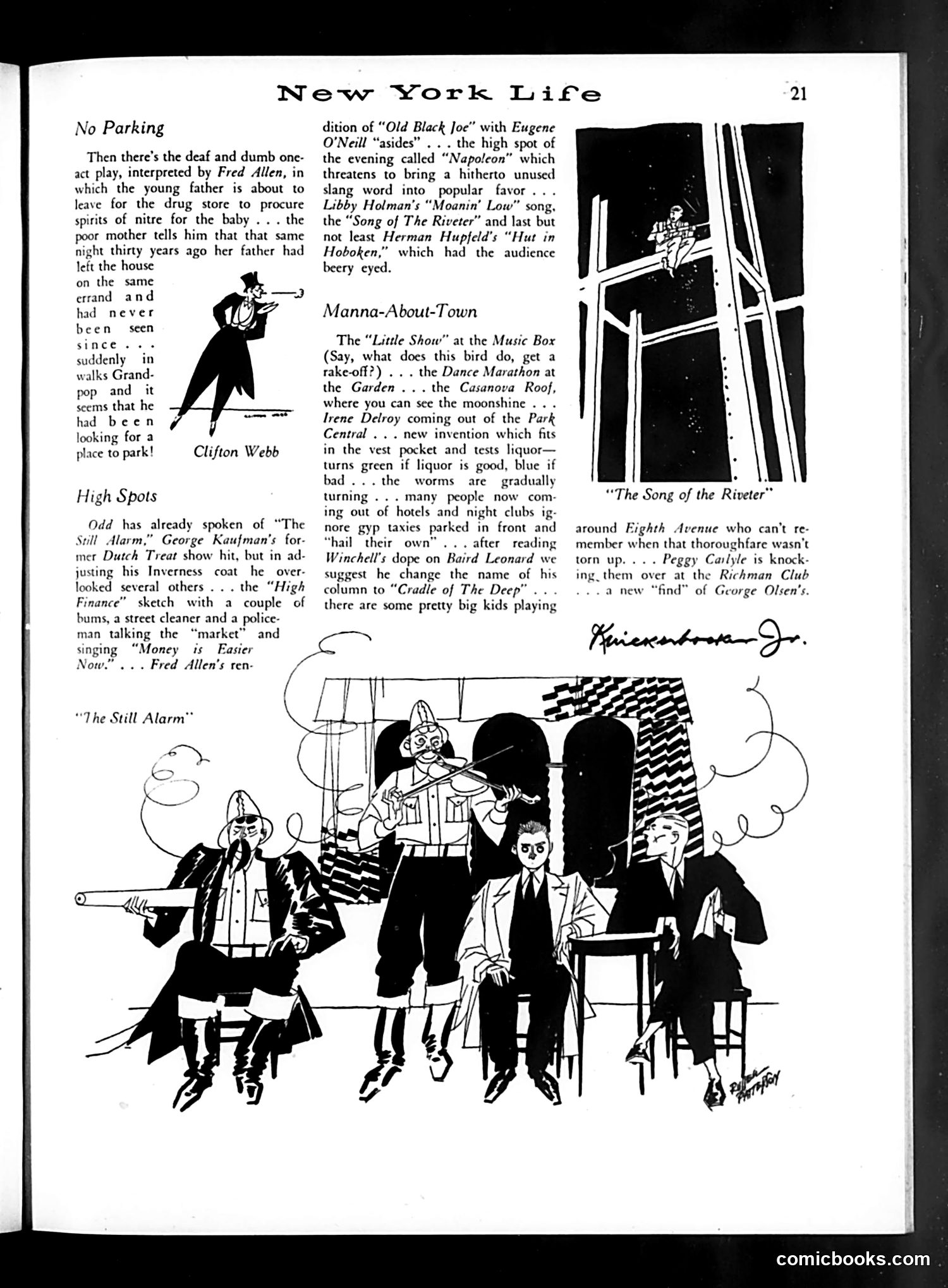
This page from *Life* magazine reviews Broadway theatrical performances and New York nightlife venues, likely from the late 1920s. The humor relies on contemporary references: Fred Allen's sketch jokes about a father who vanished 30 years ago while getting supplies—only to reappear, having spent decades searching for a parking spot (satire on New York's chronic parking shortage). "The Still Alarm" illustration depicts vaudeville performers in comedic poses, referencing George Kaufman's successful play. The page name-drops performers like Libby Holman and mentions venues like the Music Box theater and Casanova Roof nightclub. "Manna-About-Town" gossip references columnist Walter Winchell's reporting style and mentions a new pocket-sized liquor-testing device (likely Prohibition-era). References to "hailing their own" taxis and ignoring street taxis reflect contemporary transportation tensions. The satire is primarily theatrical/entertainment-focused rather than political, targeting New York's infrastructure problems and social scene.
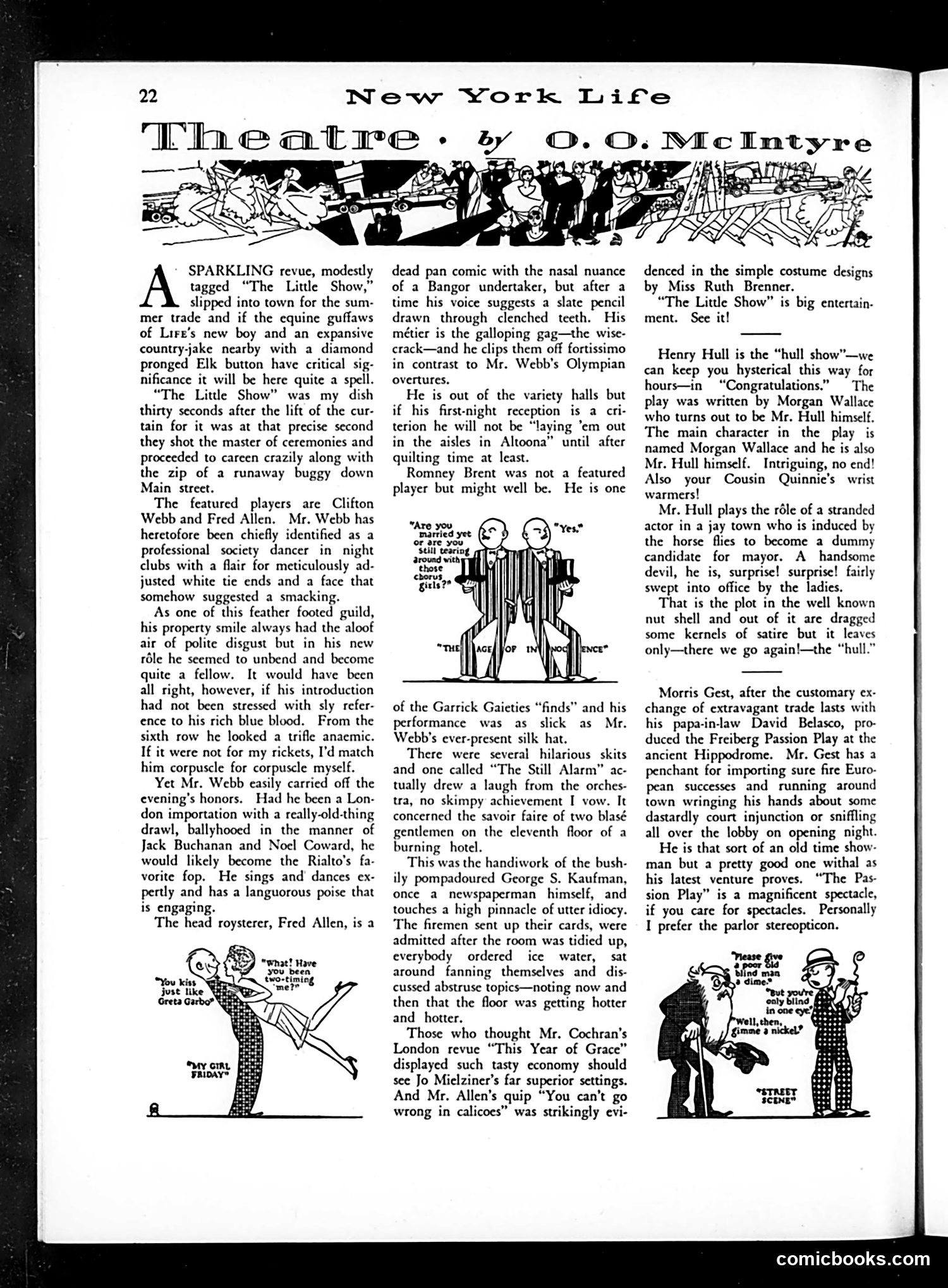
This is a theatre critic's review of a Broadway revue titled "The Little Show." The piece praises the show's comedic opening—a slapstick sequence involving a runaway buggy down Main Street. The critic highlights two featured performers: **Clifton Webb**, a society dancer transitioning to comedy (mocked for his aristocratic affectations and pale complexion), and **Fred Allen**, a vaudeville comic with a harsh, nasal delivery. The review notes Allen's "dead pan" style and rapid-fire jokes, contrasting him favorably with Webb's more refined manner. A sketch by **George S. Kaufman** about two blasé gentlemen calmly discussing a hotel fire while firemen arrive is singled out for humor. The reviewer also mentions designer **Jo Mielziner's** superior set design and costume designer **Ruth Brenner**. A secondary review covers "Congratulations," starring **Henry Hull**, where Hull's character is named after the play's writer, **Morgan Wallace**—who is Hull himself. The self-referential casting is presented as amusing.
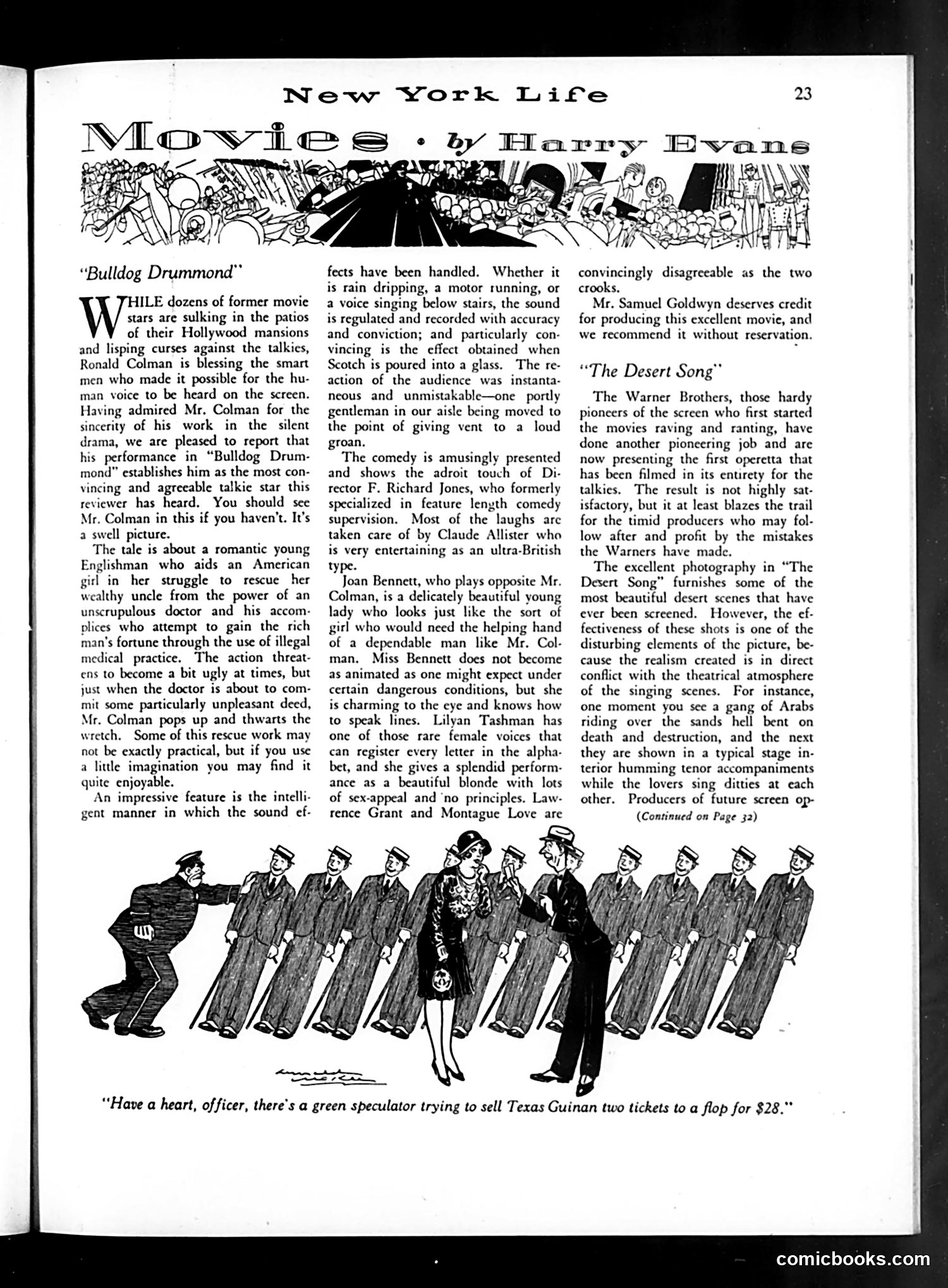
This page from Life magazine contains two film reviews by Harry Evans and a single-panel cartoon satirizing Hollywood's transition to "talking pictures" (talkies). **The Reviews**: Evans favorably reviews Ronald Colman's performance in "Bulldog Drummond," praising how sound effects enhance the film—notably the authentic recording of Scotch being poured, which delighted audiences. He also reviews "The Desert Song," Warner Brothers' first complete operetta filmed for talkies, finding it technically accomplished but dramatically conflicted between realistic cinematography and theatrical singing scenes. **The Cartoon**: Shows a woman in civilian clothes standing among identical uniformed police officers, with the caption about a "green speculator" trying to sell worthless theater tickets ("Texas Guinan two tickets to a flop for $28"). This references the era's theater ticket scalping and likely alludes to Texas Guinan, a famous nightclub hostess of the 1920s-30s known for her theatrical persona. The page captures Hollywood's early-talkie era (likely late 1920s), when sound technology was revolutionary but technically imperfect.
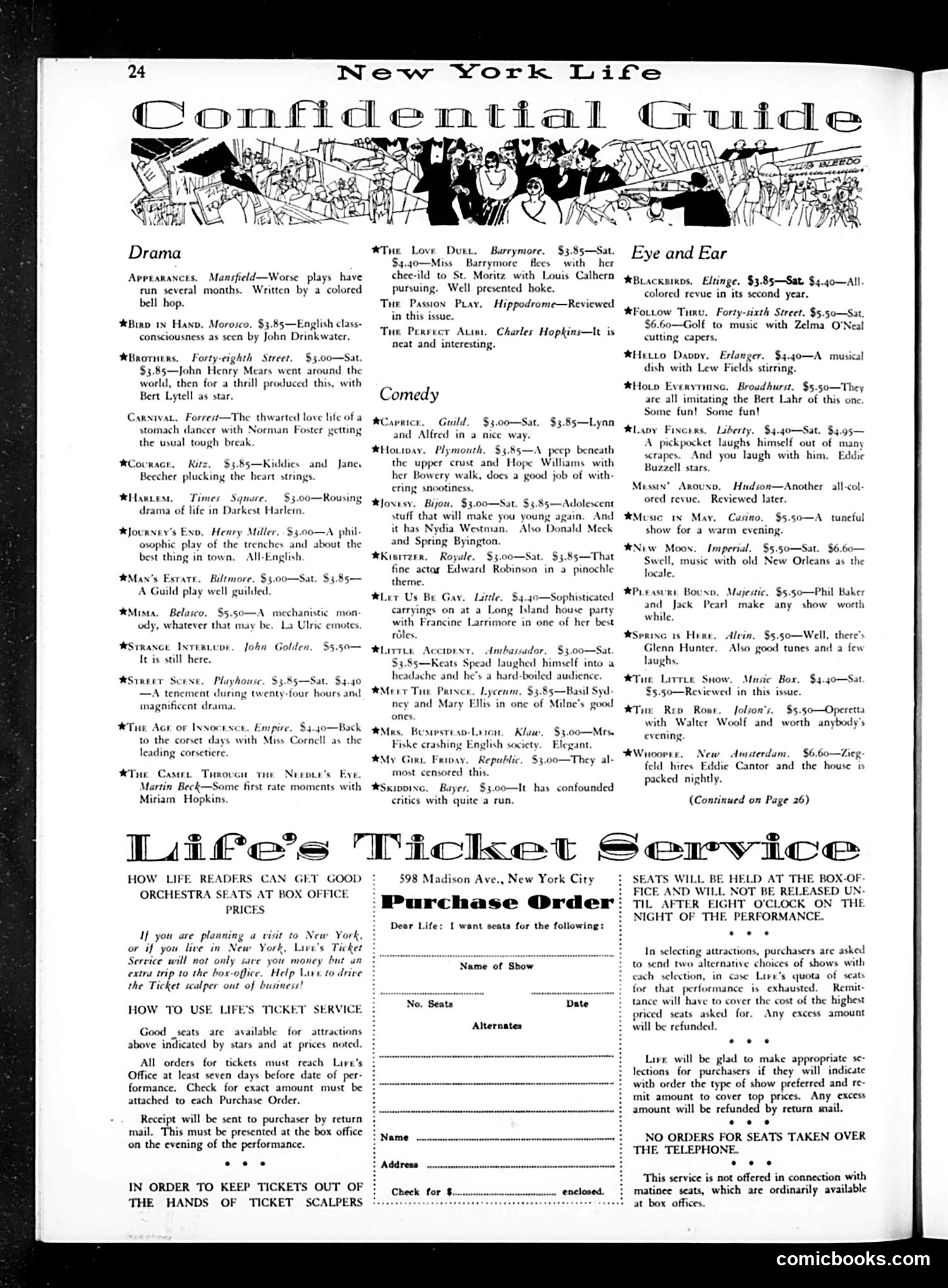
This page is primarily a **theater listings and ticket service advertisement**, not a political cartoon. It contains no political satire or caricatures. The content shows: 1. **Drama/Comedy Reviews**: Brief, often sarcastic capsule reviews of Broadway shows currently running, with theater names, prices, and lead actors. The tone is witty and dismissive—e.g., "Worse plays have run several months" about one production. 2. **"Eye and Ear" Section**: Similar reviews of musicals and revues, including several "all-colored revue[s]" (reflecting the segregated entertainment landscape of the era). 3. **Life's Ticket Service**: Instructions for ordering orchestra seats through Life magazine at box office prices, positioning the service as protecting readers from ticket scalpers. The satire here is *theatrical* (mocking bad plays), not political. This is a service feature and entertainment guide typical of Life magazine's arts coverage, aimed at New York theater-goers.
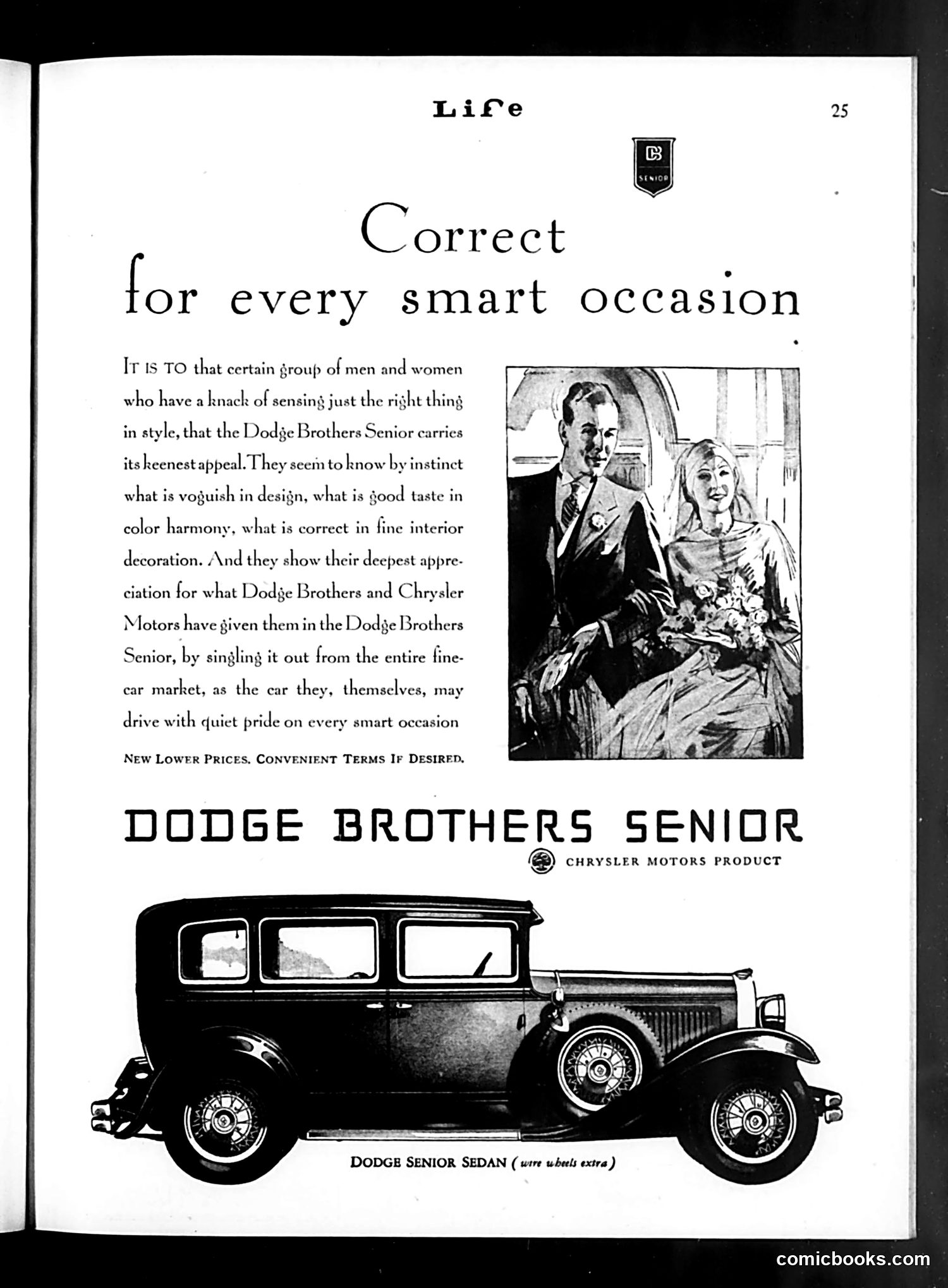
This is **not a cartoon or satire** — it's a straightforward advertisement for the Dodge Brothers Senior automobile, published in *Life* magazine (likely 1920s-early 1930s based on the car's design). The ad targets affluent consumers by appealing to social aspiration. The illustration shows an elegantly dressed couple, suggesting that owning this car signals good taste, refinement, and membership in an exclusive social circle ("that certain group of men and women"). The text flatters potential buyers, implying they possess instinctive understanding of style, design, and "correct" taste. The vehicle itself is presented as a luxury product—a sedan with multiple windows and refined styling. The phrase "correct for every smart occasion" emphasizes the car's appropriateness for formal social events. This represents how early automobile advertising used *status symbols* and social positioning rather than mechanical features to sell cars to the wealthy.
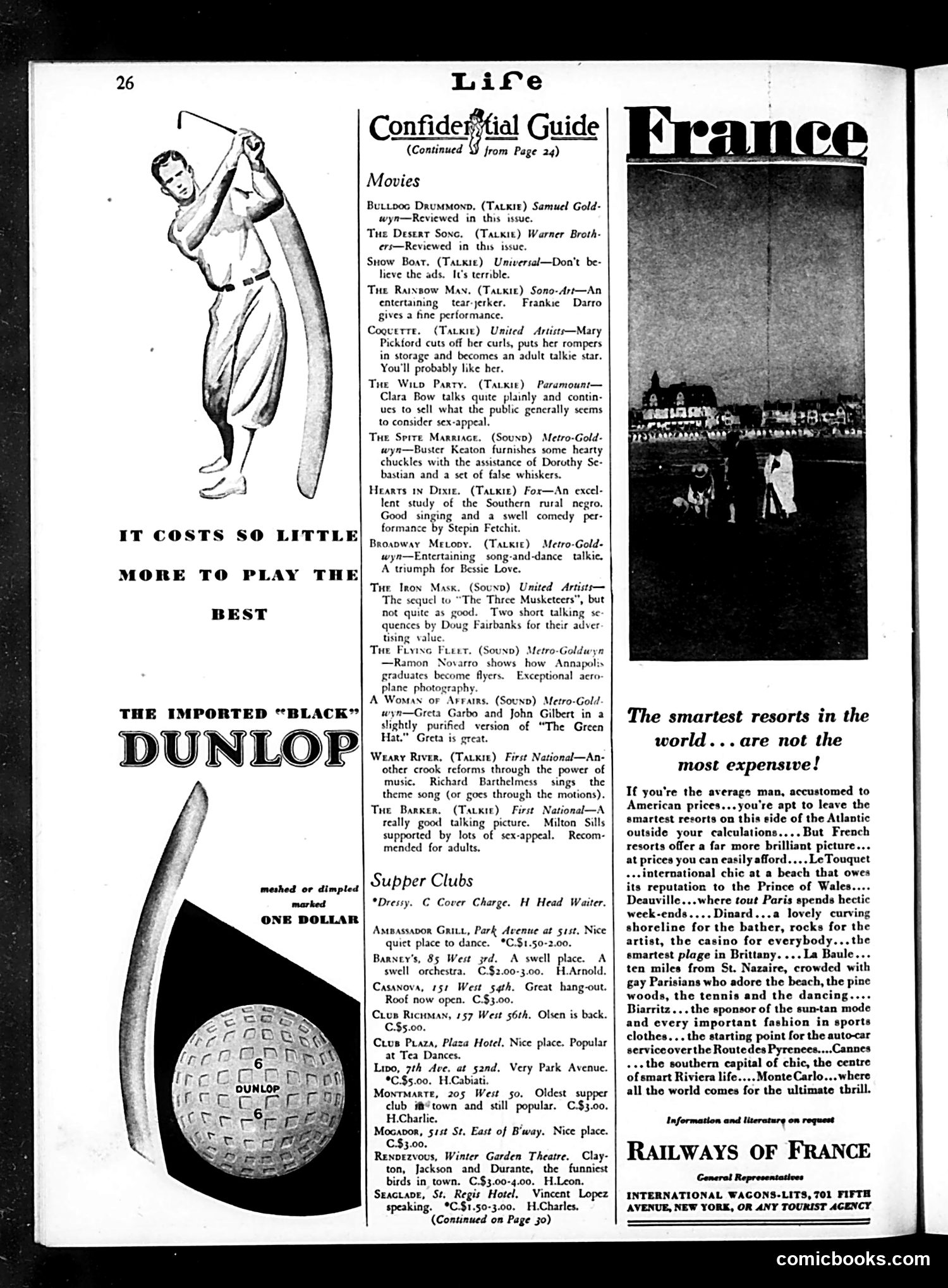
This page from Life magazine (circa 1928-1929, based on the talkie film references) contains primarily **advertising and entertainment listings** rather than political satire. The left side features a **Dunlop golf ball advertisement** emphasizing quality ("It costs so little more to play the best"), with an illustration of a golfer mid-swing. The center presents a **"Confidential Guide"** reviewing current talking pictures and supper clubs—typical Life magazine content. The film reviews are candid and witty (dismissing *Show Boat* as "terrible," noting Mary Pickford's transition to adulthood in *Coquette*). The right side is a **Railways of France advertisement** promoting French resorts as affordable luxury alternatives to expensive American destinations, targeting the average American traveler. **No political cartoon or satire appears on this page.** It's a standard magazine layout mixing editorial content with paid advertising—common in Life's era.
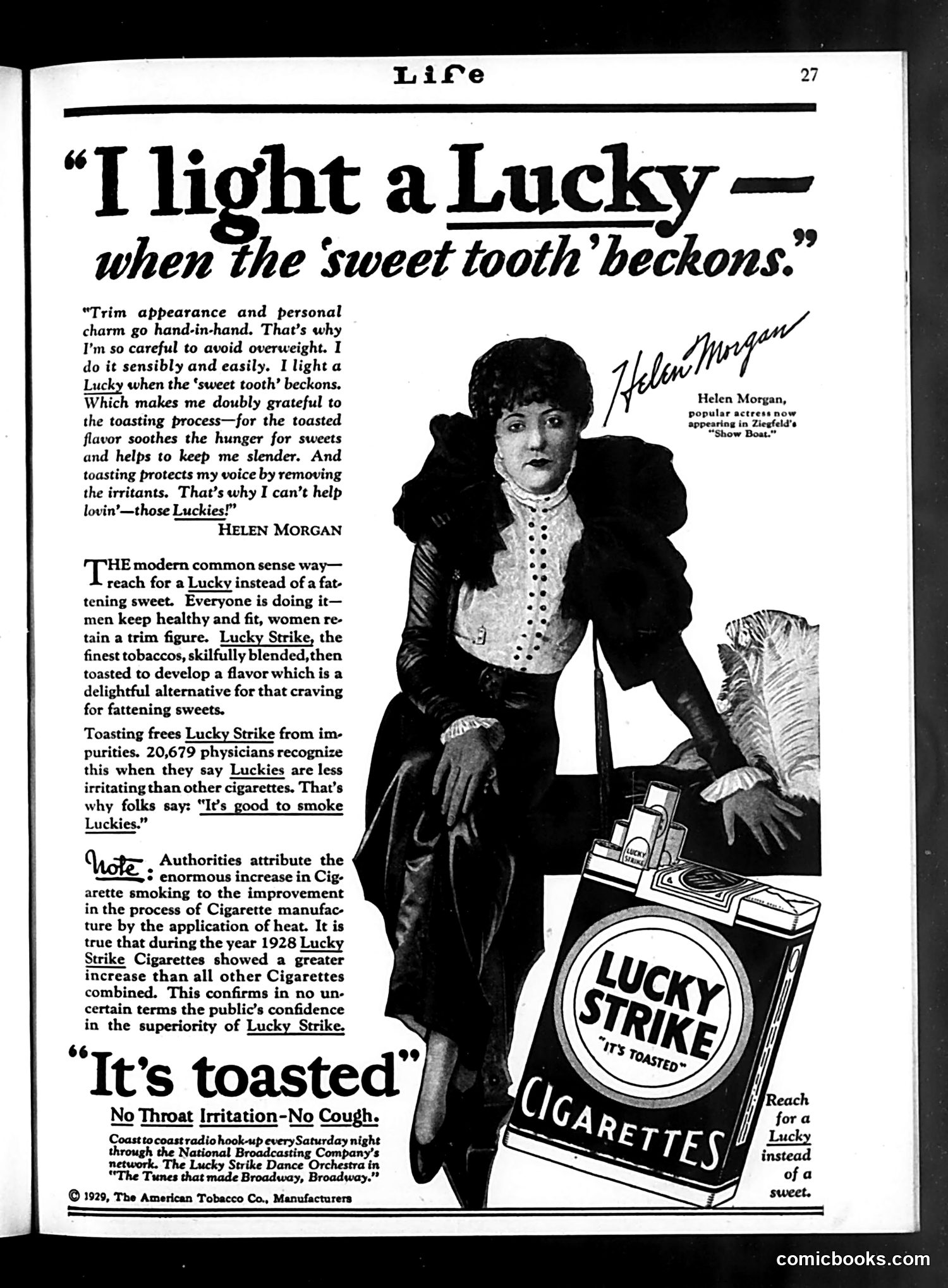
This is a **cigarette advertisement**, not satire—it's a genuine 1929 Lucky Strike marketing campaign featuring actress Helen Morgan. The ad promotes cigarettes as a diet aid and health product by a modern standard that would be shocking today. **Key claims made:** - Smoking Lucky Strikes instead of eating sweets helps women "retain a trim figure" - The toasting process makes cigarettes "less irritating" and protects the voice - 20,679 physicians endorse them as less harmful than other cigarettes - Smoking increased because cigarette manufacturing improved **Historical context:** This reflects pre-1940s attitudes when tobacco companies made explicit health claims and used celebrity endorsements. The "reach for a Lucky instead of a sweet" slogan became famous for marketing cigarettes as a weight-loss tool to women specifically—exploiting diet anxiety to expand the female smoking market. The ad is historically significant as evidence of how brazenly tobacco companies made false health claims before FDA regulations and the surgeon general's warning.
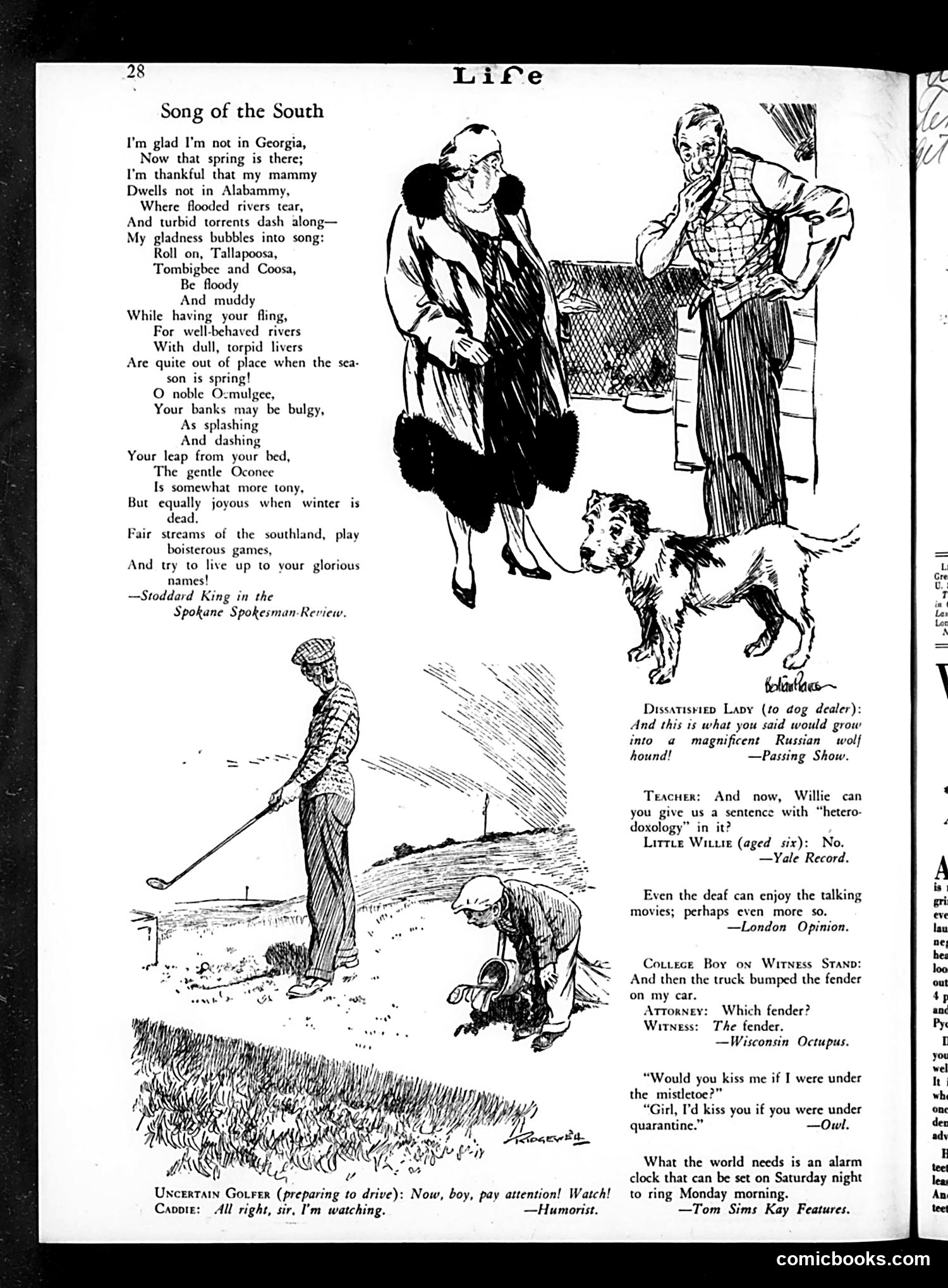
This page from *Life* magazine contains a poem and several brief humorous quips typical of 1920s-30s satirical journalism. The main feature, "Song of the South" by Stoddard King, ironically celebrates Southern rivers flooding during spring—praising their chaotic, muddy behavior as preferable to "well-behaved" rivers. It's gentle social satire celebrating natural exuberance over civilized restraint. The cartoon vignettes below mock everyday absurdities: a golfer instructing an inattentive caddy; a woman complaining a purchased dog won't grow into the promised Russian wolfhound; a child's malapropism; a witness unable to distinguish which fender was damaged; and quips about talking movies, mistletoe romance, and an alarm clock that prevents Monday hangovers. These are slice-of-life jokes reflecting middle-class American concerns—automobile culture, pet purchases, trivial legal confusion, technological novelty. The humor relies on obvious wordplay and situational irony rather than political commentary. The illustrations are simple pen-and-ink sketches typical of the era's magazine design.
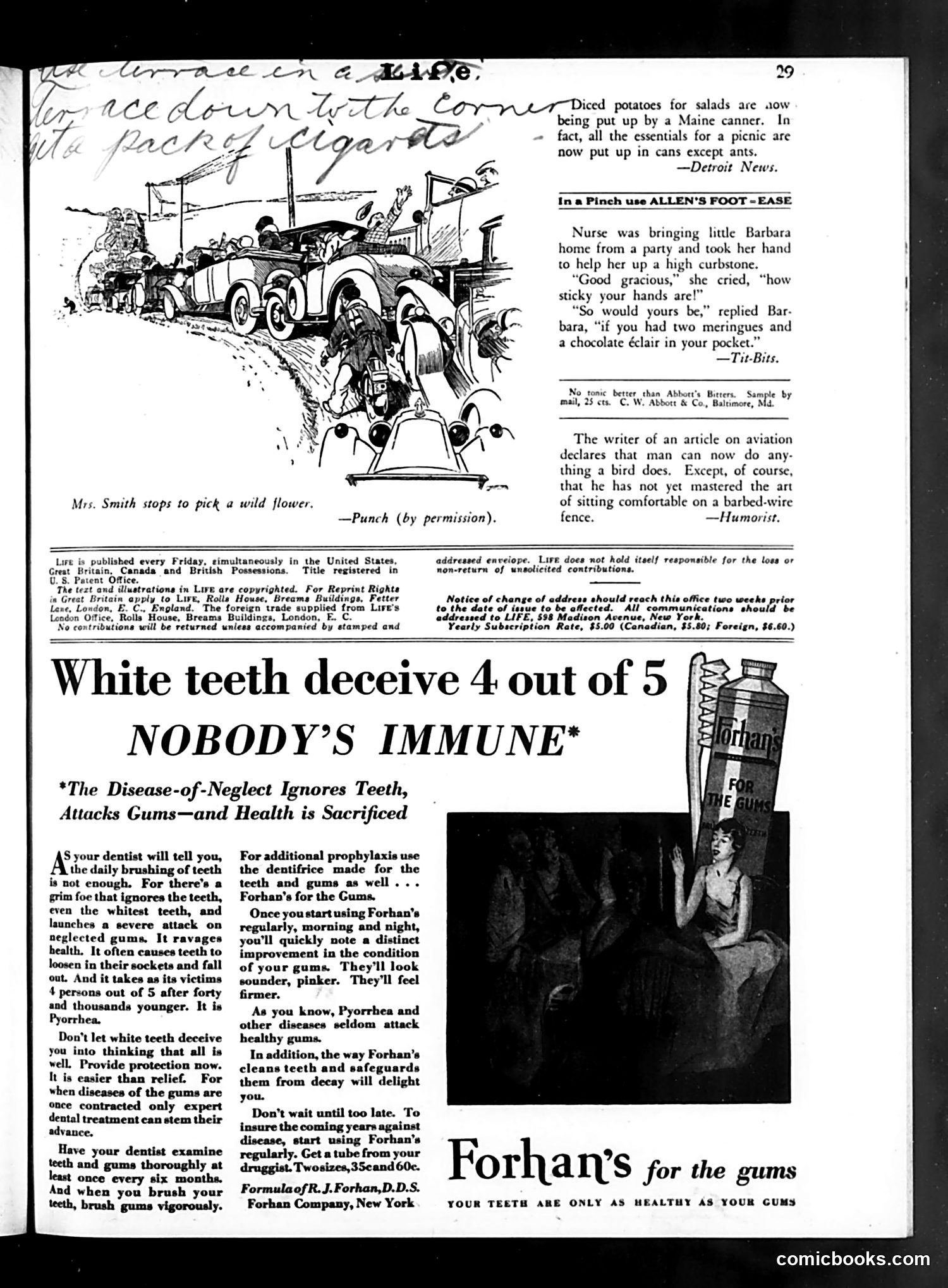
This page is primarily **advertising and filler content** rather than political satire. The main cartoon shows "Mrs. Smith stops to pick a wild flower"—a humorous domestic scene where a woman bends down during what appears to be a car-filled outing, likely referencing the growing prevalence of automobiles in everyday life. The page consists mostly of **brief humorous anecdotes** from various sources (Punch, Detroit News, Tit-Bits, Humorist) making light observations about modern conveniences, children's behavior, and emerging technology. The dominant content is a **Forhan's dental product advertisement** warning about pyorrhea (gum disease), claiming "4 out of 5" people over 40 suffer from it. This reflects early 20th-century marketing emphasizing newly-identified health concerns to drive consumer purchases of specialized products—a common advertising strategy of the era.
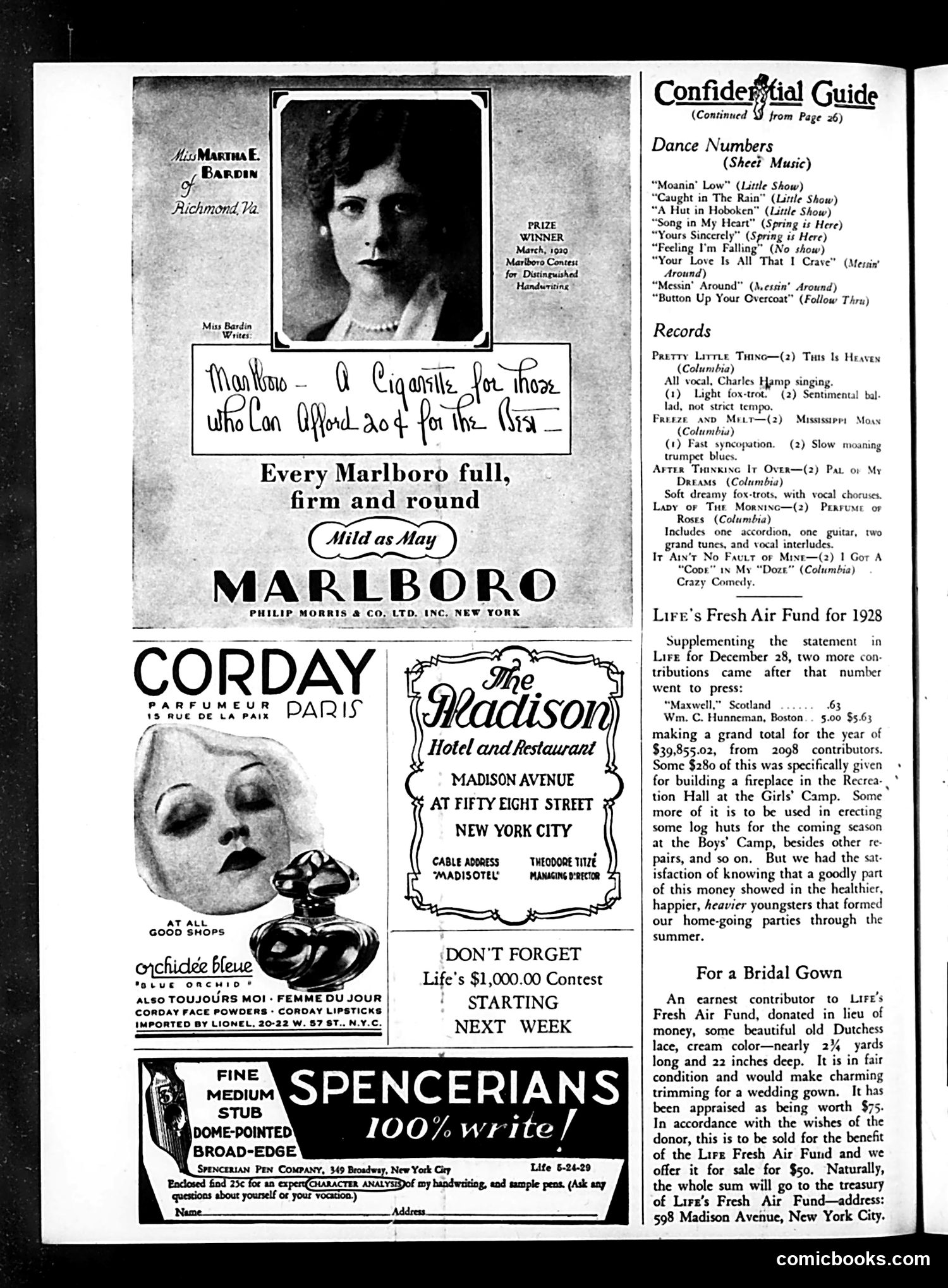
This page is primarily **advertising and editorial content**, not political satire. The top features a prize-winning handwriting sample from Martha E. Bardon of Richmond, Virginia, advertising Marlboro cigarettes with the tagline "Every Marlboro full, firm and round." Below are advertisements for luxury goods (Corday perfume, Spencerian pens) and The Gladison Hotel in New York City. The right column contains a "Confidential Guide" listing popular 1928 dance numbers and phonograph records—typical entertainment listings for *Life* magazine's readers. The largest section is devoted to **Life's Fresh Air Fund**, a charitable campaign providing recreational experiences for underprivileged children. The text describes monetary contributions and a donated piece of antique lace being sold to benefit the fund. **No political cartoons or satire appear on this page.** It represents typical 1920s magazine content mixing advertisements, entertainment guides, and charitable fundraising announcements.
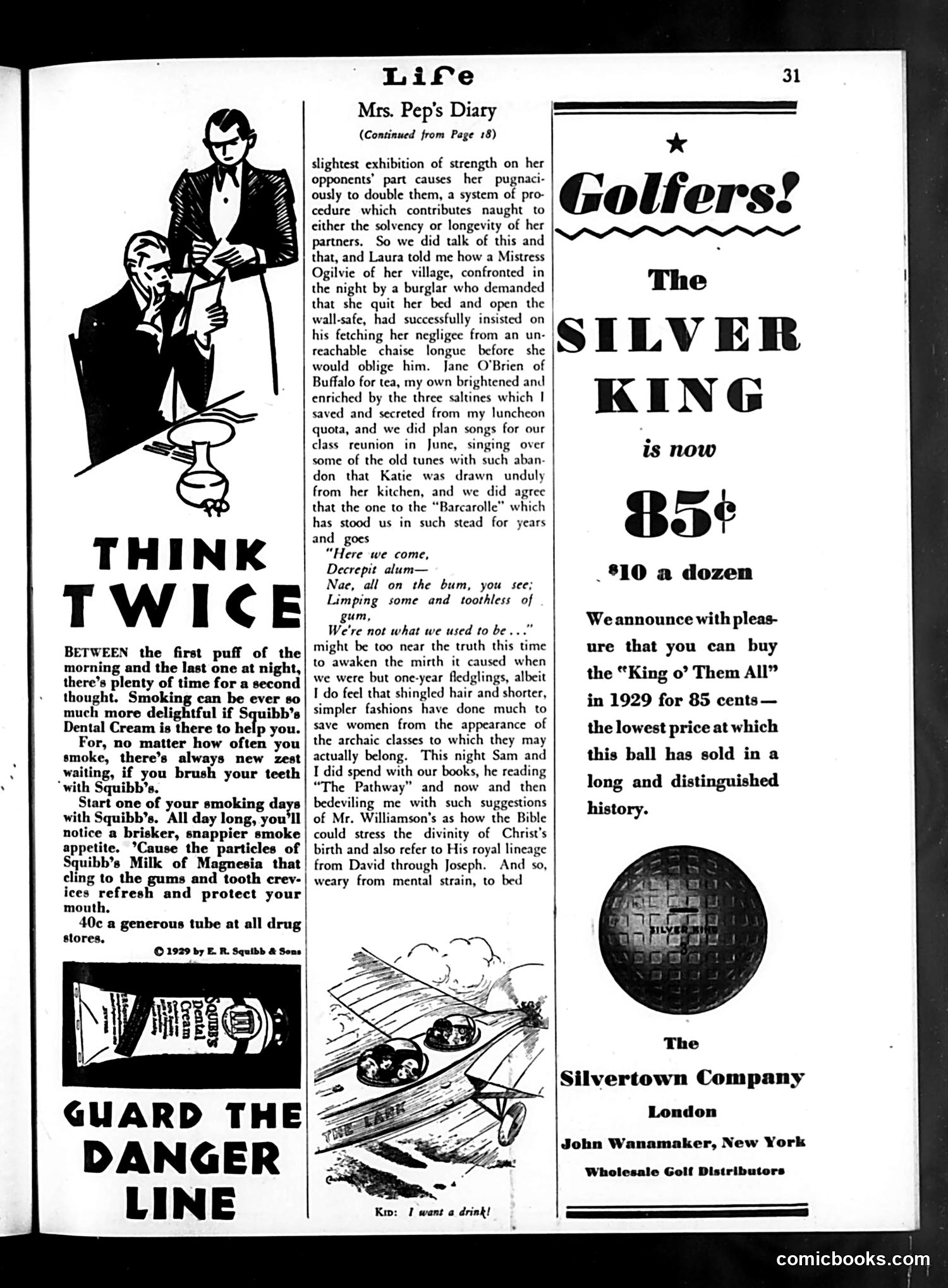
This page contains **primarily advertisements** rather than satirical cartoons. **Left side:** A Squibb's Dental Cream ad featuring an illustration of a man offering toothpaste to a woman, promoting dental hygiene for smokers. The pitch is that brushing with Squibb's between cigarettes maintains fresher breath and healthier gums—a straightforward product advertisement reflecting 1929's casual attitude toward smoking. **Right side:** An advertisement for the "Silver King" golf ball, now priced at 85 cents, marketed as the lowest price in its "long and distinguished history." **Center:** "Mrs. Pep's Diary" is a continuing serialized column recounting mundane domestic life—social visits, conversations about marriage, singing, and reading. It's humorous social commentary on middle-class women's lives rather than political satire. The page reflects 1920s consumer culture and leisure activities rather than containing the political cartoons a modern reader might expect from a "satirical magazine."
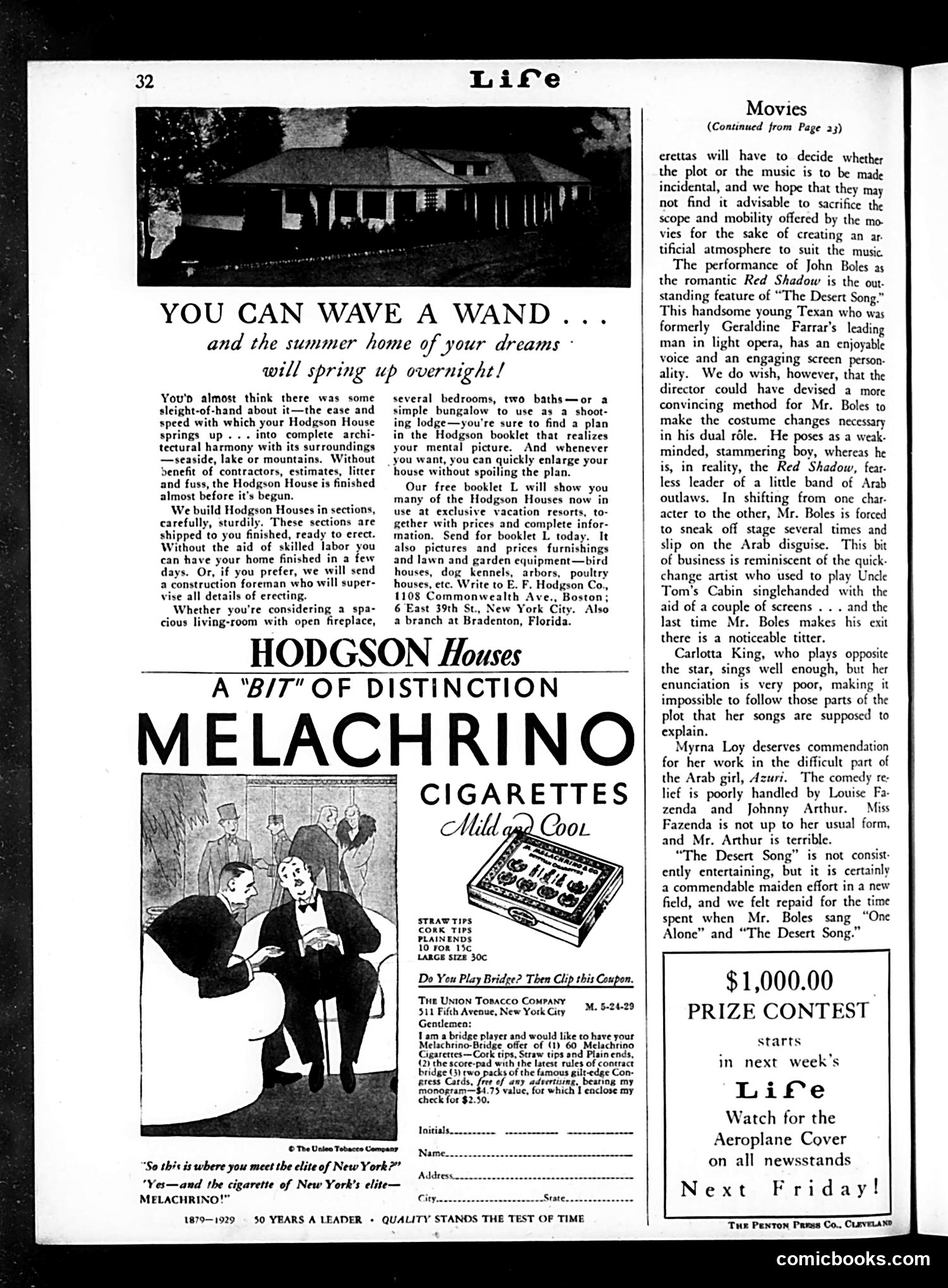
This page is primarily **advertising**, not satire or political commentary. It features two major ads: **Hodgson Houses**: A prefabricated home company using the metaphor of magic ("wave a wand") to suggest effortless, rapid home construction. The pitch emphasizes speed, simplicity, and customization—homes arrive in sections and assemble without skilled labor. **Melachrino Cigarettes**: An advertisement playing on social aspiration, with the tagline "the cigarette of New York's elite." The cartoon shows two well-dressed men in what appears to be an exclusive club setting, establishing Melachrino as a luxury product. A bridge-player promotion coupon offers cigarettes bundled with elegant score pads and gilt-edged cards. The page also contains a **movie review** (continuing from page 23) discussing "The Desert Song," critiquing actor John Boles and other performers. There is no political satire here—this is a standard 1920s magazine page blending consumer advertising with entertainment coverage.
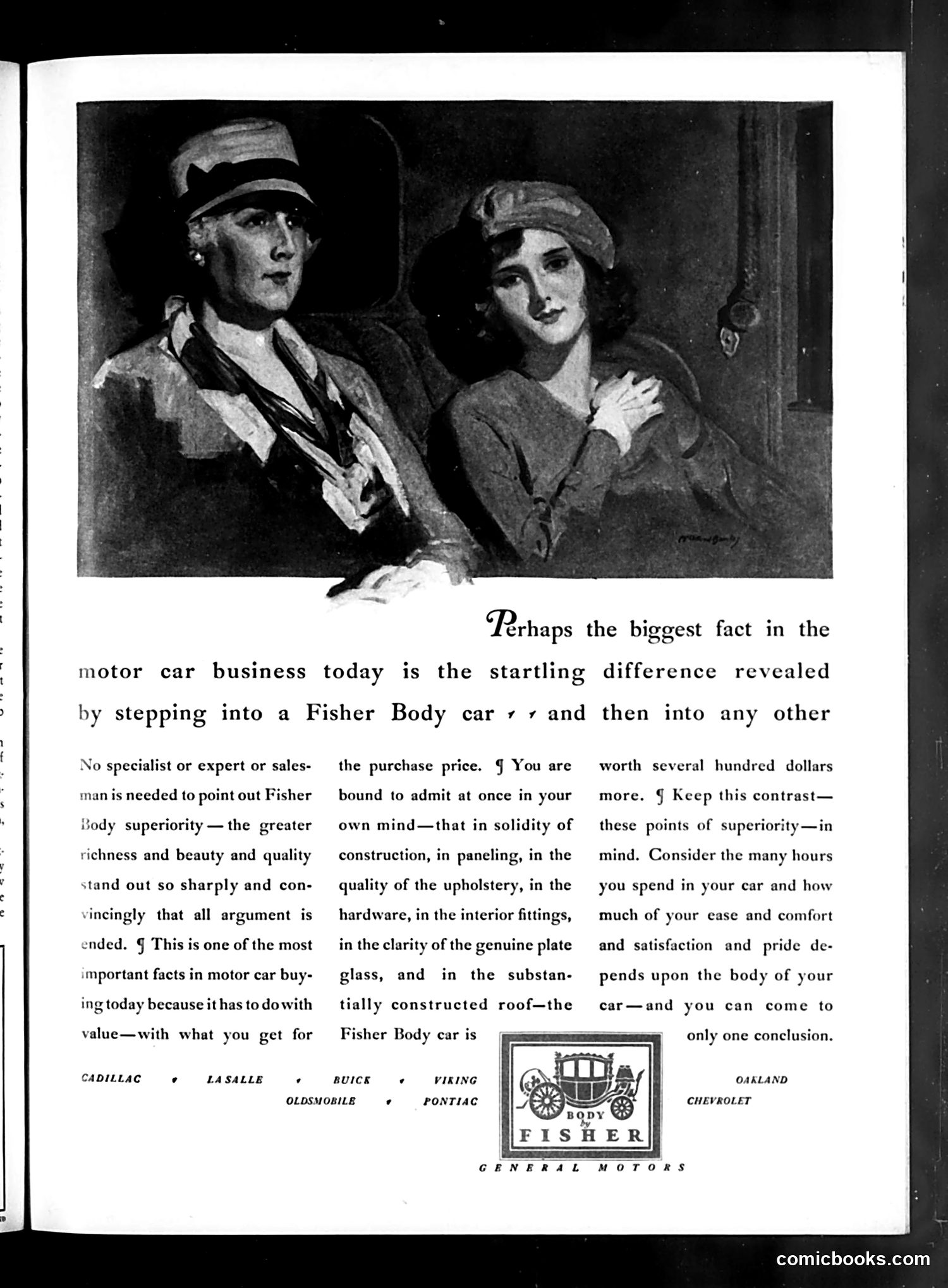
This is **not a cartoon or satire** — it's a straightforward automobile advertisement from Life magazine's advertising section. The page promotes Fisher Body, a General Motors subsidiary that manufactured car bodies for multiple GM brands (Cadillac, LaSalle, Buick, Oldsmobile, Pontiac, Oakland, and Chevrolet). The accompanying photograph shows two figures (likely actors in a staged scenario) examining a car interior, meant to demonstrate the visual superiority of Fisher Body construction. The ad's argument is purely commercial: Fisher Body cars are worth "several hundred dollars more" due to superior construction, materials, upholstery, hardware, and glass quality. The text appeals to buyers' desire for comfort, pride, and value — arguing that since consumers spend considerable time in their cars, the body quality directly impacts their satisfaction. This represents typical early 20th-century automotive marketing emphasizing craftsmanship and materials as differentiators.
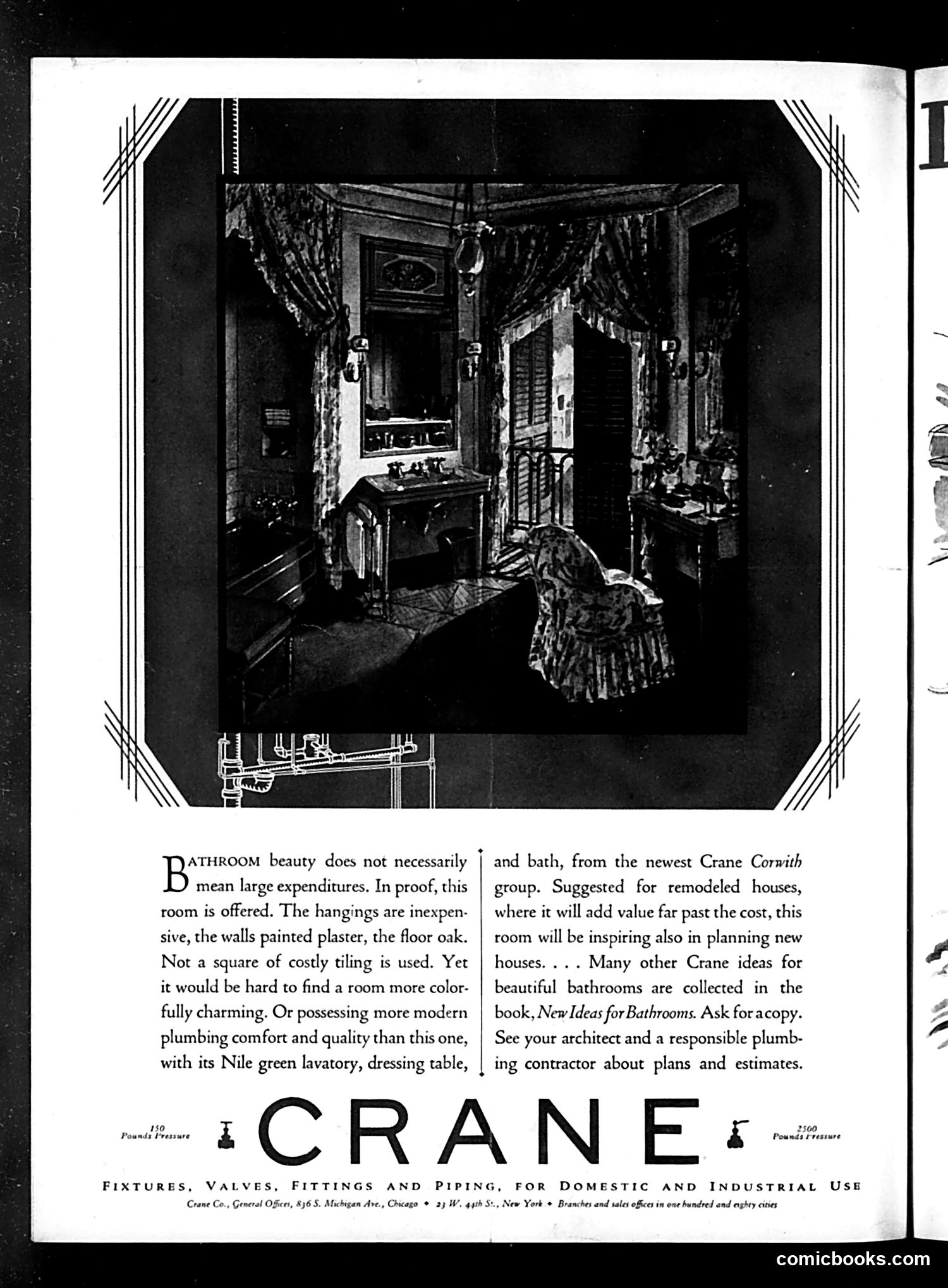
This is primarily a **Crane plumbing fixtures advertisement**, not political satire. The page showcases a bathroom design meant to demonstrate that elegance doesn't require excessive spending. The ad emphasizes affordable materials—inexpensive hangings, painted plaster walls, oak flooring, and notably *no costly tiling*—while still achieving "colorfully charming" aesthetics. The featured "Nile green lavatory" and fixtures from Crane's Corwith group represent modern plumbing comfort at accessible price points. The advertisement's pitch targets middle-class homeowners considering bathroom remodels or new house construction in what appears to be the early 20th century, promoting both practicality and aspirational modernity. There is no cartoon or political content on this page—it is straightforward product advertising using a room photograph to sell the philosophy that quality bathroom design needn't be prohibitively expensive.