
Life, 1929-05-24 · page 17 of 36
Life — May 24, 1929 — page 17: what you’re looking at
What you’re looking at
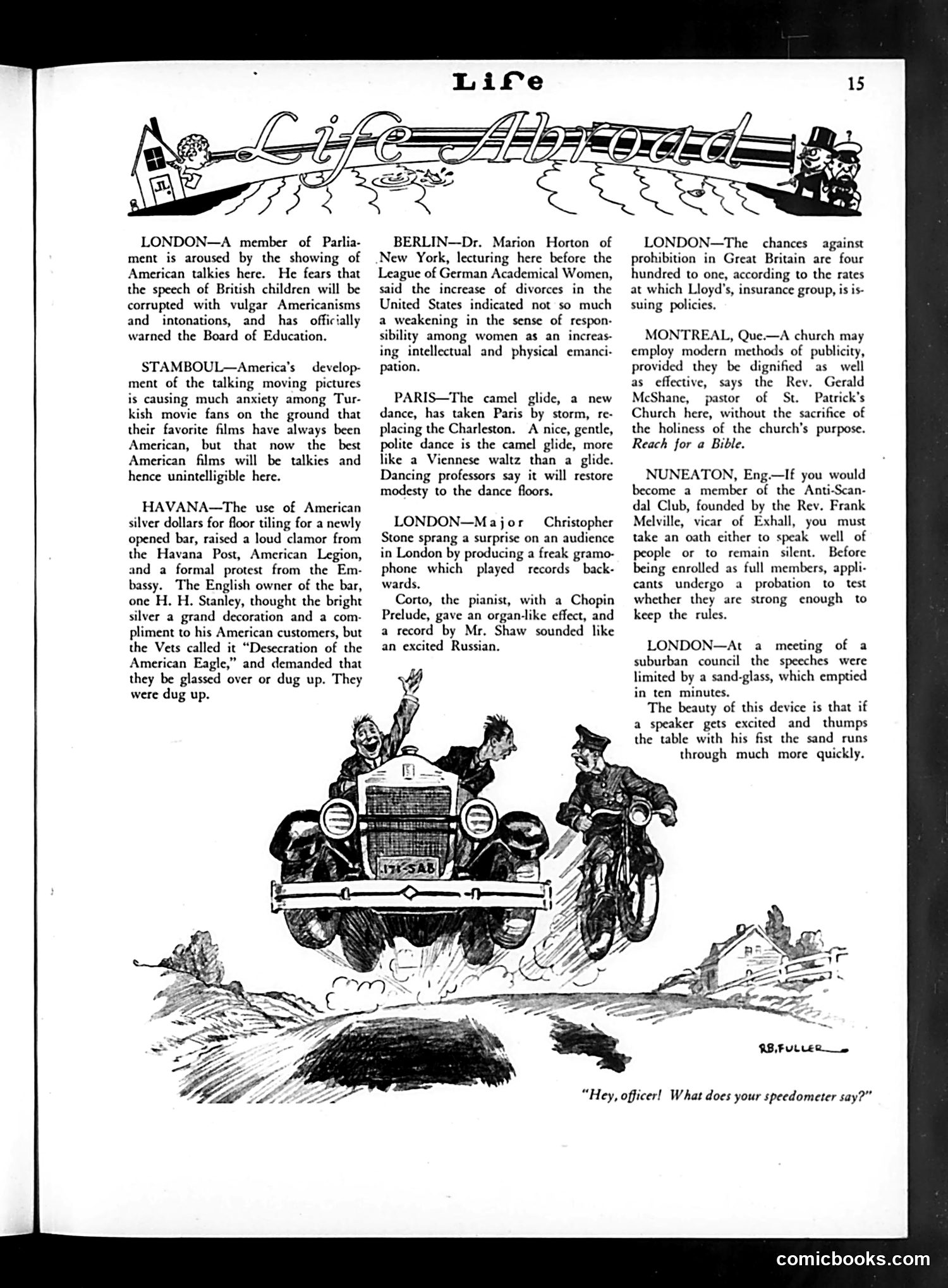
This page contains brief international news items with social commentary rather than a traditional political cartoon. The main illustration depicts a car airborne after hitting a pothole, with the caption "Hey, officer! What does your speedometer say?"—satirizing the contradiction between speed limits and dangerously poor road conditions. The news briefs mock various contemporary concerns: American "talkies" (talking pictures) corrupting British children with slang; Turkish anxiety about American cultural influence; and a bar in Havana that decorated itself to honor American patrons, only to be snubbed by them. The items together suggest anxieties about American cultural dominance and changing social values in the 1920s-30s era.
📄 Transcribed text from this page (OCR, searchable)
Machine-transcribed from the original scan — historical spelling and the odd misread are preserved.
LONDON—A member of Parlia- ment is aroused by the showing of American talkies here. He fears that the speech of British children will be corrupted with vulgar Americanisms and intonations, and has officially warned the Board of Education. STAMBOUL—America’s _ develop- ment of the talking moving pictures is causing much anxiety among Tur- kish movie fans on the ground that their favorite films have always been American, but that now the best American films will be talkies and hence unintelligible here. HAVANA—The use of American silver dollars for floor tiling for a newly opened bar, raised a loud clamor from the Havana Post, American Legion, and a formal protest from the Em- bassy. The English owner of the bar, one H. H. Stanley, thought the bright silver a grand decoration and a com- pliment to his American customers, but the Vets called it “Desecration of the American Eagle,” and demanded that they be glassed over or dug up. They were dug up. BERLIN—Dr. Marion Horton of New York, lecturing here before the League of German Academical Women, said the increase of divorces in the United States indicated not so much a weakening in the sense of respon- sibility among women as an increas- ing intellectual and physical emanci- pation, PARIS—The camel glide, a new dance, has taken Paris by storm, re- placing the Charleston. A nice, gentle, polite dance is the camel glide, more like a Viennese waltz than a glide. Dancing professors say it will restore modesty to the dance floors. LONDON—Major Christopher Stone sprang a surprise on an audience in London by producing a freak gramo- phone which played records back- wards, Corto, the pianist, with a Chopin Prelude, gave an organ-like effect, and a record by Mr. Shaw sounded like an excited Russian. LONDON—The chances against prohibition in Great Britain are four hundred to one, according to the rates at which Lloyd's, insurance group, is is- suing policies, MONTREAL, Que.—A church may employ modern methods of publicity, provided they be dignified as well as effective, says the Rev. Gerald McShane, pastor of St. Patrick's Church here, without the sacrifice of the holiness of the church's purpose. Reach for a Bible. NUNEATON, Eng.—If you would become a member of the Anti-Scan- dal Club, founded by the Rev. Frank Melville, vicar of Exhall, you must take an oath either to speak well of people or to remain silent. Before being enrolled as full members, appli- cants undergo a probation to test whether they are strong enough to keep the rules. LONDON—At a meeting of a suburban council the speeches were limited by a sand-glass, which emptied in ten minutes. The beauty of this device is that if a speaker gets excited and thumps the table with his fist the sand runs through much more quickly. “Hey, officer! What does your speedometer say?” comicbooks.com