
Life, 1929-05-24 · page 25 of 36
Life — May 24, 1929 — page 25: what you’re looking at
What you’re looking at
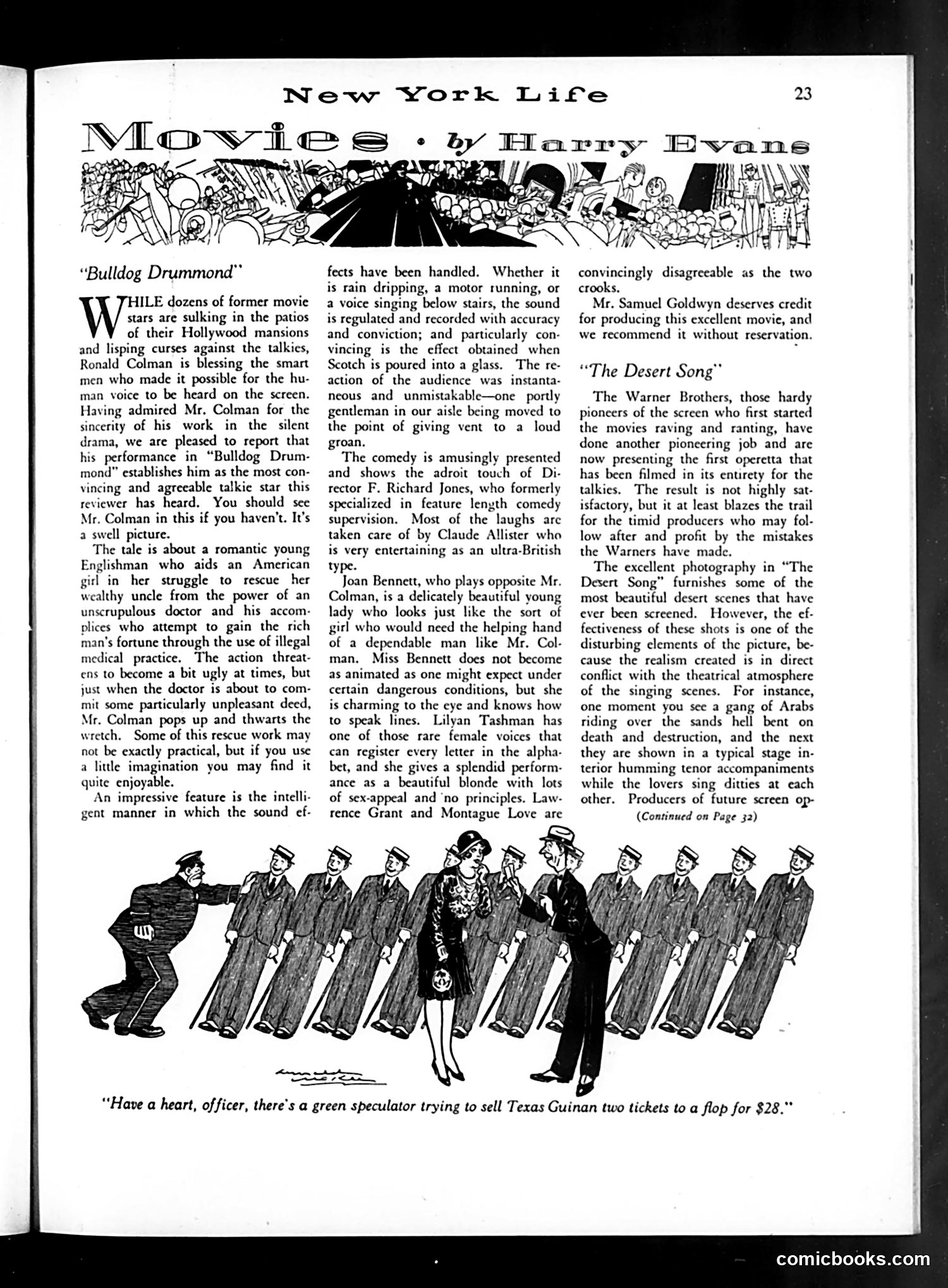
This page from Life magazine contains two film reviews by Harry Evans and a single-panel cartoon satirizing Hollywood's transition to "talking pictures" (talkies). **The Reviews**: Evans favorably reviews Ronald Colman's performance in "Bulldog Drummond," praising how sound effects enhance the film—notably the authentic recording of Scotch being poured, which delighted audiences. He also reviews "The Desert Song," Warner Brothers' first complete operetta filmed for talkies, finding it technically accomplished but dramatically conflicted between realistic cinematography and theatrical singing scenes. **The Cartoon**: Shows a woman in civilian clothes standing among identical uniformed police officers, with the caption about a "green speculator" trying to sell worthless theater tickets ("Texas Guinan two tickets to a flop for $28"). This references the era's theater ticket scalping and likely alludes to Texas Guinan, a famous nightclub hostess of the 1920s-30s known for her theatrical persona. The page captures Hollywood's early-talkie era (likely late 1920s), when sound technology was revolutionary but technically imperfect.
📄 Transcribed text from this page (OCR, searchable)
Machine-transcribed from the original scan — historical spelling and the odd misread are preserved.
New York Life 23 Mowvie Ss - \& Harry Pwans “Bulldog Drummond” ILE dozens of former movie stars are sulking in the patios of their Hollywood mansions and lisping curses against the talkies, Ronald Colman is blessing the smart men who made it possible for the hu- man voice to be heard on the screen. Having admired Mr. Colman for the sincerity of his work in the silent drama, we are pleased to report that his performance in “Bulldog Drum- mond” establishes him as the most con- vincing and agreeable talkie star this reviewer has heard. You should see Mr. Colman in this if you haven't. It’s a swell picture. The tale is about a romantic young Englishman who aids an American girl in her struggle to rescue her wealthy uncle from the power of an unscrupulous doctor and his accom- plices who attempt to gain the rich man’s fortune through the use of illegal medical practice. The action threat- ens to become a bit ugly at times, but just when the doctor is about to com- mit some particularly unpleasant deed, Mr. Colman pops up and thwarts the wretch. Some of this rescue work may not be exactly practical, but if you use a little imagination you may find it quite enjoyable. An impressive feature is the intelli- gent manner in which the sound ef- fects have been handled. Whether it is rain dripping, a motor running, or a voice singing below stairs, the sound is regulated and recorded with accuracy and conviction; and particularly con- vincing is the effect obtained when Scotch is poured into a glass. The re- action of the audience was instanta- neous and unmistakable—one portly gentleman in our aisle being moved to the point of giving vent to a loud groan, The comedy is amusingly presented and shows the adroit touch of Di- rector F, Richard Jones, who formerly specialized in feature length comedy supervision. Most of the laughs arc taken care of by Claude Allister who is very entertaining as an ultra-British type. Joan Bennett, who plays opposite Mr. Colman, is a delicately beautiful young lady who looks just like the sort of girl who would need the helping hand of a dependable man like Mr. Col- man. Miss Bennett does not become as animated as one might expect under certain dangerous conditions, but she is charming to the eye and knows how to speak lines. Lilyan Tashman has one of those rare female voices that can register every letter in the alpha- bet, and she gives a splendid perform- ance as a beautiful blonde with lots of sex-appeal and ‘no principles. Law- rence Grant and Montague Love are convincingly disagreeable as the two crooks, Mr. Samuel Goldwyn deserves credit for producing this excellent movie, and we recommend it without reservation. “The Desert Song” The Warner Brothers, those hardy pioneers of the screen who first started the movies raving and ranting, have done another pioneering job and are now presenting the first operetta that has been filmed in its enurety for the talkies. The result is not highly sat- isfactory, but it at least blazes the trail for the timid producers who may fol- low after and profit by the mistakes the Warners have made. The excellent photography in “The Desert Song” furnishes some of the most beautiful desert scenes that have ever been screened. However, the ef- fectiveness of these shots is one of the disturbing clements of the picture, be- cause the realism created is in direct conflict with the theatrical atmosphere of the singing scenes. For instance, one moment you see a gang of Arabs riding over the sands hell bent on death and destruction, and the next they are shown in a typical stage in- terior humming tenor accompaniments while the lovers sing ditties at each other. Producers of future screen op- (Continued on Page 32) “Have a heart, officer, there's a green speculator trying to sell Texas Guinan two tickets to a flop for $28." comicbooks.com