
Life, 1929-05-24 · page 24 of 36
Life — May 24, 1929 — page 24: what you’re looking at
What you’re looking at
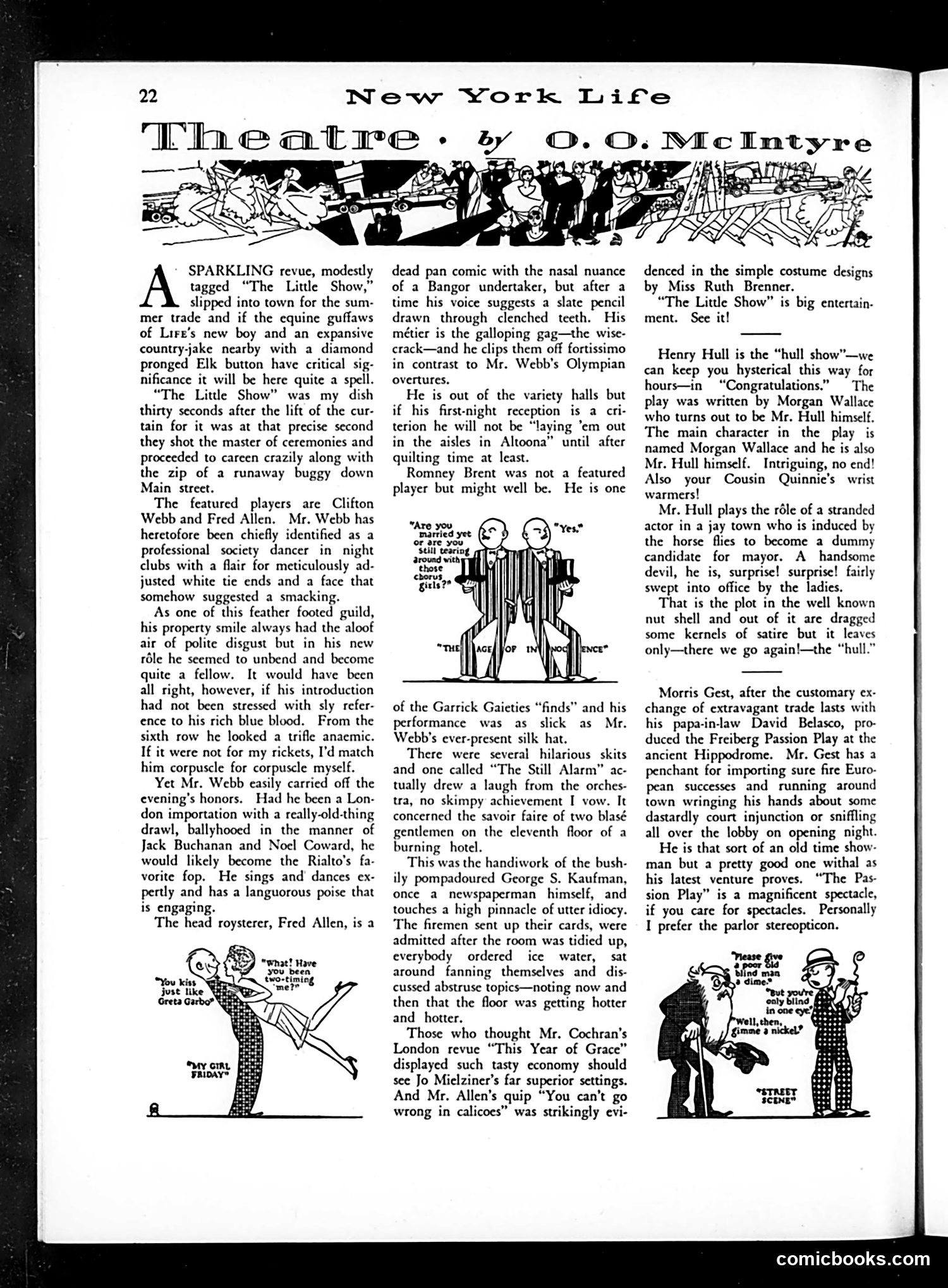
This is a theatre critic's review of a Broadway revue titled "The Little Show." The piece praises the show's comedic opening—a slapstick sequence involving a runaway buggy down Main Street. The critic highlights two featured performers: **Clifton Webb**, a society dancer transitioning to comedy (mocked for his aristocratic affectations and pale complexion), and **Fred Allen**, a vaudeville comic with a harsh, nasal delivery. The review notes Allen's "dead pan" style and rapid-fire jokes, contrasting him favorably with Webb's more refined manner. A sketch by **George S. Kaufman** about two blasé gentlemen calmly discussing a hotel fire while firemen arrive is singled out for humor. The reviewer also mentions designer **Jo Mielziner's** superior set design and costume designer **Ruth Brenner**. A secondary review covers "Congratulations," starring **Henry Hull**, where Hull's character is named after the play's writer, **Morgan Wallace**—who is Hull himself. The self-referential casting is presented as amusing.
📄 Transcribed text from this page (OCR, searchable)
Machine-transcribed from the original scan — historical spelling and the odd misread are preserved.
22 SPARKLING revue, modestly tagged “The Little Show,” slipped into town for the sum- mer trade and if the equine guffaws of Lire’s new boy and an expansive country-jake nearby with a diamond pronged Elk button have critical sig- nificance it will be here quite a spell. “The Little Show” was my dish thirty seconds after the lift of the cur- tain for it was at that precise second they shot the master of ceremonies and proceeded to caren crazily along with the zip of a runaway buggy down Main street. The featured players are Clifton Webb and Fred Allen. Mr. Webb has heretofore been chiefly identified as a professional society dancer in night clubs with a flair for meticulously ad- justed white tie ends and a face that somehow suggested a smacking. As one of this feather footed guild, his property smile always had the aloof air of polite disgust but in his new réle he seemed to unbend and become quite a fellow. It would have been all right, however, if his introduction had not been stressed with sly refer- ence to his rich blue blood. From the sixth row he looked a trifle anaemic. If it were not for my rickets, I’d match him corpuscle for corpuscle myself. Yet Mr. Webb easily carried off the evening's honors. Had he been a Lon- don importation with a really-old-thing drawl, ballyhooed in the manner of Jack Buchanan and Noel Coward, he would likely become the Rialto’s fa- vorite fop. He sings and’ dances ex- pertly and has a languorous poise that is engaging. The head roysterer, Fred Allen, is a dead pan comic with the nasal nuance of a Bangor undertaker, but after a time his voice suggests a slate pencil drawn through clenched teeth. His métier is the galloping gag—the wise- crack—and he clips them off fortissimo in contrast to Mr. Webb's Olympian overtures. He is out of the variety halls but if his first-night reception is a cri- terion he will not be “laying ’em out in the aisles in Altoona” until after quilting time at least. Romney Brent was not a featured player but might well be. He is one of the Garrick Gaieties “finds” and his performance was as slick as Mr. Webb's ever-present silk hat. There were several hilarious skits and one called “The Still Alarm” ac- tually drew a laugh from the orches- tra, no skimpy achievement I vow. It concerned the savoir faire of two blasé gentlemen on the eleventh floor of a burning hotel. This was the handiwork of the bush- ily pompadoured George S. Kaufman, once a newspaperman himself, and touches a high pinnacle of utter idiocy. The firemen sent up their cards, were admitted after the room was tidied up, everybody ordered ice water, sat around fanning themselves and dis- cussed abstruse topics—noting now and then that the floor was getting hotter and _ hotter. Those who thought Mr. Cochran’s London revue “This Year of Grace” displayed such tasty economy should see Jo Mielziner’s far superior settings. And Mr. Allen’s quip “You can’t go wrong in calicoes” was strikingly evi- New York Life denced in the simple costume designs by Miss Ruth Brenner. “The Litde Show” is big entertain- ment. See it! Henry Hull is the “hull show”—we can keep you hysterical this way for hours—in “Congratulations.” The play was written by Morgan Wallace who turns out to be Mr. Hull himself. The main character in the play is named Morgan Wallace and he is also Mr. Hull himself. Intriguing, no end! Also your Cousin Quinnie’s wrist warmers! Mr. Hull plays the réle of a stranded actor in a jay town who is induced by the horse flies to become a dummy candidate for mayor. A handsome devil, he is, surprise! surprise! fairly swept into office by the ladies. That is the plot in the well known nut shell and out of it are dragged some kernels of satire but it leaves only—there we go again!—the “hull.” Morris Gest, after the customary ex- change of extravagant trade lasts with his papa-in-law David Belasco, pro- duced the Freiberg Passion Play at the ancient Hippodrome. Mr. Gest has a penchant for importing sure fire Euro- pean successes and running around town wringing his hands about some dastardly court injunction or sniffling all over the lobby on opening night. He is that sort of an old time show- man but a pretty good one withal as his latest venture proves. “The Pas- sion Play” is a magnificent spectacle, if you care for spectacles. Personally I prefer the parlor stereopticon. comicbooks.com