
A complete issue · 35 pages · 1928
Life — February 23, 1928
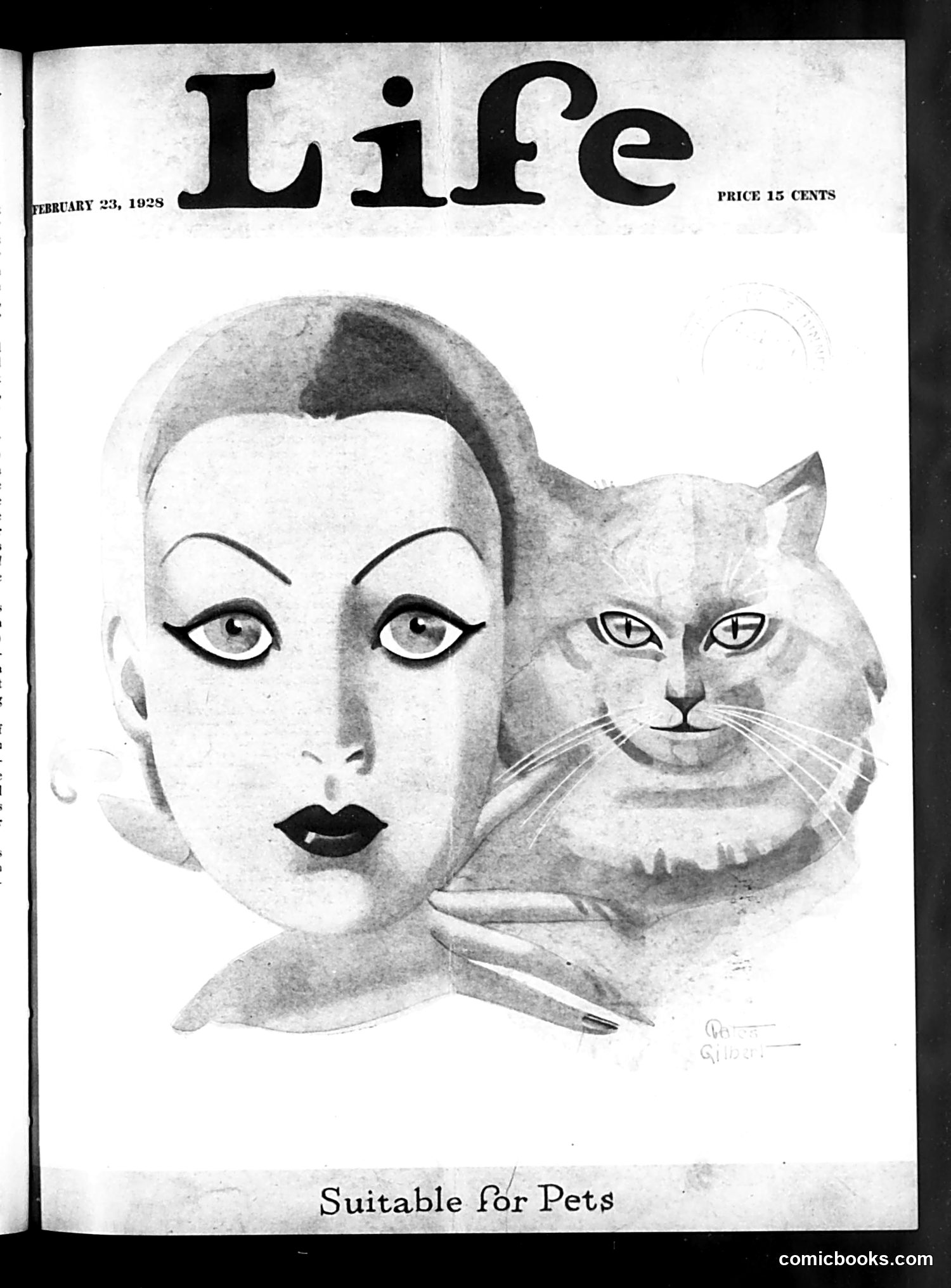
This cover illustration depicts a stylized woman's face alongside a cat, both rendered in 1920s art deco style with exaggerated features—dramatic eyebrows, defined eyes, and bold lips. The caption reads "Suitable for Pets," establishing a humorous comparison between the woman and feline. The satire likely comments on 1920s beauty standards and cosmetics trends, particularly the heavily made-up "flapper" aesthetic that was popular during this era. By equating fashionable women's appearance to something "suitable for pets," the cartoonist mocks the artificiality of contemporary beauty culture and makeup application. The matching stylized features between woman and cat reinforce this satirical parallel, suggesting that such exaggerated cosmetic styling was regarded by some as peculiar or animalistic.
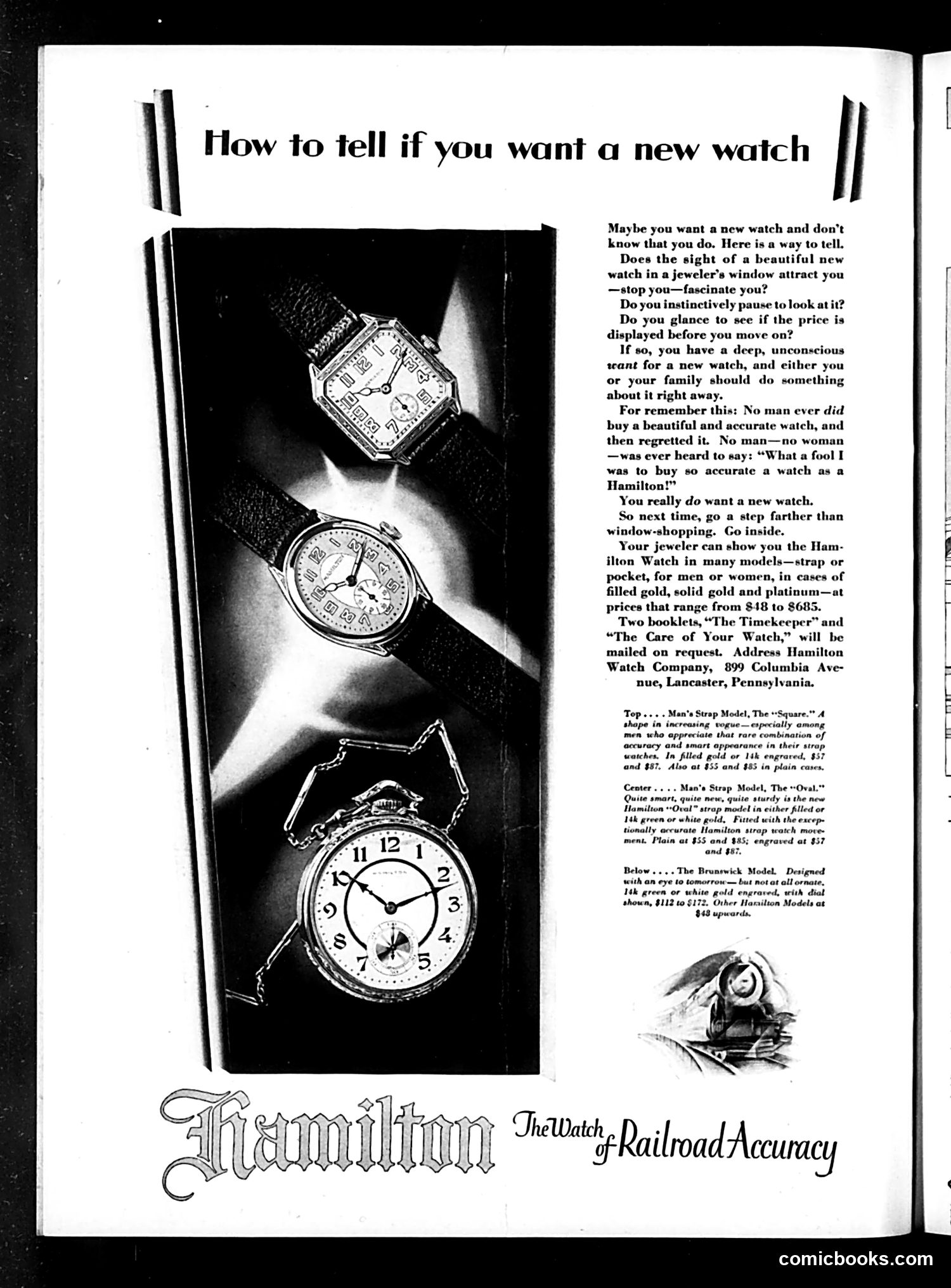
This is a straightforward **advertisement, not satire or political content**. The page promotes Hamilton watches, positioned as luxury timepieces of "railroad accuracy." The headline "How to tell if you want a new watch" uses light humor to frame a sales pitch: it suggests that admiring an attractive watch in a jeweler's window indicates desire for one. The copy plays on aspirational messaging—these are high-end watches ($48–$685 range, expensive for the era) made in precious metals. Three watch models are displayed: "The Square," "The Oval," and "The Brunswick." The advertisement emphasizes accuracy and craftsmanship as selling points, using the slogan "The Watch of Railroad Accuracy" to suggest reliability and precision. This represents typical mid-20th-century luxury marketing: quality, prestige, and subtle persuasion disguised as friendly advice.
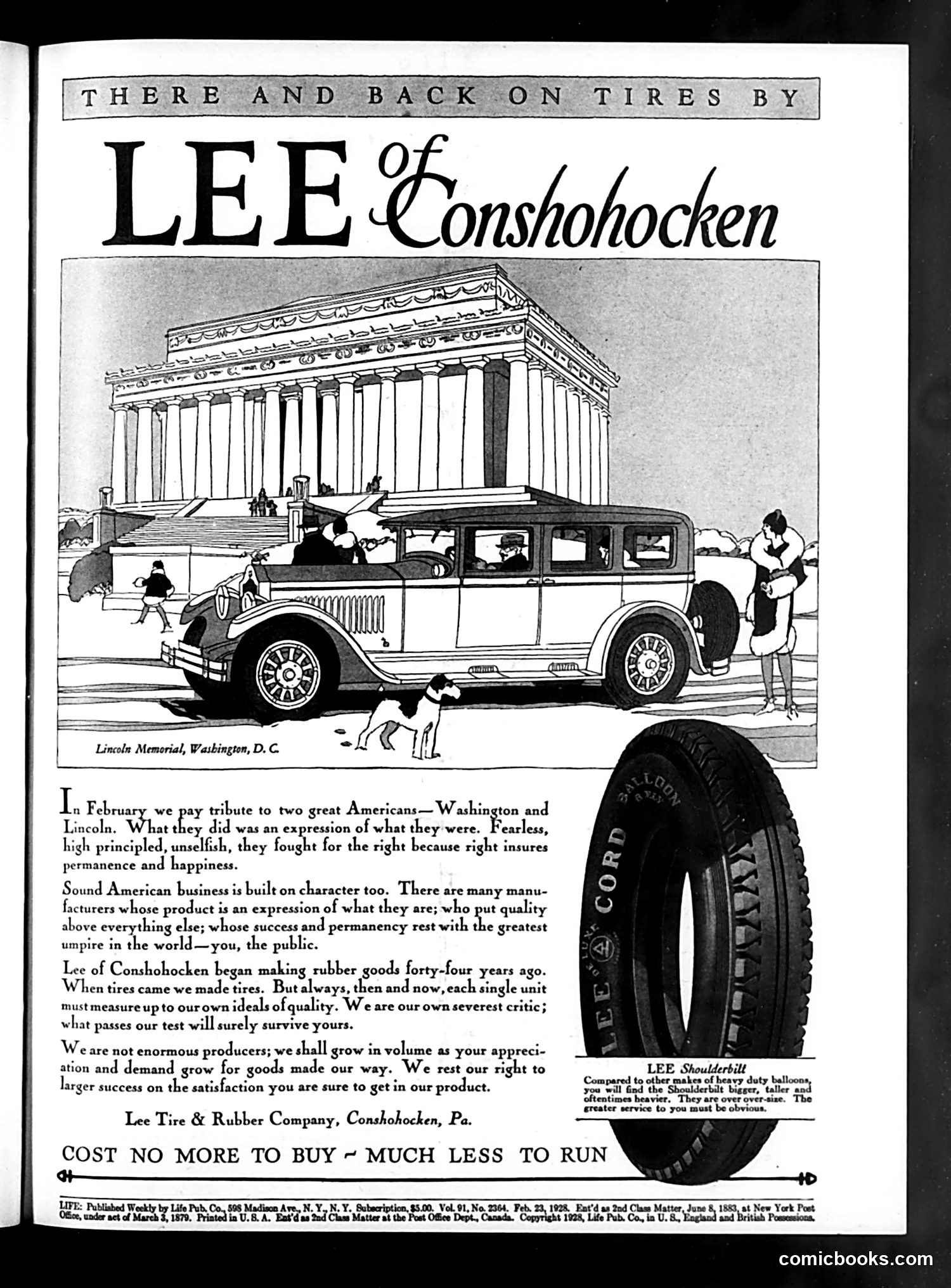
This is **primarily an advertisement**, not a political cartoon. It's a 1928 Lee Tire & Rubber Company ad for their "Shoulderhill" tire brand. The ad uses patriotic imagery—showing a car parked before the Lincoln Memorial in Washington, D.C.—to associate Lee tires with American values. The text draws a parallel between the character of Washington and Lincoln and the character of American business, arguing that quality products express national ideals. The actual "joke" or selling point is modest: Lee tires are reliable and economical ("Cost no more to buy ~ much less to run"). The patriotic framing attempts to make tire quality seem morally significant, appealing to consumers' sense of supporting authentic American enterprise. This is straightforward commercial persuasion dressed in nationalist rhetoric, typical of 1920s advertising.
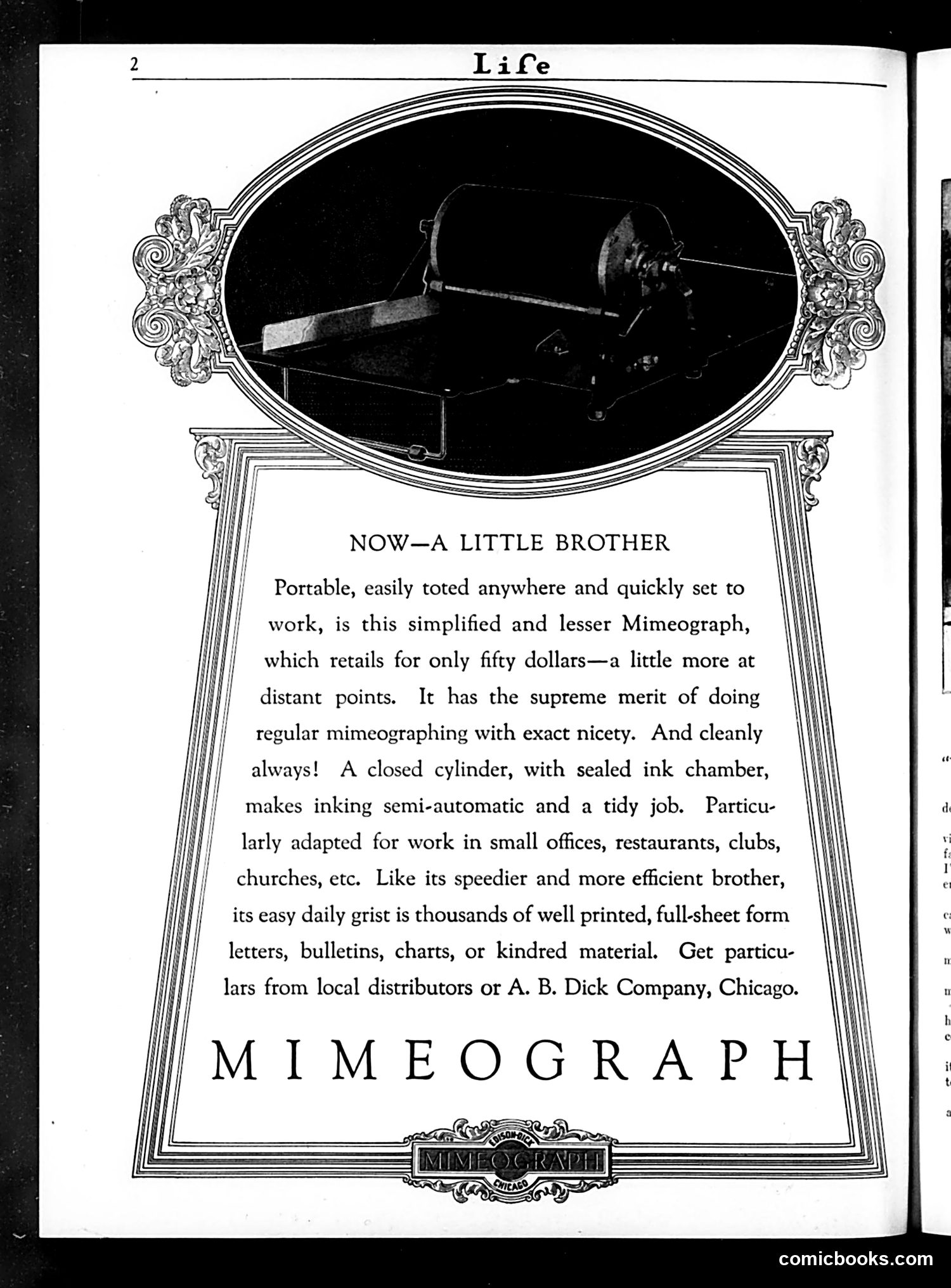
This page is primarily **advertising**, not editorial content or satire. It promotes a "Mimeograph" machine—a duplicating device—marketed as "a little brother" to larger, more expensive models. The ad emphasizes practical benefits: portability, affordability ($50), ease of use, and clean operation via a sealed ink chamber. It targets small-scale businesses: offices, restaurants, clubs, and churches needing to produce "full-sheet form letters, bulletins, charts, or kindred material." The image shows the mechanical device itself. The decorative Art Nouveau border and formal layout are typical of early 20th-century advertising design. There is no satirical or political content—this is straightforward commercial promotion by A.B. Dick Company of Chicago, a major mimeograph manufacturer.
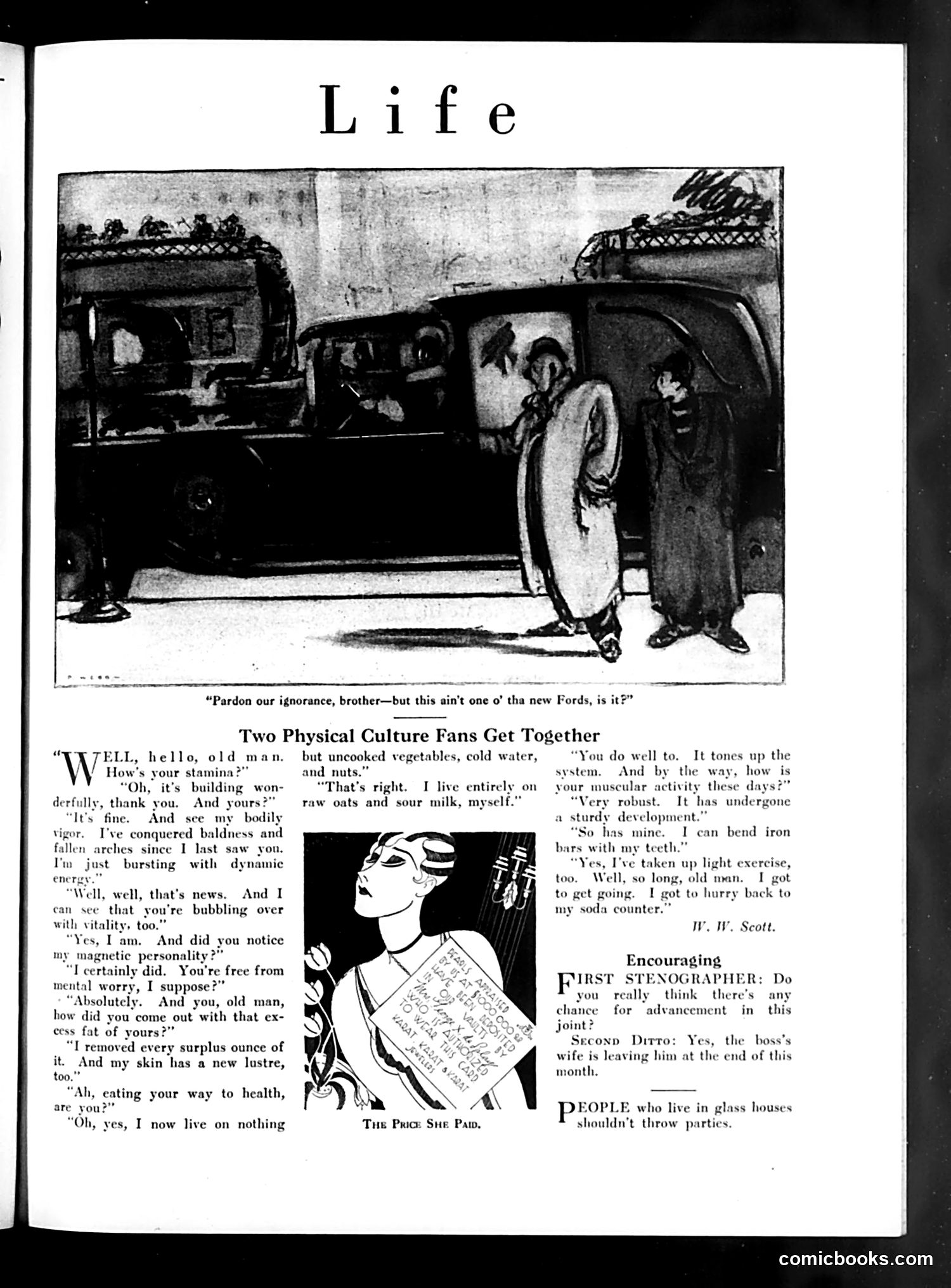
This page from *Life* magazine contains two separate pieces of humor: **Top cartoon**: Shows two men examining a Ford automobile, with the caption "Pardon our ignorance, brother—but this ain't one o' tha new Fords, is it?" This is Ford-brand satire, likely mocking the Model T's homogeneous appearance—so many identical Fords existed that people couldn't distinguish old models from new ones. **Main article**: "Two Physical Culture Fans Get Together" depicts a dialogue between two men discussing health regimens. One boasts of his "dynamic energy" and "magnetic personality" from avoiding "mental worry," while the other credits raw foods and exercise. The illustration shows a woman studying physical culture literature. The satire targets the early 20th-century "physical culture" movement—trendy health/fitness fads of the era—mocking participants' earnest belief in these pseudoscientific wellness philosophies.
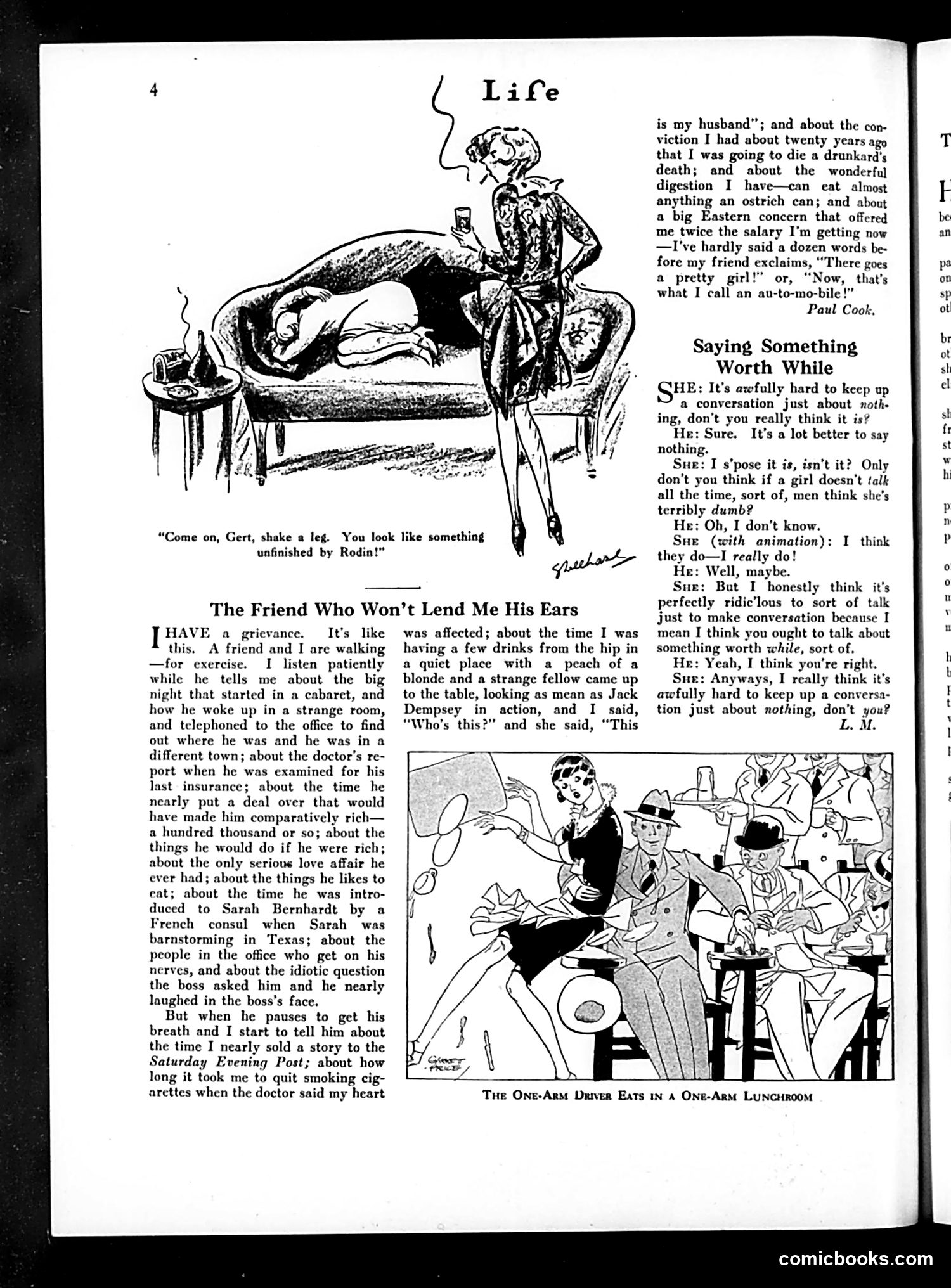
This page contains two humorous pieces from Life's satirical tradition: **"The Friend Who Won't Lend Me His Ears"** is a complaint-driven monologue where the narrator describes boring a friend with endless trivial personal stories—medical issues, financial problems, romantic history—while the friend is forced to listen. The satire targets self-absorbed people who monopolize conversations without considering their listener's interest. **"Saying Something Worth While"** is a dialogue mocking superficial conversation. A woman defends talking about nothing, while a man argues that silence beats empty chatter. The humor stems from the contradiction: both characters are guilty of exactly what they're criticizing. The accompanying cartoons illustrate these social awkwardness scenarios. The satire reflects early-20th-century concerns about modern social etiquette and genuine human connection.
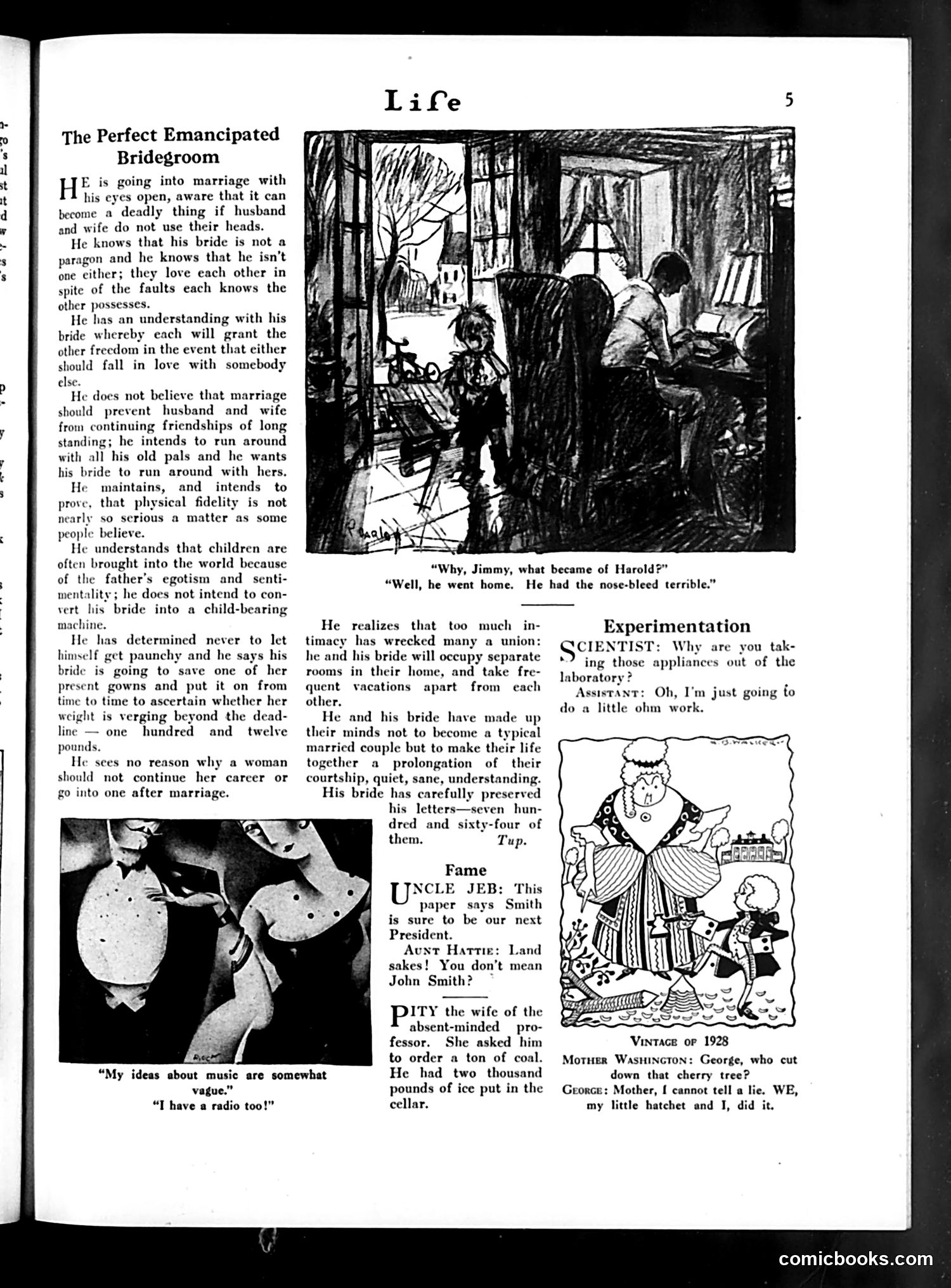
This article satirizes modern, progressive ideas about marriage in the 1920s. The "perfect" groom is characterized as unusually enlightened: he maintains friendships with other women, expects his wife to continue her career, believes physical fidelity is unimportant, and doesn't want children. The satire works through exaggeration—these radical positions are presented as virtuous, yet the absurdity becomes apparent. The accompanying illustration shows a domestic scene with a caption about "Harold," suggesting the ideology leads to marital dysfunction despite good intentions. The article mocks the era's "emancipation" rhetoric by showing how extreme interpretations of equality and freedom paradoxically undermine traditional marriage bonds, appealing to readers skeptical of 1920s social modernization.
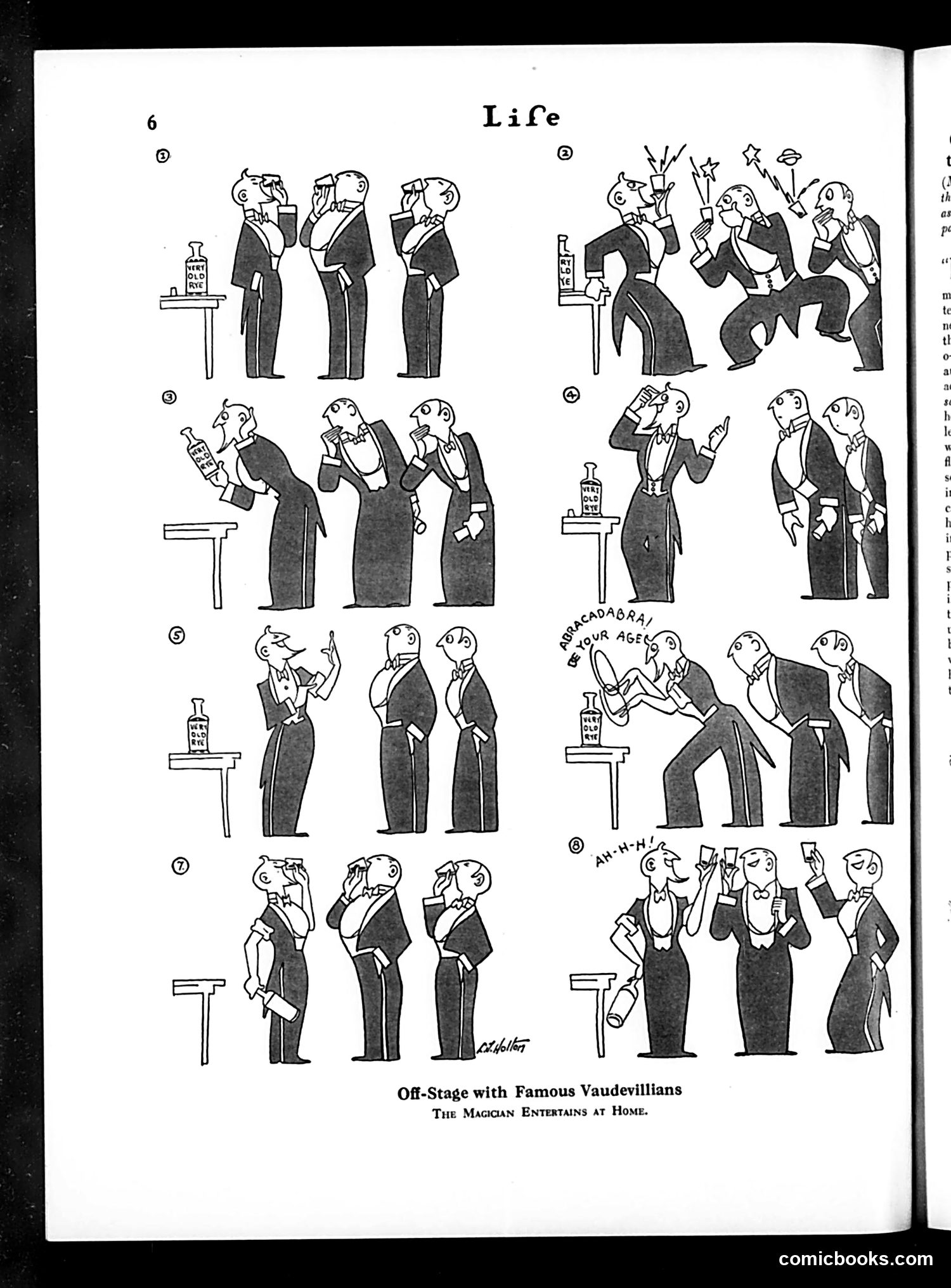
This page presents a satirical comic titled "Off-Stage with Famous Vaudevillians: The Magician Entertains at Home." It depicts a magician performing tricks for other entertainers at a private gathering, shown across eight numbered panels. The humor derives from contrasting the magician's polished stage performance with his attempts to entertain peers backstage or at home. Each panel shows escalating reactions—from calm observation (panels 1-2) through increasingly animated responses (panels 3-8), culminating in chaos with sound effects like "Abracadabra!" and "Ah-H-H!" The satire mocks vaudeville performers' tendency to overperform even in casual settings, and perhaps pokes fun at magicians' reputation for tiresome repetition of their act. The comedy relies on visual escalation rather than complex political commentary, targeting the entertainment industry's culture circa the early 20th century.
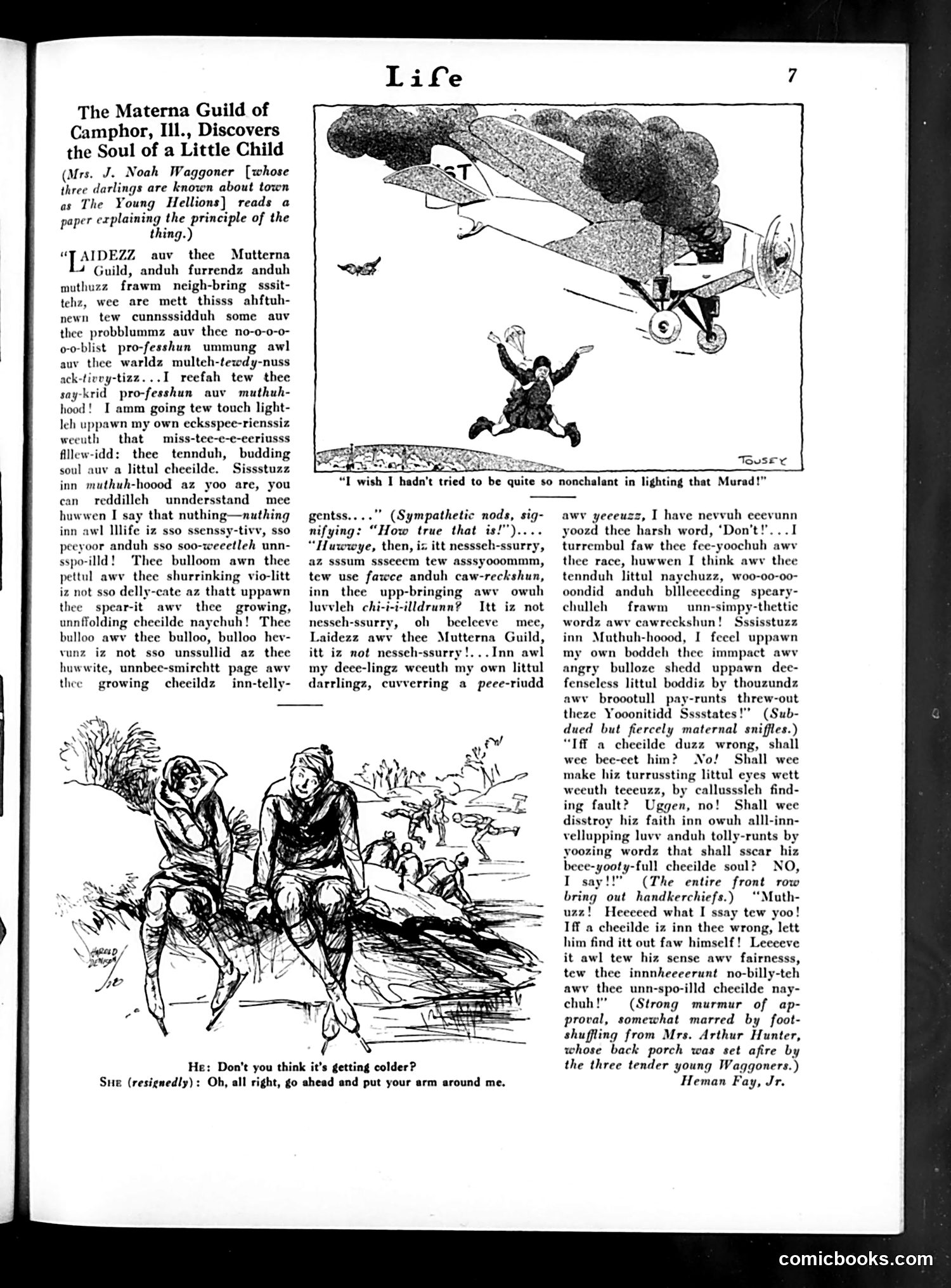
This page satirizes sentimental rhetoric about childhood innocence. The headline announces "The Materna Guild of Camphor, Ill., Discovers the Soul of a Little Child," and the left column contains deliberately garbled, pseudo-profound dialect about children's spiritual essence—mock-serious nonsense written in incomprehensible babble. The lower cartoon shows two adults sitting together. The man asks if she thinks it's getting colder; she responds by suggesting he put his arm around her. This illustrates the satire's point: adults exploit saccharine sentimentality about children as a cover for their own selfish romantic or sexual intentions. The page mocks both overly sentimental organizations that claim deep wisdom about childhood and the hypocrisy of adults who hide ordinary motives behind noble language.
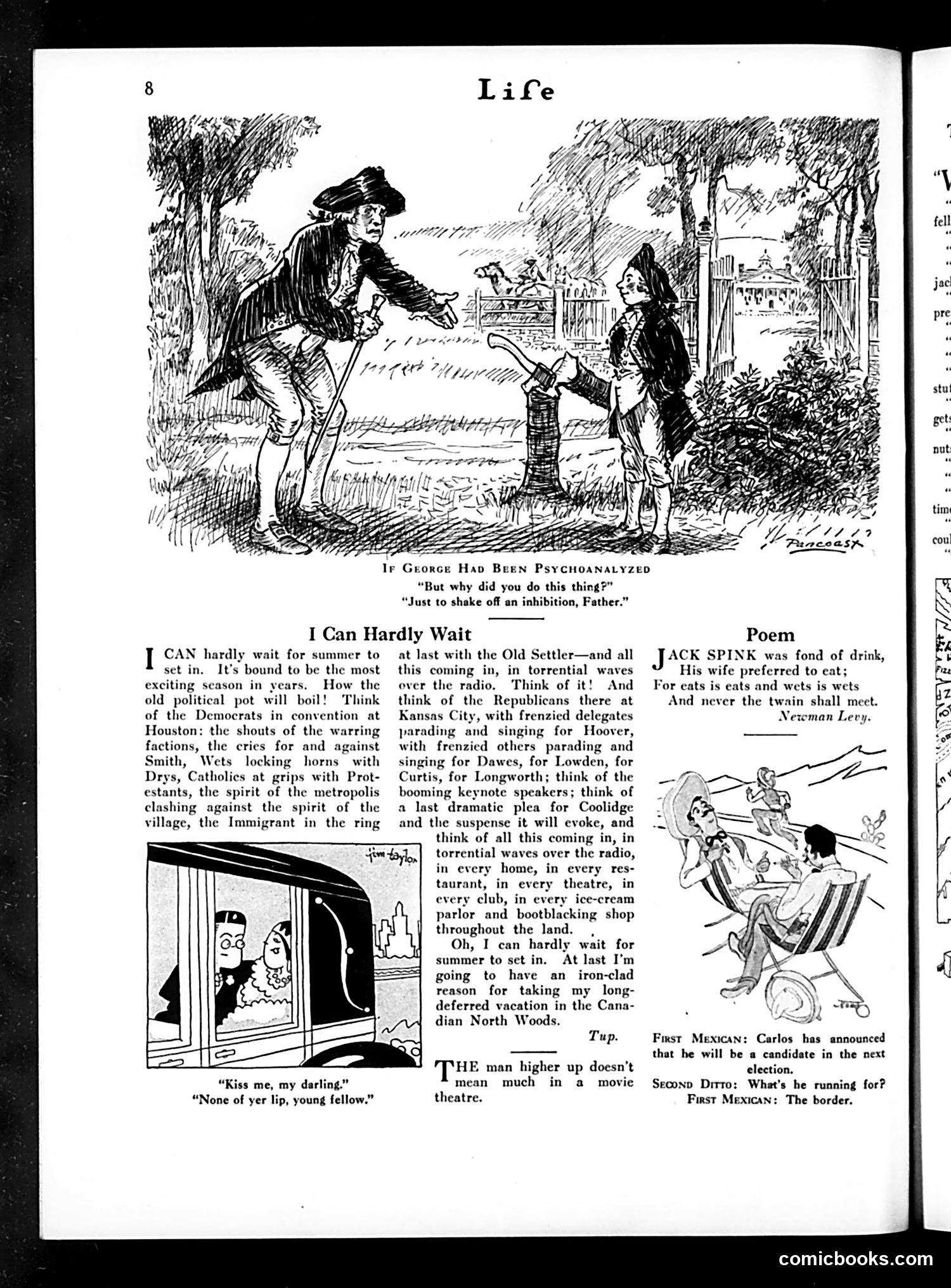
**Top Cartoon:** Titled "If George Had Been Psychoanalyzed," this depicts a father and child with a psychoanalyst's interpretation of the famous George Washington cherry-tree legend. The child says "Just to shake off an inhibition, Father"—satirizing how psychoanalysis (then trendy among intellectuals) reframes traditional moral stories as psychological symptoms rather than character lessons. The joke mocks the era's enthusiasm for Freudian analysis. **"I Can Hardly Wait" Section:** A humorous piece anticipating summer politics, mentioning Democratic conventions in Houston and Republican activities at Kansas City, plus references to figures like Hoover, Dawes, and Coolidge—suggesting 1920s political season anxieties. **Small Comics:** Include domestic humor and a brief Mexican-border political joke about elections. The page reflects 1920s American satirical commentary on psychology, politics, and social life.
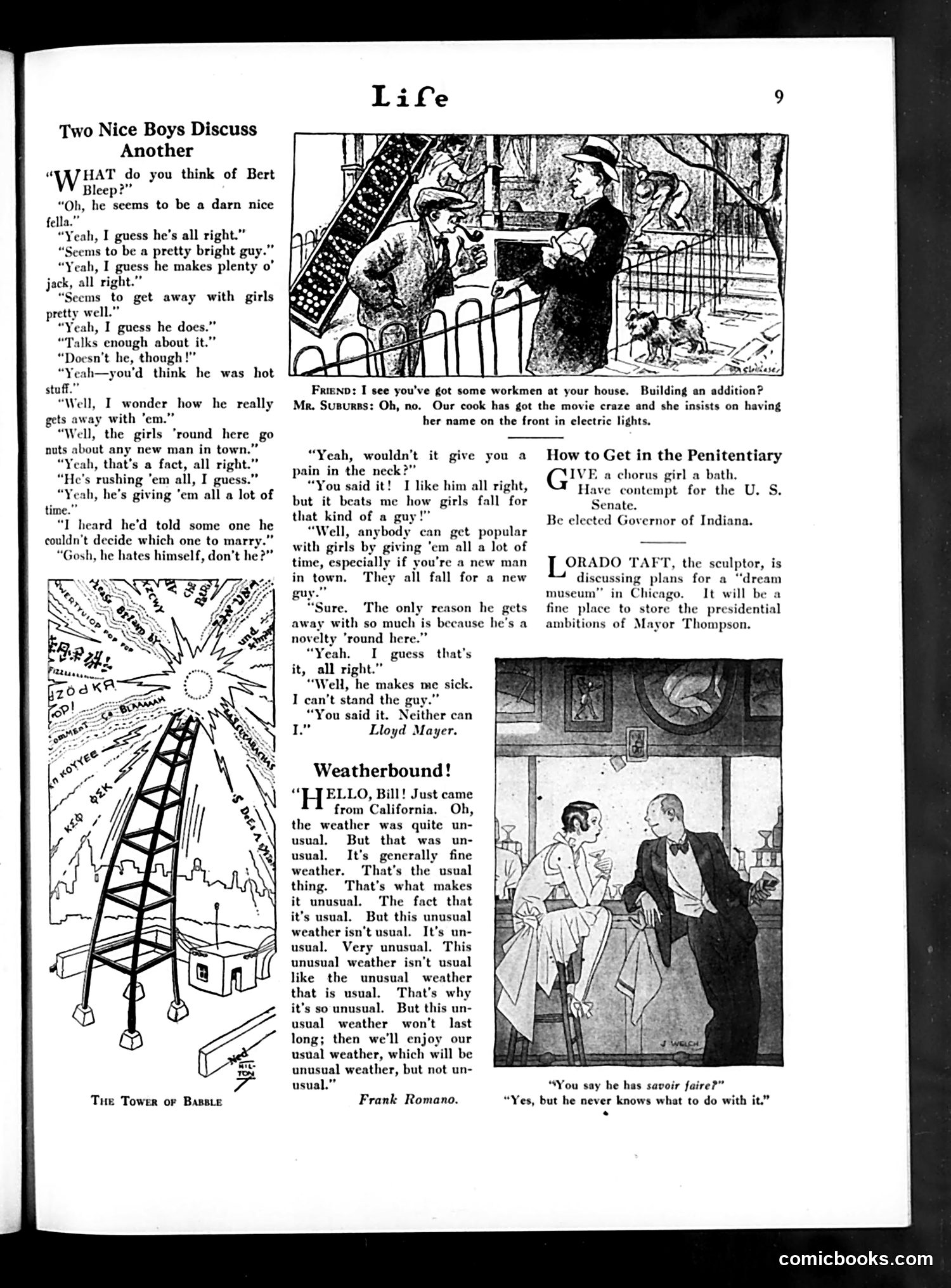
**"Two Nice Boys Discuss Another"**: A dialogue between two men discussing their acquaintance Bert Bleep. They debate whether he's genuinely popular or merely succeeds with women through novelty and persistence. The humor lies in their circular reasoning—concluding he gets away with excessive behavior simply because he's "a novelty 'round here." **"The Tower of Babble"**: A satirical cartoon showing a radio transmission tower surrounded by chaotic text labels. The joke appears to criticize radio broadcasting's cacophony of competing messages and advertising—mocking the medium's tendency to overwhelm listeners with simultaneous, contradictory content. **"Weatherbound"**: Frank Romano's piece humorously depicts someone describing California weather in absurdly circular logic, emphasizing how "unusual" weather is "unusual"—satirizing meaningless small talk and weather-related conversation clichés.
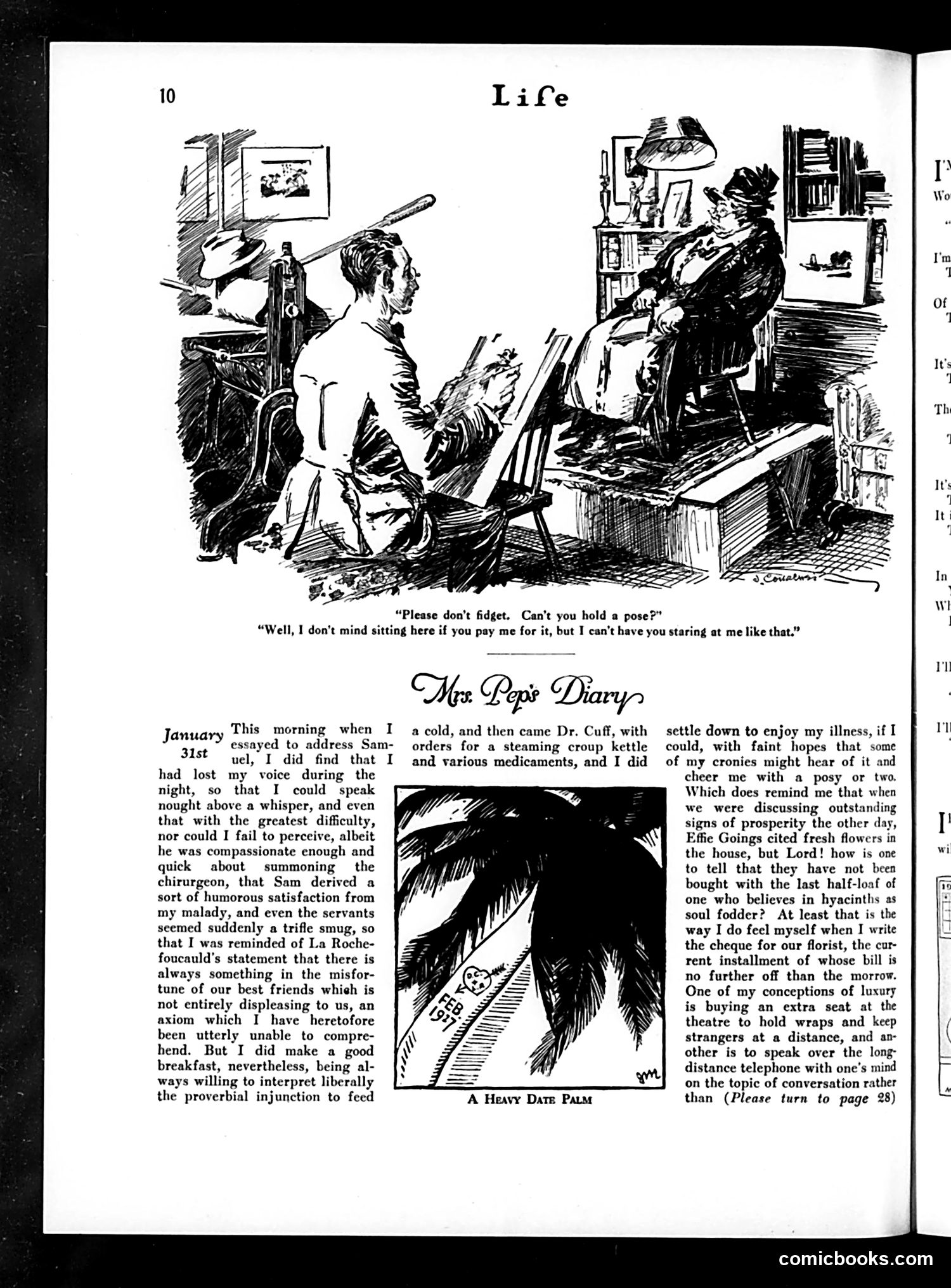
The main cartoon depicts an artist painting a portrait while a sitter complains about staring. The humor relies on a common tension: the artist needs the subject to hold still and maintain an expression, but the sitter finds this uncomfortable and monotonous. Below is "Mrs. Pop's Diary" (dated January 31st), a humorous column where the author describes having a cold and summoning Dr. Cuff. The entry humorously contrasts the doctor's quick efficiency with the author's elaborate complaints and observations about illness, luxury spending (theater seats, florists), and social pretensions. The accompanying illustration labeled "A Heavy Date Palm" appears to be unrelated visual humor. This represents typical early-20th-century American satirical magazine content mocking ordinary domestic life and social affectations.
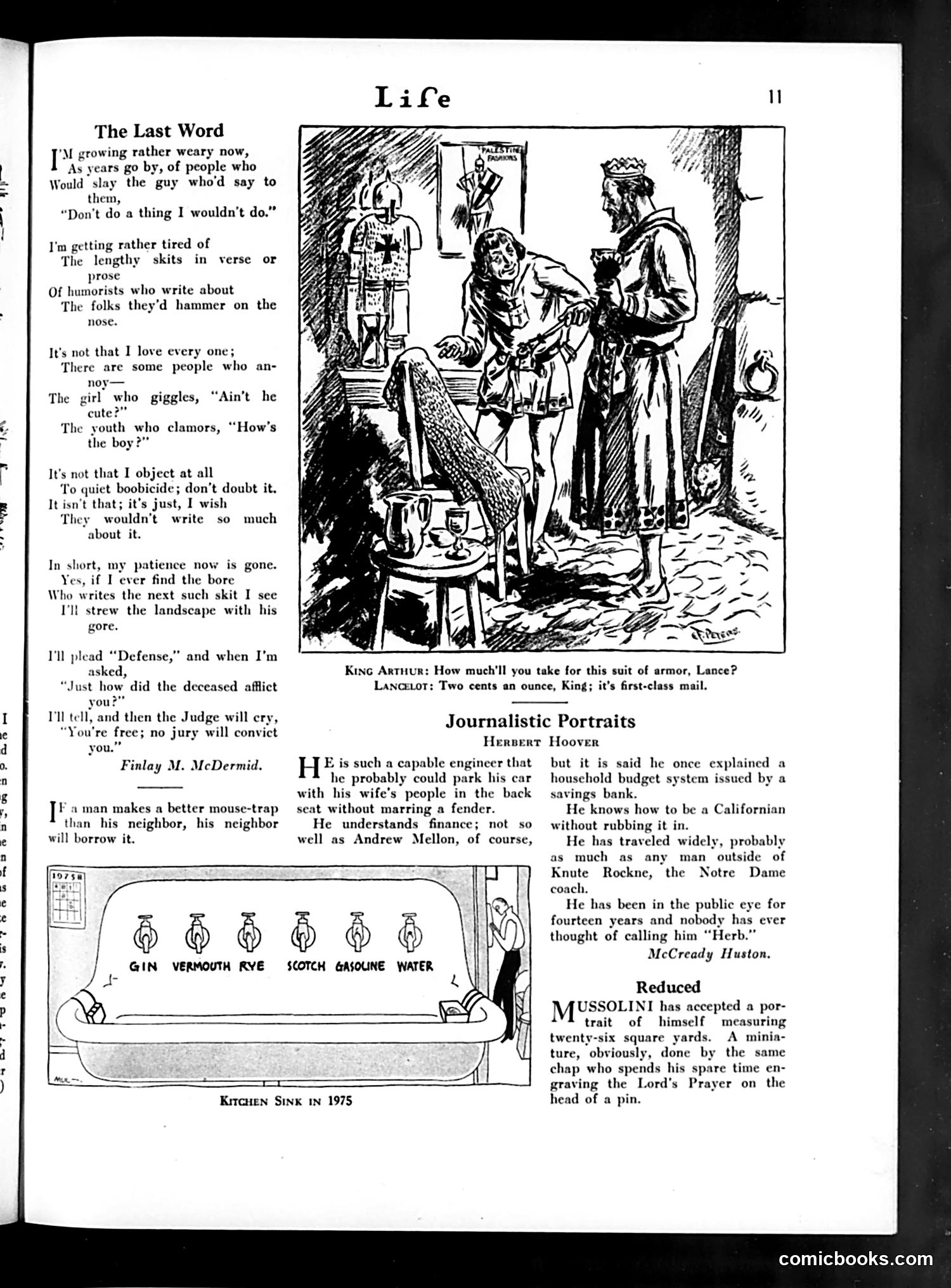
This page contains three distinct pieces: 1. **"The Last Word"** (poem by Finlay M. McDermid): A satirical complaint about tedious humor writing—specifically mocking humorists who write lengthy, repetitive pieces about irritating people (giggling girls, clamoring youth). The author declares he's tired of such writing and threatens legal action against anyone continuing the trend. 2. **King Arthur cartoon**: A medieval scene where Lancelot negotiates the price of armor with King Arthur, quoting "two cents an ounce" mail costs—an anachronistic joke mixing medieval chivalry with modern postal rates. 3. **"Journalistic Portraits"** (by Herbert Hoover): Brief character sketches of notable figures, including references to engineers, Californians, travelers, and Mussolini (described as accepting a "portrait of himself measuring twenty-six square yards").
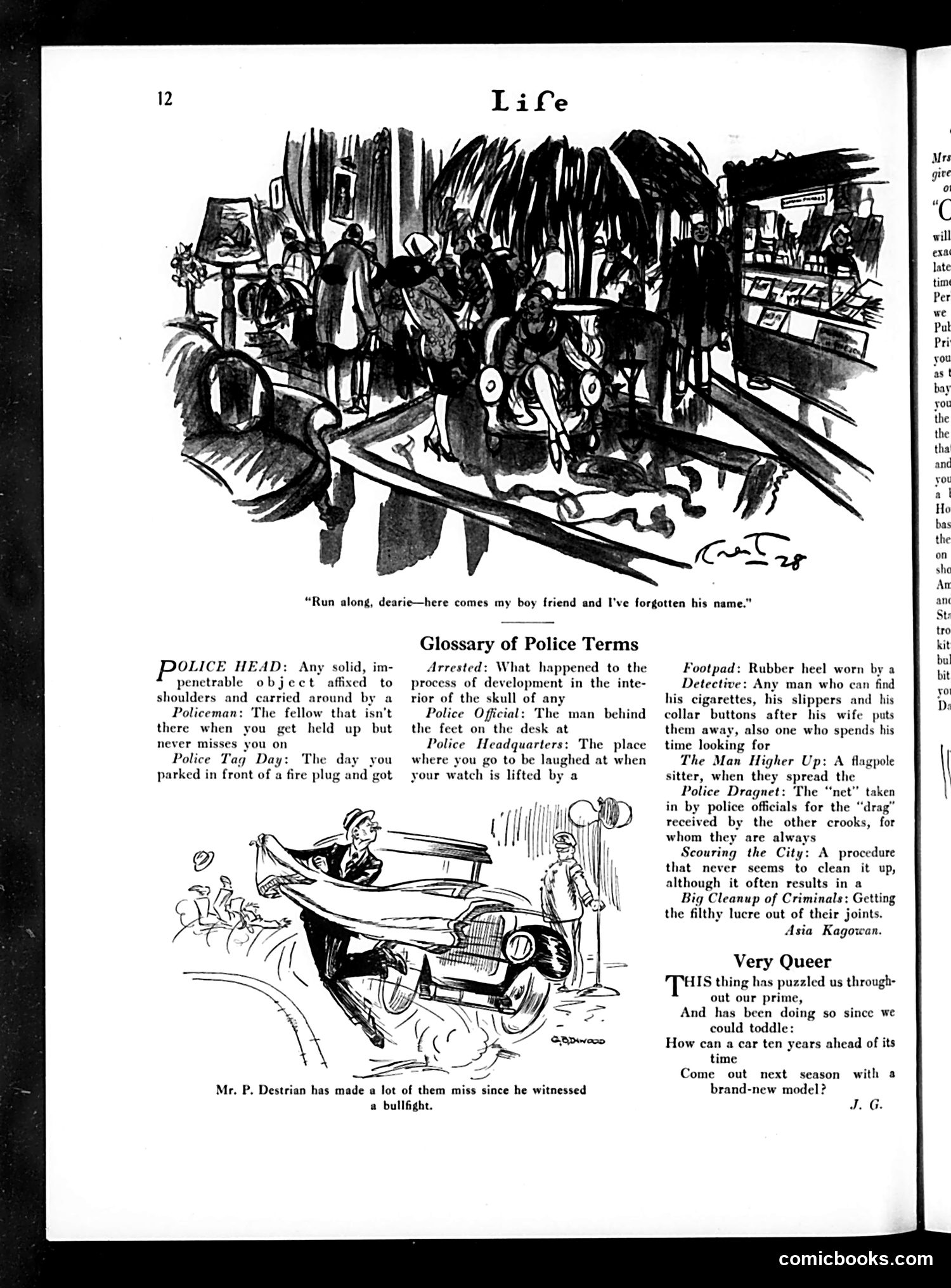
The top cartoon depicts a crowded street scene with the caption: "Run along, dearie—here comes my boy friend and I've forgotten his name." This is a joke about infidelity and casual romantic entanglements—a woman hurriedly dismisses one man as another approaches, having forgotten the first man's identity. The satire targets social hypocrisy and the loose romantic behaviors of the era. Below is a "Glossary of Police Terms"—humorous definitions mocking police procedures and corruption, including terms like "Footpads," "Detective," and "Police Dragnet." The bottom cartoon shows a man being struck by a car, captioned: "Mr. P. Destrian has made a lot of them miss since he witnessed a bullfight." This satirizes how witnessing bullfighting has altered a pedestrian's street-crossing behavior, making him recklessly confident.
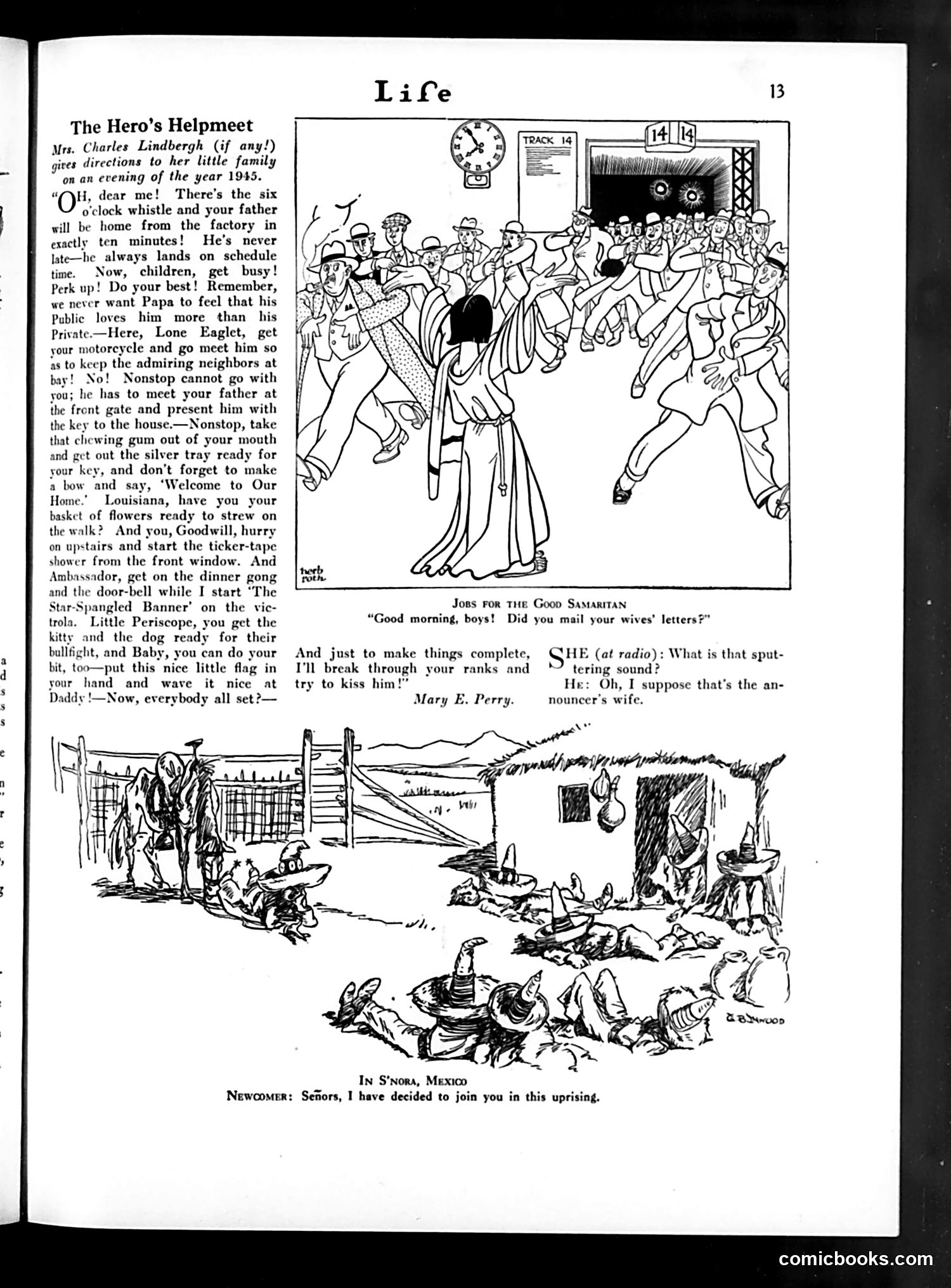
**"The Hero's Helpmeet"** (top): A humorous piece about Mrs. Charles Lindbergh preparing for her husband's arrival home from his factory job in 1945. She instructs the household to welcome him with an elaborate reception—fresh flowers, the silver tray, the dinner gong, and "The Star-Spangled Banner" on the victrola. This satirizes both the postwar domestic ideal of wives catering to returning workers and Lindbergh's controversial public status (he was an aviation hero but faced criticism for isolationist views). **"Jobs for the Good Samaritan"** (middle): A brief joke about a radio announcement asking wives if they've mailed letters. **"In Sonora, Mexico"** (bottom): A cartoon depicting armed conflict, with a newcomer joining an uprising—likely satirizing foreign intervention or mercenary involvement in Mexican political instability.
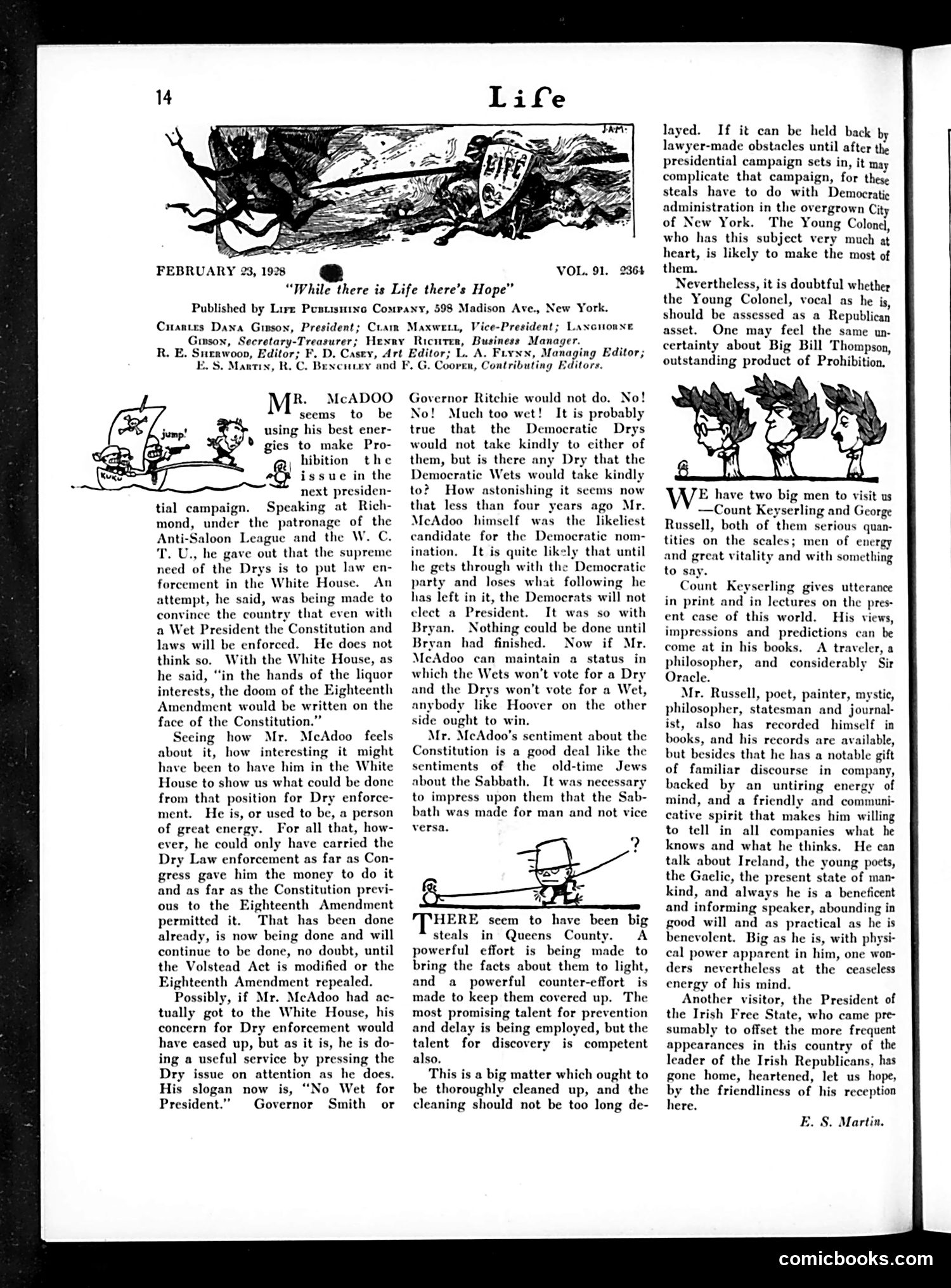
**Main Political Cartoon (top left):** The cartoon depicts Governor McAdoo refusing to support prohibition enforcement, shown as a figure unwilling to enforce "Dry" (anti-alcohol) laws. The satire mocks McAdoo's weak stance on this divisive issue, suggesting he lacks the energy needed for the coming presidential campaign. **Political Context:** The article criticizes McAdoo for his indecisive position on Prohibition—neither fully supporting "Dries" (prohibitionists) nor "Wets" (anti-prohibition forces). The text argues this weak positioning, combined with his past as an enforcer of the Eighteenth Amendment, makes him an unsuitable Democratic candidate. **Additional References:** The page discusses Count Keyserling and George Russell as visiting speakers, positioning them as intellectual counterweights to American political shortcomings of the era.
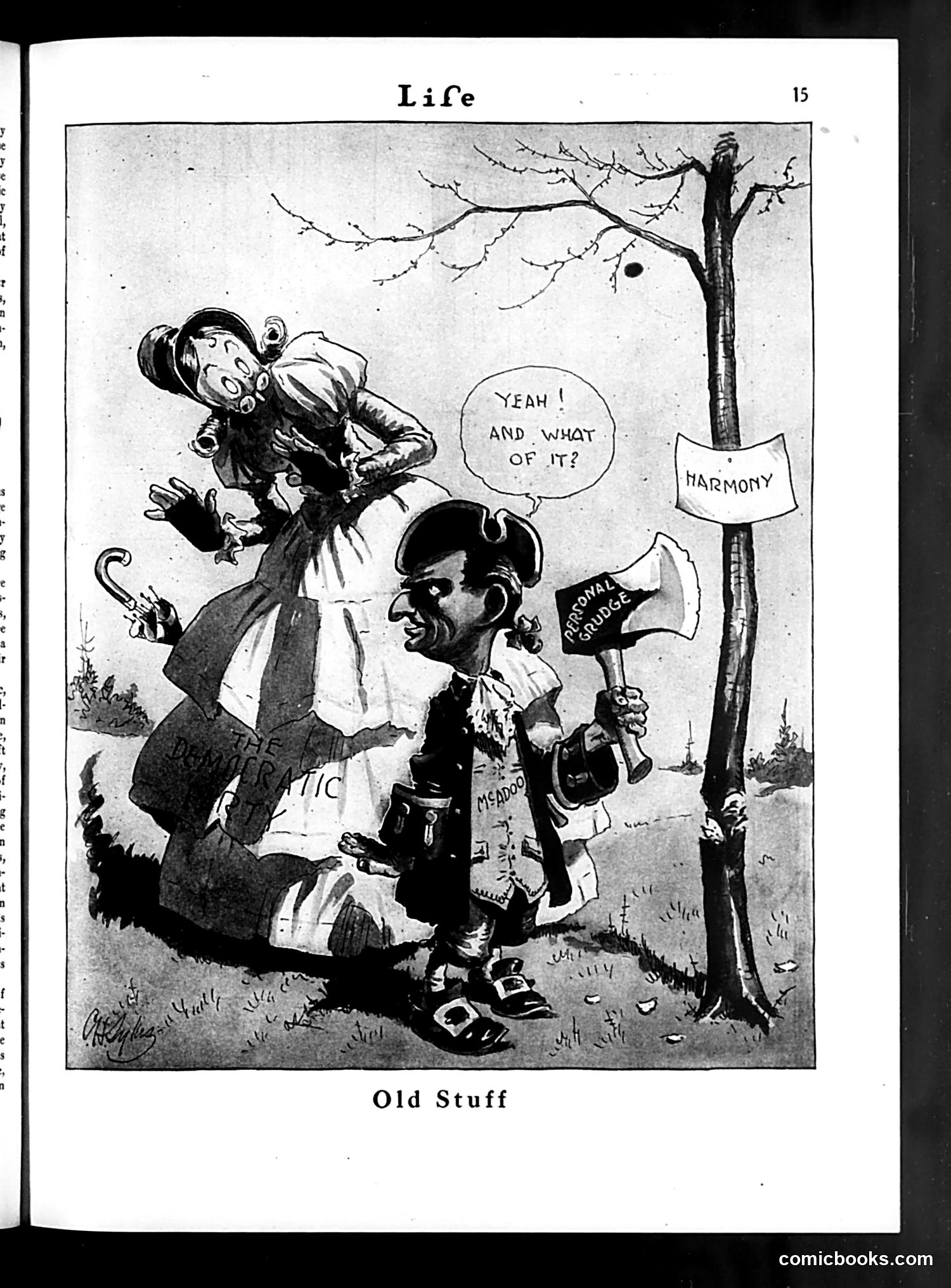
This cartoon satirizes political or social discord through two caricatured figures. One larger figure (labeled "HARMONY") holds an axe toward a bare tree, while a smaller figure responds "Yeah! And what of it?" The labels visible include "TARIFF," "POLITICS," and what appears to be "REMEDY" or similar text on the axe itself. The dead tree and desolate landscape suggest economic decline or destruction. The cartoon's title "Old Stuff" and the dialogue suggest weary repetition of political arguments—likely about tariff policy and its economic consequences. One figure proposes "harmony" as a solution while the other dismissively questions its value, implying political gridlock over persistent economic problems.
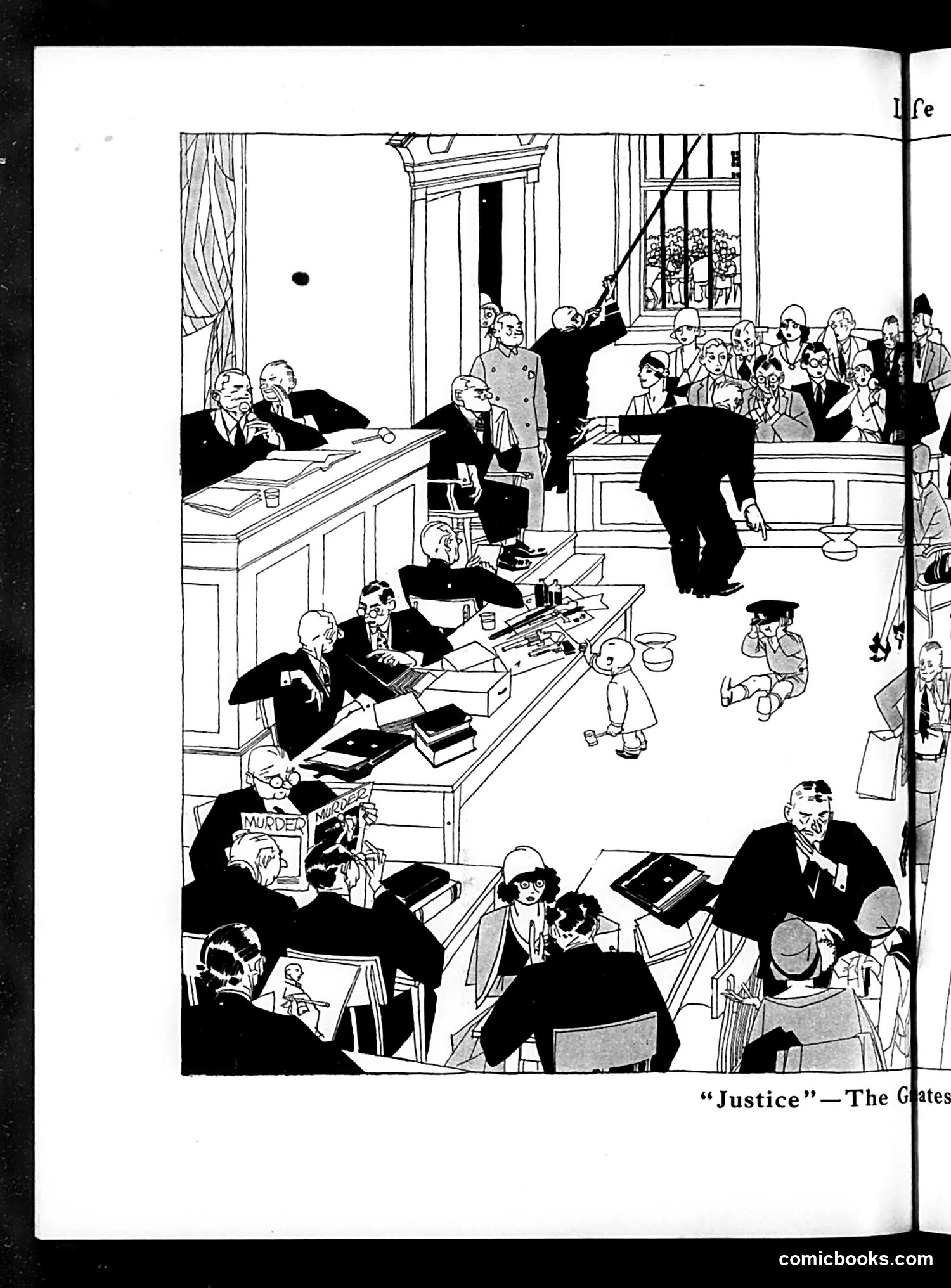
This courtroom cartoon satirizes the American legal system's chaos and absurdity. The scene depicts a judge's bench presiding over utter pandemonium: spectators crowd the gallery, a child plays on the courtroom floor, adults sprawl casually reading newspapers (one marked "MURDER"), and figures seem indifferent to proceedings. The satire targets the disconnect between the formal institution of justice (represented by the judge and formal courtroom architecture) and its actual dysfunction—suggesting the court system is so disorganized or corrupted that serious matters like murder receive no genuine attention. The casual, almost circus-like atmosphere ridicules both public apathy toward legal proceedings and institutional ineffectiveness in delivering meaningful justice.
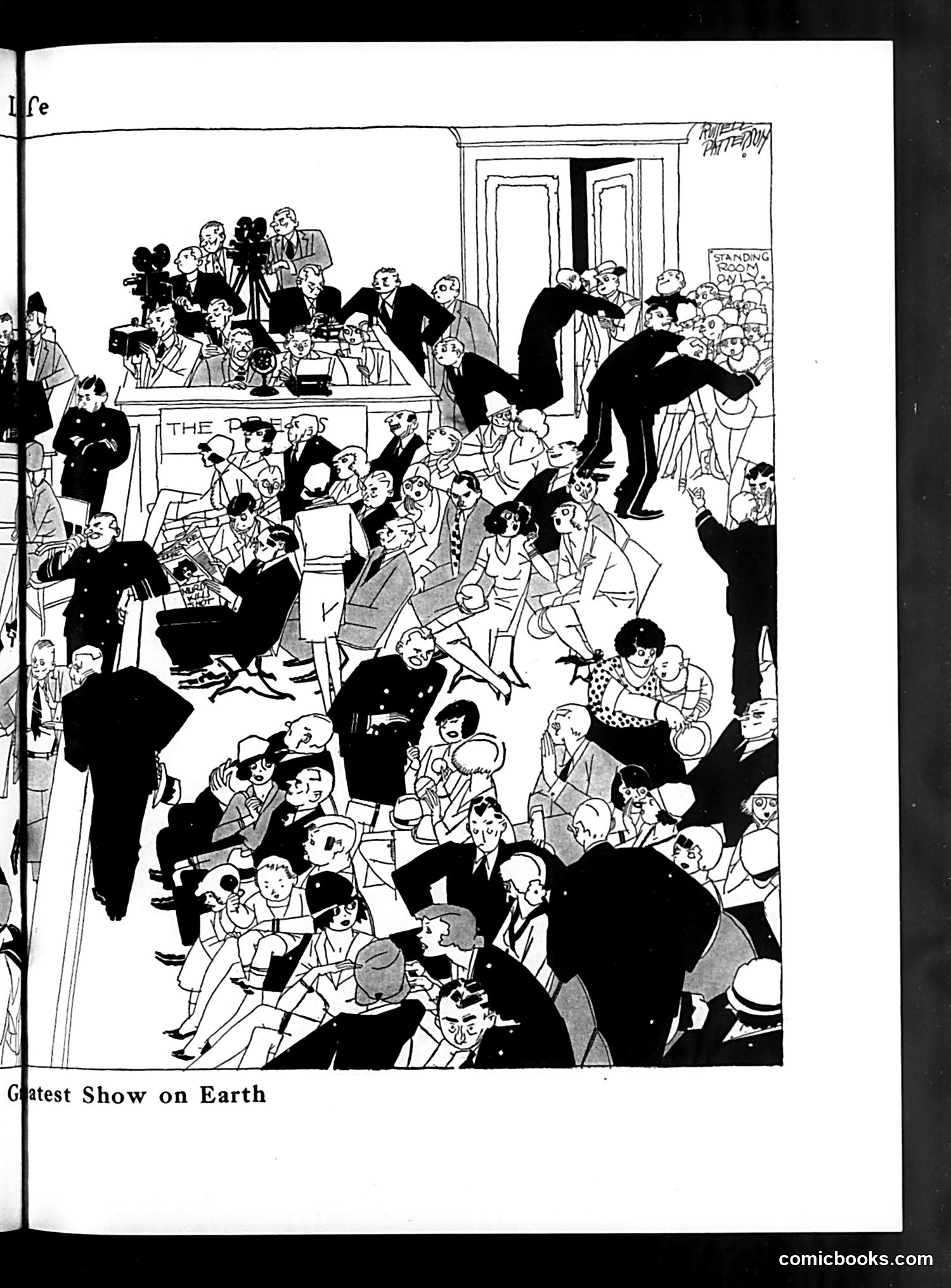
This satirical cartoon depicts a chaotic political or social event, with dignitaries on an elevated platform addressing a massive, unruly crowd below. The exaggerated caricatures and slapstick physical comedy—figures tumbling and gesturing wildly—suggest the scene is mocking some form of public spectacle or political theater. The title "Greatest Show on Earth" implies ironic commentary: what's presented as serious governance or important civic occasion is actually treated as circus-like entertainment. The crowded composition and visual chaos emphasize disorder and the difficulty of managing public attention or discourse. Without clearer contextual dating or labeled figures, the specific political target remains unclear, though the cartoon criticizes how public events devolve into undignified spectacle rather than substantive discourse.
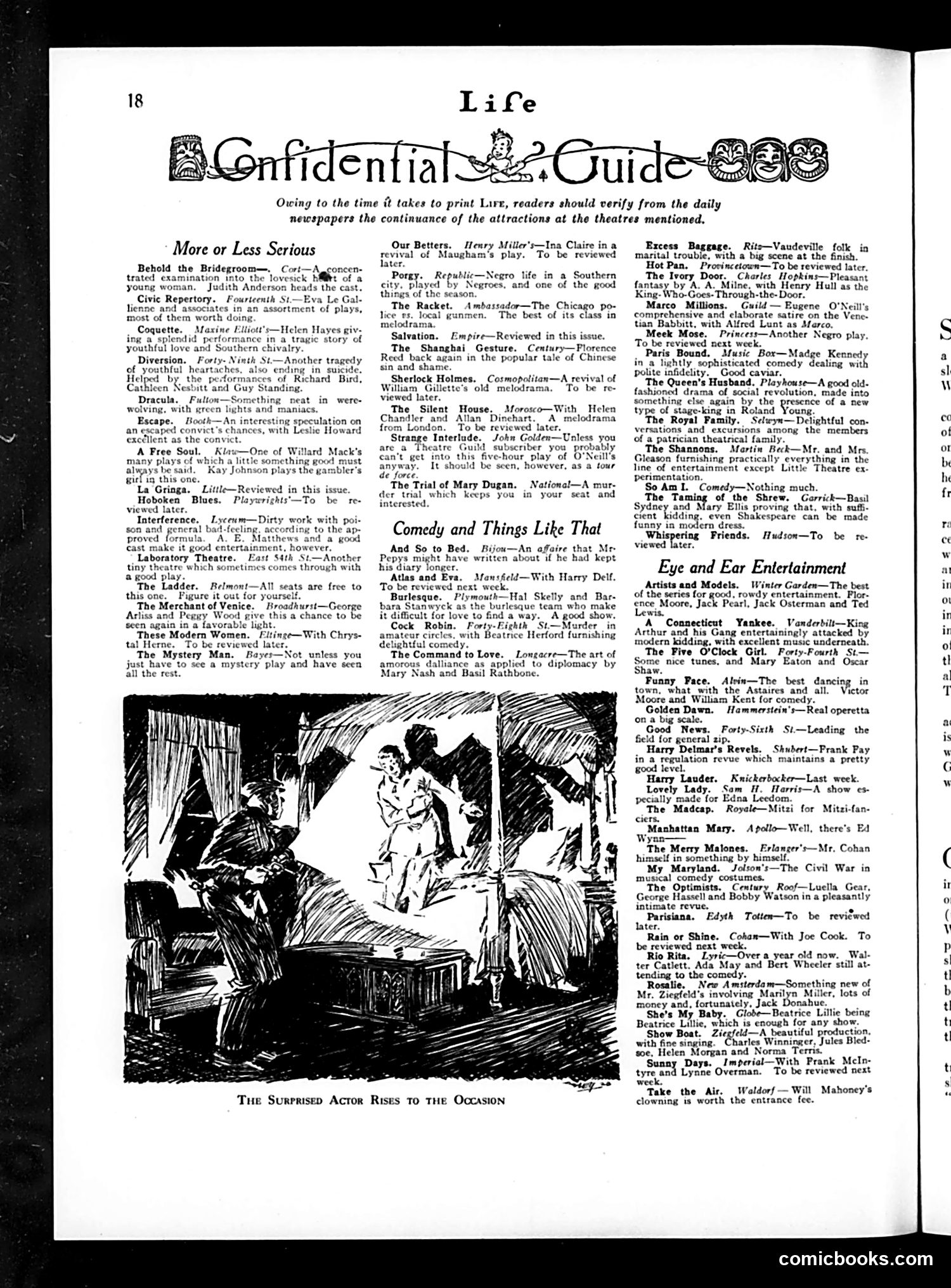
This page is a **theater guide and entertainment column** from Life magazine, not a political cartoon. It reviews Broadway productions currently running, organized by tone ("More or Less Serious" and "Comedy and Things Like That"). The **single illustration** depicts a scene titled "The Surprised Actor Rises to the Occasion"—showing what appears to be a theatrical moment where an actor reacts dramatically to an unexpected situation on stage, likely illustrating how performers improvise when something goes wrong during a performance. The reviews mention notable actors of the era (Helen Hayes, Ina Claire, Alfred Lunt) and significant plays, including Eugene O'Neill's *Strange Interlude* and *Marco Millions*, and a production of *Porgy* performed by Black actors. Several entries reference race explicitly, reflecting the segregated theater world of this period. This is primarily **informational content** for readers seeking theater recommendations—not satire or political commentary.
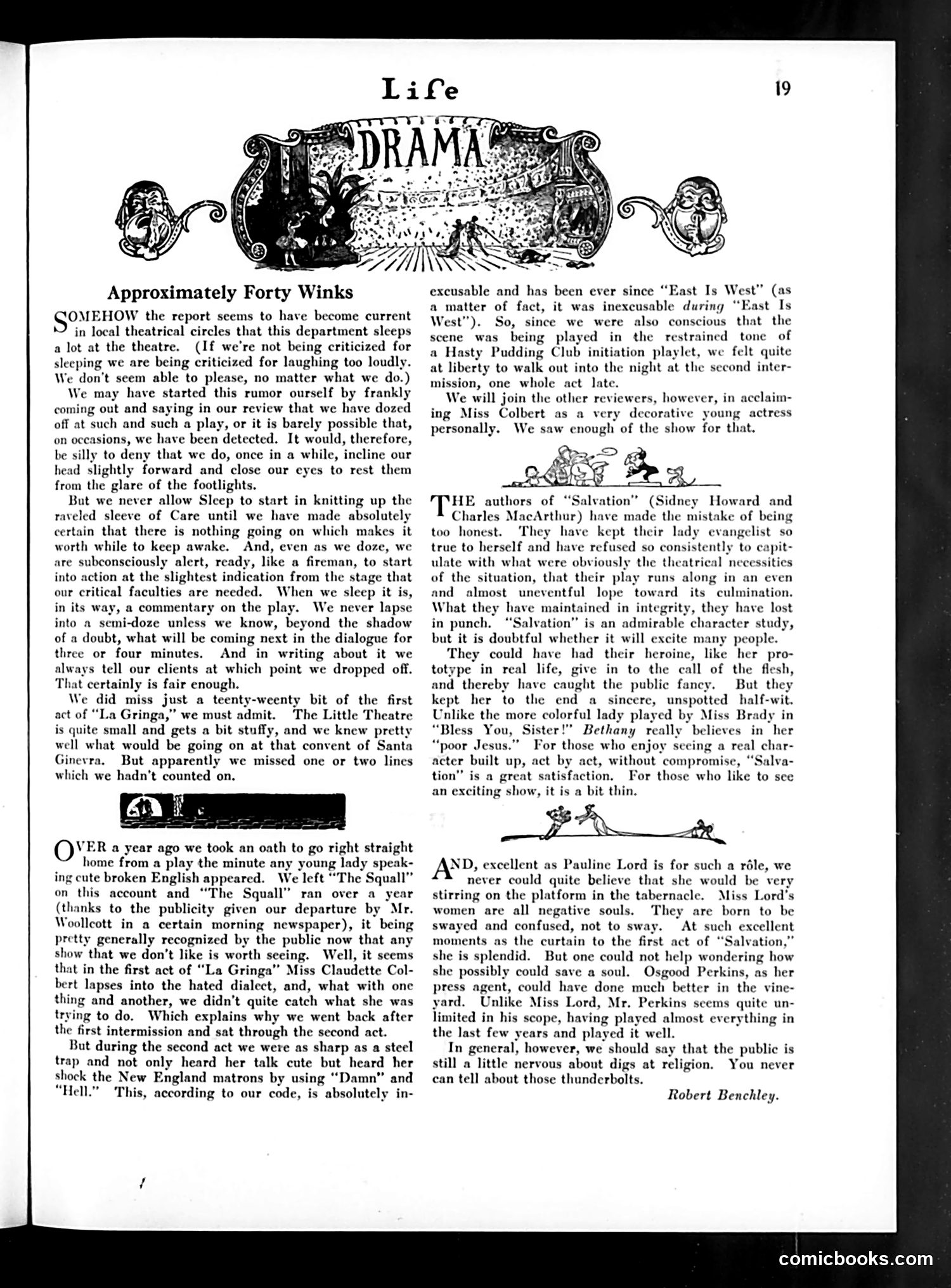
This page satirizes theater critics (including Life's own reviewer) who sleep during performances. The opening section humorously defends the practice, claiming critics remain "subconsciously alert" and only doze when confident nothing important is happening—essentially admitting they judge plays as boring. The subsequent reviews discuss specific productions: *La Gringa* (where the critic admits missing part of the first act, then returned), and *Salvation* by Sidney Howard and Charles MacArthur. The critic praises the latter's honest character work but finds it theatrically dull—lacking "punch" despite integrity. References to *The Squall* and Alexander Woollcott (a famous contemporary critic) appear, suggesting Life's reviewer competes within a well-known critical circle. The mention of actress Claudette Colbert using "damn" and "hell" reflects period concerns about stage language offending audiences. The satire ultimately pokes fun at both sleeping critics and productions that fail to engage even alert viewers.
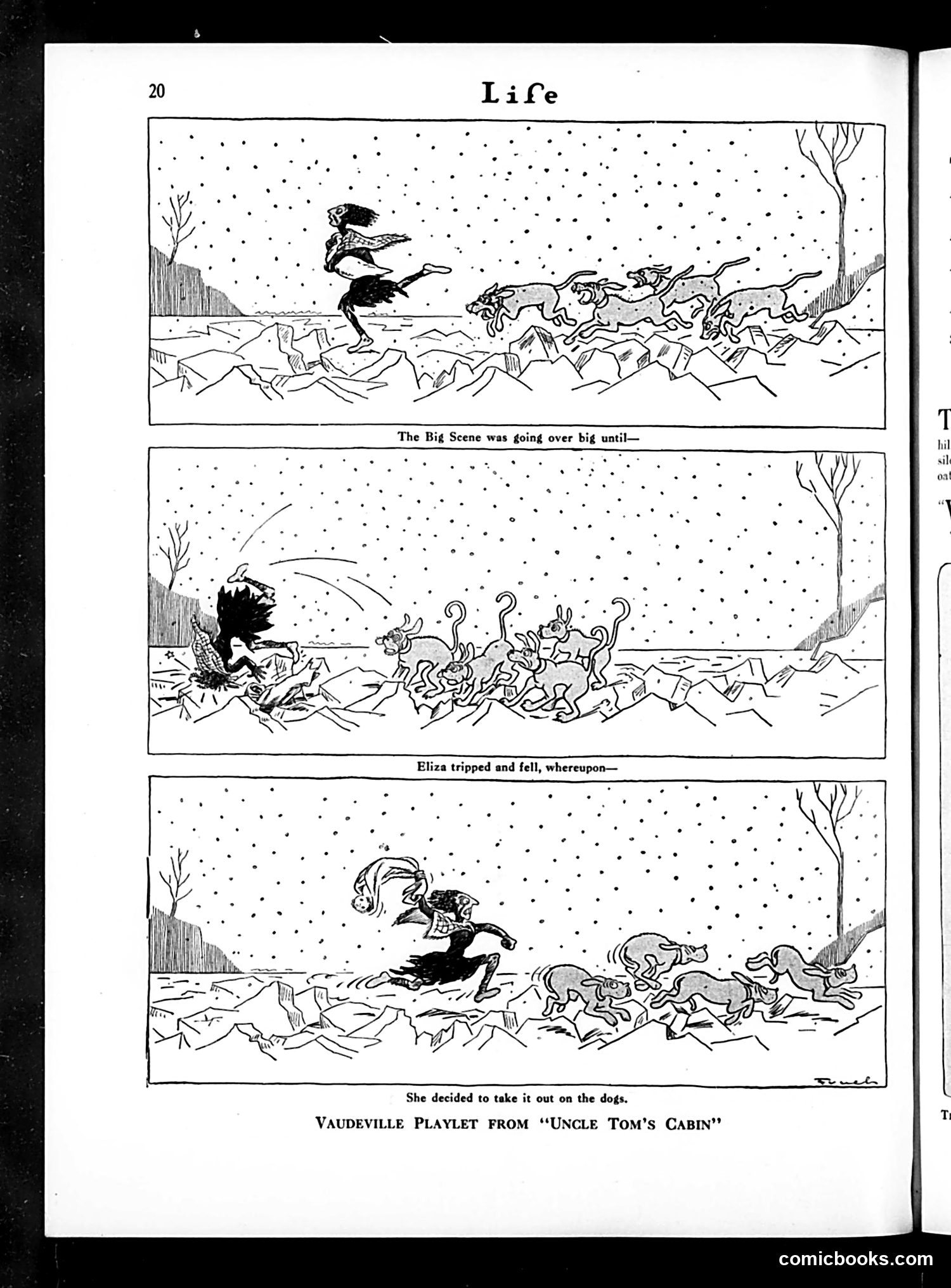
This is a three-panel vaudeville sketch parodying "Uncle Tom's Cabin." The sequence shows a character (labeled "Eliza") fleeing across an icy landscape while being chased by dogs—a famous scene from Harriet Beecher Stowe's novel about slavery. The satire here mocks theatrical adaptations of the serious novel by presenting it as cheap vaudeville entertainment. The final panel's caption, "She decided to take it out on the dogs," suggests comedic physical slapstick rather than dramatic tragedy. The joke appears to be deflating the melodrama of the original by reducing it to lowbrow entertainment where the protagonist simply attacks her pursuers instead of experiencing genuine peril. This reflects how "Uncle Tom's Cabin" had become a staple of popular theatrical productions, often heavily adapted and sensationalized for entertainment purposes rather than preserving the work's moral gravity.
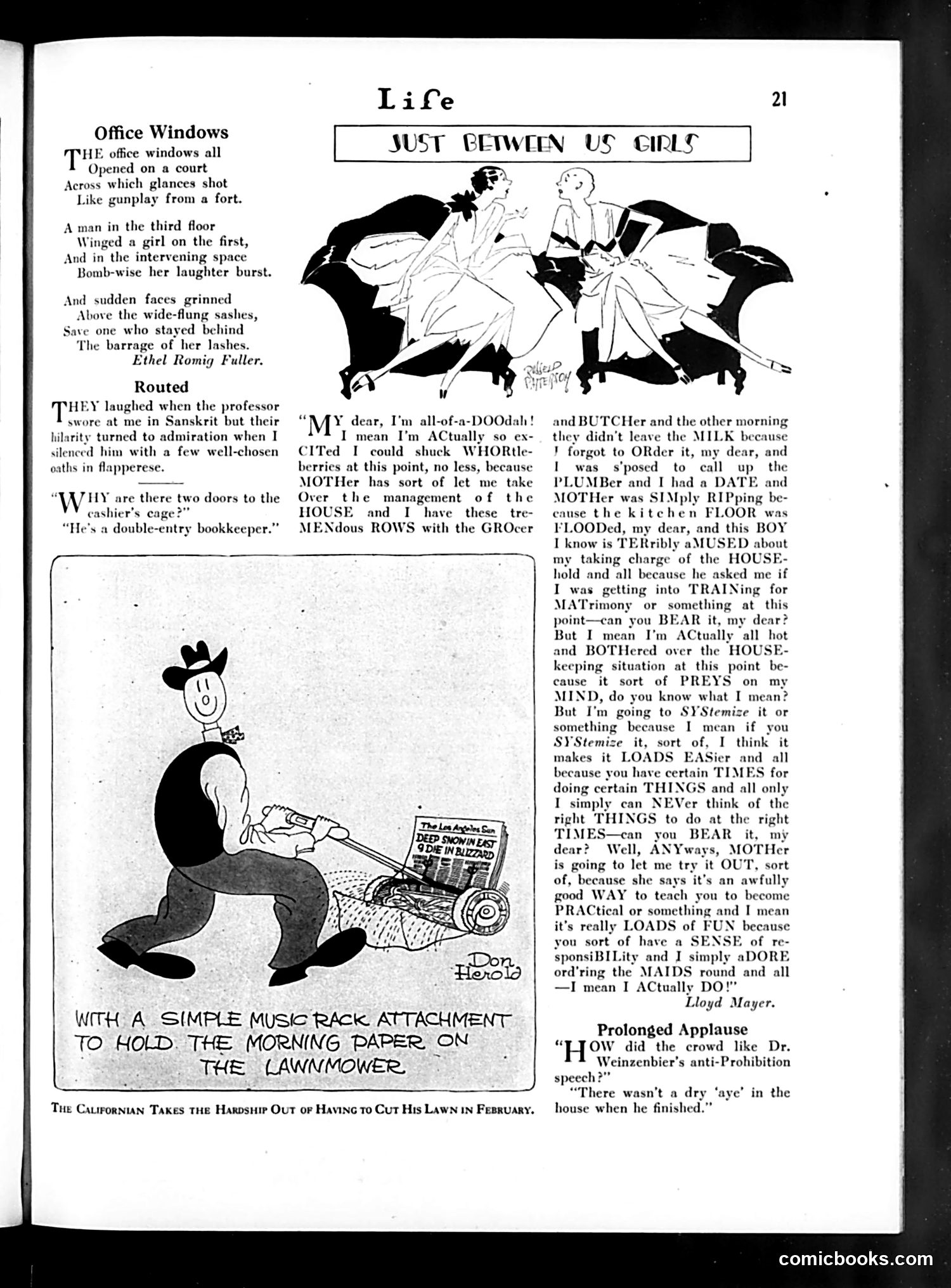
This page satirizes 1920s social dynamics, particularly the "flapper" generation and gender roles. **"Office Windows"** and **"Routed"** are brief humorous pieces about workplace romance and linguistic cleverness—the flapper using slang to impress. **"Just Between Us Girls"** is the main satire: a rambling monologue from a young woman given household management responsibilities. She hyperbolically emphasizes random words in affected speech patterns, revealing anxiety about domestic duties (coordinating deliveries, managing staff, housekeeping schedules) while simultaneously seeking approval and excitement. The satire targets both flapper superficiality and the tension between wanting independence and societal expectations that women manage homes. **The lawnmower cartoon** mocks a Californian's solution to lawn-cutting in winter—attaching the morning newspaper to a music rack as an absurdist "attachment." **"Prolonged Applause"** is a dry joke about Prohibition: a politician's anti-Prohibition speech provoked emotional reactions ("not a dry 'aye'"—no dry eyes, but also a pun on "aye"/prohibition-related speech).
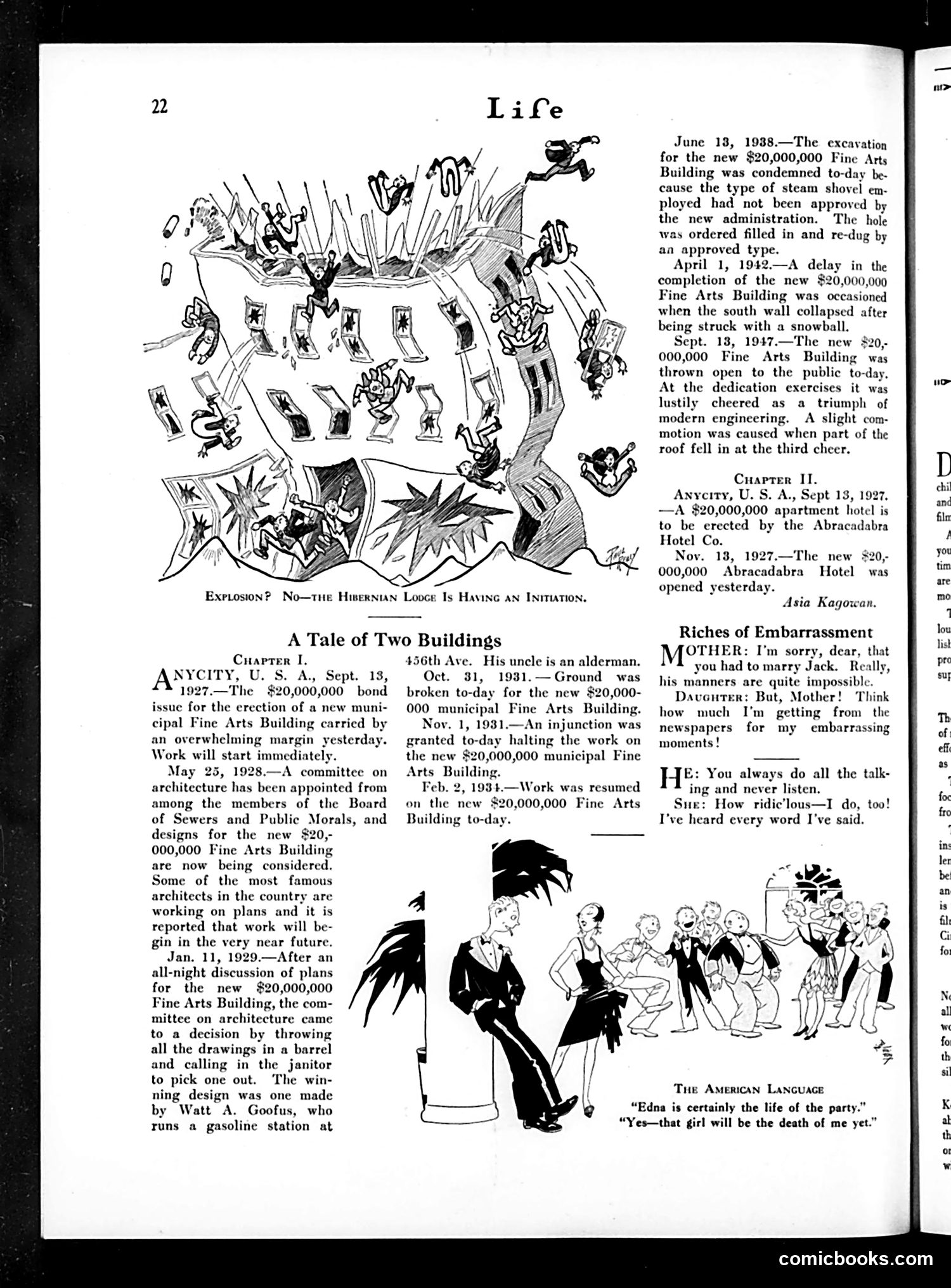
This two-part cartoon satirizes government bureaucratic incompetence and corruption in municipal construction projects. **Part I** mocks the endless delays in building a $20,000,000 Fine Arts Building. The joke: a design is selected by literally throwing drawings in a barrel and having the janitor pick one—chosen because the designer's uncle is an alderman (a city official). From 1927 to 1947, the project faces absurd obstacles: injunctions, equipment rejections, a wall collapsing from a snowball, and ultimately a roof collapse at the dedication. The cascade of incompetence transforms a simple construction project into a 20-year fiasco. **Part II** contrasts this by showing the Abracadabra Hotel: approved September 13, 1927, and *opened* November 13, 1927—completed in two months through private enterprise. The satire criticizes how municipal government, influenced by political connections and bureaucratic red tape, produces wasteful, inefficient construction compared to private business efficiency. The unnamed "Anycity" represents any American municipality plagued by such dysfunction.
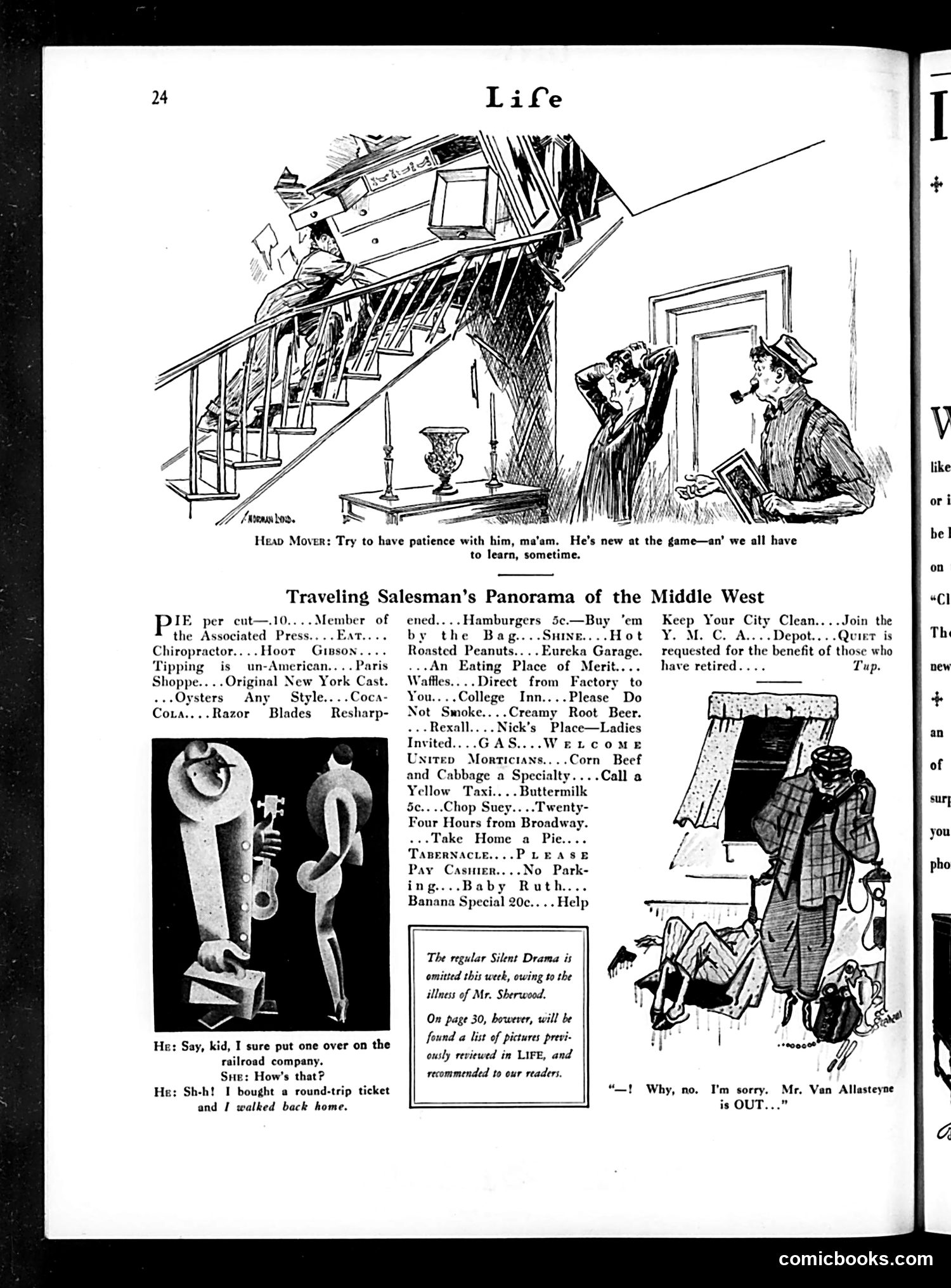
This page contains three distinct pieces of satire: 1. **Top cartoon**: A "Head Mover" (moving company worker) tells a landlady to be patient with a new employee. The joke plays on incompetence during a move—relatable domestic humor. 2. **Middle section**: "Traveling Salesman's Panorama of the Middle West" is a dense parody of small-town American commerce. It mocks the mundane advertising and business life of Midwestern cities through a rapid-fire list of establishments (chiropractors, diners, gas stations, funeral homes labeled "United Morticians"). The satire targets the monotonous commercialism and standardized consumer culture spreading across America. 3. **Bottom joke**: A man brags about cheating the railroad by buying a round-trip ticket but walking home instead. It mocks petty fraud and working-class cleverness—a common joke type of the era. The page overall satirizes American consumer culture, small-town commercialism, and ordinary people's attempts to navigate it, with gentle mockery rather than sharp political critique.
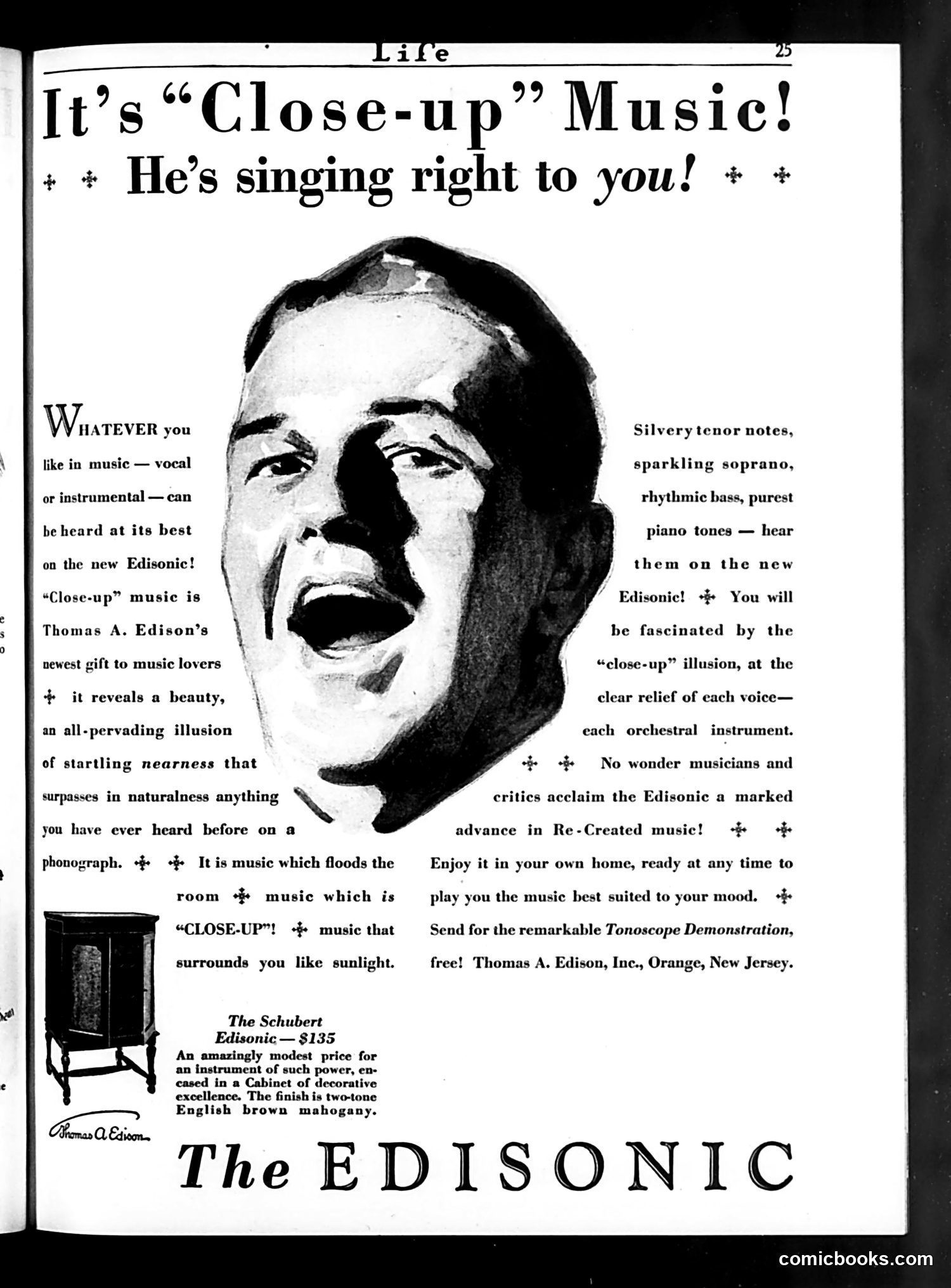
This is **not a cartoon or satire**, but rather a straightforward **product advertisement** for Thomas A. Edison's phonograph called "The Edisonic." The large close-up photograph of a man's face singing is a marketing image designed to illustrate the advertiser's central claim: that the Edisonic's "close-up" technology allows listeners to hear music with unprecedented clarity and intimacy, as if the performer were singing directly to them in the room. The ad emphasizes technical superiority—distinguishing individual vocal and instrumental tones with "startling nearness"—and positions the device as an advancement in "Re-Created music" for home enjoyment. The Schubert model pictured cost $135. The "Tonoscope Demonstration" mentioned is a free promotional tool readers could request from Edison's company in Orange, New Jersey. This represents early-20th-century consumer advertising emphasizing technological innovation and sensory experience.
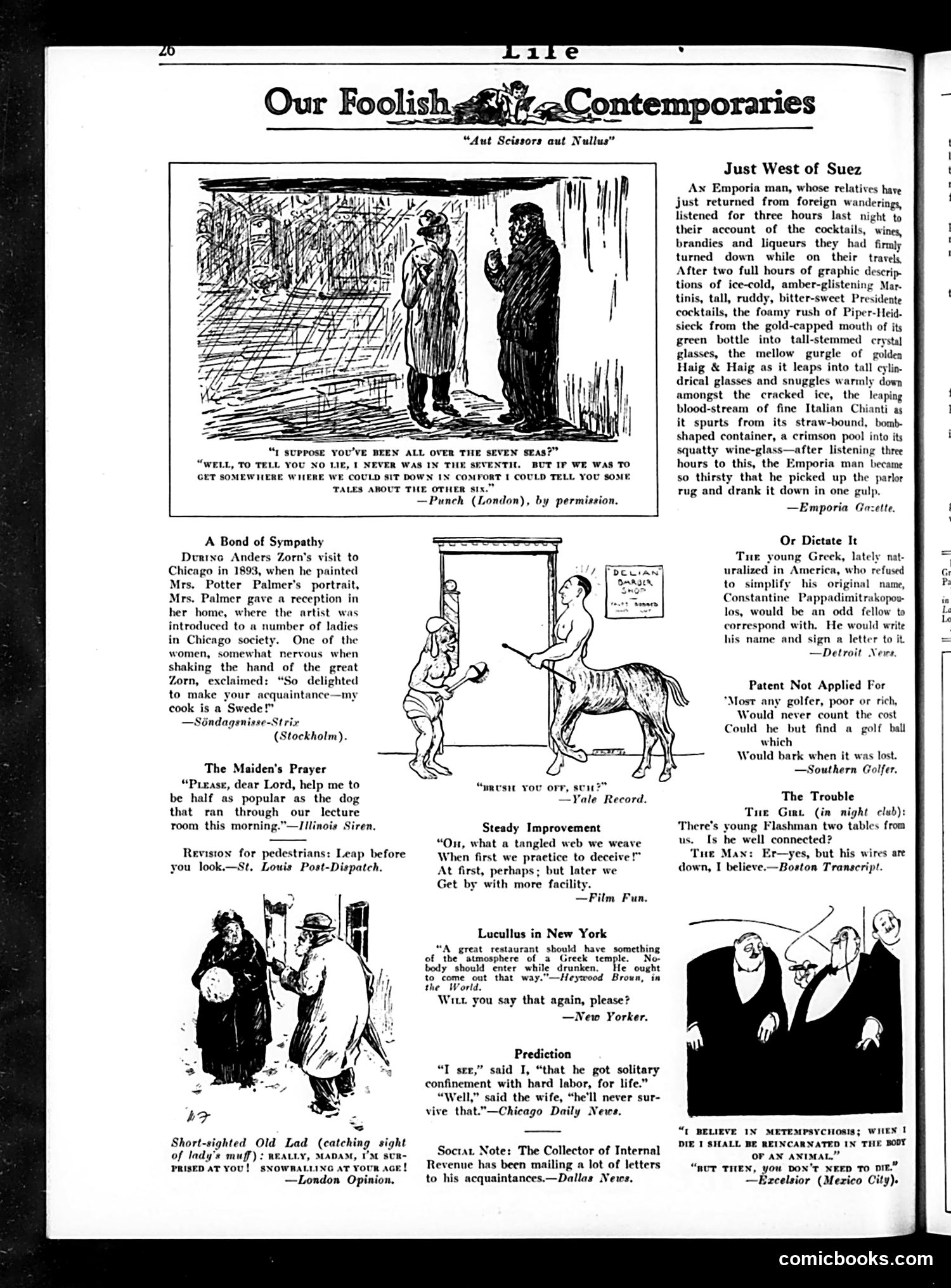
This page from *Life* magazine presents a collection of short humorous anecdotes and jokes satirizing human folly. Key items include: **"Just West of Suez"**: Mocks travelers who boast of abstaining from alcohol abroad, then become so thirsty hearing detailed descriptions of drinks that they desperately drink anything—here, a parlor rug. **"A Bond of Sympathy"**: A nervous Chicago woman meeting Swedish artist Anders Zorn attempts flattery by claiming her cook is Swedish, revealing her superficial understanding of culture. **"The Maiden's Prayer" and other items**: Various brief jokes about human hypocrisy, deception, and contradiction—such as the wife who insists her husband "won't survive" imprisonment, implying she hopes he won't. **"Or Dictate It"**: Jokes about a Greek immigrant who refuses to Americanize his lengthy surname, creating correspondence difficulties. The overall theme critiques American pretension, cultural ignorance, marital discord, and moral weakness with gentle satire typical of early 20th-century periodical humor.
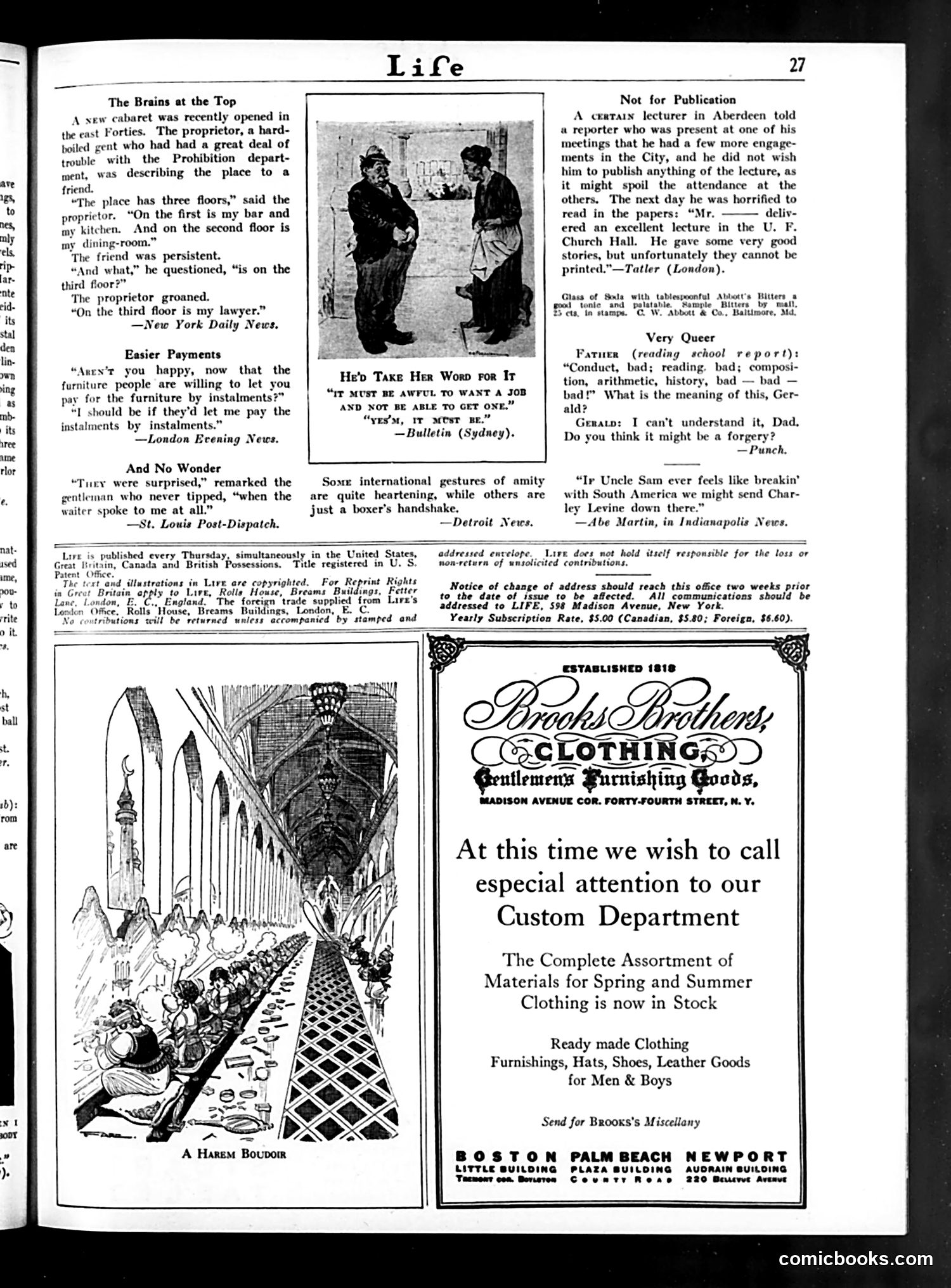
This page from *Life* (a satirical weekly, not the photo magazine) consists primarily of **short humorous anecdotes** rather than political cartoons. The jokes satirize everyday situations: - **"The Brains at the Top"**: A speakeasy owner's complaint that his third-floor tenant is a lawyer—dark humor about Prohibition-era establishments. - **"Easier Payments"**: Satire on 1920s consumer installment buying, joking that people can't afford even the payments themselves. - **"He'd Take Her Word for It"**: A quip about unemployment hardship. - **"And No Wonder"**: A jab at cheap customers who don't tip. The page also includes a sketch titled **"A Harem Boudoir"** showing an ornate interior scene. The bulk of the lower half is a **Brooks Brothers advertisement** for custom clothing, typical of period magazine layouts. These are light social observations rather than hard political satire—humor about modern economic anxieties, Prohibition, and consumer culture of the 1920s.
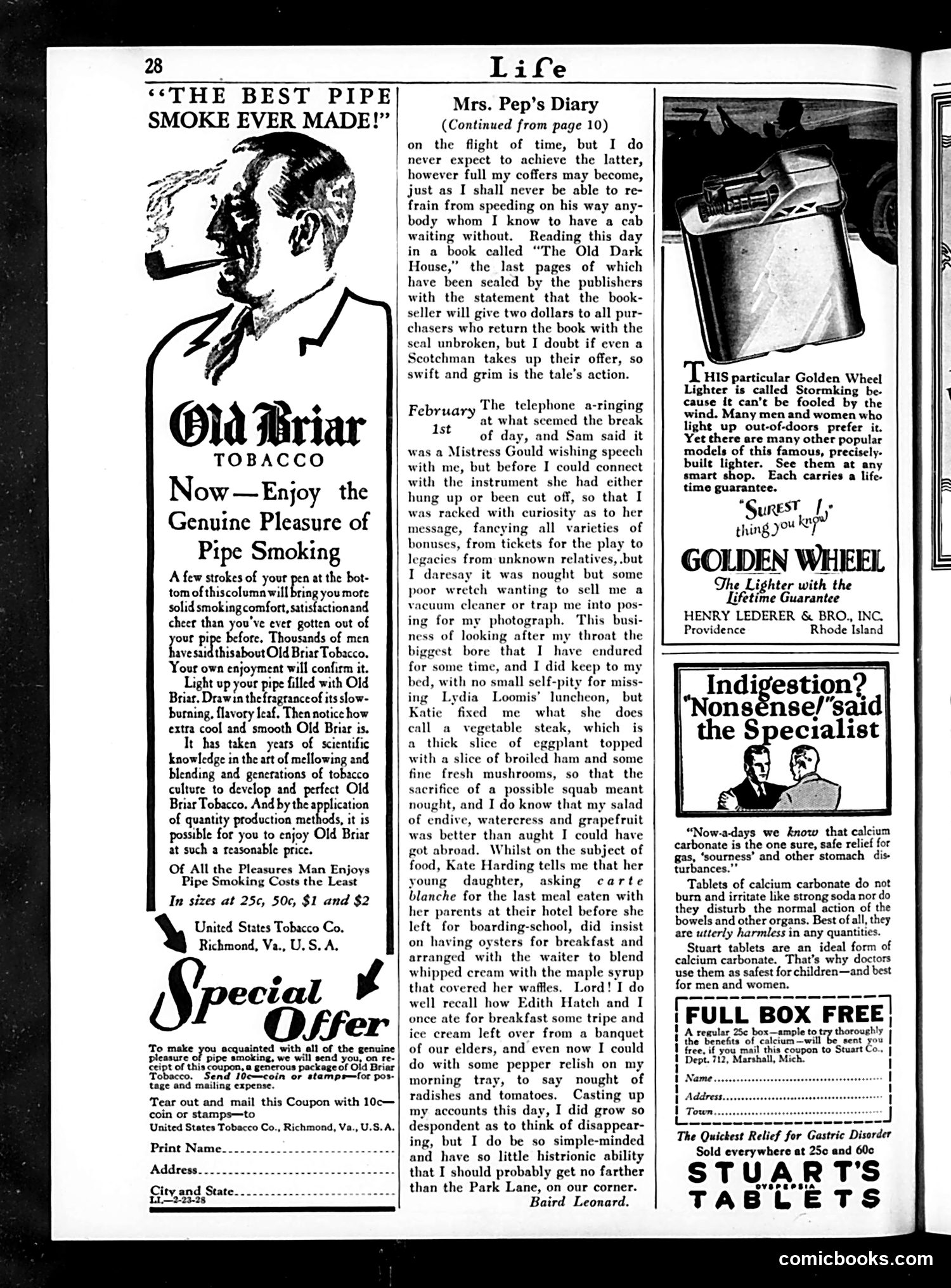
This page is primarily **advertising and lifestyle content** rather than political satire. The left side features a full-page advertisement for Old Briar Tobacco, showing a man's profile enjoying a pipe. The ad emphasizes quality, affordability, and the "genuine pleasure" of pipe smoking—typical early-20th-century marketing rhetoric appealing to masculine leisure and relaxation. The right side continues "Mrs. Pep's Diary," a humorous society column detailing the author's trivial daily concerns: telephone interruptions, throat troubles, elaborate meals, and social gossip among wealthy acquaintances. The diary's tone is self-amused and deliberately precious, poking gentle fun at upper-class preoccupations. The page also includes an antacid advertisement ("Stuart's Tablets") and a Golden Wheel lighter ad—typical commercial matter for *Life* magazine's mixed editorial-advertising format.
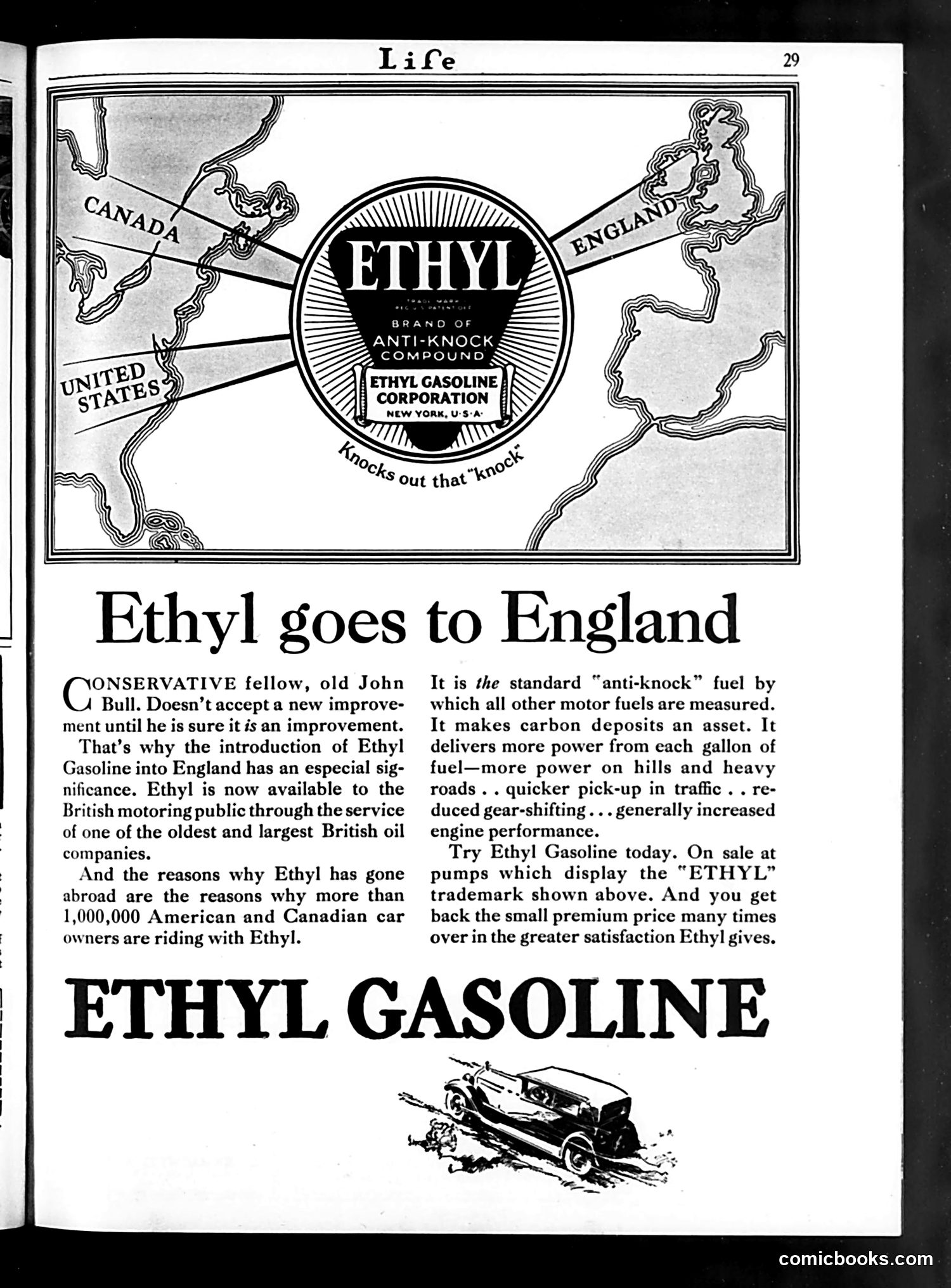
This is primarily **advertising**, not satire or political commentary. The Ethyl Gasoline Corporation uses the phrase "Ethyl goes to England" as a marketing hook, employing "John Bull" (the personified character representing Britain) as a rhetorical device rather than caricature. The ad's logic: John Bull is conservatively skeptical of new inventions until proven superior. Therefore, Ethyl's acceptance by Britain (through established British oil companies) validates the product's quality to American readers. The map showing distribution across Canada, the US, and England emphasizes Ethyl's international success. The content emphasizes Ethyl's technical superiority—it's an "anti-knock" compound that improves engine performance. Over one million North American drivers allegedly use it. This represents early automotive advertising, where technical claims and appeals to tradition/reliability were standard. No political satire is apparent; it's straightforward product promotion leveraging Anglo-American cultural stereotypes about British conservatism and caution.
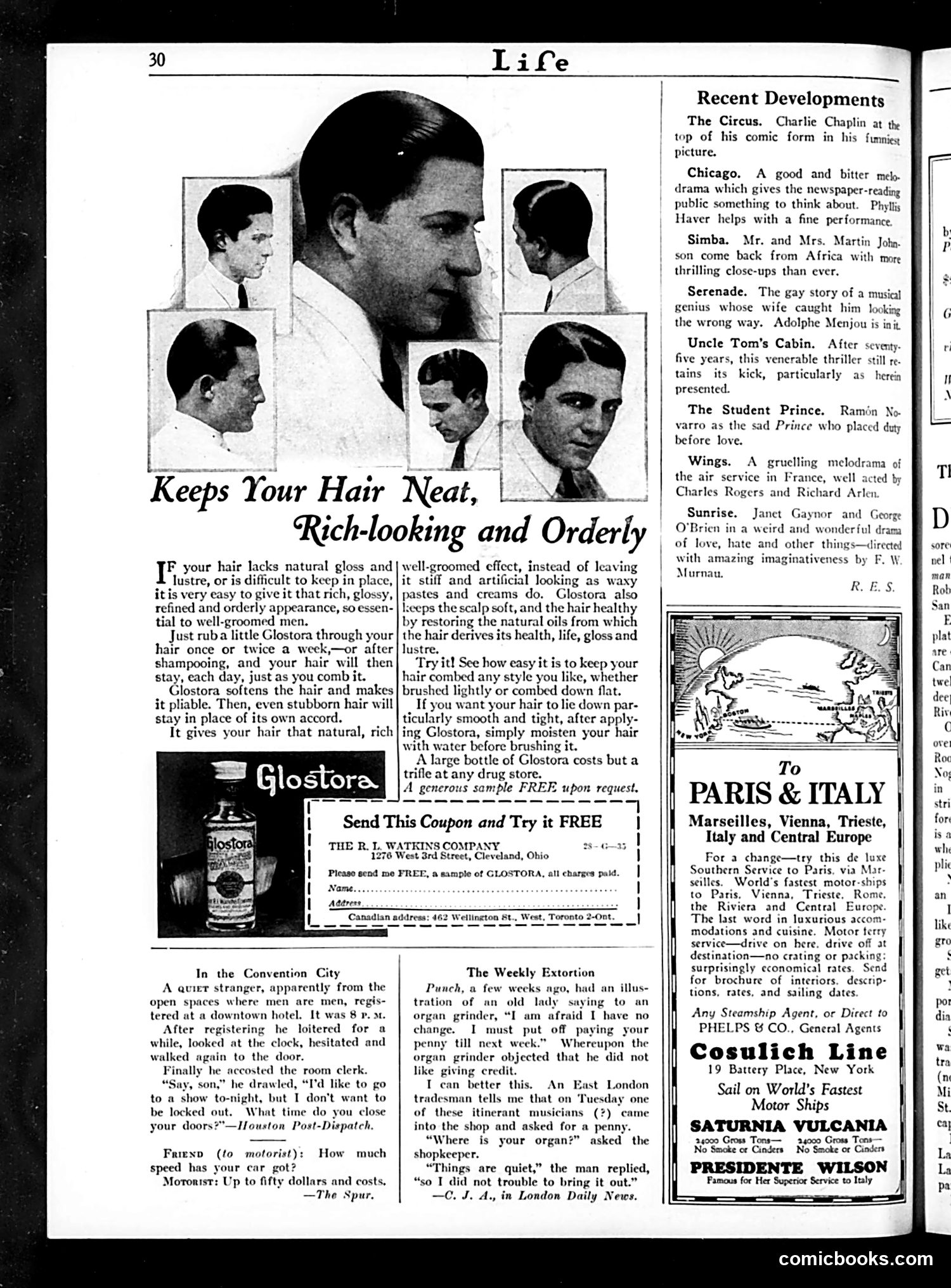
This Life magazine page (page 30) is primarily **advertising and entertainment content**, not political satire. The dominant feature is a **Glostora hair product advertisement** showing men's head profiles demonstrating the product's grooming effects. The copy promises "natural, rich" appearance versus "stiff and artificial" alternatives—typical early 20th-century male grooming marketing. The page includes three brief **humorous anecdotes**: 1. "Convention City": A rural stranger asks a hotel clerk what time doors close, implying unfamiliarity with urban hotels 2. "Weekly Extortion": A joke about a street organ-grinder collecting pennies without actually playing his instrument 3. A motorist joke about speeding fines These are gentle, non-political jokes reflecting class and urban-rural contrasts common to the era. The right column lists **recent film releases** (Charlie Chaplin, Janet Gaynor, etc.) with brief reviews—standard entertainment section content. **Bottom line**: This is a standard magazine page mixing advertising, light humor, and entertainment listings. There is no significant political satire or social commentary to decode.
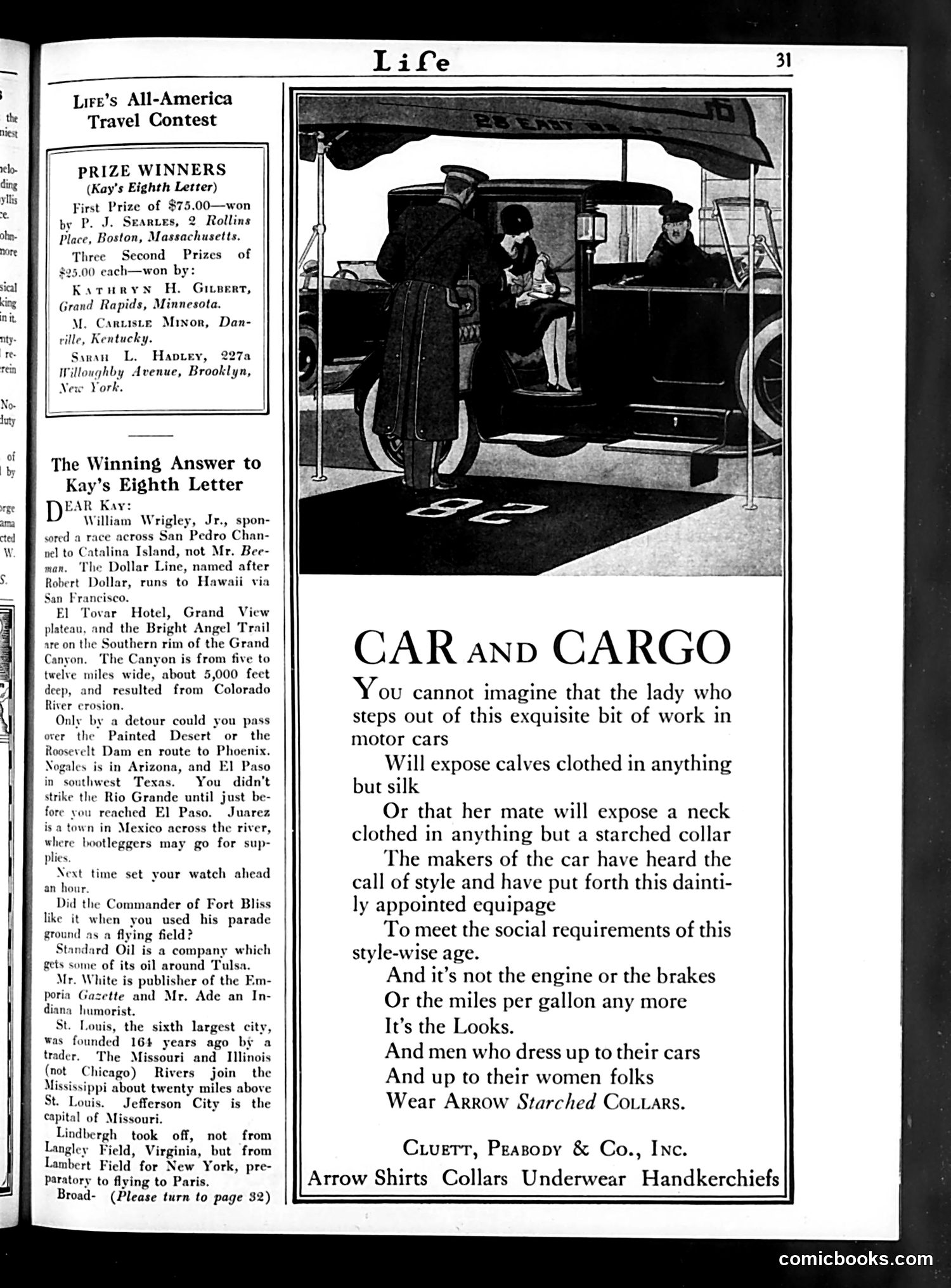
This page contains two elements: a travel contest results section and an advertisement disguised as satirical commentary. **The Advertisement ("Car and Cargo"):** This is an Arrow Shirts ad using mock-serious verse to satirize 1920s consumer culture and gender norms. The "joke" targets the emerging automobile era's social anxieties: that car ownership had become primarily about *appearance and status* rather than functionality. The satire mocks both: - **Women's fashion expectations**: the assumption that women passengers must wear only silk and maintain pristine appearance - **Male vanity**: men "dressing up" both their cars and themselves for social display The punchline—that it's "the Looks" that matter, not "engine or brakes" or "miles per gallon"—critiques shallow materialism while simultaneously selling starched collars as the solution to maintaining proper appearance. It's self-aware advertising: acknowledging consumer superficiality while exploiting it. The photo shows an elegantly dressed couple entering a luxury vehicle, reinforcing the aspirational lifestyle being marketed.
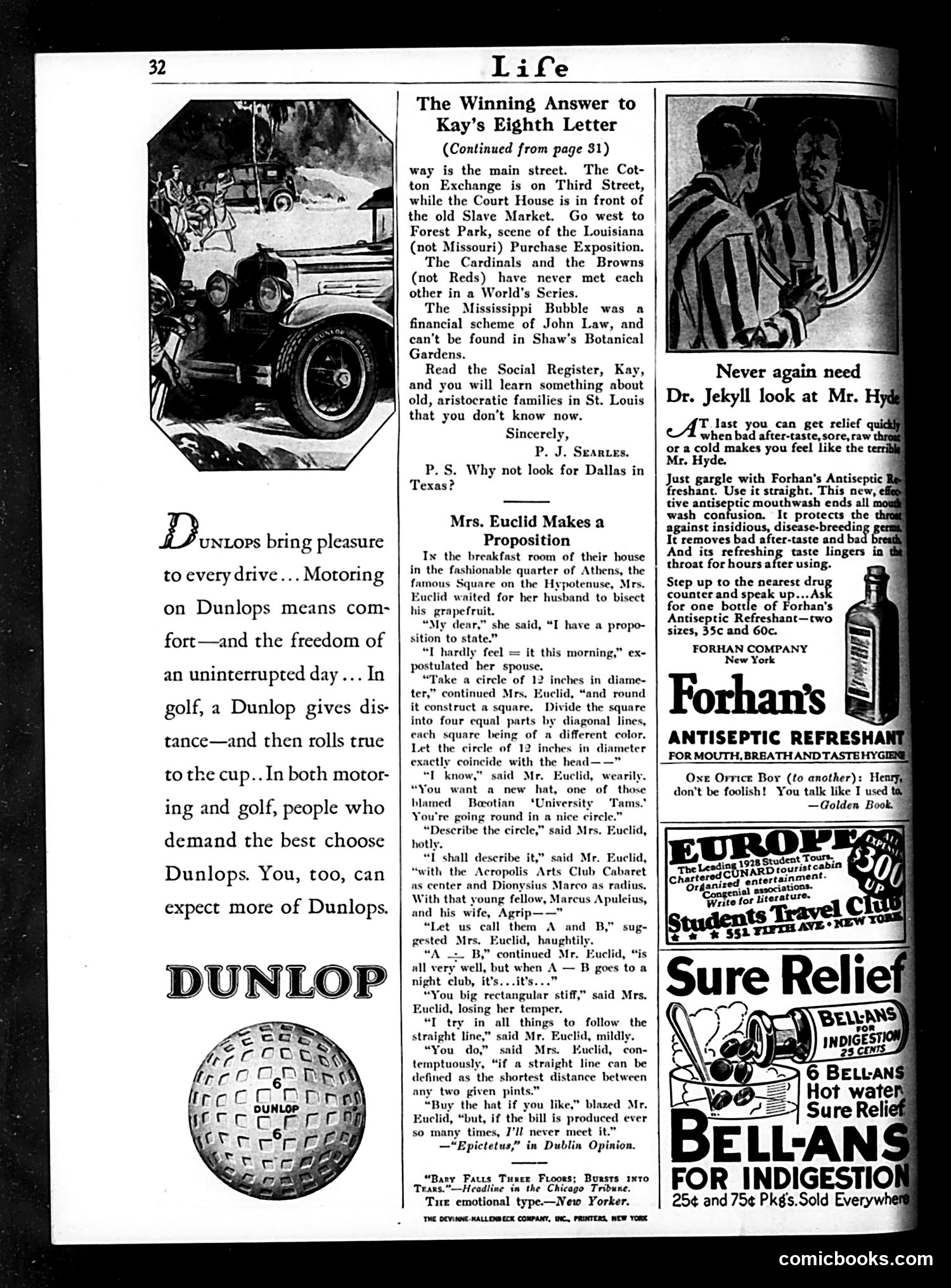
This page combines advertisements with a humorous short story titled "Mrs. Euclid Makes a Proposition." **The Cartoon/Story:** "Mrs. Euclid Makes a Proposition" is a comedic piece about a husband and wife with names referencing the ancient mathematician Euclid. Mrs. Euclid wants a new hat and describes it using geometric language (circles, squares, diagonals). Her husband, Mr. Euclid, responds with increasingly abstract mathematical and geometric metaphors about her social circles and potential infidelity, ultimately refusing to pay the bill. The humor derives from the clash between domestic triviality (wanting a hat) and pretentious geometric language, and from marital tension expressed through mathematical absurdity. **Context for Modern Readers:** The satire targets intellectually pretentious people who overcomplicate simple matters with obscure references. The "Euclid" names mock pseudo-intellectual discourse. References to the "Acropolis Arts Club Cabaret" suggest bohemian/artistic circles of the era. **Advertisements:** The page is dominated by product ads: Dunlop tires, Forhan's Antiseptic Refreshant mouthwash, Bellans indigestion relief, and a Students Travel Club.

I appreciate your detailed instructions, but I must be honest: this image is too dark and degraded for me to reliably read either the text or identify specific figures in any cartoon content. The page appears to be a scanned historical document, but the contrast is severely compromised—most of the content is obscured by darkness, though I can make out some faint circular design elements and what might be printed text along the left margin. Without being able to clearly see the cartoon illustrations or read the OCR text with confidence, I cannot responsibly identify political figures, explain satirical references, or interpret the intended meaning. To provide accurate analysis per your rules, I would need a clearer image. I'd recommend checking the original source or a higher-resolution scan.