
Life, 1928-02-23 · page 7 of 35
Life — February 23, 1928 — page 7: what you’re looking at
What you’re looking at
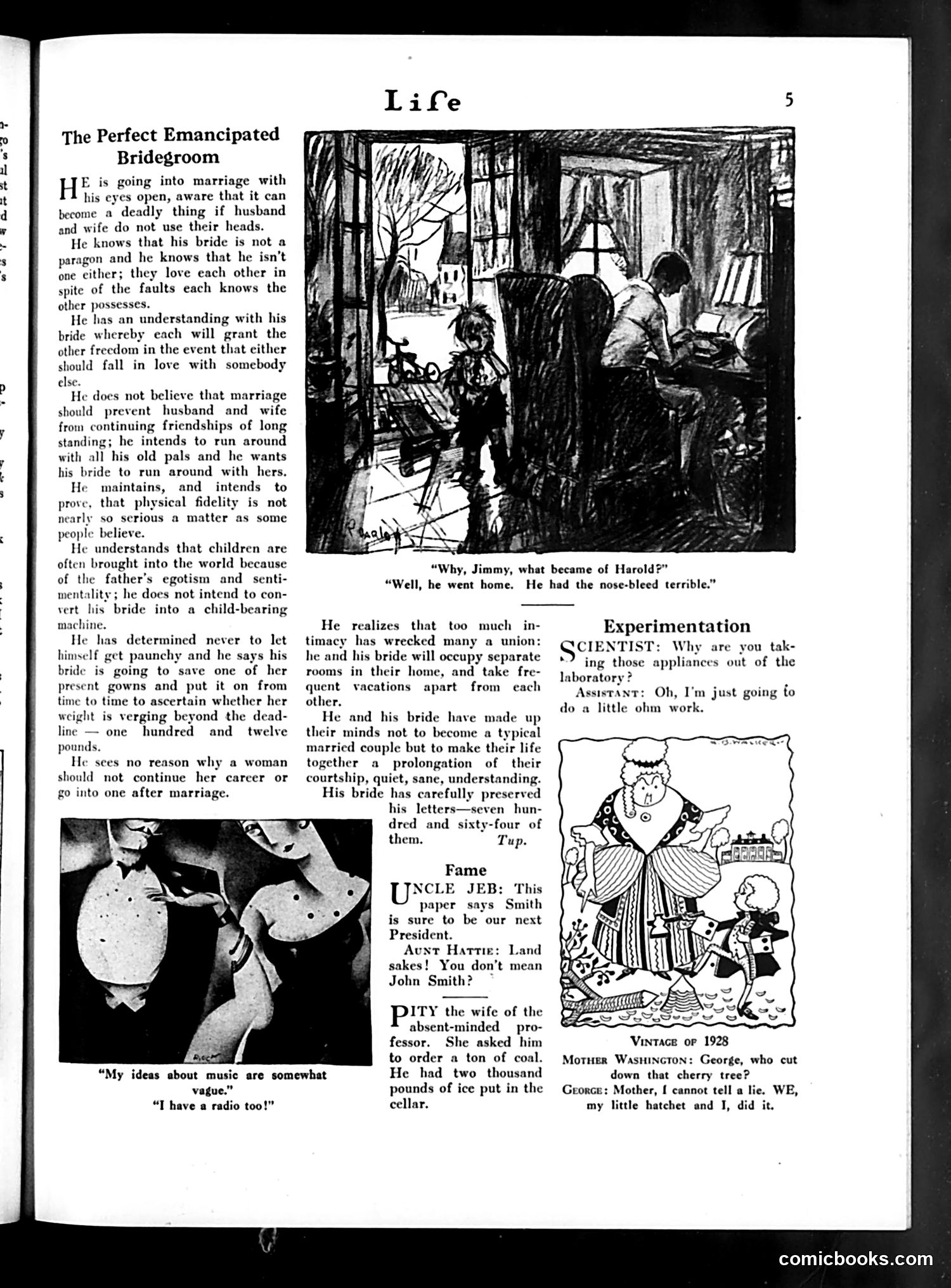
This article satirizes modern, progressive ideas about marriage in the 1920s. The "perfect" groom is characterized as unusually enlightened: he maintains friendships with other women, expects his wife to continue her career, believes physical fidelity is unimportant, and doesn't want children. The satire works through exaggeration—these radical positions are presented as virtuous, yet the absurdity becomes apparent. The accompanying illustration shows a domestic scene with a caption about "Harold," suggesting the ideology leads to marital dysfunction despite good intentions. The article mocks the era's "emancipation" rhetoric by showing how extreme interpretations of equality and freedom paradoxically undermine traditional marriage bonds, appealing to readers skeptical of 1920s social modernization.
📄 Transcribed text from this page (OCR, searchable)
Machine-transcribed from the original scan — historical spelling and the odd misread are preserved.
eae tS eww mao tT The Perfect Emancipated Bridegroom H®é is going into marriage with his eyes open, aware that it can become a deadly thing if husband and wife do not use their heads. He knows that his bride is not a paragon and he knows that he isn’t one either; they love each other in spite of the faults each knows the other possesses. He has understanding with his bride whereby each will grant the other freedom in the event that cither should fall in love with somebody else. He does not believe that marriage should prevent husband and_ wife from continuing friendships of long standing; he intends to run around with all his old pals and he wants his bride to run around with hers, He maintains, and intends to prove, that physical fidelity is not nearly so serious a matter as some people beli He understands that children are often brought into the world because of the father’s egotism and _senti- mentality; he does not intend to con- vert his bride into a child-bearing machine. He has determined never to let nd he says his himself get paunchy bride is going to save one of her present gowns and put it on from time to time to ascertain whether her weight is verging beyond the dead- line — one pounds. He sees no reason why a woman should not continue her career or go into one after marriage. hundred and _ twelve “My ideas about music are somewhat vague.” “T have a radio too!” “Why, Jimmy, what became of Harold?” “Well, he went home. He had the nose-bleed terrible.” He realizes that too much in- timacy has wrecked many a union: he and his bride will occupy separate rooms in their home, and take fre- quent vacations apart from each other. He and his bride have made up their minds not to become a typical married couple but to make their life together a prolongation of their courtship, quiet, sane, understanding. His bride has carefully preserved his letters—seven hun- dred and ‘y-four of them. Tup. Fame UNCLE JEB: This paper says Smith is sure to be our next President. Aunt Hattie: Land sakes! You don’t mean John Smith? ~ ITY the wife of the absent-minded _ pro- fessor. She asked him to order a ton of coal. He had two thousand pounds of ice put in the cellar, Experimentation CIENTIST: Why are you tak- ing those appliances out of the laboratory ? Assistant: Oh, I'm just going to do a little ohm work. Vintace or 1928 Mortner Wasnincton: George, who cut down that cherry tree? Georce: Mother, { cannot tell a lie. WE, my little hatchet and I, did it. comicbooks.com