
Life, 1928-02-23 · page 21 of 35
Life — February 23, 1928 — page 21: what you’re looking at
What you’re looking at
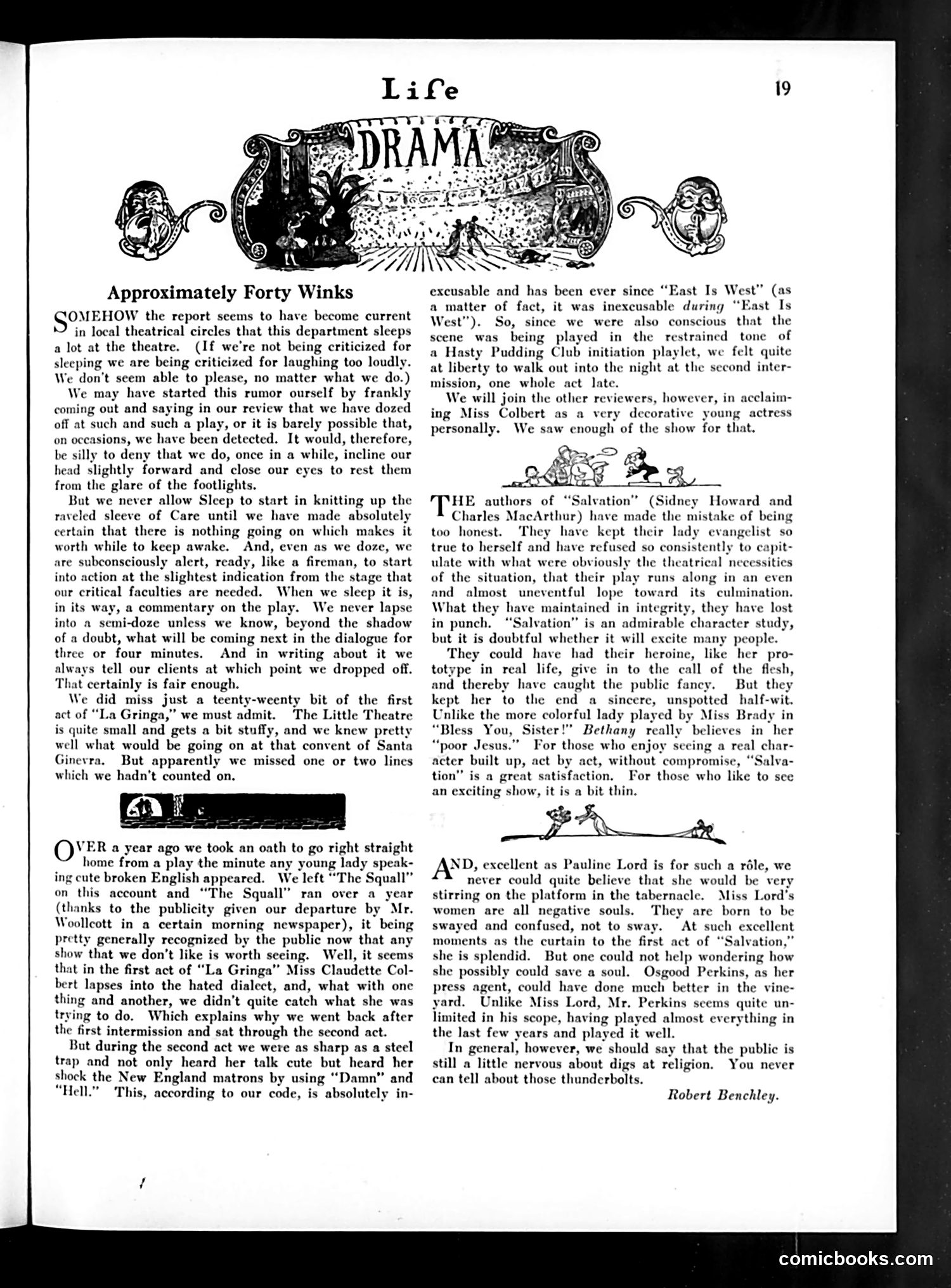
This page satirizes theater critics (including Life's own reviewer) who sleep during performances. The opening section humorously defends the practice, claiming critics remain "subconsciously alert" and only doze when confident nothing important is happening—essentially admitting they judge plays as boring. The subsequent reviews discuss specific productions: *La Gringa* (where the critic admits missing part of the first act, then returned), and *Salvation* by Sidney Howard and Charles MacArthur. The critic praises the latter's honest character work but finds it theatrically dull—lacking "punch" despite integrity. References to *The Squall* and Alexander Woollcott (a famous contemporary critic) appear, suggesting Life's reviewer competes within a well-known critical circle. The mention of actress Claudette Colbert using "damn" and "hell" reflects period concerns about stage language offending audiences. The satire ultimately pokes fun at both sleeping critics and productions that fail to engage even alert viewers.
📄 Transcribed text from this page (OCR, searchable)
Machine-transcribed from the original scan — historical spelling and the odd misread are preserved.
Approximately Forty Winks SOMEHOW the report seems to have become current in local theatrical circles that this department sleeps a lot at the theatre. (If we're not being criticized for sleeping we are being criticized for laughing too loudly. We don't seem able to please, no matter what we do.) We may have started this rumor ourself by frankly coming out and saying in our review that we have dozed off at such and such a play, or it is barely possible that, on occasions, we have been detected. It would, therefore, be silly to deny that we do, once in a while, incline our head slightly forward and close our eyes to rest them from the glare of the footlights. But we never allow Sleep to start in knitting up the raveled sleeve of Care until we have made absolutely certain that there is nothing going on which makes it worth while to keep awake. And, even as we doze, we are subconsciously alert, ready, like a fireman, to start into action at the slightest indication from the stage that our critical faculties are needed. When we sleep it is, in its way, a commentary on the play. We never lapse into a semi-doze unless we know, beyond the shadow of a doubt, what will be coming next in the dialogue for three or four minutes. And in writing about it we always tell our clients at which point we dropped off. That certainly is fair enough. We did miss just a teenty-weenty bit of the first act of “La Gringa,” we must admit. The Little Theatre is quite small and gets a bit stuffy, and we knew pretty well what would be going on at that convent of Santa Ginev But apparently we missed one or two lincs which we hadn't counted on. VER a year ago we took an oath to go right straight home from a play the minute any young lady speak- ing cute broken English appeared. We left “The Squall” on this account and “The Squall” ran over a year (thanks to the publicity given our departure by Mr. Woollcott in a certain morning newspaper), it being pretty generally recognized by the public now that any show that we don’t like is worth seeing. Well, it seems that in the first act of “La Gringa” Miss Claudette Col- bert lapses into the hated dialect, and, what with one thing and another, we didn’t quite catch what she was trying to do. Which explains why we went back after the first intermission and sat through the second act. But during the second act we were as sharp as a steel trap and not only heard her talk cute but heard her shock the New England matrons by using “Damn” and “Hell.” This, according to our code, is absolutely in- excusable and has been ever since “East Is West’ (as a matter of fact, it was inexcusable during “East Is West” So, since we were also conscious that the scene was being played in the restrained tone of a Hasty Pudding Club initiation playlet, we felt quite at liberty to walk out into the night at the second inter- mission, one whole act late. We will join the other reviewers, however, in acclaim- ing Miss Colbert as a very decorative young actress personally. We saw enough of the show for that. 2 2 ody Br <2 HE authors of “Salvation” (Sidney Howard and Charles MacArthur) have made the mistake of being too honest. They have kept their lady evangelist so true to herself and have refused so consistently to capi ulate with what were obviously the theatrical nece of the situation, that their play runs along in and almost uneventful lope toward its culmination. What they hav intained in integrity, they have lost in punch, “S s an admirab r study, but it is doubtful whether it will excite many people. They could have had their heroine, like her pro- totype in real life, give in to the call of the flesh, and thereby have caught the public fan But th kept her to the end a sincere, unspotted half-wit. Unlike the more colorful lady played by Miss Brady in “Bless You, Sister!” Bethany reall “poor Jesus.” For those who enjoy acter built up, act by act, without compromise, “Salva- tion” great satisfaction. For those who like to see an exciting show, it is a bit thin. PA ND, excellent as Pauline Lord is for such a réle, we never could quite believe that she would be very stirring on the platform in the tabernacle. Miss Lord's women are all negative souls. They are born to be swayed and confused, not to sway. At such excellent moments as the curtain to the first act of “Salvation,” she is splendid. But one could not help wondering how she possibly could save a soul. Osgood Perkins, as her press agent, could have done much better in the vine- yard. Unlike Miss Lord, Mr. Perkins seems quite un- limited in his scope, having played almost everything in the last few years and played it well. In general, however, we should say that the public is still a little nervous about digs at religion. You never can tell about those thunderbolts. believes in her eing a real char- Robert Benchley. comicbooks.com