
A complete issue · 40 pages · 1927
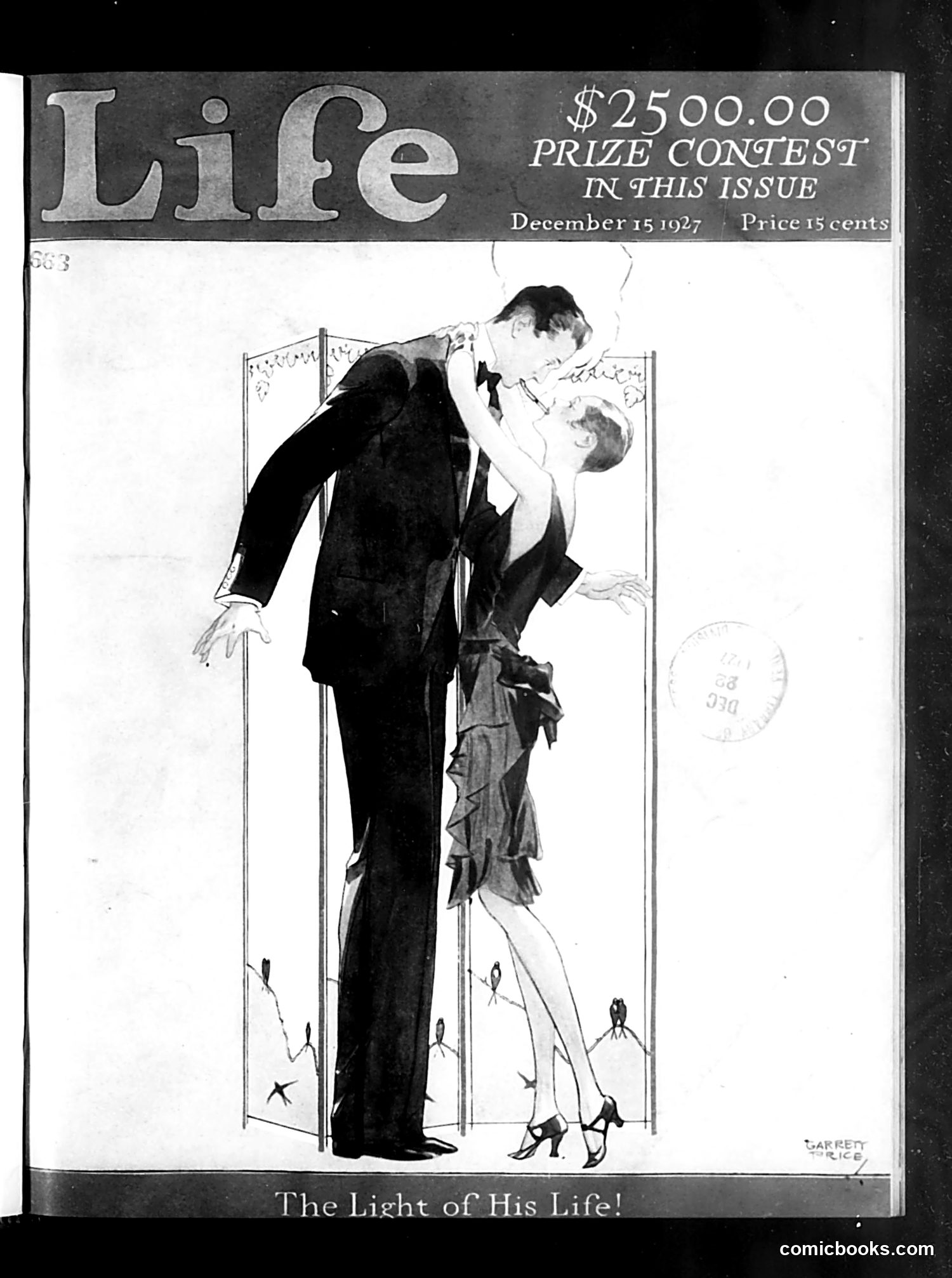
Life — December 15, 1927
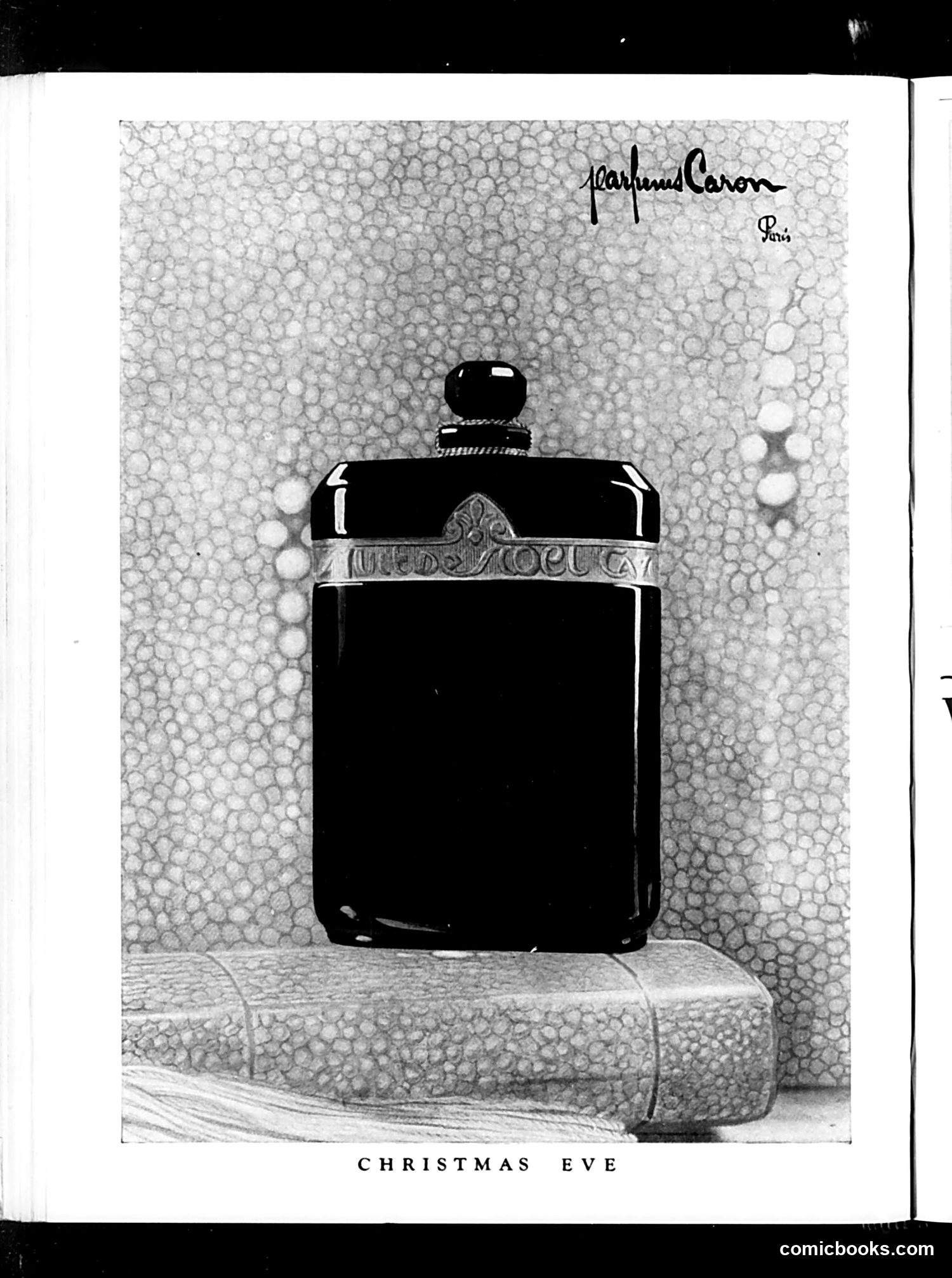
This appears to be a perfume advertisement for "Christmas Eve" by Madame Carson (signature visible at top). The image shows an elegant black perfume bottle with ornamental silver band, displayed against a textured backdrop with a patterned wall and surface. Rather than satire or political commentary, this is a straightforward luxury goods advertisement typical of *Life* magazine's advertising content. The "Christmas Eve" title capitalizes on holiday shopping season, marketing the fragrance as an upscale gift item. The sophisticated black bottle and refined presentation reflect 1920s-30s advertising aesthetics, targeting affluent consumers seeking premium fragrances during the Christmas period. This is commercial advertising rather than political or social satire.
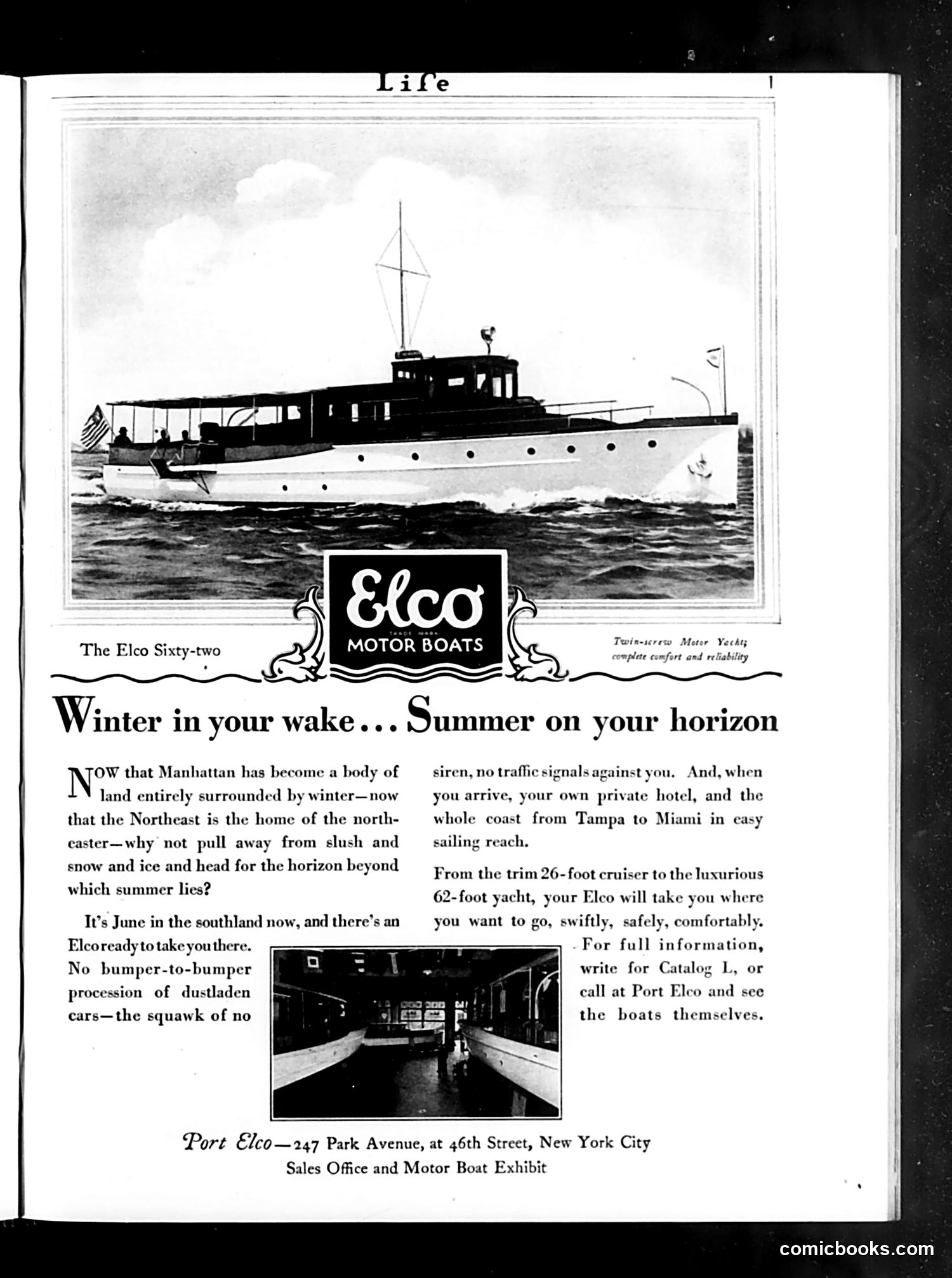
This is **not a cartoon or satire page**, but rather a **straightforward advertisement** for Elco Motor Boats, published in *Life* magazine. The page features a photograph of "The Elco Sixty-two," a motorized yacht, with the tagline "Winter in your wake...Summer on your horizon." The ad targets wealthy northeastern Americans by pitching escape from harsh winters—suggesting they motor their private yacht to Florida's warm coast (Tampa to Miami). The text emphasizes luxury amenities: no traffic, "your own private hotel," and swift, safe travel. A smaller interior photograph shows the boat's cabin. Contact information directs readers to Port Elco in New York City. This represents typical early 20th-century lifestyle advertising targeting affluent readers.
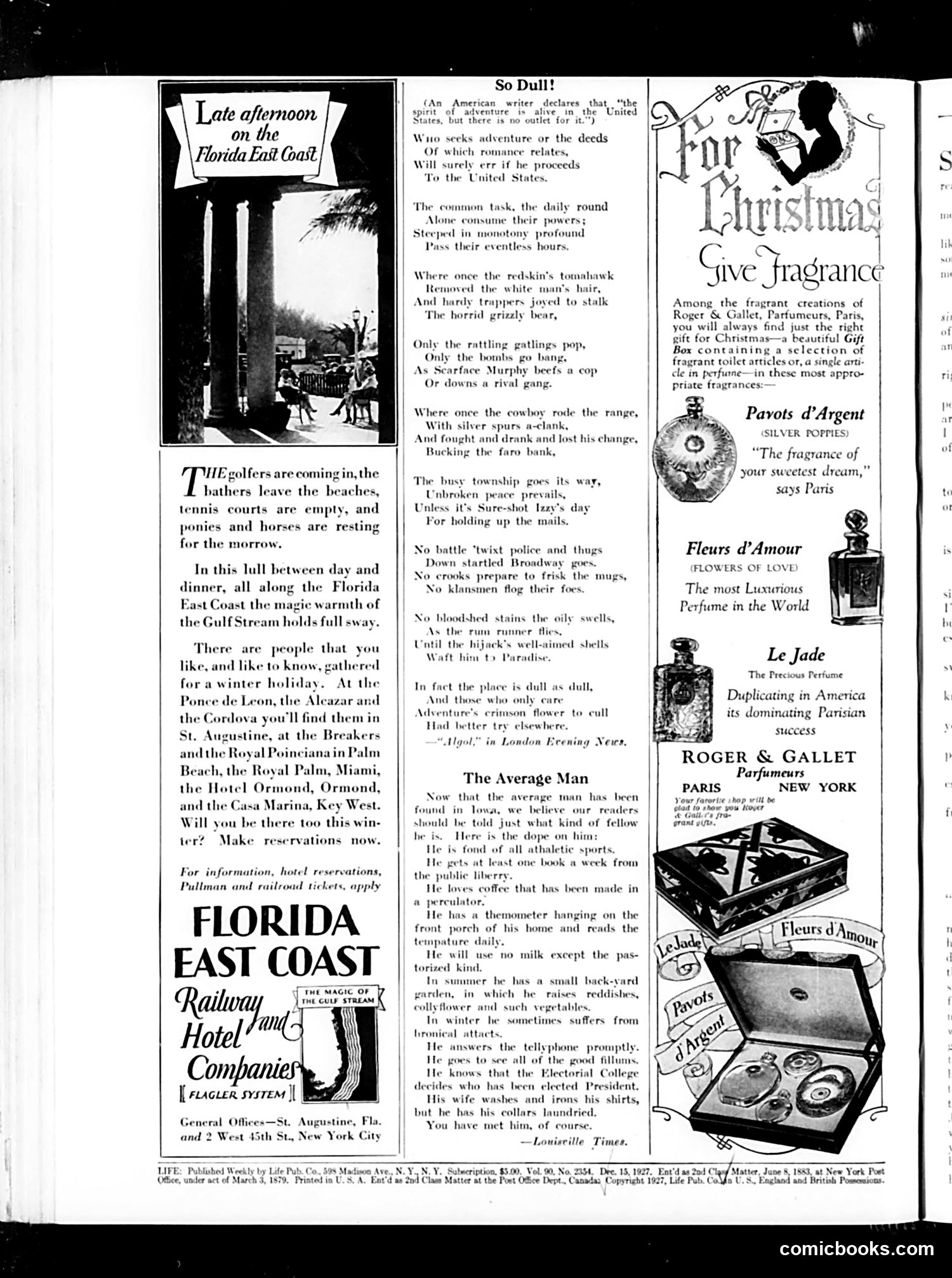
This page is primarily **advertising and editorial content** rather than political satire. The left side features a travel advertisement for the **Florida East Coast Railway**, promoting winter holidays at various Florida destinations (Ponce de Leon, Breakers, Royal Poinciana, etc.). The accompanying illustration shows a scenic Florida landscape. The center contains a poem titled **"So Dull!"** about small-town American life—apparently satirizing the monotonous routine of average citizens through verse. It's social commentary on provincial boredom rather than political satire. The right side advertises **French perfumes** from Roger & Gallet (Pavots d'Argent, Fleurs d'Amour, Le Jade), marketed as luxury Christmas gifts. The "Average Man" piece humorously catalogs typical middle-class male characteristics and habits. Overall, this is a **commercial page** mixing lifestyle advertising with light social humor typical of 1920s *Life* magazine.
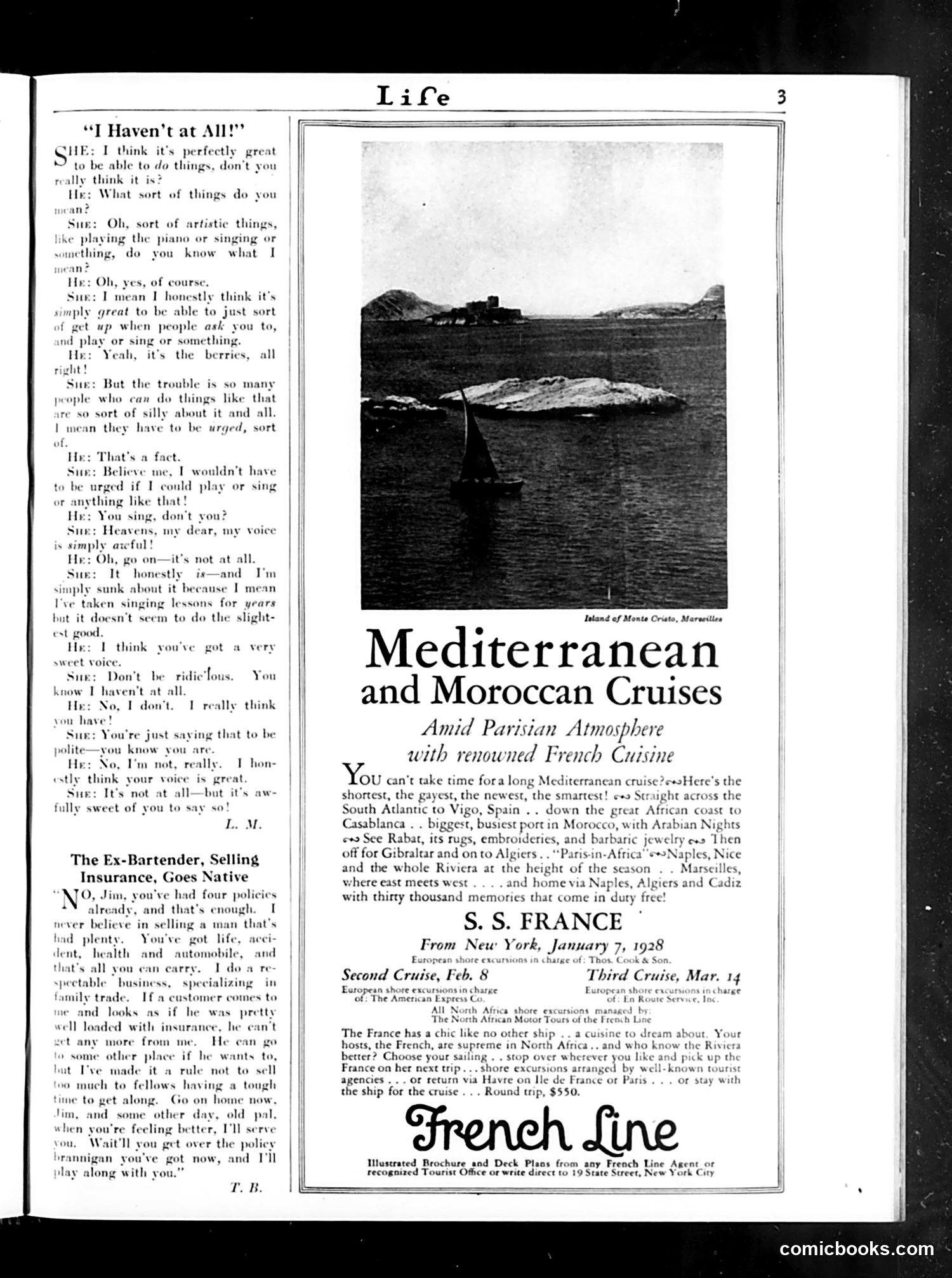
This Life magazine page (page 3) contains two distinct sections: **Left side:** A satirical dialogue titled "I Haven't at All!" between a man and woman. The woman claims it's "perfectly great" to do artistic things like piano or singing when asked. The man points out she's being "urged" to do these things. The satire mocks people who pretend to have genuine artistic talents they've only pursued because of social pressure—claiming natural ability when actually lacking it. **Right side:** A full-page advertisement for S.S. France cruise line offering Mediterranean and Moroccan voyages with French cuisine. The ad emphasizes luxury travel to exotic locations. The page juxtaposes social satire with period luxury advertising typical of Life magazine's mixed editorial-commercial format.
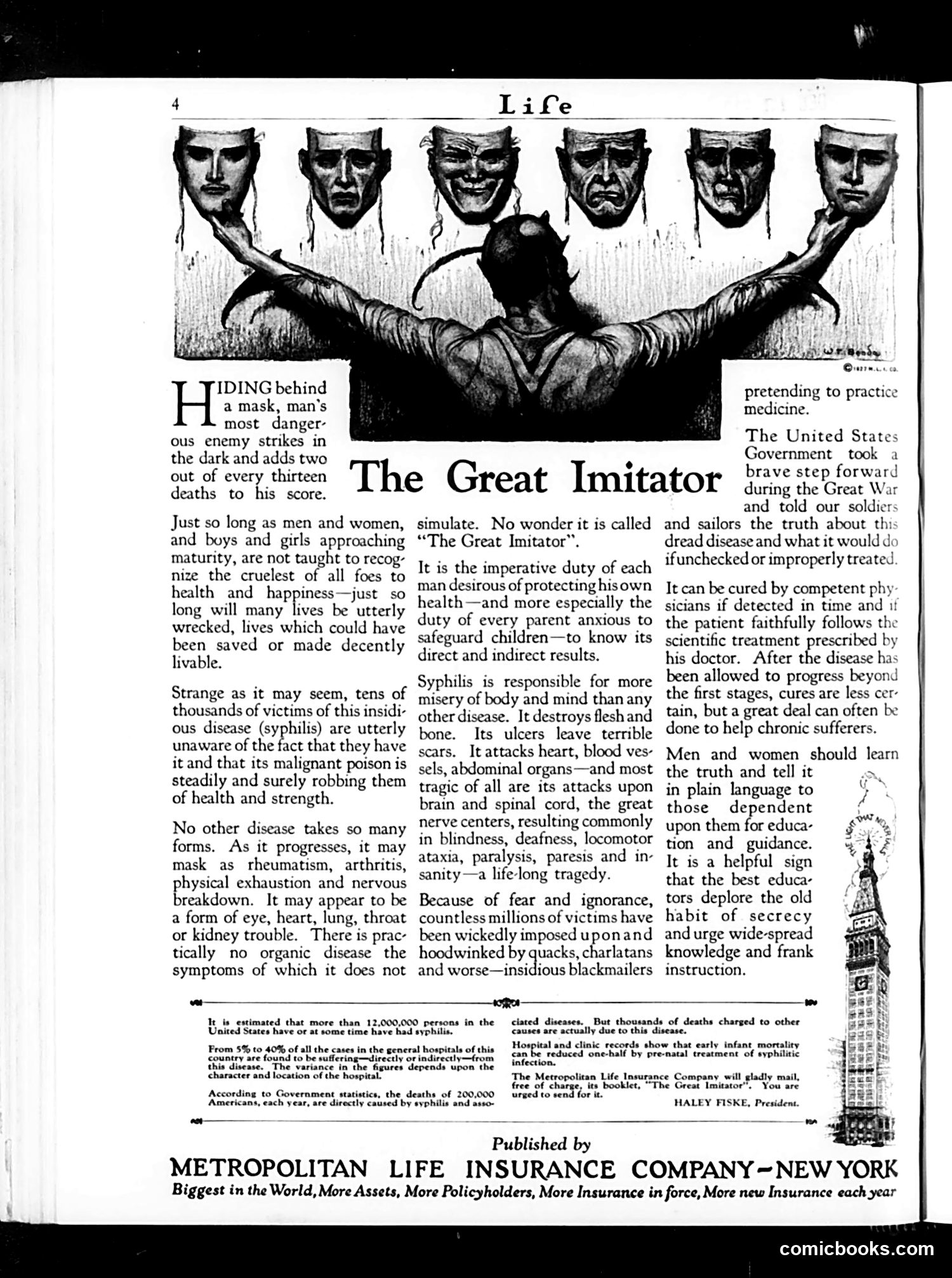
This is a public health advertisement by Metropolitan Life Insurance Company about syphilis, which they call "The Great Imitator" because it mimics symptoms of other diseases (rheumatism, arthritis, heart/kidney trouble). The central image shows a figure displaying six different masks or faces—representing how syphilis disguises itself as various conditions. The text emphasizes syphilis's devastating effects: blindness, deafness, paralysis, and insanity if untreated. The advertisement appears during the era (likely WWI or after) when the U.S. government conducted public awareness campaigns about venereal disease among soldiers. The message combines fear-based messaging with calls for frank, open education rather than secrecy—a progressive stance for the period regarding discussing sexual health publicly.
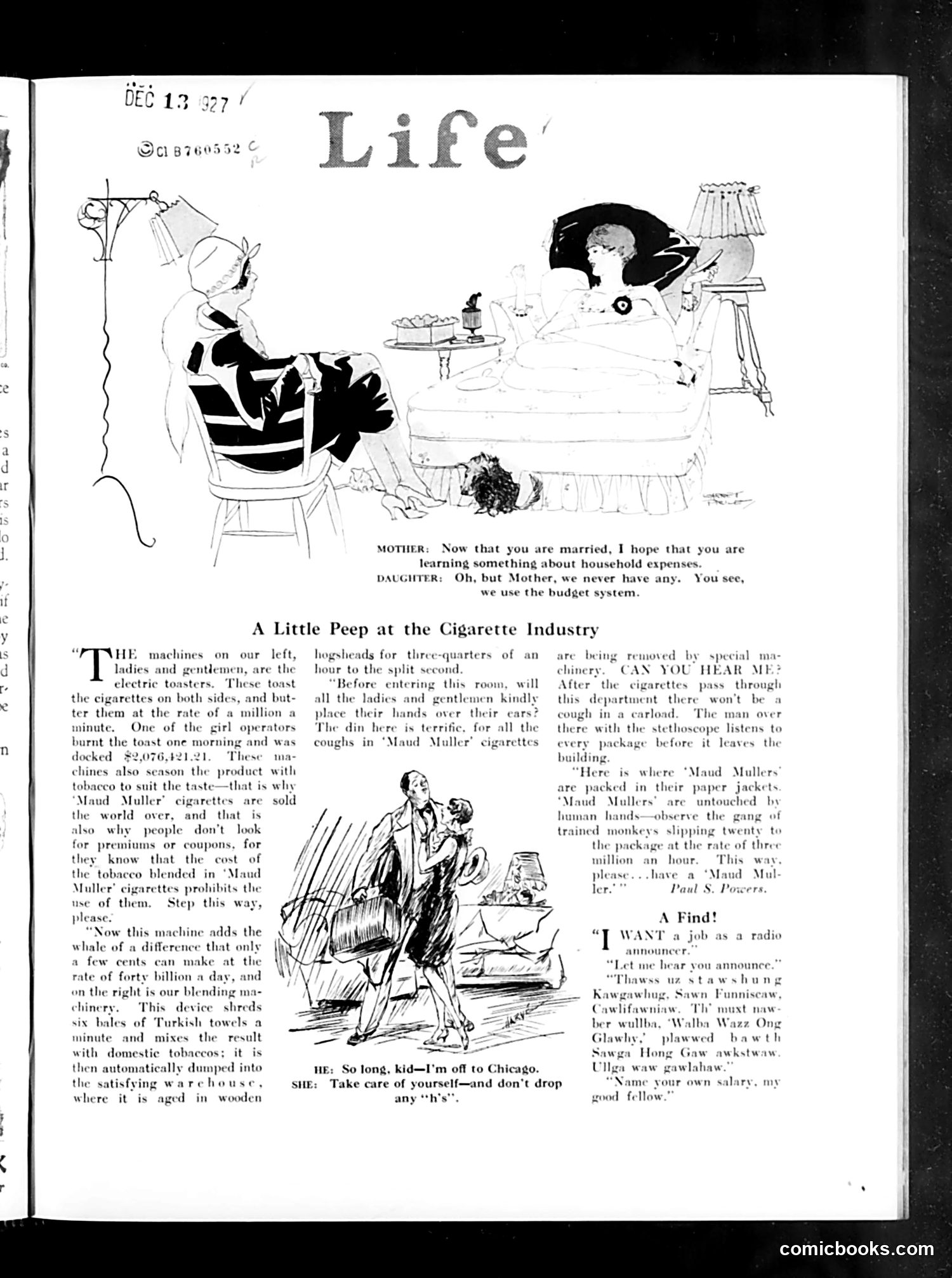
This page contains two distinct pieces of satirical content: **Top cartoon:** A domestic scene where a newly married daughter tells her mother she uses "the budget system" for household expenses—implying financial discipline rather than careful spending. The satire targets newlyweds' pretensions about managing money systematically. **Main article: "A Little Peep at the Cigarette Industry"** describes a factory tour of cigarette manufacturing, specifically "Maud Muller" brand cigarettes. The text humorously details machinery and processes, including trained monkeys that pack cigarettes at "three million an hour." **Bottom vignette:** A man leaving for Chicago tells a woman to "take care of yourself—and don't drop any 'h's," mocking working-class speech patterns—a period satire of pronunciation and class markers. The overall page mixes domestic humor, industrial satire, and class-based comedy typical of early-20th-century *Life* magazine.
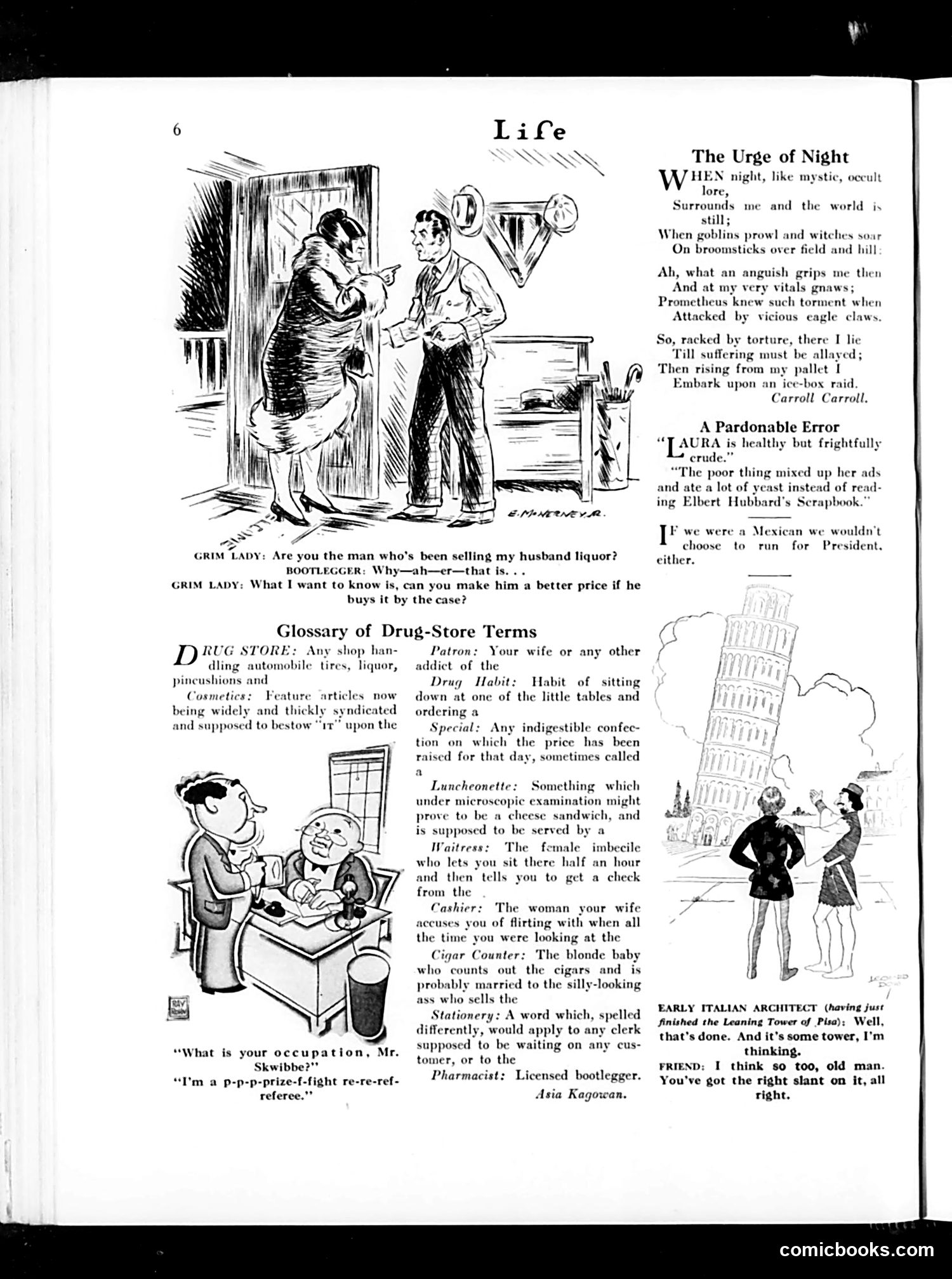
This page contains three distinct satirical pieces: 1. **"The Urge of Night"** - A poem by Carroll Carroll about nighttime anxieties and supernatural torments, likely reflecting post-WWI anxieties about modern life's psychological pressures. 2. **Top cartoon** - Shows a "grim lady" confronting a bootlegger about her husband's liquor purchases, satirizing Prohibition-era bootlegging and marital discord over secret drinking. 3. **"Glossary of Drug-Store Terms"** - Humorous definitions mocking American drug-store culture, including patrons ("your wife"), waitresses, and cashiers. The accompanying cartoon shows a "p-p-prize-fight re-re-referee" - likely mocking speech impediments or nervous mannerisms of working-class men. This satirizes both drug-store social hierarchies and stereotypes about working people. The page reflects 1920s concerns: Prohibition, marital tension, and class-based social observation.
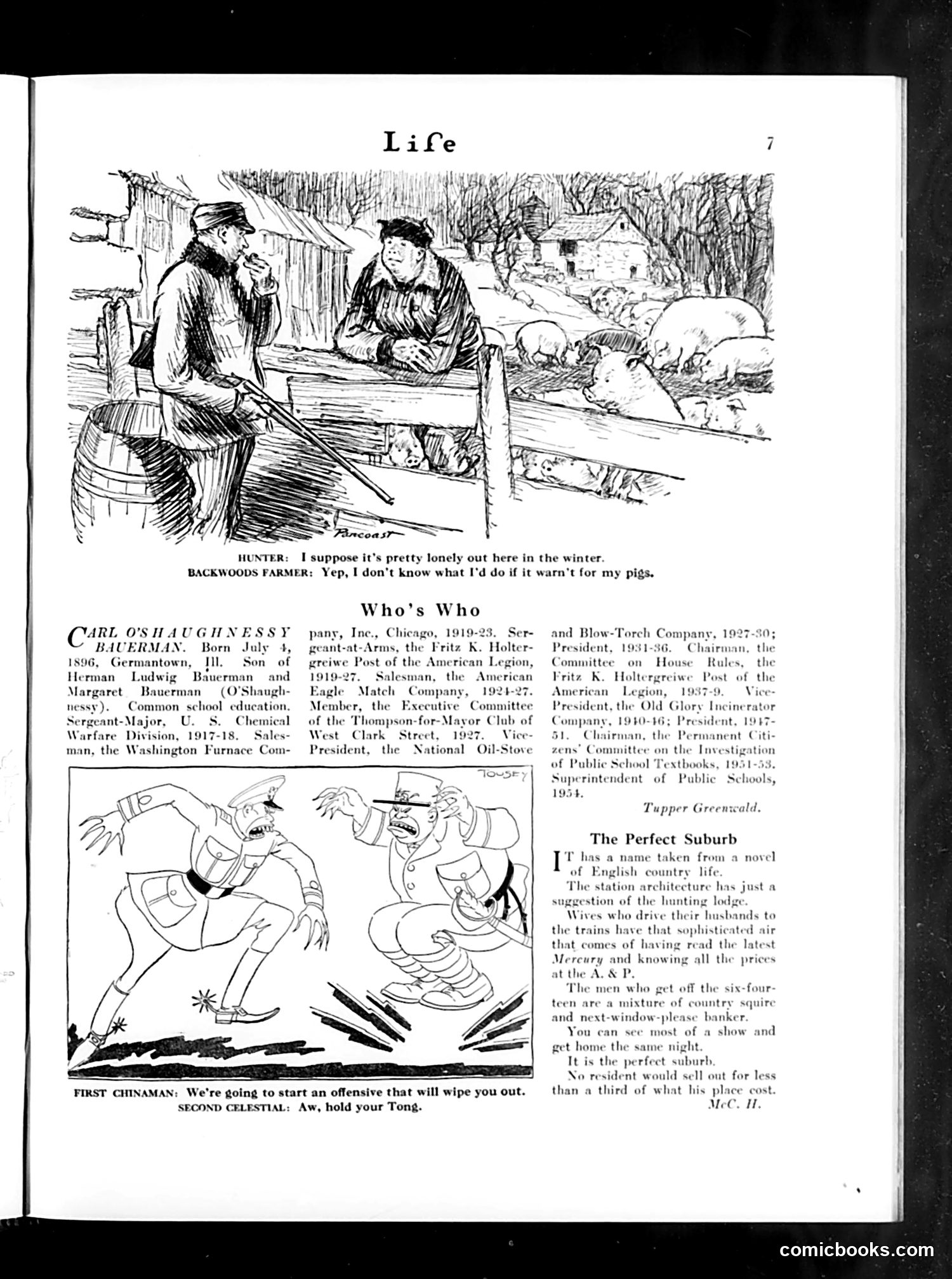
**Top Cartoon:** Two men chat by a pig pen during winter. The hunter complains to a "Backwoods Farmer" about isolation; the farmer replies he wouldn't survive without his pigs. This is a gentle rural humor about self-sufficiency and animal companionship in isolated farming communities. **Bottom Cartoon:** Two caricatured figures in military/combat gear appear to be Chinese soldiers or celestial beings (the text references "First Chinaman" and "Second Celestial"), engaged in violent combat. The caption suggests starting an offensive to "wipe you out." This reflects early 20th-century stereotyping of Asian conflicts, likely referencing tensions or wars involving China during this period (Life was published 1919-23 according to visible dates).
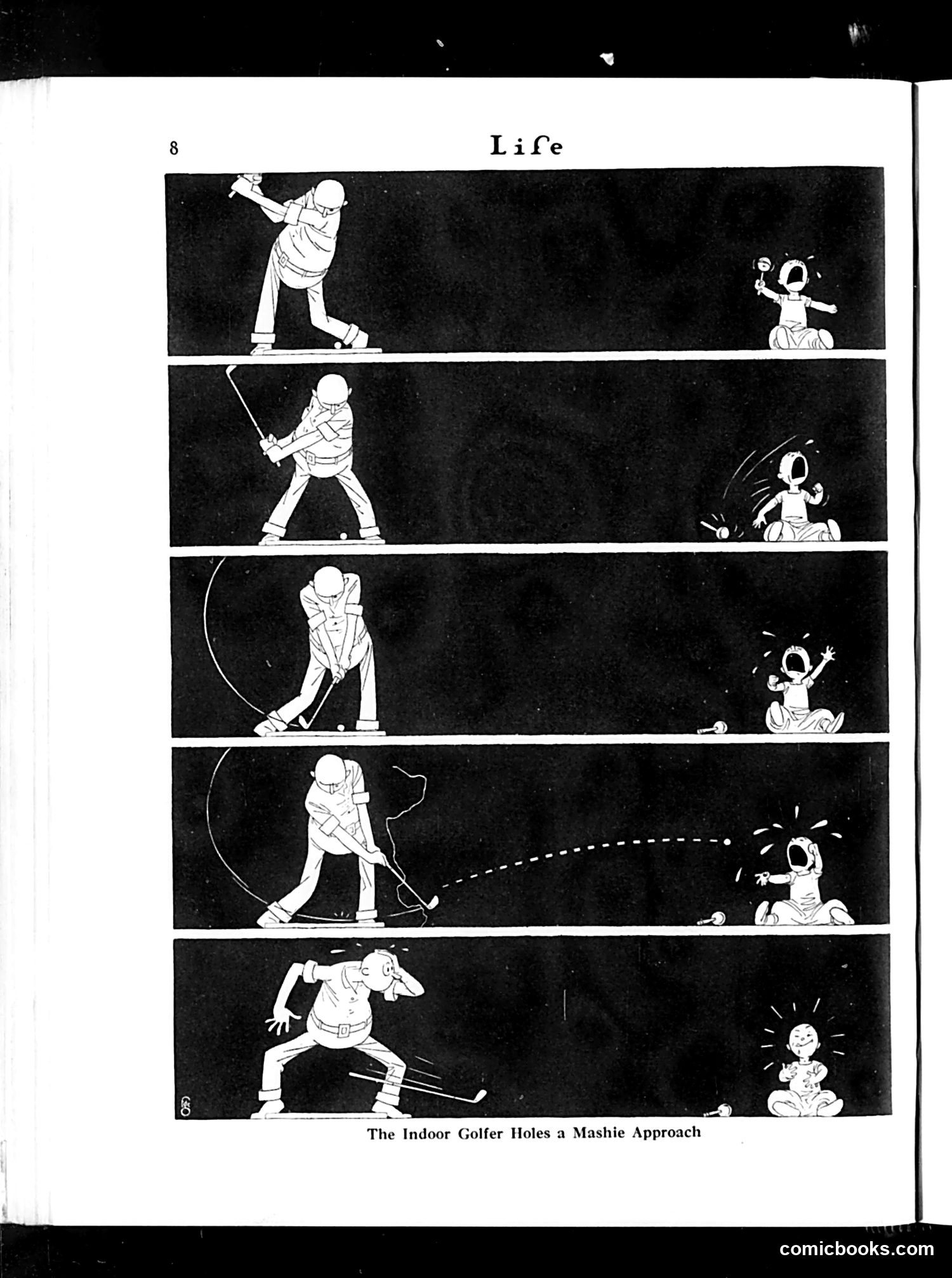
This is a humorous six-panel comic sequence showing a man playing golf indoors, apparently in his home. The caption plays on golf terminology ("mashie approach" being a golf club stroke). The joke depicts escalating chaos: the golfer swings repeatedly, each time hitting a small object (likely a ball) at a seated woman on the right who reacts with increasing distress and injury. By the final panel, she appears knocked over or defeated. The satire mocks both the indoor golf fad (apparently popular enough to warrant mockery in *Life*) and marital dynamics of the era—suggesting husbands' recreational hobbies cause domestic havoc and injury to their wives. The humor relies on slapstick violence presented as comedic consequence of a husband's selfish hobby.
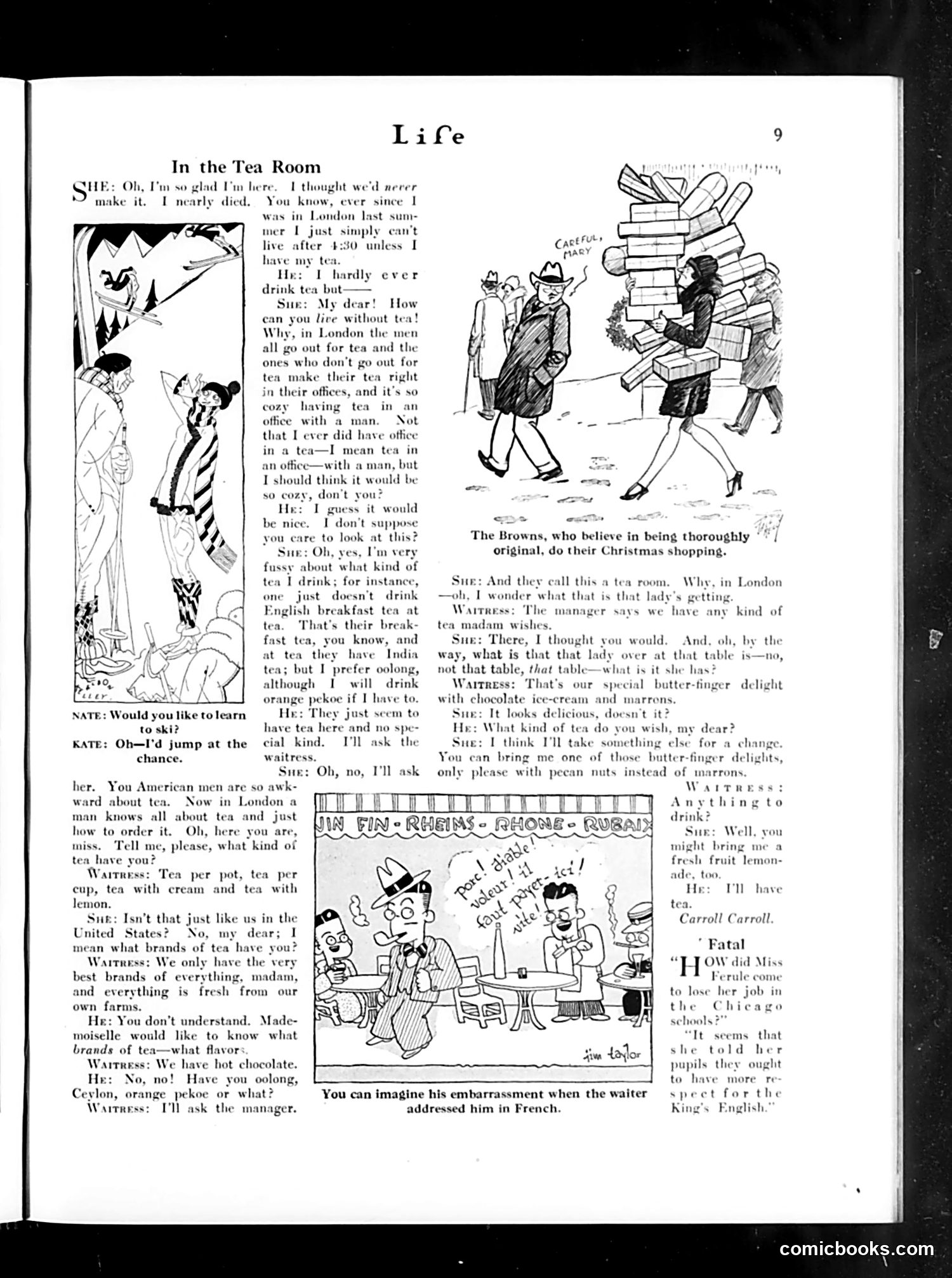
This page satirizes American ignorance of tea culture and etiquette. The dialogue between "She" and "He" (appearing to be American tourists) and a British waitress mocks how Americans didn't understand English tea traditions—they don't know basic varieties (Ceylon, oolong, orange pekoe) or proper service customs. The cartoon below, captioned "You can imagine his embarrassment when the waiter addressed him in French," shows an American man flustered when a waiter speaks French to him, satirizing American travelers abroad who lack cultural sophistication or language skills. The "Browns" illustration depicts Christmas shopping excess. Overall, the page ridicules American provincialism, consumer materialism, and cultural ignorance when encountering European customs—common themes in early 20th-century Life magazine's humor.
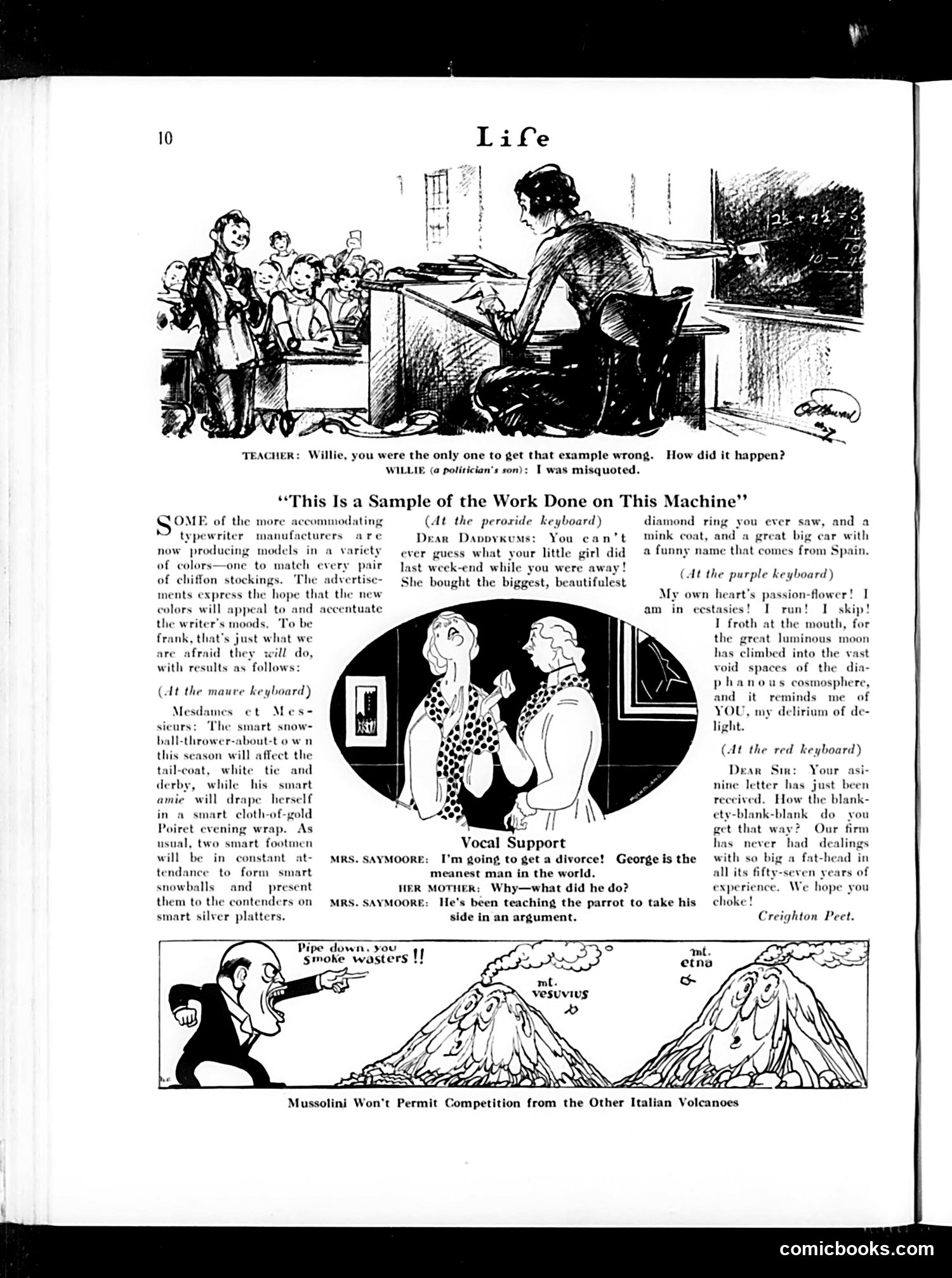
This page contains three distinct satirical pieces: 1. **Top cartoon**: A classroom scene where a teacher confronts student "Willie" about getting an example wrong. Willie claims he was "misquoted"—a political jab at politicians who deny statements. 2. **Middle section**: Humorous letters to editors, including complaints about typewriter colors and a woman's extravagant purchases while her husband was away. 3. **Bottom cartoon**: "Mussolini Won't Permit Competition from the Other Italian Volcanoes" depicts Mussolini as a volcano ordering other volcanoes to cease activity. This satirizes Mussolini's authoritarian control and monopoly on power in 1920s-30s Italy, using volcanic imagery as metaphor for his dominating, explosive political presence.
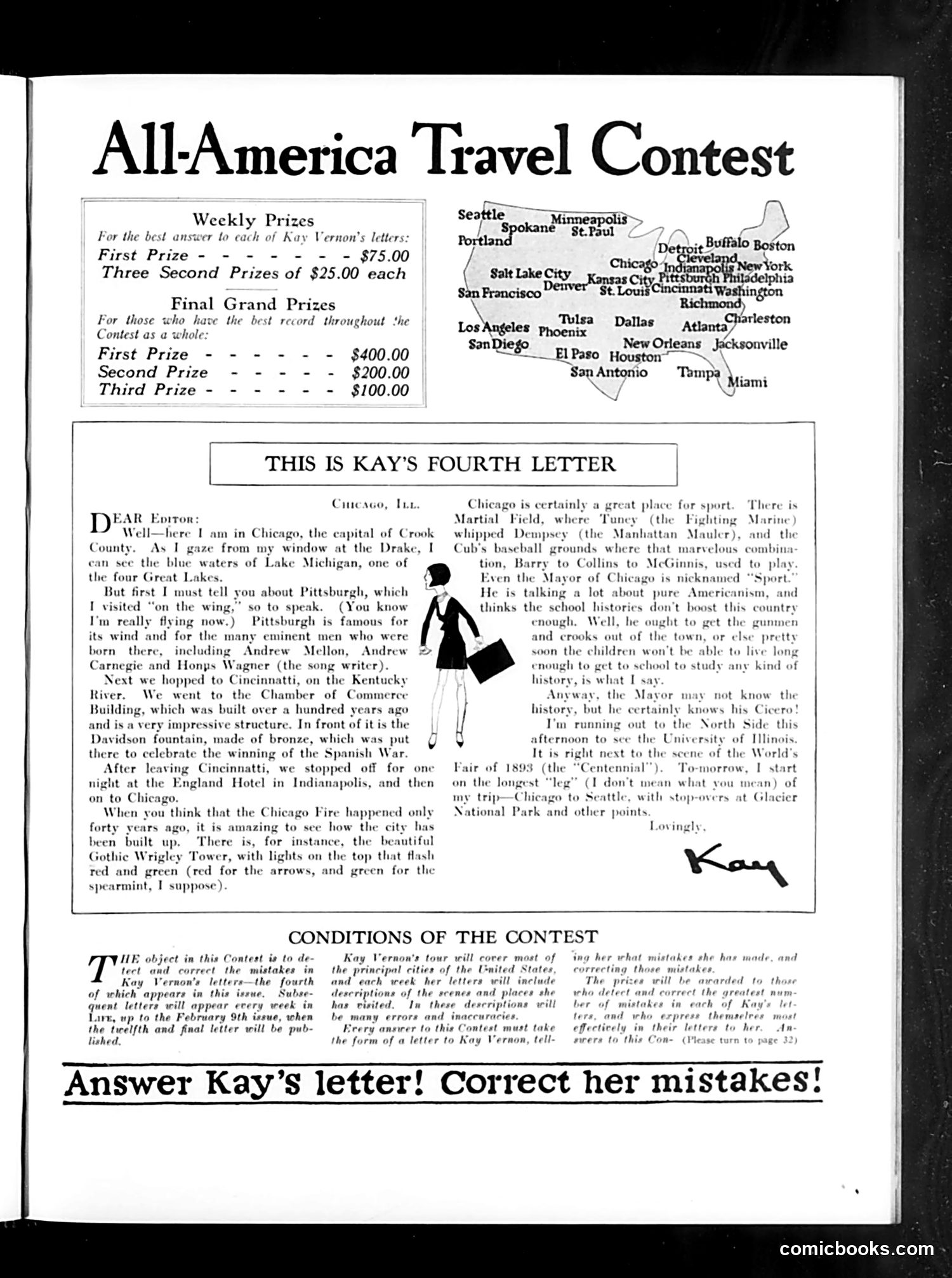
This page features the fourth letter in an interactive contest where readers correct errors made by "Kay Vernon," a fictional travel correspondent. The letter describes Kay's trip through Chicago, mentioning landmarks like Wrigley Field, the Chicago Fire, and planned visits to the University of Illinois and Niagara Falls. The contest invites readers to identify factual mistakes in Kay's account and submit corrections for prizes (up to $400). This was a popular early-20th-century magazine engagement strategy—combining education about American geography and history with reader participation and prize incentives. The accompanying map shows major U.S. cities, reinforcing the travel/geography theme. The illustration depicts a fashionable woman traveler, representing the "modern" mobile woman of the era.
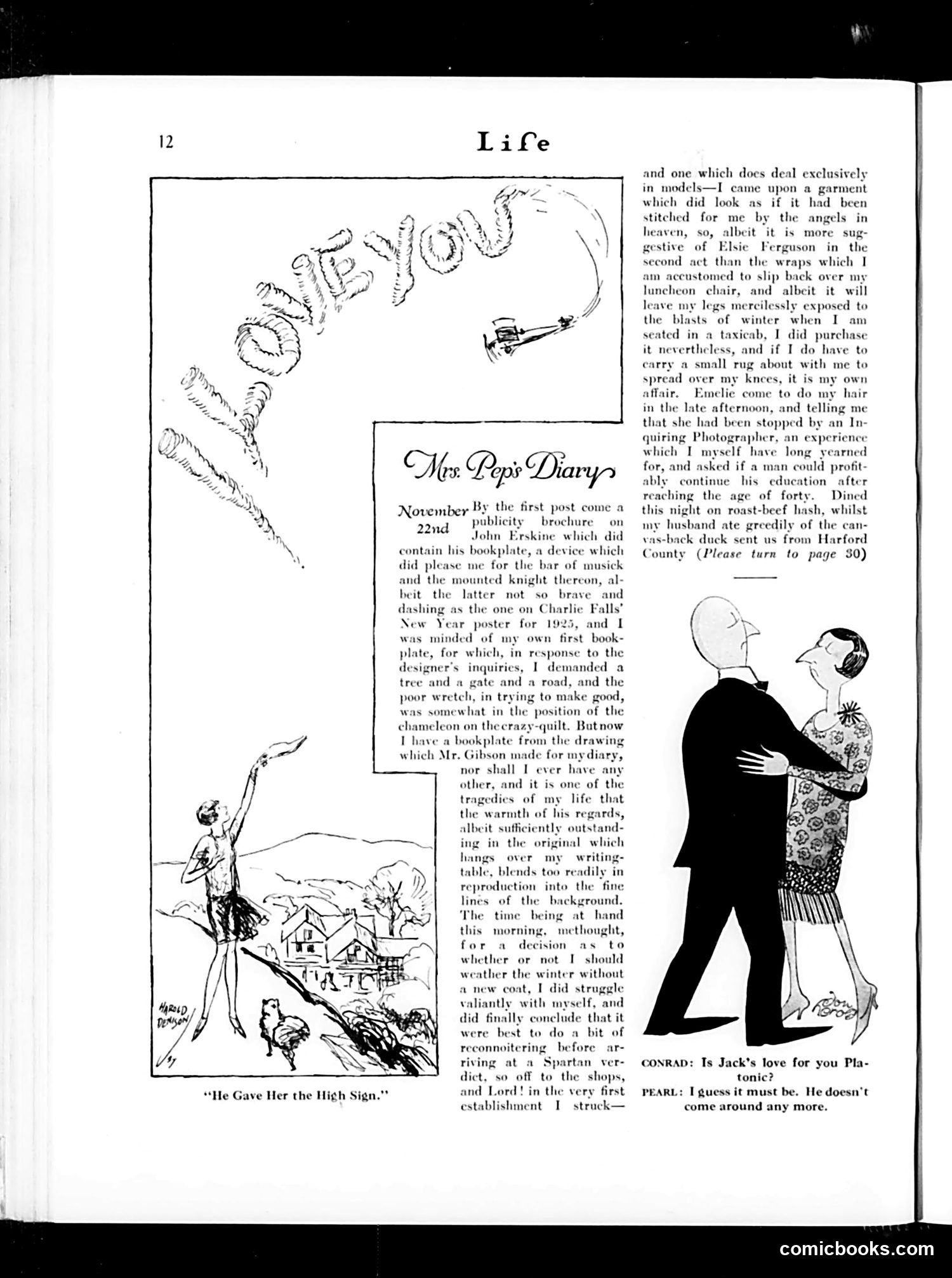
This page from *Life* magazine features "Mrs. Pep's Diary" (November 22nd entry) with two illustrations and a brief comedic dialogue between characters named Conrad and Pearl. The cartoon titled "He Gave Her the High Sign" (lower left) depicts a stylized woman making an exaggerated gesture toward a rural house scene—likely satirizing theatrical or melodramatic behavior in everyday situations. The right illustration shows a man in formal dress with a woman in patterned clothing, accompanying dialogue about a character named Jack and romantic disappointment. Pearl's response ("I guess it must be. He doesn't come around any more") suggests satirizing unrequited love or relationship dissolution. The diary entry discusses mundane domestic concerns: bookplates, winter clothing, and social visits—typical humor of the era mocking upper-class women's preoccupations.
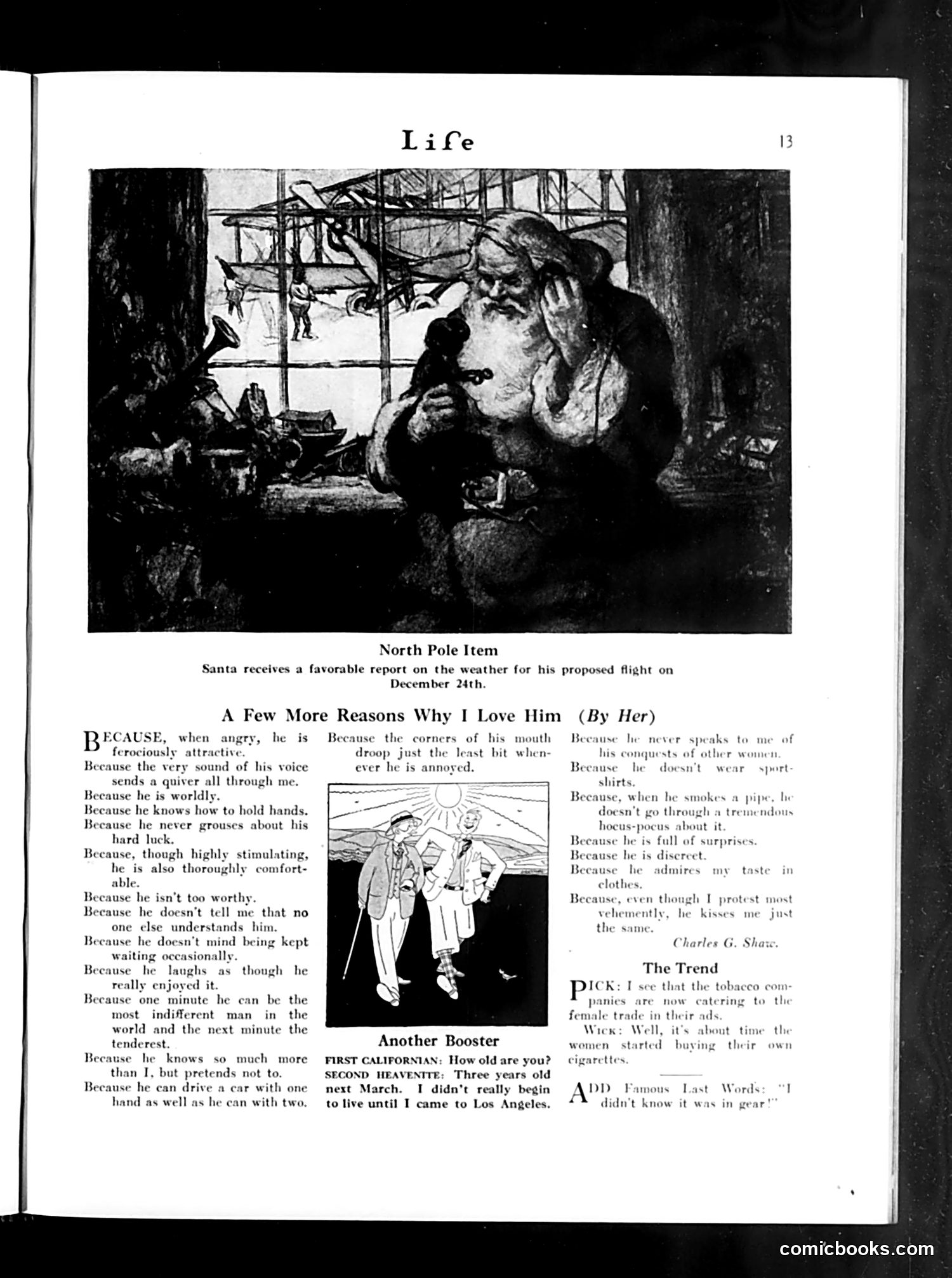
**Top Image ("North Pole Item"):** Shows Santa Claus receiving a weather report for a proposed December 24th flight. The satire plays on Santa as a practical aviator consulting meteorological data—a humorous juxtaposition of traditional Christmas mythology with modern aviation concerns (likely referencing early 20th-century aviation's hazards). **Middle Section ("A Few More Reasons Why I Love Him"):** A romantic poem by a woman listing affectionate reasons for loving an unnamed man, emphasizing his emotional restraint, driving ability, and discretion. This appears to be gentle domestic satire about male virtue and modern courtship expectations. **Bottom ("Another Booster"):** A brief interview segment where someone discusses moving to Los Angeles, reflecting early 20th-century westward migration enthusiasm. The page combines holiday whimsy, romantic humor, and period-specific social commentary.
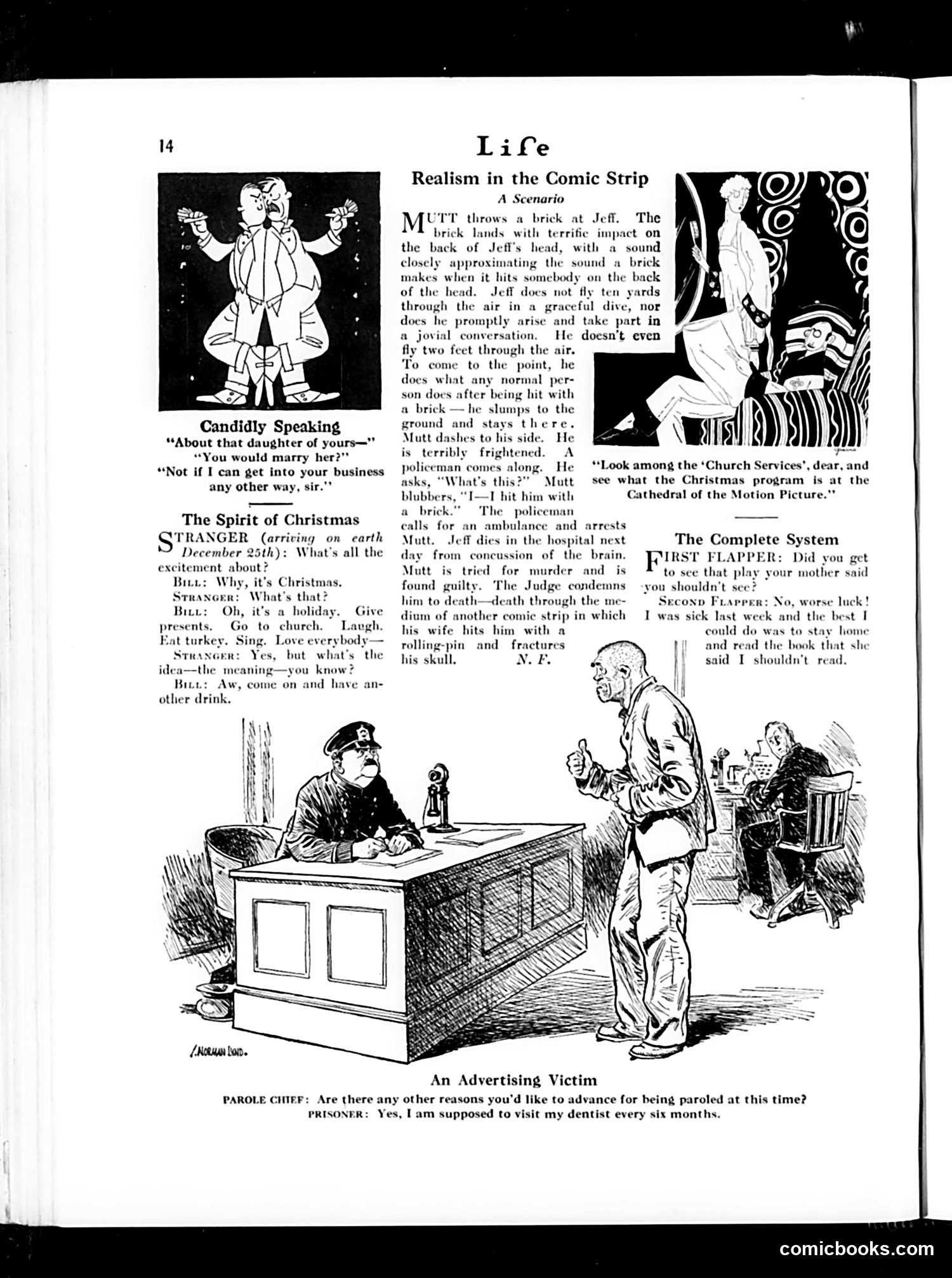
This page contains several satirical comic scenarios from Life magazine: 1. **"Candidly Speaking"** mocks courtship euphemisms—a man asking "Would you marry her?" after hitting someone with a brick, absurdly treating violence as casual. 2. **"The Spirit of Christmas"** satirizes commercialism: a stranger asks what Christmas means, and the response is materialistic (presents, church, eating, singing) rather than spiritual. 3. **"Realism in the Comic Strip"** critiques how comic strips ignore physics—a character hit with a brick should realistically collapse, not heroically continue, exposing the artificiality of the medium. 4. **"The Complete System"** jokes about censorship and parental control of reading material. 5. **"An Advertising Victim"** shows a prisoner citing dental visits as his parole reason—satirizing how advertising creates manufactured needs and compliance.
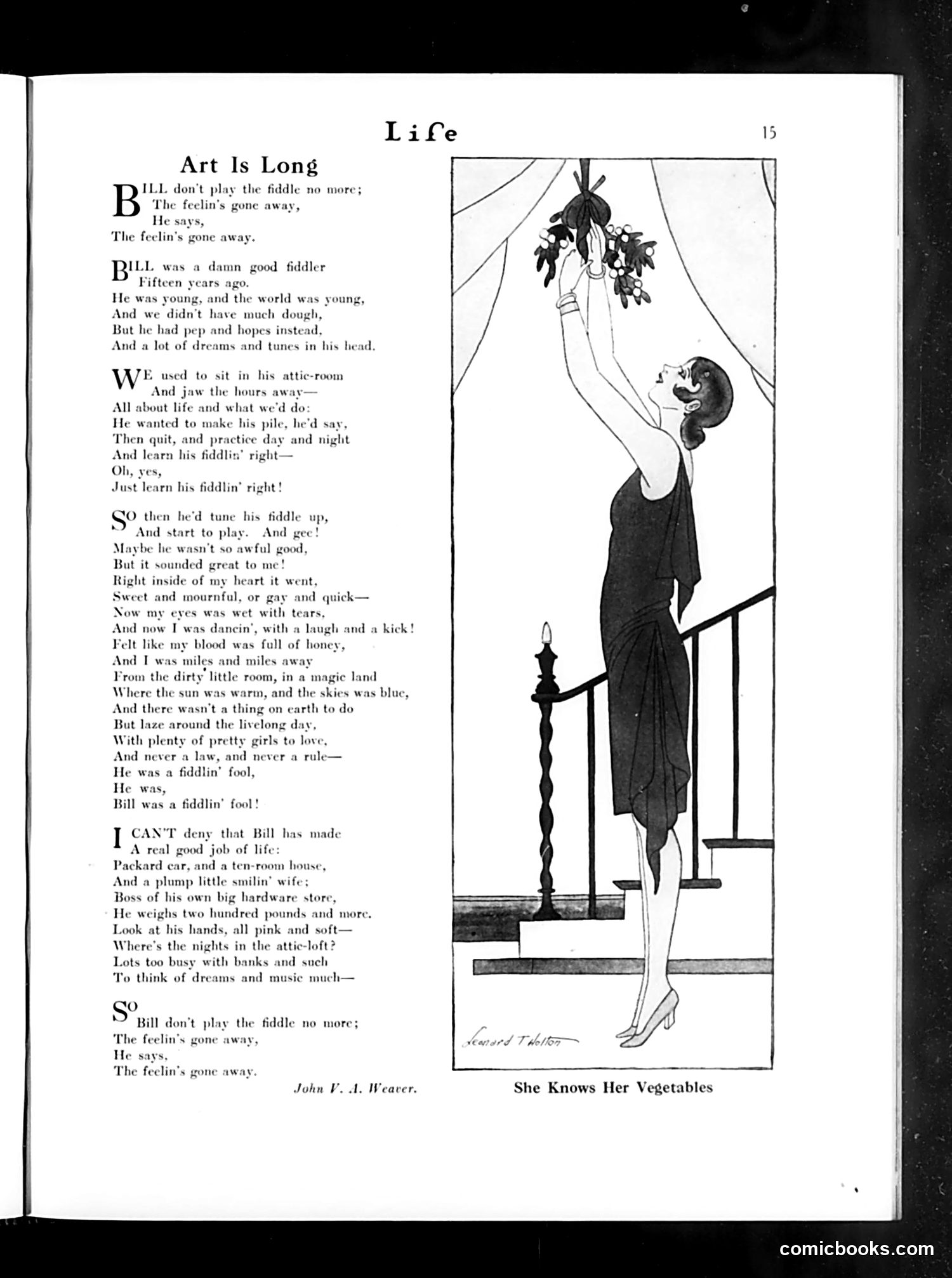
The page contains a poem by John F. A. Weaver titled "Art Is Long," which laments how Bill—once an aspiring fiddler with artistic dreams—abandoned music for material success. He now owns a hardware store and lives a conventional life, having lost "the feelin'" for his art. The accompanying illustration, "She Knows Her Vegetables," depicts a woman reaching up to mistletoe while holding what appears to be produce. The satirical point criticizes how practical concerns and domesticity replace youthful artistic ambition. The contrast between artistic aspiration and bourgeois respectability—a common early-20th-century *Life* magazine theme—suggests that commercial success comes at the cost of creative passion and personal fulfillment.
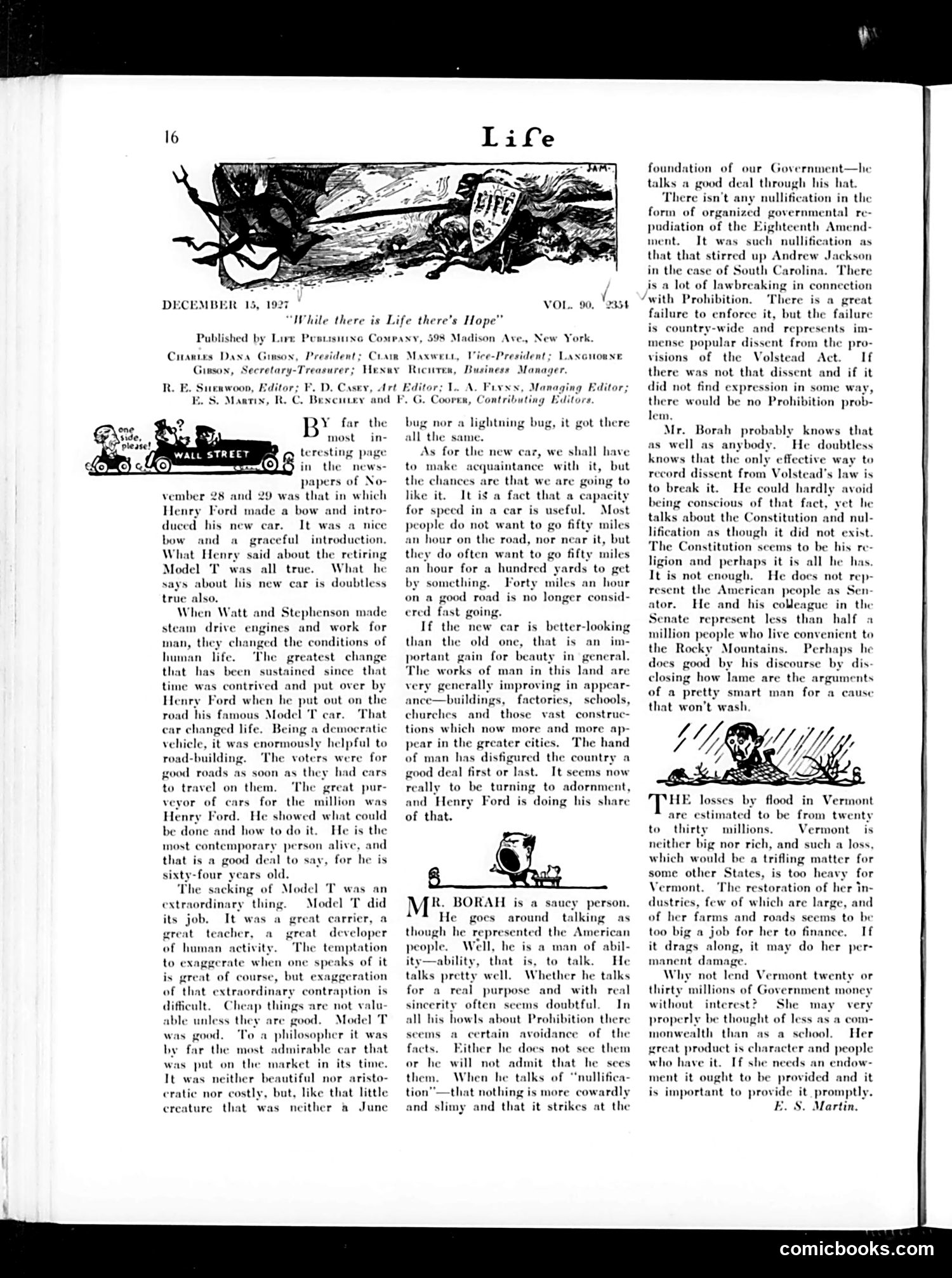
This *Life* magazine page (December 15, 1925) contains editorial commentary attacking Senator William E. Borah of Idaho. The text criticizes Borah for publicly opposing Prohibition while claiming to represent "the American people," despite the fact that less than half the nation lives in regions where Prohibition is popular. The piece sarcastically notes Borah is "saucy" and talkative but avoids honestly discussing Prohibition enforcement failures. The author argues Borah's arguments against Prohibition are "cowardly" and "sling mud" rather than address real issues. The cartoon imagery (appears to show a figure with exaggerated features) likely caricatures Borah, reinforcing the written critique of his political posturing on this divisive 1920s issue.
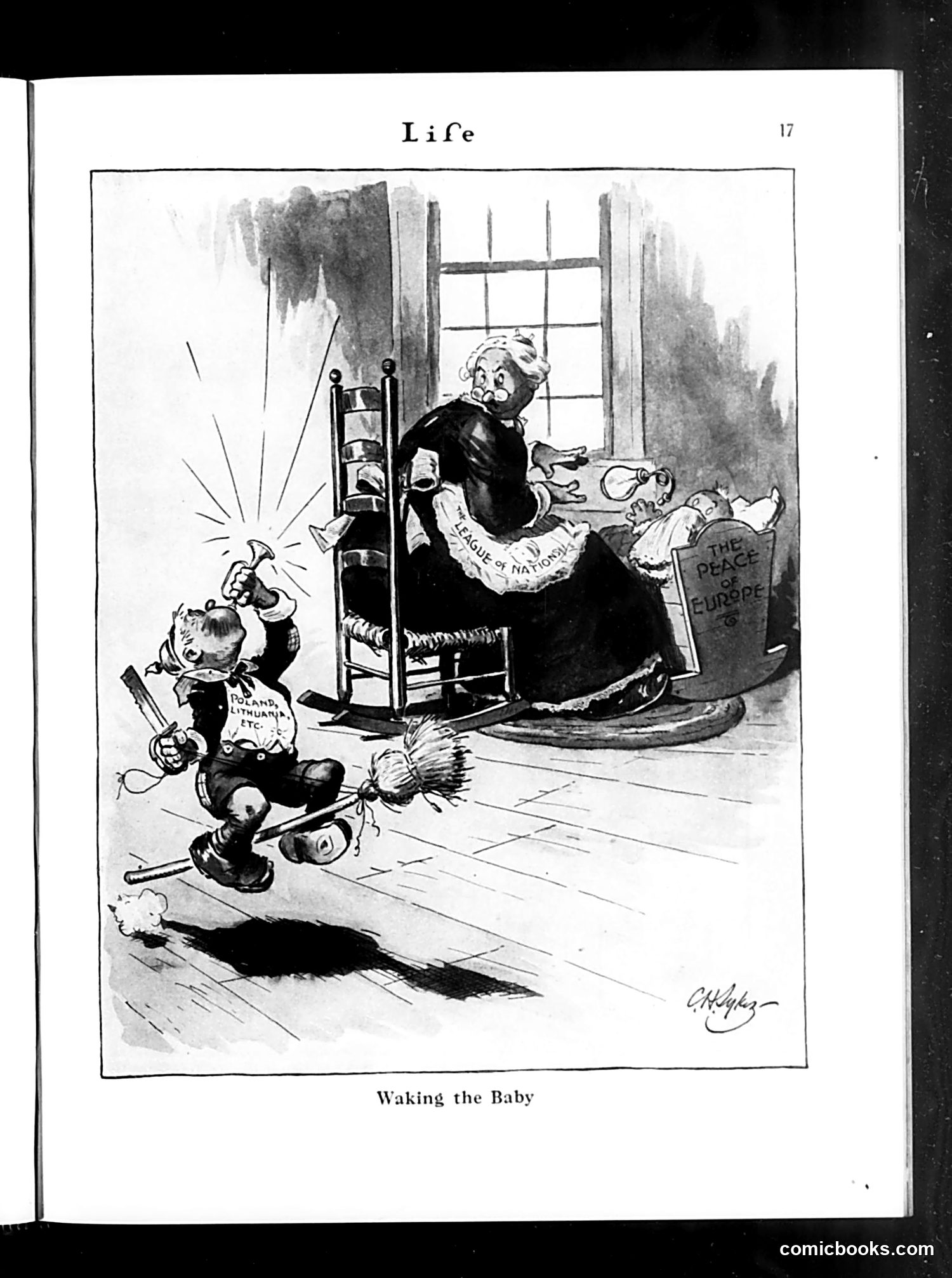
This political cartoon satirizes post-World War I European peace efforts. The central figure appears to be a sleeping infant labeled "Peace of Nations," while a woman (likely representing a European nation or allied power) rocks a cradle. On the left, a small figure labeled "Ireland" is depicted as a troublemaker creating noise and disruption with firecrackers or explosives, deliberately waking the baby. The satire suggests that Irish independence movements or political agitation were threatening fragile post-war peace negotiations in Europe. The cartoon implies Ireland was being a destabilizing force when European leaders were trying to establish lasting peace after the war's conclusion.
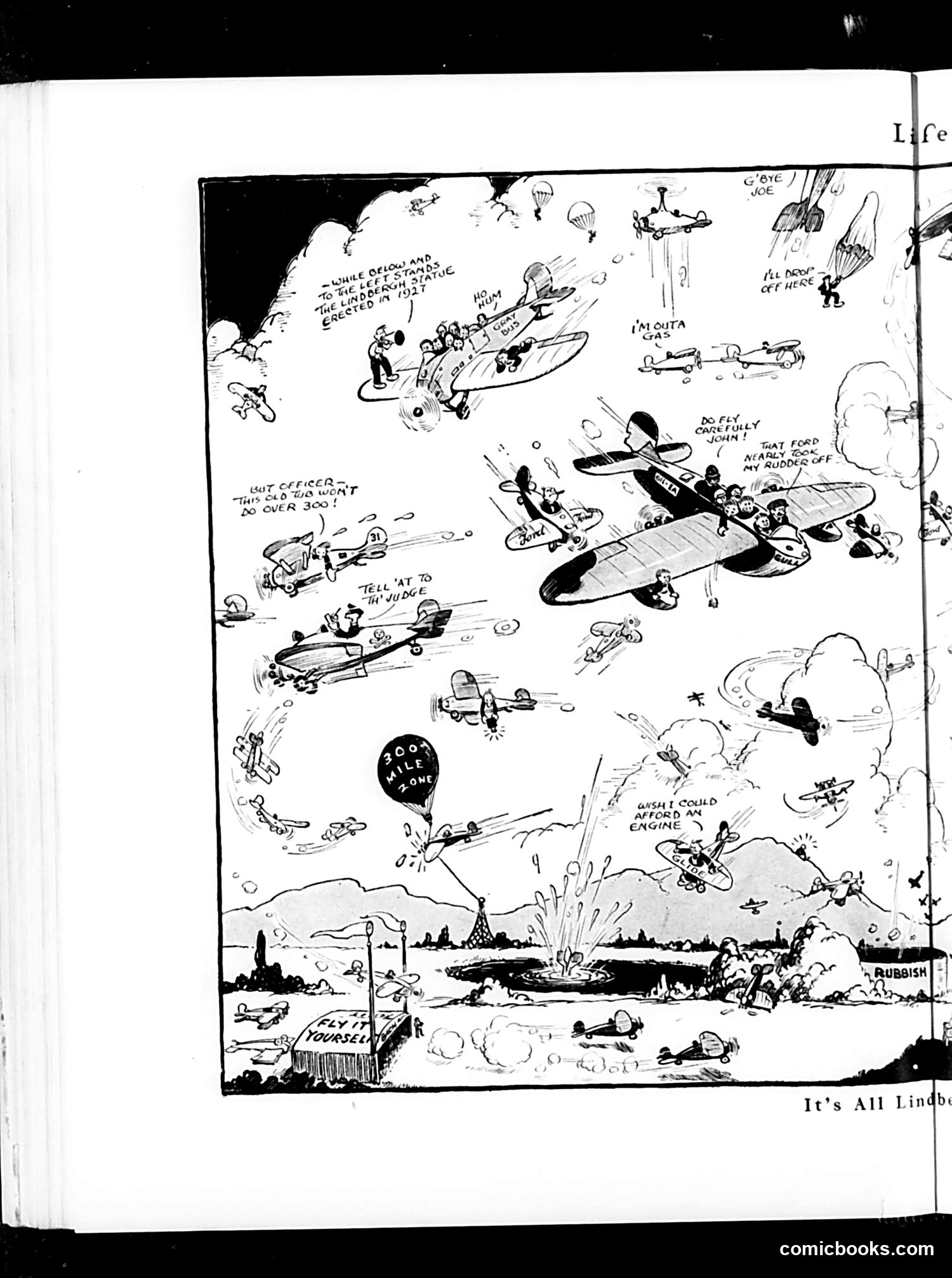
This is a satirical cartoon depicting a chaotic aerial dogfight scene. The central image shows multiple military aircraft engaged in combat above a cityscape, with pilots making exasperated comments about the confusion. Speech bubbles include complaints like "I'M OUTA GAS," "OUT OFFICERS, I SHOULD WORRY DO OVER 300," and "TELL 'AT TO TH'JUDGE." The satire appears to mock the disorganization and absurdity of aerial combat—pilots are running out of fuel, colliding with each other, and expressing frustration about unclear orders and dangerous conditions. The "SMILE FOR LIFE" circular stamp suggests this is commentary on wartime aviation, likely from the WWI or WWII era when such cartoons were common in Life magazine. The humor derives from depicting military operations as comedically incompetent rather than heroic, reflecting period skepticism toward military leadership and the fog of war.
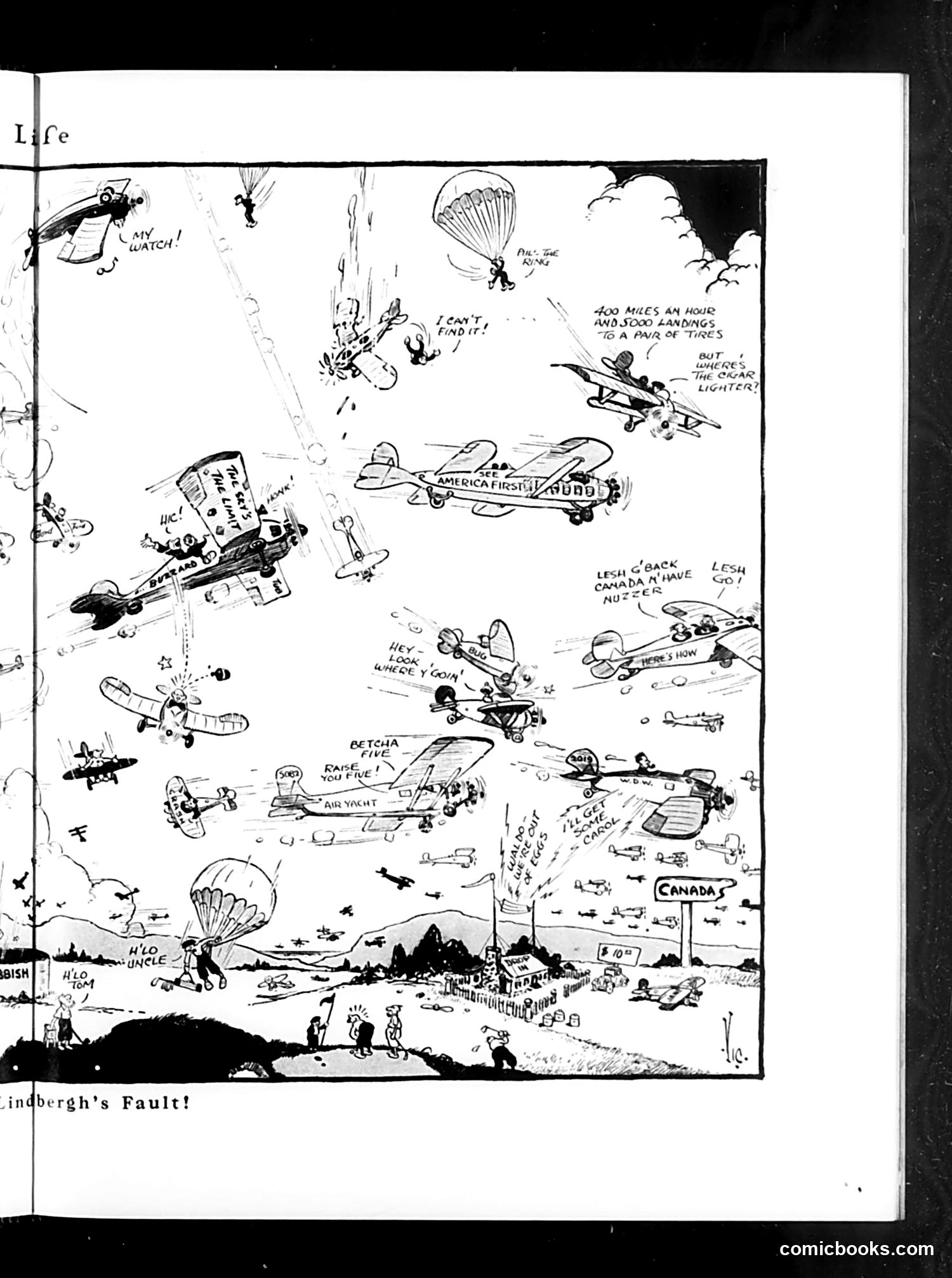
This satirical cartoon depicts a chaotic aerial scene crowded with various aircraft, parachutes, and aviation mishaps near the Canada border. The title references Charles Lindbergh, the famous aviator. The cartoon appears to mock aviation safety and competition during the early aviation era. Multiple labeled aircraft (including "America First" and "Air Yacht") show pilots in distress, with speech bubbles containing complaints about equipment failures and collisions. The bottom shows onlookers observing the aerial chaos. The satire likely criticizes either Lindbergh's influence on reckless aviation pursuits, the aviation industry's safety standards, or both. The joke seems to be that despite aviation's supposed progress, the reality remains dangerously chaotic—blaming this mess on Lindbergh's popularity or endorsement of flying. The "400 miles an hour and 5000 landings to a pair of tires" comment sarcastically suggests absurdly unrealistic aviation claims.
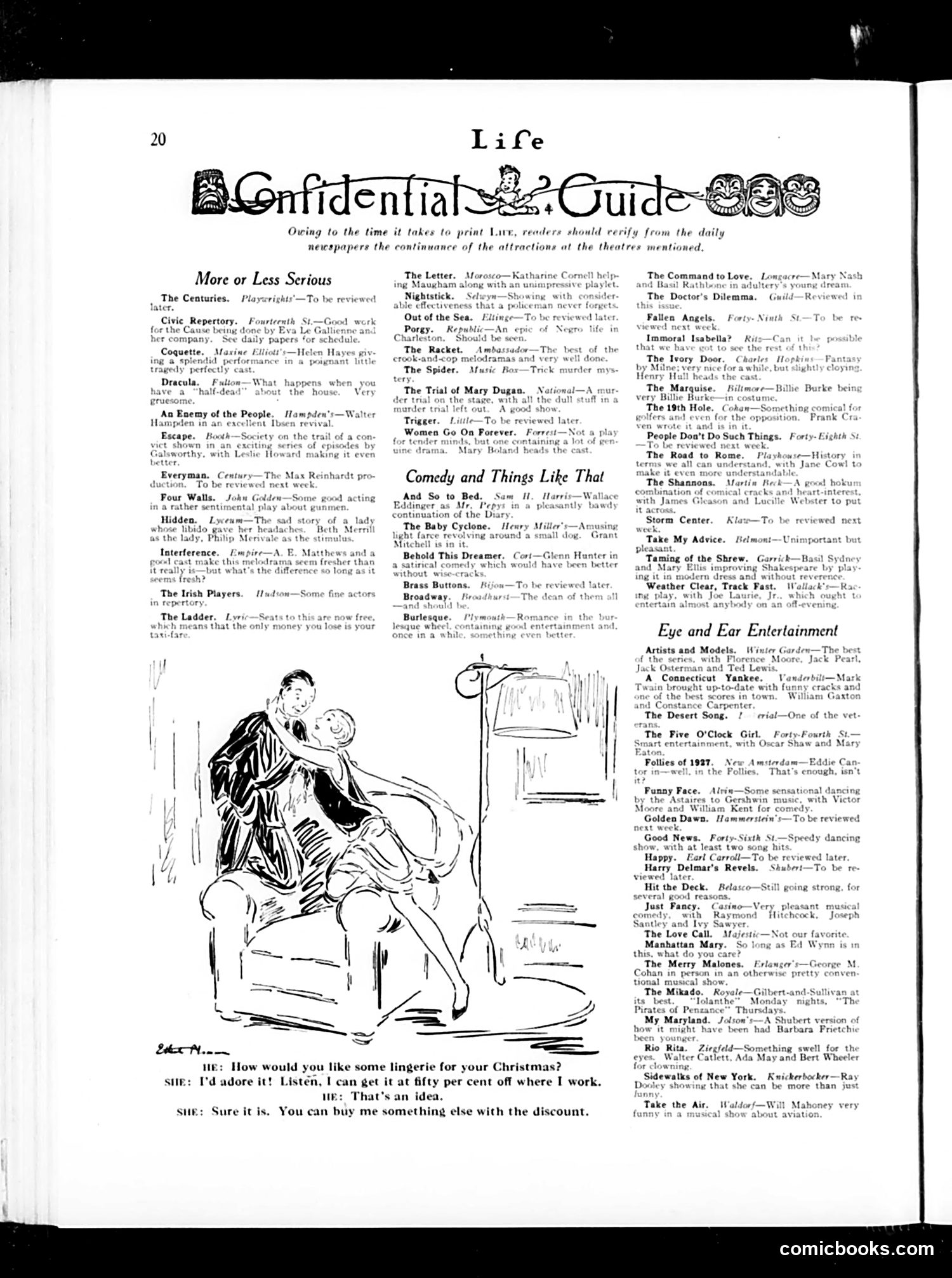
This page is a theater review guide listing Broadway shows and entertainment options, with one cartoon illustrating a domestic shopping dialogue. **The Cartoon:** The single illustration depicts a domestic scene where a husband asks his wife what she'd like for Christmas lingerie. She responds enthusiastically that she'd love it, then reveals she can get it at a 50% discount "where I work." The husband, seizing the opportunity, suggests using the savings to buy "something else with the discount." **The Satire:** The joke targets practical domesticity and the erosion of romantic gift-giving. Rather than presenting lingerie as a romantic Christmas gesture, it becomes a transaction—the wife has access to employee discounts, converting a potentially intimate gift into a cost-saving opportunity. The husband's immediate pivot to purchasing additional items mocks how commercial considerations supersede sentiment in marriage. The humor reflects 1920s attitudes about marriage and consumer culture, suggesting that even intimate gifts devolve into budget calculations.
This drama column discusses early 20th-century Shakespeare productions and their varying approaches to the playwright's work. The author critiques over-embellished stagings, arguing that Shakespeare benefits from simpler presentation. **Key references:** - **Bernard Shaw**: The critic whose dramatic writings the author admits echoing unknowingly - **Max Reinhardt**: A famous German director whose ornate production of "A Midsummer Night's Dream" impressed audiences with its spectacle and German-language delivery - **Modern-dress productions**: Basil Sydney and Mary Ellis performing "The Taming of the Shrew" in contemporary 1920s clothing rather than period costumes—a then-novel approach - **Richard Boleslavsky**: Director of a stripped-down "Much Ado About Nothing" at the American Laboratory Theatre The satirical point: the author argues that Shakespeare's genuine theatrical power emerges *despite* elaborate production values, not because of them. Modernizing costumes or removing decorative spectacle paradoxically helps actors and audiences connect with the material's human core.
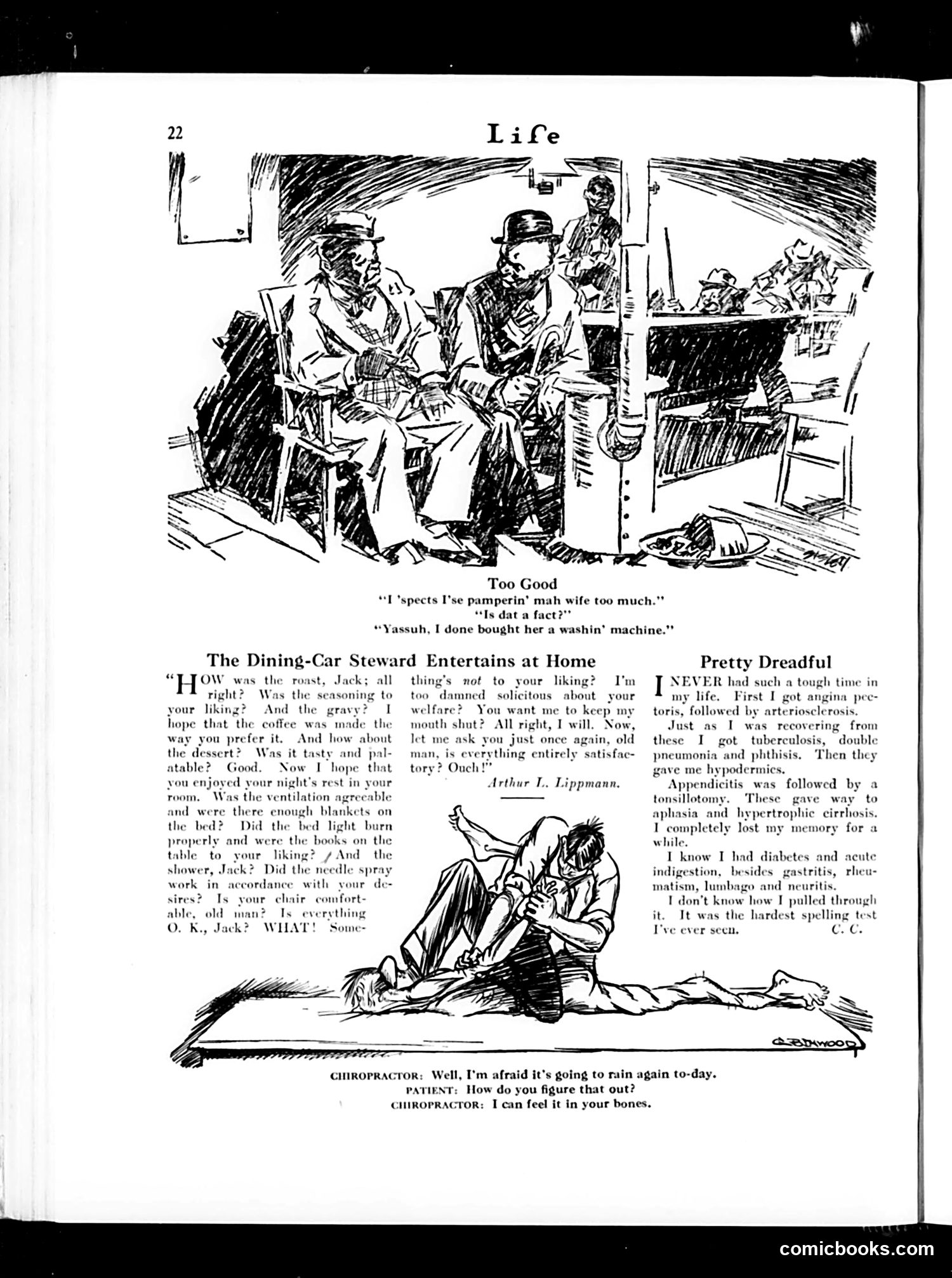
This page contains three satirical pieces reflecting early 20th-century social attitudes: **"Too Good"** mocks African American dialect and working-class economics. The joke depends on stereotypical speech patterns to suggest that buying a washing machine represents excessive pampering—reflecting the era's dismissive attitudes toward both Black workers and labor-saving technology for ordinary people. **"The Dining-Car Steward Entertains at Home"** satirizes service-industry staff who adopt obsequious formality in their personal lives, unable to relax even at home. The steward's constant solicitude about comfort mirrors his professional manner absurdly. **"Pretty Dreadful"** presents a patient cataloging serious illnesses (tuberculosis, appendicitis, diabetes) with deadpan understatement, then reveals the punchline: it was actually a difficult spelling test. The joke relies on contrast between grave medical conditions and trivial academic struggle. The chiropractor joke at bottom mocks pseudoscientific medicine through a pun about "feeling it in your bones." All three pieces use exaggeration and reversal to critique their subjects, typical of Life's satirical approach.
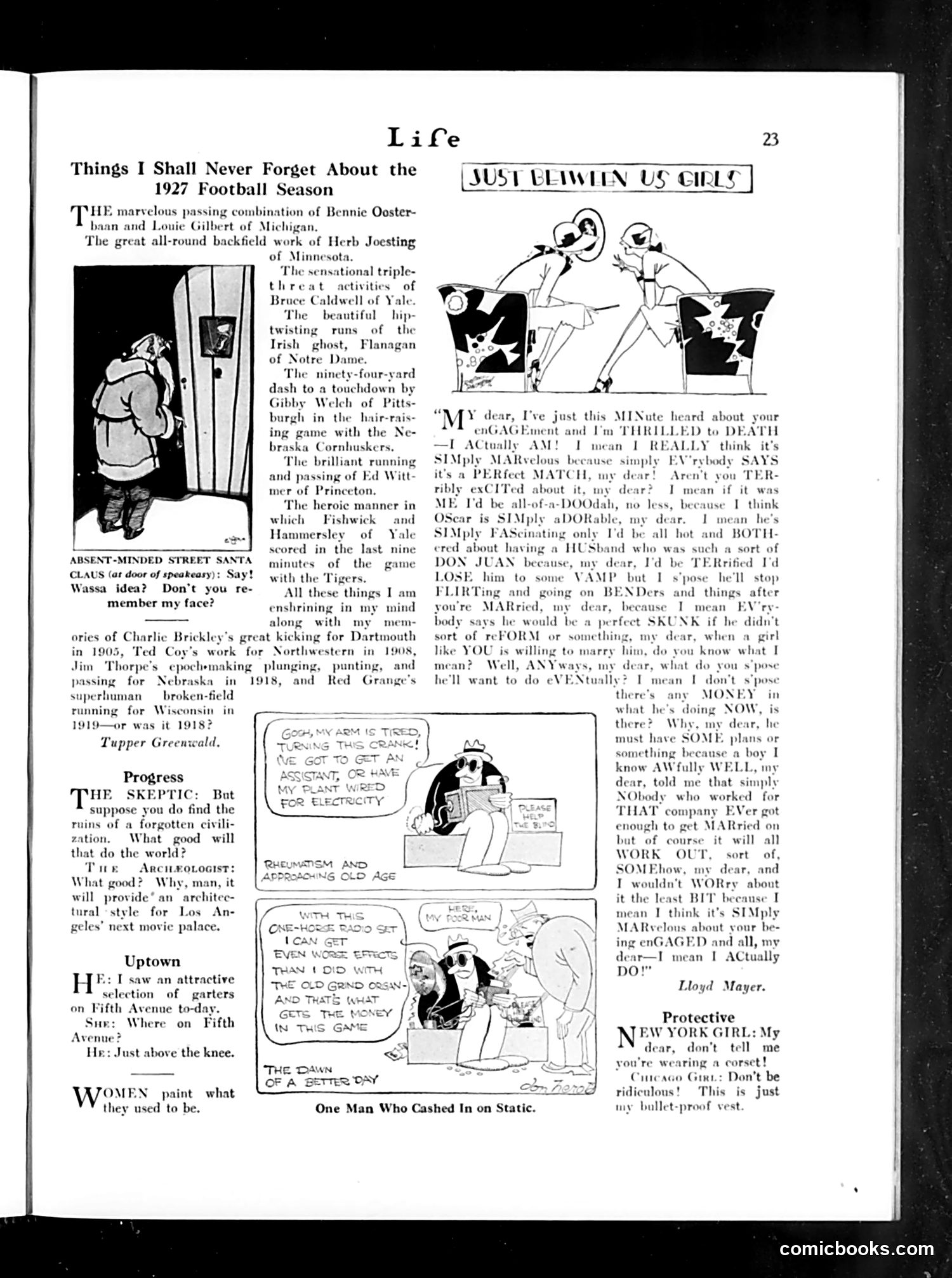
This page from Life magazine contains three distinct satirical pieces reflecting 1920s American culture: **"Things I Shall Never Forget About the 1927 Football Season"** nostalgically lists memorable college football players and moments, then humorously compares them to legendary early-1900s players (Brickley, Coy, Thorpe, Grange). The joke satirizes how each generation thinks their era produced superior athletes. **"Just Between Us Girls"** is a gossipy monologue where one woman excitedly tells another about her engagement. The humor comes from the breathless, affected speech pattern (capitalized emphases throughout) and shallow concerns—she's thrilled but immediately worried her fiancé is a "skunk" who'll cheat, assuming he must reform simply because he'd marry her. **The cartoon "One Man Who Cashed In on Static"** appears to satirize radio technology and commercialism, though details are partially obscured. **"Protective"** is a brief joke about Chicago's violent reputation: a New York woman asks if a Chicago woman is wearing a corset; she replies it's a "bullet-proof vest"—implying Chicago is so dangerous that armor is necessary.
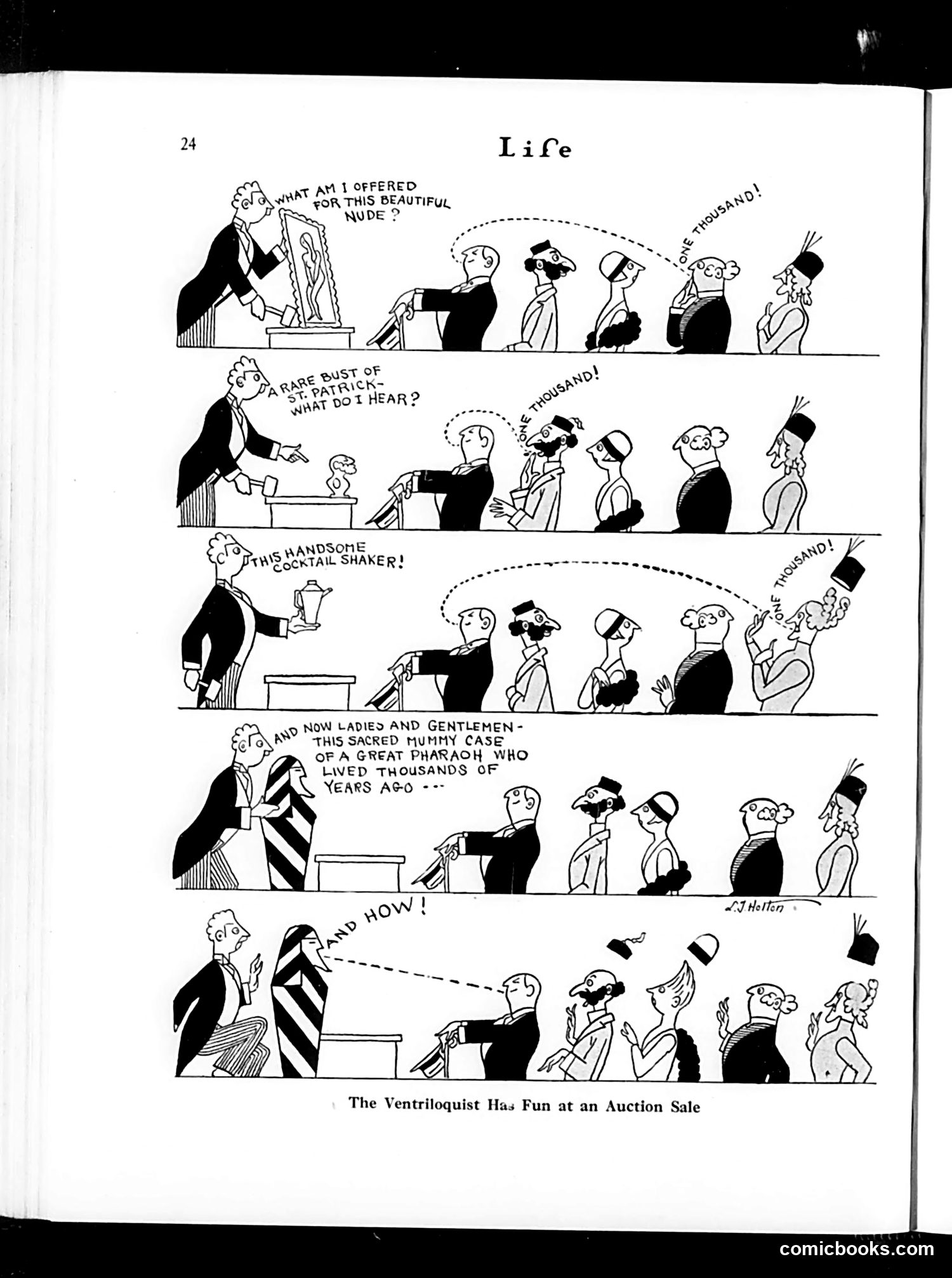
This comic strip satirizes auction house theatrics through a ventriloquist's performance. A showman auctioneer uses a ventriloquist dummy to artificially inflate bidding on increasingly absurd items: a nude statue, a bust, a cocktail shaker, and an Egyptian mummy case. Each time he presents an item, audience members' bids escalate ("One thousand!"), driven by the dummy's enthusiastic responses and the auctioneer's exaggerated sales patter. The joke mocks both auction house hype and bidders' susceptibility to manufactured excitement—the dummy's participation suggests the bidding is largely theatrical performance rather than genuine competitive interest. It's satire on commercial manipulation and crowd psychology in the pre-auction era.
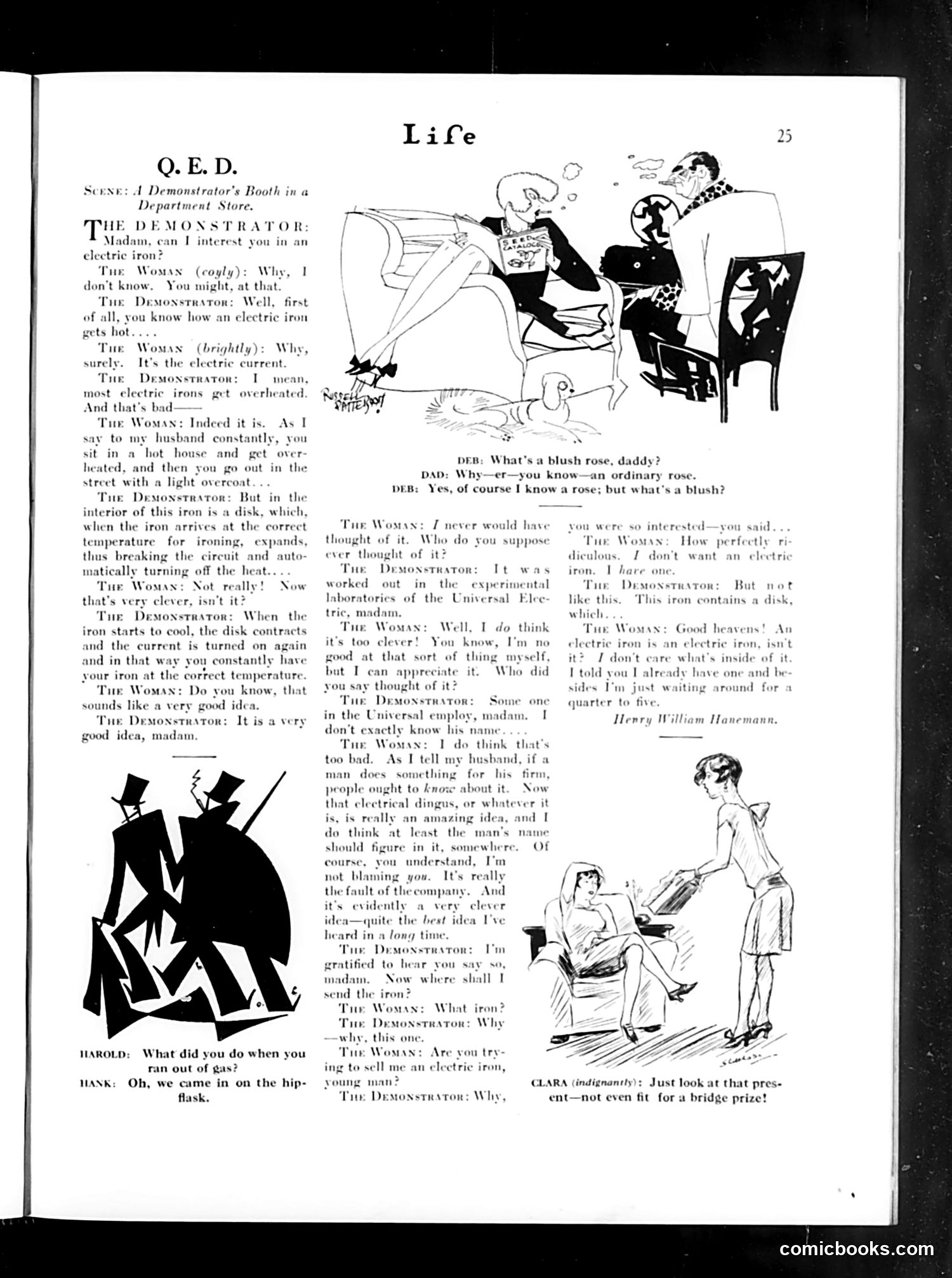
This page satirizes the absurdity of overly technical product demonstrations. In the main sketch "Q.E.D.," a department store demonstrator tries selling an electric iron to a woman by explaining its thermostat mechanism—a disk that expands with heat, breaking the electrical circuit to prevent overheating. The joke is that the woman completely misses the point. Rather than appreciating the innovation, she fixates on irrelevant details: she compares the iron's temperature regulation to sitting in a hot house and wearing a light overcoat. She then insists the unnamed inventor at "Universal" deserve credit, missing that such technical improvements are simply corporate work. The satire targets both the demonstrator's over-explanation and the consumer's inability to grasp modern technology. The small comic exchanges at bottom (about blush roses and running out of gas) are unrelated vignettes. Overall, the page mocks the gap between manufacturers' technical innovation and average consumers' comprehension of how modern conveniences actually work.
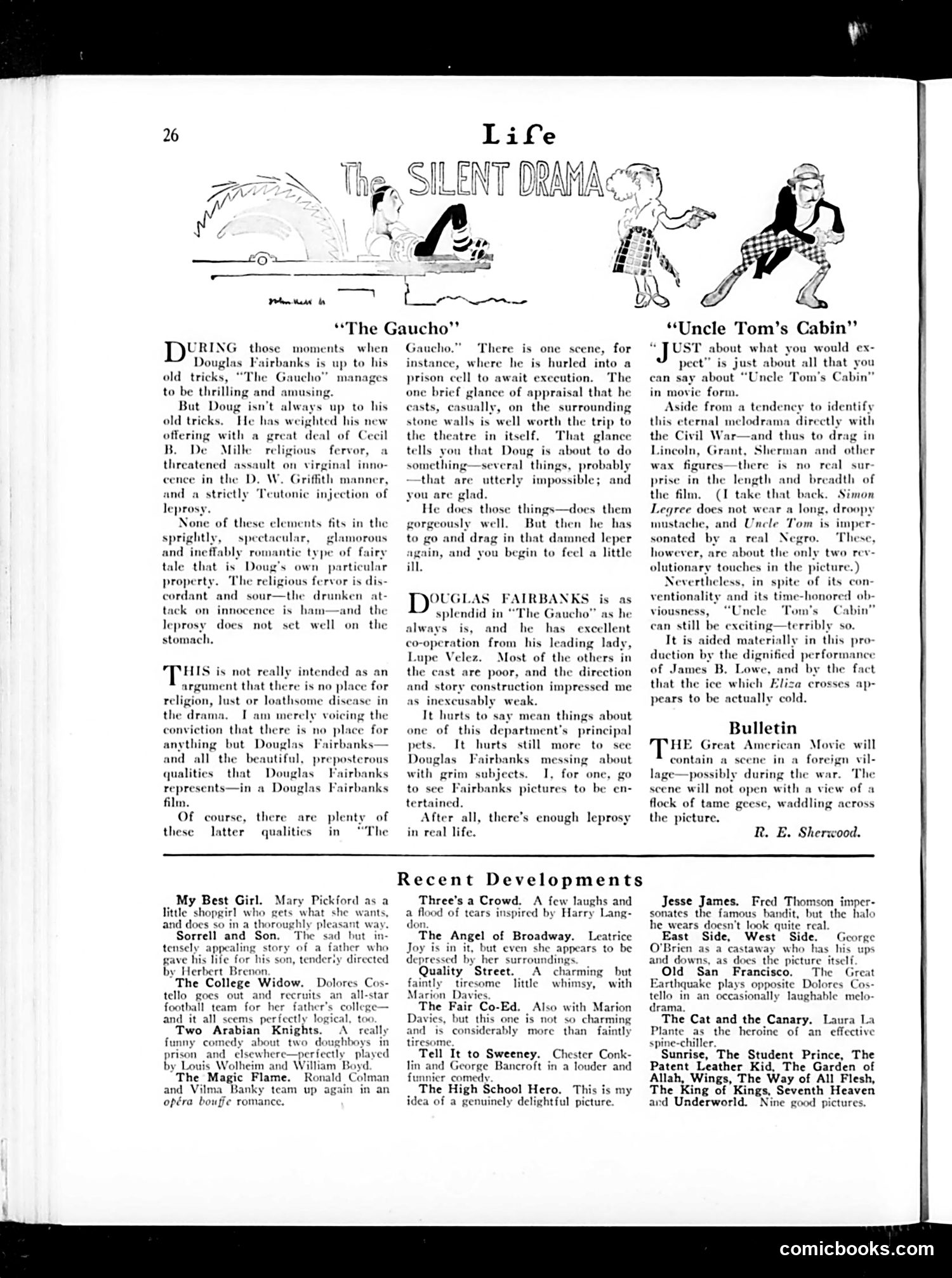
This page contains two film reviews of silent movies starring major actors of the era. **"The Gaucho"** reviews Douglas Fairbanks' latest picture. The critic praises Fairbanks' signature athleticism and charm—his ability to perform impossible stunts with casual grace. However, the review faults the film for mixing Fairbanks' light, fantastical style with heavy dramatic elements borrowed from other directors: religious fervor (Cecil B. De Mille), sexual assault (D.W. Griffith), and leprosy. The complaint is that these grim, realistic subjects clash jarringly with what audiences expect from a Fairbanks picture—pure spectacle and fun. **"Uncle Tom's Cabin"** criticizes the film for being conventionally melodramatic, though it oddly drags in Civil War figures (Lincoln, Grant, Sherman) unnecessarily. The review notes James B. Lowe's dignified performance and praises the film as genuinely exciting despite its predictability. Both reviews reflect 1920s film criticism: concerns about tonal consistency and whether serious subjects belong in entertainment cinema.
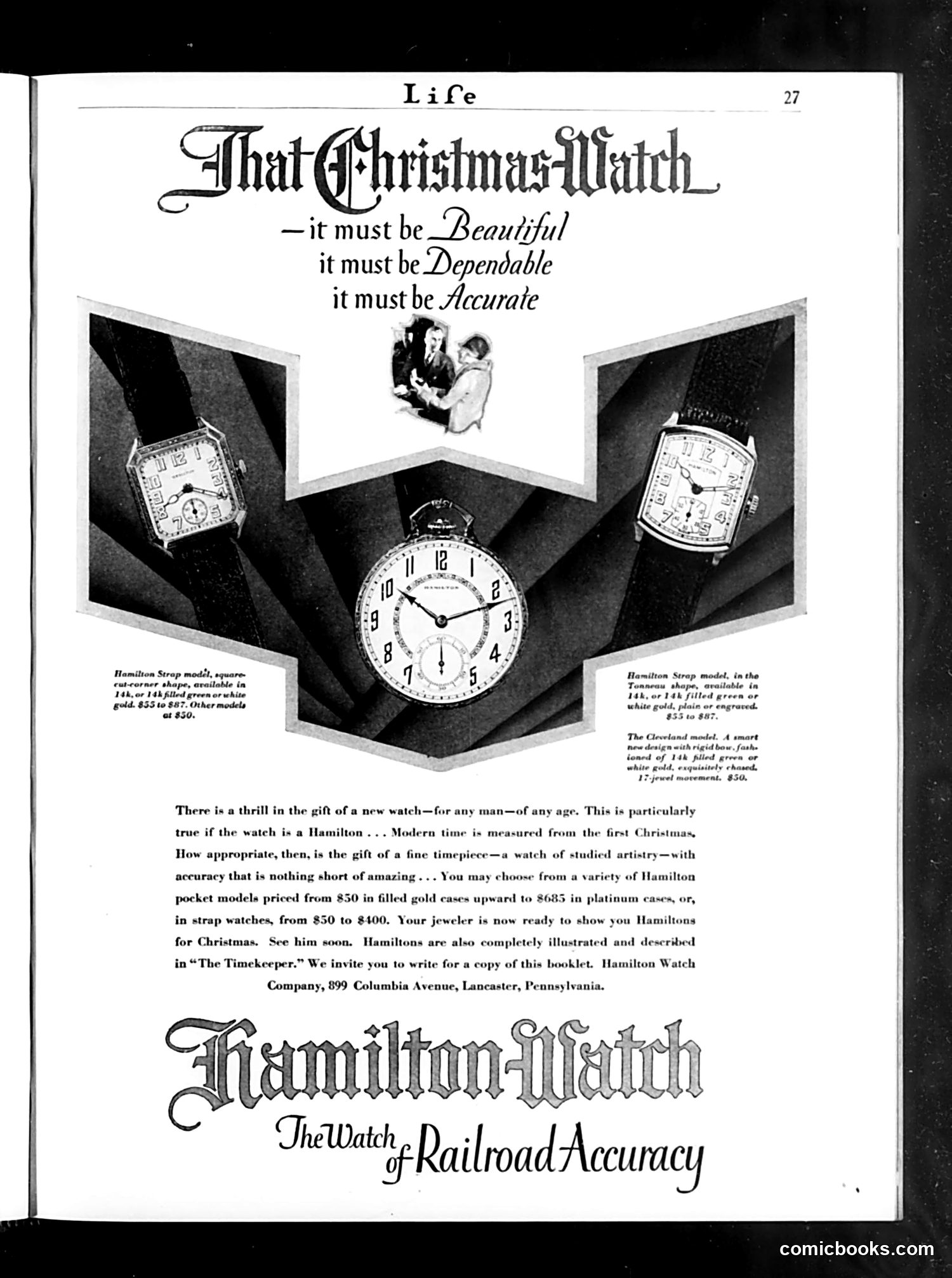
This is **not a cartoon or satire—it's a straightforward luxury product advertisement** from Life magazine's early-to-mid 20th century. The page promotes Hamilton watches as Christmas gifts, emphasizing three qualities: beauty, dependability, and accuracy. The imagery shows three watch models displayed on dark fabric—two wristwatches (Strap models) flanking a pocket watch (Cleveland model), with a small illustration of a gift-giving couple at the top. The sales pitch targets affluent readers by positioning watch-giving as an appropriate, meaningful gift and exploiting the brand's reputation for "railroad accuracy"—a selling point referencing Hamilton's historical use by railroad workers, where precise timekeeping was essential for safety. Prices range from $50 to $685, positioning these as premium luxury items. The ad directs readers to visit jewelers or request a detailed brochlet titled "The Timekeeper." There is no satire or political commentary—this is period advertising copy appealing to holiday gift-buying.
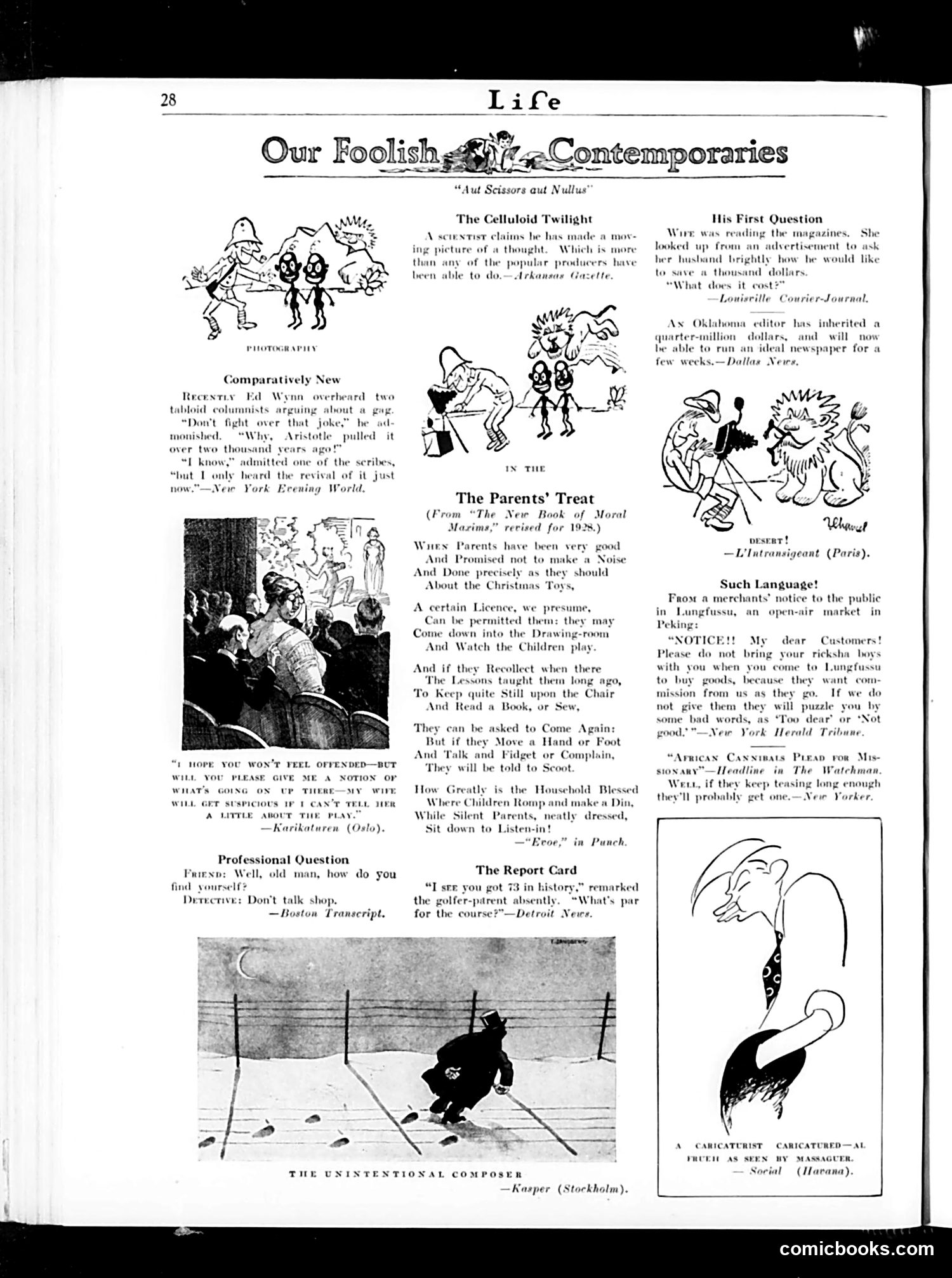
This page collects brief satirical observations and cartoons mocking contemporary American manners and foolishness circa 1928. **Key pieces:** - **"The Celluloid Twilight"**: Scientists claiming movie innovations appear repeatedly—the satire mocks exaggerated technological boasting. - **"The Parents' Treat"**: A mock-moral poem about well-behaved parents visiting children's nurseries, then sarcastically praising households where children actually run wild—inverting Victorian propriety expectations. - **"His First Question"**: A wife sees a money-saving ad; her immediate response is "What does it cost?"—satirizing women's supposedly frivolous spending habits. - **"The Report Card"**: A father ignores his child's mediocre 73% grade, asking instead "what's par for the course"—mocking distracted, golf-obsessed parents. - **Various international quotes** ridicule merchants' awkward English, overly fancy language, and other minor absurdities. The page exemplifies Life's lightweight humor targeting middle-class American pretension and family dynamics.
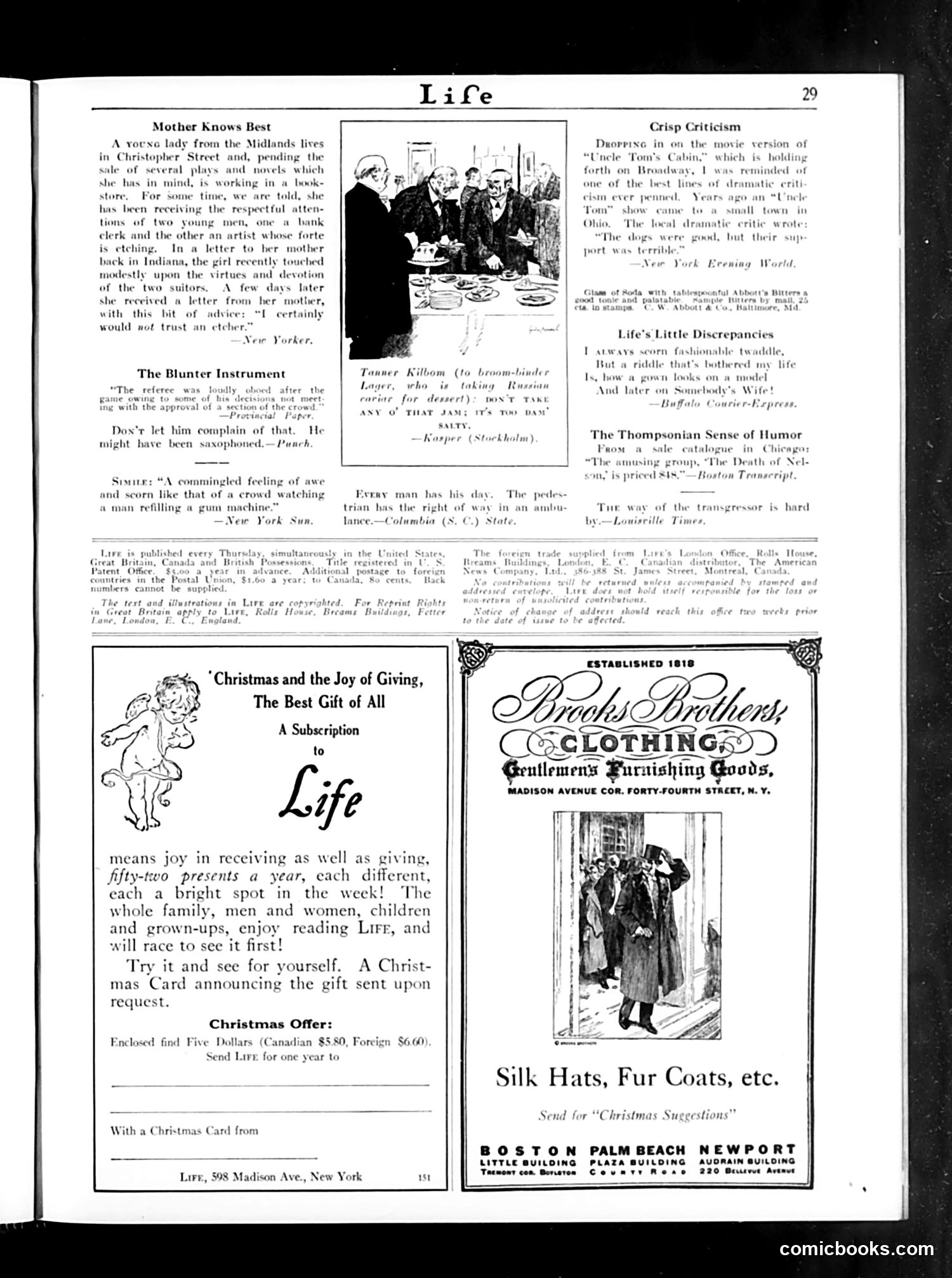
This page contains **short humor pieces and advertisements** rather than political cartoons. The humor relies on early 20th-century social observations: **"Mother Knows Best"**: A young woman from Indiana receives romantic attention from a bank clerk and artist, writes home about their virtues, and her mother wisely advises: "I certainly would not trust an other." The joke is the mother's pragmatic skepticism about both suitors despite the daughter's enthusiasm. **"Life's Little Discrepancies"**: A brief verse mocking the gap between how fashionable gowns look on fashion models versus on actual wives—commenting on advertising deception. **"The Blunter Instrument"**: A joke about a referee's crude language during a game. **Other snippets**: Brief quips about pedestrian rights, transgressors, and humor in catalogs. The page is primarily **advertising** (Life magazine subscriptions and Brooks Brothers clothing), with lightweight domestic and social satire typical of Life's mid-period satirical humor focused on urban middle-class life rather than political commentary.
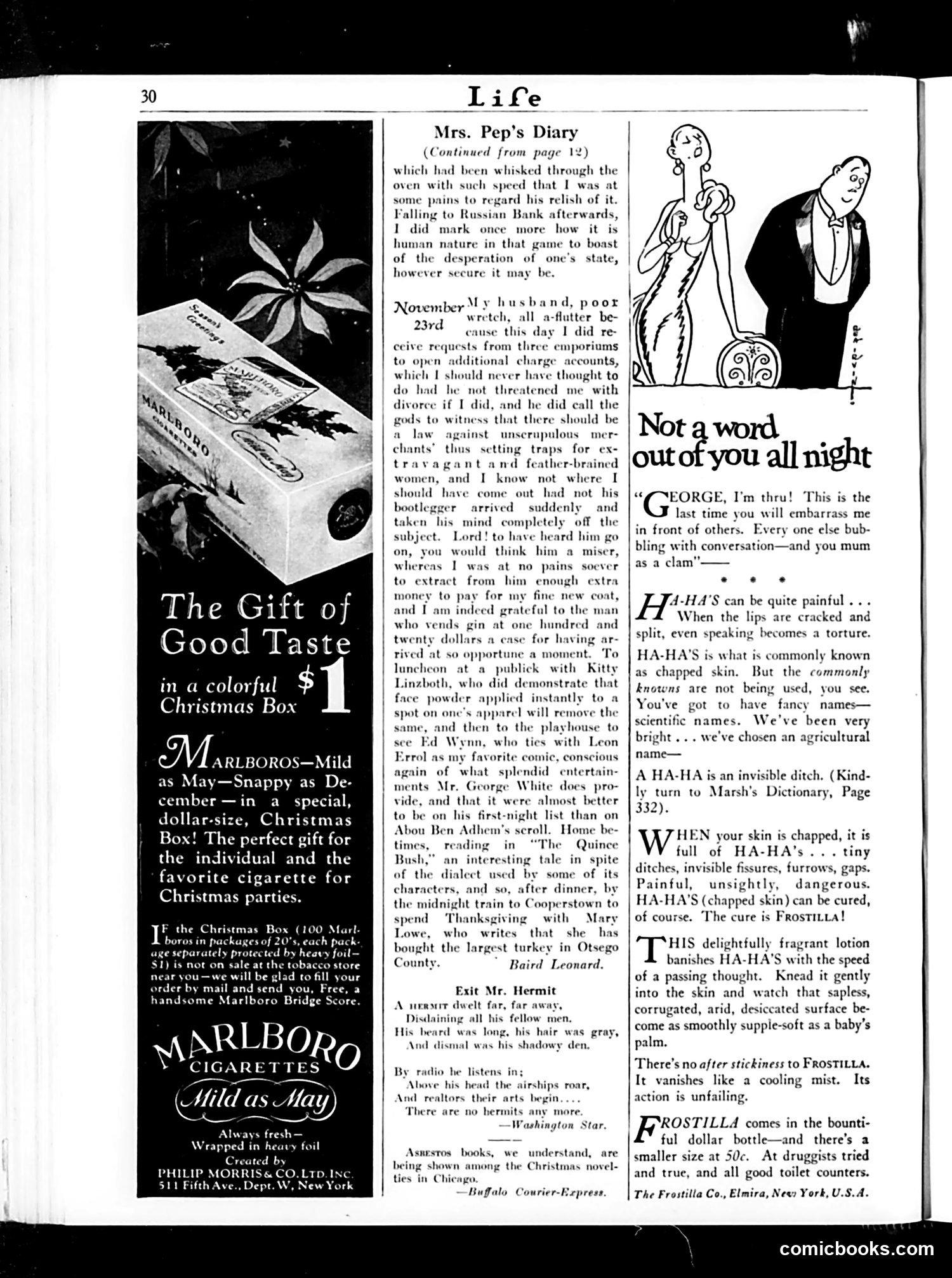
This page contains mostly **advertising and satirical product descriptions** rather than political cartoons. The main content is a **mock advertisement for "HA-HA'S" (chapped skin)**, which satirizes the era's trend of inventing pseudo-scientific or pretentious names for common ailments. The joke: manufacturers create fancy terminology like "HA-HA" (defined as "an invisible ditch") to sell ordinary lip balm and skin remedies at premium prices. This mocks 1920s-30s marketing tactics that disguised simple products with scientific-sounding jargon to justify higher costs. The page also includes: - **Mrs. Pep's Diary**: A humorous domestic column about a wife's shopping habits and marital tensions - A Marlboro cigarette advertisement - A poem titled "Exit Mr. Hermit" about modern isolation The cartoon illustration shows a silent, frowning man being criticized by his wife for not participating in conversation—likely referencing social expectations around masculine engagement at social gatherings.
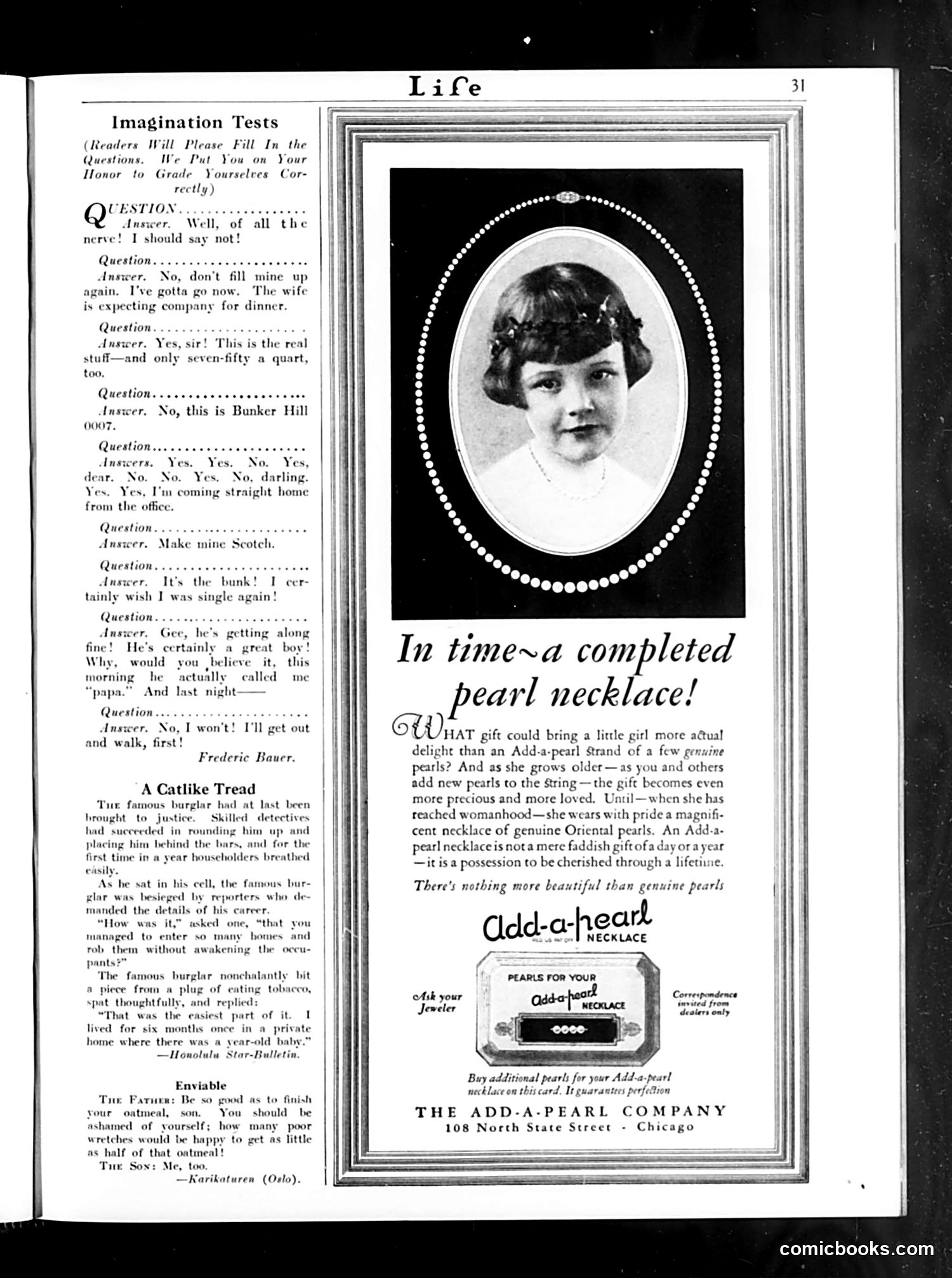
This page contains three distinct sections: **"Imagination Tests"** (left column): A satirical humor piece where readers fill in blanks to complete dialogues. The jokes target familiar domestic scenarios—a husband reluctant to spend money, someone bragging about illegal alcohol (Prohibition era, referencing "seven-fifty a quart"), a man claiming he won't leave work early, and a stepfather boasting about being called "papa." The humor relies on recognizable middle-class anxieties and hypocrisy of the 1920s. **"A Catlike Tread"** (lower left): A short anecdote about a famous burglar explaining his success—he once lived invisibly in a home for six months near a baby. The joke is dark comedy about criminal audacity and domestic intrusion. **"Enviable"** (bottom): A brief exchange mocking a father's claim that his son wishes he had less food, when clearly the son means he wants *more*. **Advertisement** (right): The bulk of the page is an "Add-a-Pearl" necklace ad marketing an incremental gift concept where pearls are added as a girl grows up. The page is primarily **advertising with humor content**, typical of Life magazine's mixed editorial-commercial format.
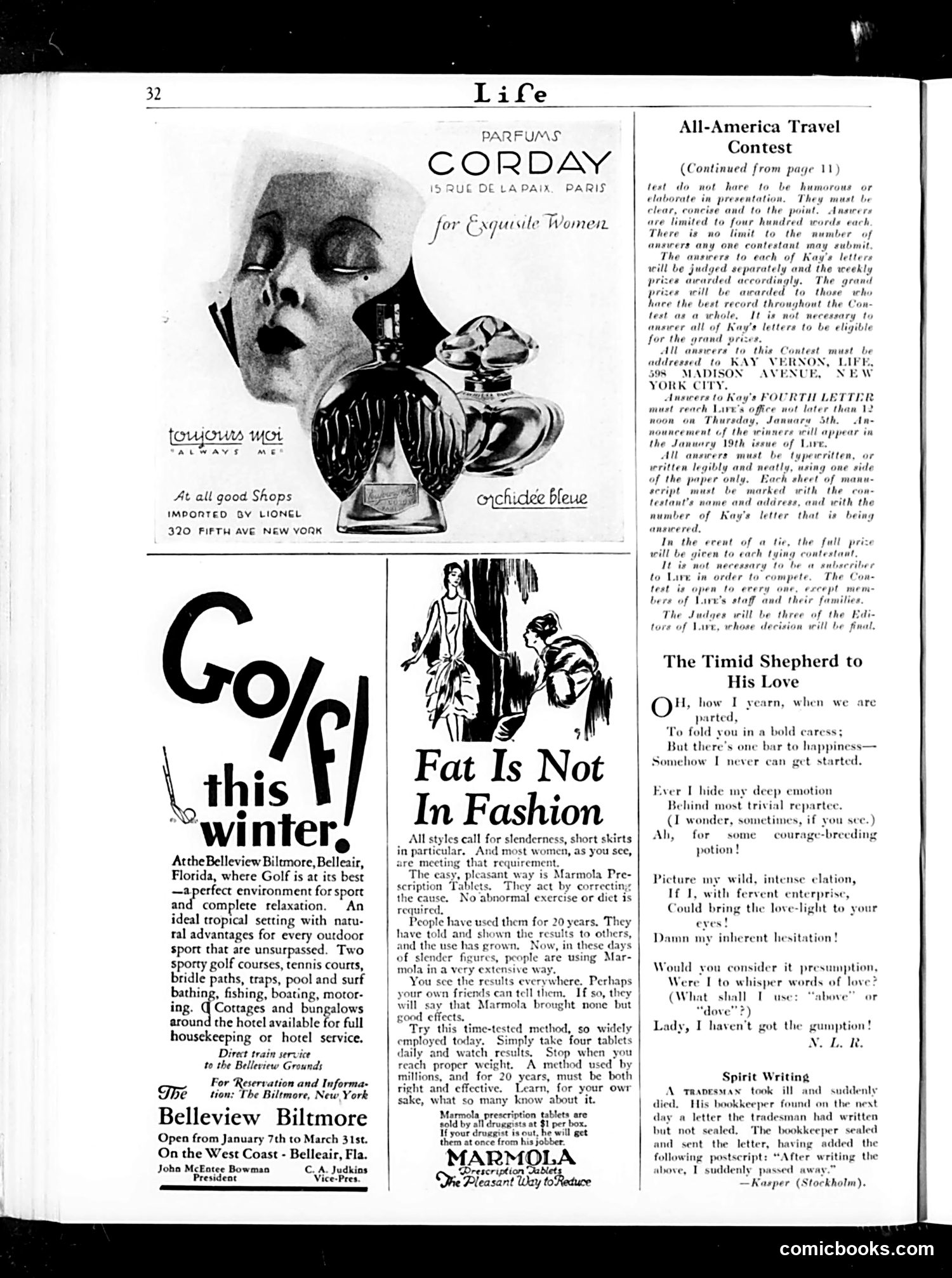
This page contains primarily **advertisements and contest information** rather than political cartoons. The main visual elements are: 1. **Corday Perfume ad** (top): Features a stylized woman's face with Art Deco styling, advertising French perfume for "exquisite women"—typical luxury marketing of the era. 2. **Marmola Diet Tablets ad** (center-left): Advertises weight-loss pills, claiming they reduce weight without exercise or dieting. This reflects 1920s anxieties about women's bodies and the fashion trend toward "slenderness, short skirts." The ad explicitly states "Fat Is Not In Fashion." 3. **Belleview Biltmore resort ad** (bottom-left): Promotes a Florida luxury hotel. The page also contains an **All-America Travel Contest** announcement and a **poem** titled "The Timid Shepherd to His Love"—typical romantic/humorous verse found in Life magazine. The content reflects 1920s consumer culture, beauty standards, and leisure activities rather than political satire or commentary.
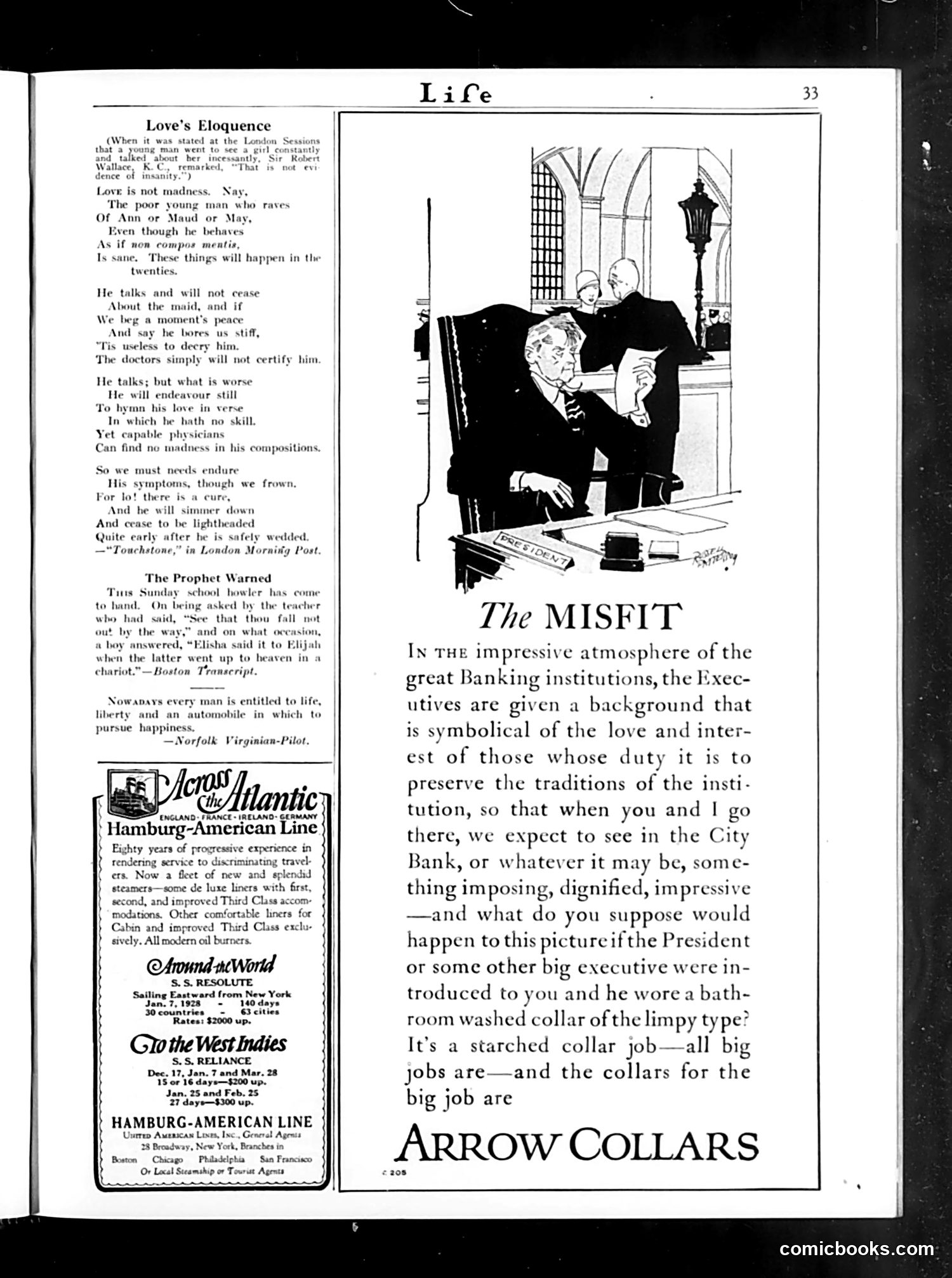
This page is primarily an advertisement for Arrow Collars (a men's collar brand), framed as social satire. The accompanying illustration shows a dignified banker or business executive in an impressive office setting. The ad's pitch is that in prestigious banking institutions, appearance and propriety are essential—executives must project authority and respectability. The satire operates on two levels: it mocks corporate pretension while simultaneously leveraging that pretension to sell products. The "misfit" of the title refers to what would happen if such an important executive wore an inferior, poorly-starched collar—it would undermine the entire impression of gravitas and tradition. The ad argues that "big jobs" require proper collars, positioning Arrow Collars as essential to professional success and institutional credibility. The other content on the page consists of humorous poetry about young love in the 1920s and miscellaneous amusing anecdotes—typical Life magazine filler material from this era.
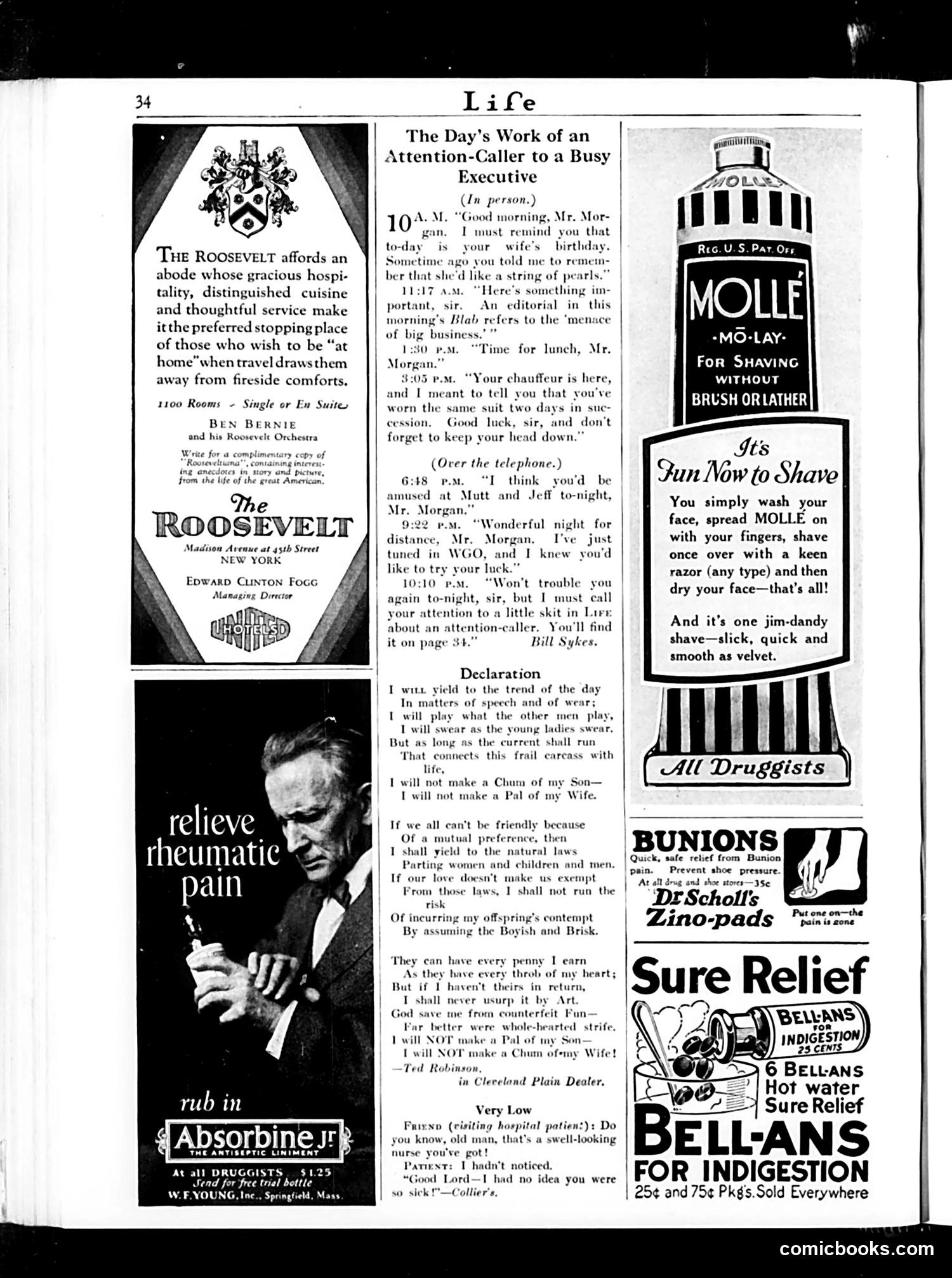
This page combines advertising with satirical content typical of Life magazine's format. **"The Day's Work of an Attention-Caller to a Busy Executive"** is a humorous sketch mocking the modern businessman's life. An employee repeatedly interrupts a busy executive (Mr. Morgan) throughout the day with trivial reminders—his wife's birthday, a suit worn twice, entertainment suggestions, and finally a self-referential joke directing him to page 34 where this very article appears. The satire targets both the distracted executive culture and the absurdity of constant interruptions in business. **"Declaration"** by Ted Robinson is a serious poem rejecting modern parenting trends. It criticizes making one's son a "chum" or wife a "pal," arguing against abandoning traditional parent-child boundaries in favor of casual friendship. This reflects contemporary debates about changing family dynamics in the 1920s-30s. The remainder consists of period advertisements for medical remedies (rheumatism liniment, bunion pads, indigestion relief) and grooming products, which were common Life magazine content.
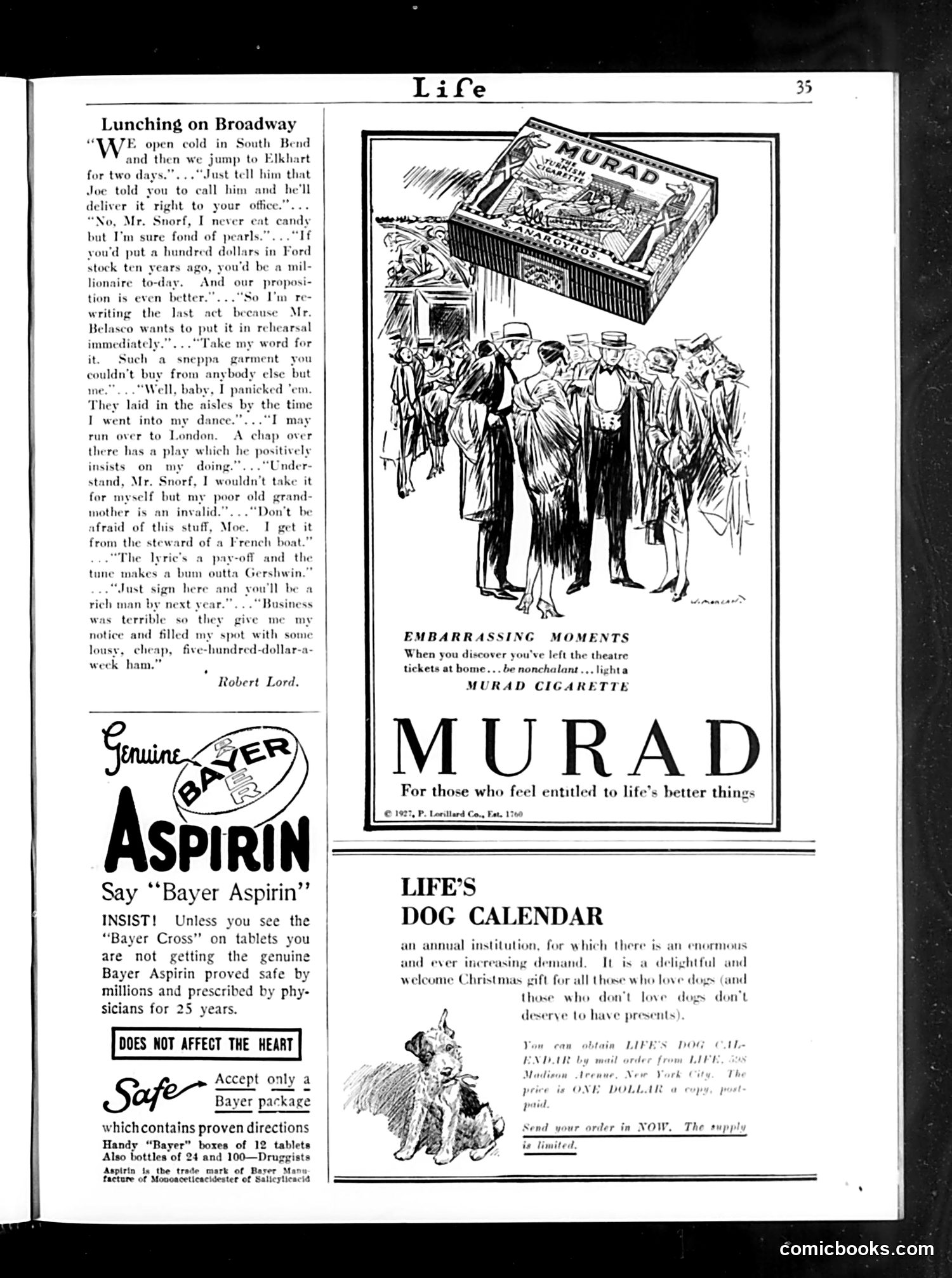
This page satirizes **Broadway theater culture** through Robert Lord's "Lunching on Broadway" column—a series of overheard conversations showcasing theatrical pretension and self-aggrandizement. The speakers (actors, producers, agents) boast about touring schedules, financial schemes, romantic conquests, and connections to famous composers like Gershwin. The humor lies in their transparent exaggeration and desperation masked as sophistication. References to "Belasco" (David Belasco, a famous producer) and name-dropping suggest status-climbing among theater people. The page also contains **period advertisements**: Bayer Aspirin (emphasizing the "Bayer Cross" trademark amid counterfeit concerns), Murad Cigarettes (positioned as luxury goods for the refined), and Life's Dog Calendar (a novelty gift). The cartoon depicts crowded Broadway pedestrians gathered around a giant cigarette box, visualizing the "embarrassing moments" ad copy—forgetting theater tickets at home, forcing awkward explanations.
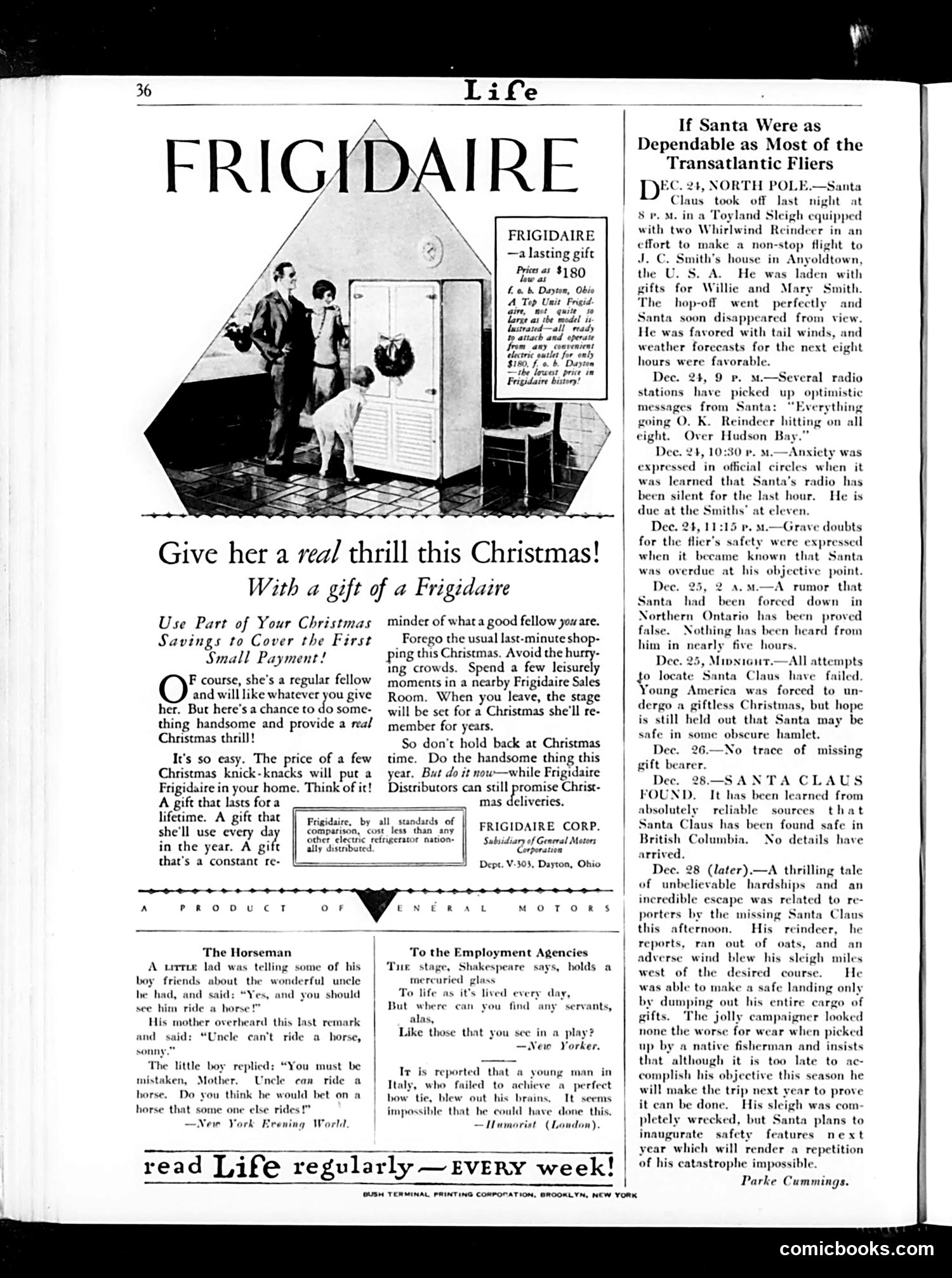
This page contains a **Frigidaire refrigerator advertisement** and several unrelated humor pieces. The main advertisement uses aspirational messaging to sell electric refrigerators as the ultimate Christmas gift for wives. It emphasizes the appliance as a "lasting gift" that provides year-round utility—a departure from typical last-minute shopping. The copy addresses husbands directly, positioning the purchase as both generous and practical. The right column features a satirical piece titled **"If Santa Were as Dependable as Most of the Transatlantic Fliers."** This mocks the reliability of 1920s transatlantic aviation by treating Santa's Christmas Eve delivery like a commercial flight with radio updates, delays, and eventual failure. The joke exploits contemporary anxiety about new air travel technology—fliers frequently disappeared or crashed during this era. By applying flight-dispatch language to Santa, the satire highlights how unreliable early aviation was, ultimately delivering "a giftless Christmas." The page also includes brief humor pieces about horseback riding, employment agencies, and Italian fashion.
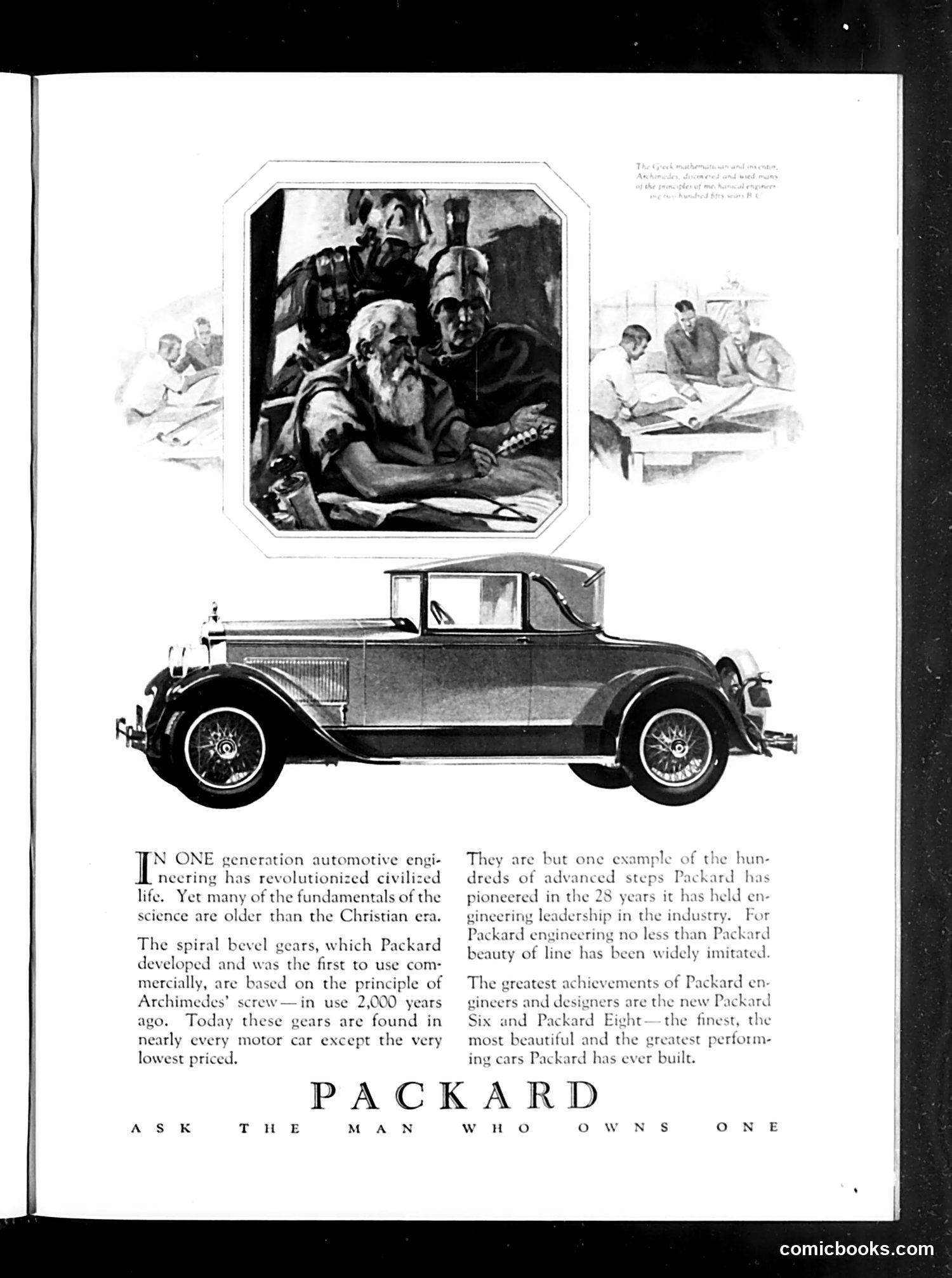
This is primarily a **Packard automobile advertisement**, not political satire. The page promotes Packard cars by emphasizing their engineering heritage and innovation. The three illustrations above the car depict historical scenes—likely representing Archimedes and ancient engineers—to establish that Packard's technology builds on principles "older than the Christian era." This rhetorical strategy lends gravitas and timelessness to the brand. The central image shows a 1920s Packard automobile in profile. The advertisement claims Packard pioneered advanced engineering over 28 years, specifically mentioning spiral bevel gears based on Archimedean principles. It concludes by promoting two flagship models: the Packard Six and Packard Eight, described as "the finest, the most beautiful." The tagline "Ask the man who owns one" was Packard's actual advertising slogan, positioning ownership as a mark of discerning taste. This reflects early 1920s luxury automotive marketing targeting wealthy consumers.
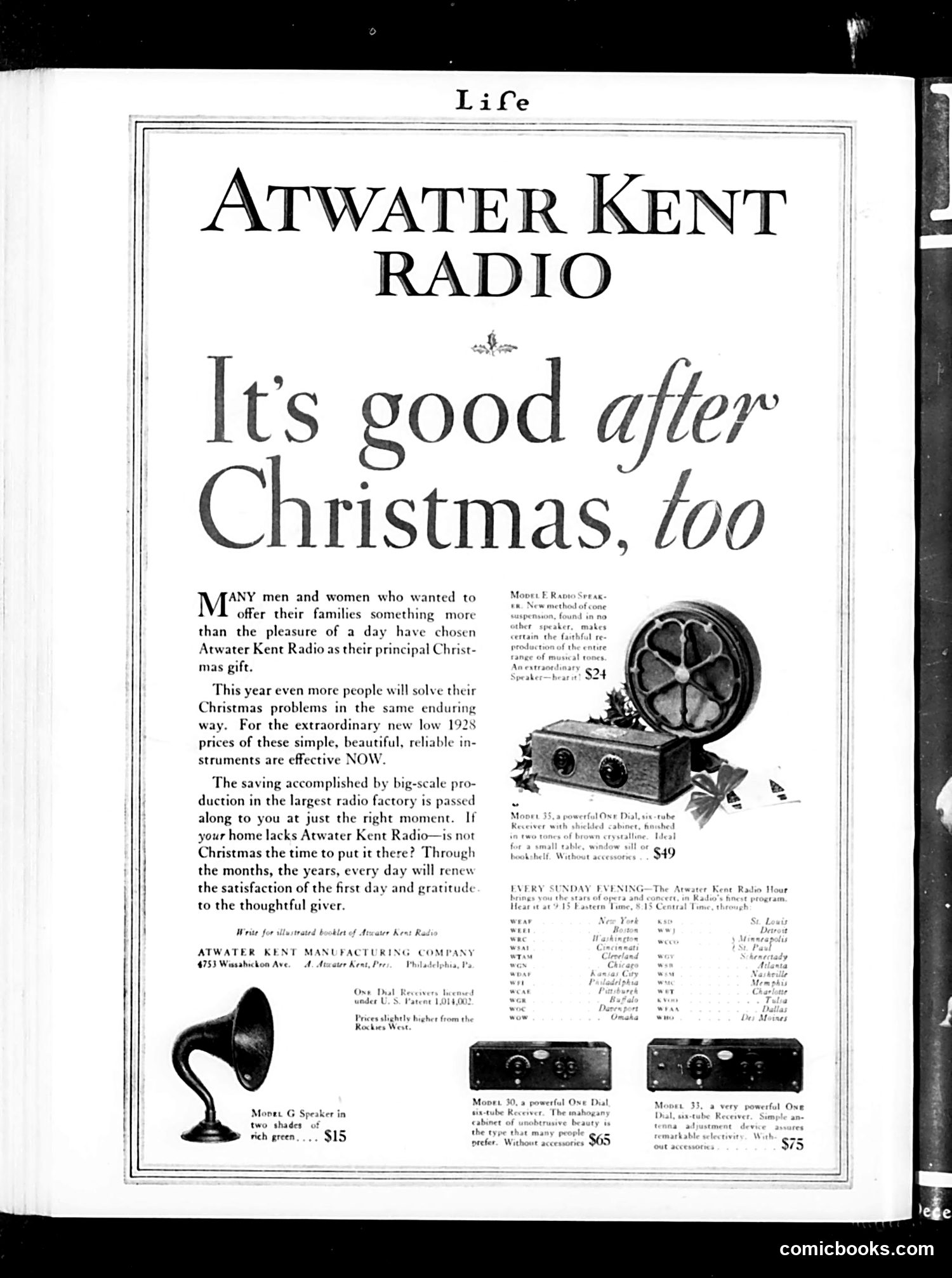
This is **not a cartoon or satire**—it's a straightforward **product advertisement** for Atwater Kent Radio, a major manufacturer of the era. The page promotes radio receivers as ideal Christmas gifts, emphasizing 1928's newly reduced prices made possible by mass production. Multiple radio models are displayed with prices ranging from $15 (speaker) to $75 (receiver), positioned as affordable luxury items for American homes. The advertisement appeals to sentiment ("the thoughtful giver") while highlighting the practical benefit: radio would provide year-round entertainment and gratification. The company note about broadcasting times and stations reflects radio's novelty—listeners needed guidance on when programming aired. This represents radio's emergence as a consumer commodity rather than a specialized hobbyist technology. The marketing strategy—linking the product to family pleasure and gratitude—reflects Depression-era advertising emphasizing value and emotional reward during economically uncertain times.