
Life, 1927-12-15 · page 28 of 40
Life — December 15, 1927 — page 28: what you’re looking at
What you’re looking at
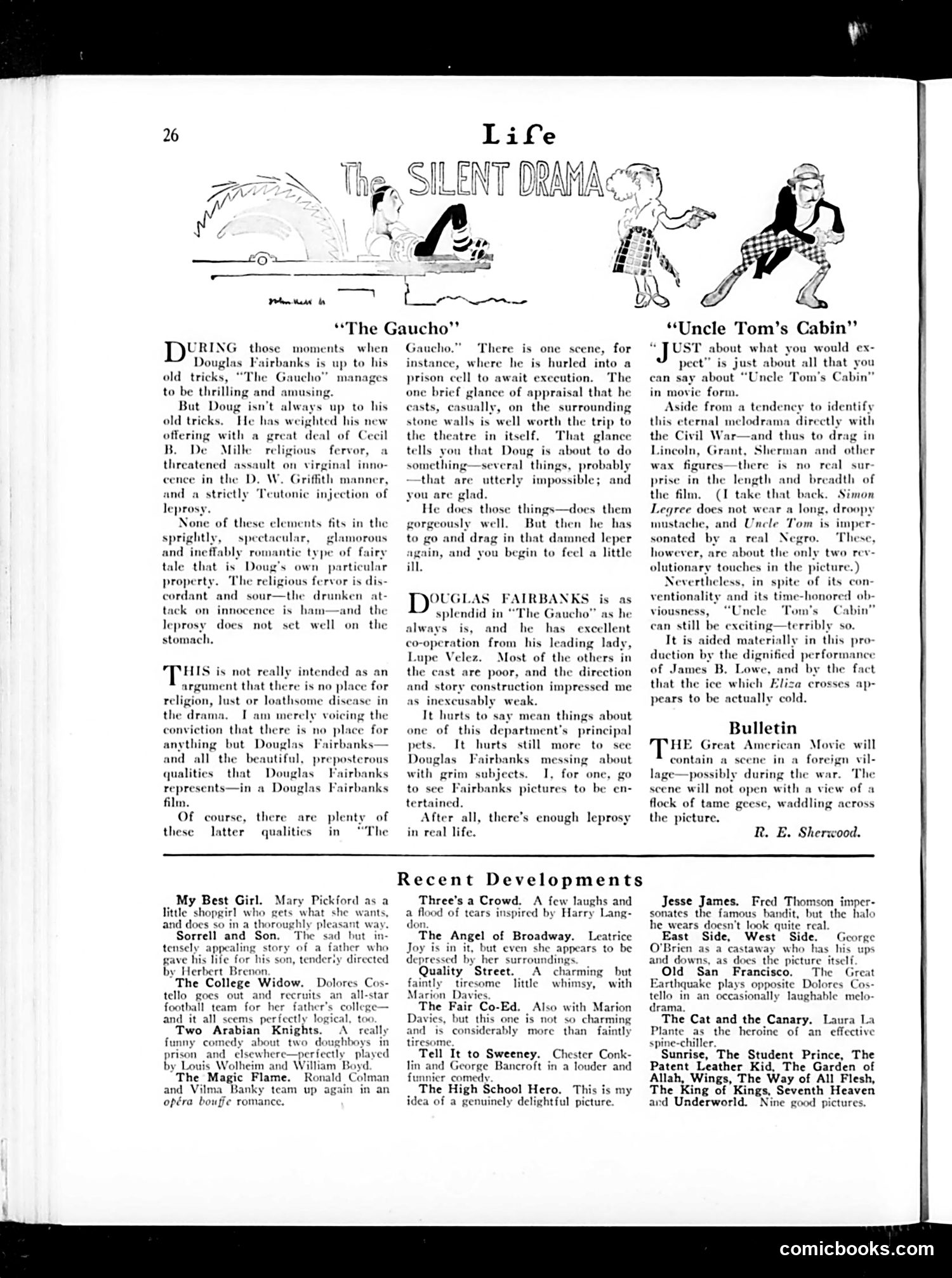
This page contains two film reviews of silent movies starring major actors of the era. **"The Gaucho"** reviews Douglas Fairbanks' latest picture. The critic praises Fairbanks' signature athleticism and charm—his ability to perform impossible stunts with casual grace. However, the review faults the film for mixing Fairbanks' light, fantastical style with heavy dramatic elements borrowed from other directors: religious fervor (Cecil B. De Mille), sexual assault (D.W. Griffith), and leprosy. The complaint is that these grim, realistic subjects clash jarringly with what audiences expect from a Fairbanks picture—pure spectacle and fun. **"Uncle Tom's Cabin"** criticizes the film for being conventionally melodramatic, though it oddly drags in Civil War figures (Lincoln, Grant, Sherman) unnecessarily. The review notes James B. Lowe's dignified performance and praises the film as genuinely exciting despite its predictability. Both reviews reflect 1920s film criticism: concerns about tonal consistency and whether serious subjects belong in entertainment cinema.
📄 Transcribed text from this page (OCR, searchable)
Machine-transcribed from the original scan — historical spelling and the odd misread are preserved.
26 Life “The Gaucho” URING those Douglas Fairbanks is up to his old tricks, “The Gaucho” to be thrilling and amusing. But Doug isn't always up to his old tricks. He has weighted his new offering with a great deal of Cecil B. De Mille religious fervor, a threatened assault on virginal inno- cence in the D. W. Griffith manner, and a strictly Teutonic injection of leprosy. None of these elements fits in the sprightly, spectacular, glamorous and ineffably romantic type of fairy tale that is Doug's own particular property. The religious fervor is dis- cordant and sour—the drunken at- tack on innocence is ham—and_ the leprosy does not well the moments when manages set on stomach, HIS is not really intended as an ‘gument that there is no place for religion, lust or loathsome disease in the drama, I am merely voicing the conviction that there is no place for anything but Douglas Fairbanks— und all the beautiful, preposterous that) Douglas Fairbanks represents—in a Douglas Fairbanks film. Of course, there are plenty of these latter qualities in he qualities Gauche There is one scene, for instance, where he is hurled into a prison cell to await execution. The onc brief glance of appraisal that he casts, casually, on the surrounding stone walls is well worth the trip to the theatre in itself. That glan tells you that Doug is about to do something—several things, probably that are utterly impossible; and you are glad. He does those things—does them usly well. But then he has in that damned leper igain, and you begin to feel a little ill. ge to go and dra OUGLAS FAIRBANKS is as splendid in “The Gaucho” as he always is, and he has excellent co-operation from his leading lady, Lupe Velez. Most of the others in the cast are poor, and the direction and story construction impressed me as inexcusably we It hurts to say mean things about of this department's principal It hurts still more to see Douglas Fairbanks messing about with grim subjects. I, for one, go to see Fairbanks pictures to be ¢ tertained. After all, there’s enough leprosy al life. one pets. ST about what you would ex- is just about all that you y about “Uncle Tom's Cz in movie form. Aside from a tendency to identify this eternal melodrama dircetly with the Civil War—and thus to drag in Lincoln, Grant, Sherman and other wax figures—there is no real sur prise in the length and breadth of the film. (I take that back. Simon Legree does not wear a long, droopy nd Uncle Tom is imper- real Negro. These, pout the only two rev- olutionary touches in the picture.) Nevertheless, in spite of its con- ventionality and its time-honore viousness, “Uncle Cabin” can still be exciting—terribly so. It is aided materially in this pr duction by the dignified performance of James B. Lowe, and by the fact that the ice which Eliz ap- pears to be ac vin” ‘Tom's Bulletin HE Great American Movie will contain a scene in a foreign vil- lage—possibly during the war. ‘The scene will not open with a view of a flock of tame geese, waddling across the picture. R. E. Sherwood. Recent Developments My Best Girl. Mary Pickford as little shopgirl who gets what she wants, and does so in a thoroughly pleasant way. Sorrell and Son. The sad but in- tensely appealing story of a father who gave his life for his son, tenderiy directed by Herbert Brenon The College low. Dolores Cos- tello S out a recruits an all-star football team for her father’s college— and it all scems perfectly logical, too. Two Arabian Knights A. really funny comedy about two doughboys in prison and clsewhere—perfectly played by Louis Wolheim and William Boyd. The Magic Flame. Ronald Colman and Vilma Banky team up again in an opéra bouffe romance. Three's a Crowd. A few laughs and a flood of tears inspired by Harry Lang- don. The Angel of Broadway. Leatrice Joy is in it, but even she appears to be depressed by her surroundings. Quality Street. A charming faintly tiresome little whimsy, Marion Davies. The Fair Co-Ed. Also with Marion Davies, but this one is not so charming and is considerably more than faintly tiresome. Tell It to Sweeney. Chester Conk- lin and George Bancroft in a louder and funnier comedy The High School Hero. This is my idea of a genuinely delightful picture. but with Jesse James. Fred Thomson imper- sonates the famous bandit, but the halo he _wears doesn't look quite real. East Side, West Side. George O'Brien as a castaway who has his ups and downs, as does the picture itself Old San Francisco. The Great Zarthquake plays opposite Dolores Cos- tello in an occasionally laughable melo- drama, The Cat and the Canary. Laura La Plante as the heroine of an effective spine-chiller. Sunrise, The Student Prince, The Patent Leather Kid, The Garden of Allah, Wings, The Way of All Flesh, The King of Kings, Seventh Heaven and Underworld. Nine good pictures. comicbooks.com