
Life, 1927-12-15 · page 23 of 40
Life — December 15, 1927 — page 23: what you’re looking at
What you’re looking at
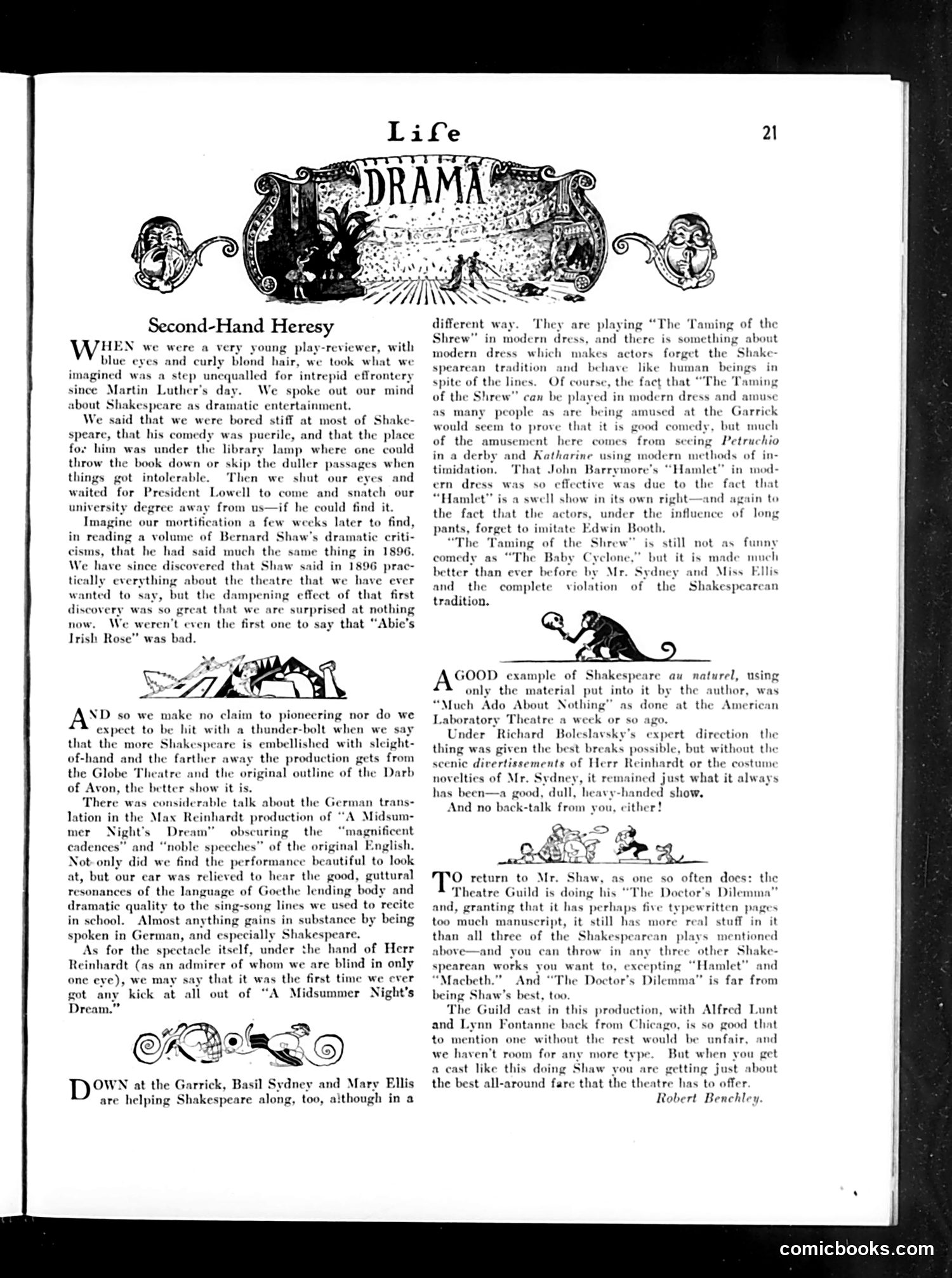
This drama column discusses early 20th-century Shakespeare productions and their varying approaches to the playwright's work. The author critiques over-embellished stagings, arguing that Shakespeare benefits from simpler presentation. **Key references:** - **Bernard Shaw**: The critic whose dramatic writings the author admits echoing unknowingly - **Max Reinhardt**: A famous German director whose ornate production of "A Midsummer Night's Dream" impressed audiences with its spectacle and German-language delivery - **Modern-dress productions**: Basil Sydney and Mary Ellis performing "The Taming of the Shrew" in contemporary 1920s clothing rather than period costumes—a then-novel approach - **Richard Boleslavsky**: Director of a stripped-down "Much Ado About Nothing" at the American Laboratory Theatre The satirical point: the author argues that Shakespeare's genuine theatrical power emerges *despite* elaborate production values, not because of them. Modernizing costumes or removing decorative spectacle paradoxically helps actors and audiences connect with the material's human core.
📄 Transcribed text from this page (OCR, searchable)
Machine-transcribed from the original scan — historical spelling and the odd misread are preserved.
gy ZI. Second-Hand Heresy HEN we were a very young play blue eyes and curly blond hair, w imagined was a step unequalled for i id effrontery sin Martin Luther's day. We spoke out our mind about Shakespeare as dramatic entertainment. We said that we were bored stiff at most of Shake- speare, that his comedy was pucrile, and that the place for him was under the library lamp where one could throw the book down or skip the duller passages when things got intolerable. Then we shut our eyes and waited for President Lowell to come and snatch our university degree away from us—if he could find it. Imagine our mortification a few weeks later to find, in reading a volume of Bernard Shaw's dramatic criti- cisms, that he had d much the same thing in 1896. We have since discovered that Shaw said in 1 prac- tically everything about the theatre that we have ever wanted to say, but the dampening effect of that first discovery so great that we are surprised at nothing now. We weren't even the first one to say that “Abie’s Irish Rose” was bad. -reviewer, with took what we re ND so we make no claim to pionecring nor do we expect to be hit with a thunder-bolt when we say that the more Shakespeare is embellished with sleight- of-hand and the farther a the production gets from the Globe Theatre and the original outline of the Darb of Avon, the better show it is. There was considerable talk about the German trans- lation in the Max Reinhardt production of “A Midsum- mer Night's Dream” ring the “magnificent cadences” and “noble speeches” of the original English. Not-only did we find the performance beautiful to look at, but our ear was relieved to hear the good, guttural of Goethe lending body and song lines we used to recite substance by being obse’ atic quality to the sin in school. Almost anything g spoken in German, and especial As for the spectacle itself, under the Reinhardt (as an admirer of whom we are blind in only one eye), we may say that it was the first time we ever got any kick at all out of “A Midsummer Night's Dream.” ns OWN at the Garrick, Basil Sydney and Mary Ellis are helping Shakespeare along, too, although in a different way. They are playing “The Taming of the Shrew” in modern dress, and there is something about modern dress which makes actors forget the Shake spearean tradition and behave like human beings in spite of the lin Of course, the fact that “The Taming of the Shrew” can be played in modern dress and amuse as many people as arc at the Garrick would seem to prove that it is good comedy, but much of the amusement seeing Petruchio in a derby and Katharine using modern methods of in- timidation. That John Barrymore's “Hamlet” in mod- ern dress to the fact that “Hamlet” is a swell show in its own right—and again to the fact that the actors, under the influence of le pants, forget to imitate Edwin Booth, “The Taming of the Shrew” is still comedy as “The Baby Cyclone,” but better than ever before by Mr. Sydney and the complete violation of the tradition. being amused here comes from was so effective was duc not funny it is made much ind Miss Ellis Shakespearean as 300D example of Shakespeare au naturel, using only the material put into it by the at the A‘ “Much Ado About Nothing” Laboratory Theatre a week or so ago. author, was as done American Under Richard Boleslavsky’s expert direction the thing was given the best breaks possible, but without the scenic divertissements of Herr Reinhardt or the novelties of Mr. Sydney, it remained just what od, dull, heavy-handed show. And no back-talk from you, ystume always aa O return to Mr. Shaw, as one so often does: the Theatre Guild is doing his “The Doctor's Dilemma” and, granting that it has perhaps five typewritten pages too much manuscript, it still has more real stuff in it than all three of the Shakespearean plays mentioned above—and you can throw in any three other Shake- n works you want to, excepting “Hamlet” and And “The Doctor’s Dilemma” is far from w’s best, too. uild cast in this production, with Alfred Lunt and Lynn Fontanne back from Chicago, is so good that rest would be unfair, and But when you get a cast like this doing Shaw you are getting just about the best all-around fare that the theatre has to offer Robert Benchley. to mention one without the we haven't room for any more type comicbooks.com