
A complete issue · 44 pages · 1927
Life — November 24, 1927
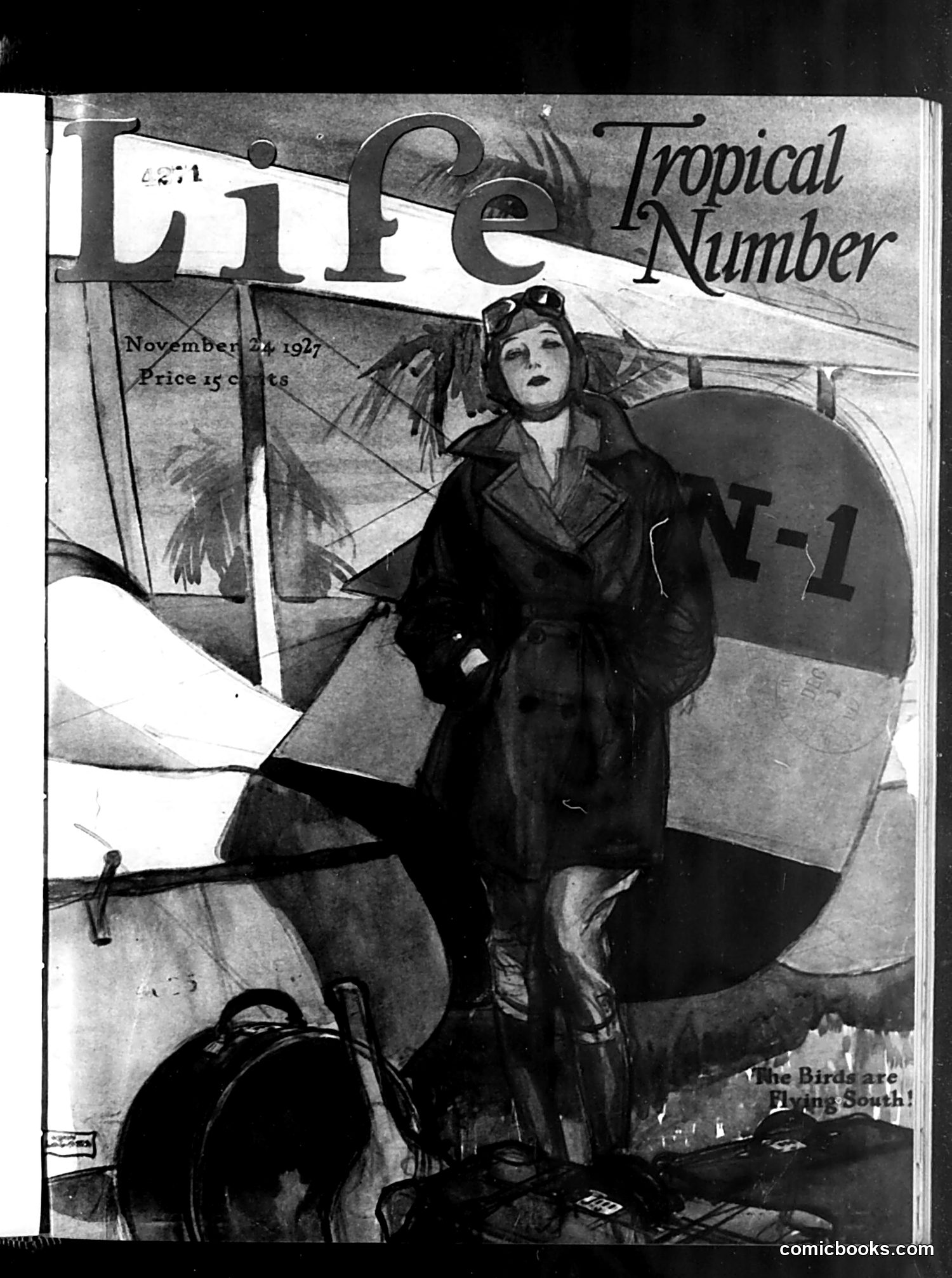
This cover depicts a woman in aviator gear posed against a seaplane marked "N-1," with the tagline "The Birds are Flying South!" The "tropical number" theme references seasonal migration and leisure travel to warm climates. The aviation imagery likely references the era's fascination with flying—1927 was Charles Lindbergh's famous transatlantic flight year. The woman's pilot outfit and fashionable appearance suggest the modern, adventurous "flapper" aesthetic of the 1920s. The phrase "flying south" plays on double meaning: both literal bird migration and the American leisure class's winter escape to tropical destinations like Florida. The overall composition satirizes contemporary wealth, mobility, and the glamorization of aviation during the Jazz Age.
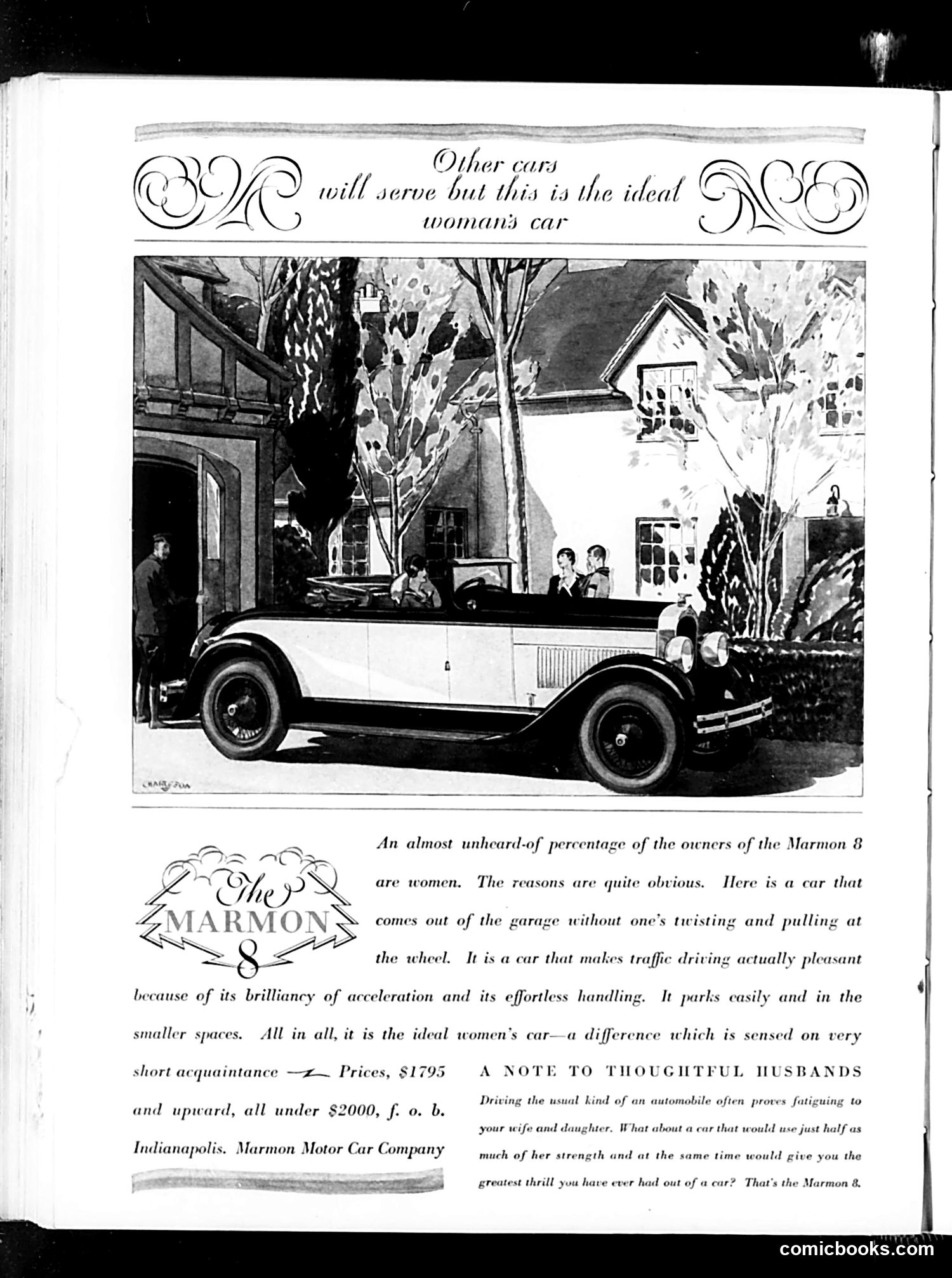
This page is primarily an **advertisement, not satire or political commentary**. It promotes the Marmon 8 automobile manufactured by the Marmon Motor Car Company in Indianapolis. The ad claims the car is "the ideal woman's car" and notes that "an almost unheard-of percentage of the owners of the Marmon 8 are women." It emphasizes features appealing to female drivers: easy handling, smooth acceleration, effortless parking, and no need for "twisting and pulling at the wheel." A secondary "Note to Thoughtful Husbands" suggests the car would be suitable for wives and daughters, using language that appeals to masculine protectiveness and gift-giving. The illustration shows the vehicle in a domestic setting with women passengers, reinforcing the marketing message. This reflects early 1920s attitudes about gendered consumer marketing.
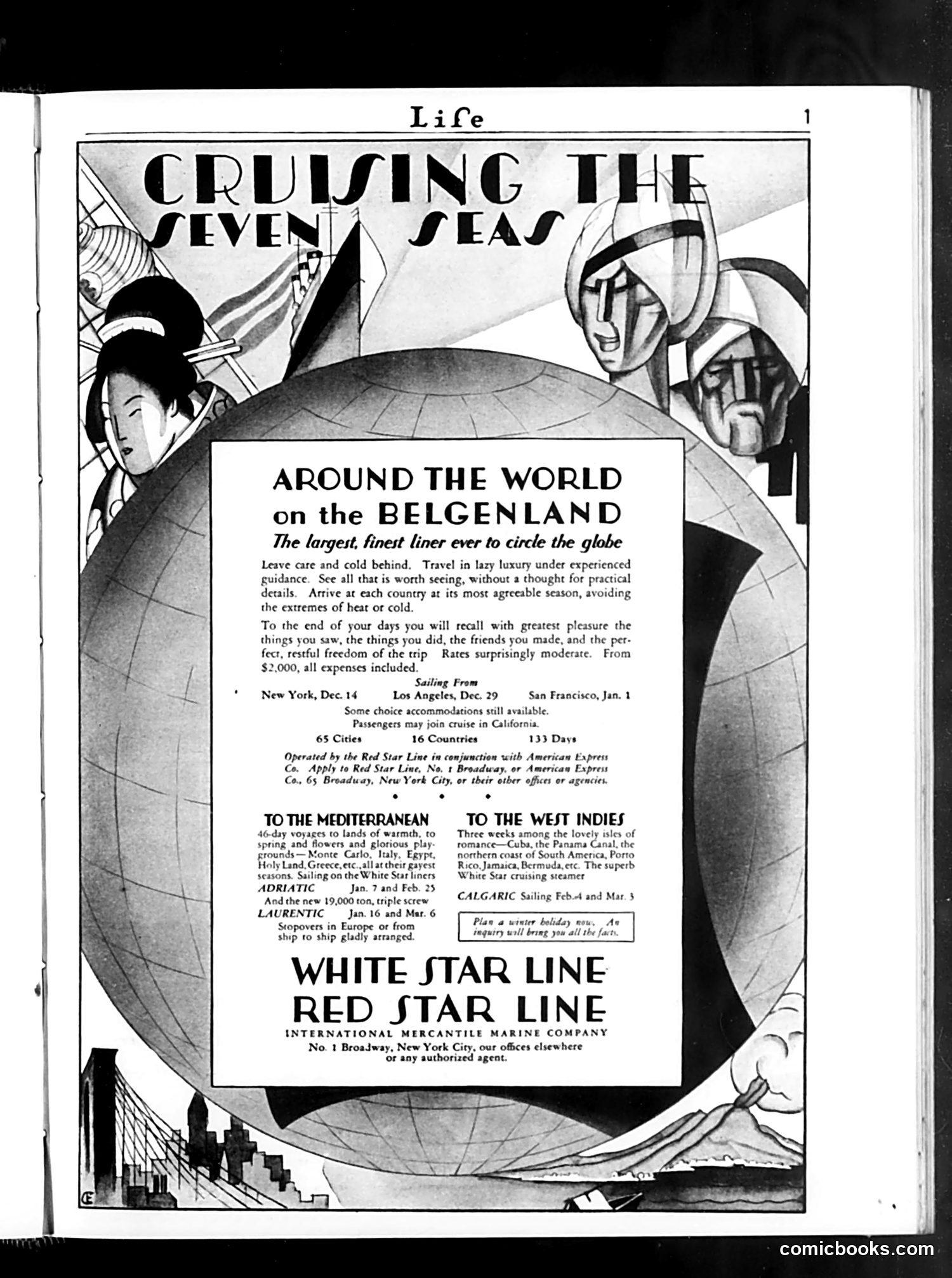
This is primarily **advertising, not satire or political commentary**. The page promotes luxury cruise vacations offered by the White Star Line and Red Star Line shipping companies. The art deco design features figures in period dress (appearing to be from different cultures/regions) arranged around a globe, emphasizing the "around the world" travel experience. The imagery suggests exotic destinations and cosmopolitan adventure. The text advertises a 133-day world cruise on the Belgenland, departing from New York in December, visiting 65 cities across 16 countries. Additional cruises to the Mediterranean and West Indies are promoted. This reflects early 20th-century leisure travel marketing targeting wealthy Americans, emphasizing luxury, convenience, and the appeal of global exploration without practical concerns.
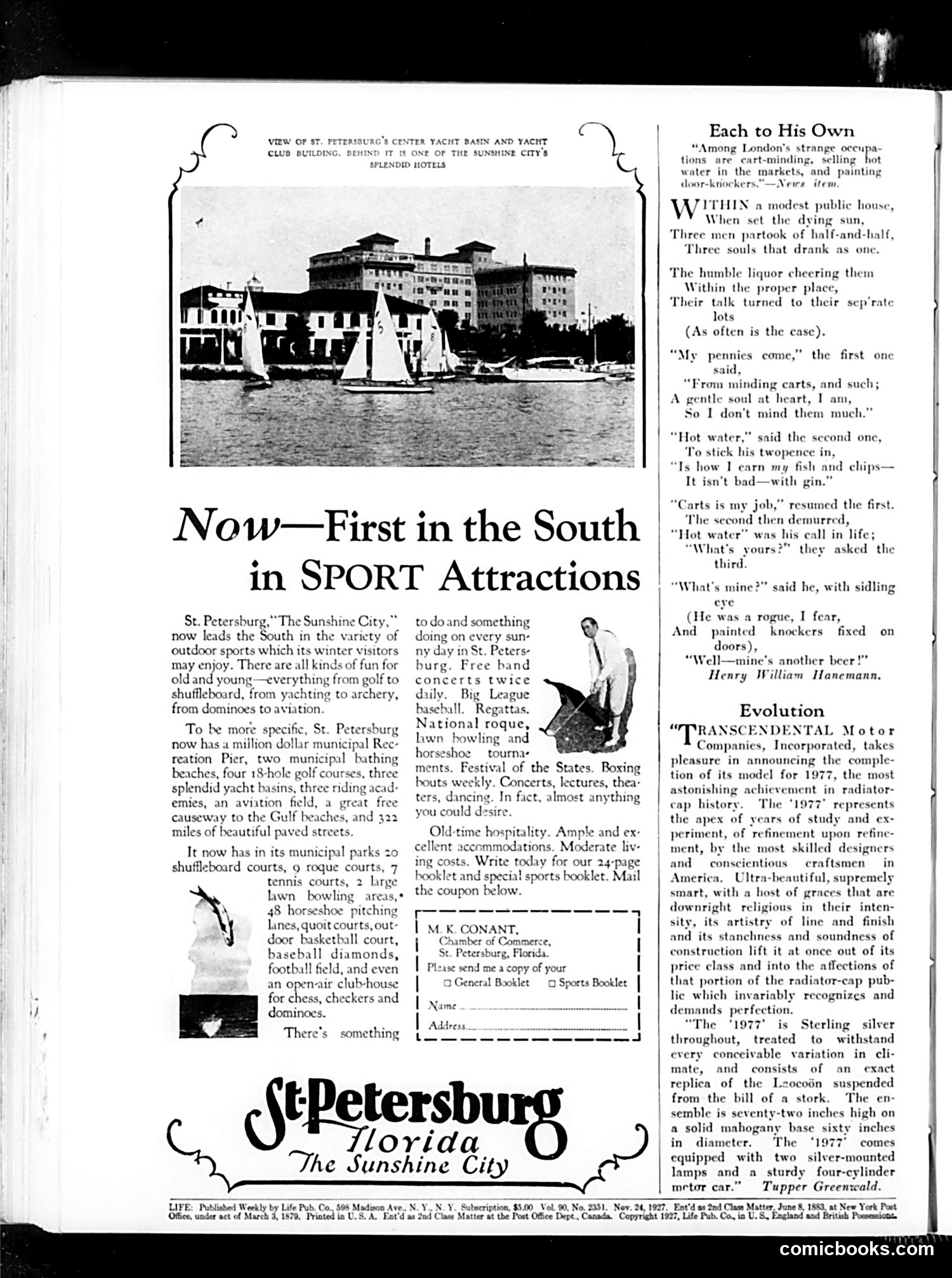
This page is primarily **advertising and promotional content** rather than political satire. The main feature is a St. Petersburg, Florida tourism advertisement highlighting the city's sports attractions—yacht racing, tennis, golf, bowling, and baseball. The right side contains a humorous poem titled "Each to His Own" depicting three working-class men in a pub, each prioritizing different small pleasures (pennies, hot water for tea, carts/jobs). This appears to be gentle social commentary about working-class life and modest aspirations, not sharp political satire. The bottom right features a car advertisement for the 1977 "Transcendental Motor" with glowing review language. **Overall assessment**: This is a commercial page with light humor rather than political cartooning.
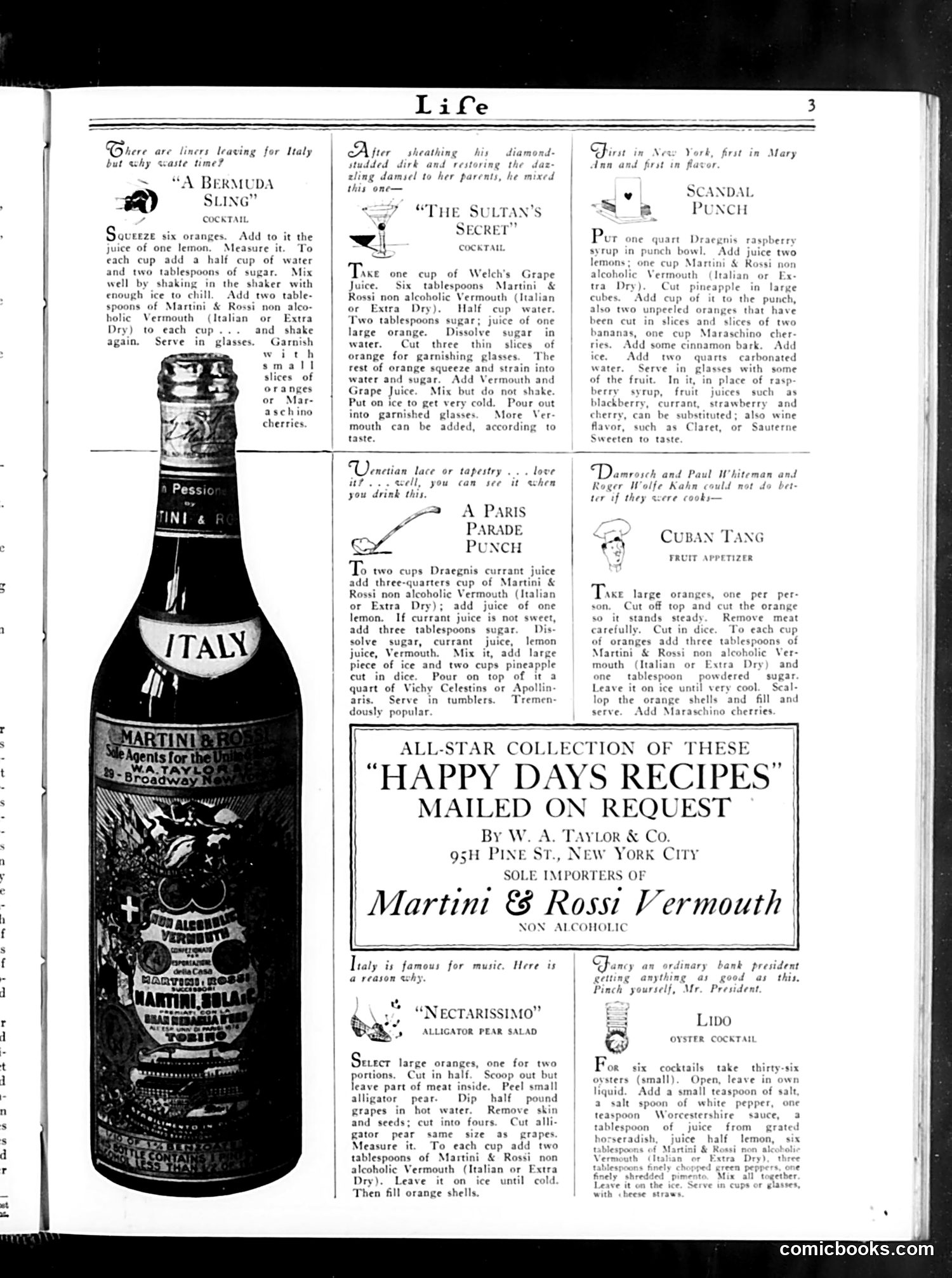
This page is primarily **advertising content**, not political satire. It features cocktail recipes and promotional material for Martini & Rossi vermouth, a non-alcoholic Italian beverage. The left side displays a large bottle of Martini & Rossi vermouth with decorative labeling. The right side contains several cocktail recipes with period-appropriate names ("A Bermuda Sling," "The Sultan's Secret," "Scandal Punch," "A Paris Parade Punch," "Cuban Tang," and "Lido"), each with ingredient lists and instructions. At the center is a boxed advertisement for "Happy Days Recipes" mailed by W.A. Taylor & Co., sole importers of the vermouth. The only potentially humorous element is a caption noting "Italy is famous for music. Here is a reason why"—likely a light joke about the product's Italian origin. This is fundamentally a **commercial product advertisement** rather than satirical commentary.
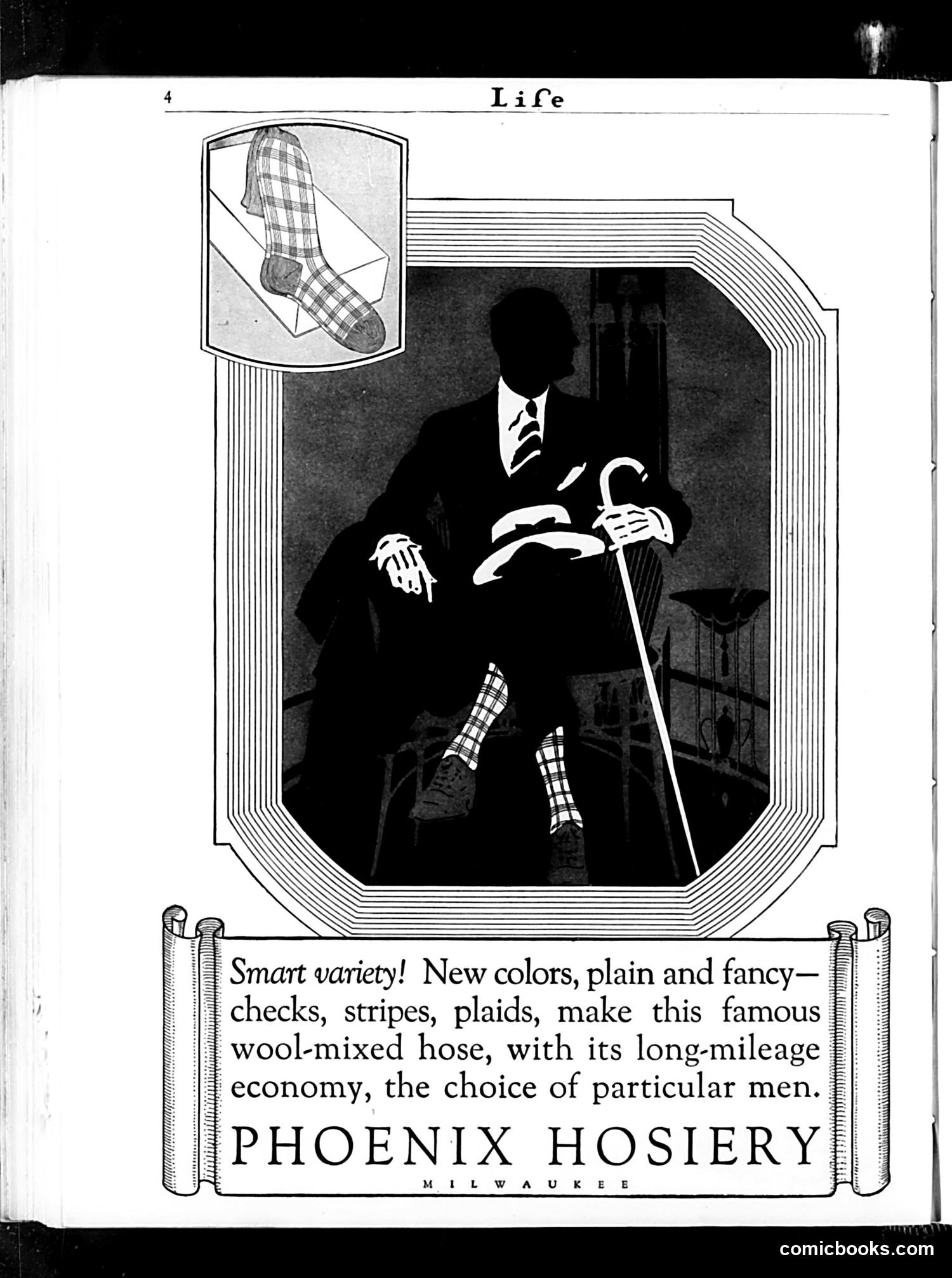
This page is primarily a **product advertisement** for Phoenix Hosiery from Milwaukee, not political satire. The image shows a well-dressed businessman in formal attire displaying checkered socks—the product being advertised. The accompanying text emphasizes that Phoenix Hosiery offers "smart variety" in "new colors, plain and fancy—checks, stripes, plaids," marketed as economical and durable ("long-mileage economy"). The advertisement targets male consumers, positioning quality hosiery as a mark of refined taste ("the choice of particular men"). The small inset image at top left shows the socks in isolation for product detail. This reflects early 20th-century marketing that associated practical goods with sophistication and masculine discernment.
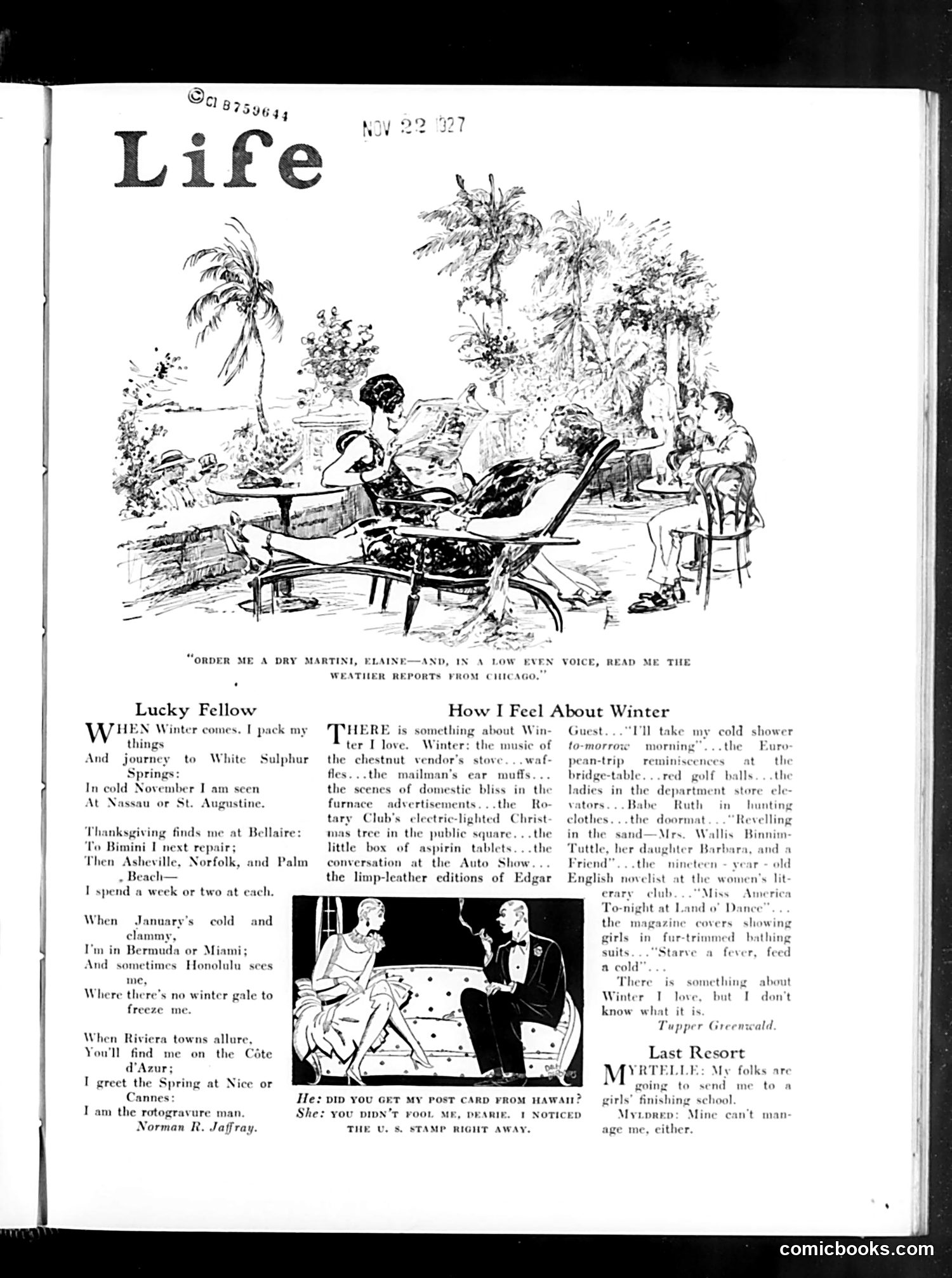
This page from Life (dated NOV 22, 1927) contains humorous essays and a cartoon rather than political commentary. The main illustration shows a couple at what appears to be a tropical resort. The caption reads: "HEZ DID YOU GET MY POST CARD FROM HAWAII? / SHE: YOU DIDN'T FOOL ME, DEARIE. I NOTICED THE U.S. STAMP RIGHT AWAY." The joke satirizes people who pretend to travel exotically while actually staying home—the woman detects her husband's ruse by noticing he used a U.S. postage stamp rather than a Hawaiian one, revealing he mailed the postcard locally to create the illusion of being abroad. The surrounding text includes travel-themed essays like "Lucky Fellow" about winter getaways and "How I Feel About Winter," reflecting 1920s leisure culture and vacation fantasies among the affluent.
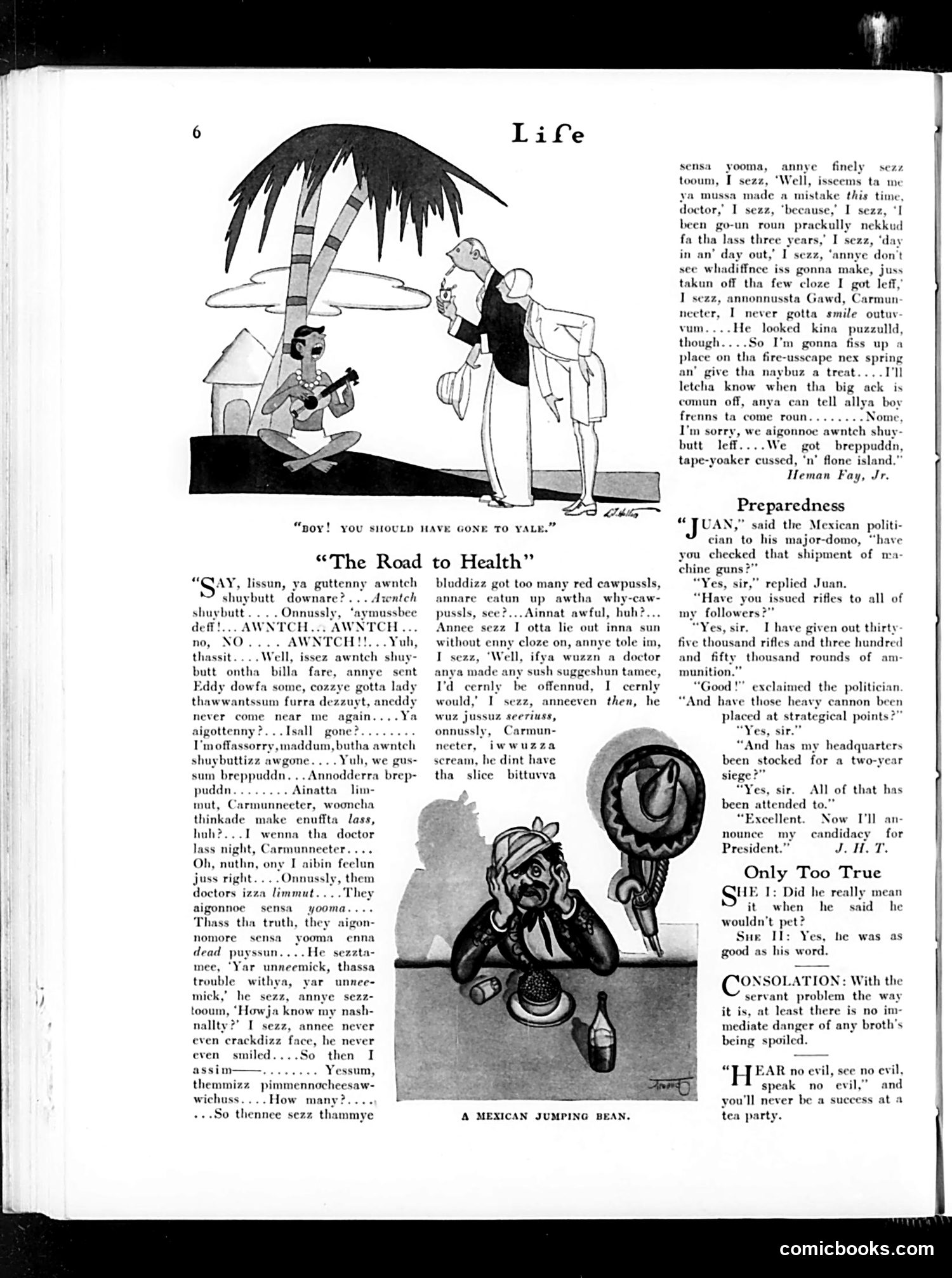
This cartoon satirizes medical quackery and folk remedies. The illustration shows a doctor figure examining a patient beneath a palm tree, while the accompanying dialect-heavy text parodies African American vernacular speech patterns (common in early 20th-century Life magazine satire). The joke critiques ineffective "cure-all" treatments and charlatan doctors who promise health through dubious means. The palm tree setting suggests tropical or exotic remedies, which were marketed as miracle cures during this era. The patient's complaints and the doctor's responses mock both gullible patients seeking quick fixes and unscrupulous practitioners exploiting them. The satire targets the broader problem of medical fraud and superstition in healthcare, though the use of dialect humor reflects problematic editorial choices typical of the period.
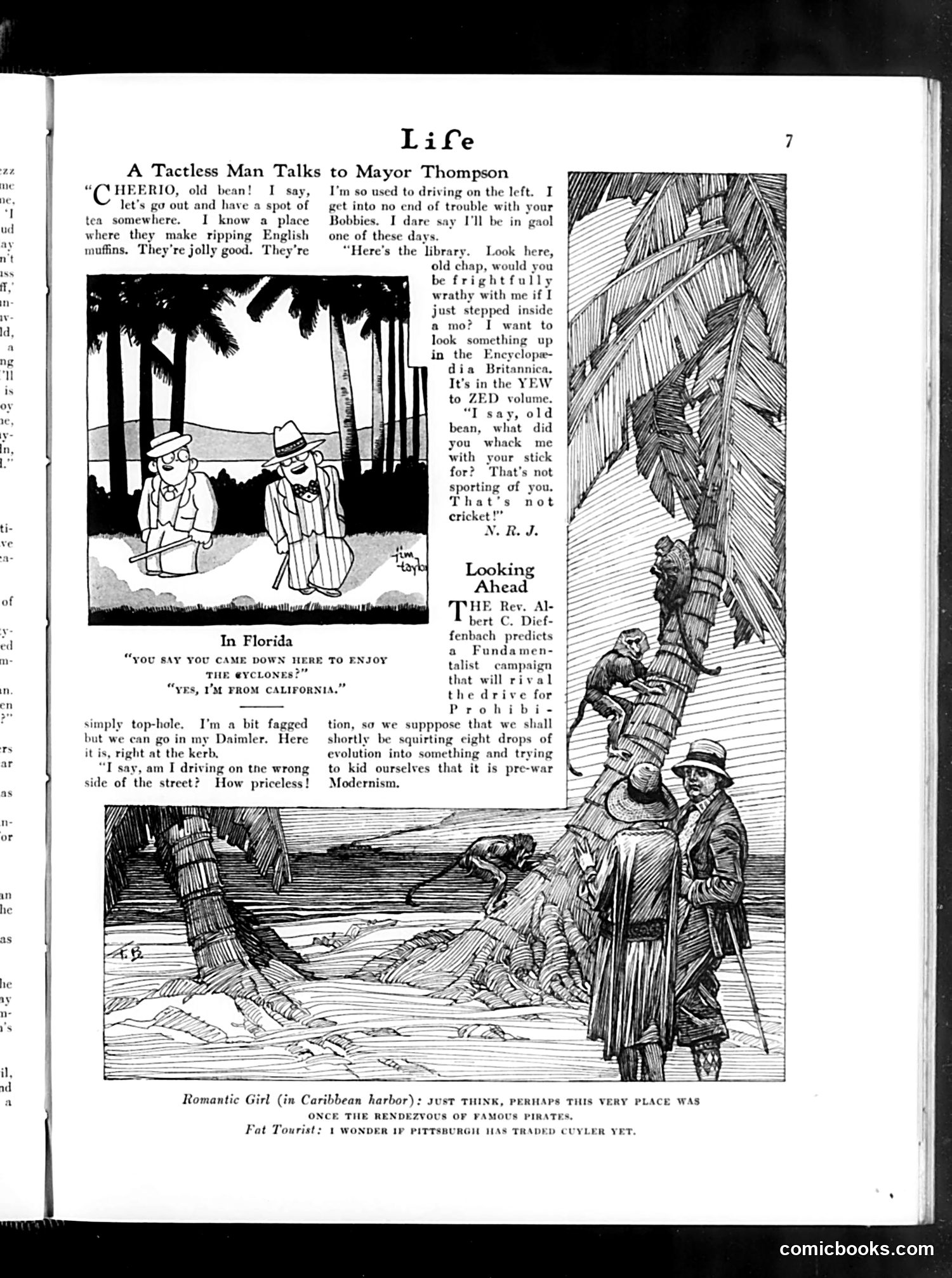
This page contains three separate satirical pieces: 1. **"A Tactless Man Talks to Mayor Thompson"** (top): A dialogue joke about someone recommending a spot in London for "ripping English muffins," with the punchline that they're "jolly good." 2. **"In Florida"** (middle cartoon): Two men discuss driving a Daimler car in Florida, with one complaining about driving on the wrong side of the street—satirizing either tourist confusion or poor local road conditions. 3. **"Looking Ahead"** (right): Commentary on Rev. Albert C. Dieffenbach's Prohibition campaign, predicting it will lead to "pre-war Modernism"—a satirical warning about unintended social consequences of Prohibition. 4. **"Romantic Girl" and "Fat Tourist"** (bottom): Captions about a Caribbean harbor location and Pittsburgh trade, likely mocking travelers' romantic notions versus commercial reality.
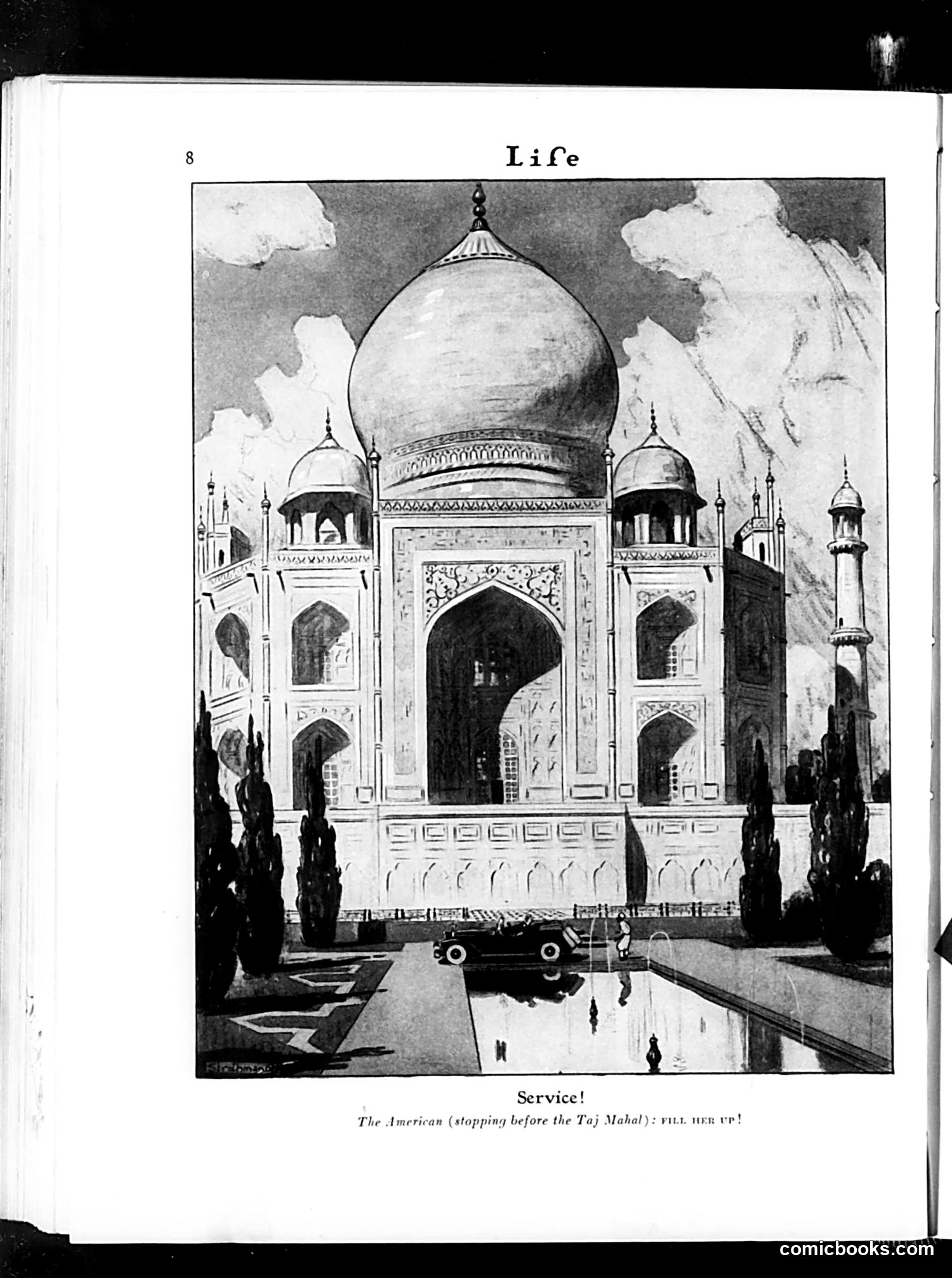
This is a satirical illustration from *Life* magazine depicting the Taj Mahal with the caption "Service! The American (stopping before the Taj Mahal): FILL HER UP!" The joke targets American tourists and car culture. An American motorist treats the iconic Taj Mahal—one of the world's most sacred and historically significant monuments—as if it were a gas station, requesting a fill-up. The satire mocks: 1. **American ignorance** of cultural significance abroad 2. **Consumerism** and the automobile's dominance in American life 3. **Lack of reverence** toward historical landmarks 4. **Ugly American** tourism—the stereotype of Americans traveling abroad with little appreciation for non-American culture The illustration suggests Americans reflexively view all places through the lens of commercial utility and automotive convenience.
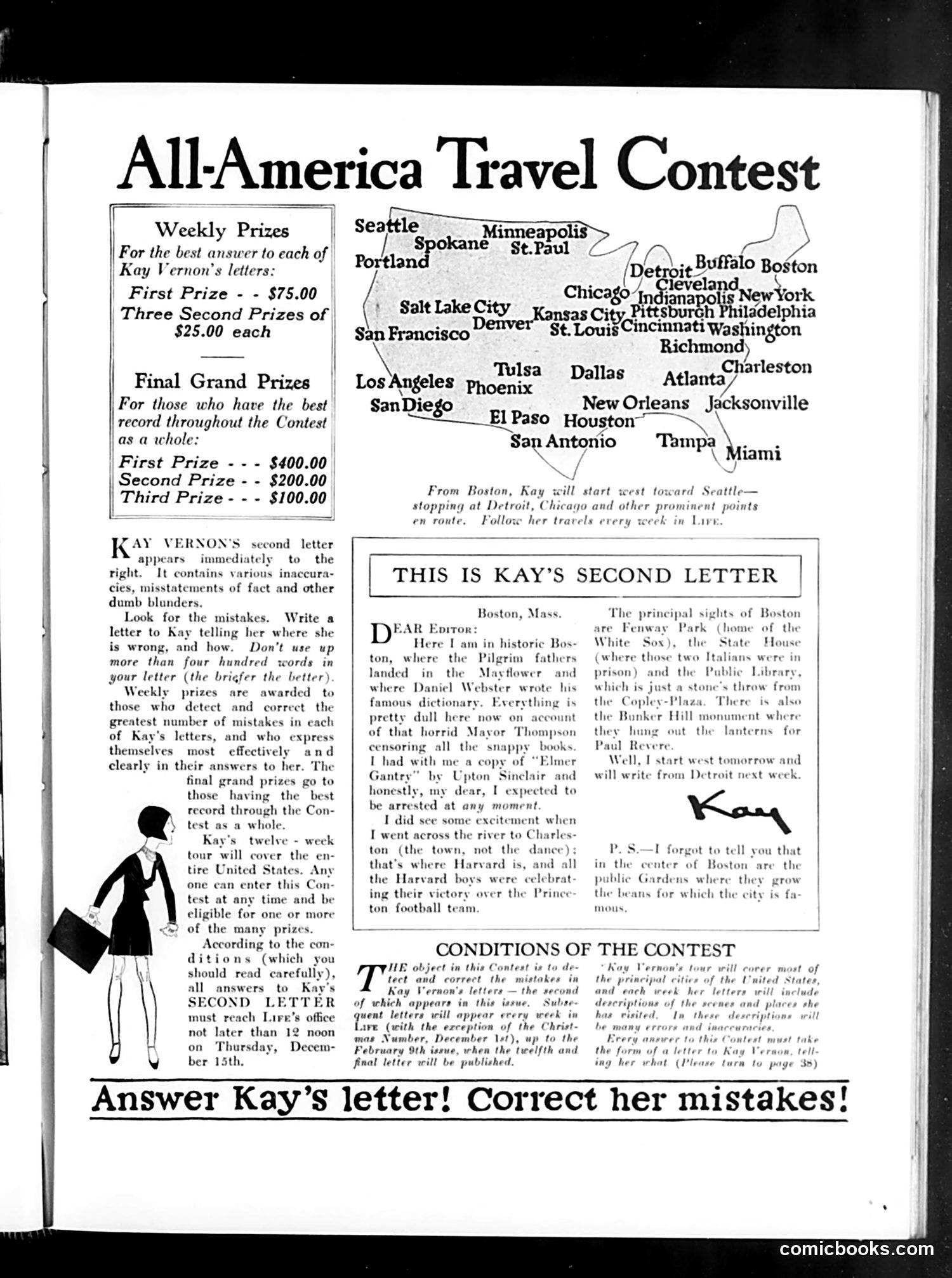
This page features a reader-participation contest from *Life* magazine. The premise: a character named "Kay Vernon" is traveling across the United States and writing letters describing her journey, but deliberately including factual errors and geographical inaccuracies. Readers are challenged to identify and correct these mistakes in exchange for cash prizes (weekly prizes of $75 and $25, with final grand prizes up to $400). The accompanying illustration shows a stylized woman traveler with luggage. The contest format was a common *Life* magazine engagement strategy—combining geography education with humor and the appeal of prize money during what appears to be the early-to-mid 20th century. Readers would need to fact-check Kay's claims about American cities and landmarks as she travels from Boston westward to Seattle.
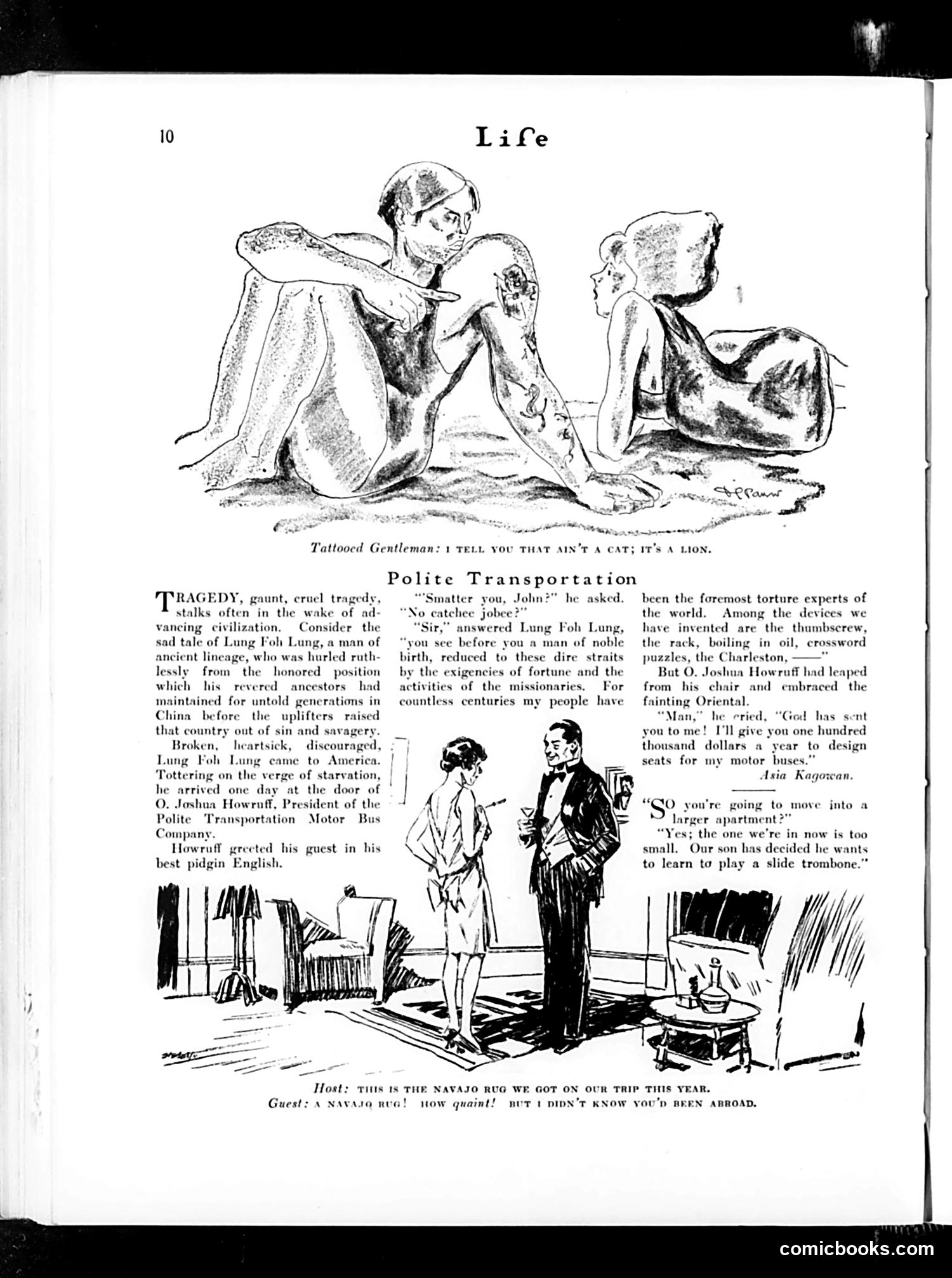
This page contains two distinct pieces. The top illustration is a suggestive cartoon captioned with a crude joke about tattoos and anatomy. The main story, "Polite Transportation," mocks a Chinese immigrant named Lung Foh Lung who arrives at Joshua Howell's (President of the Polite Transportation Motor Bus Company) office. The narrative satirizes both the immigrant's broken English and American economic pretension. Howell offers Lung money to design bus seats, calling this "polite" capitalism. The lower cartoon depicts their meeting, with a guest making a pun about "Navajo bugs" versus travel abroad—mocking both Native American terminology and immigrant unfamiliarity with American culture. The satire targets early 20th-century American attitudes: patronizing treatment of Asian immigrants, capitalist exploitation disguised as generosity, and casual ethnic humor.
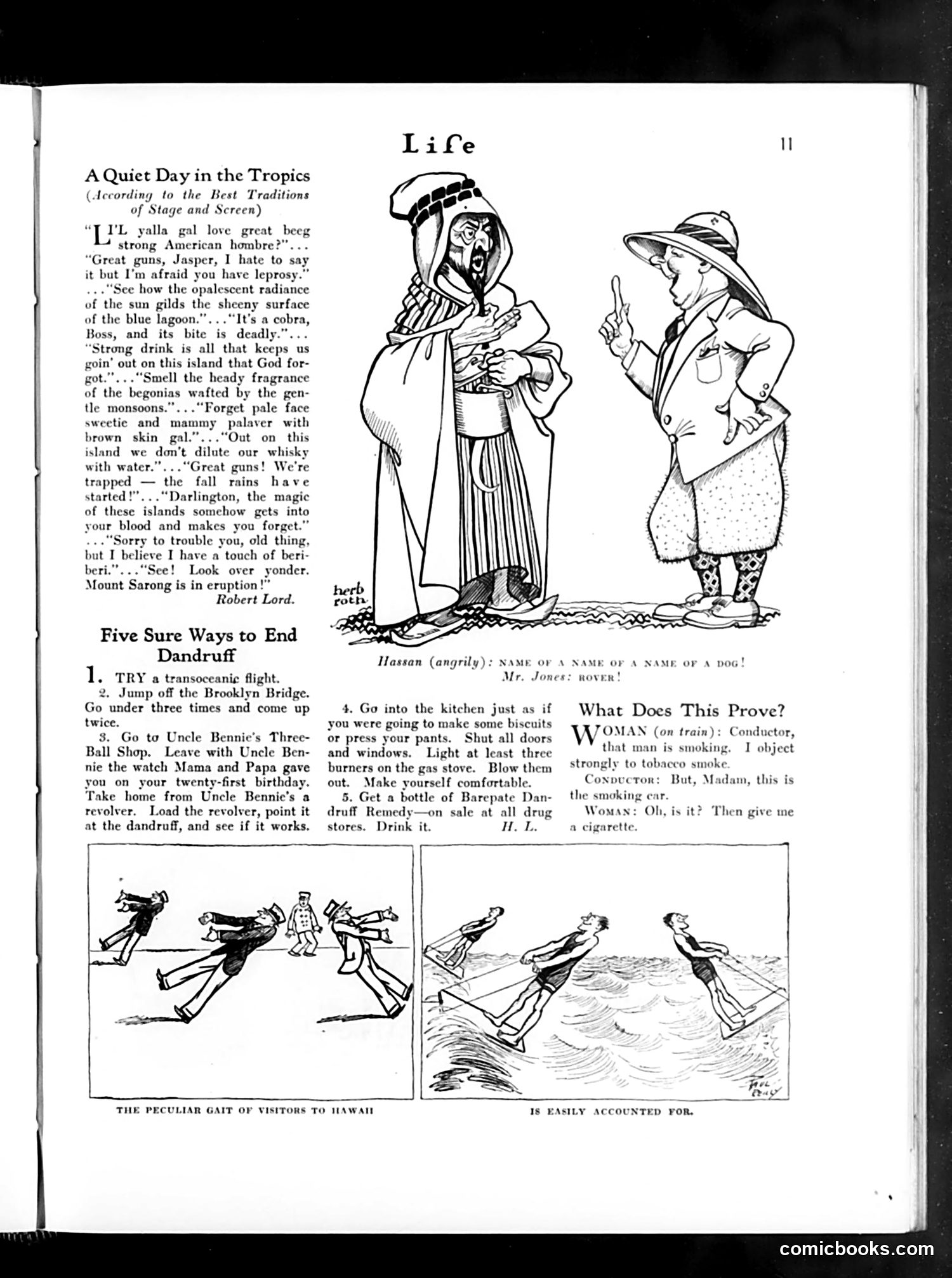
This page contains three distinct humor pieces: 1. **"A Quiet Day in the Tropics"** (top): A satirical poem by Robert Lord mocking theatrical clichés about tropical settings—exaggerated dramatic dialogue about exotic dangers, colonial adventure tropes, and stereotypical "local color" effects used in stage and screen productions of the era. 2. **"Five Sure Ways to End Dandruff"** (left): Absurdist humor listing ridiculous solutions (transatlantic flights, jumping off bridges, etc.)—clearly meant as nonsensical satire about dandruff remedies. 3. **"What Does This Prove?"** (right): A brief comic exchange between a woman and conductor about smoking in a train car, with accompanying illustrations of visitors to Hawaii walking with unusual gaits, captioned to explain their peculiar movement. The cartoons parody early 20th-century stage conventions and tourist stereotypes.
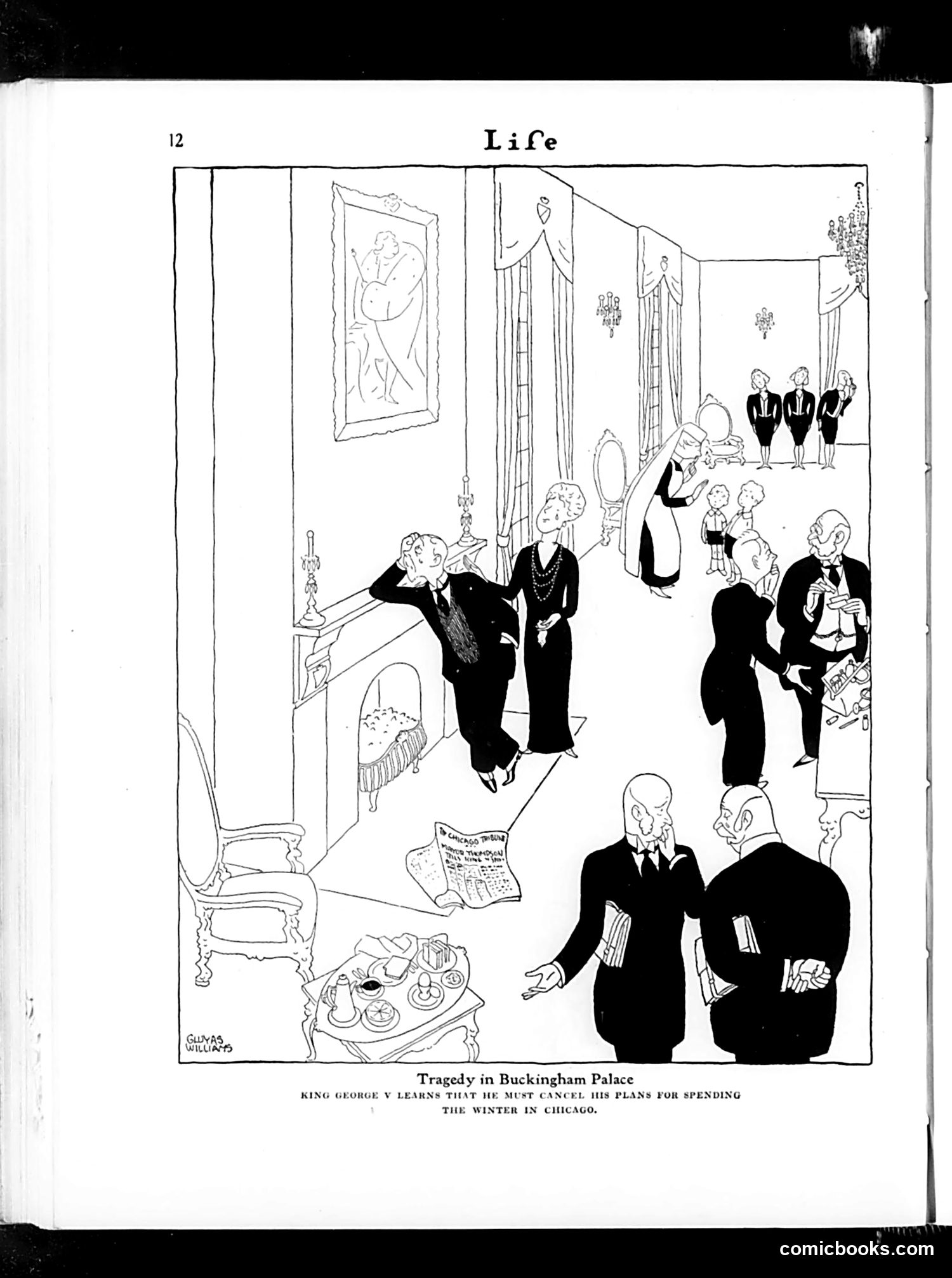
This satirical cartoon depicts King George V learning he must cancel his winter plans in Chicago. The caption indicates the "tragedy" is the king's disappointment at having to forgo a leisure trip to America. The drawing shows an elegant palace interior with well-dressed aristocrats and servants reacting to this news. The humor appears to target the perceived self-centeredness of royalty—treating a cancelled vacation as a genuine tragedy worthy of palace-wide concern. The cartoon likely satirizes either the royal family's frivolous priorities or, alternately, mocks the notion that a British monarch would casually plan an American winter holiday. Without knowing the specific historical date, the exact political context remains unclear, though it seems to mock royal entitlement and disconnection from ordinary concerns.
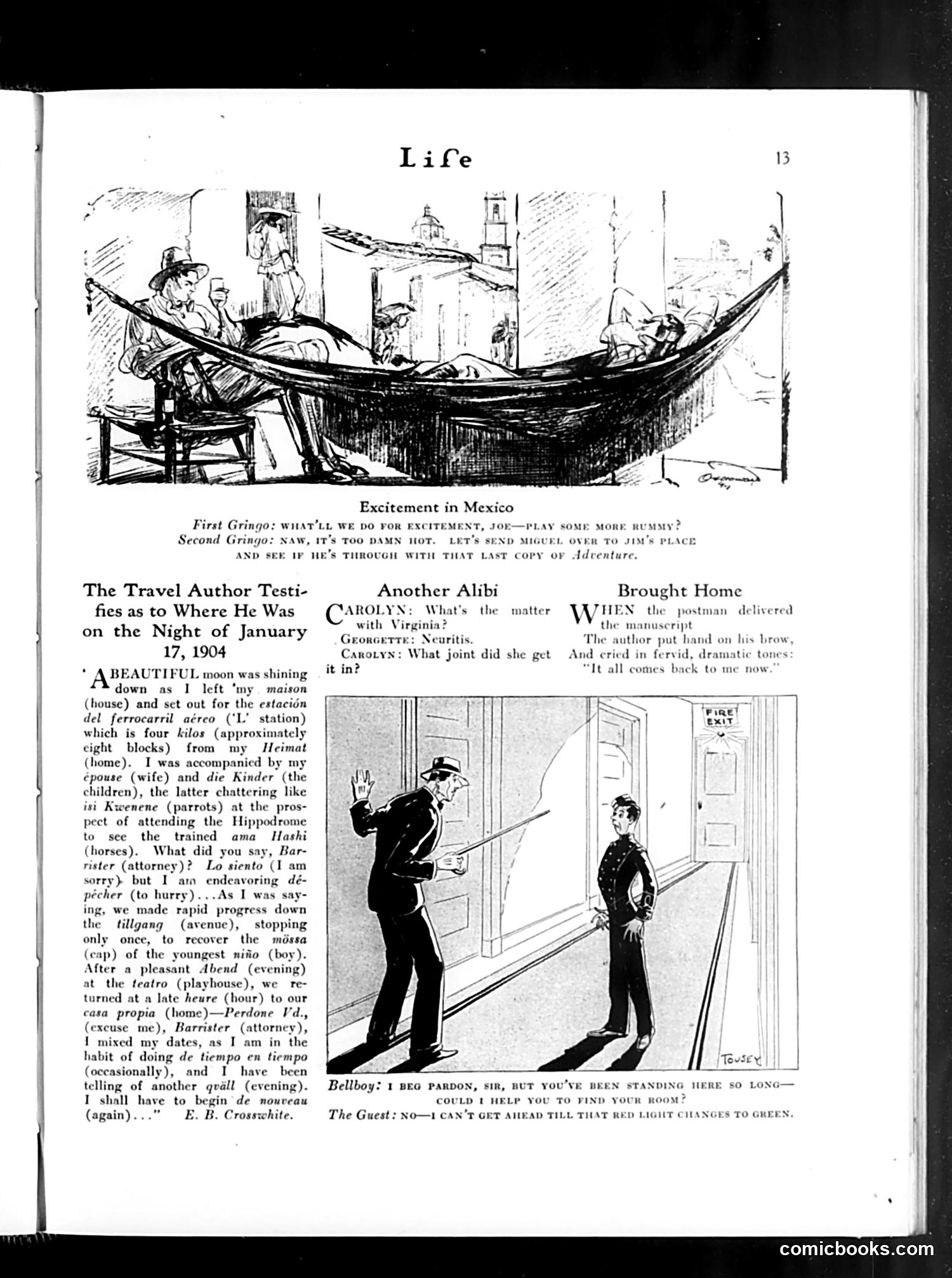
The top cartoon depicts two American men in hammocks in Mexico, labeled "First Gringo" and "Second Gringo." They're discussing how to combat boredom—suggesting sending for "Miguel" to Jim's place and a copy of *Adventure* magazine. The joke satirizes American tourists in Mexico seeking entertainment and distraction from the heat and monotony of travel. The lower section contains three separate pieces: a travel account from January 17, 1904, about nighttime travel in Mexico; a brief exchange about Virginia; and "Brought Home," showing a bellboy helping a guest find his hotel room. These appear to be humorous anecdotes typical of Life's satirical format, poking fun at travelers' mishaps and cultural confusion abroad.
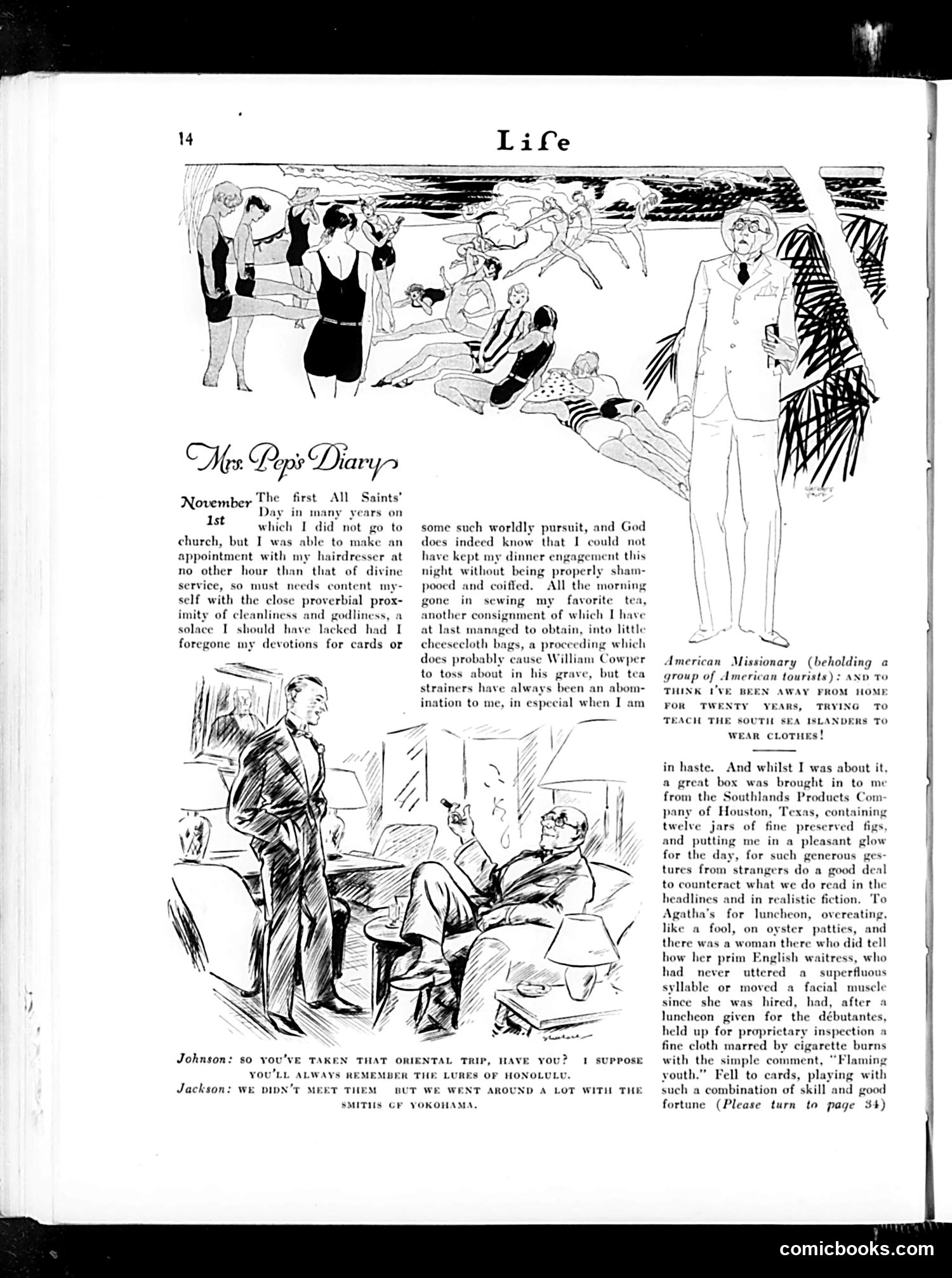
This page from *Life* magazine presents a satirical diary entry mocking upper-class social pretensions. The main illustration shows an American missionary surrounded by wealthy tourists in what appears to be an exotic setting. The humor centers on the contrast between Mrs. Pop's claimed pious devotion (she skipped All Saints' Day services for social engagements) and her actual priorities—playing cards, attending lunches, and socializing with English society women. The lower cartoon depicts two men (Johnson and Jackson) discussing their travels to Yokohama, with the joke being they encountered the "smiths of Yokohama" rather than learning anything meaningful about the culture. The satire targets wealthy Americans' superficial engagement with both religion and world travel, treating exotic experiences as social accessories rather than genuine cultural encounters.
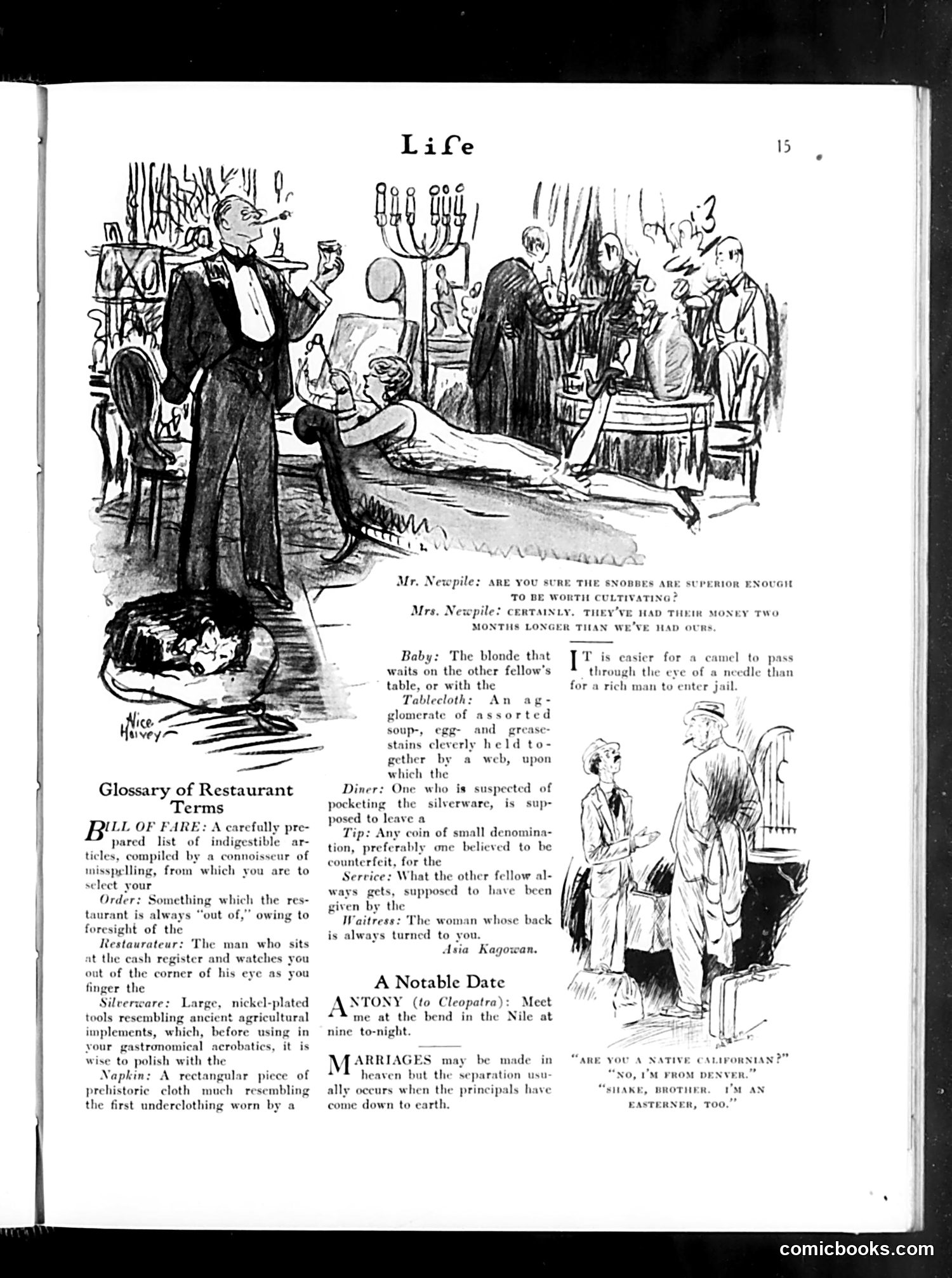
This page contains social satire typical of early 20th-century *Life* magazine. The main cartoon depicts a formal dinner scene where a snobbish couple (Mr. and Mrs. Newpile) are questioned about cultivating the "snobbes"—wealthy but socially inferior nouveaux riches. Mrs. Newpile boasts their money exceeds the questioner's by two months' earnings, satirizing materialism masquerading as refinement. Below is a "Glossary of Restaurant Terms"—mock-definitions mocking both pretentious dining culture and working-class restaurant staff. Terms like "Bill of Fare," "Order," and "Silverware" are redefined sarcastically to expose hypocrisy between fine dining's pretense and its actual operations. The bottom section contains unrelated brief humor pieces about romance and geography. The satire targets Gilded Age social climbing and restaurant culture's artificiality.
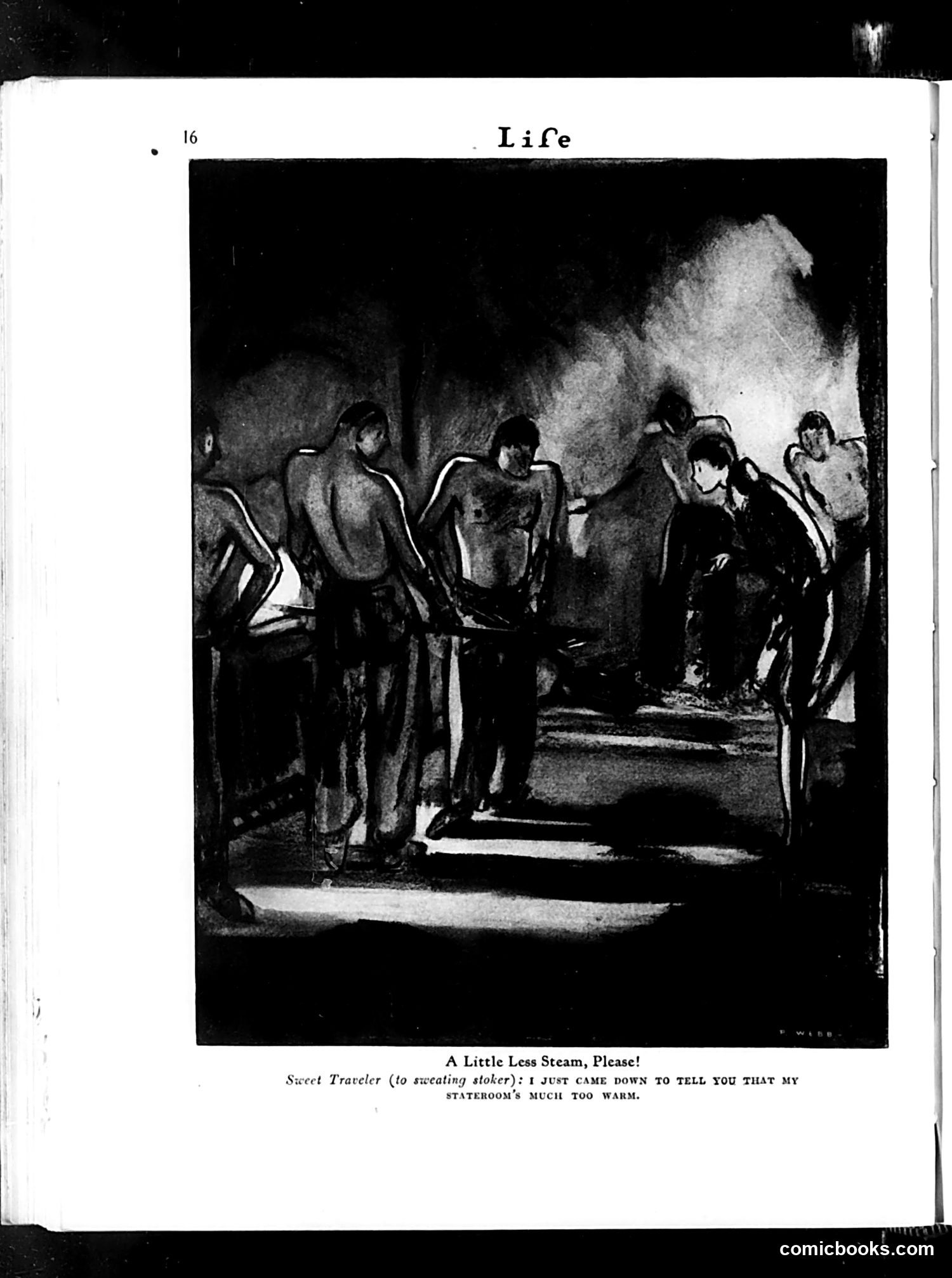
This satirical cartoon depicts a scene aboard a ship's stateroom, with a "Sweet Traveler" (an upper-class passenger) complaining to the crew about excessive heat. The figure is sweating profusely and states: "I JUST CAME DOWN TO TELL YOU THAT MY STATEROOM'S MUCH TOO WARM." The humor targets wealthy travelers' complaints about minor discomforts during ocean voyages. The joke appears to be that first-class passengers would descend to the engine room—where workers labored in extreme heat—merely to grumble about their accommodations being slightly warm. It satirizes the obliviousness of privileged travelers to the harsh working conditions of ship staff, highlighting class disparity and the absurdity of such complaints given the actual conditions endured by lower-class workers.
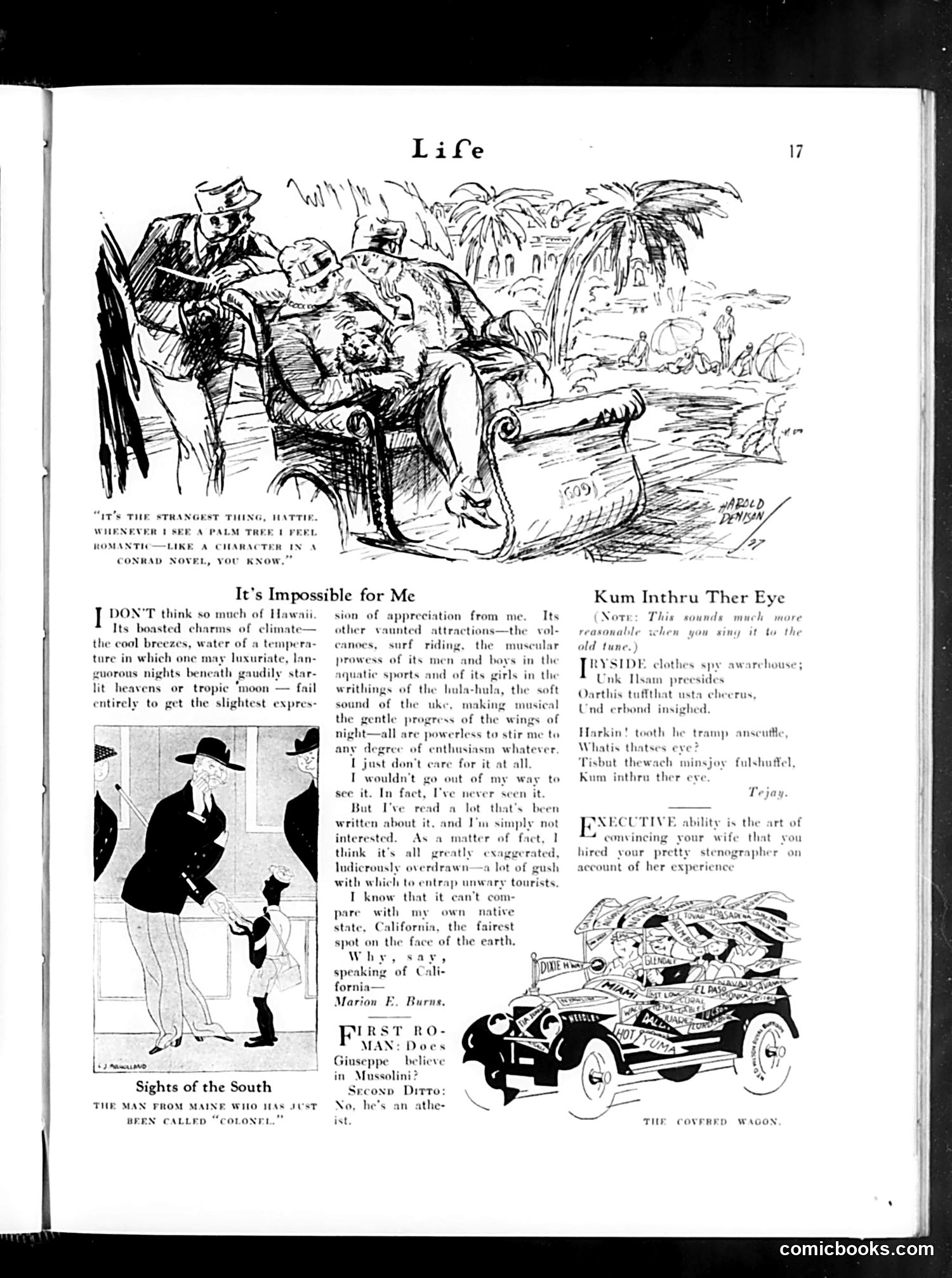
This page contains several satirical pieces mocking travel and tourism attitudes. **"It's Impossible for Me"** ridicules a Californian's dismissal of Hawaii, claiming he's uninterested despite never visiting—a hypocritical stance the author Marion E. Burns satirizes. The piece suggests people often reject unfamiliar experiences based on prejudice rather than actual knowledge. **"Sights of the South"** cartoon depicts a tall Southern belle with three men, captioned as introducing "the man from Maine who has just been called 'Colonel'"—mocking how Northerners are flattered and patronized in the South. **"The Covered Wagon"** illustration shows an absurdly overloaded automobile, satirizing tourists who overprepare or overpack for trips. The page overall ridicules American tourist attitudes and regional stereotypes of the early 20th century.
This page contains editorial commentary rather than political cartoons. The main illustrated element is a decorative header showing classical/mythological figures, not a satirical cartoon requiring interpretation. The text discusses recent American disasters and social issues: severe flooding in New England and the Mississippi Valley, calling them "freak" weather events while questioning divine meaning. The editors praise several developments: public opinion reversing a magistrate's harsh sentence against a boy, exposure of the Burns Detective Agency's invasive jury investigation methods during oil trials, and court action restoring a homeowner's house number against corporate overreach. The final section briefly critiques Chicago's Mayor Thompson for not promoting the scandalous *Greville Memoirs* in public schools—this appears to be ironic commentary on Thompson's governance rather than genuine advocacy. The tone is typical Progressive-era magazine discourse: praising civic intervention, public opinion power, and court accountability.
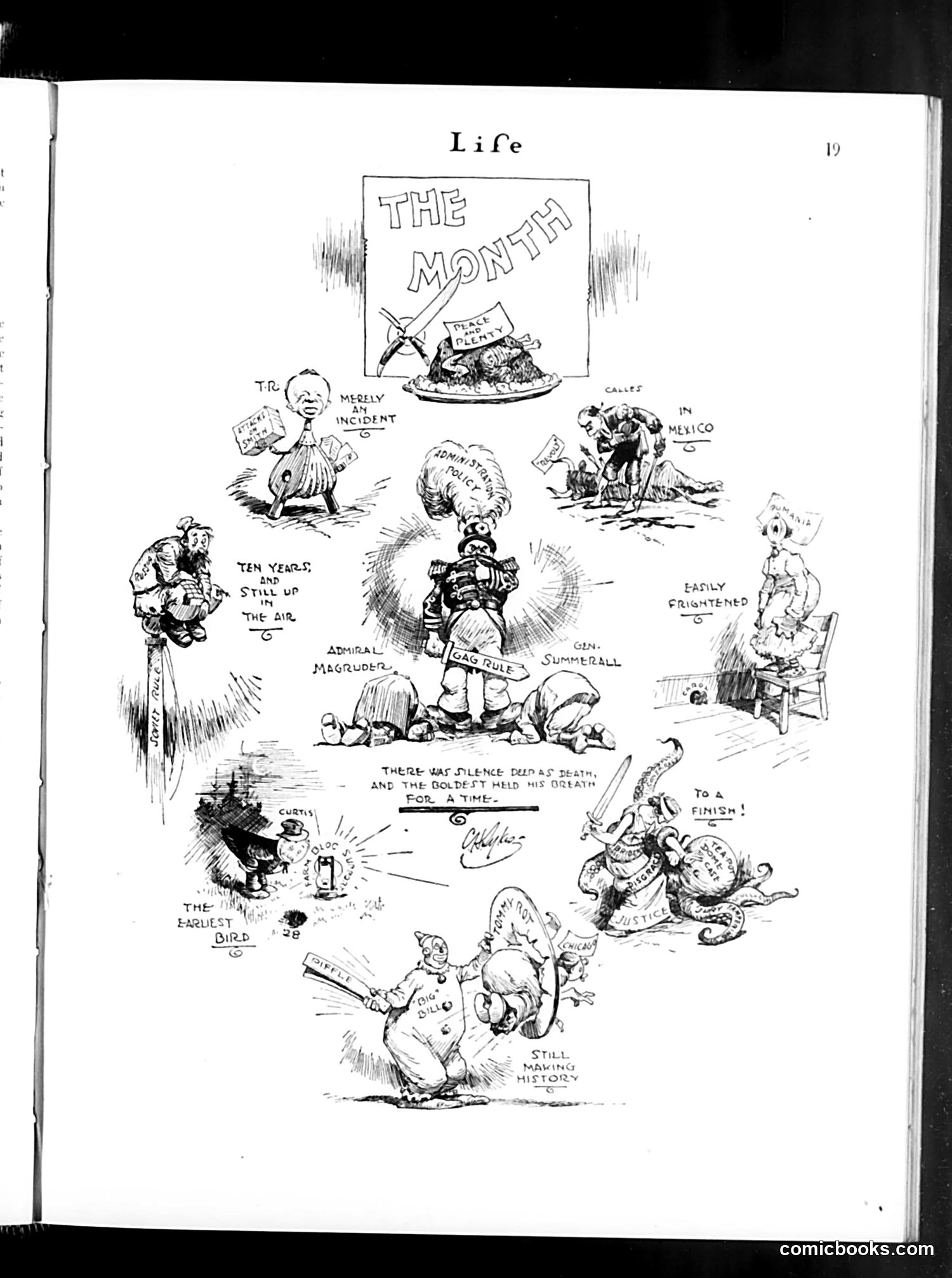
This is a satirical review of current events, presented as vignettes around a central naval figure (likely Admiral Summerall, based on the label). Each sketch represents a notable incident from the month being reviewed: - "Merely an incident" - a casual political matter - "Ten years and still up in the air" - an unresolved dispute - "In Mexico" - diplomatic troubles - "Easily frightened" - someone timid - "The earliest duel" - an early confrontation - "Still making history" - ongoing significant events The central figure appears to be a military or government official presiding over these monthly occurrences. The cartoon uses exaggerated caricature and humor to mock both the incidents themselves and the public figures involved. The exact references are unclear without the magazine's date, but this format was typical of Life's monthly satirical recaps of news and politics.
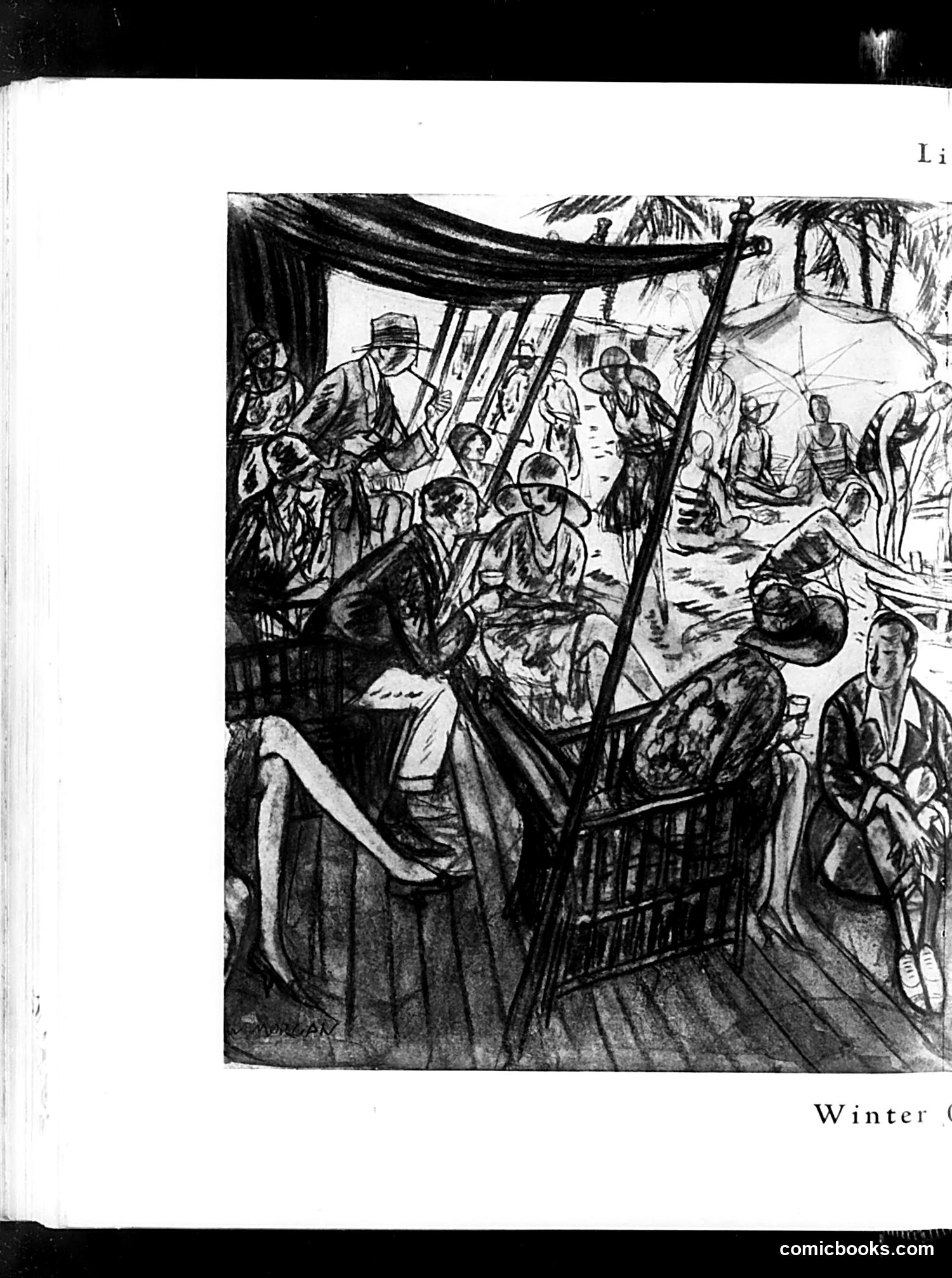
This page contains a single illustration depicting what appears to be a crowded scene under a tent or canopy structure, with numerous figures in period clothing engaged in various activities. The scene is rendered in bold black ink with strong contrast, typical of early-to-mid 20th century satirical illustration. The caption reads "Winter" (partially visible as "Winter C"), suggesting seasonal commentary. However, without additional OCR text or visible magazine content, the specific satirical point remains unclear. The dense, chaotic composition with multiple figures suggests social observation or commentary on crowd behavior, but the exact political or social references cannot be definitively identified from the image alone. The page number "Li" appears at top right.
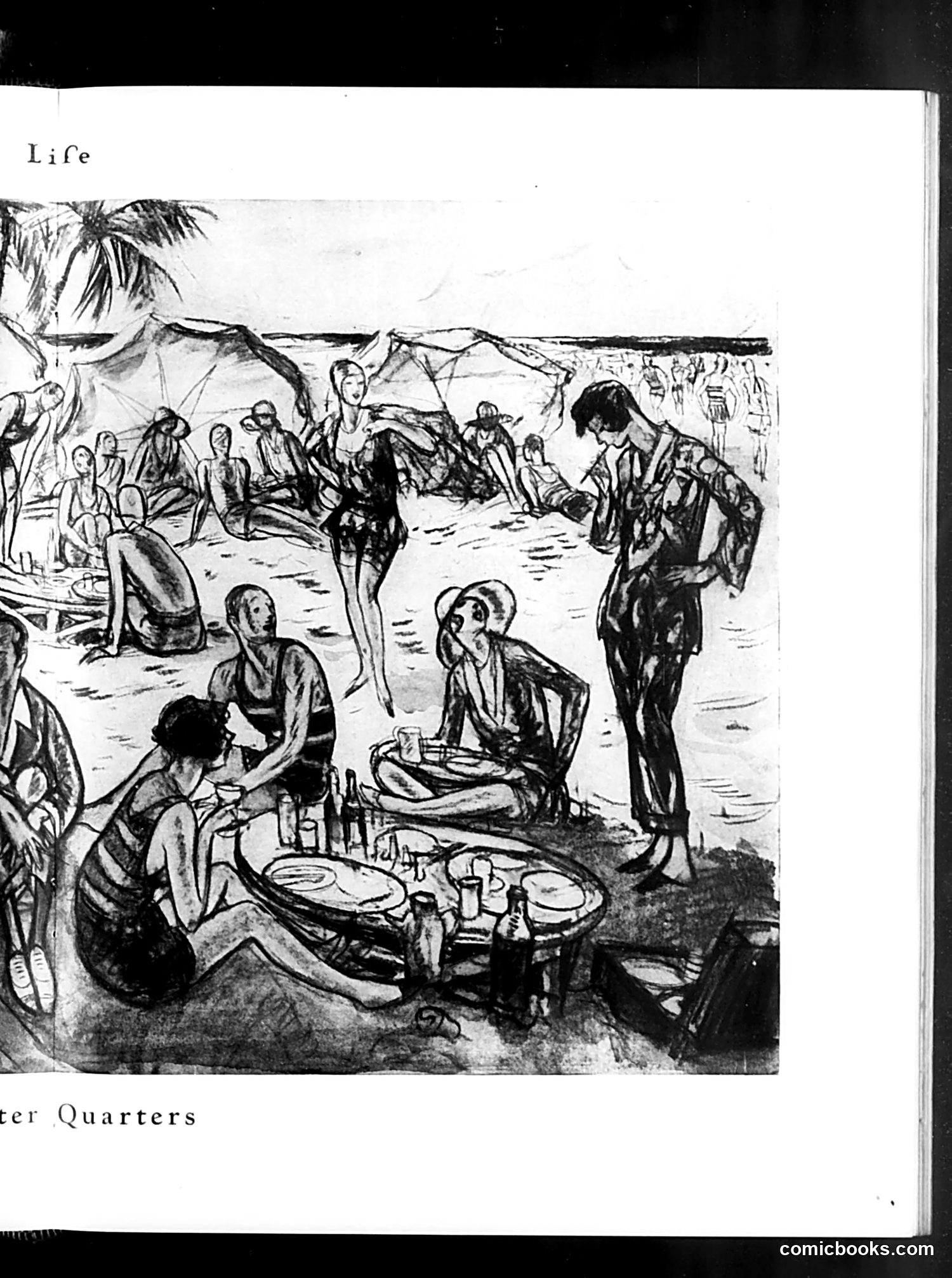
This page shows a beach or seaside social scene titled "Life" with the partial heading "ter Quarters" (likely "Quarter Quarters" or similar). The sketch depicts people in various states of leisure and social interaction—some seated with food and drinks, others standing or socializing under umbrellas and palm trees. The satirical point appears to target upper-class or leisure-class social behavior during what seems to be a vacation or resort setting. The style and clothing suggest early-to-mid 20th century. However, without clearer context or visible date information, the specific satirical target remains unclear. The drawing emphasizes contrasts in how different figures engage socially and with consumption, which was typical of Life magazine's social commentary.
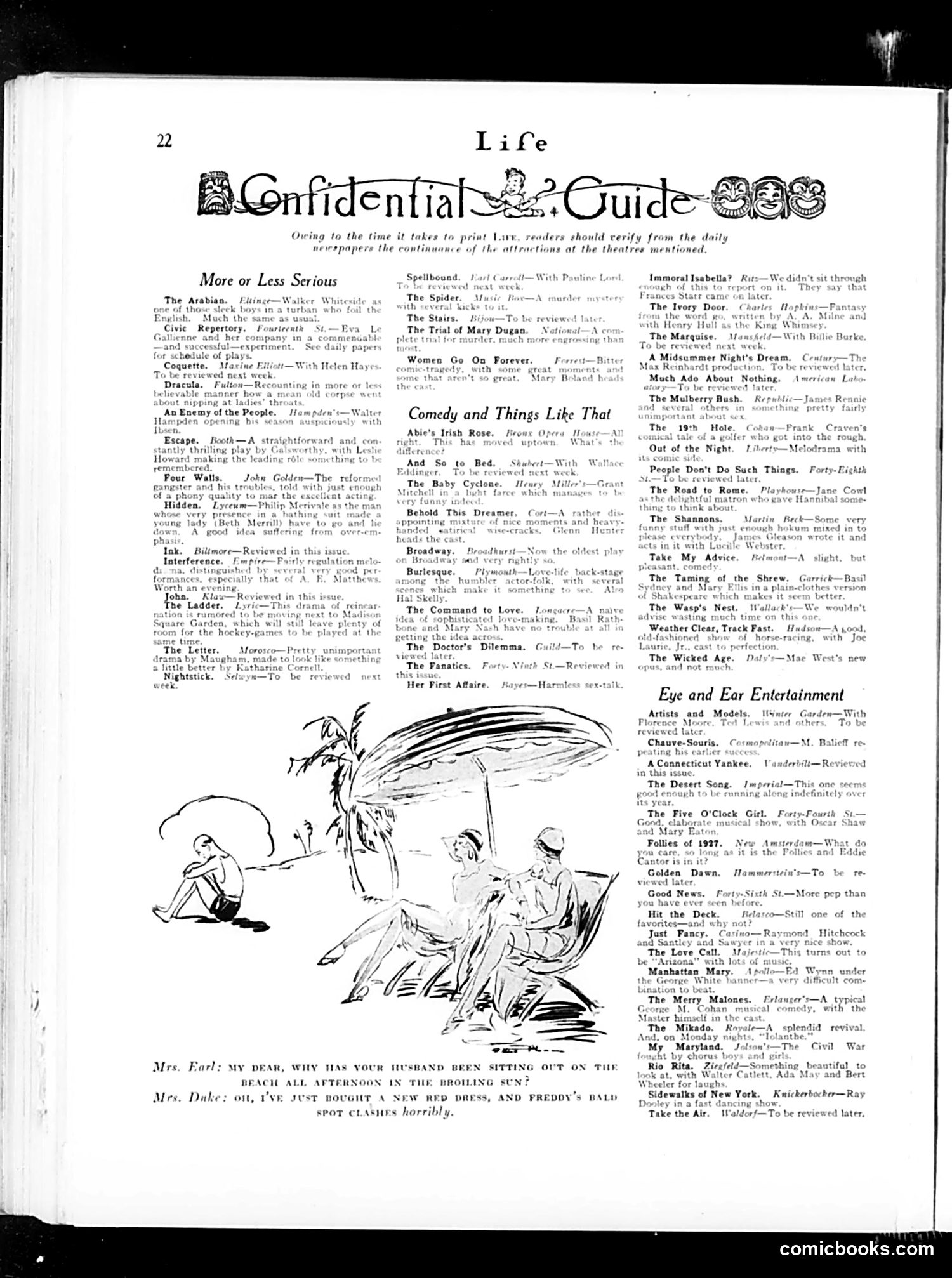
This page is primarily a **theater guide**, not a political cartoon. It lists Broadway shows opening that week with brief critical notes—a standard feature of Life magazine during the 1920s entertainment boom. The single cartoon depicts two figures on a beach: a woman in a bathing suit and a man sitting apart. The caption reads: "Mrs. Earl: My dear, why has your husband been sitting out on the beach all afternoon in the broiling sun? / Mrs. Duke: Oh, he just bought a new red dress, and Freddy's bald spot clashes horribly." **The joke**: A husband deliberately sunburns his scalp to avoid the embarrassment of his wife's garish new dress clashing with his pale bald head. It's a mild domestic satire about fashion excess and marital compromise—typical of Life's humorous social commentary during the Jazz Age.
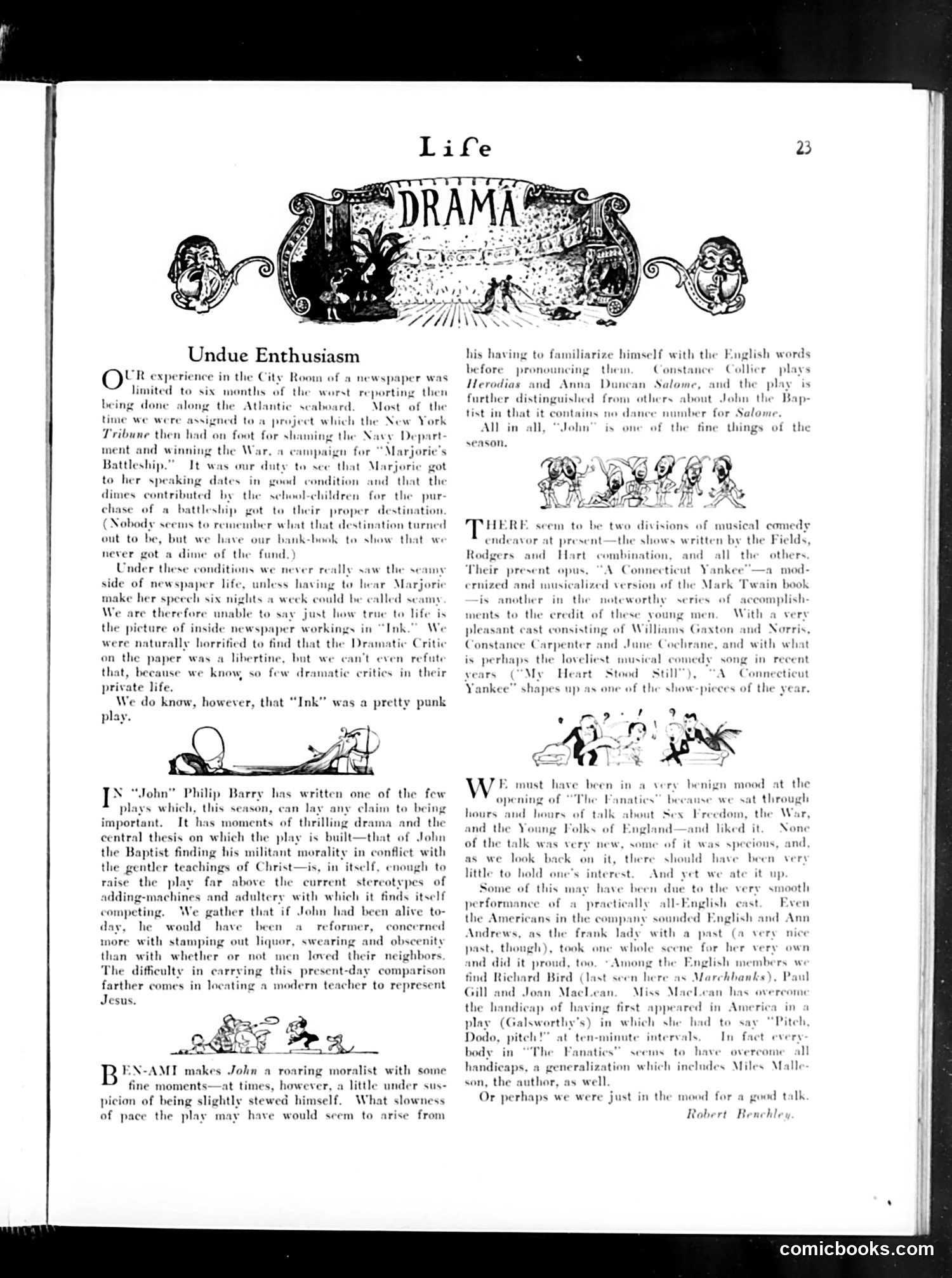
This page contains theater reviews by Robert Benchley discussing three Broadway productions: **"Ink"** — A play about newspaper work that Benchley dismisses as "pretty punk," noting the irony that its dramatic critic character is portrayed as a libertine, which he finds implausible. **"John"** — Philip Barry's play about John the Baptist confronting Christ's gentler teachings versus his own moral militancy. Benchley praises its serious dramatic moments but notes the difficulty of finding a modern equivalent to Jesus for the comparison to work. The cast includes Constance Collier and Anna Duncan. **"A Connecticut Yankee"** — A Rodgers and Hart musical adaptation of Mark Twain's novel, featuring Williams Gaxton and Constance Carpenter. Benchley finds it entertaining but somewhat slow, attributing this partly to the British cast's unfamiliarity with English pronunciation. The satirical cartoons are decorative elements typical of *Life* magazine's theatrical coverage. The overall tone is Benchley's characteristic wry humor about Broadway's mixed quality.
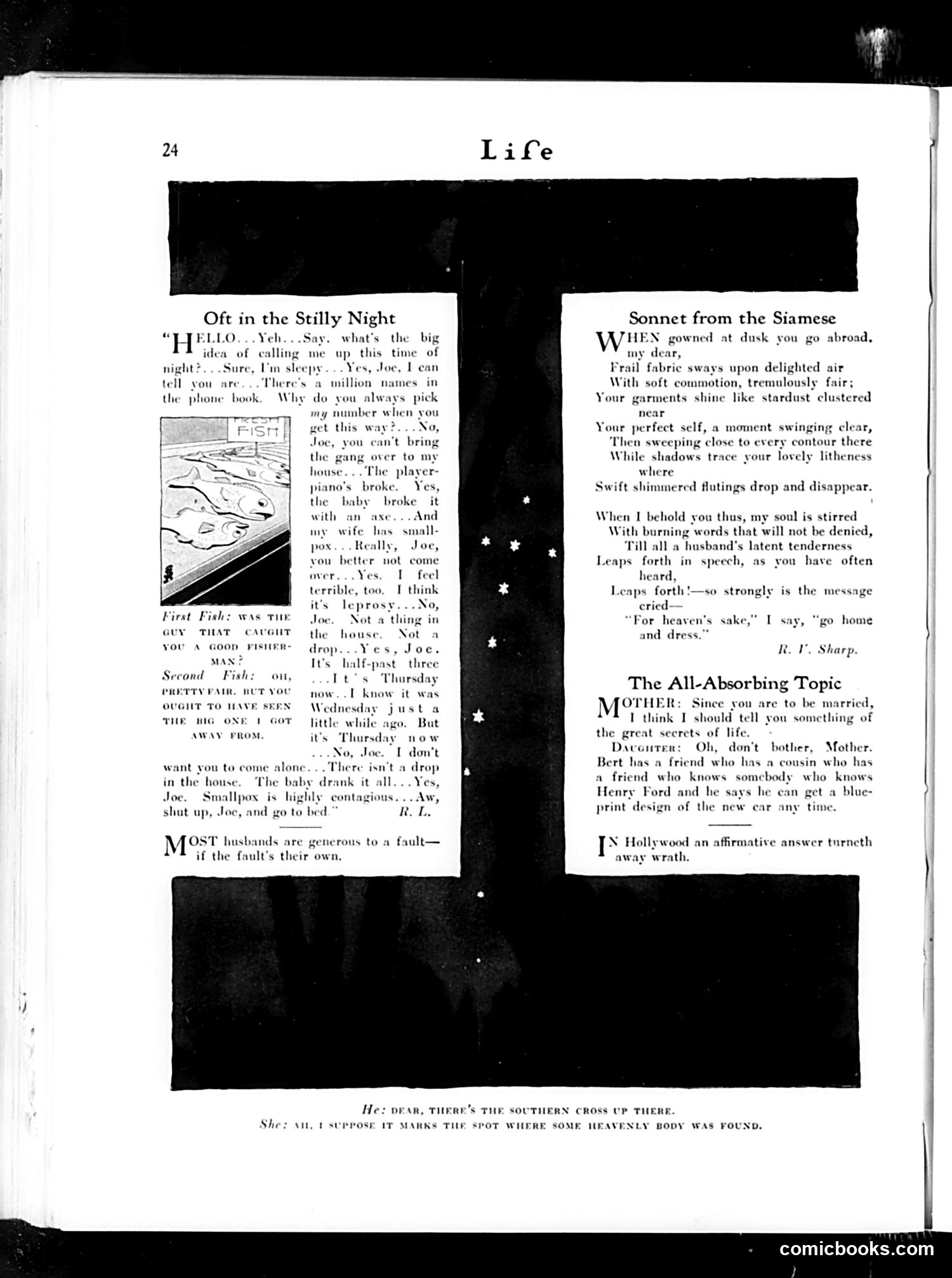
This page contains three separate humorous pieces typical of *Life* magazine's satirical content: **"Oft in the Stilly Night"** presents a comedic phone conversation where a man desperately tries to discourage a friend (Joe) from visiting by fabricating increasingly absurd excuses—a broken piano, smallpox, leprosy—highlighting the social awkwardness of unwanted social calls during this era. **"Sonnet from the Siamese"** is a mock-romantic poem that builds elaborate praise for a woman's beauty before the punchline: the speaker's actual response is simply telling her to "go home and dress"—satirizing the gap between flowery male sentimentality and practical reality. **"The All-Absorbing Topic"** jokes that a young woman preparing for marriage cares more about obtaining blueprints for Henry Ford's new automobile design than learning about married life—mocking both the era's fascination with Ford's innovations and young women's consumer interests. The fish cartoon appears decorative, not satirical.
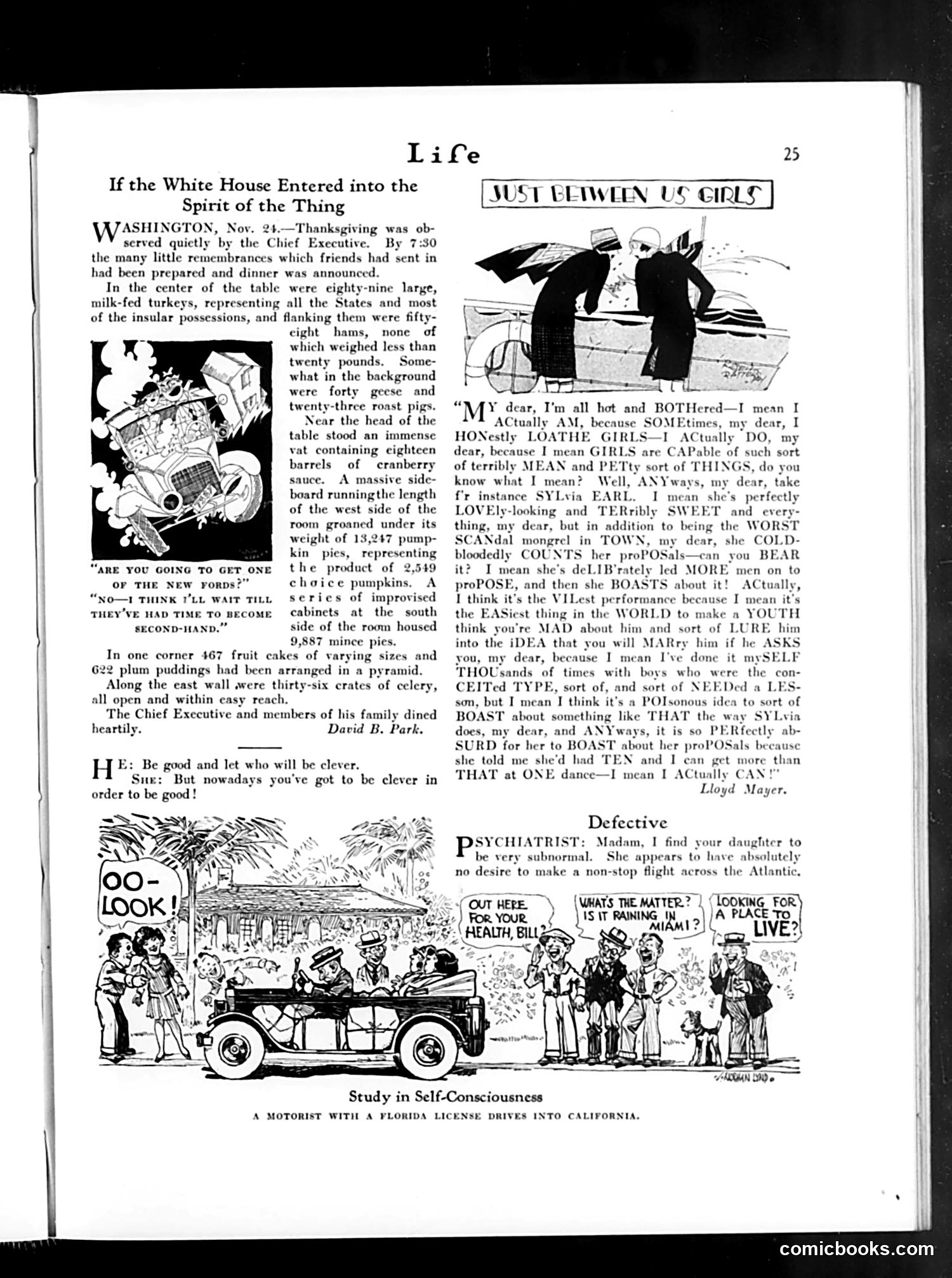
**"If the White House Entered into the Spirit of the Thing"** satirizes excessive consumption and Thanksgiving excess. The article humorously describes President Coolidge's supposedly modest Thanksgiving dinner, then reveals absurdly massive quantities—89 turkeys, 13,247 pumpkin pies, 9,887 mince pies—mocking either wasteful abundance or the gap between public austerity and private indulgence during the 1920s. **"Just Between Us Girls"** parodies women's gossip columns, featuring a breathless narrator criticizing a rival named Sylvia Earl for manipulating men's marriage proposals. The satirical point targets female social competition and romantic scheming, with deliberate capitalization emphasizing melodrama. **"Defective"** jokes that a psychiatrist diagnoses a young woman as "subnormal" for lacking desire to attempt a transatlantic flight—mocking both psychiatric jargon and the era's obsession with aviation stunts as indicators of normalcy. **"Study in Self-Consciousness"** depicts a motorist with a Florida license plate in California, comedically illustrating self-aware travelers broadcasting their origins.
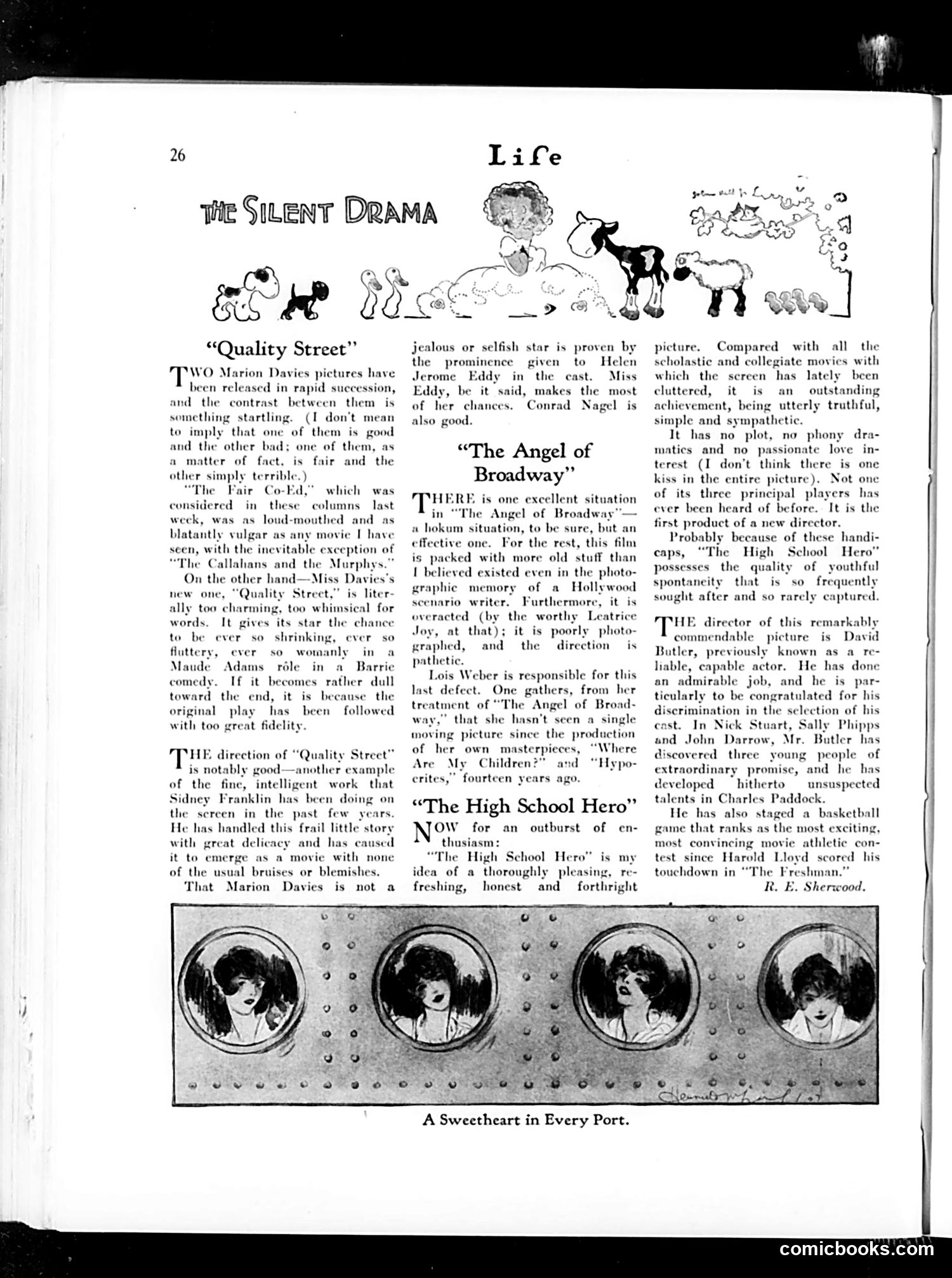
This page contains film reviews from Life, the American satirical magazine, critiquing silent films starring Marion Davies and others. **Key points:** The reviewer praises Davies in "Quality Street" as charming and delicate—a stark contrast to her previous vulgar role in "The Fair Co-Ed." Director Sidney Franklin receives credit for intelligent, careful direction. "The Angel of Broadway" is dismissed as hackneyed and poorly directed by Lois Weber, who apparently hasn't seen a modern film in fourteen years (referencing her own 1910s work). "The High School Hero" earns genuine enthusiasm as an honest, plot-free film featuring unknown young actors and a director (David Butler) transitioning from acting. The reviewer particularly praises its realistic basketball sequence as superior since Harold Lloyd's famous football scene in "The Freshman." The reviews reflect 1920s cinema standards: character and direction valued over plot, concern with vulgarity versus refinement, and appreciation for authentic youth performances over established stars.
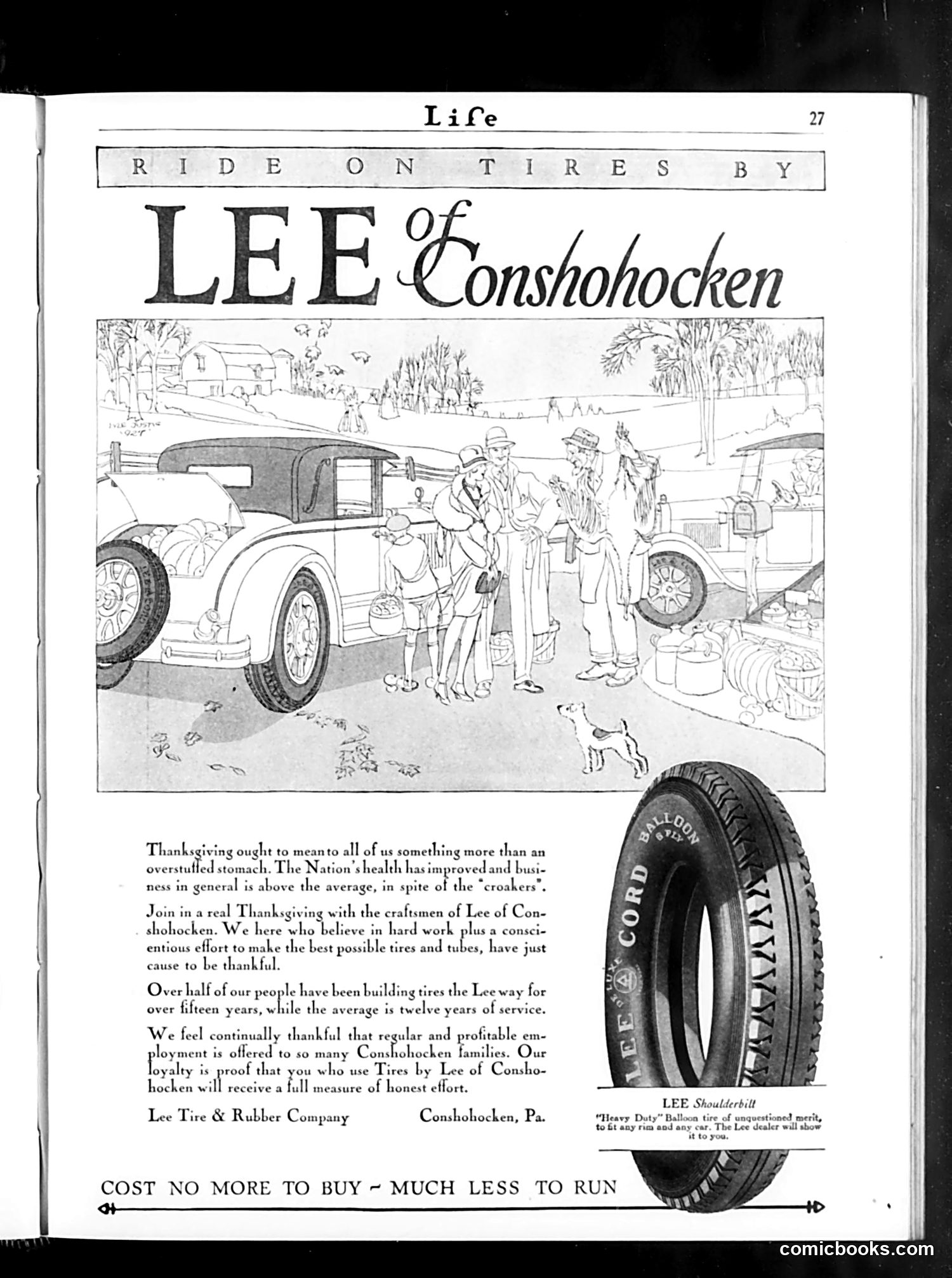
This is primarily a **tire company advertisement**, not political satire. The page features an illustration of a Thanksgiving picnic scene with well-dressed people and automobiles gathered outdoors, alongside a large product image of a Lee tire. The text positions Lee tires as a source of American gratitude and prosperity. It appeals to worker loyalty by emphasizing that over half their workforce has served 15+ years—framing tire manufacturing as stable, respectable employment during the post-WWI economic period. The phrase "in spite of the 'croakers'" likely references contemporary pessimists doubting America's economic recovery. The advertisement counters this skepticism by celebrating national health and business growth. The tagline "Cost No More to Buy—Much Less to Run" is a straightforward sales claim about value. This is corporate messaging disguised as patriotic sentiment, using Thanksgiving imagery to associate the brand with American values and prosperity.
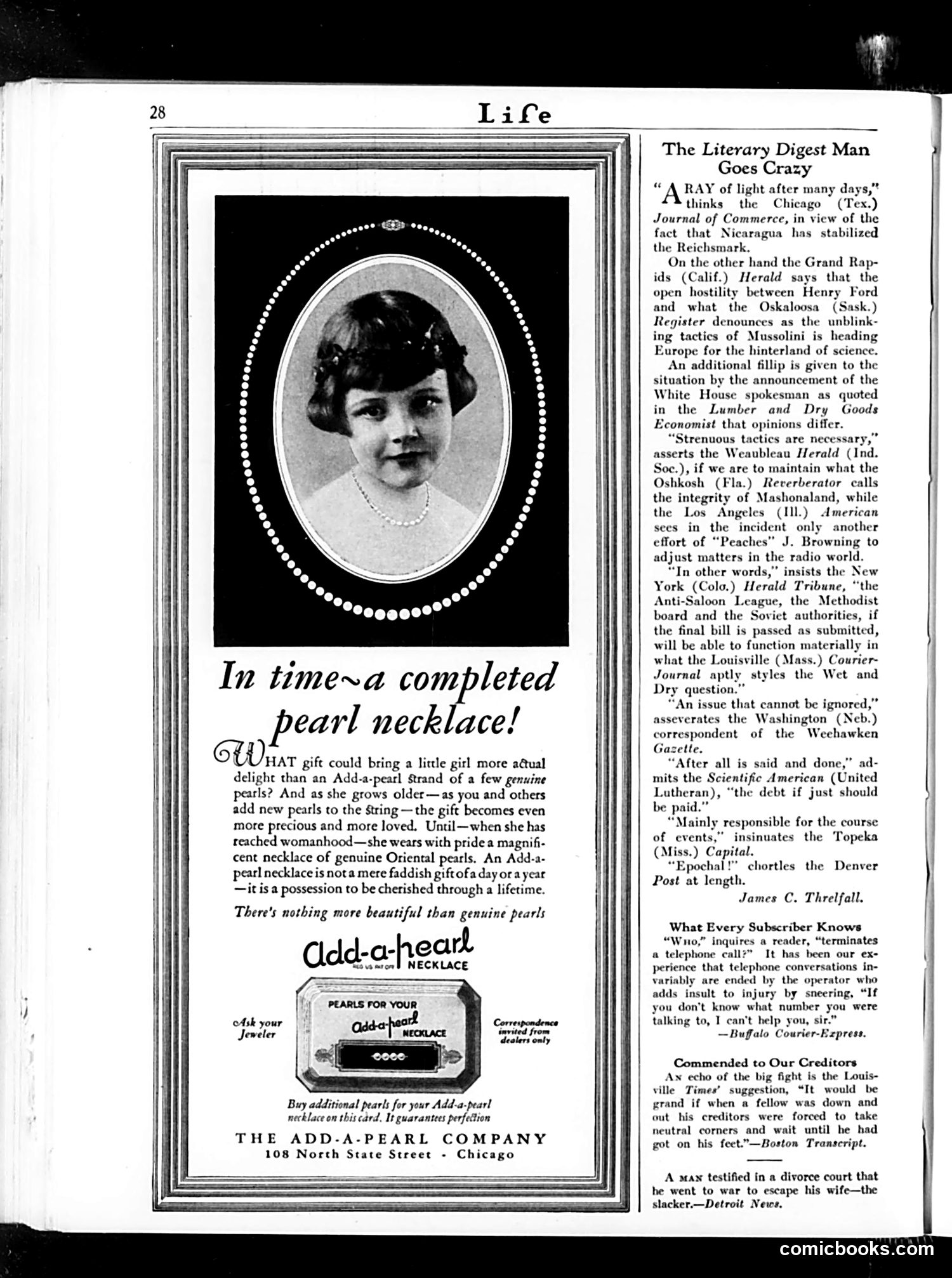
This satirical piece mocks the absurdity of contemporary newspaper editorial commentary. The author lists deliberately fake newspaper names from tiny towns (Chicago, Texas; Oskaloosa, Saskatchewan; Oshkosh, Florida—geographically impossible combinations) offering contradictory opinions on major issues: Nicaragua's political stability, Mussolini's European tactics, and Prohibition. The satire works by showing how small-town papers, through these fabricated citations, attempt to sound authoritative while contradicting each other on serious matters. By attributing incoherent statements to nonexistent publications, the piece ridicules both editorial pretension and readers' gullibility in accepting citations as proof of legitimacy. The page also contains an **Add-a-Pearl necklace advertisement**—standard commercial content from the era—unrelated to the satire.
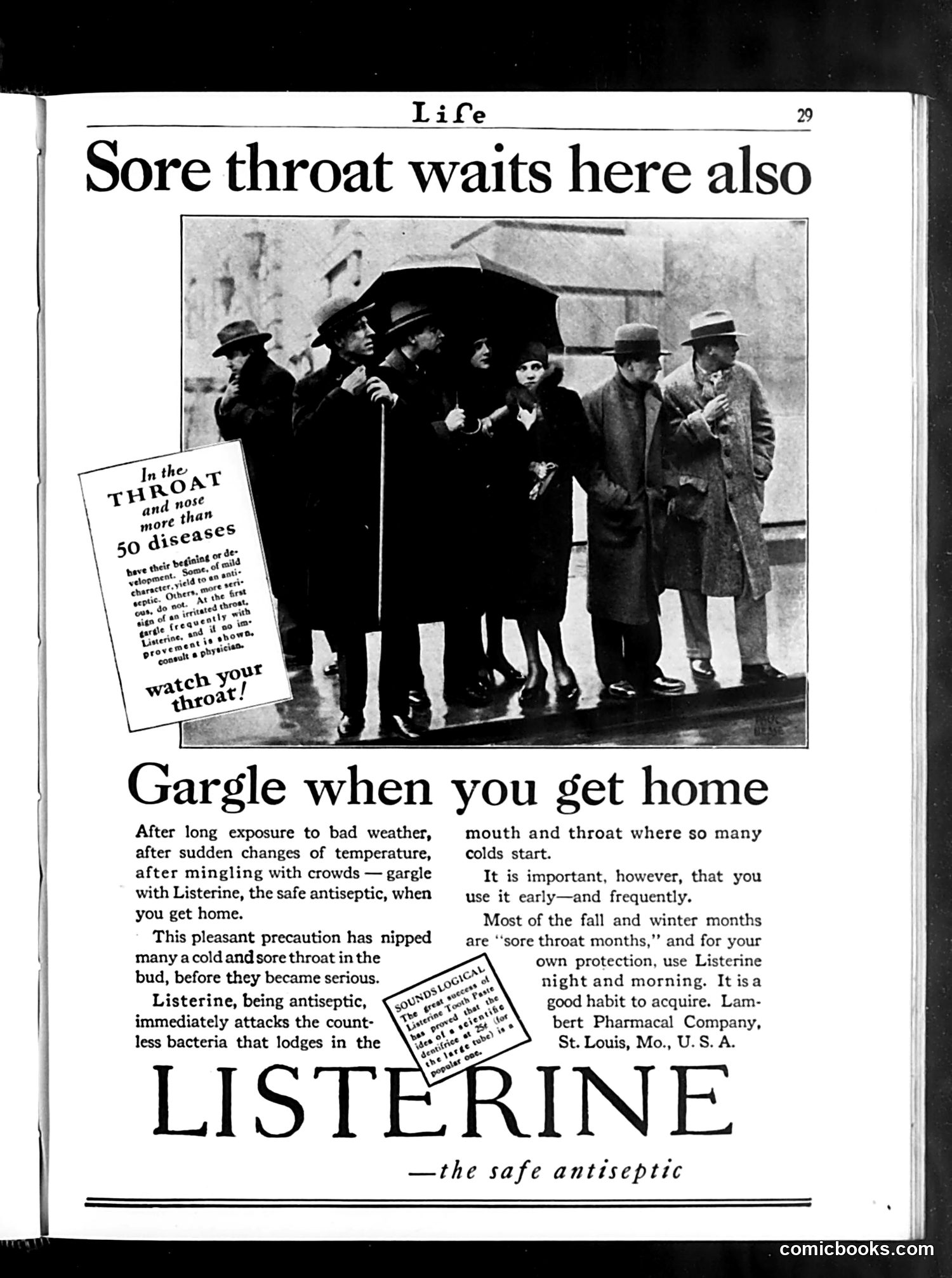
This is primarily a **Listerine mouthwash advertisement**, not political satire. The page uses a photograph of people huddled together under an umbrella in wet weather as a visual hook. The advertisement's logic is straightforward: exposure to "bad weather," "sudden changes of temperature," and "mingling with crowds" supposedly causes sore throats. The solution is gargling with Listerine antiseptic when you return home. The satire—if present—is subtle and lies in the **exaggerated health claims** typical of early 20th-century patent medicine advertising. The ad implies that Listerine can prevent colds through antiseptic action, a claim modern medicine would find dubious (since colds are viral, not bacterial). The photograph illustrates the "mingling with crowds" risk factor, showing ordinary people in close quarters during bad weather—a relatable scenario for readers concerned about contagion during fall and winter months.
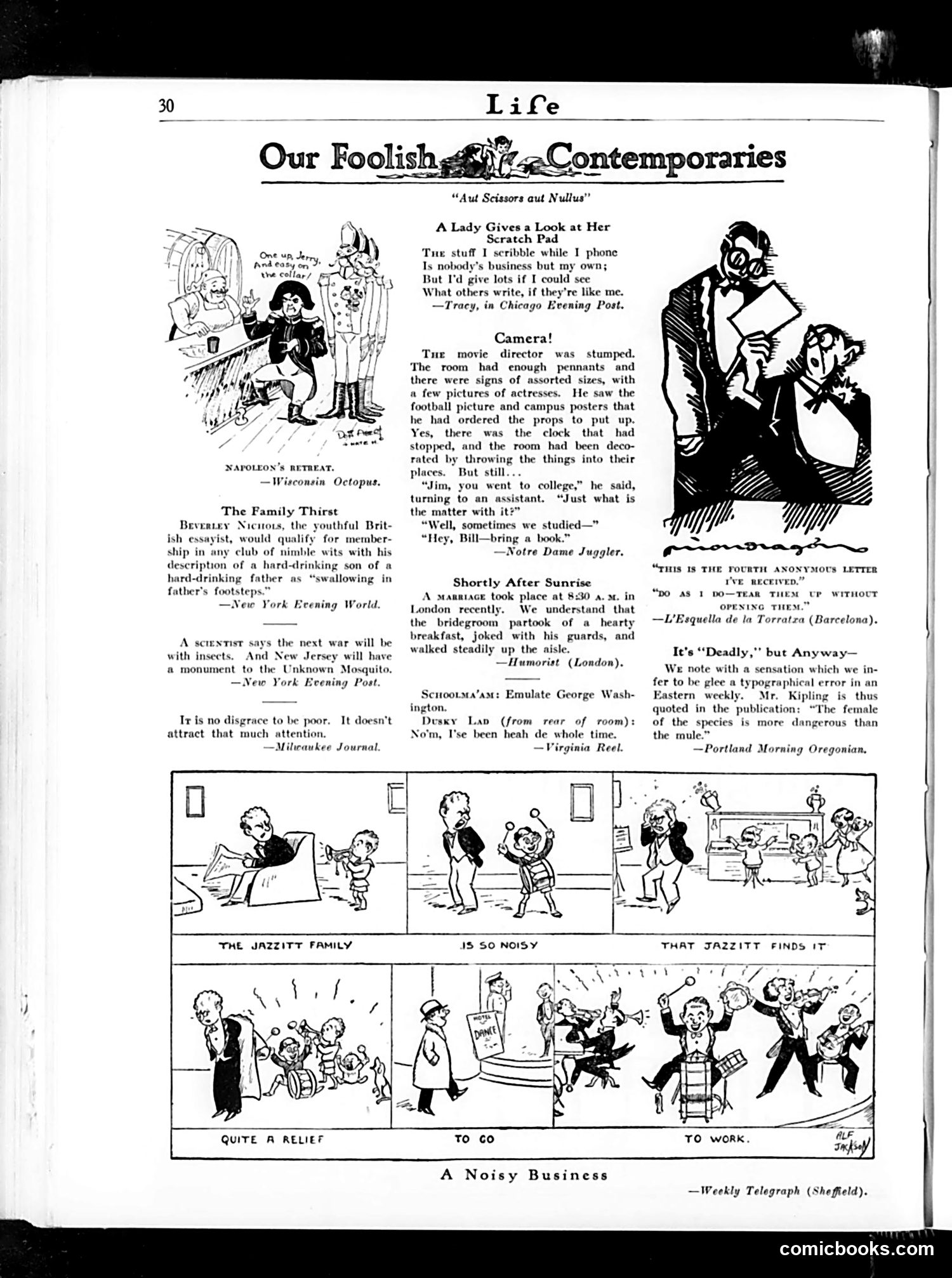
This page collects humorous observations and cartoons mocking contemporary society and literary culture. The main cartoon "A Noisy Business" (bottom) depicts the "Jazzitt Family"—a satirical jab at jazz-age households of the 1920s, showing a family creating excessive noise that forces the father to escape to work for "relief." Jazz culture and its association with loud, chaotic modernity was a common target of period satire. The scattered quotations above ridicule various social types: a lady indiscreetly writing notes while phoning, a movie director struggling to authentically recreate college life, and a marriage where the bridegroom ate heartily before his (implied) execution—a dark joke about capital punishment. The final item mocks a typographical error misquoting Kipling's famous line about dangerous females. Throughout, the page lambastes modern manners, technology, and cultural shifts through reprinted jokes from various newspapers.
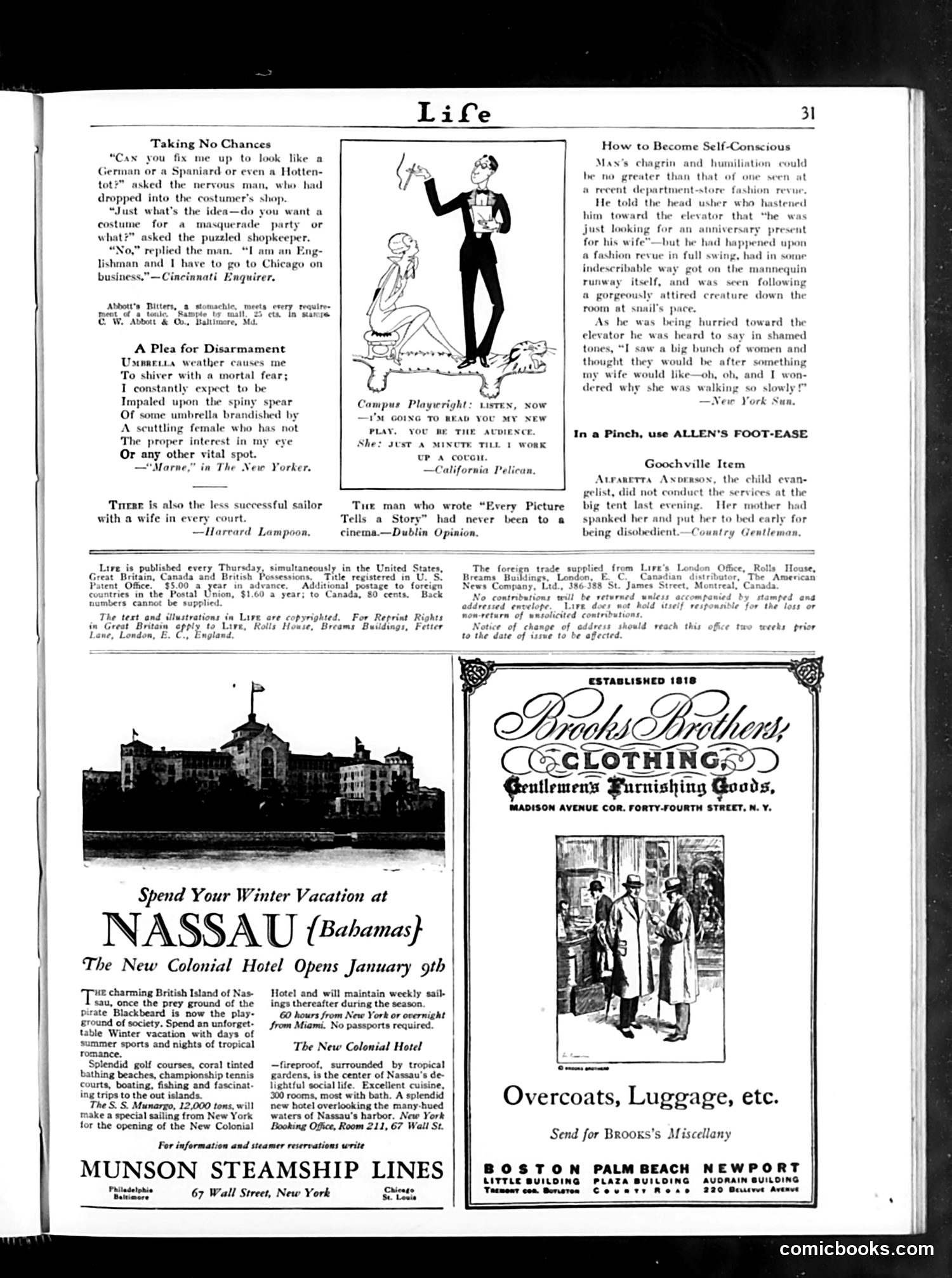
This page contains **three brief satirical jokes** and multiple advertisements: 1. **"Taking No Chances"** (top left): A man asks a tailor to create a costume resembling a German or Spaniard for a masquerade party. The joke: he's actually an Englishman going to Chicago on business and wants to avoid being recognized by fellow Chicagoans—implying English businessmen faced social ridicule or unwanted attention there. 2. **"A Plea for Disarmament"** (middle left): A humorous complaint about aggressive umbrella-wielders during bad weather, personified as scatterbrained women who endanger passersby—typical period humor mocking women's spatial awareness and carelessness. 3. **"Campus Playwright"** (cartoon, center): A male playwright rehearses his new play with a female audience member, who interrupts asking to "work up a cough"—satirizing theatrical pretension and absurdity. The remainder is **advertisements** for winter vacations (Nassau), Brooks Brothers clothing, and foot care products—typical 1920s Life magazine commercial content.
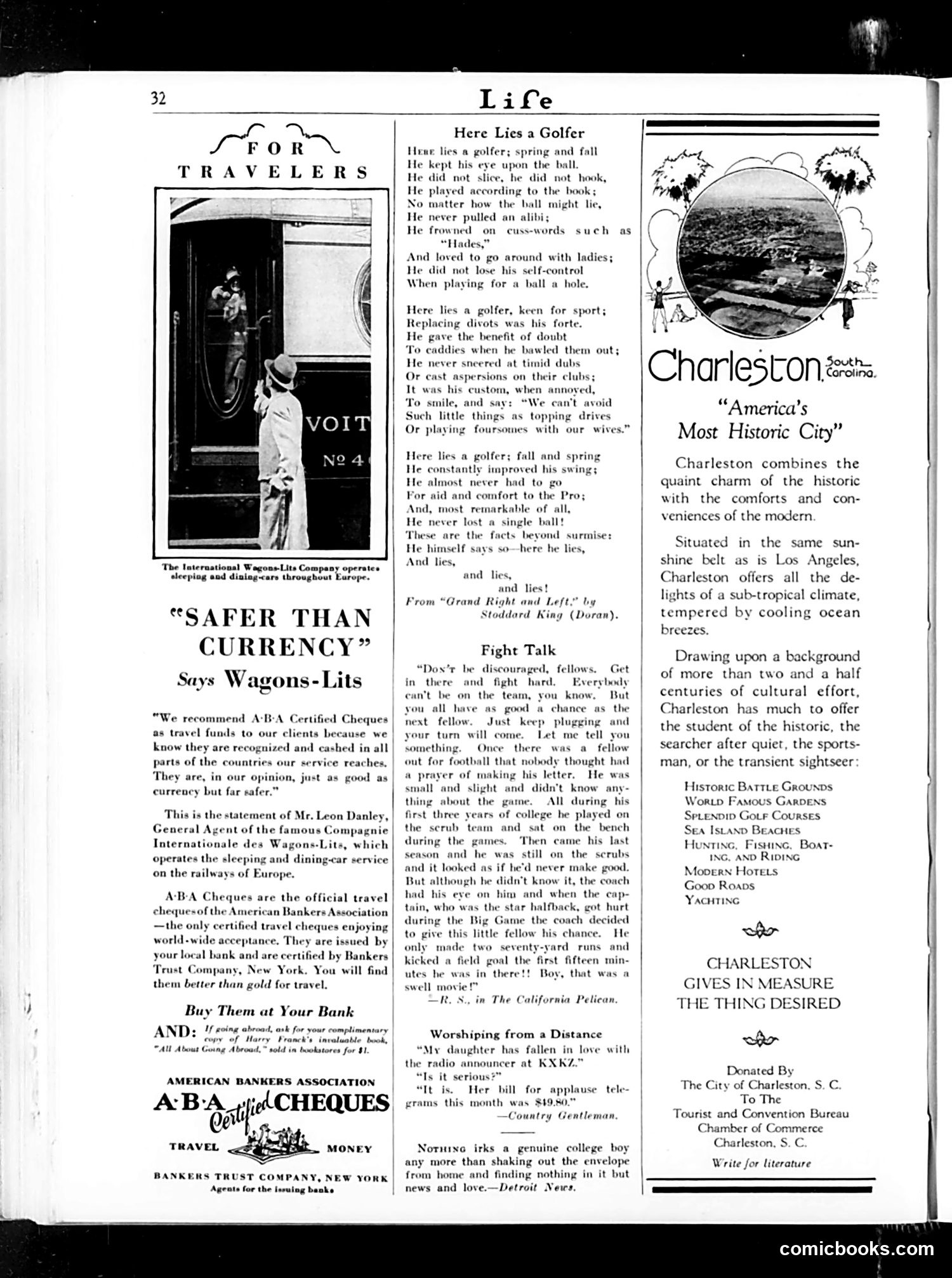
This page combines travel advertising with humorous editorial content. The main advertisement promotes A-B-A Certified Cheques as safer than currency for European travel, featuring a photo of a Wagons-Lits (sleeping car) conductor and endorsement from the company operating European rail service. The editorial humor includes: **"Here Lies a Golfer"** — A mock epitaph satirizing the "perfect gentleman golfer" who follows all rules, maintains composure, never cheats, and—most ironically—"never lost a single ball." The repeated final lines ("and lies, and lies, and lies") mock the impossibility of such perfection, suggesting golfers are inherent exaggerators. **"Fight Talk"** and other brief anecdotes mock sports enthusiasm and college boy culture—including a joke about a radio announcer and a daughter sending expensive applause telegrams. The Charleston tourism section promotes the southern city's historical attractions and climate. Overall, this is a typical 1920s Life page mixing commercial messaging with lighthearted satire about American leisure, sports, and social conventions.
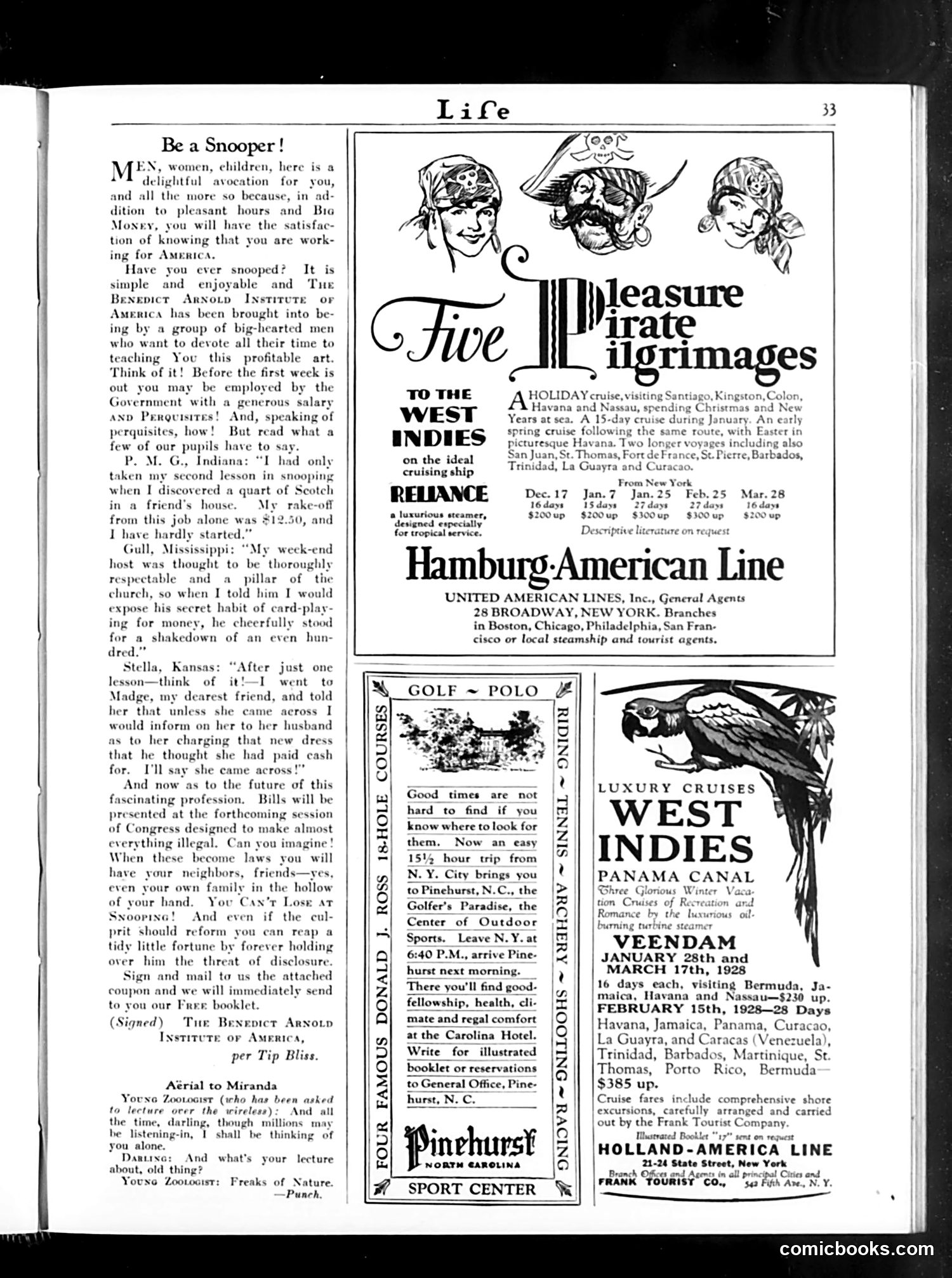
This page satirizes Prohibition-era enforcement and government overreach. The main article promotes the fictional "Benedict Arnold Institute of America," which trains citizens as paid informants ("snoopers") to report neighbors' violations—particularly illegal alcohol possession. The satire targets the popular practice of blackmail and extortion that flourished under Prohibition. The testimonials describe citizens informing on friends and acquaintances for personal profit, with one explicitly describing extortion ("shakedown"). The reference to Benedict Arnold—America's most famous traitor—underscores the betrayal inherent in this informant culture. The piece mocks both the government's dependence on citizen surveillance and Americans' willingness to profit from each other's misdeeds. It's dark humor about how Prohibition incentivized dishonesty and corruption among ordinary people. The page also contains typical period travel advertisements, unrelated to the satire.
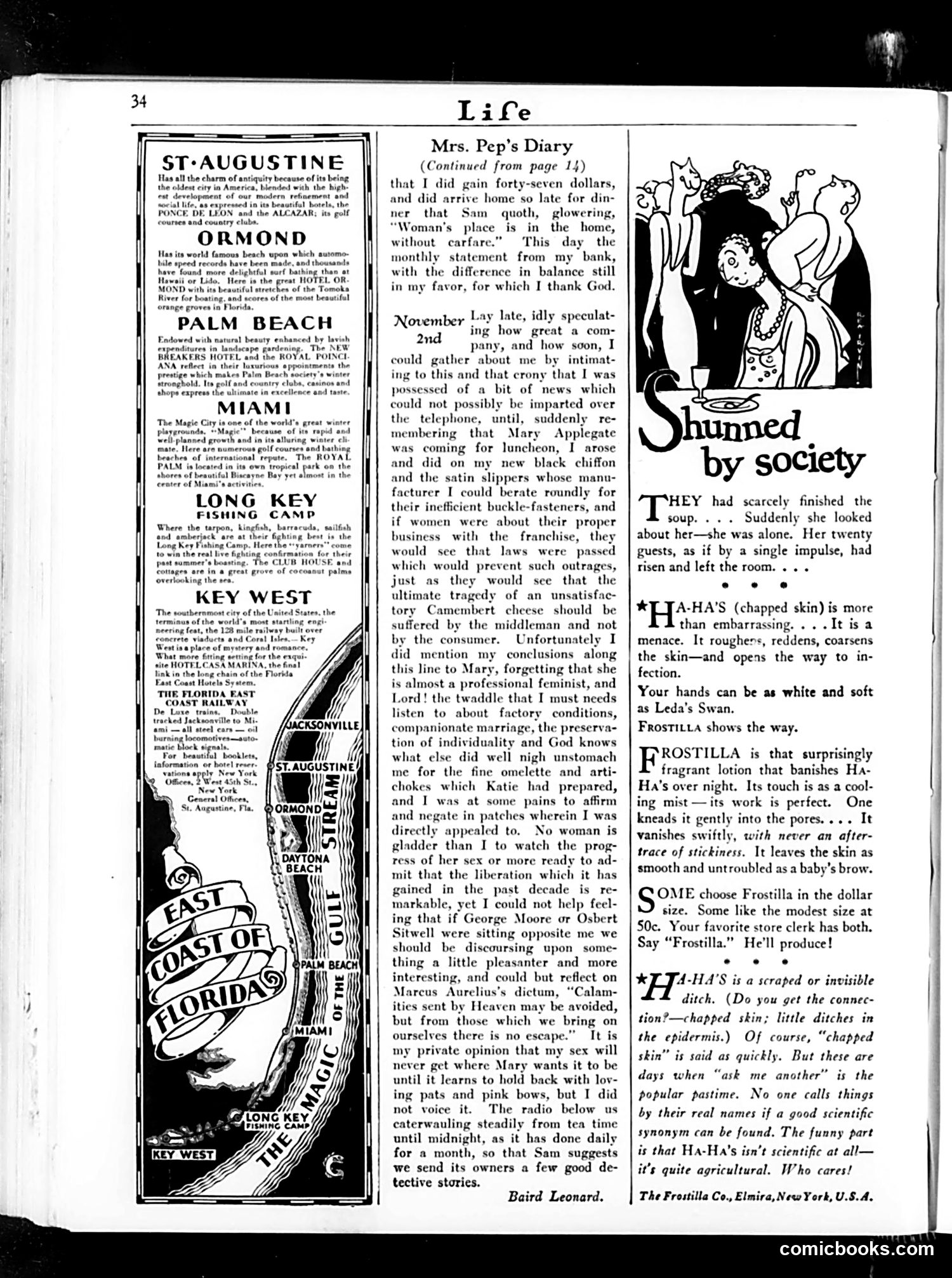
This page combines a travel advertisement section (left) promoting Florida destinations—St. Augustine, Ormond, Palm Beach, Long Key Fishing Camp, and Key West—with two separate satirical pieces. **"Mrs. Pep's Diary"** mocks upper-middle-class women's contradictions. The diarist gains money through her own business ventures, yet her husband insists "Woman's place is in the home." She admires women's liberation yet finds feminist friend Mary Applegate's conversation about factory conditions and "companionate marriage" tedious—she'd prefer discussing literature with men instead. The satire targets women who support gender equality in theory while resisting it in practice, and their discomfort with serious discussions of women's rights. **"Shunned by Society"** (right) is an advertisement for Frostilla lotion, satirizing social anxiety. A hostess's guests abruptly abandon her mid-dinner, apparently due to visible chapped skin (labeled "Ha-Ha's"). The product promises to restore social acceptability by eliminating this skin condition—a humorous exaggeration of cosmetic anxiety and social pretension. Both pieces satirize 1920s-era vanity and hypocrisy.
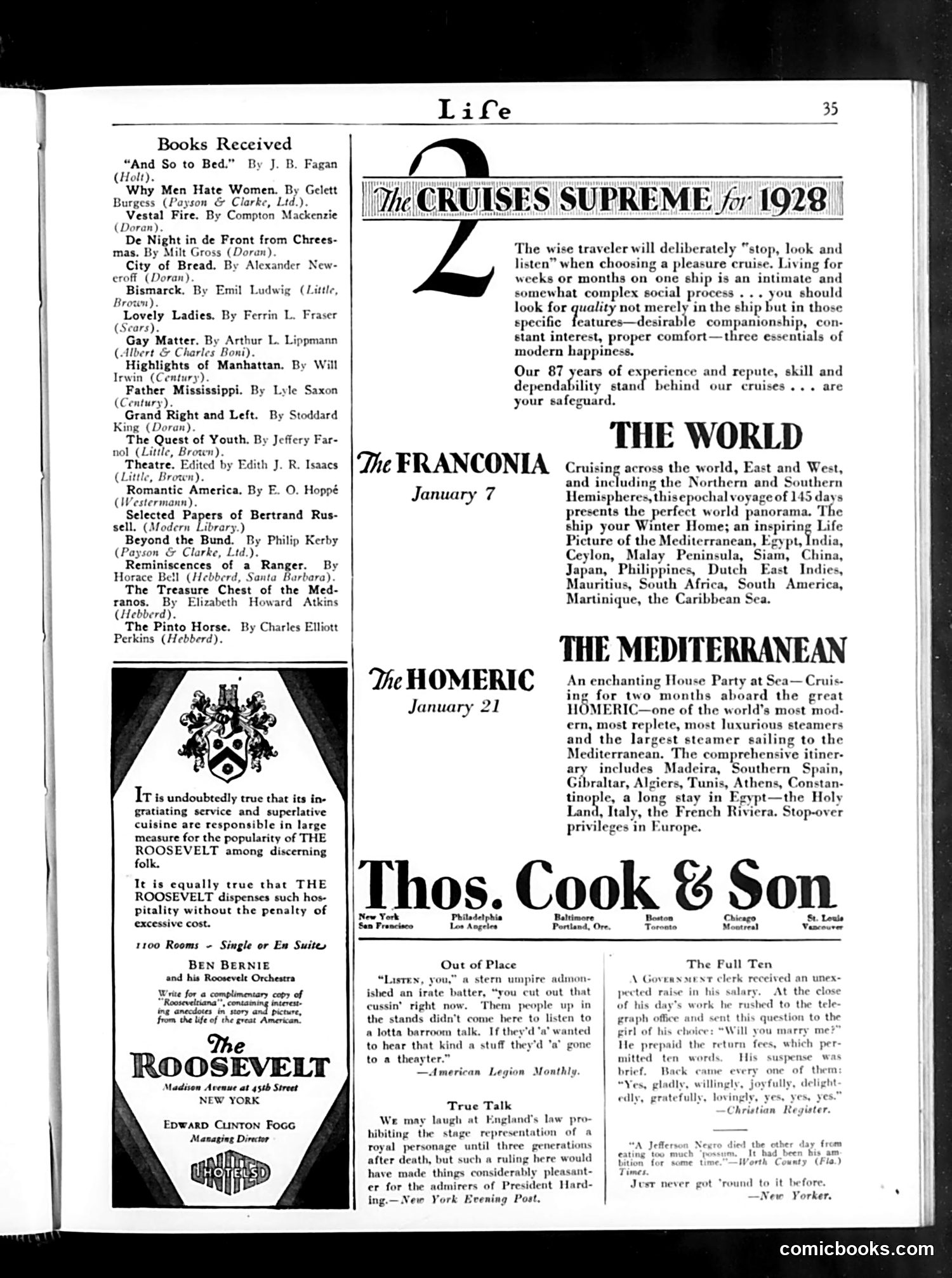
This page is primarily **advertising and book reviews**, not political satire. The dominant content features cruise ship advertisements for 1928 voyages—the Franconia (world circumnavigation) and Homeric (Mediterranean)—emphasizing luxury, comfort, and social refinement for wealthy travelers. A small advertisement promotes **The Roosevelt Hotel** in New York, noting its superior service and reasonable pricing. The **Books Received** section lists recent publications, mostly literary works and biographies from 1927-1928. Two brief **humor snippets** appear at bottom: "Out of Place" mocks an umpire forbidding ballpark profanity (targeting working-class behavior), and "True Talk" references England's law restricting theatrical depictions of royalty for three years after death. The page reflects **1920s consumer culture and class attitudes**—targeting educated, affluent readers interested in world travel and literature. The humor reinforces period gentility standards and social propriety.
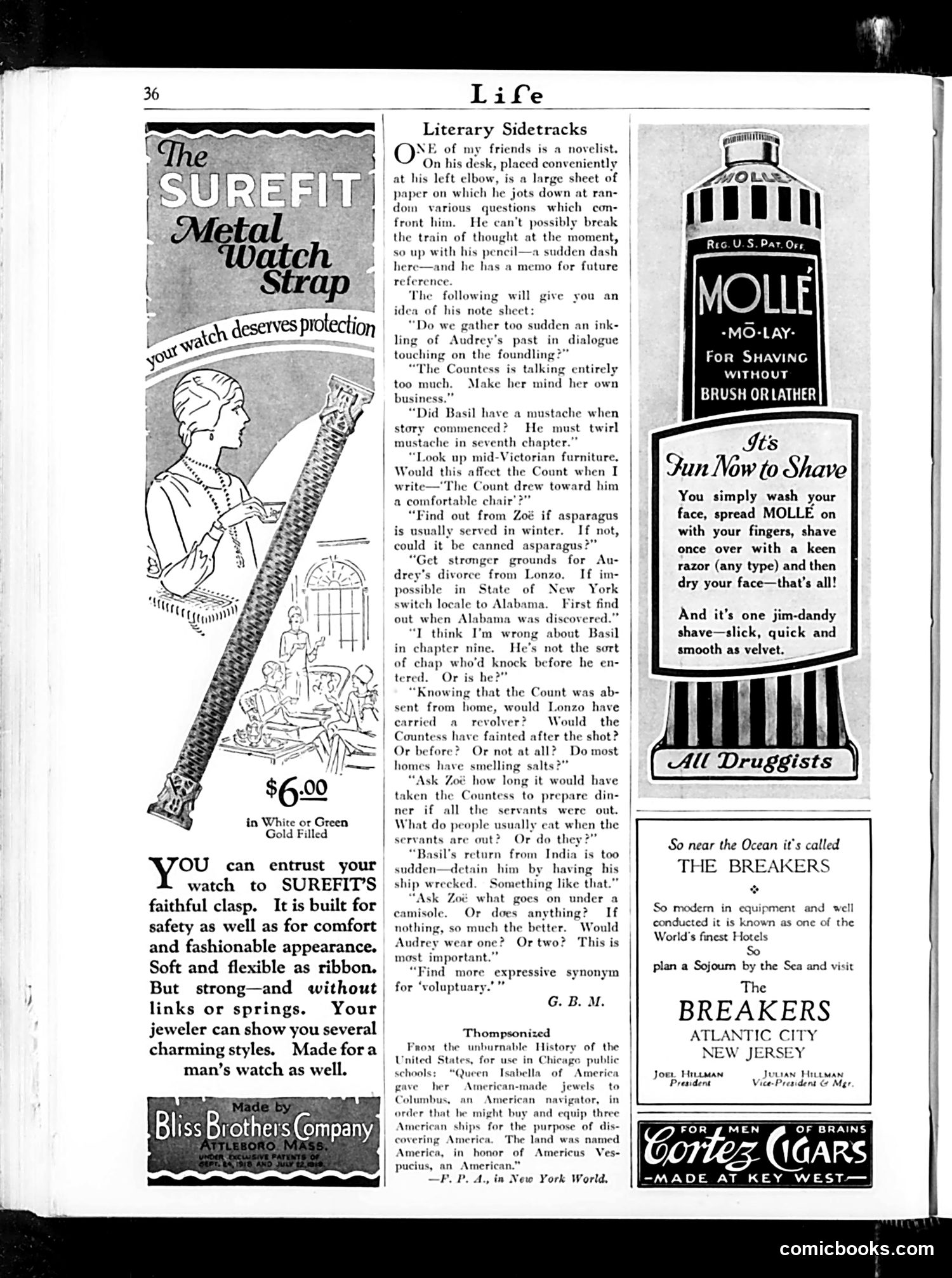
This page is primarily **advertising and light editorial content**, not political satire. The "Literary Sidetracks" section humorously depicts a novelist's note-sheet filled with mundane practical questions that interrupt creative writing—character details (mustache timing, divorce grounds), historical facts (when Alabama was discovered), domestic logistics (asparagus seasonality, servant schedules), and wardrobe considerations. The satire gently mocks novelists' tendency to get bogged down in trivial continuity details rather than focusing on narrative flow. The "Thompsonized" history is a brief joke playing on period names: Queen Isabella supposedly gave Columbus American-made jewels to finance ships discovering "America"—a circular, absurd origin story that treats naming conventions as causally backwards. The remainder consists of straightforward advertisements: the Surefit watch strap, Molle shaving cream, the Breakers hotel, and Cortes cigars. This reflects Life's business model of mixing light humor with paid advertising content.
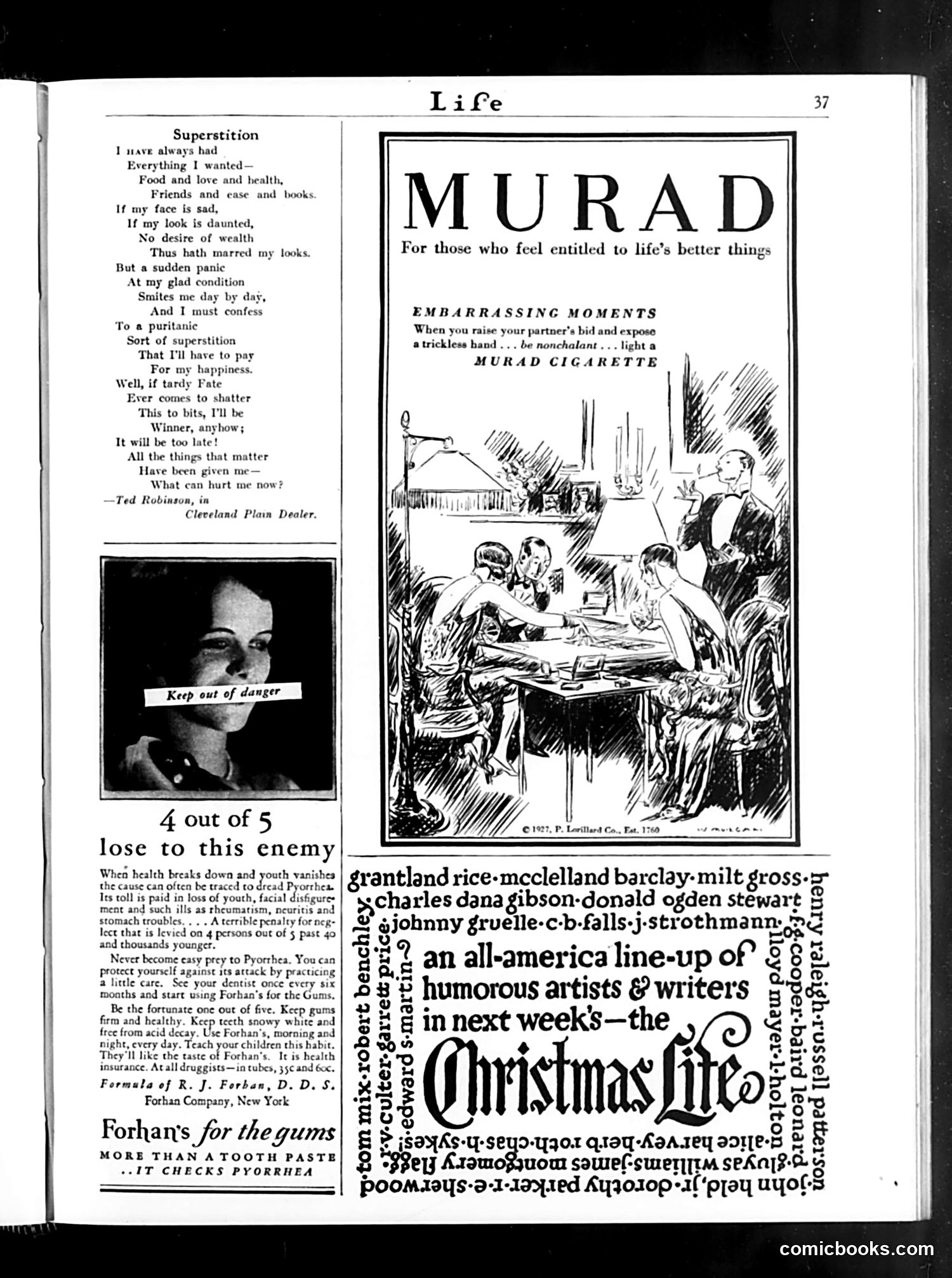
This page contains **poetry and advertisements** rather than political cartoons. The left side features Ted Robinson's poem "Superstition" about fear that good fortune will inevitably be punished—a common psychological anxiety expressed through verse. Below is a **Forhan's toothpaste advertisement** exploiting health fears. It claims that pyorrhea (gum disease) causes serious ailments like rheumatism and disfigurement, affecting "4 out of 5" people over 40. This uses scare tactics typical of early 20th-century patent medicine advertising—exaggerating disease severity to sell products. The right side advertises **Murad cigarettes** with a cartoon showing people playing bridge. The humor involves smoking to appear calm during an awkward card-game moment—suggesting cigarettes help manage social embarrassment. This represents an era when cigarettes were actively marketed as stress-relief products without health warnings. The page also announces upcoming **Life magazine content** featuring prominent humorists and artists of the period.
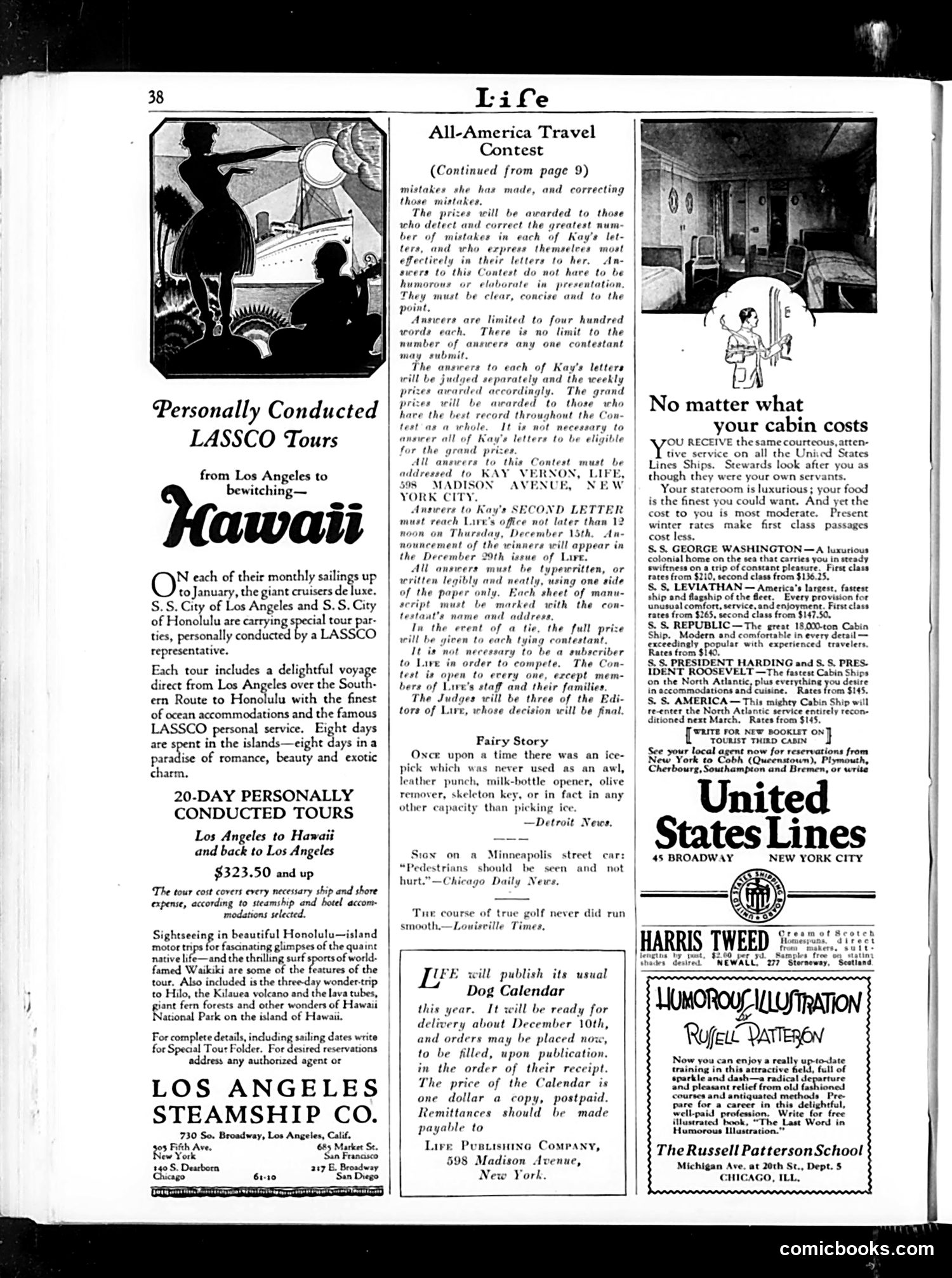
This page is **primarily advertising and contest information**, not satirical content. The top silhouette illustration advertises LASSCO steamship tours to Hawaii—a luxury travel service. The silhouetted figures suggest romance and exotic adventure, appealing to affluent Depression-era readers seeking escape. The page mainly promotes Life magazine's "All-America Travel Contest," where readers identify and correct mistakes in letters from a character named Kay Vernon. Winners receive travel prizes. The small "Fairy Story" section offers mild humor: an ice pick that was *only* ever used for picking ice—a joke about something fulfilling its single intended purpose, contrasting with the Swiss Army knife-like versatility the opening suggests. The street-car quote about pedestrians being "seen and not hurt" is dry observational humor. The right side advertises ship lines and travel services. This is a **commercial page**, not political satire.
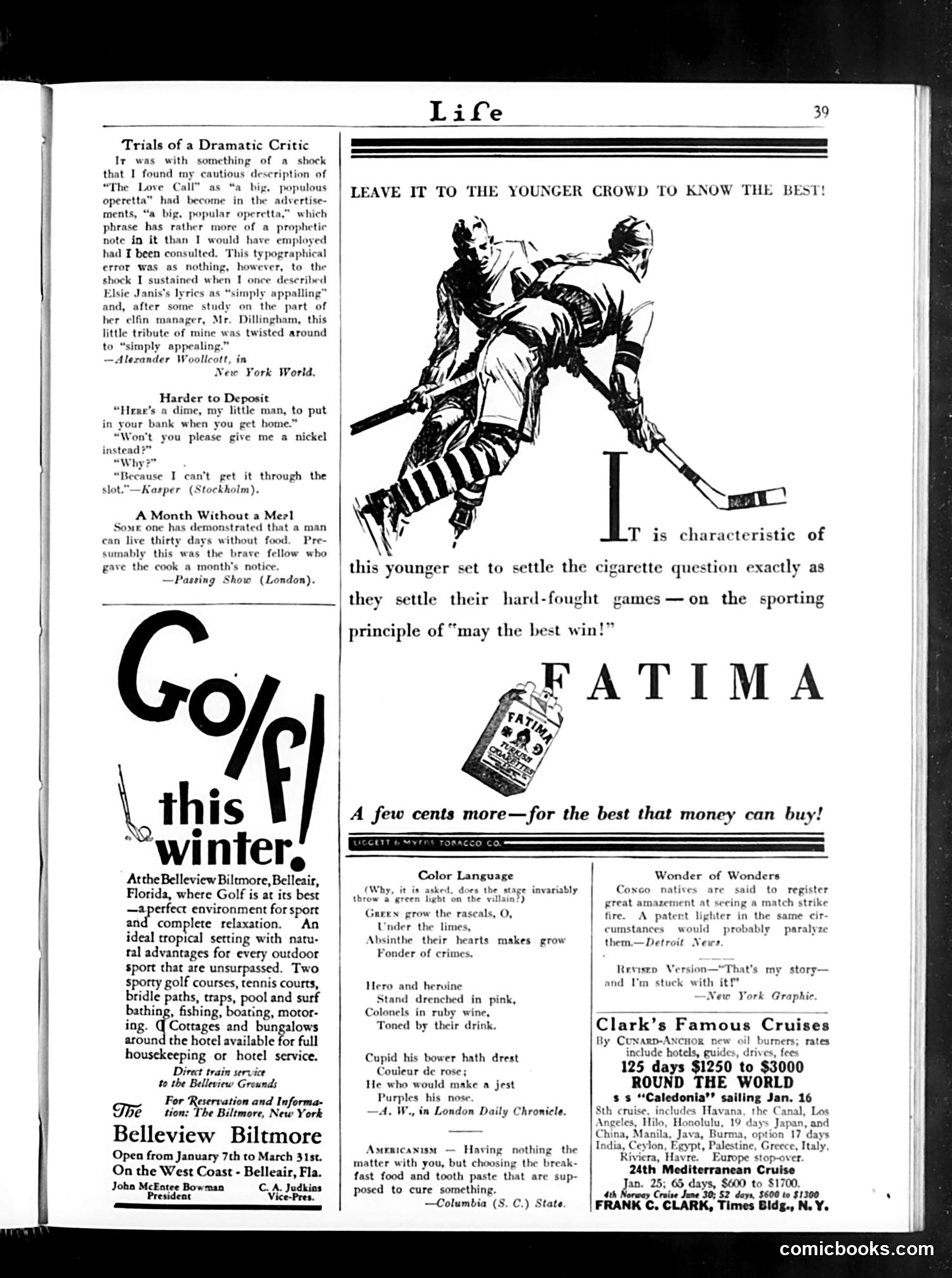
This page is primarily **advertising**, with minimal editorial content. The top section contains three brief humorous anecdotes attributed to various publications, including a piece by Alexander Woollcott about typographical errors in theater criticism. The dominant visual element is a **hockey illustration** promoting **Fatima cigarettes**. The image shows two players in dynamic action, with the accompanying text suggesting that young people settle disputes—whether about cigarettes or sports—on "the sporting principle of 'may the best win!'" This is a straightforward cigarette advertisement leveraging masculine athleticism and competition to appeal to younger consumers. The remaining content consists of standard period advertisements: a Florida golf resort (Belleview Biltmore), Clark's cruise line packages, and various miscellaneous items including literary humor columns about banking, food budgets, and linguistic observations. The page represents typical 1920s-era commercial publication content mixing light editorial humor with prominent paid advertising.
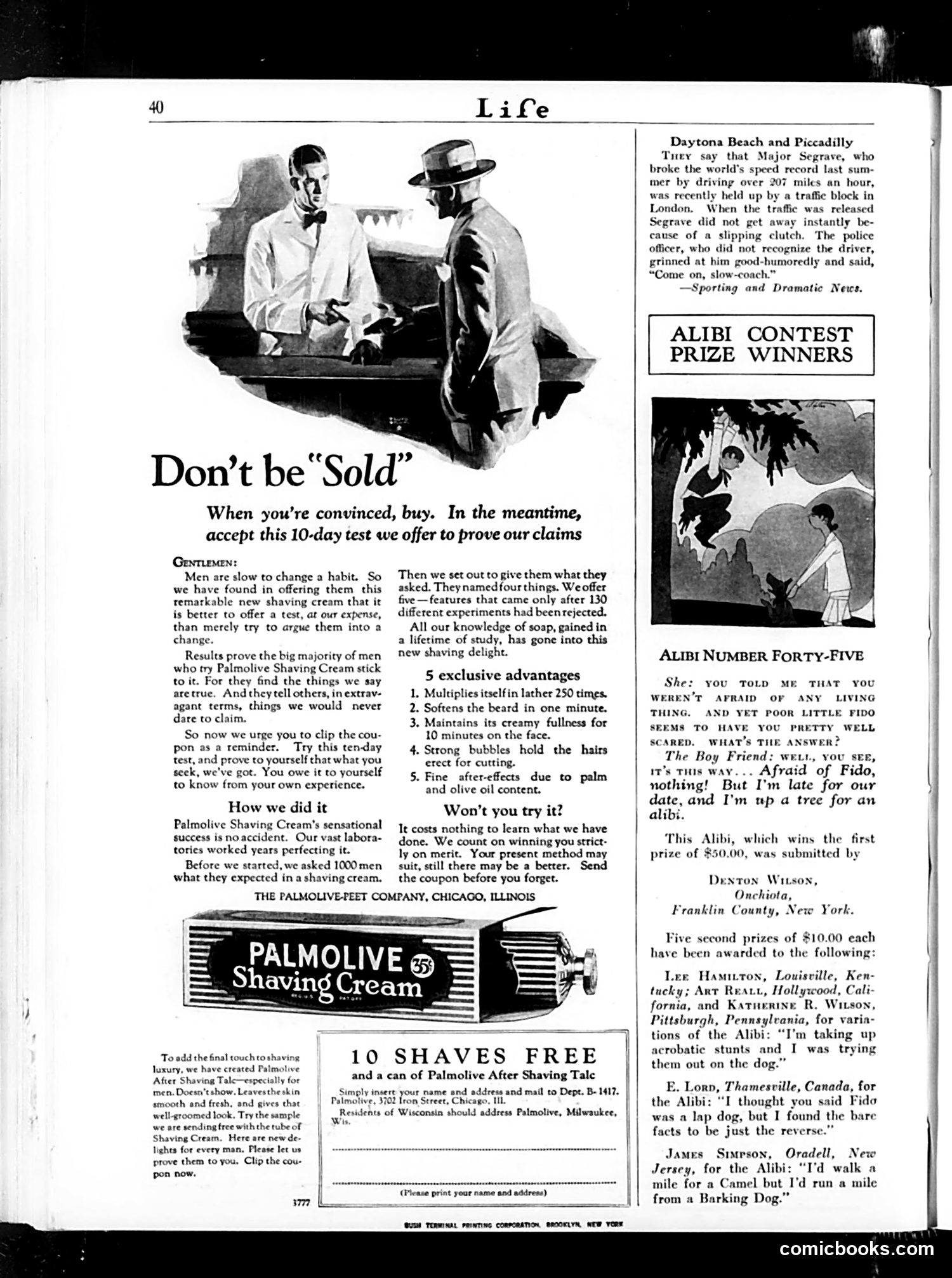
This page is primarily a **Palmolive Shaving Cream advertisement** with a small "Alibi Contest" feature. **The Main Advertisement:** The large illustration shows two men in conversation—one appears to be a salesman or representative pitching the product to a skeptical customer. The headline "Don't be 'Sold'" uses ironic wordplay: it tells men not to be persuaded by mere sales talk, but rather to test the product themselves. The ad emphasizes Palmolive's confidence in its formula, offering a free 10-day trial. The copy boasts of "five exclusive advantages" developed through 130 experiments, appealing to masculine logic and self-reliance rather than emotional salesmanship. **The Alibi Contest Section:** This is a humor feature where readers submitted funny excuses. The winning entry involves a boyfriend making up an elaborate excuse (climbing a tree) to explain why he's late for a date, attributing it to the dog. The humor relies on absurdist logic typical of 1920s magazine humor. Overall, this reflects early 20th-century advertising strategy: rational product claims paired with magazine entertainment to engage male readers.
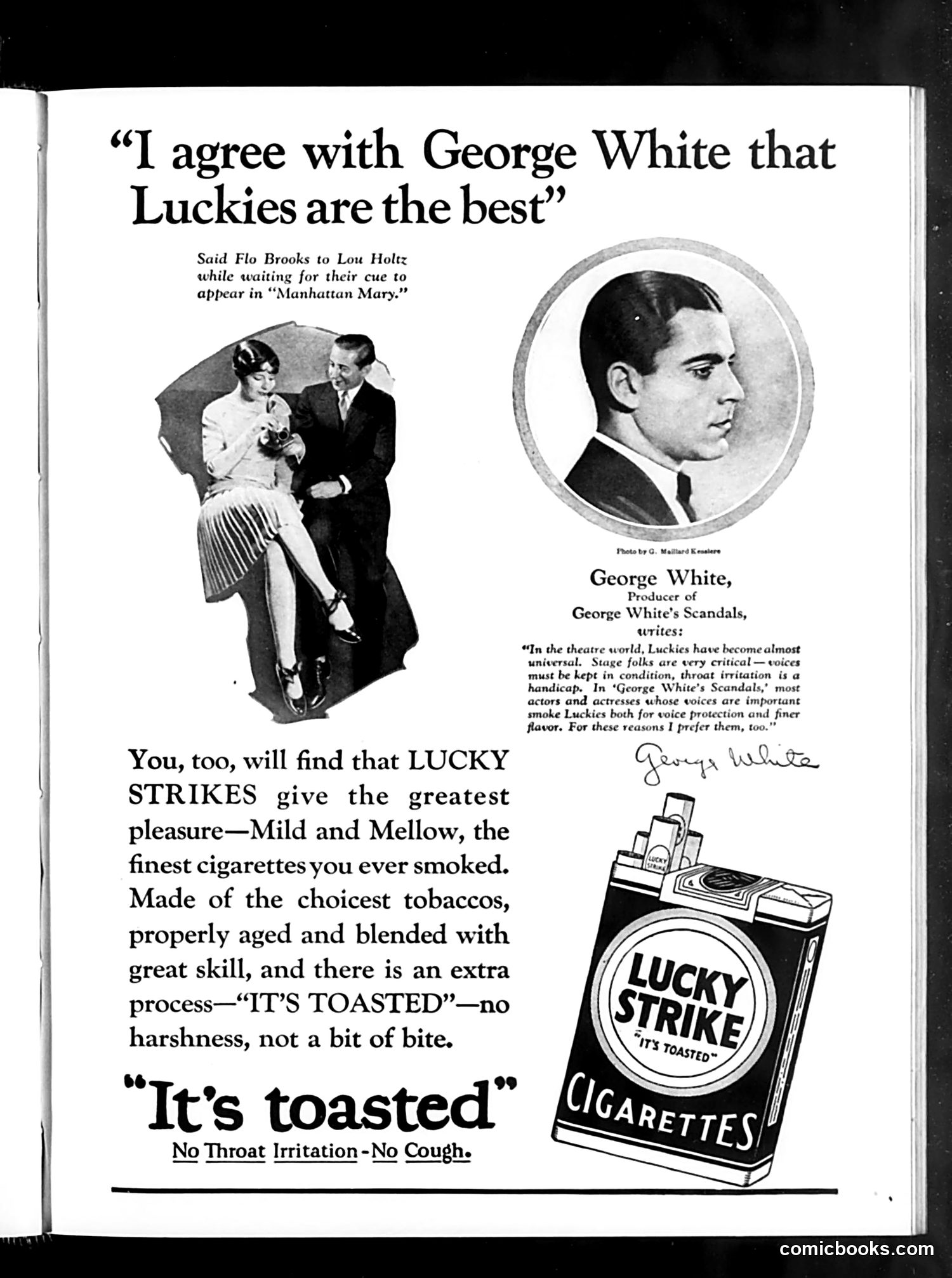
This is a **Lucky Strike cigarette advertisement** disguised as entertainment journalism, not political satire. The page features **George White**, a real Broadway producer known for the "Scandals" revue series, endorsing Lucky Strikes alongside actors **Flo Brooks** and **Lou Holtz** from the show "Manhattan Mary." The advertisement uses a common 1920s-30s marketing tactic: celebrity endorsement. White claims actors prefer Luckies because the "toasted" process protects voices—a health claim that would later be exposed as misleading. The stated benefit of "no throat irritation, no cough" directly contradicts modern knowledge about smoking. This represents **early celebrity-driven advertising** before regulations restricted such endorsements. The "Life" magazine context suggests this appeared alongside actual entertainment journalism, blurring advertisement and editorial content—a practice now heavily regulated.
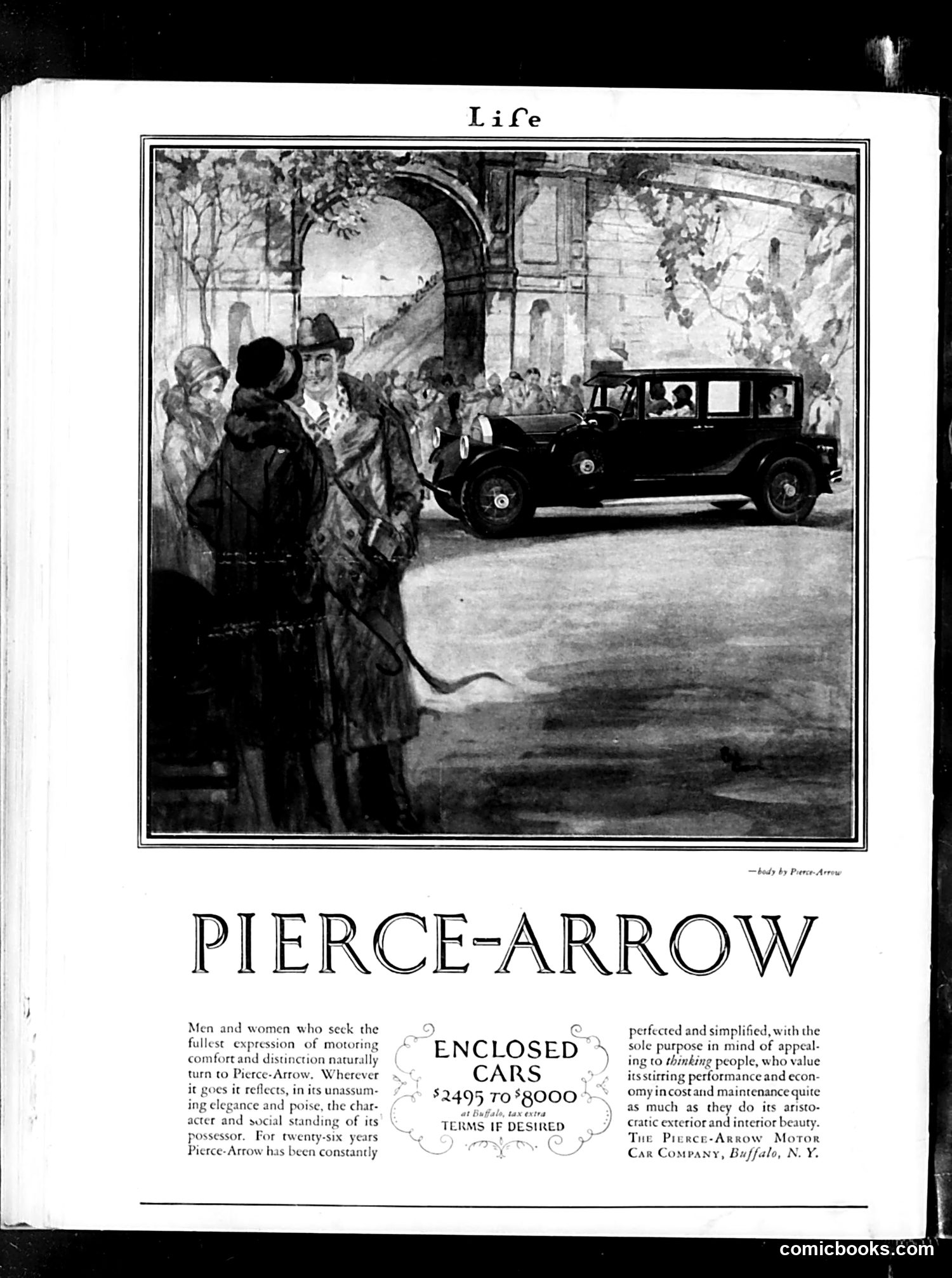
This is primarily a **car advertisement**, not political satire. It's a full-page ad for Pierce-Arrow automobiles from Life magazine, featuring an illustration rather than a cartoon. The image depicts an elegant urban street scene with well-dressed pedestrians observing a Pierce-Arrow automobile passing by—a typical advertising trope of the era. The composition suggests that owning this car signals wealth and social status to onlookers. The text emphasizes luxury and exclusivity: the car appeals to "thinking people" who value both performance and "aristocratic exterior and interior beauty." Prices range from $2,495 to $8,000 (substantial sums in this period), with financing available. The overall message is straightforward brand positioning: Pierce-Arrow represents refined taste and social distinction. There is no satirical commentary visible—this is straightforward luxury marketing aimed at upper-class consumers. The phrase about reflecting "the character and social standing of its possessor" makes the status-symbol appeal explicit.