
Life, 1927-11-24 · page 32 of 44
Life — November 24, 1927 — page 32: what you’re looking at
What you’re looking at
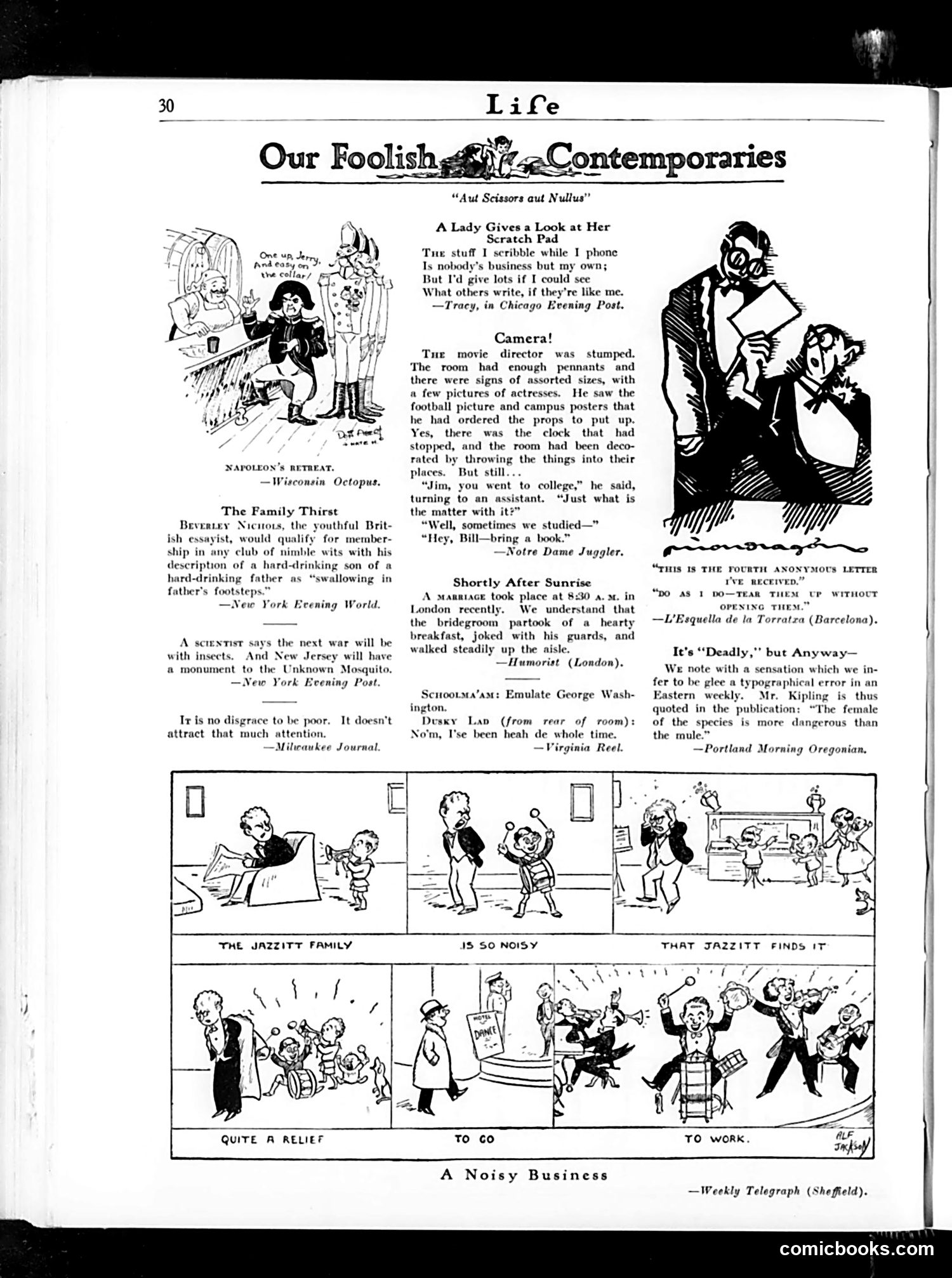
This page collects humorous observations and cartoons mocking contemporary society and literary culture. The main cartoon "A Noisy Business" (bottom) depicts the "Jazzitt Family"—a satirical jab at jazz-age households of the 1920s, showing a family creating excessive noise that forces the father to escape to work for "relief." Jazz culture and its association with loud, chaotic modernity was a common target of period satire. The scattered quotations above ridicule various social types: a lady indiscreetly writing notes while phoning, a movie director struggling to authentically recreate college life, and a marriage where the bridegroom ate heartily before his (implied) execution—a dark joke about capital punishment. The final item mocks a typographical error misquoting Kipling's famous line about dangerous females. Throughout, the page lambastes modern manners, technology, and cultural shifts through reprinted jokes from various newspapers.
📄 Transcribed text from this page (OCR, searchable)
Machine-transcribed from the original scan — historical spelling and the odd misread are preserved.
Ove up Jer fredeeny te wwe collars Dat Fee} NAPOLEON'S RETREAT. —Wisconsin Octopus. The Family Thirst Bevertey Nicuows, the youthful Brit- ish essayist, would qualify for member- ship in any club of nimble wits with his description of a hard-drinking son of a hard-drinking fo “swallowing in father's footsteps.” —New York Evening World. Pr as A scteytist says the next war will be with insects. And Jersey will have @ monument to the Unknown Mosquito. —New York Evening Post. Ir is no disgrace to be poor. It doesn’t attract that much attention. ~Milwaukee Journal. “Aut Scissors aut Nullus” A Lady Gives a Look at Her Scratch Pad Tue stuff I scribble while I phone Is nobody's business but my own; But I'd give lots if I could see What others write, if they're like me. —Tracy, in Chicago Evening Post. Camera! Tue movie director was stumped. The room had enough pennants and there were signs of assorted sizes, with a few pictures of actresses. He saw the football picture and campus posters that he had ordered the props to put up. Yes, there was the clock that had stopped, and the room had been deco- rated by throwing the things into their But still... im, you went to college,” he said, turning to an assistant. “Just what is the matter with it?” “Well, sometimes we studied—” “Hey, Bill—bring a book.” —Notre Dame Juggler. Shortly After Sunrise A manaiace took place at 8:30 a. a, in London recently. We understand that the bridegroom partook of a hearty breakfast, joked with his guards, and walked steadily up the aisle. —Humorist (London). Scntootsa’am: Emulate George Wash- ington. I Lap (from rear of room): No'm, I’se been heah de whole time. —Virginia Reel. “cis is THE rovrTHt AN ive CEIVE “po aS 1 DO—TEAR THEM UP wiTHoUT OPENING THEM.” quella de la Torratzra (Barcelona). <YMOUS LETTER It's ‘‘Deadly,"’ but Anyway— We note with a sensation which we in- fer to be glee a typographical error in an Eastern weekly. Mr. Kipling is thus quoted in the publication: “The female of the species is more dangerous than the mule.” —Portland Morning Oregonian, QUITE A RELIEF A Noisy Business —Weekly Telegraph (Sheffield). comicbooks.com