
A complete issue · 36 pages · 1927
Life — October 27, 1927
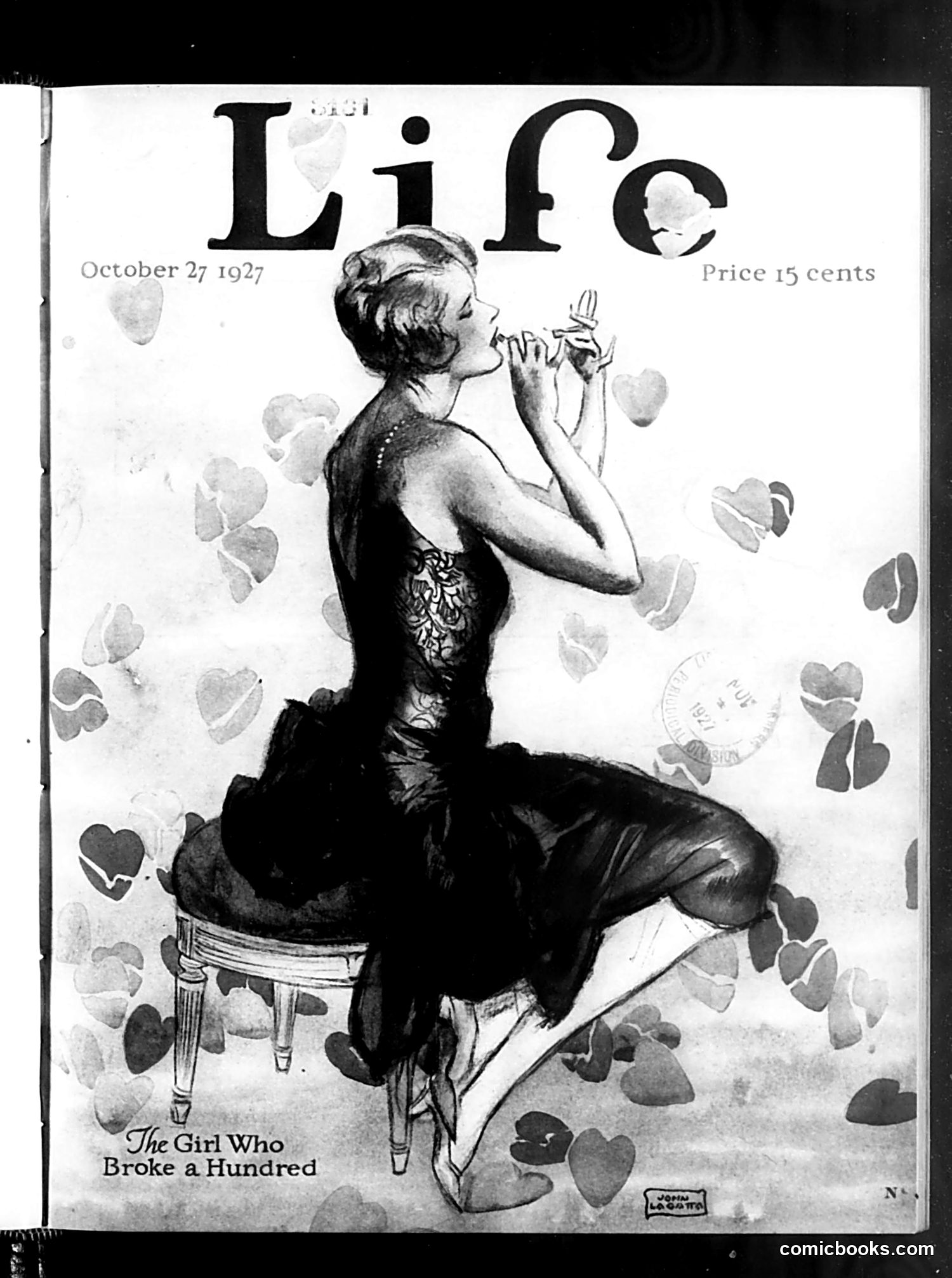
This is a Life magazine cover featuring an illustration titled "The Girl Who Broke a Hundred." The image shows a fashionably dressed woman in 1920s attire (short bobbed hair, elegant black dress) sitting on a chair and applying makeup or cosmetics. She's surrounded by decorative heart shapes. The "hundred" likely refers to driving at 100 miles per hour—a scandalous feat for the era when cars were still relatively new and speed limits were low. The cover satirizes the "modern woman" of the Jazz Age: independent, daring, and willing to break social conventions. The hearts emphasize the flirtatious, rebellious nature of this figure, poking fun at both female recklessness and society's shock at women's newfound freedoms in the 1920s.
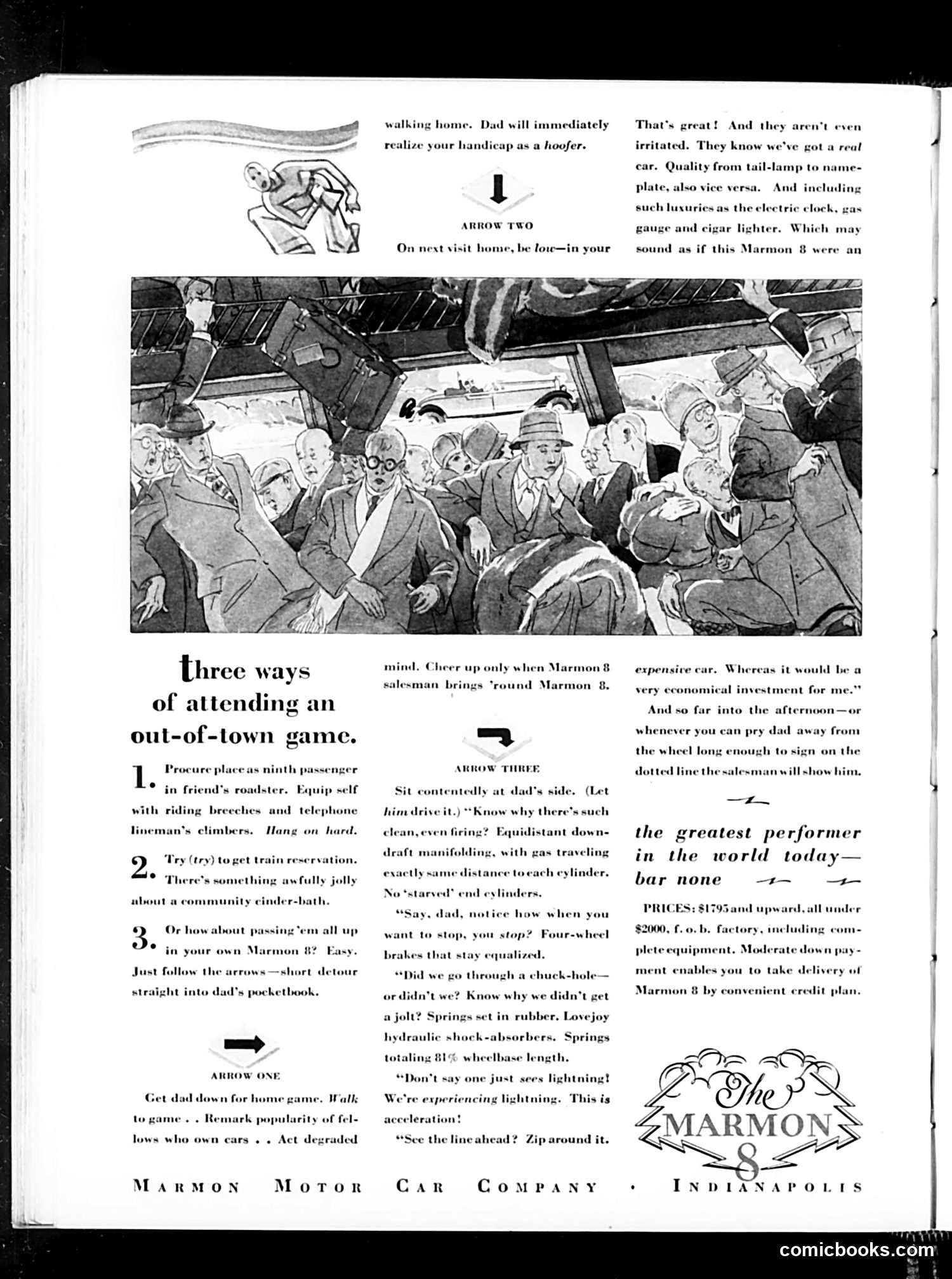
This page is primarily **advertising**, not political satire. It's a Marmon Motor Car Company advertisement from Indianapolis promoting the Marmon 8 automobile. The small cartoon at top-left depicts a man walking home, labeled a "hoofer" (slang for someone who walks). The advertisement uses humor to contrast walking with owning a Marmon 8, which supposedly offers superior quality and luxury features (electric clock, gas gauge, cigar lighter). The large illustration shows a crowded train car of passengers, accompanying "three ways of attending an out-of-town game"—walking, taking a train, or driving your own Marmon 8. The satire gently mocks inconvenient travel alternatives to promote automobile ownership as the superior, more comfortable option for sports fans. The page reflects 1920s consumerism and the aspirational marketing of automobiles.
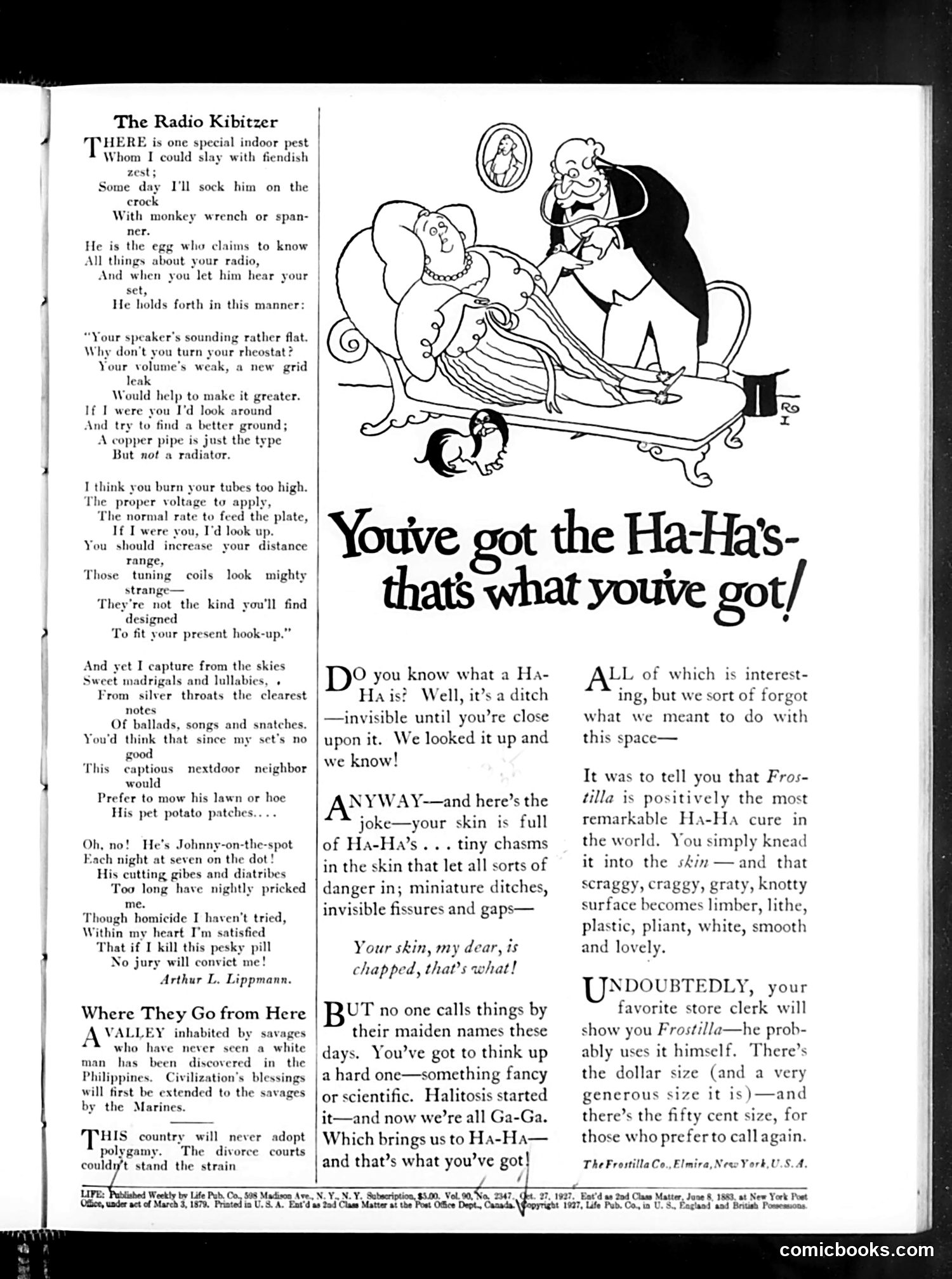
This page combines poetry and satirical advertisement from *Life* magazine (circa 1920s based on typography). **"The Radio Kibitzer"** poem mocks a know-it-all neighbor who offers unsolicited radio repair advice—a reference to early radio technology's novelty and the common frustration of amateur experts. **The main advertisement** for "Frostilla" skin cream uses humor to address a genuine social concern: visible skin imperfections ("Ha-Ha's"—tiny skin fissures). The cartoon shows an exasperated couple where the woman suffers from poor skin condition while a man gestures dismissively. The ad's joke relies on wordplay: transforming the medical term "halitosis" (bad breath, popularized in Listerine ads) into "Ha-Ha"—suggesting the skin condition is laughable/embarrassing. It then promises Frostilla transforms "scraggy, craggy, graty" skin into "smooth and lovely." This reflects 1920s marketing's increasing use of shame and pseudo-scientific language to sell cosmetics.
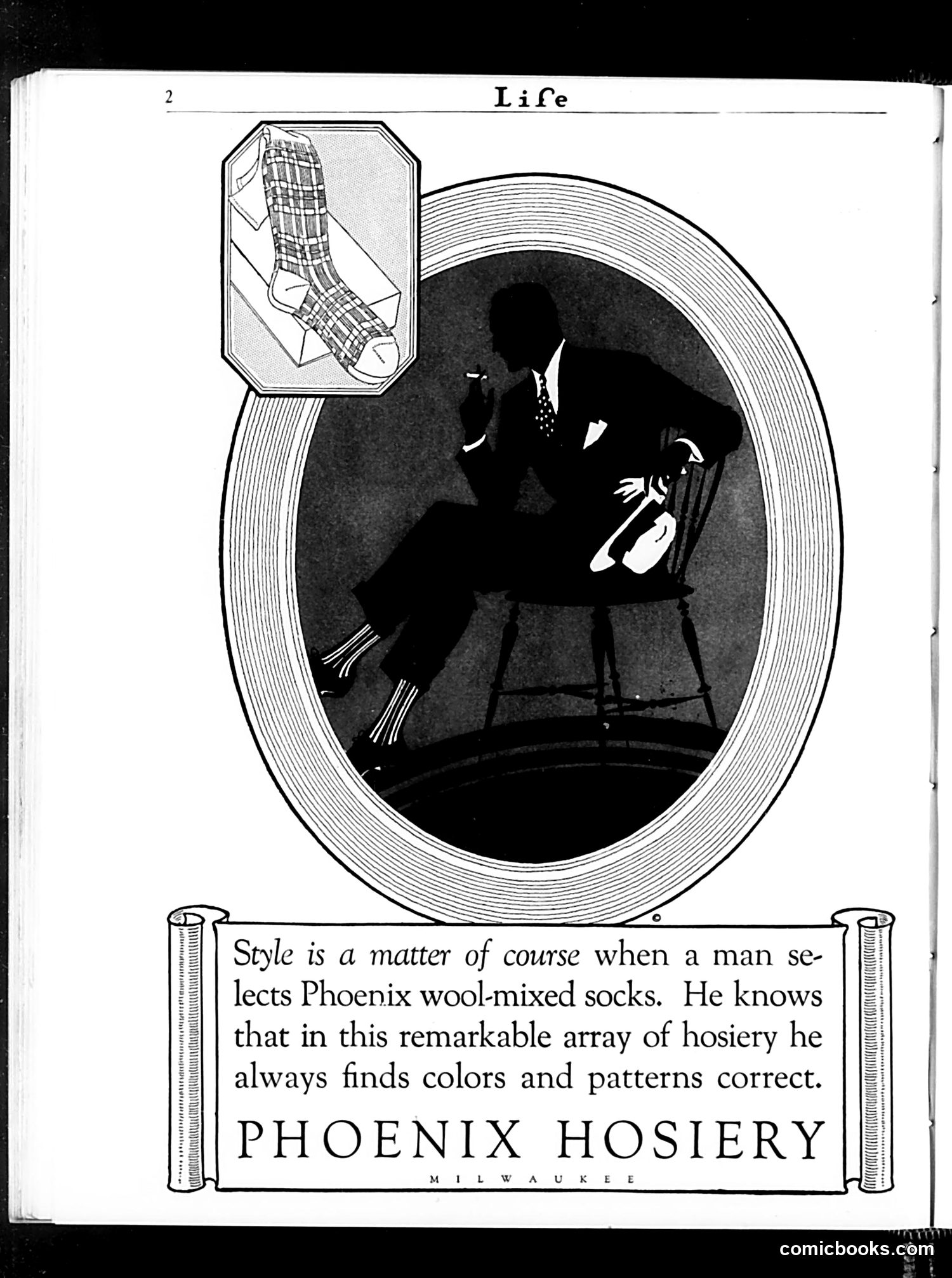
This page is primarily **advertising, not satire or political commentary**. It's a Phoenix Hosiery advertisement from Milwaukee. The image shows a silhouetted man sitting in a chair, examining socks. An inset illustration displays a checkered sock pattern. The accompanying text emphasizes that selecting Phoenix wool-mixed socks demonstrates personal style and taste, as the brand reliably offers correct colors and patterns. This is straightforward early-20th-century product advertising aimed at gentlemen concerned with sartorial propriety. The "style" reference appeals to male vanity and social awareness—suggesting that proper sock selection reflects character and attention to detail. There is no political satire, caricature, or social commentary present on this page.
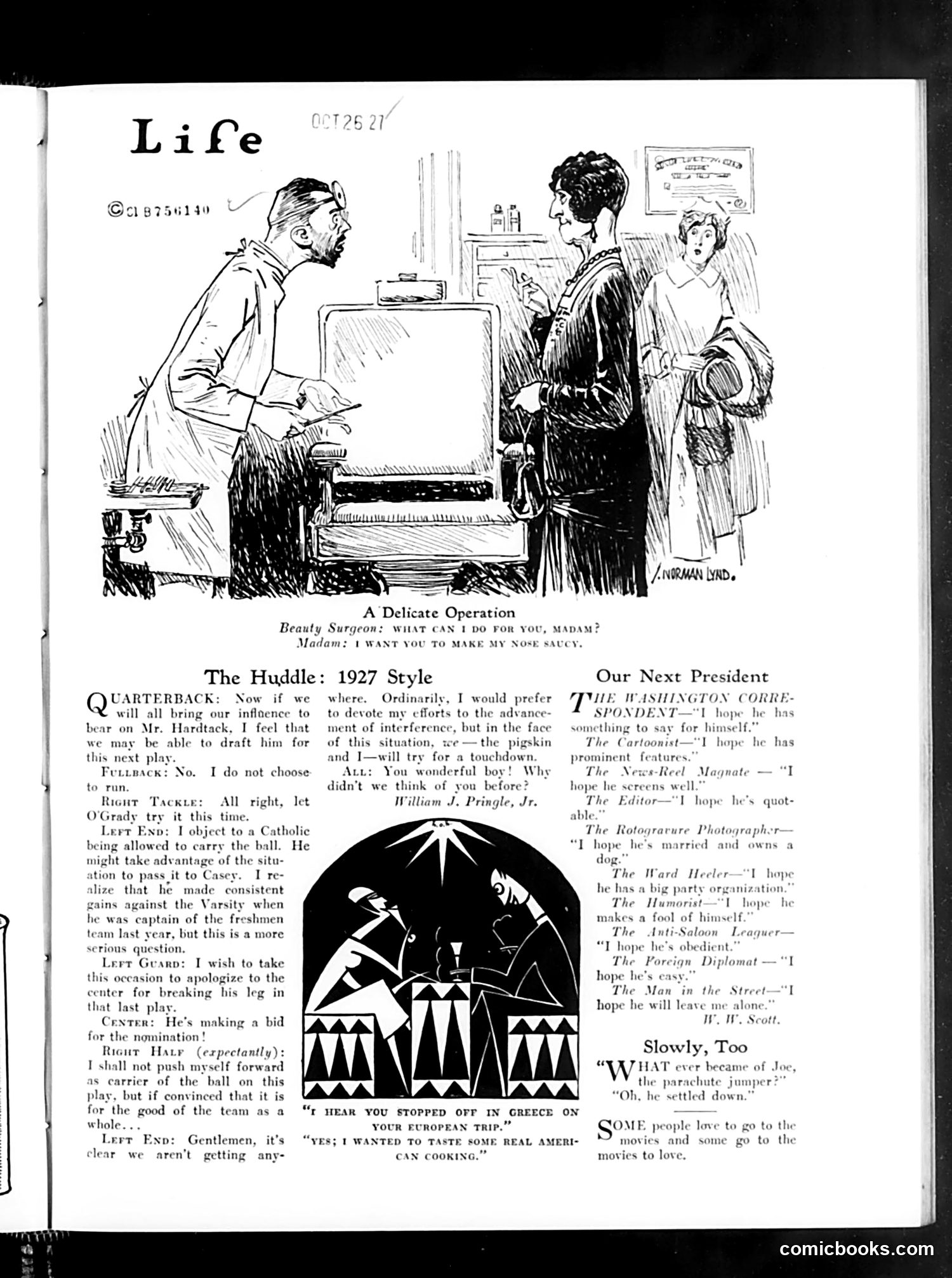
This page contains two main comedic pieces from 1927: **"A Delicate Operation"** (top cartoon): A beauty surgeon is asked by a woman to make her nose "saucy." The humor relies on the then-popular cosmetic surgery trend, satirizing vanity and the growing acceptance of surgical beauty modification. **"The Huddle: 1927 Style"** (left column): Football players discuss strategy, with dialogue satirizing college football politics—specifically debates about Catholic players, eligibility rules, and recruitment advantages. The humor targets the serious nature of college sports administration. **"Our Next President"** (right column): Various figures express hopes about a future president's personal qualities (marriage, dog ownership, obedience) rather than political capabilities—satire on voters prioritizing personality over policy. The page reflects 1920s American concerns: cosmetic surgery, college sports corruption, and superficial electoral preferences.
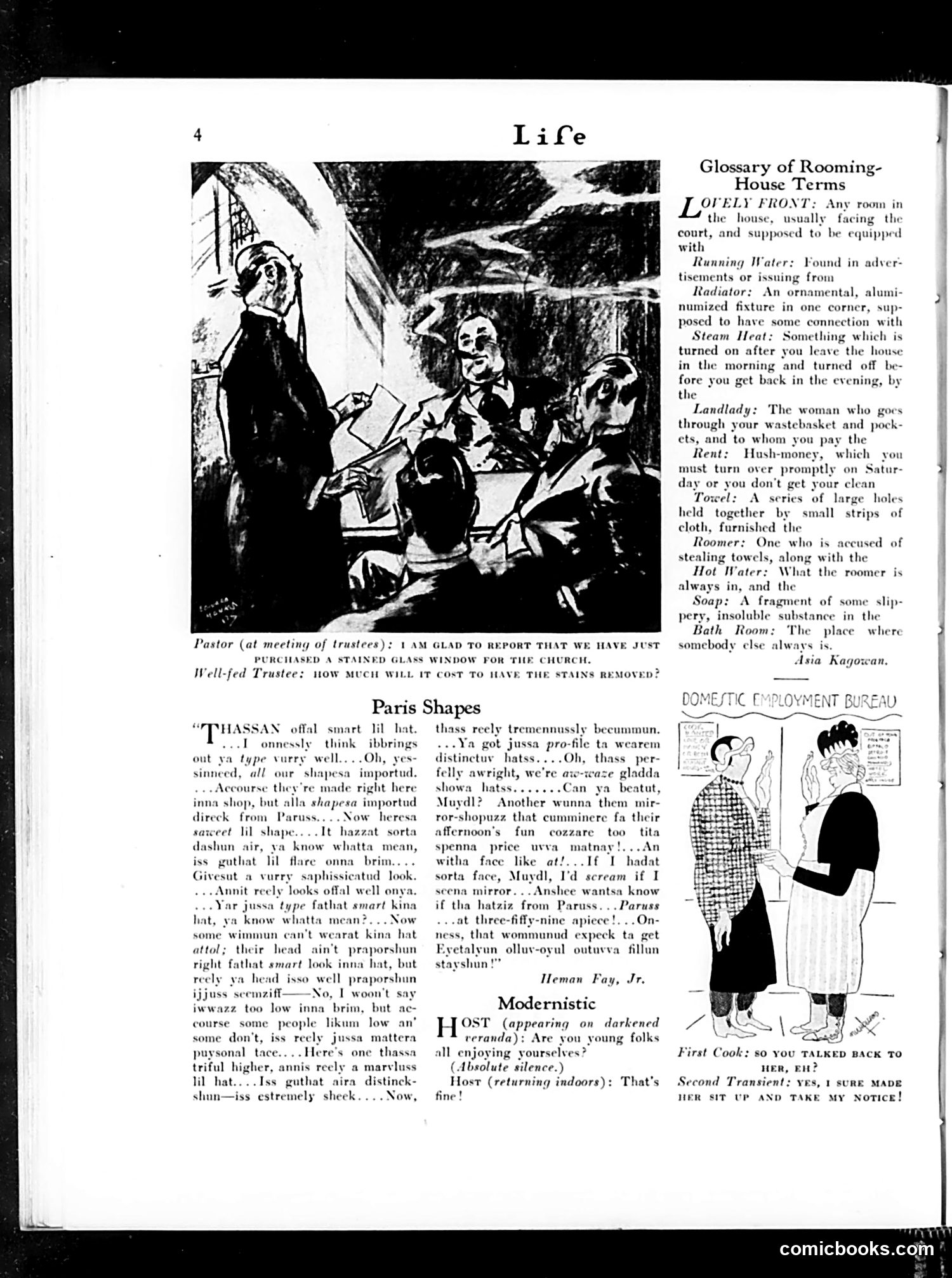
The main illustration depicts a church scene where a pastor reports to trustees about a stained glass window. The humor relies on a housing/rooming glossary sidebar, suggesting this is about the challenges of urban apartment living—a staple of Life's satirical content. Below that, "Paris Shapes" mocks Parisian French fashion slang and affectations, using exaggerated dialect to satirize how Americans perceived French style pretension. The rapid-fire phrases ("type smart," "sorta face") caricature both Parisian fashion terminology and the Americans who adopted it. The "Modernistic" cartoon shows indoors and outdoors dialogue, likely commenting on contemporary social behavior or generational differences during the early-to-mid 20th century, though the specific reference is unclear without additional context.
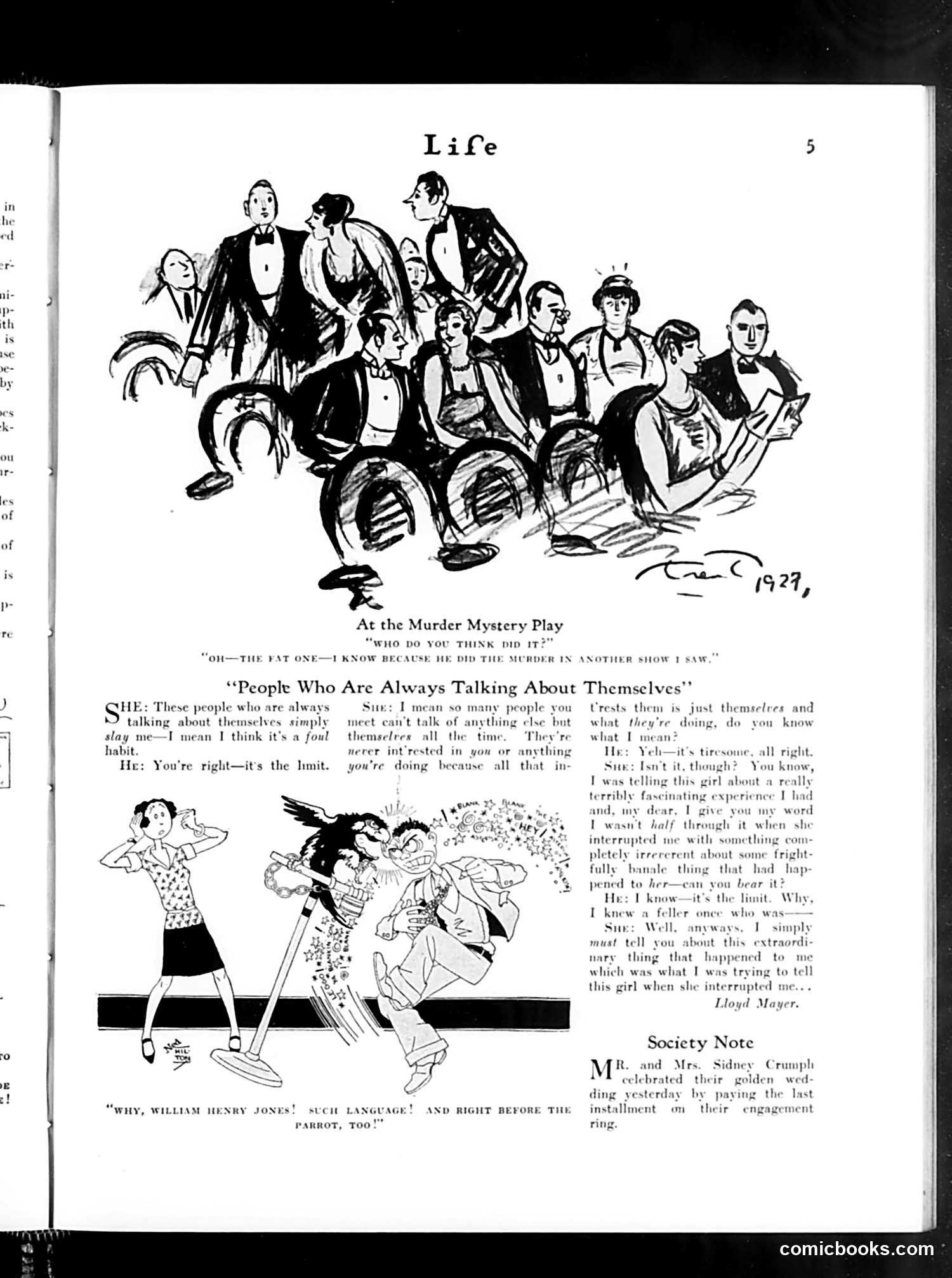
This page satirizes **self-absorbed socialites** through two cartoons: **Top cartoon**: Depicts well-dressed people at a "Murder Mystery Play," with the caption asking "WHO DO YOU THINK DID IT?"—mocking how attendees obsess over trivial entertainment rather than substantive matters. **Bottom cartoon**: Shows a woman interrupting a man's story. The dialogue reveals the satire's core: people "always talking about themselves" can't discuss anything except their own experiences. When the woman tries to tell her own story, she interrupts herself to discuss her own fascinating anecdote instead—illustrating the narcissism being mocked. The humor targets 1920s upper-class social culture, where self-centered conversation dominates gatherings. A brief society note about an engagement appears at right.
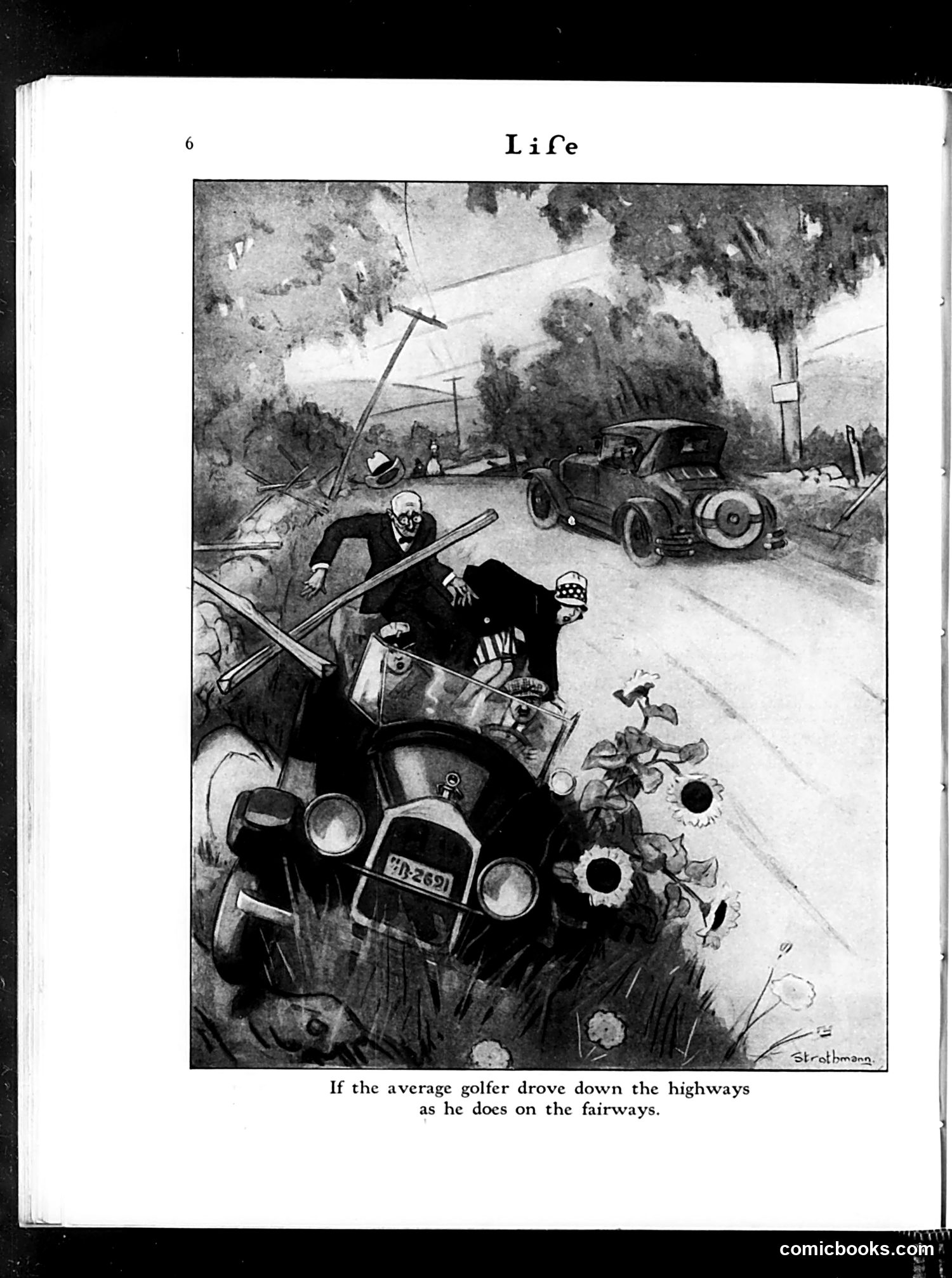
This satirical cartoon from *Life* magazine depicts a humorous critique of golfers' driving habits. The image shows a golfer operating an automobile with the same reckless abandon he uses on the golf course—the car is careening wildly down a highway, decorated with flowers like a funeral wreath, while other vehicles swerve to avoid it. The caption reads: "If the average golfer drove down the highways as he does on the fairways." The satire plays on the stereotype that golfers are poor drivers on the golf course, often hitting erratic shots. The cartoon exaggerates this incompetence to dangerous levels on public roads, suggesting such behavior would be catastrophic. It's a commentary on both golf etiquette and early automobile safety concerns during the automotive age.
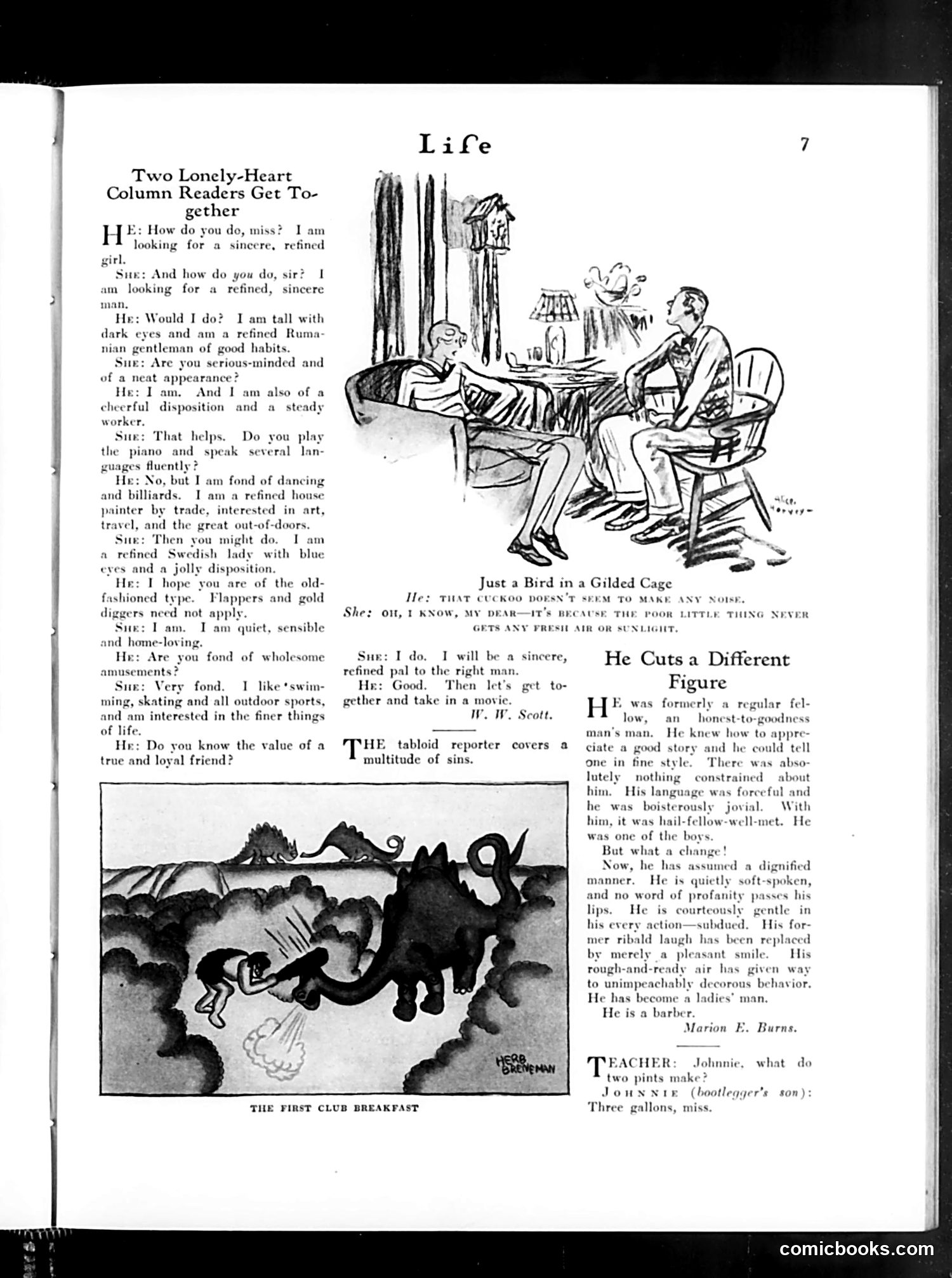
This page contains three satirical pieces typical of early 20th-century Life magazine humor: 1. **"Two Lonely-Heart Column Readers Get Together"**: A dialogue between a man and woman responding to lonely-hearts advertisements, each describing themselves in idealized terms (refined, cultured) while revealing contradictions—he claims refinement but likes dancing and billiards; she wants sincerity but seems superficial. The satire mocks how people misrepresent themselves in personal ads. 2. **"The First Club Breakfast"**: A cartoon showing a small figure confronting an octopus-like creature, likely satirizing early club culture or social pretensions with surreal absurdity. 3. **"He Cuts a Different Figure"**: A story about a man who transformed from a boisterous, crude fellow into a refined "ladies' man" and barber—satirizing social climbing and affected manners. The humor targets romantic pretension, social aspiration, and personal reinvention.
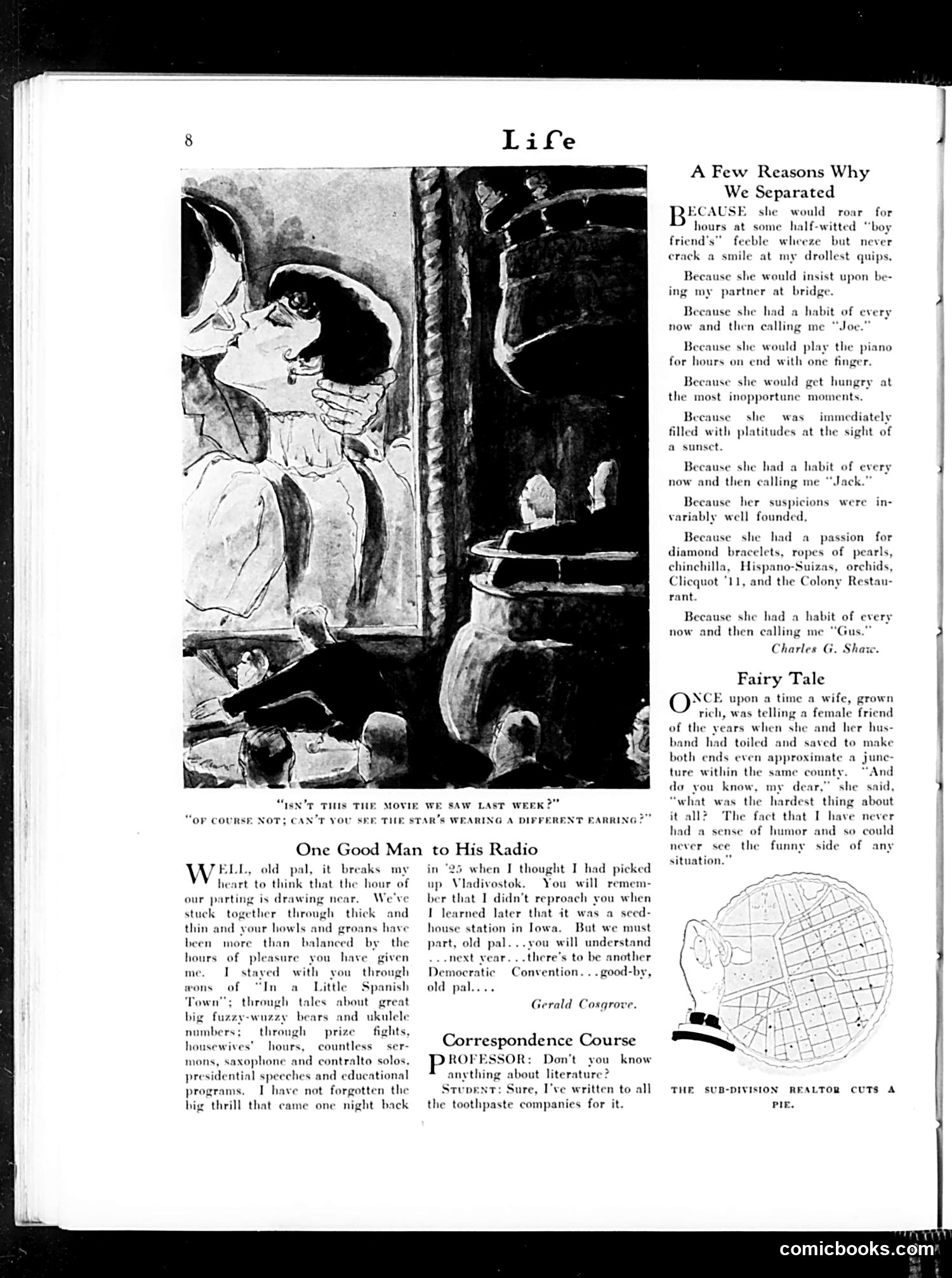
This page contains three distinct pieces of satirical content from *Life* magazine. The main illustration shows a couple at a window, with a caption mocking movie-going and fashion: "Isn't this the movie we saw last week?" / "Of course not; can't you see the star's wearing a different earring?"—satirizing both repetitive Hollywood plots and women's obsession with fashion details. **"A Few Reasons Why We Separated"** (by Charles G. Shaw) humorously lists petty grievances in a relationship: a partner's annoying laugh, piano habits, calling him by wrong names, jealousy, and shopping addictions. It's satire on how small irritations accumulate in marriages. **"One Good Man to His Radio"** depicts someone nostalgically recalling radio broadcasts and political conventions from years past. The remaining pieces—"Fairy Tale," "Correspondence Course"—appear to be brief humorous sketches but lack sufficient context for detailed analysis from this single page.
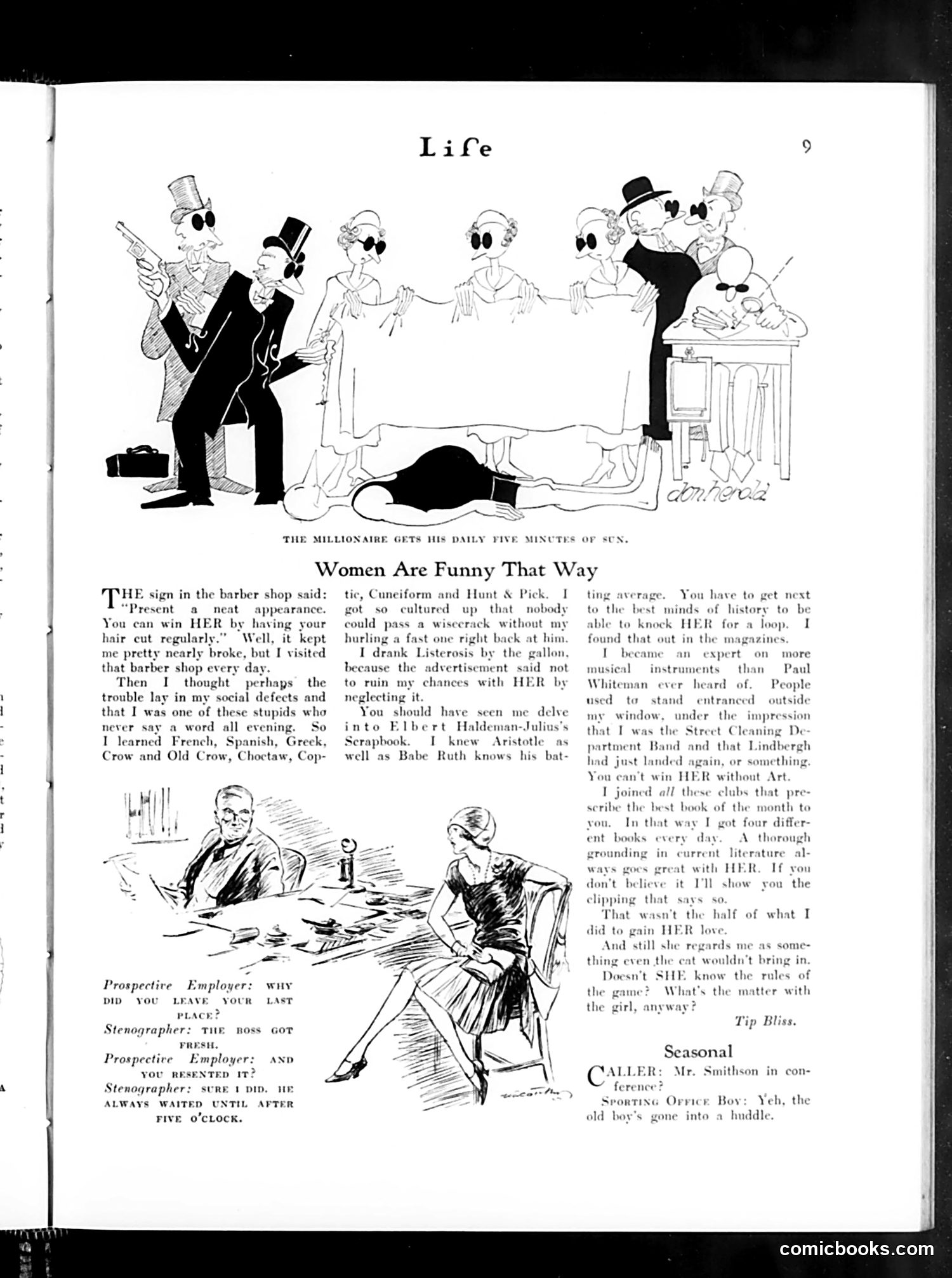
This page satirizes gender dynamics and workplace behavior in the early 20th century. The top cartoon depicts "The Millionaire Gets His Daily Five Minutes of Sun"—showing wealthy men lounging while a woman lies on the ground, likely critiquing idle wealth and gender imbalance. The main article "Women Are Funny That Way" mocks a man's failed attempts to win a woman's affection through self-improvement (learning languages, joining clubs, studying literature). The humor lies in his confusion: despite his efforts, she remains uninterested, suggesting women's preferences are unpredictable or irrational to men. The embedded jokes mock workplace hierarchies and stenographer-employee dynamics, showing typical office power imbalances of the era. The overall tone satirizes both masculine presumption and the "mysterious" nature of female behavior.
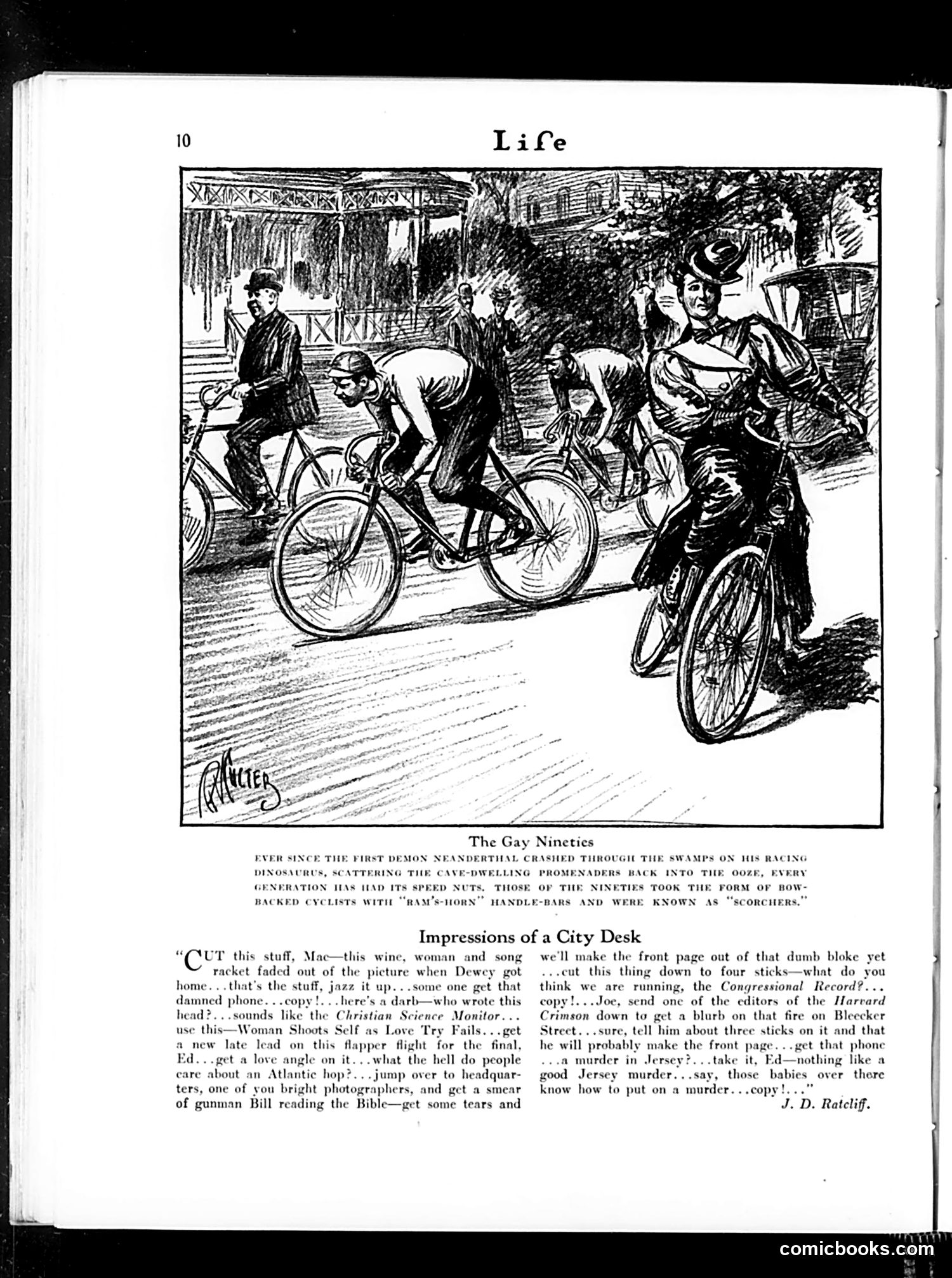
The top illustration satirizes 1890s bicycle culture, specifically the "scorchers"—reckless young cyclists who raced dangerously through city streets. The caption's absurd comparison to "demons" crashing through primeval swamps mocks the moral panic surrounding this new transportation technology and the youth who embraced it. The bottom section, "Impressions of a City Desk," is a satirical monologue by J.D. Ratcliff about newspaper office chaos—editors juggling sensational stories (murders, scandals, Atlantic liners), writers' demands, and competing publications. It ridicules the frenetic, ethically-loose nature of 1890s newspaper journalism, where sensationalism trumped accuracy and managing editors faced constant pressure for attention-grabbing content.
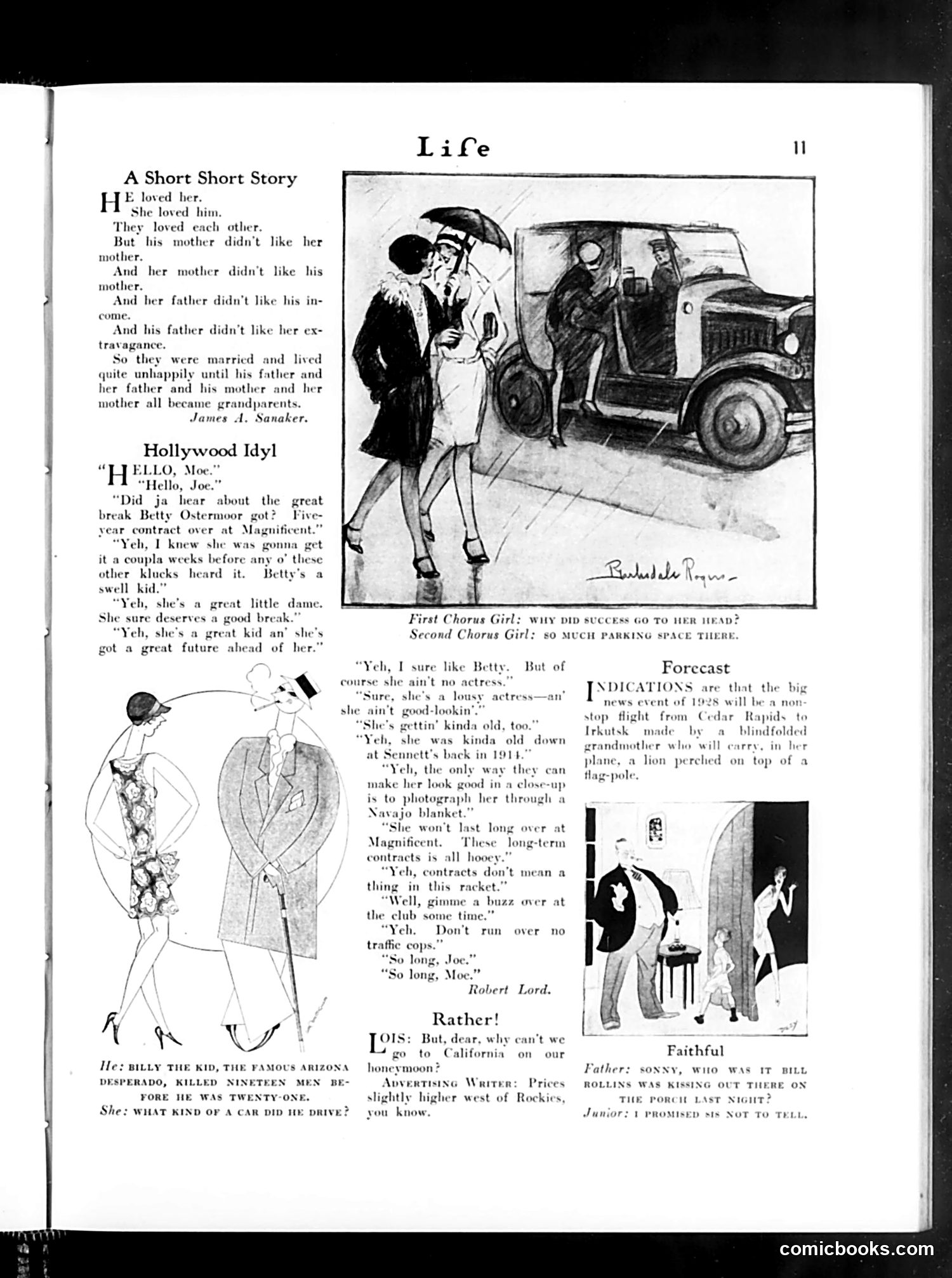
This page contains several short satirical pieces mocking 1920s Hollywood and romance: **"A Short Short Story"** parodies melodramatic romantic fiction about class conflict—a couple's marriage fails because their parents disapprove of their backgrounds. **"Hollywood Idol"** satirizes the film industry's superficiality. The dialogue mocks Betty Ostermoor (appears to be a fictional starlet), discussing her career prospects with cynicism about acting talent, studio contracts, and publicity stunts. References to "Magnificent" (likely a studio) and "long-term contracts" suggest skepticism about Hollywood's promises. **The fashion sketches** on the left appear to mock women's 1920s clothing styles. **"Forecast"** and **"Rather!"** are brief humorous anecdotes about relationships and social expectations. The overall tone is irreverent toward Hollywood celebrity culture and romantic conventions of the era.
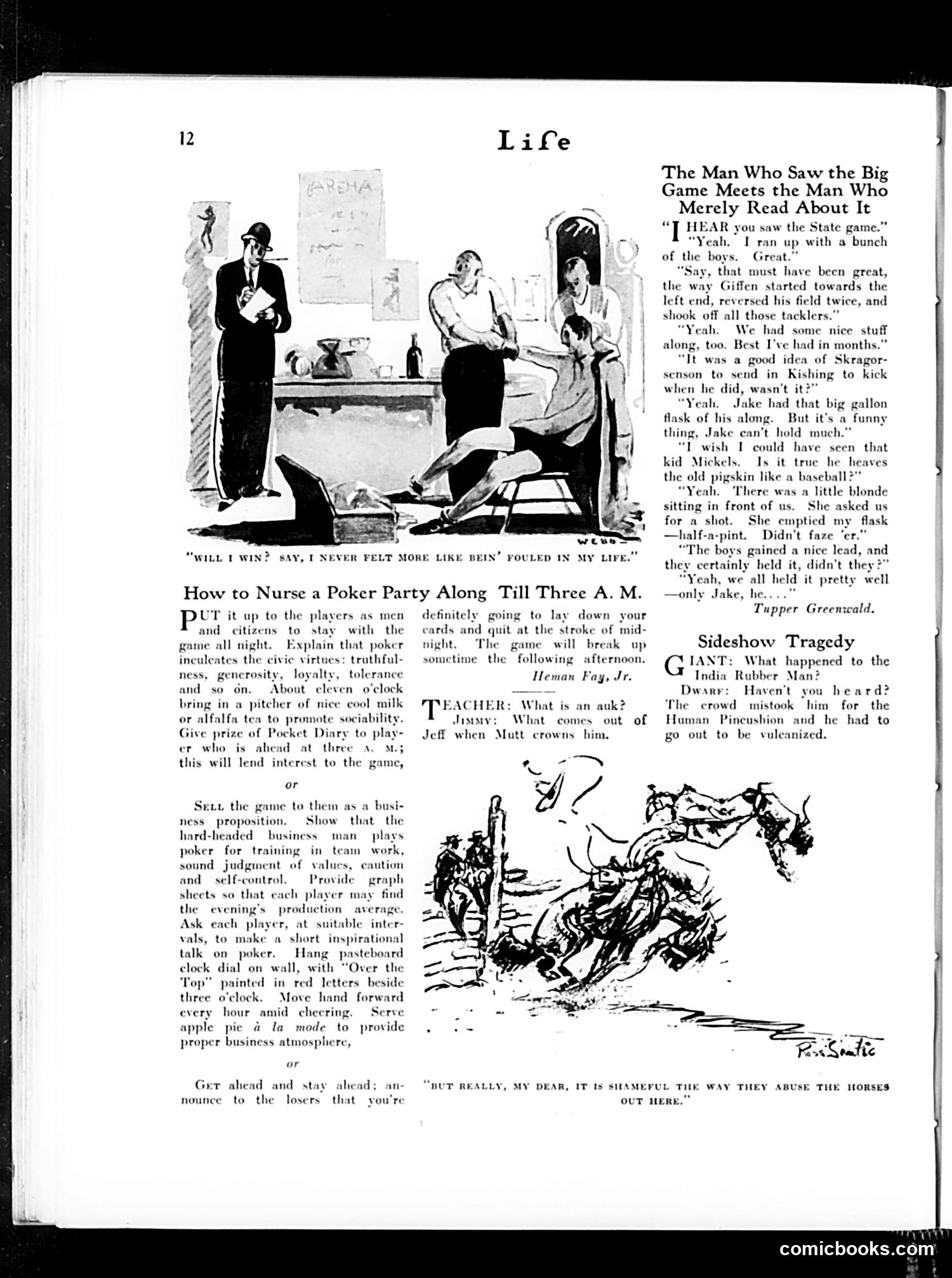
This page contains three distinct pieces: 1. **Top cartoon**: Shows men in an office discussing a football game. The caption "Will I win? Say, I never felt more like bein' fouled in my life" is a pun on football terminology, suggesting the speaker feels defeated or manipulated in business, not sports. 2. **"How to Nurse a Poker Party"**: Practical advice for hosting an all-night poker game, treating it as a business training exercise in judgment and self-control. This reflects early 20th-century masculine culture where poker parties were social institutions. 3. **"Sideshow Tragedy"**: A brief joke about mistaken identity at what appears to be a circus or carnival, where someone thought to be the "Human Rubberman" was actually an ordinary person—humor derived from carnival/sideshow culture. The page reflects 1920s leisure and urban entertainment customs.
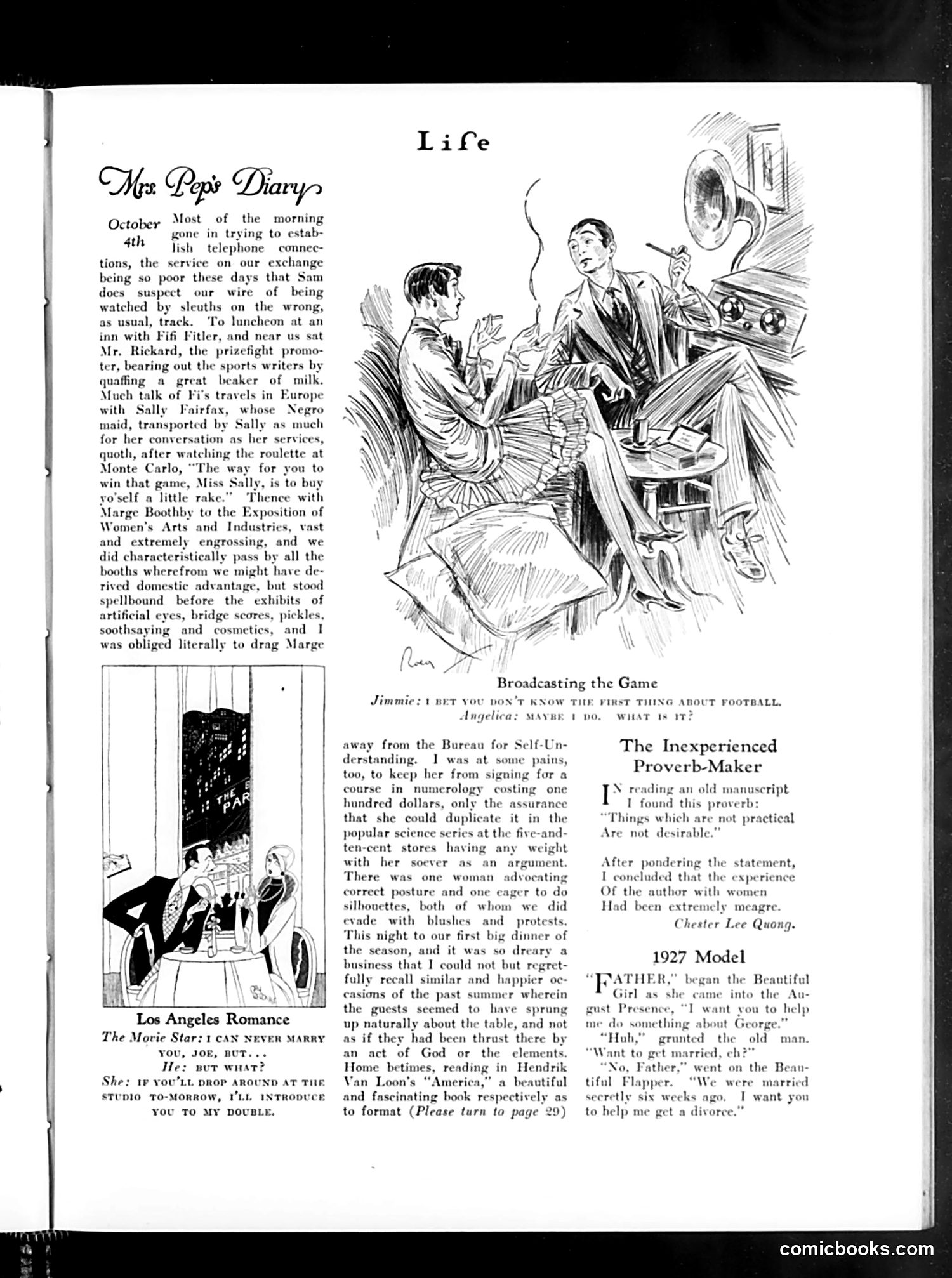
This Life magazine page from October 4th contains several satirical pieces about 1920s social life: **"Mrs. Pep's Diary"** mocks high society's obsession with sports, travel, and leisure—mentioning European trips, gambling at Monte Carlo, and visits to women's exhibitions. The illustration (bottom left) shows a couple dining, likely depicting the idle wealthy. **"Broadcasting the Game"** is a brief joke about football ignorance between characters named Jimmie and Angelica. **"The Inexperienced Proverb-Maker"** satirizes someone misunderstanding practical wisdom. **"1927 Model"** and **"Los Angeles Romance"** appear to be additional gossip-column style pieces mocking Hollywood culture and romantic entanglements among the entertainment set. The overall tone ridicules wealth, superficiality, and modern urban social pretensions of the Jazz Age.
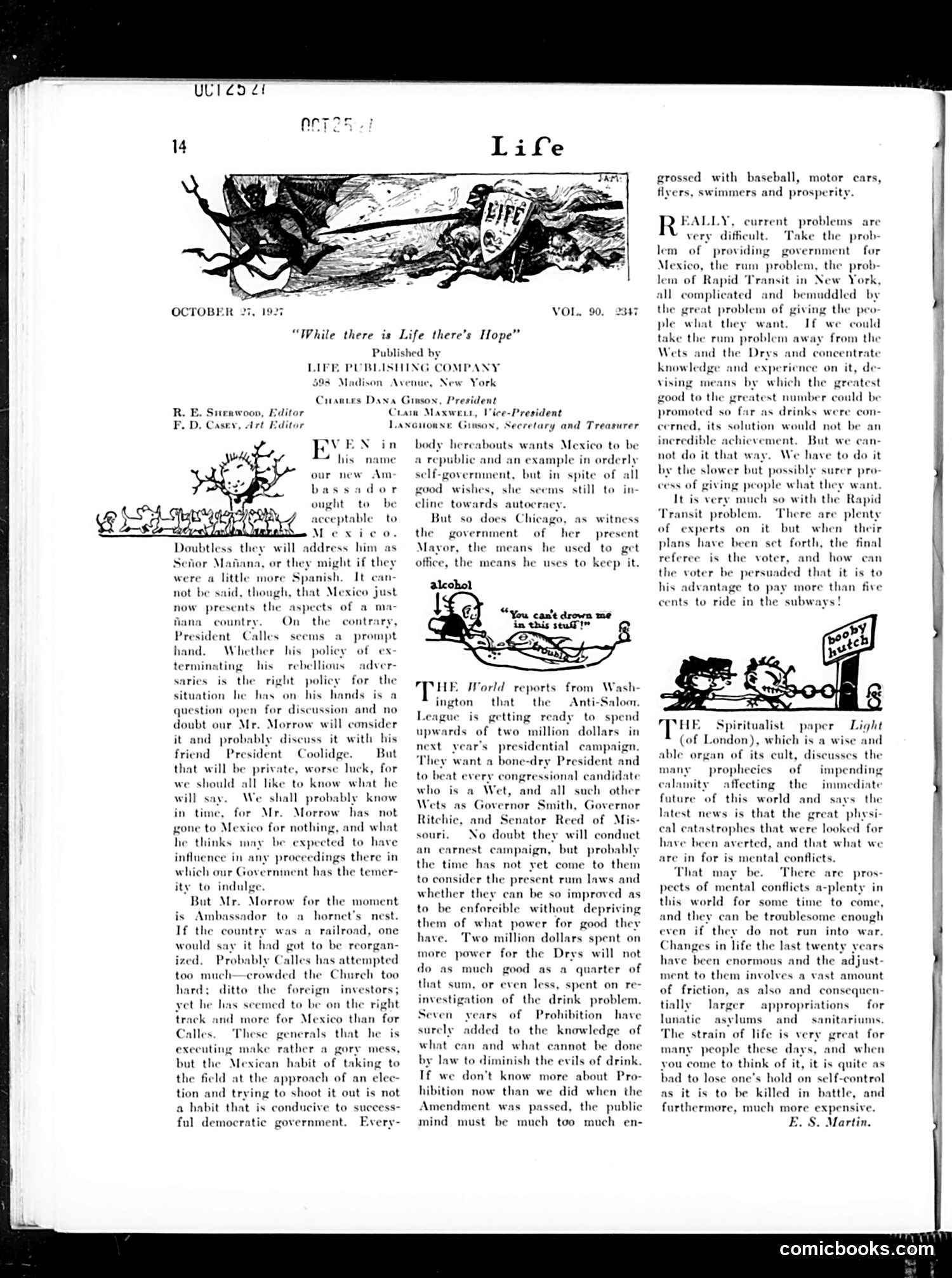
The main cartoon depicts **Mexico's political instability**. The image shows a figure labeled "LIFE" being tossed violently by a chaotic mass of tangled, writhing forms—representing Mexico's turbulent government and internal conflicts. The accompanying editorial criticizes **President Calles of Mexico**, discussing his attempts at "exterminating rebellious adversaries" and autocratic governance. The text references the ongoing tension between secular and religious forces (the "rum problem" and conflicts with the Catholic Church during Mexico's post-revolutionary period). The satire suggests Mexico's government is dangerously unstable and unpredictable, making it difficult for American interests and "life" itself to maintain equilibrium. This reflects American anxieties about Mexican political chaos during the late 1920s.
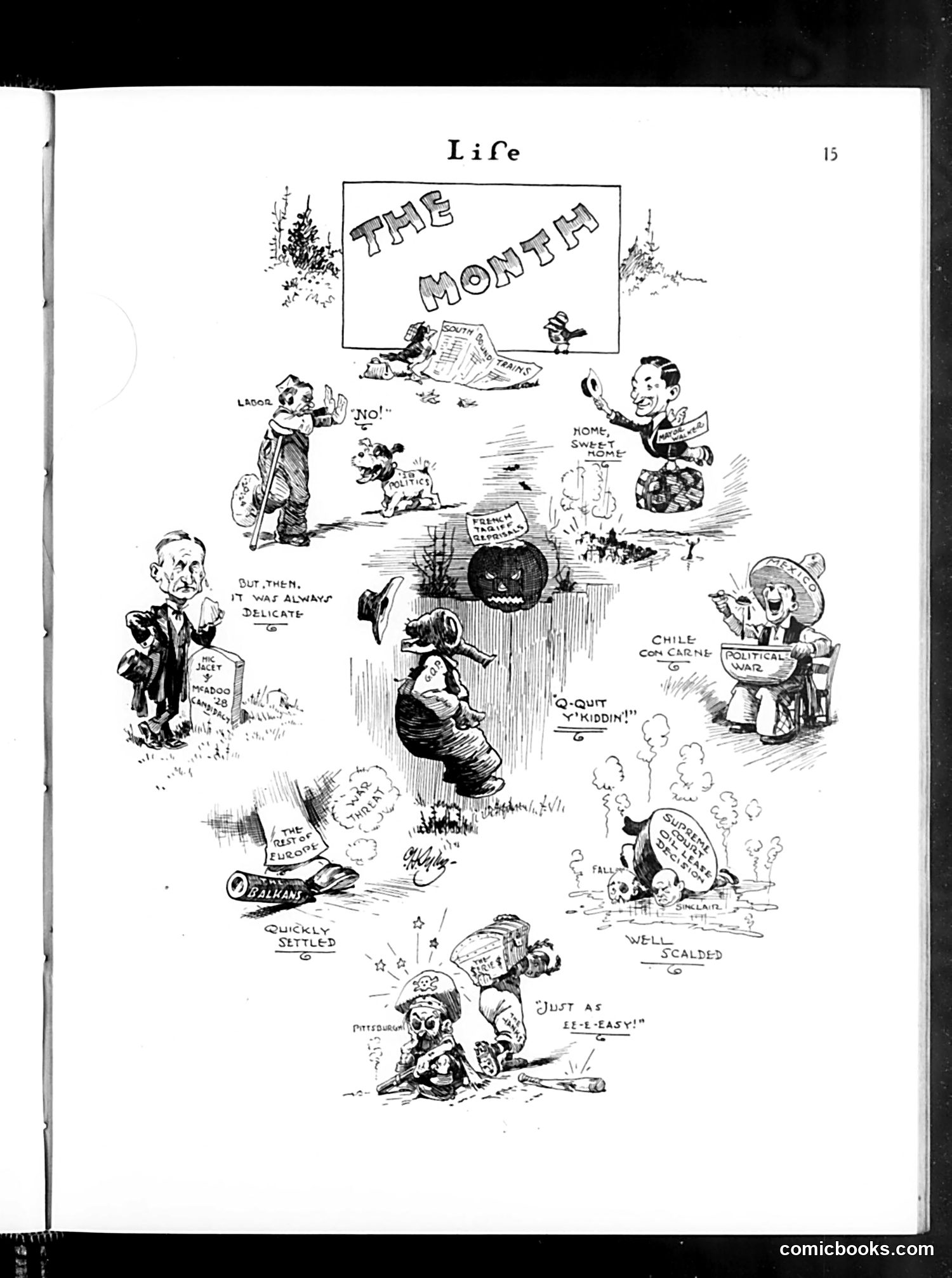
This satirical page depicts various international political crises as domestic household problems. The central title "THE MONTH" frames current events as a family's ongoing troubles. Visible scenarios include: - **"Home Sweet Home"** figure (upper right) suggesting domestic chaos - **"Chile" and "Corn Came"** reference (right side) - likely Chile's political instability - **"Political War"** label indicates electoral/governmental conflict - **"Quickly Settled"** and **"Well Scaled"** captions suggest ironic commentary on how conflicts were supposedly resolved - Various cartoon figures enacting disputes, including one labeled **"Just as Easy!"** (bottom) The cartoonist presents complex international incidents as simple domestic squabbles, using caricature and labels to mock political leaders' claims that serious crises were easily managed. Without clearer date context, specific figures remain unclear, though the style suggests early 20th-century American satirical commentary on world affairs.
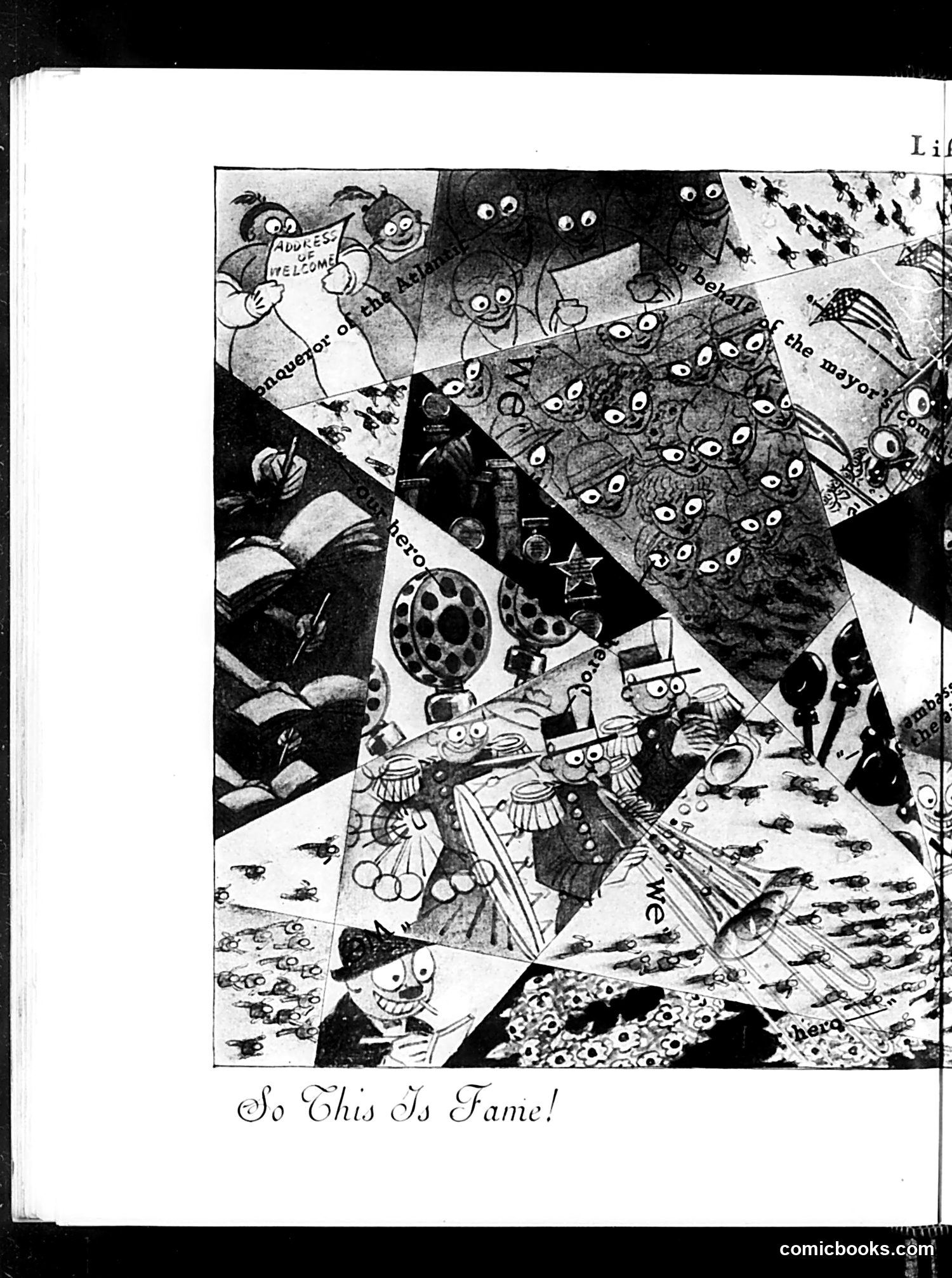
This satirical cartoon depicts a chaotic party or celebration scene crowded with exaggerated, wide-eyed figures in various costumes and formal attire. The composition suggests the overwhelming, absurd nature of sudden celebrity. The title "So This Is Fame!" indicates the satire targets how fame creates pandemonium and attracts a bizarre assemblage of hangers-on and spectators. The densely packed, frenzied crowd of cartoonish characters—some in military uniforms, others in formal dress—represents the loss of privacy and dignity accompanying celebrity status. The visual style and satirical subject matter are typical of *Life* magazine's early-to-mid 20th century social commentary, mocking the superficiality and circus-like atmosphere surrounding famous individuals. The specific identity of who achieved this "fame" remains unclear from the visible text.
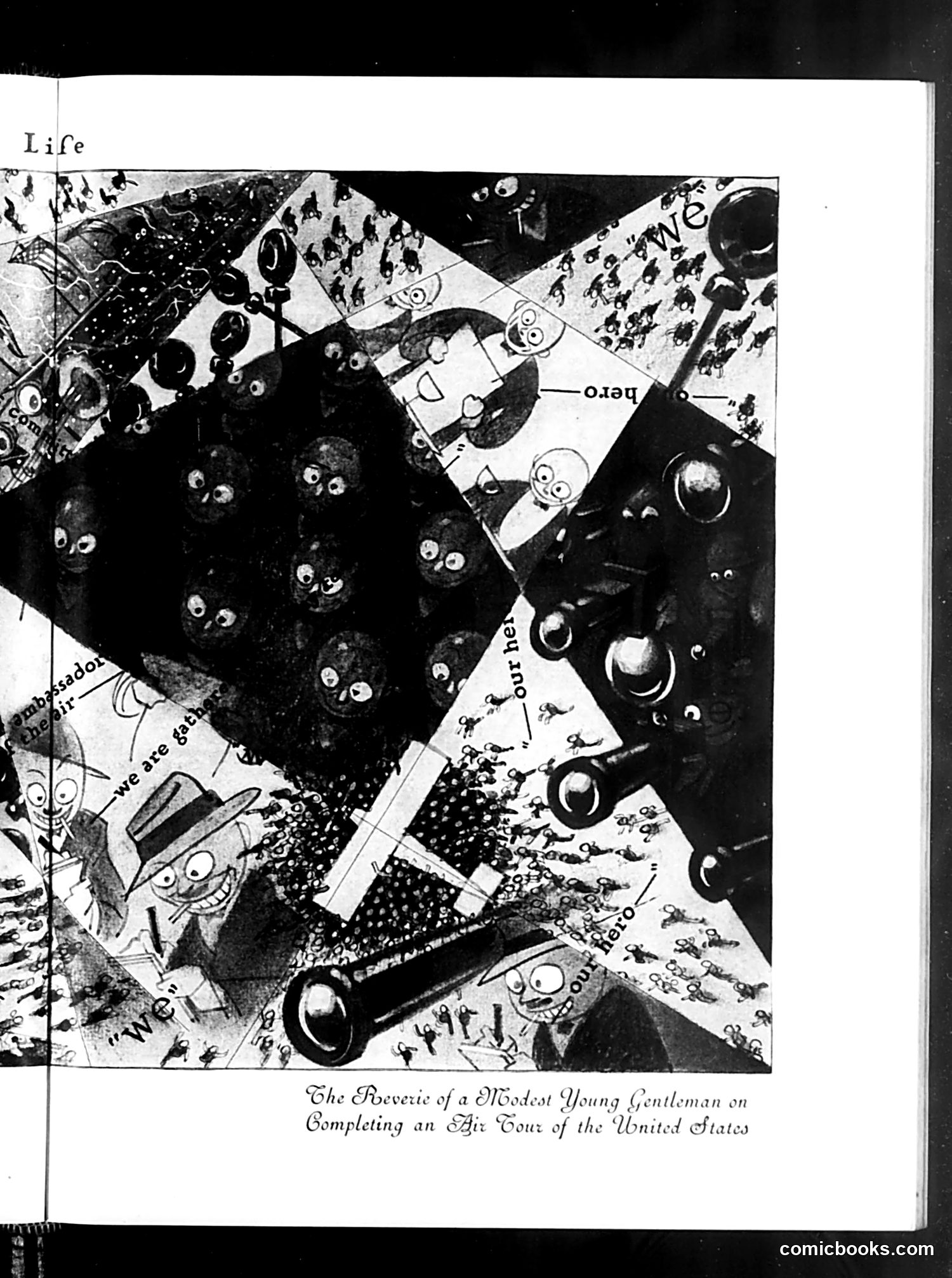
This Life magazine page presents a satirical illustration titled "The Reverie of a Modest Young Gentleman on Completing an Air Tour of the United States." The cartoon depicts a young man daydreaming (shown in the dark silhouette on the left) while surrounded by whimsical visions of his aircraft tour experiences (shown in the lighter panels). The illustrations include caricatured figures, spotted patterns suggesting maps or geographical references, and various circular emblems that likely represent different American locations or states visited. The satire appears to mock the vanity and self-importance of someone who has completed a cross-country aviation journey—treating what was still a remarkable feat in early aviation history with gentle ridicule about the young man's inflated sense of accomplishment and the grandiose "reverie" or fantasies he entertains about his modest travel achievement.
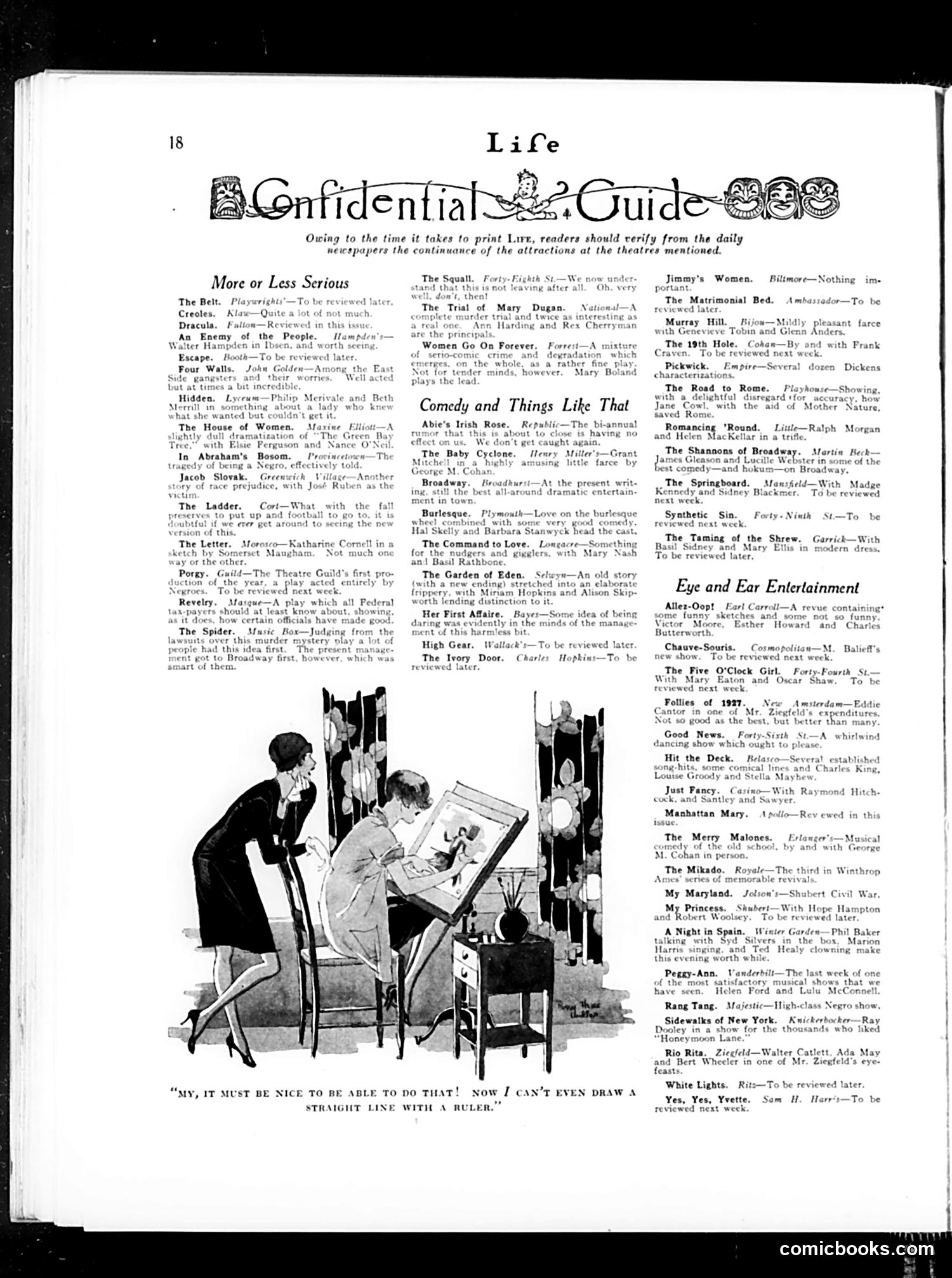
This page from *Life* magazine reviews Broadway theatrical productions, with a humorous cartoon illustrating artistic frustration. The central illustration depicts a woman artist attempting to draw a straight line with a ruler while a man looks over her shoulder, captioned: "My, it must be nice to be able to do that! Now I can't even draw a straight line with a ruler." The satire mocks the gap between perceived ease and actual difficulty—suggesting that what appears simple (drawing a straight line) proves surprisingly challenging in practice. This likely comments on gender dynamics in art or professional competence, implying the observer underestimates the skill required for precise work. The surrounding text catalogs current Broadway shows with brief critical assessments and casting information, typical of *Life*'s entertainment coverage during the 1920s theatrical season. The page serves dual purposes: entertainment guide and satirical social commentary.
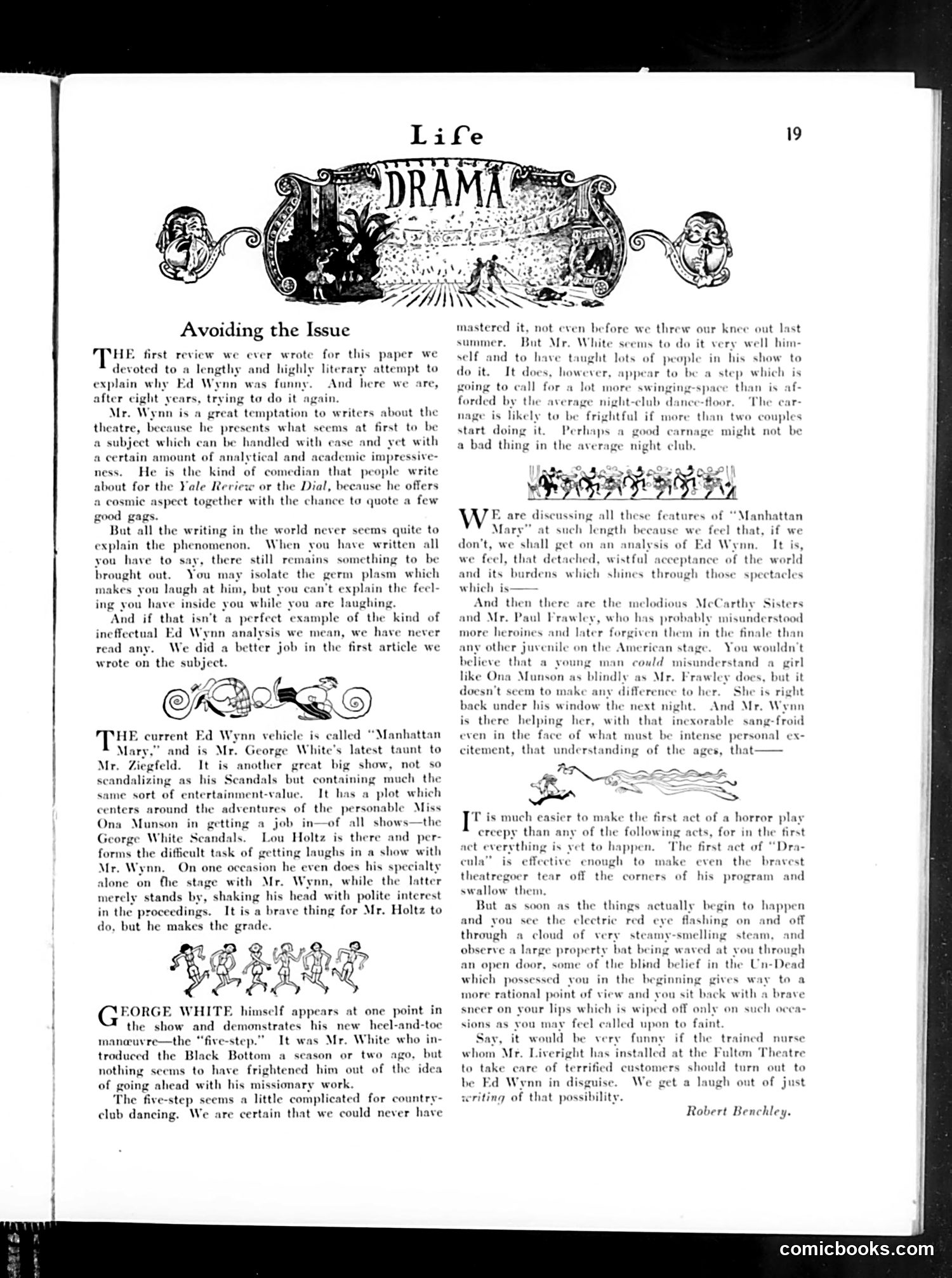
This is a theater review discussing Ed Wynn's current show "Manhattan Mary," produced by George White as competition against Florenz Ziegfeld's productions. The page satirizes the difficulty of explaining *why* Wynn is funny—his comedic appeal resists rational analysis despite critics' repeated attempts. The review identifies several performers: Ona Munson (the lead), Lou Holtz (a comedian), the McCarthy Sisters, Paul Frawley, and George White himself (who demonstrates his signature dance, the "five-step," a follow-up to his earlier innovation, the Black Bottom). The satire's point: Wynn embodies an ineffable quality—described as "detached, wistful acceptance"—that transcends analytical explanation. The critic ironically acknowledges he's *avoiding* a deeper analysis of Wynn by discussing the show's plot and supporting cast instead, recognizing the futility of the exercise.
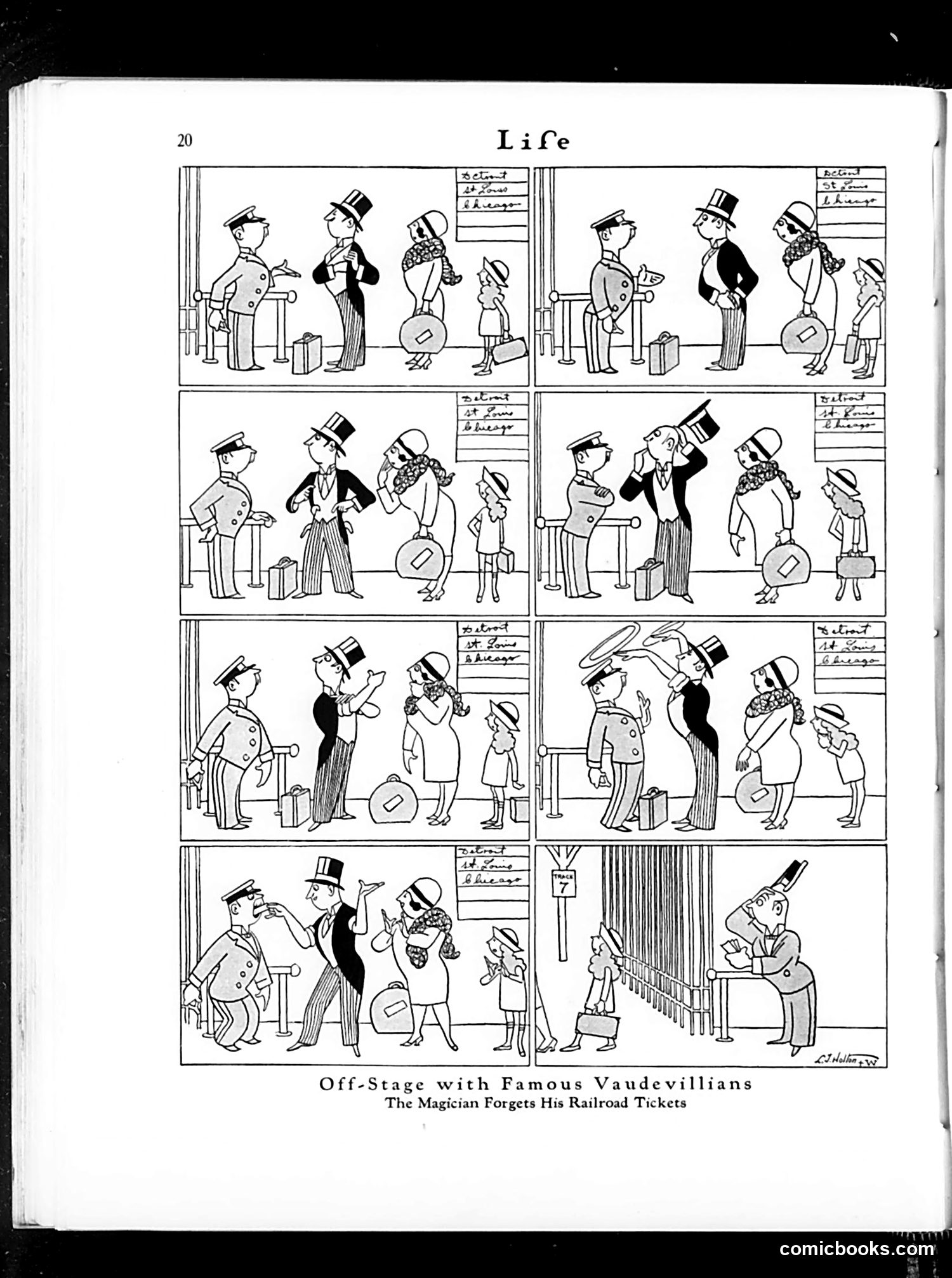
This is a comic strip from *Life* magazine showing a sequence of panels depicting vaudeville performers backstage. The title indicates the humor centers on a magician who has misplaced his railroad tickets—an ironic situation given that magicians are known for their sleight-of-hand and ability to make things "disappear." The strip shows the magician interacting with other vaudeville performers and what appear to be theater staff or handlers. The joke likely plays on the contrast between the magician's professional skill at making things vanish on stage versus his mundane inability to keep track of practical travel documents in real life. The final panel shows the magician apparently addressing an audience, suggesting the resolution or punchline of the forgotten tickets storyline.
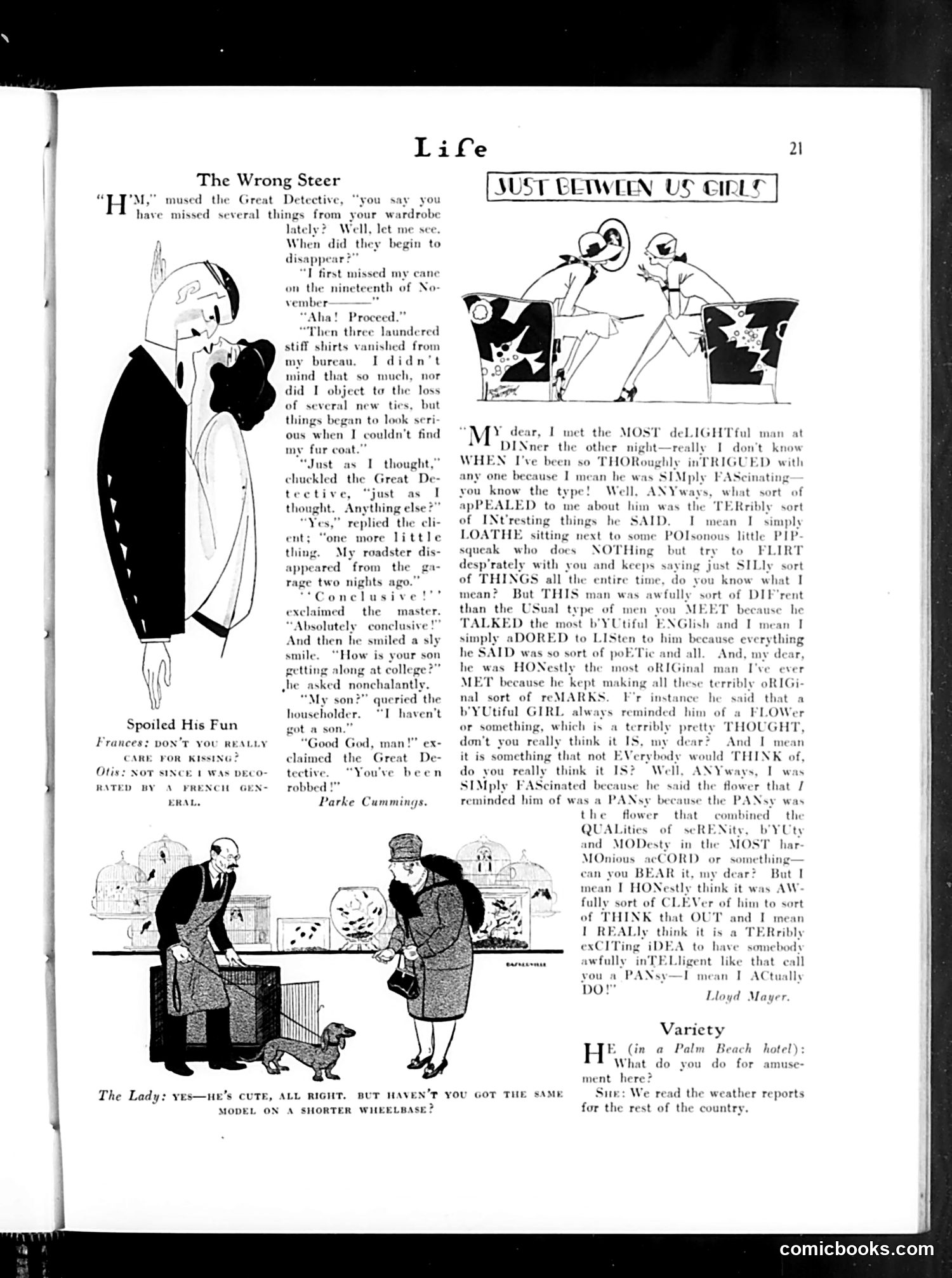
This page contains three distinct humor pieces typical of 1920s satirical magazines: **"The Wrong Steer"** (top left): A detective story parody where a "Great Detective" deduces that a client's missing items (cane, shirts, ties, fur coat, roadster) were stolen by the client's son—yet the client claims to have no son. The joke is the detective's absurd logic reaching the wrong conclusion. **"Spoiled His Fun"** (bottom left): A brief joke about a man named Otis who dislikes kissing because he was decorated by a French general—likely referencing WWI medal ceremonies or military honors, the humor deriving from an unexpected explanation. **Untitled monologue** (right): A woman's breathless account of meeting an interesting dinner guest. The satire targets affected upper-class speech patterns (exaggerated emphasis, affected pronunciation) and vapid socialite discourse—she's impressed by commonplace observations presented pretentiously. The piece mocks both the speaker's shallow values and her mannered affectations. All three pieces employ wordplay and social observation typical of *Life* magazine's humor during the Jazz Age era.
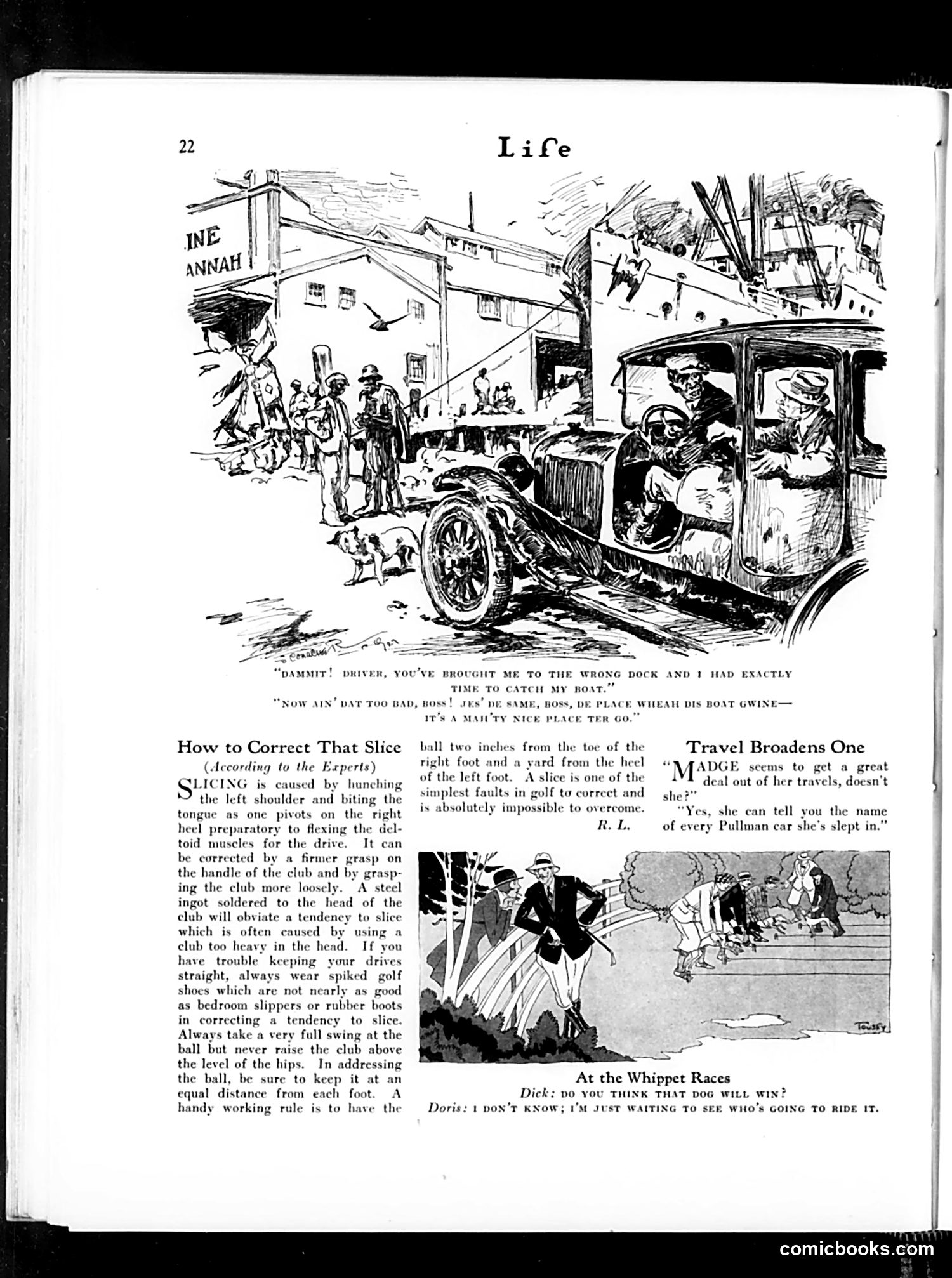
This page contains three satirical pieces typical of early 20th-century American humor: 1. **"How to Correct That Slice"**: A humorous golf advice column that deliberately offers contradictory tips (e.g., "always wear spiked golf shoes" which are "not nearly as good as bedroom slippers"), culminating in the absurdist conclusion that slicing is "absolutely impossible to overcome." This mocks overwrought golf instruction manuals popular with the leisure class. 2. **Top cartoon**: A dock scene where a driver has taken passengers to the wrong location. The dialect-heavy dialogue ("Jess de same, Boss") suggests working-class characters, likely reflecting period stereotypes. 3. **"Travel Broadens One"**: A joke about a wealthy woman (addressed as "Judge") who travels extensively but only remembers Pullman car names—mocking superficial tourism and social pretension among the wealthy. 4. **"At the Whippet Races"**: A visual gag where Doris jokingly suggests someone will ride the racing dog, playing on the absurdity of dog racing as entertainment. All pieces target leisure-class pursuits and pretension.
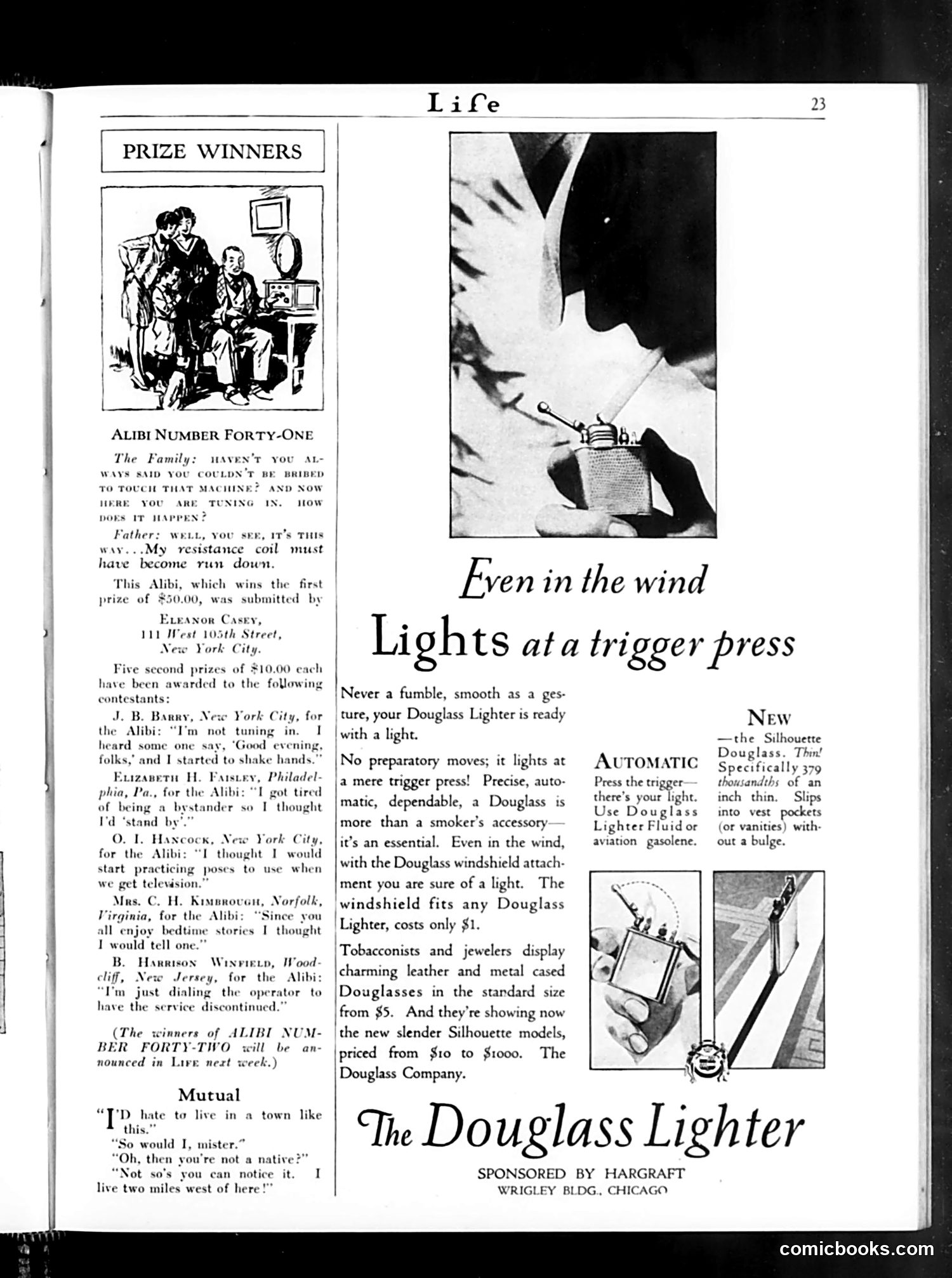
This page contains **prize-winning contest entries** and **advertising**, not political satire. The "Alibi Number Forty-One" section showcases humorous reader submissions to Life's ongoing contest. The featured cartoon depicts a family confronting a father who's using a radio ("tuning in") after previously claiming he wouldn't be corrupted by such technology. His excuse—that his "resistance coil must have become run down"—is a pun playing on electrical terminology to humorously justify his hypocrisy. This reflects 1920s-30s anxieties about **radio's addictive appeal** and changing household norms. The page also includes other readers' submitted alibis (excuses) using similar wordplay, plus a brief joke about small-town life. The **dominant content is a Douglass Lighter advertisement** promoting a windproof cigarette lighter with trigger-press ignition. It emphasizes reliability and portability—notably mentioning it fits vest pockets of vanities "without a bulge," reflecting era-specific fashion concerns.
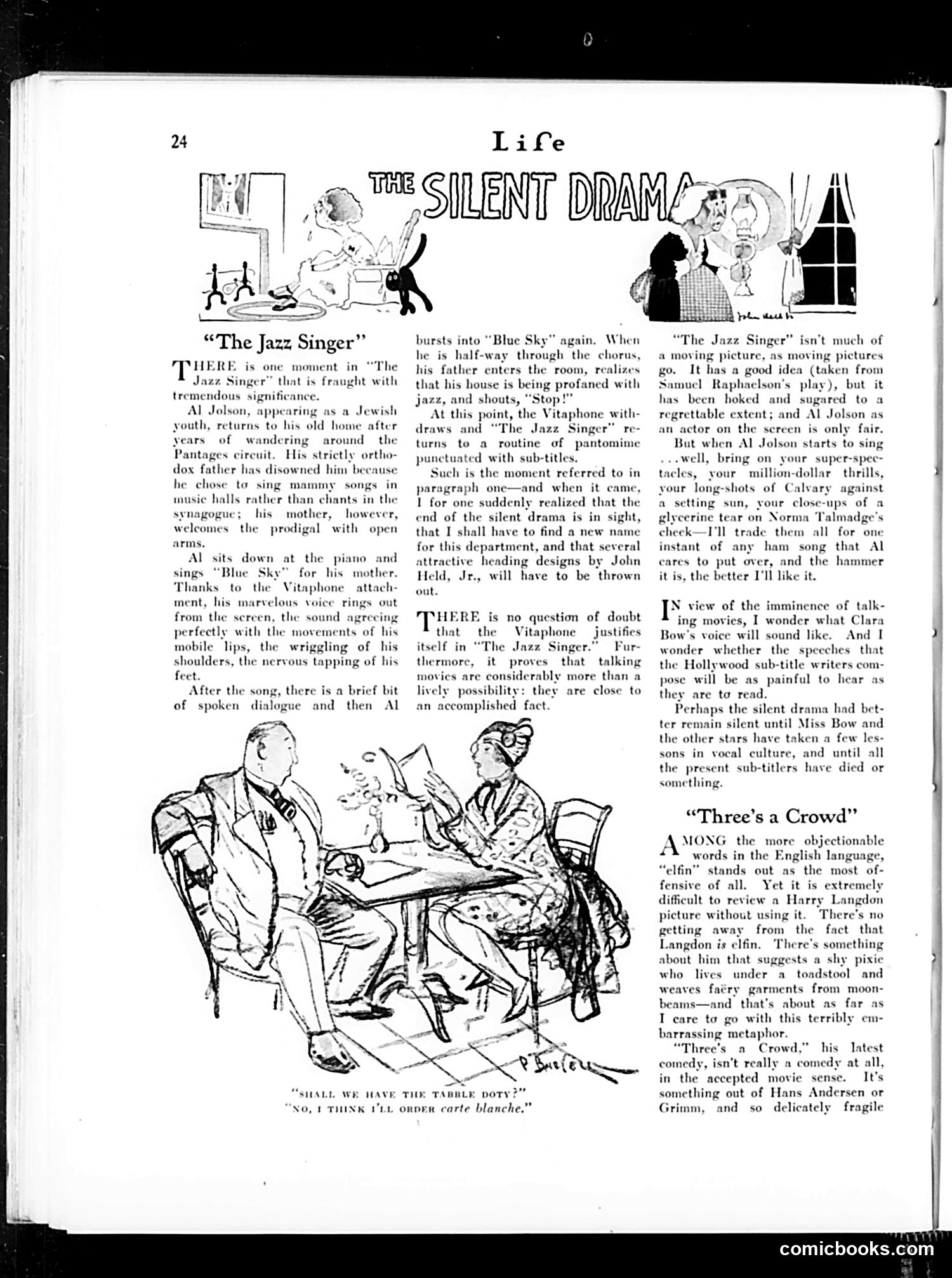
This page reviews early "talking pictures," specifically *The Jazz Singer* (1927) starring Al Jolson. The critic discusses a pivotal scene where Jolson's character—a Jewish boy who left home to perform jazz in music halls—sings "Blue Sky" at the piano. His Orthodox father enters and shouts "Stop!" at the profane jazz music, causing the new Vitaphone sound technology to cut out, returning the film to silent pantomime. The reviewer argues this moment marks the end of silent cinema. While criticizing the film's plot as "hoked and sugared," he praises Jolson's singing as superior to the entire production, trading all spectacular silent-film effects for "one instant of any ham song" Jolson performs. The cartoon below shows two men discussing dinner, using the phrase "carte blanche" (blank check)—likely satirizing wealthy patrons' pretensions. The page also briefly reviews Harry Langdon's *Three's a Crowd*, describing it as delicate rather than comedic.
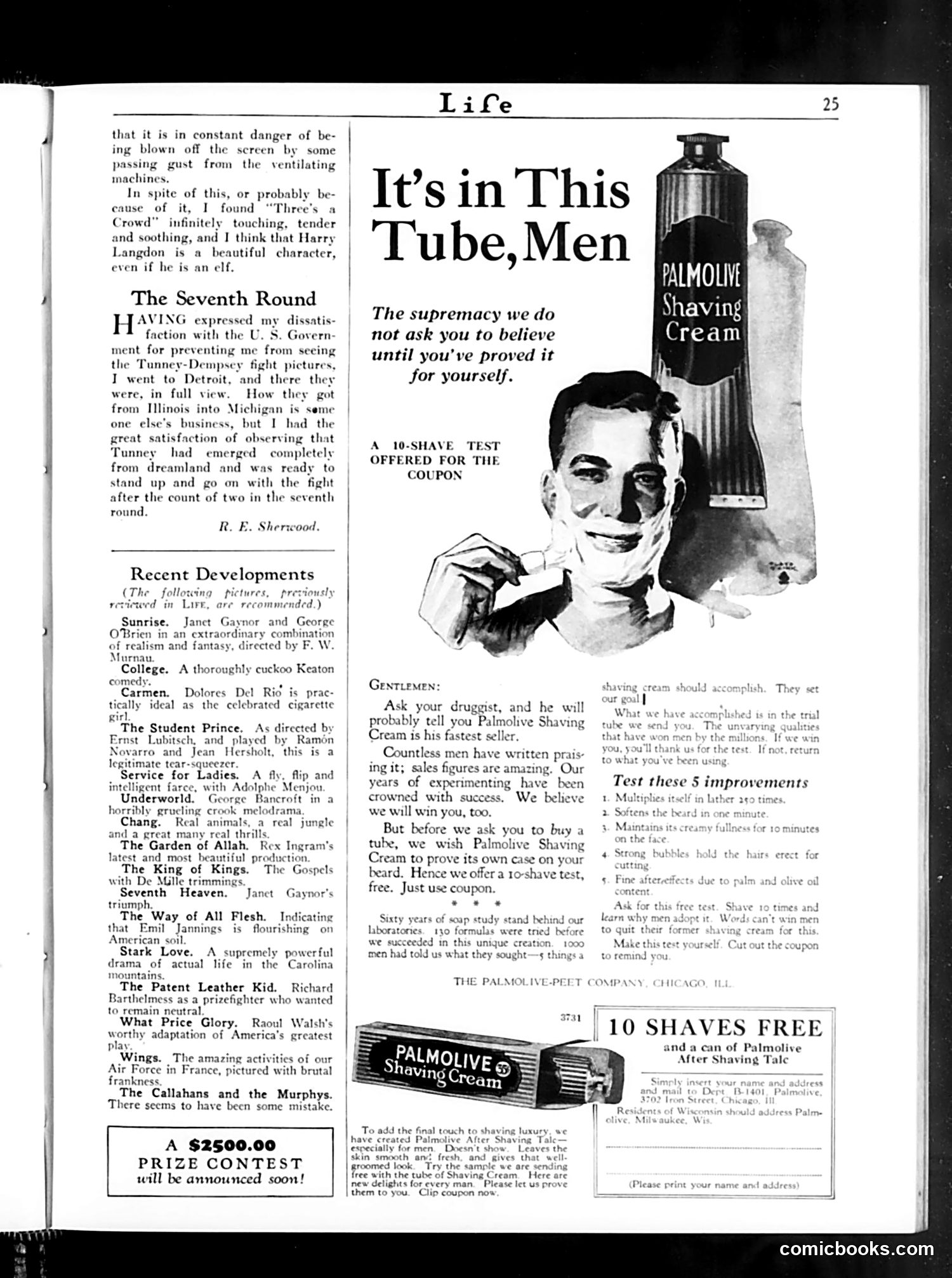
This page is primarily **advertising for Palmolive Shaving Cream**, not political satire. The large illustration shows a man applying shaving cream, with the product bottle prominently displayed. The ad's appeal is straightforward: Palmolive claims supremacy as a shaving product and offers a "10-shave test" coupon so consumers can prove its superiority themselves. The copy emphasizes that countless men praise it and that sales figures are "amazing." The smaller text on the left contains **film reviews** of recent movies (Wings, The King of Kings, Seventh Heaven, etc.), which was typical Life magazine content. There's also a brief editor's note about the Tunney-Dempsey boxing match. The $2,500 prize contest announcement at bottom-left appears unrelated to the shaving cream. This is a standard commercial page from the 1920s, demonstrating how magazines funded themselves through advertising while providing entertainment and cultural commentary.
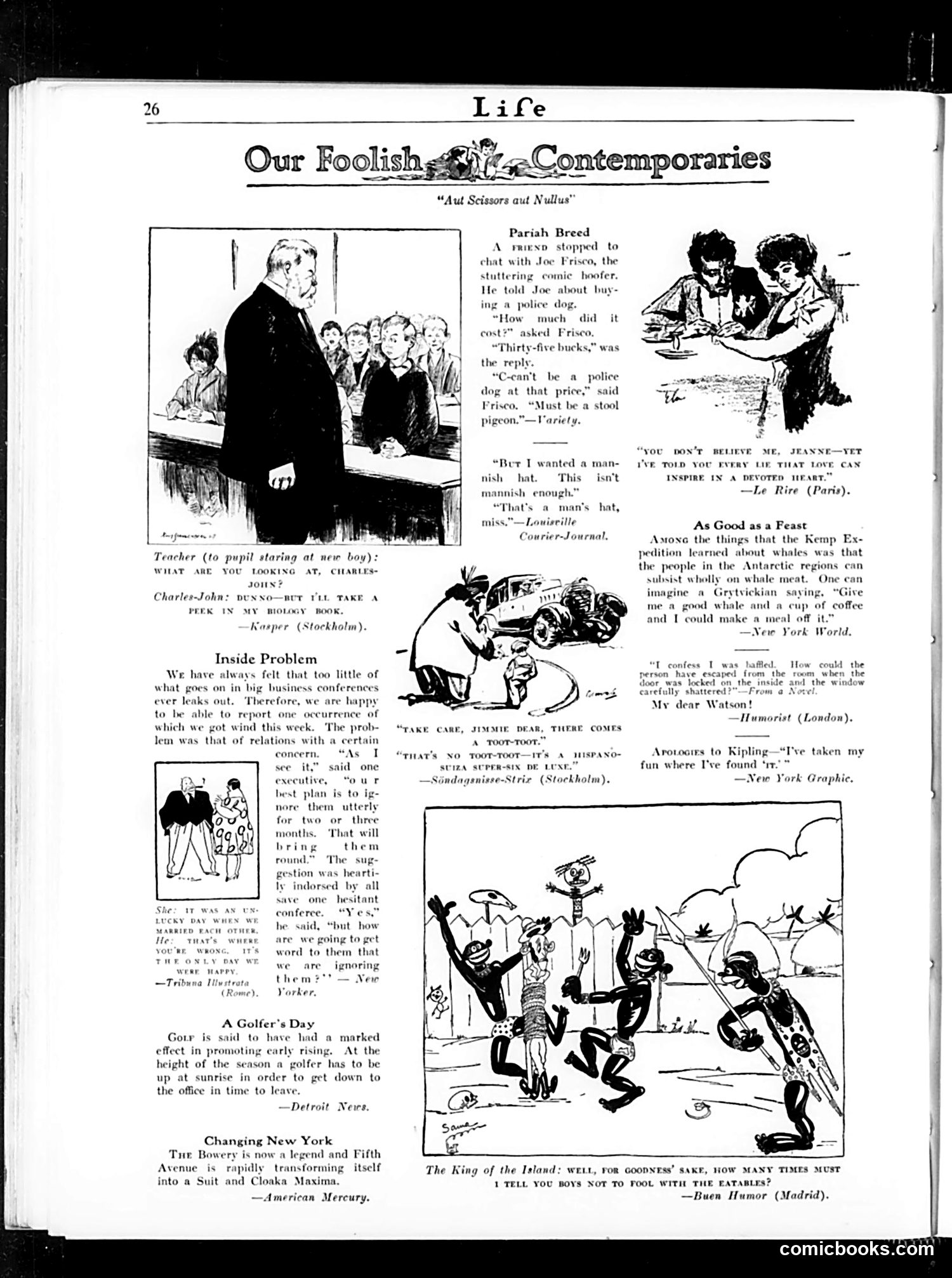
This page from *Life* magazine collects brief humorous anecdotes and cartoons from contemporary newspapers and publications, labeled "Our Foolish Contemporaries"—satirizing current trends and social behavior. **Key content:** - **The police dog joke**: A man brags about buying a cheap police dog; Joe Frisco (a real stuttering comedian of the era) quips it must be a "stool pigeon"—slang for an informant, implying the dog is worthless. - **Marriage/romance bits**: Continental European humor about masculine women's hats and skeptical romantic declarations. - **Business satire**: An executive's solution to employee relations: ignore dissidents for months until they accept their position—mocking corporate callousness. - **Period-specific humor**: References to golf culture, whale meat expeditions, and the transformation of New York's neighborhoods reflect 1920s-30s American concerns. The cartoons mock contemporary foolishness through exaggeration and wordplay typical of satirical magazines of this era.
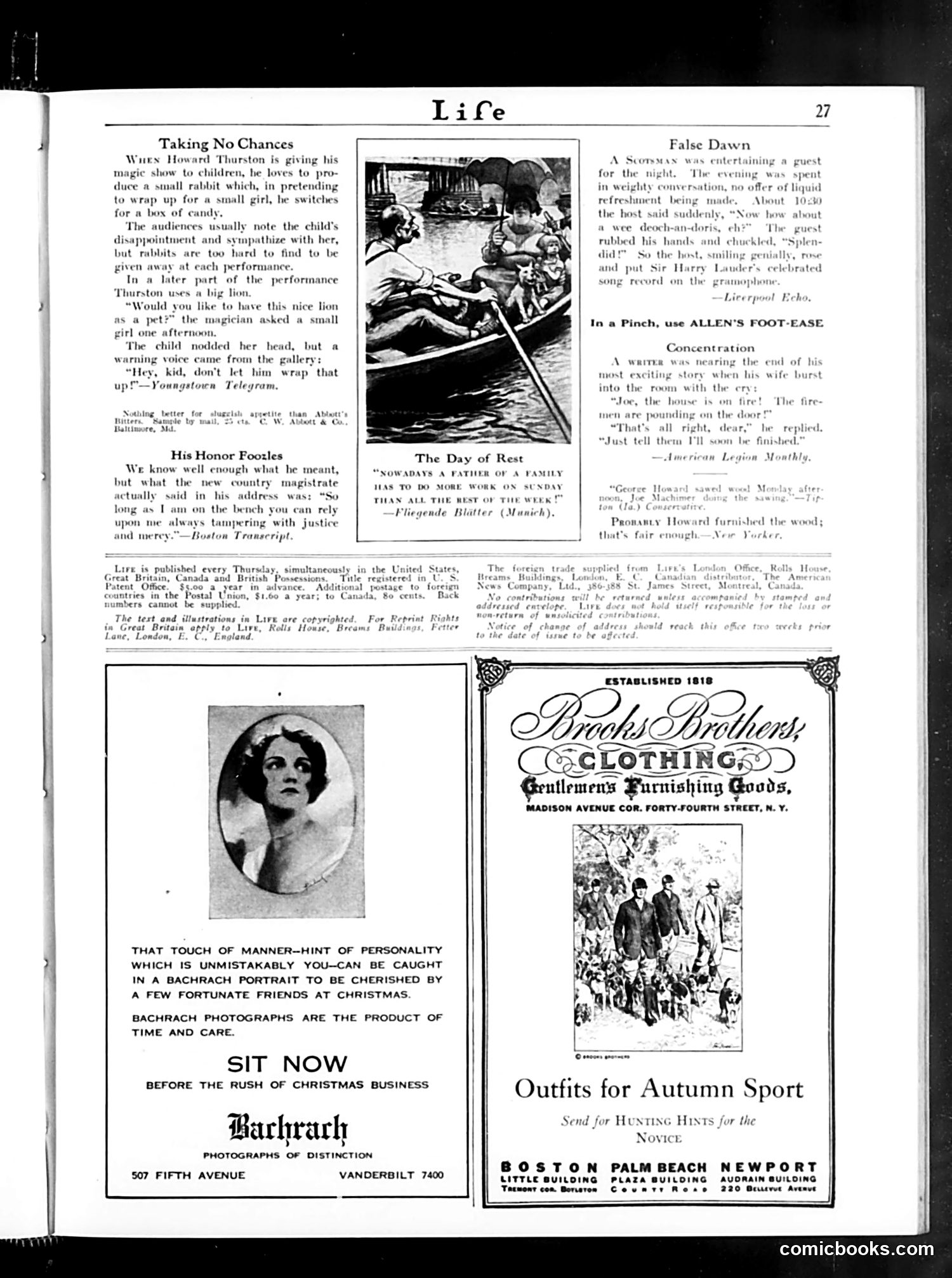
This page from Life magazine (established 1918) contains period humor pieces typical of early 20th-century American satire: **"Taking No Chances"** mocks magician Howard Thurston's cautious substitution of candy for rabbits during children's shows—he avoids giving away live rabbits because they're expensive to replace at each performance. **"His Honor Foozles"** satirizes a new magistrate's malapropism: intending to promise impartial justice, he accidentally says he'll "tamper with justice and mercy"—a humorous slip revealing incompetence. **"False Dawn"** depicts a Scottish guest's disappointment: after hinting at wanting a whisky ("deoch-an-doris"), the host plays a Sir Harry Lauder record instead—a letdown pun on "false dawn" expectations. The page balances brief comic anecdotes with period advertisements for photography services (Bachrach), clothing (Brooks Brothers), reflecting Life's format of satirical content interspersed with upscale advertising targeting middle/upper-class readers.
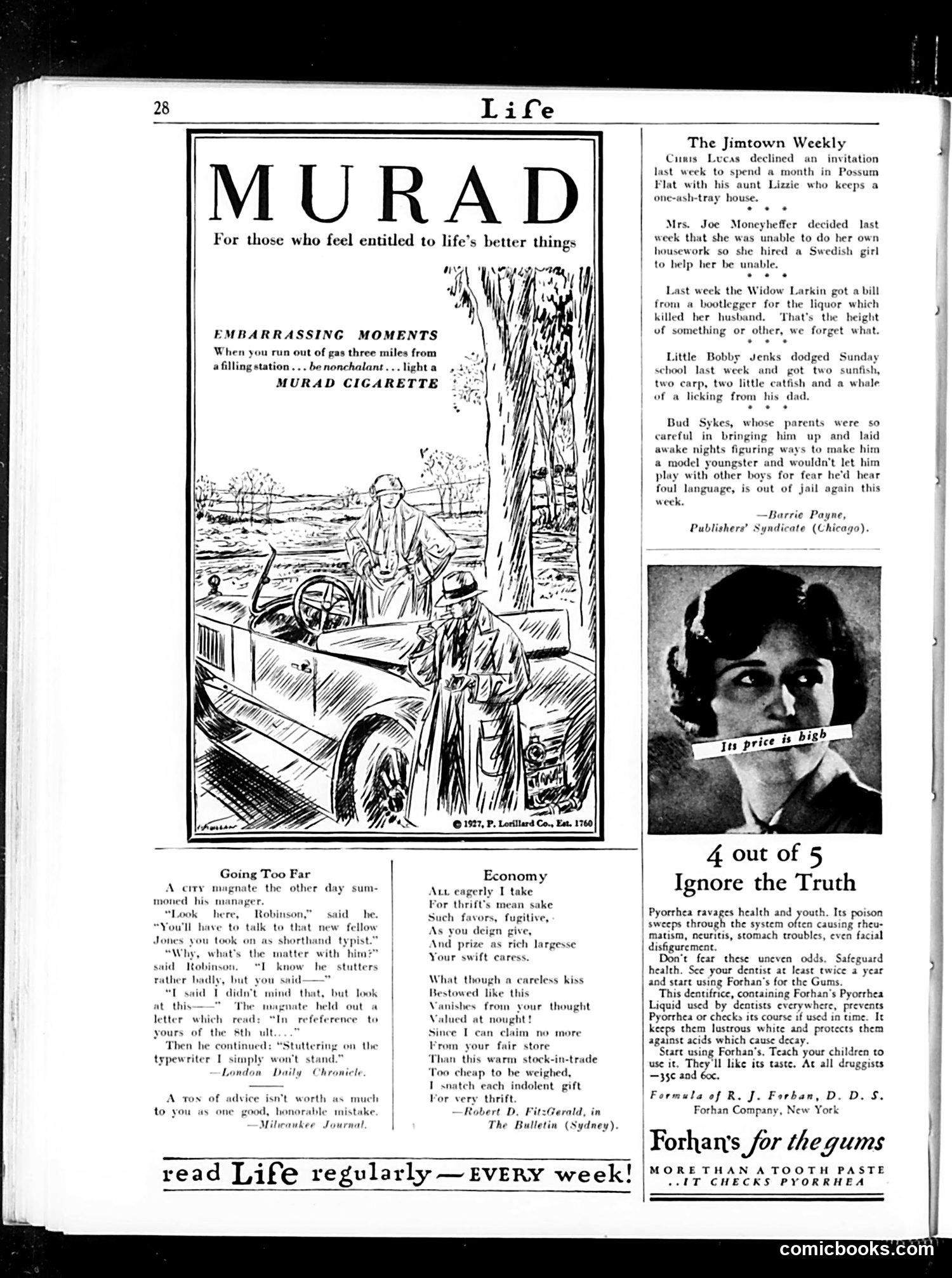
This 1920s page combines satirical humor with advertising. The main cartoon, "Embarrassing Moments," advertises Murad cigarettes by depicting a man casually lighting a cigarette when his car runs out of gas miles from a filling station—suggesting composure through smoking. The "Jimtown Weekly" sidebar offers small-town gossip with cynical commentary: Curtis Lucas avoiding his aunt's meager home; Mrs. Moneyheffer hiring help because she's lazy; the Widow Larkin receiving a bootlegger's bill for liquor that killed her husband (darkly satirizing Prohibition-era irony); and Bud Sykes, raised carefully by protective parents, now "out of jail again." The satire targets American middle-class pretension, Prohibition's failures, and the gap between parental intentions and outcomes. Advertisements for Forhan's toothpaste and cigarettes occupy the remaining space, typical of Life's commercial integration. The cartoons assume readers' familiarity with small-town America and contemporary social anxieties.
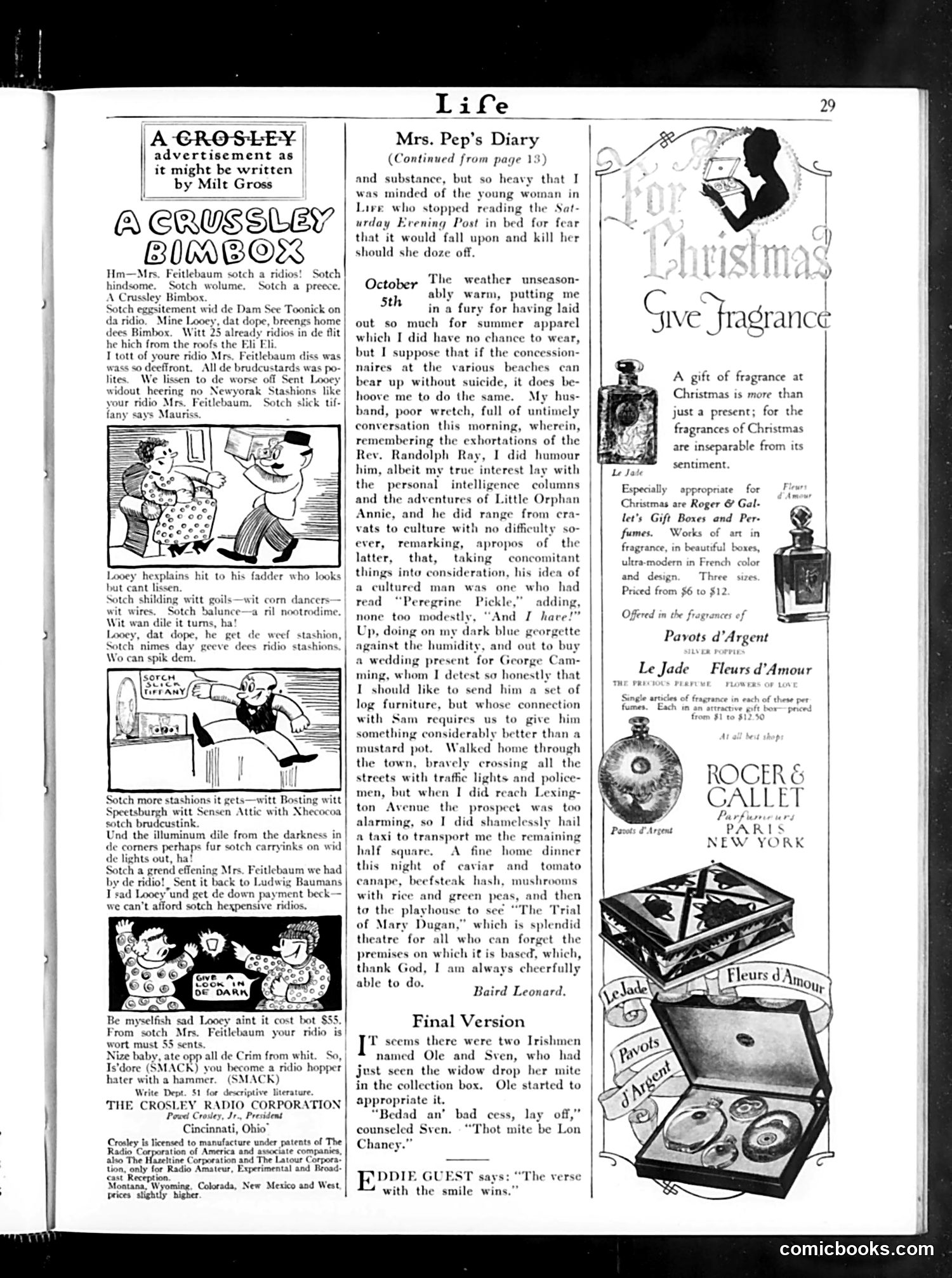
This page features Milt Gross's parody advertisement for a "Crussley Bimbox" radio, written in exaggerated Yiddish-inflected English. Gross satirizes both consumer culture and ethnic stereotypes popular in 1920s humor. The character Mrs. Feitlebaum's malapropisms and fractured syntax ("Sotch hindsome," "eggsitement") mock immigrant speech while celebrating the radio as a marvel of modern technology and entertainment. The adjacent "Mrs. Pep's Diary" offers upper-class domestic observations (attending theater, buying wedding gifts, reading *Peregrine Pickle*), creating sharp class contrast. Below, a brief joke about two Irishmen stealing from a church collection box reveals period antisemitic and ethnic humor—the humor relies on recognizing "Lon Chaney" (the actor famous for disguises) as a coded reference. The page is primarily humorous content with advertising, reflecting Life's satirical approach to American culture and class divisions.
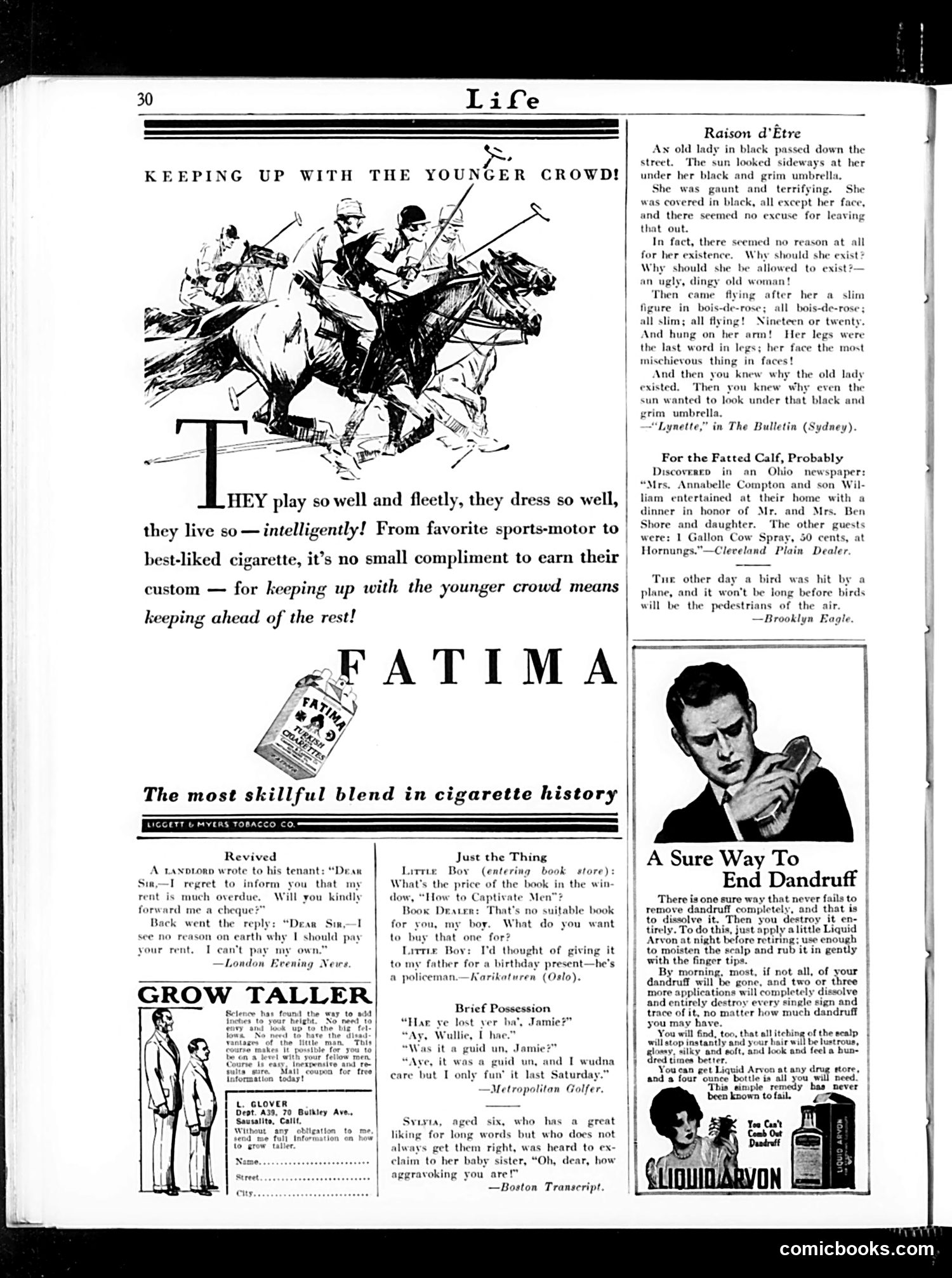
This page from *Life* magazine (a satirical publication, not the modern photo magazine) contains several short humorous pieces typical of early-to-mid 20th century humor journalism. The main cartoon "Keeping Up with the Younger Crowd" depicts young people on horseback, establishing the satire's premise: that staying fashionable and "intelligent" (keeping up appearances through consumer choices—sports cars, cigarettes) is the key to youth culture. The Fatima cigarette ad below capitalizes on this messaging. The surrounding brief anecdotes are gentle social humor: a landlord-tenant dispute about unpaid rent, a child misunderstanding adult language ("aggravoking" instead of "aggravating"), a book-buying misunderstanding, and a sentimental piece about an elderly woman whose purpose is revealed when a young woman appears. Most notably, the "Raison d'Etre" section expresses period attitudes about women's roles and value—the old woman exists mainly to contrast with and enhance the youth and beauty of a younger woman. The dandruff remedy ad represents typical period advertising pseudo-science.
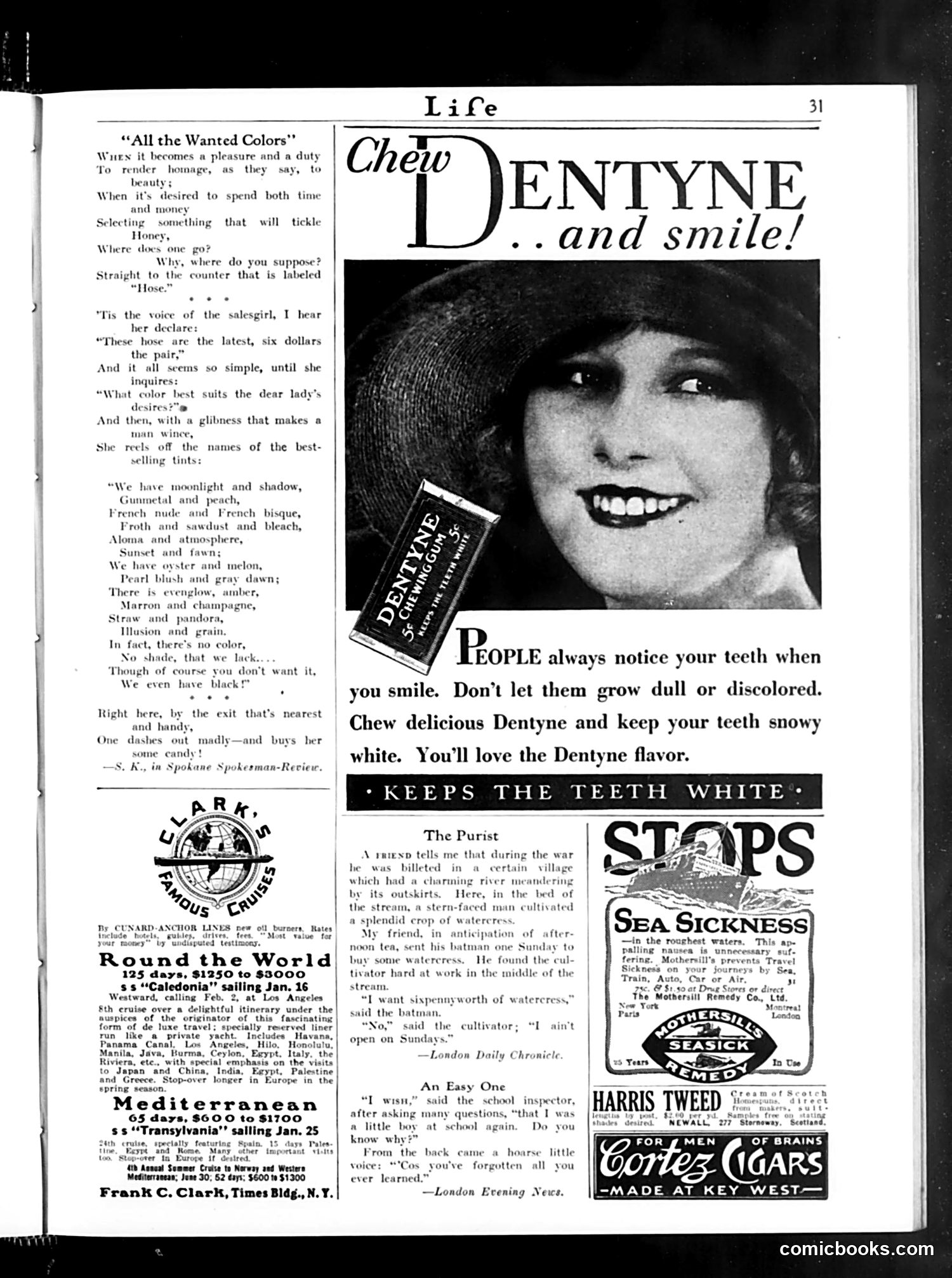
This page is primarily **advertising**, not political satire. The dominant content is a Dentyne chewing gum advertisement featuring a smiling woman's photograph with the tagline "Chew Dentyne...and smile!" The left column contains a humorous **poem about shopping for hosiery** ("All the Wanted Colors"). A male narrator describes visiting a hosiery counter where a salesgirl overwhelms him with absurdly poetic color names—"moonlight and shadow," "French bisque," "atmosphere," "evenglow"—for what are presumably basic women's stockings. The joke is that excessive, flowery marketing language makes simple products seem impossibly complicated, driving the customer to buy hastily just to escape. The page also includes three brief **humorous anecdotes** ("The Purist," "An Easy One") and multiple travel and product advertisements typical of 1920s Life magazine. There is **no political content** on this page. The satire is purely commercial and social—poking fun at retail marketing tactics and human nature rather than addressing political issues.
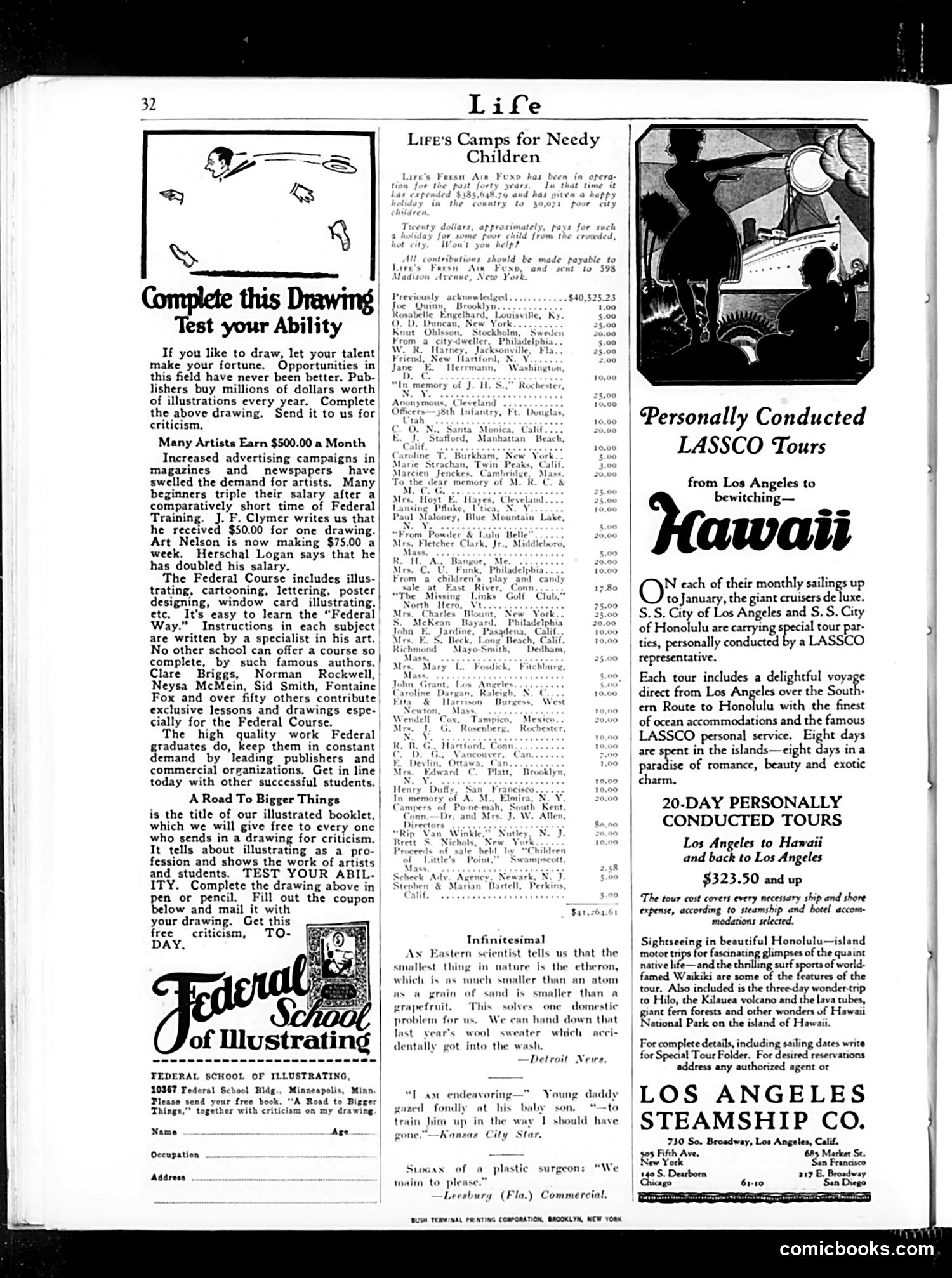
This page is primarily **advertising and promotional content**, not political satire. The main features are: 1. **"Complete This Drawing" advertisement** (left): A Federal School of Illustrating recruitment ad offering art training and promising high earnings ($500+/month). It references real illustrators like Clare Briggs and Norman Rockwell as instructors—legitimate commercial artists of the era. 2. **"Life's Camps for Needy Children"** (center): A charity appeal listing donor contributions, showing Life magazine's philanthropic mission during what appears to be the interwar period. 3. **"Infinitesimal" joke** (center): A brief humorous anecdote about an "Eastern scientist" explaining atomic/subatomic scale to a child—typical period science humor. 4. **LASSCO Hawaiian cruise advertisements** (right): Promoting luxury steamship tours to Hawaii at $323.50+, targeting affluent readers. The page reflects 1920s-era commercial culture: vocational education marketing, charitable fundraising, and luxury travel promotion—not political commentary.
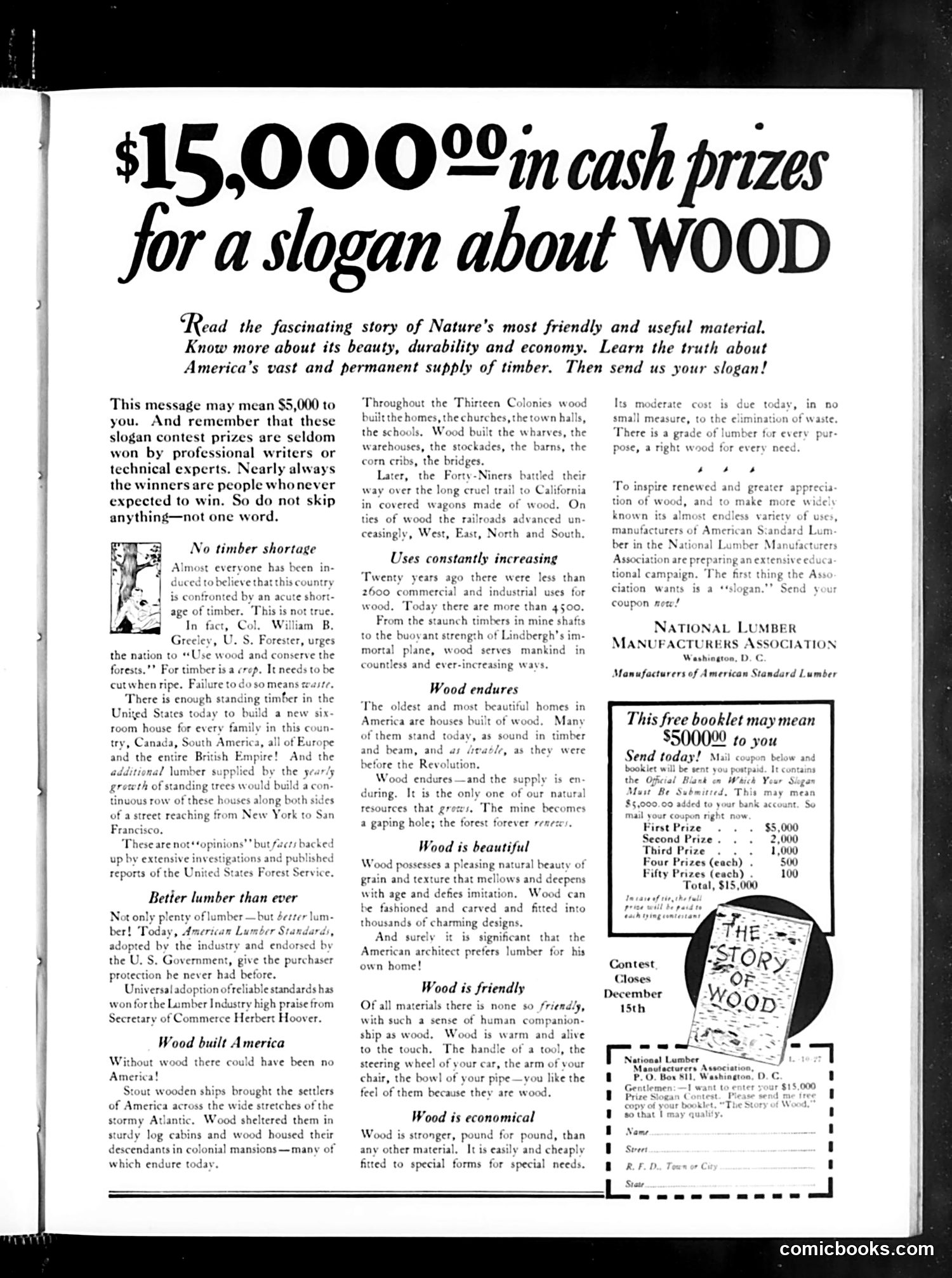
This is not a satirical cartoon, but rather a **straightforward advertising campaign** by the National Lumber Manufacturers Association. There is no satire or political commentary present. The page promotes a slogan-writing contest offering $15,000 in total prizes for catchy phrases about wood's virtues. The text argues wood is America's essential material—citing its historical role in building the nation, its durability, beauty, friendliness, and economy. It counters timber-shortage concerns by claiming ample forest reserves exist. The piece emphasizes wood's expanding uses (from 2,600 uses twenty years prior to over 4,500 currently) and references Charles Lindbergh's airplane, suggesting wood's modern relevance. The contest itself—targeting ordinary people rather than professional writers—was a common marketing tactic of the era. This appears to be a genuine industry promotion, likely from the 1920s-30s, with no hidden satirical intent.
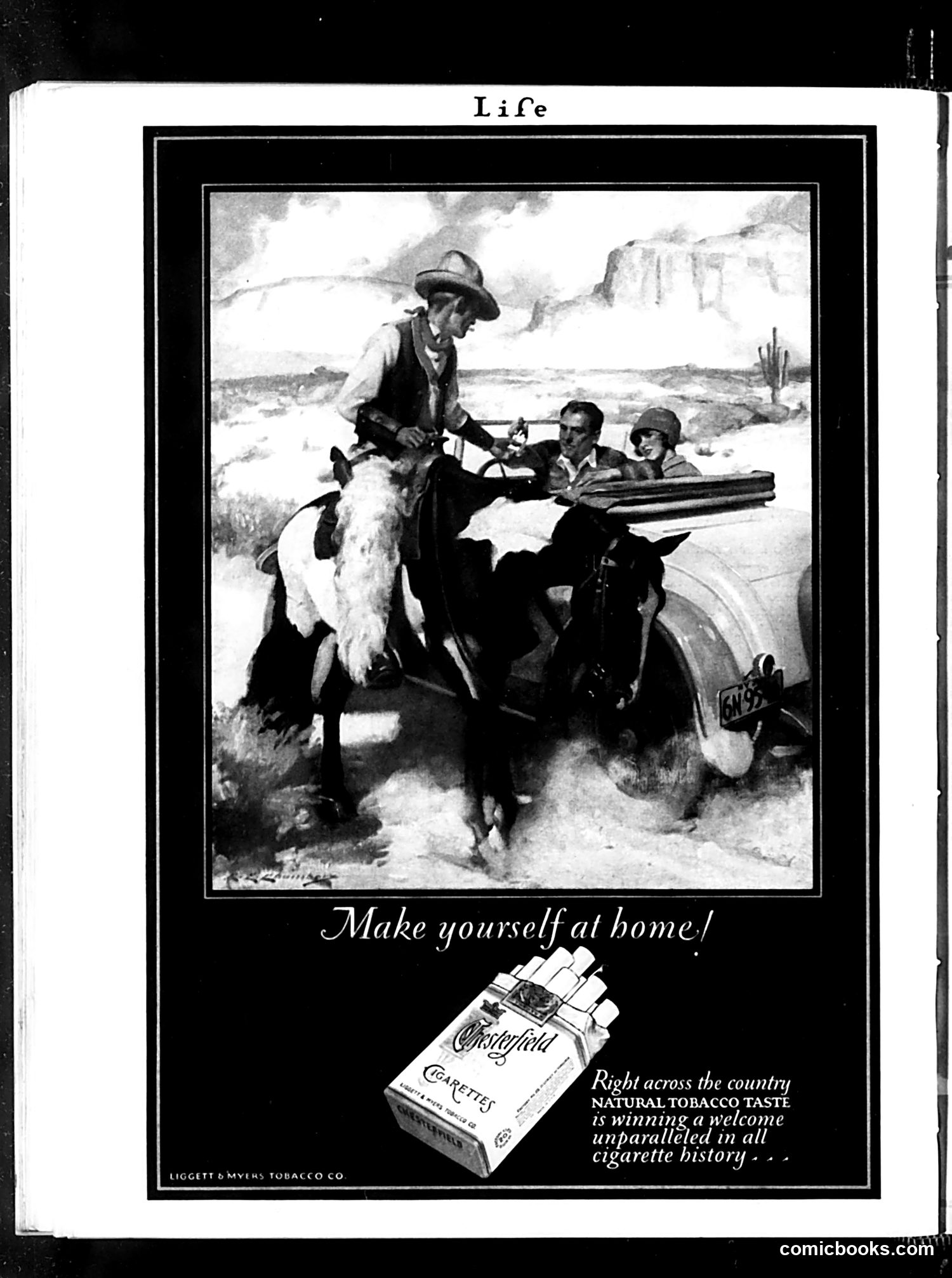
This is a **cigarette advertisement**, not political satire. The image shows a cowboy on horseback in a desert landscape (appearing to be the American Southwest, with a saguaro cactus visible) encountering two men with what looks like surveying equipment. The ad's tagline—"Make yourself at home!"—pairs the rugged, independent cowboy imagery with Chesterfield cigarettes. The accompanying text claims the cigarettes' "natural tobacco taste is winning a welcome unparalleled in all cigarette history." The appeal is straightforward: associating the product with American frontier masculinity and freedom. The cowboy represents authenticity and self-reliance—qualities the advertiser wants consumers to associate with smoking Chesterfields. This was typical 1920s-30s tobacco marketing strategy, using idealized American imagery to sell cigarettes.