
Life, 1927-10-27 · page 21 of 36
Life — October 27, 1927 — page 21: what you’re looking at
What you’re looking at
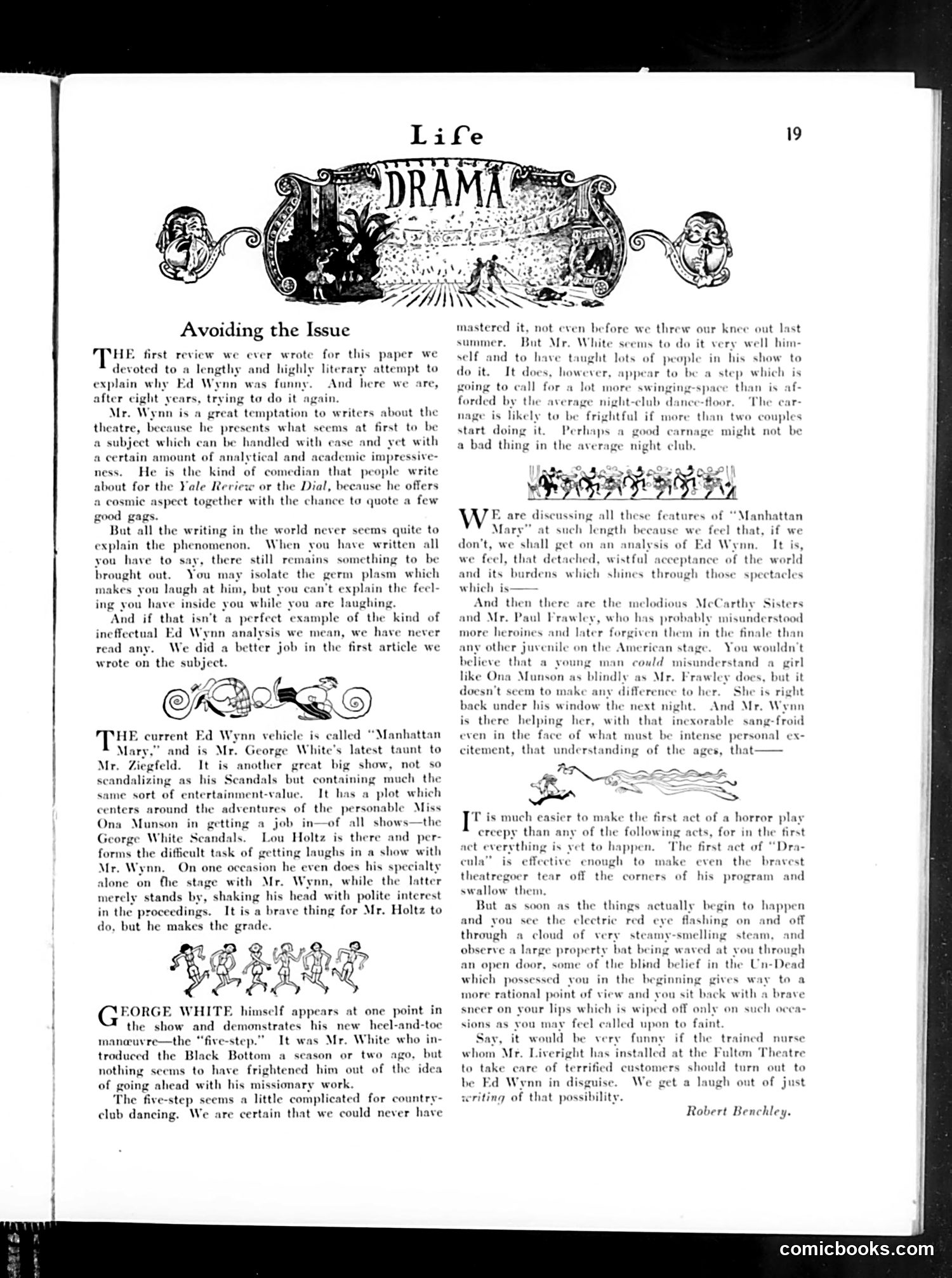
This is a theater review discussing Ed Wynn's current show "Manhattan Mary," produced by George White as competition against Florenz Ziegfeld's productions. The page satirizes the difficulty of explaining *why* Wynn is funny—his comedic appeal resists rational analysis despite critics' repeated attempts. The review identifies several performers: Ona Munson (the lead), Lou Holtz (a comedian), the McCarthy Sisters, Paul Frawley, and George White himself (who demonstrates his signature dance, the "five-step," a follow-up to his earlier innovation, the Black Bottom). The satire's point: Wynn embodies an ineffable quality—described as "detached, wistful acceptance"—that transcends analytical explanation. The critic ironically acknowledges he's *avoiding* a deeper analysis of Wynn by discussing the show's plot and supporting cast instead, recognizing the futility of the exercise.
📄 Transcribed text from this page (OCR, searchable)
Machine-transcribed from the original scan — historical spelling and the odd misread are preserved.
Avoiding the Issue THE first review we ever wrote for this paper we devoted to a lengthy and highly literary attempt to explain why Ed Wynn was funny. And here we are, after eight years, trying to do it again. Mr. Wynn is a great temptation to writers about the theatre, because he presents what seems at first to be a subject which can be handled with ease and yet with a certain amount of analytical and academic impressive- ness. He is the kind of comedian that people write about for the Yale Review or the Dial, because he offers a cosmic aspect together with the chance to quote a few good gags. But all the writing in the world never seems quite to explain the phenomenon. When you have written all you have to say, there still remains something to be brought out. You may isolate the germ plasm which makes you laugh at him, but you can't explain the feel- ing you have inside you while you are laughing. And if that isn’t a perfect example of the kind of ineffectual Ed Wynn analysis we mean, we have read any. We did a better job in the first article we wrote on the subject. CRORES HE current Ed Wynn vehicle is led “Manhattan Mary,” and is Mr. George White's 1 t taunt to Mr. Ziegfeld. It is another great big show, not so scandalizing as his Scandals but containing much the same sort of entertainment-value. It has a plot which centers around the adventures of the personable Miss Ona Munson in getting a » in—of all shows—the George White Scandals. Lou Holtz is there and per- forms the difficult task of getting laughs in a show with Mr. Wynn. On one oceasion he even does his specialty alone on fhe stage with Mr. Wynn, while the latter merely stands by, shaking his head with polite interest in the proceedings. It is a brave thing for Mr. Holtz to do, but he makes the sole FORGE WHITE # appears at one point in the show and demonstrates his new h nd-toc manauvre—the “five-step.”” It was Mr. White who in- troduced the Black Bottom a season or two ago, but nothing seems to have frightened him out of the idea of going ahead with his missionary work. The five-step scems a little complicated for country- club dancing. We are certain that we could never have mastered it, not even before we threw our knee out last summer. But Mr. White seems to do it very well him- self and to have taught lots of p do it. It does, | ng to call for a forded by the aver nage is likely to be start doing it. ple in his show to er, appear to be than is af- The car- two couples more swinging-spac ght-club dance-tloor. ge nig frightful if more th. Perhaps a bad thing in the a good carnage might not be ght club. Averag WE are discussing all these “Manhattan n features of Mary” at such length because we feel that, if we don't, we shall get on an analysis of Ed Wynn. It is, we feel, that detached, wistful acceptance of the world and its burdens which shines through those spectacles which is— And then there are the and Mr. more heroines and later forgiven them in the finale than You wouldn't melodious McCarthy , who has probably misunderstood Sisters aul Frawley any other juvenile on the American stage believe that a young man could misunderstand a girl like Ona Munson as blindly as Mr. Frawley does, but it doesn’t seem to make any difference to her. She is rig And Mr. Wynn sang-froid back under his window the next night is there with that even in the face of what must be that understanding helping her, inexorable intense personal ex- f the ages, citement, that—— T is much easier to make the first act of a horror play ercepy than any of the following acts, for in the first act everything is vet to happen. The first act of “Dra- cula” is effective enough to make even the bravest theatregoer tear off the corners of his program and swallow them. But as soon as the and you see the through observe things actually begin to happen on and off steamy-smelling steam, and electric red eve flashing a cloud of very a larg an open ¢ property bat being waved at you through some of the blind belief in the Un-Dead rives way to a which possessed you in the | nnin more rational point of view and you sit back with a brave ly on such occa- sneer on your lips which is wiped off sions as you may feel called upon to faint Say, it funny if the trained nurse whom Mr. Liveright has installed at the Fulton Theatre to take care of terrified customers should turn out to be Ed Wynn in disguise. We get a laugh out of just writing of that possibility. would be very Robert Benchley. comicbooks.com