
Life, 1927-10-27 · page 26 of 36
Life — October 27, 1927 — page 26: what you’re looking at
What you’re looking at
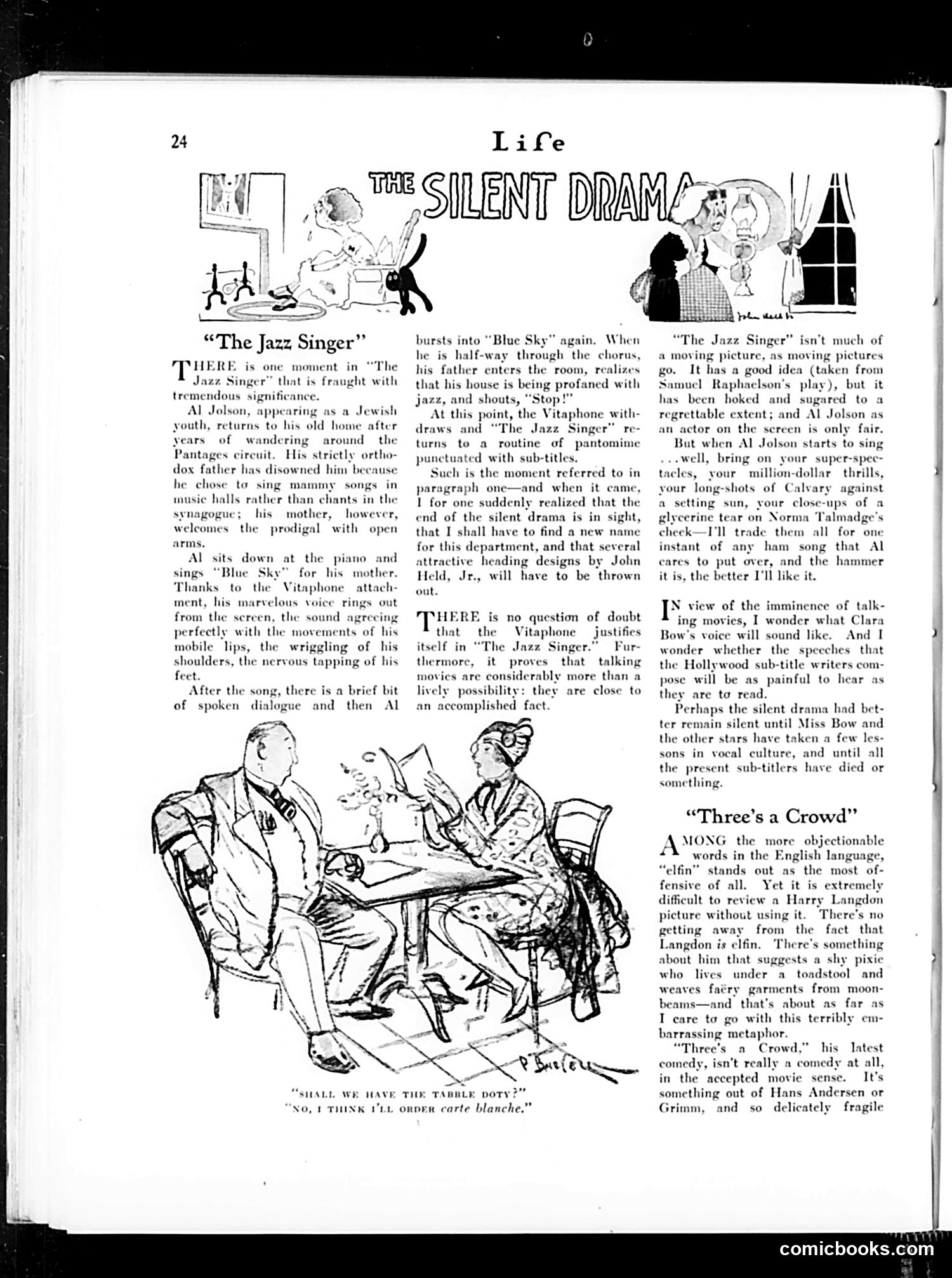
This page reviews early "talking pictures," specifically *The Jazz Singer* (1927) starring Al Jolson. The critic discusses a pivotal scene where Jolson's character—a Jewish boy who left home to perform jazz in music halls—sings "Blue Sky" at the piano. His Orthodox father enters and shouts "Stop!" at the profane jazz music, causing the new Vitaphone sound technology to cut out, returning the film to silent pantomime. The reviewer argues this moment marks the end of silent cinema. While criticizing the film's plot as "hoked and sugared," he praises Jolson's singing as superior to the entire production, trading all spectacular silent-film effects for "one instant of any ham song" Jolson performs. The cartoon below shows two men discussing dinner, using the phrase "carte blanche" (blank check)—likely satirizing wealthy patrons' pretensions. The page also briefly reviews Harry Langdon's *Three's a Crowd*, describing it as delicate rather than comedic.
📄 Transcribed text from this page (OCR, searchable)
Machine-transcribed from the original scan — historical spelling and the odd misread are preserved.
“The Jazz Singer” is one moment in “The Inger” that is fraught with tremendous signifi Al Jolson, ap} youth, returns to years a Jewish his old home after around the Pantages circuit. His strictly ortho- dox father has disowned him because he chose to sing mammy songs in of wandering music halls rather than chants in the synagogue; his ’ welcomes the prodigal with open arms. Al sits down the piano sings “Blue Sky" for his mothe Thanks to the Vitaphone attach- ment, his marvelous voice rings out mother, howeve from the screen, the sound agreeing perfectly with the movements of his mobile lips, the wriggling of his shoulders, the nervous tapping of his feet. After the song, there is a brief bit of spoken dialogue and then Al bursts into “Blue Sky” again. When he is half-way through the chorus, his father enters the room, realizes that his house is being profaned with jazz, and shouts, “Stop!” nt, the Vitaphone with- draws and “The Jazz Singer’ re- turns to a routine of pantomime punctuated with sub-titles. Such is the moment referred to in paragraph one—and when it came, 1 for one suddenly realized that the end of the silent drama is in sight, that I shall have to find a new name for this department, and that several attractive heading designs by John Held, Jr., will have to be thrown out. HERE is no question of doubt that the Vitaphone justifies itself in “The Jazz Singer.” Fur- thermore, it proves that talking movies are considerably more than a lively possibility: they are close to ccomplished fact. an “SHALL WE HAVE THE TABBLE poty?” “No, 1 THINK ILL oRvER carte blanche.” “The Singer” isn't much of a moving picture, as moving pictures go. It has a good idea (taken from Samuel Raphaelson’s play), but it has been hoked and sugared to a regrettable extent; and Al Jolson as an actor on the screen is only fair. But when Al ..well, bring on your super-spec- tacles, your million-dollar thrills, your long-shots of Calvary against a setting sun, your close-ups of a glycerine tear on Norma ‘Talmadge’s eh I'll trade them all for one instant of any ham song that Al cares to put over, and the hammer it is, the better I'll like it. Jolson starts to sing N view of the imminence of talk- ing movies, I wonder what Clara Bow’s voice will sound lik And I wonder whether the speeches that the Hollywood sub-title writers com- pose will be as painful to hear as they are to read. Perhaps the silent drama had bet- ter ren silent until Miss Bow and the other stars have taken a few les- sons in vocal culture, and until all the present sub-titlers have died or something. “Three’s a Crowd” MONG the more objectionable words in the English language, “elfin” stands out as the most of- fensive of all. Yet it is extremely difficult to review a Harry Langdon picture without using it. There's no getting away from the fact that Langdon is elfin. There's something about him that suggests a shy pixie who lives under a toadstool and weaves faéry garments from moon- beams—and that's about as far as I care ta go with this terribly em- barrassing metaphor. Three’s a Crowd,” his latest comedy, isn’t really a comedy at all, in the accepted movie sense. It's something out of Hans Andersen or Grimm, and so delicately fragile i | ;ukAl comicbooks.com