
A complete issue · 42 pages · 1927
Life — July 7, 1927
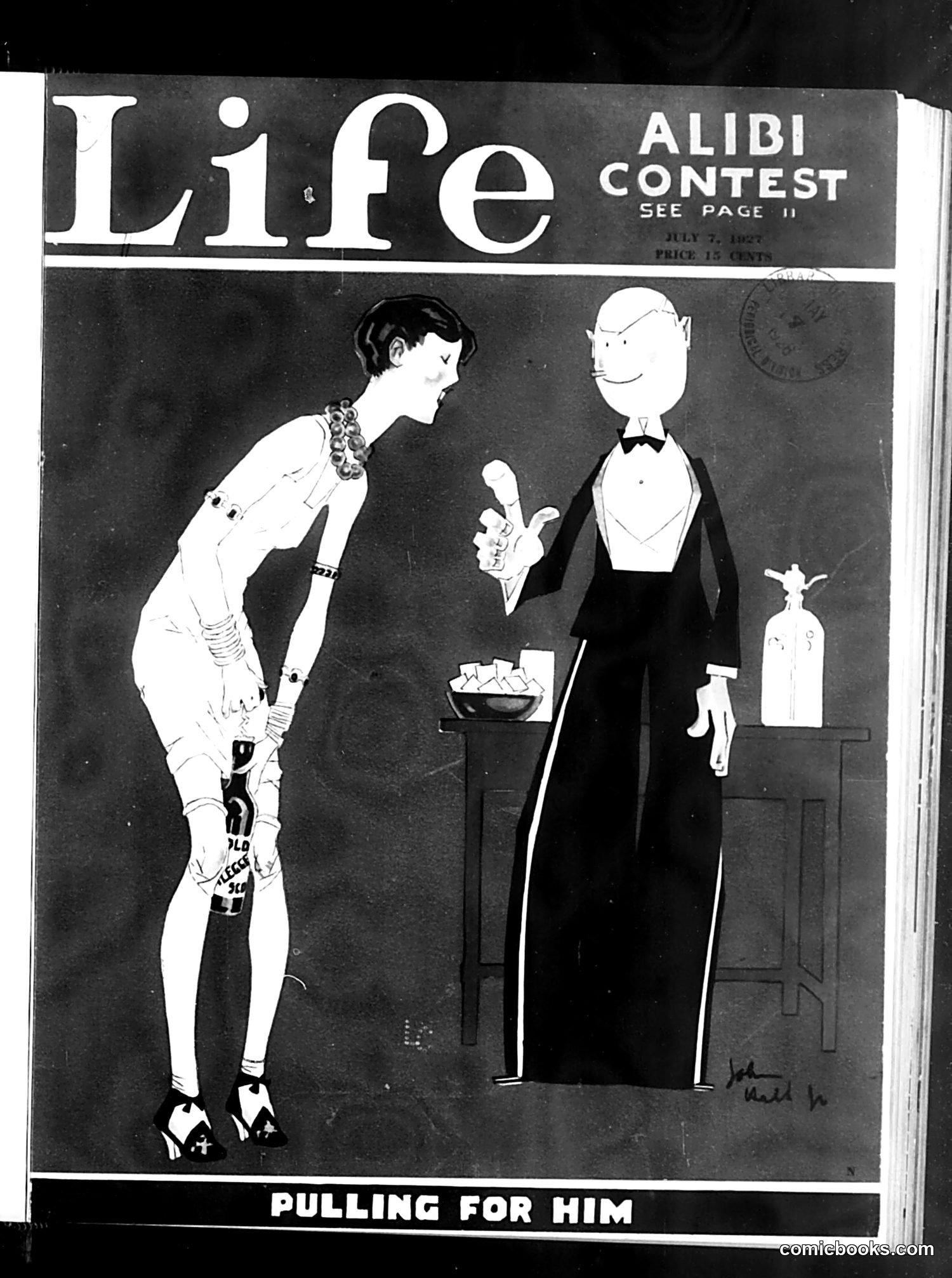
This satirical cartoon titled "Pulling for Him" depicts a woman in revealing 1920s attire (short dress, heels, jewelry) leaning toward a formally dressed man in a tuxedo. The woman appears to be tempting or persuading the man, who holds a cane and looks somewhat uncomfortable or conflicted. The "Alibi Contest" reference suggests this relates to contemporary social debates about morality and behavior. The setting—with cocktail items visible—evokes Prohibition-era themes of hidden indulgence and temptation. The satire likely mocks either gender relations of the Jazz Age, marital dynamics, or masculine resistance to modern women's boldness. The woman's aggressive posture and the man's defensive stance humorously comment on shifting social roles during the 1920s.
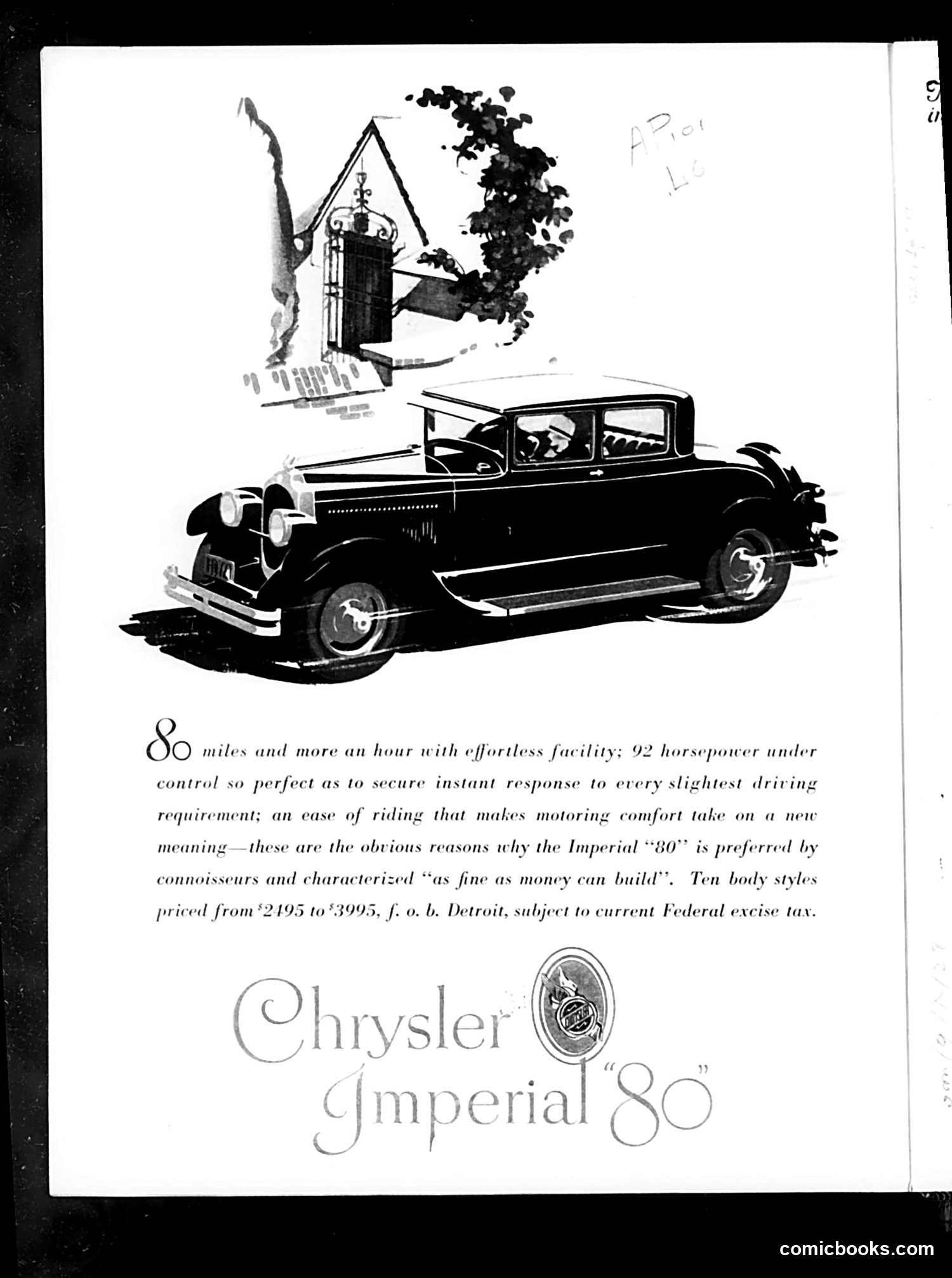
This is primarily a **car advertisement**, not satire or political commentary. The page promotes the Chrysler Imperial "80" automobile, highlighting its performance capabilities (80+ mph, 92 horsepower) and comfort features. The upper illustration appears to be **decorative architectural imagery** — possibly depicting a mansion or estate — establishing aspirational lifestyle associations with the vehicle. This was common advertising strategy: linking luxury cars to wealth and social status. The advertisement emphasizes the car's refinement, describing it as "fine as money can build," and lists ten body styles priced from $2,195 to $3,995, f.o.b. Detroit, plus Federal excise tax. This represents **straightforward 1920s-era luxury automobile marketing** rather than satirical content.
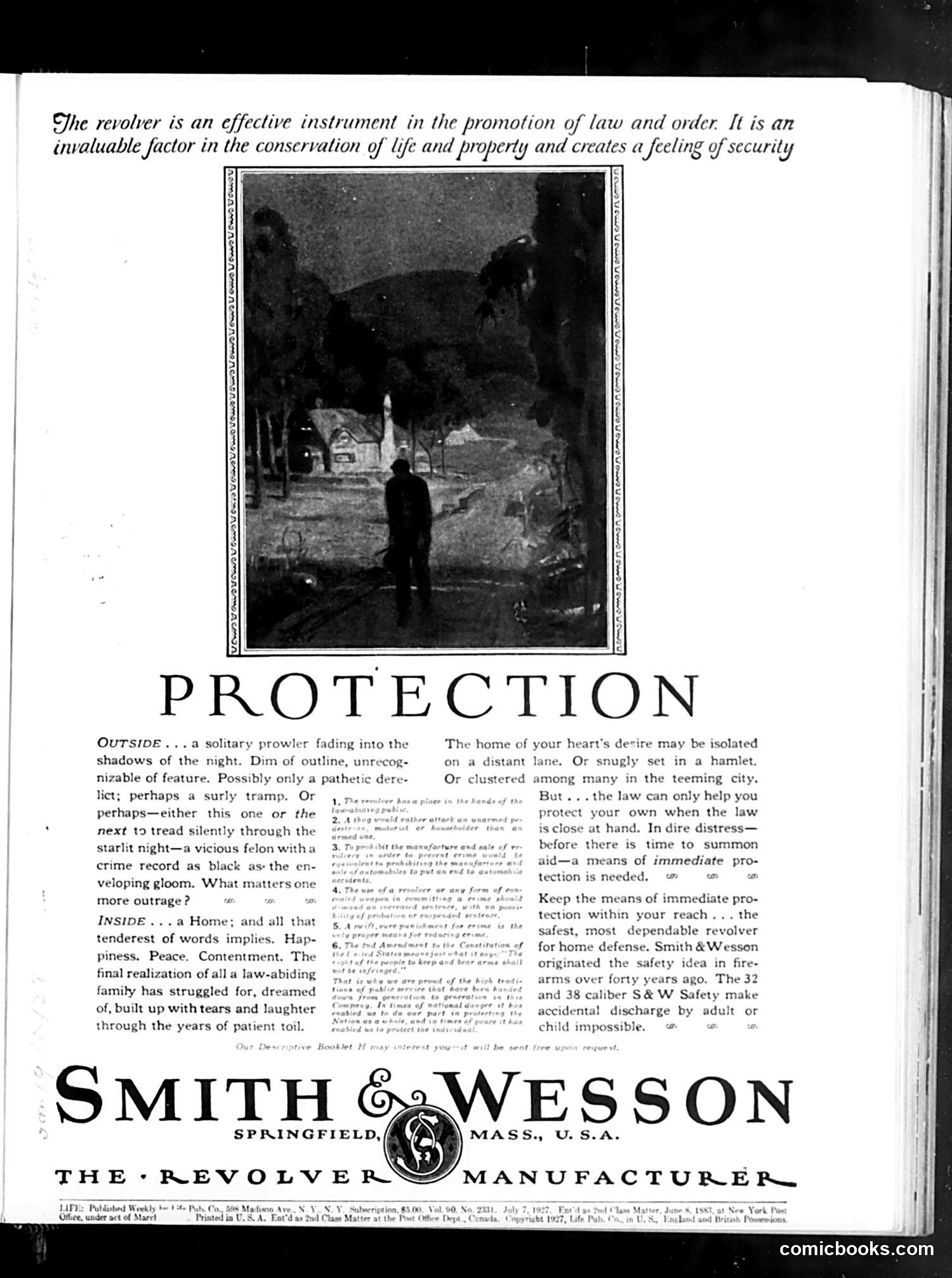
This page is **primarily a Smith & Wesson revolver advertisement**, not political satire. The top quote claims revolvers promote "law and order" and "security." The image shows a silhouetted figure standing guard at night outside an isolated house—a domestic security scenario. The accompanying text uses melodramatic language ("vicious felon," "pathetic derelict") to argue that homeowners need revolvers for self-defense since "the law...cannot always be close at hand." S&W markets the revolver as the "safest, most dependable" home defense tool, noting their weapons originated "the safety idea in fire-arms over forty years ago." This is **commercial persuasion**, not editorial commentary—using fear-based messaging to sell weapons to civilians concerned about crime and home protection.
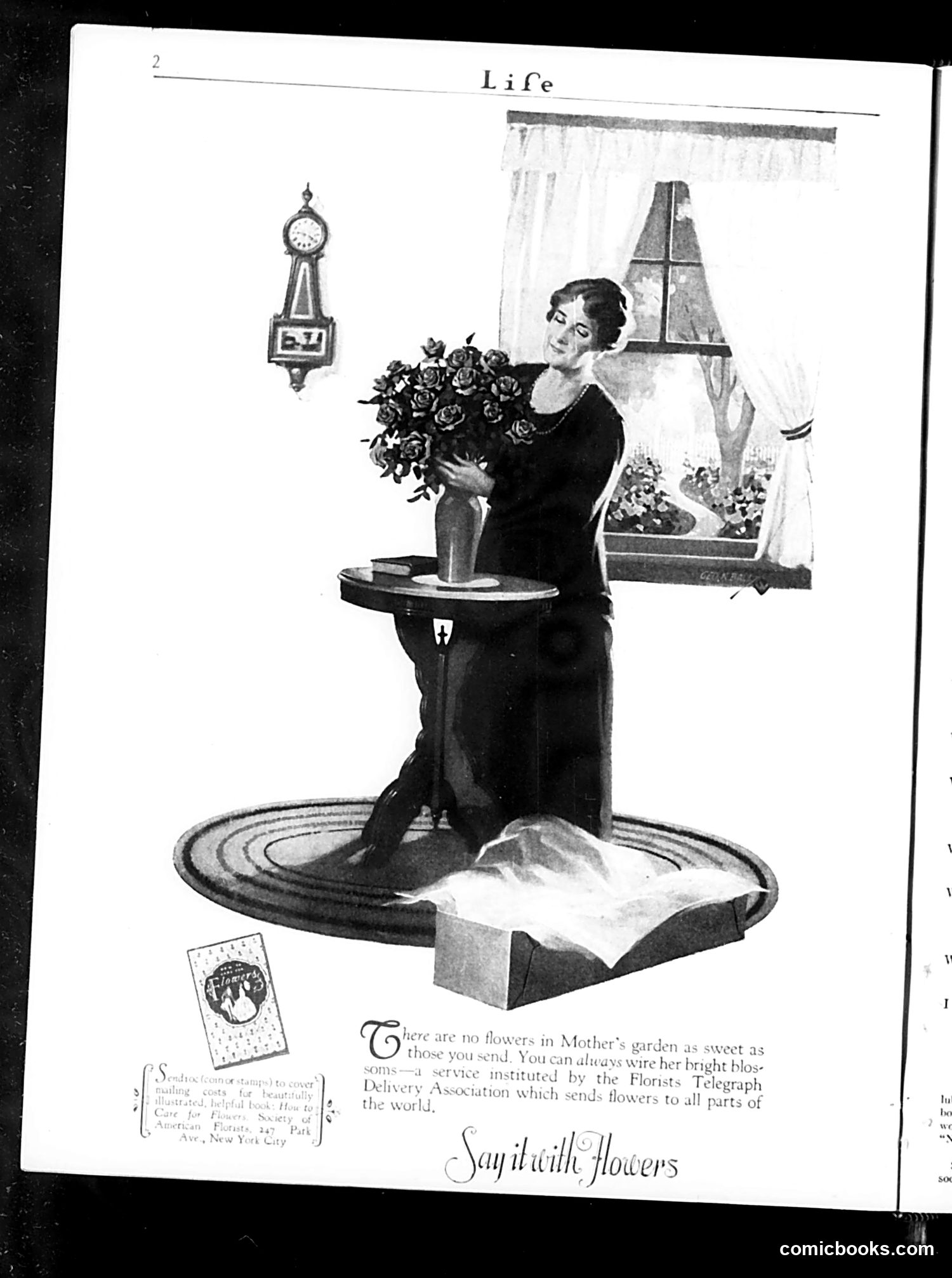
This page is primarily an **advertisement for flower delivery**, not political satire. The illustration shows a woman arranging flowers by a window with a clock and curtained backdrop. The ad promotes the **Florists' Telegraph Delivery Association**, a service that sends flowers "to all parts of the world." The tagline "Say it with Flowers" was their actual marketing slogan from this era. The text suggests flowers are an appropriate gift—particularly meaningful from a mother's garden or as a sentimental gesture. There's a small product image in the lower left corner showing what appears to be a calendar or promotional material. This reflects early 20th-century consumer culture, when *Life* magazine mixed editorial content with advertisements. The piece contains no political commentary—it's straightforward commercial messaging dressed in genteel, sentimental language typical of the period.
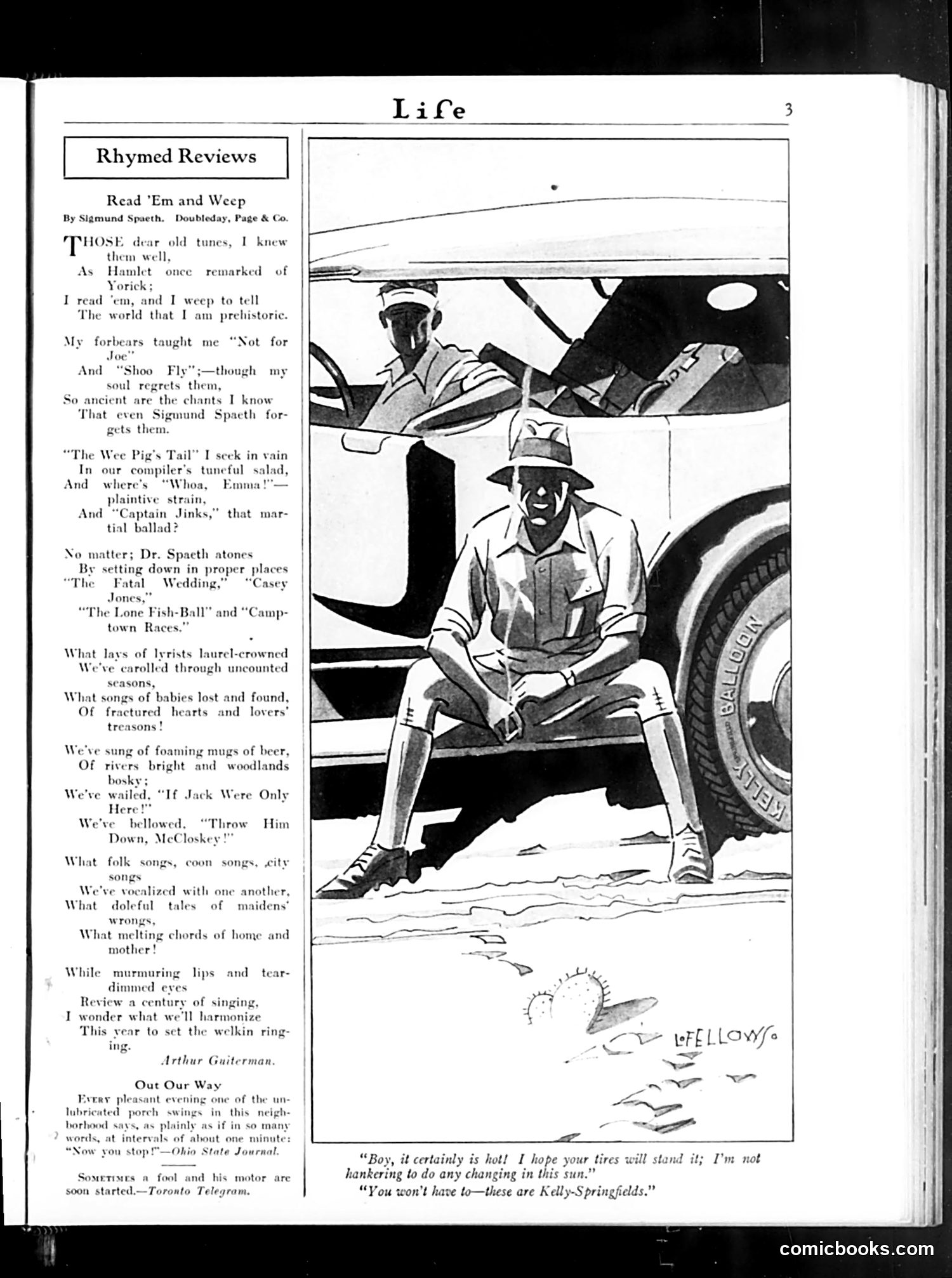
This page contains a "Rhymed Review" titled "Read 'Em and Weep" by Sigmund Spaeth, critiquing old songs and nursery rhymes. The accompanying illustration shows a man in casual attire sitting on what appears to be an airplane or vehicle, with another figure visible above. The poem humorously laments the loss of traditional songs—referencing titles like "The Wee Pig's Tail," "Captain Jinks," and "The Fatal Wedding"—suggesting modern entertainment has displaced these old favorites. The caption quote about "Kelly-Springfields" (a tire brand) indicates the illustration is likely satirizing modern advertising's intrusion into everyday life. The overall message critiques how contemporary commercial culture has replaced traditional folk entertainment.
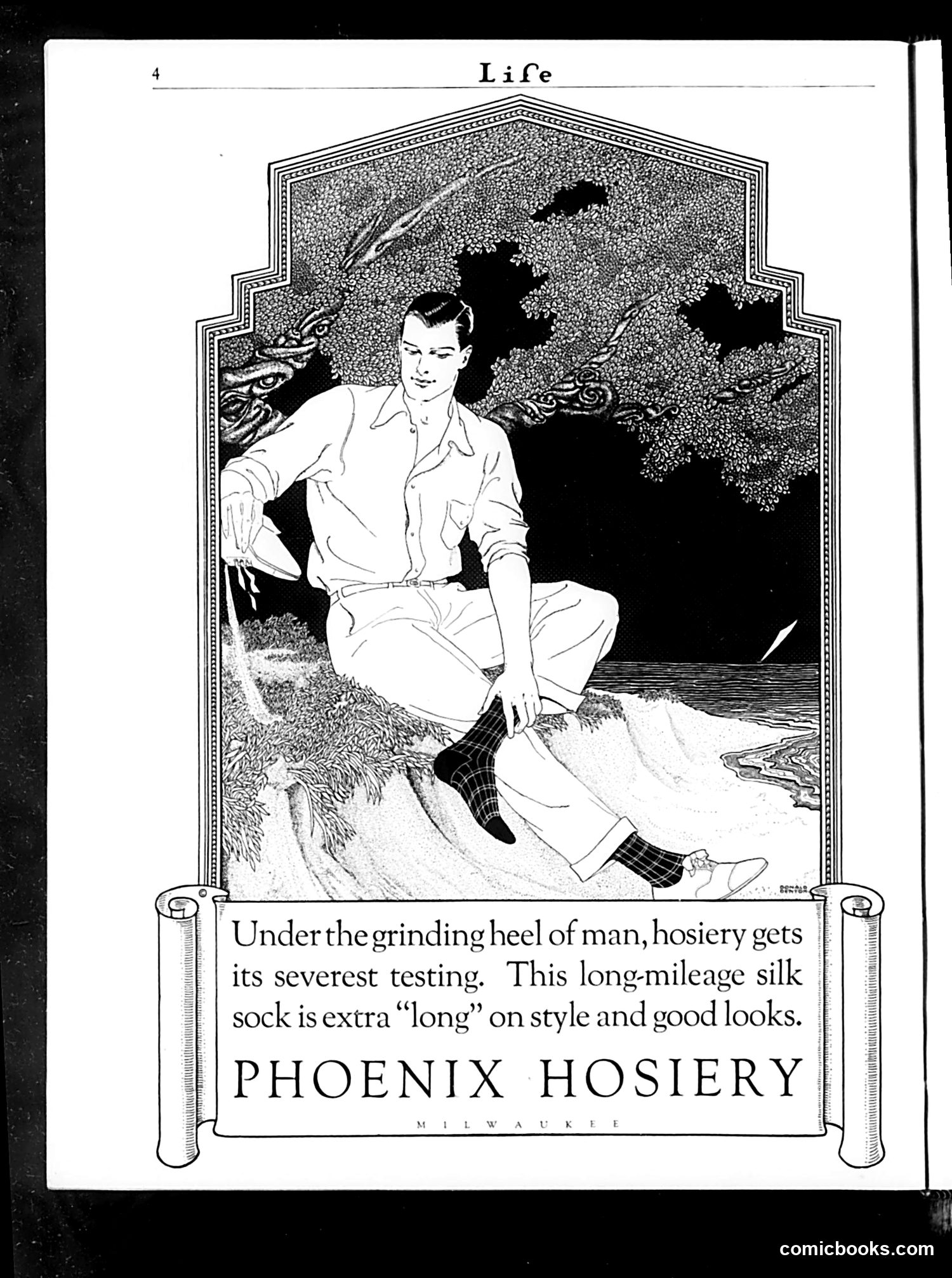
This page is primarily a **commercial advertisement**, not political satire. It promotes Phoenix Hosiery from Milwaukee, featuring an illustration of a well-dressed man in casual outdoor attire (white shirt, plaid socks, sitting position). The advertisement's copy uses a humorous sales pitch: "Under the grinding heel of man, hosiety gets its severest testing." This is a tongue-in-cheek reference to the physical wear socks endure through daily use, positioning Phoenix's "long-mileage silk sock" as durable enough to withstand such punishment while maintaining "style and good looks." The art style is typical 1920s-30s commercial illustration. There is no political commentary—this is straightforward product marketing using wit rather than satire.
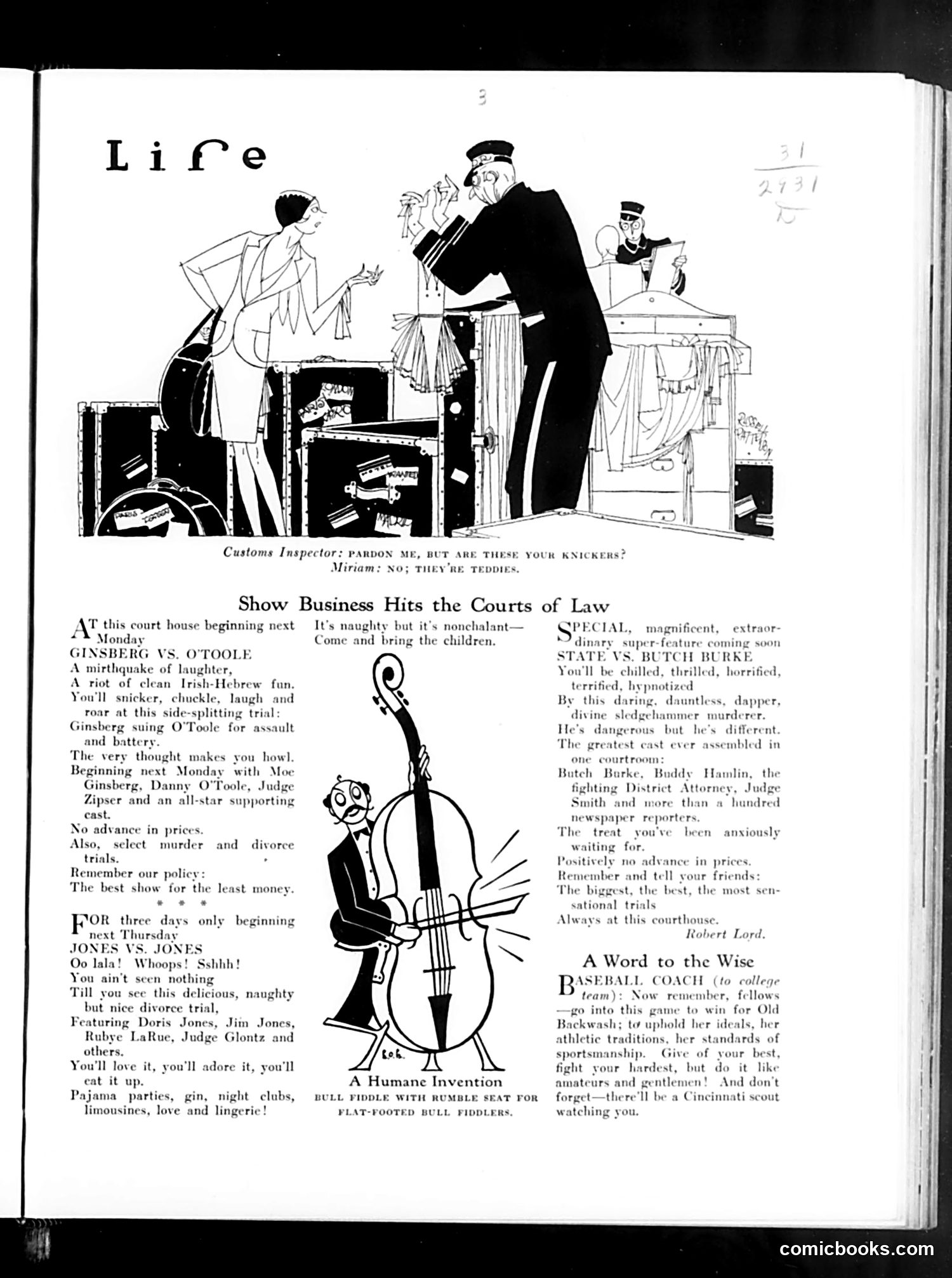
This page advertises upcoming court trials as entertainment for readers. The main illustration shows a customs inspector discovering contraband "knickers" (British term for underwear/shorts), which he mistakes for teddy bears—a joke playing on post-WWI fashion anxieties about women's clothing becoming more revealing and scandalous. Two trials are promoted: 1. **Ginsberg vs. O'Toole** - an assault case presented as comedic Irish-Jewish humor 2. **State vs. Butch Burke** - a murder trial featuring real legal figures (Judge Smith, District Attorney, newspaper reporters) The page treats serious legal proceedings as spectator entertainment, reflecting a 1920s perspective where sensational trials were popular public amusement. The "humane invention" image jokes about a cello as a device for "flat-footed bull fiddlers"—music industry slang humor.
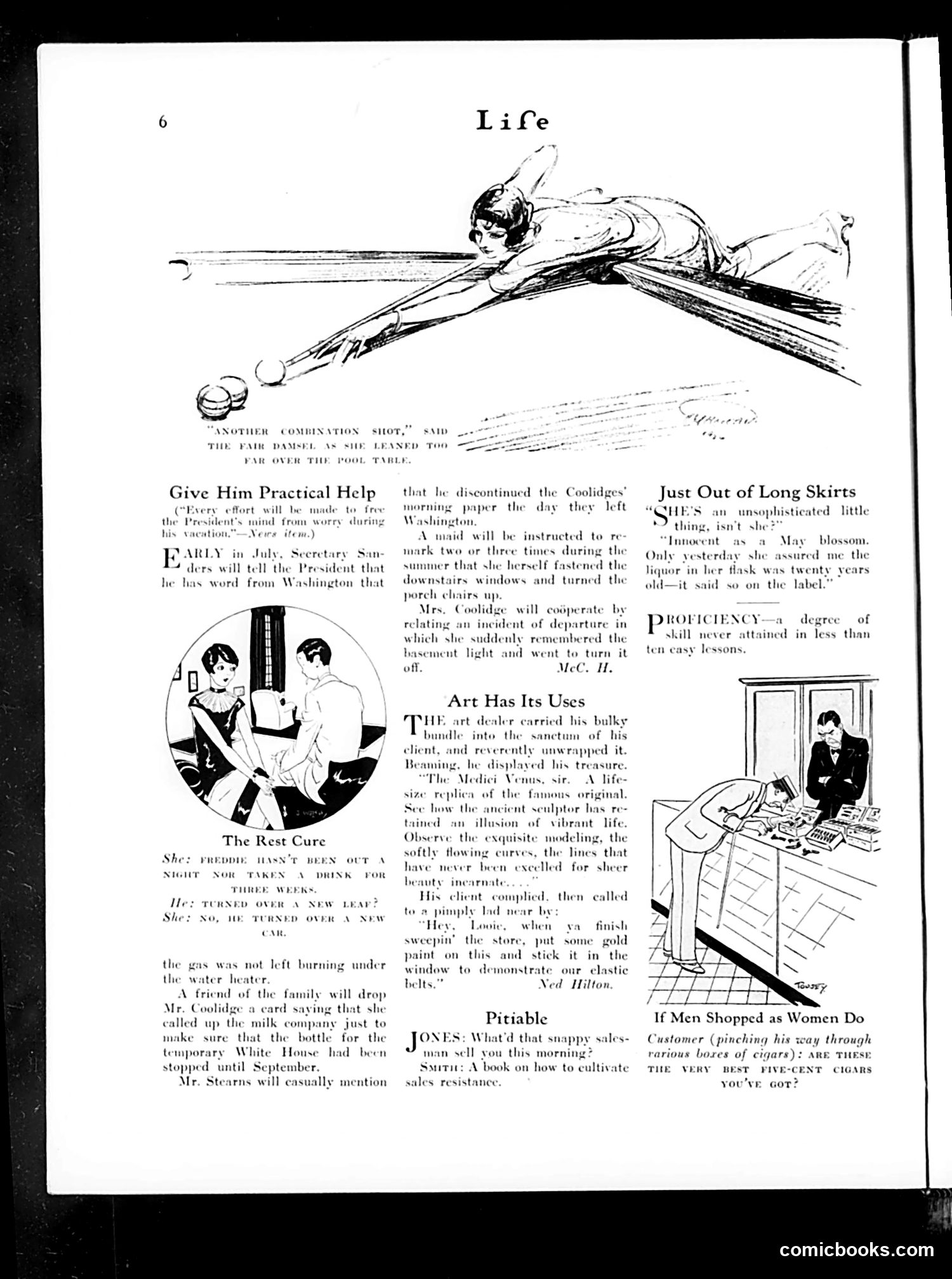
This page contains several humorous vignettes satirizing early 20th-century social customs and gender roles: **"Give Him Practical Help"** mocks Washington insiders' advice to the President during vacation—suggesting he needs constant assistance even while resting. **"The Rest Cure"** jokes about marital dynamics, showing a wife who's been out all night while her husband stayed home with the car. **"Just Out of Long Skirts"** pokes fun at young women's innocence and naivety about alcohol. **"Art Has Its Uses"** satirizes art dealers and wealthy clients—showing how art becomes a financial prop rather than genuine appreciation. **"If Men Shopped as Women Do"** humorously imagines male customers browsing tobacco as indecisively as women supposedly shop, inverting gender stereotypes for comedic effect. The page reflects period attitudes about gender, class, and social pretension.
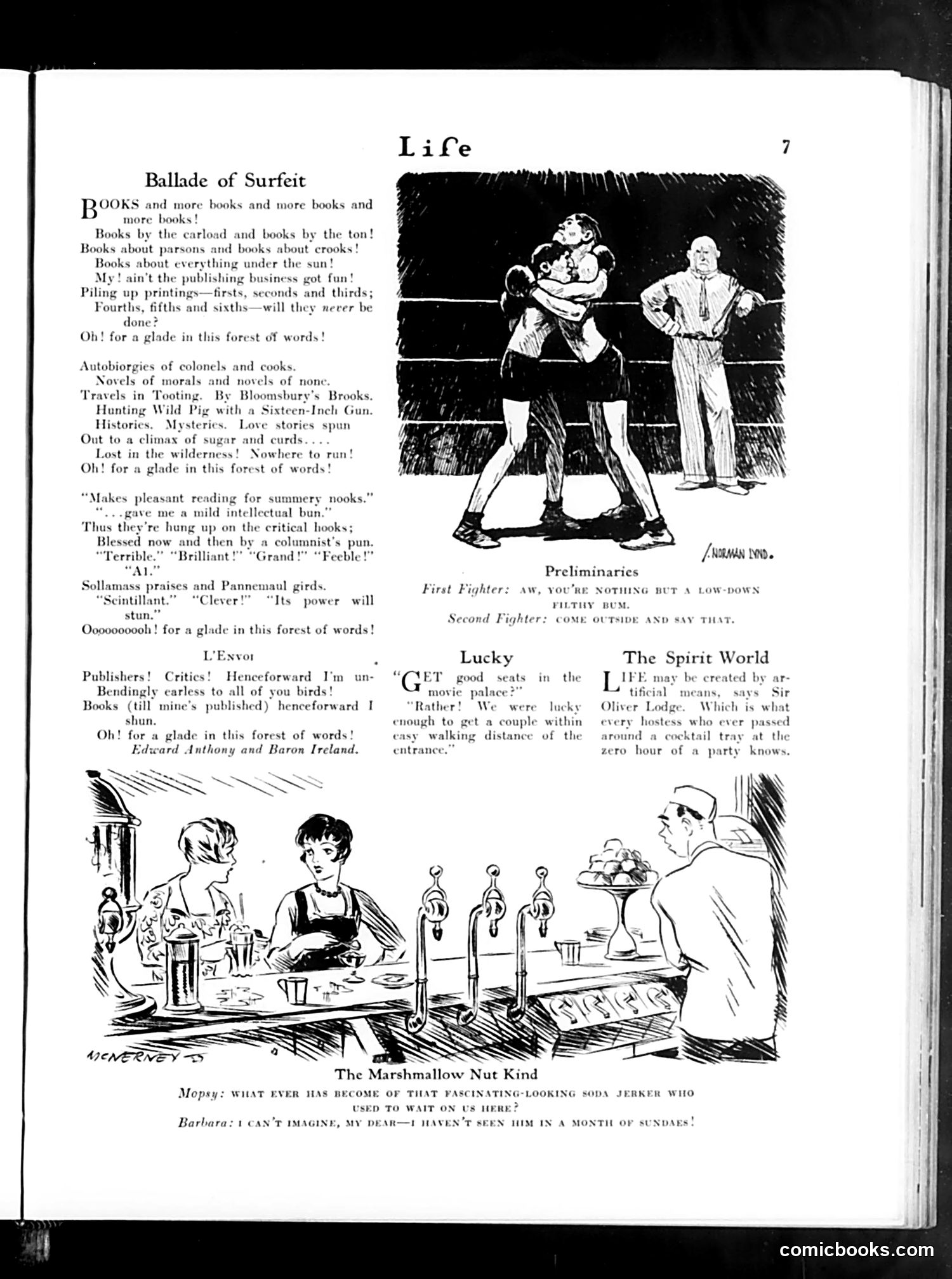
This page contains three separate satirical pieces typical of Life's humor: 1. **"Ballade of Surfeit"** — A poem mocking the publishing industry's overproduction of books on every conceivable topic, with complaints about endless printings and editions. 2. **"Preliminaries"** — A boxing cartoon showing two fighters with witty banter about a "low-down filthy bum" and taunting outside the ring—standard fight-day humor. 3. **"Lucky" and "The Spirit World"** — Two cartoons about social situations: one about getting good movie-theater seats, another referencing spiritualism (likely mocking Sir Oliver Lodge, a real spiritualist figure of the era who claimed to contact the dead). 4. **"The Marshmallow Nut Kind"** — A domestic cartoon about a woman and man discussing a missing soda jerk, playing on period slang and social observation. The humor targets publishing excess, boxing culture, spiritualism fads, and everyday domesticity.
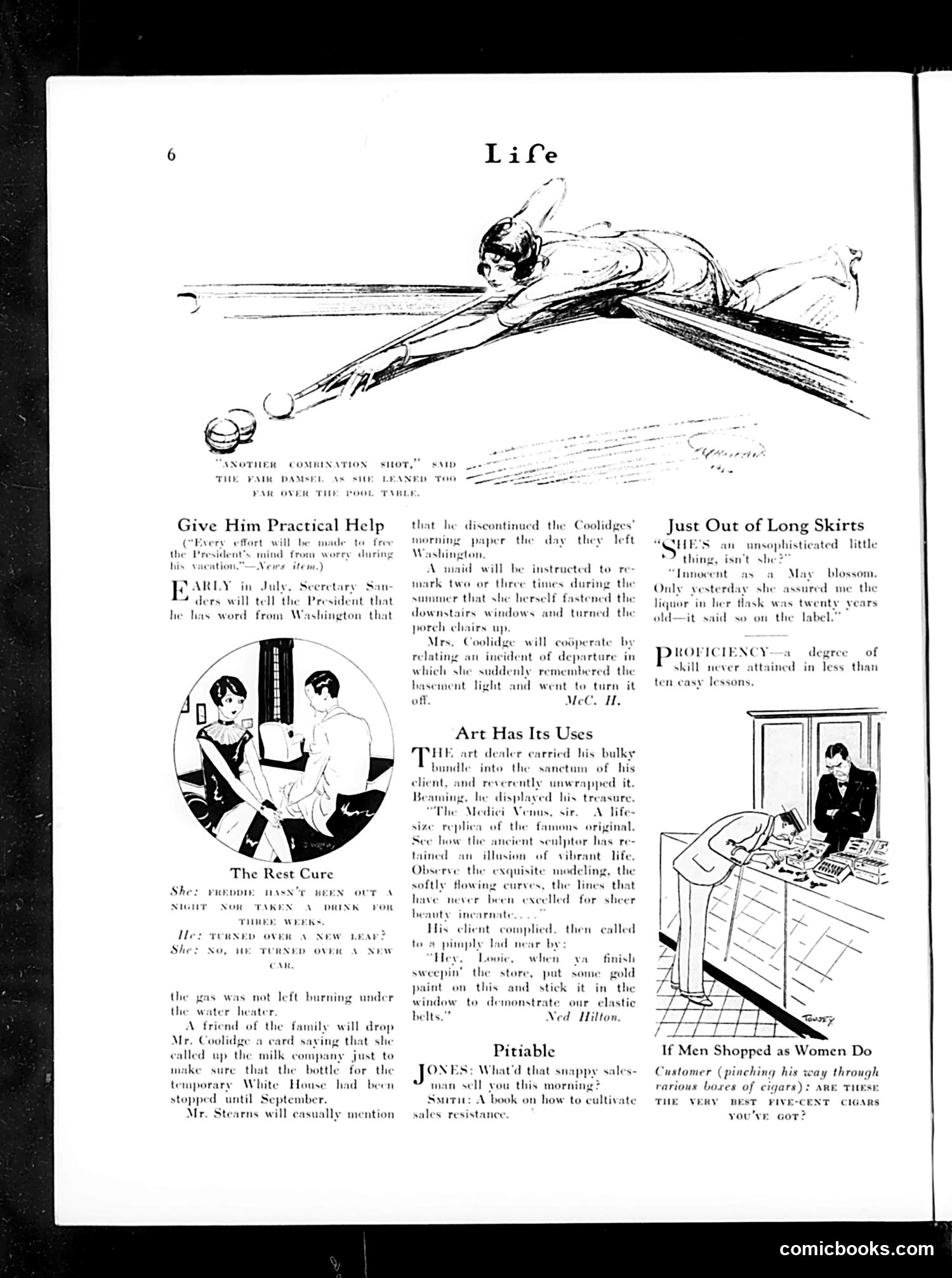
This page contains several short humorous pieces typical of early 20th-century *Life* magazine's satirical style. **Top illustration**: Shows a woman diving or leaning horizontally—captioned as another "combination shot" where "the fair damsel at she leaned too far over the pool table." **"Give Him Practical Help"**: Jokes about a President's secretary being told he'll take vacation early in July, with anecdotes about minor domestic mishaps (forgotten milk bottles, loose porch chairs). **"The Rest Cure"**: A circular illustration with dialogue about turning over a new leaf after drinking—typical temperance-era humor. **Other sections** include jokes about art dealers, sales resistance, and a final piece mocking men who shop like women do. The humor relies on domestic situations, gender stereotypes, and everyday social observations common to the era.
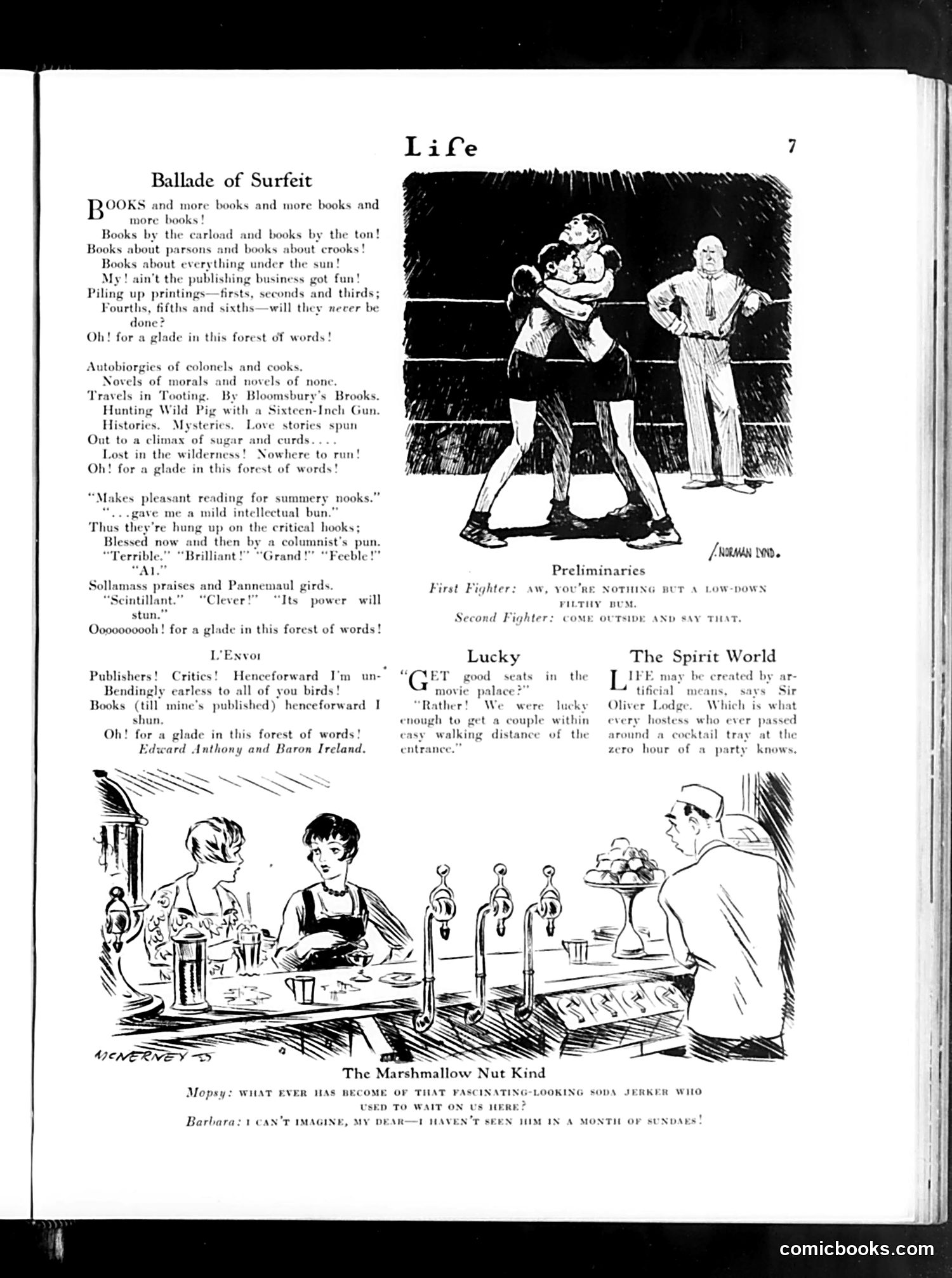
The top cartoon shows two boxers in a fighting stance, captioned "Preliminaries." The joke targets boxing culture: the first fighter is "nothing but a low-down filthy bum," while the second says "come outside and say that." This satirizes the theatrical insults and posturing that precede actual fights. The lower cartoon, "The Marshmallow Nut Kind," depicts a cocktail party where a man asks about a soda jerk who "used to wait on us here." The woman replies she hasn't seen him in a month of Sundays. The satire likely mocks the social climbing of service workers or the transient nature of working-class employment during this era. The title suggests the subject has become frivolous or insubstantial.
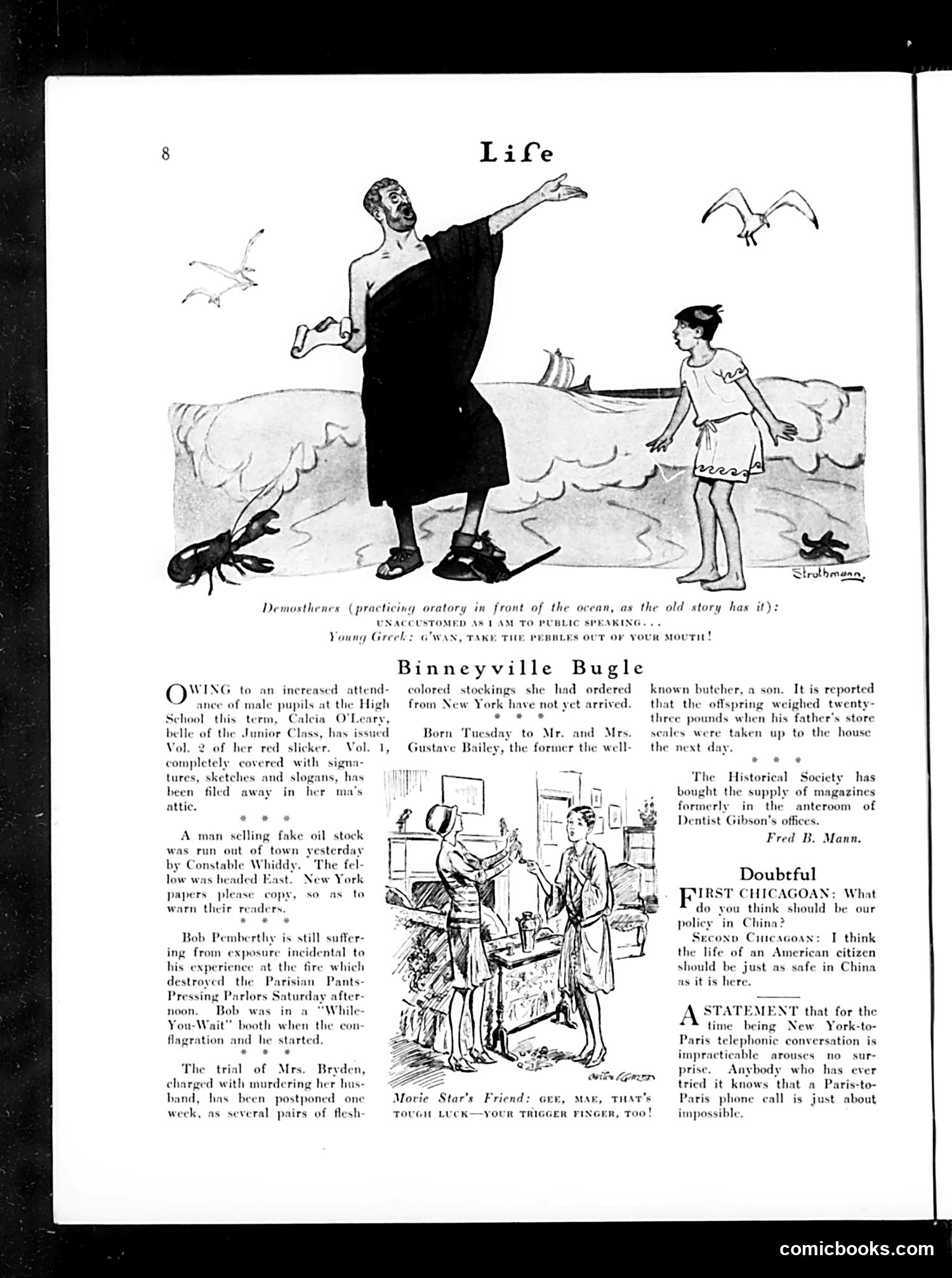
The top cartoon depicts **Demosthenes**, the ancient Greek orator, practicing public speaking by the ocean while a young girl watches. The caption references the classical anecdote where Demosthenes trained with pebbles in his mouth to overcome a speech impediment. The joke satirizes someone "unaccustomed as I am to public speaking"—a clichéd phrase speakers use despite being experienced. Below are **"Binneville Bugle"** gossip items about local events: births, business dealings, and social news. The middle cartoon shows what appears to be a domestic scene with multiple figures, captioned with a joke about "tough luck" and trigger fingers—likely a reference to accidental or careless behavior. The bottom section includes a "Doubtful" humor exchange about China policy and criticism of Paris-to-Paris telephone service reliability.
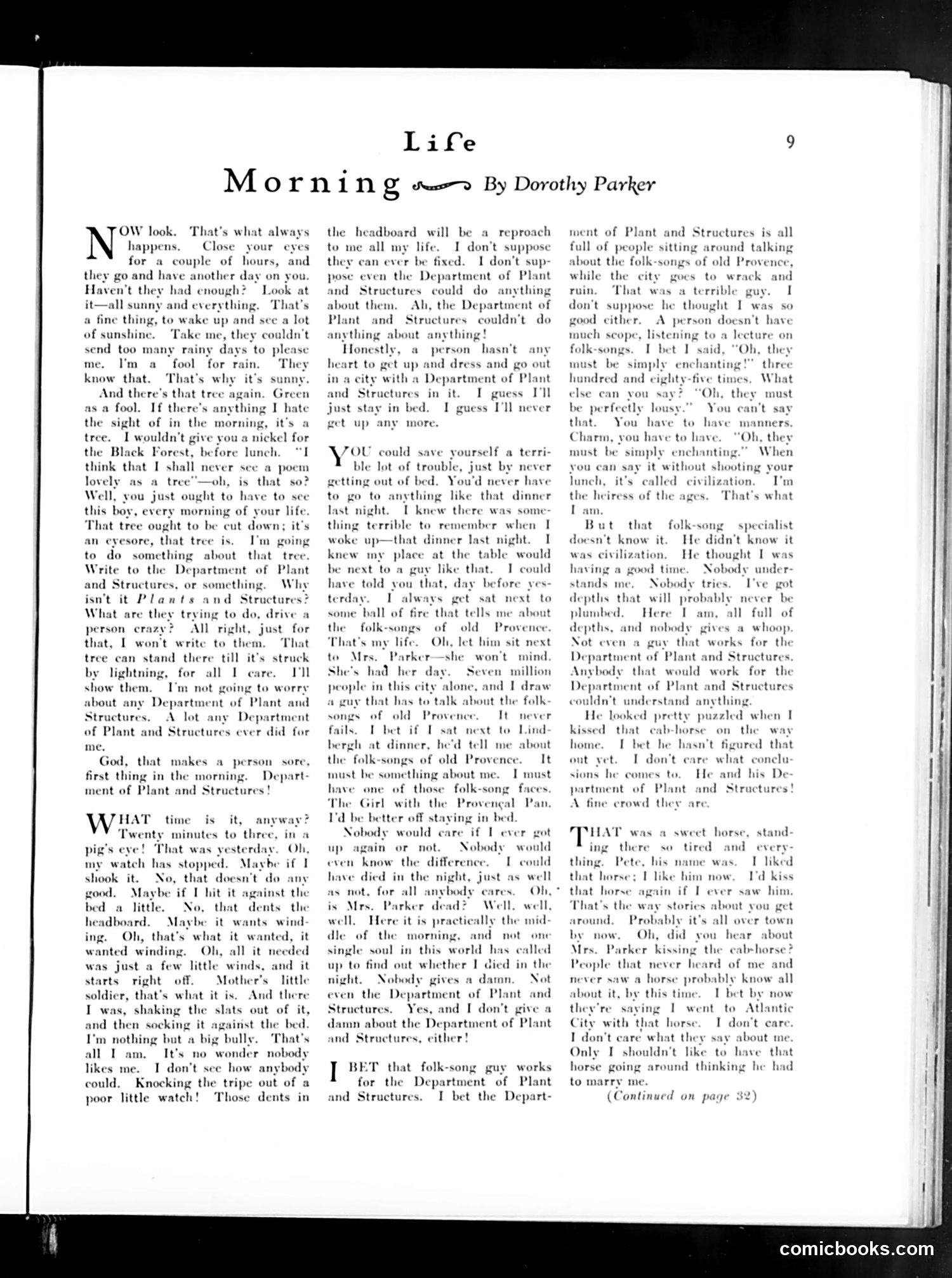
This is a short satirical story rather than a political cartoon. Parker satirizes the tedium of married domestic life and a wife's complaints about her husband's indifference. The narrator, a woman, expresses frustration that her husband won't get out of bed or engage with her. She fantasizes about reporting him to the "Department of Plant and Structures" (a bureaucratic absurdity) and imagines him attending folk-song lectures—depicted as mind-numbingly boring. The satire targets both the husband's laziness and the wife's resignation to her role. The humor lies in her escalating irritation and her resort to dark imaginings about his infidelity, ultimately revealing her own unhappiness with their marriage. It's a critique of mundane conjugal life in early 20th-century America.
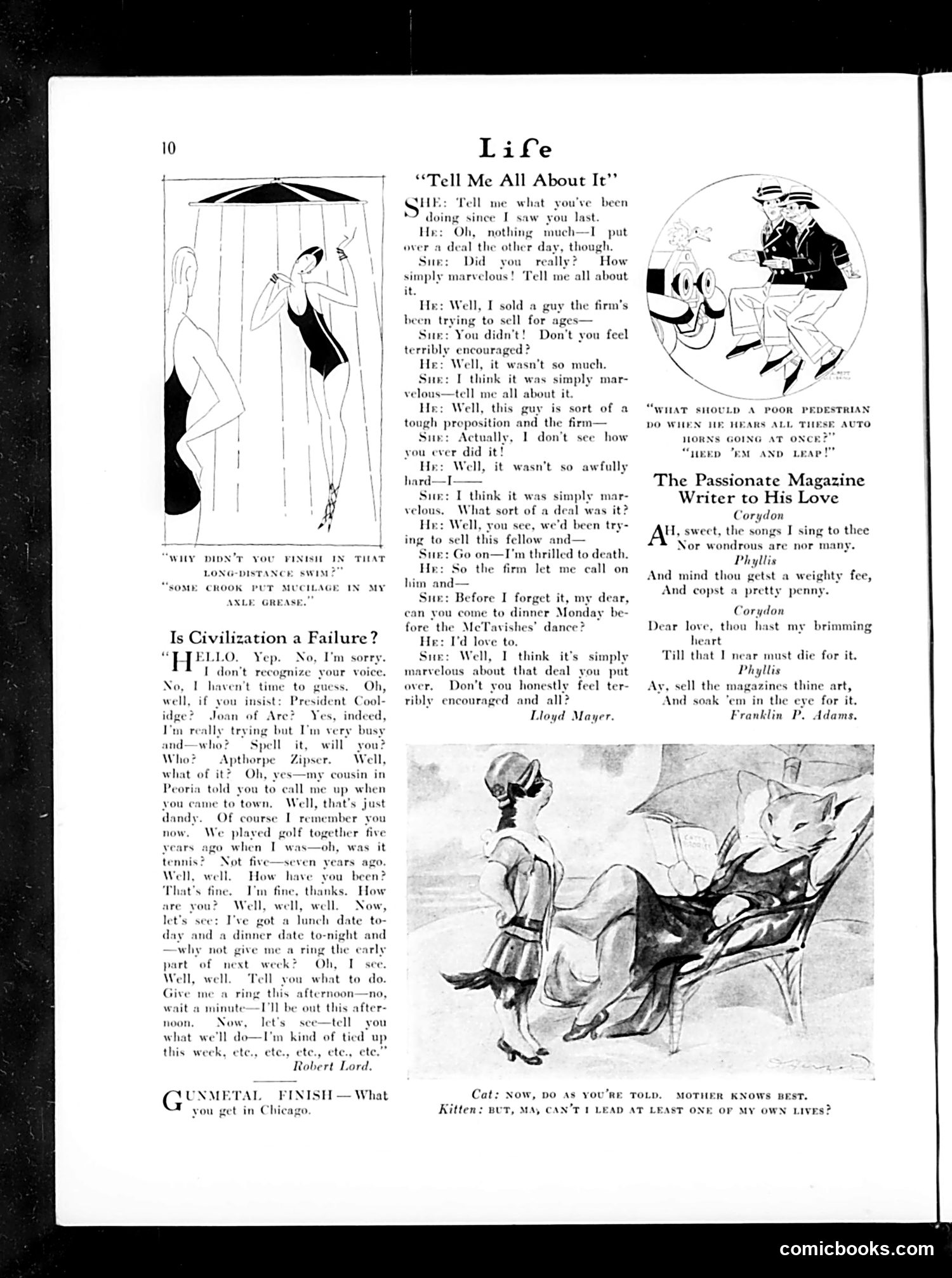
This page contains three satirical pieces typical of Life's social humor: **"Tell Me All About It"** (top): A dialogue mocking shallow romantic relationships, where a woman probes her boyfriend about a business deal he made. The satire targets how couples discuss serious matters superficially. **"Is Civilization a Failure?"** (left): A comedic phone conversation between old acquaintances who haven't spoken in years. The humor derives from the caller's presumptuous familiarity and the recipient's polite but clear disinterest—satirizing how people awkwardly reconnect and make uncomfortable social demands. **"The Passionate Magazine Writer to His Love"** (right): Parodies overwrought romantic poetry with exaggerated verses about a woman's supposed beauty and cost, mocking both sentimental literature and male sentimentality. The bottom cartoon shows a cat lecturing kittens about obedience, using humor to comment on parenting.
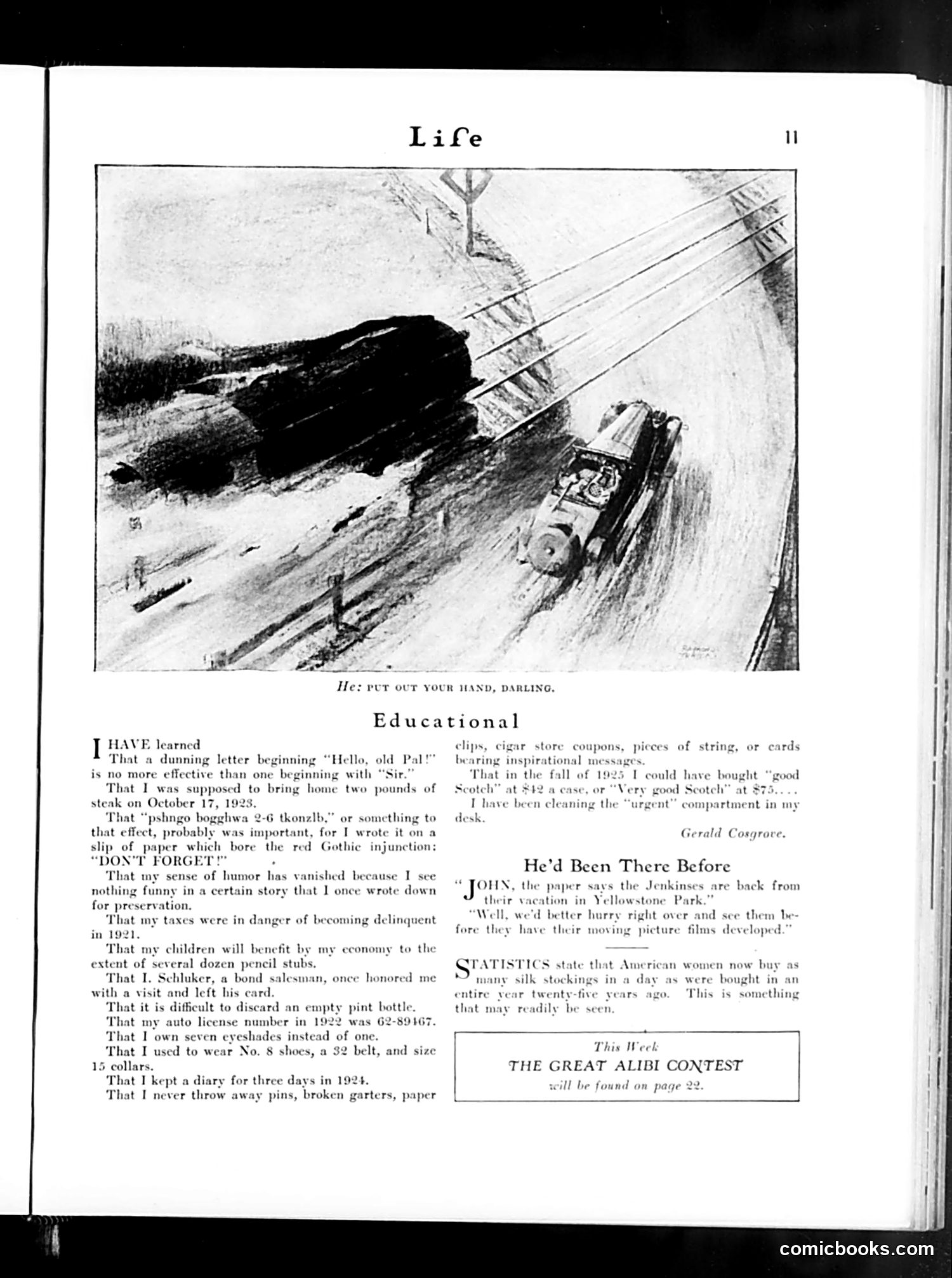
The main illustration shows a car precariously perched on a steep hillside road, with the caption "HE: put out your hand, darling." This appears to be a romantic/flirtation joke about automobile travel—the male driver suggests the female passenger extend her hand out the window, likely implying either a gesture of affection or, more darkly, a test of the car's stability on the dangerous slope. The page's text section titled "Educational" consists of humorous observations about everyday life, including commentary on letters, scotch whisky prices, eyeglasses, and personal memorabilia—typical of Life's satirical approach to documenting American consumer culture and social habits of the era.
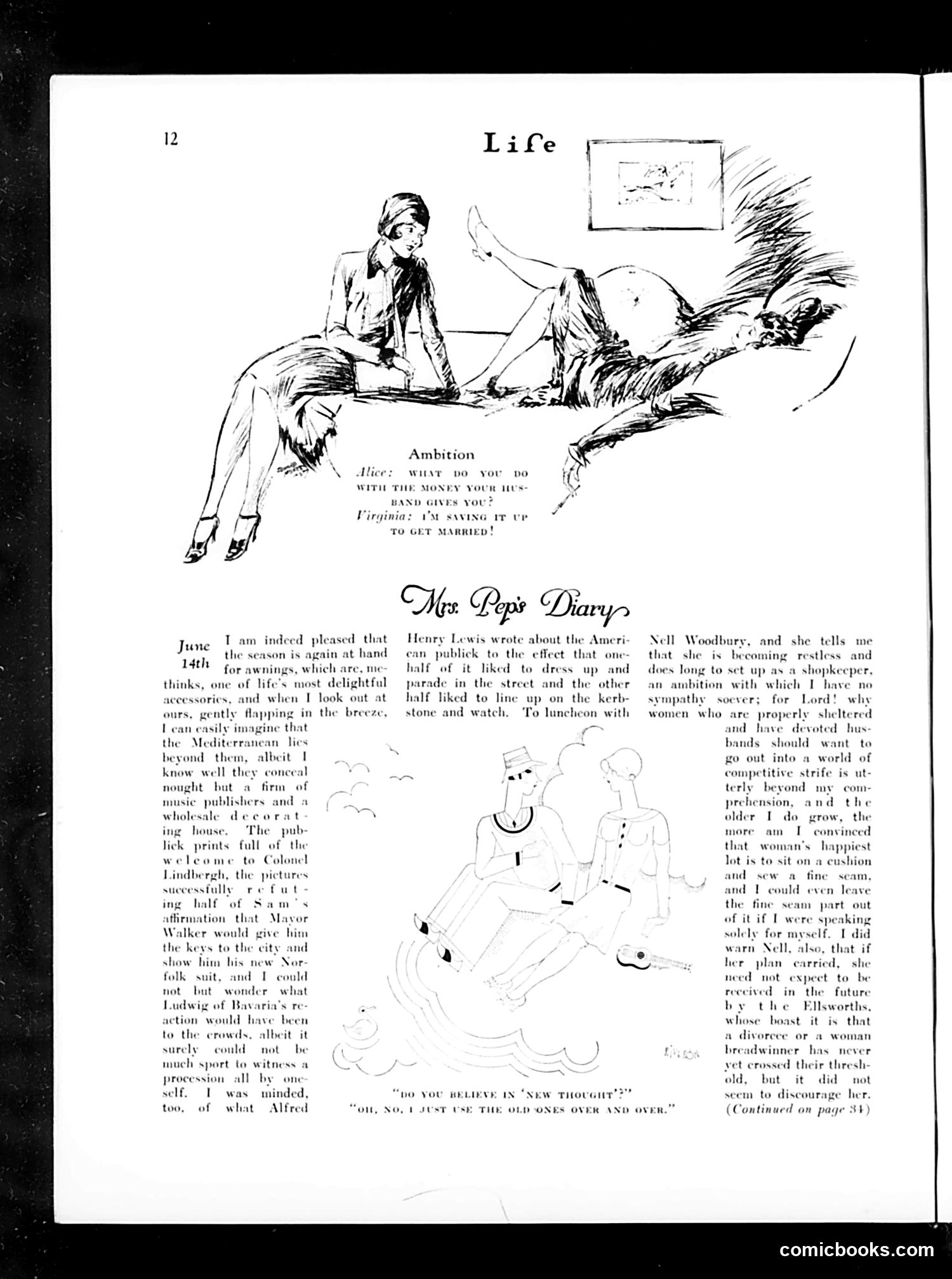
This page contains "Mrs. Pep's Diary," a satirical column mocking women's ambitions and marital aspirations. The top cartoon depicts a woman fantasizing about wealth—imagining herself with money from a husband's earnings, which she plans to use for marriage. The illustration shows her daydreaming among large clouds, suggesting idle fantasy. The diary entry below critiques Henry Lewis's writing about American parades and fashion, while commenting on Nell Woodbury, whom the diarist describes as restless and overly ambitious. The author sarcastically suggests women's "happiest lot" is domestic—sitting on a cushion sewing—directly mocking feminist aspirations and women's desire for independence or careers. The satire ridicules both women's ambitions and popular cultural attitudes dismissing them.
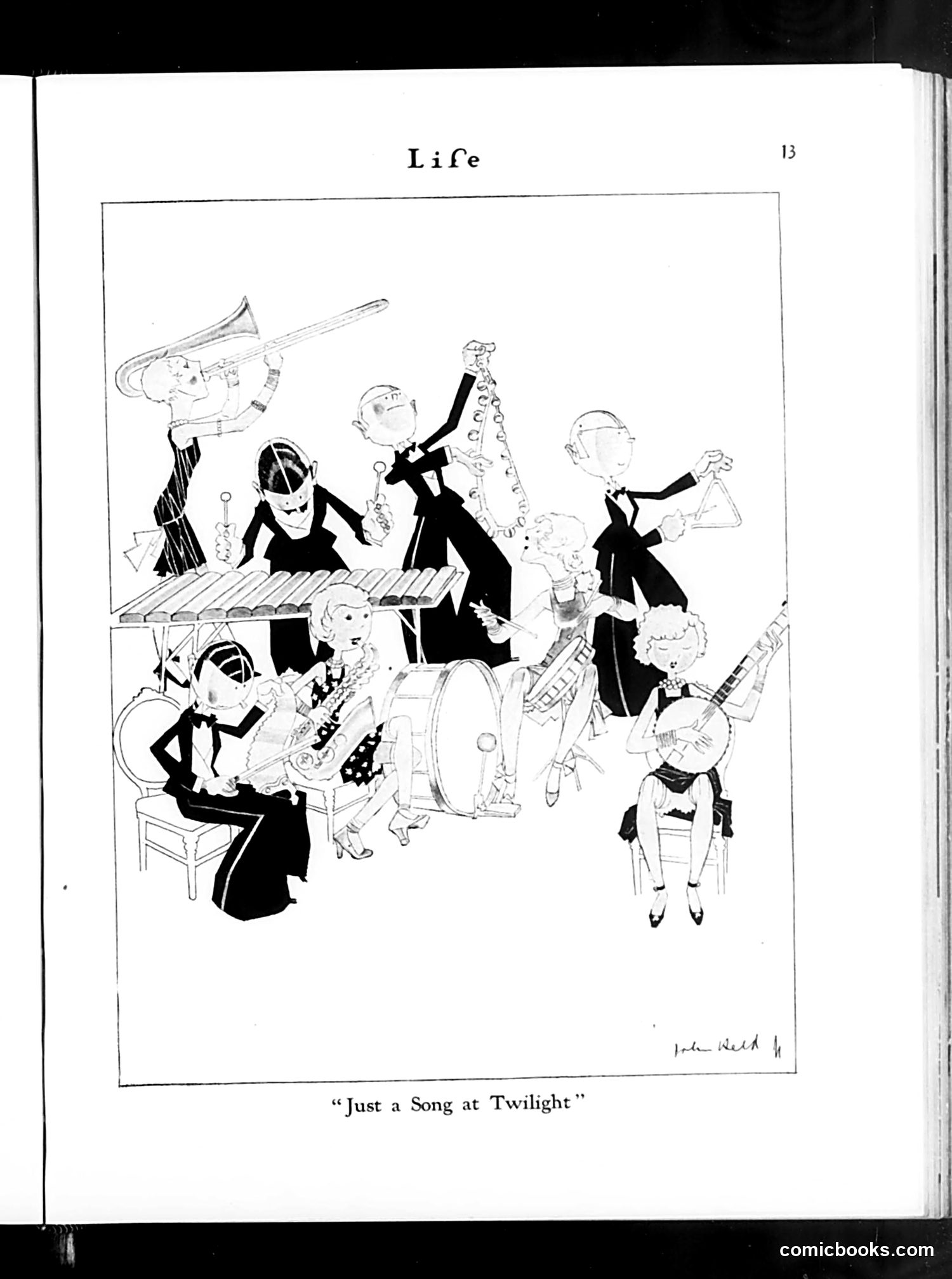
This cartoon depicts a jazz band or musical ensemble performing during what appears to be the Jazz Age. The figures are dressed in formal attire (tuxedos) while playing various instruments including trumpet, saxophone, drums, and guitar. The exaggerated, caricatured style of drawing and the energetic poses suggest this is satirizing the enthusiastic, somewhat chaotic nature of jazz performance—a musical form that was controversial and considered scandalous by many during the 1920s-1930s. The title "Just a Song at Twilight" likely ironically refers to a genteel, respectable parlor song, contrasting with the wild, modern jazz depicted. The satire probably mocks either jazz performers themselves or the cultural clash between traditional and modern music styles of the era.
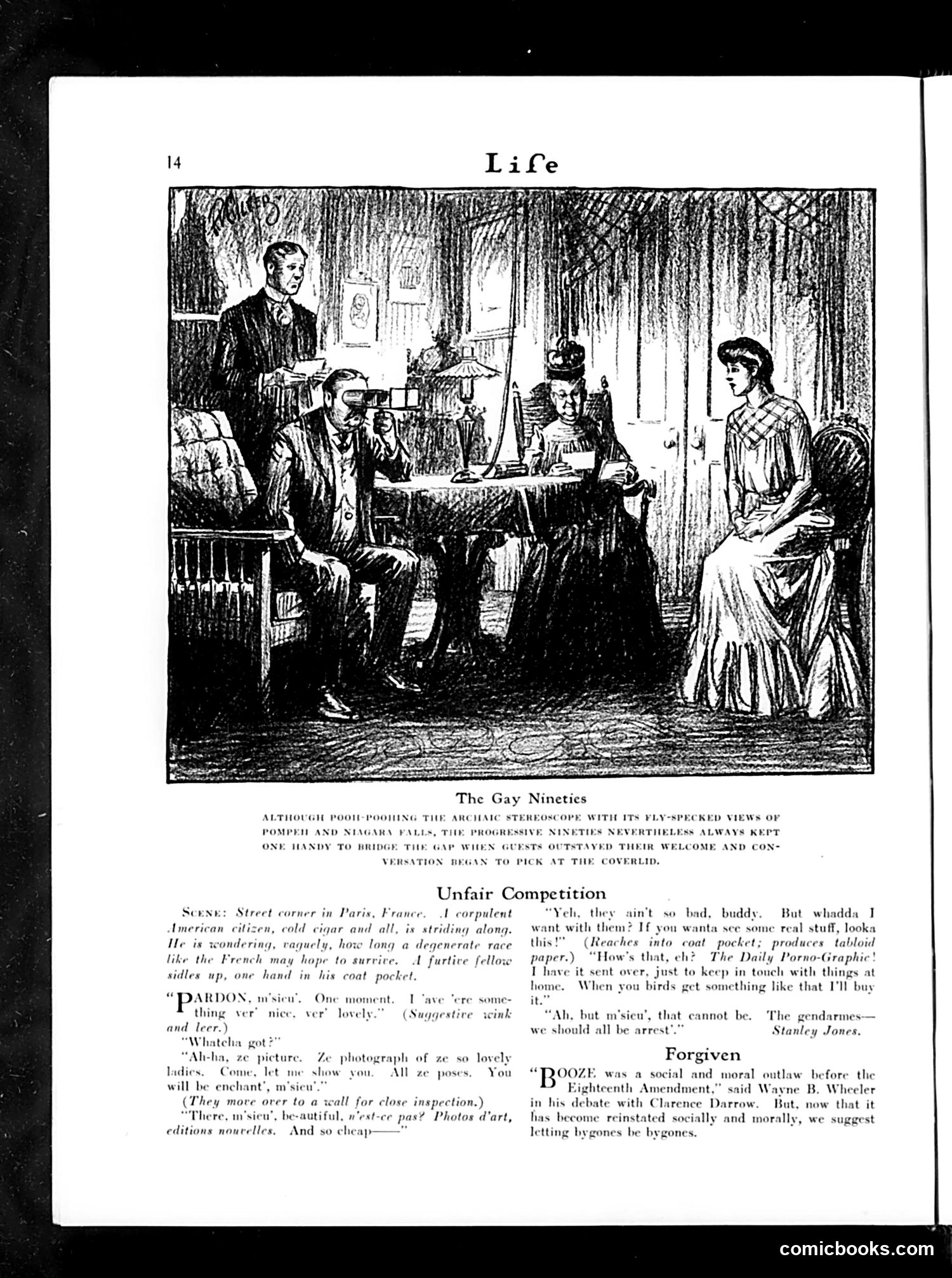
**Top Illustration:** Shows a parlor scene titled "The Gay Nineties." The caption mocks poor people using a stereoscope (an early viewing device) to see images of Niagara Falls and other sights, suggesting they couldn't afford real travel. The satire critiques class divisions—wealthy people could actually visit such places, while working-class folks experienced them only through cheap optical novelties. **"Unfair Competition":** This sketch satirizes American tourists in Paris, France. An American brags about purchasing stereoscopic photographs and other cheap souvenirs, claiming superiority over French goods. The French character responds mockingly, suggesting Americans lack taste and culture, reducing travel to collecting cheap trinkets rather than genuine cultural appreciation. **"Forgiven":** A brief editorial comment about a social/moral figure's rehabilitation (specific reference unclear without additional context).
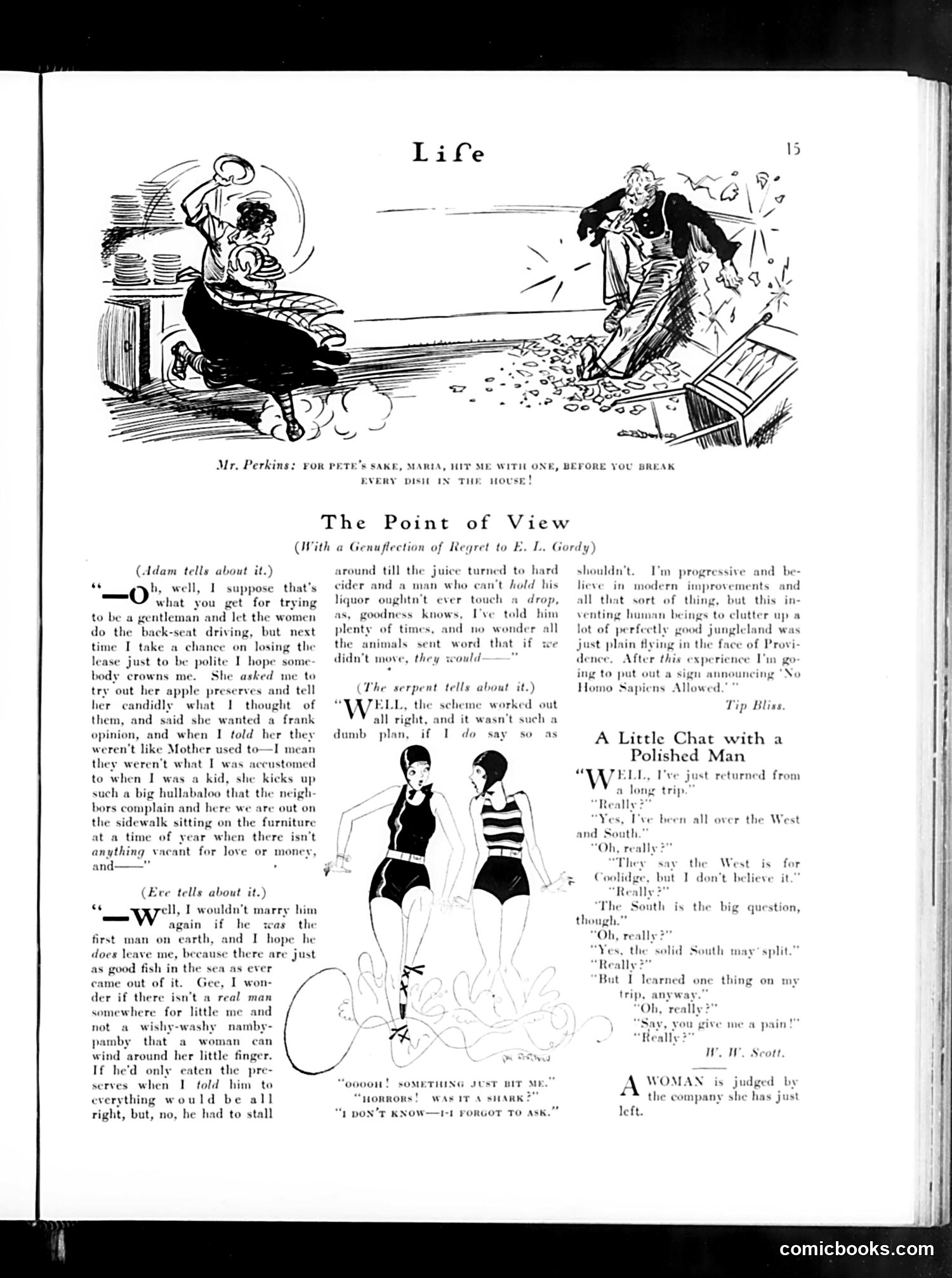
This page contains humor columns and a cartoon about domestic life and gender relations. The top cartoon shows a man (Mr. Perkins) breaking dishes while a woman watches in alarm—the caption jokes that he's destroying the household to prove his point to his wife Maria about something. "The Point of View" presents a woman's perspective on marriage, satirizing male attitudes. She describes a husband who wanted to be treated as a gentleman but proved incompetent and irresponsible, ultimately forcing her to manage everything while he complained. Below, a cartoon shows two women in bathing suits discussing a man's recent travels to the American West and South, with stereotypical observations about those regions. The page satirizes traditional gender roles, marital power dynamics, and male incompetence—common themes in early 20th-century Life magazine's social commentary.
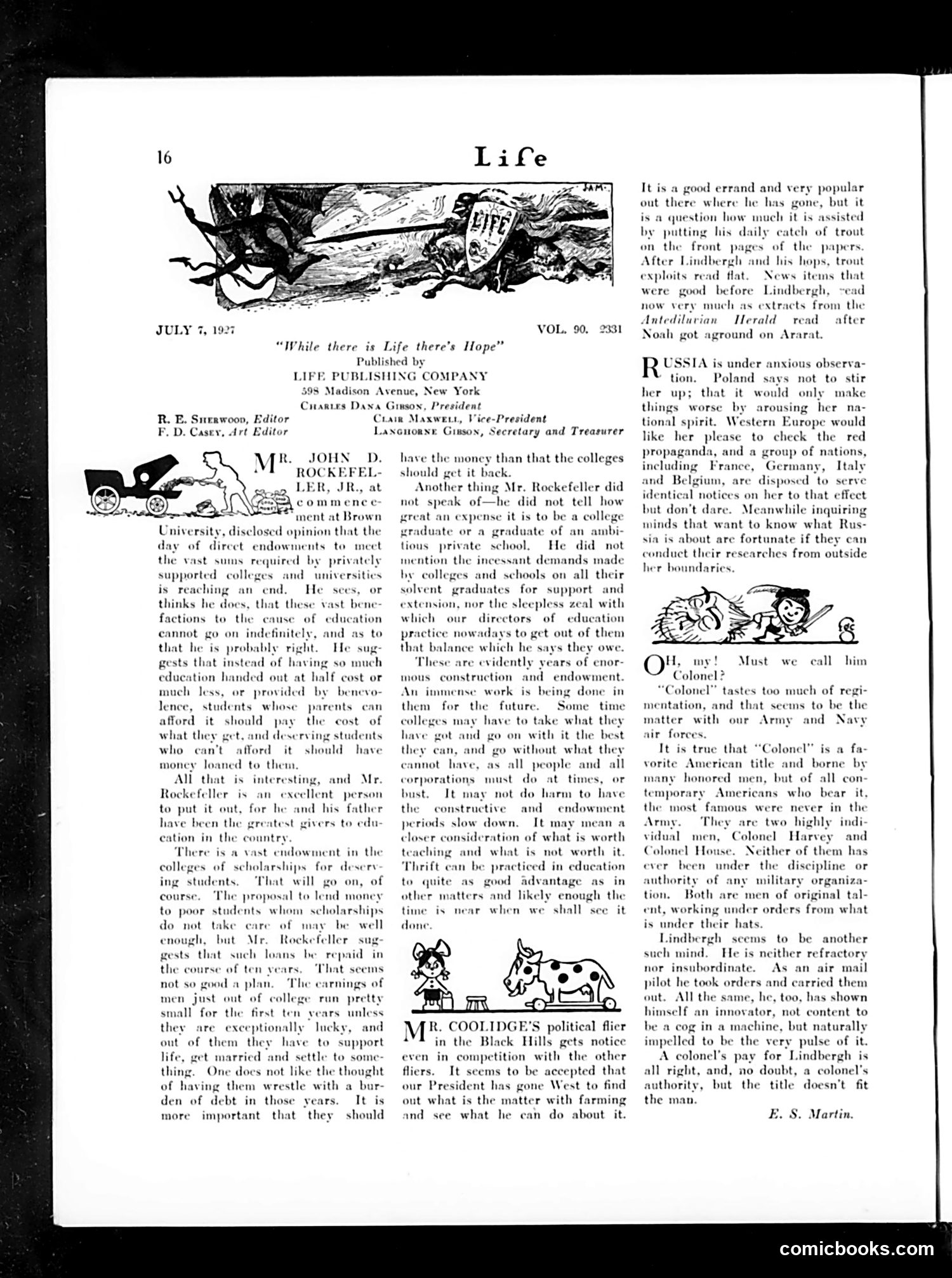
This page contains editorial commentary on three topics: **Rockefeller's Education Plan**: The editor discusses John D. Rockefeller Jr.'s proposal that students should pay college costs rather than rely on endowments, with loans available for deserving poor students. The writer questions whether recent graduates can realistically repay loans while establishing themselves. **President Coolidge's Fishing Trip**: The editorial mocks Coolidge's highly publicized fishing expedition to the Black Hills, framed as fact-finding on agricultural problems. The satire suggests his daily trout catches dominate front pages but seem trivial compared to Lindbergh's recent aviation exploits, making them feel outdated ("antediluvian"). **Russia/Poland**: A brief mention of anxiety about Soviet Russia and Poland's warnings against destabilizing her. The cartoons (visible but small) appear to be humorous illustrations supporting these commentaries. The overall tone is satirical political commentary typical of Life magazine's 1920s editorial stance.
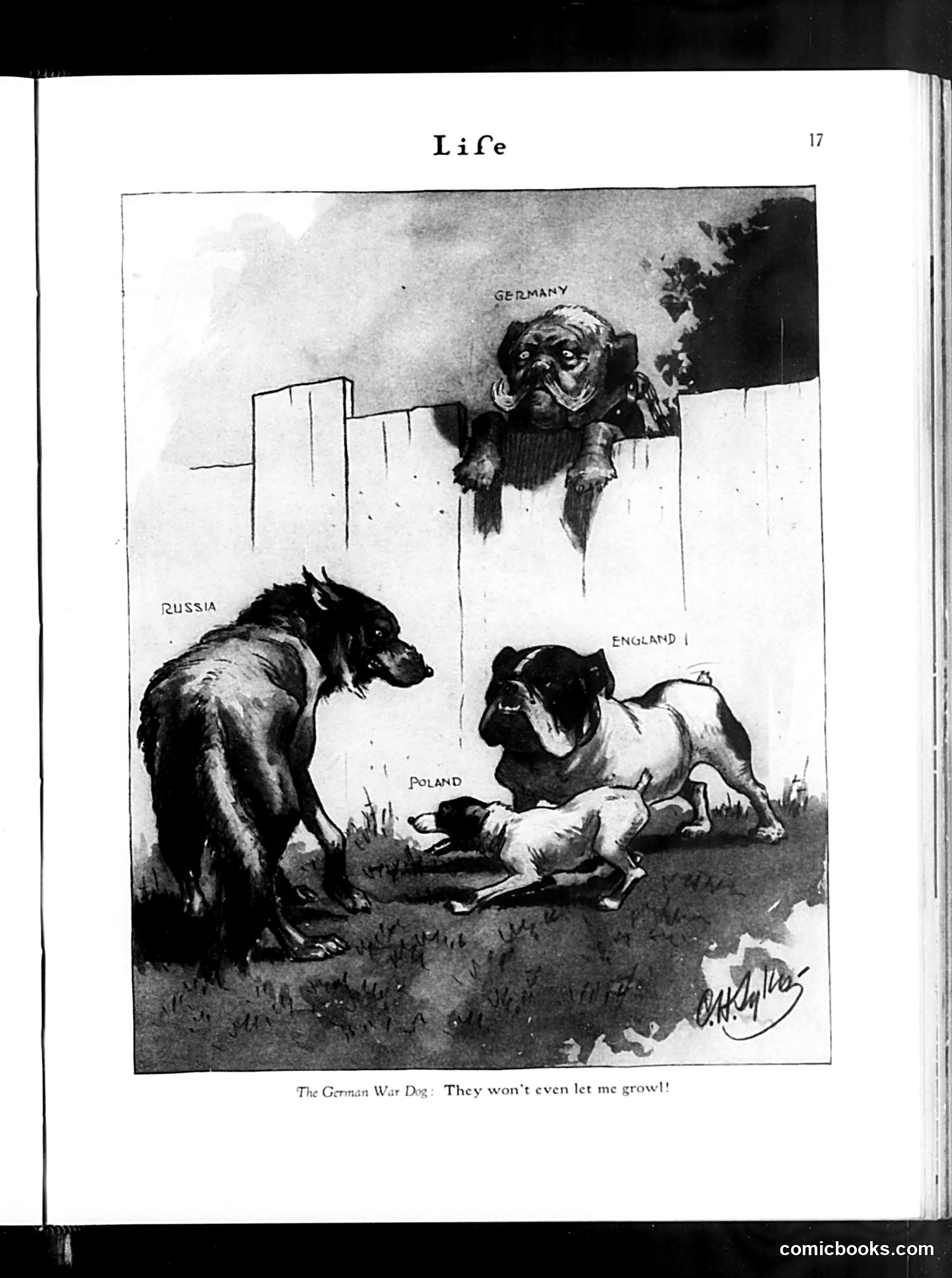
This satirical cartoon depicts Germany as a aggressive bulldog labeled "German War Dog," penned behind a fence by three other nations: Russia, Poland, and England. Germany complains, "They won't even let me grow!" The cartoon uses the dog metaphor to represent Germany as a dangerous, restrained threat. The fence symbolizes the restrictions imposed on Germany—likely referring to post-WWI treaty constraints (possibly the Treaty of Versailles) that limited German military expansion and territorial ambitions. Russia, Poland, and England are shown as neighboring powers keeping Germany contained and controlled. The satire mocks Germany's resentment of these international limitations while suggesting the other nations recognize Germany as inherently aggressive and require active restraint to prevent further war.
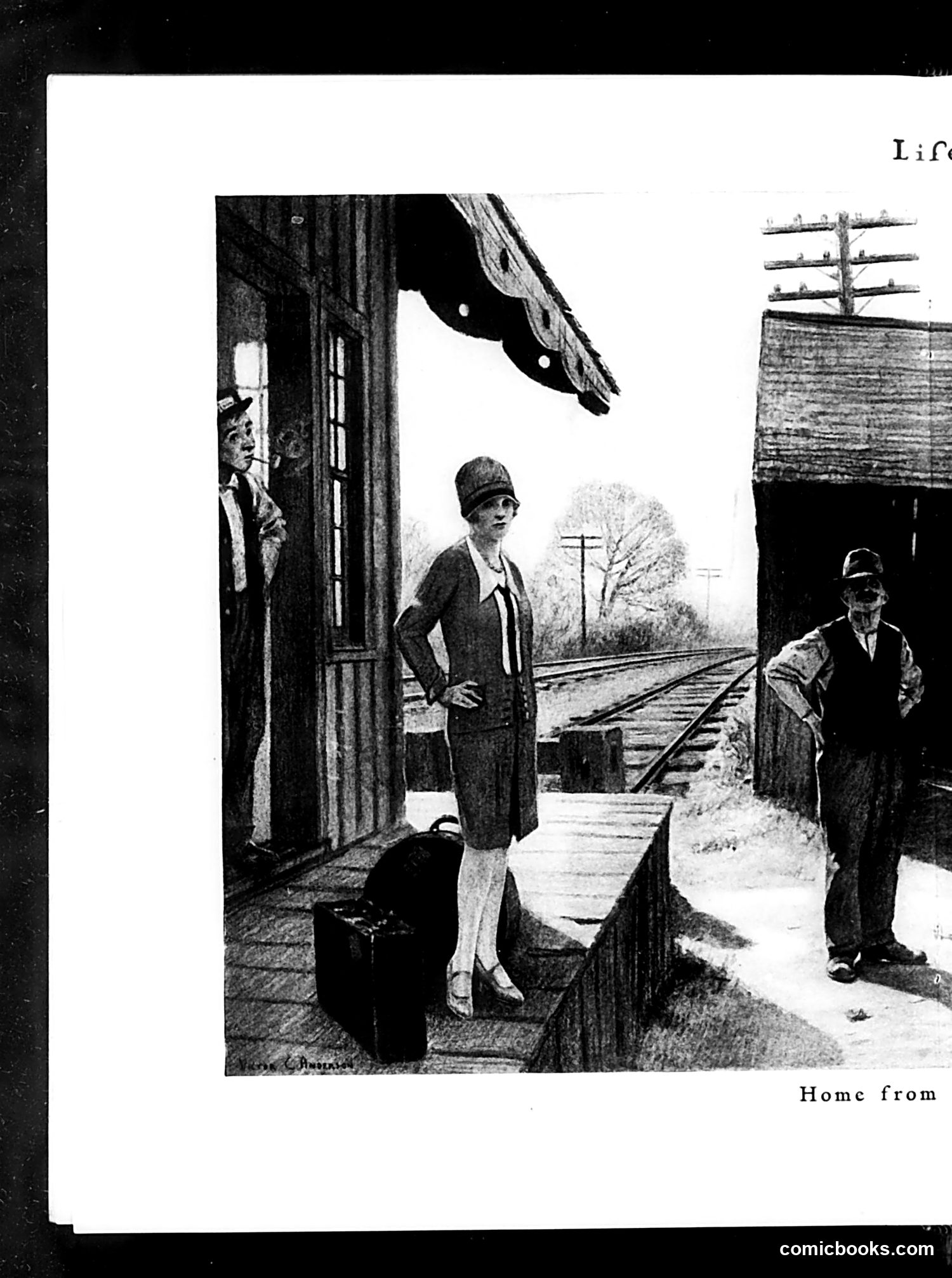
This appears to be a satirical illustration titled "Home from" (text cut off), depicting a woman at a railroad station. The image shows a fashionably dressed woman in a cloche hat and coat standing with luggage, flanked by male figures in suits and caps at what appears to be a depot or platform. The caption suggests this illustrates a social commentary about women traveling or returning from somewhere—likely a commentary on women's increased mobility and independence in the 1920s-1930s era. The presence of observant men and the woman's prominent central positioning suggests satire about changing gender roles and women's public presence during this period. Without seeing the complete caption or surrounding context, the exact joke or point remains unclear, though it likely commented on contemporary anxieties about women's social independence.
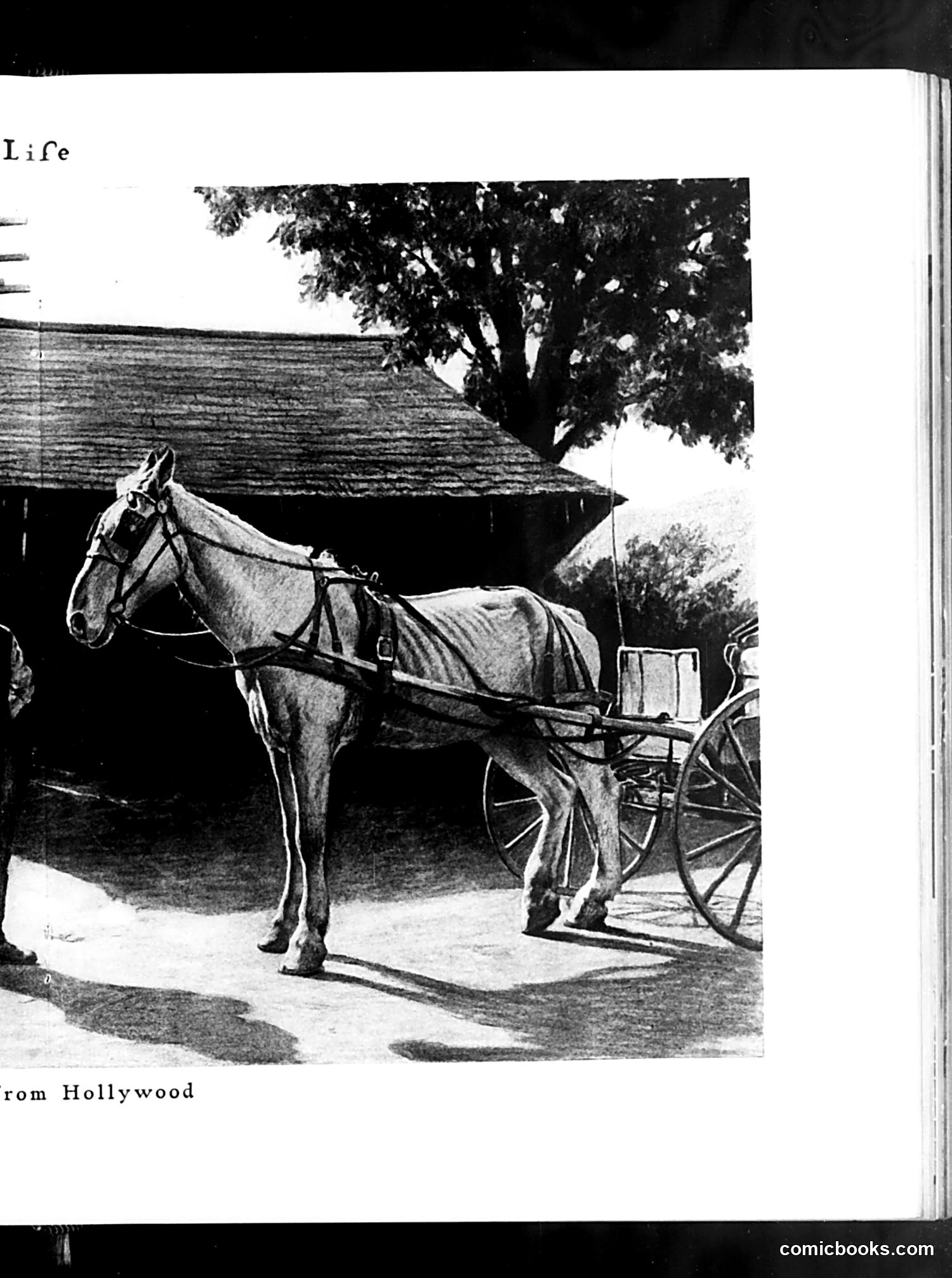
This page from *Life* magazine shows a photograph rather than a cartoon. It depicts a horse hitched to a cart or wagon, standing in front of a rural barn with a large tree. The image is captioned "from Hollywood." The satire appears to be commentary on Hollywood productions: the juxtaposition of a humble, rustic farm scene with the caption "from Hollywood" likely mocks either the artificial rurality of studio sets or suggests that Hollywood was producing overly simplistic, old-fashioned content disconnected from modern life. Without additional context from surrounding pages, the exact target of satire remains unclear, though it seems to critique the gap between Hollywood's productions and contemporary reality or taste.
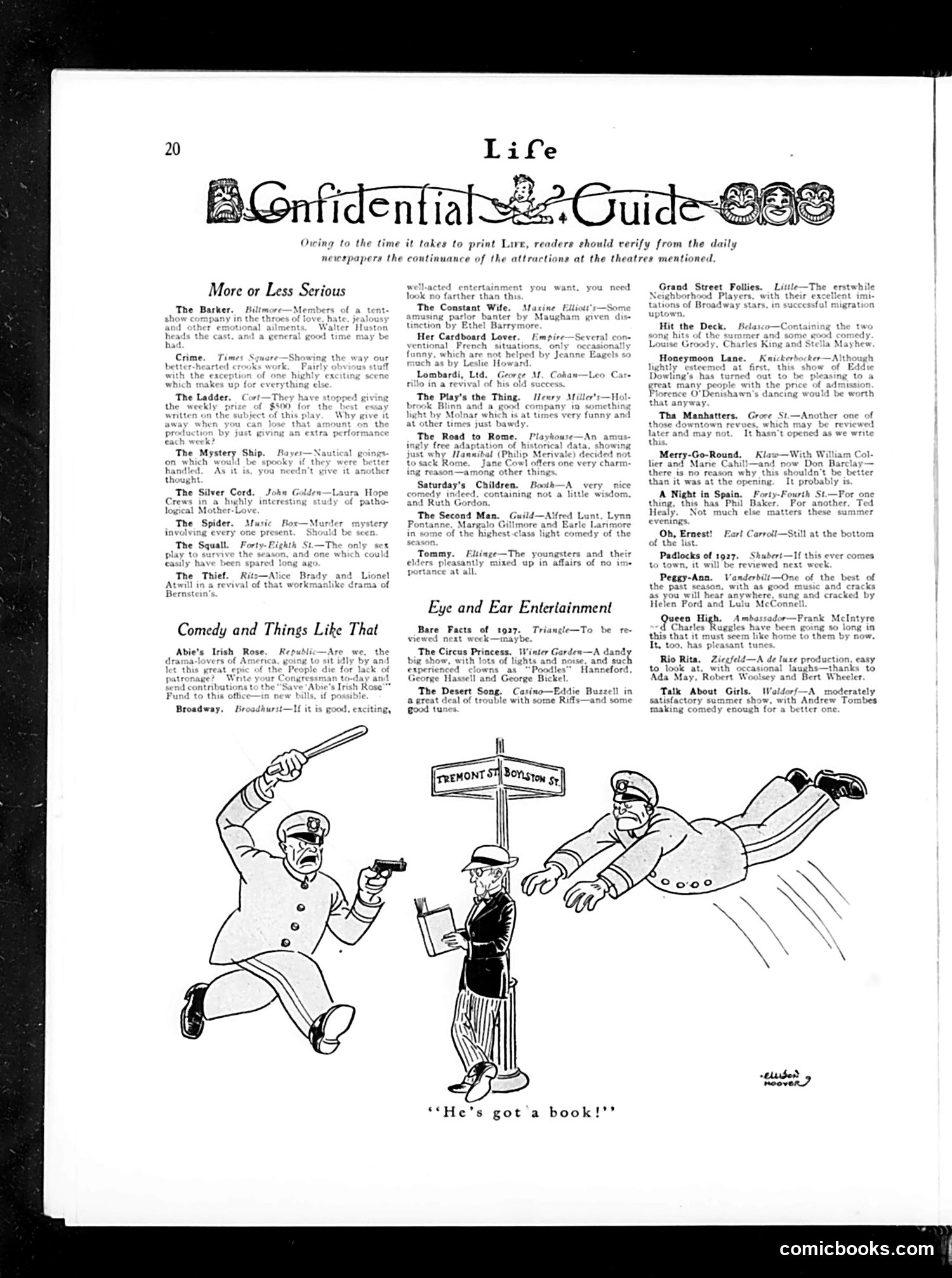
This is a **theater guide and entertainment review page** from Life magazine (likely 1927, based on references like "Bare Facts of 1927"). The main cartoon depicts a chaotic street scene at the intersection of Tremont and Boylston Streets (Boston), with the caption "He's got a book!" The satire appears to mock the **publishing/literary world's excitement** during this era. A man clutching a book causes pandemonium—a police officer wildly fires a gun, a pedestrian flees in a UFO-like device, and another figure swings a club. The exaggerated chaos suggests that possession of a "book" (likely referring to a notable new publication) was treated as sensational news worthy of frenzy. The page itself provides synopses of current Broadway and theatrical productions, written in Life's characteristic witty, brief review style. The overall tone is light satirical commentary on contemporary entertainment and publishing culture.
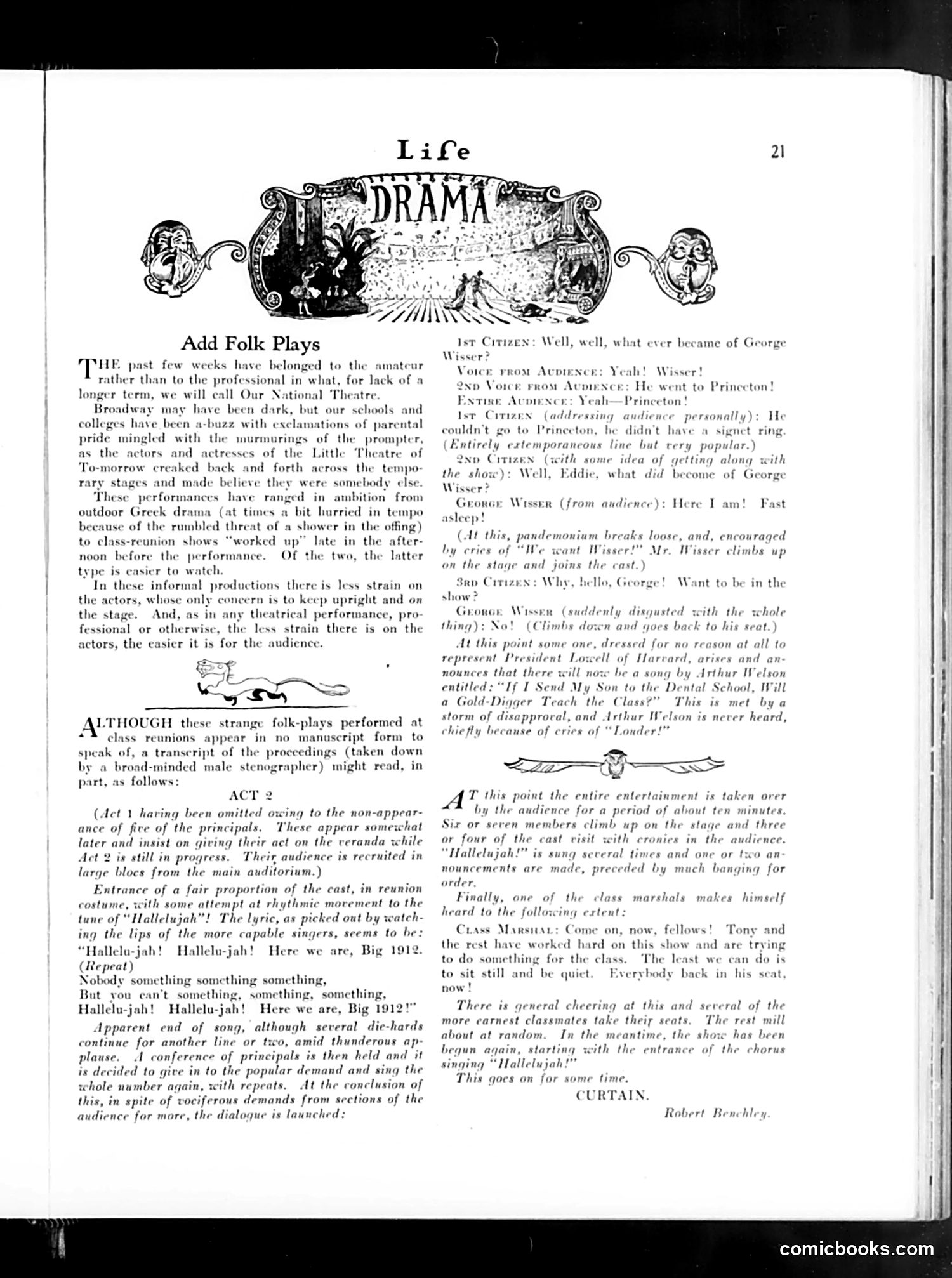
This article celebrates amateur theatrical performances at American schools and colleges, contrasting them favorably with professional Broadway theater (which "may have been dark"). The piece is largely celebratory, arguing that amateur productions place less strain on audiences because actors focus simply on staying upright rather than delivering polished performances. The satirical transcript that follows mocks a typical class reunion show—specifically a 1912 reunion performance. The humor targets the chaos of amateur theater: missing cast members, performers insisting on performing during wrong acts, a song repeated due to audience demands, and dialogue that devolves into audience members climbing onstage to join the action. The fictional song title "If I Send My Son to the Dental School, Will a Gold-Digger Teach the Class?" mocks contemporary anxieties about education and morality. The "President Lowell of Harvard" reference adds institutional satire. Overall, Life gently ridicules amateur theater's informal nature while celebrating its democratic accessibility—a distinctly American form of entertainment outside professional Broadway culture.
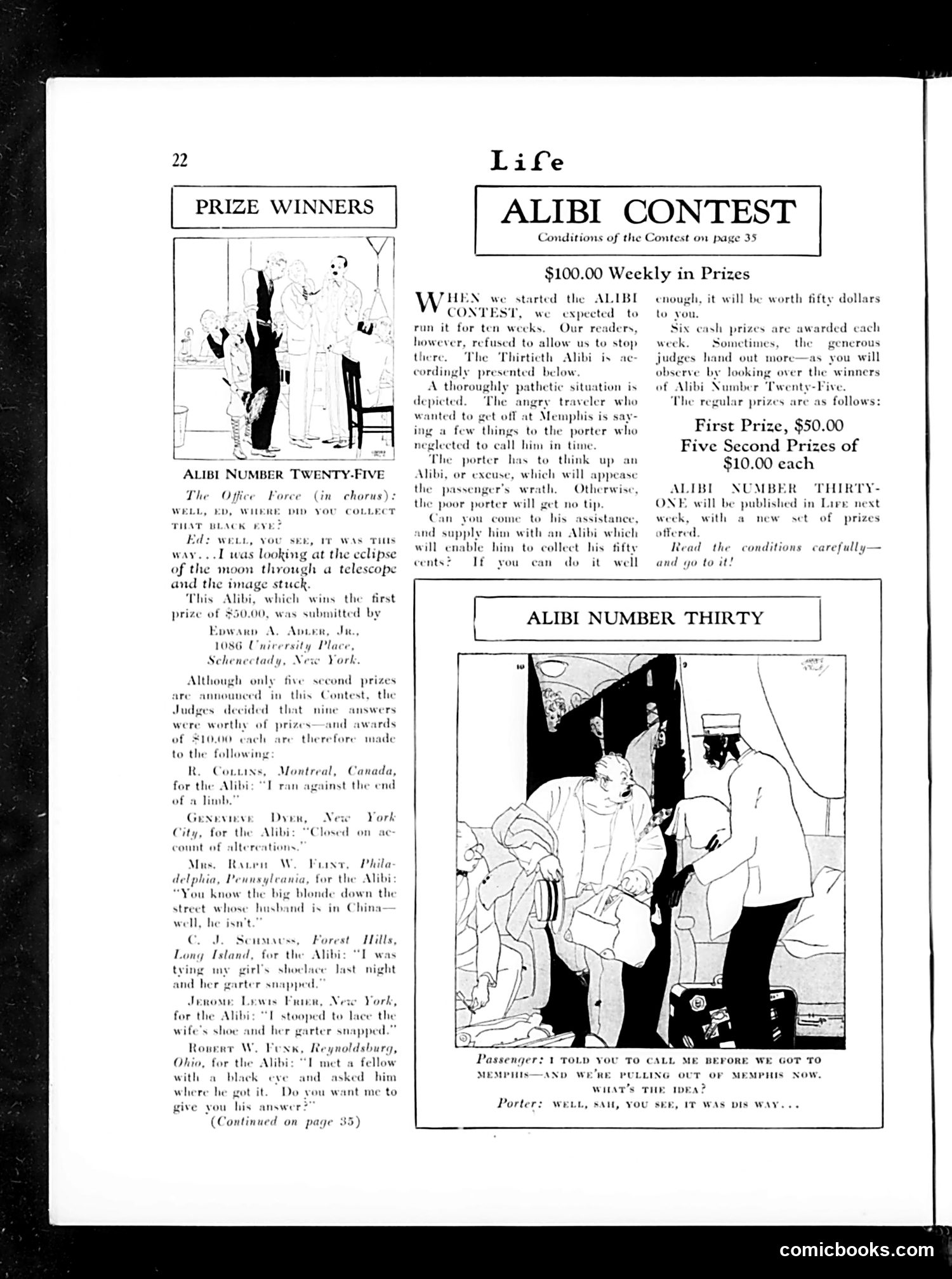
This page features Life magazine's ongoing "Alibi Contest," a participatory humor feature where readers submit creative excuses. The main cartoon shows a porter and passenger at a train station—the porter failed to wake the passenger before the Memphis stop, and readers must invent a humorous alibi (excuse) the porter could offer. The contest awarded $100 weekly in prizes ($50 first prize, five $10 second prizes). The page shows previous winning alibis—mostly jokes about black eyes, garters, and romantic mishaps used to explain various injuries or predicaments. For modern readers, this reflects early 20th-century humor conventions: slapstick scenarios, flirtation-related embarrassments, and the expectation that readers would actively participate in creating jokes. The contest itself was wildly popular—Life extended it beyond the planned ten weeks due to reader demand, suggesting this interactive format was highly engaging for the magazine's audience.
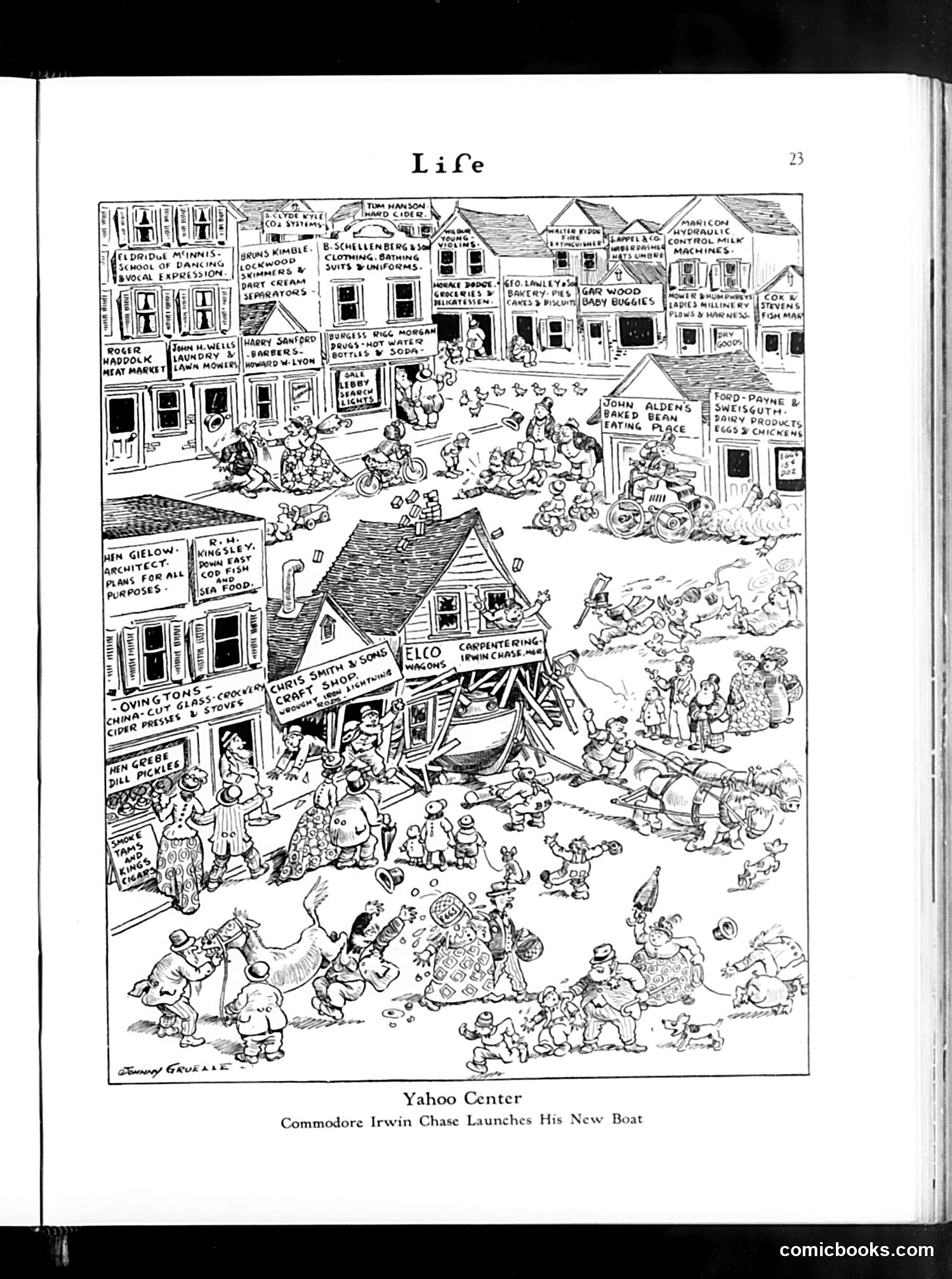
This is a densely detailed satirical cartoon depicting a bustling small-town community scene centered around "Yahoo Center." The caption references "Commodore Irwin Chase Launches His New Boat," suggesting the cartoon satirizes local civic pride and the pretension of small-town figures adopting grandiose titles. The illustration is cluttered with numerous storefronts, businesses, and townspeople engaged in various activities—children playing, adults socializing, commerce occurring. The abundance of labeled shops (meat markets, laundries, bakeries, etc.) and the chaotic energy suggest satire of small-town life's self-importance and bustling commercialism. The use of "Commodore" for launching a boat appears to mock how provincial communities inflated the significance of ordinary local events and how citizens adopted inflated titles. The overall point seems to be gentle ridicule of small-town pretension and the provincial belief that local happenings deserved grand ceremonial treatment. The cartoonist's signature appears at bottom left but is not clearly legible.
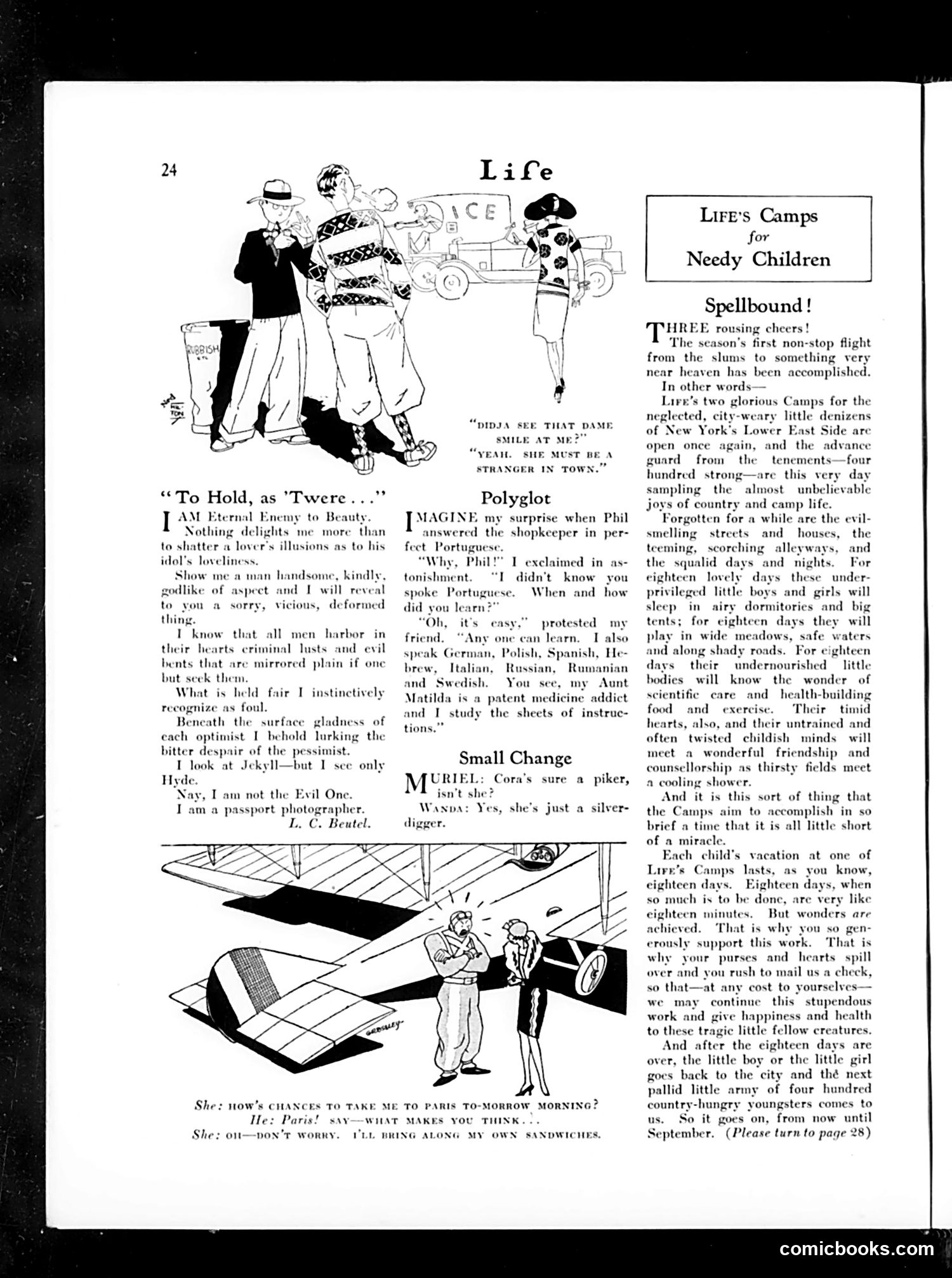
This page contains four humor pieces typical of early 20th-century Life magazine: **"To Hold, as 'Twere"** satirizes passport photographers, who were notorious for producing deliberately unflattering photos. The joke: a photographer claims to be an "Eternal Enemy to Beauty" who reveals people's inner ugliness—he "sees only Hyde" instead of Jekyll. This mocks both the poor quality of passport photos and photographers' grim, harsh lighting style. **"Polyglot"** jokes about a man who learned multiple languages (German, Polish, Spanish, Hebrew, Italian, Romanian, Swedish, Portuguese) simply by reading medicine bottle instructions from his aunt's addiction to patent medicines—a comment on both the era's dubious over-the-counter remedies and linguistic absurdity. **"Small Change"** presents a flirtation gag about a "gold digger"—a woman pursuing wealthy men. The right column promotes **Life's Camps for Needy Children**, a charitable initiative sending underprivileged Lower East Side children to country camps for eighteen days of health, fresh air, and care—contrasting sharply with urban tenement conditions.
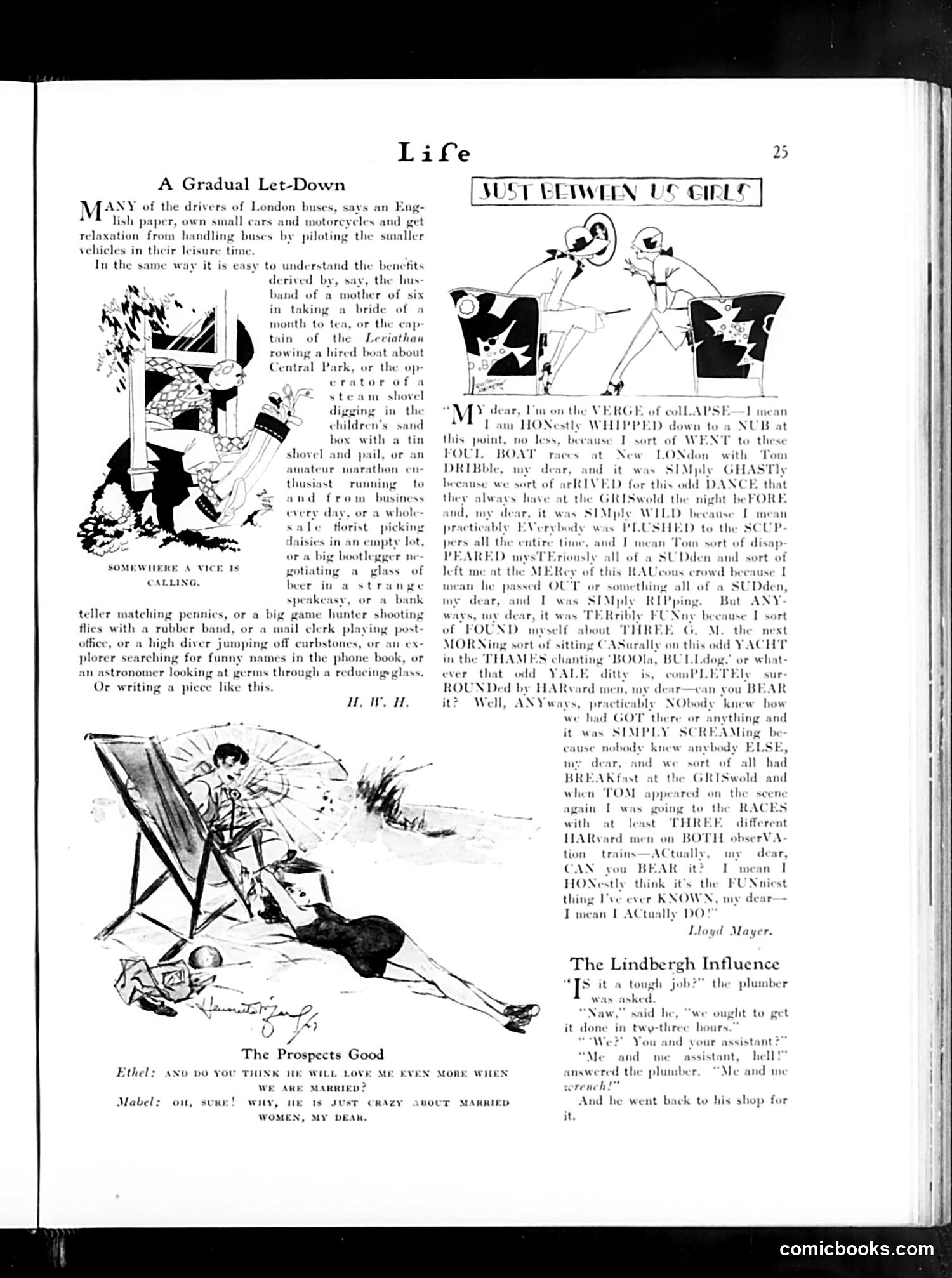
This page contains three satirical pieces typical of 1920s American humor: **"A Gradual Let-Down"** presents absurdist humor listing occupations where workers supposedly seek relaxation through unrelated leisure activities—a bus driver piloting small cars, a married man taking his young bride to tea, a steamship captain rowing boats in Central Park. The joke relies on the incongruity that these activities provide no actual relief from their professions. **"The Prospects Good"** is a brief comic dialogue between two women (Ethel and Mabel) about marriage, with Mabel claiming men "go crazy" over married women—dark humor about infidelity or masculine fickleness. **"Must Between Us Girls"** features a lengthy complaint by a woman named Lloyd Mayer about exhausting social activities—boat races, dances, yachting—involving Harvard and Yale men. The humor stems from her performative breathlessness and the breathless, capitalized speech pattern mimicking affected upper-class female gossip. **"The Lindbergh Influence"** references Charles Lindbergh's famous 1927 solo transatlantic flight, joking that a plumber now needs only "me and me wrench" to complete jobs, rather than an assistant—apparently inspired by Lindbergh's solo achievement.
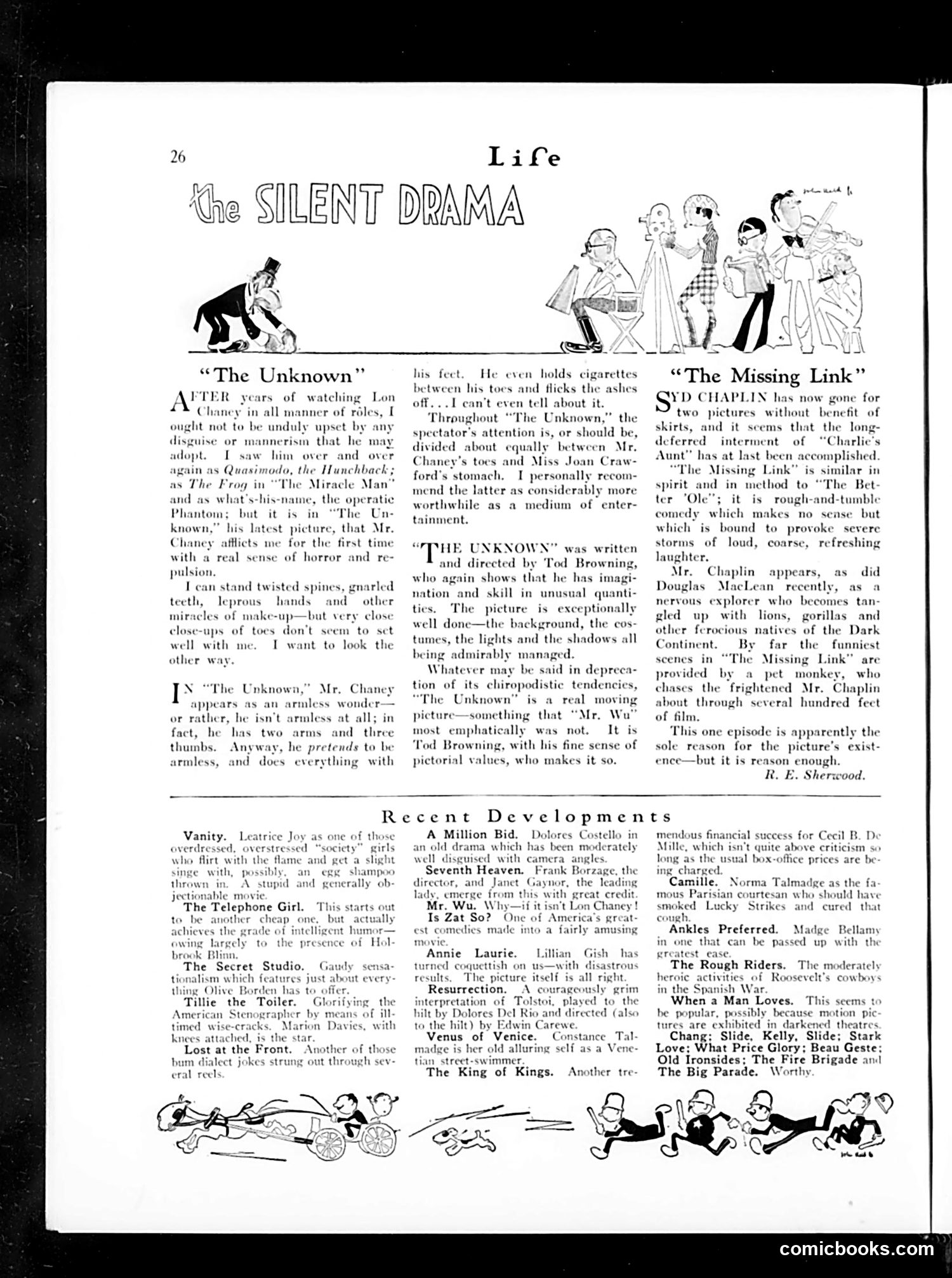
This Life magazine page reviews recent silent films, focusing on two features: **"The Unknown"** starring **Lon Chaney** and **"The Missing Link"** with **Charlie Chaplin**. **"The Unknown":** The reviewer praises Chaney's grotesque makeup artistry but finds his performance genuinely disturbing—specifically his depiction of an armless performer who manipulates cigarettes with his toes. The critic notes the film is well-directed by Tod Browning but confesses discomfort watching extreme close-ups of the character's feet, preferring to focus on co-star Joan Crawford instead. **"The Missing Link":** Chaplin plays a nervous explorer encountering wild animals and natives in Africa. The reviewer finds it crude slapstick comedy with little plot, redeemed only by scenes featuring a pet monkey chasing Chaplin through footage. The humor relies entirely on physical comedy and animal antics rather than narrative. Both reviews reflect 1920s silent cinema's emphasis on visual spectacle and physical performance over storytelling.
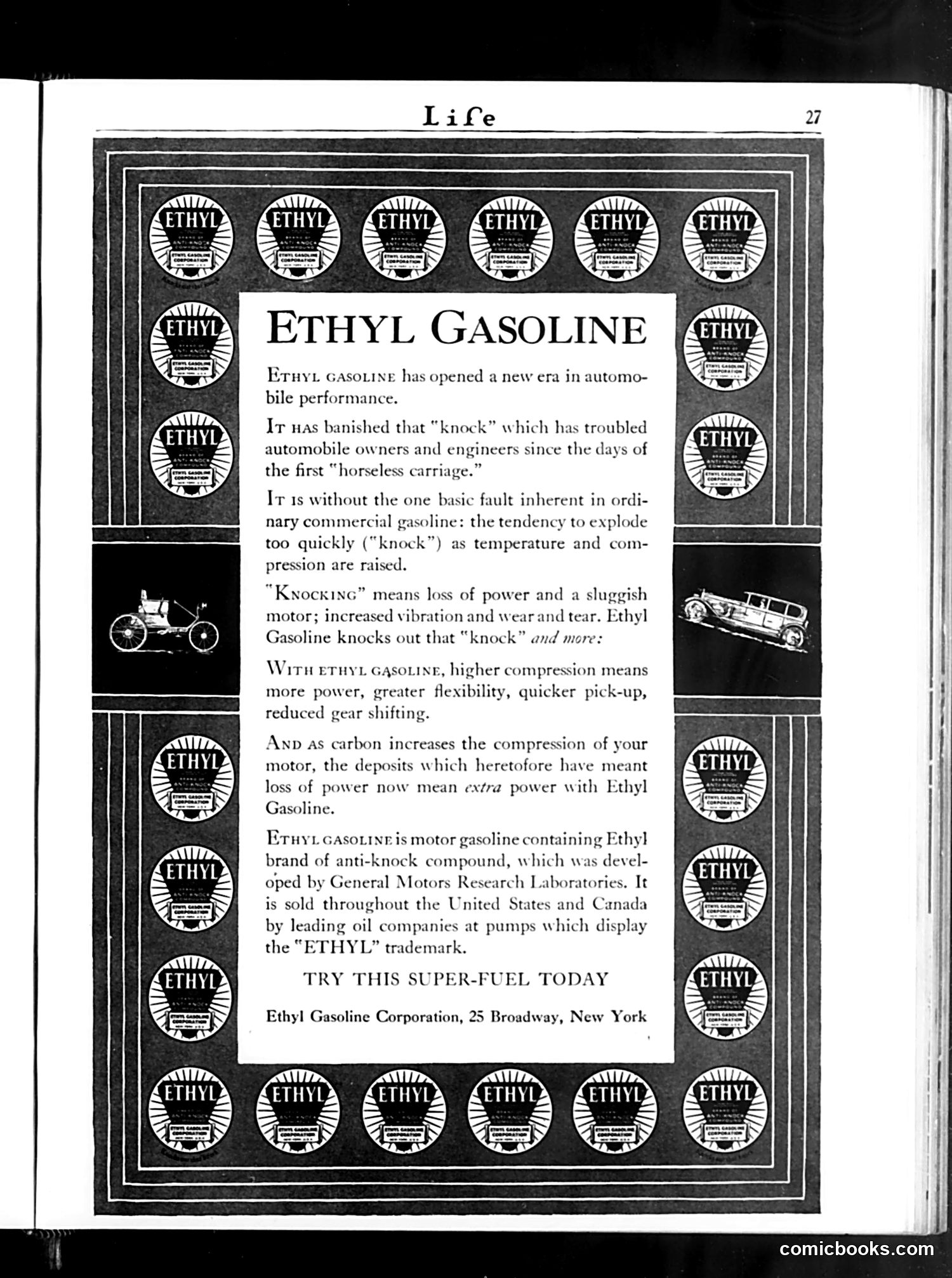
This is **not a cartoon or satire**—it's a straightforward product advertisement for Ethyl Gasoline, published in *Life* magazine (page 27). The ad promotes Ethyl brand gasoline, an anti-knock motor fuel developed by General Motors Research Laboratories. The "knock" problem referenced was a genuine mechanical issue: engine knock (pre-ignition) caused power loss, vibration, and wear in early automobiles. Ethyl's anti-knock compound solved this problem, enabling higher compression ratios and better performance. The border design features repeated "ETHYL" circular logos and period automobile illustrations. The ad emphasizes technical benefits (higher compression, quicker acceleration, reduced gear-shifting) to appeal to automobile owners and engineers. The company address (25 Broadway, New York) anchors this as legitimate corporate advertising, not satire.
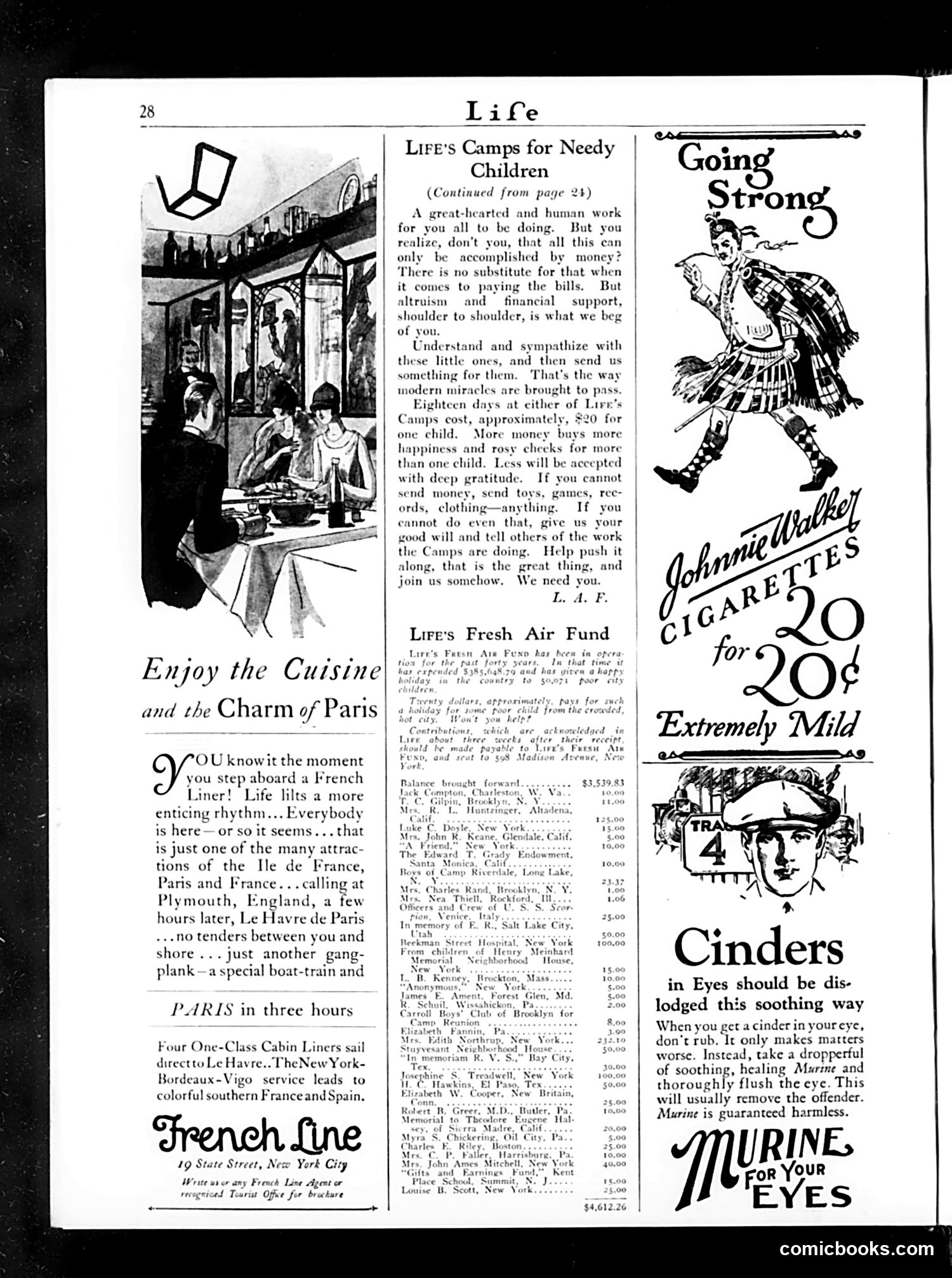
This page is primarily **advertising and charitable appeals**, not political satire. The top features a French Line cruise advertisement promoting luxury travel to Paris, appealing to affluent readers with promises of elegance and convenience ("PARIS in three hours"). The center contains a fundraising appeal for **Life's Camps for Needy Children**, explaining that $20 covers eighteen days at camp for one child. It solicits donations, emphasizing that "altruism and financial support, shoulder to shoulder" are needed—combining emotional appeal with practical financial requests. The right side displays commercial advertisements: **Johnnie Walker cigarettes** (20 for 20¢, "Extremely Mild") and **Murine eye drops** for removing cinders. The layout juxtaposes luxury travel advertising with charitable work for poor children—a stark contrast reflecting the economic inequality of the era. There is no identifiable political cartoon or satirical commentary on this particular page.
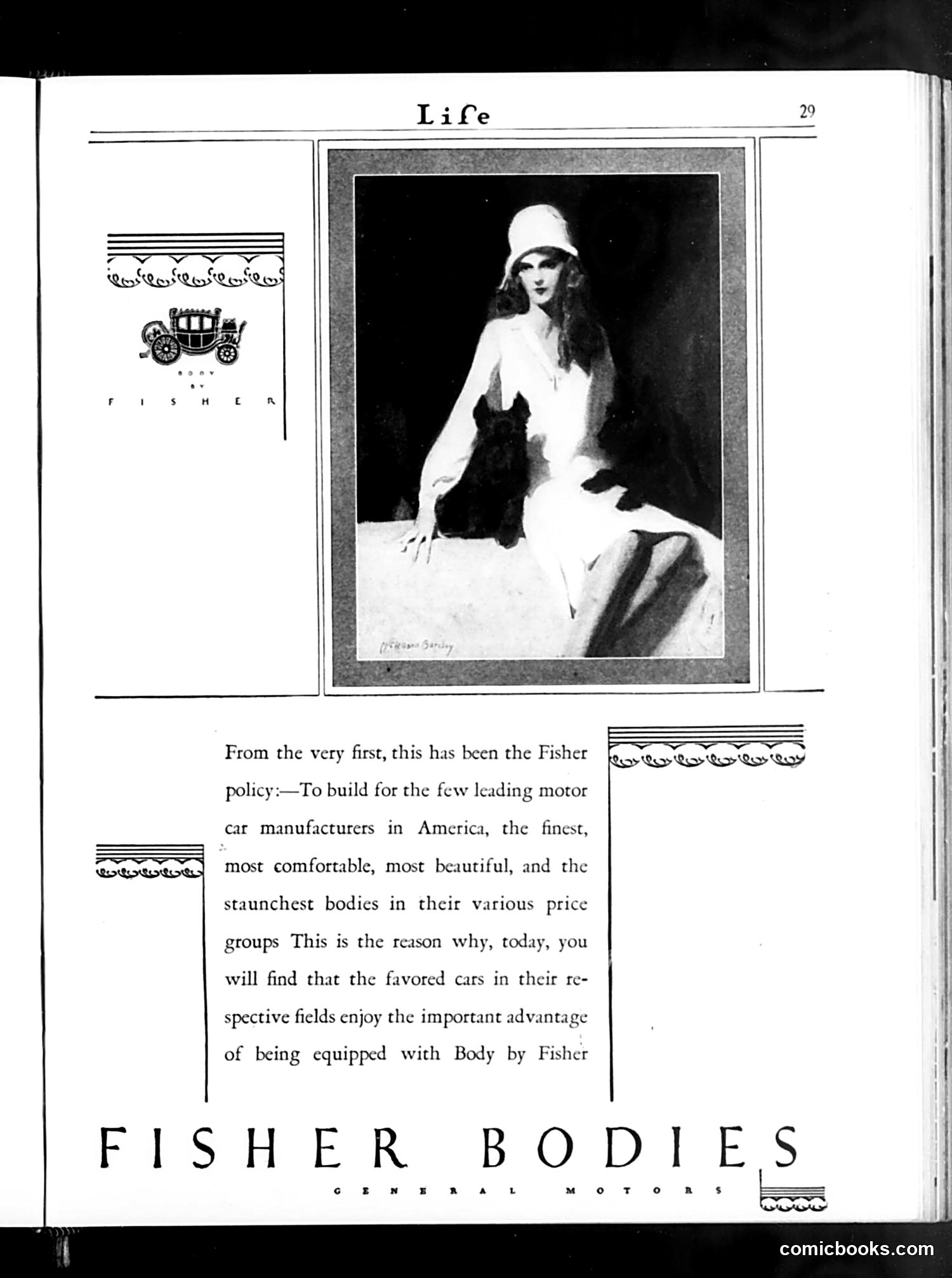
This is a Fisher Bodies advertisement for General Motors, not a political cartoon. The page features a glamorous photograph of a woman in 1920s attire (cloche hat, white outfit) posed with a black cat, accompanying promotional text about Fisher's car body manufacturing. The ad emphasizes Fisher's philosophy of building high-quality automobile bodies for major American car manufacturers across different price ranges. The messaging stresses luxury, comfort, beauty, and durability as competitive advantages. This appears to be part of Fisher's brand strategy to position their bodies as premium components sought after by leading automakers—essentially marketing through prestige rather than price. The decorative borders and elegant photography reflect typical 1920s advertising aesthetics designed to appeal to affluent consumers.
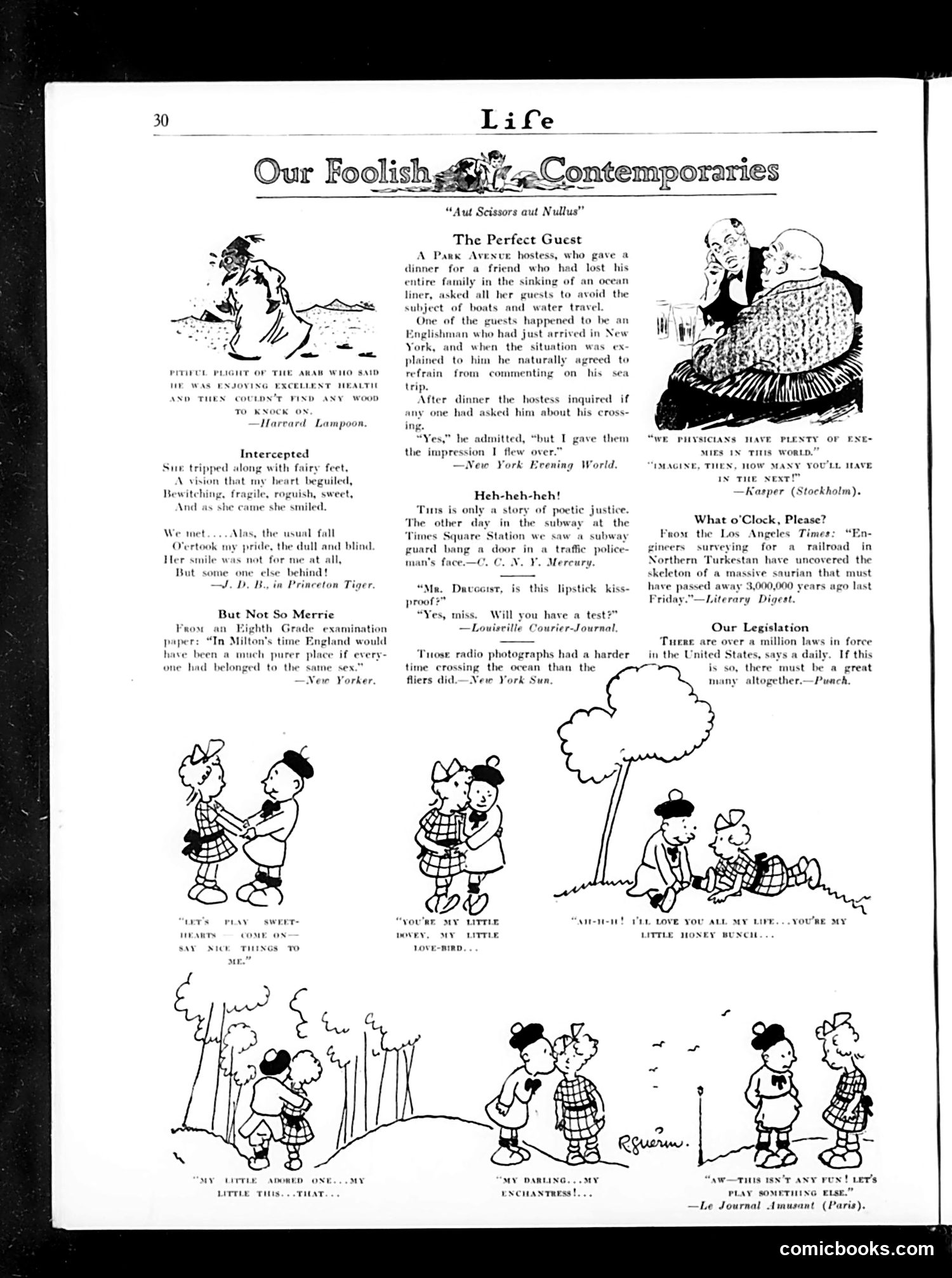
This page collects brief humorous observations and cartoons satirizing contemporary social absurdities. Key items include: **"The Perfect Guest"**: A satirical anecdote about an Englishman newly arrived in New York who, when tactfully asked to avoid discussing sea travel at a dinner (the hostess's friend lost family in a ship disaster), claims he "flew over" instead—missing the point entirely through obtuse social blindness. **"Heh-heh-heh!"**: A police officer roughly shutting a subway door in someone's face, presented as "poetic justice." **"Our Legislation"**: A quip that over one million laws exist in the U.S., suggesting legislative excess has become absurd. **Bottom cartoon strip**: A sentimental romantic sequence showing a couple's relationship progression, mocking saccharine courtship language ("my little love-bird," "honey bunch"). The page's title "Aut Scissors aut Nullus" (Latin: "Either scissors or nothing") suggests cutting satire. The humor relies on observing everyday social pretension and bureaucratic excess familiar to 1920s readers.
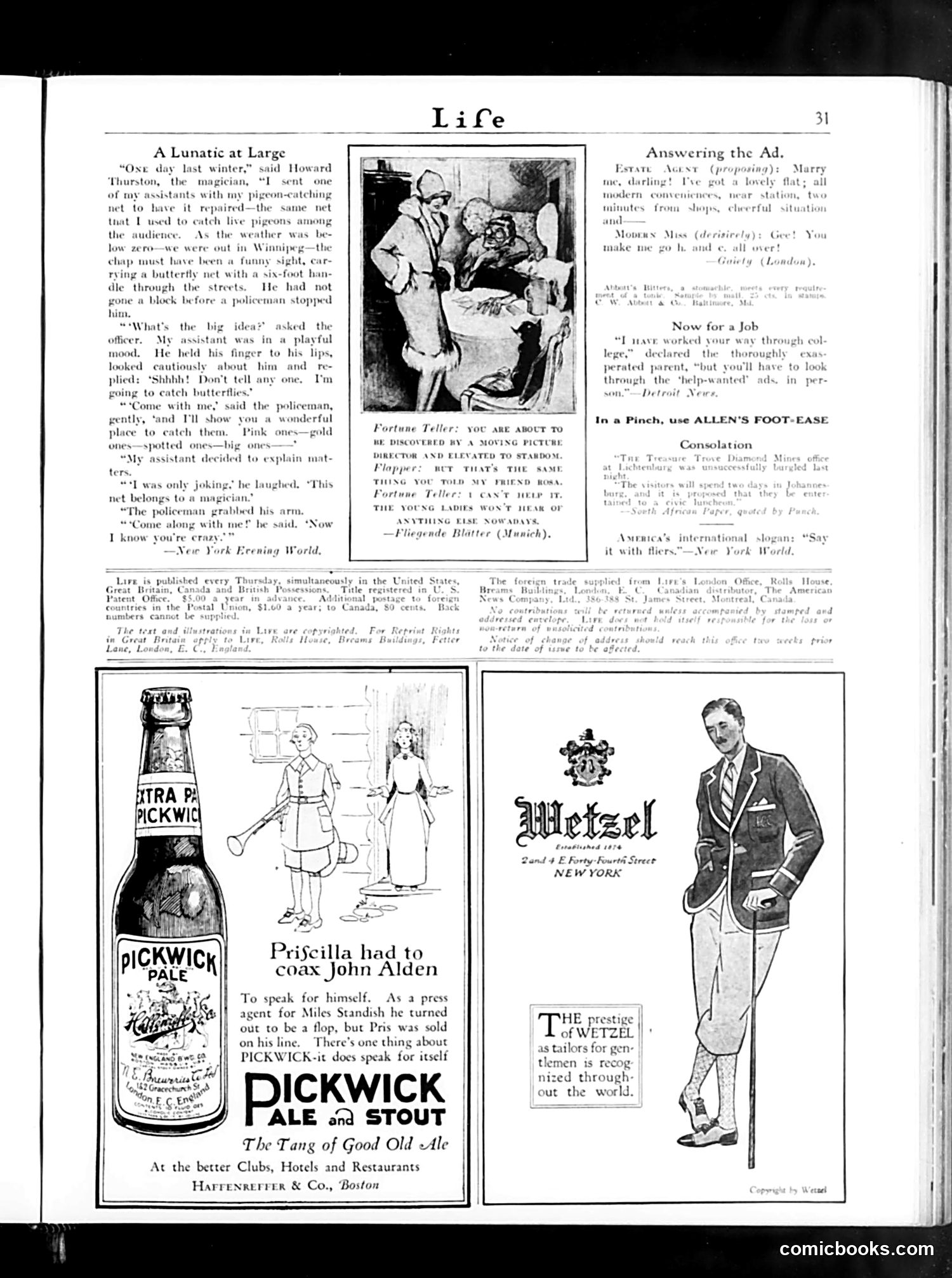
This page from *Life* magazine contains several distinct elements: **Main Story: "A Lunatic at Large"** presents a humorous anecdote by magician Howard Thurston. His assistant, carrying a butterfly net in frigid Winnipeg, is stopped by police who believe him mentally unbalanced. The joke hinges on the absurdity of catching butterflies in winter—the policeman's concern for public safety versus the assistant's innocent explanation. **Satirical Cartoons** mock 1920s social pretensions: - A fortune teller's prediction about movie stardom, with a flapper's cynical response about young women's material expectations - "Priscilla had to coax John Alden"—likely referencing the historical Pilgrim couple, adapted to mock modern dating dynamics **Advertisements** for Pickwick Pale & Stout beer, Allen's Foot-Ease, and Wetzel tailoring occupy significant space, typical of *Life*'s revenue model. The humor targets period anxieties: urban eccentricity, female materialism, and romantic role-reversals—all presented with the mild satire characteristic of 1920s American magazines.
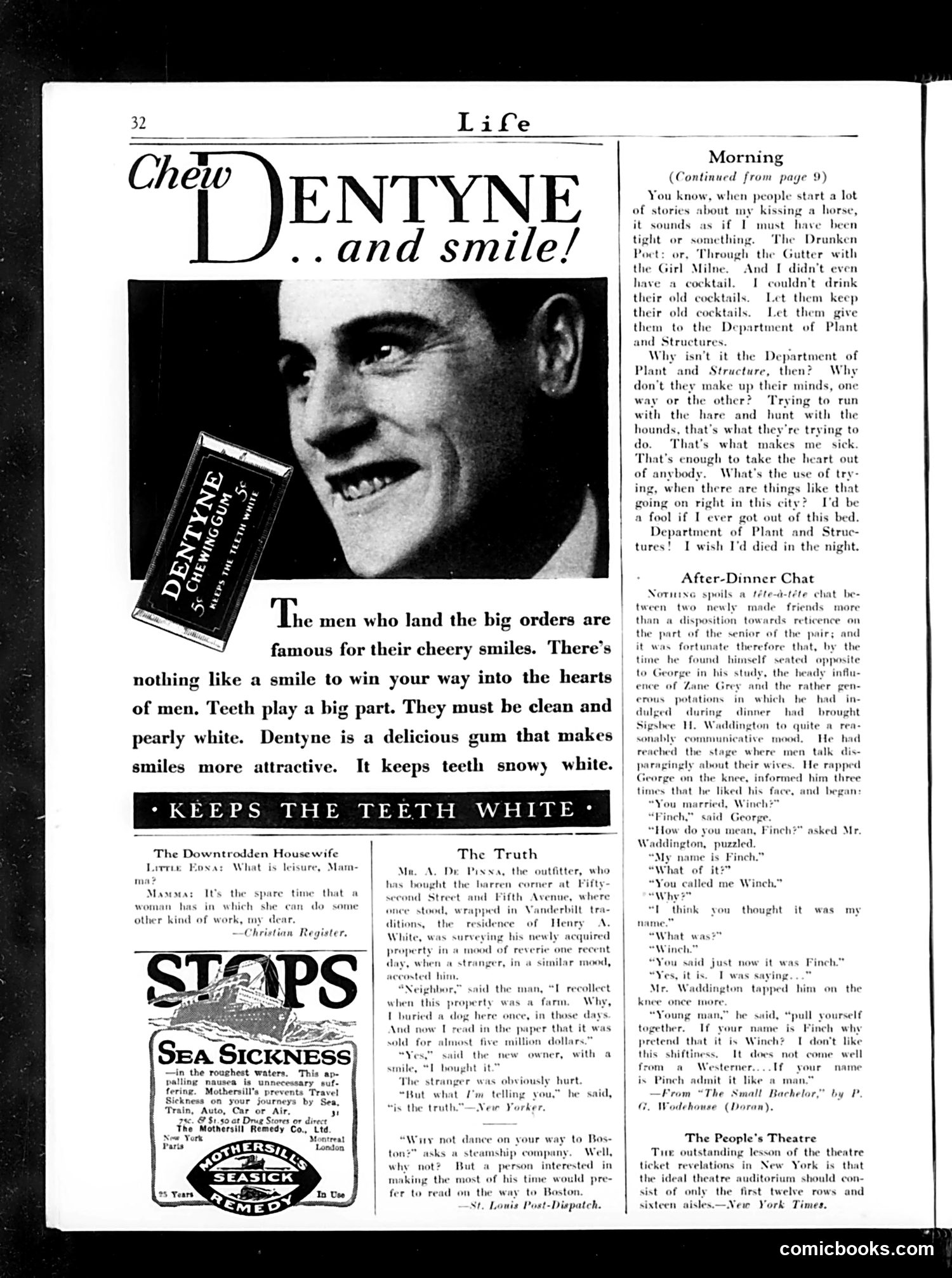
This page is primarily **advertising and humor columns**, not political satire. The main advertisement is for **Dentyne chewing gum**, featuring a man with an exaggerated smile. The ad's pitch—that salesmen win orders through cheerful smiles and white teeth—reflects early 20th-century business culture emphasizing personal charm and appearance as sales tools. The page includes several humor pieces: "The Downtrodden Housewife" (satirizing women's domestic drudgery), "The Truth" (a New Yorker anecdote about a man bragging about a valuable property's history, which the newcomer dismisses), and "After-Dinner Chat" (excerpting P.G. Wodehouse, poking fun at a drunk businessman confusing a guest's name). There's also a **Mothersill's Remedy advertisement** for seasickness prevention. These pieces mock everyday frustrations—housework, city social hierarchies, drunken obliviousness—typical of Life's satirical humor. No specific political figures or events are referenced.
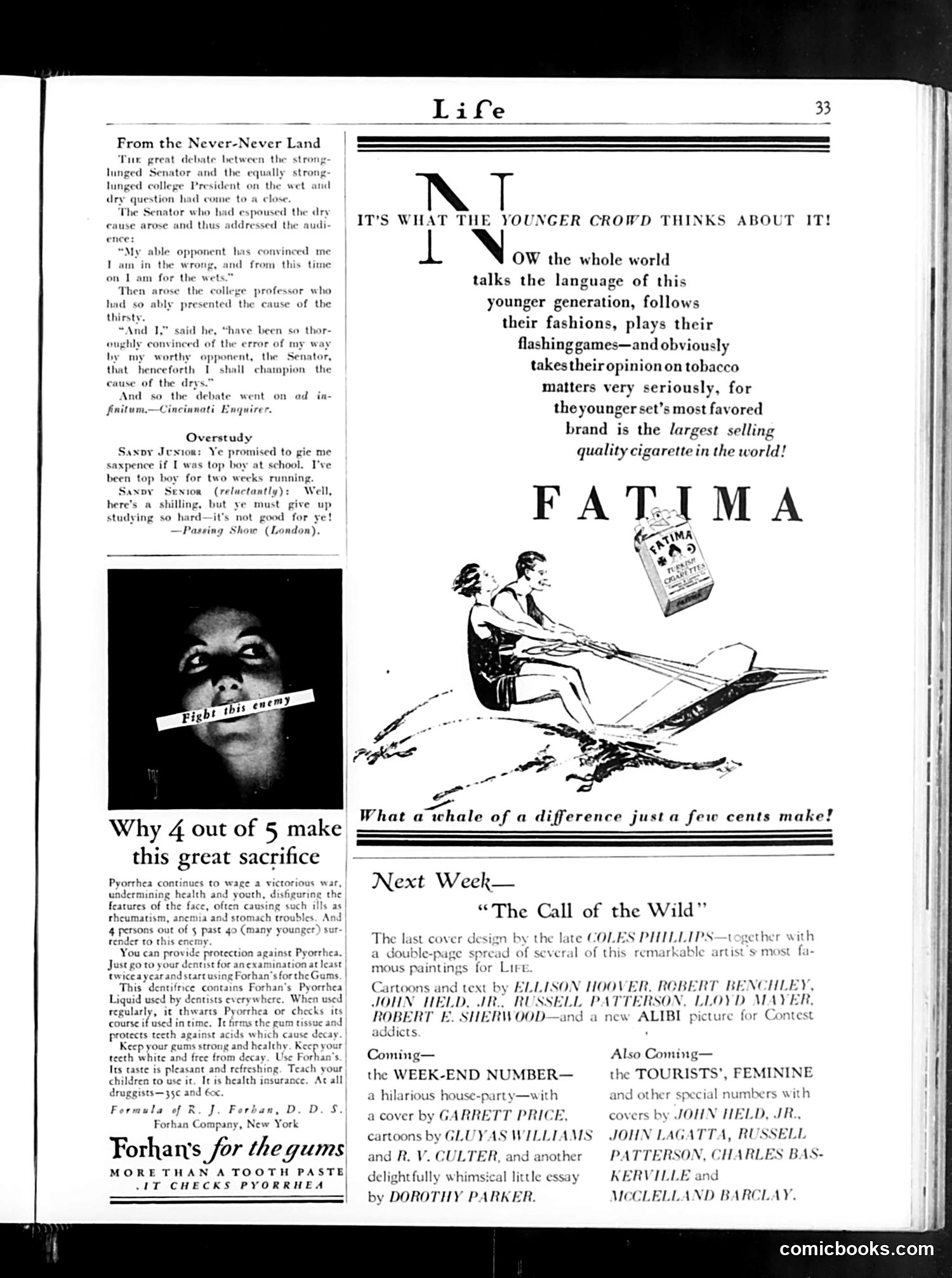
This page mixes humor, advertising, and editorial content typical of 1920s Life magazine. **The Cartoons/Humor:** - "From the Never-Never Land" satirizes Prohibition debate—a Senator and college President argue endlessly about "wet and dry" (alcohol) until each converts the other, creating absurd circular logic. - "Overstudy" is a brief joke about a Scottish boy earning a shilling but being told to stop studying hard. **The Advertising:** The dominant content is a **Fatima cigarette advertisement** exploiting youth culture. It claims younger people smoke this brand and frames tobacco as their preferred choice—appearing to target young consumers directly. This predatory marketing (now illegal) was common in the 1920s. **Additional Ads:** - Forhan's toothpaste (claims to prevent pyorrhea/gum disease) - Pyrorrhea treatment ad **Coming Attractions:** Preview of next week's *Life* features, including work by cartoonist Coles Phillips and humorist Dorothy Parker. The page reflects 1920s cultural anxieties (Prohibition debates) alongside aggressive tobacco marketing to youth—practices we'd find shocking today.
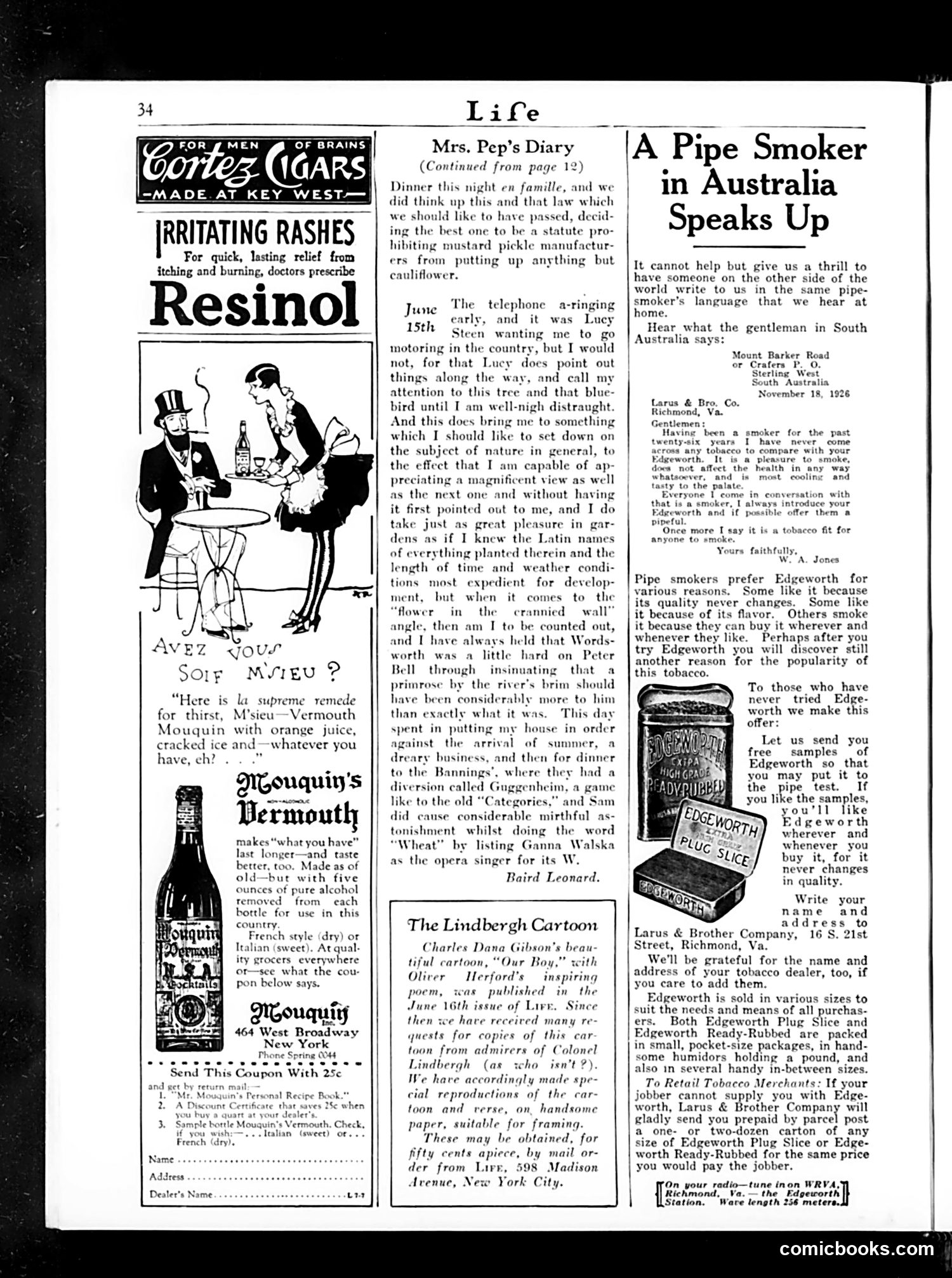
This page contains primarily **advertisements and reader correspondence**, not political satire. The main content includes: 1. **Product ads** for Resinol (skin treatment), Cortez Cigars, and Moquin's Vermouth—typical 1920s marketing with illustrated figures in fashionable dress. 2. **"Mrs. Pep's Diary"**—a humorous column satirizing upper-class women's complaints: tedious nature outings, pretentious dinner parties with games like "Guggenheim," and name-dropping (mentioning opera singer Ganna Walska). 3. **A notice about Charles Dana Gibson's "Lindbergh cartoon**"—promoting reproductions of a patriotic illustration about aviator Charles Lindbergh, available by mail order. 4. **"A Pipe Smoker in Australia Speaks Up"**—reader testimonial praising Edgeworth pipe tobacco, presented as authentic correspondence from South Australia (dated November 1926). The page reflects 1920s consumer culture and leisure-class humor rather than political commentary.
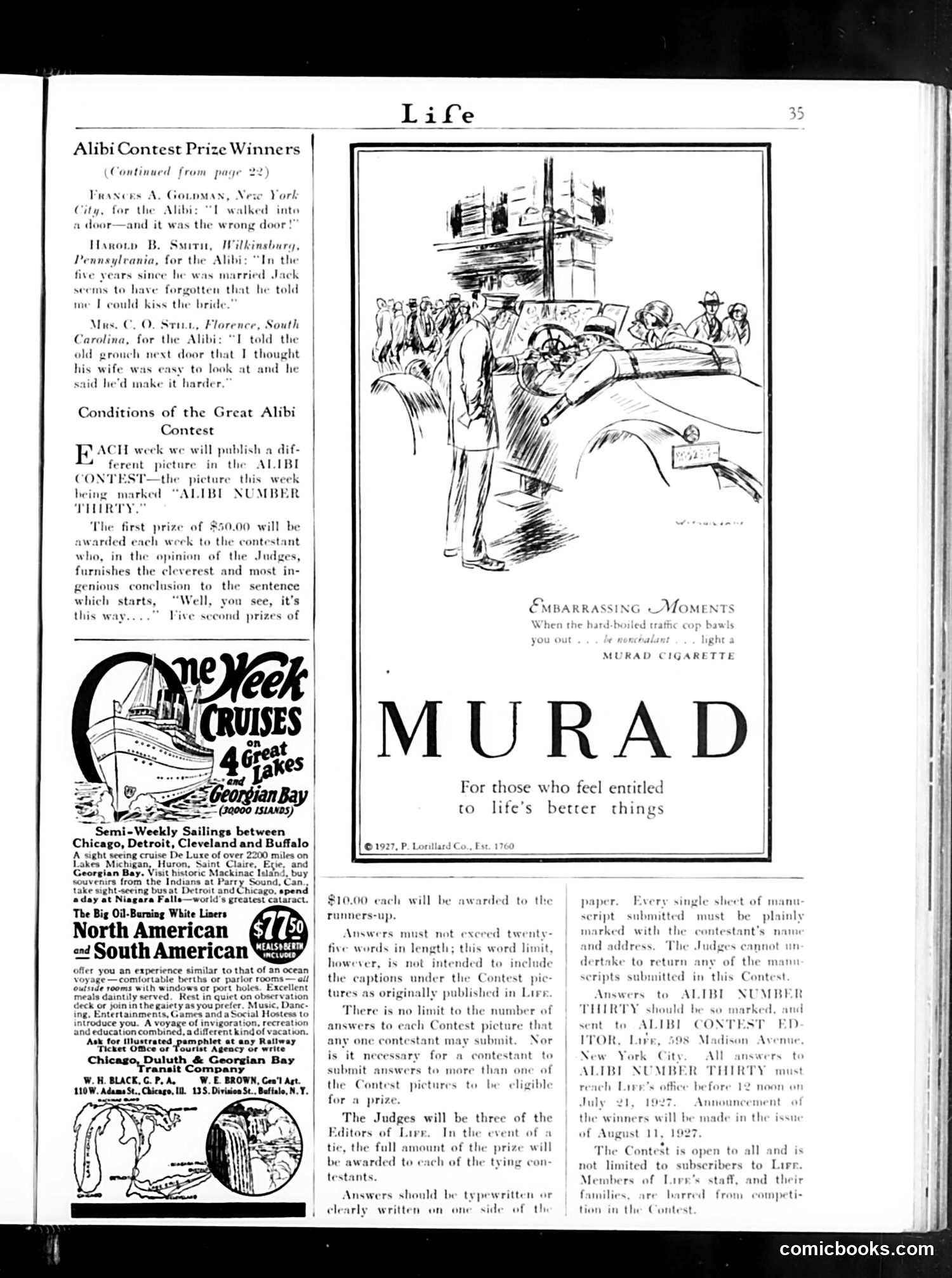
This page presents Life magazine's "Great Alibi Contest," a humor competition where readers submit witty explanations for awkward situations. The cartoon illustrates the contest theme: a traffic cop has caught someone committing a traffic violation, and the challenge is to complete the sentence "Well, you see, it's this way..." The featured cartoon shows someone offering an excuse to an authority figure—the humor derives from inventing increasingly implausible or clever alibis. Previous winners' entries exemplify the genre: mistaken identities, marital misunderstandings, and insulting neighbors. The Murad cigarette advertisement below uses the contest's "embarrassing moments" theme as marketing, suggesting their product helps one navigate social discomfort—a common advertising strategy linking products to social confidence. The contest itself was a popular reader-engagement feature of 1920s magazines, encouraging audience participation and humor submissions while building brand loyalty to Life.
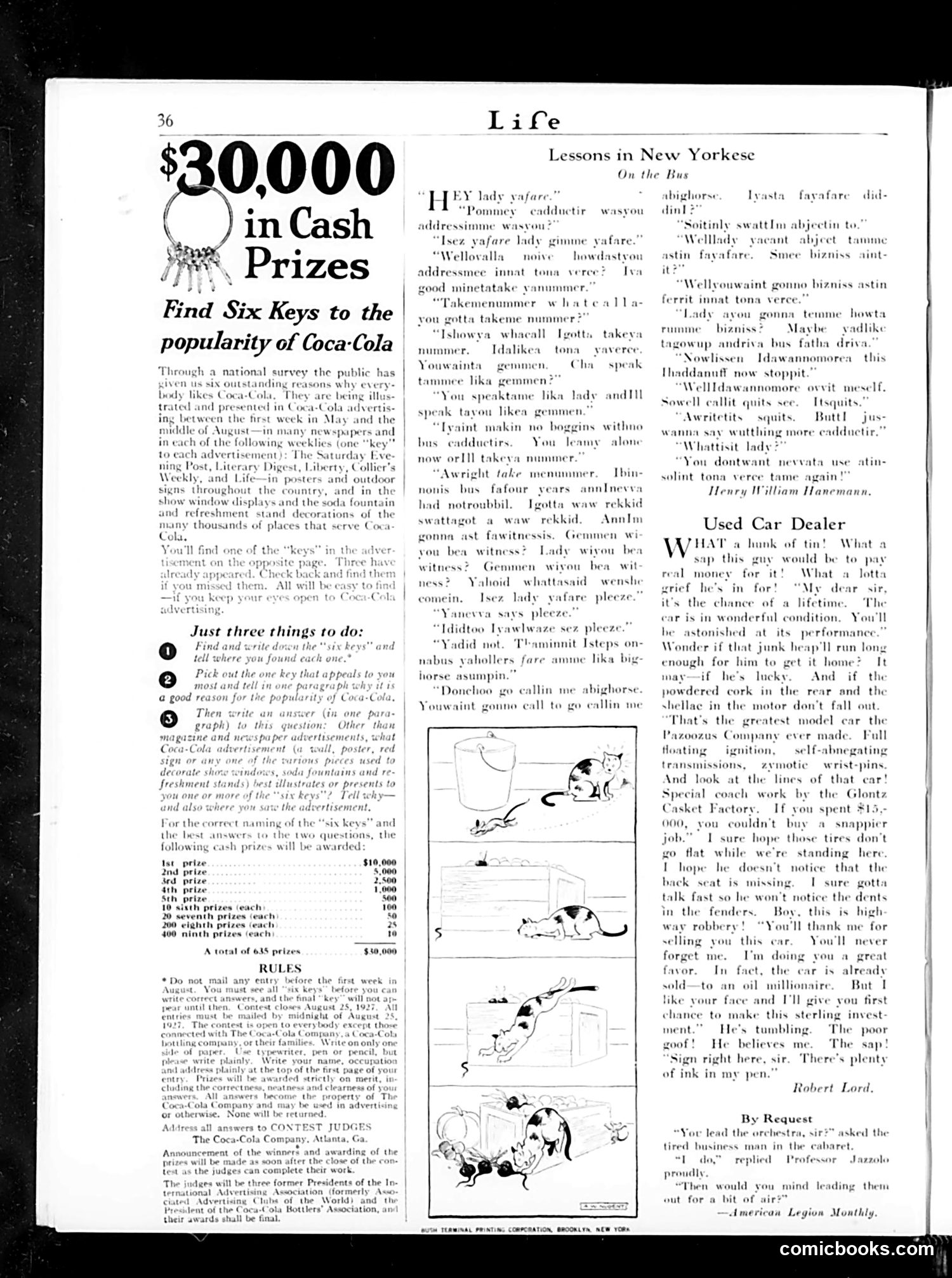
This page contains two satirical pieces poking fun at early 20th-century American vernacular and commerce. **"Lessons in New Yorkese"** is a dialect humor piece transcribing a conversation between a bus passenger and conductor in exaggerated New York accent (dropping g's, slurring words: "yafare" for "your fare," "Igotta" for "I got to"). The joke relies on the ethnic and class comedy popular in period humor—the crude speech patterns of working-class urban New Yorkers. **"Used Car Dealer"** satirizes the sleazy used-car salesman archetype through an interior monologue. The dealer cynically admits deceiving a customer about a worthless vehicle ("junk heap"), planning to exploit the buyer's naivety while talking fast to distract from obvious defects (missing back seat, dented fenders). The satire targets both the dishonest salesman and the gullible buyer ("the sap") in post-WWI consumer culture. Both pieces reflect period attitudes toward working-class speech and consumer fraud as comedic material.
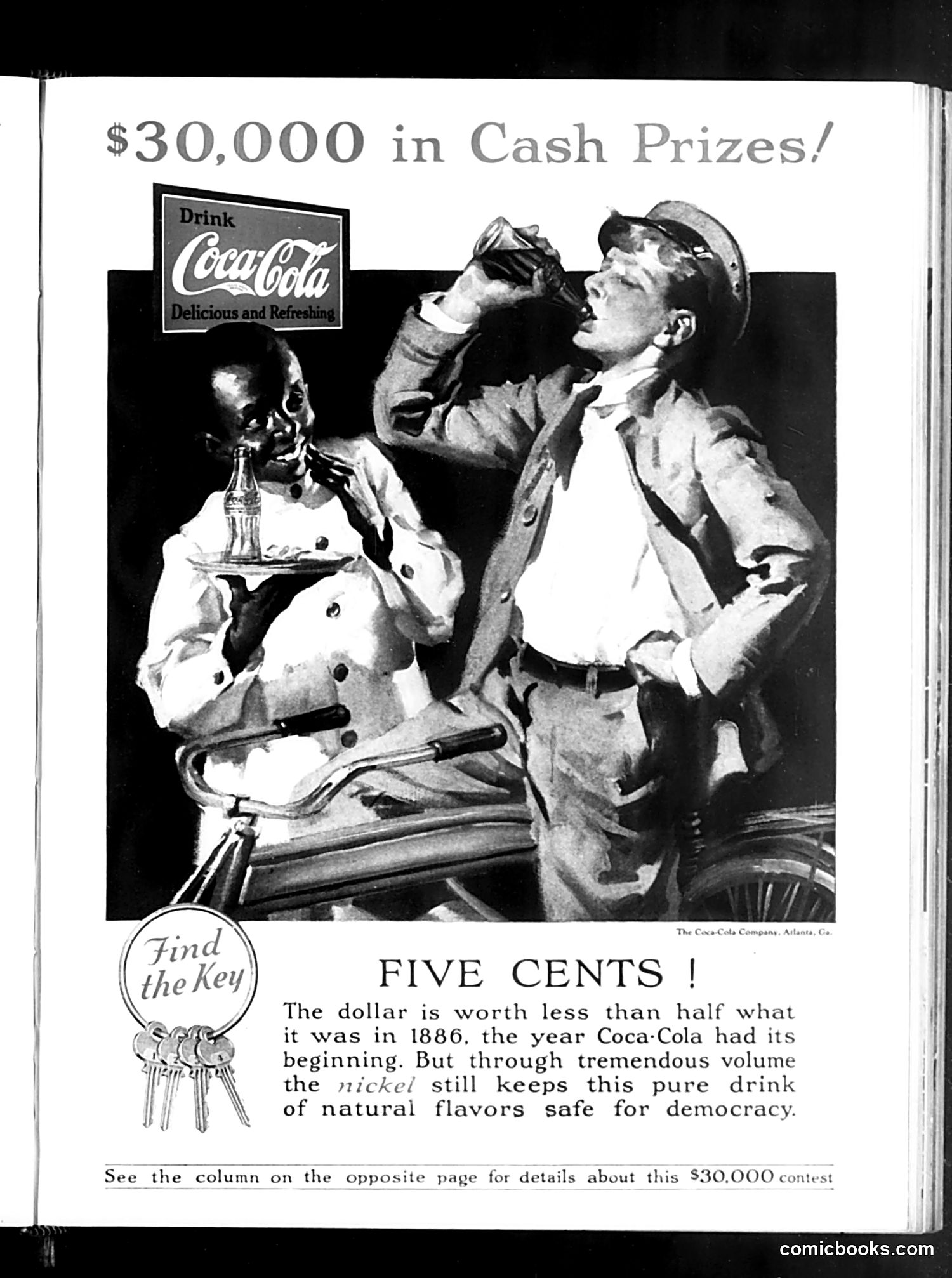
This is a Coca-Cola advertisement, not satire. The page promotes a $30,000 cash prize contest while emphasizing that Coca-Cola has maintained its five-cent price despite inflation since 1886. The image shows a server on a bicycle delivering Coca-Cola to a man, visualizing the product's accessibility and convenience. The accompanying text argues that through high sales volume, Coca-Cola can afford to keep prices stable—framing affordable pricing as democratic and egalitarian ("safe for democracy"). The "Find the key" element in the lower left likely refers to contest mechanics. This is straightforward commercial advertising leveraging patriotic language and economic messaging typical of the era, rather than political commentary or satire.
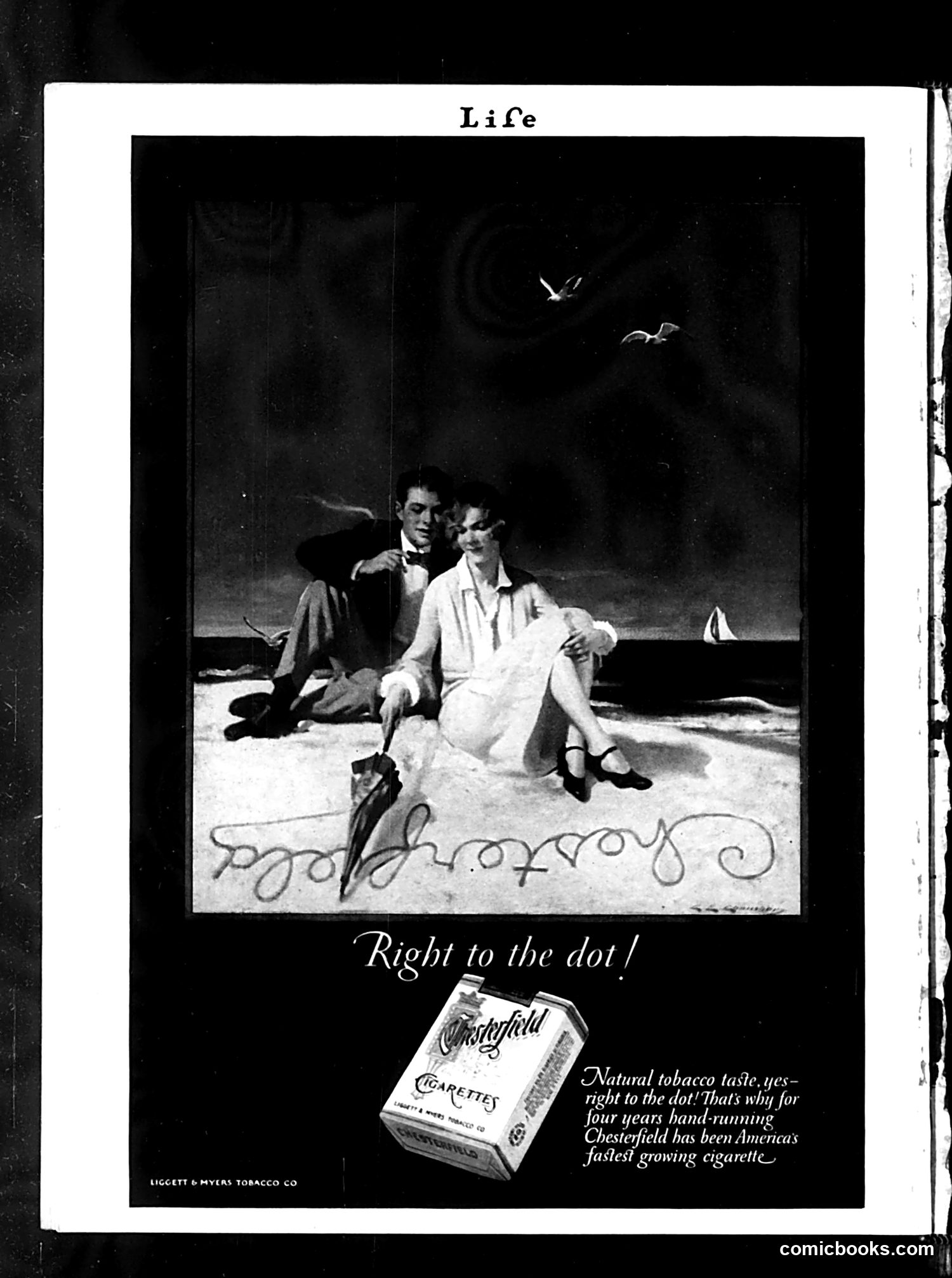
This is a **cigarette advertisement**, not political satire. The page shows a couple on a beach, with the man pointing to sand writing that says "Right to the dot!" Below is a Chesterfield cigarettes package. The ad's message is straightforward: Chesterfield cigarettes deliver "natural tobacco taste" precisely—"right to the dot." The phrase plays on the package's dot design element as a quality marker. The romantic beach scene associates smoking with leisure and intimacy, a common advertising strategy of the era. The "fastest growing cigarette" claim suggests market leadership. There is no cartoon, political commentary, or satire present—this is purely commercial promotion from Liggett & Myers Tobacco Company, typical of mid-20th century magazine advertising when cigarettes were widely advertised without health warnings.