
Life, 1927-07-07 · page 25 of 42
Life — July 7, 1927 — page 25: what you’re looking at
What you’re looking at
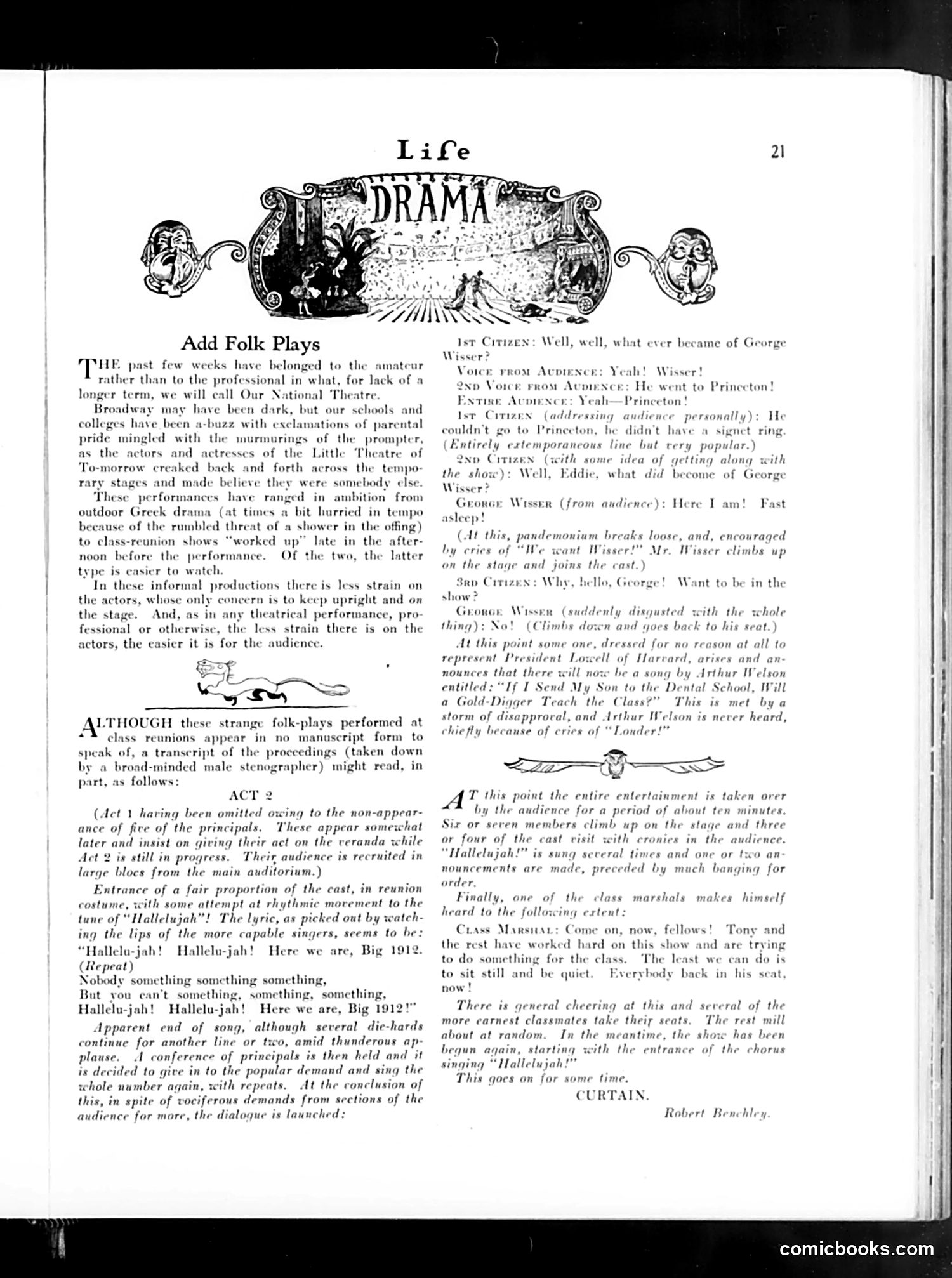
This article celebrates amateur theatrical performances at American schools and colleges, contrasting them favorably with professional Broadway theater (which "may have been dark"). The piece is largely celebratory, arguing that amateur productions place less strain on audiences because actors focus simply on staying upright rather than delivering polished performances. The satirical transcript that follows mocks a typical class reunion show—specifically a 1912 reunion performance. The humor targets the chaos of amateur theater: missing cast members, performers insisting on performing during wrong acts, a song repeated due to audience demands, and dialogue that devolves into audience members climbing onstage to join the action. The fictional song title "If I Send My Son to the Dental School, Will a Gold-Digger Teach the Class?" mocks contemporary anxieties about education and morality. The "President Lowell of Harvard" reference adds institutional satire. Overall, Life gently ridicules amateur theater's informal nature while celebrating its democratic accessibility—a distinctly American form of entertainment outside professional Broadway culture.
📄 Transcribed text from this page (OCR, searchable)
Machine-transcribed from the original scan — historical spelling and the odd misread are preserved.
Ao Add Folk Plays ypue past few weeks have belonged to the amateur rather than to the professional in what, for lack of a r term, we will call Our National Theatre Broadway may have been dark, but our schools and colleges have been a-buzz with exclamations of parental 1 pride mingled with the murmurings of the prompter, as the actors and actresses of the Little Theatre of To-morrow creaked back and forth across the tempo rary stages and made believe they were somebody else These performances have ranged in ambition from outdoor Greck drama (at times a bit hurried in tempo because of the rumbled threat of a shower in the offing) to class-reunion shows “worked up” late in the after- noon before the performance. Of the two, the latter type is casier to wateh In these informal productions there is less strain on the actors, whose only concern is to keep upright and on the stage. And, as in any theatrical performance, pro- fessional or otherwise, the less strain there is on the actors, the easier it is for the audience. ALTHOUGH these strange folk-y class reunions appear in no 1 speak of, a transcript of the proceedings (tak by a broad-minded male stenographer) might read, in part, as follows: vs performed at nuscript form to n down (Act 1 having been omitted owing to the non-appear- ance of five of the principals. These appear somewhat later and insist on giving their act on the veranda while Act 2 is still in progress. Their audience is recruited in large blocs from the main auditorium.) Entrance of a fair proportion of the cast, in reunion costume, with some attempt at rhythmic movement to the tune of “Hallelujah”! The lyric, as picked out by watch- ing the lips of the more capable singers, seems to be: “Hallelu-jah! Hallelu-jah! Here we a Big 1912. (Repeat) Nobody something something something, But you can't something, something, something, Hallelu-jah! Hallelu-jah! | Here we are, Big 1912!” Apparent end of song, although several die-hards continue for another line or two, amid thunderous ap- plause. A conference of principals is then held and it is decided to give in to the popular demand and sing the whole number again, with repeats. At the conclusion of this, in spite of vociferous demands from sections of the audience for more, the dialoque is launched: Ist Citizen: Well, well, what ever became of George Wisser? Voice rrom Aupience: Yeah! Wisser! 2xp Voice rrom Avpience: He went to Prinecton! Extine Avorence: Yeal—Princeton! Ist Citizen (addressing andience personally): He couldn't go to Princeton, he didn't have a Entirely extemporaneous line but very popular.) 2xp Crrizen (aith some idea of getting the show): Well, Eddie, what Wisser? Grorcr Wissen (from audience): Here I am! Fast asleep! (At this hy cries of with ong with of George vandemonium breaks loose, and, encouraged We on the stage and joins the cast.) ant Wisser!” Mr, Wisser climbs up Sap Crrizen: Why, hello. show ? ieorge! Want to be in the with the ths down and qoes back to his se Grorcr Wissen (suddenly disqustec thing): No! (Cl At this point some one, dressed for no reason at all to represent President Lowell of Harvard, arises and an nounces that there will now be a song by Arthur Welson entitled: “If I Send My Son to the Dental School, Will a Gold-Digger Teach the Class?” This is met bya storm of disapproval, and Arthur Welson is never heard, chiefly because of cries of “Louder!” ’ this point the entire entertainment is taken over by the audience for a period of about ten minutes Six or seven members climb up on the stage and three or four of the cast visit with cronies in the audience. “Hallelujah!” is sung several times and one or to an nouncements are made, preceded by much order anging for self Finally, one of the class marshals makes heard to the fol rcing extent: Cuass Mansiian: Come on, now, fellows! Tony and the rest have worked hard on this show and are trying to do something for the class. The least we ean do is to sit still anc now! be quiet. Everybody back in his seat, There is general cheering at this and several of the more earnest classmates take their seats. The rest mill about at random. In the meantin bequn again, starting with the ent singing “Hallelujah!” This goes on for some time. CURTAIN . the show has been of the chorus comicbooks.com