
Life, 1927-07-07 · page 20 of 42
Life — July 7, 1927 — page 20: what you’re looking at
What you’re looking at
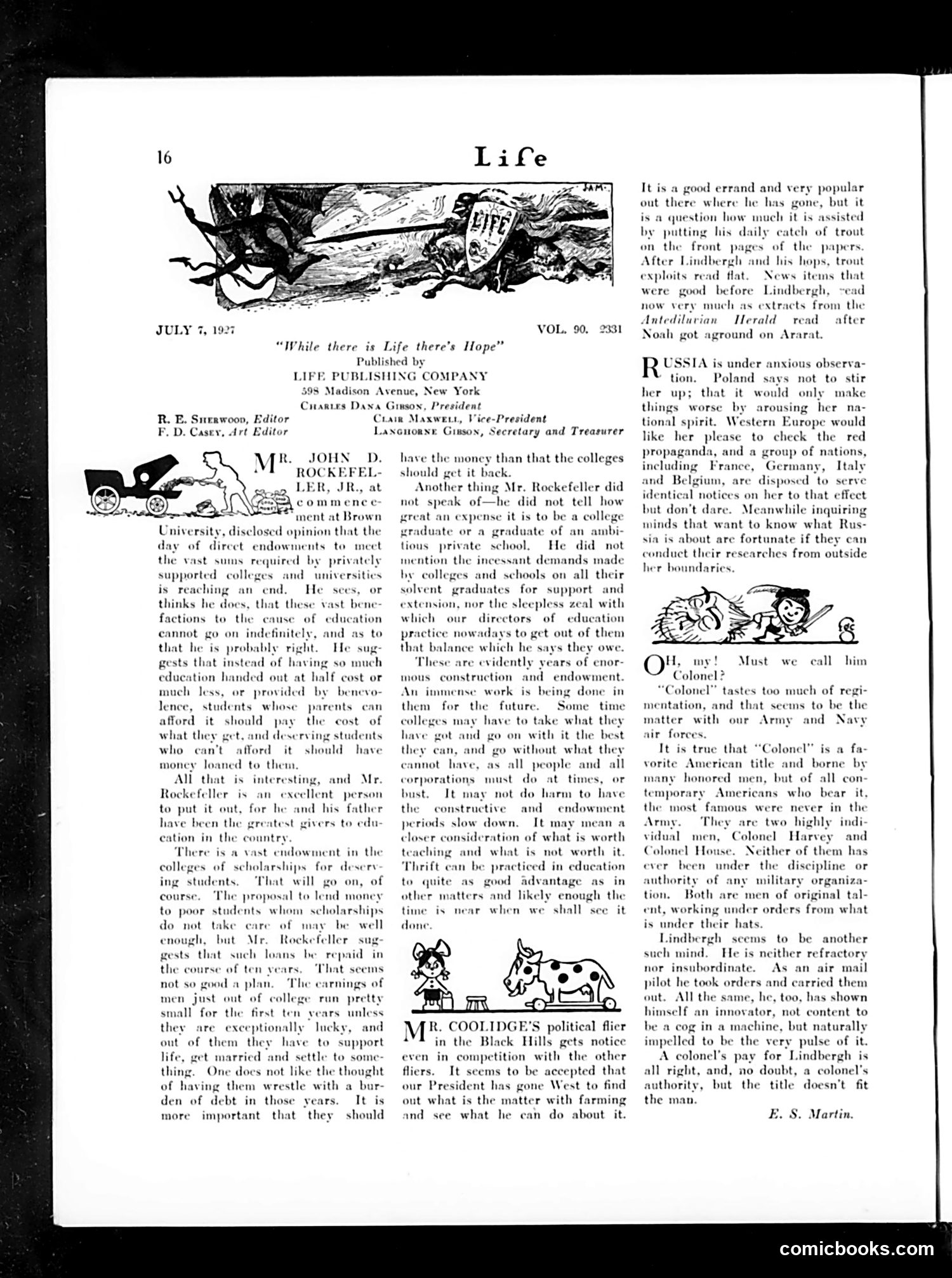
This page contains editorial commentary on three topics: **Rockefeller's Education Plan**: The editor discusses John D. Rockefeller Jr.'s proposal that students should pay college costs rather than rely on endowments, with loans available for deserving poor students. The writer questions whether recent graduates can realistically repay loans while establishing themselves. **President Coolidge's Fishing Trip**: The editorial mocks Coolidge's highly publicized fishing expedition to the Black Hills, framed as fact-finding on agricultural problems. The satire suggests his daily trout catches dominate front pages but seem trivial compared to Lindbergh's recent aviation exploits, making them feel outdated ("antediluvian"). **Russia/Poland**: A brief mention of anxiety about Soviet Russia and Poland's warnings against destabilizing her. The cartoons (visible but small) appear to be humorous illustrations supporting these commentaries. The overall tone is satirical political commentary typical of Life magazine's 1920s editorial stance.
📄 Transcribed text from this page (OCR, searchable)
Machine-transcribed from the original scan — historical spelling and the odd misread are preserved.
JULY 7, 1927 VOL, 90, 2331 “While there is Life there’s Hope” Published by LIFE PUBLISHING COMPANY 598 Madison Avenue, New York Crartes Dana Ginson, President R. E. Surawoon, Editor M"- _D. ROCKEFE 53093, LER, IR., at ai ment at Brown University, disclosed opinion that the day of direct endowments to meet the vast sums required by privately supported colleges and universities is reaching an end. He sces, or thinks he does, that these vast bene factions to the cause of education cannot go on indefinitely, and as to that he is probably right. He sug- gests that instead of having so much education handed out at half cost or much less, or provided by benevo- lence, students whose parents can afford it should pay the cost of what they get, and deserving students who can't afford it) should have money loaned to them. All that is interesting, and Mr. Rockefeller is an excellent) person to put it out, for he and his father have been the greatest givers to edu cation in the country There is a vast endowment in the colleges of scholarships for desery ing students. That will go on, of course. The pre to poor students whom scholarships do not take care of may be well enough, but Mr. Rockefeller sug: sal to lend money gests that such loans be paid in the course of ten vears at seems not so good a plan f college run pretty small for the first ten vears unless The earnings of men just out they are exceptionally lucky, and out of them they have to support life, get married and settle to some- thing. One does not like the thought of having them wrestle with a bur- den of debt in those years. It is more important that they should Cram Maxwetut, Vice-President F. D. Casey, Art Editor Lane axe. Ginson, Secretary and Treasurer have the money than that the colleges should get it back. Another thing Mr. Rockefeller did not speak of—he did not tell how great an expense it is to graduate or a graduate of an ambi- tious private school, He did not mention the incessant demands made by colleges and schools on all their solvent graduates for support and extension, nor the sleepless zeal with a colle which our directors of education practice nowadays to get out of them that balance which he says they owe. These are evidently years of enor- mous construct ind endowment An immense work is being done in them for the future. Some time colleges may have to take what they have got and go on with it the best they ad go without what they cannot have, as all people and. ail corporations must do at times, or bust. It may not do harm to have the constructive and endowment periods slow down, It may mean a closer consideration of what is worth and what is not worth it n be practiced in education to quite as good advantage as in other matters and likely enough the time is near when we shall see it done M R. COOLIDGE’S political flier + in the Black Hills gets notic even in competition with the other fliers. It seems to be accepted that our President has gone West to find out what is the matter with farming and see what he can do about it. It is a good errand and very popular out there where he has gone, but it is a question how much it is assisted by putting his daily catch of trout on the front pages of the papers. After Lindbergh and his hops, trout exploits read flat. News items that before Lindbergh, ead now very much as extracts from the Antediluvian Herald read after Noah got aground on Ararat. were go USSIA is under anxious observa- tion. Poland says not to stir her up; that it would only make things worse by arousing her na- tional spirit. Western Europe would like her please to check the red propaganda, and a group of nations, including France, Germany, Italy and Belgiut disposed to serve identical notices on her to that effect but don’t dare. Meanwhile inquiring minds that want to know what Rus- sia is about are fortunate if they can conduct their researches from outside her boundaries. H, my! Must we call him Colonel? olonel” tastes too much of regi- mentation, and that seems to be the matter with our Army and Navy rir forces. It is true that “ is a fa- vorite American title and borne by many honored men, but of all con Colonel’ temporary Americans who bear it. the most famous were never in the Army. ‘They are two highly indi vidual men, Colonel Harvey and Colonel House. Neither of them has ever been under the discipline or authority of any military organiza- tion, Both are men of original tal- ent, working under orders from what is under their hats. Lindbergh scems to be another such mind. He is neither refractory nor insubordinate. As an air wi pilot he took orders and carried them out. All the same, he, too, has shown himself an innovator, not content to be a cog in a machine, but naturally impelled to be the very pulse of it. A colonel’s pay for Lindbergh is all right, and, no doubt, a colonel's authority, but the title doesn’t fit the man. E. S. Martin. comicbooks.com