
A complete issue · 44 pages · 1926
Life — May 20, 1926
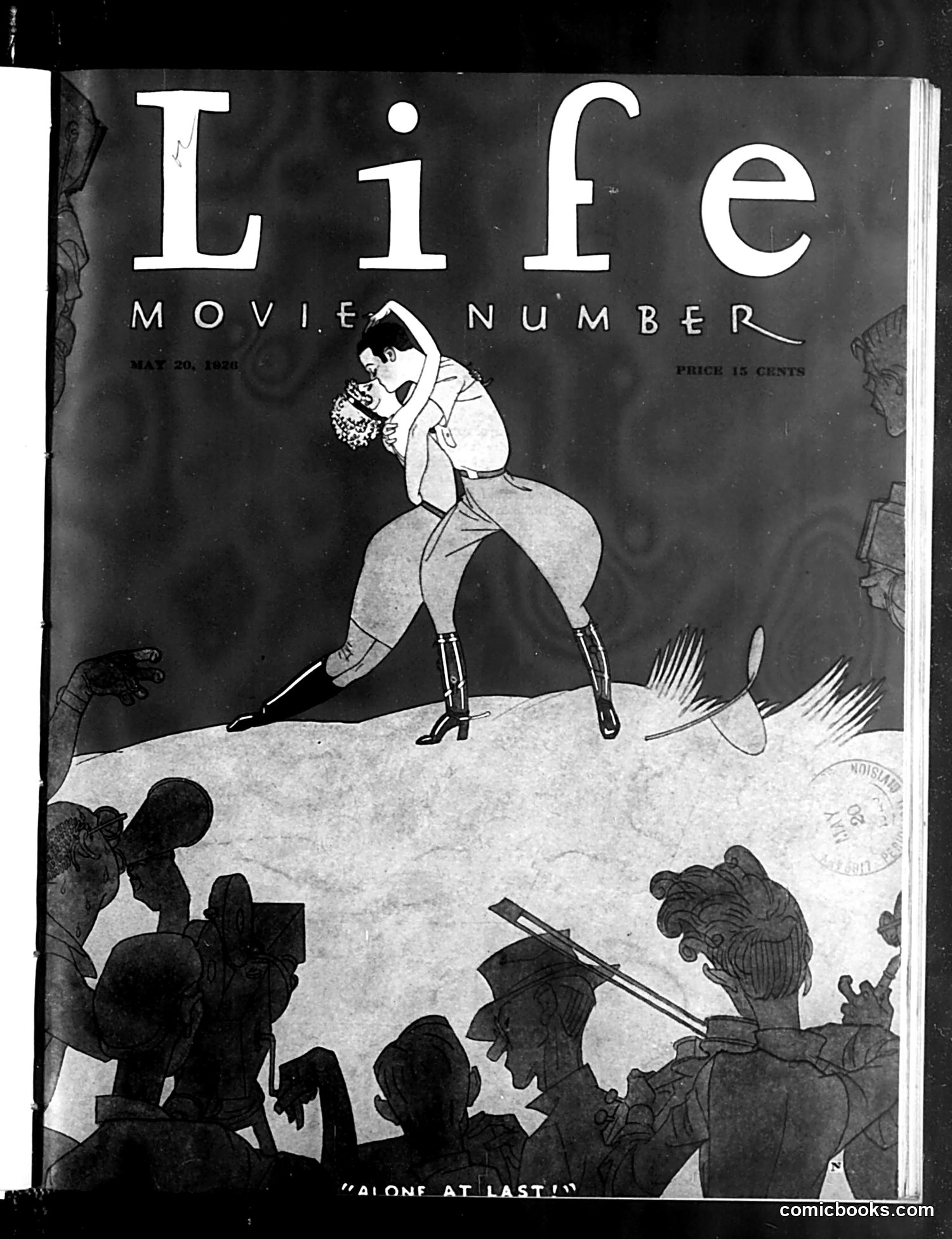
This is the cover of *Life* magazine from May 20, 1920, priced at 15 cents. The illustration depicts a woman in a bathing suit posing on a beach while silhouetted onlookers (appearing to be cameramen and male spectators) watch from below. The caption reads "Alone at Last!" The satire targets the emerging culture of beach culture and public display of women's bodies in the 1920s. The woman's theatrical pose and the eager crowd of observers mock both the exhibitionism of bathing beauties and the voyeuristic attention they attracted. The ironic title—"Alone at Last!"—emphasizes the contradiction: despite being surrounded by admirers, she performs solitude. This reflects 1920s anxieties about changing gender norms, the "New Woman," and the public sexualization of female bodies during the Jazz Age.
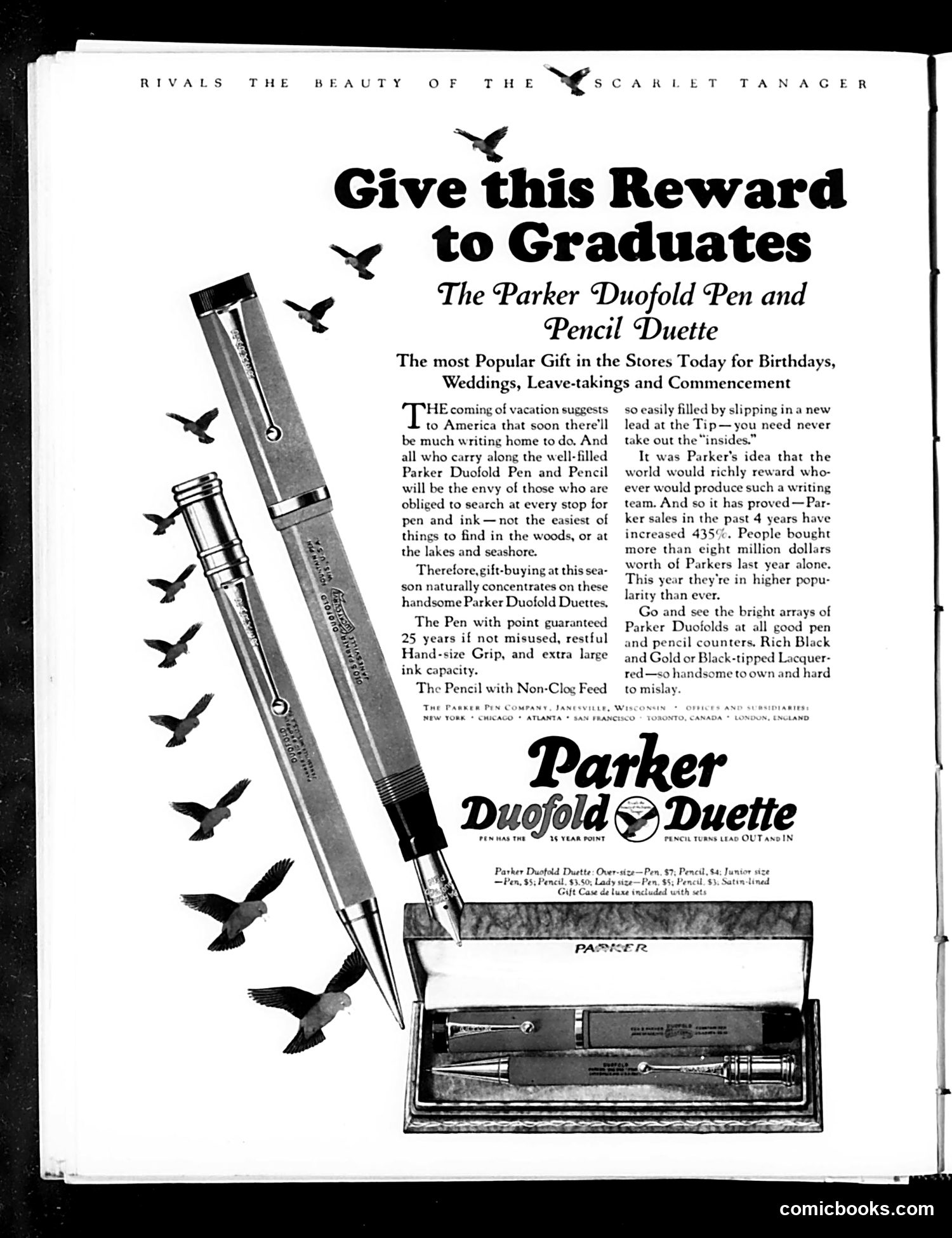
This is **not a cartoon or satire page** — it's a **straightforward advertisement** for Parker Duofold pens and pencils, positioned as graduation gifts. The ad targets gift-buyers with the headline "Give this Reward to Graduates," marketing the Parker Duofold Pen and Pencil Duette as ideal commencement presents. The decorative flying birds are purely ornamental. The copy emphasizes practical features: the pen's 25-year point guarantee, hand-size grip, and large ink capacity; the pencil's "Non-Clog Feed" mechanism. It notes Parker products are bestsellers (435% sales increase mentioned) and available in attractive finishes like Rich Black and Gold or lacquered options. The boxed product image at bottom shows the pen-and-pencil set in its presentation case. This is period advertising, circa early-to-mid 20th century, with no satirical intent.
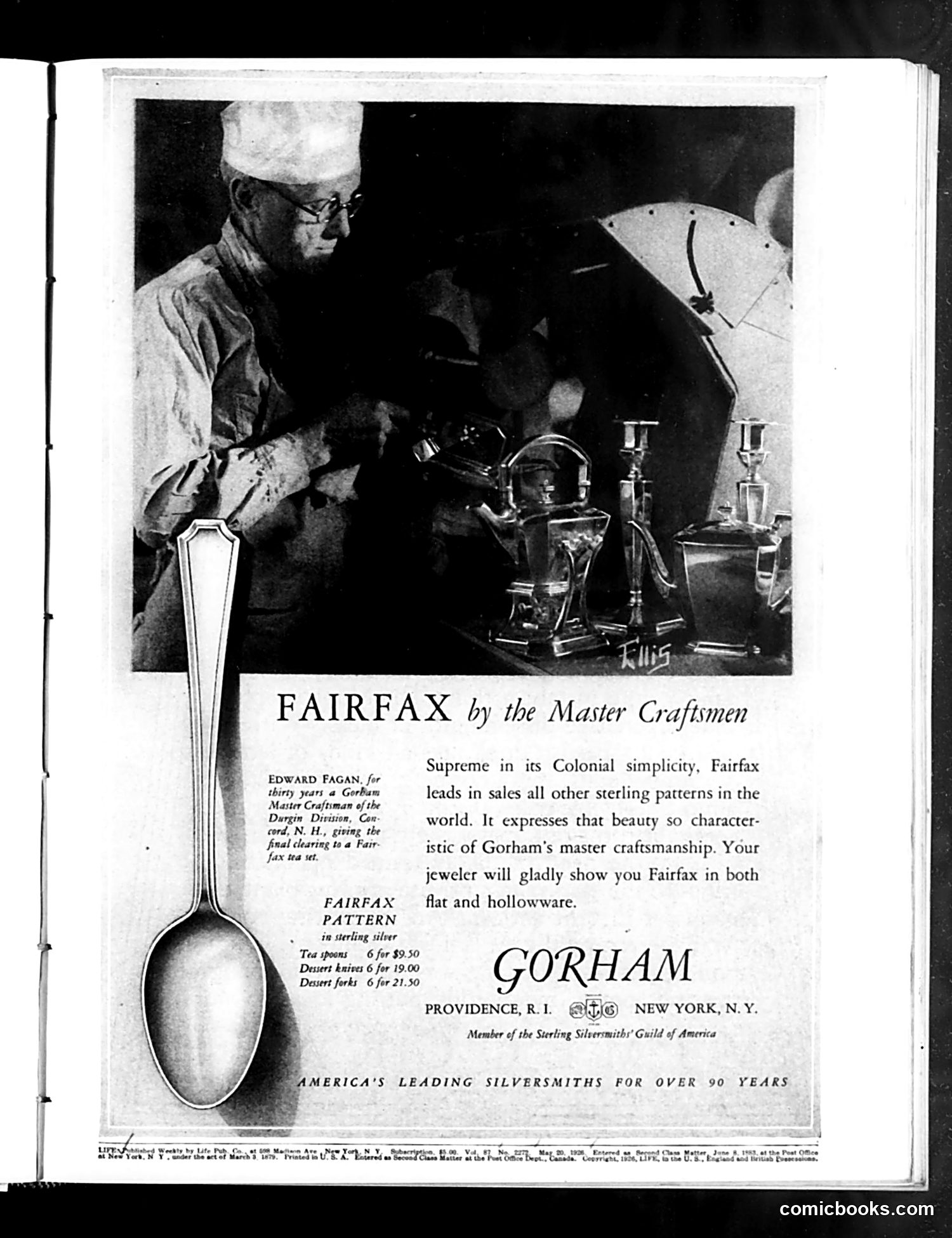
This page is **not a cartoon or satirical content** — it's a straightforward advertisement for Gorham silverware, specifically their "Fairfax" pattern flatware. The image shows an elderly craftsman (identified as Edward Fagan, a Gorham Master Craftsman) examining sterling silver pieces. The ad emphasizes Colonial-inspired design and superior craftsmanship, positioning Fairfax as the leading sterling pattern "in sales all other sterling patterns in the world." The copy appeals to aspiring middle-class consumers by associating the product with master craftsmanship and American heritage. Pricing is listed for tea spoons ($9.50 per six), dessert knives, and forks. This represents vintage brand marketing rather than satire.
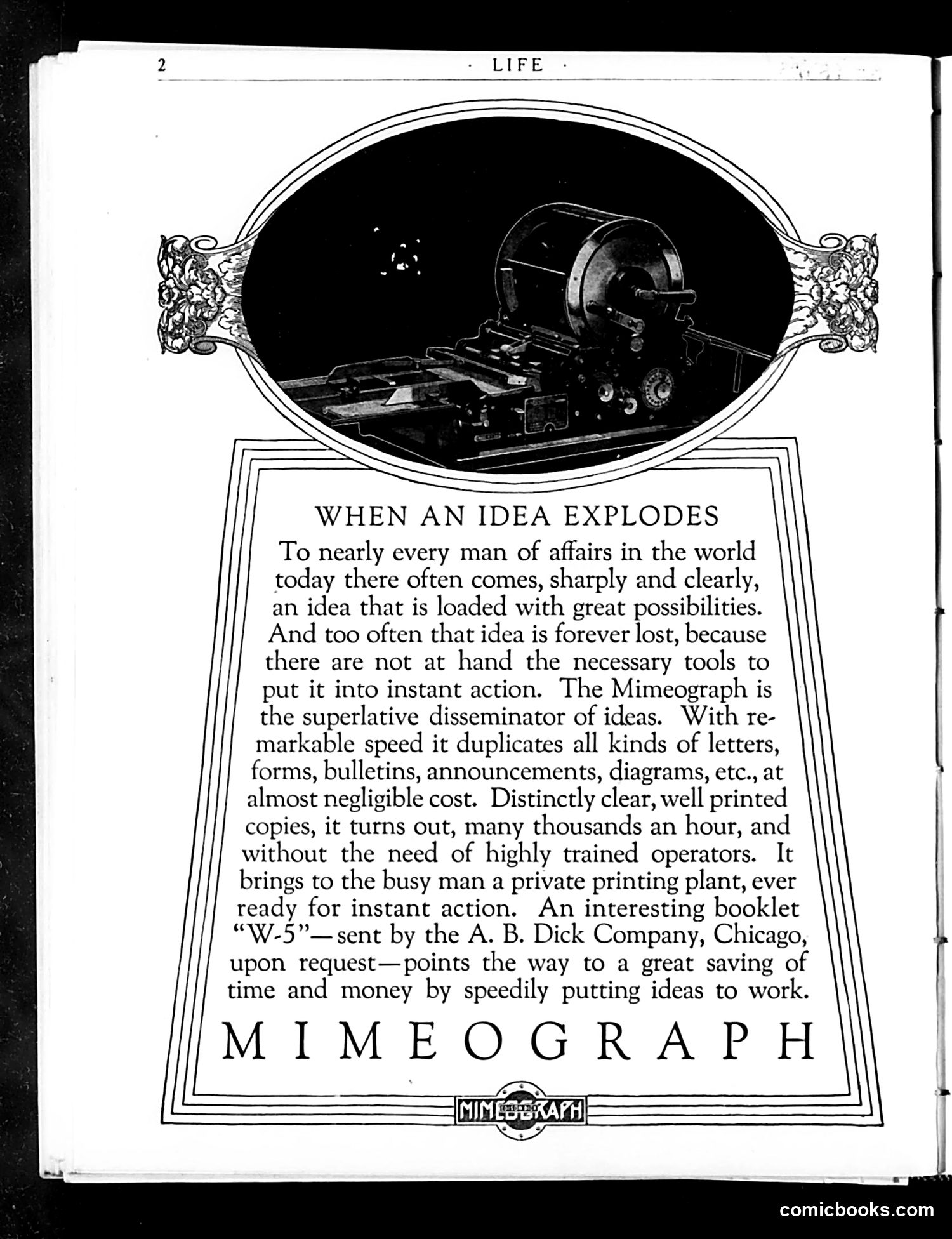
This page is primarily **advertising, not satire or editorial content**. It's a full-page ad for the Mimeograph machine by the A.B. Dick Company of Chicago. The ad uses the headline "WHEN AN IDEA EXPLODES" and features an image of the mimeograph machine itself. The accompanying text argues that good ideas often fail because people lack tools to act on them quickly. The mimeograph, the ad claims, solves this by rapidly duplicating documents—letters, forms, bulletins, diagrams—at minimal cost and without requiring skilled operators. The pitch targets busy businessmen by positioning the mimeograph as a "private printing plant" that enables fast implementation of ideas. A booklet "W-5" is offered upon request. This reflects early-20th-century concerns about efficiency and modern business technology.
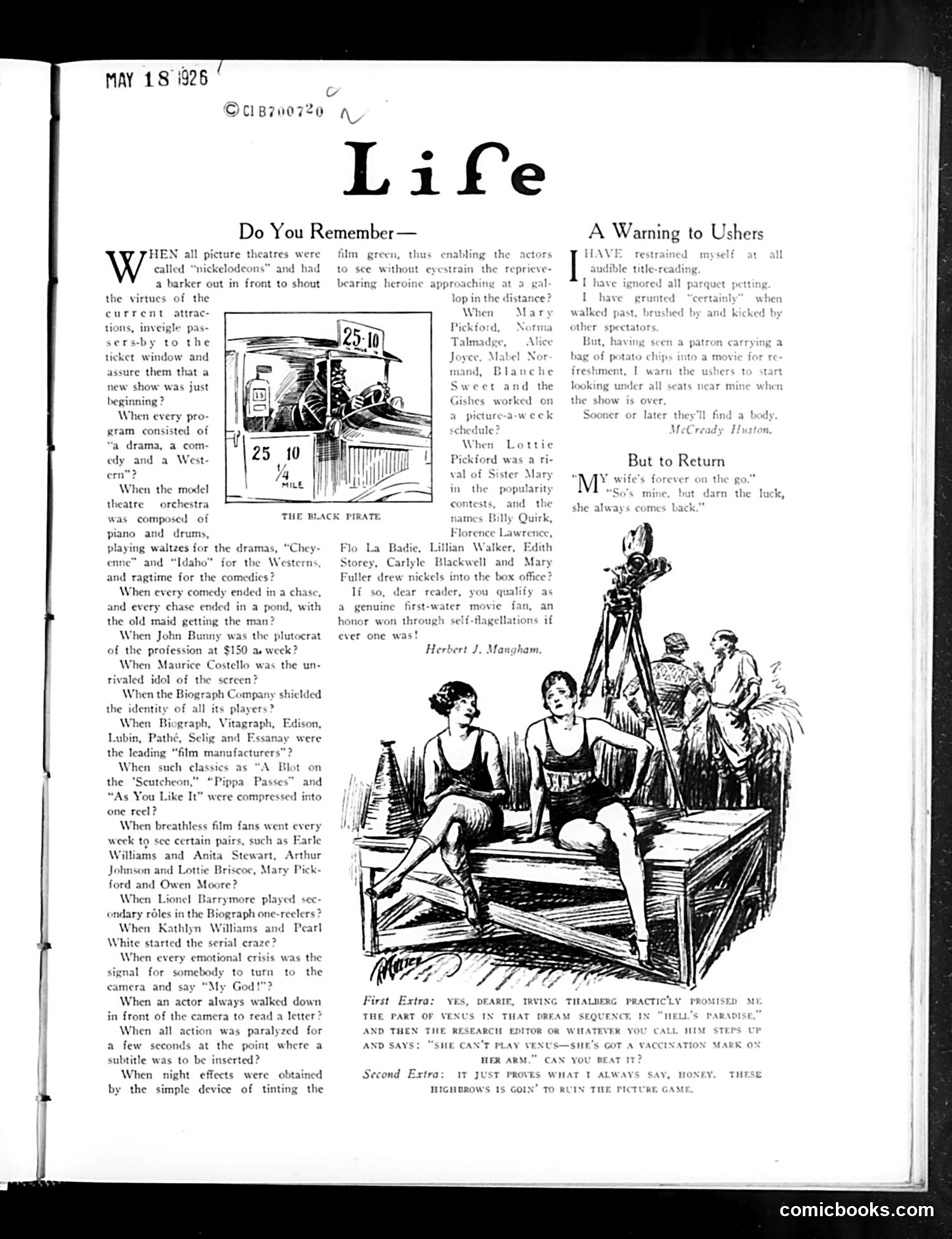
This page contains nostalgic commentary about early cinema ("Do You Remember") and includes a warning to theater ushers about patron behavior. The left column recalls silent film conventions: tinted film stock, orchestral accompaniment, famous early actors (Mary Pickford, Charlie Chaplin, Lillian Gish), and technical innovations like subtitles and night-effect cinematography. The central illustration shows two women on a film set with camera equipment, accompanying dialogue about movie extras and behind-the-scenes practices. "A Warning to Ushers" (right column) humorously addresses theater staff about maintaining decorum—restraining parquet seating, preventing bag-rustling during screenings, and discouraging latecomers from disrupting shows. The two dialogue captions at bottom feature women exchanging witty remarks about film production and romantic plot devices, typical of Life's satirical commentary on contemporary entertainment.
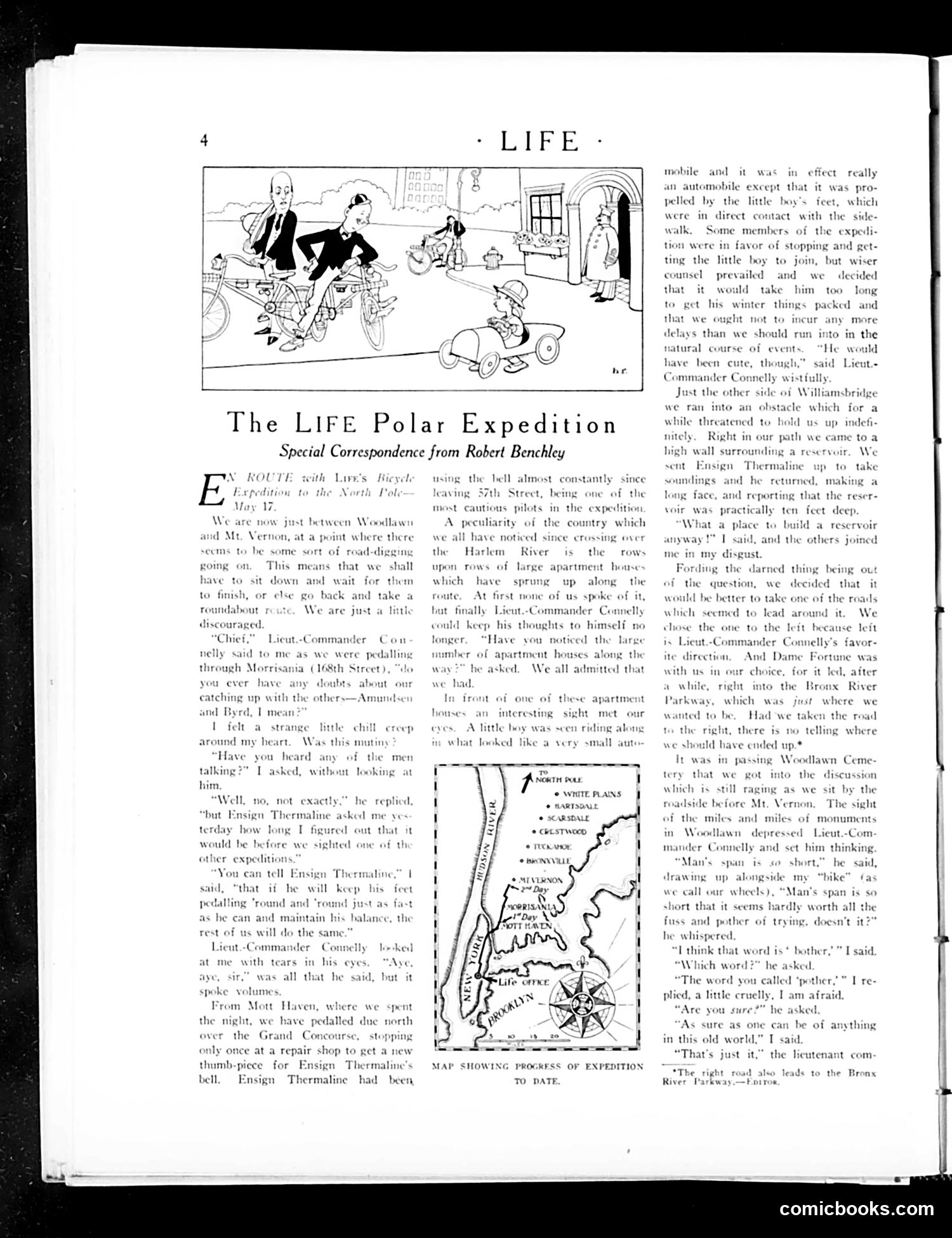
This page features "The LIFE Polar Expedition," a humorous travel narrative by Robert Benchley about a bicycle journey through New York State in May. The cartoon at top depicts expedition members on various bicycles—including what appears to be an adult on a standard bike, children on tricycles, and a boy on a very small vehicle—navigating city streets comically. The satire mocks expedition terminology and adventurous pretense applied to an ordinary suburban bike ride. References to "Ensign Thermalne," "Lieut.-Commander Connelly," and military ranks for casual participants inflate the mundane journey with mock-heroic language. The map shows their modest upstate New York route. The humor lies in treating a simple recreational trip as a serious polar/arctic-style exploration.
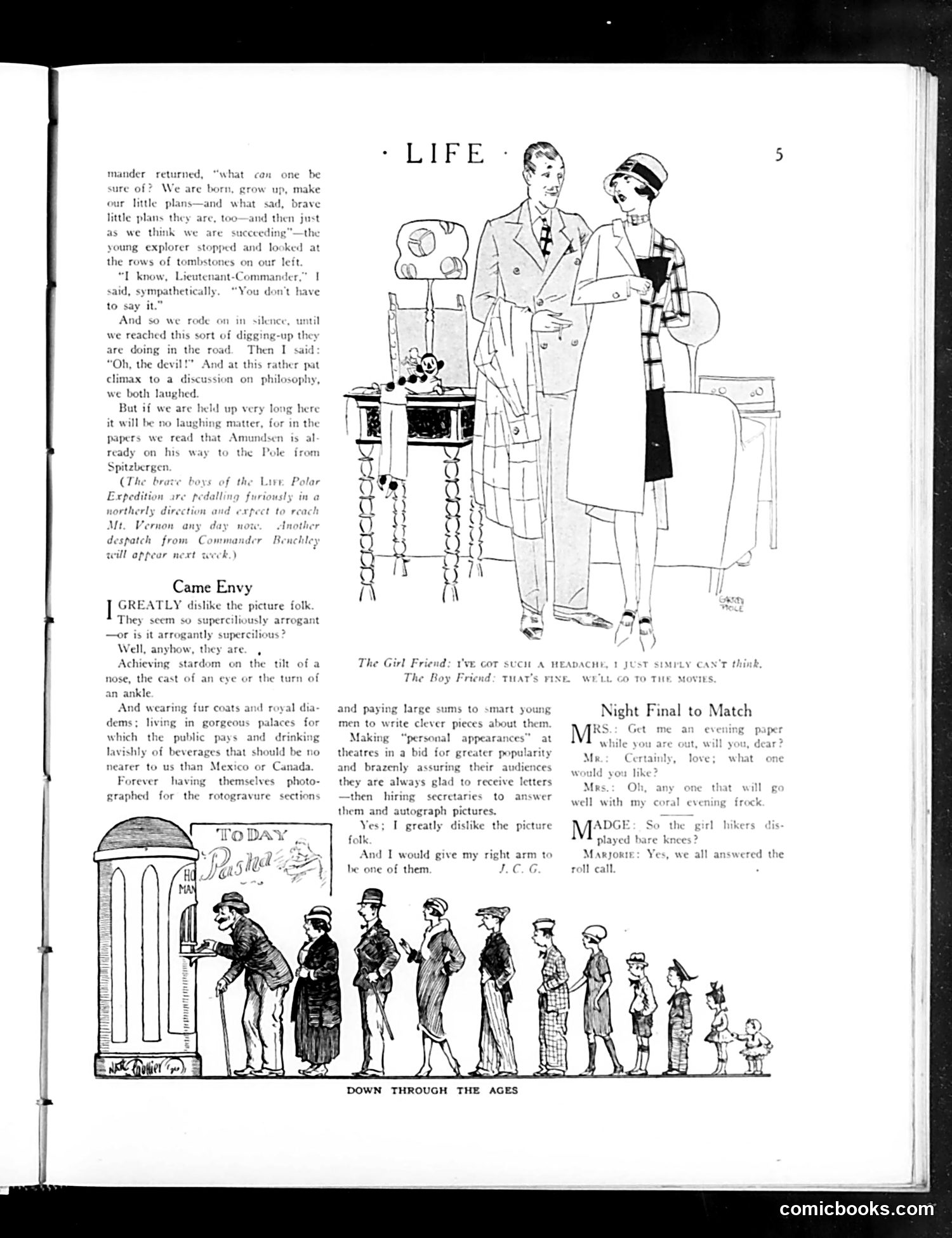
This page from *Life* magazine satirizes two social phenomena: **"Came Envy"** section mocks the aspirational behavior of picture-folk (likely referring to silent film celebrities). The satire targets their perceived arrogance—their ostentatious displays of fur coats, royal diamonds, and expensive automobiles. The critique suggests they're using "personal appearances" at theaters to manipulate audiences and secure fan mail and autograph requests. **"Down Through the Ages"** cartoon illustrates how human vanity persists across history—showing a progression of figures from antiquity to modern times, all apparently seeking attention at what appears to be a public structure or monument. Both pieces target contemporary celebrity culture and human nature's timeless appetite for status and recognition, with particular jabs at the nascent film industry's influence on American social values.
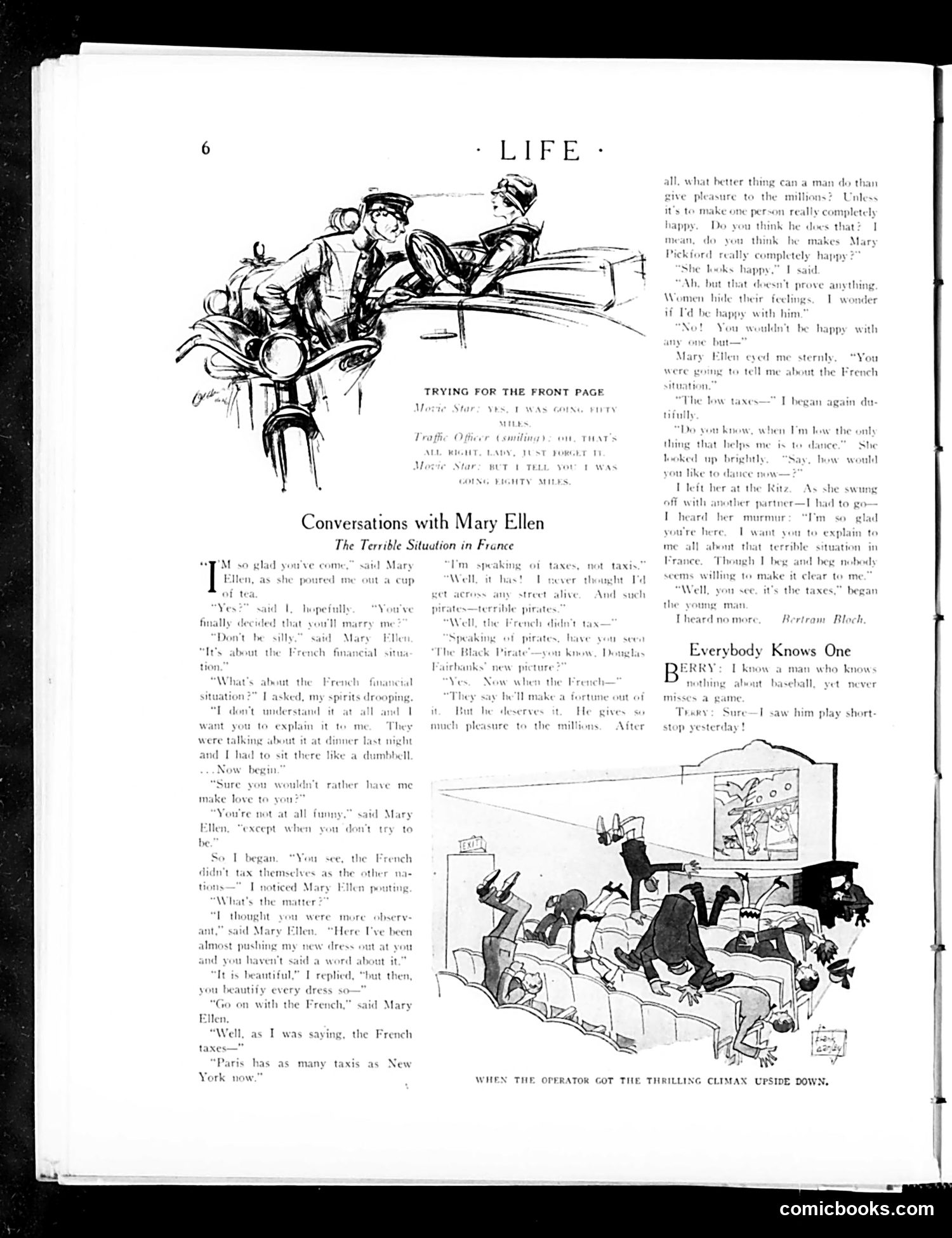
This page contains two distinct pieces: **"Conversations with Mary Ellen"** (left): A dialogue-based humor piece where Mary Ellen discusses French financial problems with the narrator. The joke centers on French taxation being compared to piracy—the French supposedly had "as many taxis as New York now," a pun conflating "taxes" with "taxis" (the vehicle). This satirizes post-WWI French economic struggles and heavy taxation. **"Everybody Knows One"** (right): A cartoon showing people at what appears to be a baseball game or sporting event with chaotic action. The caption references "the operator" getting "the thrilling climax upset down"—likely satirizing someone who ruins an entertainment experience through incompetence or mishap. The humor is situational rather than political. Both pieces use light satire typical of Life magazine's comedic approach to contemporary social observation.
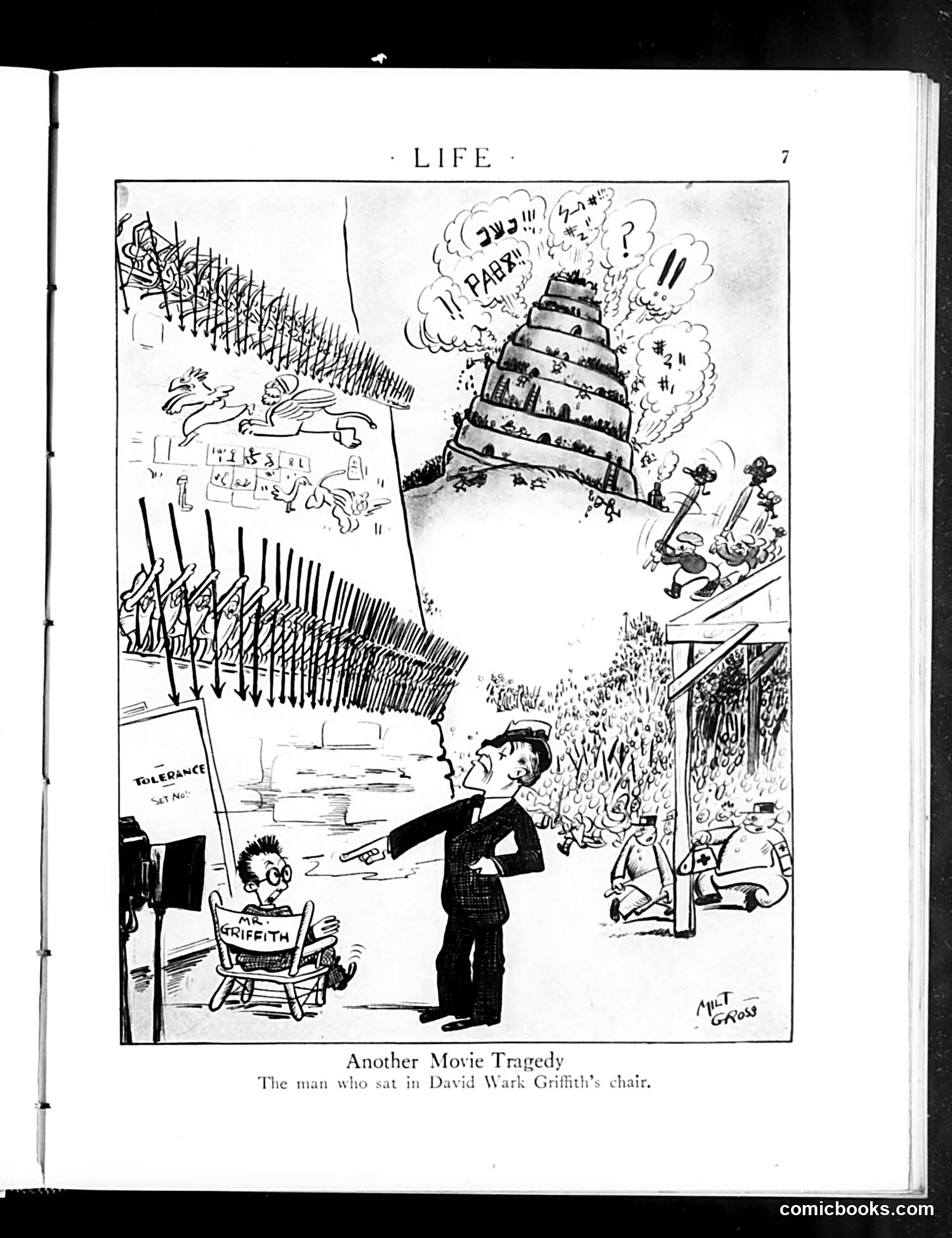
This cartoon satirizes the chaos of early film production. The caption references "The man who sat in David Wark Griffith's chair"—Griffith being a pioneering but notoriously demanding film director. The cartoon depicts a film set in complete disorder: a massive tower structure is collapsing with explosions, crowds of extras scatter in panic, and a well-dressed man (the director or producer) gestures helplessly at the disaster. A child labeled "Griffith" sits in a director's chair, implying incompetent leadership has replaced Griffith's authority. The joke mocks both the extravagant, accident-prone nature of silent-era filmmaking and the notion that someone unqualified has assumed control of a major production—resulting in catastrophic mishaps rather than professional filmmaking.
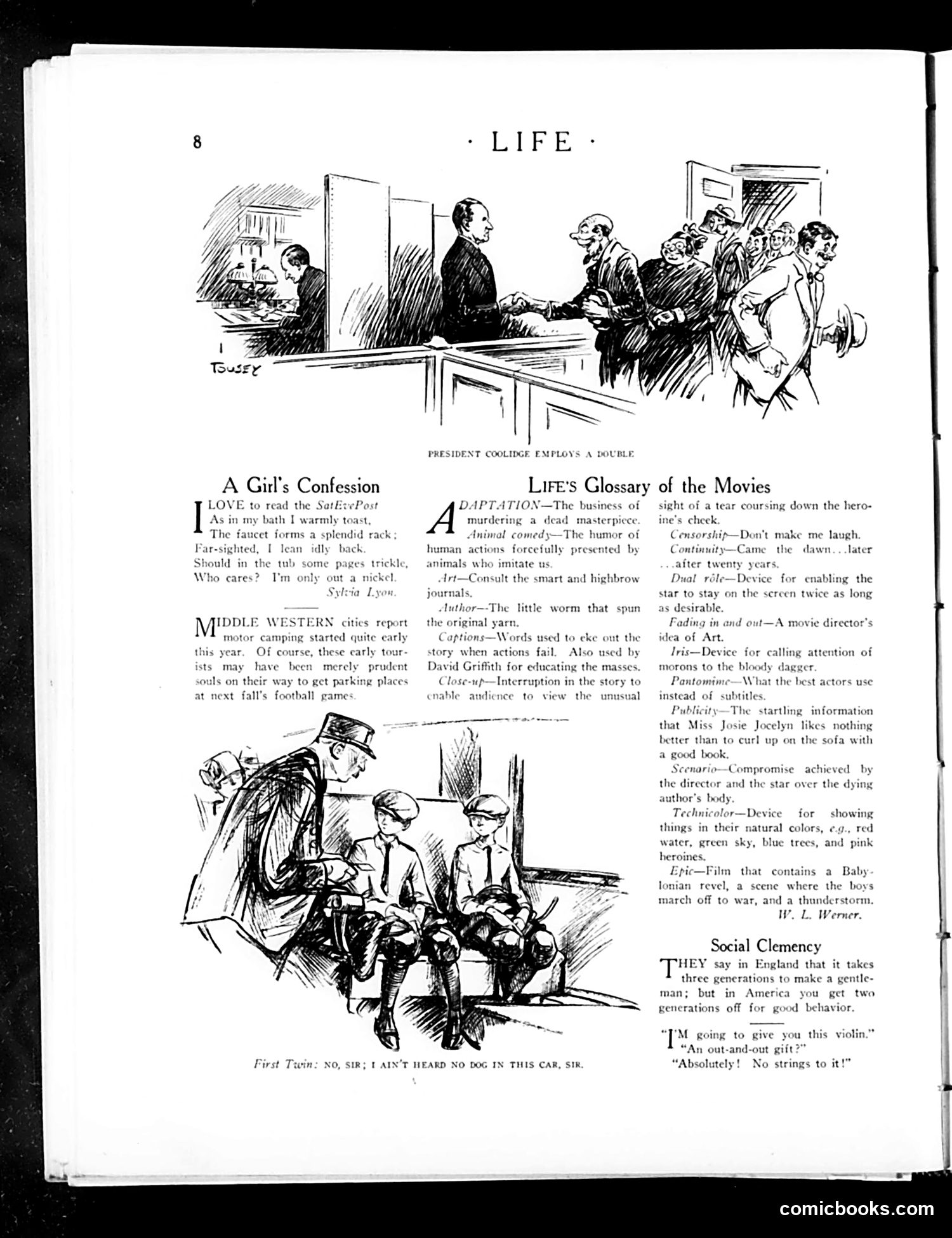
**Top Cartoon:** Labeled "President Coolidge Employs a Double," this sketch shows a man greeting visitors at what appears to be an office or reception area, while another man works at a desk in the background. The joke satirizes President Calvin Coolidge's reputation for being taciturn and withdrawn from public engagement—suggesting he needed a "double" to handle social interactions with visitors while he avoided them. **Bottom Cartoon:** Depicts a well-dressed man with two young boys and a dog in a car. The caption reads "First Twin: No, sir; I ain't heard no dog in this car, sir"—a joke about children's innocent honesty inadvertently contradicting their father's lie to avoid responsibility for the dog. The page also includes a "Girl's Confession" column and "Life's Glossary of the Movies," providing satirical commentary on contemporary entertainment and social mores.
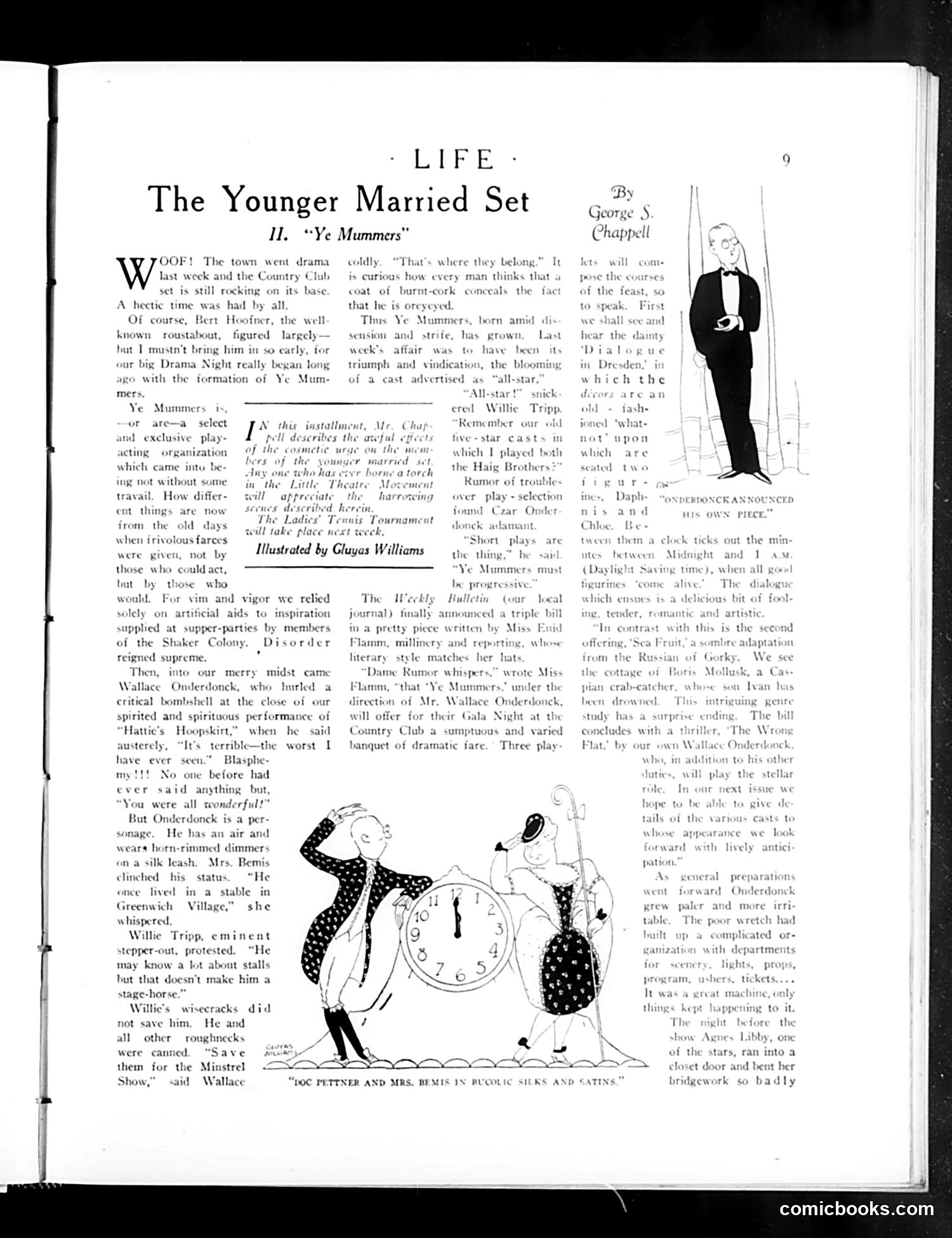
This satirical piece by George S. Chappell mocks fashionable young married couples in New York's theater world. The illustration shows two figures in evening dress manipulating a large clock, captioned "Doc Pittner and Mrs. Bemis in Busick Silks and Satins." The satire targets theatrical pretension and social climbing. References include Wallace Underdonck (mocked for wearing "born-rimmed dimmers on a silk leash") and Willie Tripp, described as an "eminent stepper-out." The piece criticizes their affected mannerisms, absurd social gatherings at country clubs, and self-important theatrical productions. The "Ye Mummers" subtitle directly calls them actors or pretenders—people performing for social status rather than living authentically. The clock manipulation suggests they're wasting time with frivolous pursuits.
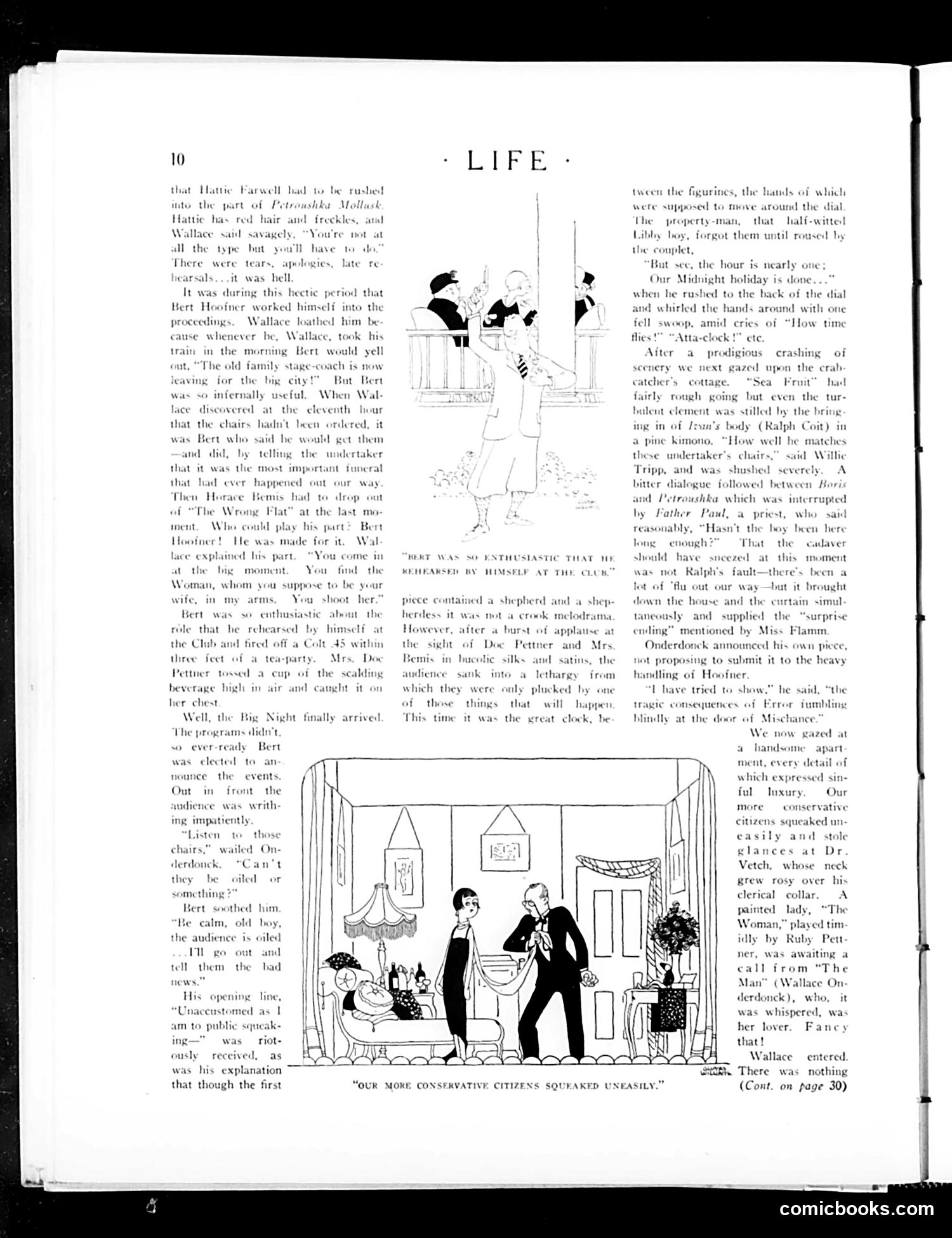
This page contains two illustrations satirizing early 20th-century theatrical and social pretension. The upper cartoon depicts a chaotic scene at what appears to be a theater or social club, with figures in formal dress amid absurdist activity—suggesting mockery of avant-garde or experimental theater. The lower cartoon, captioned "OUR MORE CONSERVATIVE CITIZENS SQUEAKED UNEASILY," shows well-dressed people in an elegant interior reacting with discomfort or disapproval to something. The caption suggests satire of bourgeois sensibilities—conservative citizens are portrayed as easily scandalized or upset by modern social/theatrical developments. The accompanying text discusses theater productions, performers named Bert Hoofine and Wallace, and satirizes both theatrical pretension and audience reactions to experimental entertainment, typical of Life magazine's social commentary on American cultural anxieties of its era.
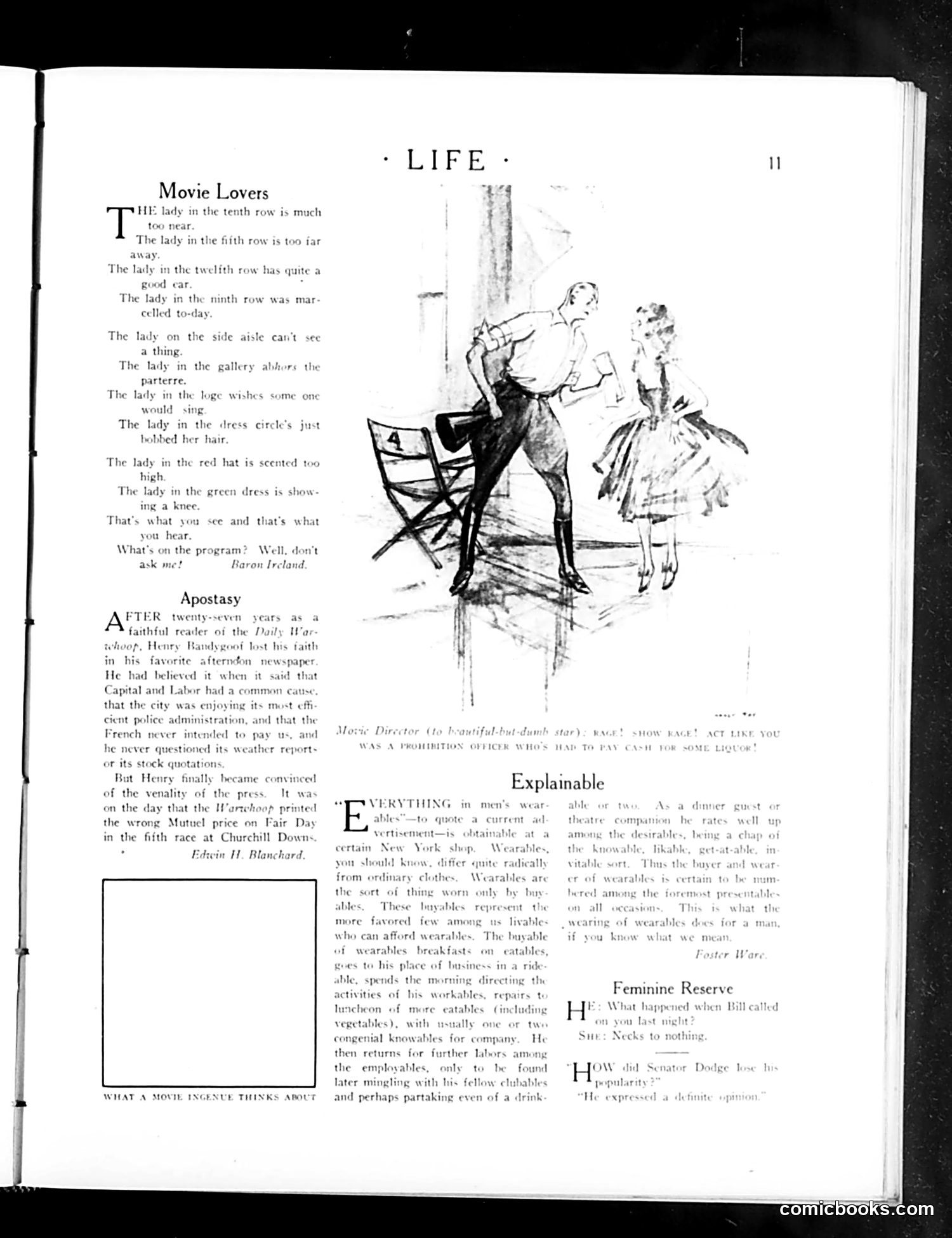
This page contains three distinct pieces of satire about 1920s social life: **"Movie Lovers"** (poem by Baron Ireland): Satirizes cinema etiquette by cataloging annoying moviegoers—those sitting too near, too far, or in poor positions; the woman with a rustling dress, the noisy eater, the perfumed woman. The joke targets shared frustrations of theater attendance. **"Apostasy"** (Edwin H. Blanchard): Mocks a newspaper editor's reversal of political beliefs after becoming convinced of the press's power, specifically regarding stock prices and financial reporting. **"Examinable"** and **"Feminine Reserve"**: Brief humorous exchanges about "wearables" (clothing) and romantic disappointments. The illustrated cartoon depicts a movie theater scene, reinforcing the "Movie Lovers" theme with a sketch of audience members in period dress and seating positions.
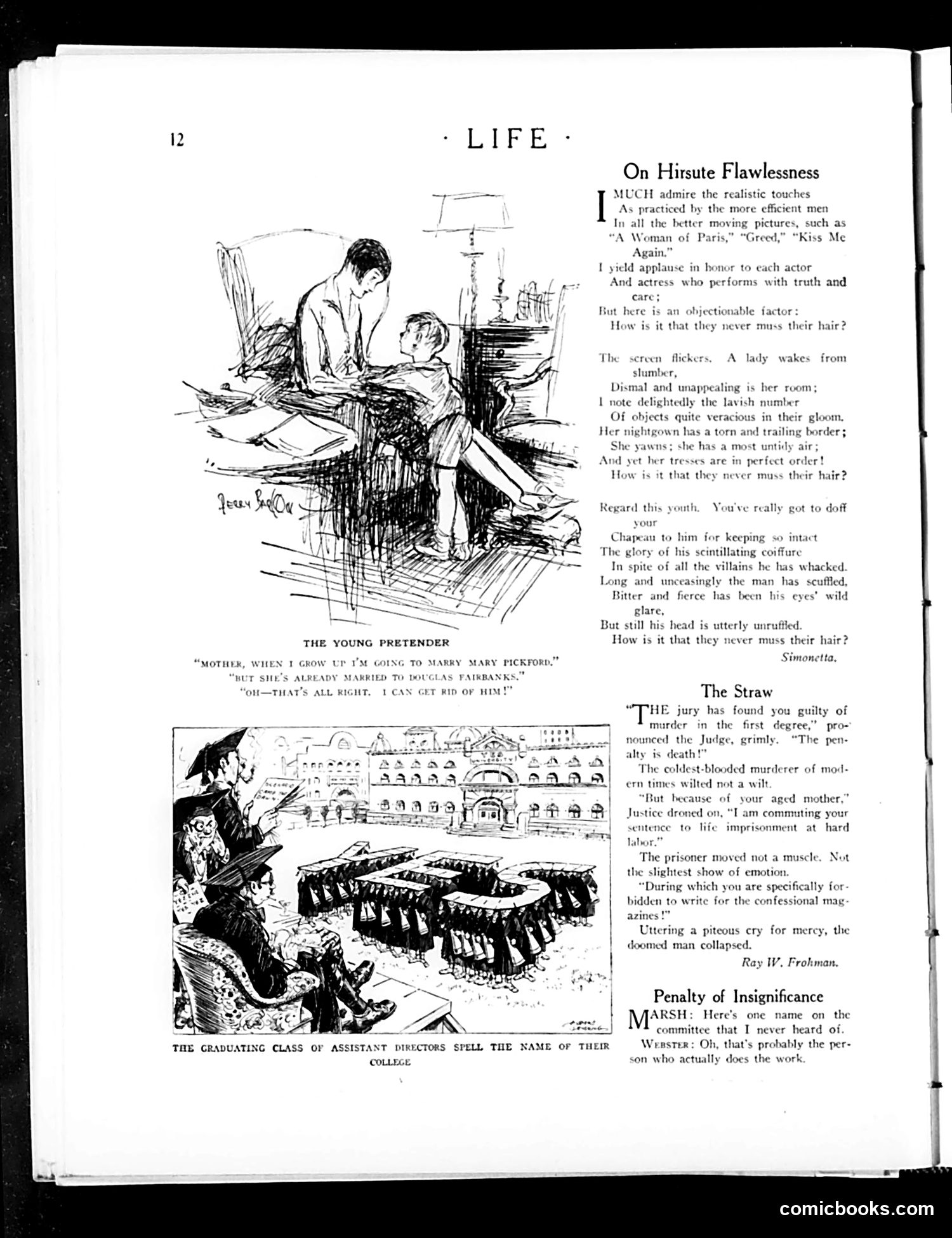
This page contains three satirical pieces about entertainment and society: **"On Hirsute Flawlessness"** critiques Hollywood's unrealistic standards, specifically mocking actors who never appear with disheveled hair despite their characters' supposed circumstances. The poem questions how screen performers maintain perfect grooming even in dramatic scenes. **"The Young Pretender"** cartoon depicts a mother boasting about her son marrying into wealth (Mary Pickford/Douglas Fairbanks), revealing social climbing ambitions among the middle class. **"The Straw"** and **"Penalty of Insignificance"** appear to be brief satirical dialogues about crime/justice and committee work, mocking bureaucratic absurdity and people who perform tasks without recognition. The overall theme critiques Hollywood vanity, social pretension, and institutional indifference—typical Life magazine satire of early 20th-century American society.
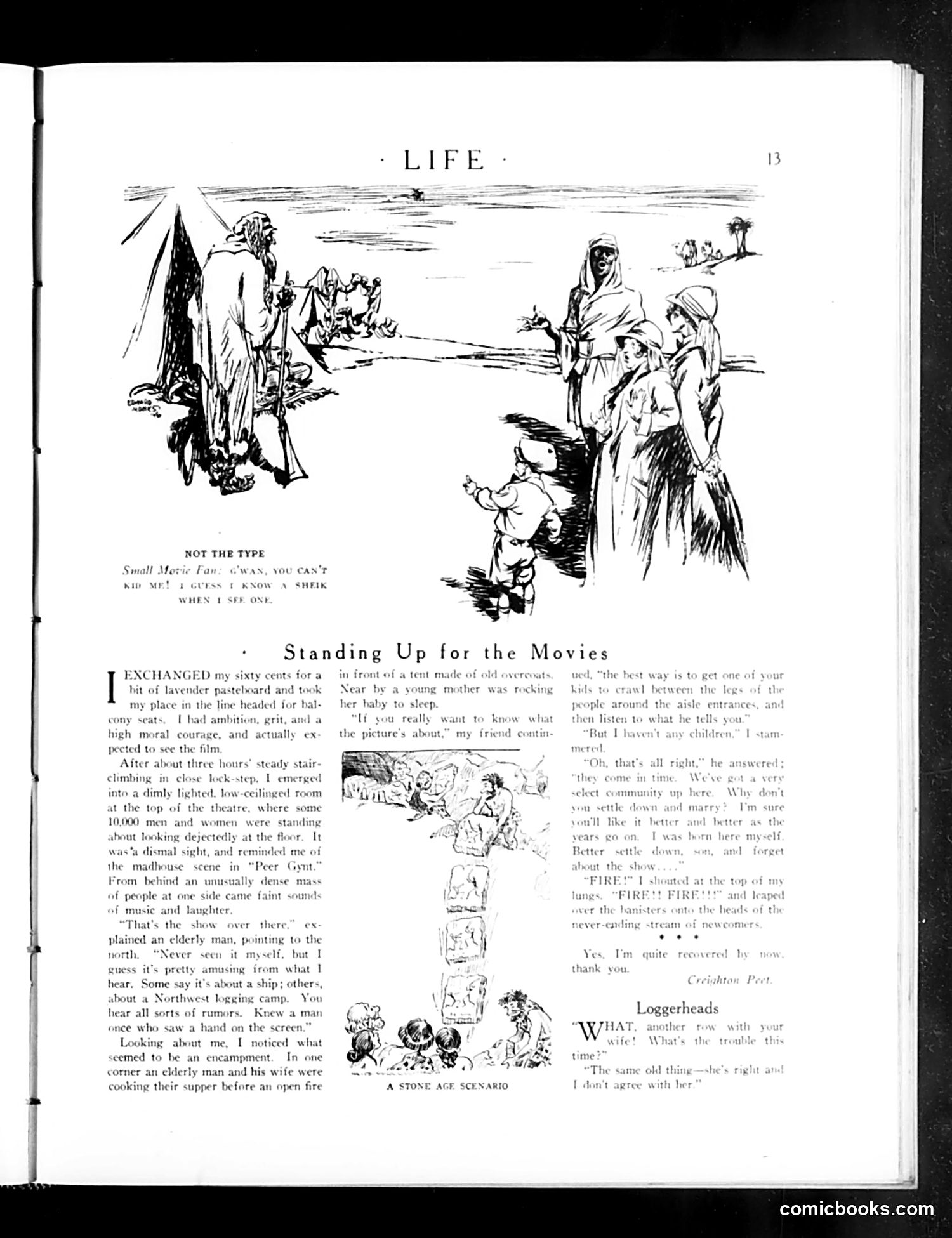
This page contains two cartoon sections: **"Not the Type"** (top): A brief joke about a woman telling a male acquaintance she can't kiss him when she sees a sheik, implying she reserves romantic behavior for glamorous figures. This references the "Sheik" craze of the 1920s—the popularity of Rudolph Valentino's exotic film roles. **"Standing Up for the Movies"** (main article): The author describes attending a crowded movie theater and encountering "a dimly lighted, two-coloneled room" packed with 10,000 people. A woman's moral objections to cinema are countered by the author's defense of movies as harmless entertainment. The accompanying cartoons illustrate chaotic theater scenes. **"Loggerheads"** (bottom): A brief domestic humor joke about marital disagreement. The page satirizes both movie-theater culture and contemporary attitudes toward cinema as entertainment.
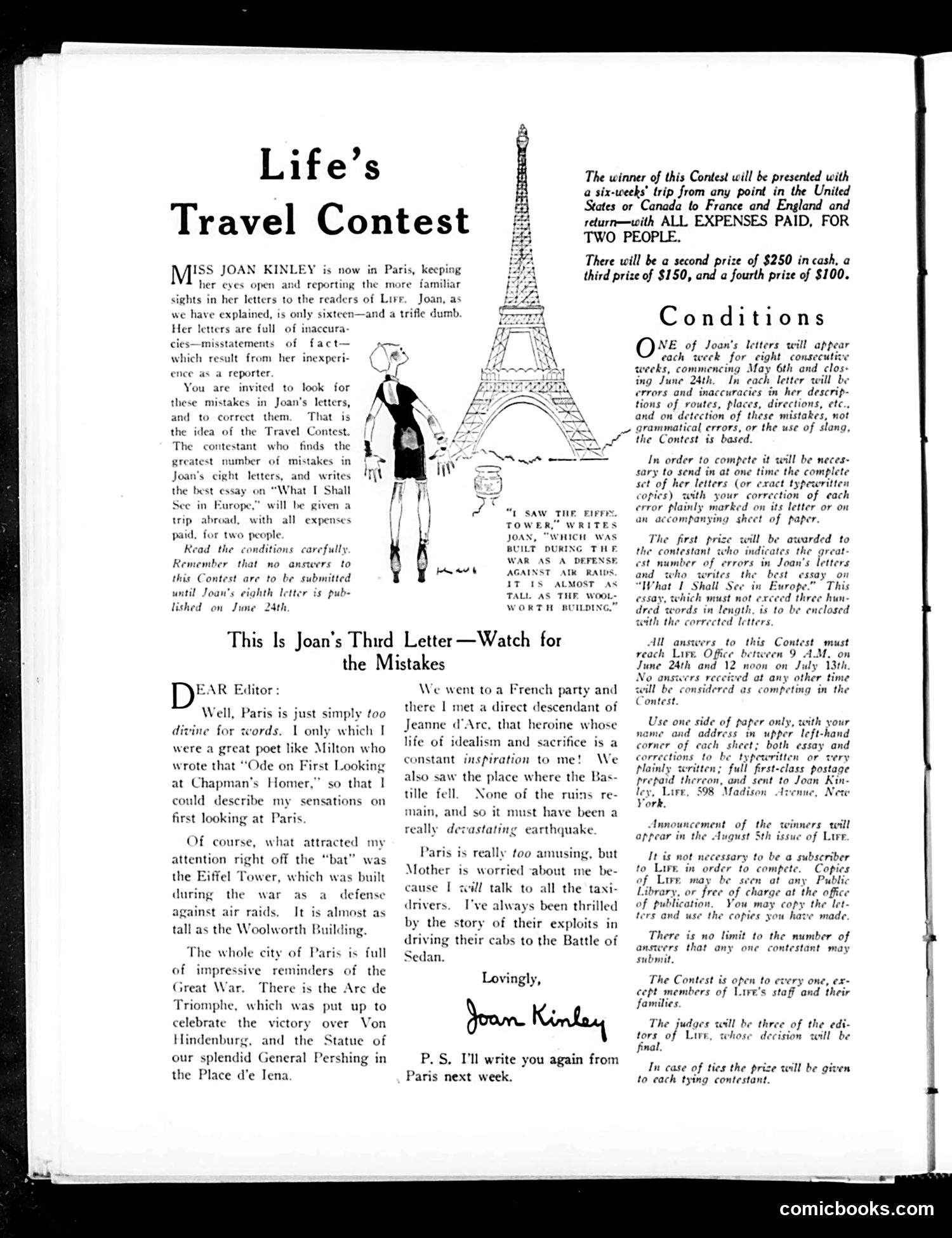
This page announces a satirical contest where readers hunt for deliberate errors in letters written by Joan Kinley, a Life reporter stationed in Paris. The contest plays on the common experience of inaccurate travel journalism—the page explicitly states Joan's letters contain "inaccuracies—misstatements of fact" resulting from her inexperience as a reporter. The cartoon shows Joan gesturing at the Eiffel Tower, establishing the Paris setting. Readers compete by finding and documenting errors in her descriptions of Parisian landmarks and experiences. The winner receives an all-expenses-paid trip for two to France and England. This format cleverly satirizes both amateur travel writing and the period's travel culture, inviting readers to become editors while entertaining them with intentional mistakes.
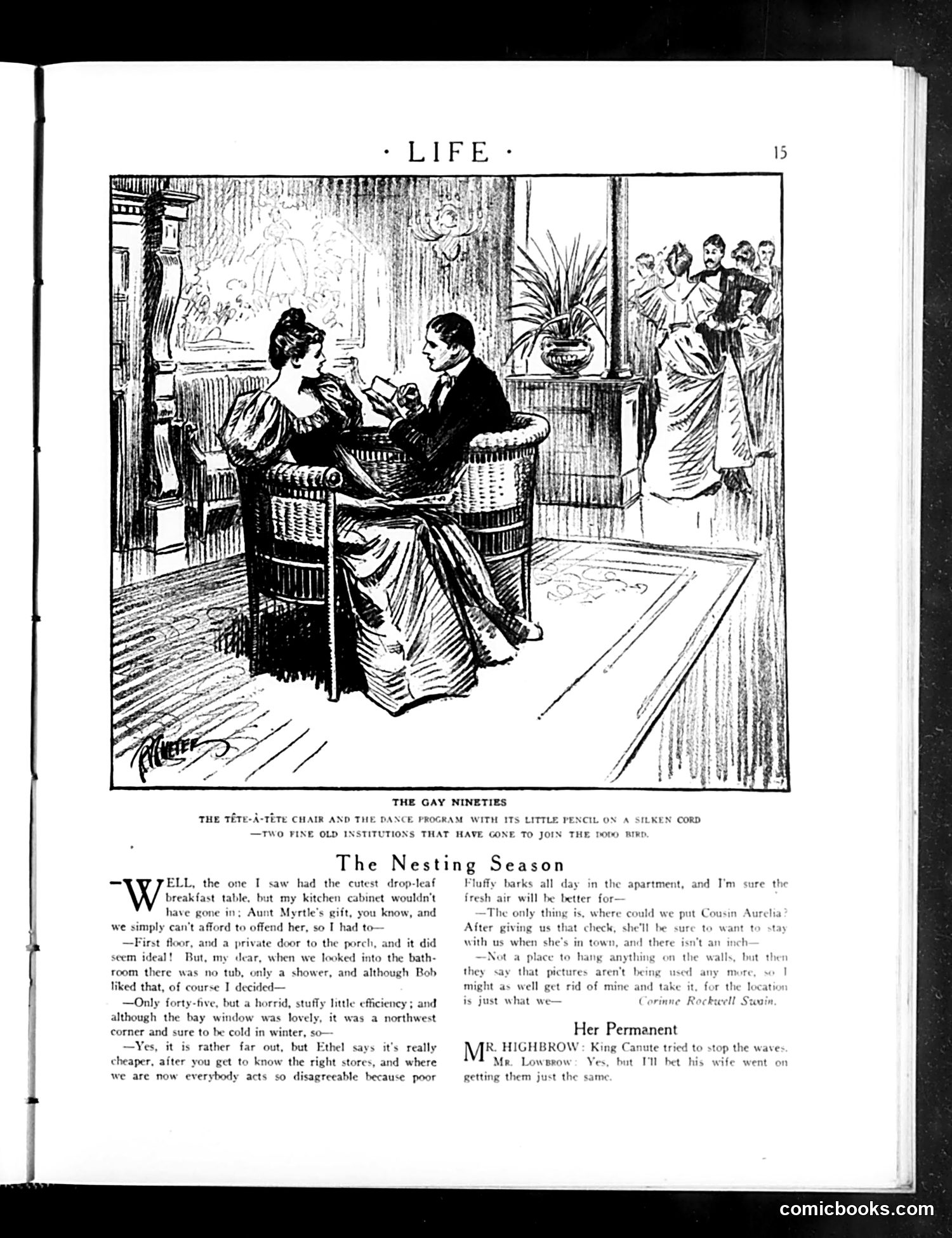
This page from *Life* magazine features a satirical cartoon titled "The Gay Nineties" depicting a couple in an intimate domestic moment—a man offering a woman a chair by a window. The caption references "the tête-à-tête chair and the dance program with its little pencil on a silken cord—two fine old institutions that have gone to join the dodo bird." The satire targets the loss of Victorian courtship rituals and social conventions. The accompanying text, "The Nesting Season" and "Her Permanent," humorously discusses modern couples choosing practical apartment living and economic considerations over romantic tradition. The cartoon mocks how contemporary (1890s-era) life has abandoned elaborate social formalities—specifically the intimate two-person chair and dance card customs—replacing them with mundane domestic reality, reflecting anxieties about modernization and changing social values.
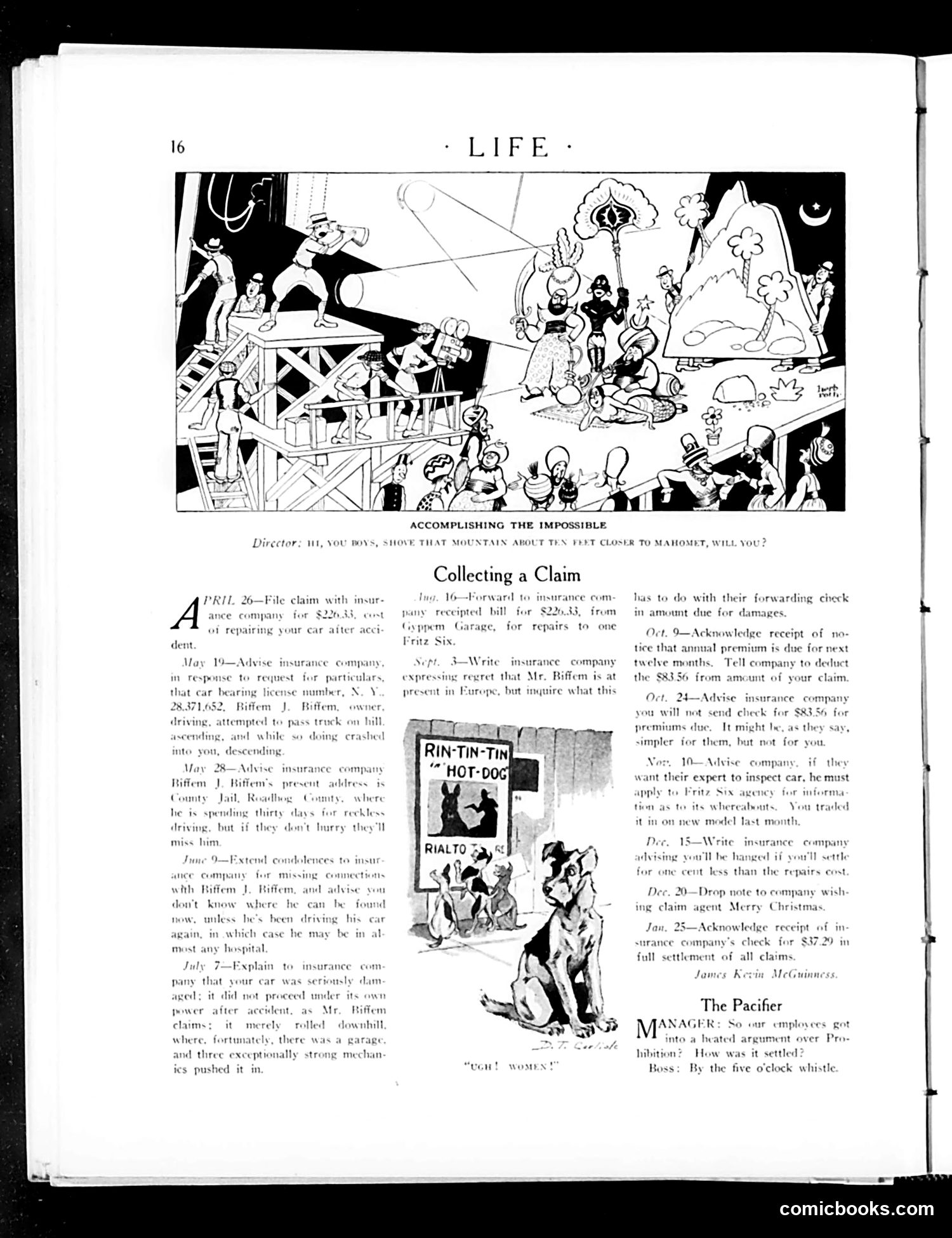
This page satirizes the insurance claims process through a series of humorous scenarios involving a Mr. Biffem and his damaged automobile. The top cartoon depicts an elaborate circus or theatrical scene, captioned "Accomplishing the Impossible," with a director requesting someone move a mountain closer to Mahomet. The text below presents a month-by-month chronicle of Biffem's frustrating attempts to collect insurance for car repairs. Each entry documents bureaucratic delays and contradictions—insurance companies requesting information, losing documents, disputing claim amounts, and offering partial settlements. The satire targets the inefficiency and evasiveness of early 20th-century insurance companies. The cartoons and anecdotes suggest that collecting a legitimate claim is as difficult as performing impossible feats. The accompanying advertisements for Tin-Tin Hot Dog and Rialto emphasize consumer goods amidst these frustrations, reflecting period advertising practices.
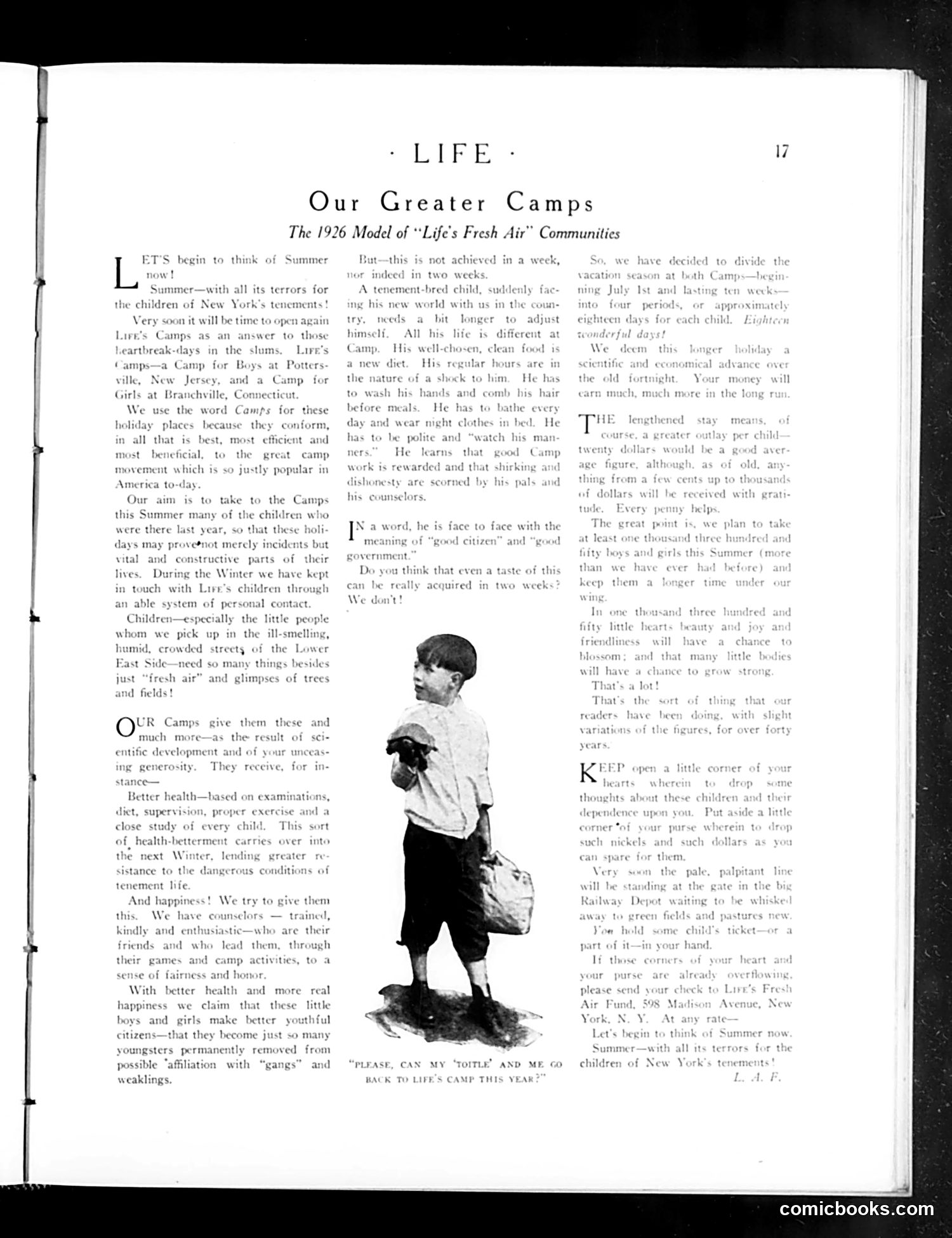
This is an advocacy piece, not satire. Life magazine promotes its "Fresh Air" summer camp initiative for poor children from New York City tenements. The accompanying illustration shows a thin, underfed boy carrying a suitcase—a sympathetic image meant to represent the target beneficiary: impoverished urban children needing health and moral improvement. The text argues camps provide essential benefits: better nutrition, exercise, hygiene training, and character development. The article emphasizes that even two weeks away from crowded, unsanitary city conditions could transform sickly children into "better citizens" and protect them from "gangs and weaklings." This reflects Progressive Era ideology: upper-class paternalism toward the poor, faith in environment-based reform, and anxiety about urban immigrant populations. The call to readers to donate reflects Life's genuine philanthropic mission alongside its satirical content.
This page discusses the British coal miners' general strike (involving 4.5 million workers) and its political implications. The editors debate whether the strike represents economic justice or revolutionary threat, with references to how Prime Minister MacDonald and opposition leader Baldwin each view the situation. The key comparison is to Italy, where labor unrest was violently suppressed by Mussolini's Fascists using "black shirts and castor oil" (a brutal humiliation tactic). The editors warn that while Britain should address miners' legitimate grievances through buying the mines, permanent solutions cannot come "at the cost of free speech." The implicit warning: ignore workers' real suffering and you risk inviting fascism. A separate item notes John Adams Abbott's exoneration from charges of disrespecting Mussolini while serving as a tour guide in Italy—illustrating American tensions with fascist regimes.
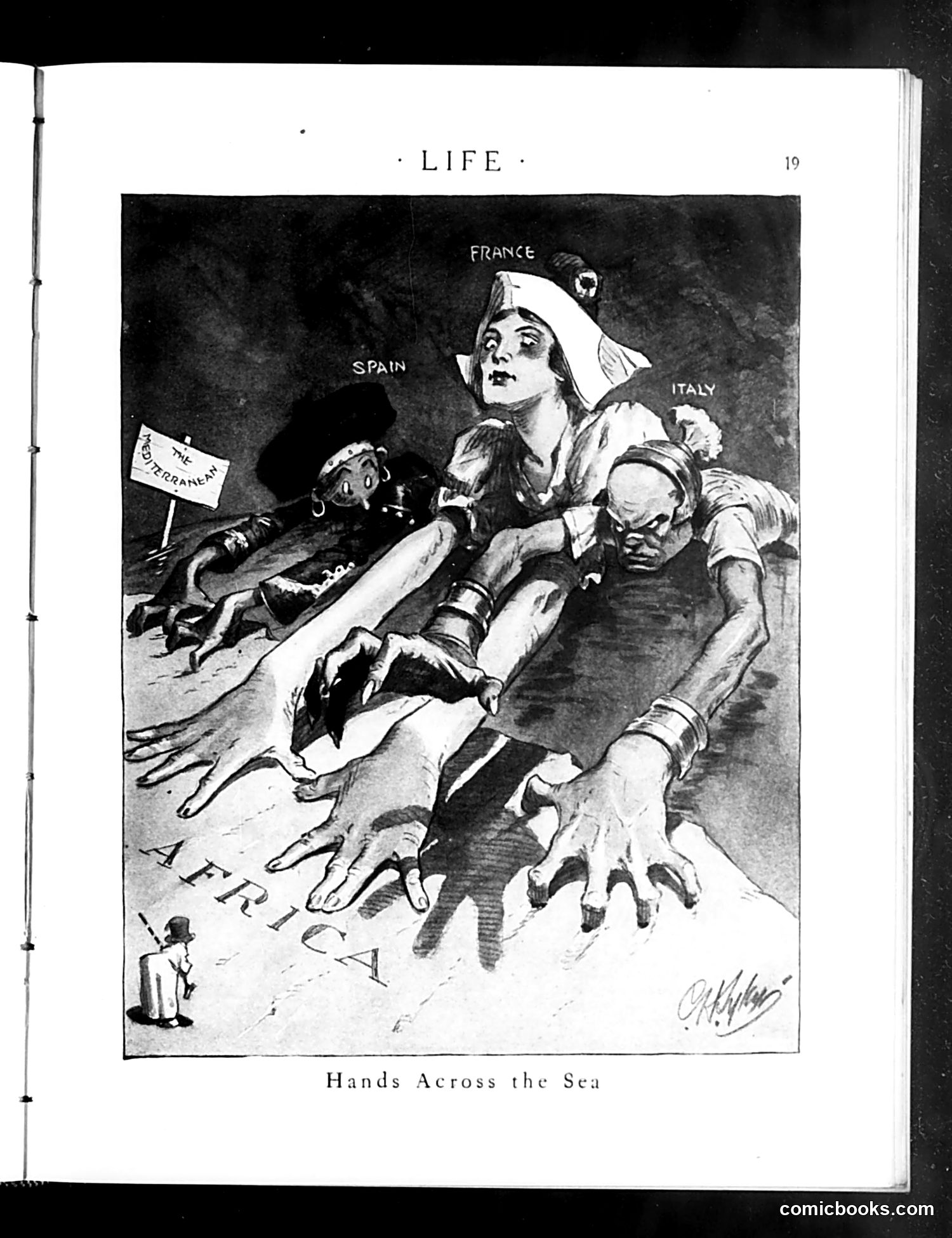
This political cartoon depicts a French nurse figure (labeled "France") reaching across the Mediterranean to assist two wounded or suffering figures labeled "Spain" and "Italy." A small figure in the lower left appears to observe the scene. The cartoon likely references early 20th-century Mediterranean geopolitics, possibly depicting France's diplomatic or humanitarian role toward its neighbors. The "Mediterranean" label and the nurse imagery suggest either a conflict situation or health/stability crisis affecting Spain and Italy that France is responding to. The artist's signature appears in the lower right. Without knowing the specific publication date, the precise historical event referenced remains unclear, though the composition emphasizes France's positioning as a caretaker or supporter of its southern neighbors.
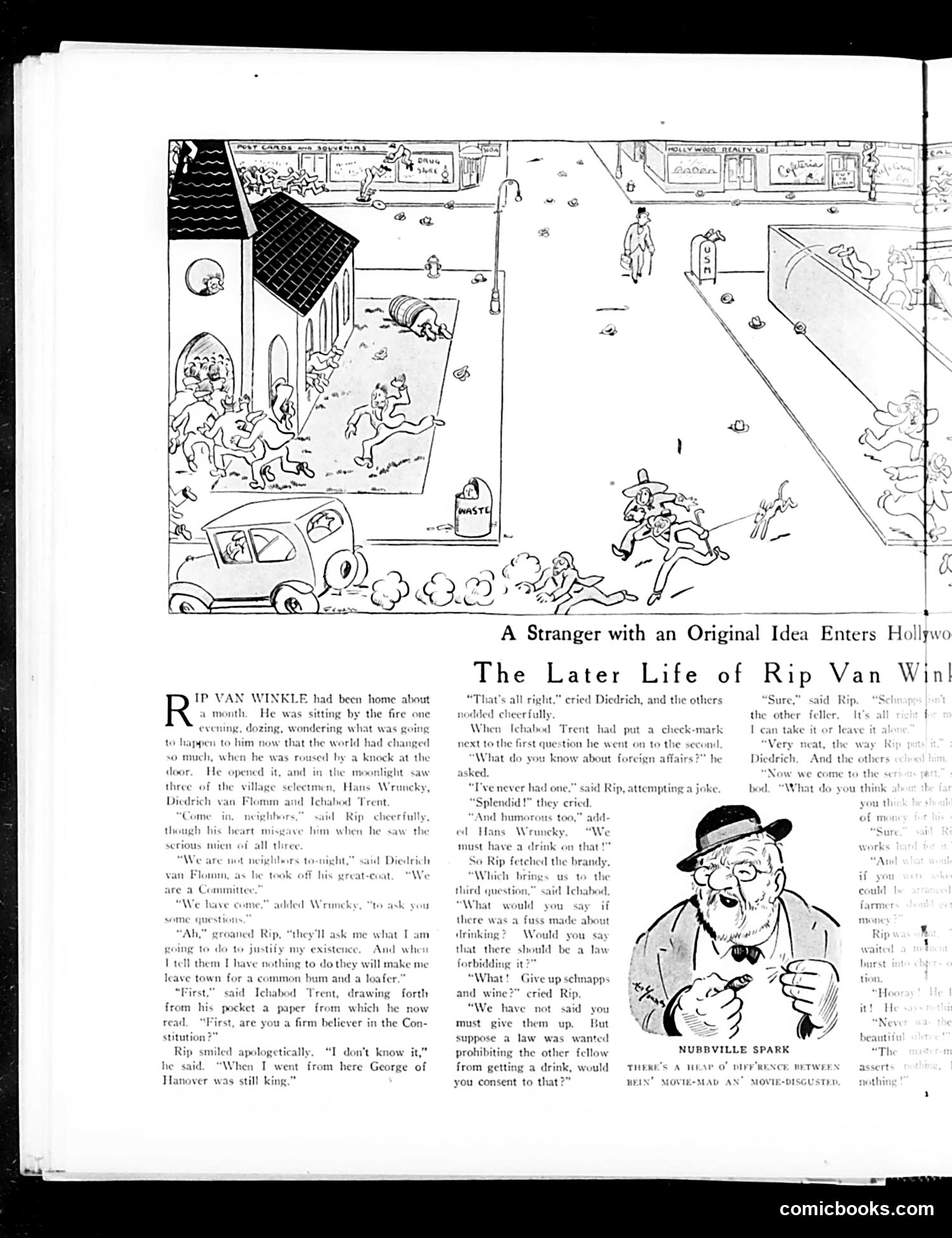
This satirical story uses the classic American tale of Rip Van Winkle—a man who slept through major historical changes—to mock Prohibition-era politics and hypocrisy. The plot: Three village selectmen interrogate Rip about his political beliefs and personal habits, culminating in a trap question about alcohol. They propose a hypothetical law prohibiting others from drinking while implying they themselves would continue. Rip refuses to consent to such selective prohibition. **The satire targets:** - Government officials' moral inconsistency during Prohibition (1920-1933) - The absurdity of laws applying differently to different people - Political questioning disguised as civic concern The "Rip Van Winkle" framing suggests these small-town leaders represent outdated, hypocritical attitudes—similar to how Rip slept through irrelevant changes. The cartoon on the page depicts chaotic small-town life, visually reinforcing the satire's critique of provincial American governance and selective law enforcement.
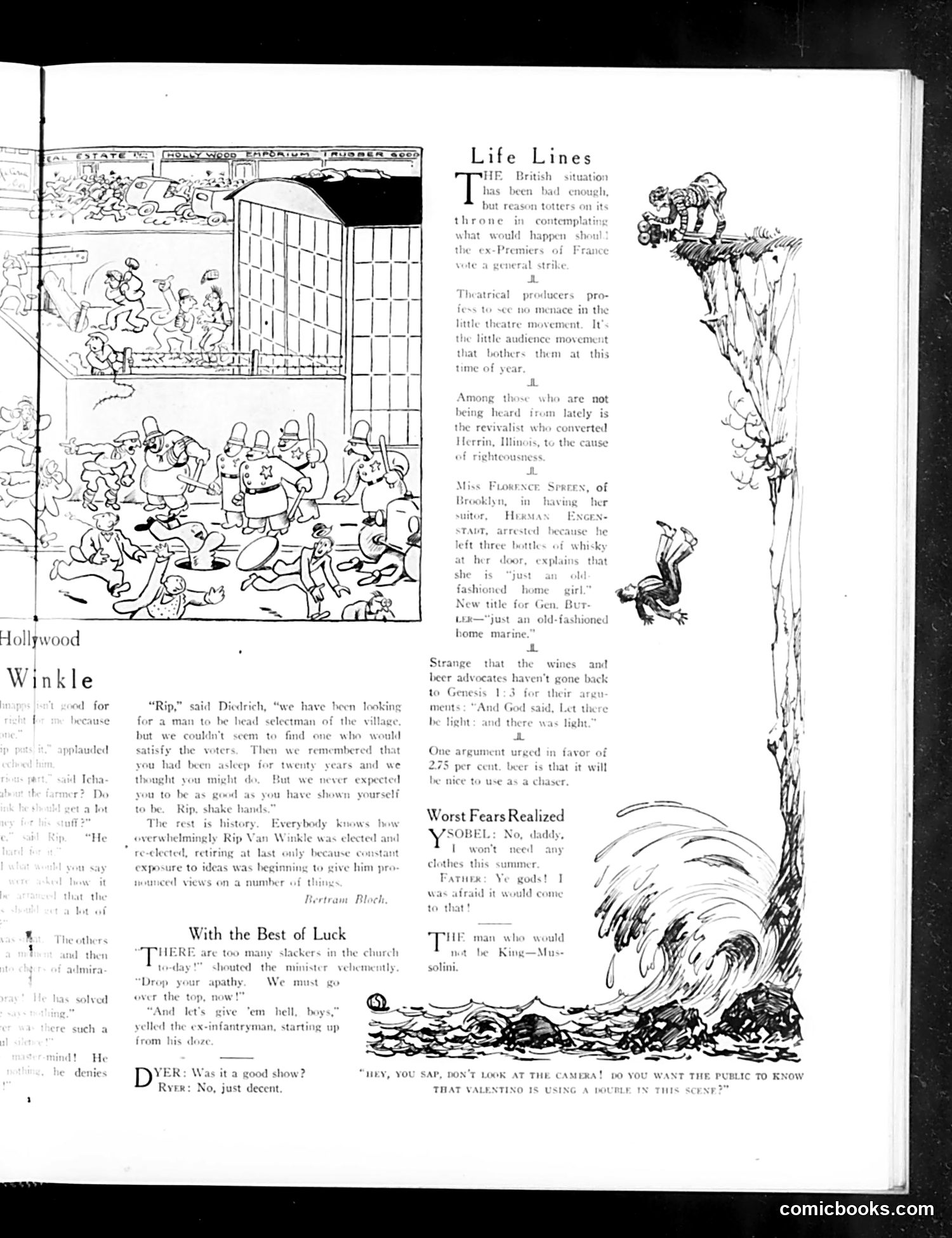
This page from *Life* magazine contains several satirical pieces mocking contemporary figures and social anxieties: **"Hollywood Winkle"** (top left): A cartoon about Rip Van Winkle awakening after twenty years, now considered for village leadership. The satire targets unqualified candidates gaining prominence—likely referencing real political figures of the era. **"Life Lines"** (right column): Social commentary on British politics, theatrical producers worried about audiences, and mentions of "ex-Premiers of France" voting on a general strike—referencing post-WWI European political instability. **"Worst Fears Realized"**: A father fears his son won't need clothes (implying social collapse or indecency becoming normalized). **"With the Best of Luck"**: Church dialogue mocking apathy and calls for aggressive action ("give 'em hell"). **Bottom caption**: A meta-joke about Valentino (silent film star Rudolph Valentino) using a double in a scene—satirizing Hollywood's deceptive practices. The page reflects post-WWI anxieties about social disorder, political incompetence, and Hollywood's questionable ethics.
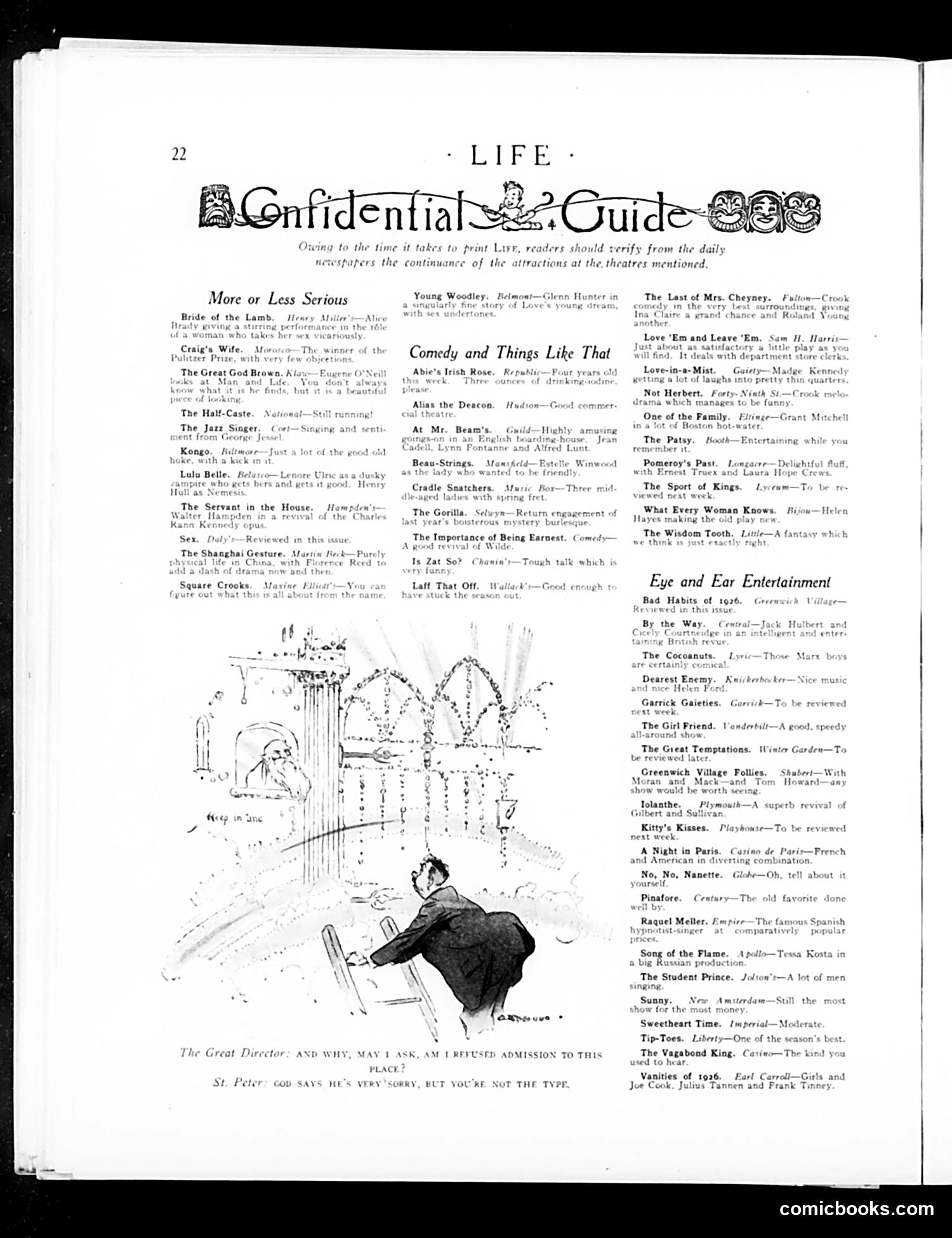
This cartoon satirizes theatrical gatekeeping and artistic pretension in 1920s Broadway. A man is being denied entry to a theater by its director, who dismisses him with "you're not the type." The joke targets the exclusionary attitudes of theater impresarios who controlled access to performances based on subjective judgments about who "belonged" in their venues. The rejected patron appears ordinary—suggesting the satire critiques how directors arbitrarily excluded average theatergoers while catering to fashionable, elite audiences. The cartoon reflects broader 1920s tensions between "high" artistic culture and popular entertainment. Broadway was consolidating around commercially successful shows (listed above) while maintaining social hierarchies about who deserved admission. The humor derives from the absurdity of such gatekeeping: a theater supposedly serving the public being run like an exclusive club by a pretentious director wielding arbitrary power over admission.
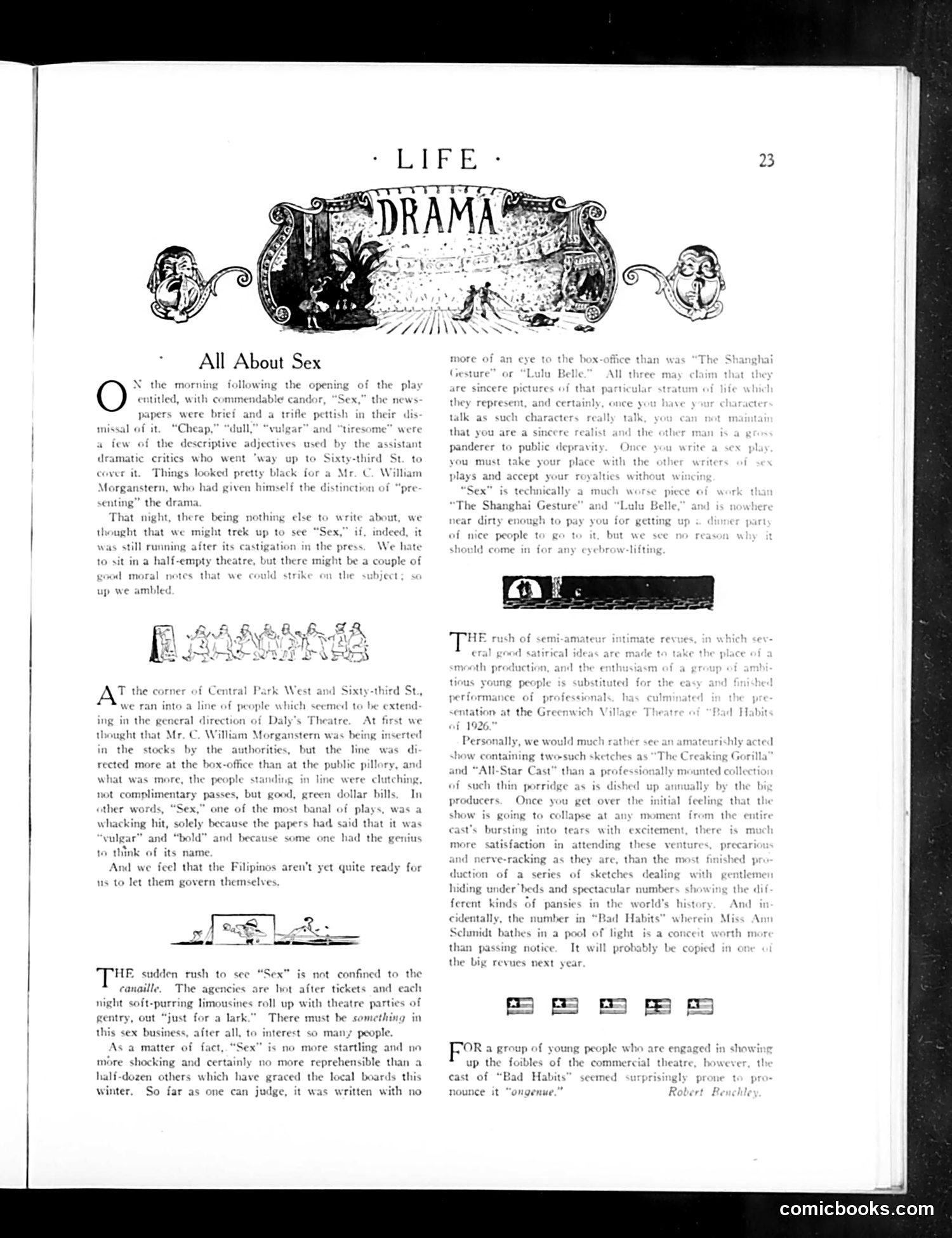
This page reviews the play "Sex," which opened to scandal and critical dismissal. The author explains the play's unexpected success despite negative reviews calling it "cheap," "dull," and "vulgar." The satire targets both theatrical snobbery and public hypocrisy. Critics attacked the play harshly, yet audiences flocked to see it—proving the scandal itself sold tickets. Life mocks how agencies and society crowds now seek it out "for a lark," pretending moral superiority while chasing controversy. The author argues "Sex" is no more shocking than other plays that "graced the local boards," suggesting the outrage is manufactured. The jab at Filipinos' readiness for self-governance appears oddly placed, likely reflecting the magazine's era-typical casual racism. The cartoons (decorative vignettes) show theatrical life. Overall, the piece satirizes how American audiences and critics claim moral standards while eagerly consuming exactly what they publicly condemn.
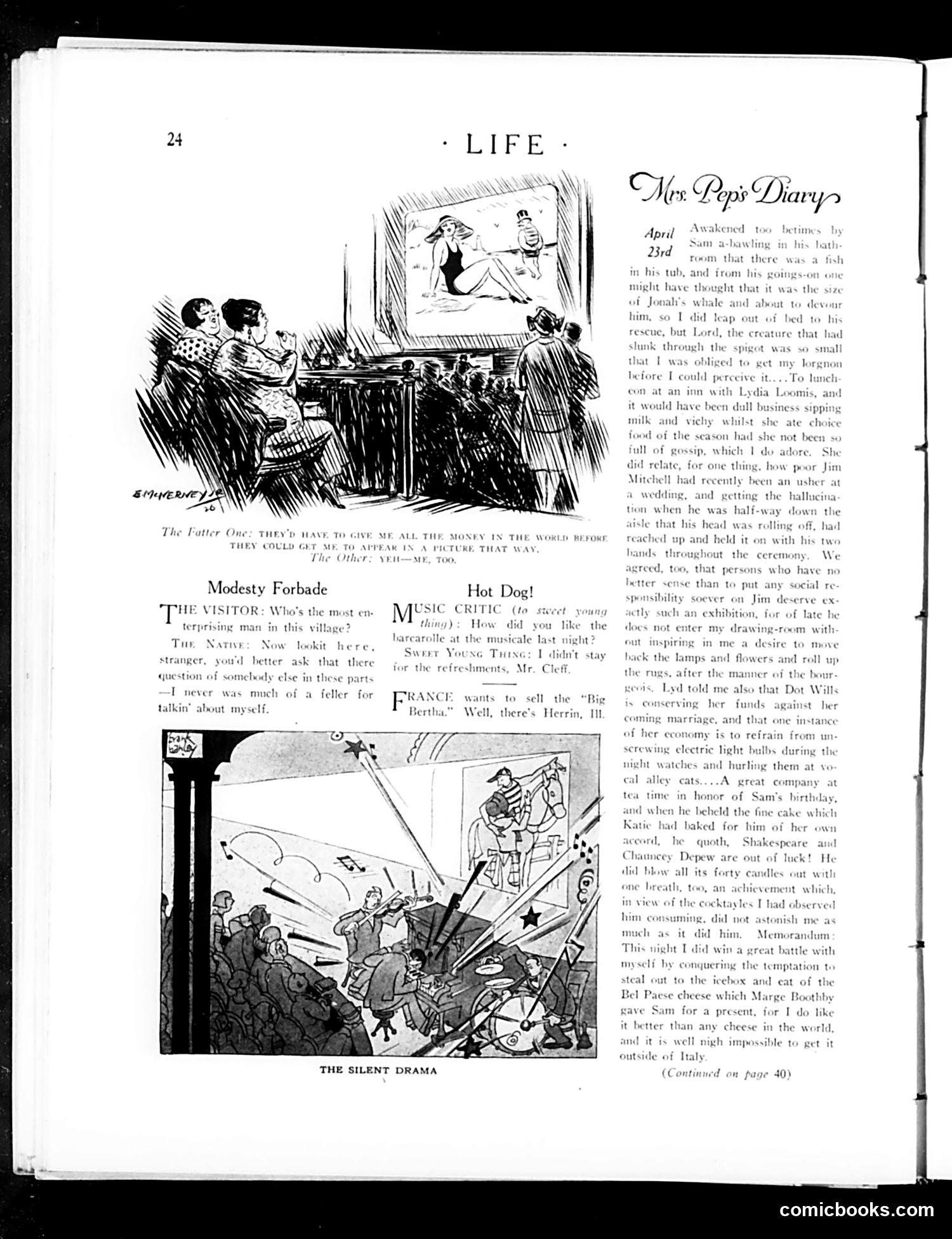
This page contains **three separate humor pieces** typical of Life's satirical format: 1. **"Modesty Forbade"** (top): A brief joke about a visitor asking a villager if he's met an "enterprising man" in town. The setup suggests the visitor is looking for someone to con or swindle, but the punchline (text too degraded to read fully) plays on the villager's modest response. 2. **"Hot Dog!"** (right): A music critic's brief, dismissive review of a musical performance. The satire mocks critics' pretentious language and short attention spans—he barely watched before leaving. 3. **"The Silent Drama"** (large illustration, bottom): An elaborate visual gag depicting a chaotic orchestra or theater scene with multiple figures in frenzied action. Without clearer visibility, the specific satire is unclear, but it likely mocks theatrical or musical performers. **"Mrs. Peps' Diary"** (right column) is a longer satirical narrative piece about domestic life and social pretensions—unrelated to the cartoons above it.
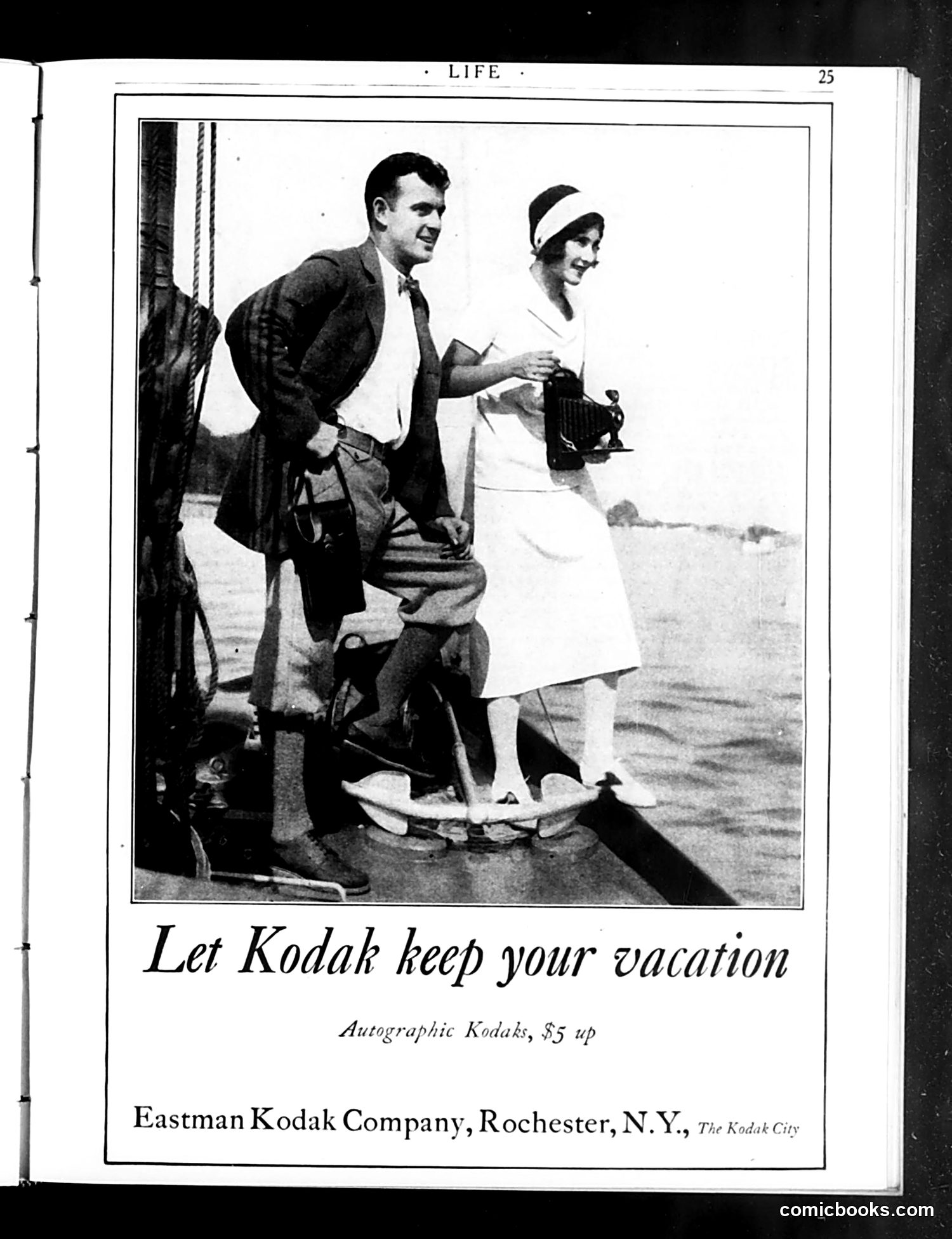
This is a **Kodak camera advertisement**, not political satire or a cartoon. It depicts a couple on what appears to be a boat or seaside setting. The woman holds an "Autographic Kodak" camera while the man gestures toward the scenery. The ad's tagline—"Let Kodak keep your vacation"—promotes portable cameras as essential vacation equipment. The message is straightforward: tourists should photograph their trips to preserve memories. This reflects early-20th-century consumer culture when personal photography was becoming accessible to middle-class Americans. The aspirational imagery (well-dressed couple, leisure activity) was typical advertising aimed at promoting this relatively new technology to potential buyers. No satire or political commentary is present here—it's simply a commercial pitch.
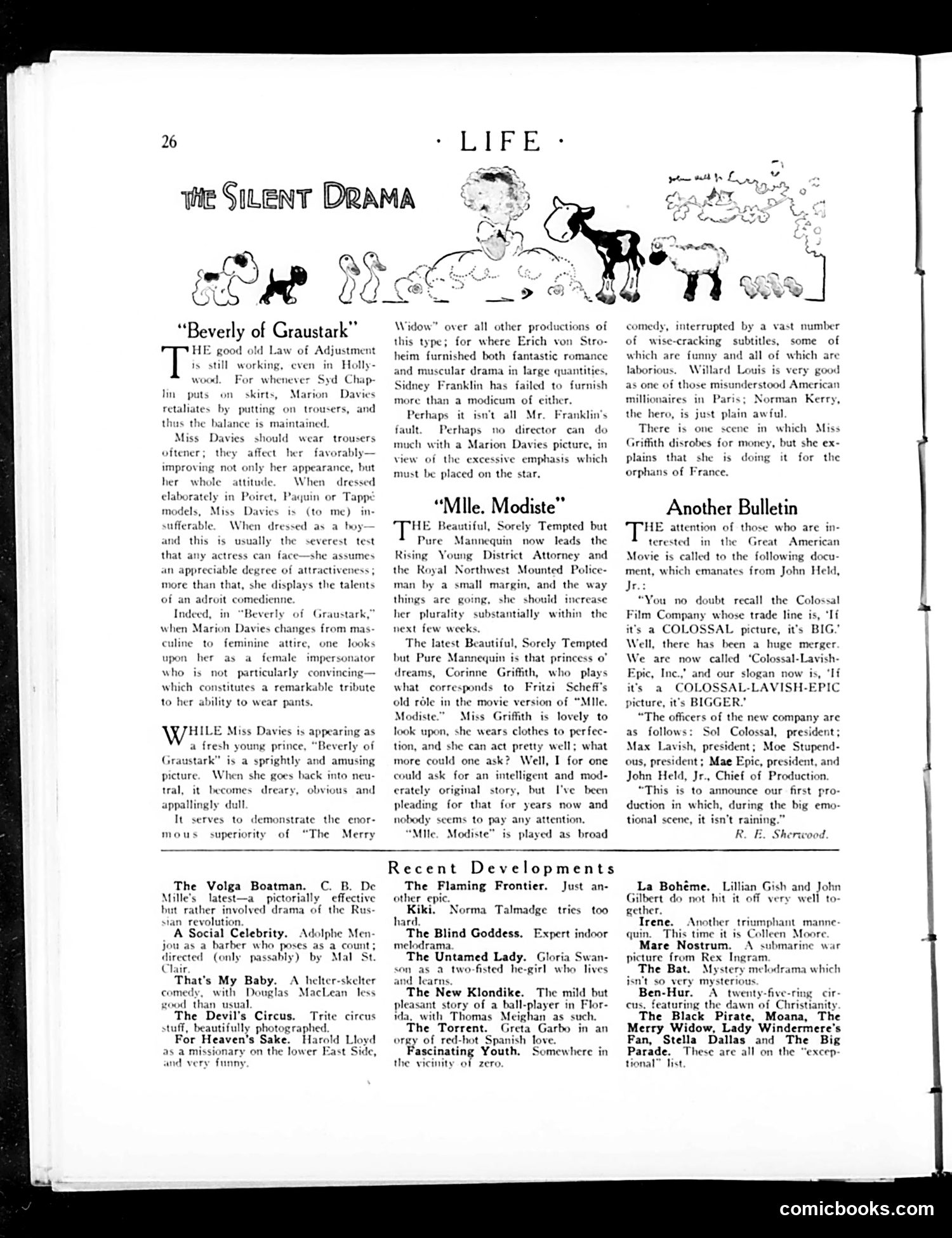
This page from *Life* magazine critiques 1920s silent films, focusing on actress Marion Davies. The main cartoon (top) humorously illustrates the "Law of Adjustment"—a satirical observation that when actor Syd Chaplin wears skirts in films, Davies retaliates by wearing trousers, maintaining balance. The critic praises Davies in masculine roles, claiming she displays genuine comedic talent in trousers but becomes "insufferable" in feminine dress. The reviews mock the era's romantic melodramas, particularly comparing "Beverly of Graustark" unfavorably to earlier Erich von Stroheim productions. Other reviewed films—"Mlle. Modiste," "The Volga Boatman," "Kiki"—receive mixed assessments. The critic repeatedly laments that filmmakers prioritize beautiful actresses in shallow roles over intelligent storytelling, a common complaint about early Hollywood's treatment of female performers. The cartoonish animals scattered throughout appear decorative rather than satirical.
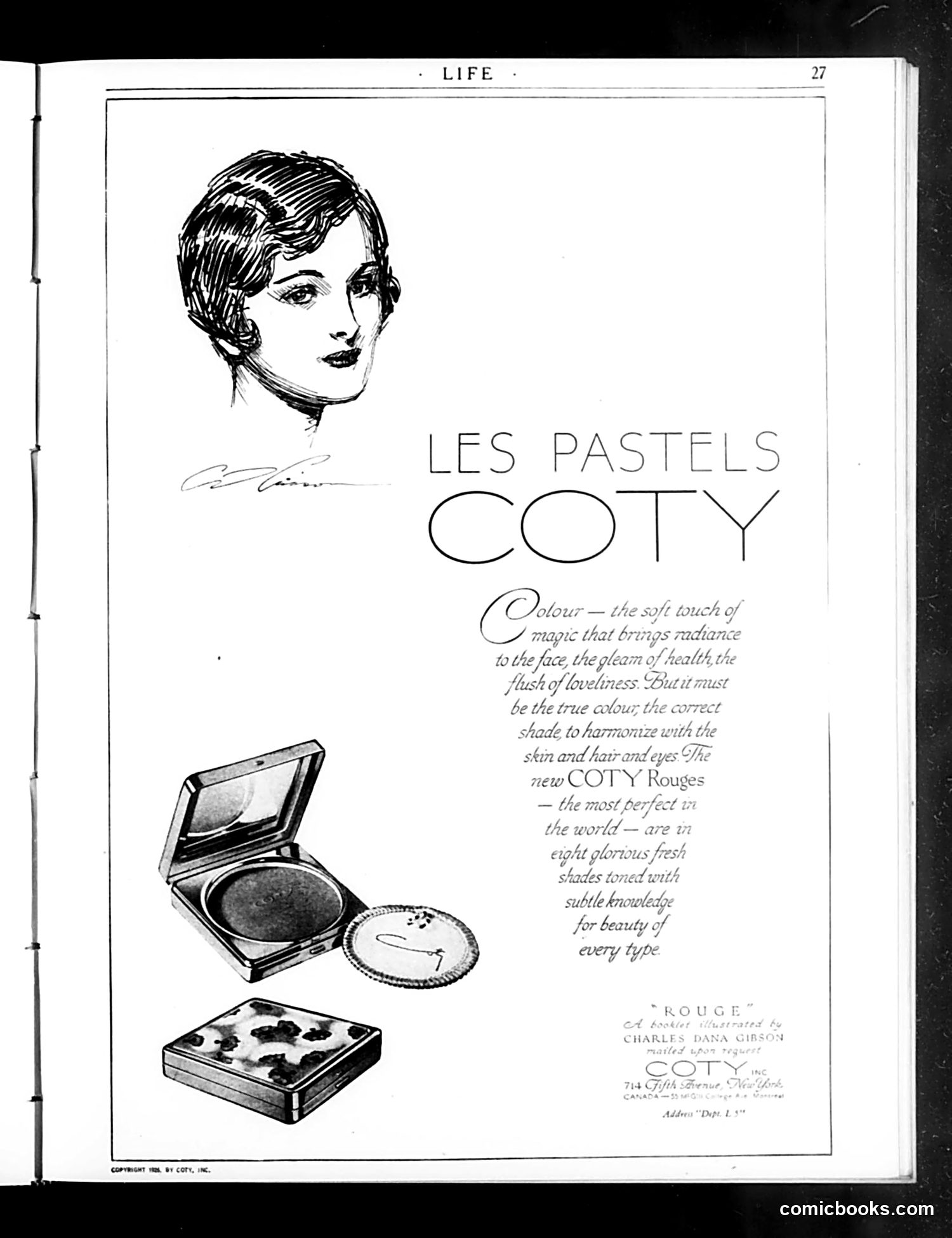
This page is primarily **an advertisement**, not satire or political commentary. It advertises "Les Pastels Coty," a cosmetics line featuring rouge (blush/lipstick products) by the Coty company. The ad includes: - A stylized sketch of a woman's face in 1920s-30s style - Product images showing compact cases and a palette - Marketing copy emphasizing that proper color selection flatters different skin tones and features **No political cartoon or satire is present.** This is straight commercial advertising that appeared in *Life* magazine. The "satire" magazine regularly carried advertisements alongside humorous content. The focus is entirely on selling beauty products by claiming their eight rouge shades suit "every type" of beauty. The elegant illustration and refined language reflect period advertising aesthetics targeting women consumers.
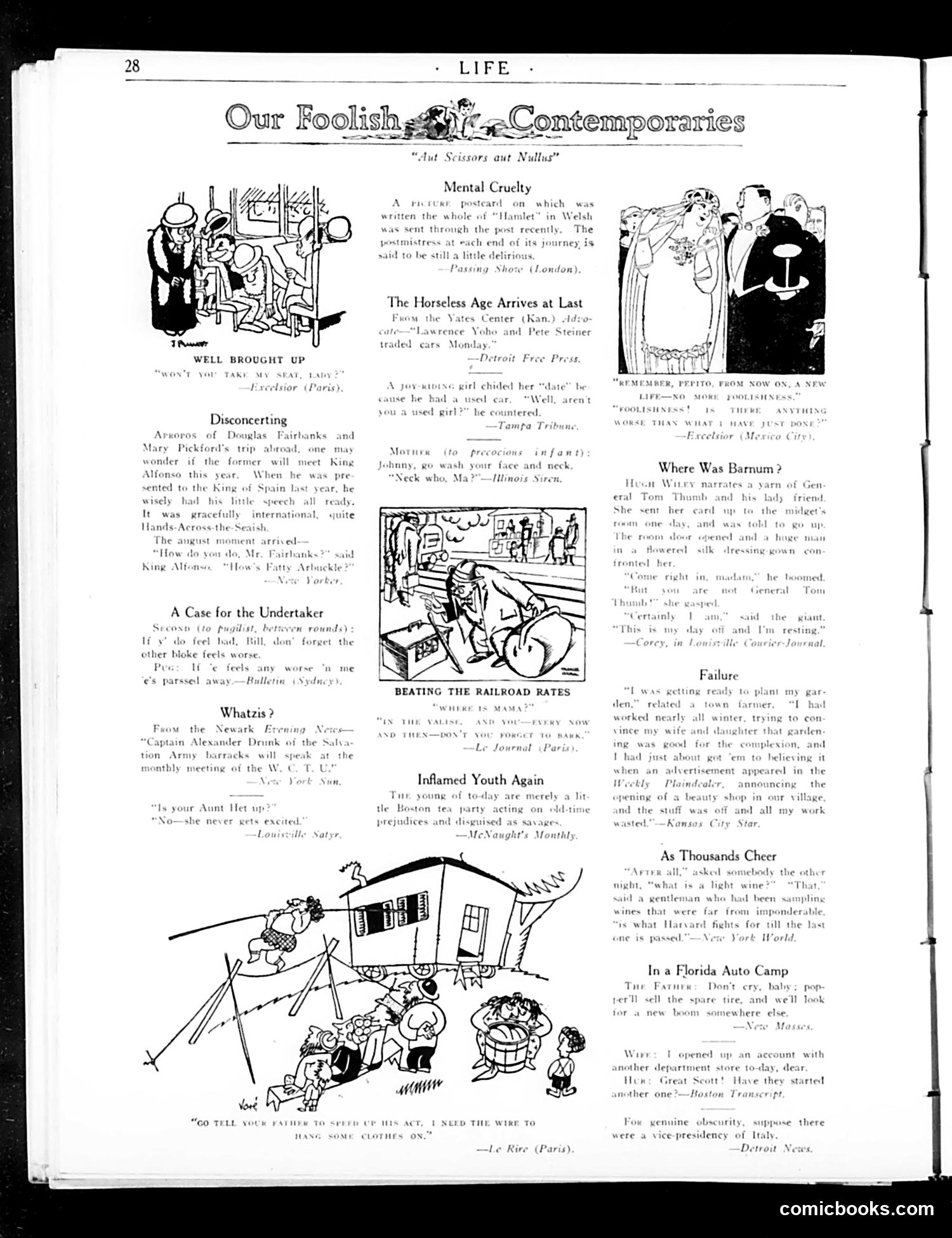
This is a satirical humor page from *Life* magazine featuring short comedic anecdotes and cartoons mocking contemporary social follies. Key items include: **"Mental Cruelty"**: A jest about someone sending the entire text of *Hamlet* written in Welsh through the mail—absurd because it's impractical and pointless. **"The Horseless Age Arrives at Last"**: A girl asks her date if he owns a used car; he says no. The joke plays on 1920s anxiety about automobile ownership as a status symbol for courting. **"Where Was Barnum?"**: References P.T. Barnum (famous showman), suggesting someone is as gullible as Barnum's audiences. **"Beating the Railroad Rates"** (large cartoon): Shows people living in a tilted house to avoid train fares—visual satire of penny-pinching absurdity. **Other items** mock Prohibition-era drinking, Harvard drinking culture, and absurd economic hardship humor during what appears to be the Great Depression era. The overall tone ridicules foolish contemporary behaviors and social pretensions.
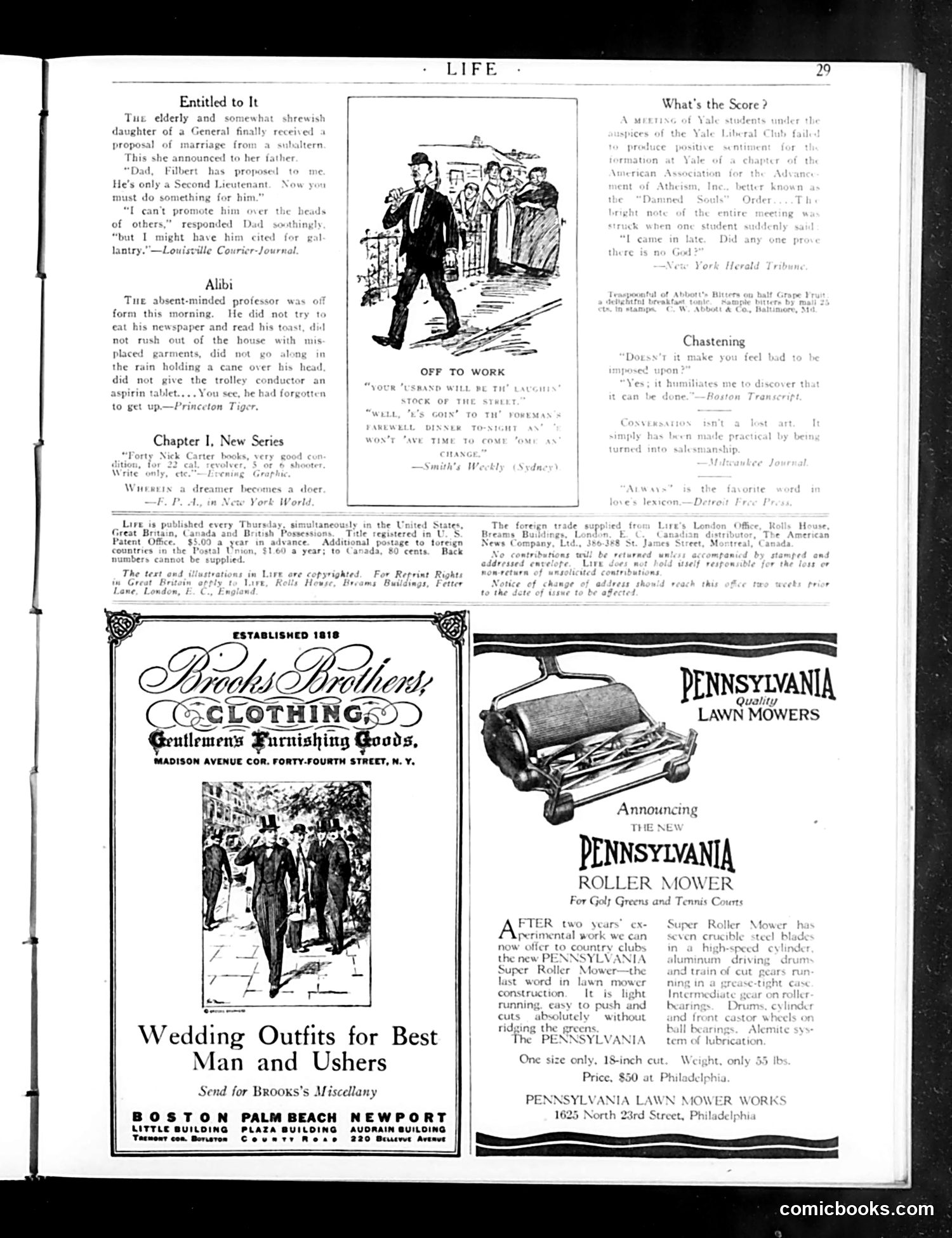
This page contains **two unrelated editorial cartoons and advertisements** rather than a coherent satirical narrative. The top cartoon "Off to Work" depicts a well-dressed man departing, with accompanying text about stock market activity and financial sentiment—likely commenting on **economic optimism or speculation of the 1920s era**. The joke appears to reference routine daily financial trading ("stock of the street"). The shorter anecdotes ("Entitled to It," "Alibi," "Chastening") are humorous vignettes about domestic life and social expectations, typical of Life magazine's satirical humor—poking gentle fun at courtship, marriage proposals, and family dynamics. **The bulk of the page is advertising**: Brooks Brothers clothing for formal wear, and Pennsylvania lawn mowers—typical commercial content for the magazine. These ads target affluent readers. Without more context or clearer OCR text, the specific satirical targets remain somewhat obscured, but the general tone reflects 1920s middle-to-upper-class American social commentary and consumer culture.
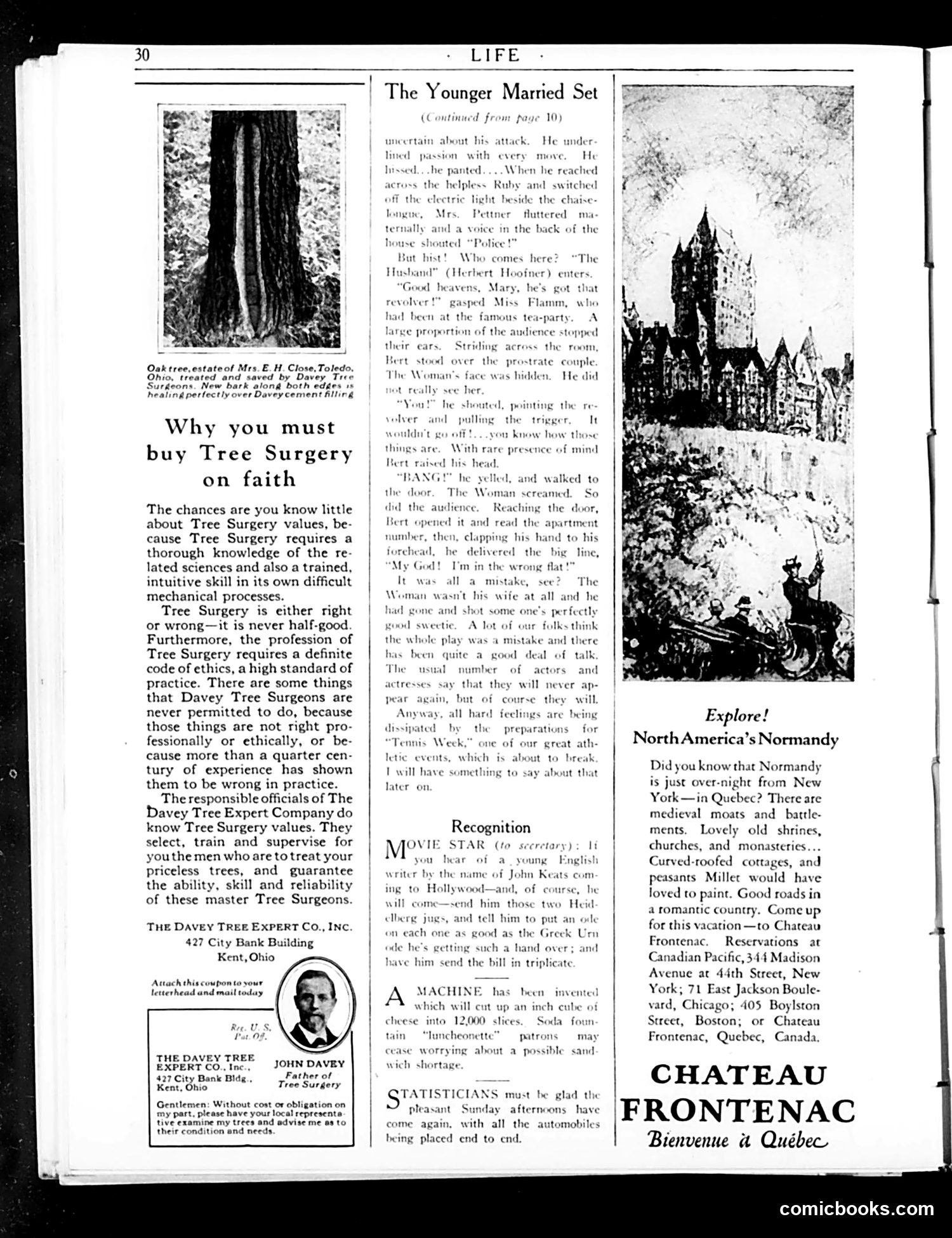
This page contains a serialized comic narrative (continued from page 10) about a domestic farce. The plot involves a man who mistakenly enters the wrong apartment and shoots someone, believing it to be an intruder. He then discovers his error—the "Woman" he shot was not his wife, but a stranger's "sweetie." The humor relies on physical comedy and mistaken identity, typical of 1920s silent film conventions. The narrative mentions this will be part of "Tennis Week," described as "one of our great athletic events." The piece satirizes both domestic comedy clichés (the wrong apartment mix-up) and theatrical melodrama, with characters and actresses promising "they will never appear again" after such embarrassing mishaps—a running joke about actors' dramatic declarations. The accompanying advertisements promote tree surgery services and a Quebec resort destination, unrelated to the comic narrative.
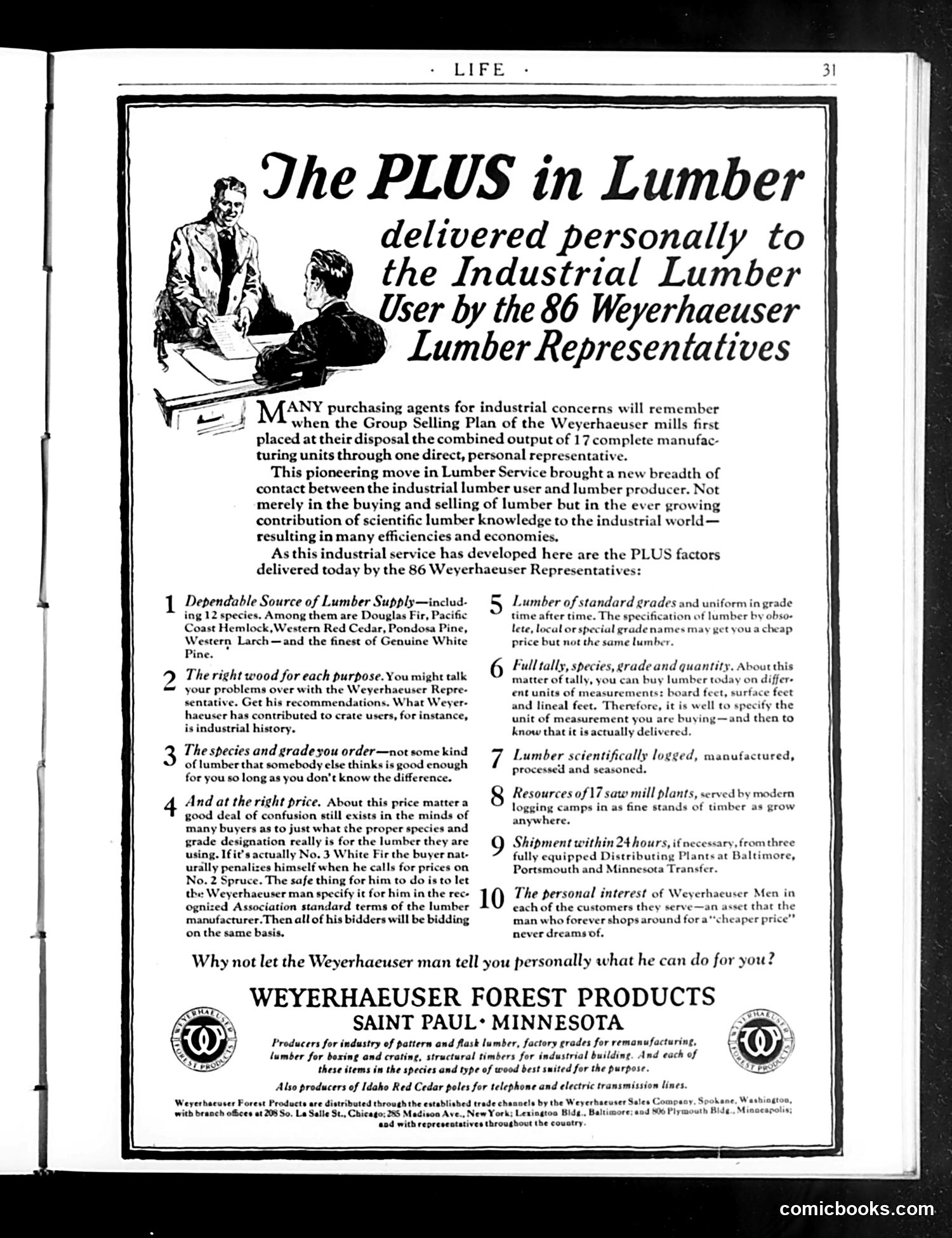
This is **not a cartoon or satire**—it's a straightforward **advertisement** for Weyerhaeuser Forest Products, placed in *Life* magazine (page 31). The illustration shows two businessmen in an office examining lumber specifications, a visual device to establish credibility and professional authority. The "PLUS" headline markets Weyerhaeuser's sales innovation: their "Group Selling Plan" that consolidated 17 mills under 86 personal representatives serving industrial buyers directly. The ten numbered points pitch competitive advantages: reliable supply, species variety, personalized consultation, standardized grades, consistent quality, precise measurement units, scientific processing, multiple mills, fast shipping, and dedicated customer service. The tone is earnest corporate boosterism typical of 1920s-era industrial advertising—no satire intended. It reflects how major American companies marketed modernization and efficiency to business purchasers during this period.
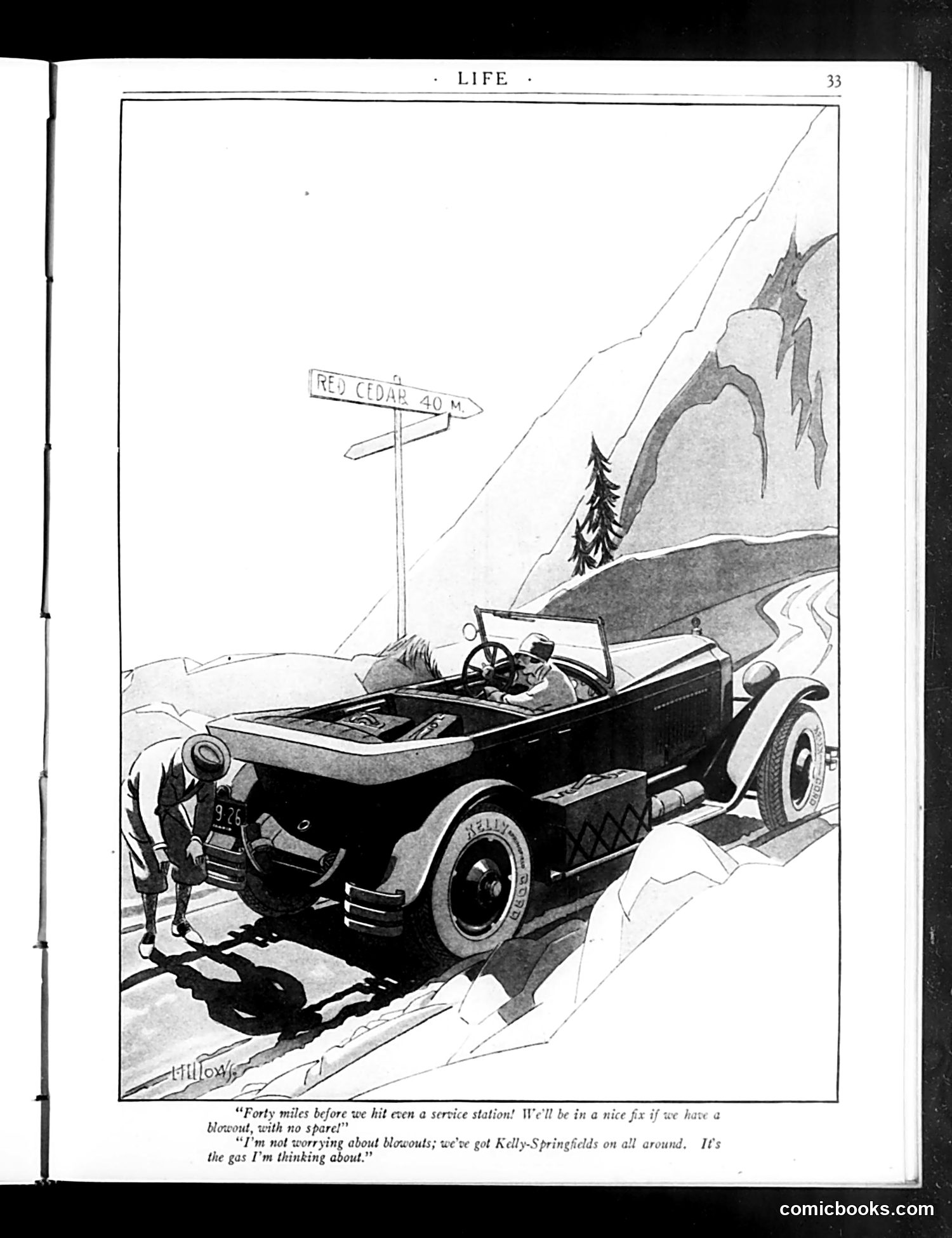
This is a humorous cartoon about early automobile travel anxieties. Two motorists are stranded on a remote mountain road with a directional sign reading "RED CEDAR 40 M." (40 miles away). The joke plays on shifting concerns: one man worries about tire blowouts on the isolated road, but his companion reassures him they have reliable "Kelly-Springfields" tires. However, his real worry is **gasoline supply**—they might run out of fuel before reaching the next service station. The humor lies in the contrast between expected worry (tire failure) and the actual problem (fuel depletion), reflecting early-1900s motorist concerns about limited infrastructure and long distances between gas stations. Kelly-Springfield was a real tire brand of the era, making the advertisement-like product placement part of the joke.
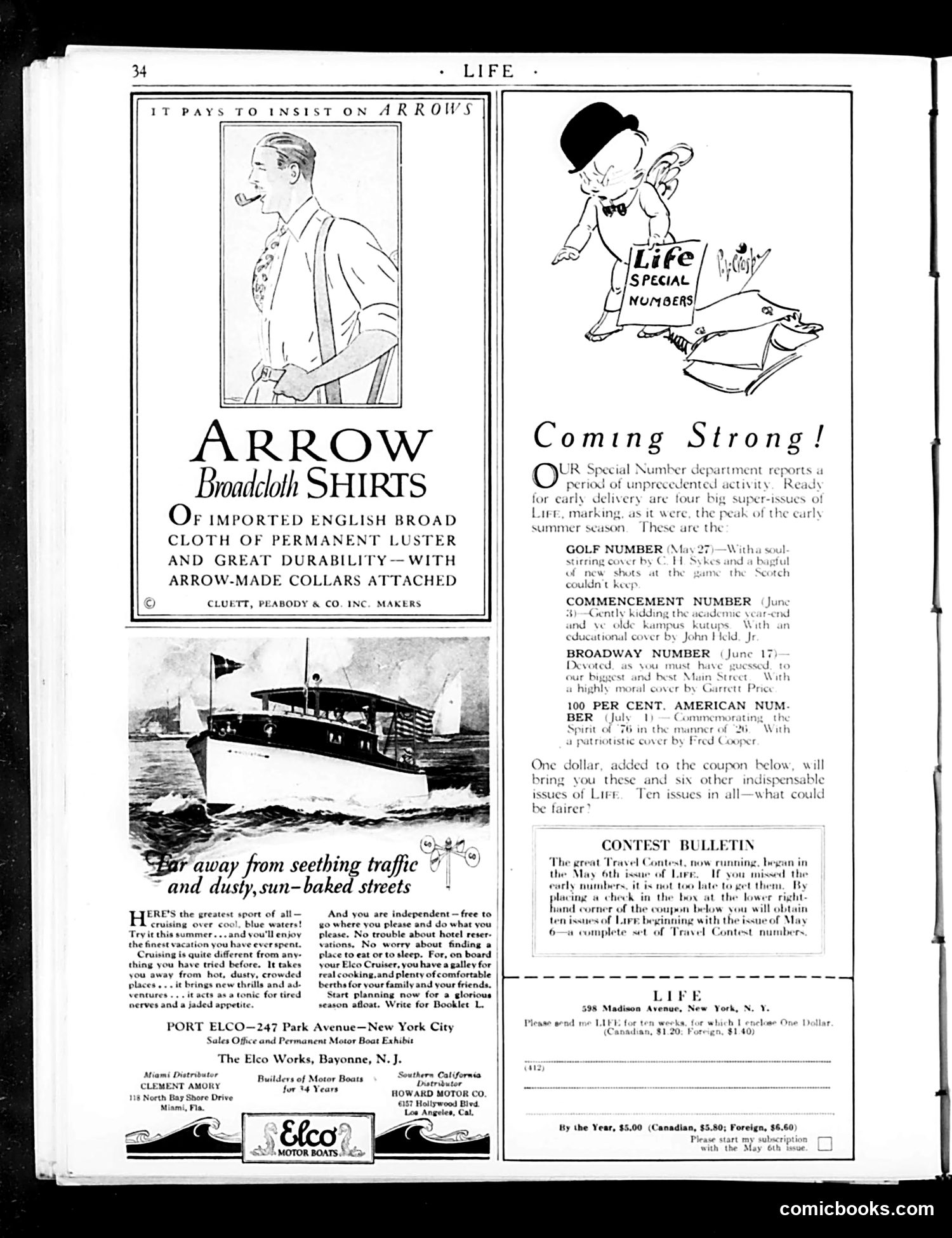
This page is primarily **advertising and promotional content** rather than satirical cartoons. The left side features an **Arrow Shirts advertisement** promoting "broadcloth shirts" with attached collars—a practical innovation for men's fashion of the era. Below it is an **Elco motorboat advertisement** encouraging leisure cruising as an escape from urban "seething traffic and dusty, sun-baked streets," appealing to middle-class aspirations for vacation luxury. The right side is a **Life magazine self-promotion** announcing special themed issues: Golf Number, Commencement Number, Broadway Number, and a "100 Per Cent. American Number" (July 1st). The cartoon mascot appears to be hawking these issues with patriotic fervor. A subscription offer at bottom offers ten issues for one dollar added to the coupon. The page reflects **1920s consumer culture**—emphasizing leisure, independence, and modern conveniences as markers of middle-class success. The tone is aspirational rather than satirical.
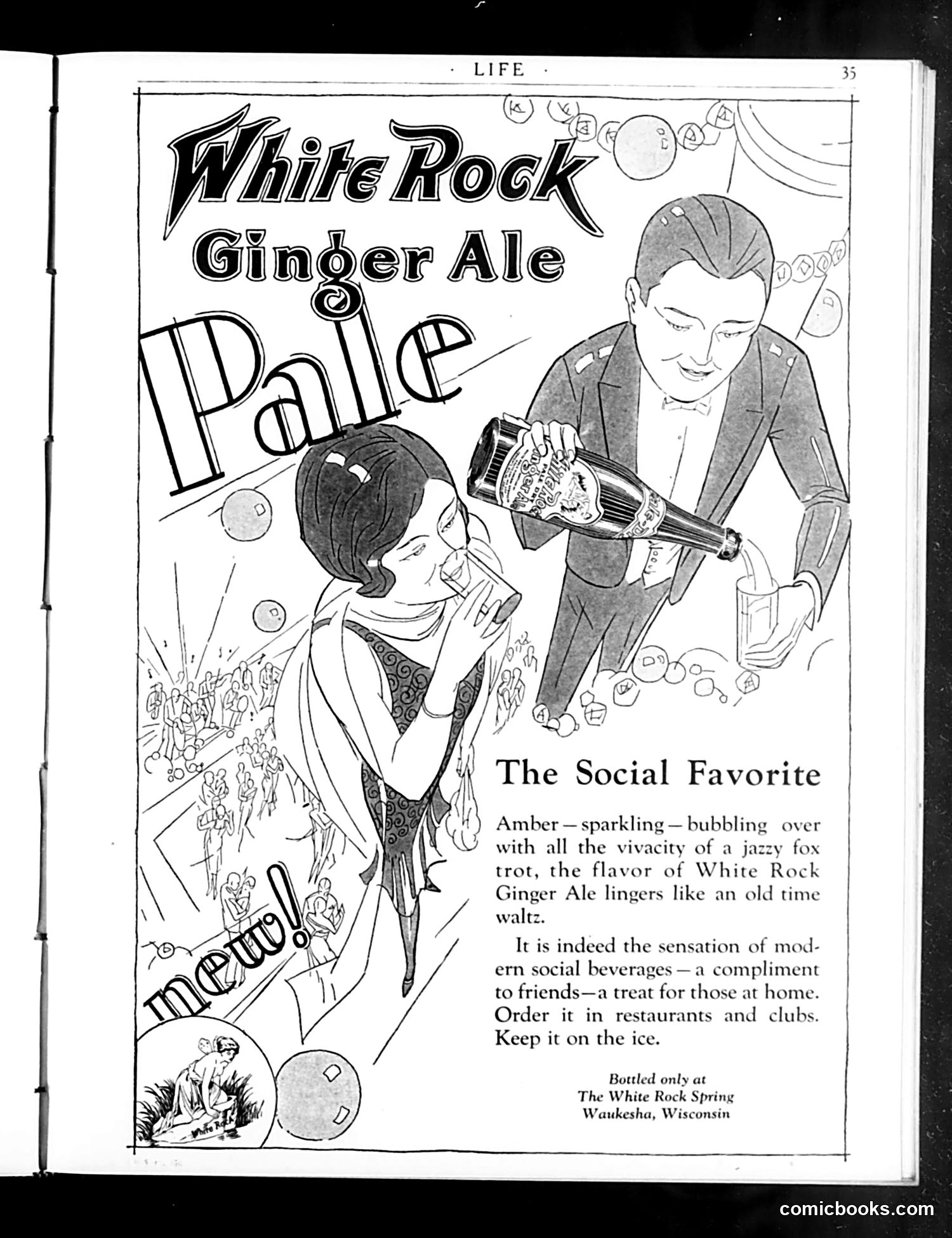
It advertises White Rock Ginger Ale, bottled in Wisconsin. The illustration shows two elegantly dressed figures at what appears to be a social gathering—a woman in a short dress being served ginger ale by a man in a suit. The art style and language ("jazzy fox trot," "old time waltz") reflect 1920s Jazz Age culture. The ad's appeal is purely social: the product is positioned as sophisticated, modern, and essential for entertaining friends. The "social favorite" tagline and references to serving it "in restaurants and clubs" suggest it's a status symbol for the leisure class. There is no political commentary or satirical point—this is straightforward commercial advertising using contemporary design and cultural references to market a beverage.
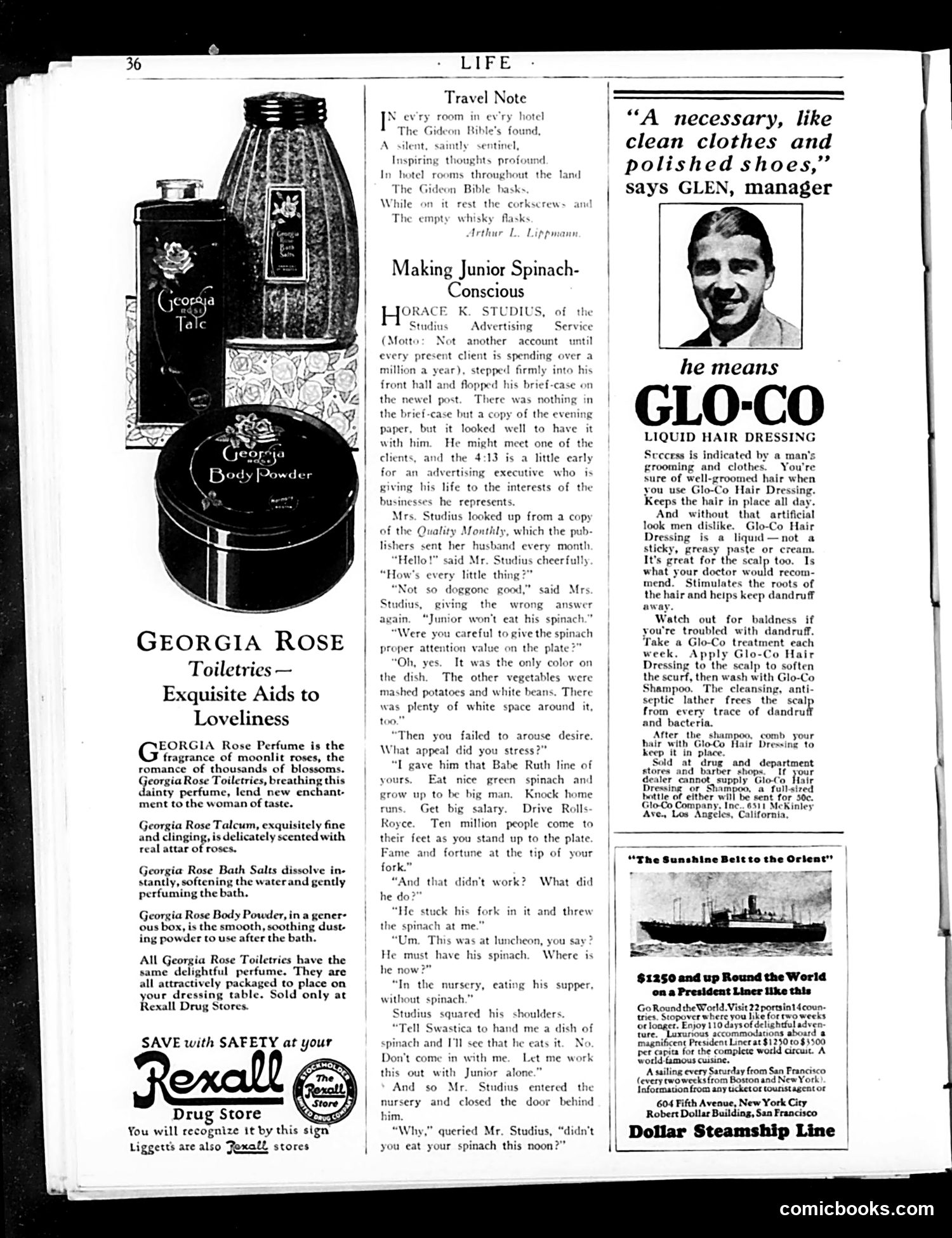
This page is primarily **advertising** for Georgia Rose toiletries and Glo-Co hair dressing, with two lighter editorial pieces sandwiched between. The main satirical content is "Making Junior Spinach-Conscious," a humorous short story about advertising executive Horace K. Studius trying to convince his son to eat spinach. The satire targets **advertising industry tactics**: Studius attempts to sell spinach to his child using the same manipulative techniques he uses professionally—appealing to desire through celebrity endorsement (Babe Ruth) and "attention value" rather than honest persuasion. The joke is that these advertising methods fail completely on a child who simply throws the spinach at his father. The piece mocks how advertising executives, immersed in their trade, apply hollow marketing strategies to real life with absurd results. The brief "Travel Note" poem observes the ubiquity of Gideon Bibles in hotel rooms, alongside whisky flasks—a gentle social observation about American hotel culture, not sharp satire. The page otherwise consists of product advertisements typical of 1920s-30s lifestyle magazines.
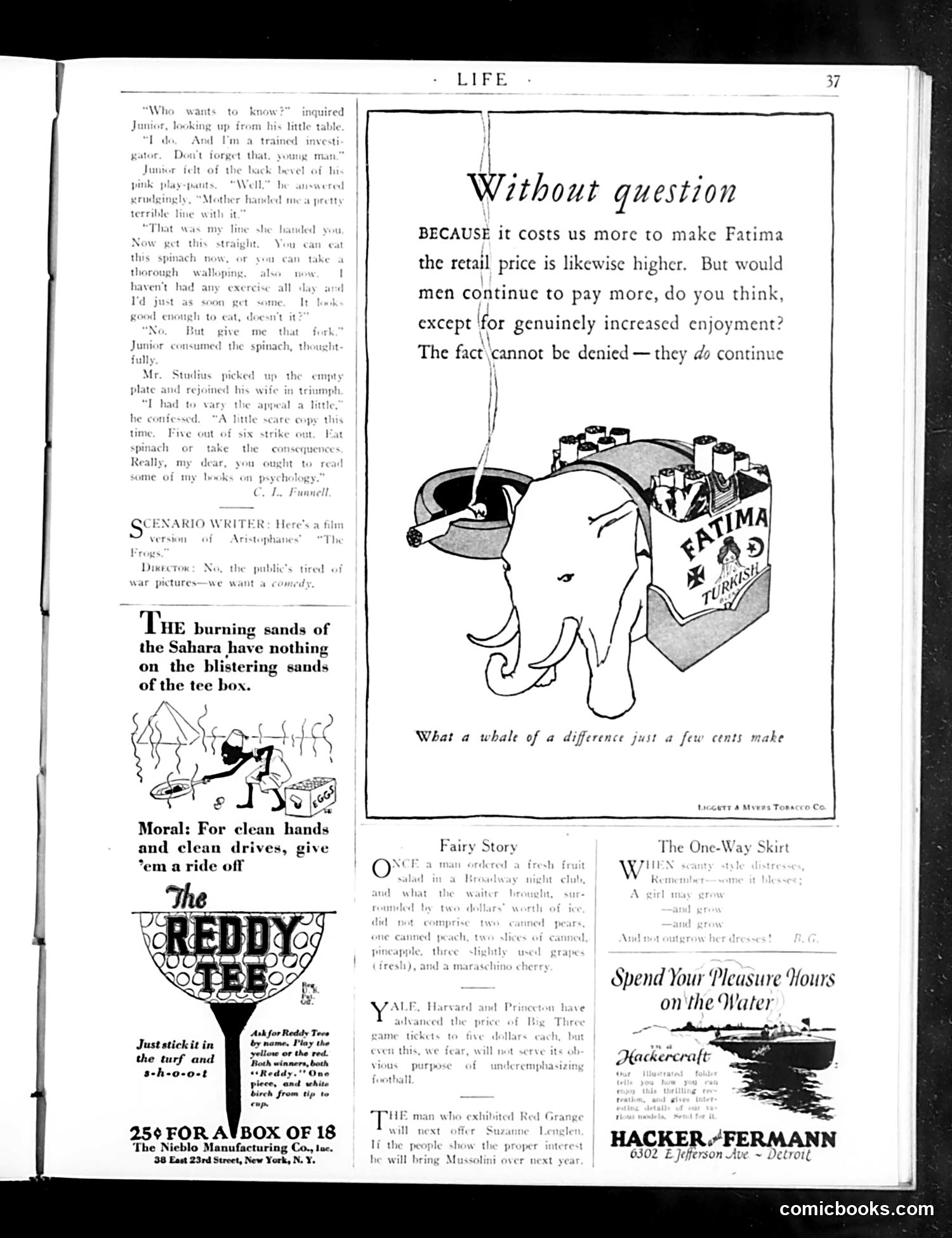
This page mixes **advertising with light humor and social commentary** typical of Life's satirical format. The main advertisement promotes **Fatima cigarettes**, arguing that despite higher prices, men willingly pay more because the product delivers "genuinely increased enjoyment"—a straightforward pitch that the quality justifies the cost. Below that, a **golf joke** compares the "burning sands of the Sahara" to hot sand on a golf course, with the moral recommending "Reddy Tees" (golf tees) for clean hands and better drives. The remaining content includes brief **gossip items and society notes**: a "Fairy Story" about a fruit salad, a comment on women's fashion ("The One-Way Skirt"), and references to Yale, Harvard, and Princeton price increases for football tickets. A final item mentions someone exhibiting "Red Grange" and speculates about bringing "Mussolini over next year"—likely referencing contemporary celebrity or political interest circa the 1920s-30s. The page is primarily **commercial and entertainment-focused** rather than politically satirical.
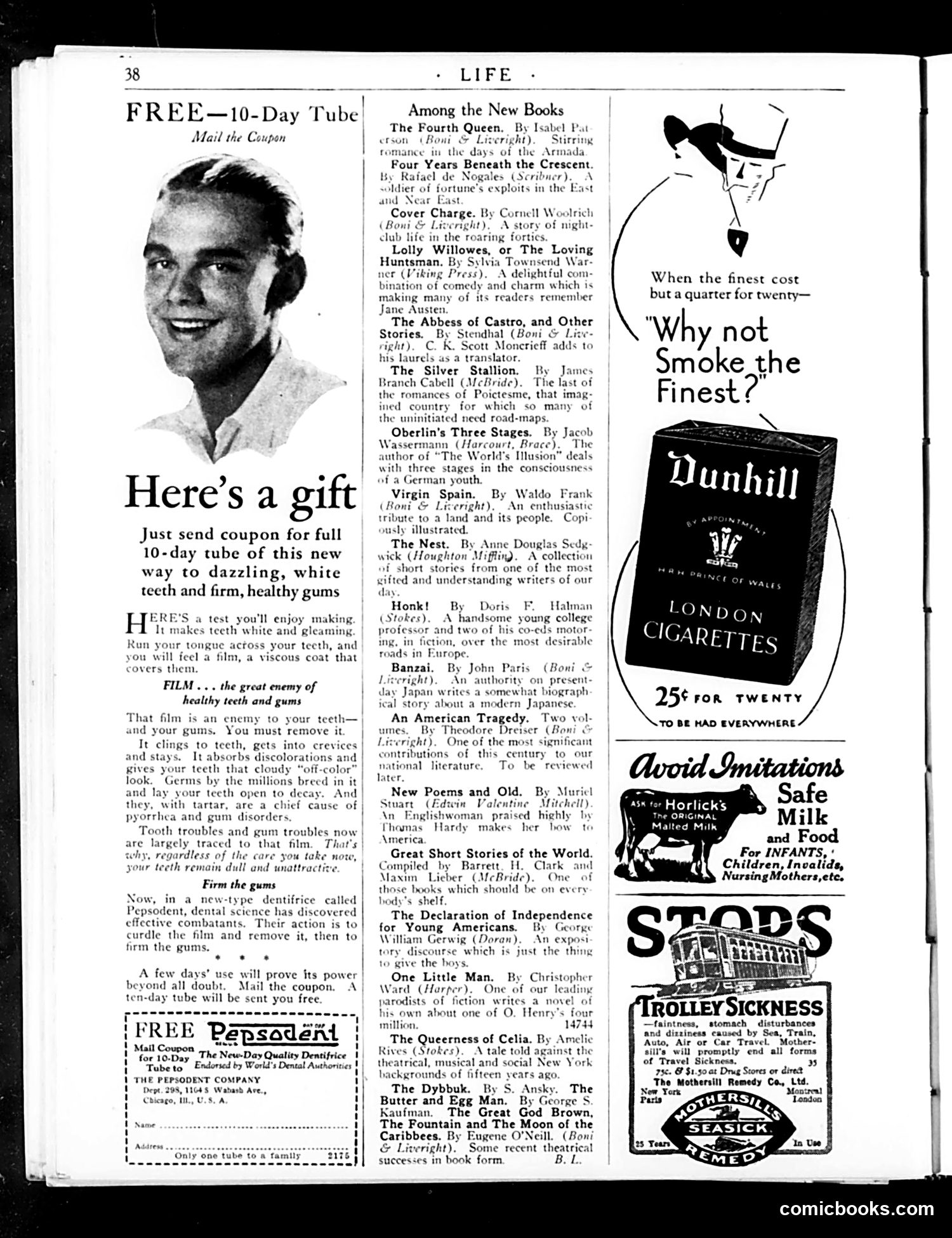
This page is primarily **advertising and book reviews**, not political satire. The dominant content is a **Pepsodent toothpaste advertisement** (left side) featuring an endorsement strategy common to 1920s marketing: claiming scientific backing ("new-type dentifrice") and offering free samples via mail coupon. The advertisement reflects period anxieties about hygiene and social acceptability—the copy warns that "film" on teeth breeds germs and causes decay, appealing to modern fears of invisible threats. The male model's appearance suggests endorsement from a relatable figure. The right side lists contemporary books, with other period advertisements (Dunhill cigarettes, Horlick's milk, seasickness remedy). The cigarette ad's messaging—"Why not smoke the finest?"—illustrates how luxury tobacco was marketed without health warnings. The overall page reflects 1920s consumer culture: mass-market anxiety about personal hygiene, mail-order commerce, and emerging modernist literature reviews. There is **no political cartoon or satire present**.
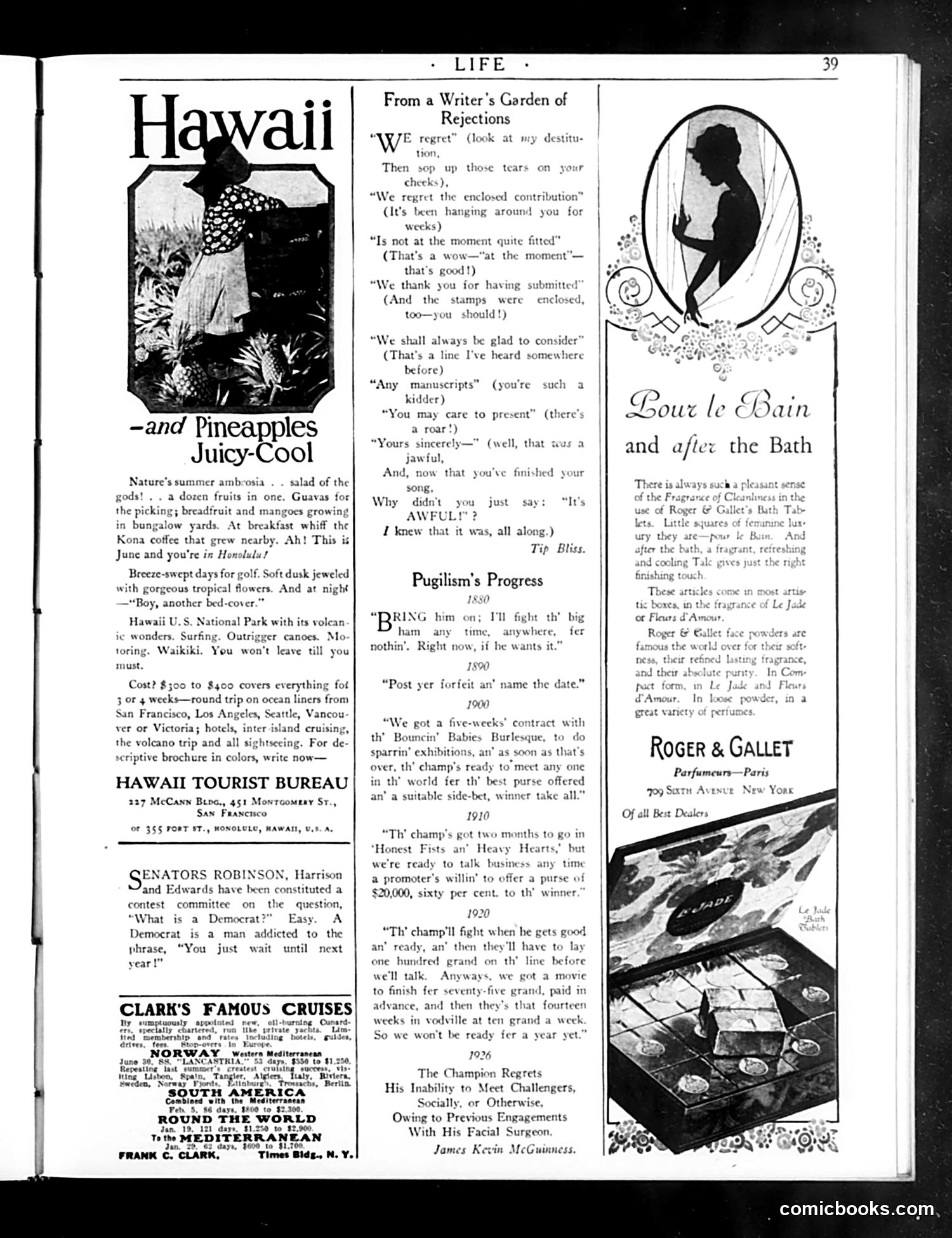
This satirical cartoon traces the decline of professional boxing's legitimacy over roughly 50 years. In 1880, a fighter eagerly accepts any match for prize money. By 1890-1900, he's making contracts and demanding larger purses. By 1910-1920, his demands escalate dramatically—requiring huge upfront deposits and refusing fights unless conditions are perfect. The final panel delivers the satire's punch: by 1926, the champion avoids fighting altogether, claiming he's too busy visiting his "facial surgeon." This mocks boxing's evolution from a sport into a money-grabbing enterprise where fighters prioritize appearance and profit over actual competition. The cartoon satirizes how professional boxing had become driven by greed and ego rather than athletic merit—a common complaint about 1920s sports culture.
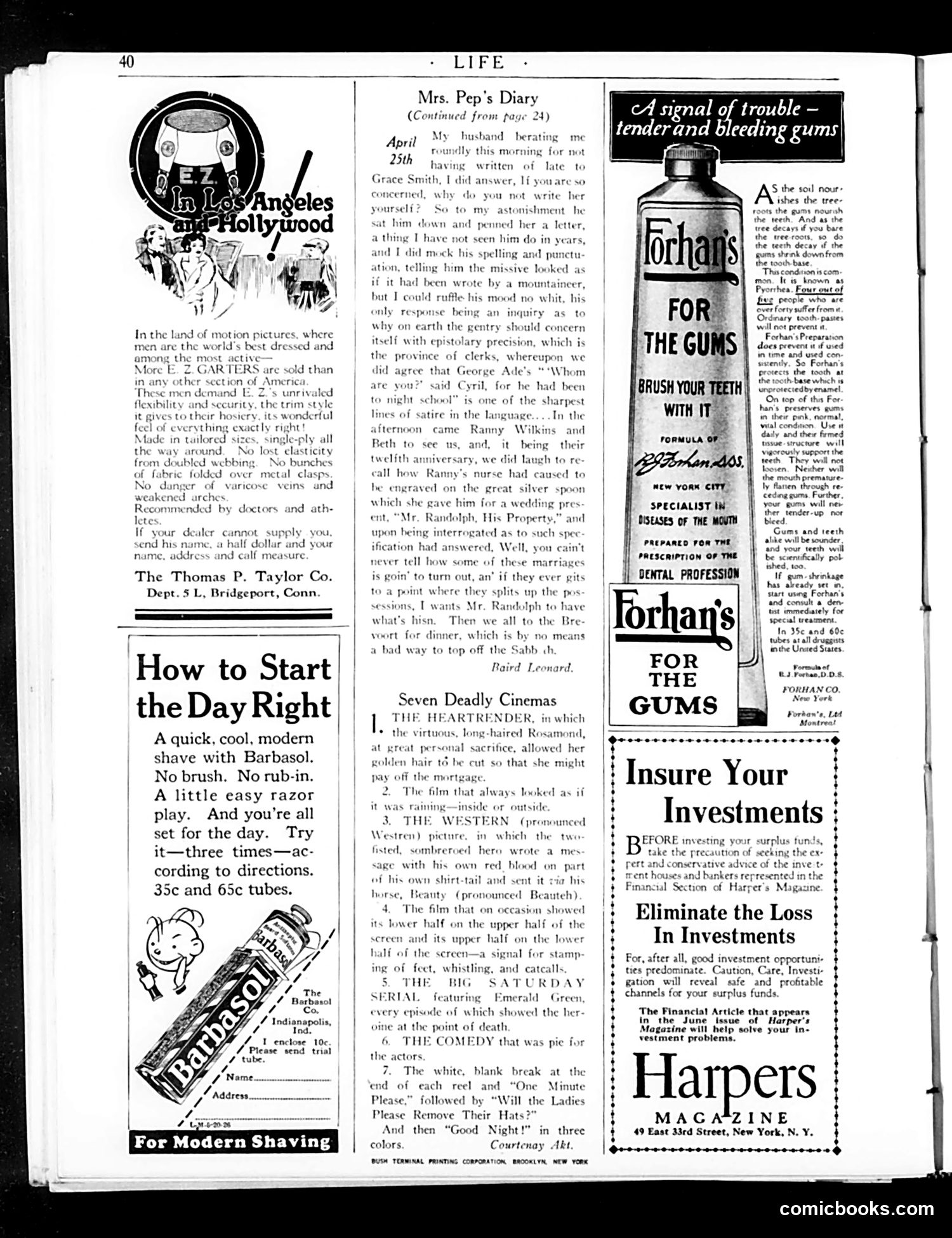
This page is primarily **advertising and editorial content** rather than political satire. The main cartoon is a **Barbasol shaving cream advertisement** featuring a simple, cheerful illustration of a man with shaving cream, promoting modern, brush-free shaving as convenient and effortless—reflecting 1920s consumer culture's embrace of labor-saving products. The substantive content is **"Mrs. Pep's Diary,"** a humorous domestic column describing everyday married life. The entry humorously depicts a husband reluctantly writing a letter to a friend's wife, with satirical jabs at male spelling and punctuation abilities. It includes gossip about social circles (weddings, anniversaries, dinners) with gentle mockery of upper-middle-class mannerisms. Secondary material includes **"Seven Deadly Cinemas,"** a satirical film criticism list mocking common silent film tropes—melodramas with virtuous heroines, Westerns with poorly-framed action, comedies with slapstick, etc. **The page reflects 1920s concerns**: consumer convenience, marital dynamics, and growing film industry clichés. The humor is domestic and social rather than political.
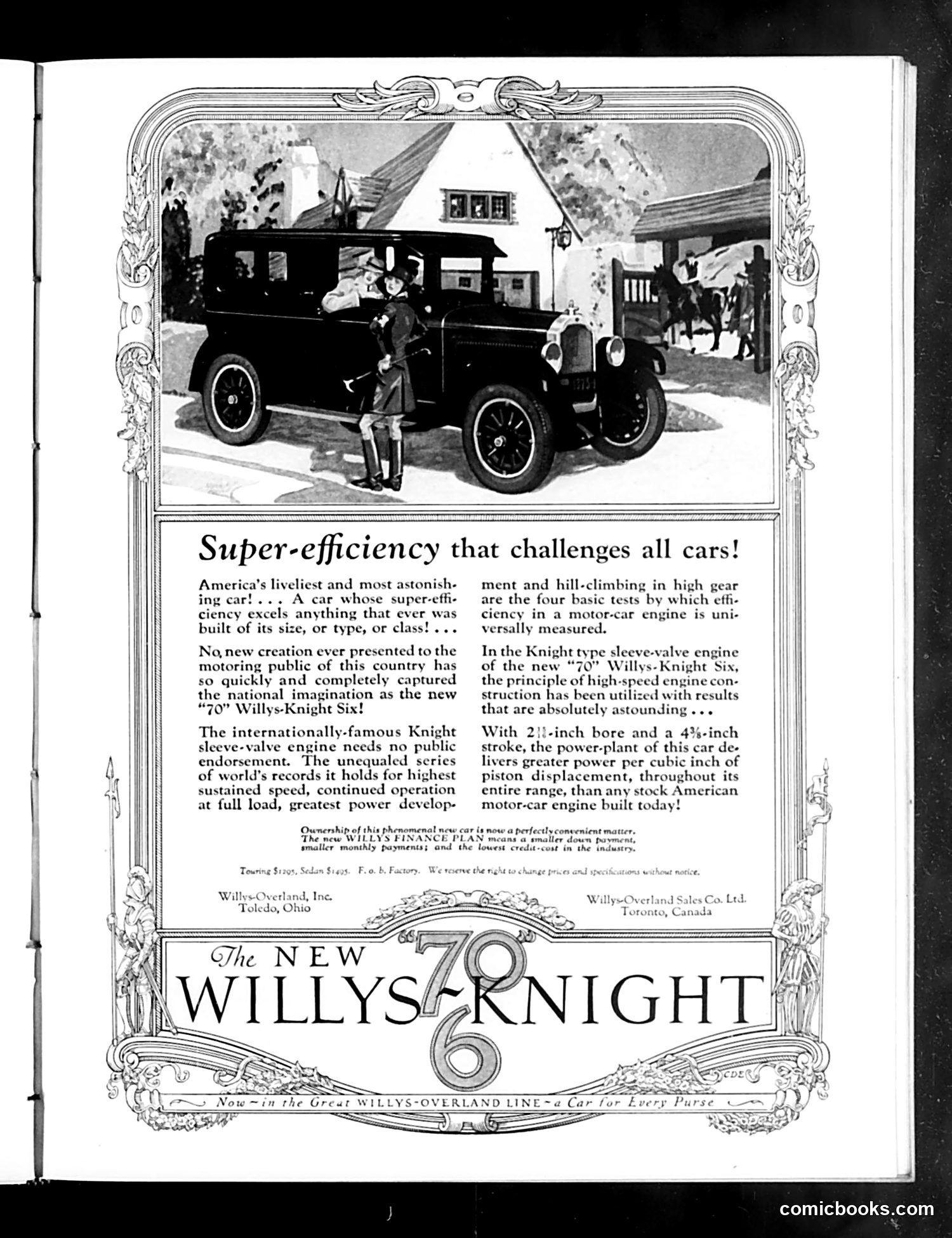
This page is a straightforward **advertisement for the Willys-Knight automobile**, not a political cartoon or satire. The "70" Willys-Knight Six was a real car model being marketed to American consumers. The ad emphasizes the vehicle's technical superiority—its sleeve-valve engine design, power output, and efficiency compared to competitors. The photograph shows the car in a pleasant suburban or small-town setting, suggesting reliability and accessibility for ordinary families. The only noteworthy element for modern readers is the **financing plan mentioned** ("Willys Finance Plan"), indicating that car payments were becoming a normal way to purchase vehicles in this era. This represents mainstream advertising from Life magazine's era, when publications mixed editorial content with advertisements. There is no hidden political message or satirical commentary visible here.
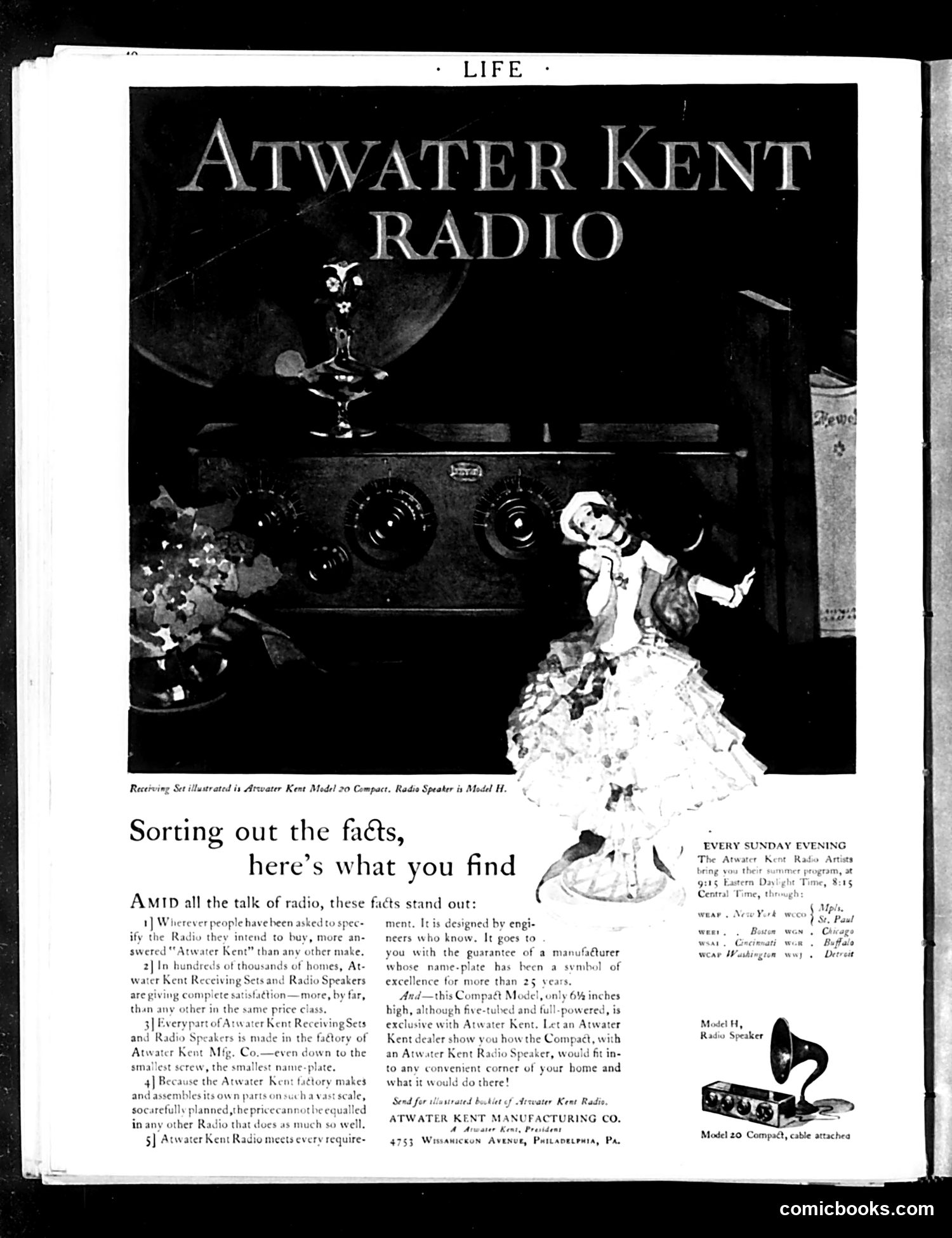
This is primarily a **radio manufacturer advertisement**, not political satire. The page promotes Atwater Kent brand radios and speakers, featuring a stylized illustration of a fashionable woman in 1920s dress operating a radio receiver. The text presents five numbered "facts" claiming Atwater Kent's superiority: more people choose it than competitors, thousands own them, receiving sets and speakers are made in their own factory, the Compact Model is exclusive to Atwater Kent, and their radios meet "every requirement." The satirical element is minimal—it's mostly straightforward early-radio-era advertising, typical of Life magazine's mix of humor and commercial content. The "sorting out the facts" headline gently mocks advertising claims generally, but the page itself is essentially a sponsored promotion for a major radio manufacturer of that period (likely 1920s-early 1930s, given the styling and radio technology depicted).