
A complete issue · 44 pages · 1926
Life — April 15, 1926
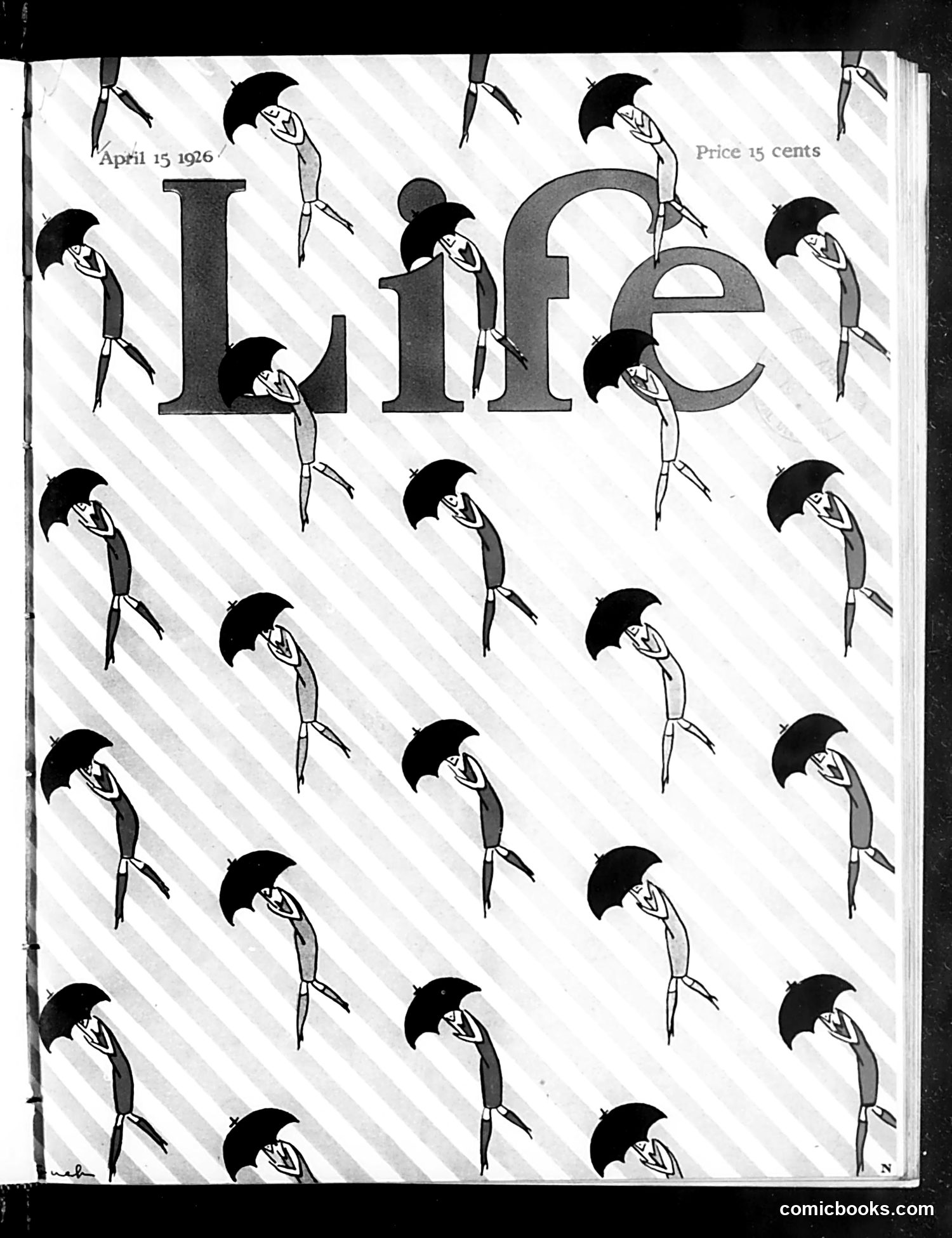
This cover features a repeating pattern of stylized figures holding umbrellas, with large typography spelling "Life" overlaid in the center. The figures appear to be drawn in a modernist, art deco style typical of 1920s illustration. Without additional context visible on the page, the specific satirical meaning is unclear. The repeating umbrella motif might reference rainy weather, an upcoming season, or possibly a social trend of 1926. The geometric, repetitive design reflects the modernist aesthetic popular in magazine design of this era. The cover's sophisticated typography and illustration style suggests Life was marketing itself as a fashionable publication for urban readers. The 15-cent price point indicates middle-class readership.
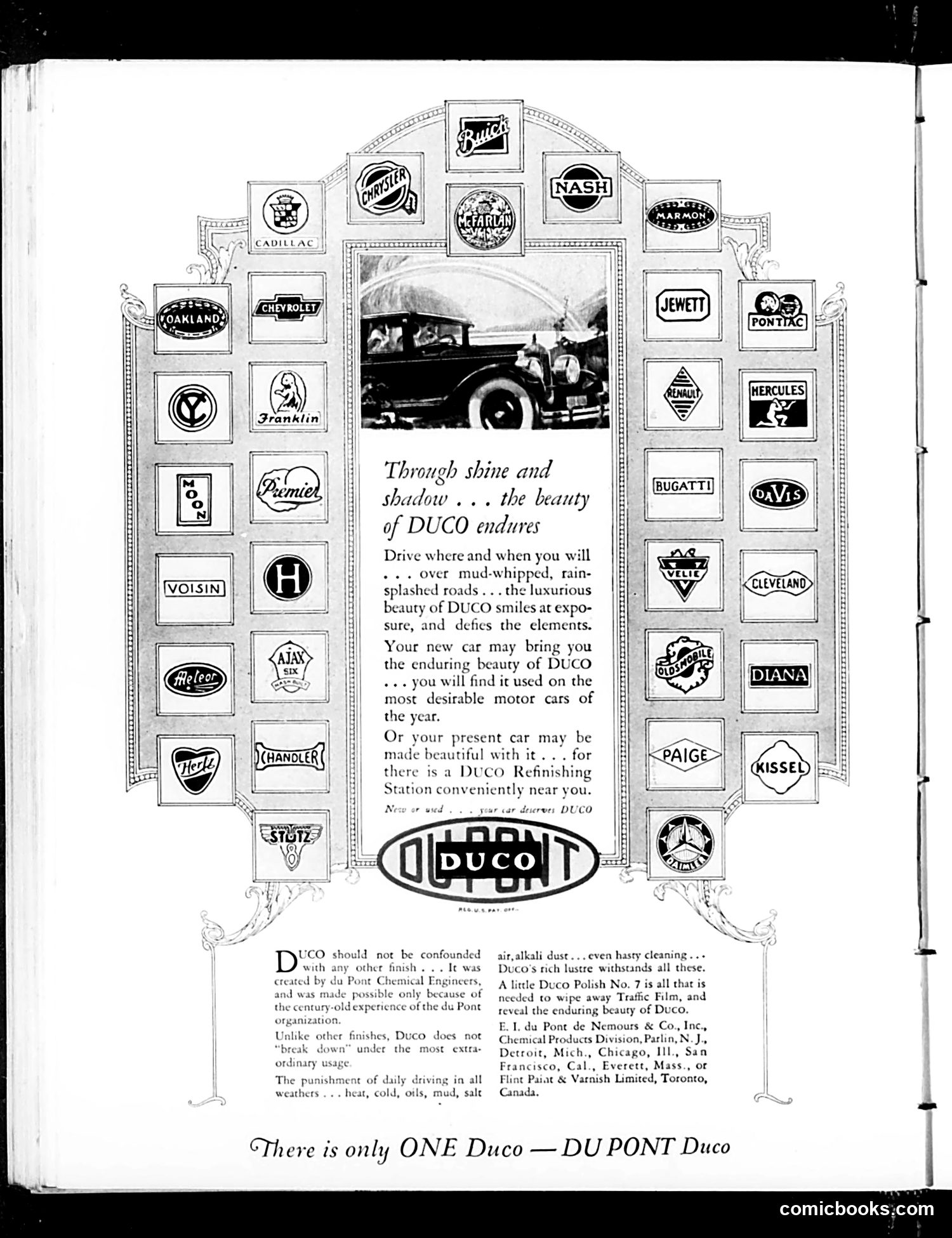
This page is **primarily an advertisement**, not editorial satire. It advertises Duco, a car polish/finish product made by DuPont Chemical Engineers. The design features a central photograph of a vintage automobile surrounded by logos of American car manufacturers from the era (Cadillac, Chevrolet, Nash, Buick, Packard, Franklin, Studebaker, etc.). The ad's pitch emphasizes Duco's durability: it withstands harsh conditions (mud, rain, salt, oils) and maintains shine better than competing finishes. The text notes Duco can be applied at "Refinishing Stations" and that DuPont's chemical expertise created this superior product. The tagline—"There is only ONE Duco—DUPONT Duco"—claims market dominance. This is vintage industrial advertising showcasing American manufacturing confidence, not political or social satire.
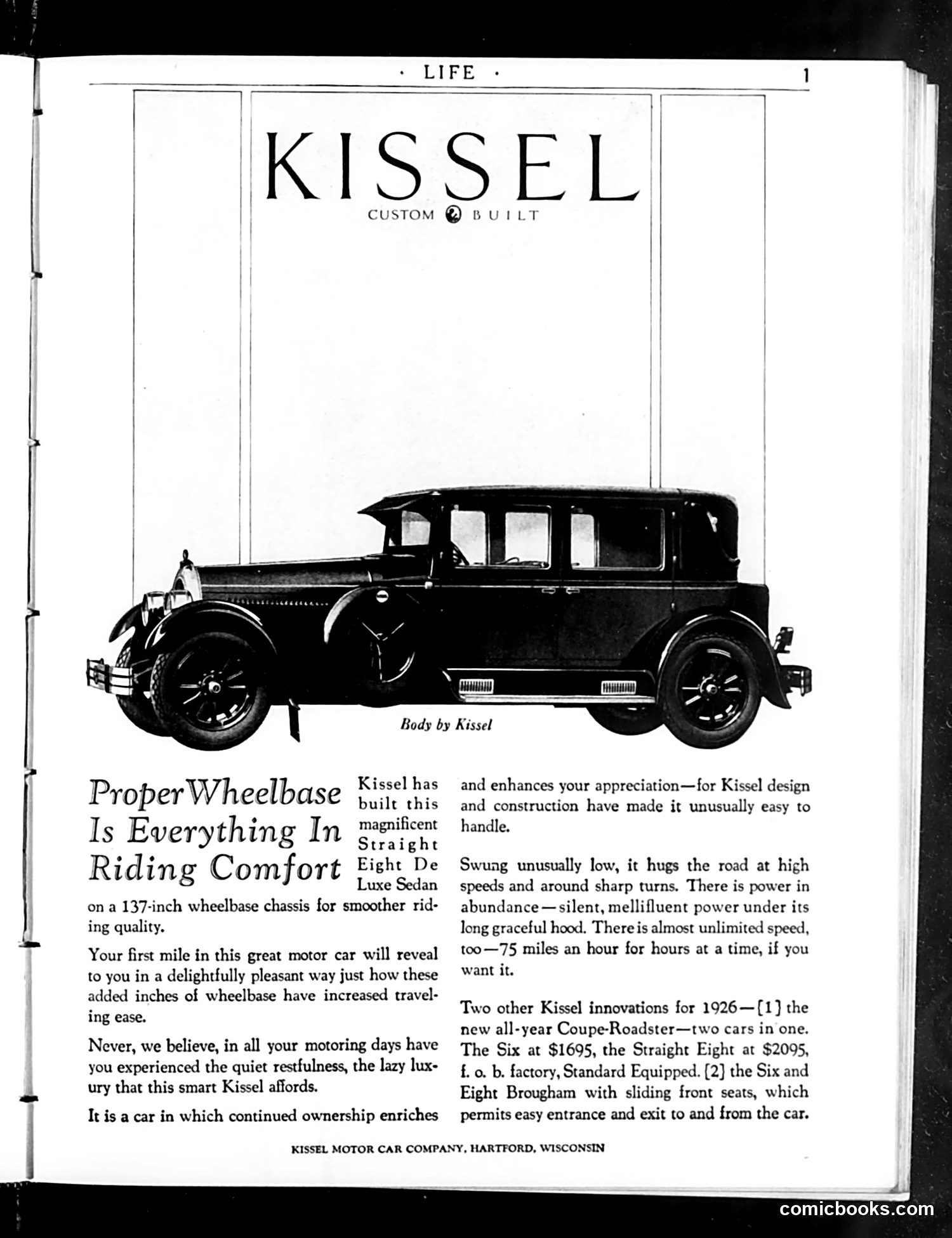
This is **not a cartoon or satirical content** — it's a straightforward automobile advertisement for the Kissel motor car, placed in Life magazine circa 1926. The page features a black-and-white illustration of a Kissel "Straight Eight De Luxe Sedan" with promotional text emphasizing its 137-inch wheelbase, smooth ride quality, and performance capabilities (up to 75 mph). The copy appeals to luxury and comfort, claiming superiority in "quiet restfulness" and ease of handling. The Kissel Motor Car Company, based in Hartford, Wisconsin, is marketing this vehicle to affluent readers. Two other 1926 models are mentioned: the Six at $1,695 and the Straight Eight at $2,095. This represents typical 1920s automotive advertising in a major publication.
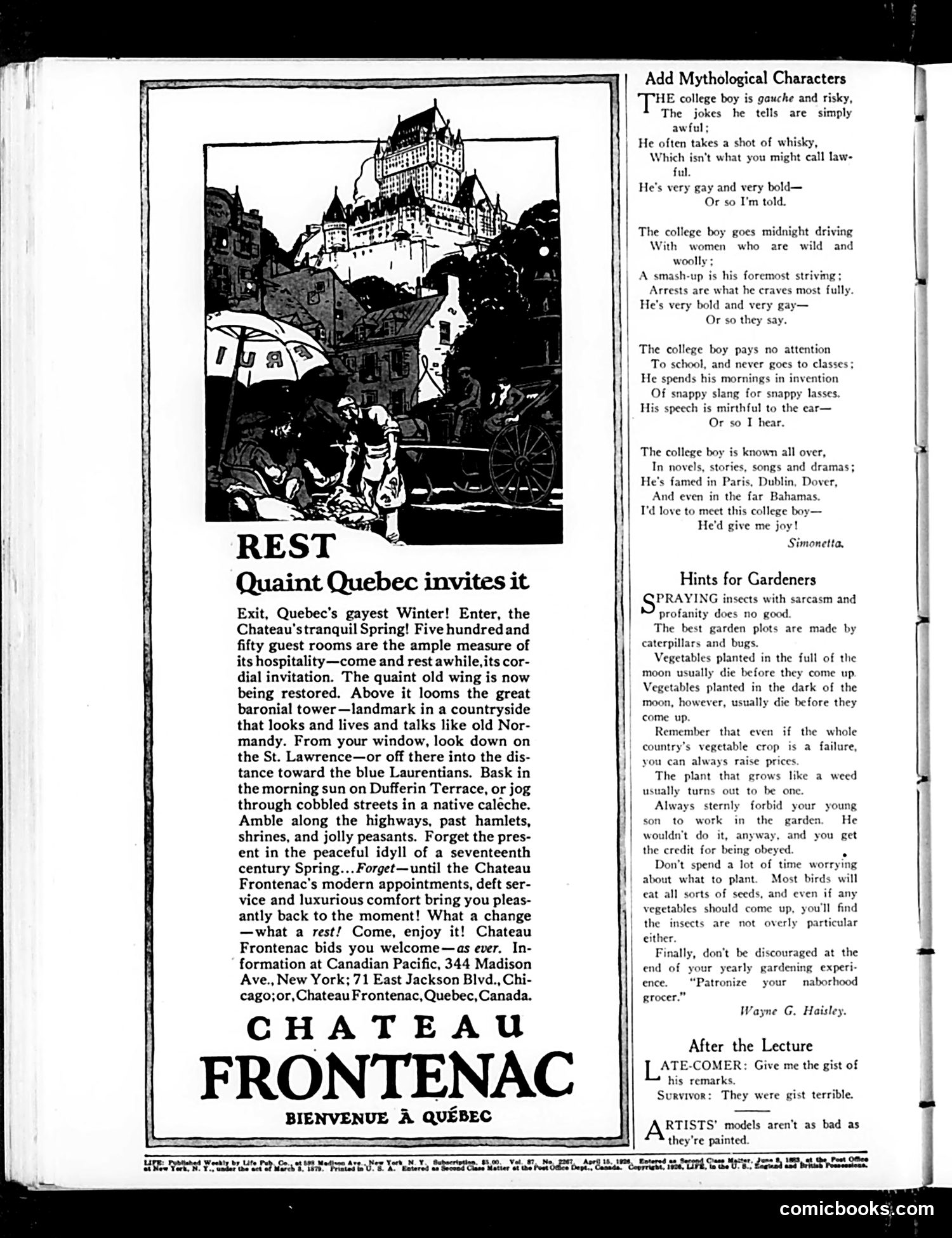
This page is primarily **advertising** for Château Frontenac, a luxury hotel in Quebec City, rather than political satire or comics. The large illustrated advertisement depicts the iconic castle-like hotel with tourists enjoying winter activities below—carriages, pedestrians with umbrellas, and scenic views. The ad promotes Quebec as a tourist destination, emphasizing the hotel's "modern appointments, deft service and luxurious comfort." The right column contains three brief humorous items: a poem about a dissolute college boy ("Simonella"), gardening tips by Wayne G. Haisley, and a short joke about artists' models. These are generic humor pieces typical of Life magazine's satirical content, unrelated to the main advertisement. The page reflects early-20th-century promotional tourism marketing and light social commentary rather than political messaging.
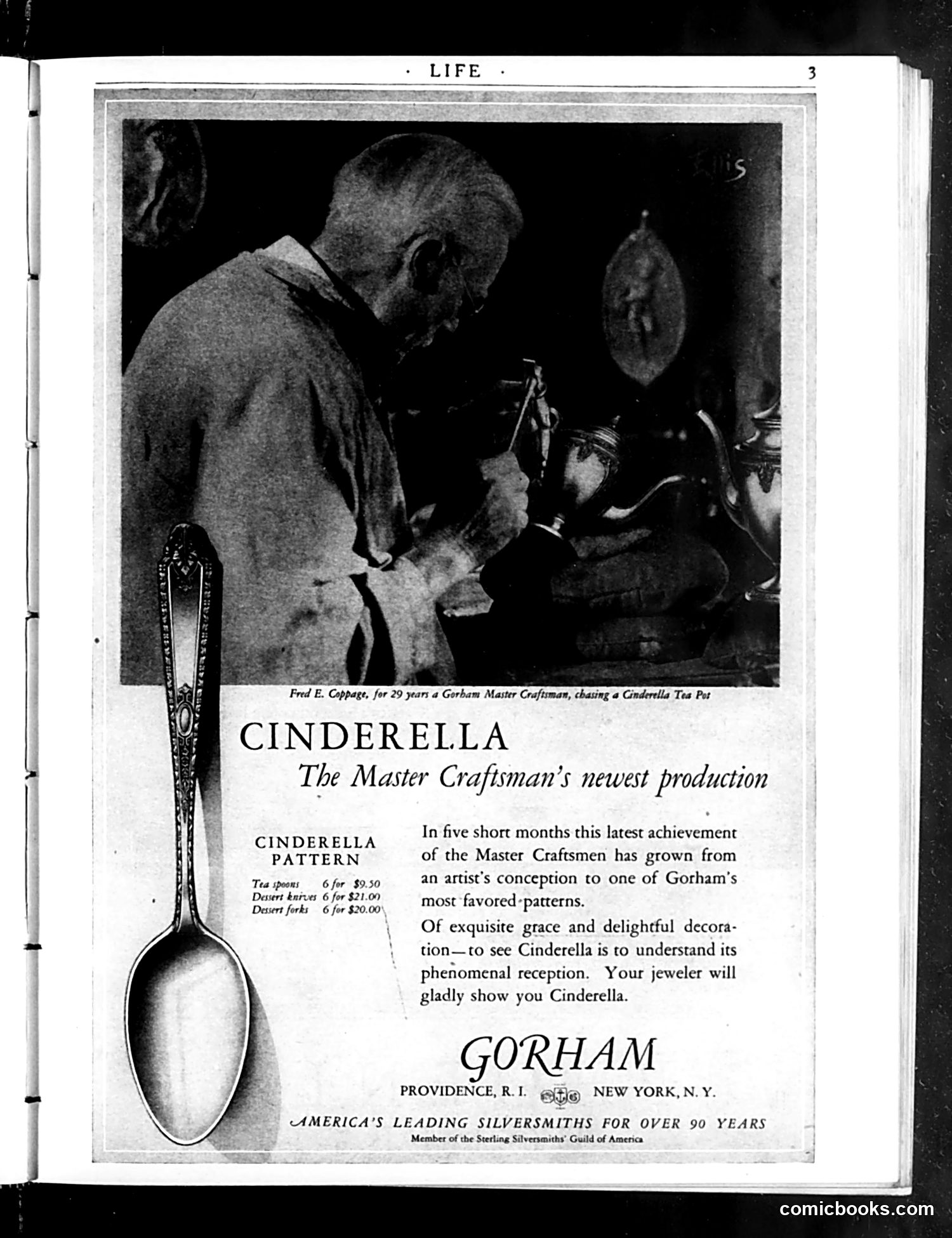
This page is **primarily an advertisement**, not satire or political content. It features Gorham Manufacturing Company, a major American silversmith, promoting their "Cinderella" pattern of flatware. The image shows Fred E. Coppages, a Gorham Master Craftsman with 20 years experience, chasing a decorative Cinderella teapot. The accompanying text emphasizes the pattern's "exquisite grace and delightful decoration," developed over five months from artistic conception to production. The Cinderella reference is purely aesthetic—evoking elegance and fairy-tale charm for luxury silverware marketing. The advertisement positions Gorham as "America's leading silversmiths for over 90 years," targeting wealthy consumers through Life magazine's readership. No political or satirical content is present; this is straightforward luxury goods advertising.
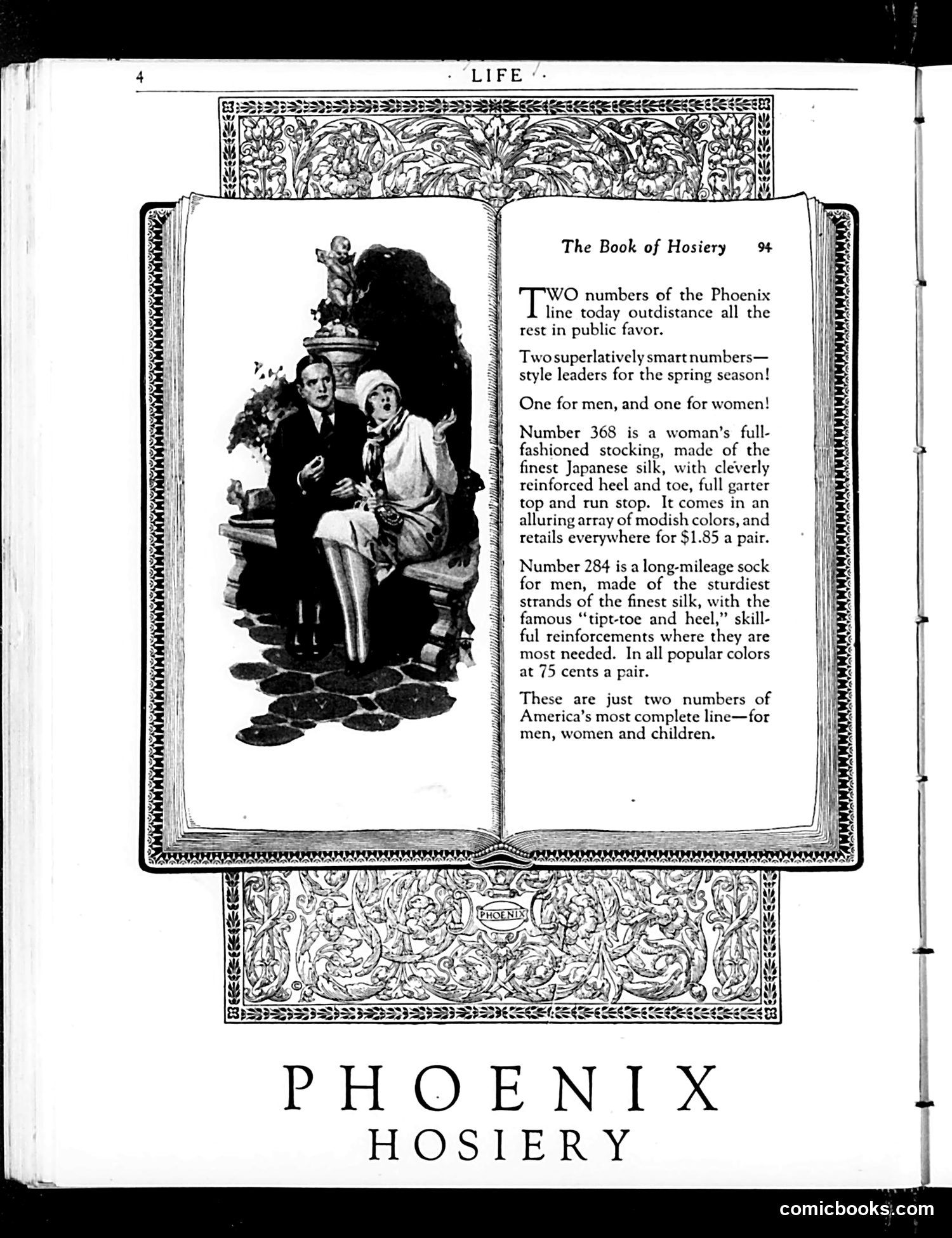
This page is primarily a **Phoenix Hosiery advertisement**, not political satire. The left side features an illustration of a well-dressed couple (man and woman) posed together, likely advertising hosiery to different demographics. The text promotes two specific products: - **Number 368**: women's silk stockings ($1.85/pair) with reinforced heel and toe - **Number 284**: men's silk socks (75 cents/pair) with "tipt-toe and heel" reinforcements The advertisement emphasizes these are "style leaders for the spring season" and part of "America's most complete line—for men, women and children." This is straightforward early 20th-century commercial content with no discernible political commentary or satire present.
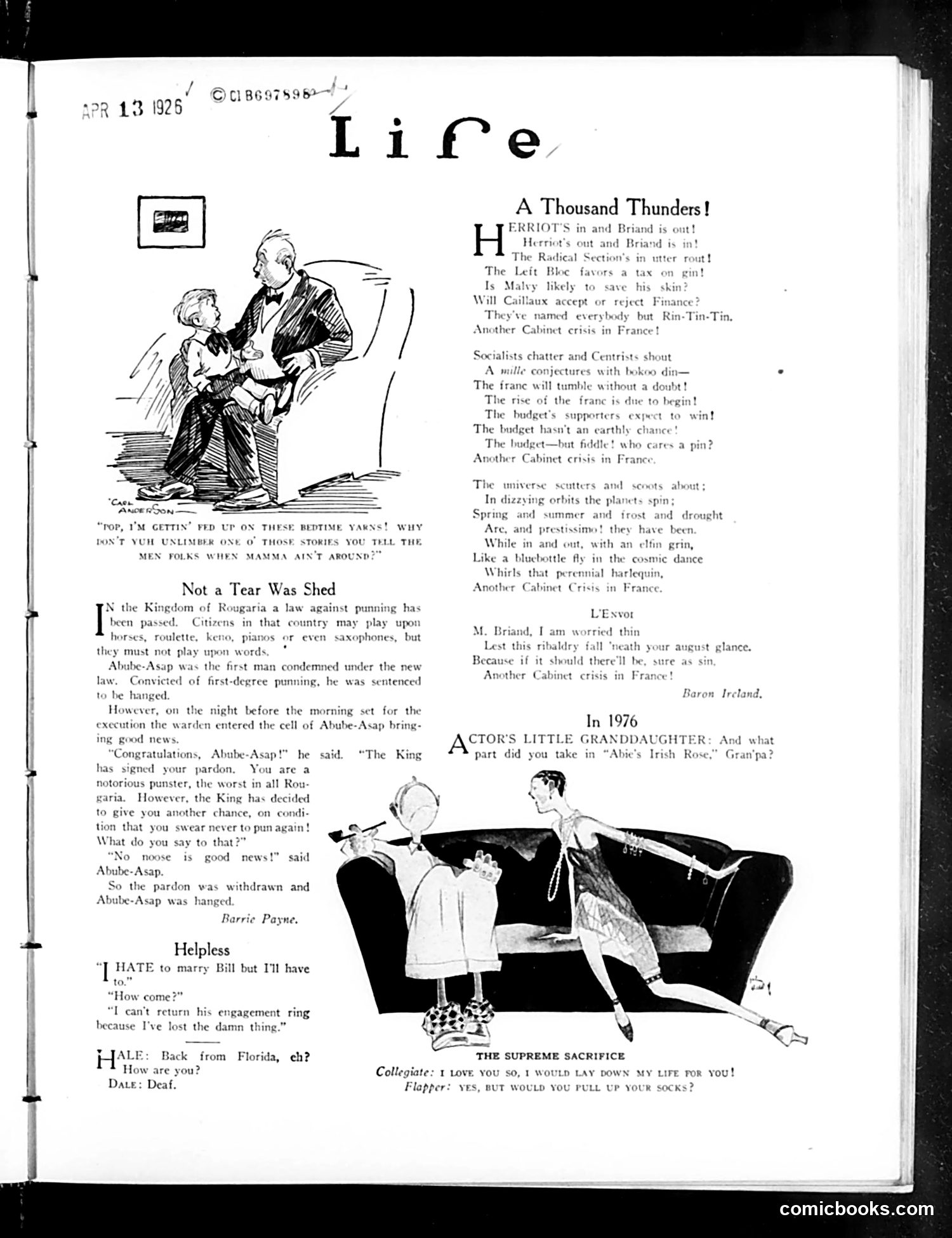
This page contains political satire about French government instability. The opening poem "A Thousand Thunders!" mocks repeated cabinet crises in France—the text repeatedly references "Another Cabinet crisis in France," suggesting chronic governmental dysfunction was a running joke at the time. The main narrative, "Not a Tear Was Shed," appears to satirize political punishment in an unspecified kingdom (likely allegorical). It describes a notorious criminal ("Abube-Asap") condemned to death but pardoned by a king, only to be executed anyway for refusing to stop committing crimes. The lower sections contain unrelated humor pieces: "In 1976" is a flapper-era joke about romantic sacrifice, and "Helpless" jokes about broken engagements.
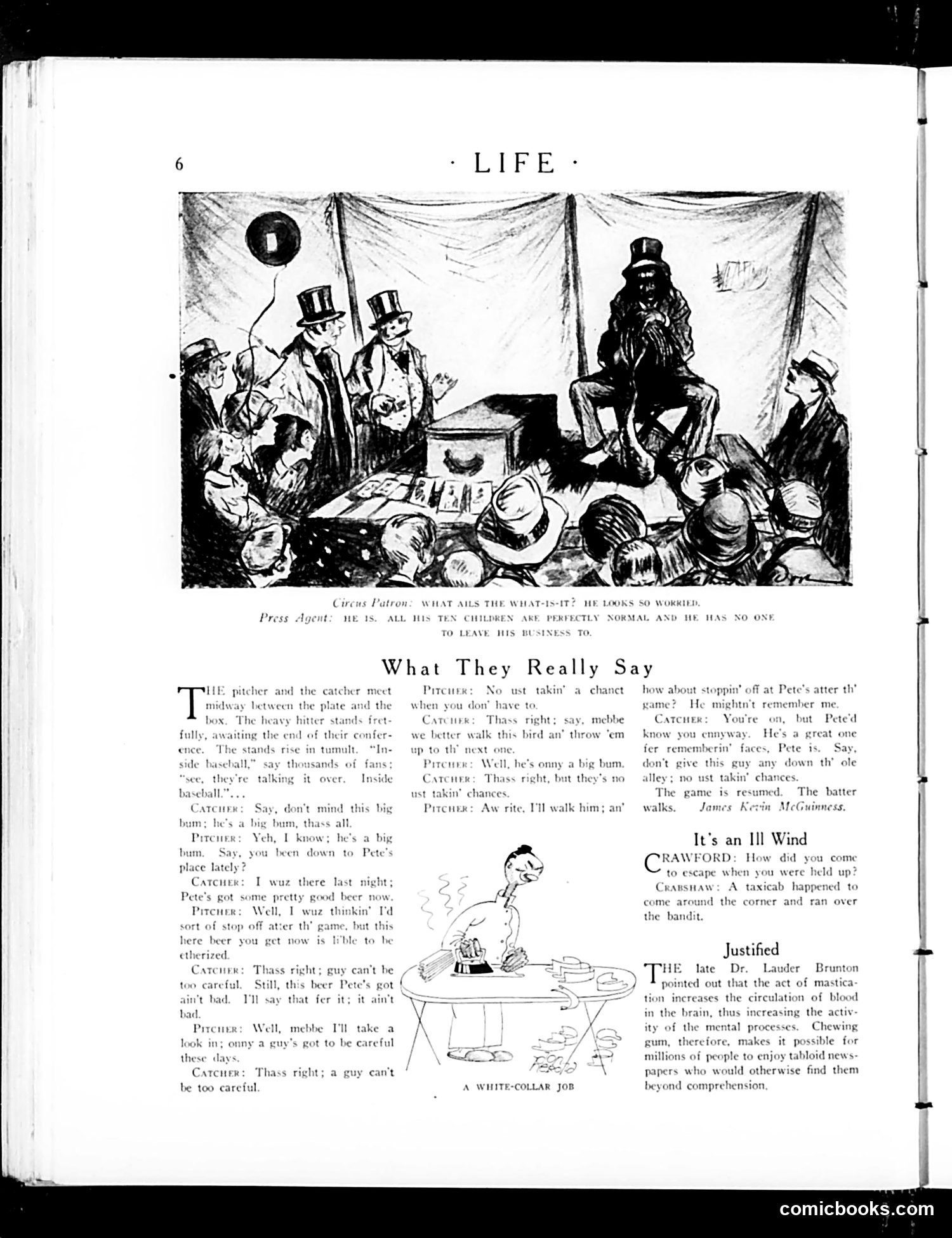
This page satirizes baseball culture through a circus-themed cartoon at top. The sketch shows a circus ringmaster, performers, and audience—a metaphorical comparison suggesting baseball games have become theatrical spectacles rather than genuine sport. The dialogue sections below mock typical baseball fan conversations. "What They Really Say" presents a pitcher and catcher discussing Pete (likely a player), emphasizing how fans discuss players' drinking habits and poor behavior, which they rationalize as acceptable. The satire suggests fans overlook or excuse misconduct if a player performs well athletically. "It's an Ill Wind" and "Justified" appear to be separate humorous pieces about urban life—one involving a taxicab accident, another defending chewing gum as beneficial to mental circulation. The overall theme critiques how sports fans prioritize entertainment spectacle and player performance over moral standards.
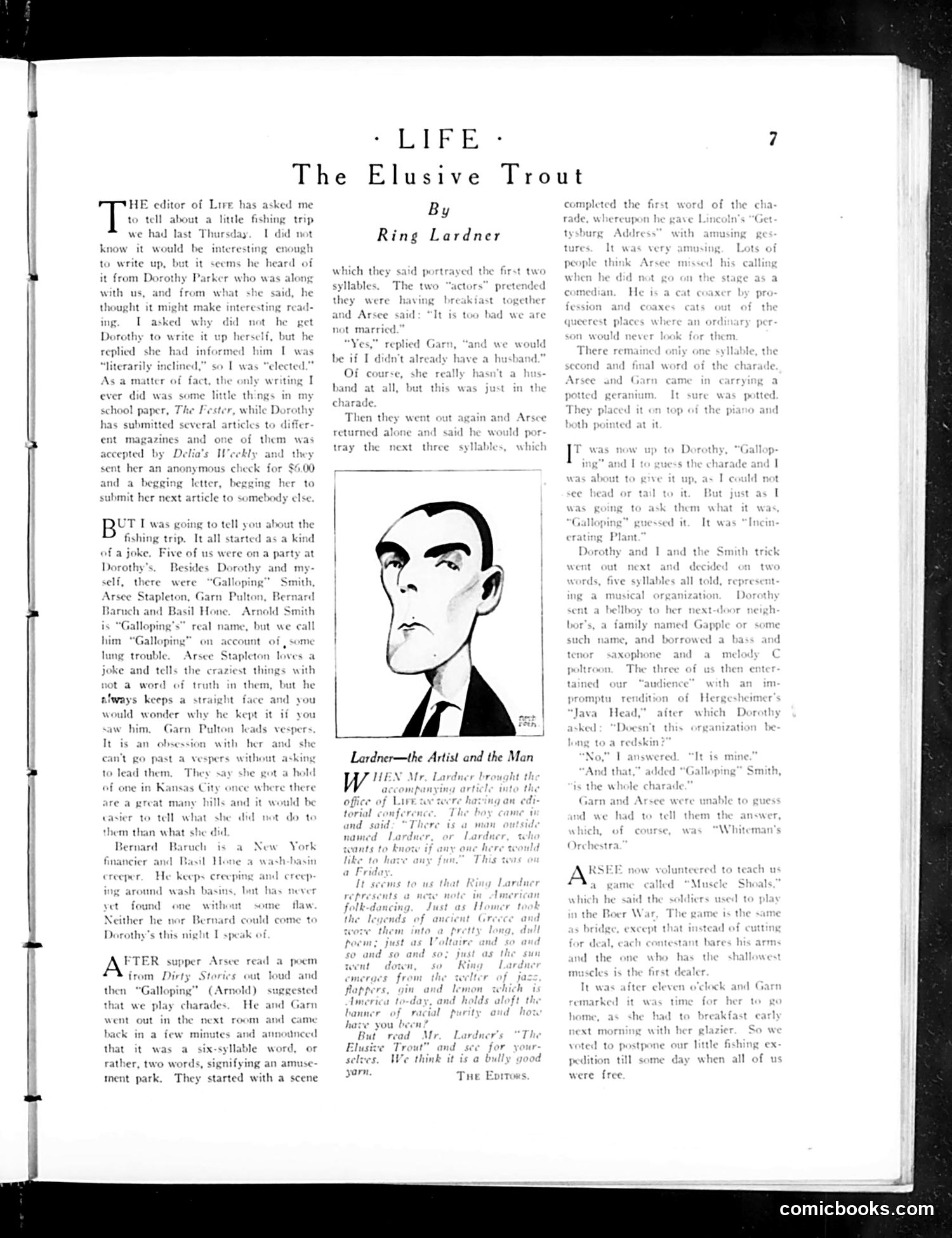
This satirical article describes a humorous fishing trip involving theater people, including someone named "Galloping" Smith (whose real name is apparently a running joke). The accompanying caricature depicts a man with exaggerated features—prominent nose, thin face, stern expression—labeled "Lardner—the Artist and the Man." The piece satirizes theatrical pretension and romantic comedies. The characters attempt to act out a charade where they perform an elaborate musical number, apparently mocking both amateur dramatics and the sentimental conventions of contemporary theater. The "elusive trout" appears to be both literal (a fishing story) and metaphorical—a critique of people chasing after frivolous entertainment and artifice rather than genuine experiences.
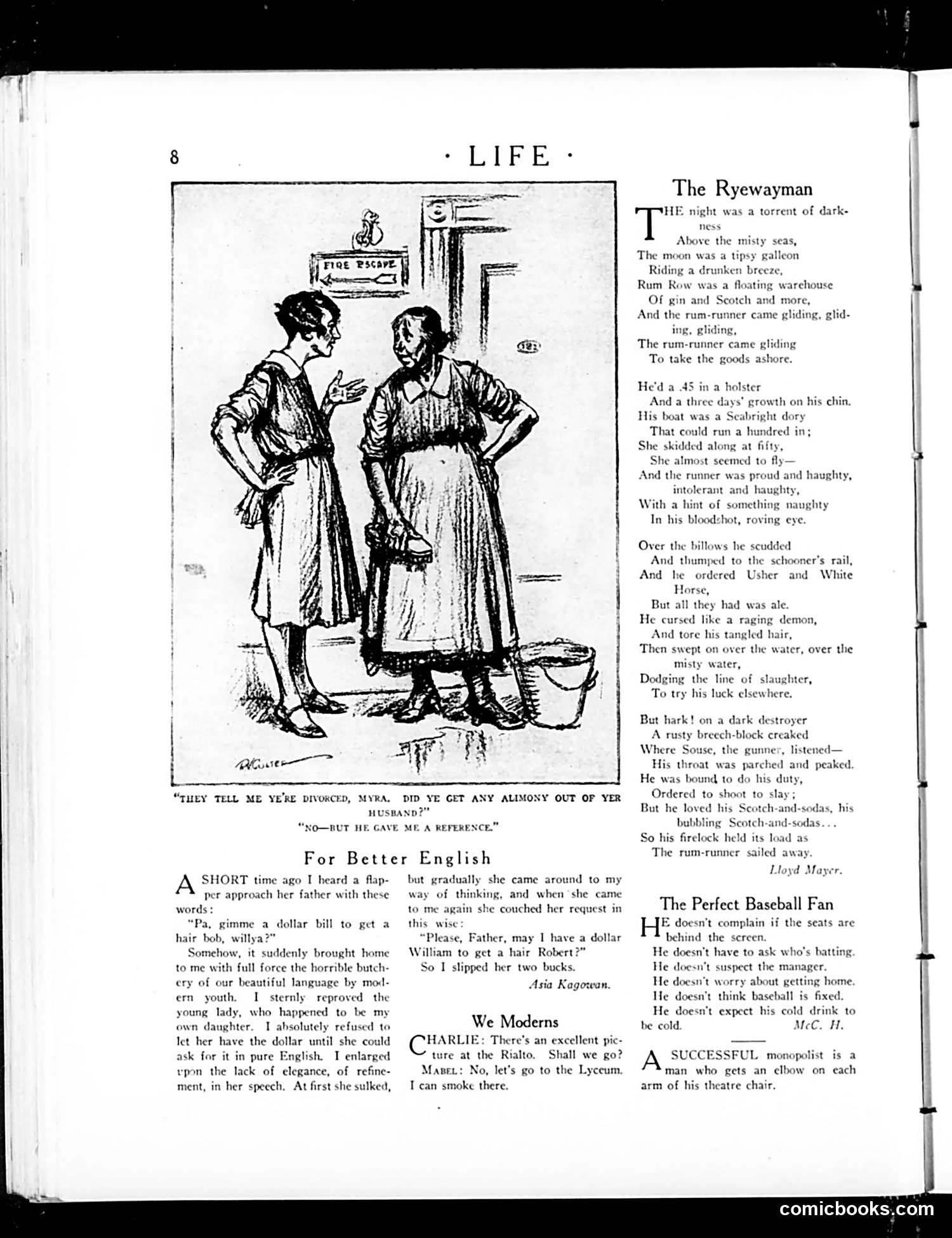
The main illustration shows two women in conversation beneath a sign reading "Riot Escape." The cartoon's caption reads: "They tell me ye're divorced, Myra. Did ye get any alimony out of yer husband?" with the response "No—but he gave me a reference." This is a joke about divorce and female employment in the early 20th century. The humor lies in the woman receiving a job reference from her ex-husband instead of financial alimony—a practical but emotionally deflating outcome. The Scottish dialect ("ye're," "yer") suggests working-class characters, implying this was a common circumstance among ordinary people rather than the wealthy. The satire critiques inadequate divorce settlements for women while highlighting their limited economic options beyond securing employment.
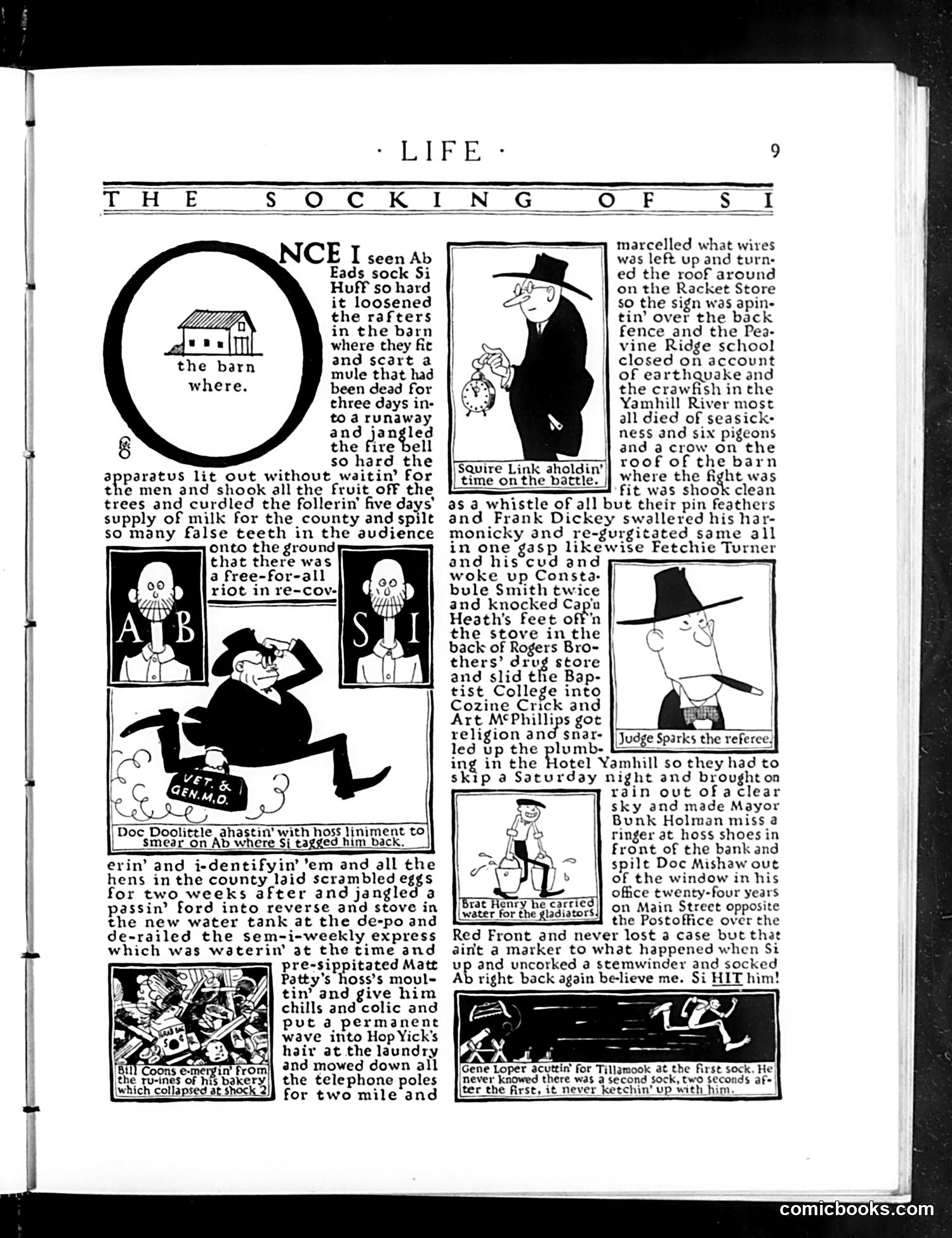
This page satirizes small-town American life through interconnected anecdotes about a character named "Si." The cartoons depict various humorous incidents: Si causing a barn fire by striking a match too hard; Doc Doolittle fighting with Si in a cloud of dust labeled "GEN. MUD"; Brat Henry carrying water for gladiators; Judge Sparks serving as referee; and Bill Coons emerging from his bakery's collapsed roof. The text describes Si's chaotic adventures—disturbing animals, creating floods, and spreading chaos through the town via telephone poles. The humor relies on exaggeration and slapstick: Si as a bumbling character whose ignorance or carelessness creates rippling disasters throughout the community. This reflects early 20th-century American humor mocking rural or small-town incompetence and mishaps.
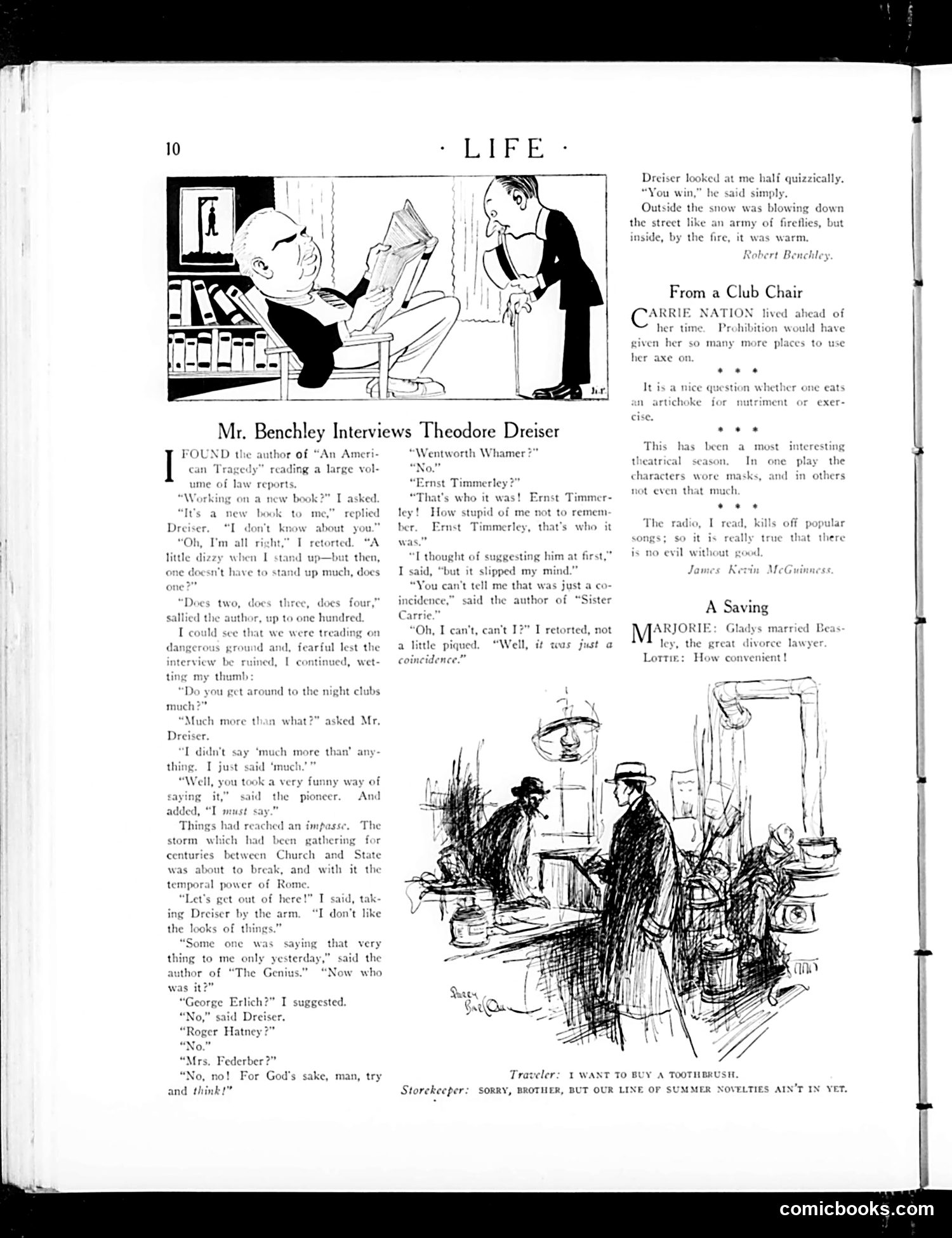
This page contains three distinct pieces of satire: 1. **"Mr. Benchley Interviews Theodore Dreiser"** (top left): A cartoon showing an interview between humorist Robert Benchley and novelist Theodore Dreiser. The text depicts Benchley playfully challenging Dreiser about whether he's read his own works, with Dreiser admitting he hadn't finished "An American Tragedy." It's gentle literary satire mocking authorial pretension. 2. **"From a Club Chair"** (right column): Brief editorial commentary on Prohibition's effects, noting it gave women more venues to frequent. The radio killing popular songs receives mild criticism. 3. **"A Saving"** (bottom right): A cartoon joke about a woman marrying a divorce lawyer for convenience, with a separate vignette showing shopkeeper humor about summer novelties. The overall tone is lighthearted domestic and literary satire typical of 1920s Life magazine.
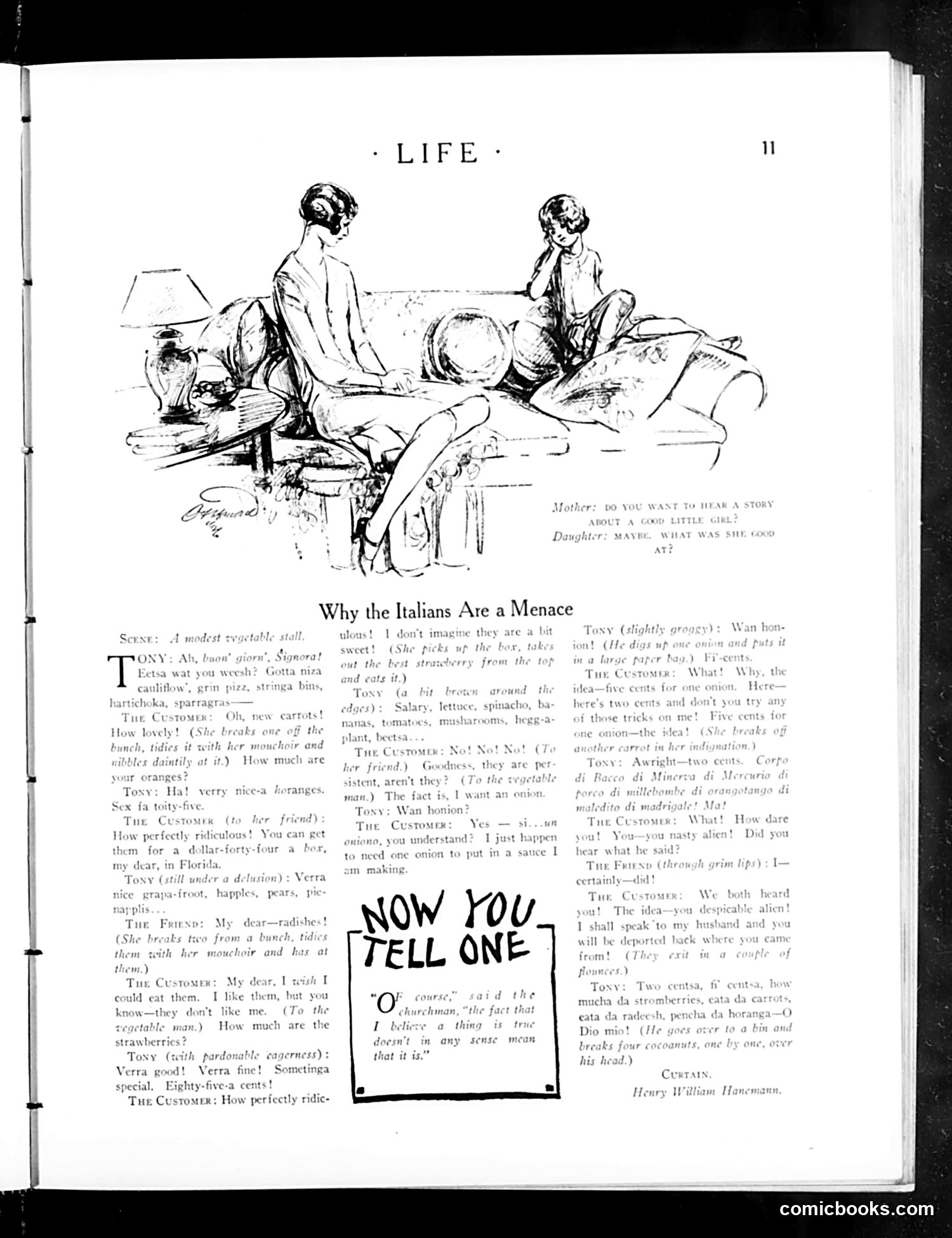
This satirical sketch depicts a domestic scene where a mother and daughter discuss Italian immigrants. The humor relies on ethnic stereotyping common to early 20th-century American humor. The dialogue presents caricatured Italian speech patterns and stereotypes: Italians are portrayed as eating "strange" vegetables (onions, spinach, mushrooms, beets) unfamiliar to Anglo-American diets, and the setup jokes that this dietary difference makes them a "menace." A character named Tony embodies Italian immigrant stereotypes—his fractured English and enthusiasm for inexpensive foods reinforce period prejudices about working-class immigrants. The "menace" framing reflects actual anti-Italian sentiment of the era, though the page treats it as lighthearted domestic comedy rather than serious social commentary.
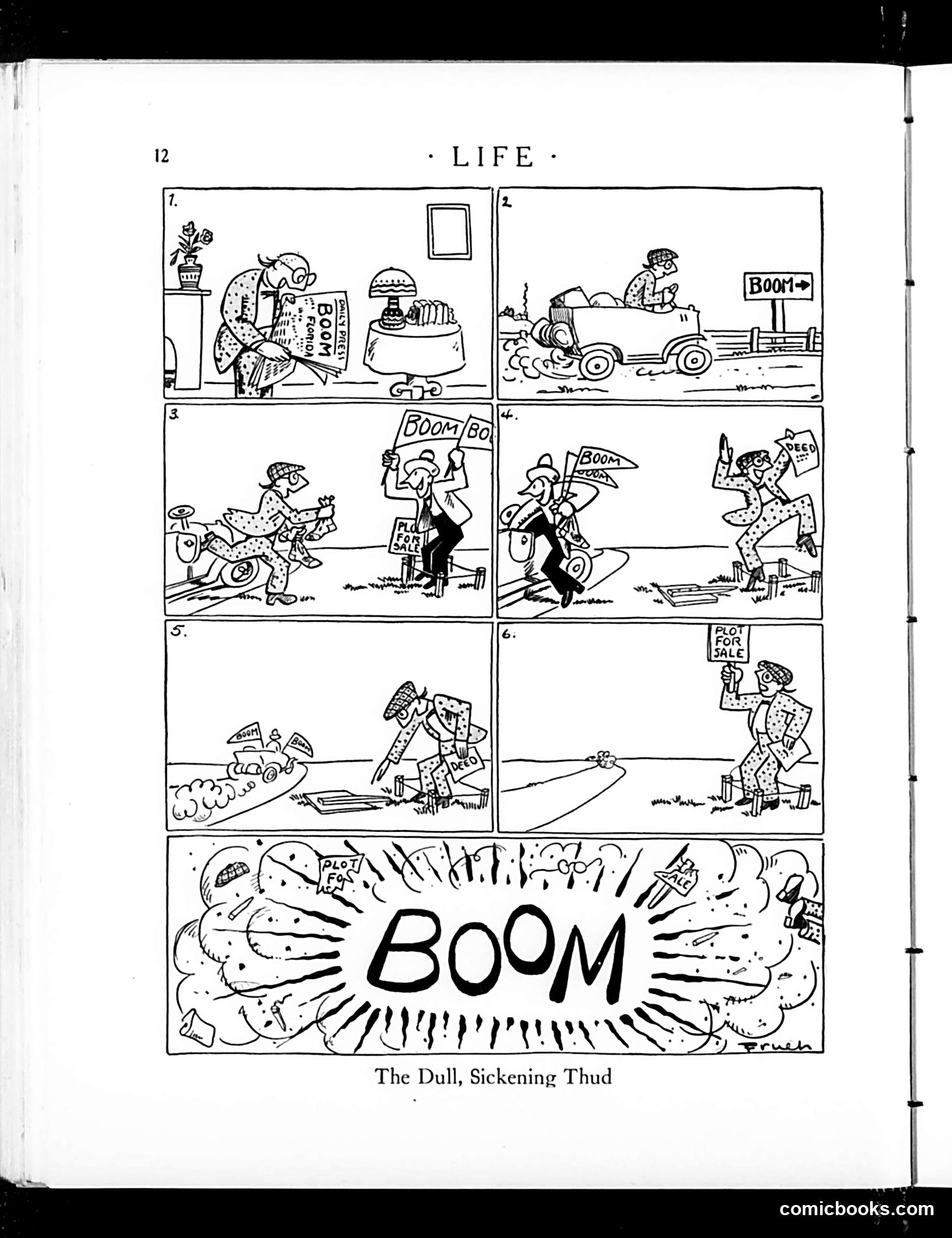
This comic strip satirizes the real estate boom of the 1920s. A man repeatedly attempts to sell property ("Boom!" signs appear throughout), experiencing escalating failures. He starts with a newspaper advertisement, then tries direct sales pitches to increasingly skeptical buyers on what appears to be vacant land. Each panel shows him growing more desperate as he's rebuffed. The final large "BOOM" represents either a market collapse or the man's complete breakdown. The title "The Dull, Sickening Thud" suggests the crashing sound of the real estate bubble bursting—likely referencing the speculative excess and inevitable market corrections that characterized 1920s American prosperity before the 1929 crash.
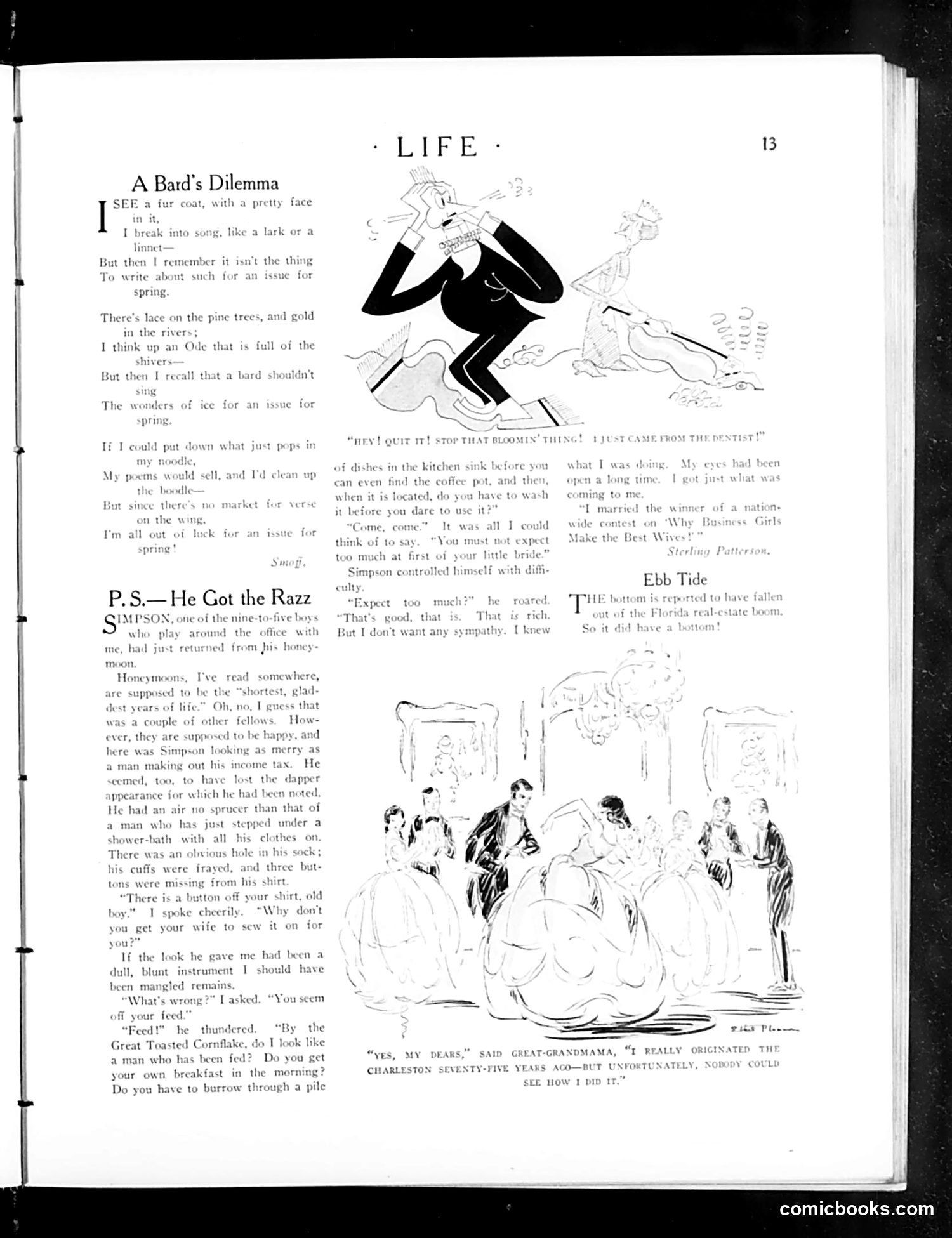
This page contains three satirical pieces about domestic life and social etiquette: **"A Bard's Dilemma"** (top left) is a humorous poem about a writer struggling to find poetic inspiration amid mundane household tasks—dirty dishes, coffee pots, and spring cleaning—suggesting the difficulty poets face monetizing their work. **"P.S.—He Got the Razz"** depicts a newly-married man experiencing domestic embarrassment: his wife criticizes his appearance and grooming habits. The satire targets husbands being hen-pecked by wives focused on propriety and appearances. **"Ebb Tide"** (bottom) shows an elderly woman claiming to have originated the Charleston dance seventy-five years ago—a joke about generational disputes over who invented popular dances, and older generations' incredulity about modern youth crazes. All pieces mock domestic tensions and generational attitudes circa the 1920s-30s.
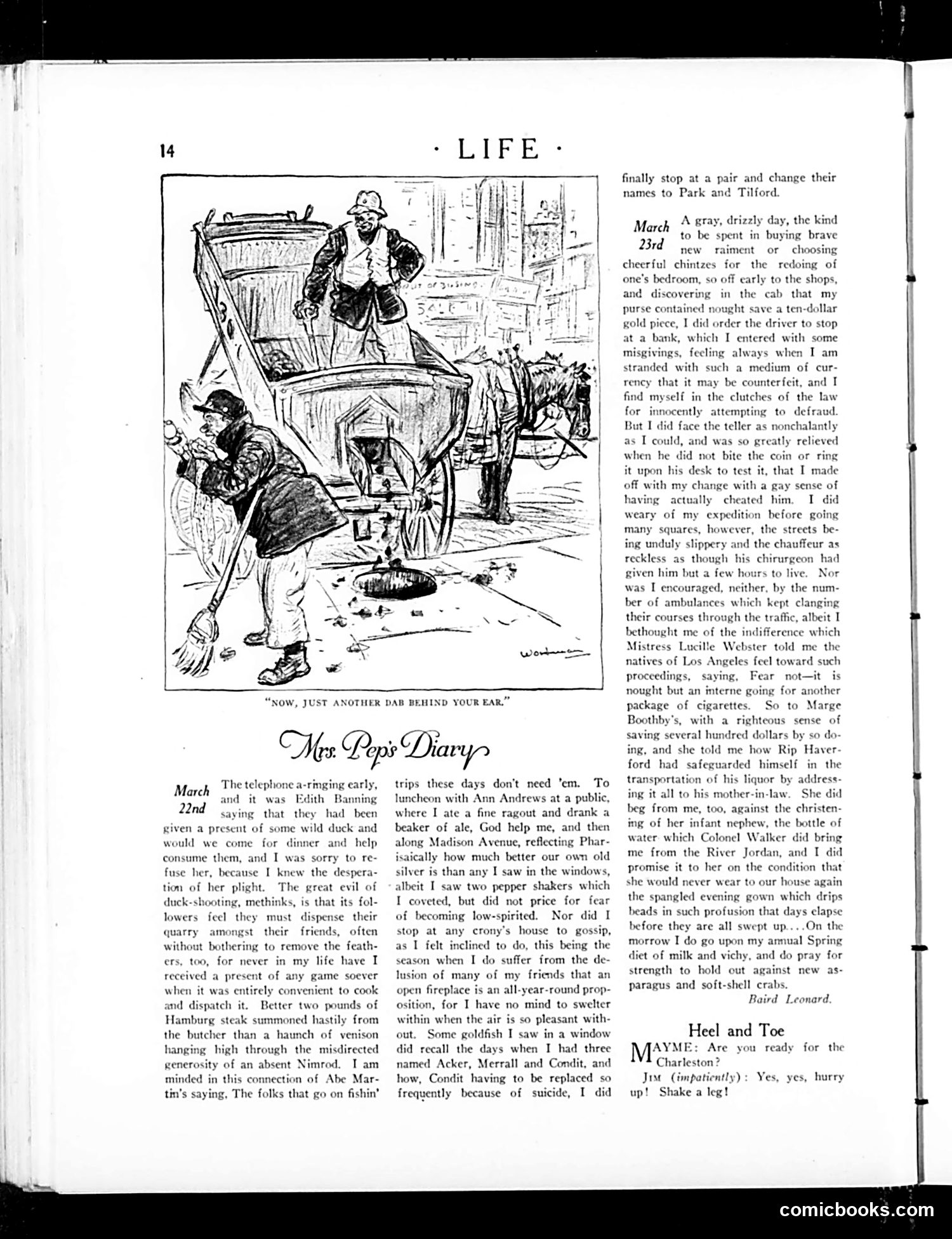
This cartoon satirizes taxi drivers and street traffic in early 20th-century urban America. The illustration shows a disheveled cabbie applying something (likely perfume or cologne) behind a passenger's ear—a gesture suggesting the driver is trying to mask the foul odors of the cab itself, which appears cluttered and dirty. The joke targets poor urban sanitation and hygiene standards of the era, particularly the deplorable conditions of public transportation. The caption's ironic tone suggests this cosmetic "solution" is absurdly inadequate for addressing the cab's actual filth. The cartoon mocks both negligent drivers and the broader urban infrastructure problems that made such vehicles notoriously unclean and unpleasant for passengers.
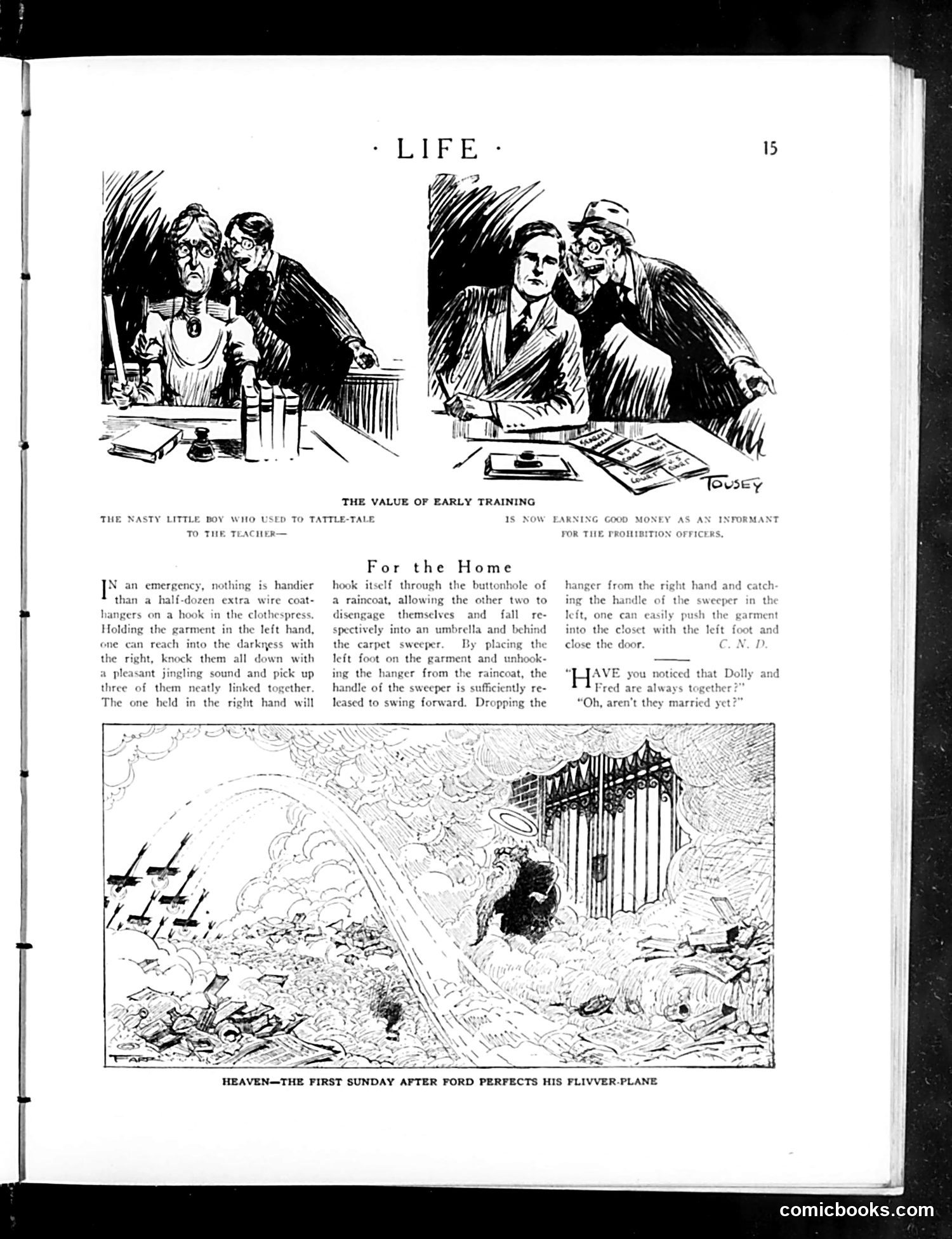
This page contains two distinct satirical pieces: **Top cartoons** ("The Value of Early Training"): These mock a "nasty little boy who used to tattle-tale" who has grown up to become an informant for Prohibition officers, now "earning good money." The satire criticizes childhood gossips who become adult informers—a common social anxiety during Prohibition (1920-1933). **"For the Home" section**: Practical domestic advice about hanging coats and managing garments in tight closets. **Bottom cartoon** ("Heaven—The First Sunday After Ford Perfects His Flivver-Plane"): This satirizes Henry Ford's automobile innovations. It depicts heaven overflowing with crashed aircraft (Ford's hypothetical flying cars), suggesting that widespread personal flight technology would create chaos rather than paradise—a humorous commentary on technology's disruptive potential.
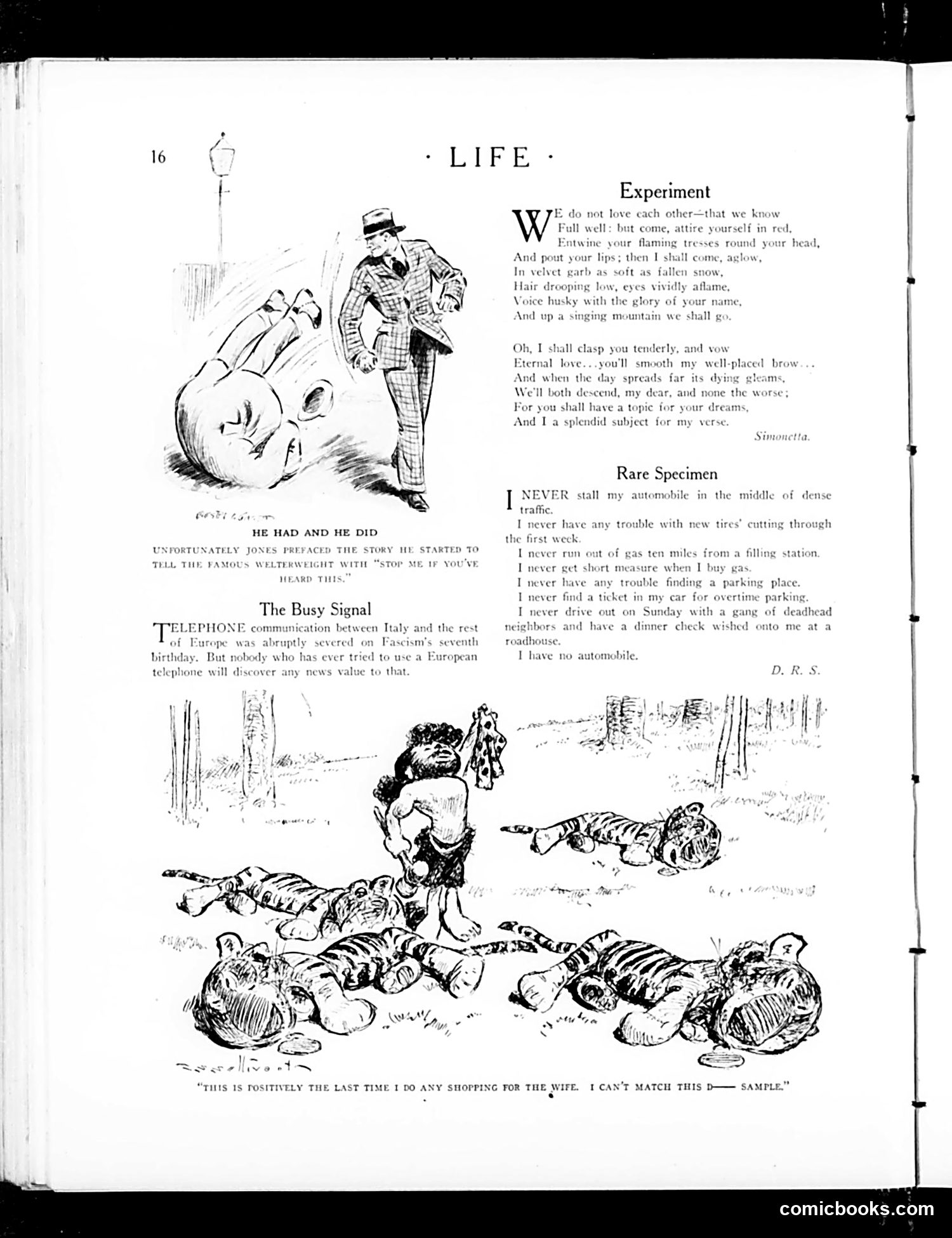
The page contains three separate pieces: 1. **"Experiment"** — A poem by Simonetta about romantic seduction, illustrated with a man in checkered suit approaching a reclining woman. 2. **"Rare Specimen"** — A humorous list by D.R.S. cataloging an automobile owner who never encounters common driving problems (traffic, tire trouble, parking tickets, etc.), ending with the punchline "I have no automobile." 3. **"The Busy Signal"** — A brief note about telephone communication between Italy and Europe being severed under Fascism's seventh birthday, with an illustration showing multiple people lying prone on the ground, apparently unable to communicate. The satire targets Fascist Italy's isolation and communication blackout, depicted through dark humor in the prone figures below.
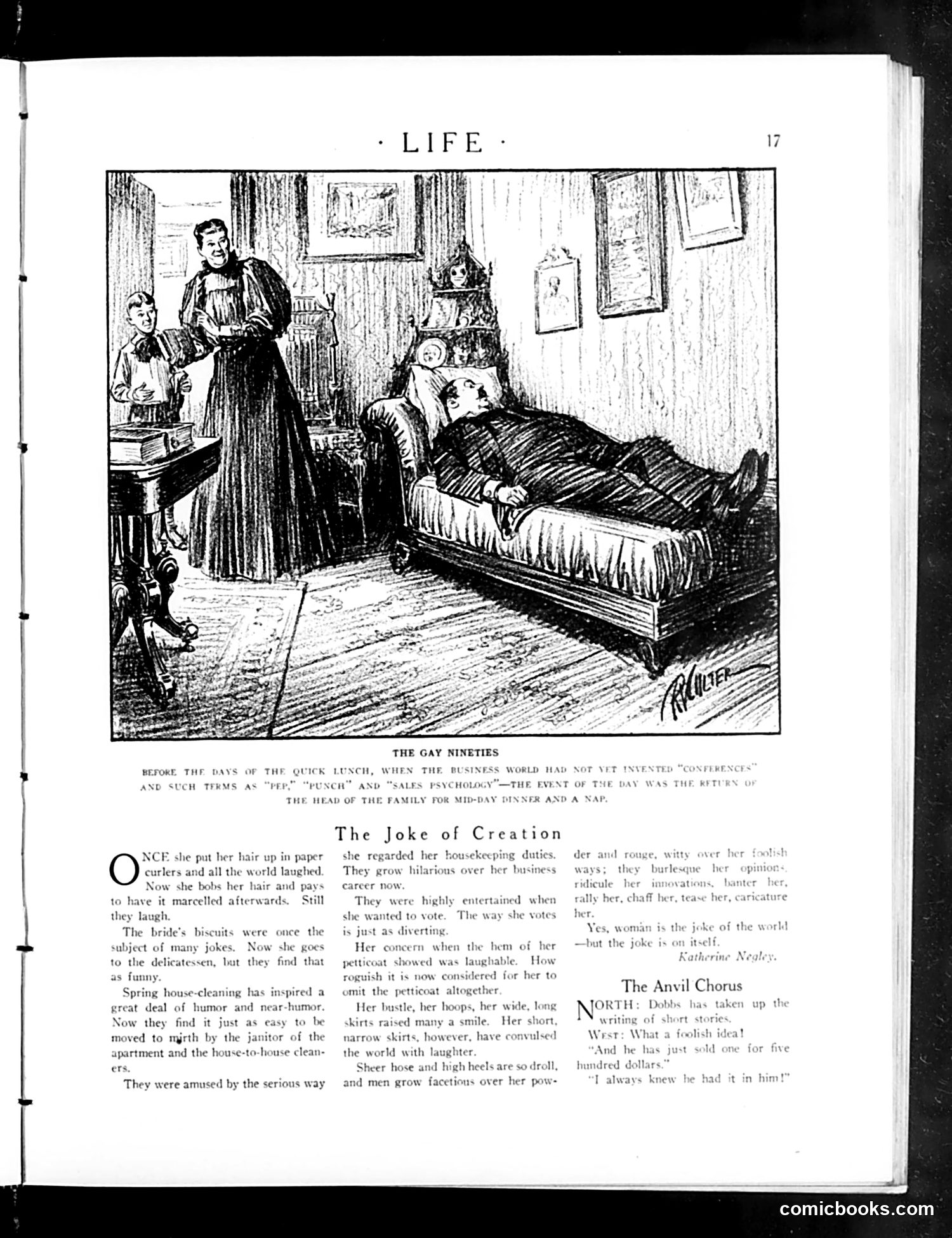
This Life magazine page satirizes changing attitudes toward women from the 1890s to the present (the magazine's contemporary moment). The cartoon depicts a bedridden man being attended to by his wife and servant—likely representing the "gay nineties" era when women's roles were strictly domestic. The accompanying text mocks how men previously found women's appearance and domestic concerns hilarious: her failed biscuits, her hairstyles, her petticoats and bustles. The satire's point: men treated women's aspirations—voting, business careers, fashion choices—as jokes rather than serious concerns. "The Joke of Creation" and "The Anvil Chorus" sections continue this theme, suggesting women have become the world's "joke" precisely because their innovations and independence challenge traditional male expectations. The piece critiques the casual dismissal of women's ambitions as inherently comedic.
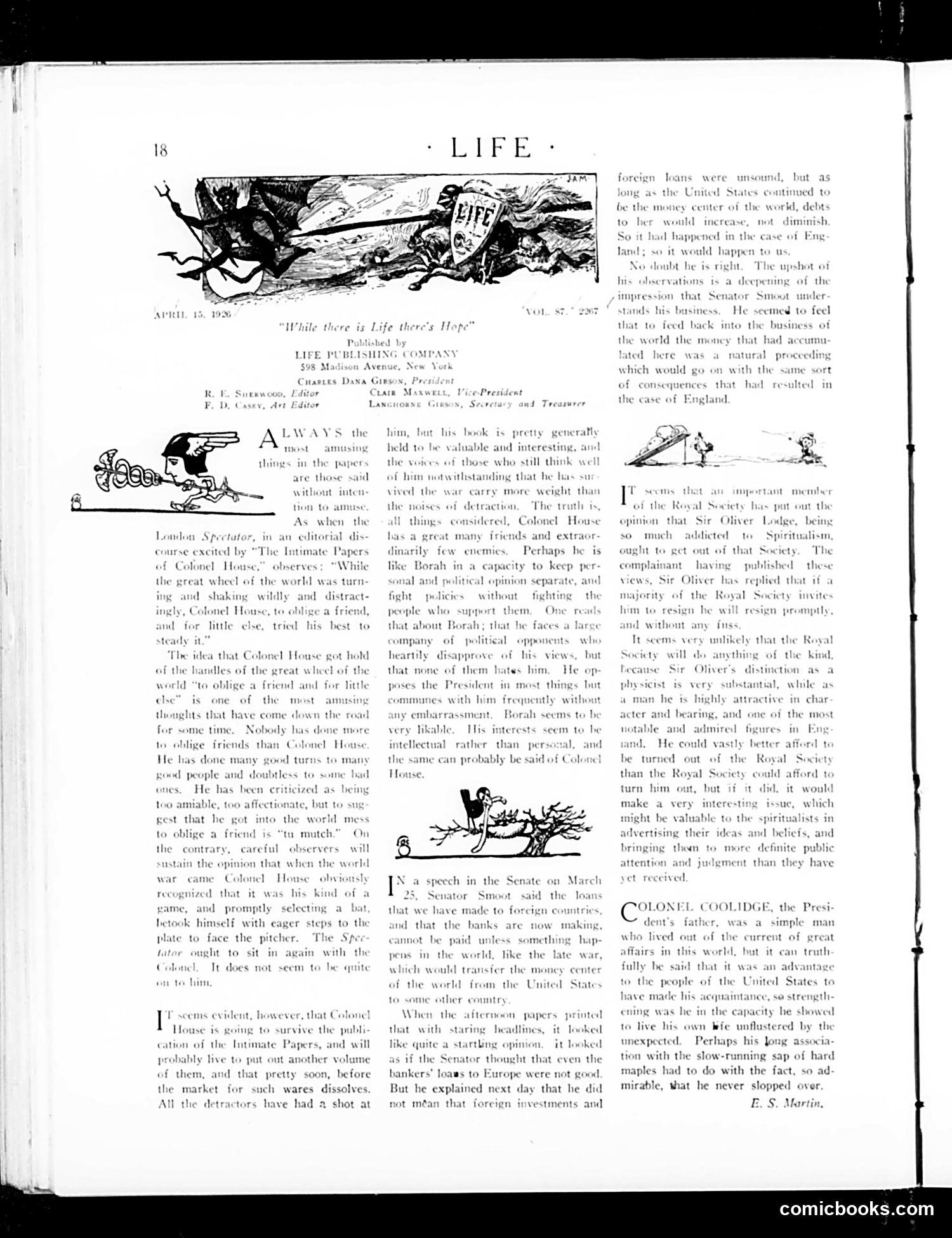
This page discusses **Senator Smoot** and **Colonel Coolidge** (father of President Calvin Coolidge) in the context of post-WWI foreign loans and financial policy. **The political context:** The article critiques Senator Smoot's statements about foreign loans to Europe, suggesting his position that banks' loans abroad won't diminish but rather increase America's role as "money center of the world." The writer argues this misunderstands economic consequences—echoing what happened with England's finances. **Colonel Coolidge** is praised as a simple, unflappable man who lived outside current affairs. The satire suggests he represents an older American virtue of detachment from the world's financial entanglements. **The cartoons** (small illustrations) appear to be decorative period humor, though specific figures are unclear in reproduction. The broader point: American financial interventionism abroad carries unintended consequences—a prescient concern given the 1920s loan bubble preceding the 1929 crash.
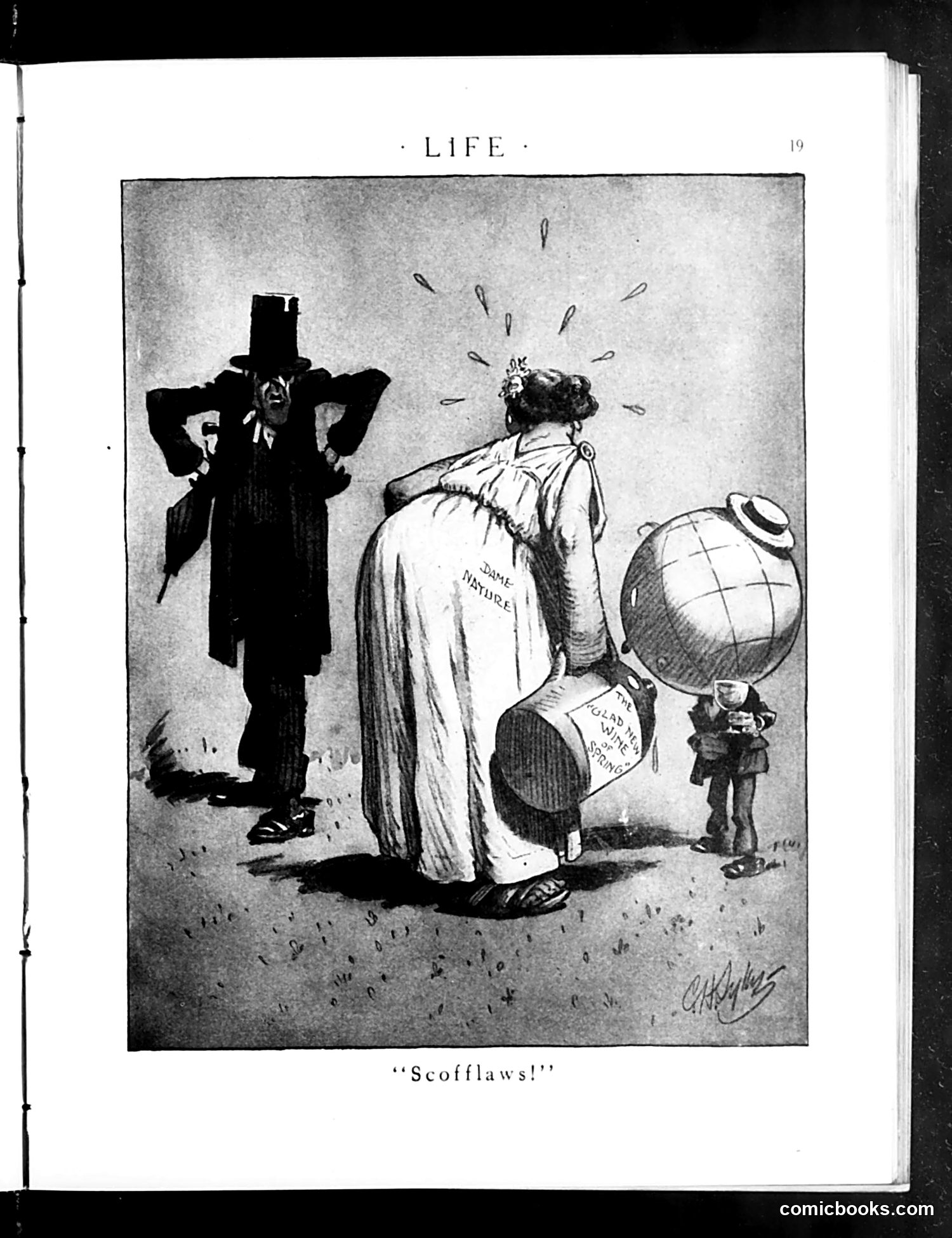
This cartoon satirizes violations of Prohibition—the ban on alcohol sales (1920-1933). The figure on the left appears to be a stern authority figure (likely a lawman or government official) confronting a woman labeled "Dame Nature" who is caught red-handed with contraband: a large globe labeled "Old Wine" and what appears to be a barrel of spirits. The humor lies in the paradox: authorities cannot actually arrest or punish nature itself for producing wine and alcohol naturally. The term "scofflaws" (those who mock the law) applies to people exploiting this loophole—essentially blaming nature rather than human bootleggers. The cartoon mocks both the futility of Prohibition enforcement and those who circumvent it through such absurd logic.
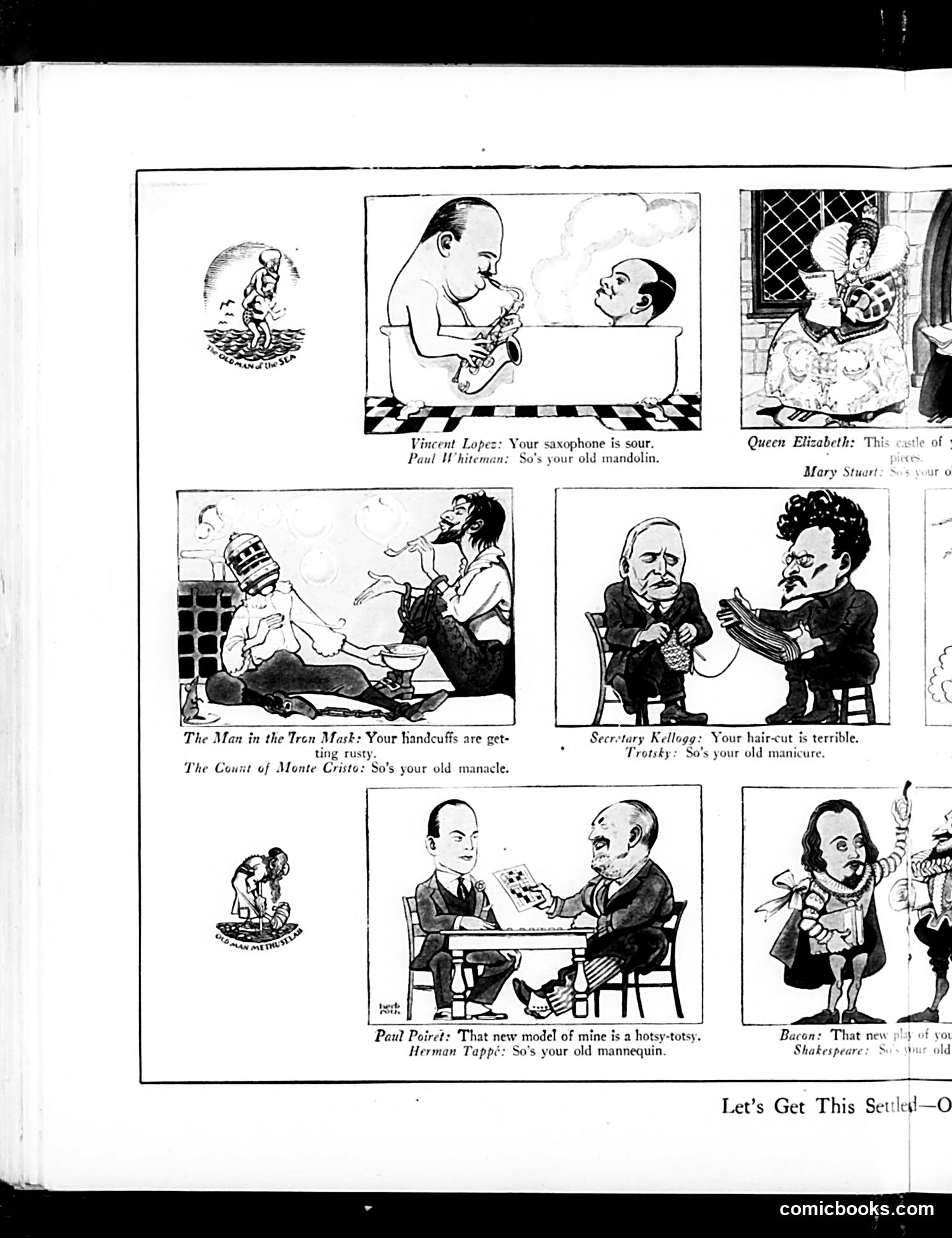
This page presents a series of cartoon panels using **literary and historical figures** (Queen Elizabeth, Mary Stuart, the Man in the Iron Mask, Count of Monte Cristo, Shakespeare, Bacon, Paul Poiret) paired with **contemporary 1920s personalities** (musician Vincent Lopez, bandleader Paul Whiteman, fashion designer Paul Poiret, and others). The joke follows a consistent pattern: each contemporary figure insults the historical figure's work/appearance, who responds with a dismissive comeback about the modern person's craft being outdated or inferior. The satire mocks **pretentiousness and mutual criticism** between high culture and modern entertainment. References like "hotsy-totsy" (slang for exciting/stylish) and "mannequin" anchor this firmly in 1920s vernacular. The underlying point appears to be that both old and new have flaws—nobody should claim superiority.
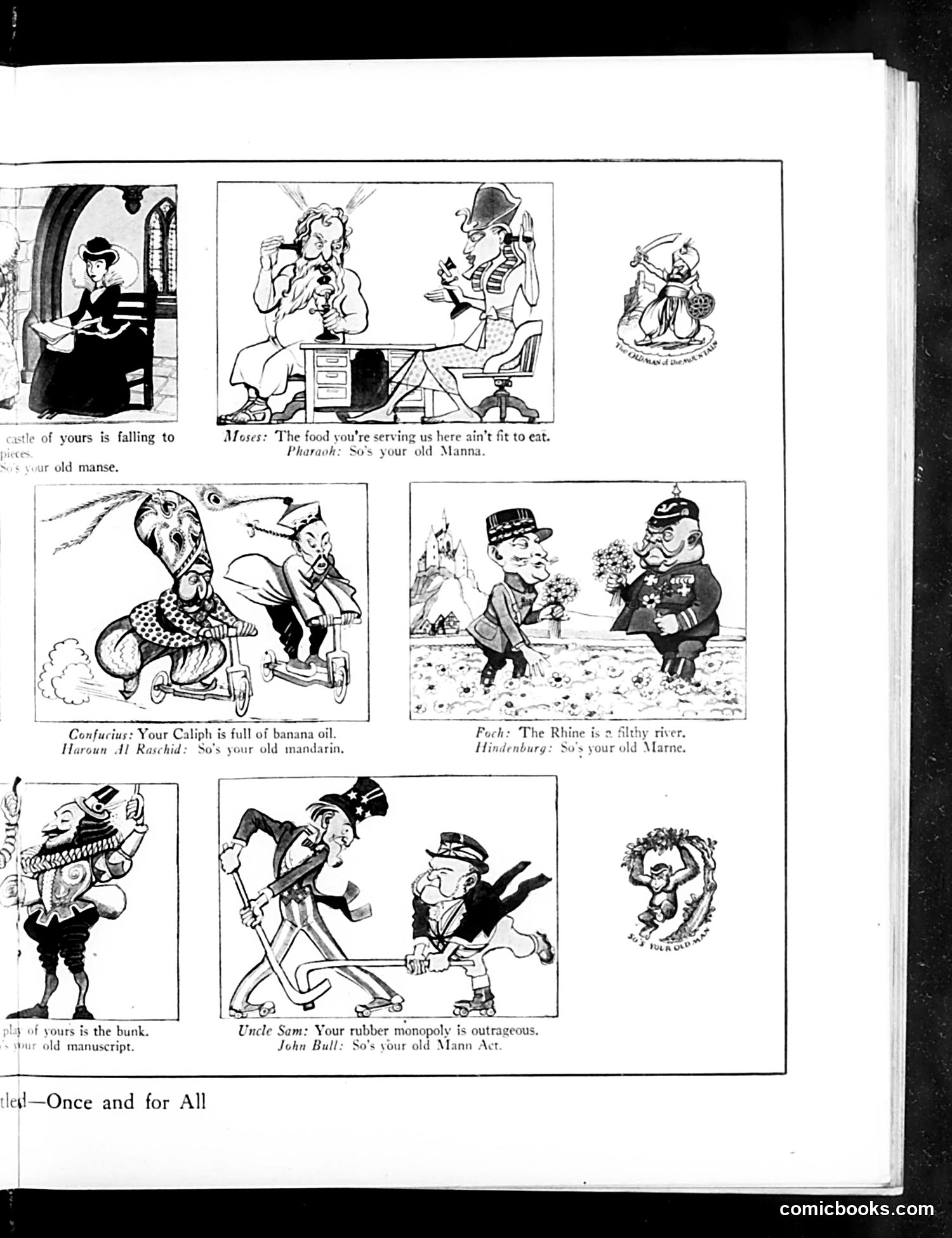
This page contains paired insult exchanges between historical/mythological figures and WWI national leaders, mocking wartime propaganda and grievances. Each panel shows a famous figure (Confucius, Pharaoh, Foch, Hindenburg, etc.) trading barbs about mutual faults. The satire targets: - **National stereotypes and complaints**: References to the Rhine, Marne, and Mann Act invoke military conflicts and moral scandals - **"Banana oil"** (slang for nonsense) suggests both sides are making false claims - **The implicit message**: All nations involved in WWI are equally culpable and hypocritical—each accusing others of exactly what they themselves do wrong The title "Once and for All" suggests exasperation with endless mutual recriminations. The cartoon uses historical parallels to argue that wartime finger-pointing is futile; everyone's "old" traditions and practices are equally corrupt. It's anti-war satire promoting skepticism about official narratives.
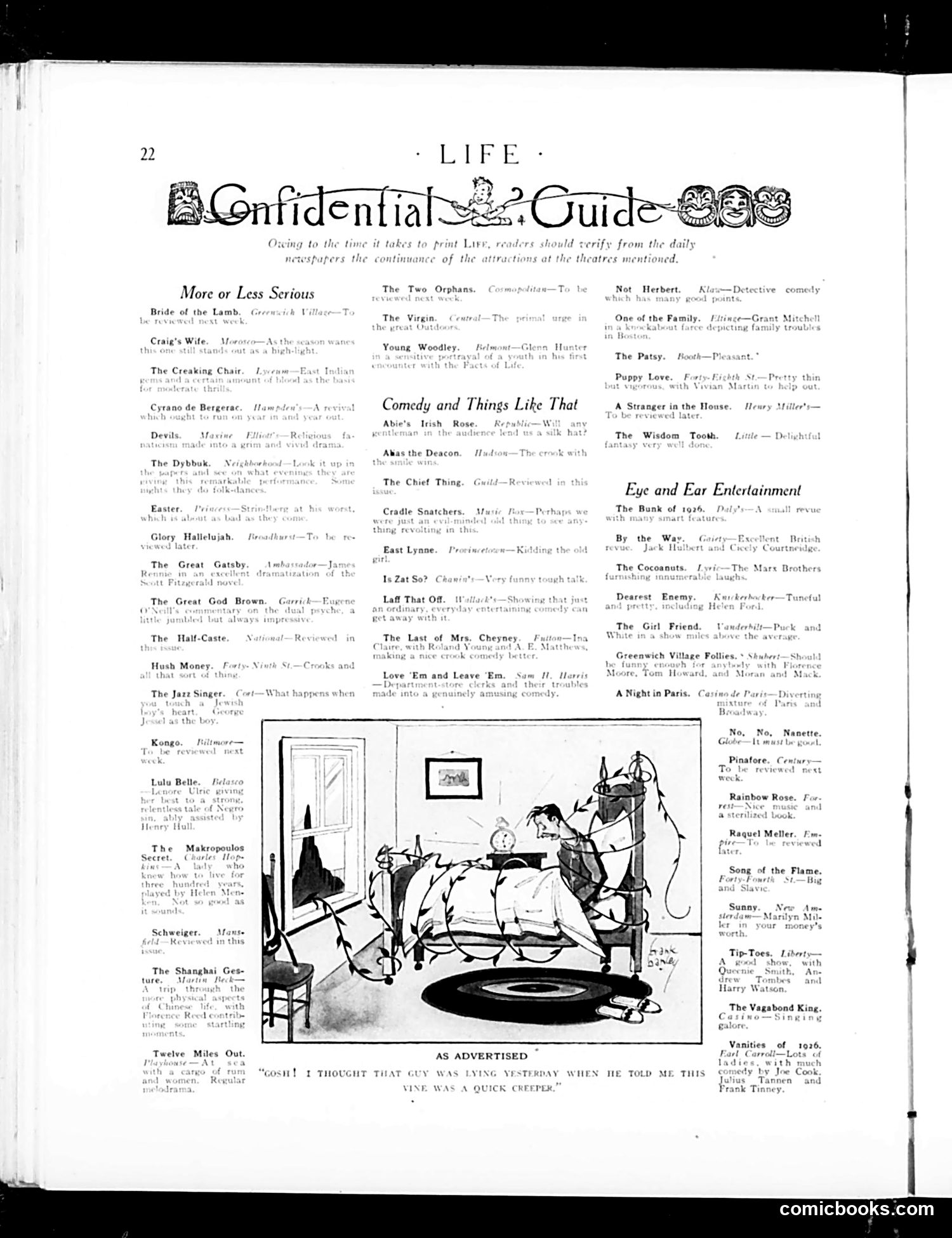
This page from *Life* magazine functions primarily as a **theater listings and entertainment guide** for Broadway shows and films circa the 1920s. The main cartoon depicts a humorous domestic scene: a man lies in bed while his wife appears to be administering some kind of medical treatment or domestic remedy, with the caption referencing someone being a "quick chipper"—likely a joke about fast recovery or dubious medical advice. The page lists contemporary theatrical productions ("The Great Gatsby," "Abie's Irish Rose," "The Jazz Singer") and vaudeville acts. Rather than political satire, this reflects *Life*'s role as a weekly entertainment magazine for urban, middle-class readers interested in theater, comedy, and popular culture. The cartoon exemplifies the magazine's typical domestic humor—poking fun at marriage, health fads, or home remedies common to the era—rather than making any broader social commentary.
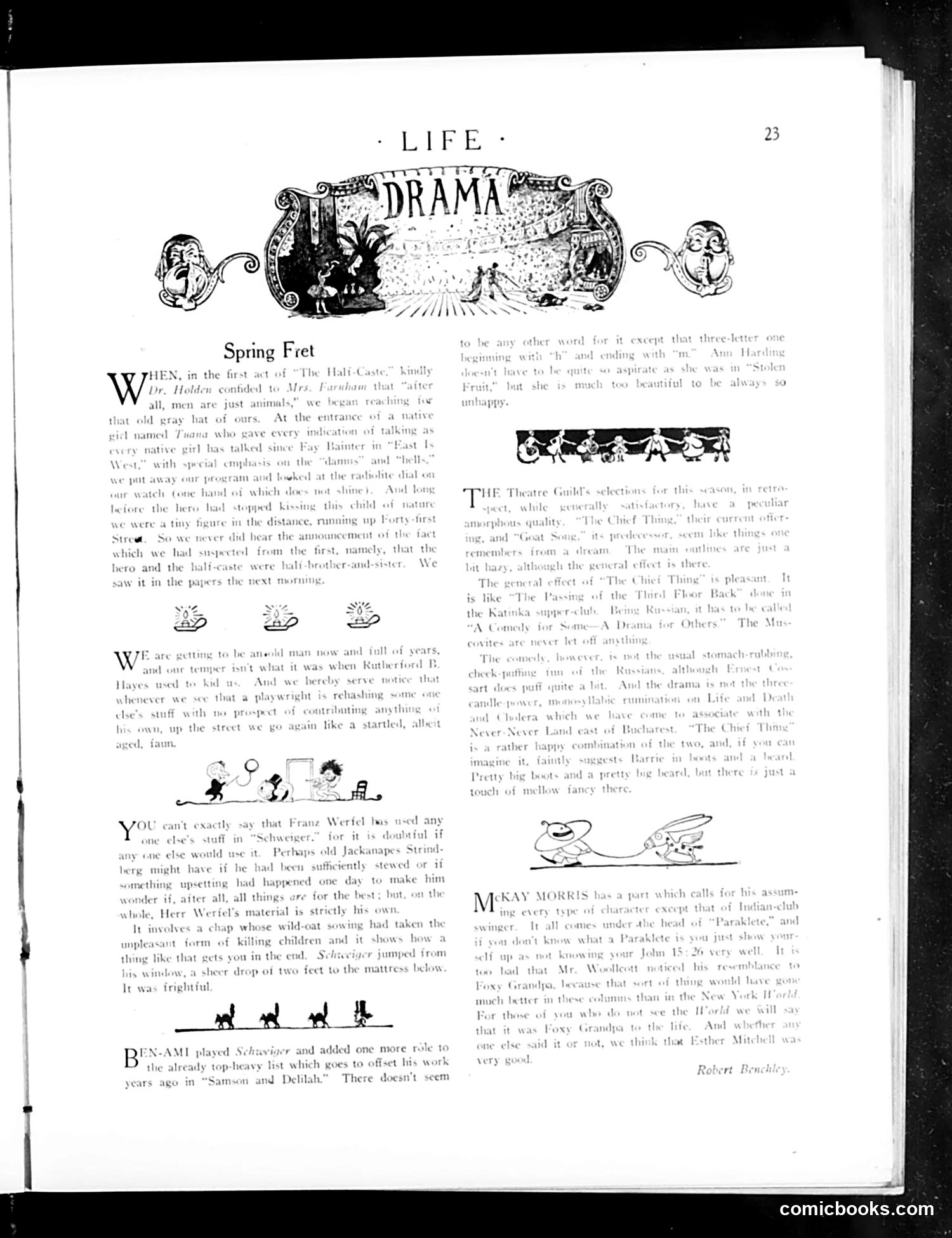
This page from *Life* magazine's "Drama" section reviews theatrical productions. The text discusses several plays including "The Half Caste," "Scherzinger," and "The Chief Thing." The decorative header features theatrical imagery typical of early 20th-century magazine design. Small illustrations throughout show performers and comedic scenes. The page credits Robert Benchley as the writer. The reviews appear to discuss character portrayals and theatrical quality rather than engage in political satire. References to actors like Dr. Holden and mentions of stage productions suggest this is straightforward theater criticism rather than social commentary. The decorative elements and layout are characteristic of *Life*'s arts coverage during this era, focusing on entertainment commentary rather than political cartooning.
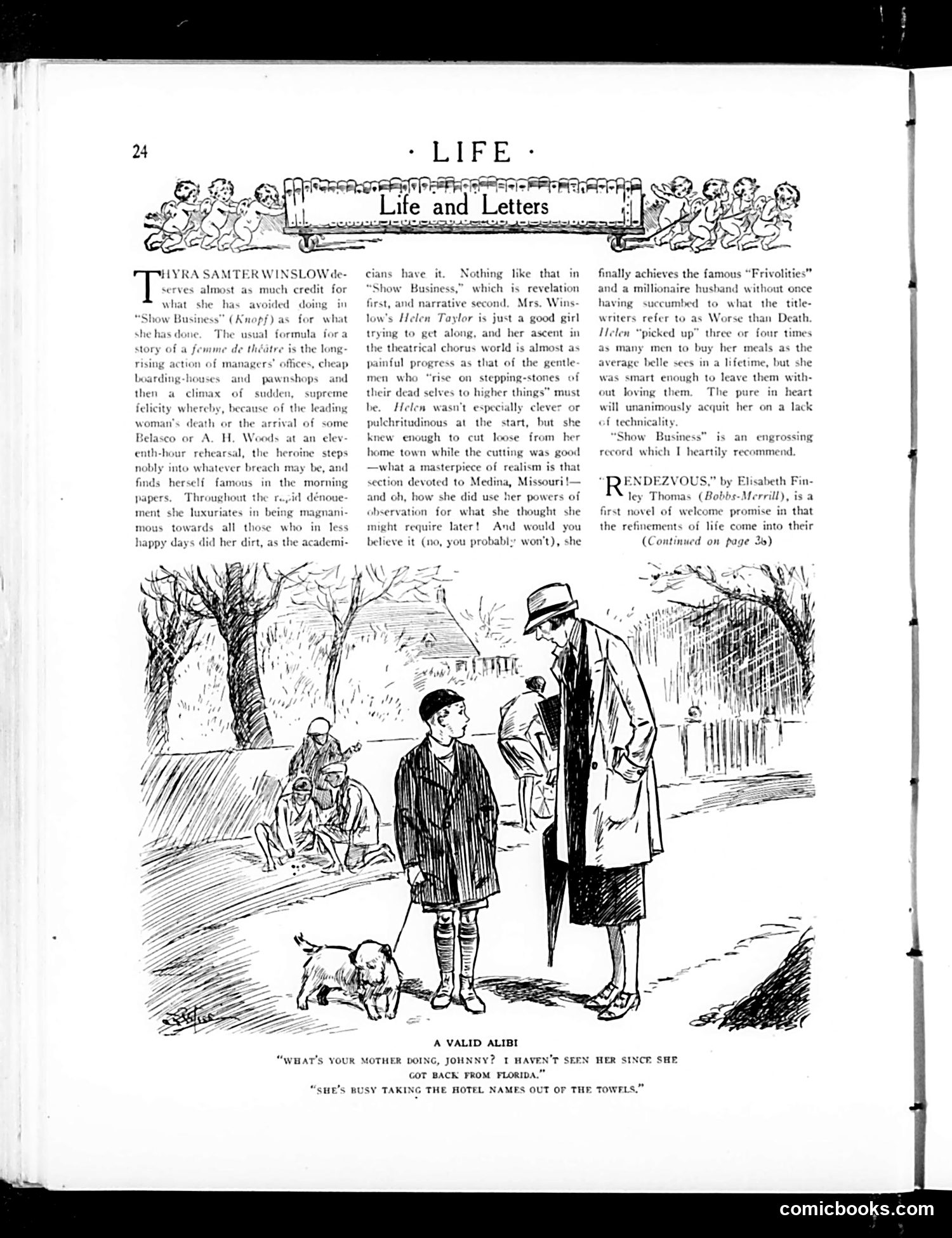
This single-panel cartoon satirizes petty theft and souvenir-taking among tourists. The joke: a mother returning from a Florida vacation is so busy removing hotel monogrammed towels (stolen souvenirs) that she hasn't been seen since arriving home. The humor targets the common practice of hotel guests pilfering towels and linens—apparently so widespread by this era that it's treated as an expected, almost humorous behavior. The "alibi" suggests the mother's towel-theft project excuses her absence from social life. The cartoon mocks both the casually dishonest tourist culture and the amount of effort required to remove hotel markings from stolen goods. It's gentle satire on middle-class moral flexibility regarding what we'd call "hospitality theft." The illustration shows an adult speaking to a young boy (Johnny), establishing the conversational setup for the punchline.
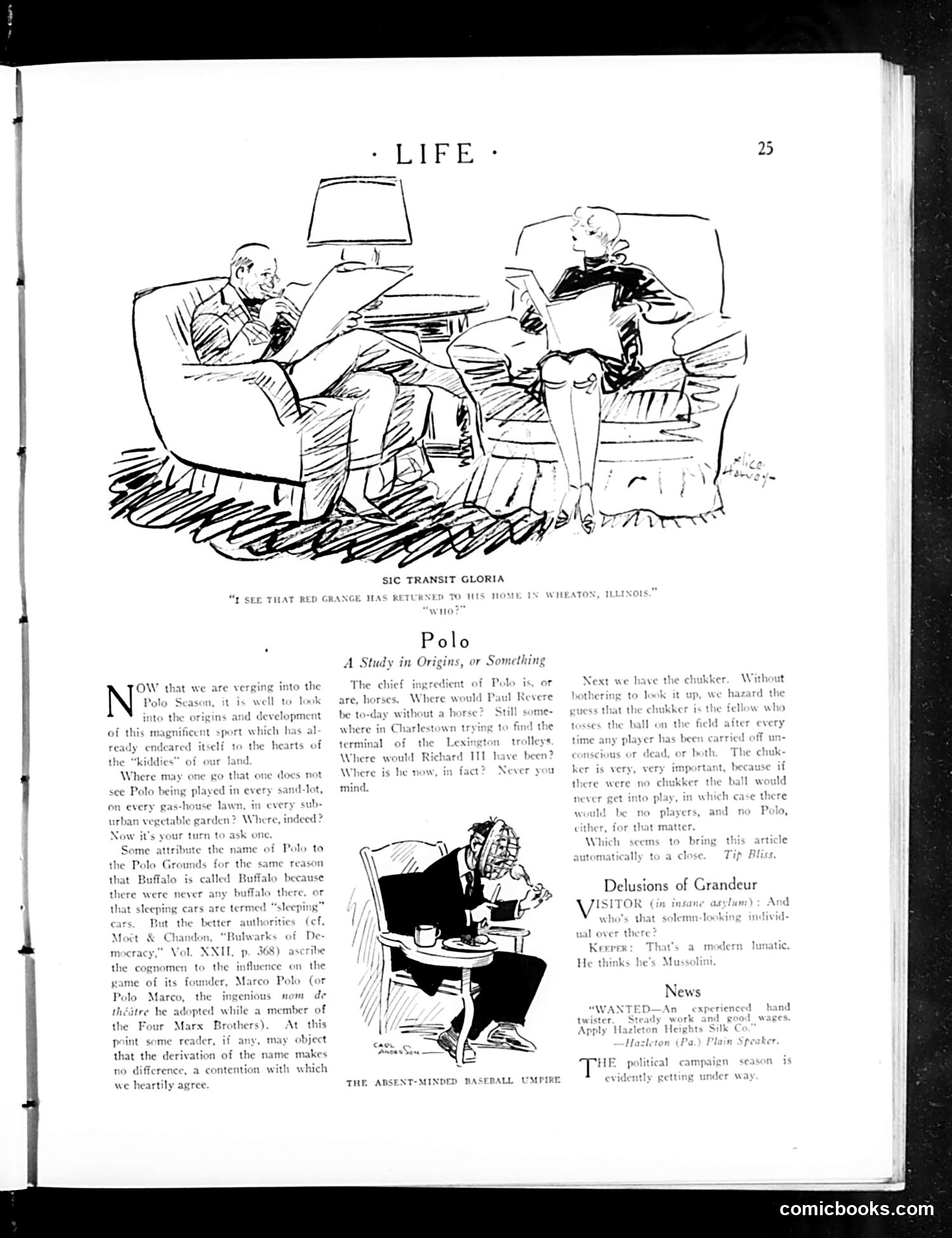
This page contains three distinct humorous pieces: 1. **Top cartoon ("Sic Transit Gloria")**: Shows a man reading to a woman, with the caption about the Red Grange returning to his home in Wheaton, Illinois. This references **Red Grange**, the famous 1920s football player ("The Galloping Ghost"), whose return to his hometown would be notable news. 2. **"Polo" article**: A satirical piece questioning polo's origins and necessity. The joke is that polo requires horses—and the article humorously asks where historical figures like Paul Revere and Richard III would be without them. It's gentle satire about an elitist sport. The illustration shows someone playing polo, appearing absorbed in the game. 3. **"The Absent-Minded Baseball Umpire"**: A cartoon of an umpire so distracted he's not paying attention to the game—satirizing incompetent officials. 4. **Small items under "News"**: Brief notices, including a job wanted ad and a note about the political campaign season. The page exemplifies *Life* magazine's blend of social satire, sports humor, and everyday observations aimed at educated, urban readers.
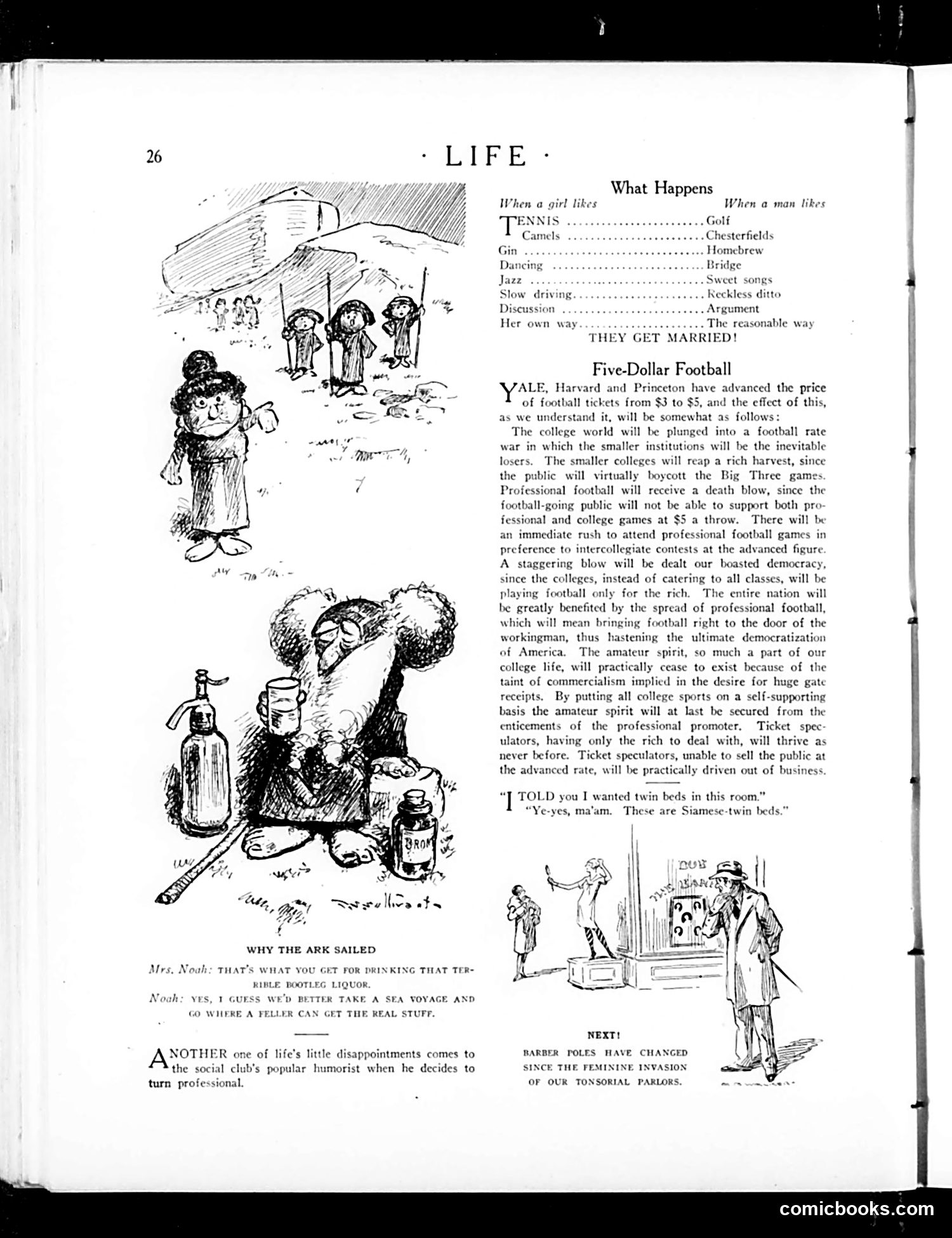
This satirical page from Life targets Prohibition-era social absurdities and economic concerns. The "Why the Ark Sailed" cartoon jokes about bootleg liquor quality—Mrs. Noah blames her husband's drinking of illegal alcohol for the flood, suggesting they need to travel somewhere with "real stuff," mocking the irony that Prohibition supposedly eliminated alcohol but created inferior black-market alternatives. The "Five-Dollar Football" article sarcastically predicts catastrophic consequences from Harvard and Princeton raising ticket prices from $3 to $5, absurdly claiming it will simultaneously destroy both college amateur spirit *and* professional football, while supposedly democratizing the sport—satirizing overblown economic panic and contradictory public complaints. The humor pieces include observations on gender preferences and a joke about "Siamese-twin beds" (likely twin beds placed close together), plus commentary on barber poles changing due to women now patronizing barbershops—reflecting 1920s social anxieties about shifting gender roles.
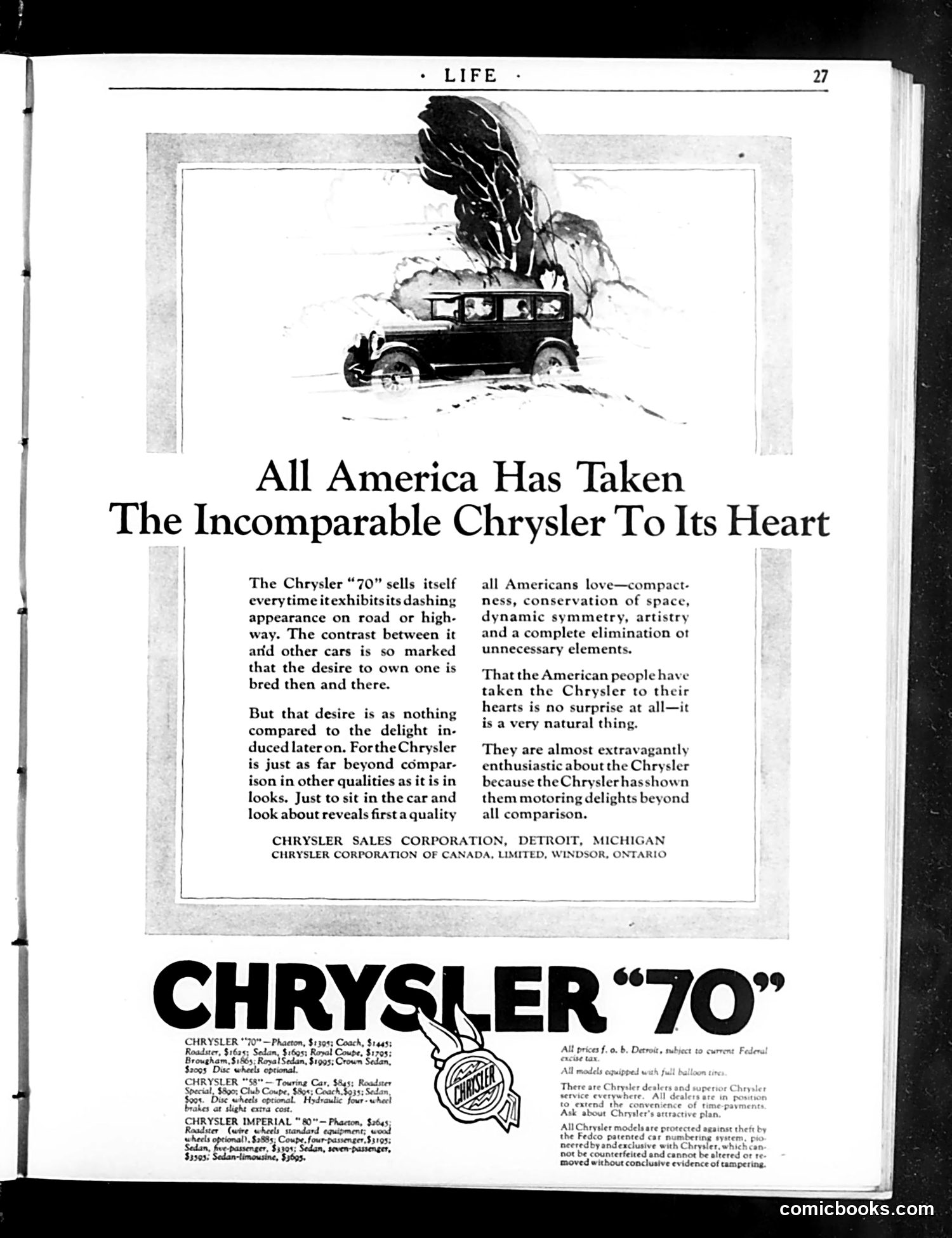
This is primarily **automobile advertising**, not satire or political commentary. The page promotes the Chrysler "70" model with enthusiastic copy claiming it has won over the American public through superior design and performance. The illustration shows a Chrysler vehicle navigating dramatically around a large boulder or cliff face—a visual metaphor for the car's capability and superiority over competitors. The exaggerated language ("Incomparable," "motoring delights beyond all comparison") and claims that Americans have emotionally embraced the brand are typical of 1920s-era advertising rhetoric. There are no identifiable caricatures or political references. The page functions as straightforward product marketing, using hyperbolic praise and detailed specifications (multiple model variants with prices) to appeal to consumers. The tone reflects the optimistic, consumerist advertising style of the era, not satirical content.
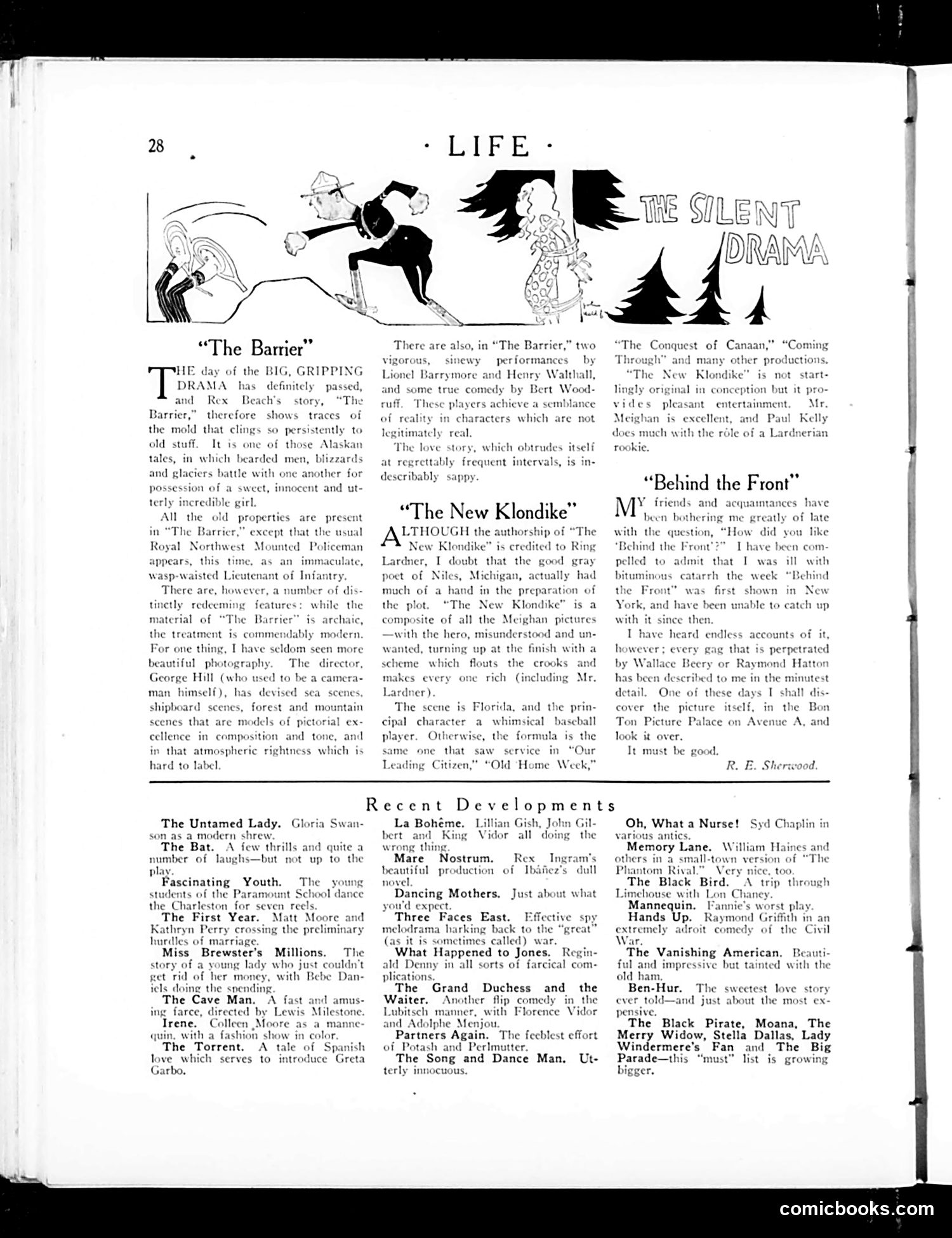
This page from *Life* magazine reviews silent films from the early 1920s. The cartoon at the top illustrates "The Silent Drama" — showing stylized scenes from featured films including "The Barrier" and "The New Klondike." The reviews discuss popular contemporary silent movies. "The Barrier" (based on Rex Beach's novel) is critiqued as formulaic — featuring the standard elements of adventure stories: blizzards, glaciers, and an "utterly incredible girl." The reviewer notes the plot relies on tired conventions of frontier melodrama. "The New Klondike" receives mixed praise, credited to Ring Lardner though the reviewer doubts his full involvement. It's described as a composite film with the familiar formula of a misunderstood hero redeemed by the ending. "Behind the Front" uses similar tropes but apparently succeeds through clever execution and comedy, making it worthy despite recycled material. The "Recent Developments" section briefly catalogs other current releases, evaluating their merits with the casual tone of contemporary criticism. The overall message: these films recycle predictable plots but succeed or fail based on execution and cast.
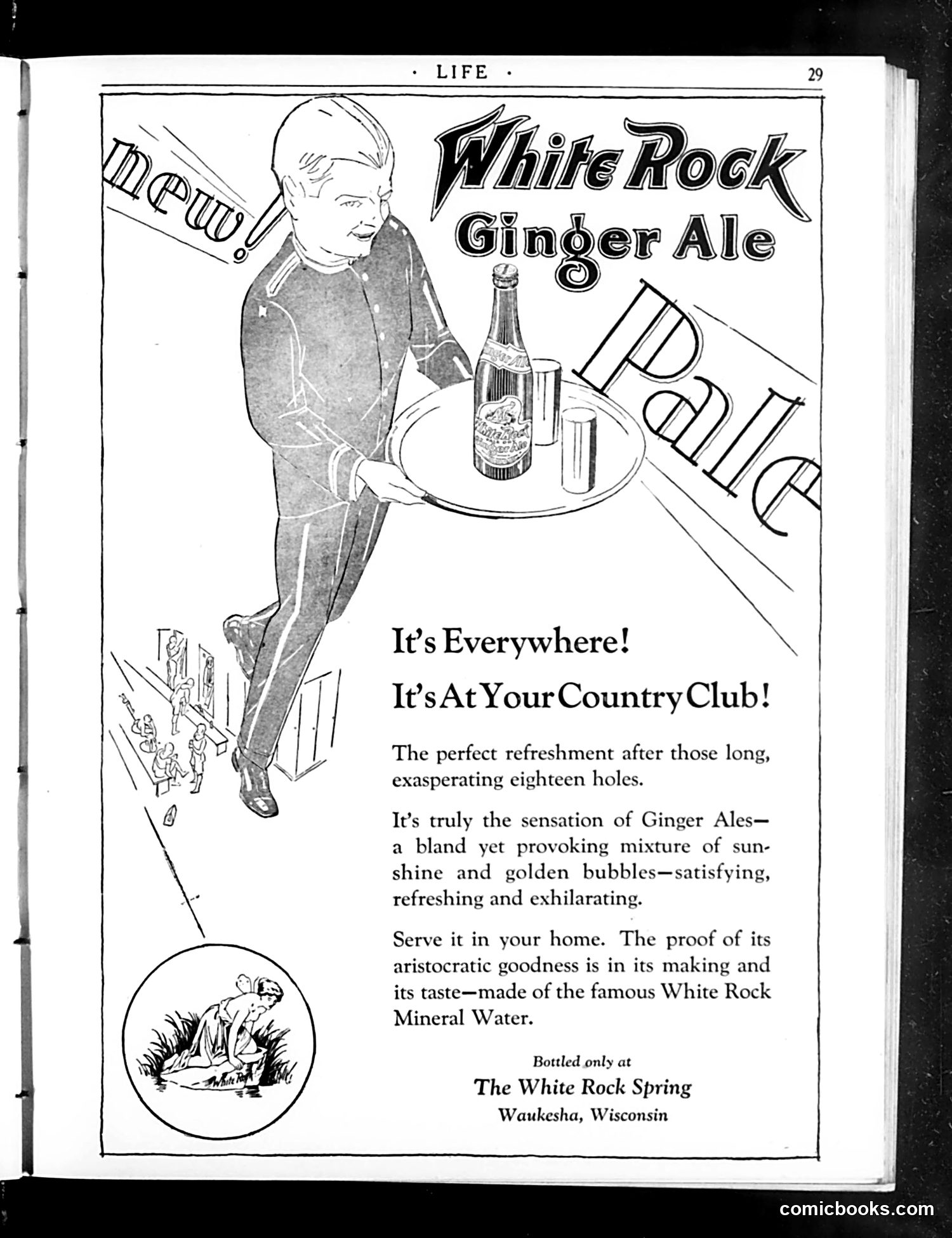
This is a **product advertisement**, not political satire. It promotes White Rock Ginger Ale from Waukesha, Wisconsin, targeting affluent consumers. The illustration depicts a well-dressed man in formal attire serving ginger ale at a country club—the setting itself signals the target demographic: wealthy golf players. The ad emphasizes "aristocratic goodness" and positions the beverage as a refined refreshment for the upper class. The messaging reflects early-20th-century marketing strategies: associating a consumer product with leisure, wealth, and social status. The description of ginger ale as "a bland yet provoking mixture of sunshine and golden bubbles" uses flowery language typical of vintage advertising. The small circular vignette at bottom-left appears to show the mineral spring source, a common advertising device meant to convey natural purity and premium quality.
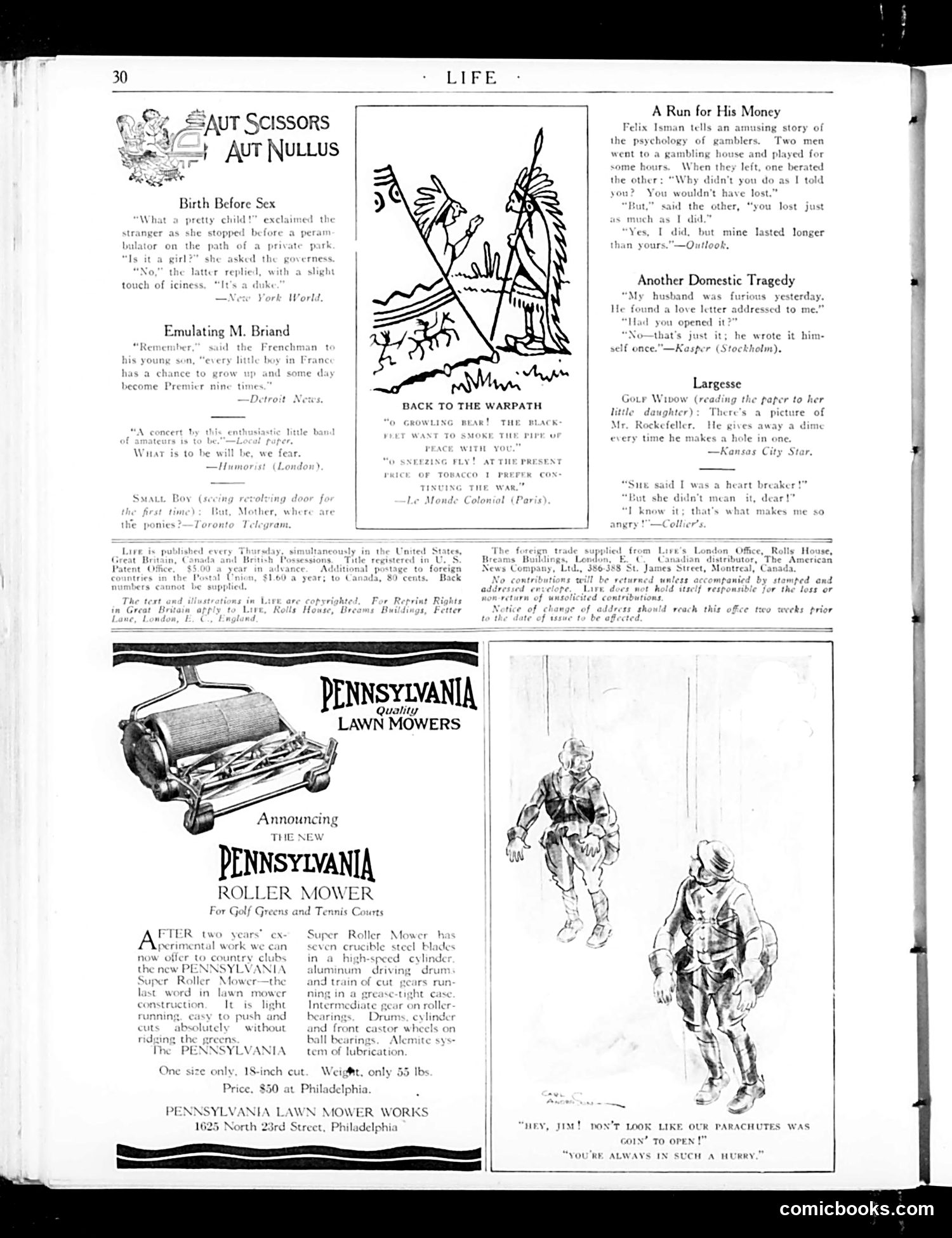
This page mixes humorous short items with advertisements. The upper section contains several brief satirical pieces: **"Aut Scissors / Aut Nullus"** presents witty one-liners about everyday life—a stranger asking a governess the baby's sex, a Frenchman encouraging a young wife, a small boy seeing a door for the first time. **"Back to the Warpath"** is a cartoon of what appears to be Native American figures, accompanying a quote about "growing bears" and smoking peace pipes—likely referencing historical tensions or treaty negotiations, though the specific reference is unclear. The right column includes humorous anecdotes: gamblers comparing losses, a domestic dispute over a love letter, and a wealthy widow's generosity. The lower half is primarily **advertising**: Pennsylvania Lawn Mowers announces a new "Super Roller Mower" for golf courses and tennis courts, with technical specifications. A final cartoon shows two figures with a parachute malfunction—one says the parachutes won't open; the other replies "You're always in such a hurry," suggesting dark wartime humor (likely WWI-era, given the magazine's publication period).
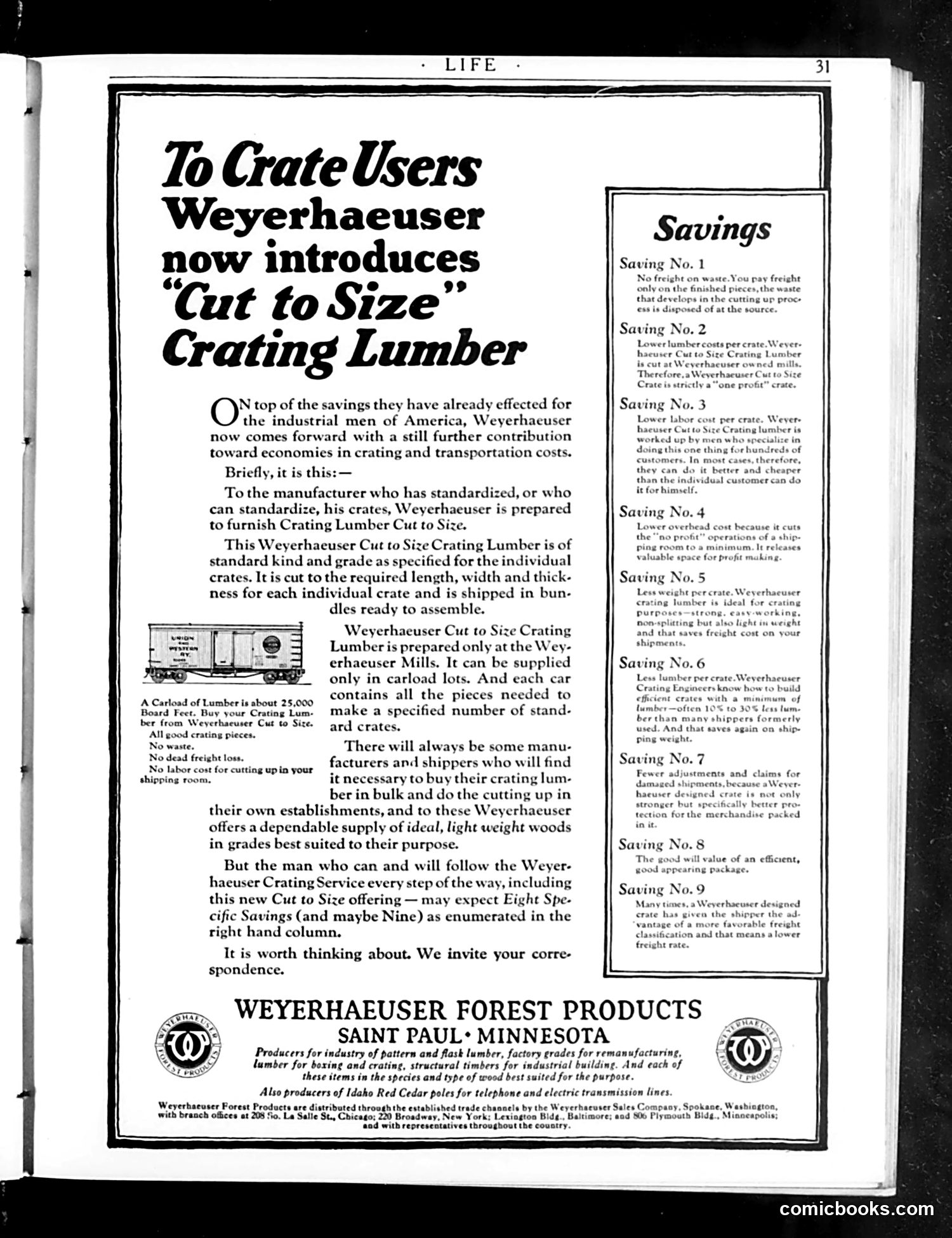
This is a **product advertisement**, not a cartoon or satirical content. It promotes Weyerhaeuser's "Cut to Size" pre-cut lumber for industrial crating. The page addresses manufacturers and shippers, emphasizing cost savings through standardized, pre-cut lumber supplied in ready-to-assemble bundles. The "Eight Specific Savings" listed argue that buying pre-cut lumber reduces waste, labor costs, and shipping weight compared to bulk purchases requiring in-house cutting. The small illustration shows a railroad car, emphasizing that the product ships in full carloads—a practical detail for industrial buyers. This represents early **20th-century industrial marketing**: appealing to efficiency, standardization, and cost reduction—values central to American manufacturing at that era. There is no satire or political commentary; it's straightforward business promotion aimed at industrial decision-makers.
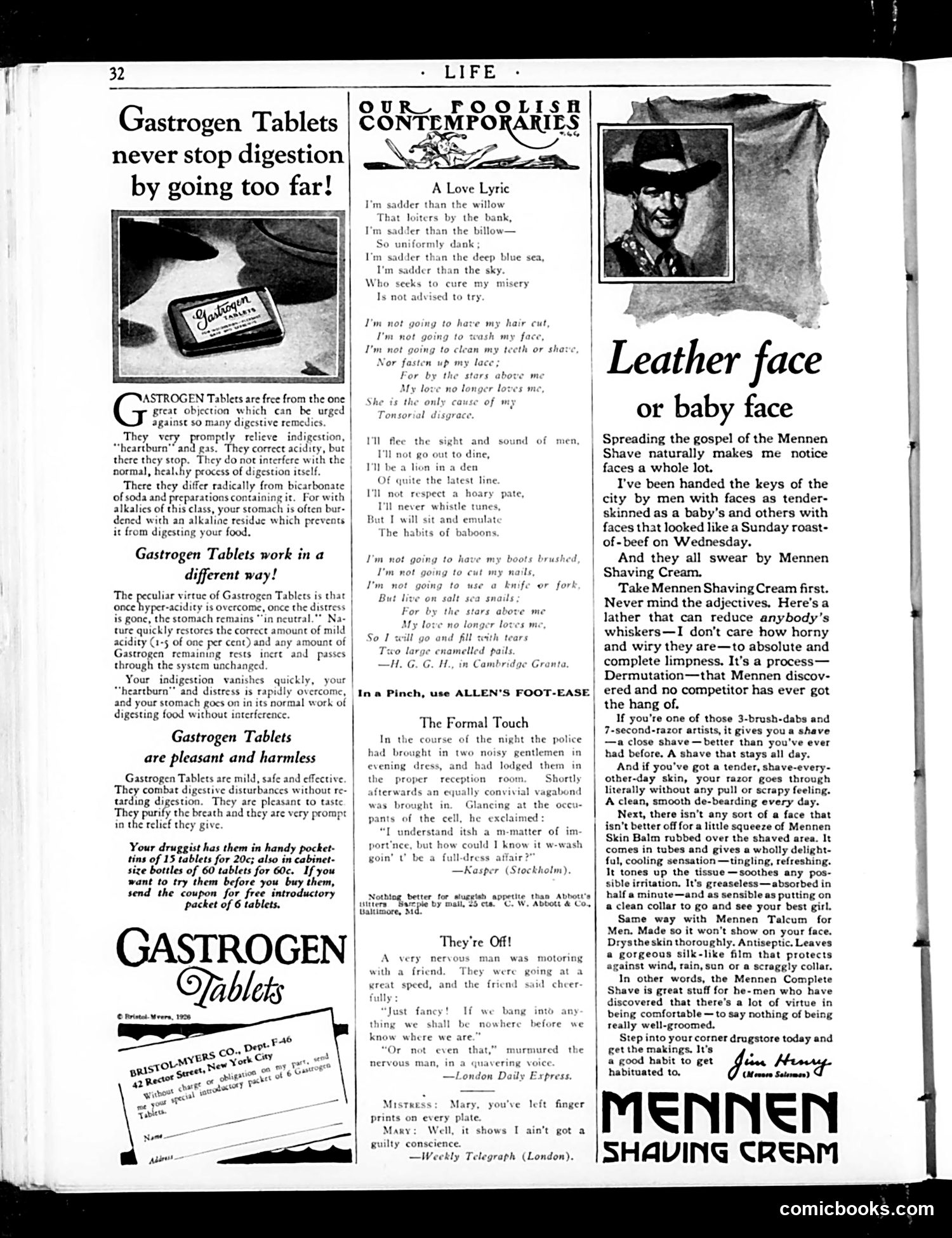
This is primarily an **advertising page** featuring digestive remedies and shaving cream, interspersed with brief humorous anecdotes typical of Life's satirical format. The main content includes: 1. **Gastrogen Tablets ads** - promoting a digestive aid that claims to relieve indigestion without over-alkalizing the stomach (a common problem with competing products like bicarbonate of soda). 2. **"A Love Lyric"** - a mock-romantic poem about a lovelorn man who refuses grooming or social activity, ending absurdly with him filling "two large enamelled pails" (the joke's punchline is unclear from context). 3. **Brief comedic sketches** including "The Formal Touch" (about drunken men in a police cell) and "They're Off!" (about nervous driving). 4. **Mennen Shaving Cream ad** - emphasizing that proper shaving reveals whether a man has a "leather face" or "baby face," targeting male vanity and grooming standards of the era. The humor is gentle and domestic, reflecting 1920s advertising and consumer culture alongside Life's trademark satirical commentary on everyday social situations.
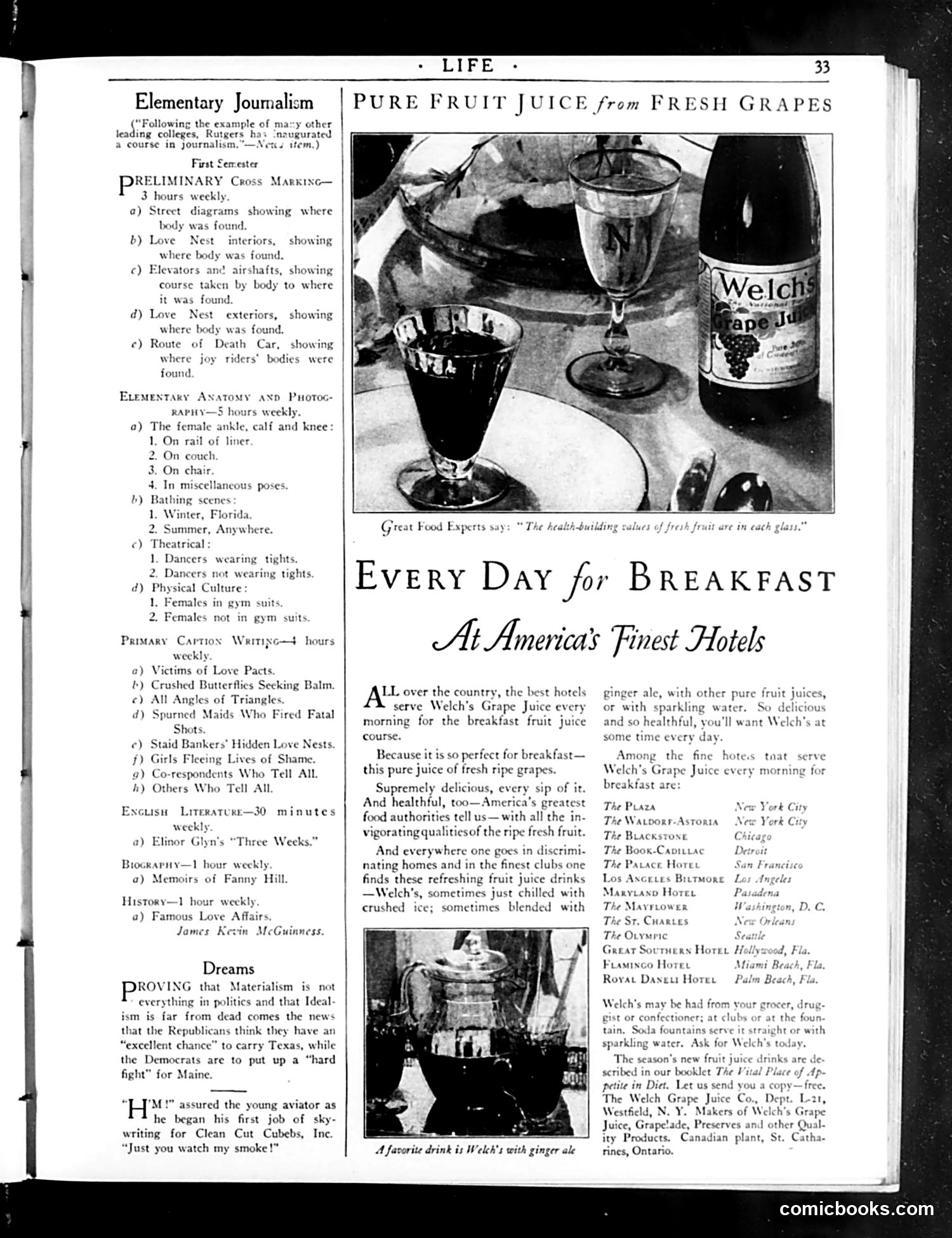
This page is primarily **advertising**, not satire or political commentary. The dominant content is a Welch's Grape Juice advertisement ("Every Day for Breakfast At America's Finest Hotels") occupying roughly half the page, listing prestigious hotels serving the product. The left column contains mock course listings for a journalism program at Rutgers College—this is **satire of sensationalist journalism**. The humor targets tabloid reporting of the 1920s: courses include "Preliminary Cross Marking" (crime scenes), "Elementary Anatomy and Photography" (voyeuristic content—women in various states of undress), and "Primary Crimes Writing" (lurid scandal stories: "Spurned Maids Who Fired Fatal Shots," "Girls Fleeing Lives of Shame"). The satire mocks how journalism had become obsessed with scandal, crime, and salacious content rather than serious reporting. The "Dreams" section below briefly ridicules idealism in politics. The page reflects 1920s concerns about tabloid excess and yellow journalism practices.
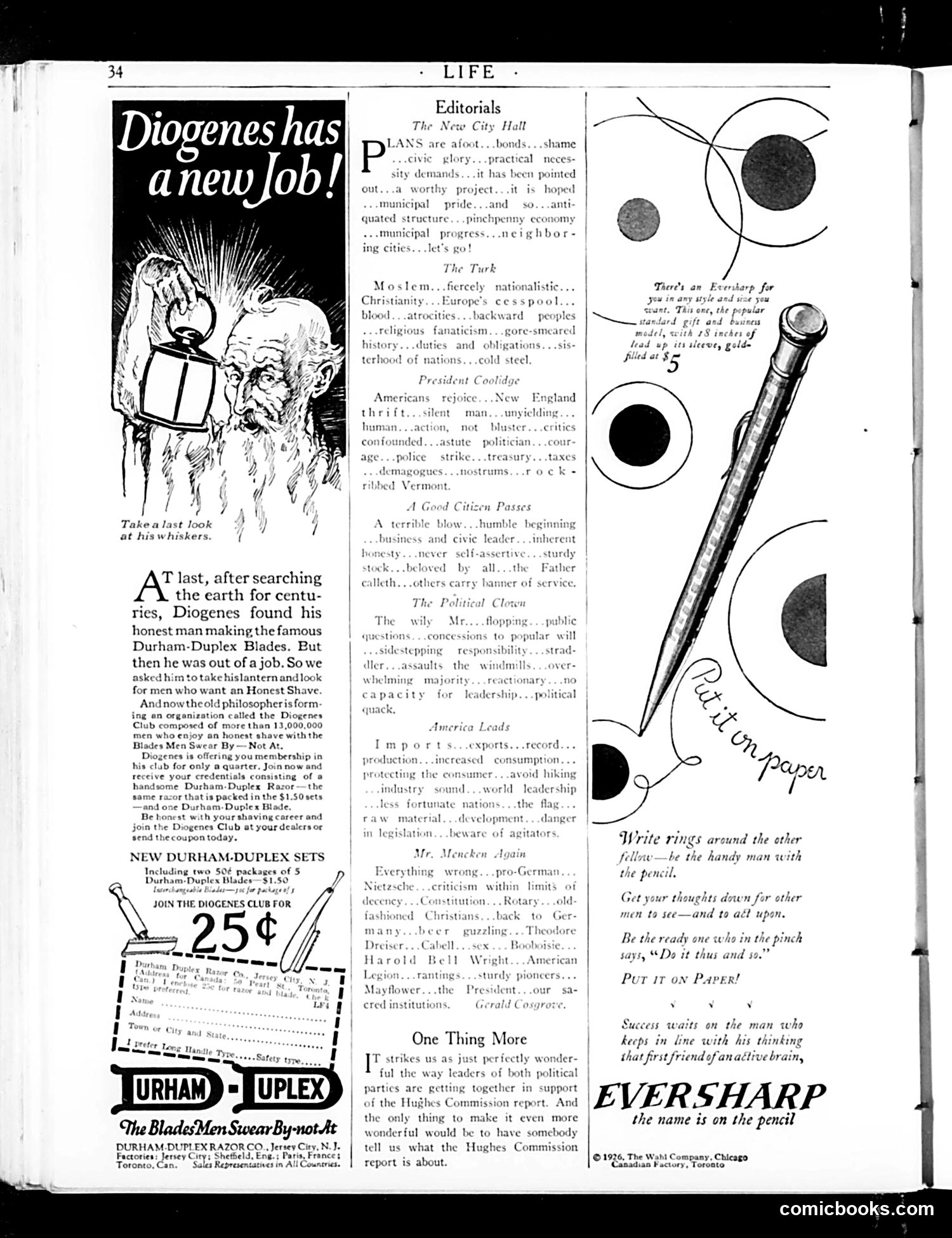
The main cartoon is a **razor blade advertisement** using classical mythology. Diogenes was an ancient Greek philosopher famous for searching everywhere with a lantern for "an honest man." The ad jokes that he finally found one—working for Durham-Duplex Razors. Now jobless, he's forming a "Diogenes Club" for men seeking honest shaves, membership costing a quarter. The accompanying **editorials** are typical Life magazine satirical commentary on contemporary issues: New City Hall construction, European politics, and social criticism. Notably, one editorial mockingly catalogs H.L. Mencken's frequent targets (Puritanism, Christianity, materialism), and another expresses frustration that political leaders support the Hughes Commission report without explaining what it actually proposes. The page concludes with an **Eversharp pencil advertisement** encouraging readers to "Put it on Paper"—write down thoughts worth sharing. This reflects 1926 concerns: infrastructure projects, post-war European tensions, and American political opacity.
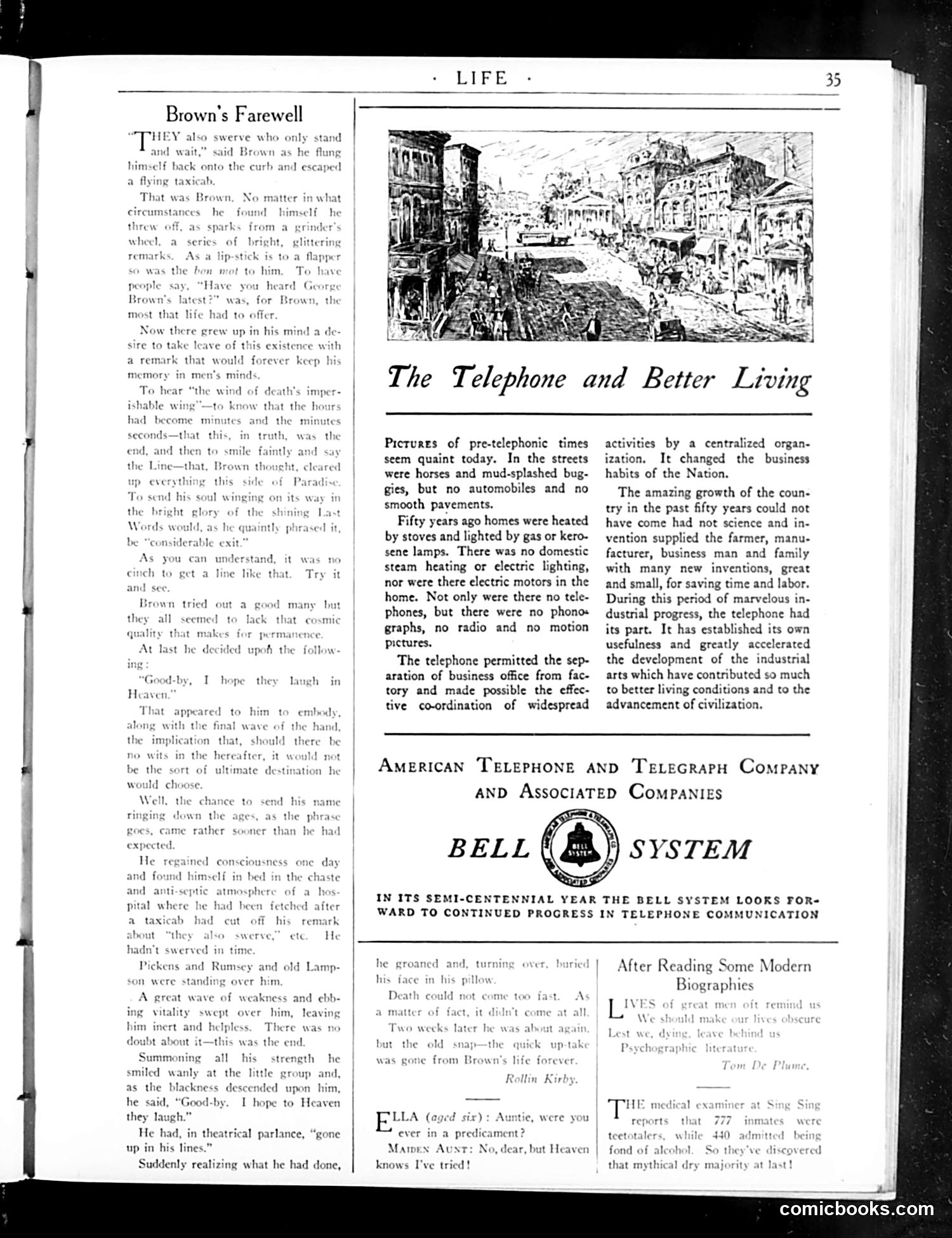
This page contains two distinct sections: **Left side:** A short story titled "Brown's Farewell" about a man named Brown who attempts suicide but survives a taxi accident. The narrative appears to be a sentimental piece about mortality and redemption, ending with Brown's graceful acceptance of life. **Right side:** A substantial advertisement for the Bell System (American Telephone and Telegraph Company), disguised as editorial content. The ad nostalgically contrasts life "fifty years ago" (pre-telephone era) with modern times—no cars, electric lights, or communication technology—then credits the telephone with enabling business coordination and national industrial progress. **The satire:** This juxtaposition is itself darkly comic. A story about a man contemplating death immediately precedes corporate messaging about technological progress and "better living." The ad's earnest claims about civilization advancement through telephones seem almost parodic when placed against Brown's existential despair—suggesting that material progress doesn't necessarily improve human meaning or happiness. The page reflects *Life* magazine's tradition of mixing editorial and advertising content ambiguously, inviting readers to question corporate narratives about progress.
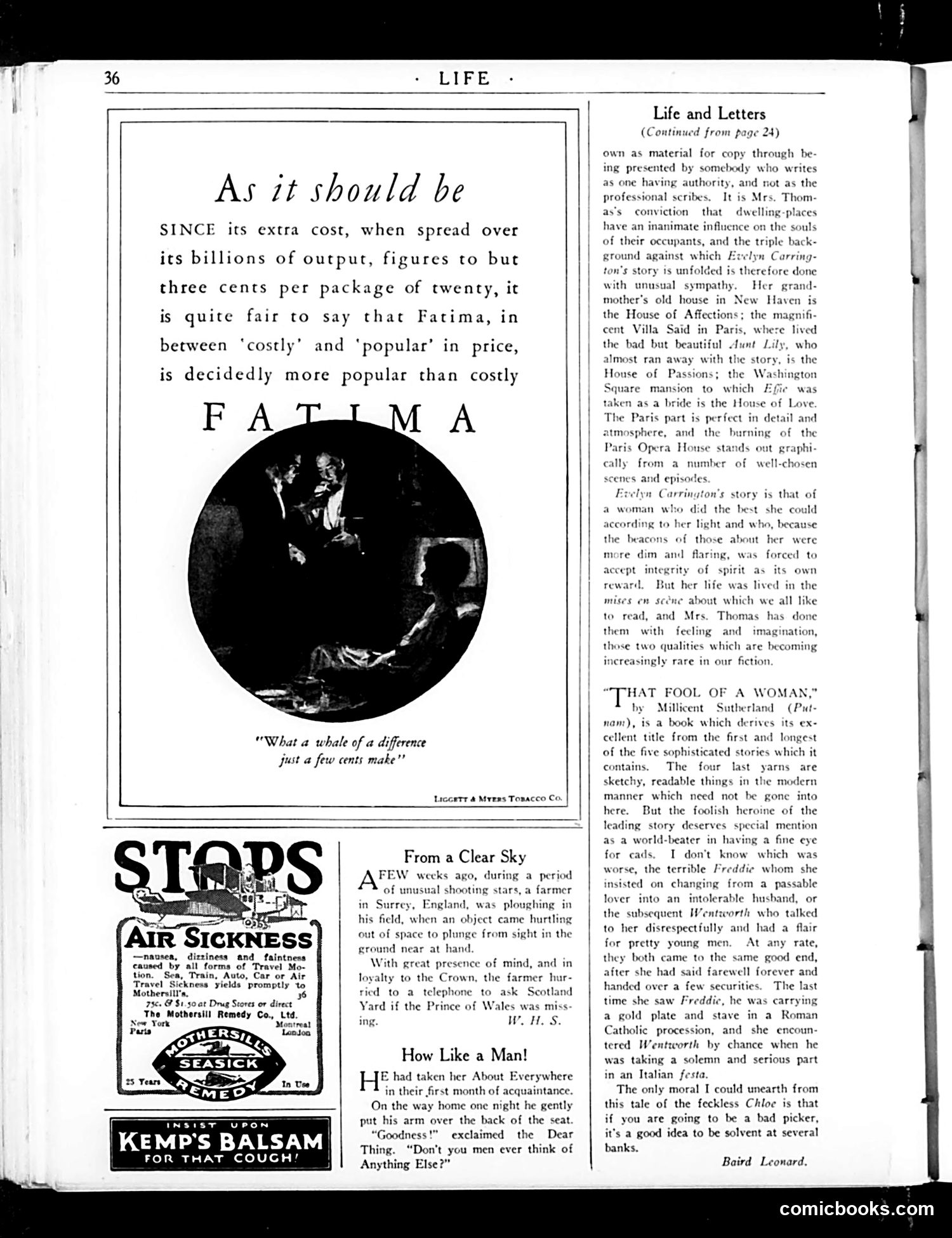
This page combines advertisements with satirical literary commentary, typical of Life magazine's format. **The Fatima Cigarette Advertisement** (top left) uses a theatrical circular image showing figures in dramatic shadow play, promoting Fatima cigarettes as affordable luxury—positioned between "costly" and "popular" in price. The tagline "What a whale of a difference just a few cents make" emphasizes value. **The "From a Clear Sky" item** is a humorous anecdote: a Surrey farmer finds a meteorite during a meteor shower and loyally phones Scotland Yard to ask if the Prince of Wales is missing—satirizing British bureaucratic deference and provincial earnestness. **"How Like a Man!"** is a domestic humor piece mocking male obliviousness. A man makes a romantic gesture (arm around seat), and his date sarcastically asks if men ever think of anything besides romance/physical contact. **The "Life and Letters" section** reviews three books, praising Evelyn Carrington's novel for its atmospheric detail and moral complexity, and critiquing "That Fool of a Woman" for its heroine's terrible romantic choices—a cautionary tale about bad judgment in selecting partners.
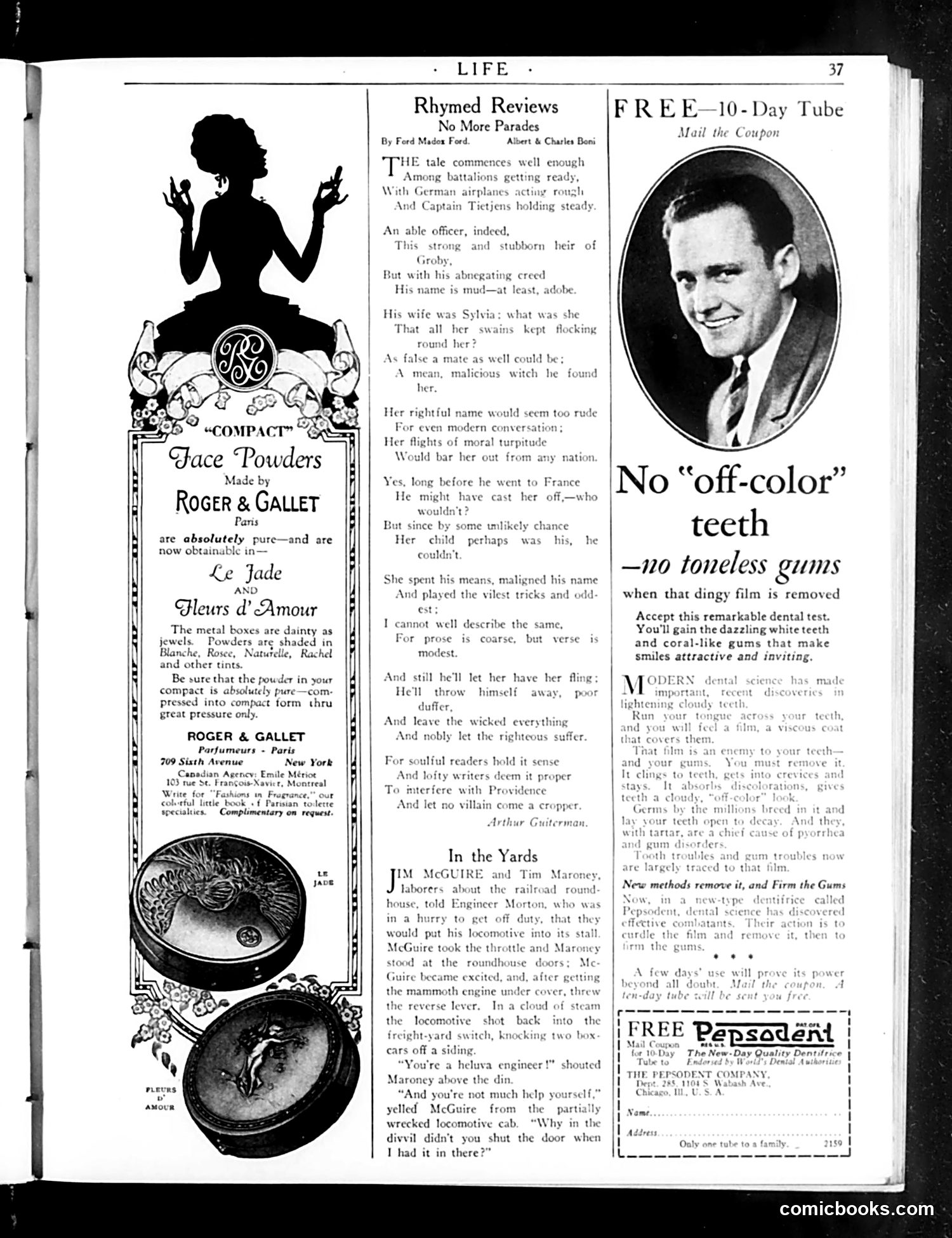
This page combines **advertising and literary criticism**, not political cartoons. The left side features an **advertisement for Roger & Gallet face powders** from Paris, with an Art Deco silhouette of a woman and decorative imagery of compact cases. The center contains a **"Rhymed Review"** by Ford Madox Ford critiquing the novel *No More Parades* (by Albert & Charles Boni). Ford presents the plot in verse: a strong but disreputable officer marries the unfaithful Sylvia, who deceives him. Ford's satirical point is that the story lacks moral decency—the characters are flawed and the protagonist endures shame, which Ford considers improper subject matter for literature. He dismisses the work as failing to maintain proper "Providence" and morality. The right side advertises **Pepsodent toothpaste**, claiming it removes a "dingy film" to reveal naturally white teeth and healthy gums—reflecting early 20th-century dental marketing claims about film buildup on teeth. The bottom section briefly describes a railroad workers' anecdote involving engineers McGuire and Maroney.
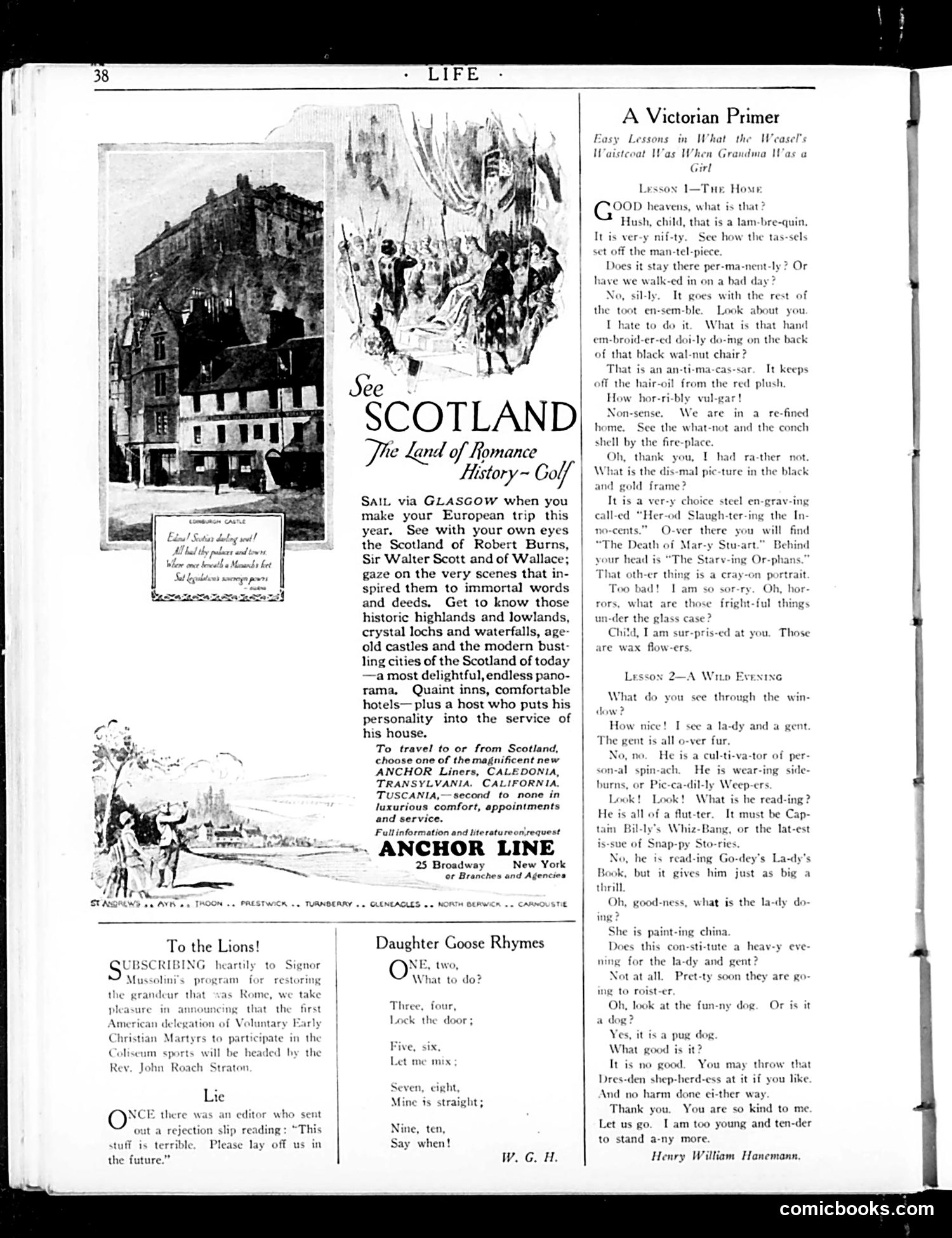
This page contains **advertising and educational content**, not political satire. The **Scotland travel advertisement** promotes Anchor Line steamships for European tourism, emphasizing Scotland's romantic literary heritage (Burns, Scott, Wallace) and golf. This reflects 1920s leisure travel marketing to affluent Americans. The **"To the Lions!" item** is a brief satirical joke about Mussolini's fascist program to restore Roman grandeur—the writer sardonically suggests American clergyman John Roach Straton should participate in Coliseum gladiator games, mocking both Mussolini's grandiose nationalism and Straton's bellicose rhetoric. The **"Victorian Primer"** is humorous nostalgic instruction on outdated Victorian home décor and social customs (lambrequins, antimacassars, parlor paintings, sideburnned gentlemen reading ladies' magazines). It gently mocks the elaborate, formal aesthetics of the previous generation through a faux-educational format. The **"Daughter Goose Rhymes"** is children's verse unrelated to political content.
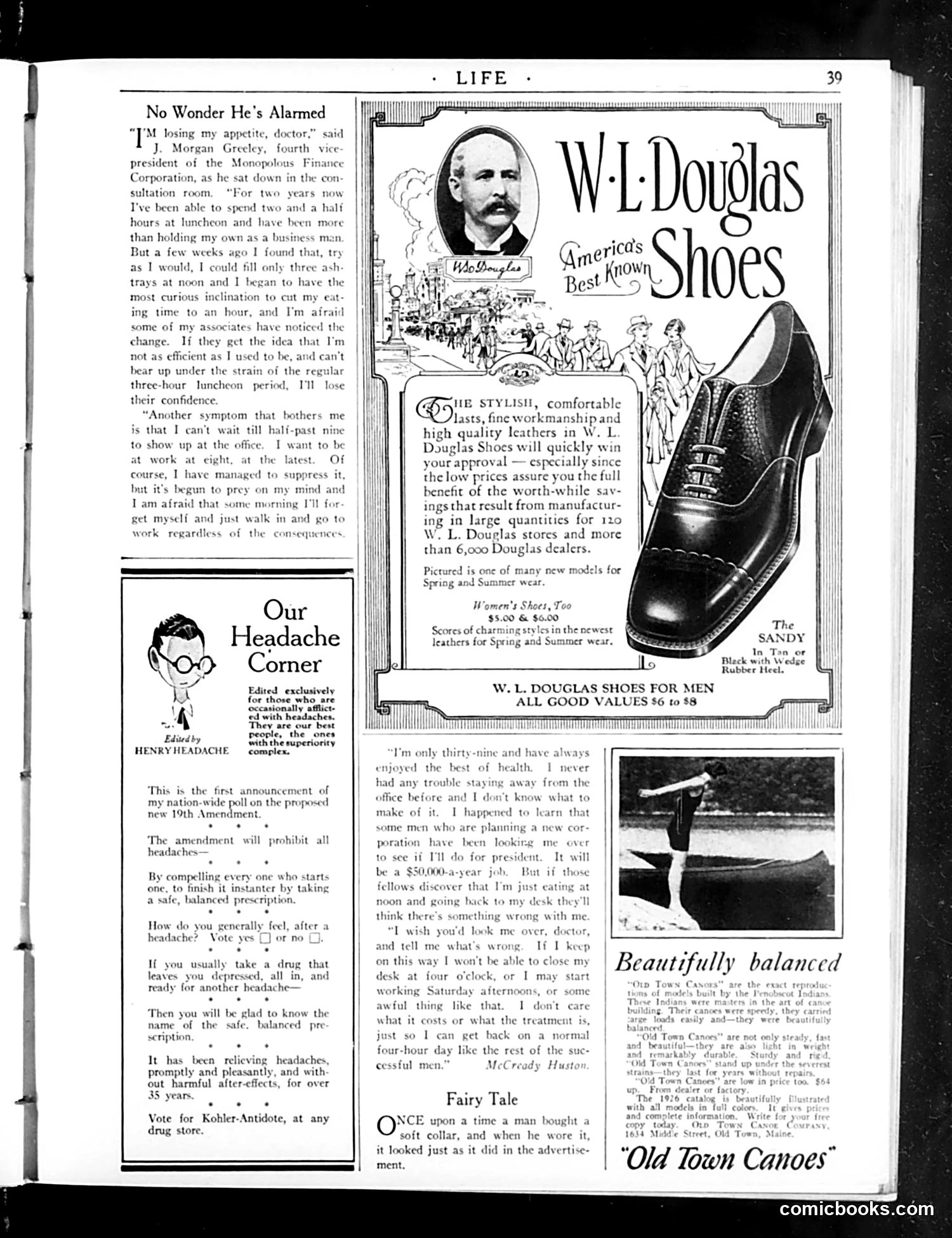
This page satirizes opposition to women's suffrage (the proposed 19th Amendment, which would grant women the right to vote). The main cartoon features J. Morgan Greeley, a fictional corporate executive, complaining to his doctor about losing his appetite and ability to work long hours. The joke is darkly ironic: his "alarming" symptoms—inability to spend 2.5 hours at lunch, leaving the office at 8 AM instead of staying late—suggest he's anxious about the coming amendment. The satire mocks anti-suffrage businessmen who feared that allowing women to vote would somehow disrupt the social order and their comfortable dominance. By presenting his minor inconveniences as a medical crisis requiring a "Kohler-Antidote," the writer ridicules such anxieties as absurdly overwrought. The page also includes advertisements (W.L. Douglas Shoes, Old Town Canoes) and an unrelated "Fairy Tale" segment below, typical of *Life* magazine's format.
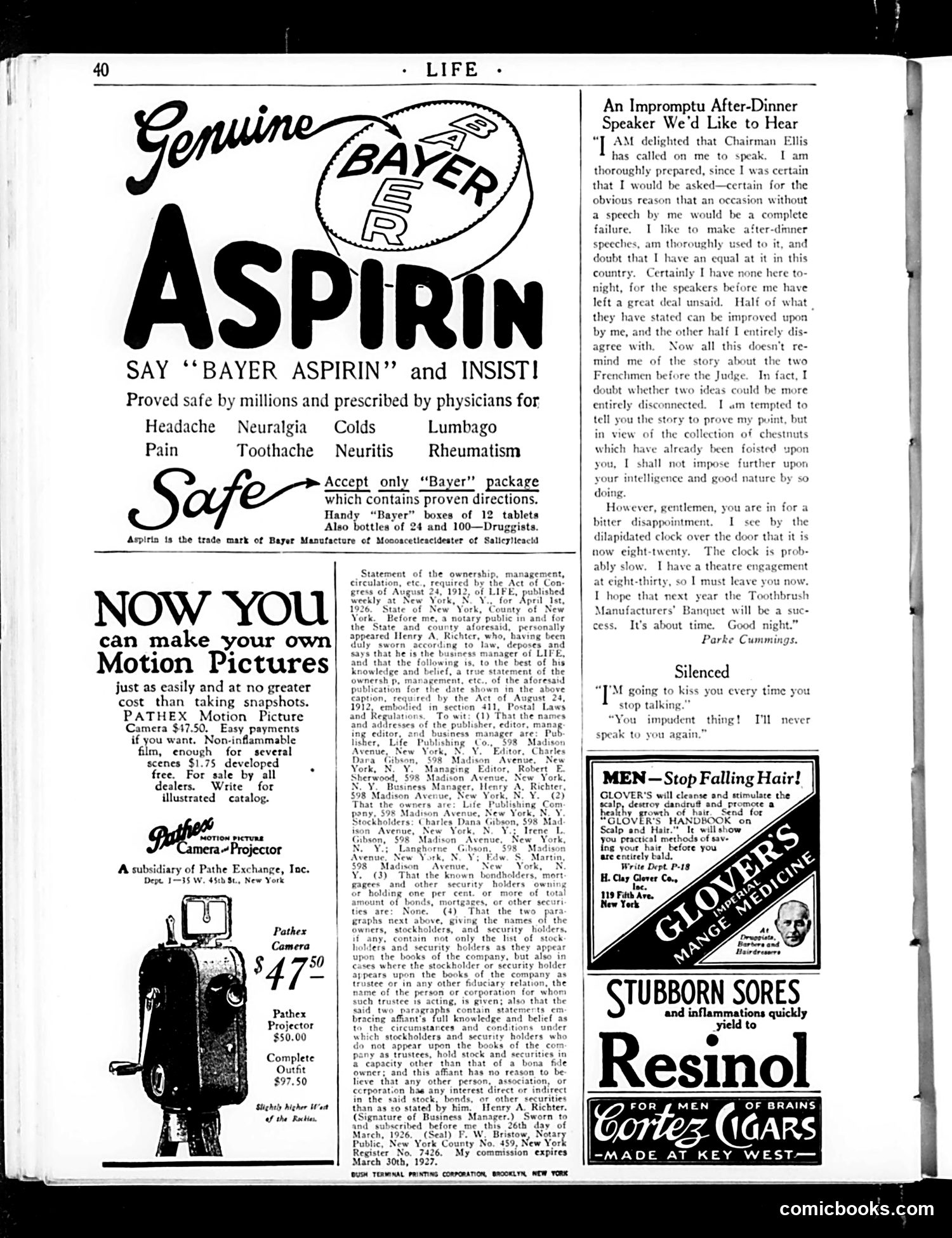
This page is primarily **advertisements** interspersed with two brief humorous pieces. **Main content:** - Large Bayer Aspirin ad (top) - Pathex home motion picture camera advertisement - Small satirical piece: "An Impromptu After-Dinner Speaker We'd Like to Hear" — a joke about a self-important speaker who interrupts his own lengthy, boastful remarks to announce he must leave early for a theater engagement, undercutting his pretensions **Second humor piece:** "Silenced" — a brief domestic joke where a woman threatens to kiss a man "every time you stop talking," and he responds "You impudent thing! I'll never speak to you again" — meaning he'll avoid future kisses by staying silent **Additional ads:** Hair loss remedies, medicinal products The page reflects 1920s consumer culture and period humor about marriage dynamics and social vanity. The cartoons are minimal; the page is dominated by commercial advertising typical of *Life* magazine's business model.
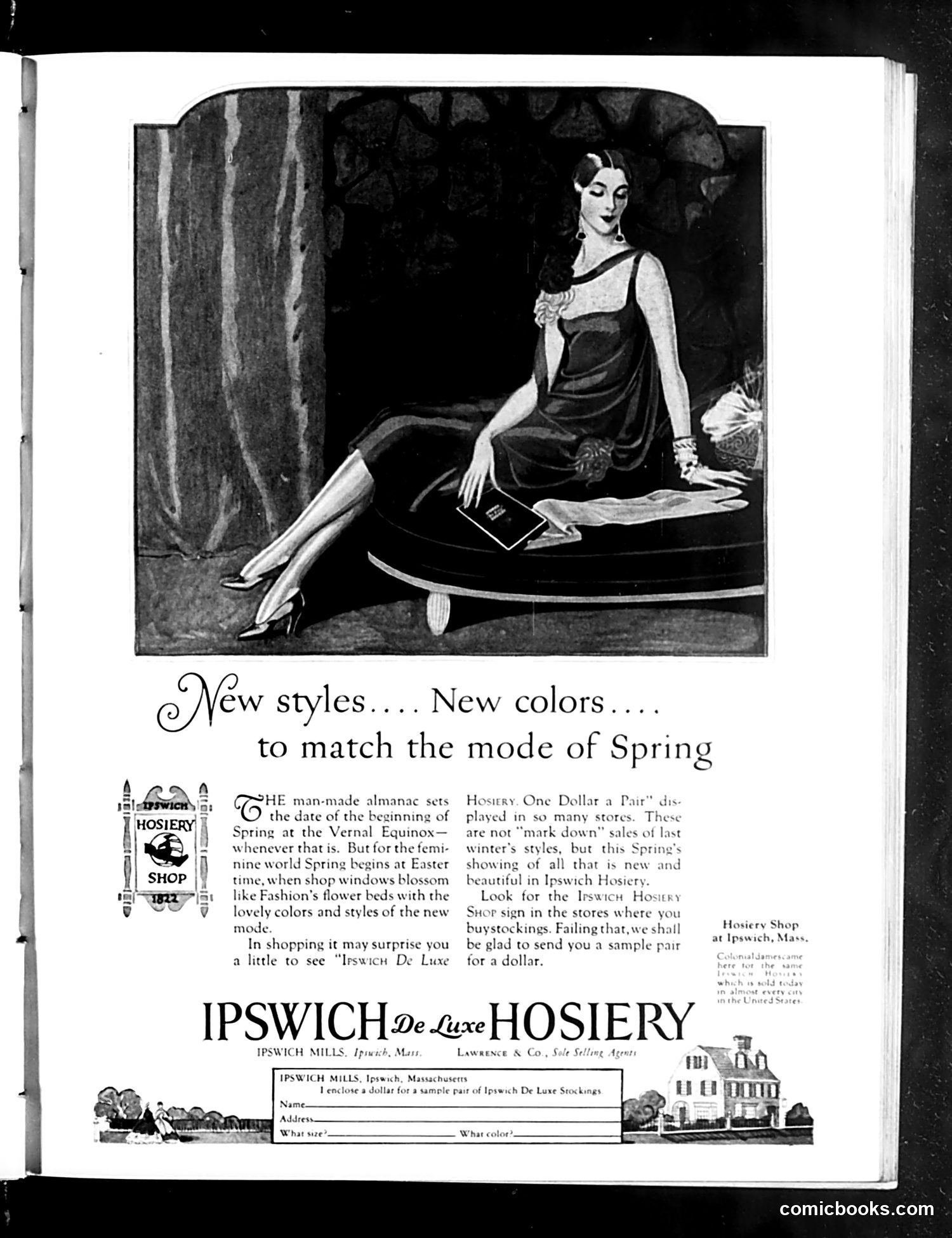
This page is **primarily an advertisement**, not political satire or comics content. It's a 1920s fashion advertisement for Ipswich De Luxe Hosiery featuring an illustration of an elegantly dressed woman in a dark slip dress, reclining with a small book or compact, embodying the fashionable "modern woman" of the era. The ad's messaging plays on seasonal timing—claiming that while the calendar marks spring at the vernal equinox, for women, spring "really" begins at Easter when new fashion appears in shop windows. The copy positions Ipswich stockings as stylish spring merchandise, not leftover winter inventory. The ad includes a mail-in coupon offering a sample pair of stockings for one dollar, a common direct-response advertising technique of the period. The Hosiery Shop location (Ipswich, Mass.) and Lawrence & Co. as selling agents are identified at the bottom. There is no satirical or comedic content—this is straightforward commercial advertising targeting female consumers through appeals to fashion consciousness and seasonal novelty.
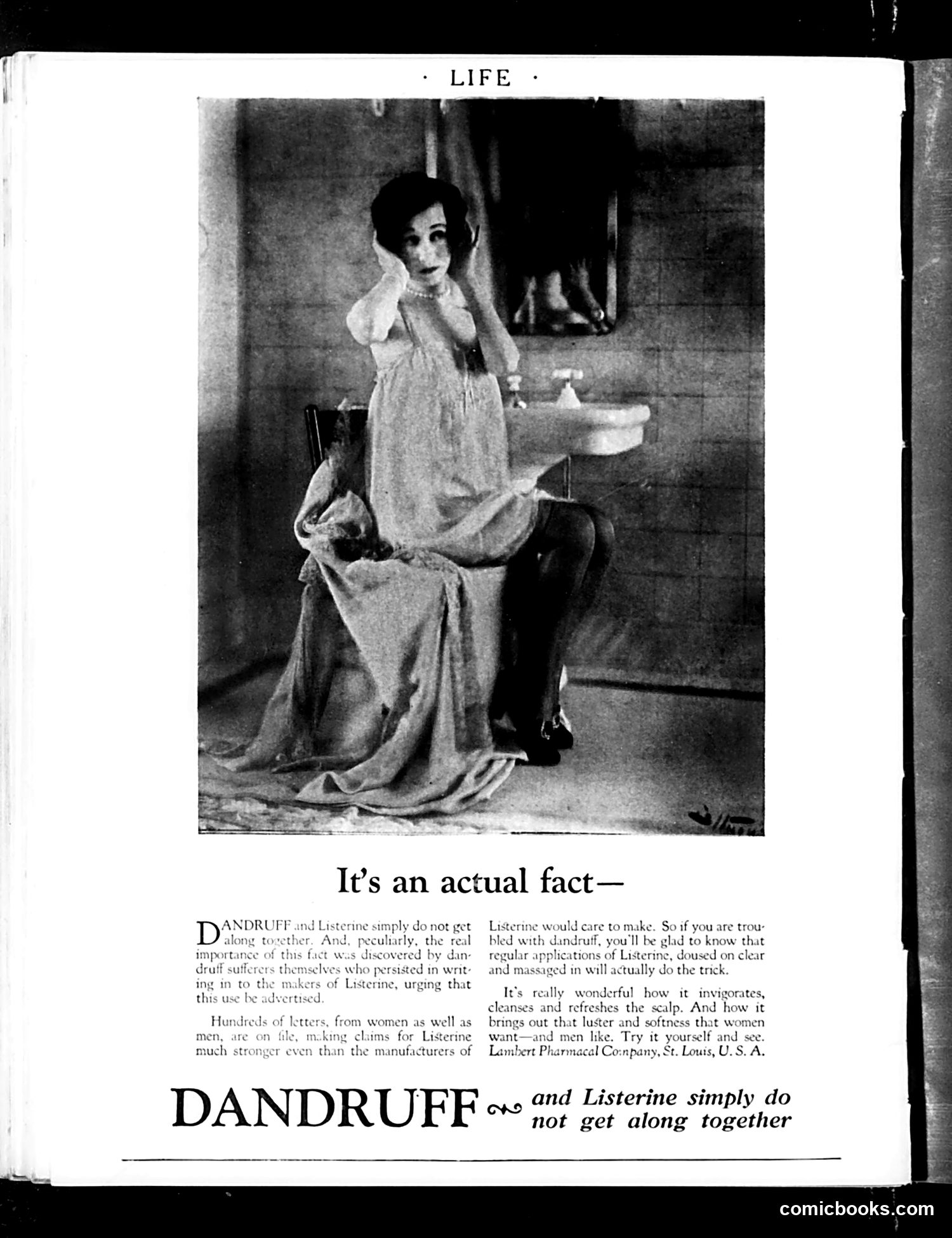
This is a **Listerine advertisement**, not political satire. The page features a photograph of a woman in an elegant Edwardian gown seated at a vanity, showcasing her groomed appearance. The advertisement's claim is straightforward: Listerine mouthwash, when applied to the scalp and massaged in, effectively treats dandruff. The headline "DANDRUFF and Listerine simply do not get along together" is a product pun. The ad cites letters from satisfied customers (both men and women) attesting to Listerine's effectiveness against dandruff, emphasizing that it "invigorates, cleanses and refreshes the scalp" while restoring "luster and softness." By modern standards, this represents a striking historical example of patent medicine marketing—promoting a mouthwash for scalp treatment—before strict FDA regulations governed medicinal claims. The elegant female imagery was typical early-20th-century advertising strategy targeting appearance-conscious consumers.