
A complete issue · 46 pages · 1926
Life — April 1, 1926
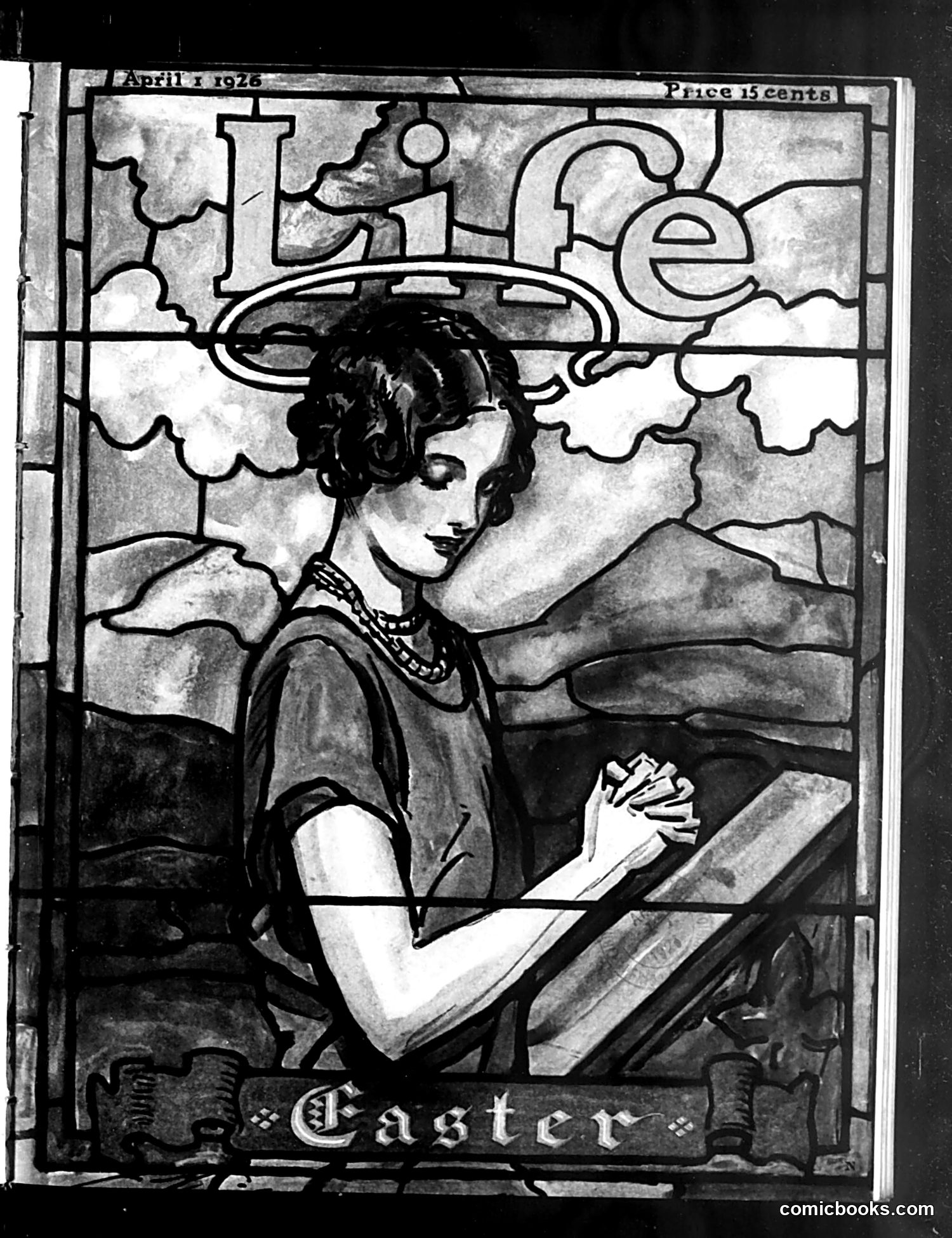
This is a Life magazine cover titled "Easter" from April 1926, priced at 15 cents. It depicts a young woman in profile, dressed in period-appropriate 1920s attire with a cloche hat and beaded necklace, holding what appears to be a hymnal or prayer book. She gazes upward with a serene expression against a stylized background featuring clouds and an angelic halo. The image represents a straightforward Easter-themed illustration celebrating the holiday's religious and feminine aesthetics typical of the era. Rather than political satire, this appears to be decorative cover art emphasizing springtime renewal, youth, and spiritual devotion—common Easter iconography. The Art Nouveau-influenced design and idealized feminine figure reflect 1920s aesthetic conventions for holiday imagery.
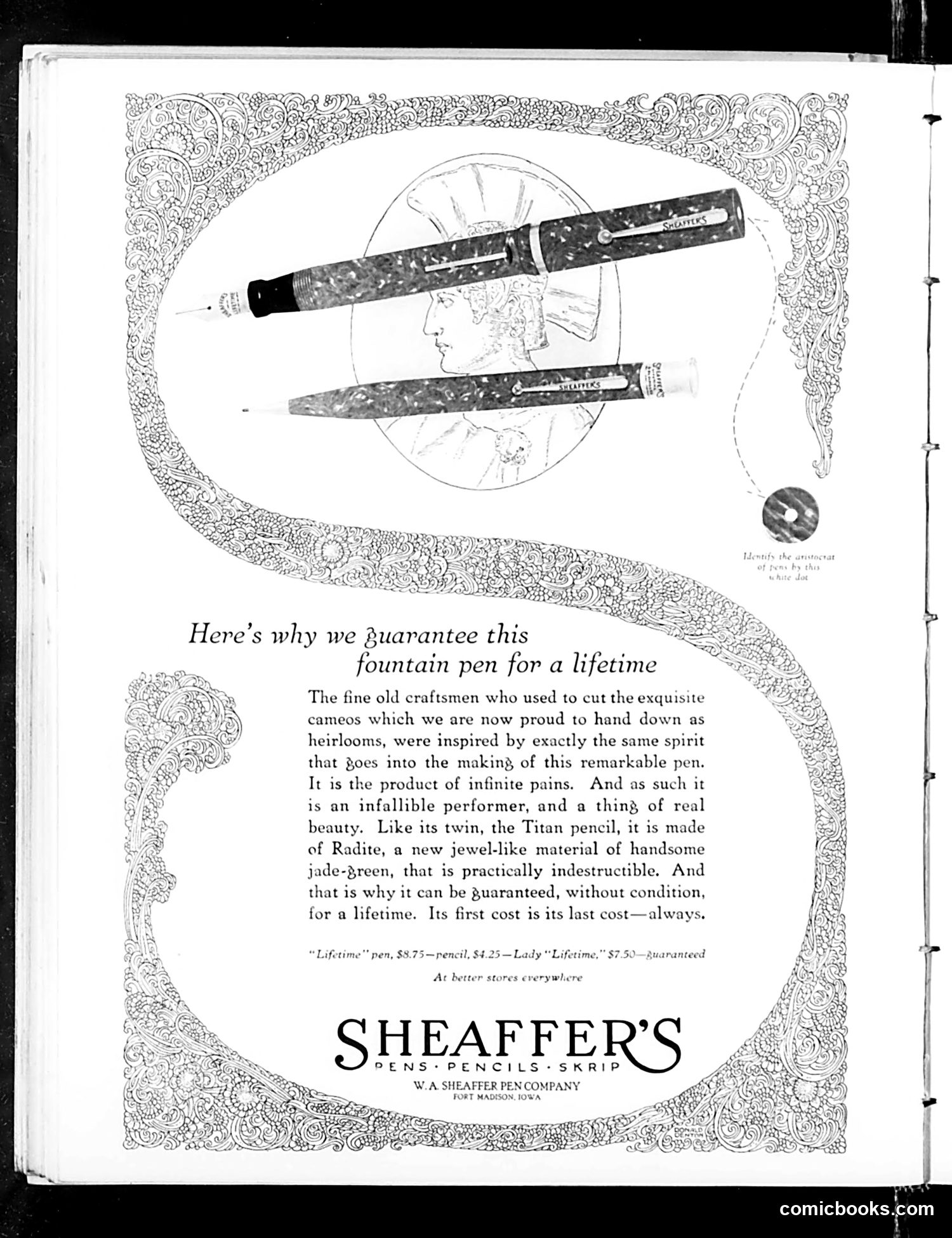
This page is primarily **advertising, not political satire**. It's a Sheaffer's pen advertisement from an early 20th-century issue of *Life* magazine. The ad features an ornate decorative border and displays two fountain pens positioned over a classical profile portrait (resembling a cameo). The ad promotes the "Lifetime" fountain pen, emphasizing its durability and craftsmanship. It compares the pen's creation to traditional cameo-cutting, highlighting that it's made from "Radite," described as a jewel-like, practically indestructible material. The copy promises a lifetime guarantee, positioning the product as both a practical writing instrument and a luxury item worth its premium cost. There is no political or social satire present on this page.
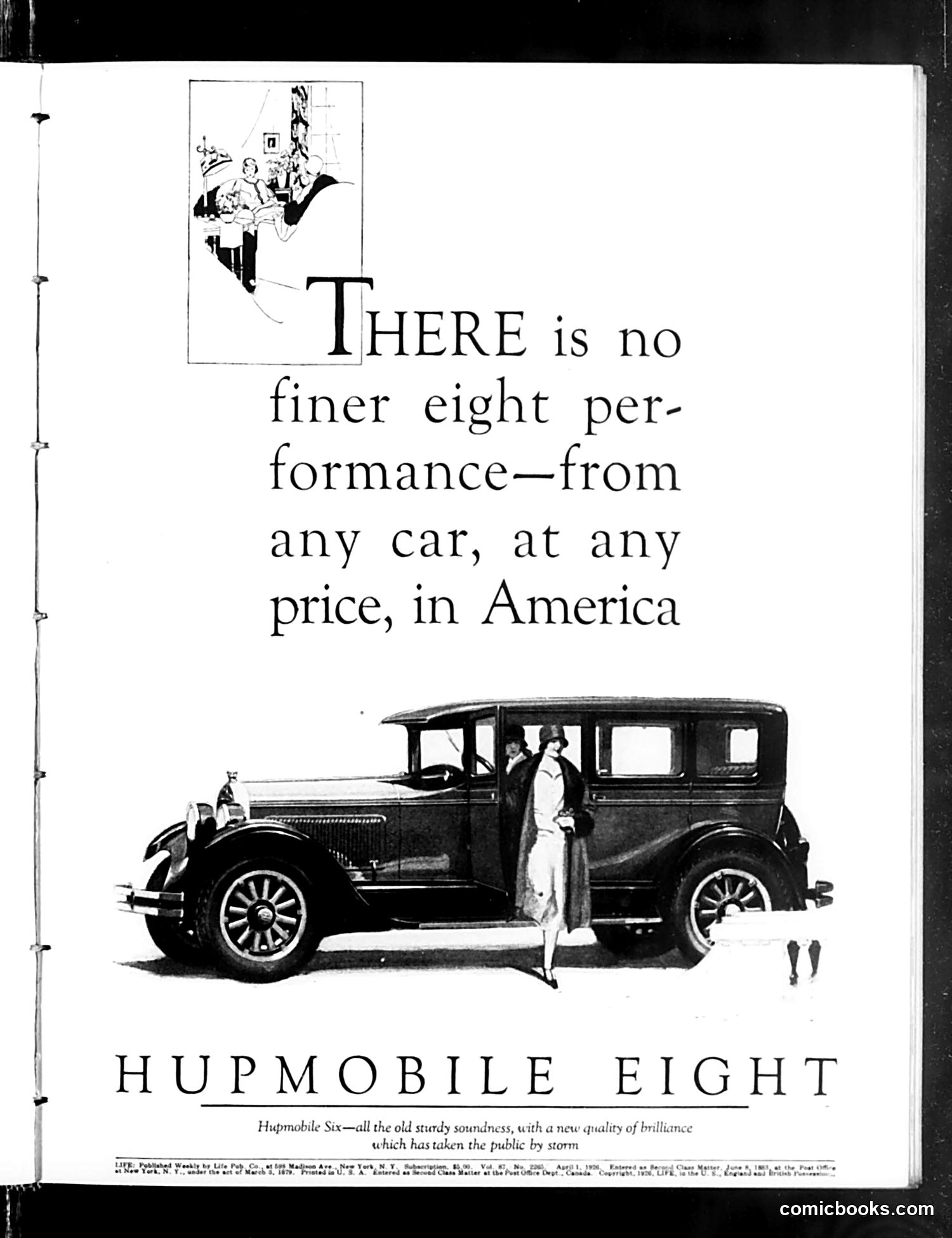
This page is primarily a **Hupmobile automobile advertisement**, not political satire. The main text claims "There is no finer eight performance—from any car, at any price in America," promoting the Hupmobile Eight model. The small illustration at top appears to show **socialite figures in an elegant setting**, likely meant to associate the car with luxury and high society—a common advertising strategy of the era. The larger illustration depicts a **well-dressed woman** standing beside the automobile, emphasizing style and sophistication to appeal to affluent consumers. The tagline notes the car combines "old sturdy soundness, with a new quality of brilliance which has taken the public by storm"—standard automotive marketing language emphasizing reliability and modern innovation.
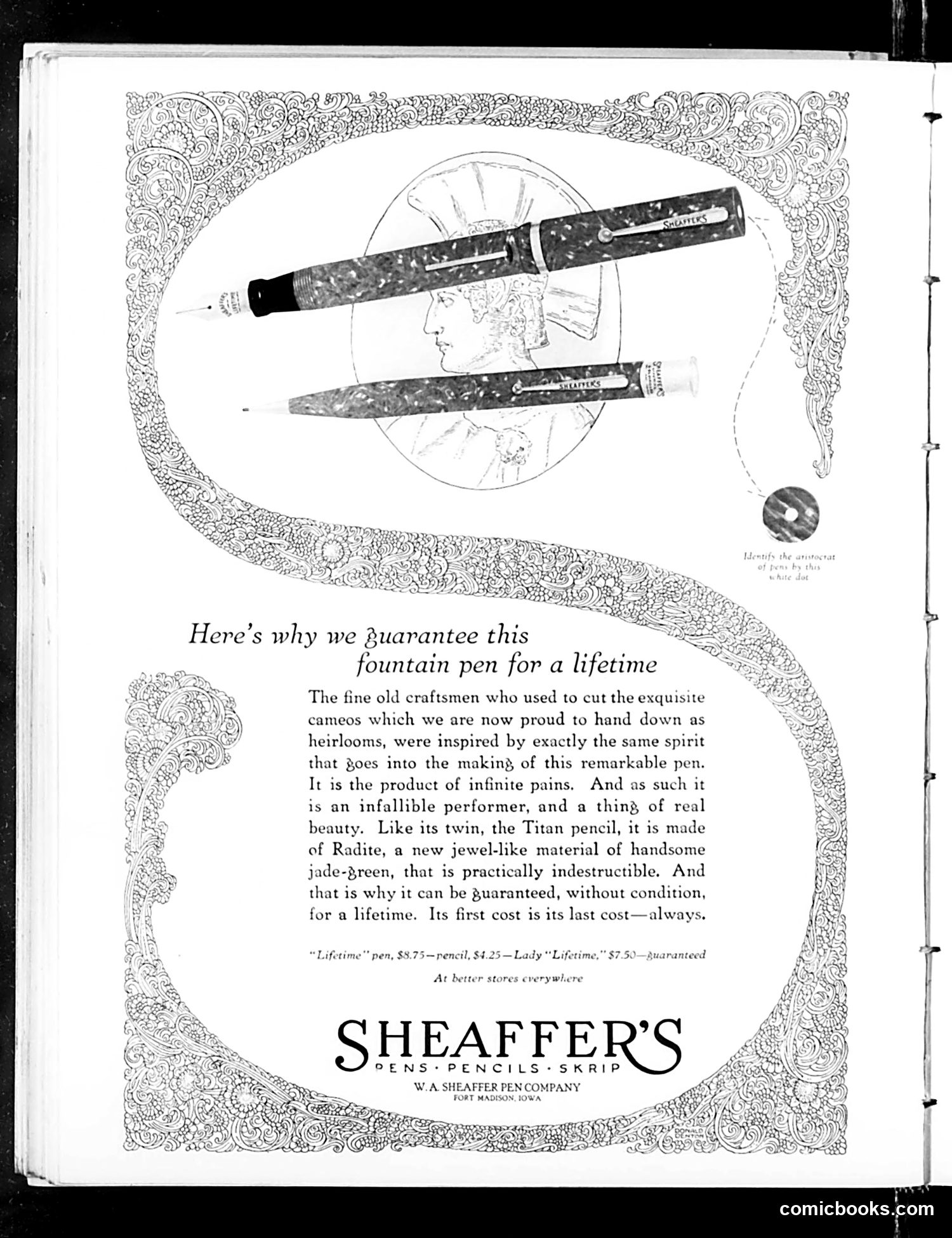
This page is primarily **advertising, not political satire**. It's a Sheaffer fountain pen advertisement from the early 20th century (Life magazine). The ad features an ornate decorative border and shows two Sheaffer pens positioned over a classical profile portrait (likely representing quality/refinement). The text emphasizes the pen's durability and craftsmanship, comparing it to traditional cameo-cutting artisans. The key marketing message: Sheaffer guarantees this pen "for a lifetime" because it's made from Radite, a purportedly indestructible material. The pricing shown suggests middle-to-upper-class consumers as the target market. There is no political cartoon or social commentary here—just period product marketing emphasizing permanence, beauty, and reliability as selling points.
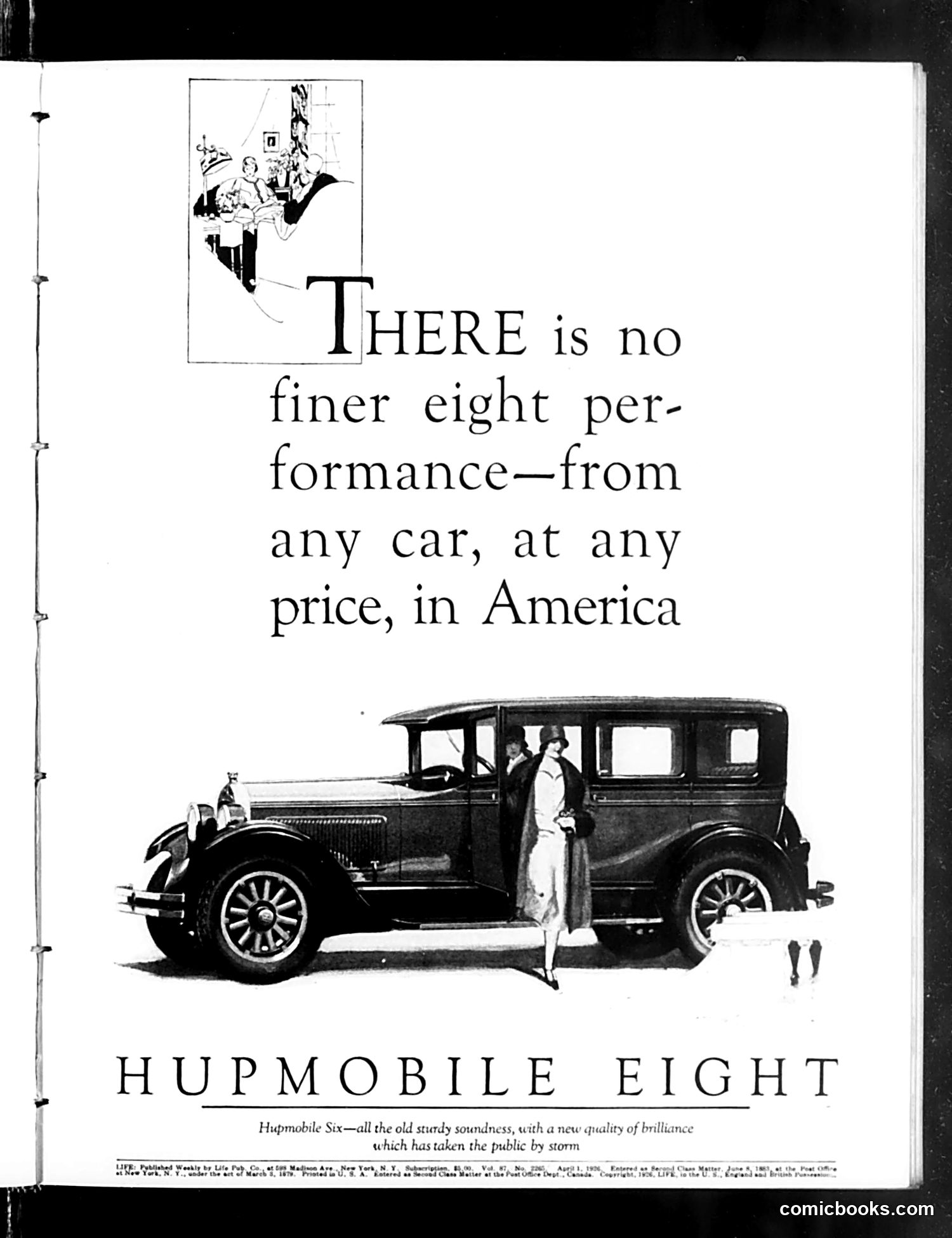
This is primarily a **Hupmobile automobile advertisement**, not political satire. The page makes a straightforward marketing claim: "THERE is no finer eight performance—from any car, at any price, in America." The upper cartoon appears to show wealthy or fashionable people (likely representing the car's target market), while the lower illustration depicts a woman in 1920s dress beside the vehicle itself. The ad emphasizes the "Hupmobile Six" as combining "old sturdy soundness, with a new quality of brilliance which has taken the public by storm." This represents typical early-20th-century automotive advertising rhetoric—claiming superiority through performance and status appeal to aspirational consumers, rather than engaging in political commentary.
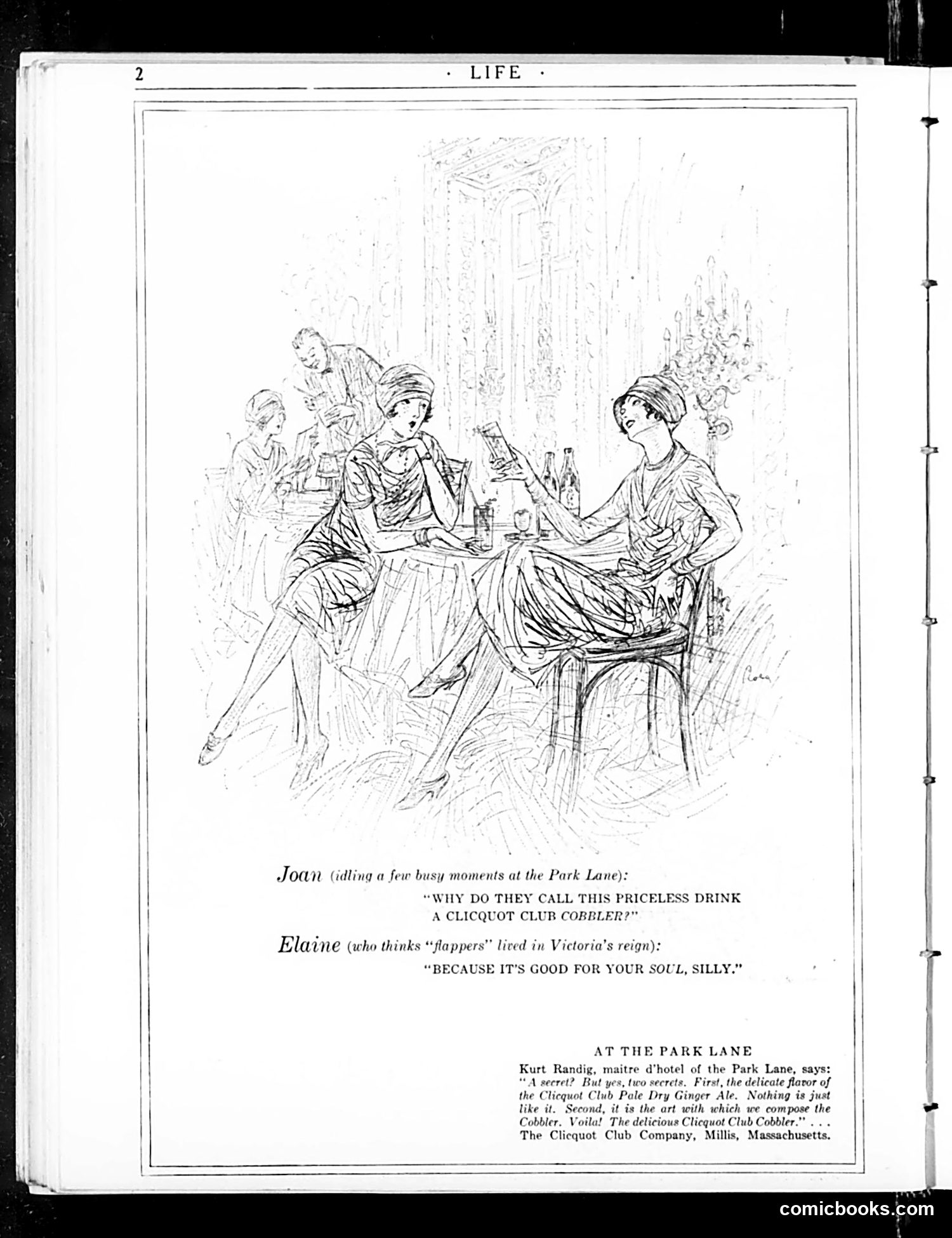
This page is primarily **advertising content disguised as social satire**. The sketch depicts fashionable women at the Park Lane, with a humorous dialogue about a "Clicquot Club Cobbler" drink. The joke is straightforward: Joan asks why this expensive beverage is called a "cobbler" (a mixed drink), and Elaine responds it's "good for your soul, silly"—a lighthearted mockery of health claims marketed alongside alcoholic beverages. The secondary text from Kurt Randig, maître d'hôtel of the Park Lane hotel, promotes the **Clicquot Club Pale Dry Ginger Ale** and its "Cobbler" preparation, emphasizing flavor and mixology craft. This is **branded entertainment**: using satirical magazine content to advertise a specific product to affluent readers frequenting upscale establishments.
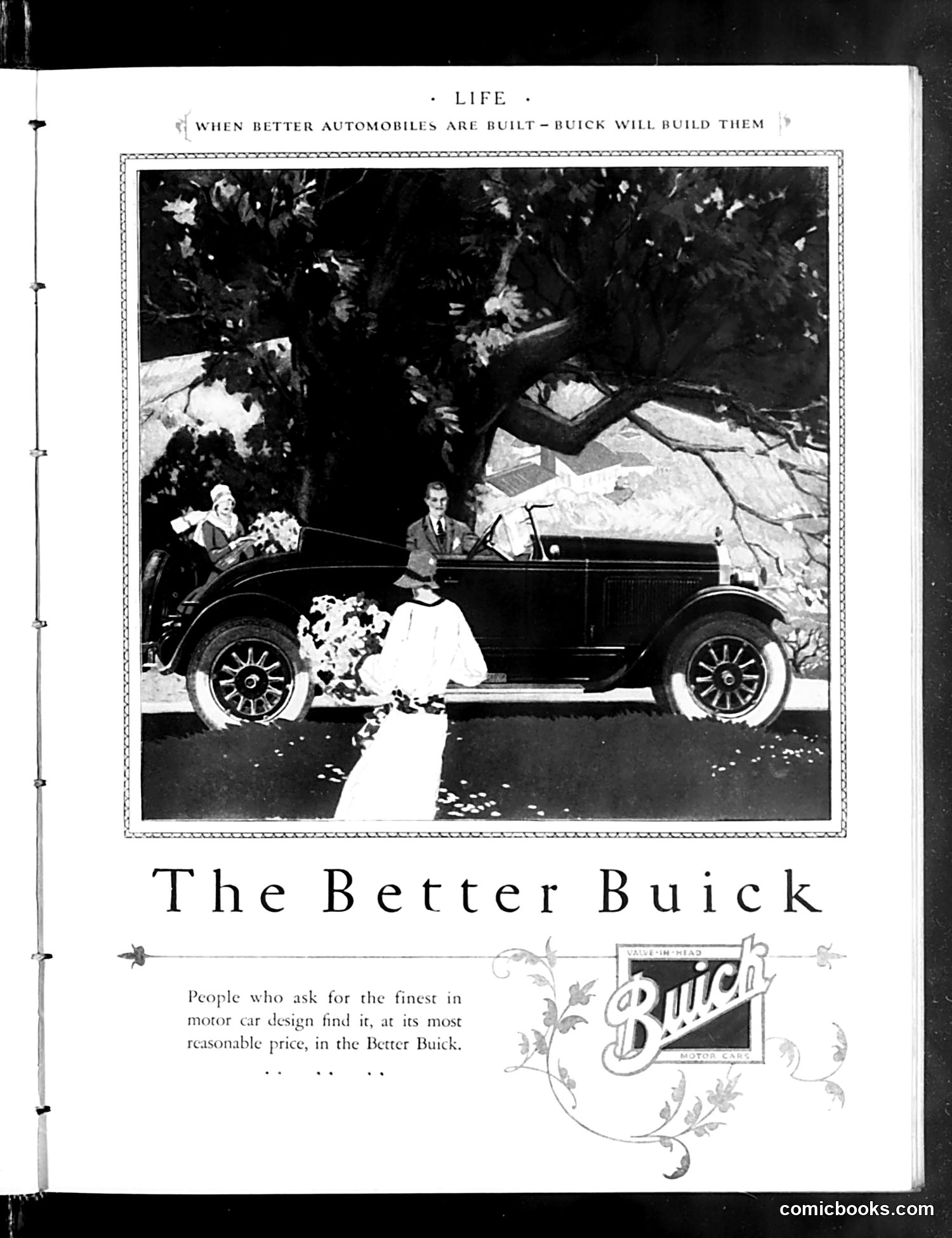
This is a **Buick automobile advertisement**, not a political cartoon. The page appears from *Life* magazine's advertising section rather than its editorial content. The ad shows an elegant scene: three well-dressed people with a luxury automobile positioned beneath flowering trees, creating an aspirational lifestyle image. The accompanying text states: "People who ask for the finest in motor car design find it, at its most reasonable price, in the Better Buick." The advertisement's purpose is straightforward product marketing—positioning Buick as offering premium automobile design at accessible pricing. The romantic, leisurely setting emphasizes luxury and refinement rather than making any political or social commentary. This represents typical early-20th-century automotive advertising that associated cars with wealth, leisure, and sophistication.
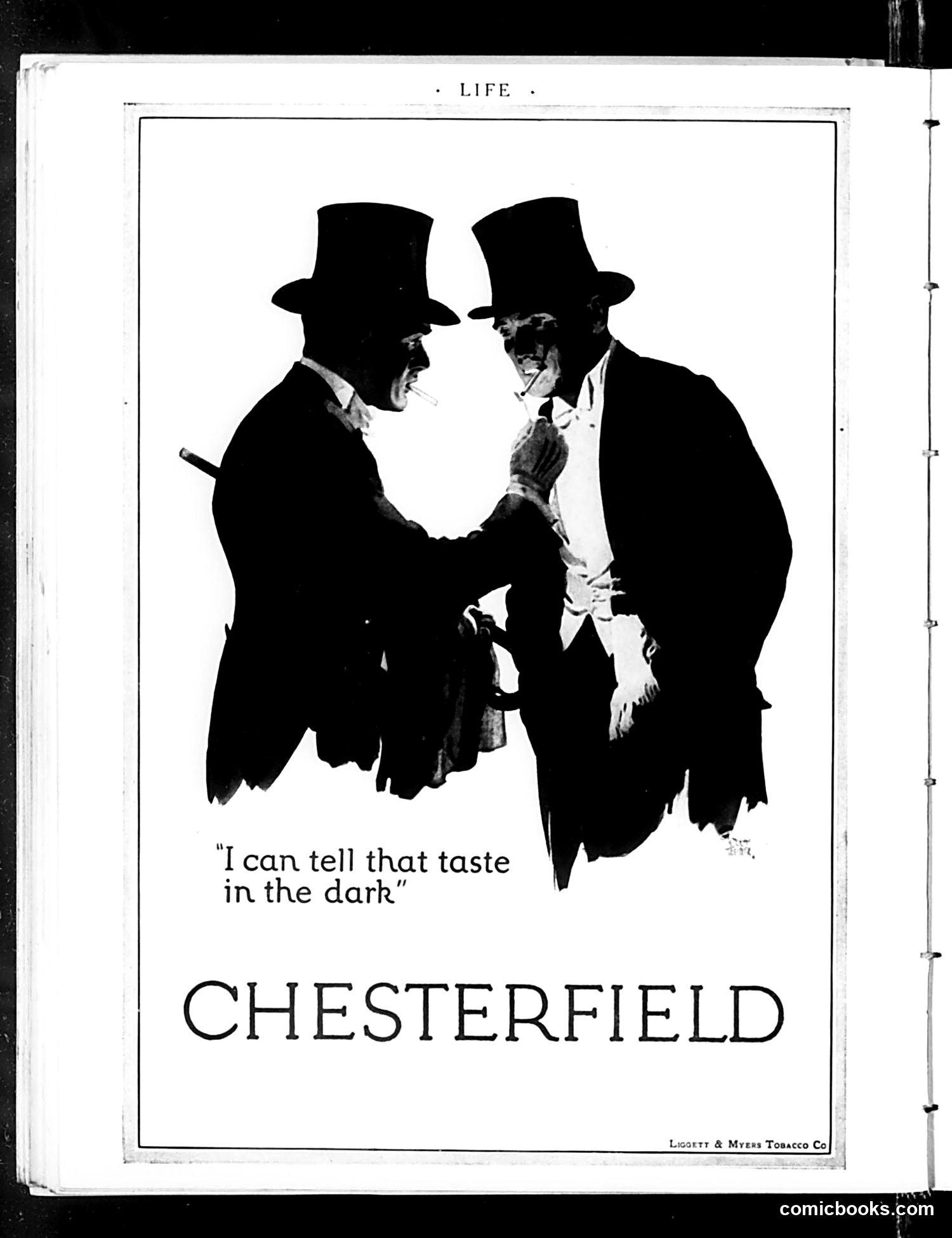
This is a Chesterfield cigarette advertisement from *Life* magazine. Two well-dressed men in top hats and formal wear are shown in silhouette, appearing to share a cigarette or taste one in darkness. The tagline reads: "I can tell that taste in the dark." The ad's humor plays on the idea that Chesterfield cigarettes are so distinctively good that a smoker can identify them by taste alone, even without seeing them. This was a common advertising strategy of the era—claiming product superiority through sensory qualities. The silhouette style and gentlemen's formal attire suggest sophistication and elegance, positioning cigarette smoking as a refined social activity for the upper classes.
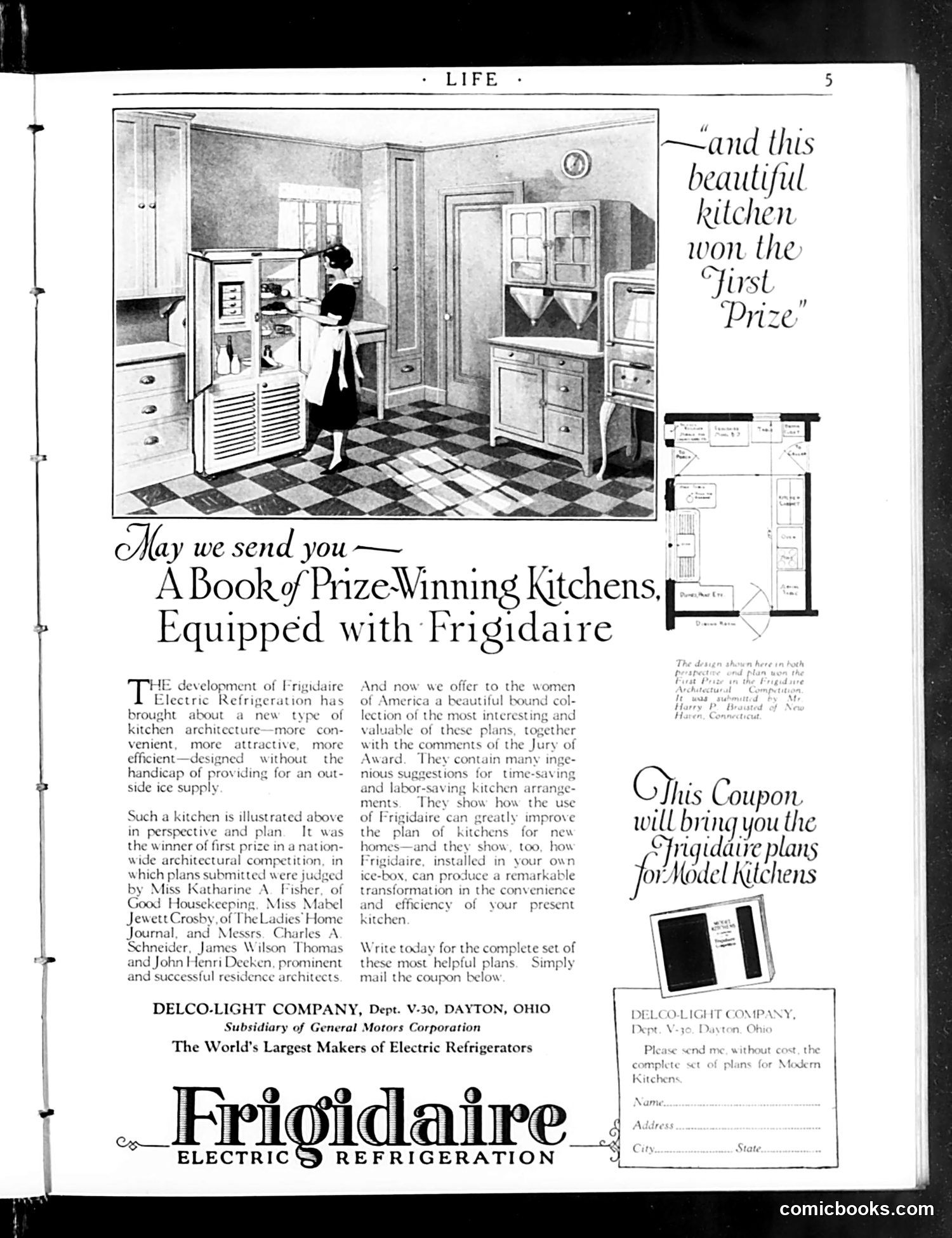
This page is primarily an **advertisement for Frigidaire electric refrigerators**, not satire or political commentary. The image shows a woman in a modern kitchen with Frigidaire appliances and a distinctive diamond-patterned floor. The ad promotes a book of "prize-winning kitchen" designs that supposedly won a competition judged by notable figures including architects and magazine editors. The advertising appeal targets women as homemakers by emphasizing how Frigidaire refrigeration can improve kitchen convenience and efficiency. A coupon invites readers to request kitchen design plans. This represents typical 1920s-30s appliance advertising that positioned electric refrigerators as symbols of modernity and labor-saving technology for the home.
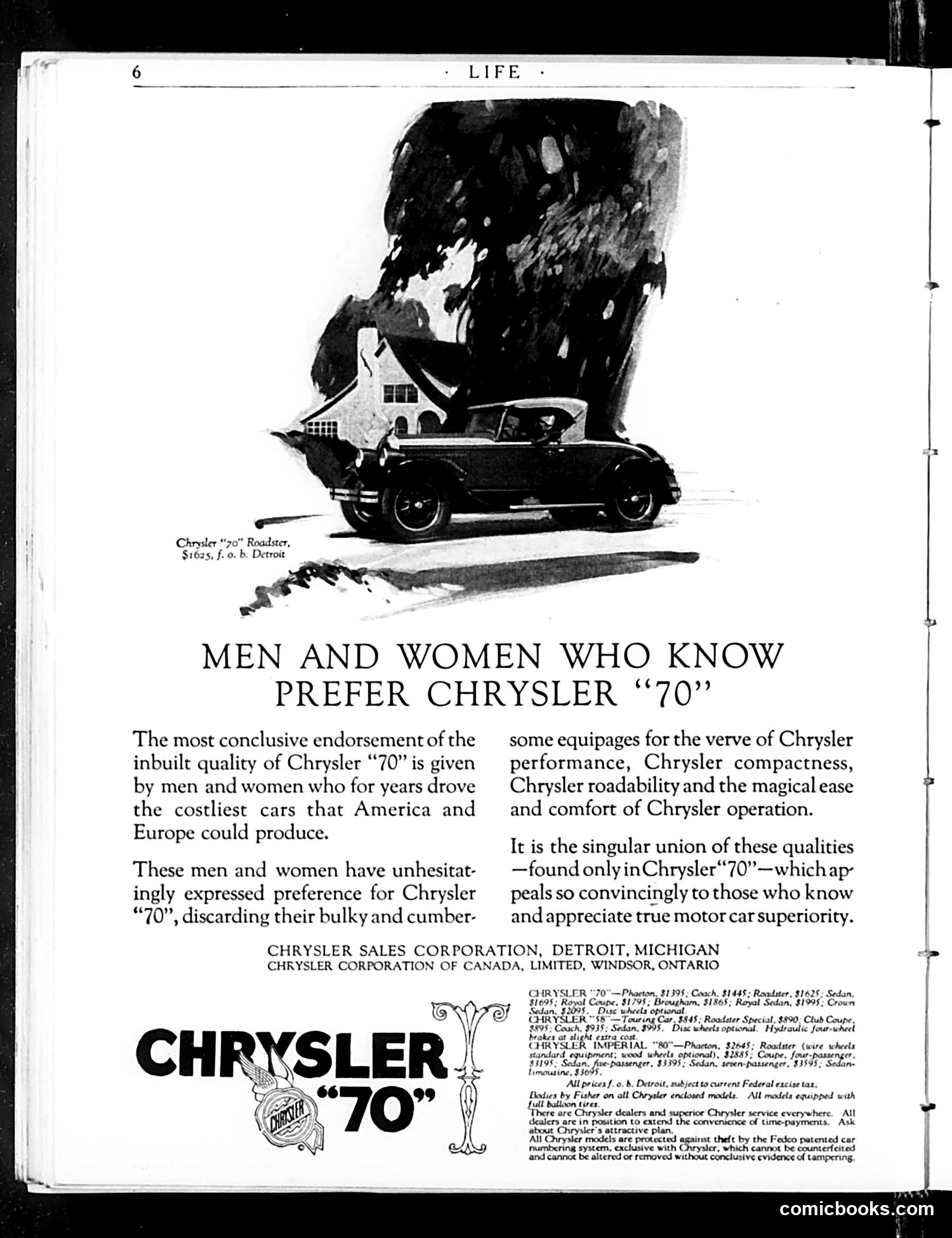
This is a **Chrysler automobile advertisement**, not a political cartoon or satire. The page promotes the Chrysler "70" model to an upscale audience. The visual shows a luxury roadster positioned beneath a double-exposure image of an elegant mansion and landscape, creating an aspirational composition. The ad copy targets "men and women who know" cars—implying sophisticated, discerning buyers who've previously owned high-end European and American vehicles. The marketing strategy emphasizes exclusivity and superiority: the car appeals to those who appreciate "true motor car superiority" and dismiss "bulky and cumbersome" competitors. The tagline "Men and Women Who Know Prefer Chrysler '70'" positions ownership as a marker of refined taste and automotive expertise. This is period advertising, not editorial commentary.
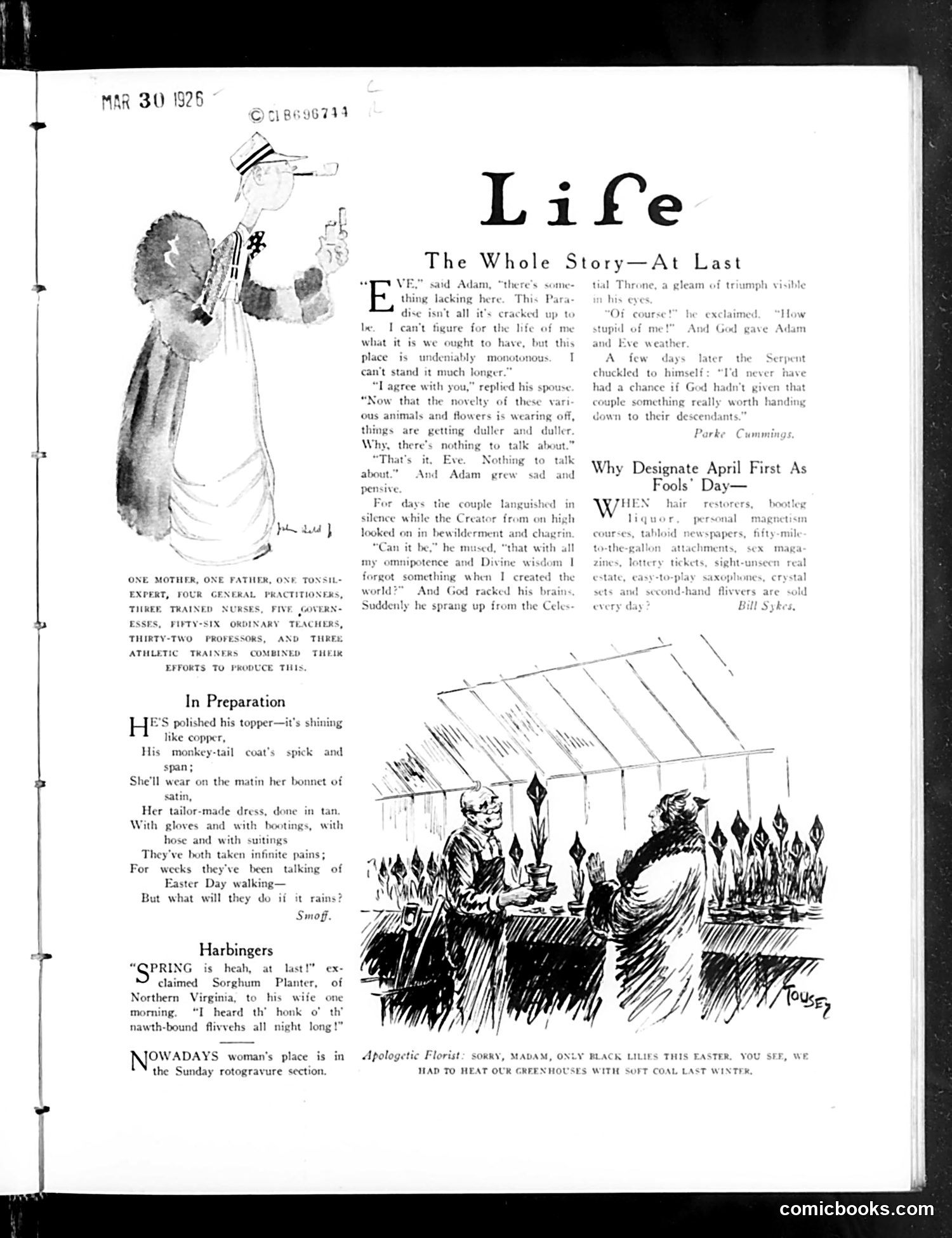
This page features satirical commentary on domestic life and social customs. "The Whole Story—At Last" presents a dialogue between Adam and Eve, humorously suggesting that marital discord is humanity's original condition—Eve complains the Paradise lacks novelty; Adam despairs that "nothing to talk about" makes it monotonous. The satire mocks the notion that human unhappiness stems from fundamental incompatibility rather than circumstance. "Why Designate April First As Fools' Day?" catalogs contemporary commercial absurdities—hair restorers, bogus investment schemes, dubious patent medicines—suggesting modern consumer culture itself represents foolishness. The cartoon depicting two figures in a tent appears to illustrate one of the accompanying humorous poem sections ("In Preparation" or "Harbingers"), likely about spring preparations or weather concerns.
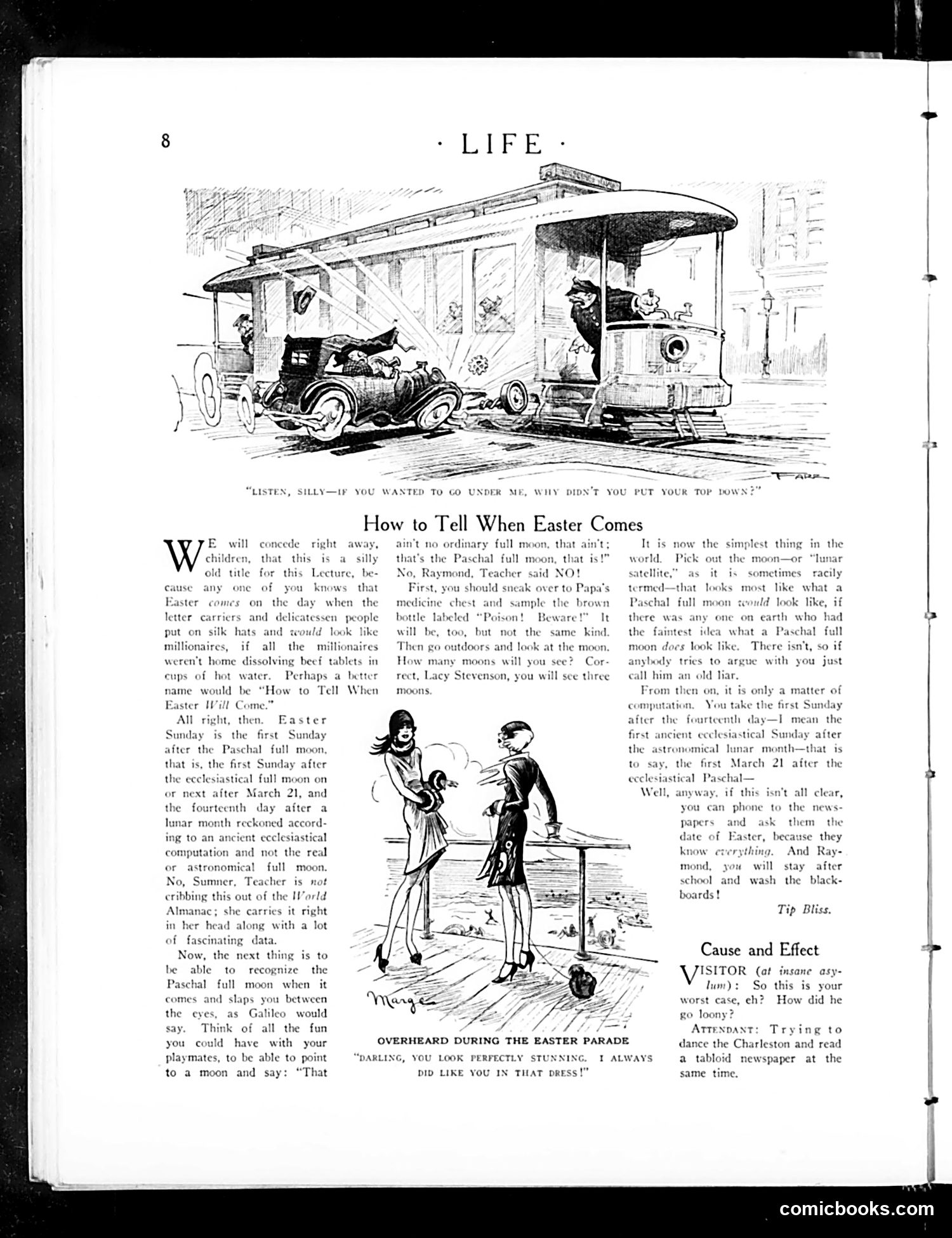
This page contains humorous advice about determining when Easter occurs. The top cartoon shows a car colliding with a streetcar, captioned with a joke about putting up the convertible top. The main article, "How to Tell When Easter Comes," explains that Easter's date is complex—determined by the first Sunday following the first full moon after the vernal equinox (March 21). The author jokes that this astronomical calculation is so confusing that people should simply "phone to the newspapers" who "know everything." A middle illustration depicts two women discussing Easter fashions ("Darling, you look perfectly stunning. I always did like you in that dress!"). The bottom section, "Cause and Effect," is a brief joke about someone going "loony" after attempting to dance the Charleston while reading a newspaper—satirizing the frenzy of 1920s fads and multitasking.
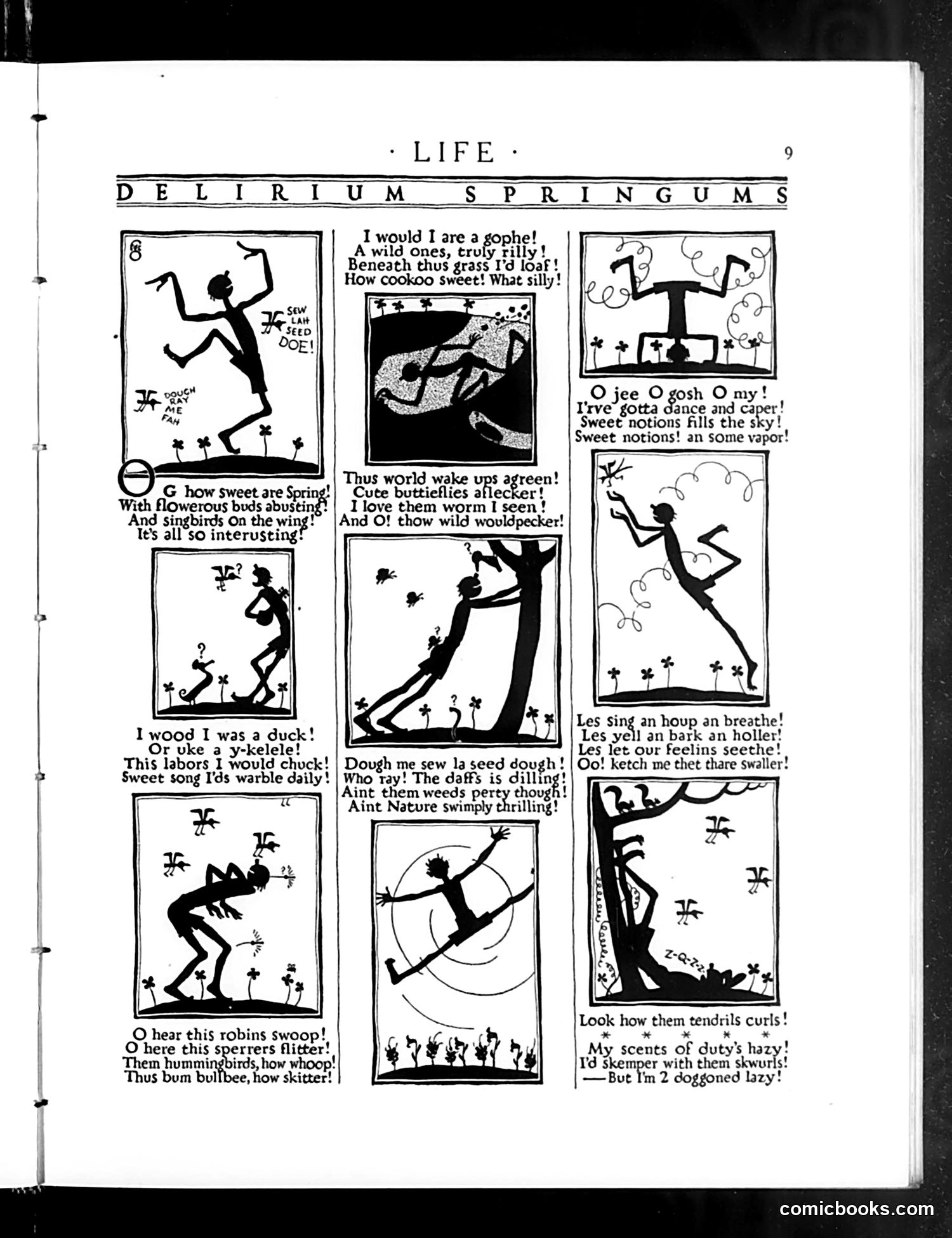
This page presents "Delirium Springums," a whimsical comic strip celebrating spring's arrival through exuberant human figures dancing, leaping, and cavorting among flowers and nature. The figures embody spring fever—uncontrolled joy and physical exuberance triggered by seasonal change. The accompanying verse uses archaic and playful language ("O jee O gosh," "ketch me thet dare swaller") to mock sentimental, overwrought romantic poetry about springtime. The satire targets the clichéd literary tradition of spring as inspiration for excessive sentimentality and nature-worship. The silhouette artwork emphasizes physical liberation and abandon. Rather than political satire, this represents Life magazine's social humor—mocking how spring affects human behavior and the pretentious poetry conventions of the era.
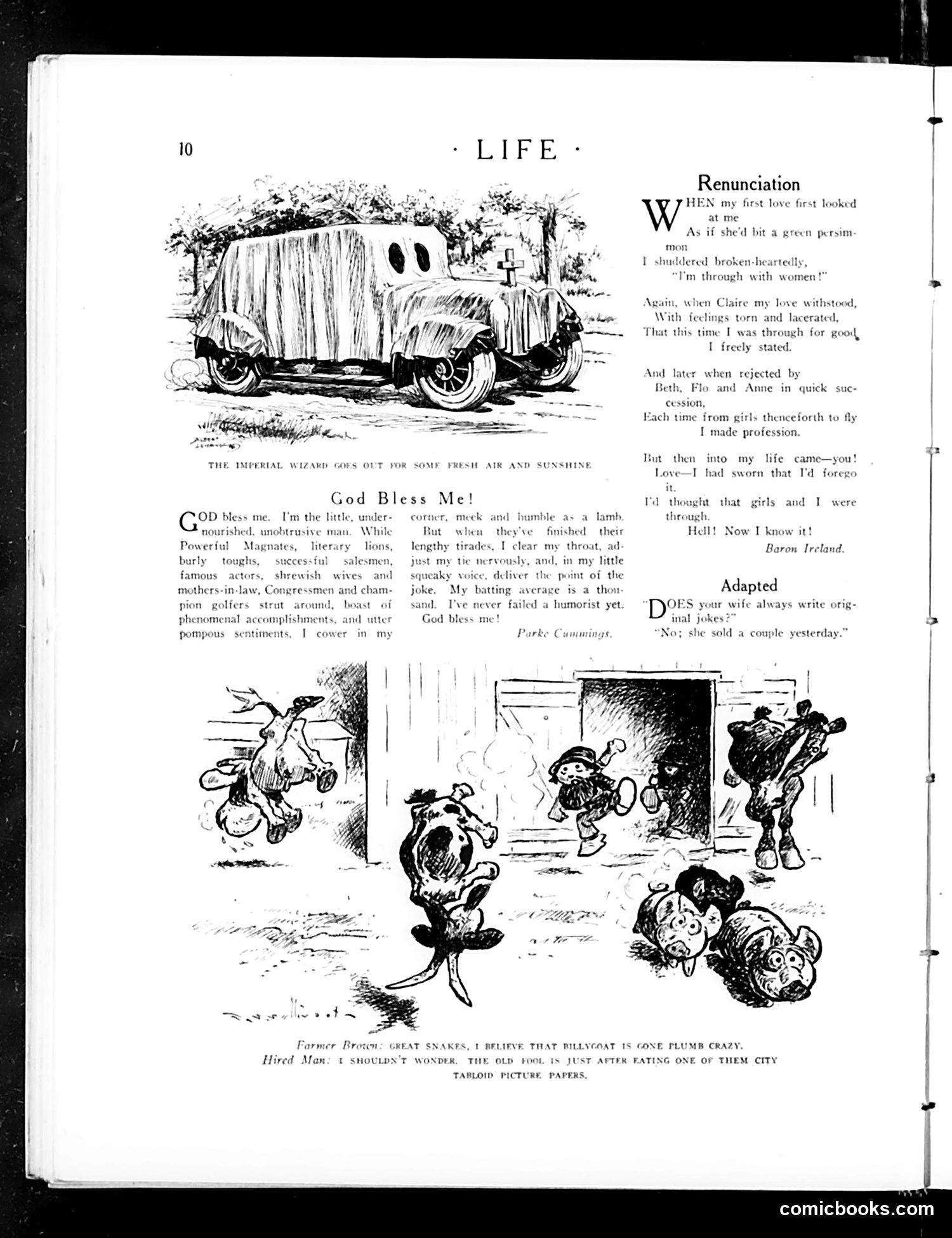
This page contains three distinct pieces of humor: 1. **"The Imperial Wizard Goes Out for Some Fresh Air and Sunshine"** - A cartoon showing a KKK leader in a car. The satire targets the KKK's pretensions of respectability and "normal" activity. 2. **"God Bless Me!"** - A humorous monologue by Park Cummings about a self-deprecating, unsuccessful performer who remains cheerful despite repeated rejections. It's gentle satire of show-business persistence. 3. **"Renunciation"** - A poem by Baron Ireland about romantic renunciation and self-deception regarding past relationships. 4. **"Adapted"** - A brief joke about wives' negotiating tactics. The bottom cartoon depicts children and chaos outside a building—likely satirizing domestic chaos or neighborhood disruption, though the exact reference is unclear without additional context.
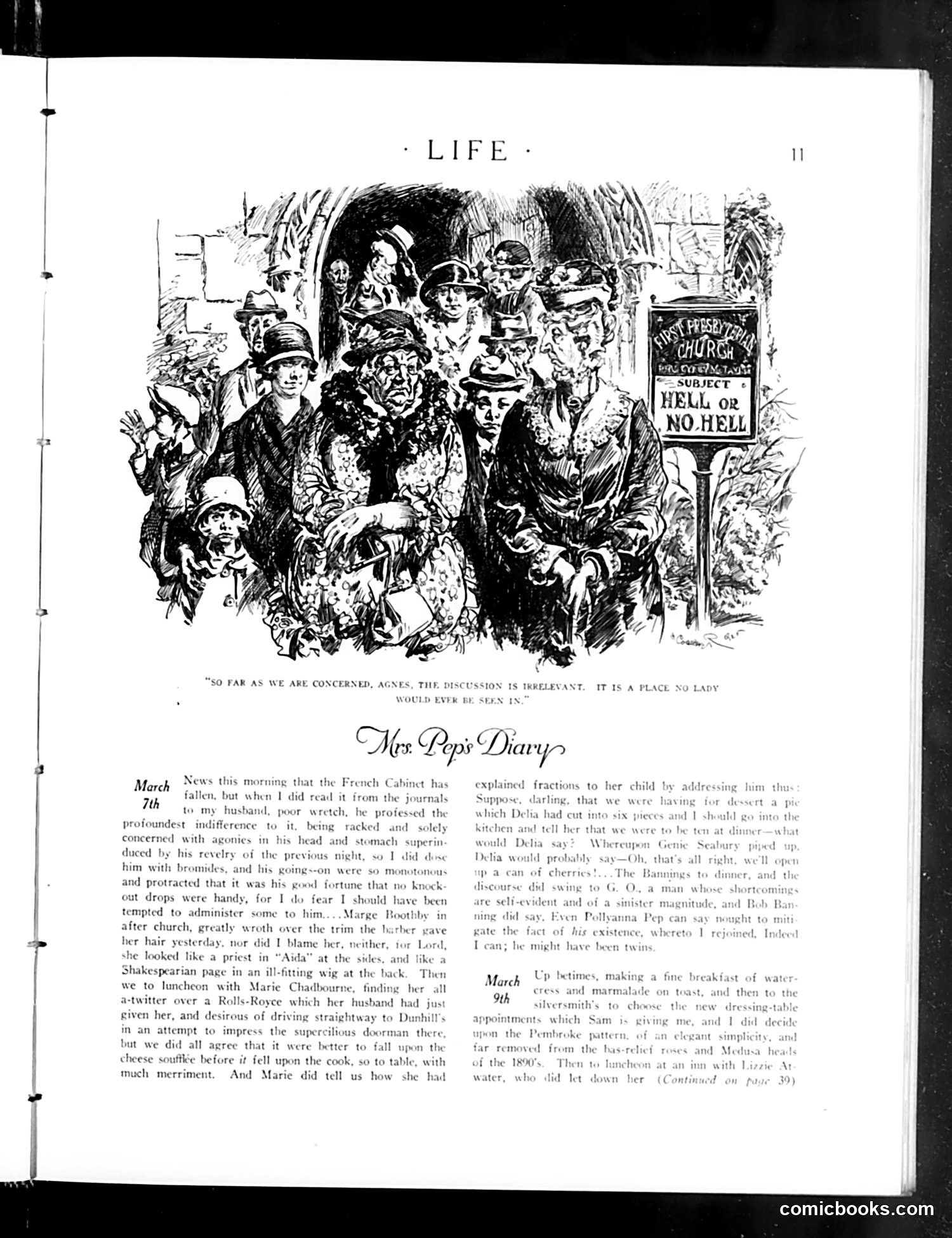
This page features "Mrs. Pop's Diary," a satirical domestic column. The accompanying illustration depicts a crowded street scene outside a church advertising a sermon on "HELL OR NO HELL"—likely mocking contemporary theological debates about damnation's existence. The diary entries (dated March 3rd and 9th) describe mundane household frustrations: a husband's indifference to French politics, servants' incompetence, and domestic trivialities. The satire targets upper-class women's preoccupations with trivial social matters while serious events occur globally. The church sign juxtaposing spiritual concerns with the narrator's obsession with household servants and dinner arrangements suggests ironic commentary on misplaced priorities among the wealthy—spiritual questions matter less than whether servants will properly execute domestic duties.
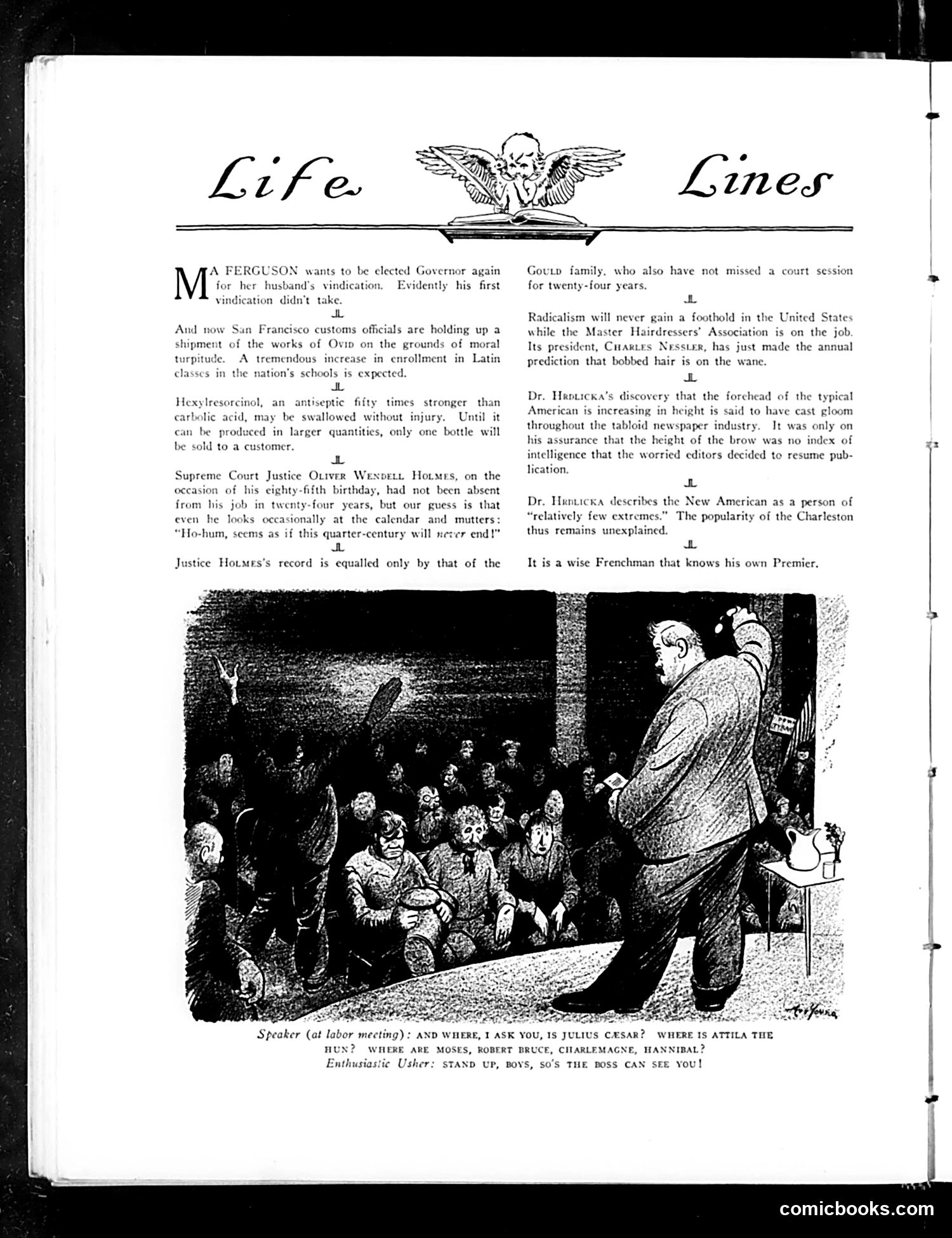
This satirical page contains brief political commentary and a cartoon mocking a labor meeting. The cartoon depicts a speaker addressing workers, referencing classical historical figures—Julius Caesar, Attila the Hun, Moses, Robert Bruce, Charlemagne, and Hannibal—asking where they are. An "Enthusiastic Usher" instructs boys to stand so "the boss can see you," suggesting the speaker is performing for management rather than genuinely advocating for workers. The satire critiques labor organizing as performative theater where speakers invoke grand historical revolutionaries while actually serving employer interests. The text snippets above cover unrelated items: Ma Ferguson's gubernatorial ambitions, San Francisco customs officials rejecting Latin classics, and remarks about Charles Nessler's hair predictions. The page exemplifies Life's satirical style targeting various political and social targets of its era.
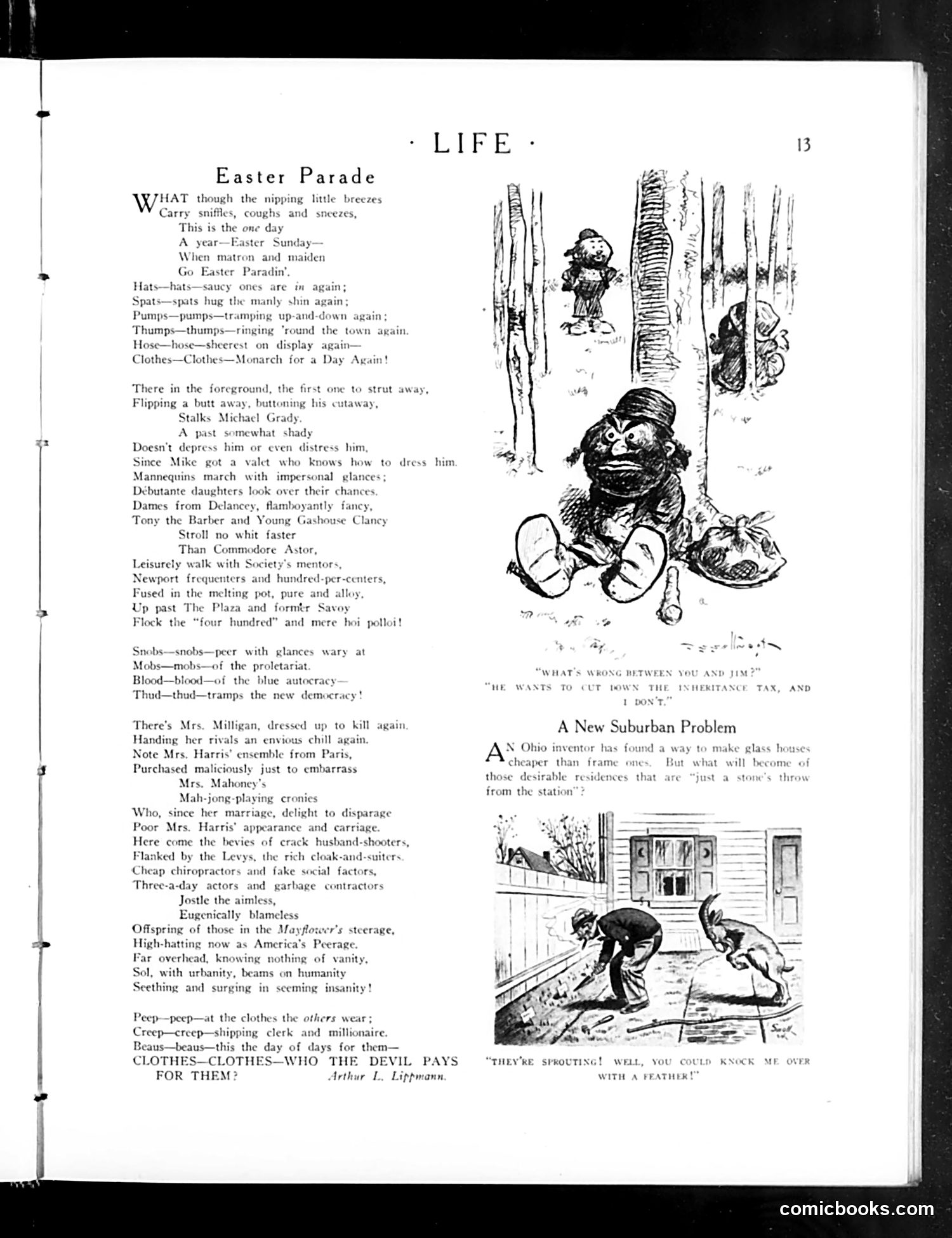
**"Easter Parade" Poem:** Arthur L. Leipman's satirical verse mocks the Easter tradition of displaying fashionable new clothing. It catalogs the social pretension surrounding the holiday—wealthy families parading in their finest, servants getting rare days off, and society figures showing off status. The poem's repeated phrases ("Hats—hats," "Clothes—Clothes") emphasize materialism. The final line, "CLOTHES—CLOTHES—WHO THE DEVIL PAYS FOR THEM?" reveals the satire's target: the extravagant spending on Easter finery, particularly questioning who bears the financial burden. **"A New Suburban Problem" Cartoon:** An illustration depicting children playing roughly outside a modest suburban house. The caption suggests conflict between neighbors over children's boisterous behavior—reflecting early-20th-century suburban growth and tensions between residents adjusting to closer living quarters.
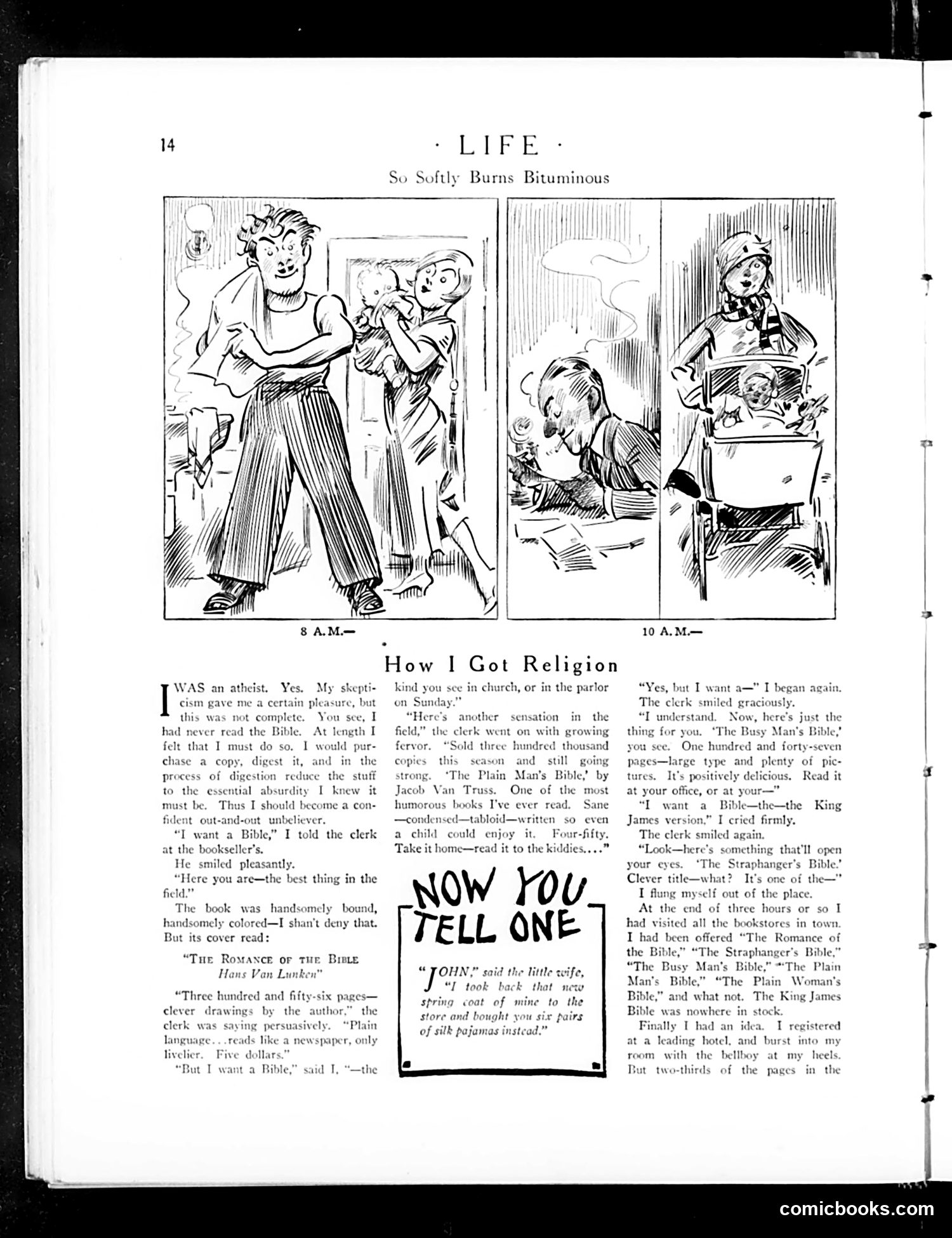
This page satirizes religious conversion through a humorous narrative. The comic panels show a man's transformation from atheist to Bible-buyer after a clever bookstore clerk's sales pitch. The satire targets both casual atheism and consumerist religion. The protagonist initially dismisses the Bible, but becomes enchanted when shown "The Busy Man's Bible"—a handsomely bound, illustrated abridgment marketed as practical and accessible. The joke centers on how commercial packaging and salesmanship convert him, not genuine spiritual conviction. The dialogue emphasizes material aspects: the book's attractive binding, its "three hundred and fifty-six pages," and the clerk's persuasive marketing. The final panels mock consumerist behavior—the narrator frantically searches bookstores for specific Bible editions, treating religion as a consumer product rather than a meaningful belief system. The satire suggests early-20th-century American religion had become commodified.
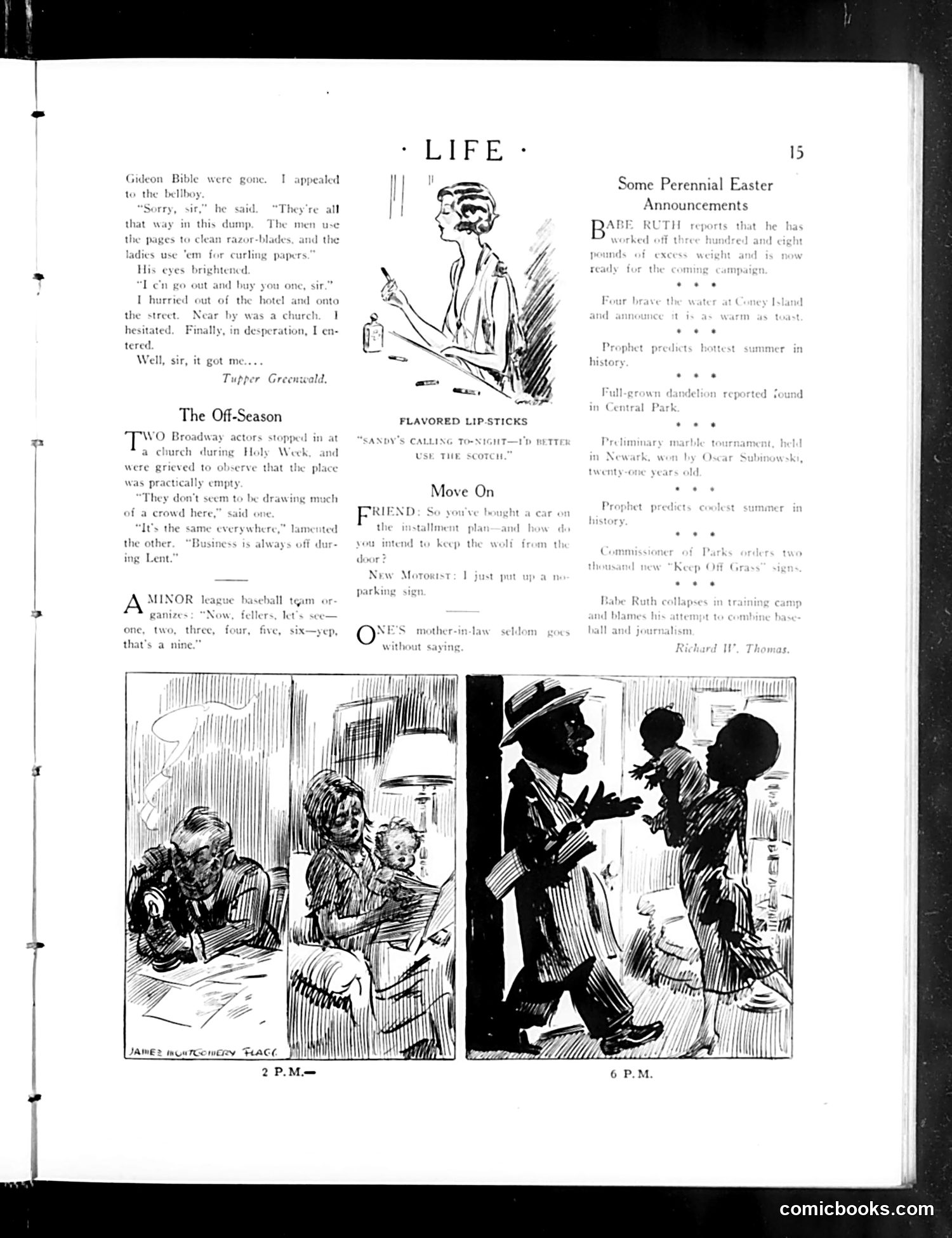
This page from *Life* magazine contains two main cartoon strips at the bottom, labeled "2 P.M." and "6 P.M.", depicting a man's changing demeanor throughout the day—presumably after drinking. The "2 P.M." panel shows him calm and domestic; the "6 P.M." panel shows him animated and gesturing wildly, likely intoxicated. The accompanying text snippets reference social situations: "Flavored Lip-Sticks," dating advice ("Sandy's calling to-night"), and keeping "the wolf from the door" (avoiding poverty). These satirize everyday middle-class anxieties and social rituals of the era. The cartoon suggests alcohol's transformative effect on behavior—a common satirical theme in *Life*, which frequently mocked American social conventions and hypocrisy. The "Move On" section offers dry observational humor about modern life.
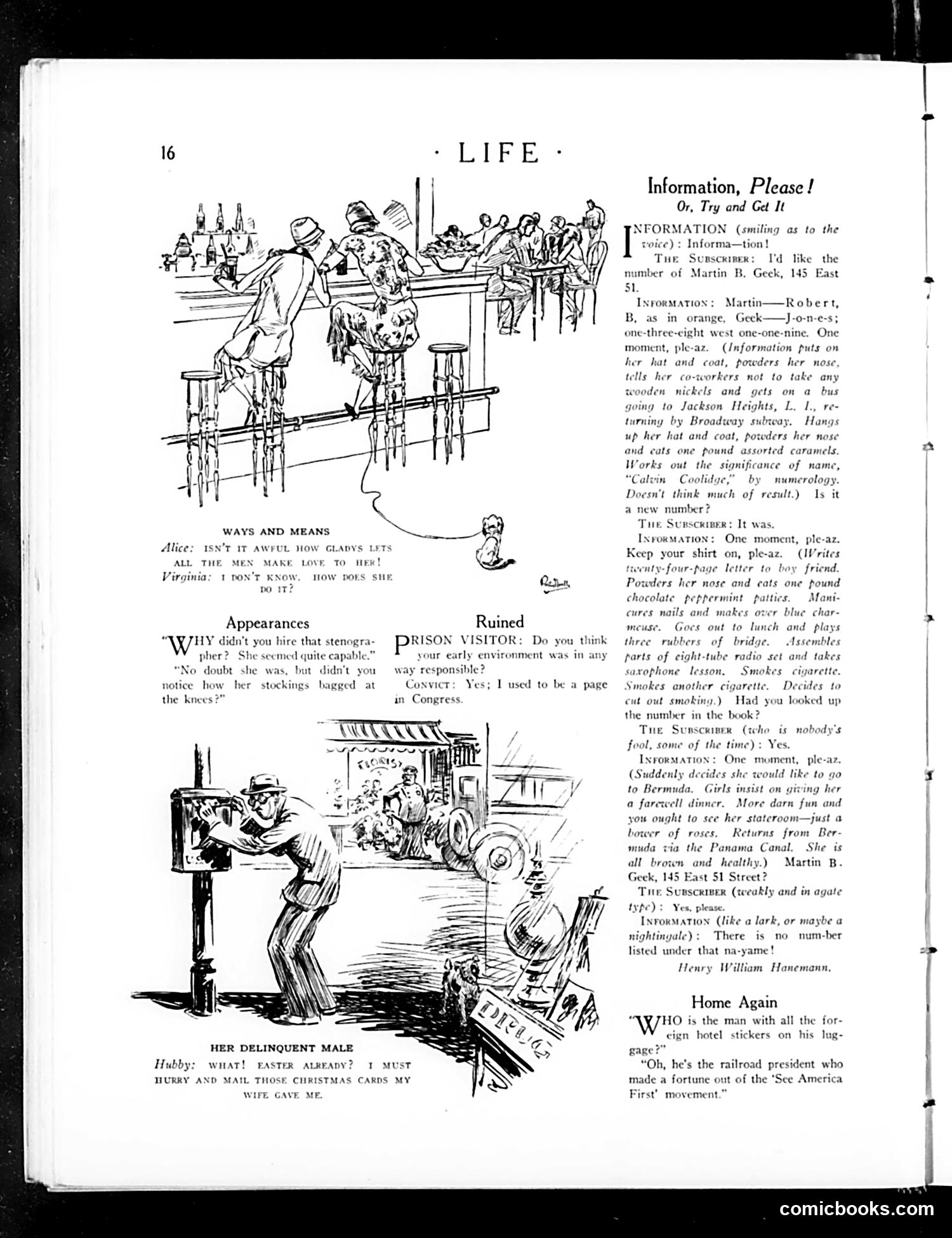
This page contains three separate humorous pieces satirizing early 20th-century American social life: **"Ways and Means"**: A dialogue joke about a woman's popularity, suggesting women use romantic appeal rather than competence to advance. **"Appearances"**: Mocks hiring discrimination, where a stenographer loses a job not for incompetence but because her stockings "bagged at the knees"—criticizing superficial judgment of women's appearance over qualifications. **"Her Delinquent Male"**: Satirizes husbands' procrastination; a man must rush to mail Christmas cards his wife gave him months earlier, implying men are irresponsible and wives must manage household tasks. **"Ruined"**: A prison visitor asks if early environment caused criminality; the convict blames being "a page in Congress"—satirizing corruption in government. **"Information, Please!"**: The longest piece mocks telephone directory assistance operators' inefficiency and distractibility, suggesting they pursue personal errands (shopping, socializing, romance) instead of focusing on their job. These reflect contemporary concerns about workplace competence, gender roles, and service quality.
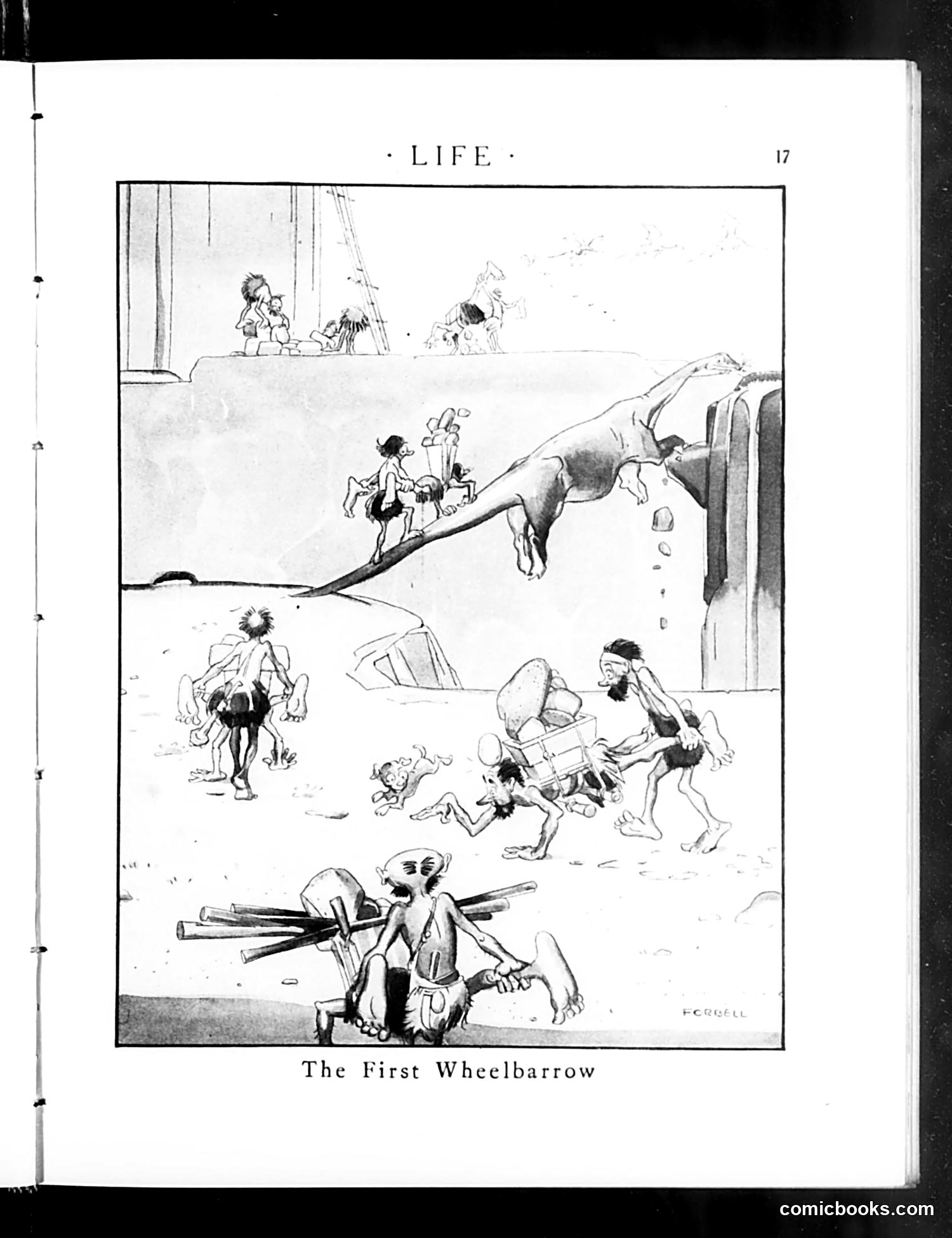
This satirical cartoon depicts the invention of the wheelbarrow as a primitive achievement. The scene shows early humans discovering and experimenting with this basic tool—some figures pushing or pulling it, others observing from above (possibly representing "civilization" or progress). The humor lies in treating the wheelbarrow as a major milestone in human development, shown through the chaotic, comedic attempts by cavemen-like figures to operate it. The exaggerated struggle and multiple people involved in such a simple invention satirizes how humans often overcomplicate basic solutions or treat mundane innovations as monumental achievements. The cartoon appears to mock either technological progress narratives or the human tendency toward self-congratulation over modest accomplishments. The "primitive" setting suggests commentary on what we consider "civilization" or "advancement."
This page attacks the corrupting effects of Prohibition enforcement on otherwise respected officials. The editorial criticizes how zealous "dry law" enforcement damages character and judgment. Two military figures are highlighted as cautionary examples: **General Smedley Butler** — a decorated Marine officer who served as Philadelphia's dry enforcement officer. He failed to make the city dry, lost political support, and quit. Upon returning to the Army, he accused a fellow officer of drinking at a party, suffered a nervous breakdown attributed to infected teeth and stress over the charges, and ended up hospitalized in San Diego. **Mr. Buckner** — referenced as having compromised his honorable reputation by encouraging young men under his influence to gather information through morally questionable means while enforcing Prohibition. Life's satirical point: Prohibition enforcement itself corrupts good men's judgment and character. The magazine suggests President Coolidge wisely avoided entanglement in this "perilous activity." A secondary joke mocks Brooklyn clergy discussing crime—Life sarcastically suggests criminals should hold their own conference about clergy's failures.
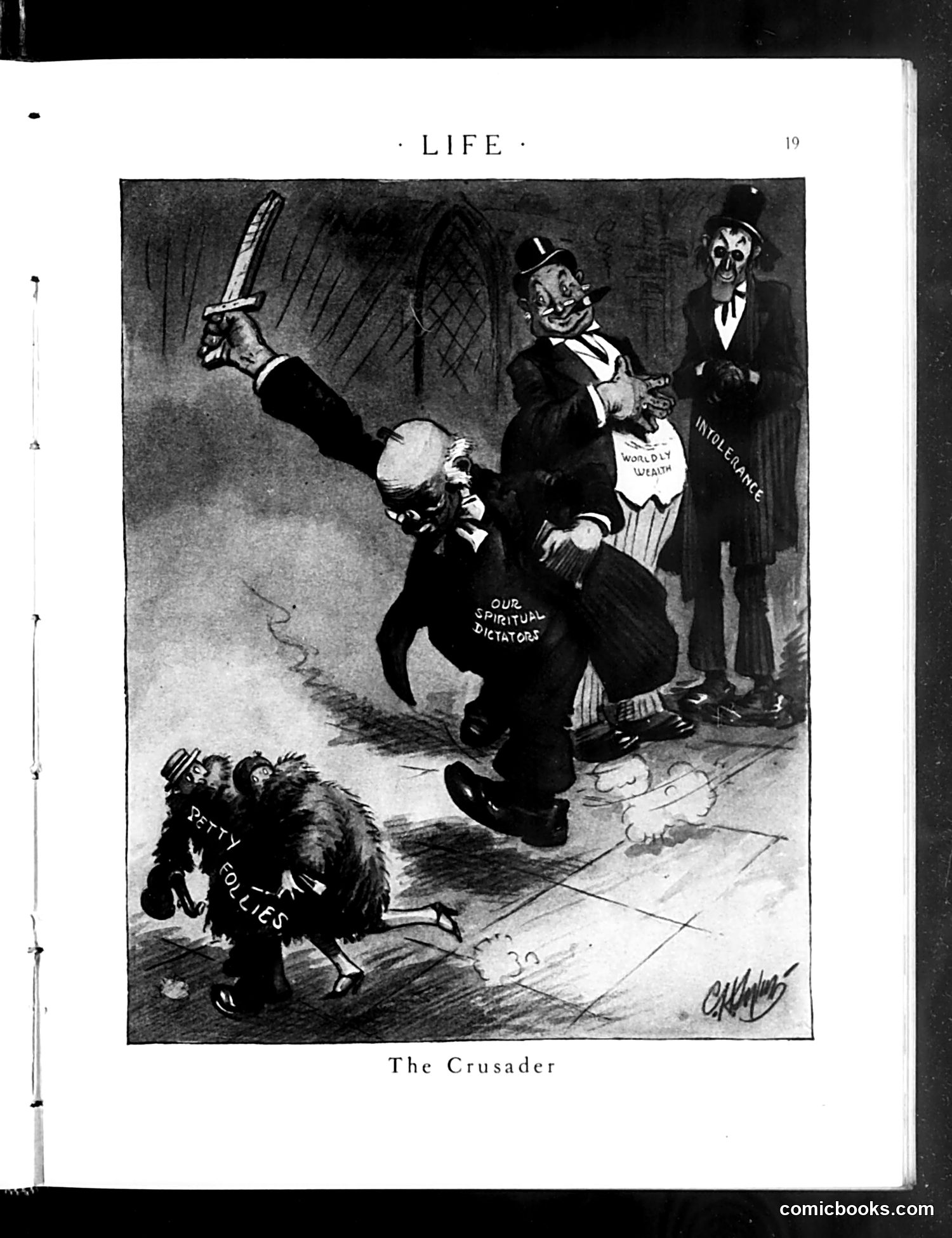
This political satire depicts a crusading figure wielding a sword against various opponents labeled "Petty Follies," "Worldly Wealth," and "Intolerance." The central character represents a self-righteous reformer or moral crusader, drawn as an exaggerated caricature in formal dress. The cartoon satirizes zealous reformers who attack social vices with righteous fervor. The labeled opponents suggest the cartoon critiques crusaders targeting moral issues like gambling, materialism, and prejudice—portraying such reformers as theatrical, possibly misguided, or overzealous in their campaigns. The Gothic interior setting emphasizes the pseudo-religious, medieval quality of this "crusade." The satire likely mocks American progressive reform movements of the early 20th century, questioning whether aggressive moral crusading actually addresses complex social problems effectively.
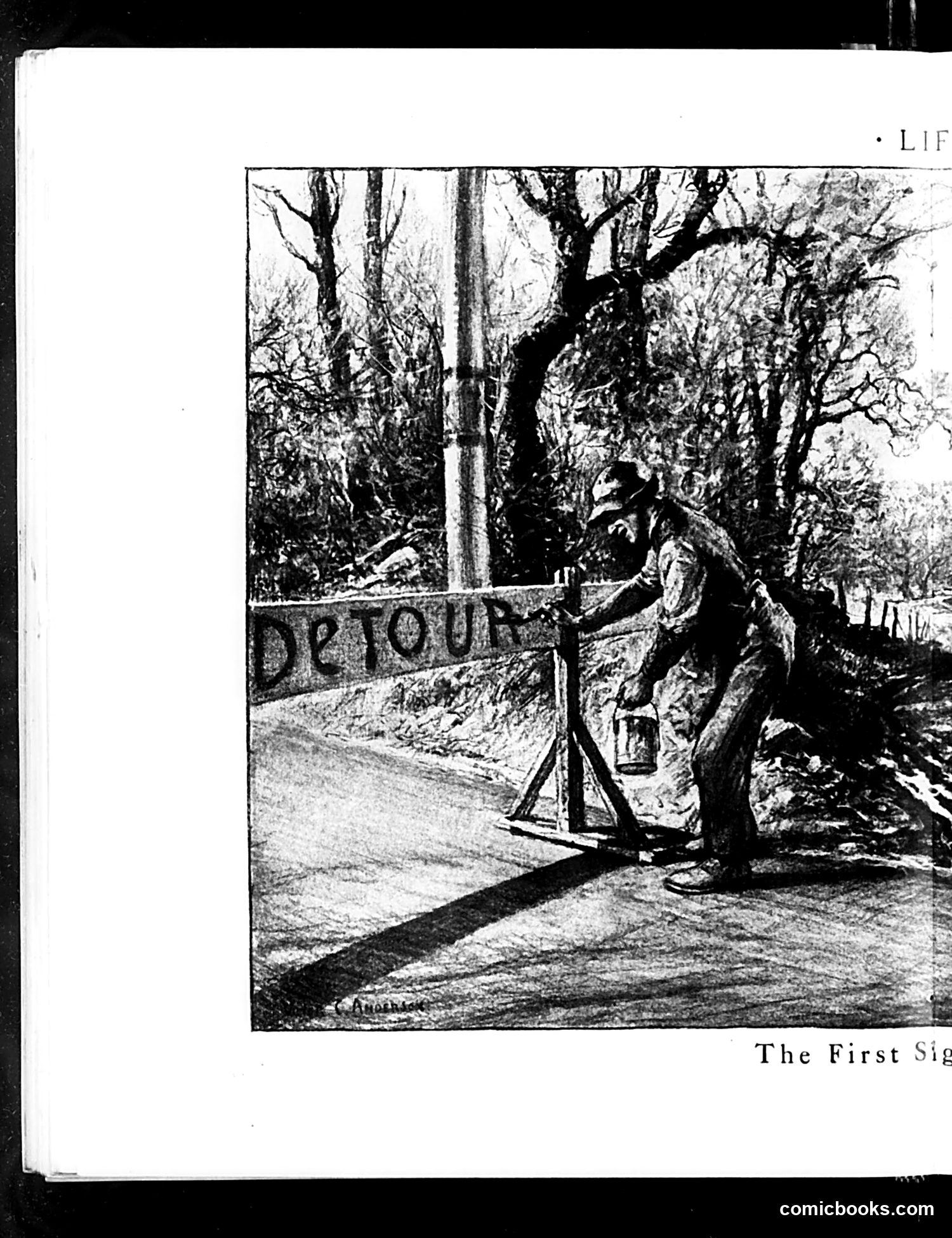
This appears to be a satirical illustration showing a figure in period clothing (possibly early 20th century) standing at a gate or entrance marked "DETOUR" in a wooded area. The figure holds what looks like a lantern or torch, suggesting a reference to historical signage or warnings. Without the complete caption or date visible, the specific satirical target is unclear. However, the detour sign suggests commentary on obstruction, misdirection, or being led away from a desired path—common Life magazine themes critiquing politics or social policy. The figure's pose and costume suggest either historical parody or commentary on authority figures misleading the public. The full meaning requires additional context from the magazine's date and complete caption.
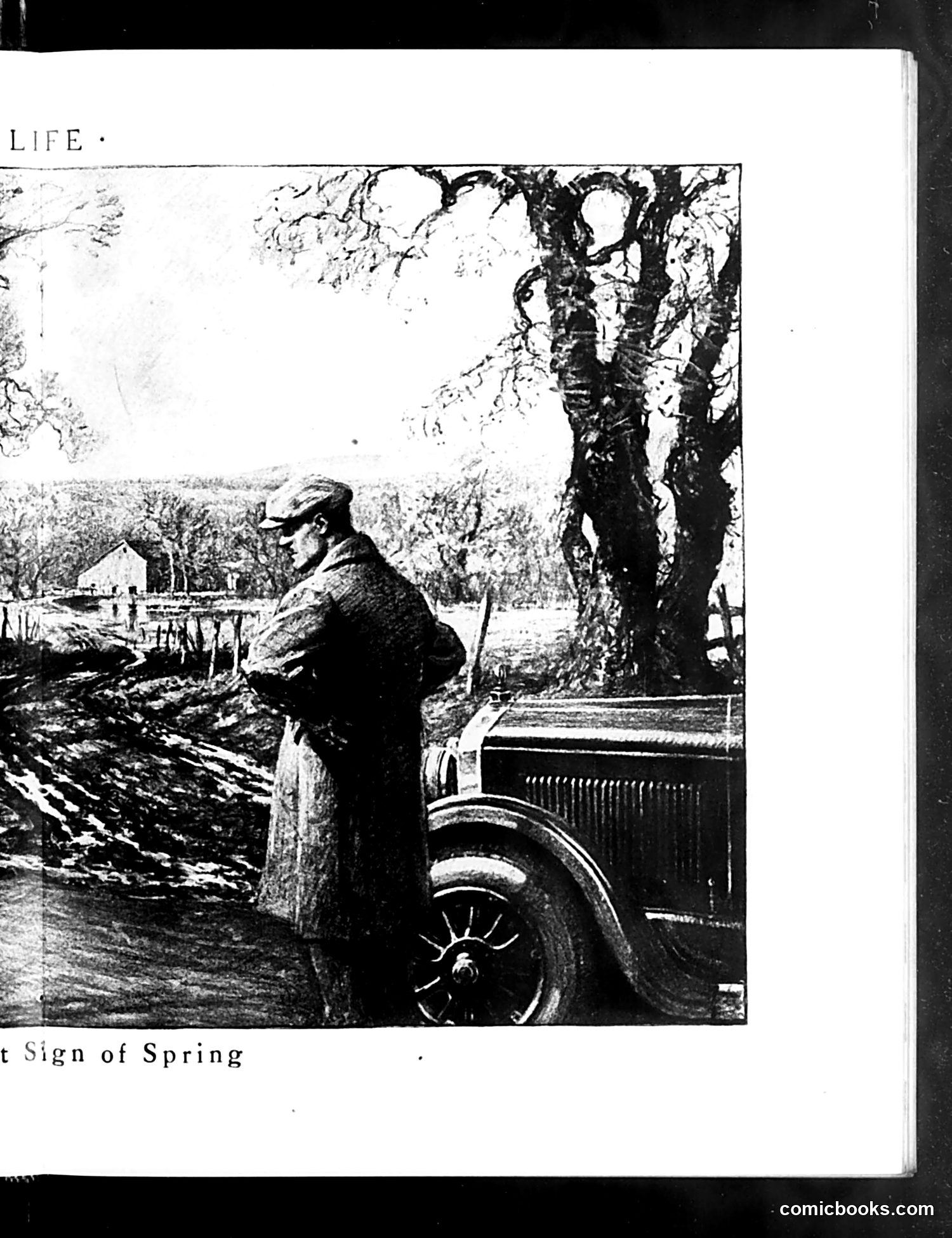
This photograph shows a man in formal attire standing beside an automobile, positioned under budding birch trees in a rural landscape. The caption identifies this as "A Sign of Spring." The image appears to be a gentle, humorous observation about seasonal change and American life in the early automotive era. The "sign of spring" likely refers both literally to the trees' new growth and humorously to the reappearance of automobiles and leisure activities after winter—a common satirical theme in Life magazine about American consumer culture and seasonal patterns. The man's formal dress contrasts with the rural setting, possibly suggesting returning urbanites exploring the countryside by car—a modern spring activity replacing traditional rural pastimes. Without clearer identification of the specific figure or publication date, the exact satirical target remains unclear.
This is a theater review comparing European circus clowns. The author, apparently Robert Benchley (bylined at end), traveled to Paris to see famous Continental performers—the Fratellini brothers and Grock—after being challenged about his clown commentary. **The satire's point:** Benchley attacks European circus clowns as inferior to American vaudeville acts. He dismisses the Fratellini despite their fame, finding their routines dated (nose-swelling gags "discarded from American circuses" after the Panama Canal's completion—a dated reference to early 1900s). **Key figures:** The Fratellini (Italian clown family), Grock (Austrian-American performer), with dismissive comparisons to Marx Brothers and Joe Jackson as superior American entertainers. **The humor:** Benchley's mock-serious tone about impulsively traveling to Paris, combined with underwhelming findings, satirizes both celebrity hype and American cultural superiority assumptions.
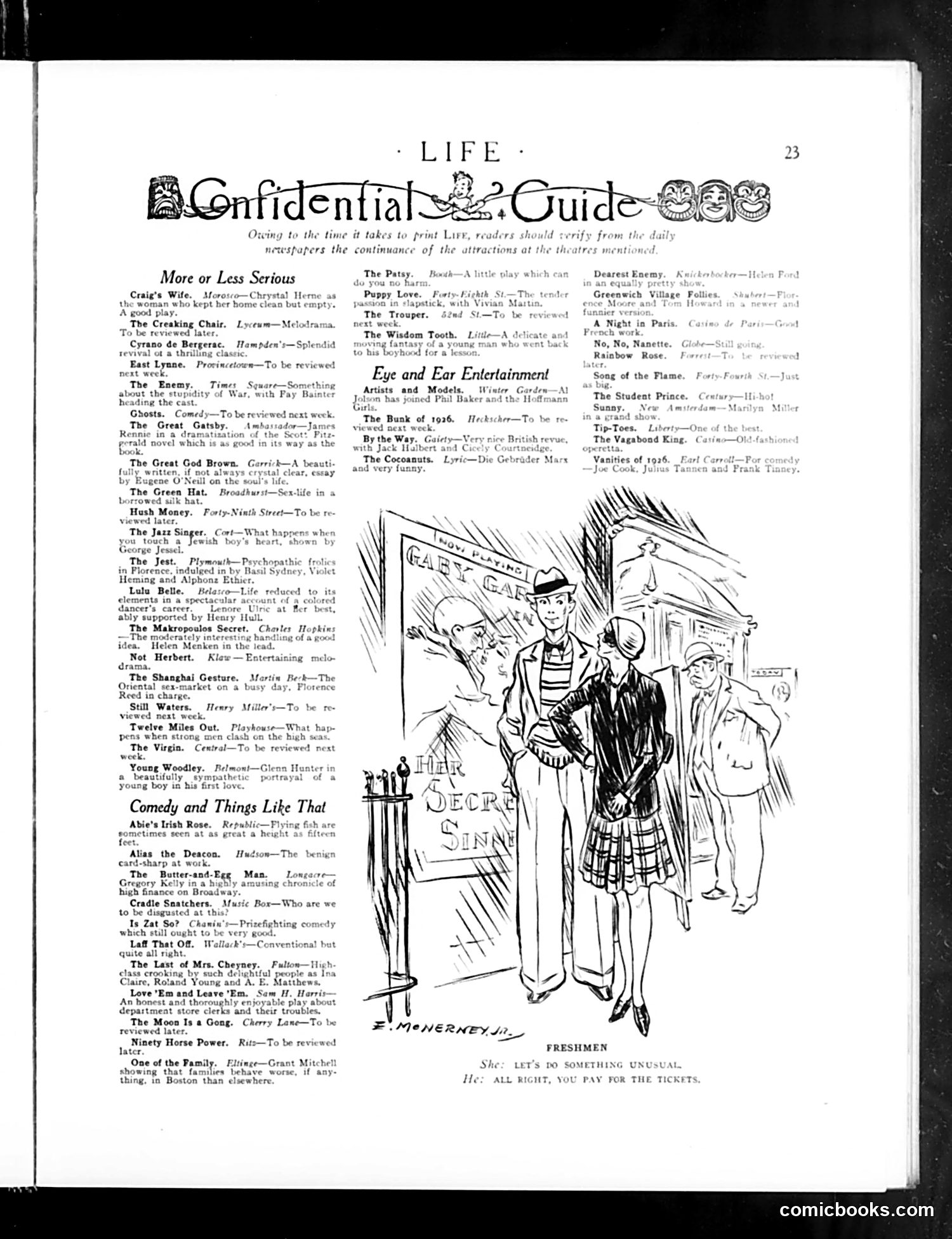
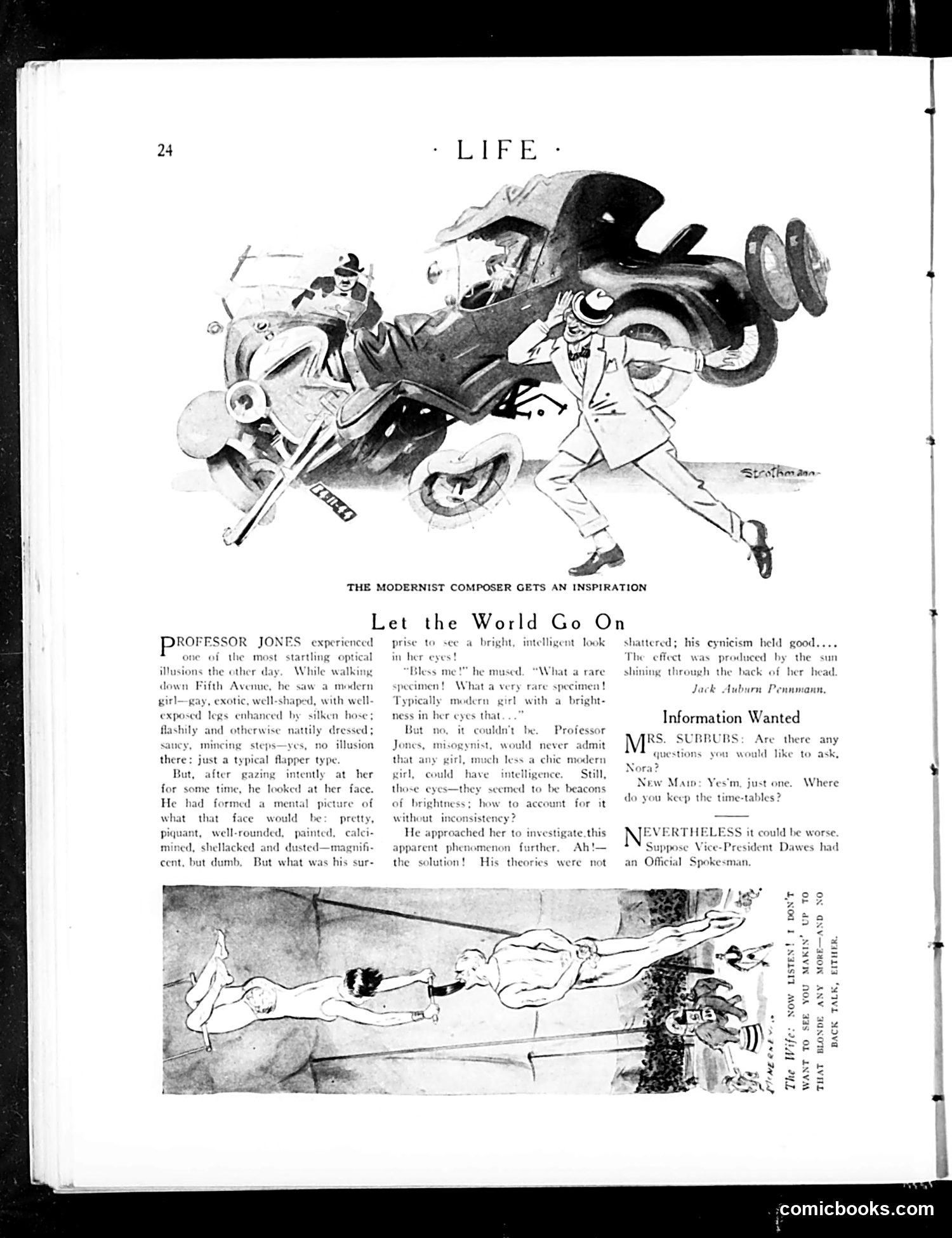
This page satirizes the "modernist" or "flapper" culture of the 1920s. The top cartoon depicts a composer being inspired by witnessing a modern young woman—likely representing how contemporary culture (jazz, mechanization, speed) influenced avant-garde art. The exaggerated, disjointed drawing style itself mimics modernist aesthetics. The story "Let the World Go On" mocks Professor Jones, who observes a fashionable young woman with "well-exposed legs" and assumes she's intellectually empty based on her appearance and "flapper" mannerisms. However, her bright, intelligent eyes contradict his prejudice, forcing him to reconsider his assumptions about modern women's intellect versus their appearance. The "Information Wanted" sidebar is a humorous aside about time-tables, unrelated to the main content. The satire targets intellectual snobbery and outdated assumptions about young women's capabilities during a period when women's social roles were rapidly changing.
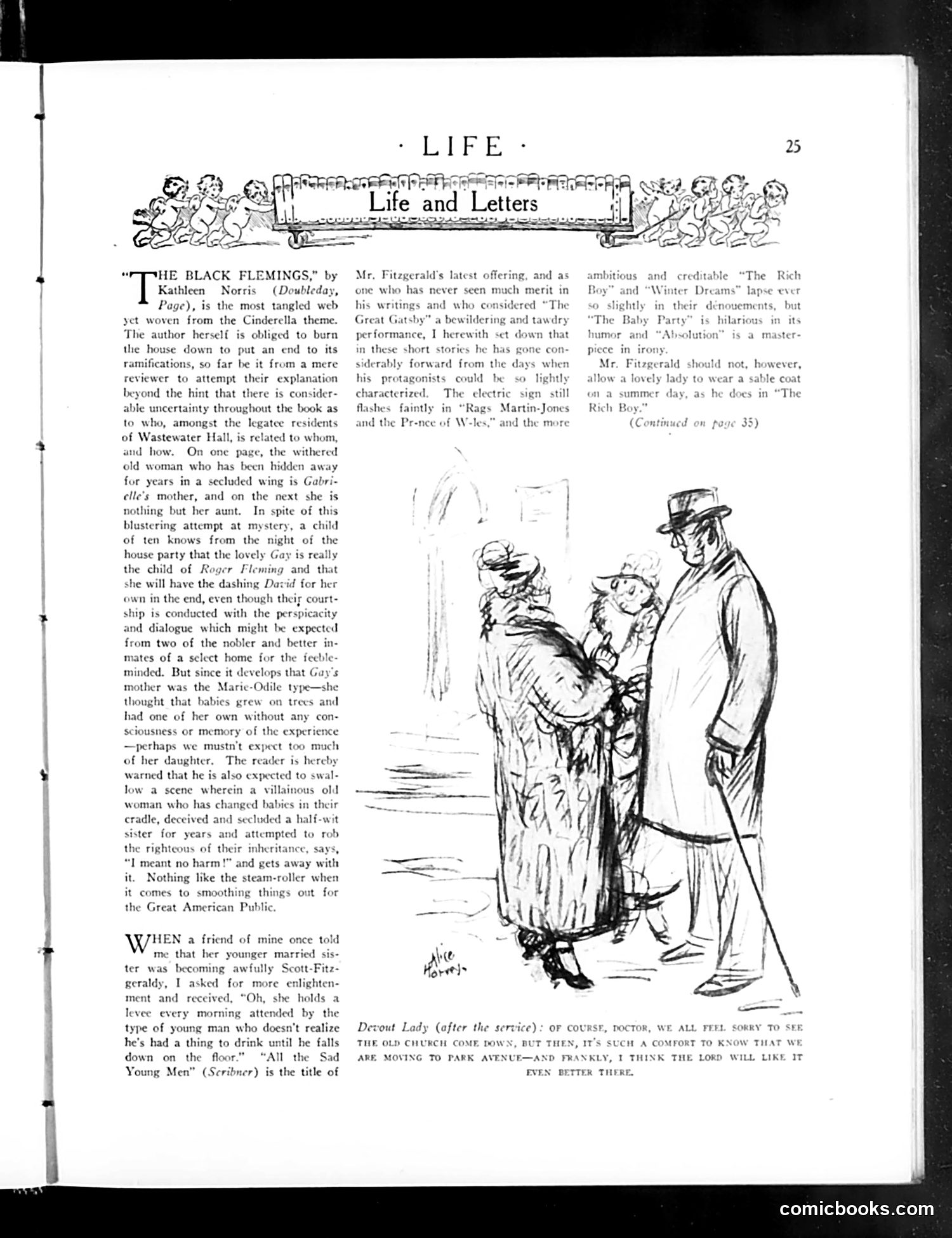
This page reviews two books and includes a cartoon satirizing wealthy Protestant hypocrisy. **The Reviews:** The text critiques Kathleen Norris's *The Black Flemings* as a convoluted melodrama with implausible plot twists, and praises F. Scott Fitzgerald's *All the Sad Young Men* as showing improvement in his characterization of wealthy, alcoholic youth. **The Cartoon:** The illustration depicts a well-dressed woman (labeled "Devout Lady") speaking to a doctor after church services. She expresses sadness about the old church being demolished—but then reveals the real point: she's pleased because her congregation is relocating to Park Avenue (an elite Manhattan address), and she believes God will prefer the more fashionable location. **The Satire:** The joke mocks the materialism of wealthy Protestants who equate spiritual devotion with social status and wealth. The woman's casual assumption that God shares her class-consciousness—that He'd prefer a church on prestigious Park Avenue over a historic neighborhood building—exposes how thoroughly consumerism and status-seeking have replaced genuine religious values.
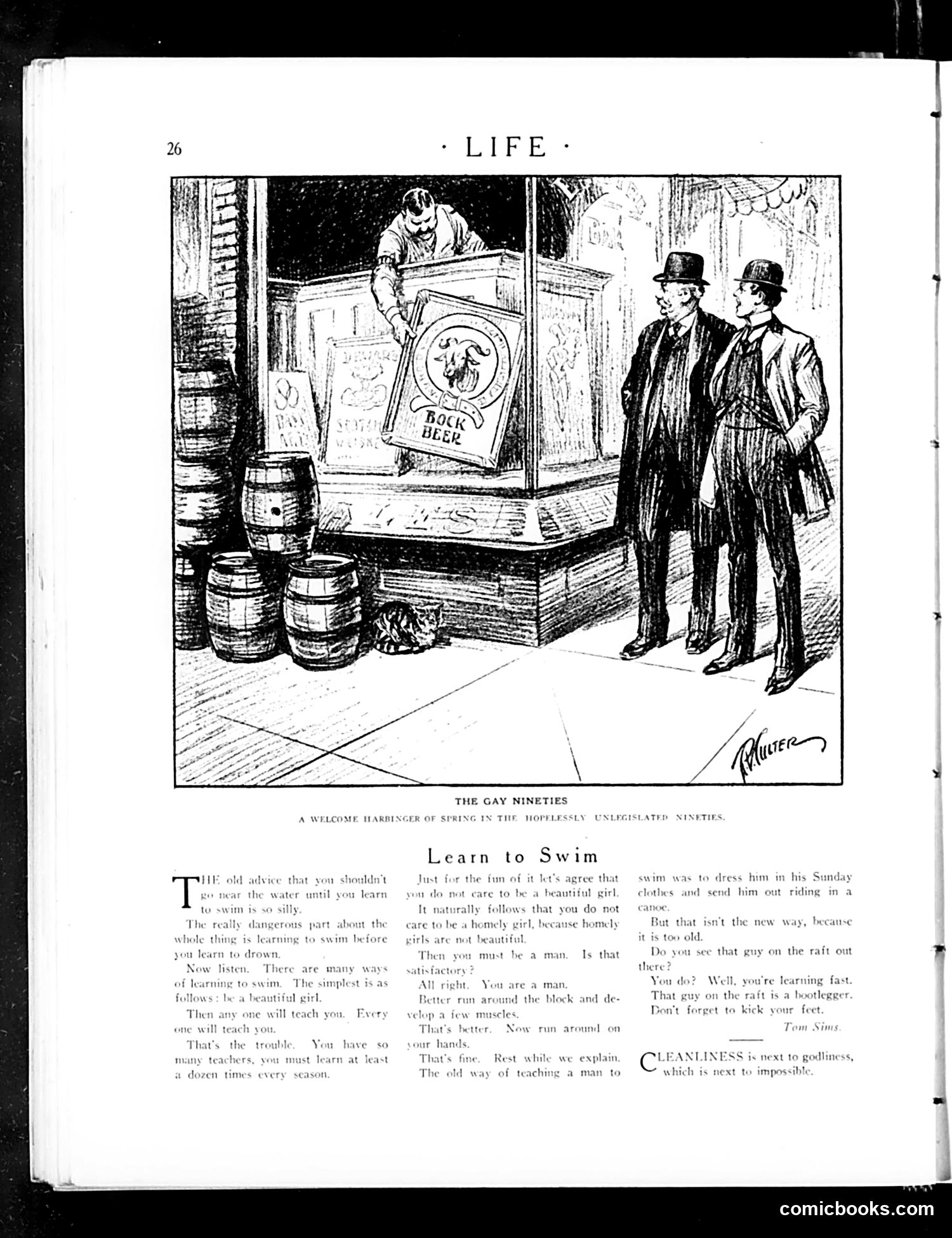
This page from *Life* magazine satirizes the 1890s ("The Gay Nineties") as an era of outdated customs and poor judgment. The cartoon depicts men in formal Victorian dress observing someone learning to swim from a raft—illustrating the absurdity of the era's teaching methods. The accompanying text humorously contrasts old versus modern swimming instruction. The "gay nineties" framing suggests nostalgia for a supposedly carefree past, but the satire reveals it was actually a time of inefficient, illogical practices. The joke mocks how 1890s men had to learn swimming by being thrown into water repeatedly—a dangerous method—whereas the (contemporary to publication) modern approach emphasizes safer, more rational instruction. The final epigram about cleanliness being "next to impossible" reinforces the overall mockery of Victorian-era standards and their impracticality.
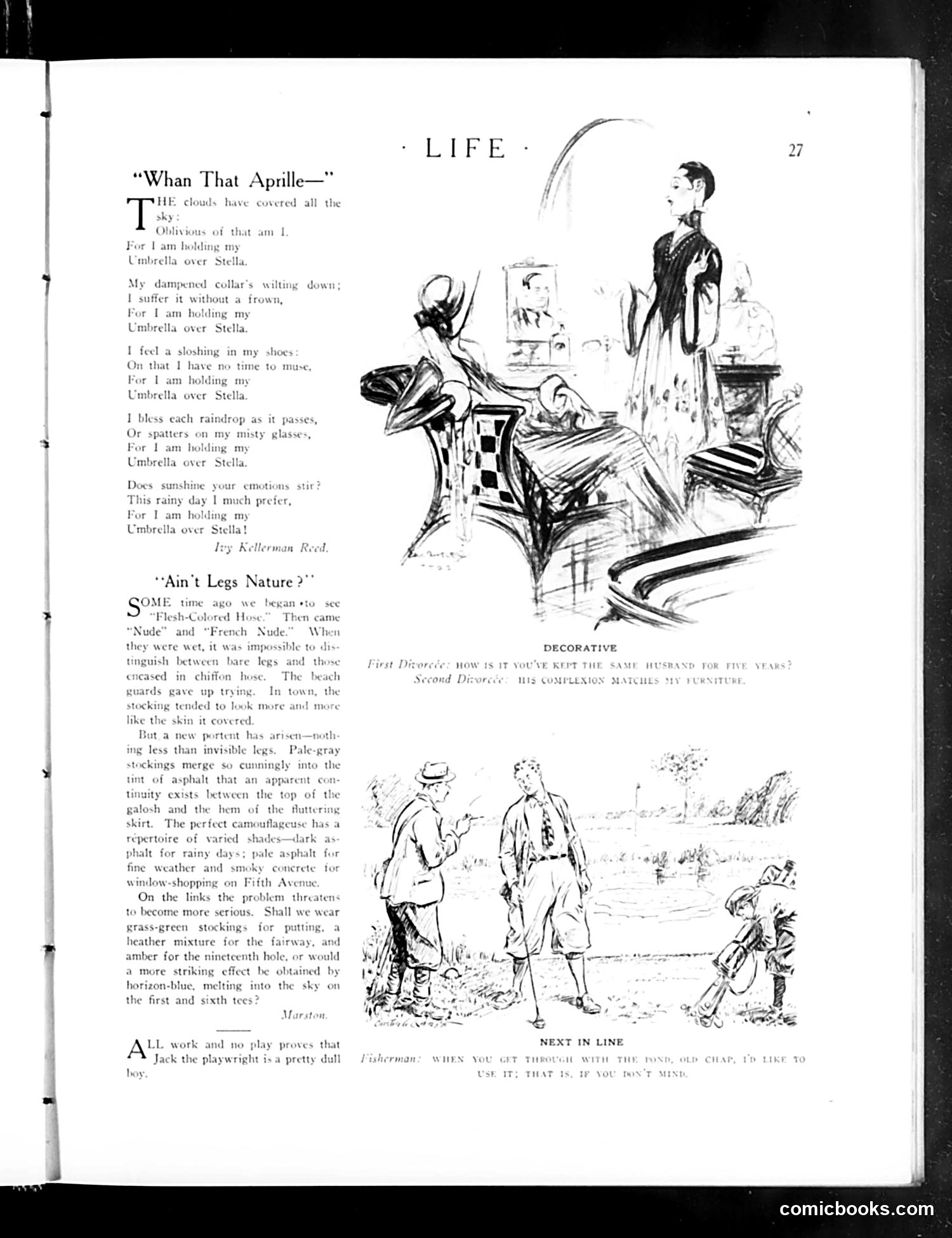
This page from *Life* satirizes early 20th-century fashion trends and social anxieties, particularly around women's hosiery. **"When That Aprille"** (top poem): A humorous love poem where the narrator's romantic gesture—holding an umbrella over a woman named Stella—is undercut by his discomfort (wet collar, sloshing shoes, dampened dignity). The satire mocks the performative nature of chivalry. **"Ain't Legs Nature?"** (main article): The piece ridicules the recent fashion trend of flesh-colored or nearly invisible stockings designed to create the illusion of bare legs. It traces this evolution from earlier "flesh-colored hose" through "Nude" and "French Nude" styles. The satire highlights the absurdity of women's fashion anxieties—particularly on golf courses—where choosing stocking colors becomes a serious practical and aesthetic dilemma (grass-green for putting, amber for specific holes, etc.). The cartoons illustrate indoor and outdoor scenes depicting these fashion concerns as genuinely vexing social problems, mocking both the fashion industry and consumers' preoccupation with appearance.
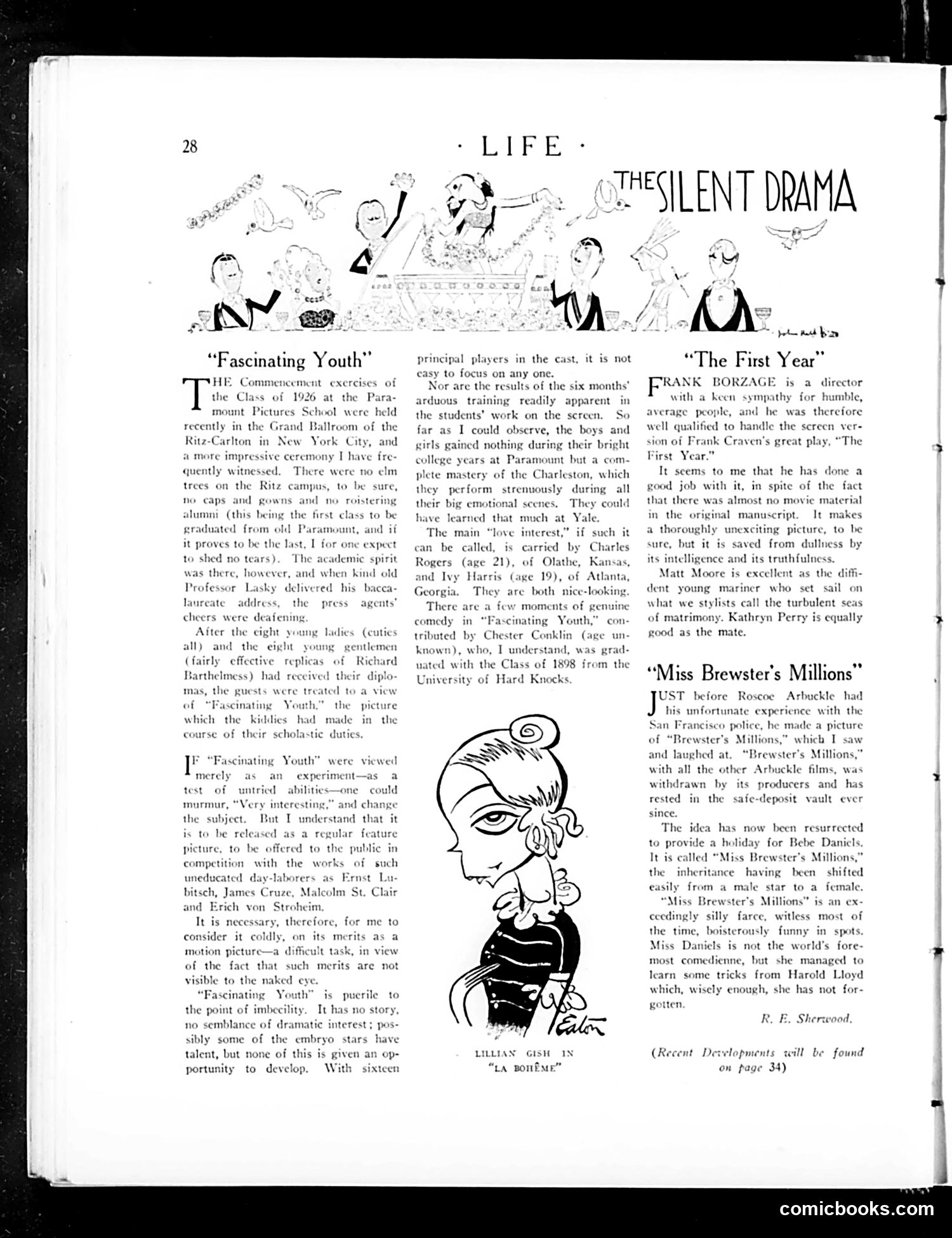
This page reviews three silent films from the mid-1920s. "Fascinating Youth" covers a Paramount Pictures film about a 1926 college class commencement, directed by Frank Borzage. The reviewer praises the young leads (Charles Rogers and Ivy Harris) but notes the film itself lacks dramatic interest despite competent acting. "The First Year" stars Matt Moore in a maritime romance with Kathryn Perry, which the reviewer finds well-acted but tedious. "Miss Brewster's Millions" stars Bebe Daniels in a remake of an earlier Roscoe Arbuckle film (withdrawn after Arbuckle's 1921 scandal). The reviewer describes it as "exceedingly silly farce" and "witless," though admitting it has funny moments. The character was sex-swapped from the original male lead to female for this version.
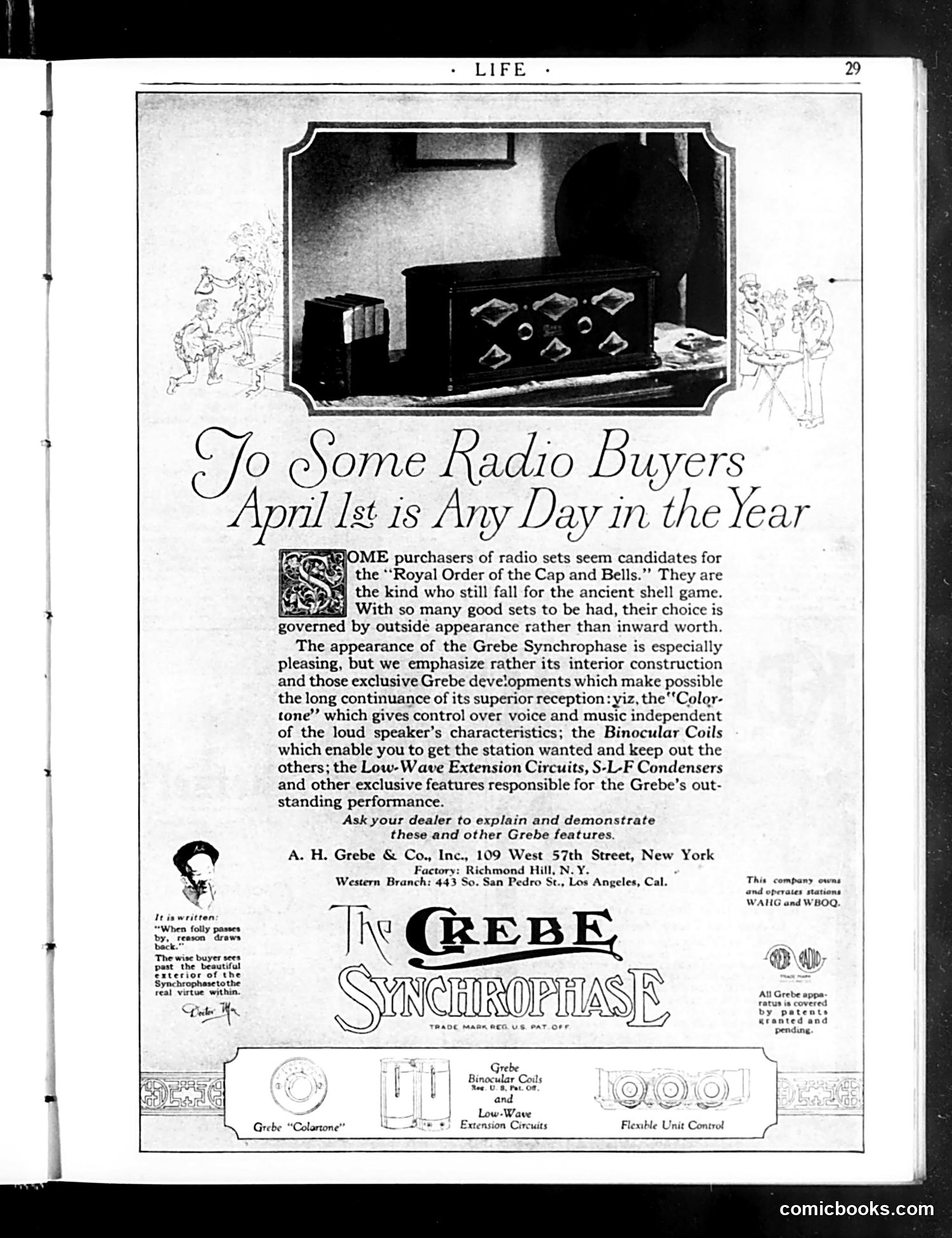
This is primarily a **Grebe Synchrophase radio advertisement** with satirical messaging, not a political cartoon. The satire targets foolish radio buyers who choose sets based on *appearance* rather than technical quality—calling them candidates for the "Royal Order of the Cap and Bells" (a traditional symbol of jesters/fools). The copy mocks consumers who fall for attractive exterior design while ignoring superior internal engineering. The small cartoon in the margin depicts a wise man rejecting folly, reinforcing this message: smart buyers should see "past the beautiful exterior...to the real virtue within." The ad emphasizes Grebe's exclusive technical features (Colortone, Binocular Coils, Low-Wave circuits) as proof of genuine superiority. This reflects 1920s radio marketing, when competing manufacturers heavily advertised technical specifications to distinguish products in an emerging consumer electronics market. The satire is commercial rather than political—aimed at competing radio brands rather than social commentary.
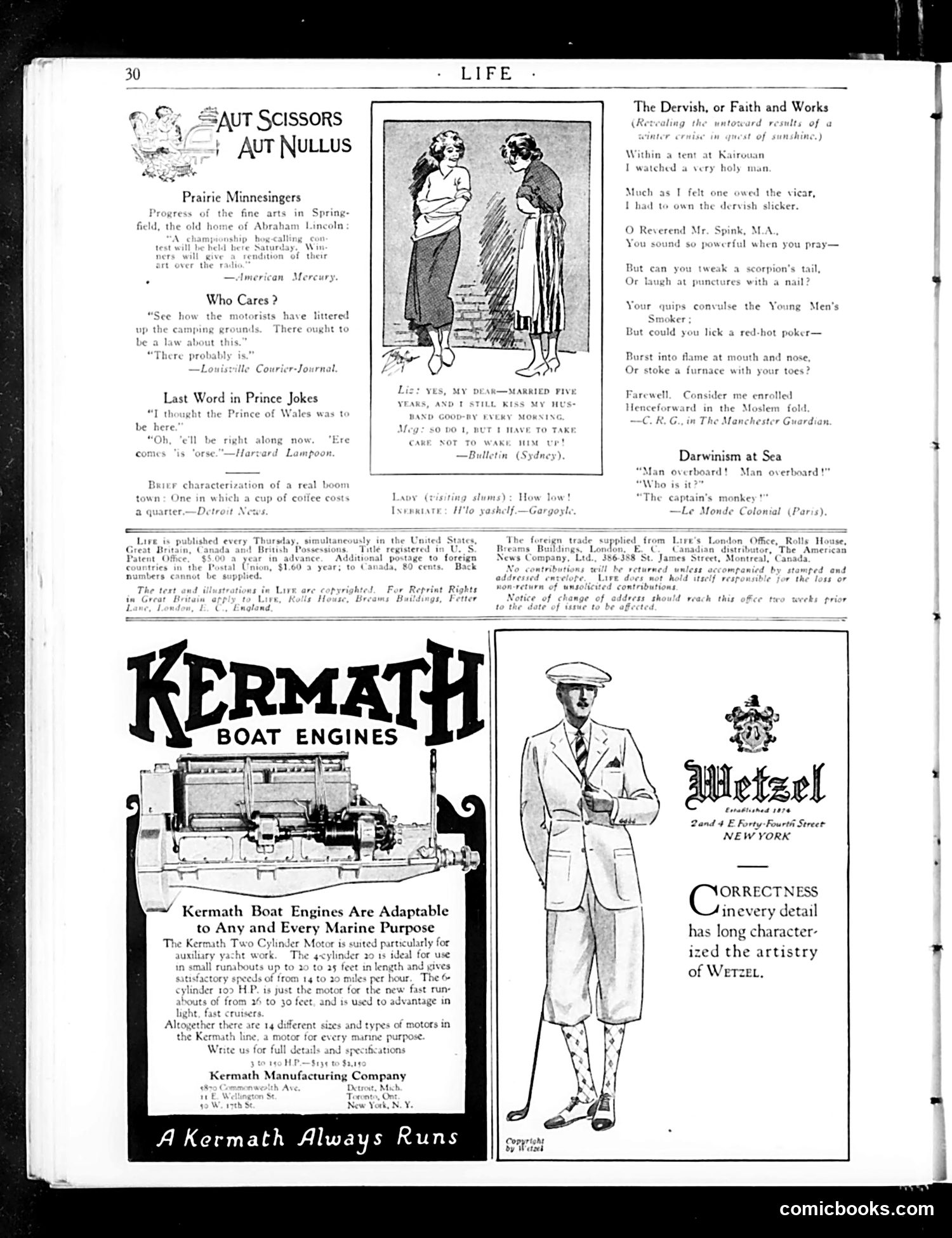
This page contains several brief humorous items typical of early 20th-century satirical magazines: **"The Dervish, or Faith and Works"** appears to be a poem mocking religious hypocrisy—contrasting a clergyman's pious sermons with his actual behavior (the "dervish" apparently behaves badly despite preaching virtue). The accompanying cartoon shows two women in conversation. **"Darwinism at Sea"** is a brief joke playing on evolutionary theory: when a man falls overboard, the captain's monkey is identified as the one in danger—suggesting sailors are barely above primates on the evolutionary scale. The remaining items are short joke snippets about Prince Wales jokes and prairie singers. **The bulk of the page is advertising**: Kermath Boat Engines and Wetzel clothing dominate the lower half, making this primarily a commercial publication page rather than editorial content. The satirical content is minimal—mostly filler between ads.
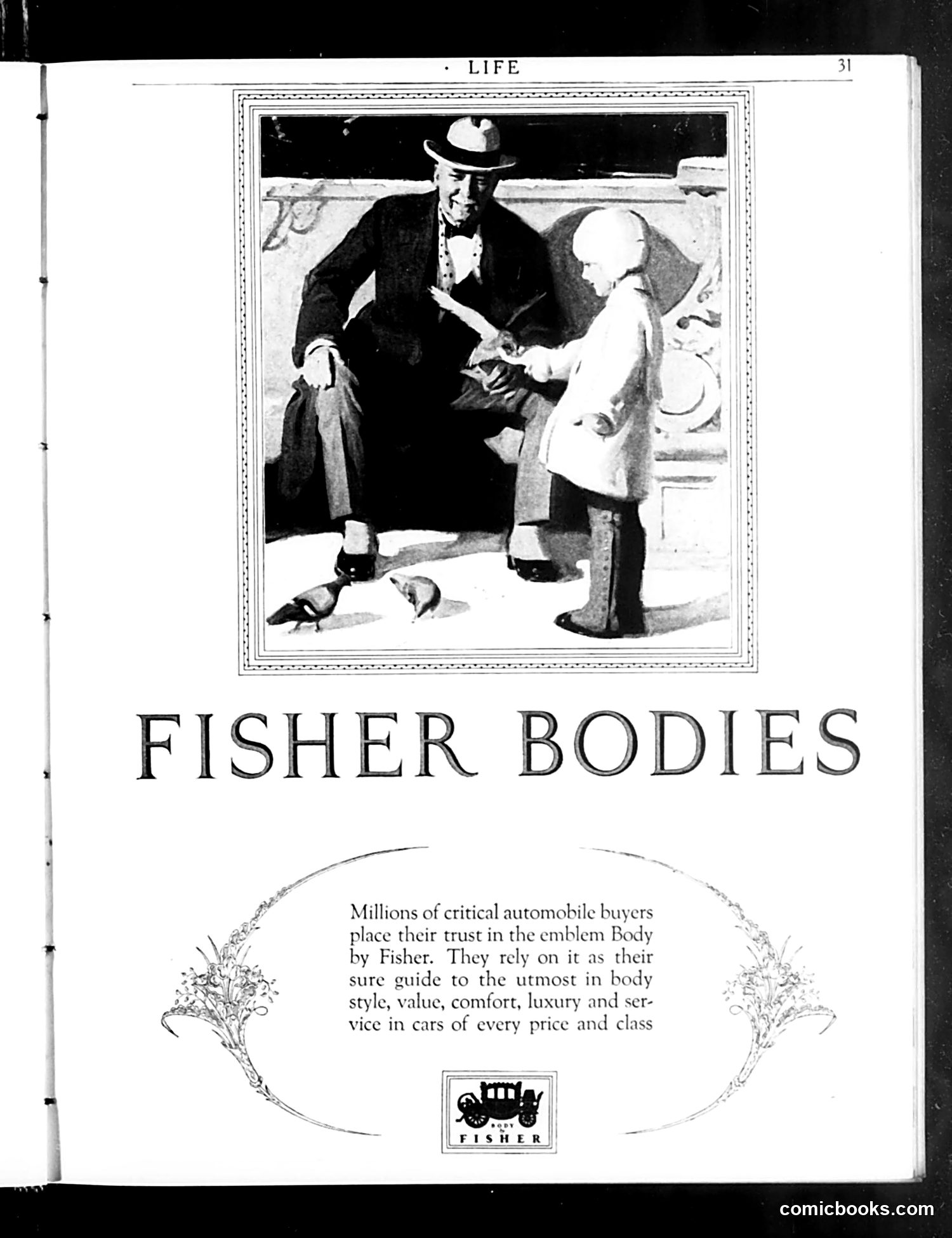
This is primarily a **Fisher Bodies automobile advertisement**, not political satire. The page shows two figures—an adult man in formal attire (bowler hat, suit) and a child—examining what appears to be a small car or automobile body model. The ad copy emphasizes Fisher Bodies' reputation as a trusted mark of quality across vehicles of all price ranges. The imagery suggests authority and approval—the well-dressed man acts as an endorser or expert guiding the younger figure, implying that Fisher Bodies' "emblem" provides reliable guidance for discerning car buyers seeking style, comfort, and luxury. The satirical element is minimal here; this is primarily commercial messaging using social status markers (formal dress, the mentor-student dynamic) to build consumer confidence in the Fisher brand.
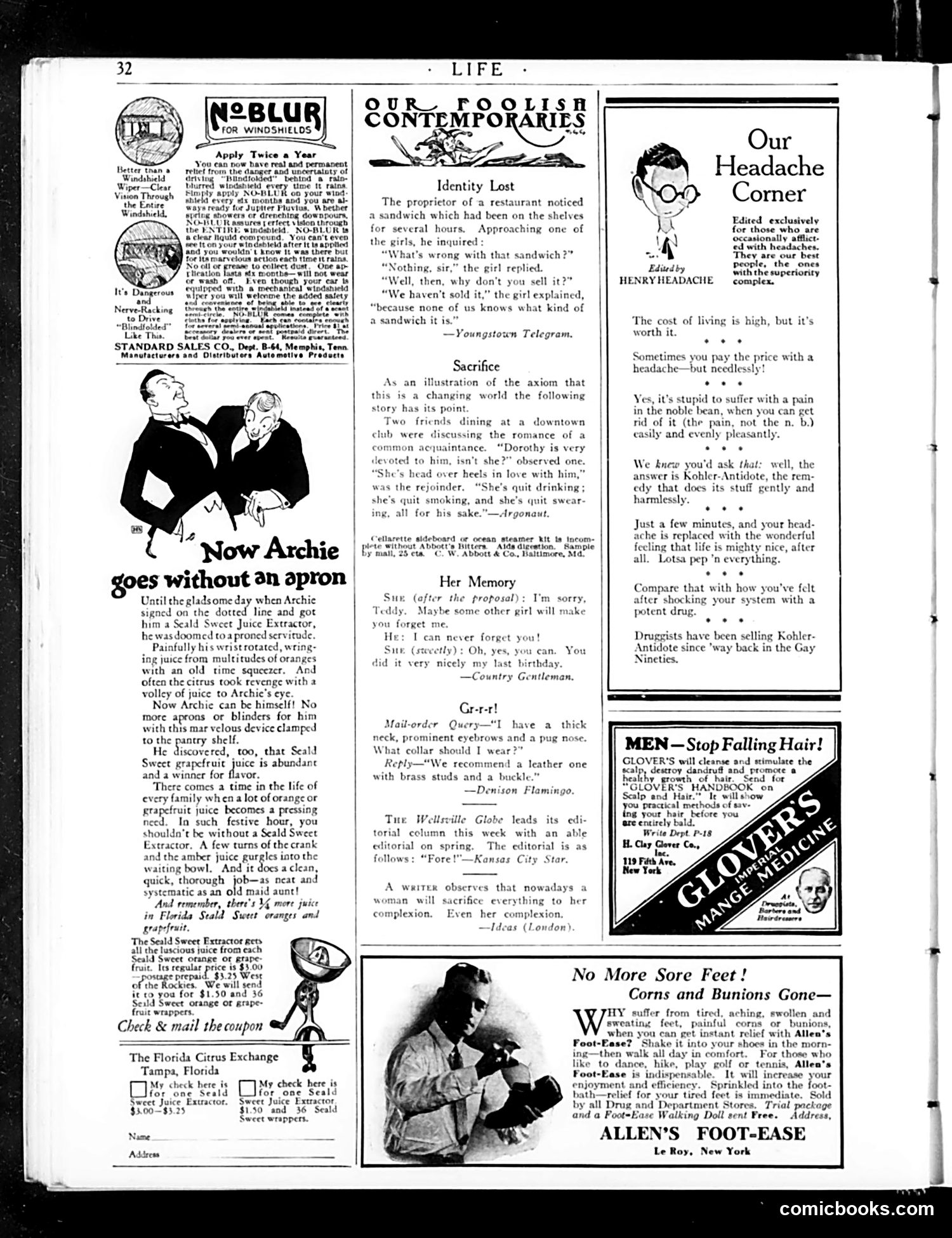
This Life magazine page (page 32) contains several satirical pieces and advertisements typical of early 20th-century American humor: **"Our Foolish Contemporaries"** presents brief anecdotes mocking everyday situations: a restaurant unable to identify a mysterious sandwich, a man who quits all vices for a woman then gets rejected, and a mail-order customer with unfortunate facial features. **"Now Archie Goes Without an Apron"** advertises the Seald Sweet Juice Extractor—a mechanical citrus juicer—by humorously depicting how messy manual squeezing was, with juice spraying into the user's eye. The satire celebrates modern conveniences solving household drudgery. **"Our Headache Corner"** promotes Kohler-Antidote headache remedy, poking fun at the "superiority complex" of the wealthy while positioning the product as a gentle alternative to harsher drugs. The advertisements throughout reflect period concerns: windshield treatments, hair loss products, foot powder—all presented with exaggerated claims typical of early 20th-century marketing. The overall tone is lighthearted mockery of contemporary life's minor frustrations and commercial solutions.
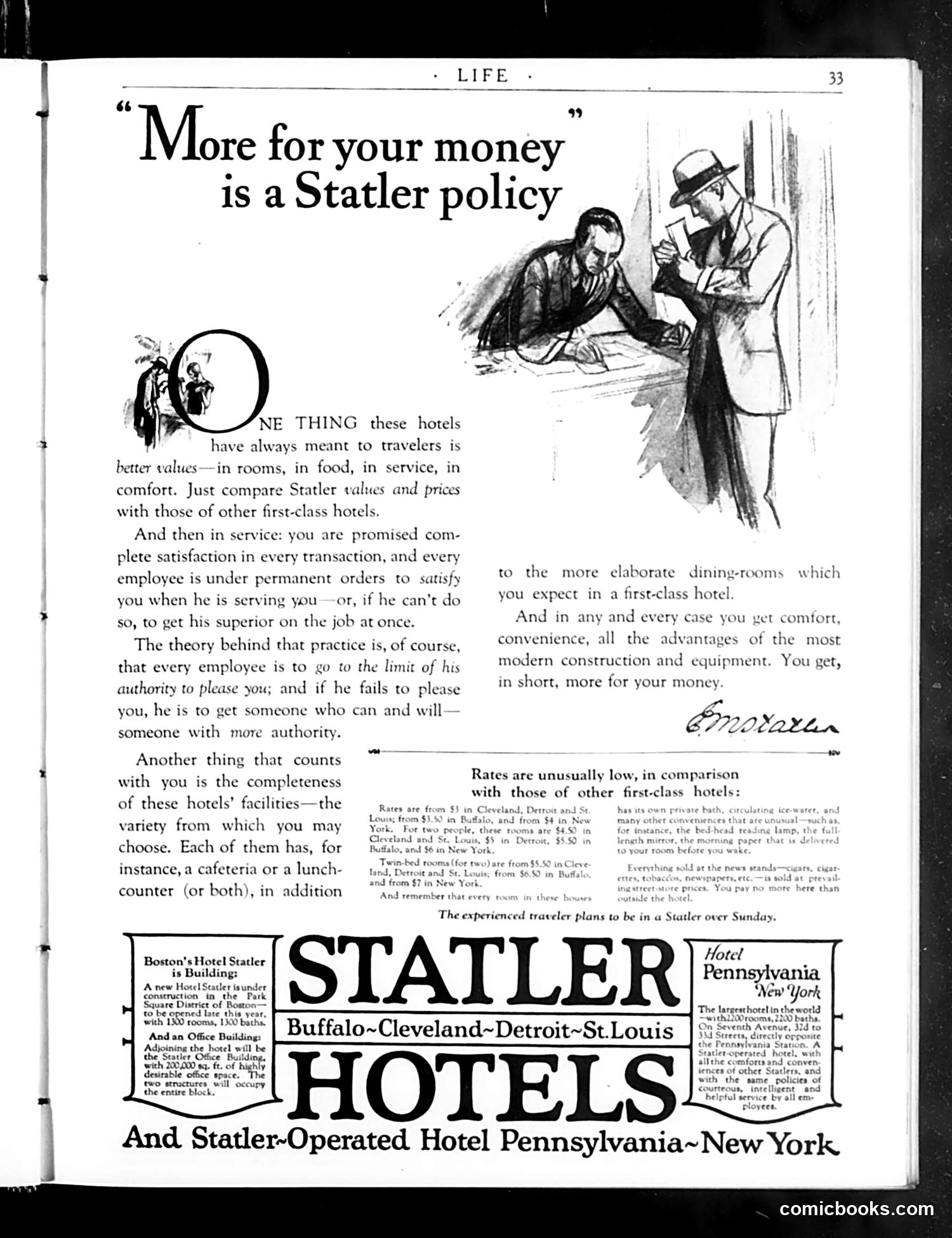
This is a **hotel chain advertisement**, not political satire. The page promotes Statler Hotels' service philosophy and value proposition to business travelers. The illustrated vignette shows a hotel clerk or manager attending to a guest's needs—depicting the promised customer service standard: employees empowered to resolve issues or escalate to supervisors who can. **Key advertising claims:** - Superior "value for money" compared to competitors - Service guarantee: every employee authorized to satisfy guests - Modern facilities (cafeterias, dining rooms, equipment) - Unusually low rates ($3-$6 per room depending on city) - Multiple locations (Boston, Buffalo, Cleveland, Detroit, St. Louis, New York, Pennsylvania) The text emphasizes that Statler differentiates itself through *employee empowerment*—staff trained to solve problems immediately or find someone with authority to do so. This was positioned as a competitive advantage in early-20th-century hospitality. The ad celebrates modern business hotel standards: standardized comfort, predictable service, and transparent pricing—concepts now routine but apparently noteworthy then.
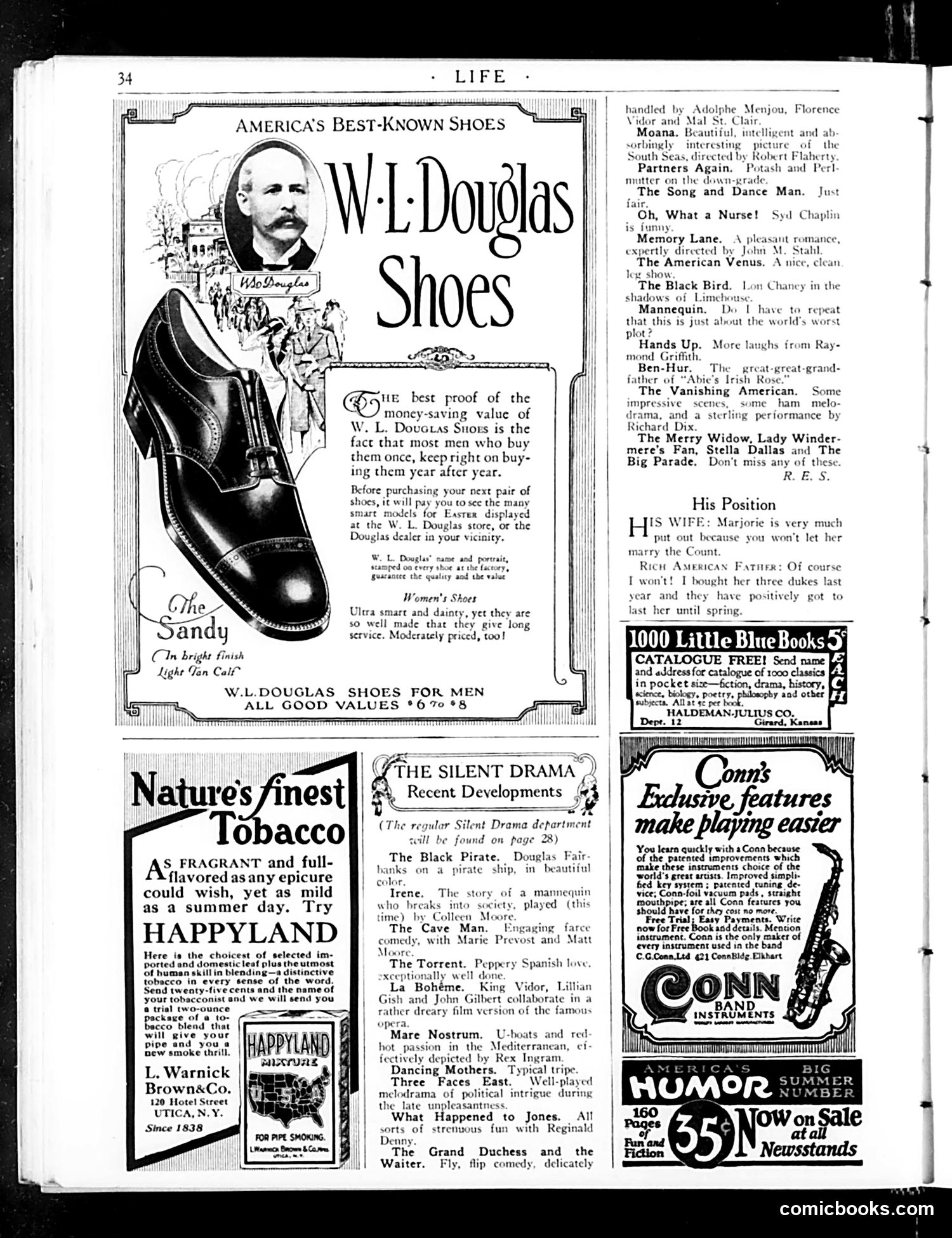
This is primarily an **advertising page** from Life magazine, circa mid-1920s, with minimal satirical content. ## Main Content: The page features large advertisements for **W.L. Douglas Shoes** (men's footwear), **Happyland Tobacco**, and **Conn musical instruments**, along with a brief **"Silent Drama" film review section**. ## Notable Satirical Element: The only humor appears in a small cartoon captioned **"His Position,"** depicting a wealthy American father refusing to let his daughter marry a European count. The joke reflects post-WWI American attitudes: the nouveau-riche businessman has purchased "three dukes" to last his daughter "until spring"—satirizing American wealth as able to buy European nobility and aristocratic titles, while mocking both American economic pretension and the perceived desperation of impoverished European aristocrats. This reflects genuine 1920s social anxiety about wealthy Americans marrying into European nobility. The page otherwise consists of straightforward product advertisements and entertainment listings typical of Life's commercial content during this era.
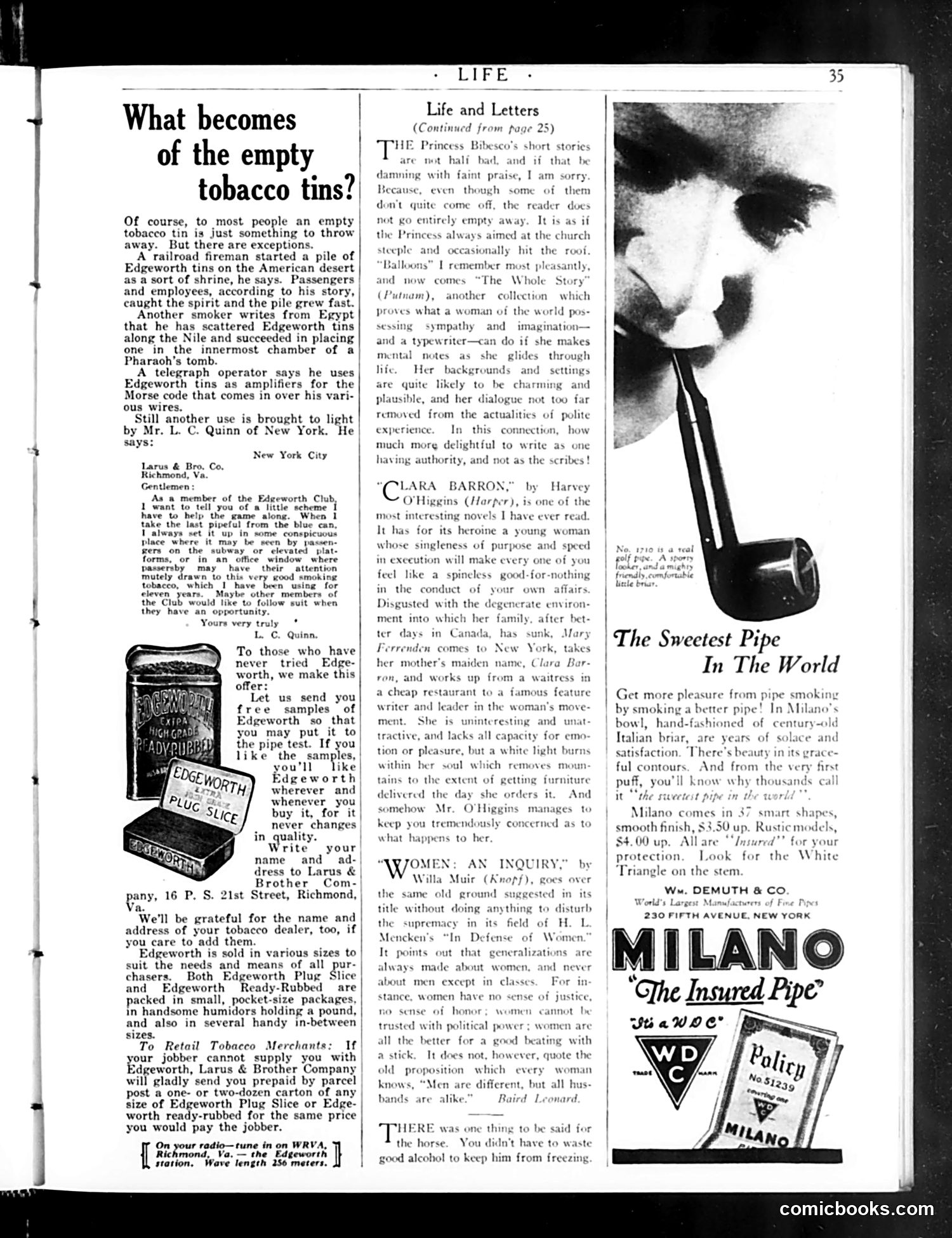
This page is primarily **advertising and reader correspondence** for Edgeworth tobacco products, with literary reviews as secondary content. ## The Main Content: The dominant feature is an **extended advertisement for Edgeworth pipe tobacco** disguised as charming reader letters. The "What becomes of the empty tobacco tins?" section presents anecdotes from supposedly satisfied customers—a railroad worker, Egyptian traveler, telegraph operator, and New York subway advertiser—all describing creative uses for empty tins. This is classic early 20th-century **advertorial strategy**: authentic-seeming testimonials that normalize the product through user stories. The right column contains book reviews of contemporary literary works by female authors (Princess Bibesco, Harvey O'Higgins), establishing *Life* magazine's intellectual credibility alongside commercial content. ## The Satire: The humor lies in the absurdity of the tobacco-tin anecdotes themselves—placing tins in Egyptian tombs, using them as Morse code amplifiers—which simultaneously mock consumer culture's waste while promoting consumption. This reflects *Life* magazine's satirical tradition of lampooning American consumer behavior and advertising excess.
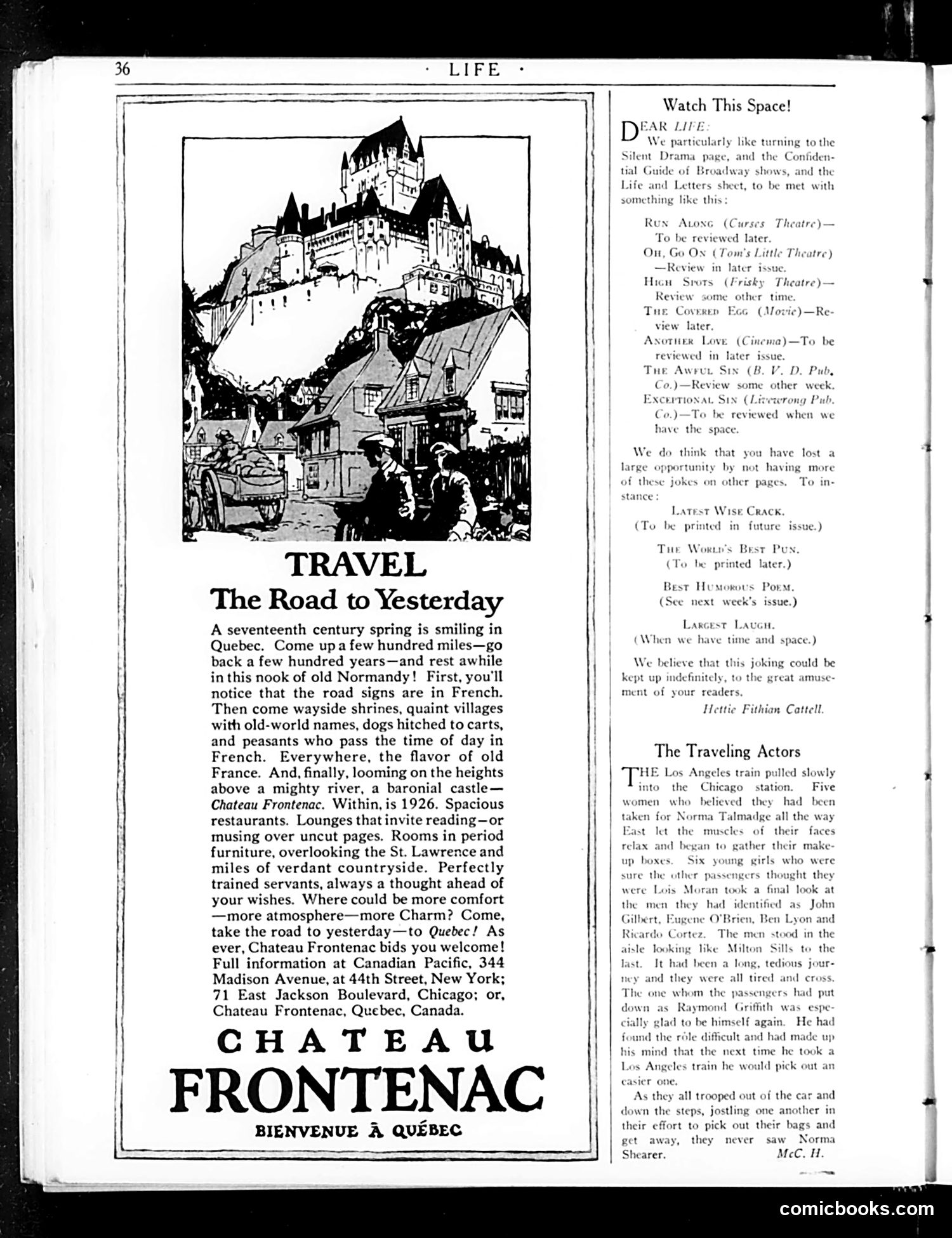
This page contains a **travel advertisement** for Chateau Frontenac in Quebec (left) and a **humor section** (right) satirizing theater reviews and celebrity culture. **The Advertisement**: Promotes Quebec as a romantic destination offering "old France" atmosphere—seventeenth-century charm with modern (1926) luxury. It's straightforward tourism marketing. **The Humor Section**: "Watch This Space!" mocks Life's own editorial practices. The magazine admits it's **postponing reviews indefinitely**—listing shows to be reviewed "later," "when we have space," or "in future issue." This is self-deprecating satire about editorial delays and broken promises. **"The Traveling Actors"** describes five women mistaken for famous actresses (Norma Talmadge, Lois Moran, John Gilbert, Ben Lyon, Ricardo Cortez, Raymond Griffith) on a train. The joke: after a long journey, they're relieved to stop pretending—then ironically, they fail to notice **actual actress Norma Shearer** leaving unrecognized. The satire targets both celebrity culture's superficiality and audiences' gullibility about star-spotting.
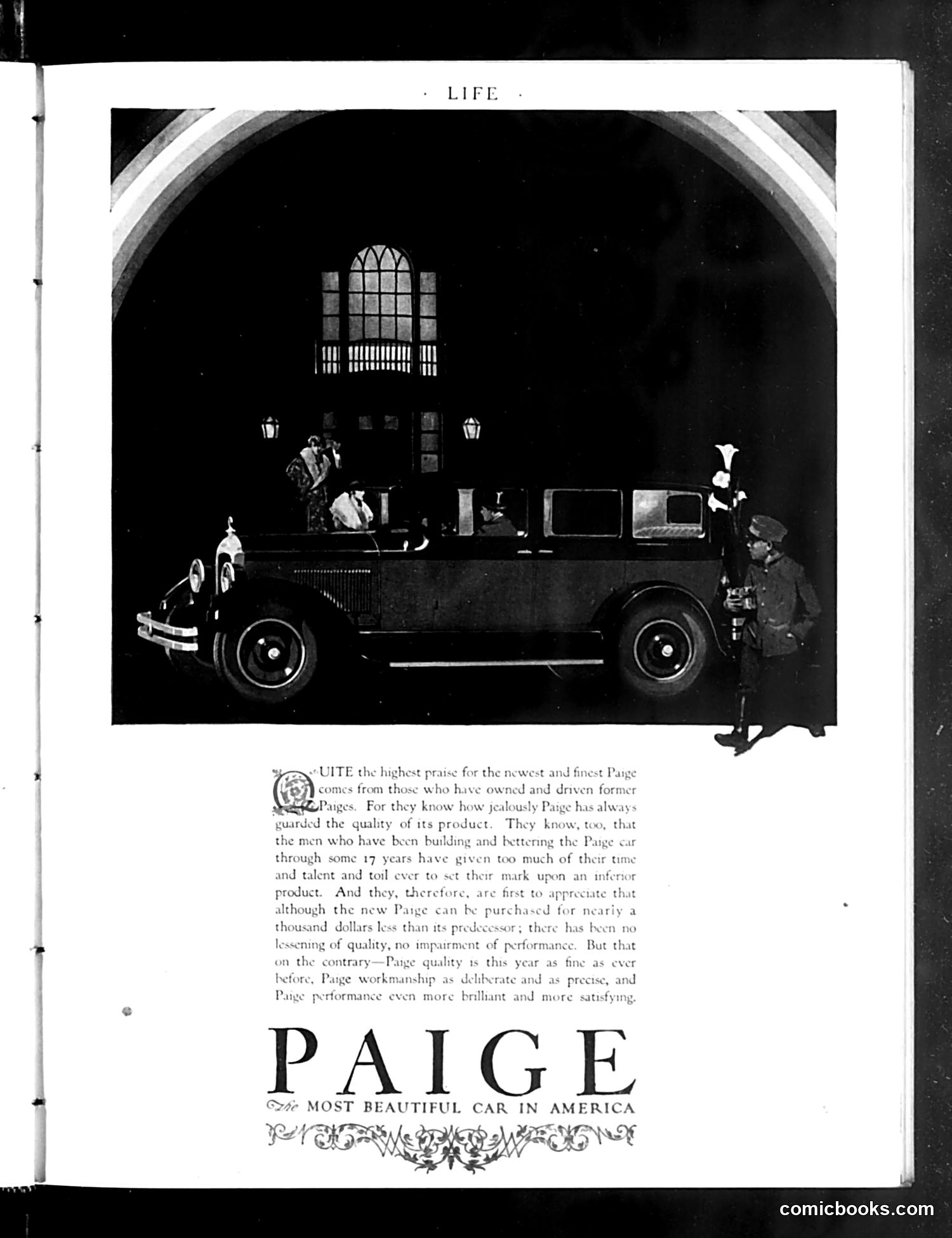
This is primarily a **Paige automobile advertisement**, not political satire. The page features a stylized illustration of a 1920s luxury car parked beneath an arched architectural structure, with figures in period dress beside it. The ad text appeals to **previous Paige owners**, claiming their loyalty validates the "newest and finest Paige." It emphasizes that despite costing nearly $1,000 less than predecessors, quality and performance remain superior. The tagline declares Paige "The Most Beautiful Car in America." This is **commercial advertising** rather than political or social satire. The "Life" magazine context suggests this ran in the famous American humor publication, but the content here is a straightforward luxury-car endorsement capitalizing on brand loyalty and value-conscious messaging—likely from the early 1920s based on automotive styling and design aesthetics.
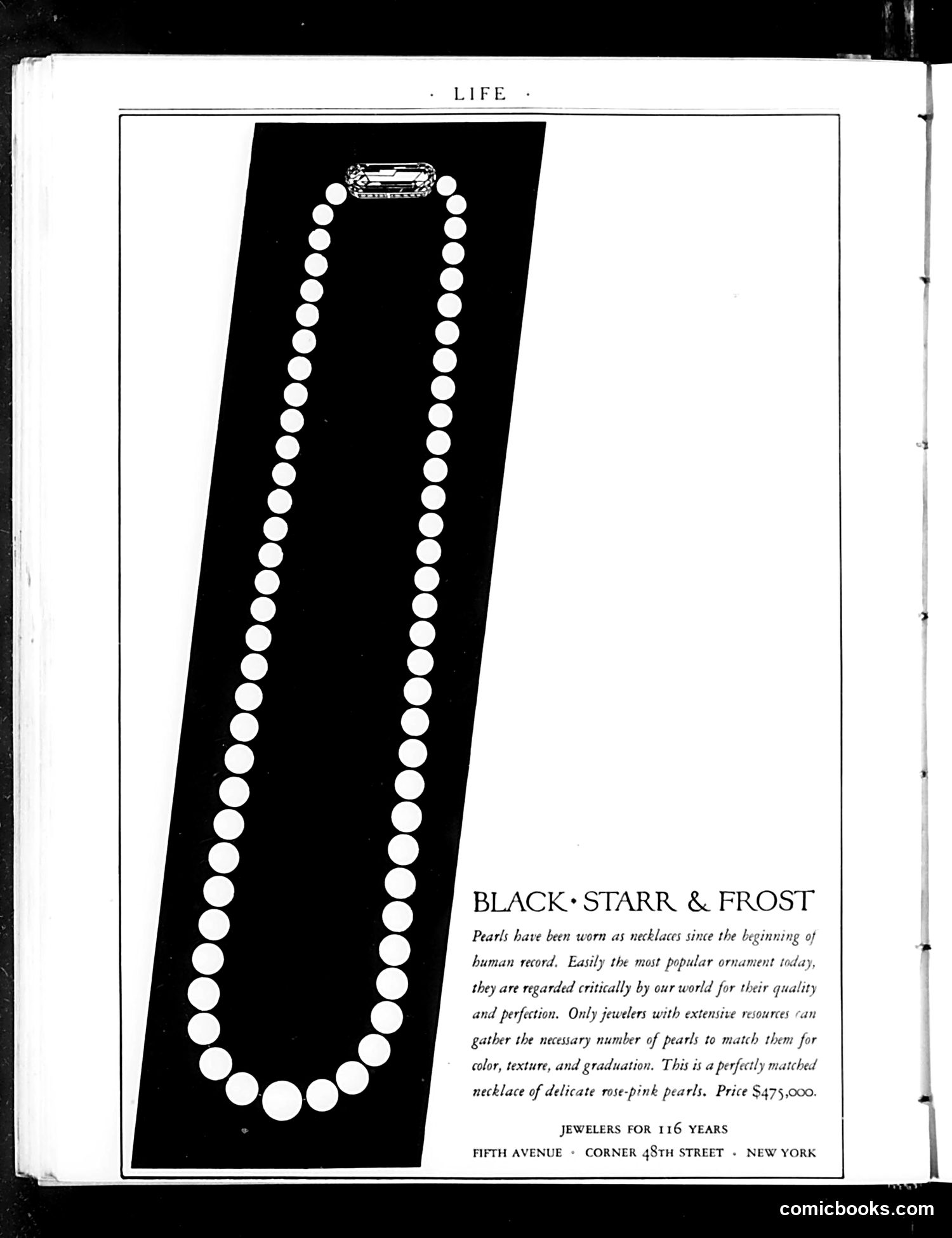
This is a **luxury jewelry advertisement**, not a cartoon or satire. It features Black, Starr & Frost, a high-end New York jeweler, advertising an exceptionally expensive pearl necklace priced at $475,000. The ad appeals to wealthy readers by emphasizing exclusivity: pearls require jewelers with "extensive resources" to gather matching specimens. The copy establishes prestige through historical authority ("worn since the beginning of human record") and the jeweler's longevity ("116 years"). The visual presentation—a strand of perfectly uniform rose-pink pearls displayed against black on the page—showcases the product's rarity and refinement. This is typical **1920s-era luxury advertising** targeting the affluent, emphasizing craftsmanship, quality, and social status rather than satire or humor.
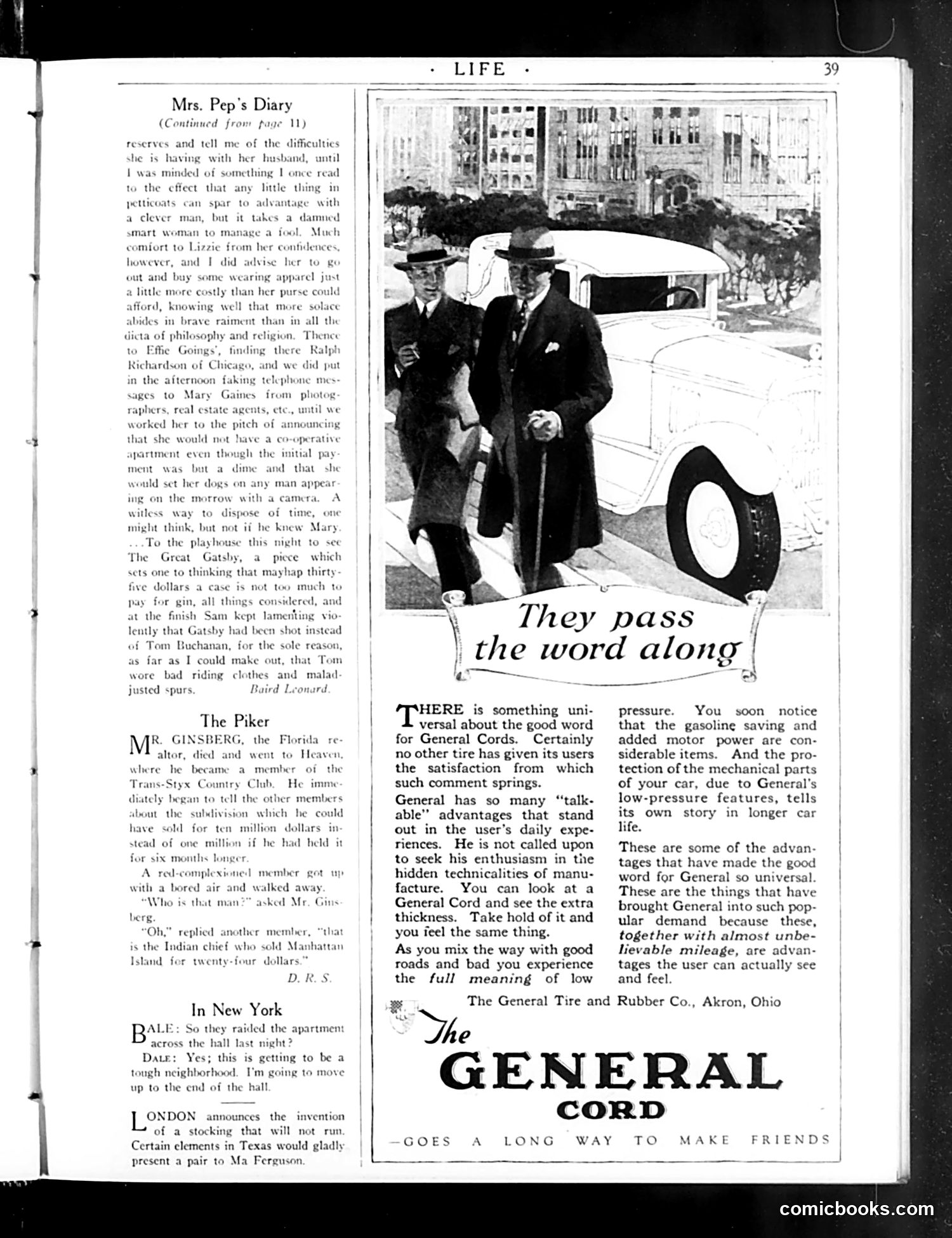
This page contains several brief satirical pieces typical of Life magazine's humor format: **"Mrs. Pep's Diary"** continues a serialized domestic comedy about a woman managing her husband and friends' romantic entanglements, including references to *The Great Gatsby* (suggesting this is from the 1920s). **"The Piker"** mocks a deceased real estate agent, Mr. Ginsberg, who died before capitalizing on a subdivision sale—a joke about missed financial opportunity and greed. **"In New York"** contains two throwaway gags about urban life and neighborhood noise. **"The Piker" (second item)** jokes about a London stocking invention and Texas governor "Ma Ferguson"—likely referring to Miriam Ferguson, who served in the 1920s. The dominant content is a **General Cord tire advertisement** disguised as editorial endorsement, praising the tire's durability and fuel efficiency with pseudo-testimonial language ("They pass the word along"). The page is primarily **advertising masquerading as content**—common in 1920s magazines where ads and editorial material blended seamlessly.
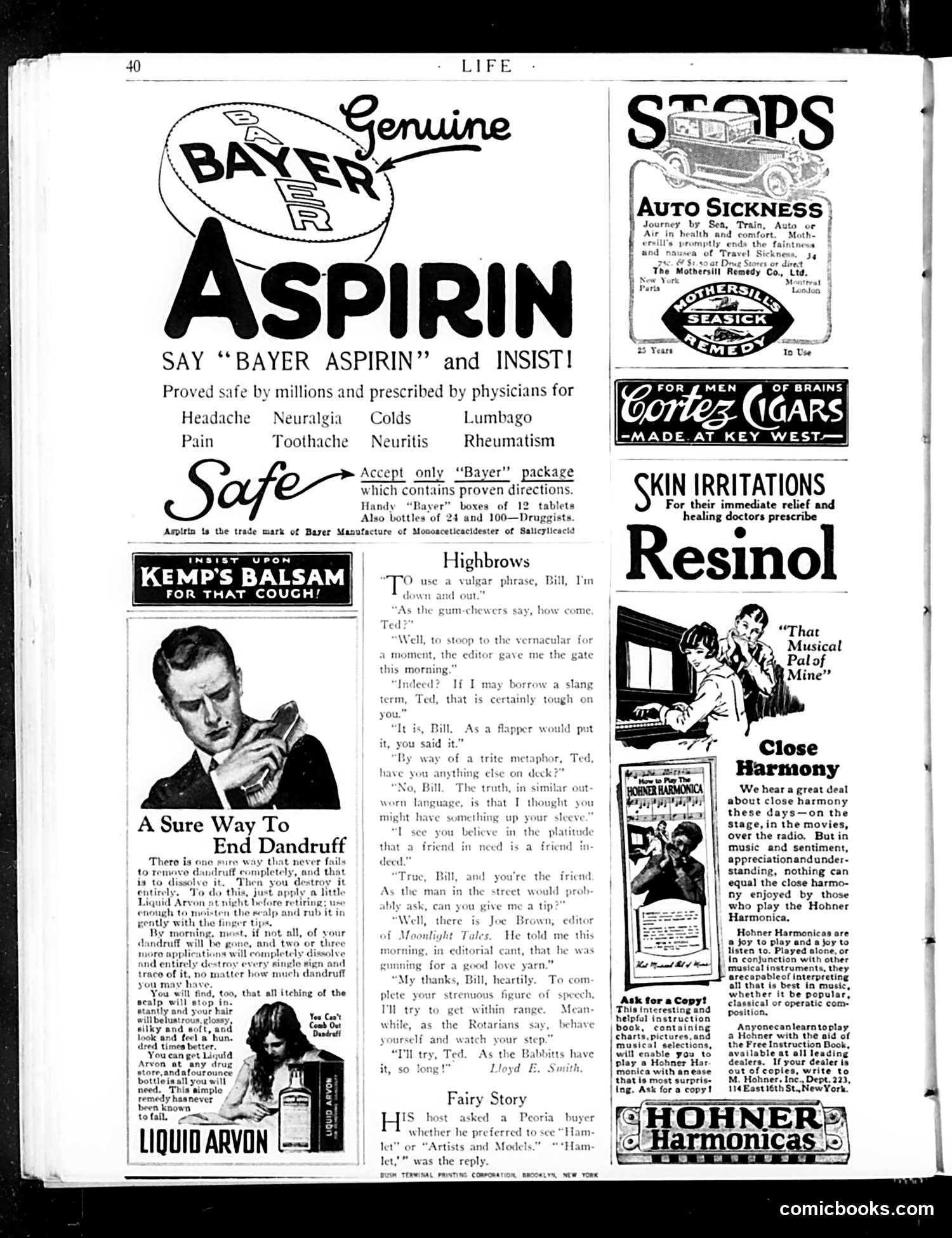
This page is predominantly **advertising**, not satirical political content. It showcases 1920s-era patent medicines and consumer products typical of the era. The main items advertised are: - **Bayer Aspirin**: Marketed as safe and doctor-approved for headaches, pain, and rheumatism - **Kemp's Balsam**: A cough remedy - **Liquid Arvon**: Marketed as a dandruff cure - **Resinol**: A skin irritation treatment - **Cortez Cigars**, **Hohner Harmonicas**, **Seasick Remedy**: Various consumer goods The only non-advertisement content is a brief humorous dialogue titled **"Highbrows"** and a short piece called **"Fairy Story"** about theater preferences—these are light, inconsequential pieces typical of Life's filler content. The page reflects the **pre-FDA era**, when manufacturers made broad health claims without regulatory oversight. The repeated emphasis on "doctor-approved" and "safe" suggests companies were responding to public skepticism about such products.
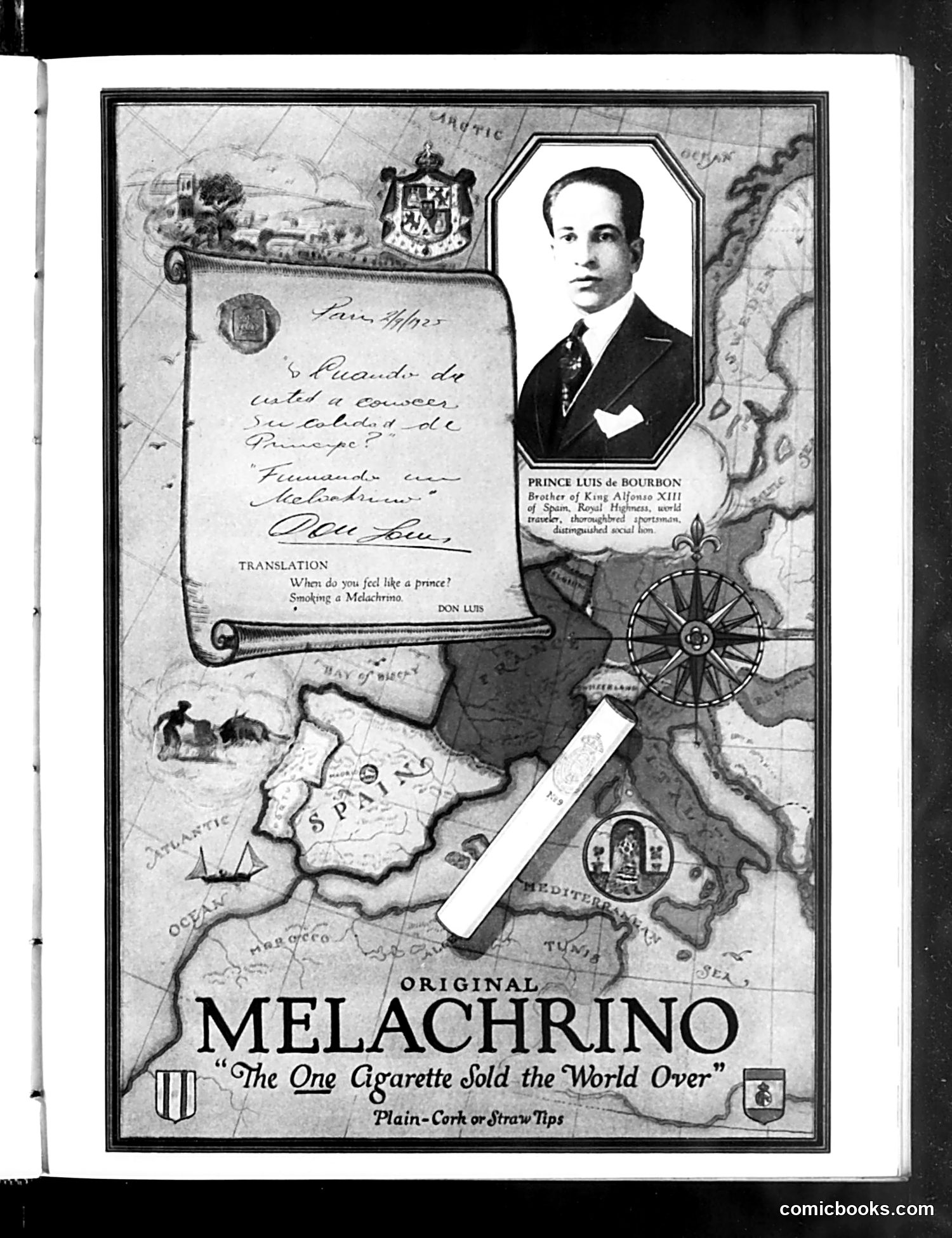
This is a **cigarette advertisement**, not political satire. It promotes "Original Melachrino" cigarettes using a Spanish aristocratic endorsement. The page features **Prince Luis de Bourbon**, identified as brother to King Alfonso XIII of Spain. His portrait appears alongside a handwritten note (in Spanish) that roughly translates to asking when one feels like a prince—answered by "smoking a Melachrino." The advertisement uses maps, a compass rose, and nautical imagery to suggest global sophistication and worldly travel. The tagline claims Melachrino is "The One Cigarette Sold the World Over." This represents early 20th-century advertising strategy: leveraging royal and aristocratic endorsements to convey luxury and prestige to consumers. The "prince" reference plays on aspirational messaging—smoking this brand supposedly confers princely status.
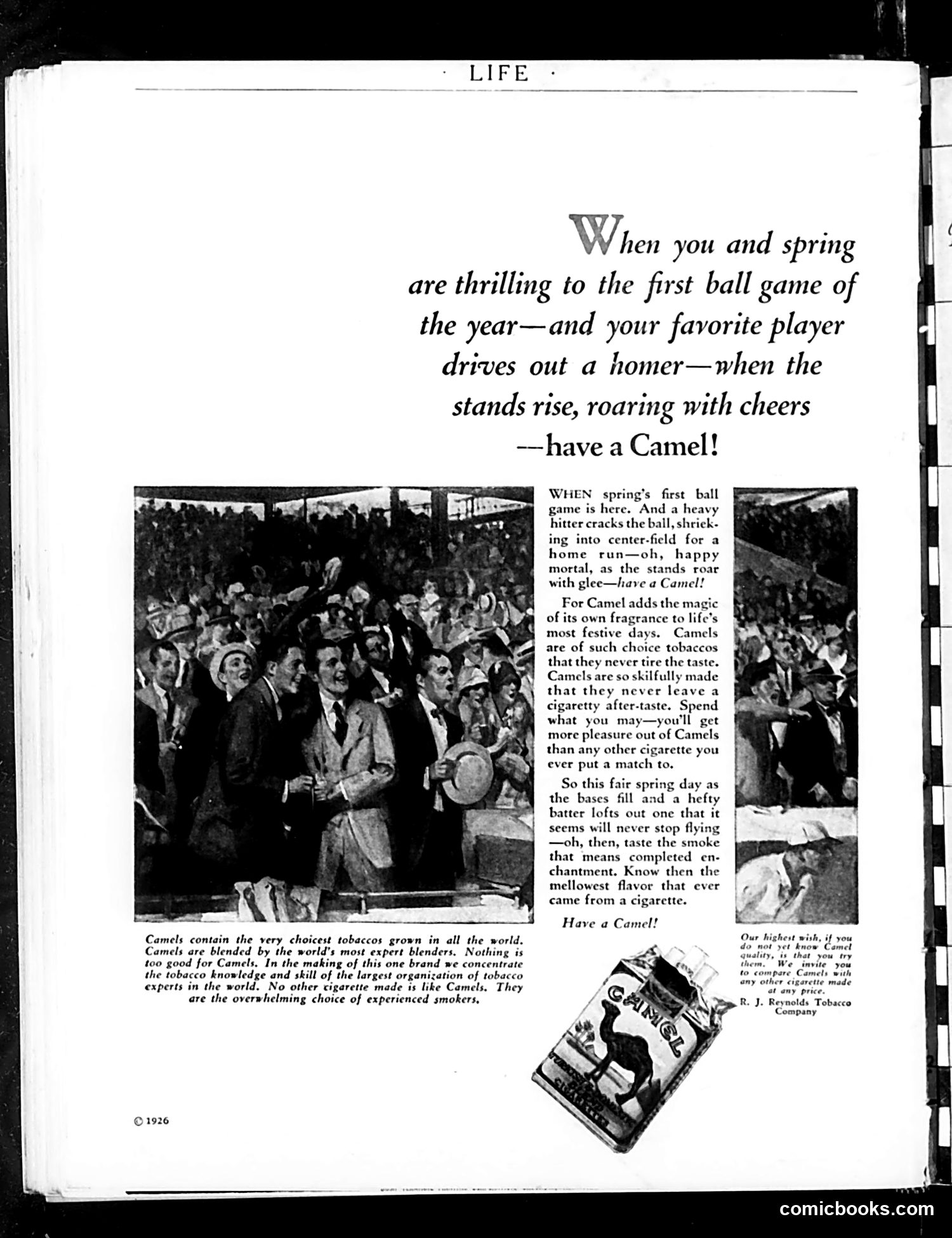
This is a **cigarette advertisement**, not political satire. It uses baseball—America's national pastime and a symbol of spring leisure—to market Camel cigarettes to readers. The ad features photographs of enthusiastic baseball fans at a game, positioned alongside promotional text urging readers to smoke Camels during exciting moments like home runs. The strategy associates cigarettes with pleasure, celebration, and "life's most festive days." Key claims (typical of 1926 advertising): Camels use superior tobaccos, never tire the taste, leave no "after-taste," and provide more pleasure than competitors. The R.J. Reynolds Tobacco Company explicitly states Camels are "the overwhelming choice of experienced smokers." **Modern context**: This represents pre-regulation tobacco marketing, when cigarettes were openly advertised without health warnings and directly associated with social enjoyment and masculine leisure activities.