
Life, 1926-04-01 · page 26 of 46
Life — April 1, 1926 — page 26: what you’re looking at
What you’re looking at
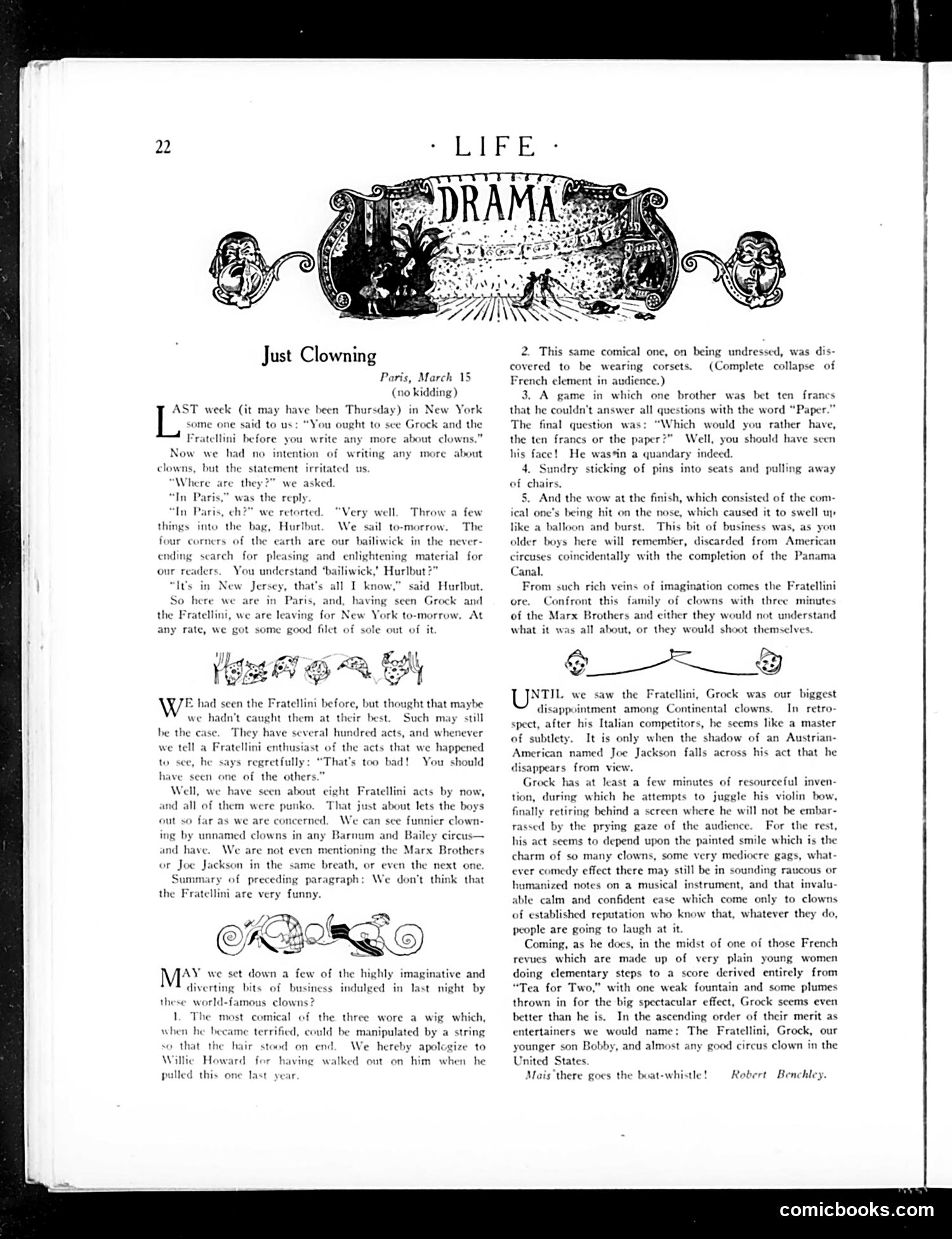
This is a theater review comparing European circus clowns. The author, apparently Robert Benchley (bylined at end), traveled to Paris to see famous Continental performers—the Fratellini brothers and Grock—after being challenged about his clown commentary. **The satire's point:** Benchley attacks European circus clowns as inferior to American vaudeville acts. He dismisses the Fratellini despite their fame, finding their routines dated (nose-swelling gags "discarded from American circuses" after the Panama Canal's completion—a dated reference to early 1900s). **Key figures:** The Fratellini (Italian clown family), Grock (Austrian-American performer), with dismissive comparisons to Marx Brothers and Joe Jackson as superior American entertainers. **The humor:** Benchley's mock-serious tone about impulsively traveling to Paris, combined with underwhelming findings, satirizes both celebrity hype and American cultural superiority assumptions.
📄 Transcribed text from this page (OCR, searchable)
Machine-transcribed from the original scan — historical spelling and the odd misread are preserved.
Just Clowning Paris, March 15 (no kidding) ST week (it may have been Thursday) in New York L some one 1 to us: “You ought to see Grock and the Fratellini before you write any more about clowns.” w we had no intention of writing any more about clowns, but the statement irritated us. "Where are they?” we asked “In Paris,” was the reply “In Paris, ch?” we retorted. “Very well. Throw a few things into the bag, Hurlbut We sail to-morrow. The four corners of the earth are our bailiwick in the never- ending search for pleasing and enlightening material for You understand ‘bailiwick,’ Hurlbut ?” “It's in New Jersey, that’s all I know,” said Hurlbut. our readers So here we are in Paris, and, having seen Grock and the Fratellini, we are leaving for New York to-morrow. At any rate, we got some good filet of sole out of it = had seen the Fratellini before, but thought that maybe we hadn't caught them at their best he the case. Such may still They have several hundred acts, and whenever we tell a Fratellini enthusiast of the acts that we happened to see, he says regretfully: “That's too bad! You should have seen one of the others.” Well, we have seen about eight Fratellini acts by now, and all of them were punko. That just about lets the boys We can sce funnier clown- s by unnamed clowns in any Barnum and Bailey circus— out so far as we are concerned. ind have. We are not even mentioning the Marx Brothers Joe Jackson in the same breath, or even the next one. Summary of preceding paragraph: We don't think that the Fratellini are very AY we set down a few of the highly imaginative and diverting bits of business indulged in last night by these world-famous clowns? 1, The most comical of the three wore a wig which, when he became terrified, could be manipulated t so that the hair stood on end a string We hereby apologize to Willie Howard for having walked out on him when he pulled this one last year 2. This same comical one, on being undressed, w covered to be wearing corsets. (Complete collapse of French element in audience.) 3. A game in which one brother was bet ten francs that he couldn't answer all questions with the word “Paper.” The final question was: “Which would you rather have, the ten francs or the paper?” Well, you should have seen his face!) He was*in a quandary indeed. 4. Sundry sticking of pins into seats and pulling away of chairs, 5. And the wow at the finish, which consisted of the com- ical one’s being hit on the nose, which caused it to swell up like a balloon and burst. This bit of business was, as you older boys here will remember, discarded from American circuses coincidentally with the completion of the Panama Canal, From such rich veins of imagination comes the Fratellini ore. Confront this family of clowns with three minutes of the Marx Brothers and cither they would not understand what it was all about, or they would shoot themselves. oO <—_® NTIL we saw the Fratellini, Grock was our biggest disappointment among Continental clowns. In retro spect, after his Italian competitors, he seems like a master of subtlety. It is only when the shadow of an Austrian- American named Joe Jackson falls across his act that he disappears from view. Grock has at least a few minutes of resourceful inven tion, during which he attempts to juggle his violin bow, finally retiring behind a screen where he will not be embar- rassed by the prying gaze of the audience. For the rest, his act seems to depend upon the painted smile which is the charm of so many clowns, some very mediocre gags, what- ever comedy effect there may still be in sounding raucous or humanized notes on a musical instrument, and that invalu able calm and confident ease which come only to clowns of established reputation who know that, whatever they do, people are going to laugh at it. Coming, as he does, in the midst of one of those French revues which are made up of very plain young women doing elementary steps to a score derived entirely from “Tea for Two,” with one weak fountain and some plumes thrown in for the big spectacular effect, Grock seems even better than he is. In the ascending order of their merit as entertainers we would name: The Fratellini, Grock, our younger son Bobby, and almost any good circus clown in the United States. Mais there goes the at-whistle ! Robert Benchley. comicbooks.com