
Life, 1926-04-01 · page 22 of 46
Life — April 1, 1926 — page 22: what you’re looking at
What you’re looking at
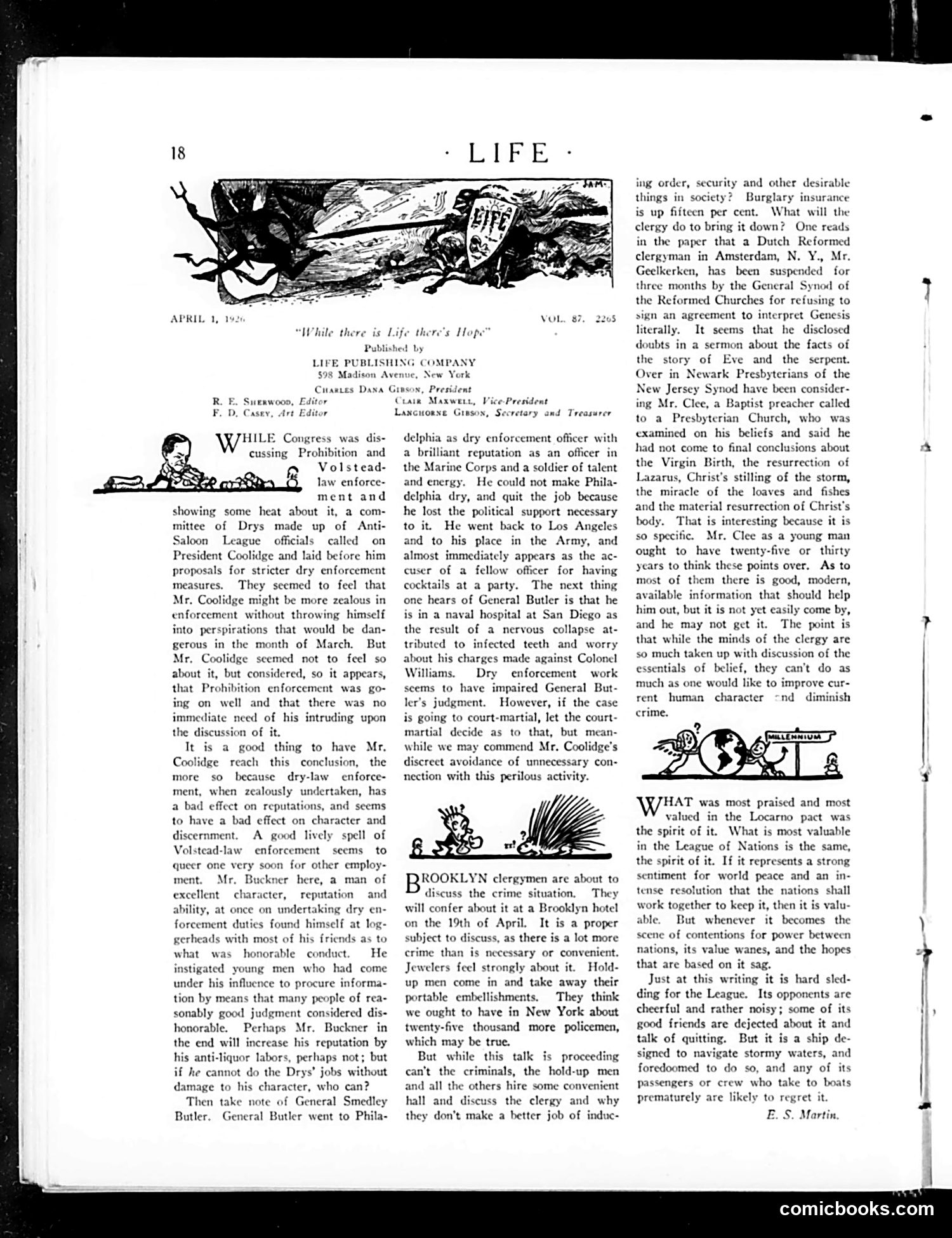
This page attacks the corrupting effects of Prohibition enforcement on otherwise respected officials. The editorial criticizes how zealous "dry law" enforcement damages character and judgment. Two military figures are highlighted as cautionary examples: **General Smedley Butler** — a decorated Marine officer who served as Philadelphia's dry enforcement officer. He failed to make the city dry, lost political support, and quit. Upon returning to the Army, he accused a fellow officer of drinking at a party, suffered a nervous breakdown attributed to infected teeth and stress over the charges, and ended up hospitalized in San Diego. **Mr. Buckner** — referenced as having compromised his honorable reputation by encouraging young men under his influence to gather information through morally questionable means while enforcing Prohibition. Life's satirical point: Prohibition enforcement itself corrupts good men's judgment and character. The magazine suggests President Coolidge wisely avoided entanglement in this "perilous activity." A secondary joke mocks Brooklyn clergy discussing crime—Life sarcastically suggests criminals should hold their own conference about clergy's failures.
📄 Transcribed text from this page (OCR, searchable)
Machine-transcribed from the original scan — historical spelling and the odd misread are preserved.
APRIL 1, 192 “While there is Li Publ LIFE PUBLISHING COM $98 Madis Citantes Dana Ginsox, Presi R. FE. Suenwoc F. D, Casey, Editor Edi HILE Congress was dis- cussing Prohibition and Q Volstead- law enforce- ment and showing some heat about it, a com- mittee of Drys made up of Anti- Saloon League officials called on President Coolidge and laid before him proposals for stricter dry enforcement measures. They seemed to feel that Mr. Coolidge might be more zealous in enforcement without throwing himself into perspirations that would be dan- gerous in the month of March. But Mr. Coolidge seemed not to feel so about it, but considered, so it appears, that Prohibition enforcement was go- ing on well and that there was no immediate need of his intruding upon the discussion of it. It is a good thing to have Mr. Coolidge reach this conclusion, the more so because dry-law enforce- ment, when zealously undertaken, has a bad effect on reputations, and seems to have a bad effect on character and discernment. A good lively spell of Volstead-law enforcement seems to queer one very soon for other employ- ment. Mr. Buckner here, a man of excellent character, reputation and ability, at once on undertaking dry en- forcement duties found himself at log- gerheads with most of his friends as to what was honorable conduct He instigated young men who had come under his influence to procure informa- tion by means that many people of rea- sonably good judgment considered dis- honorable. Perhaps Mr. Buckner in the end will increase his reputation by his anti-liquor labors, perhaps not; but if he cannot do the Drys’ jobs without damage to his character, who can? Then take note of General Smedley Butler. General Butler went to Phila- n Ave there's Hope” by NY Cain Maxwett, Vice-President Lancuorxe Grasox, Secretary and Treasurer delphia as dry enforcement officer with a brilliant reputation as an officer in the Marine Corps and a soldier of talent and energy. He could not make Phila- delphia dry, and quit the job because he lost the political support necessary to it. He went back to Los Angeles and to his place in the Army, and almost immediately appears as the ac- cuser of a fellow officer for having cocktails at a party. The next thing one hears of General Butler is that he is in a naval hospital at San Diego as the result of a nervous collapse at- tributed to infected teeth and worry about his charges made against Colonel Williams. Dry enforcement work scems to have impaired General But- ler’s judgment. However, if the case is going to court-martial, let the court- martial decide as to that, but mean- while we may commend Mr. Coolidge’s discreet avoidance of unnecessary con- nection with this perilous activity. ROOKLY? clergymen are about to discuss the crime situation. They will confer about it at a Brooklyn hotel on the 19th of April. It is a proper subject to discuss, as there is a lot more crime than is necessary or convenient. Jewelers feel strongly about it. Hold- up men come in and take away their portable embellishments, They think we ought to have in New York about twenty-five thousand more policemen, which may be true. But while this talk is proceeding can't the criminals, the hold-up men and all the others hire some convenient hall and discuss the clergy and why they don’t make a better job of induc- ing order, security and other desirable things in society? Burglary insurance is up fifteen per cent. What will the clergy do to bring it down? One reads in the paper that a Dutch Reformed clergyman in Amsterdam, N. Y., Mr. Geelkerken, has been suspended for three months by the General Synod of the Reformed Churches for refusing to sign an agreement to interpret Genesis literally, It seems that he disclosed doubts in a sermon about the facts of the story of Eve and the serpent. Over in Newark Presbyterians of the New Jersey Synod have been consider- ing Mr, Clee, a Baptist preacher called ian Church, who was examined on his beliefs and said he had not come to final conclusions about the Virgin Birth, the resurrection of Lazarus, Christ's stilling of the storm, the miracle of the loaves and fishes and the material resurrection of Christ's body. That is interesting because it is so specific. Mr. Clee as a young man ought to have twenty-five or thirty years to think these points over. As to most of them there is good, modern, available information that should help him out, but it is not yet easily come by, and he may not get it. he point is that while the minds of the clergy are so much taken up with discussion of the essentials of belief, they can’t do as much as one would like to improve cur- rent human character =nd diminish crime. to a Presbyte wrt was most praised and most valued in the Locarno pact was the spirit of it. What is most valuable in the League of Nations is the same, the spirit of it. If it represents a strong sentiment for world peace and an in- tense resolution that the nations shall work together to keep it, then it is valu- able. But whenever it becomes the scene of contentions for power between nations, its value wanes, and the hopes that are based on it sag. Just at this writing it is hard sled- ding for the League. Its opponents are cheerful and rather noisy; some of its good friends are dejected about it and talk of quitting. But it is a ship de- signed to navigate stormy waters, and foredoomed to do so, and any of its passengers or crew who take to boats prematurely are likely to regret it. E. S. Martin. comicbooks.com