
A complete issue · 40 pages · 1926
Life — March 25, 1926
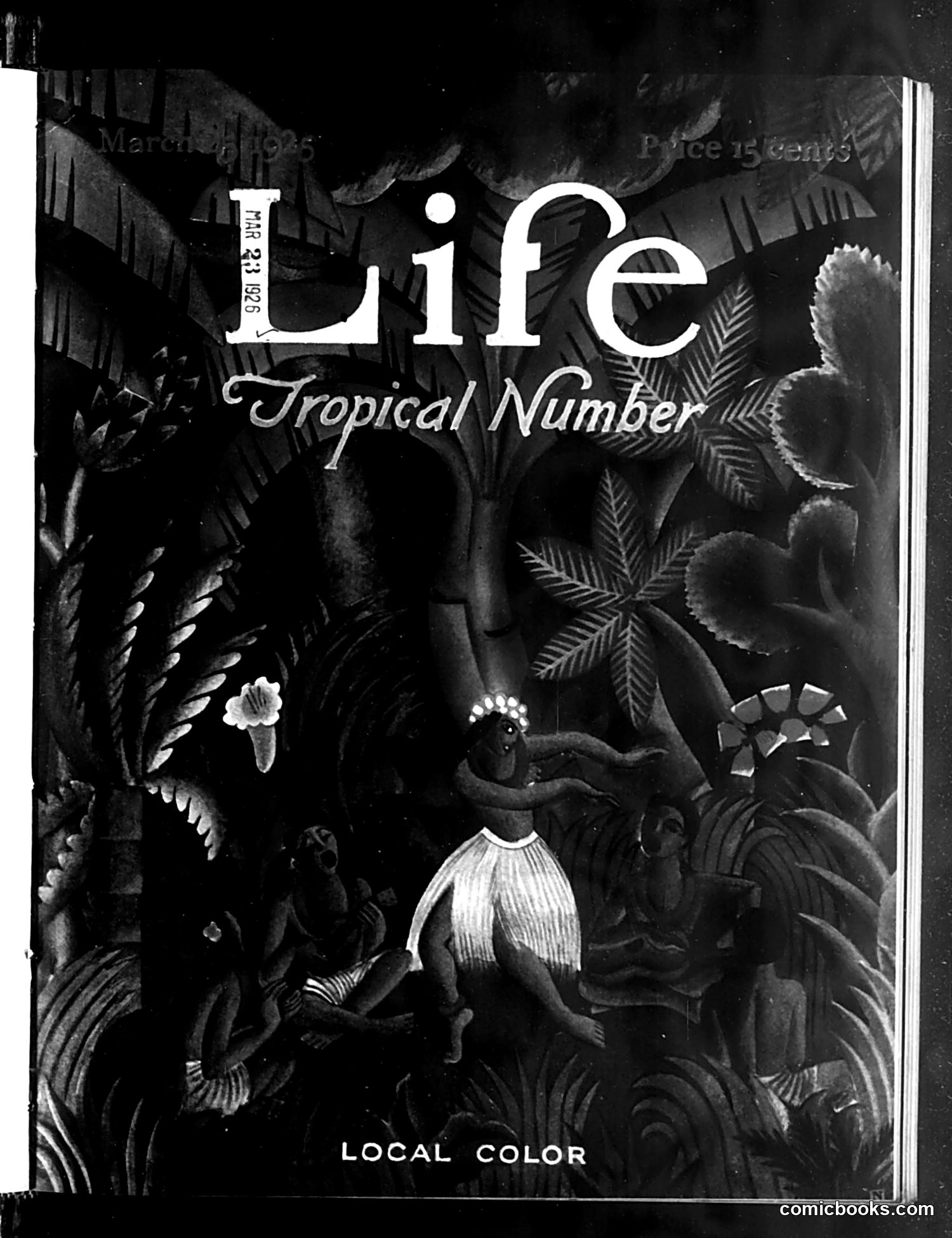
This is the cover of Life magazine's "Tropical Number" issue from March 1926, priced at 15 cents. The illustration depicts lush tropical vegetation and flora in a black-and-white art style, featuring various exotic plants including cacti, flowering plants, and ornate foliage arranged in a dense, decorative composition. The cover appears to be primarily artistic rather than satirical—it's an aesthetic celebration of tropical imagery, likely introducing a special issue devoted to tropical themes, locations, or travel. The notation "LOCAL COLOR" at the bottom suggests the issue may contain regional or travel-focused content. This appears to be a straightforward illustrative cover rather than political or social commentary.
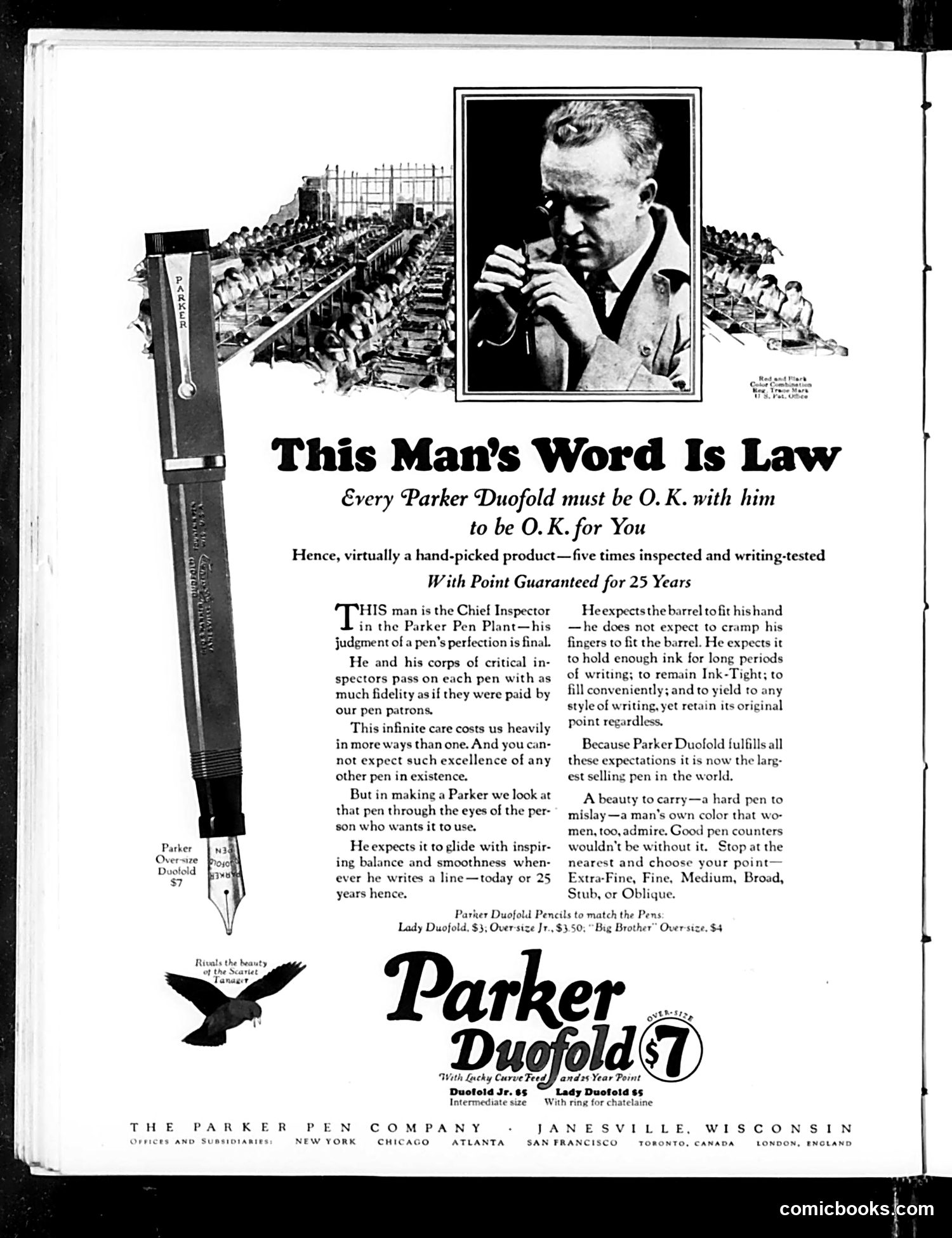
This is primarily a **product advertisement**, not political satire or a cartoon. It promotes the Parker Duofold fountain pen, marketed as "the largest selling pen in the world." The advertisement uses an authority figure—identified as the "Chief Inspector in the Parker Pen Plant"—to establish credibility. The inspector's rigorous quality control ("his judgment of a pen's perfection is final") serves as a testimonial that Parker pens meet exacting standards. The headline "This Man's Word Is Law" plays on the inspector's authority to assure consumers of product reliability. The ad emphasizes the pen's durability, ink capacity, and consistent performance over 25 years. This reflects early 20th-century advertising strategy: using expert authority and technical credibility to differentiate a consumer product in a competitive market.
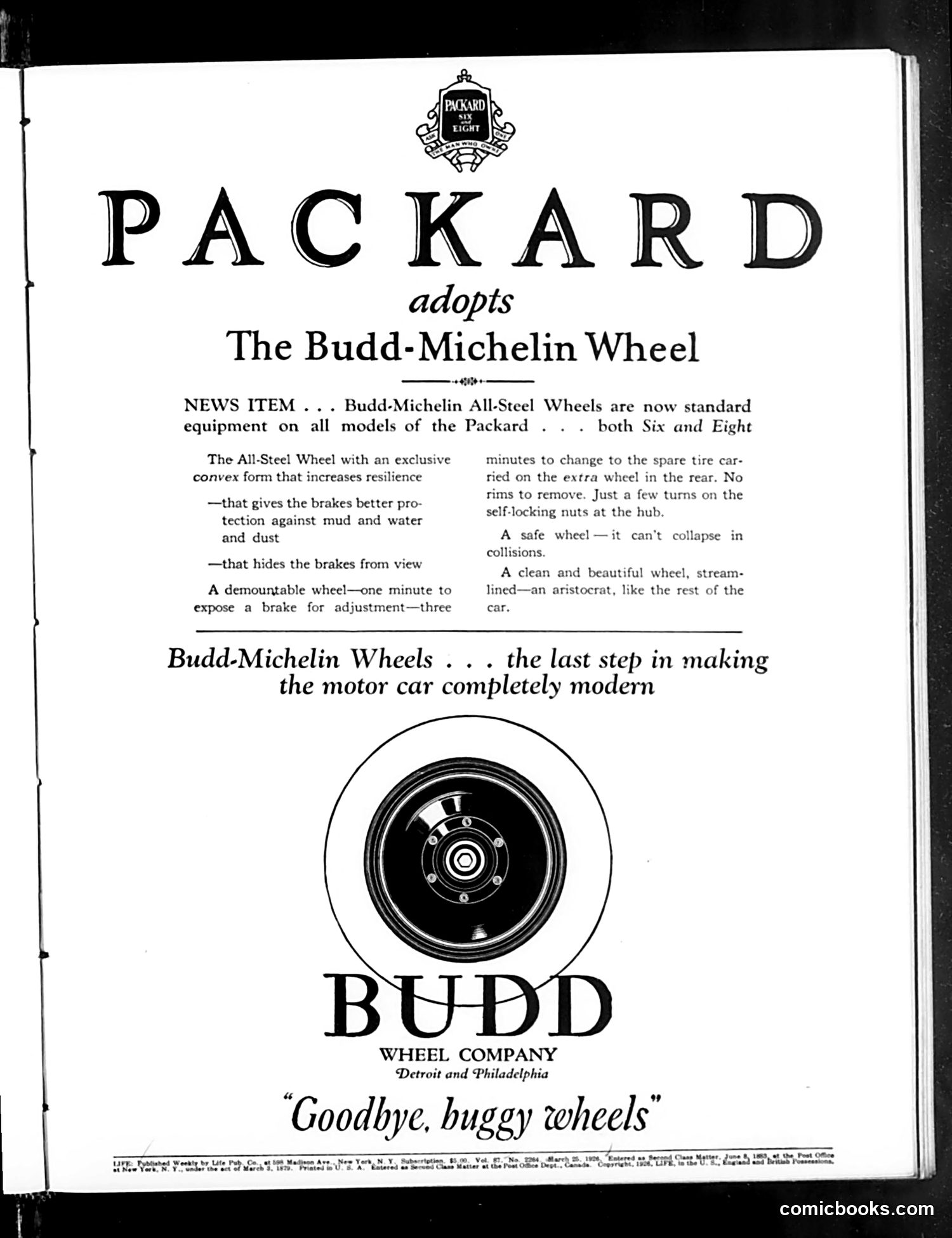
This is **not a political cartoon or satire** — it's a straightforward **advertisement** for Packard automobiles and Budd-Michelin wheels. The page announces that Packard (both Six and Eight models) now includes all-steel Budd-Michelin wheels as standard equipment. The ad emphasizes practical benefits: the wheels are durable, can be changed in minutes, hide the brakes from view, and are safer than collapsible alternatives. The "Goodbye, buggy wheels" tagline suggests these modern all-steel wheels represent progress beyond earlier wooden-spoke carriage wheels, positioning Packard as technologically advanced. This is product marketing, not editorial satire or political commentary — typical of Life magazine's commercial content during the early automotive era.
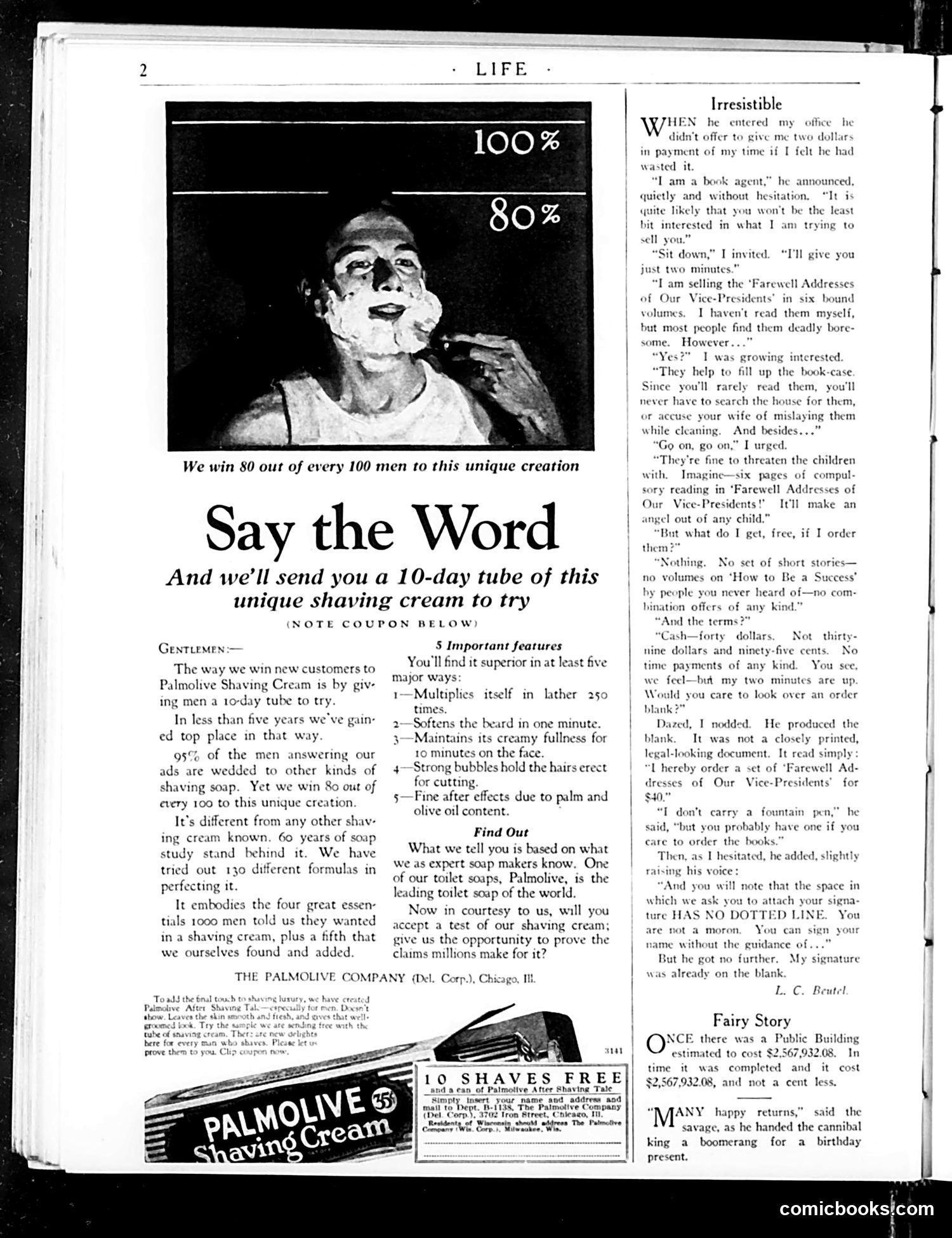
This page is primarily **advertising for Palmolive Shaving Cream**, not political satire. The large advertisement features a man's face with a percentage scale (100% to 80%), claiming the product wins "80 out of every 100 men." The ad emphasizes five product features: superior lathering, rapid beard softening, creamy fullness, hair-lifting properties, and oil-based conditioning effects. The right side contains two short stories: "Irresistible" (about a book agent's sales pitch) and "Fairy Story" (about a building project cost overrun). While *Life* magazine was known for satirical content, **this particular page is dominated by commercial advertising rather than political or social commentary**. The fictional stories are lighthearted anecdotes without apparent satirical intent.
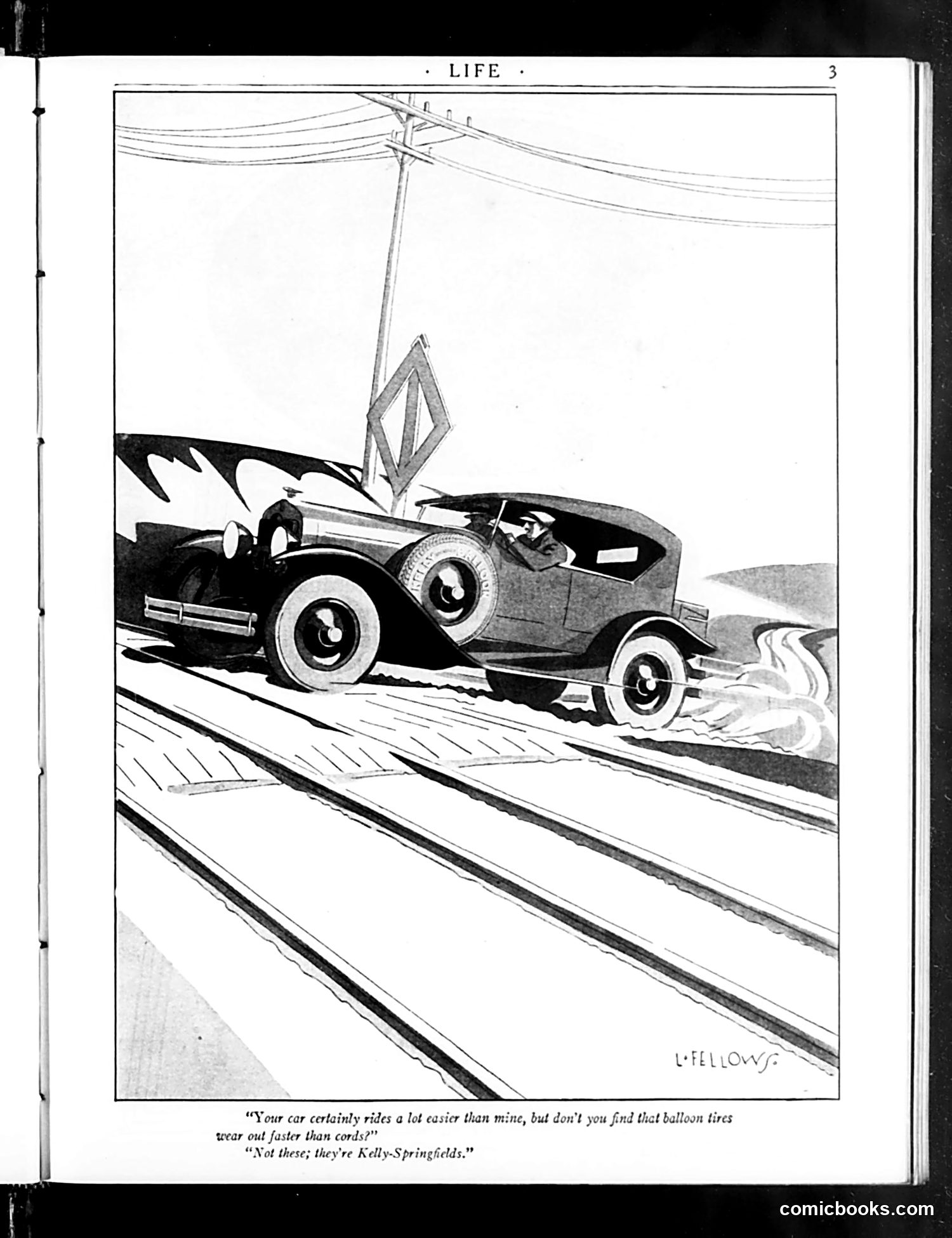
This cartoon satirizes tire quality and automotive advertising. The image shows a damaged car beneath a fallen power line, with one occupant commenting on the vehicle's poor condition. The dialogue reveals the joke: while the car "rides a lot easier," its tires wear out faster—except for "Kelly-Springfields," which are being advertised as superior. This is essentially a **disguised advertisement** presented as humor. The cartoon mocks inferior tires by depicting catastrophic vehicle damage, then pivots to promote Kelly-Springfield brand tires as the quality alternative. The joke assumes readers recognize tire brand names and care about durability—a form of branded humor common in early-20th-century American magazines where advertising and editorial content blurred together.
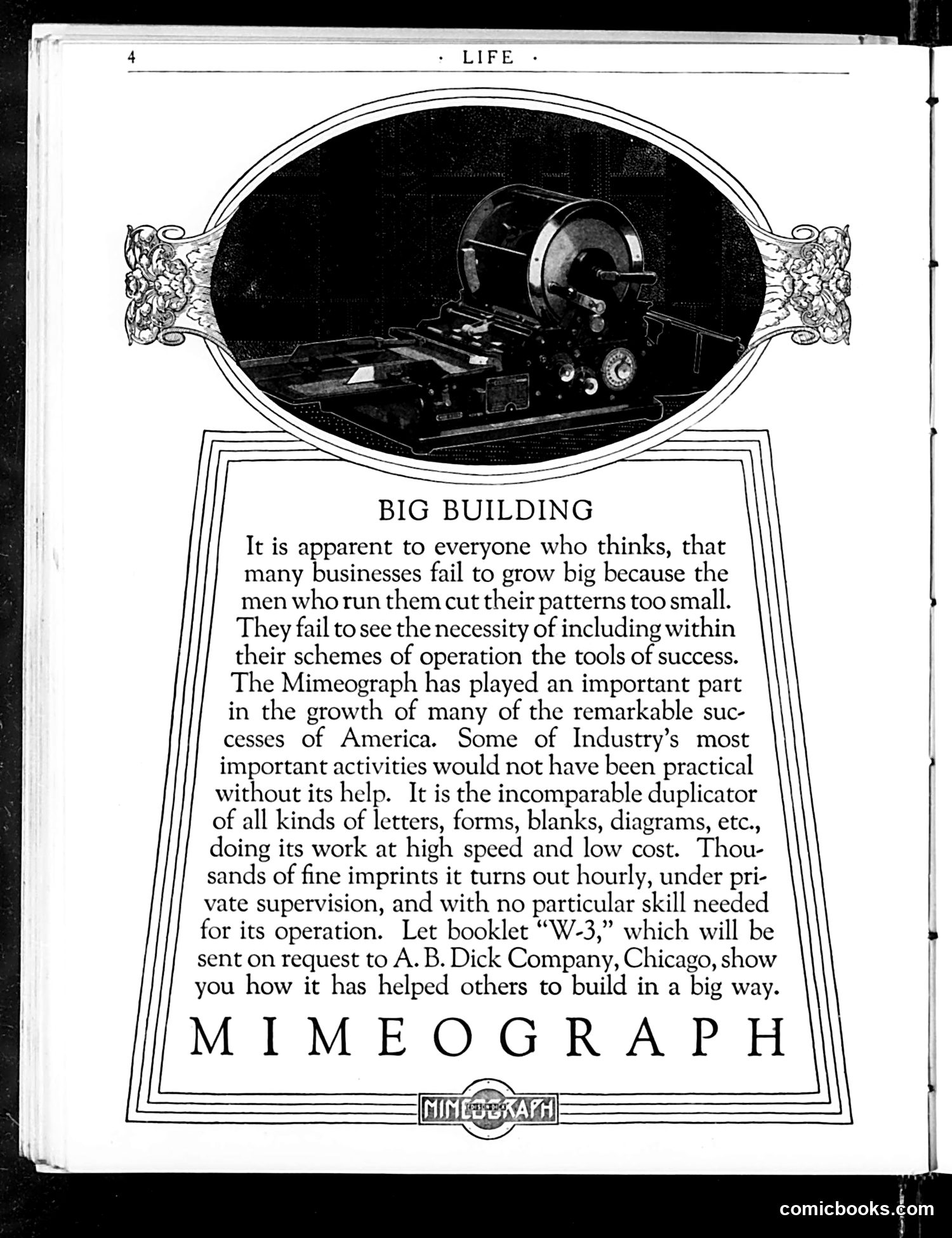
This is **not a satirical cartoon page** but rather a **straightforward advertisement** for the Mimeograph machine, placed in *Life* magazine. The ad's "Big Building" headline uses a business argument rather than humor: it claims that companies fail to grow because leaders think too small and lack proper tools. The Mimeograph—a duplicating machine for copying letters, forms, and diagrams—is presented as a practical "tool of success" that enables high-volume output at low cost without requiring skilled operators. The image shows the machine itself. The ad directs readers to request booklet "W-3" from A.B. Dick Company in Chicago for case studies of business growth. This reflects early 20th-century industrial advertising emphasizing mechanization and efficiency as keys to American business expansion.
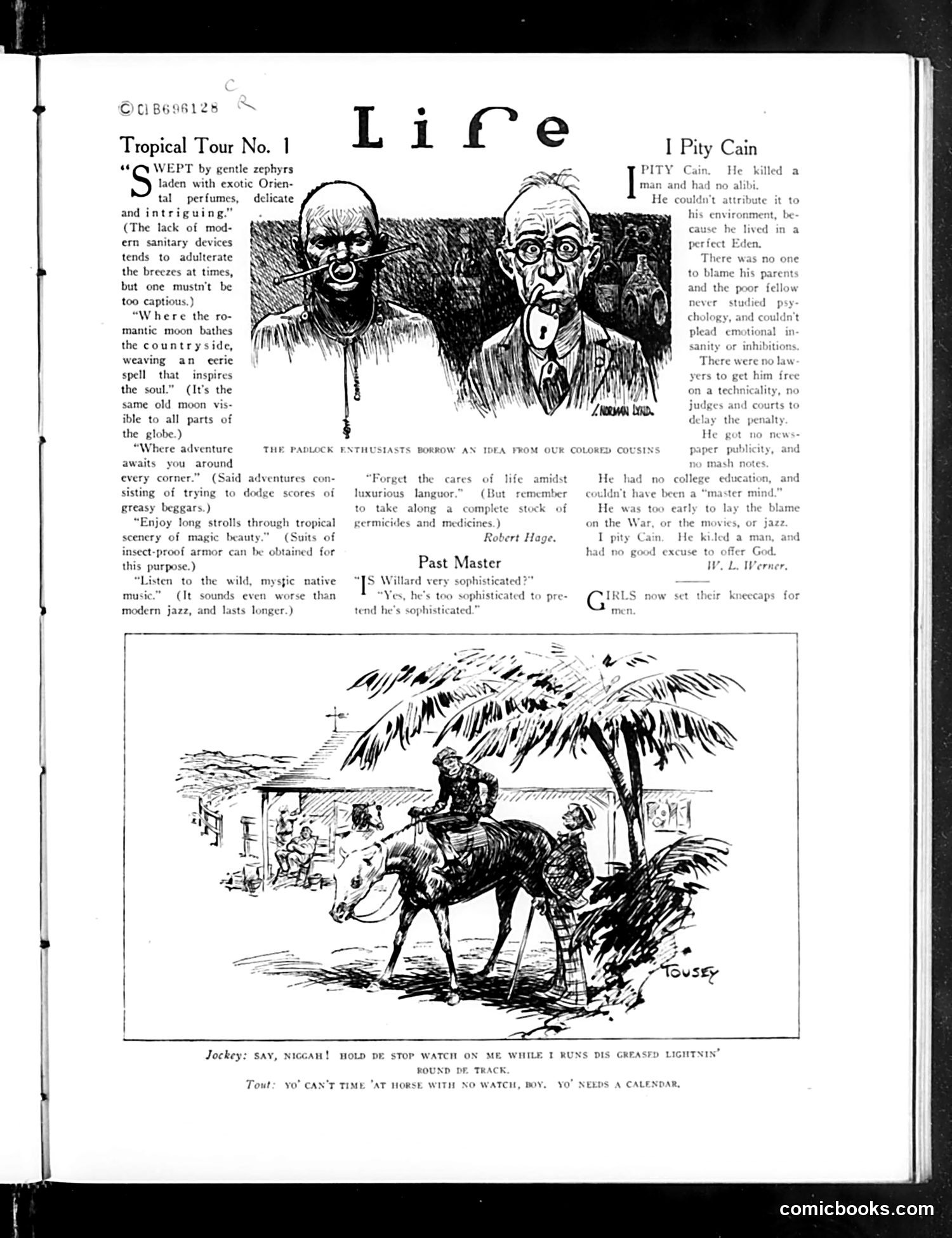
This page contains satirical commentary on early 20th-century leisure culture. The top section, "Tropical Tour No. 1," mocks affluent travelers seeking "exotic" experiences and "primitive" music, while remaining insulated from actual discomfort—a critique of colonial-era tourism's superficiality. The illustration below depicts a jockey on horseback at what appears to be a tropical resort or plantation setting. The caption's humor relies on dialect humor (typical of the era's problematic racial comedy), with a jockey and tour guide discussing timekeeping and scheduling. The separate piece "Pity Cain" offers moral commentary on inherited sin and environmental determinism—suggesting social conditions, not character, explain criminal behavior. The page reflects early 20th-century attitudes toward wealth, race, and social responsibility through satire.
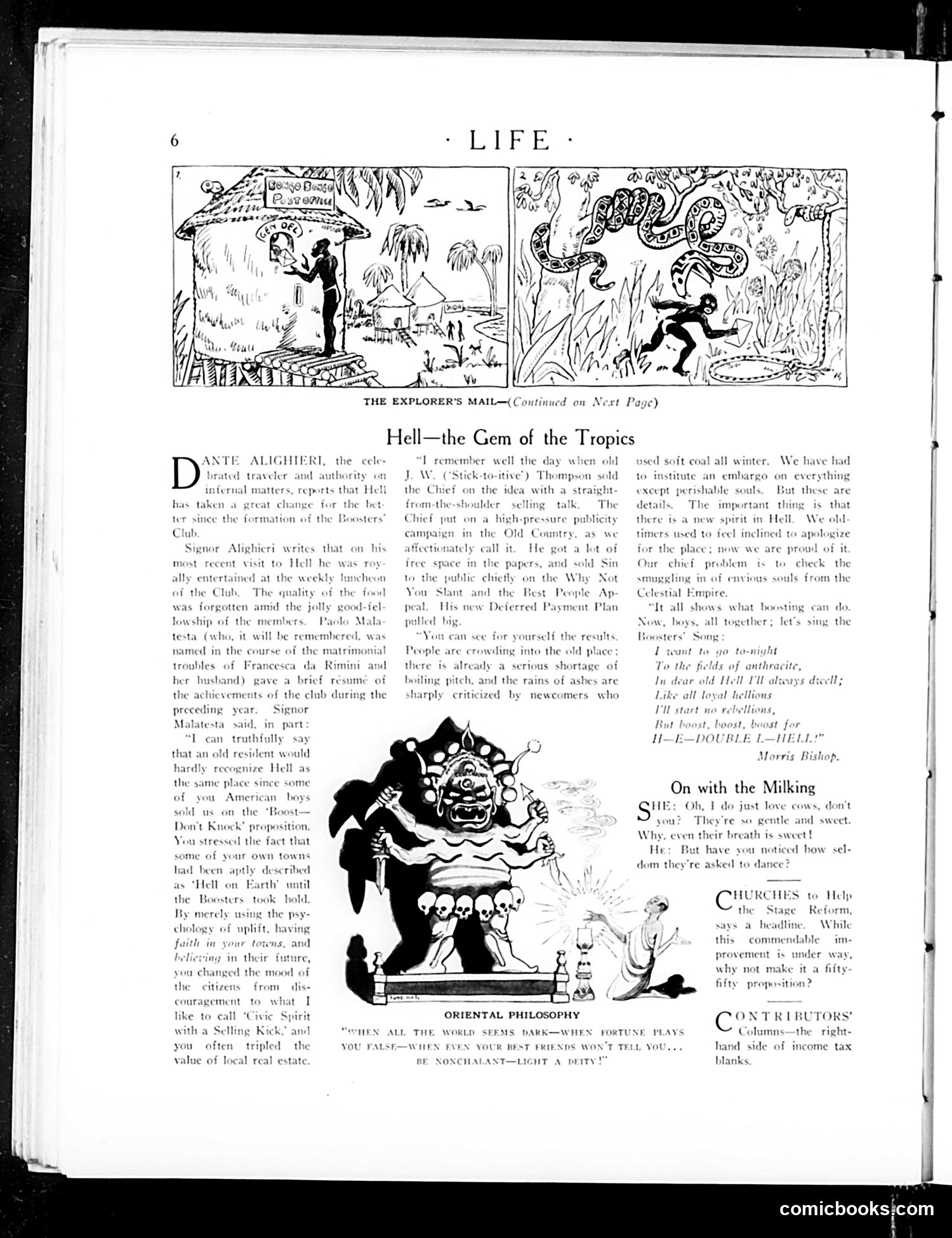
This page satirizes Hell, Colorado, a real town that had become a tourist attraction. The main article, attributed to Dante Alighieri (the medieval Italian poet), humorously treats Hell as a vacation destination. The text describes visiting Hell's Club, praising its facilities and food despite the town's somewhat disreputable reputation. The central cartoon illustrates "Oriental Philosophy," depicting a grotesque demon figure. The caption jokes about fortune-telling and deception: "When all the world seems dark—when fortune plays you false—when your best friends won't tell you... be nonchalant—light a dope!" The satire mocks both the commercialization of a poorly-regarded town and contemporary attitudes toward drugs and spiritual hucksterism, treating serious vices as laughable modern absurdities.
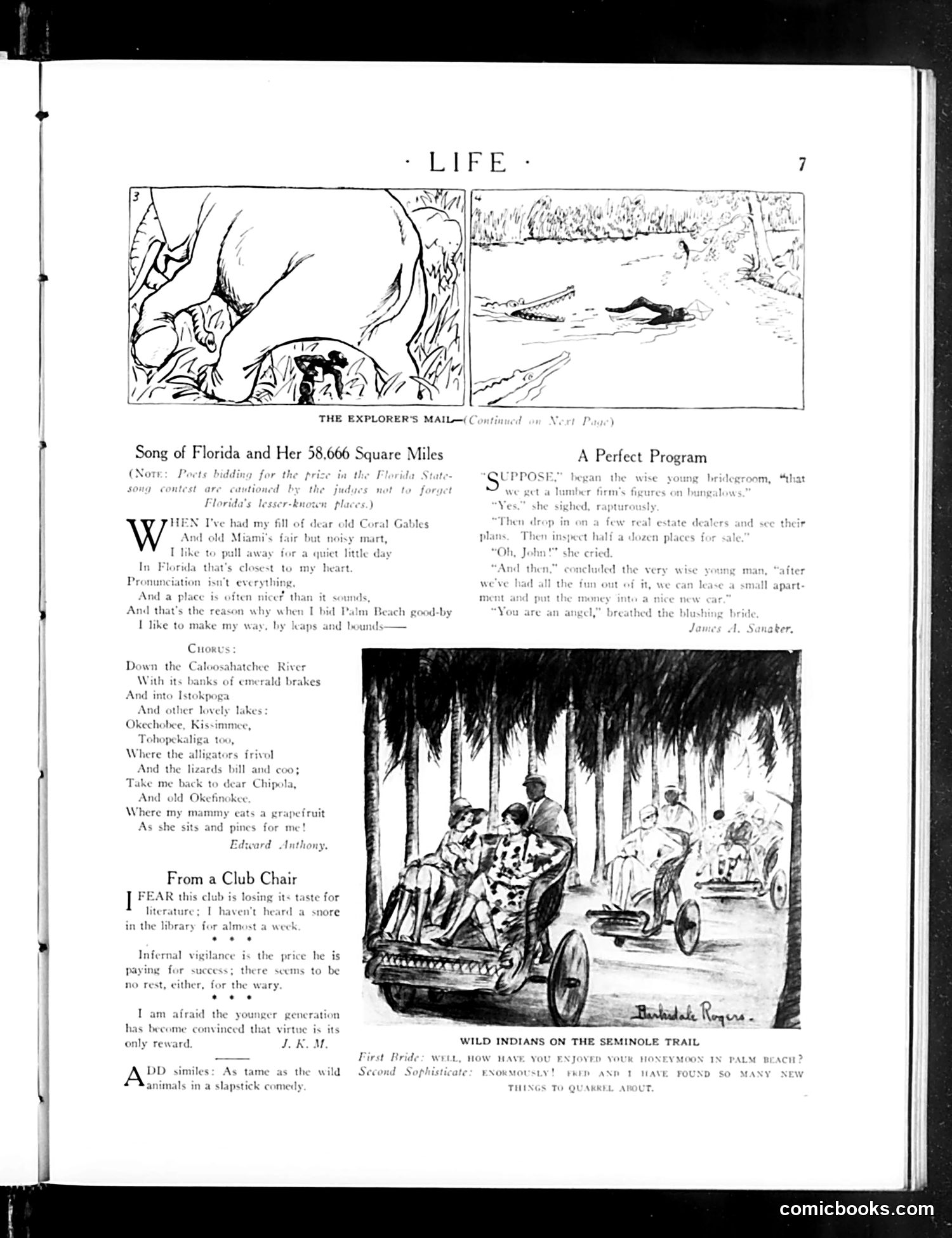
This page contains three distinct pieces of humorous content: 1. **"Song of Florida"** - A poem by Edward Anthony celebrating Florida's natural features (rivers, lakes, alligators), written in a sentimental, nostalgic style typical of early 20th-century regional celebration. 2. **"From a Club Chair"** - A brief satirical piece criticizing the younger generation's declining interest in reading and literature, lamenting that "the younger generation has become convinced that strife is only reward." 3. **"Wild Indians on the Seminole Trail"** - A cartoon illustration by Frederic Remington showing tourists in automobiles observing Native Americans, with a witty caption mocking tourists' superficial engagement with indigenous culture while on holiday in Florida. The page collectively satirizes tourism, nostalgia, and generational decline in cultural literacy.
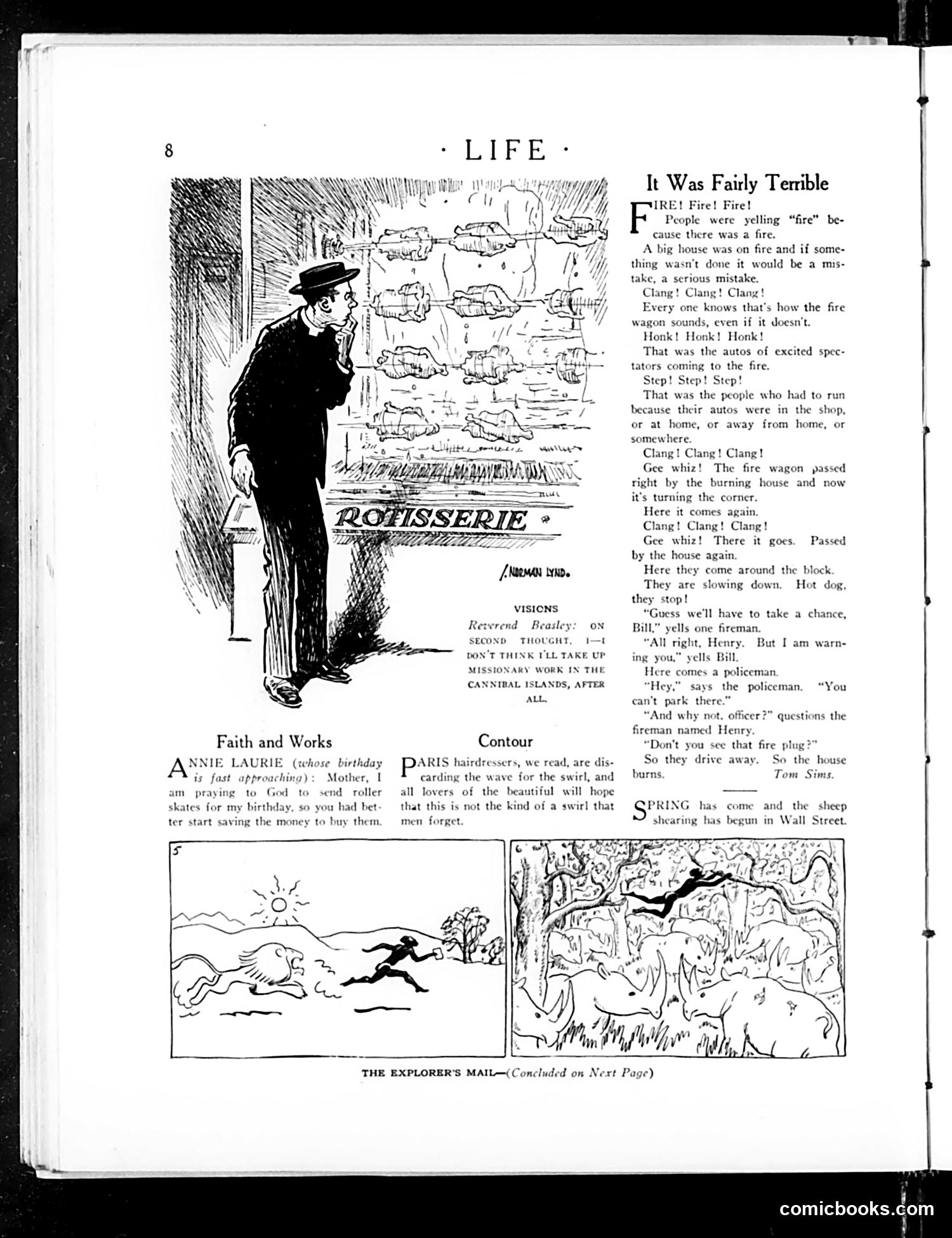
This page from *Life* magazine presents a humorous narrative about a house fire in Paris. The main illustration shows a man peering at a "Rotisserie" (a roasting shop) engulfed in flames, while the accompanying text humorously recounts the chaos of firefighting—the fire wagon bells, excited spectators, people retrieving their automobiles, and a policeman issuing parking violations even during the emergency. The satire targets Parisian priorities: the absurdity of strict parking enforcement persisting even as a building burns. The smaller cartoons below ("Faith and Works" and "Contour") appear unrelated to the fire story. The humor relies on the incongruity between urban emergency procedures and petty bureaucracy—a timeless comedic target.
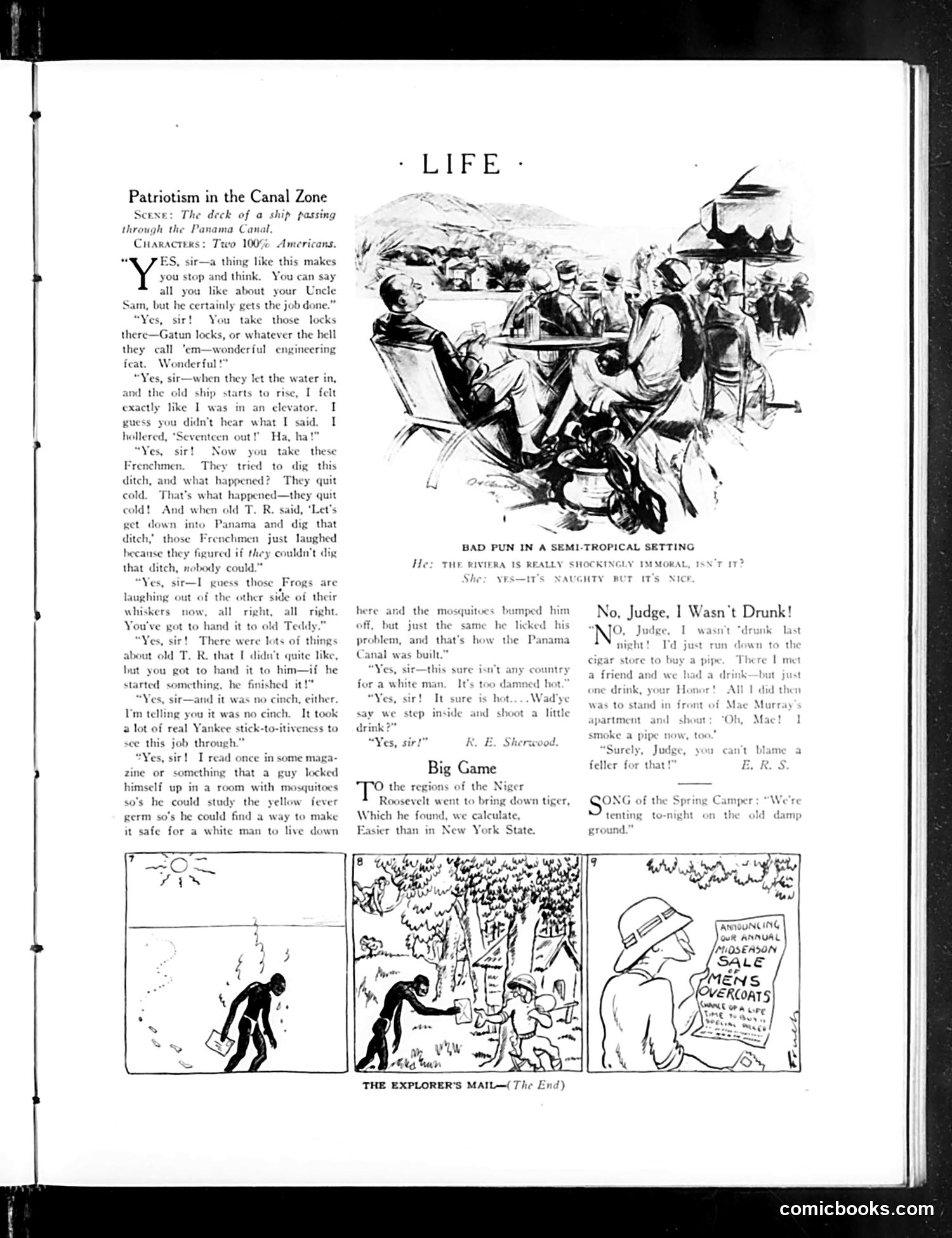
This page contains three distinct pieces: 1. **"Patriotism in the Canal Zone"** — A dialogue piece satirizing American attitudes about the Panama Canal construction. Two characters (appears to be an American and a French worker) discuss the canal's engineering challenges, with the American boasting about American superiority while the French reference earlier failed attempts. 2. **"Big Game"** — A brief poem about hunting tigers in the Niger region, contrasting dangerous African game hunting with easier New York State hunting. 3. **"The Explorer's Mail"** — A three-panel comic strip showing an explorer encountering various hazards (weather, jungle obstacles, and finally returning home to find a mundane clothing sale advertisement), satirizing the anticlimax of adventure. The overall theme involves American expansion, adventure, and the gap between exotic ambitions and domestic reality.
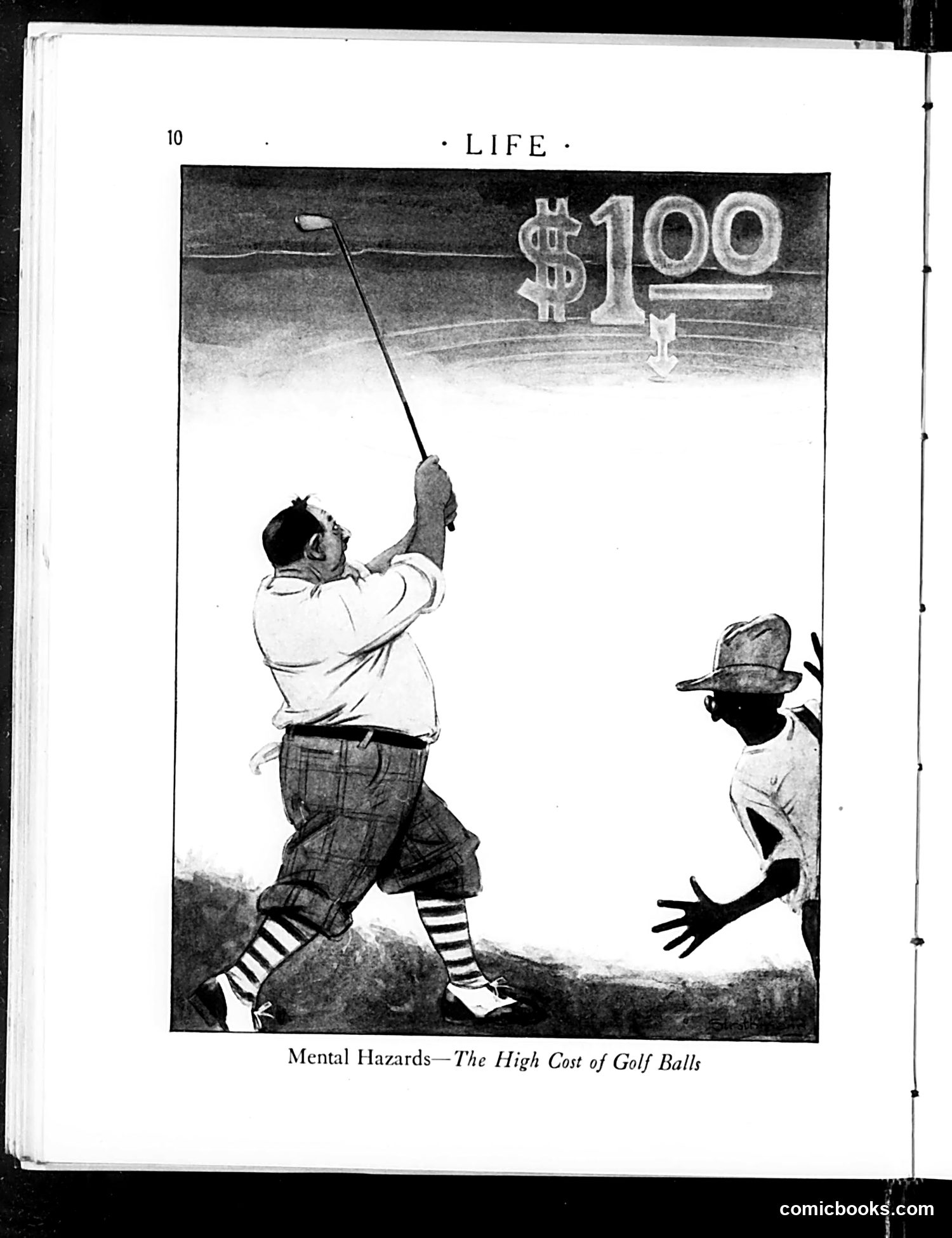
This Life magazine cartoon satirizes the anxiety and financial burden of golf in the early 20th century. A golfer mid-swing displays exaggerated tension, eyes bulging with stress. A caddy watches nervously from the sideline. The "$100" prominently displayed suggests the monetary stakes—likely representing either lost balls, wagers, or the overall expense of playing golf at that time. The satire targets golf's psychological toll on players, particularly regarding the expense of losing expensive balls during play. The cartoon implies that golfers suffer real mental distress over money lost through errant shots. This mocks both the sport's costs and players' overwrought emotional responses to those costs, reflecting period anxieties about wealth and leisure spending.
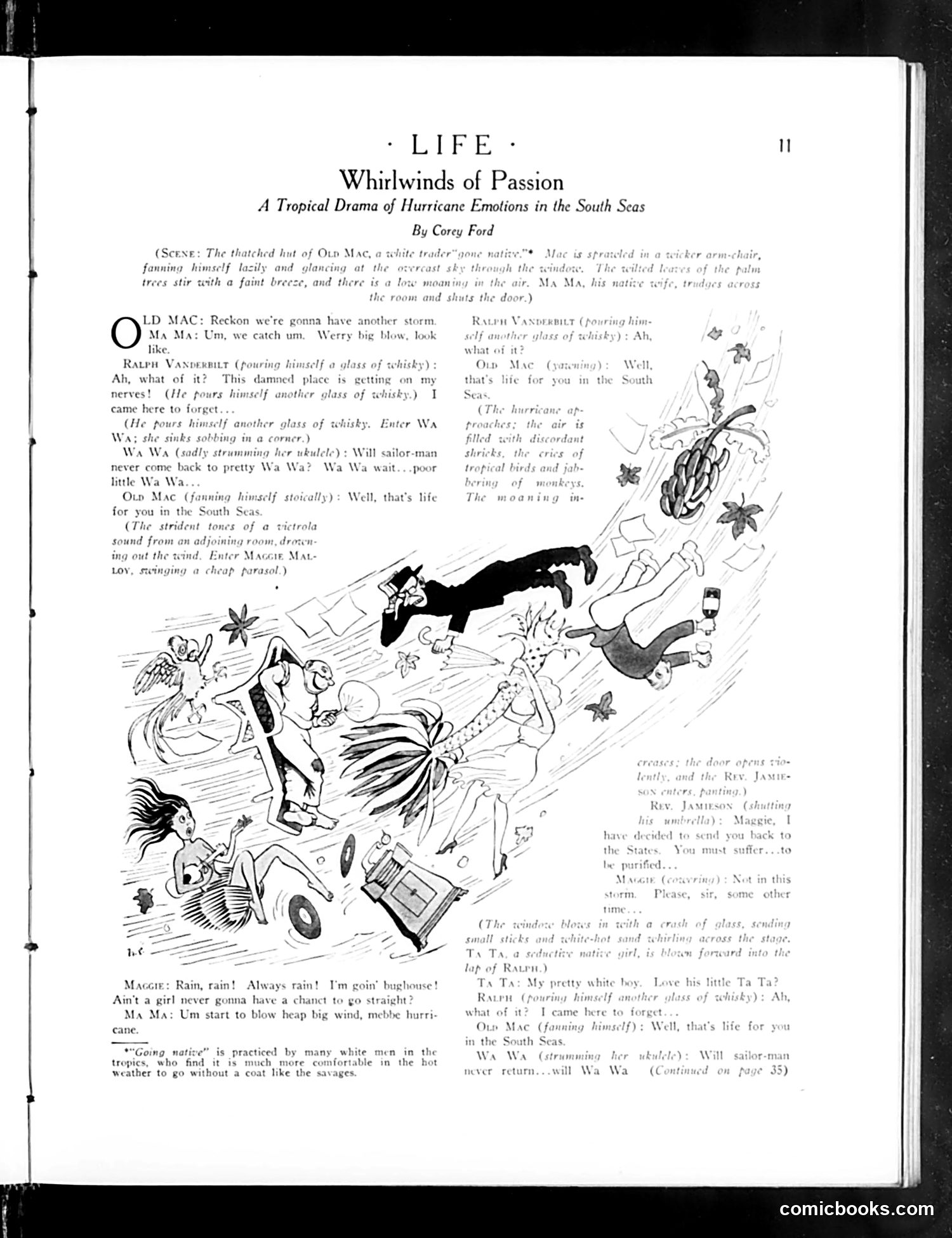
This is a theatrical play review/advertisement for "Whirlwinds of Passion: A Tropical Drama of Hurricane Emotions in the South Seas" by Corey Ford. The accompanying illustration is a chaotic, humorous sketch satirizing melodramatic tropical adventure plays—a popular entertainment genre of the era. The cartoon depicts characters being literally swept up in a hurricane's chaos, with exaggerated poses and slapstick imagery. The satire mocks the overwrought emotions and absurd plotting typical of South Seas melodramas that were fashionable in early 20th-century theater. The dialogue parodies stilted theatrical speech patterns and implausible plot devices (characters casually discussing storms while drinking whiskey). The illustration's visual chaos reinforces the joke: these plays substituted spectacle and melodrama for coherent storytelling.
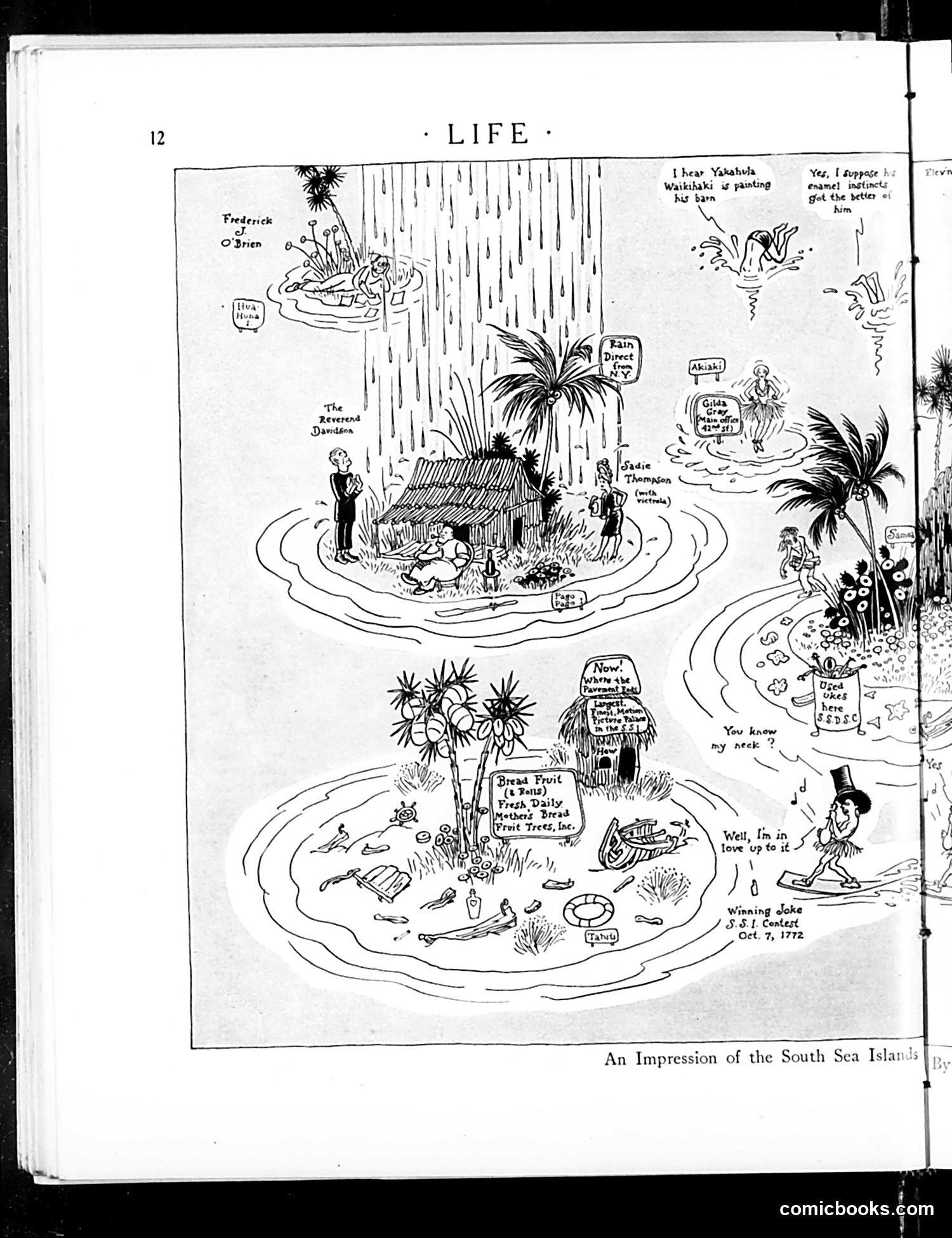
This satirical cartoon depicts a romanticized fantasy of the South Sea Islands as seen through Western eyes. The image shows two island scenes with contrasting activities: The upper island features colonizers and missionaries (labeled figures include "Frederick O'Brien" and references to "The Reverend Judkins"), depicting colonial enterprise and religious conversion efforts. The lower island shows leisure and indulgence—lounging figures, palm trees, and what appears to be commercial establishments ("Fresh Daily Mothers Bread" visible). The satire mocks Western fantasy projections onto Pacific islands: the contrast between pious missionary work and hedonistic escapism reveals hypocrisy in colonial attitudes. The detailed labels and scattered debris suggest criticism of how Western civilization disrupts island life, presenting it as either mission field or vacation playground rather than recognizing indigenous culture.
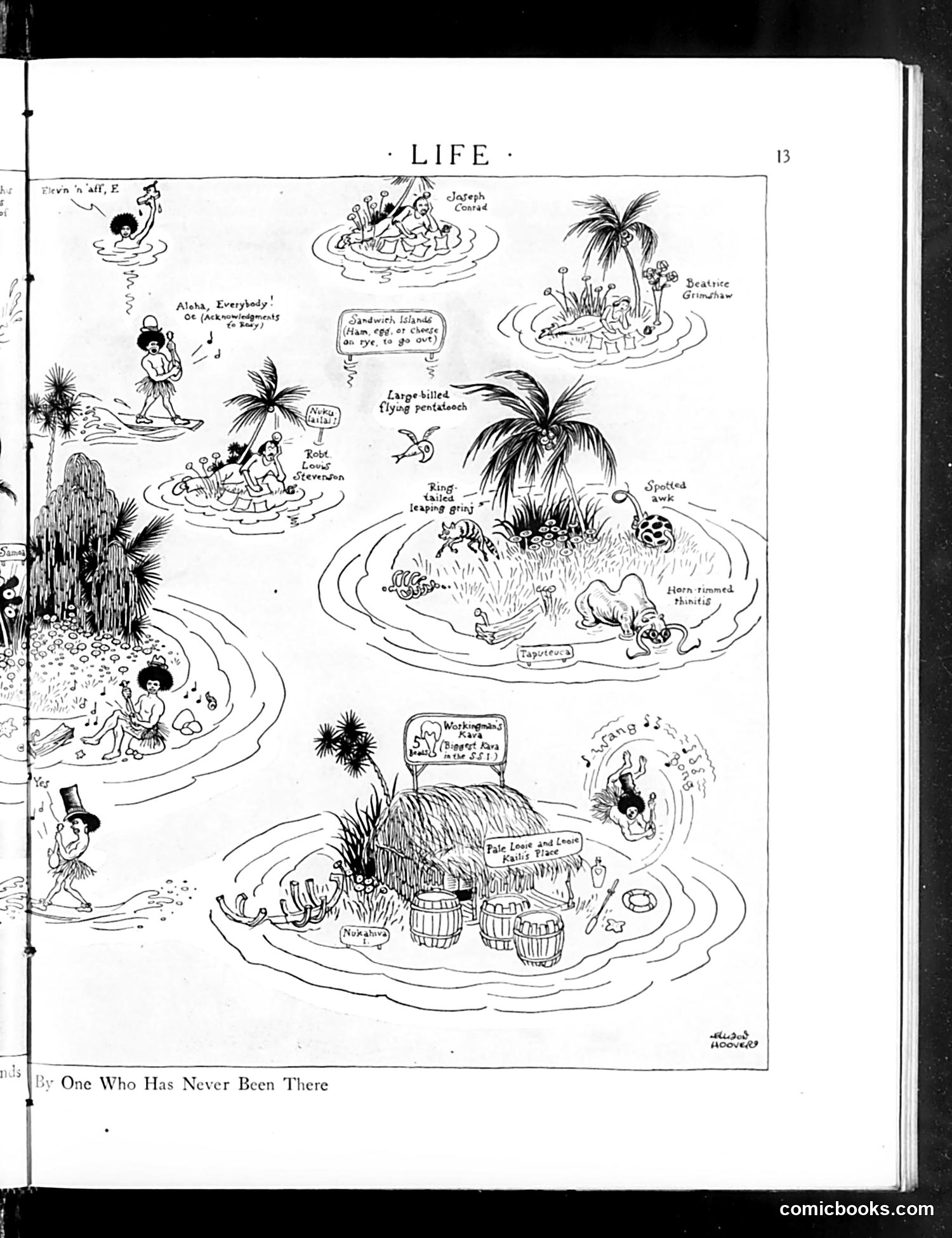
This page from *Life* magazine presents a satirical illustrated map titled "LIFE" by "One Who Has Never Been There." The cartoon depicts various island locations with caricatured scenes of colonial-era life and indigenous peoples, labeled with names like "Sandwich Islands," "Joseph Conrad," "Beatrice Girashaw," and references to "Samoa" and "Tahiti." The satire appears to mock romanticized Western perceptions of exotic tropical locales—the kind found in adventure literature and travel narratives of the period. By attributing the map to "One Who Has Never Been There," the cartoonist suggests these depictions are imaginative fantasies rather than accurate representations, poking fun at armchair travelers and literary exoticization of colonial territories popular in early 20th-century Western culture.
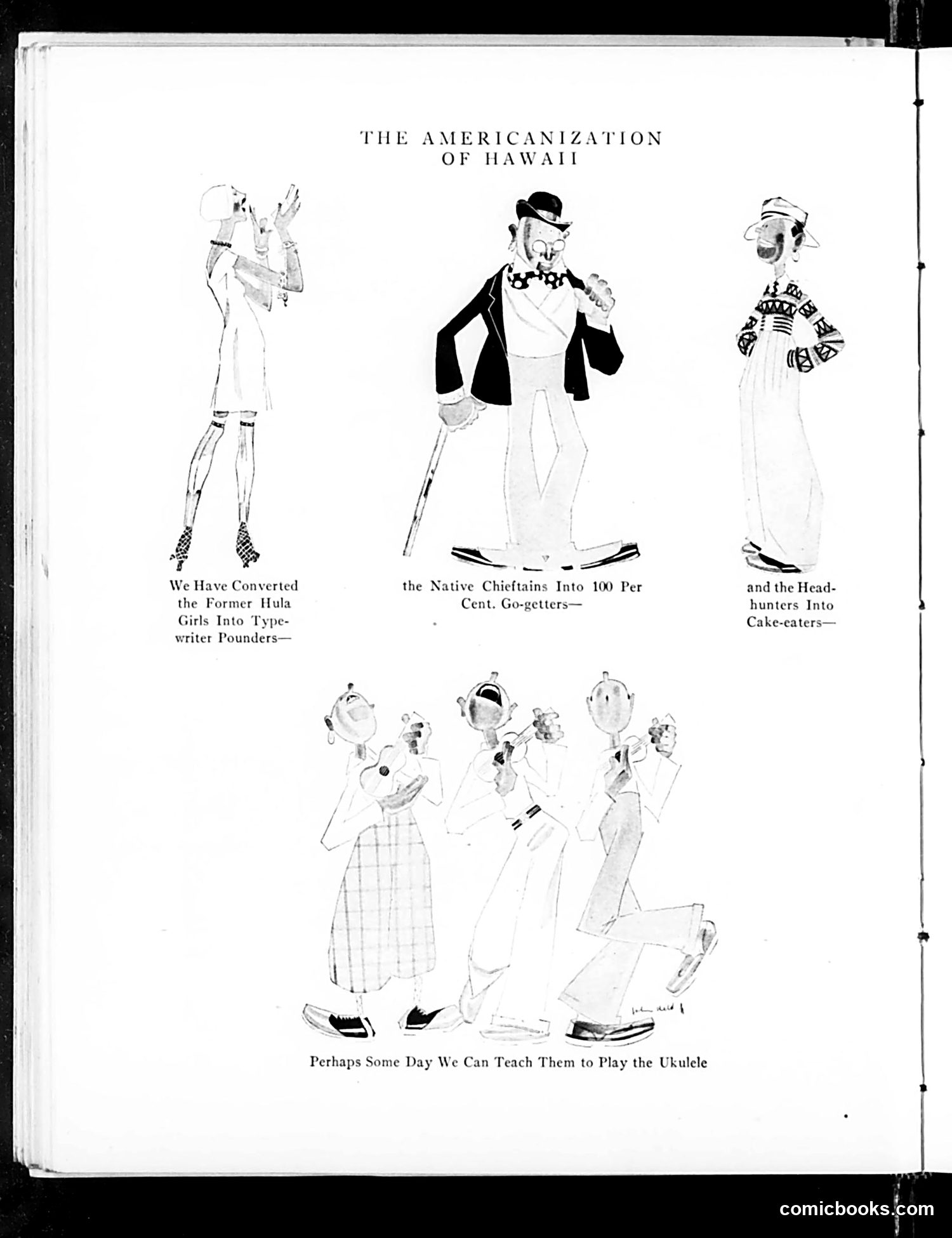
This satirical page mocks the cultural displacement of Native Hawaiians following American annexation. The cartoons depict stereotypical transformations: Hawaiian women converted to "typewriter pounders," native chiefs to "100 per cent go-getters" (adopting American business culture), and hunters to "cake-eaters" (an era-specific slur for idle, effete men). The bottom panel shows Hawaiians learning to play ukulele, presented ironically as a "perhaps someday" future goal—suggesting that despite rapid Americanization, cultural assimilation remains incomplete or problematic. The overall message critiques America's aggressive cultural imperialism in Hawaii: the colonizing power is erasing indigenous traditions while imposing capitalist values and American identity on the native population.
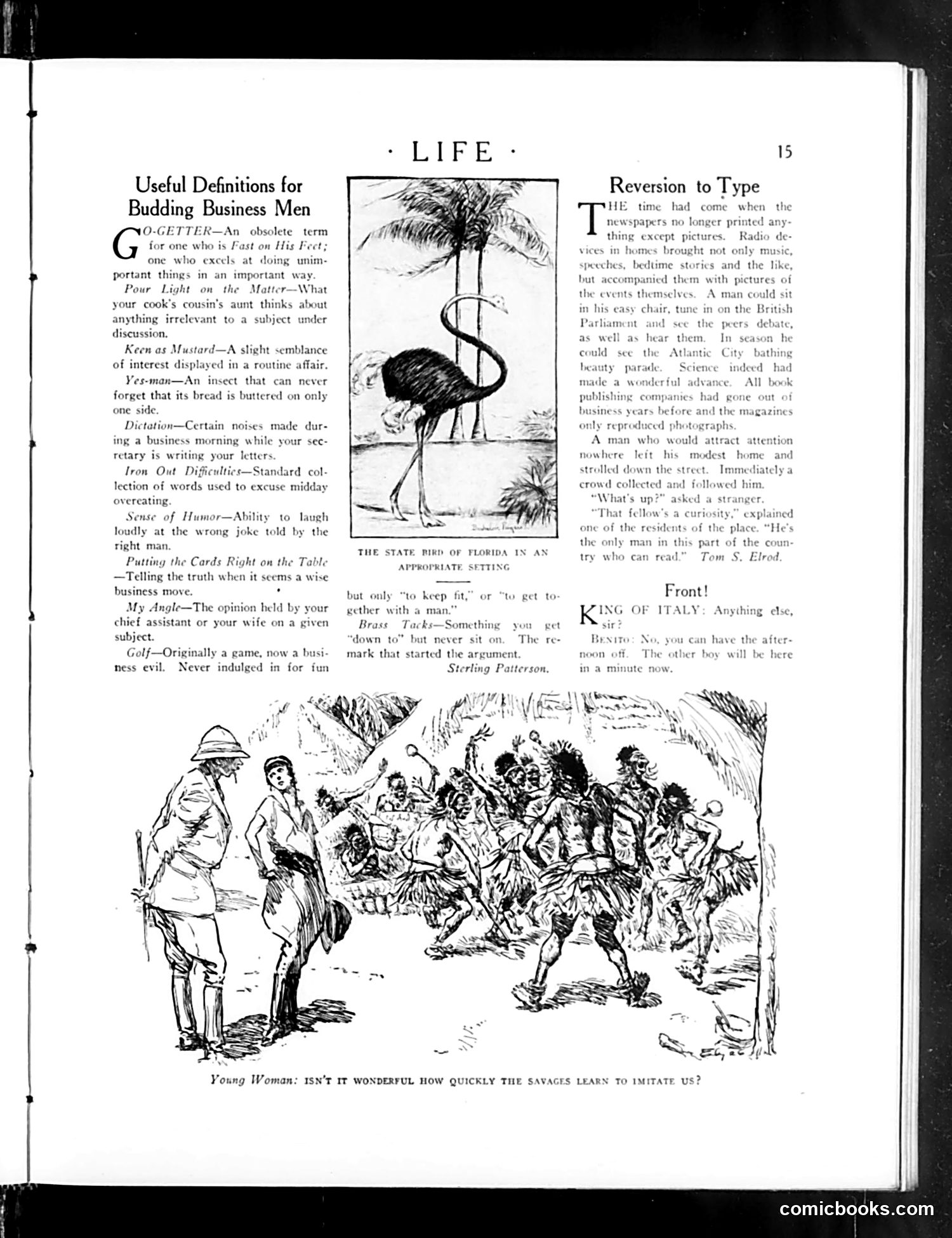
This page combines satirical business humor with colonial-era social commentary. The left column offers tongue-in-cheek "Useful Definitions for Budding Business Men"—mock definitions of workplace jargon like "Go-Getter," "Brass Tacks," and "Golf," poking fun at corporate culture and masculine business pretensions. The main illustration depicts a colonial scene with a European officer observing Indigenous people dancing. The caption reads: "Young Woman: ISN'T IT WONDERFUL HOW QUICKLY THE SAVAGES LEARN TO IMITATE US?" This satirizes European colonial attitudes—the ironic "compliment" that Indigenous peoples are adopting European ways reflects period-typical racist assumptions about "civilization." The joke critiques colonial condescension rather than endorsing it, suggesting European observers' self-satisfied ignorance about cultural appropriation and colonial impact.
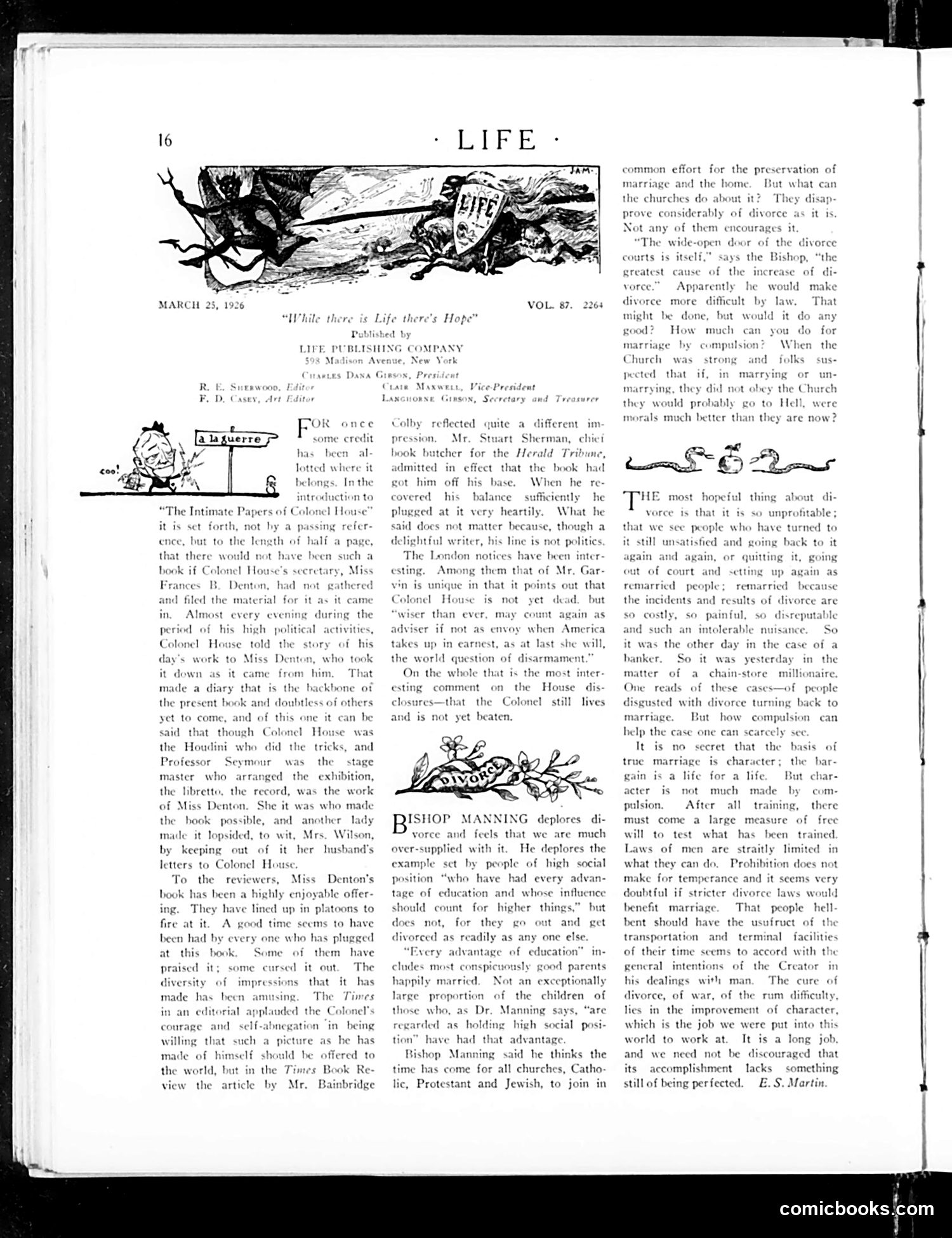
This page contains editorial commentary on divorce, not political cartoons. The main illustration—a skeletal Death figure holding a shield labeled "LIFE"—is a symbolic header for the article "While there is Life there's Hope?" The text discusses Bishop Manning's views on divorce, criticizing churches for being ineffective at preventing it. The article argues that divorce reflects character flaws rather than legal problems, and that prohibition laws cannot solve deeper moral issues. It suggests the church should focus on improving character rather than restricting divorce by law. The skeleton imagery suggests the topic's gravity, but this is primarily serious editorial commentary on 1920s social and religious attitudes toward marriage dissolution, not satire.
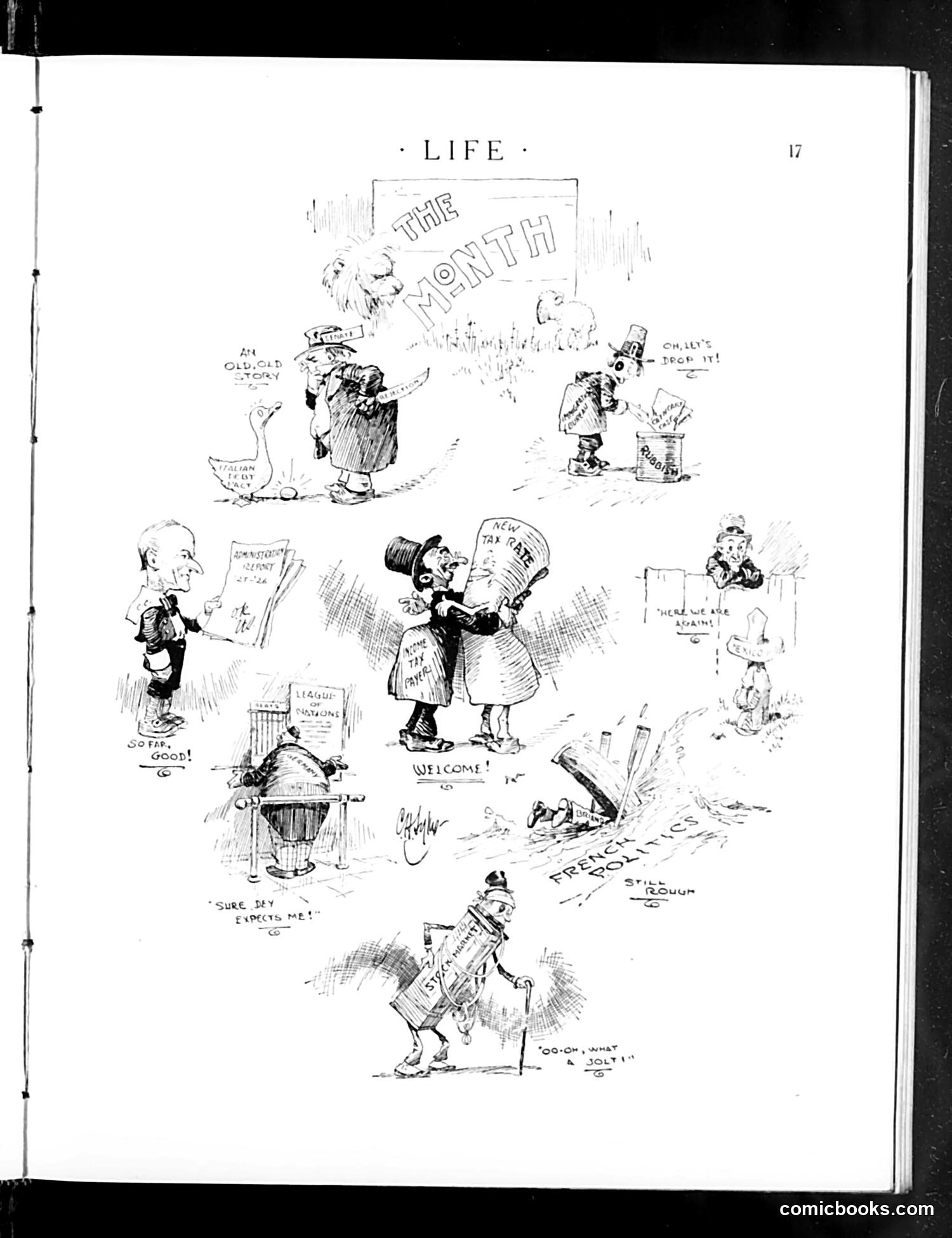
This is a satirical cartoon page titled "The Month" showing various figures dealing with contemporary issues. The sketches appear to depict political and social reactions to economic problems, likely from the early 20th century based on the style. Key visible elements include references to "new tax rates," "league," and "welcome" - suggesting commentary on taxation policy and possibly league-related politics. One figure holds papers labeled with financial/political matters. The cartoon style uses exaggerated caricatures typical of Life magazine's satirical approach. Without clearer identification of specific figures or visible dates, the exact political figures and events remain unclear, though the overall tone satirizes public reaction to government policies and economic conditions of the era.
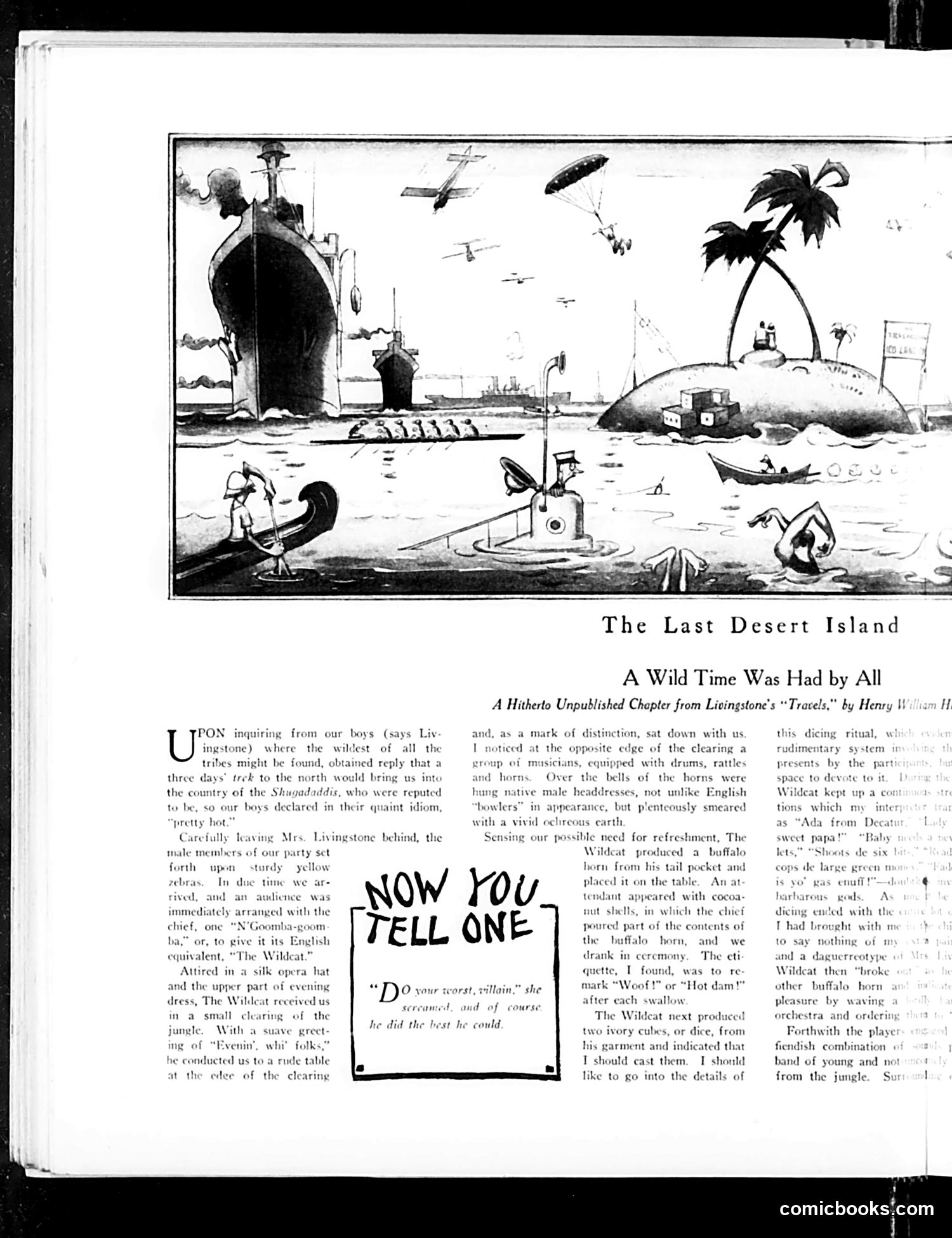
This is a humorous fictional account supposedly extracted from David Livingstone's travels, satirizing Victorian-era colonial attitudes and adventure narratives. The piece mocks the exotic "savage chief" trope by depicting an African tribal leader named "The Wildcat" dressed incongruously in a silk opera hat and evening dress—a visual joke about the absurdity of assuming native peoples are simultaneously "wild" yet susceptible to European civilization markers. The satire targets: - **Colonial superiority**: The patronizing tone describing "quaint idioms" and "suave greeting" - **Explorer mythology**: Exaggerated adventure-story conventions (three-day trek, dangerous tribes) - **Cultural stereotyping**: Reducing complex societies to caricatures of drums, rattles, and ritualistic behavior The "Now You Tell One" sidebar—with its quote about the Wildcat's fearlessness—appears to invite reader participation in tall tales, further mocking how these exploration narratives were consumed as entertainment rather than serious ethnography. The message: these adventure stories were entertaining fiction, not factual accounts of "primitive" peoples.
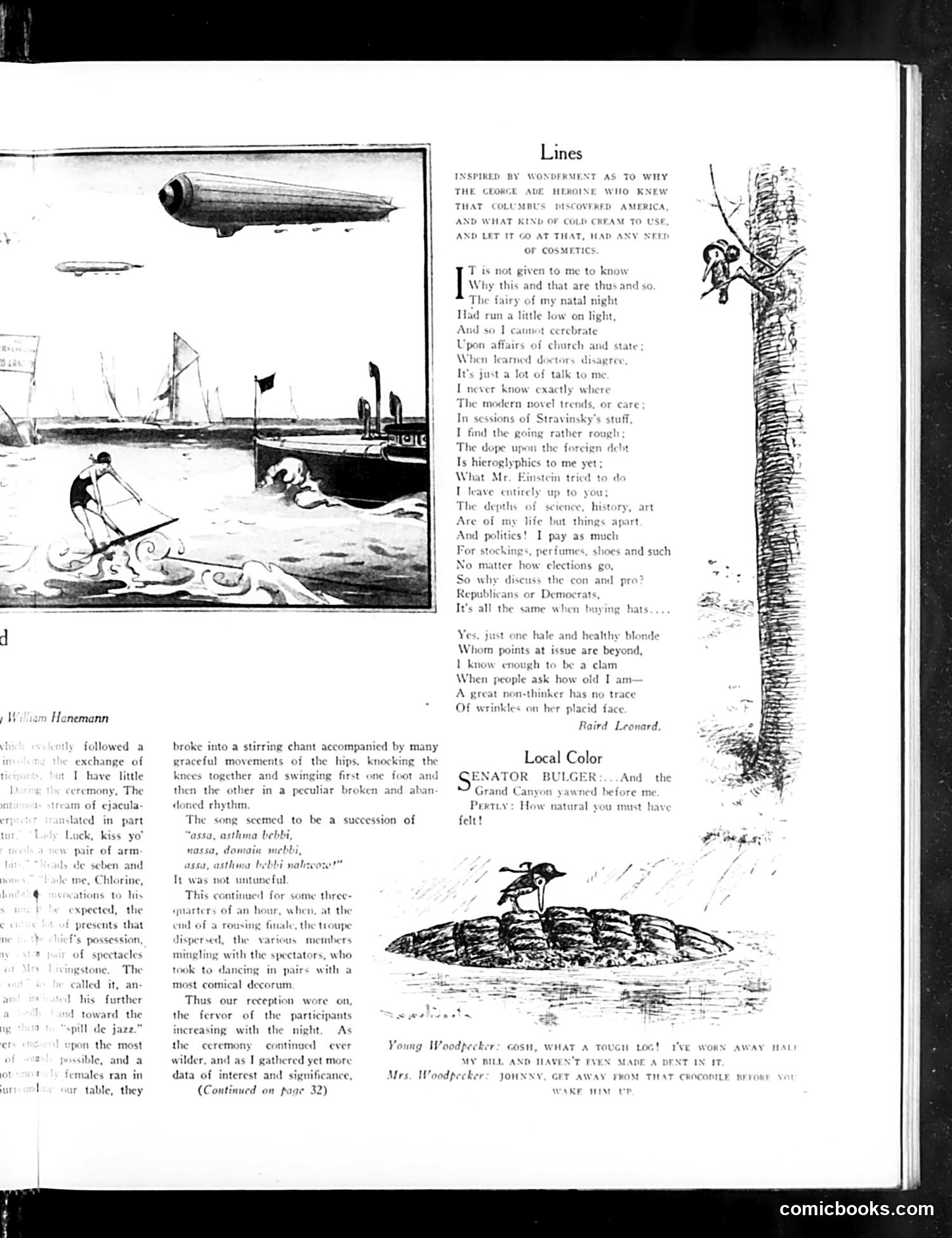
This page contains two distinct pieces of satire: **"Lines" poem** (top): A commentary on female superficiality, attributed to "Baird Leonard." The speaker mocks a woman who knows trivial facts (Columbus discovered America, cold cream brands) but claims ignorance of serious matters—politics, science, art, current events. The satire targets women's perceived disinterest in intellectual topics, presenting her as vain and shallow, caring only about beauty and fashion. **"Local Color" section** (bottom): A brief anecdote about a Senator named Bulger witnessing what appears to be indigenous or folk dancing at the Grand Canyon, with romanticized descriptions of rhythmic movement and "comical decorum." The cartoon illustrations show period-appropriate leisure scenes (airship, boat) and nature sketches, with a woodpecker joke about durability. The page reflects early 20th-century satirical attitudes toward gender and tourism, using humor to reinforce stereotypes about women's intellectual capacities.
This page reviews a theatrical revival of *Cyrano de Bergerac*, likely by Brian Hooker's translation. The article discusses Walter Hampden's production of this classic French play. The text compares French and English versions of a key emotional scene, presenting two translations of the same moment where the dying Cyrano confesses his feelings. The reviewer praises the production's theatrical moments—particularly the famous duel with ballade accompaniment and the final act—as genuinely moving experiences. The piece concludes that *Cyrano* succeeds because it delivers authentic theatrical emotion ("sentiment") rather than relying on newfangled "symbolic drama" trends. The reviewer appears to be championing traditional romantic drama over modernist theatrical experimentation that was fashionable in the 1920s. The decorative illustrations are typical Life magazine ornaments, not political cartoons.
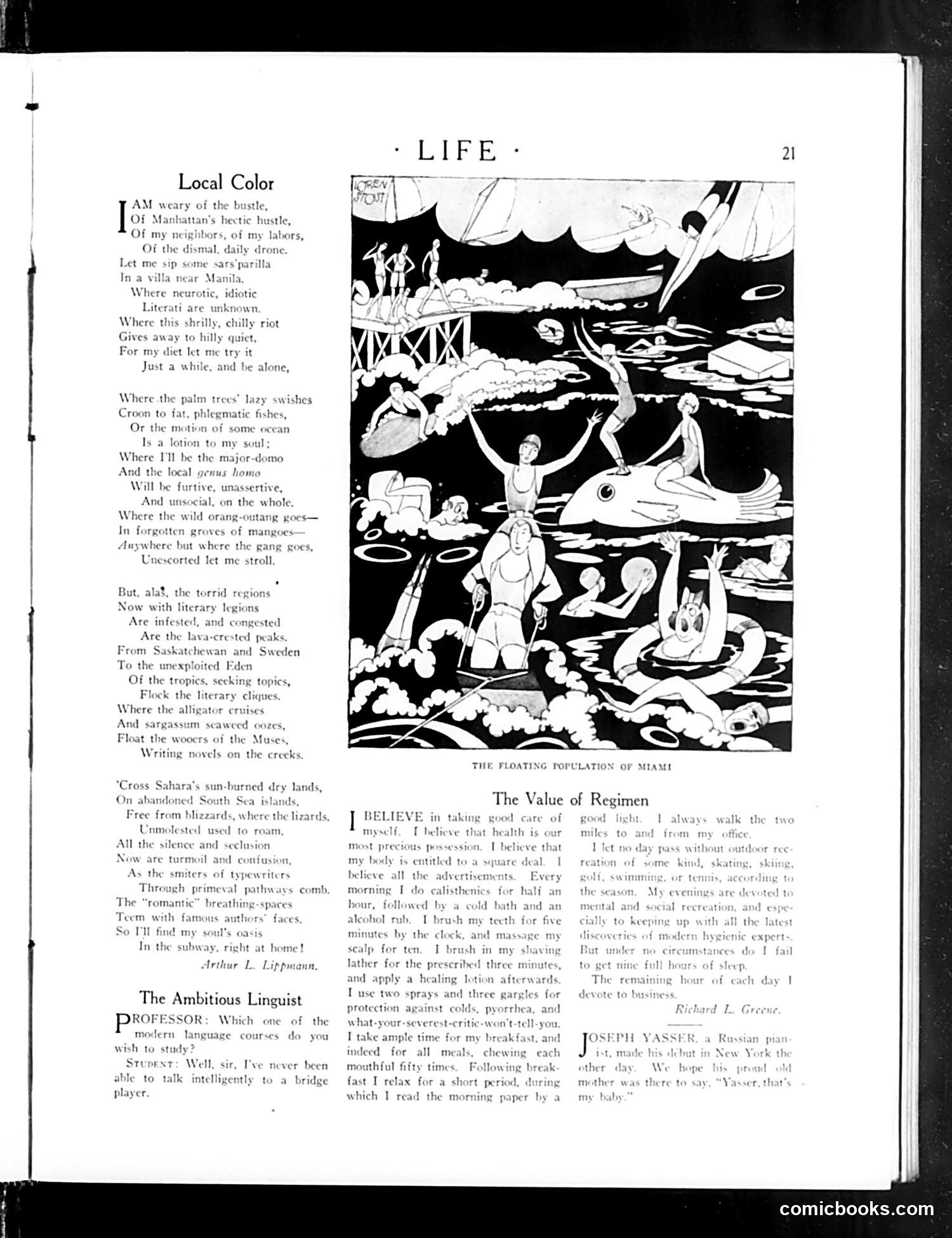
This cartoon satirizes the 1920s Florida real estate boom and the influx of leisure-seeking tourists and transplants to Miami. The illustration depicts a hedonistic, crowded beach scene with people swimming, lounging, and socializing—capturing the era's image of Miami as a paradise destination. The accompanying poem "Local Color" expresses weariness with Manhattan's urban bustle and yearns for escape to tropical leisure. It references Miami's attractions (palm trees, alligators, ocean) while mocking the literary pretensions of the floating population—writers and intellectuals flocking to Florida seeking inspiration and relaxation. The satire targets both the escapist fantasy of 1920s tourism and the bohemian artistic set migrating southward, suggesting their retreat from serious life was frivolous and self-indulgent. The term "floating population" itself implies rootlessness and instability—these weren't permanent residents but temporary pleasure-seekers.
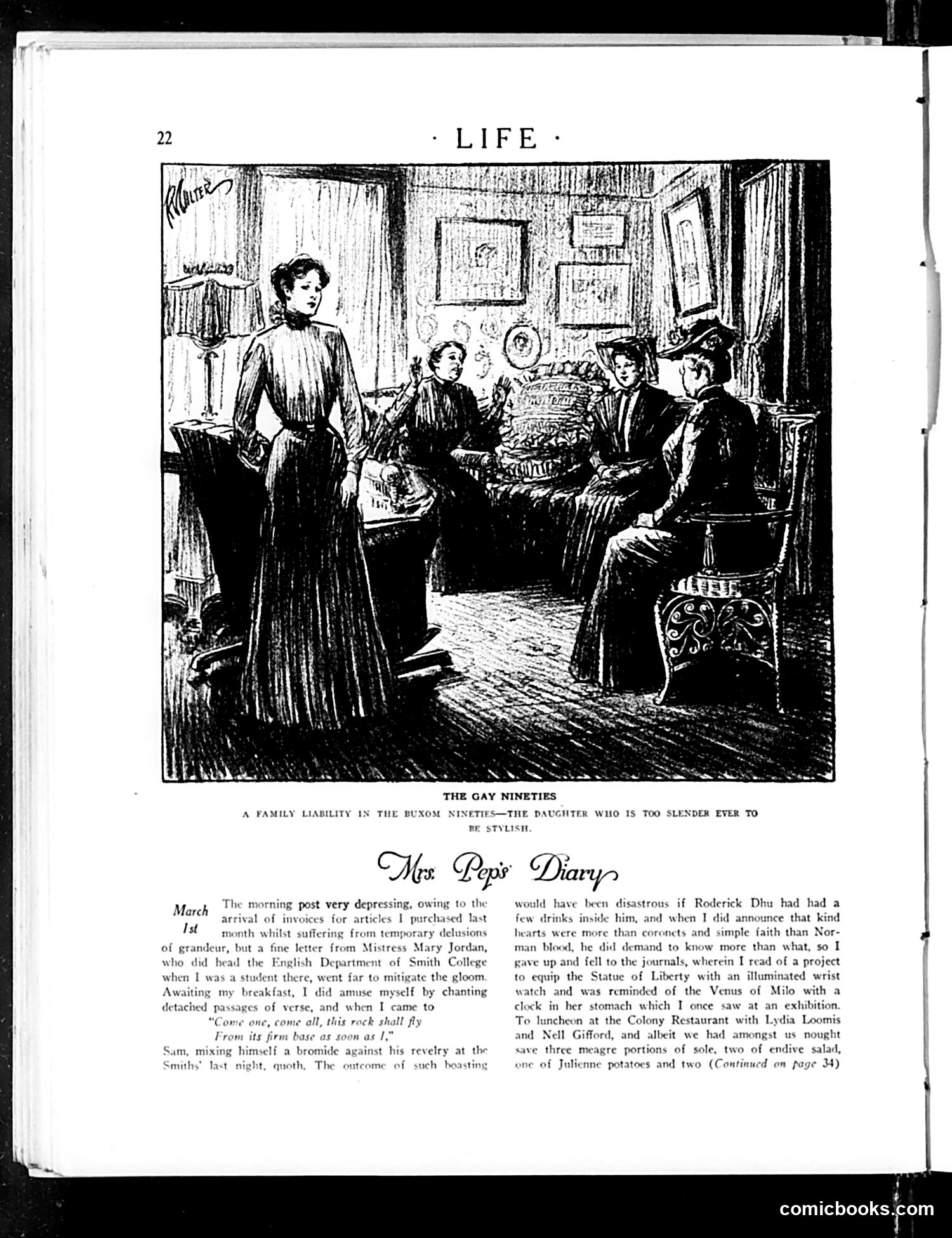
This is a satirical diary entry from Life magazine's "Gay Nineties" series, mocking 1890s social pretensions. The illustration shows a drawing room scene where a slender young woman stands among fashionably dressed guests—the cartoon's point is stated in the subtitle: she's "too slender ever to be stylish." In the 1890s, the ideal female body was full-figured and corseted; thinness was unfashionable and socially disadvantageous. The diary entry itself parodies upper-class affectation through the narrator's pretentious references (quoting Walter Scott's "Rokeby," invoking the Statue of Liberty and Venus de Milo) while describing a meager lunch of fish and vegetables—absurdly modest fare presented as if noteworthy. The satire targets both the era's arbitrary beauty standards and the hollow social climbing of wealthy women, suggesting that even wealthy families couldn't escape the tyranny of fashion's demands.
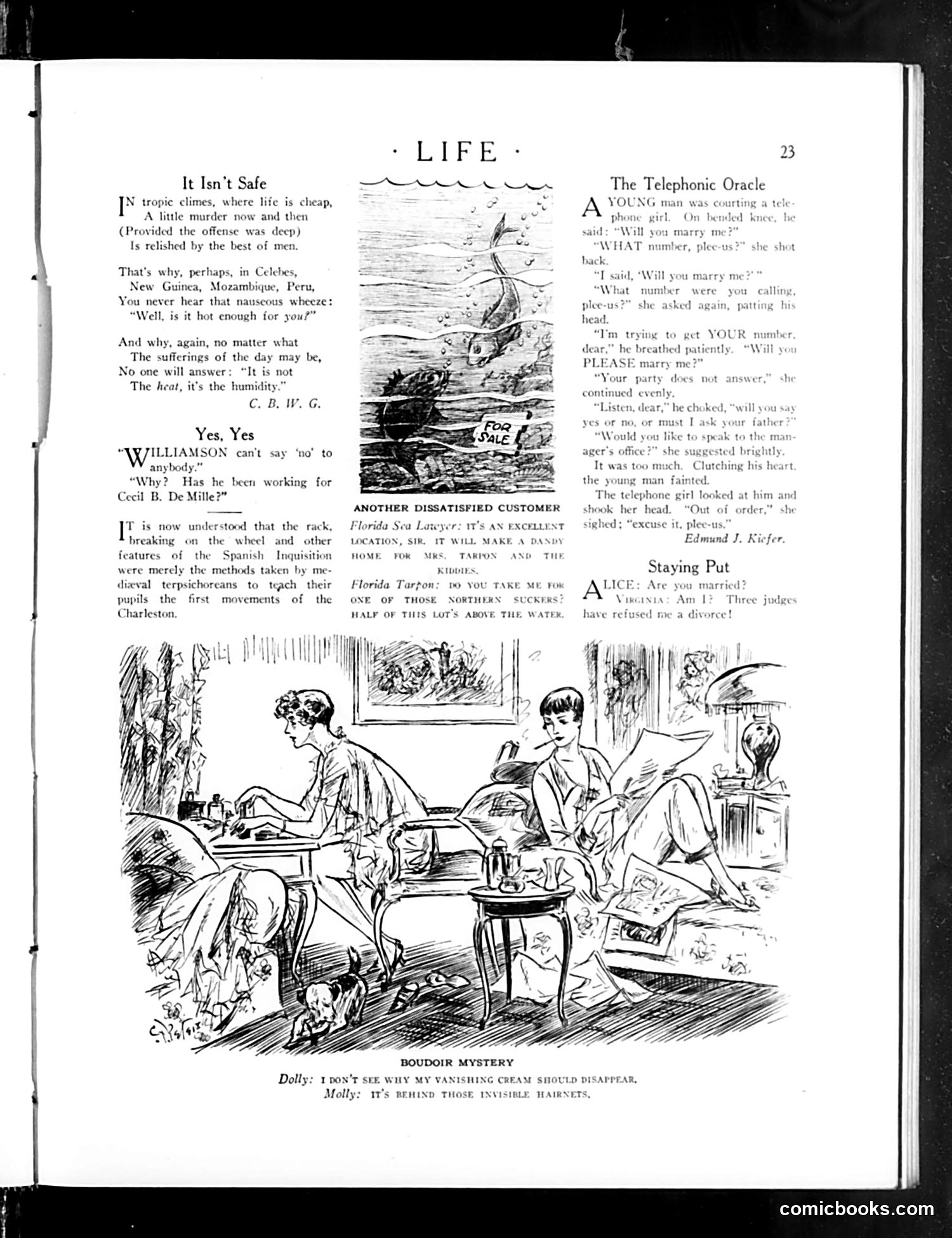
This page collects brief satirical pieces and cartoons typical of Life magazine's social commentary. **"It Isn't Safe"** jokes that tropical murderers never complain about humidity—a jab at Americans' obsession with weather complaints, particularly the cliché "is it hot enough for you?" **"Yes, Yes"** references Williamson's inability to refuse anyone, with a quip about working for Cecil B. De Mille (the famous film director), suggesting De Mille was demanding. **The Spanish Inquisition reference** compares the rack and torture devices to teaching the Charleston—a wildly popular 1920s dance, satirizing how difficult or vigorous learning it was. **"Another Dissatisfied Customer"** shows a Florida realtor and a tarpon fish; the fish warns the salesman it's swindling "northern suckers" (tourists) by selling waterlogged property. **"The Telephonic Oracle"** satirizes telephone operators and modern courtship, with a young man struggling to propose over the phone while the operator struggles to understand him. The bottom cartoon jokes about vanishing cream and invisible hairnets—cosmetic products of the era.
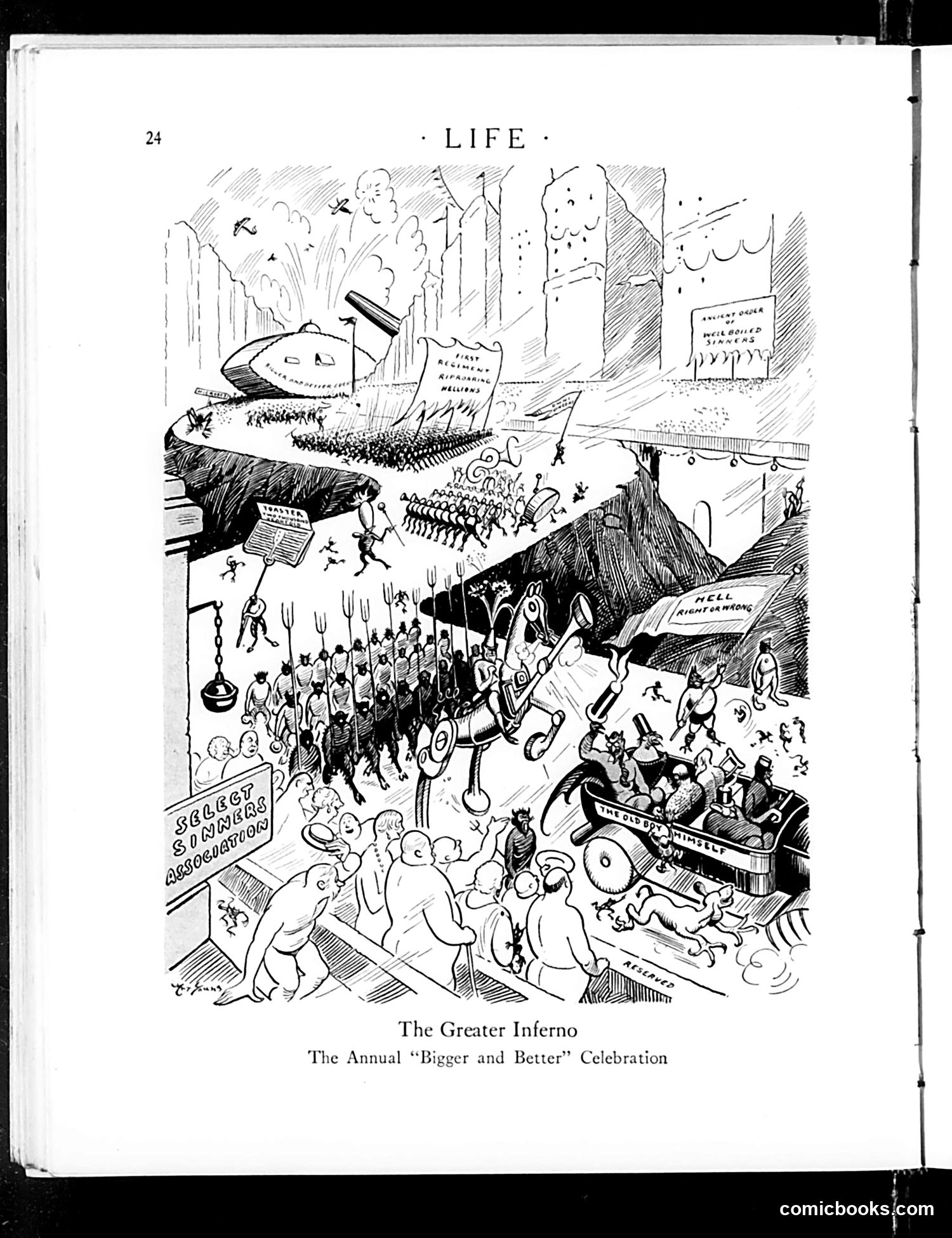
This satirical cartoon depicts a chaotic underworld scene mocking American commercial excess and competitive boosterism. The "Secret Storage Association" sign and various labeled establishments suggest corporate and commercial enterprises have invaded Hell itself. The masses of tiny figures engaging in frenzied activity—some with pitchforks, others in various states of chaos—represent humanity caught in relentless competition and consumption. The "Bigger and Better" caption sarcastically critiques American culture's obsession with endless growth and one-upmanship. This appears to be commentary on how Hell has become commercialized and industrialized, mirroring modern American society's own infernal characteristics: greed, competition, and perpetual striving. The joke suggests that Hell and contemporary American commercial culture are now indistinguishable.
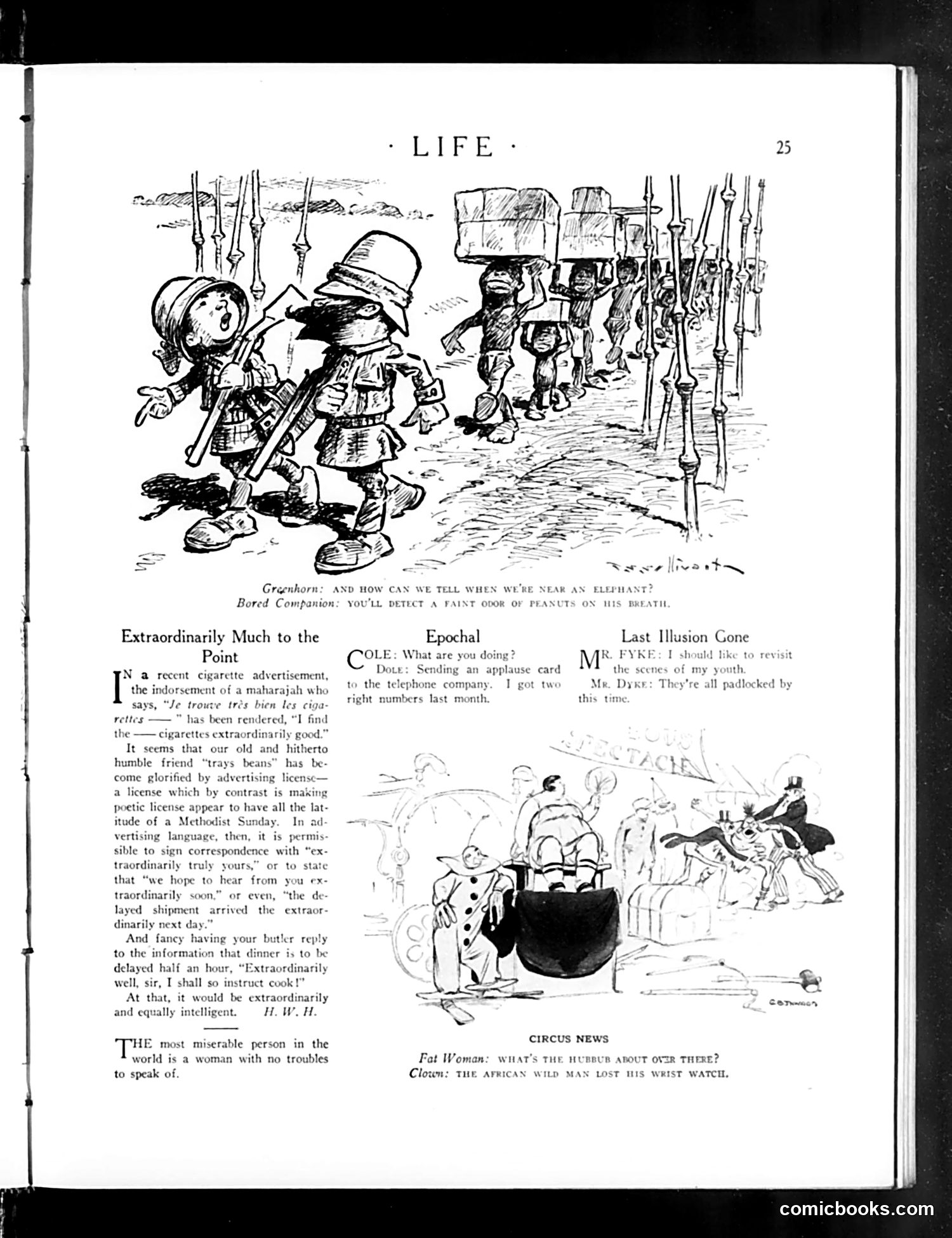
This page contains several satirical pieces typical of early 20th-century *Life* magazine humor: **Top cartoon**: Shows soldiers marching with supplies. The caption jokes about detecting an elephant by "a faint odor of peanuts on his breath"—absurdist wartime humor playing on the incongruity of military seriousness with silly animal logic. **"Extraordinarily Much to the Point"**: Satirizes overblown advertising language. A cigarette ad translated a French endorsement using "extraordinarily," which *Life* mocks by imagining this word applied to mundane situations (delayed dinners, butler instructions). The joke: advertising language is ridiculous when applied to ordinary life. **Small comedy bits**: "Epochal" shows someone sending applause cards to a telephone company; "Last Illusion Gone" and "Circus News" appear to be brief joke captions about circus performers and lost watches—typical vaudeville-era humor. **Bottom text**: A philosophical observation about miserable people being those without troubles—likely social commentary on idle wealthy women of the era. The page reflects *Life*'s focus on mocking pretension and linguistic excess in advertising and society.
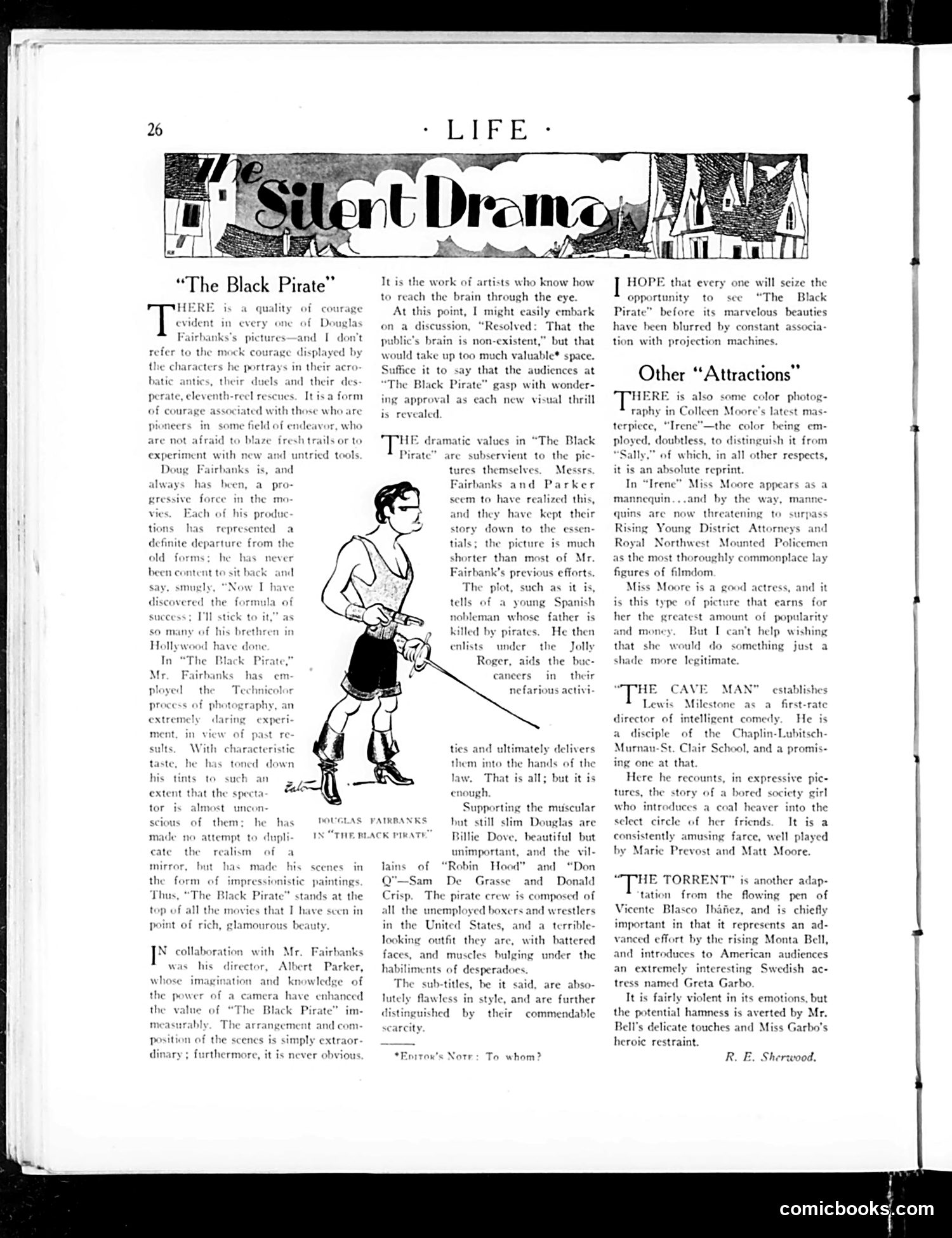
This is a film review from *Life* magazine praising Douglas Fairbanks's silent film "The Black Pirate." The critic highlights Fairbanks's innovative use of the Technicolor process and his skill at visual storytelling—reaching "the brain through the eye." The illustrated figure shows Fairbanks in character as a Spanish nobleman-turned-pirate seeking revenge for his father's death. The critic notes the film's simple plot serves the spectacular visuals rather than vice versa, and praises the supporting cast (Billie Dove, Sam De Grasse, Donald Crisp) while humorously noting the pirate crew consists of "unemployed boxers and wrestlers." The page also briefly reviews other current films: Colleen Moore's color picture "Irene" and "The Cave Man" (directed by Lewis Milestone). The reviews emphasize visual innovation and technical achievement characteristic of 1920s silent cinema criticism.
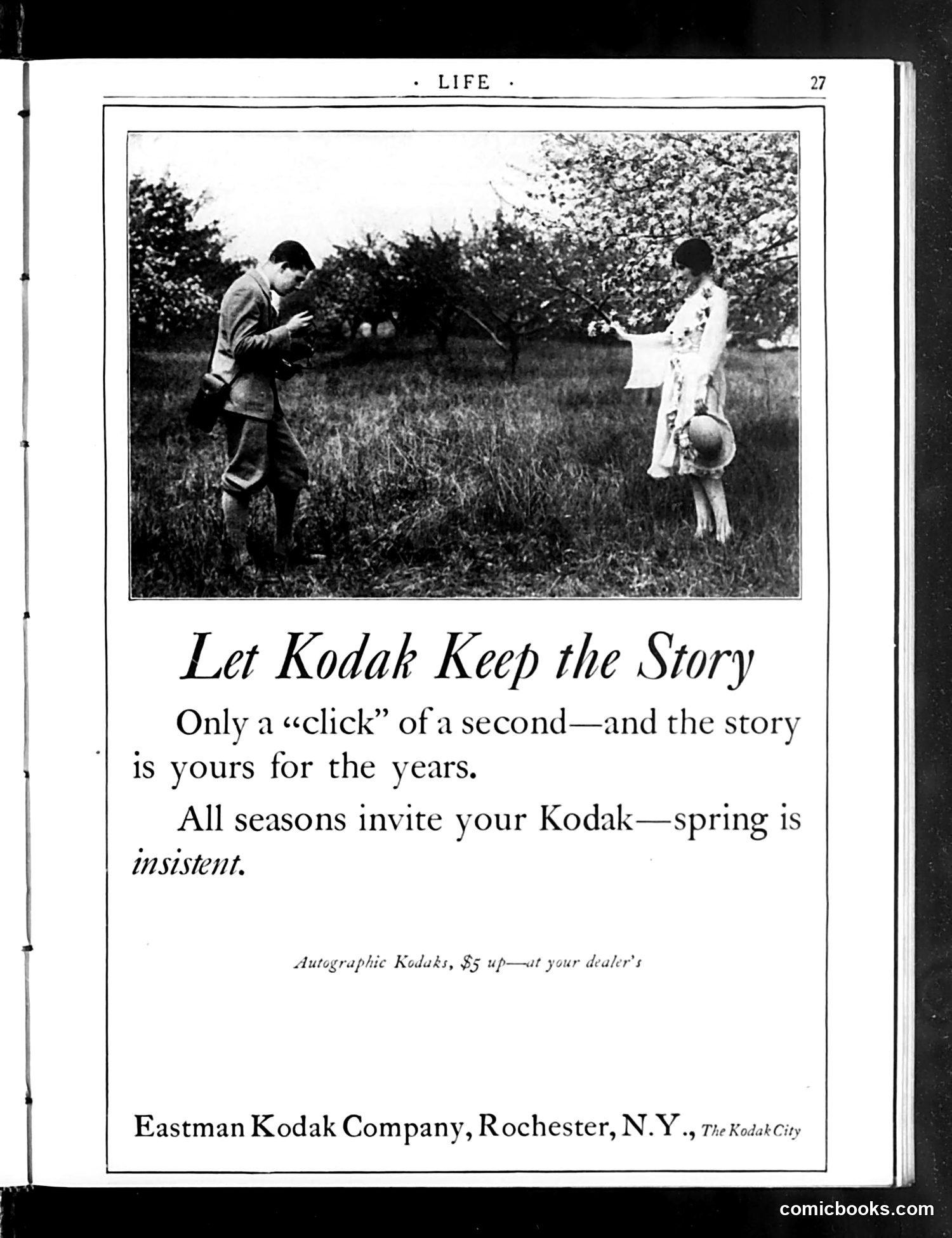
This is a **Kodak camera advertisement**, not a political cartoon or satire. The page shows two figures in an orchard or garden setting—a man on the left appears to be photographing a woman on the right who is holding a basket. The ad promotes Kodak's "Autographic" cameras (priced at $5 and up), emphasizing that a quick photograph can preserve memories permanently. The tagline "Let Kodak Keep the Story" plays on the camera's ability to document moments. The mention of spring being "insistent" suggests the season invites outdoor photography and family moments. This is straightforward product advertising from the early 20th century, highlighting photography's appeal to leisure and memory-making rather than containing satire or political commentary.
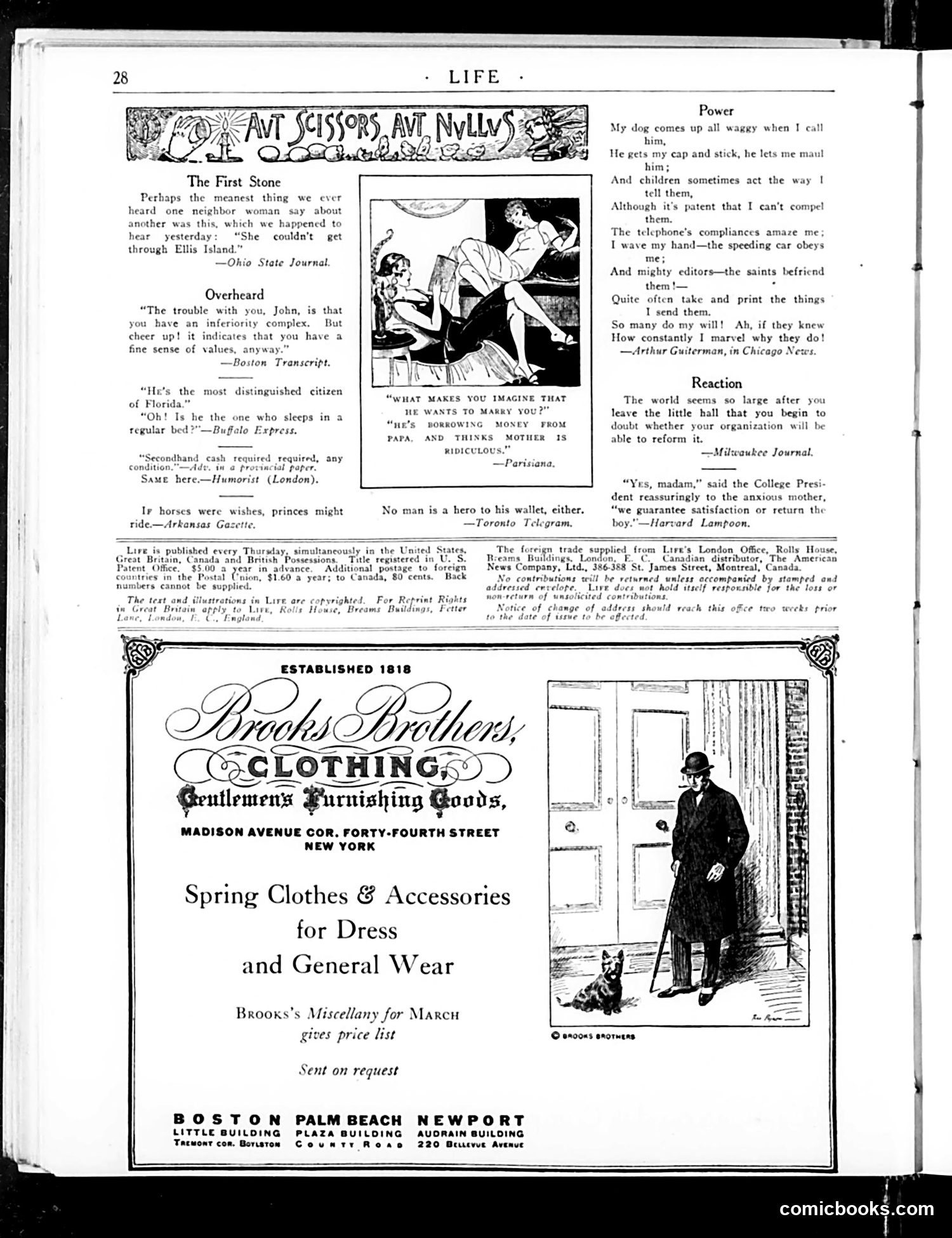
This page contains several brief satirical observations typical of *Life* magazine's humor format, plus advertising. **The cartoons/jokes:** - **"The First Stone"** mocks immigration attitudes, referencing Ellis Island processing of newcomers - **"Overheard"** presents snippets of everyday social comedy—a man with inferiority complex being reassured, and a Florida citizen's humble sleeping arrangements - **Central cartoon** (captioned) depicts a woman asking a man why he wants to marry her, revealing he's borrowing money from her father and finds her mother "ridiculous"—mocking mercenary courtship - **"Power"** is a poem by Arthur Guiterman celebrating the speaker's inexplicable influence over dogs, children, phones, and editors—satirizing human delusion about control - **"Reaction"** jokes that after leaving a meeting, one realizes the organization can't actually reform anything The page is primarily **advertising for Brooks Brothers clothing**, featuring a well-dressed man with a small dog. The content reflects *Life*'s focus on gentle social satire aimed at educated urban readers.
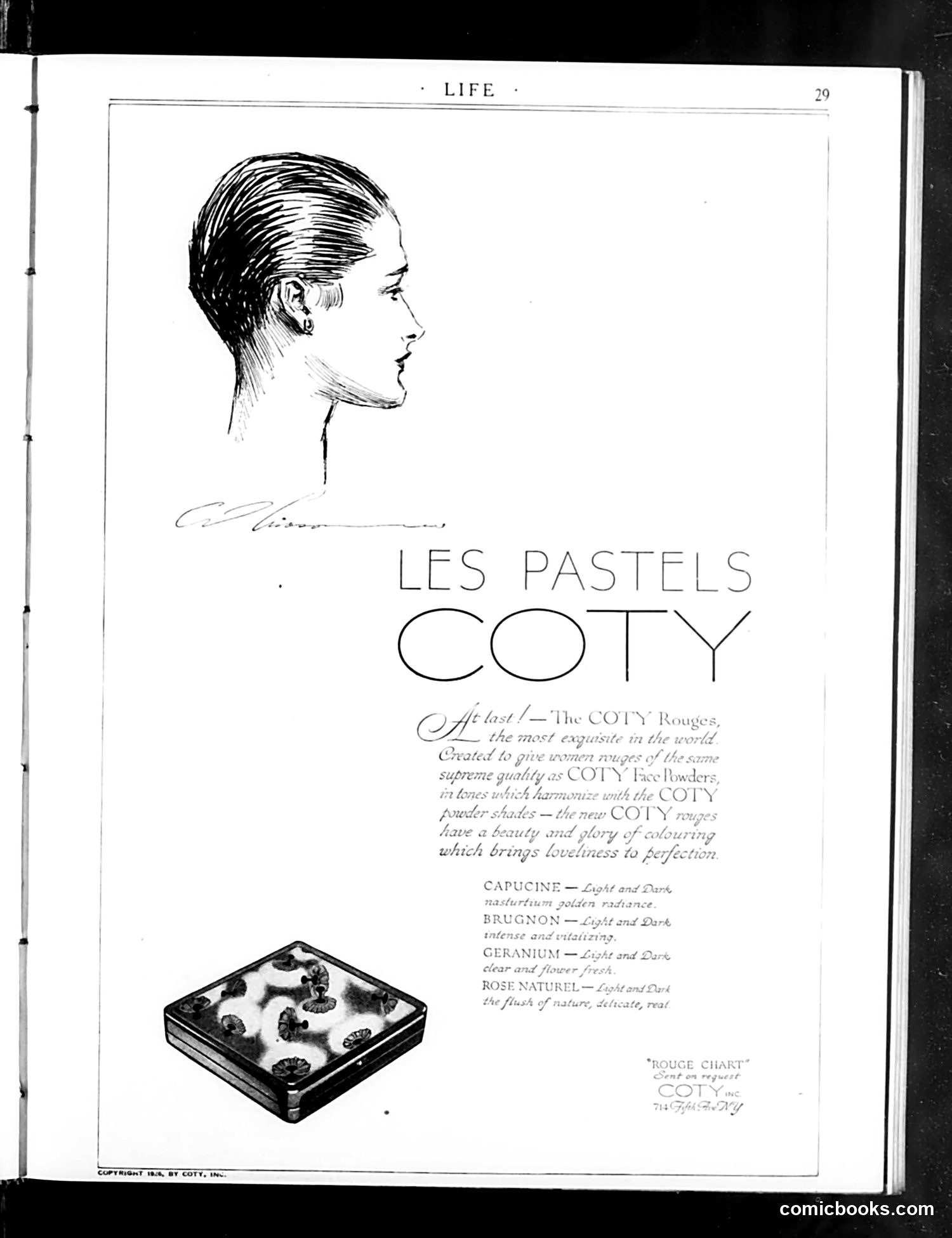
This page is primarily an **advertisement**, not political satire. It promotes "Les Pastels Coty," a cosmetic rouge product by the Coty company. The layout features a stylized line-drawing portrait of a woman in profile (in the Art Deco style typical of 1920s advertising) and an image of the actual product—a compact case with a decorative pattern. The text emphasizes that these are "the most exquisite in the world" and lists four rouge shades: Capucine, Brugnon, Geranium, and Rosé Naturel, each described with poetic language about their qualities. There is **no political cartoon or satire present**—this is simply a full-page magazine advertisement showcasing luxury cosmetics to readers, likely affluent women interested in high-end beauty products.
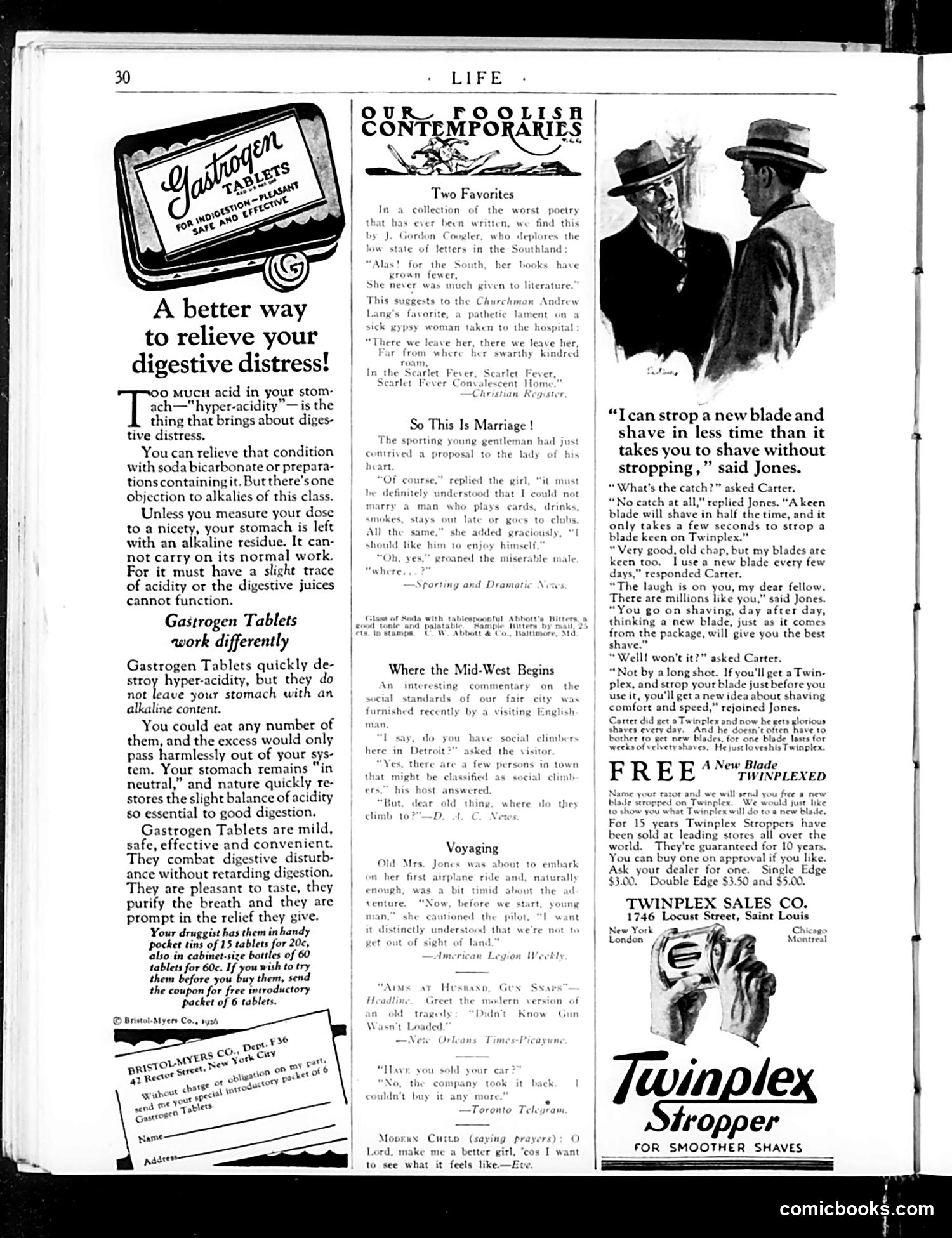
This page is primarily **advertising and humor columns** rather than political satire. The main content includes: **Advertisements:** - **Gastrogen Tablets** (top left): A digestive aid claiming to neutralize stomach acid without leaving alkaline residue - **Twinplex Stropper** (right side): A razor blade stropping device, featuring a dialogue between Jones and Carter about shaving efficiency **Satirical Columns:** The right side contains several short humorous pieces titled "Our Foolish Contemporaries," including: - Poetry criticism (mocking bad Southern literature) - Marriage satire ("So This Is Marriage!") - Social commentary on Midwestern etiquette - A brief anecdote about airplane travel **Overall Character:** This is a typical early-20th-century Life magazine page mixing consumer advertising with light social humor aimed at middle-class readers. No specific political figures or events are referenced—the satire targets universal social behaviors rather than contemporary politics.
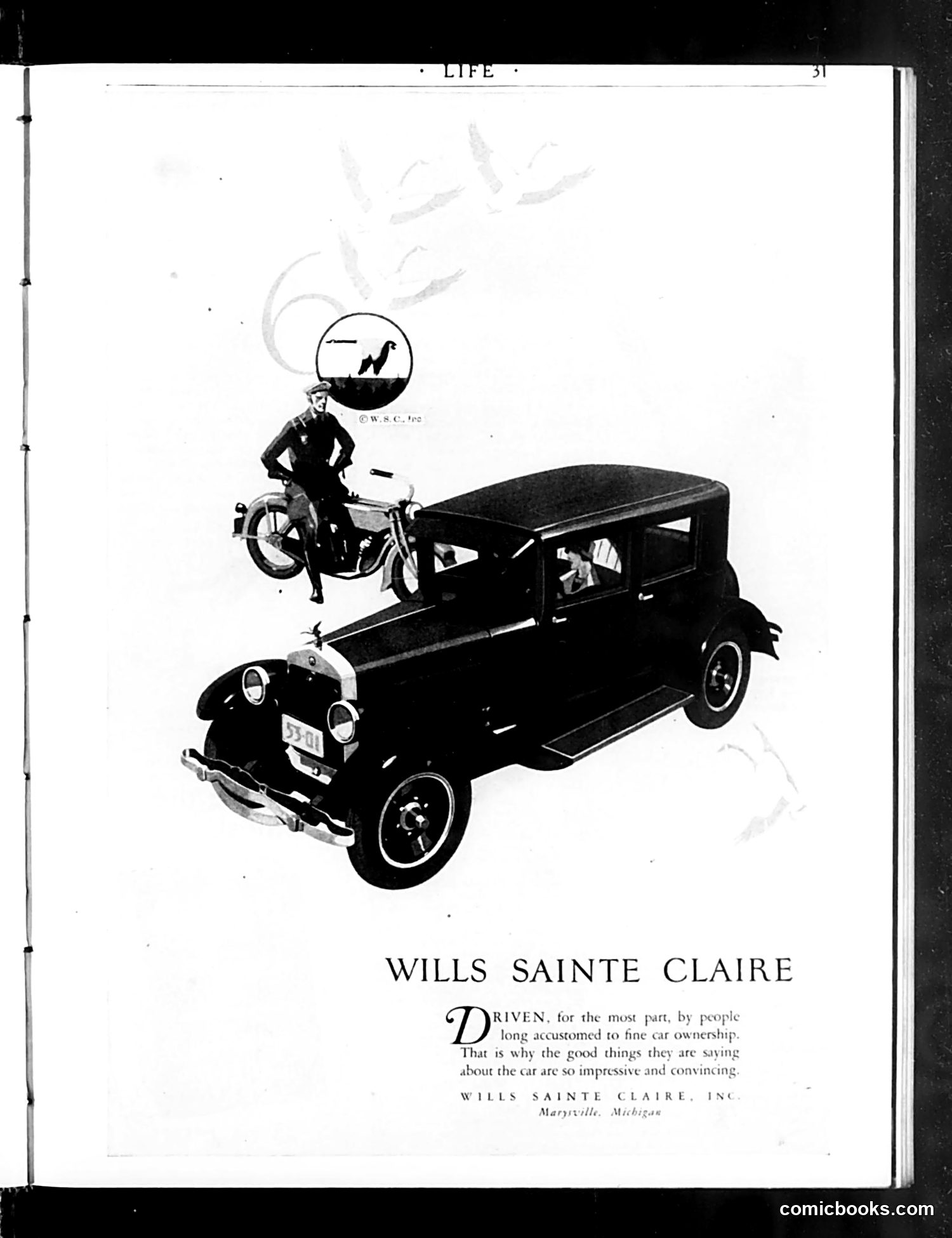
This is a **Wills Sainte Claire automobile advertisement**, not political satire. The page shows a vintage car alongside a man with a motorcycle, with birds flying overhead—imagery suggesting modernity and progress. The ad's strategy appeals to wealthy, established car owners ("people long accustomed to fine car ownership"), suggesting that praise from this discriminating demographic validates the Wills Sainte Claire brand. The implication is that wealthy connoisseurs' endorsement carries more weight than general advertising claims. This represents early automotive marketing targeting the affluent market segment. Wills Sainte Claire was an actual American car manufacturer based in Marysville, Michigan. The advertisement lacks satirical intent—it's straightforward commercial copy using aspiration and class positioning to sell luxury vehicles.
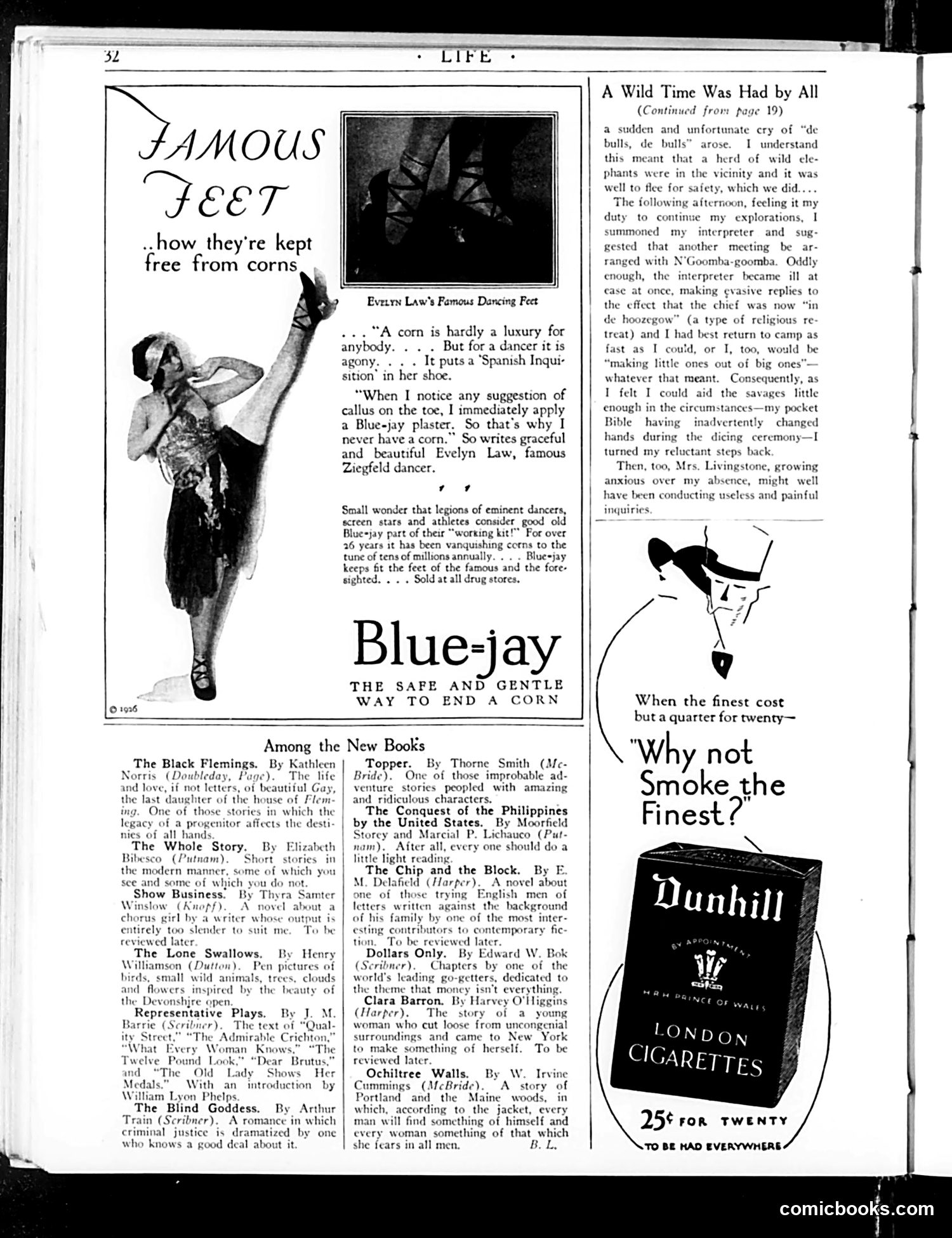
This page contains two distinct elements: **Left side: Blue-jay Corn Plaster Advertisement** A product endorsement featuring Evelyn Law, a famous Ziegfeld Follies dancer. The ad uses her celebrity status to promote a corn treatment, arguing that dancers especially need foot care since corns cause severe pain ("Spanish Inquisition in her shoe"). This is straightforward early 20th-century celebrity advertising—using a glamorous entertainer to sell a medical product. **Right side: "A Wild Time Was Had by All" (continued article)** A humorous travel narrative describing the author's African expedition, including an encounter with wild elephants and attempts to meet with a local chief. The humor relies on exaggeration and racist stereotypes (phonetic dialogue like "de bulls," "de hoozerow") common to period adventure writing. **Bottom: Dunhill Cigarettes Advertisement** A simple luxury goods ad emphasizing affordability ("a quarter for twenty"). The page reflects 1920s popular culture: celebrity endorsements, adventure narratives with problematic racial attitudes, and tobacco marketing without health warnings.
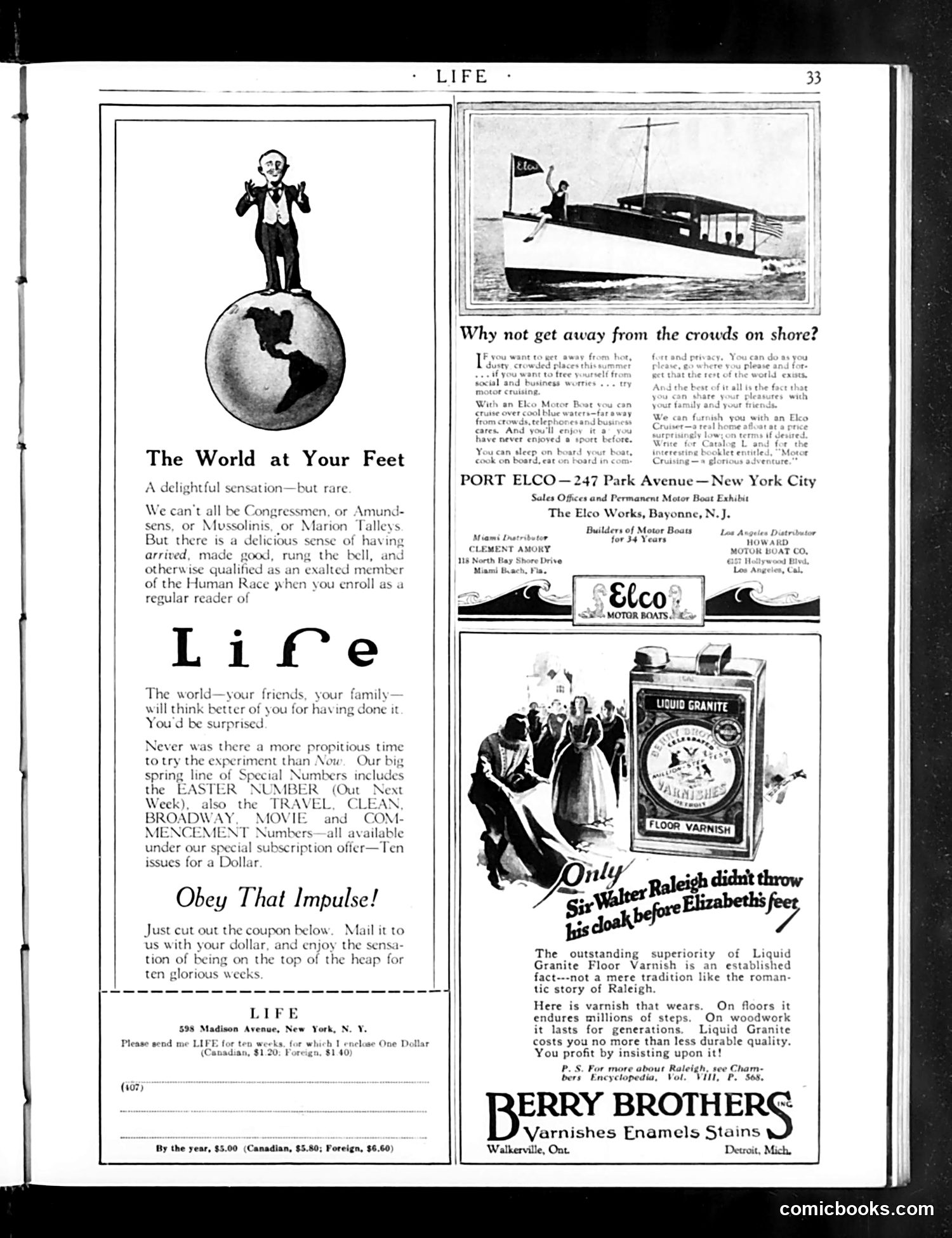
The left side features a satirical advertisement for *Life* magazine itself. The cartoon shows a small figure standing triumphantly atop a globe, captioned "The World at Your Feet"—a humorous exaggeration of the prestige supposedly gained by subscribing. The text mock-seriously claims that reading *Life* will make one's "friends" and "family" think better of you, and that subscription grants membership among "the Human Race" as an "exalted member." This is self-aware satire: the magazine is ironically promoting itself by inflating the social status supposedly conferred by readership. The right side consists entirely of advertisements for motor boats, floor varnish, and other products—typical magazine filler of the era. The page's humor relies on understanding that *Life* was a satirical, middle-class publication whose readers appreciated ironic self-promotion. Modern readers might miss that this exaggerated pitch for subscription was intentionally absurd entertainment, not sincere marketing.
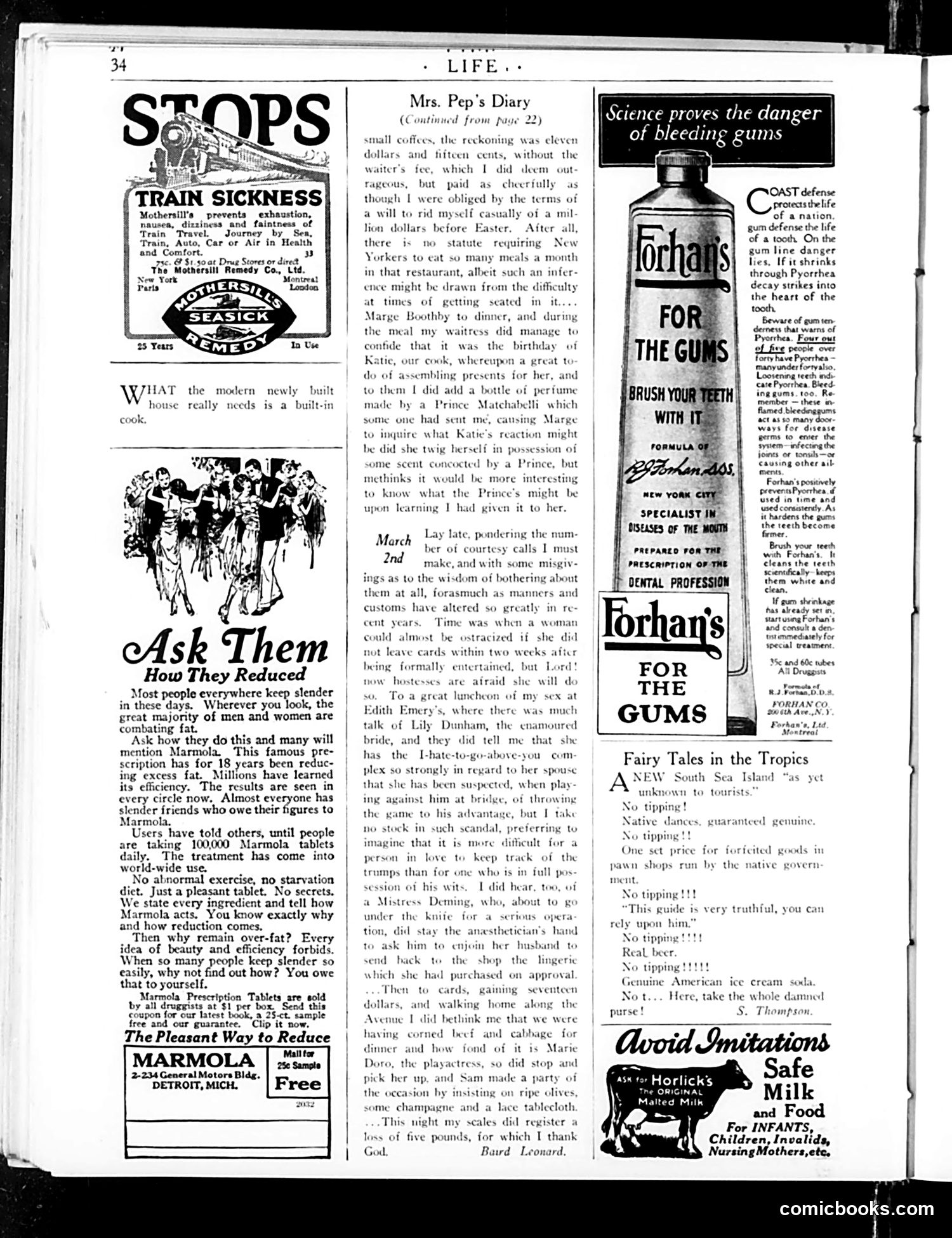
This page mixes satirical content with period advertising. The main cartoon, "Ask Them How They Reduced," mocks the era's obsession with weight loss by depicting a group of fashionably thin people. The joke targets the widespread use of "Marmola" diet tablets—a real product advertised below—which promised weight reduction without exercise or dieting. The cartoon suggests that nearly everyone in modern society has become consumed with slenderness, making this pharmaceutical solution absurdly popular. The accompanying article, "Mrs. Pep's Diary," satirizes upper-class social conventions of the 1920s: excessive courtesy calls, pretentious dining, Prince Matchabelli perfume, and the social complications of marriage and bridge-playing among the wealthy. The humor derives from documenting trivial social anxieties with exaggerated gravity. Both pieces satirize contemporary consumer culture and social pretension rather than targeting specific political figures.
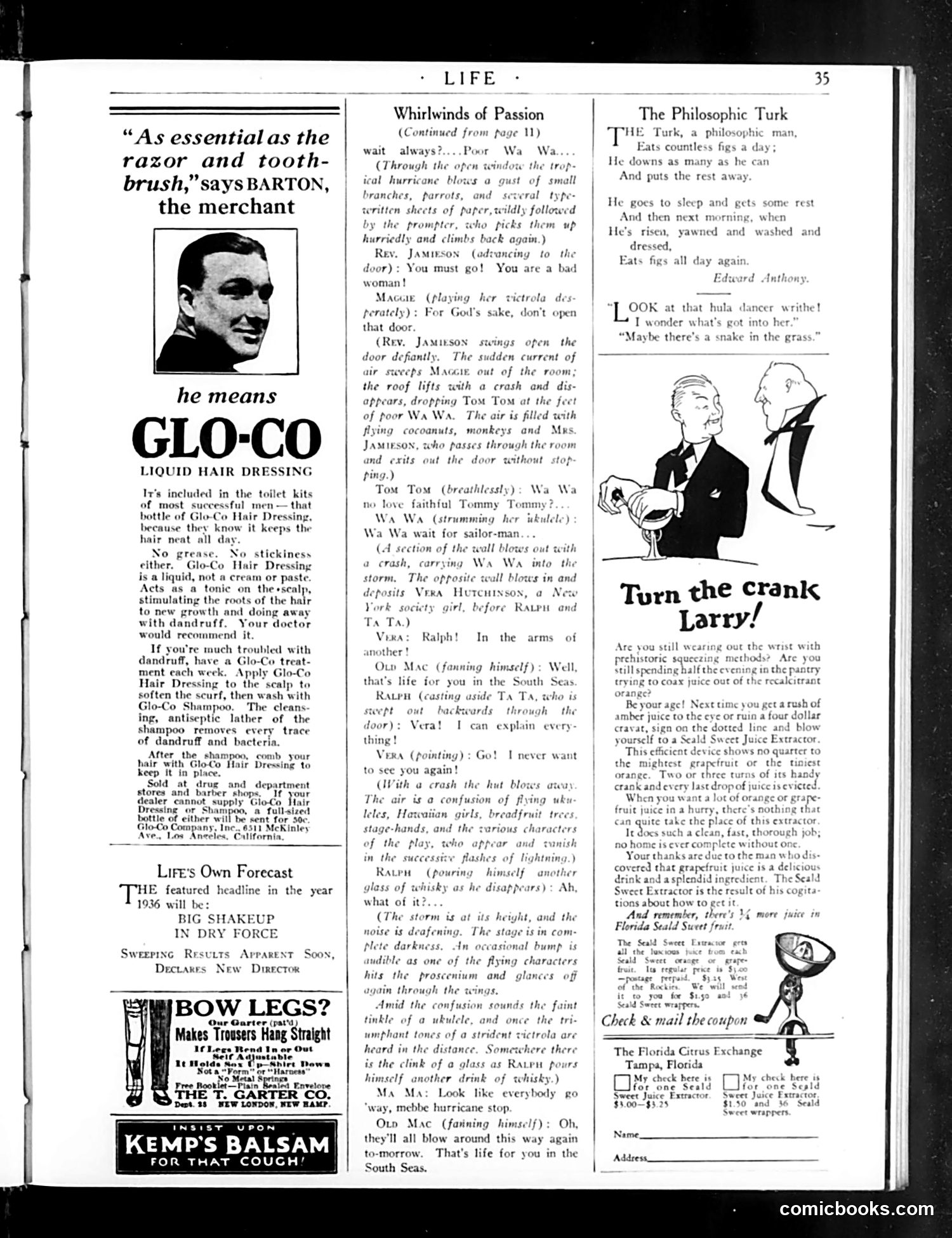
This page from Life magazine contains primarily **advertisements and light satirical content** rather than political commentary. The main elements include: **Advertisements:** Glo-Co Hair Dressing (featuring a merchant endorsement), The T. Garter Co. (for bow-legged men), and Kemp's Balsam cough remedy dominate the page. **Satirical theater piece:** "Whirlwinds of Passion" is a comedic play-script parody mocking melodramatic theatrical conventions—absurd plot devices (hurricanes destroying huts), overwrought character names (Tommy Tommy, Wa Wa), and ham-fisted dialogue typical of early 20th-century stage melodrama. **Humorous poems:** "The Philosophic Turk" and "Turn the Crank Larry" are light joke verses with no serious political intent. **Forecast section:** A brief note about anticipated government "shakeups" in 1936—likely referring to New Deal administration changes, though minimal detail is given. The page reflects Life's role as a general-interest humor and lifestyle magazine mixing consumer advertising with theatrical satire and light verse.
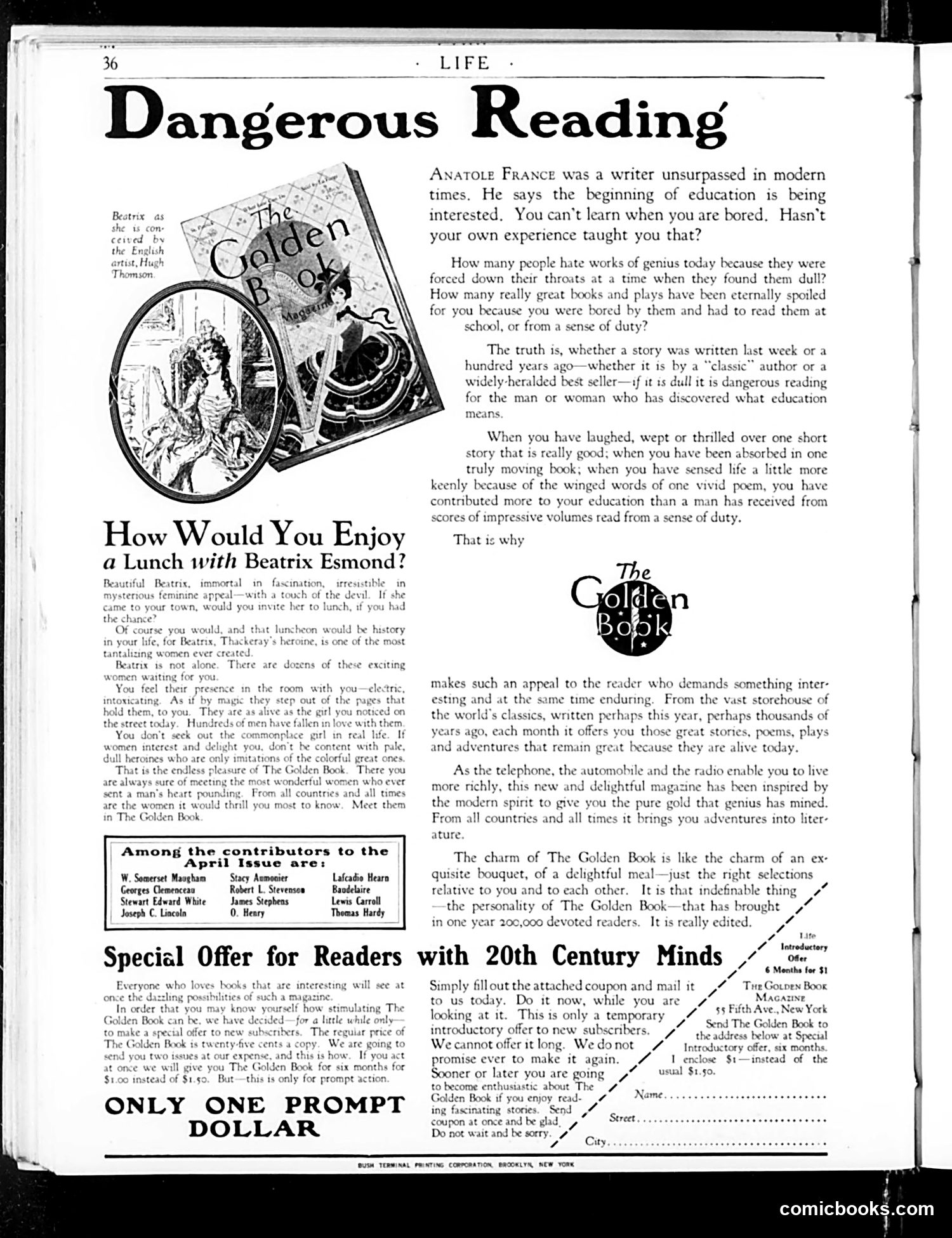
This page promotes *The Golden Book* magazine through an essay and advertisement. The content uses Anatole France as an authority figure to argue that reading should be pleasurable, not obligatory—a novel position for early 20th-century America. The essay critiques forced classical education: people develop lifelong hatred of "genius" works when compelled to read them in school "from a sense of duty." The satirical target is rigid, joyless pedagogy that treats literature as moral obligation rather than engagement. The accompanying illustration of "The Golden Book" and the fantasy scenario "How Would You Enjoy a Lunch with Beatrix Esmond?" (an attractive woman) use glamour and appeal to position the magazine as exciting, modern entertainment—contrasting sharply with dusty classroom classics. The advertisement's headline "Special Offer for Readers with 20th Century Minds" positions subscribers as progressive, rejecting Victorian educational strictness. The "$1.00 prompt action" offer creates urgency. Overall, this is advertising disguised as cultural criticism—using anti-establishment rhetoric about education to sell a literary magazine to modern, pleasure-seeking readers.
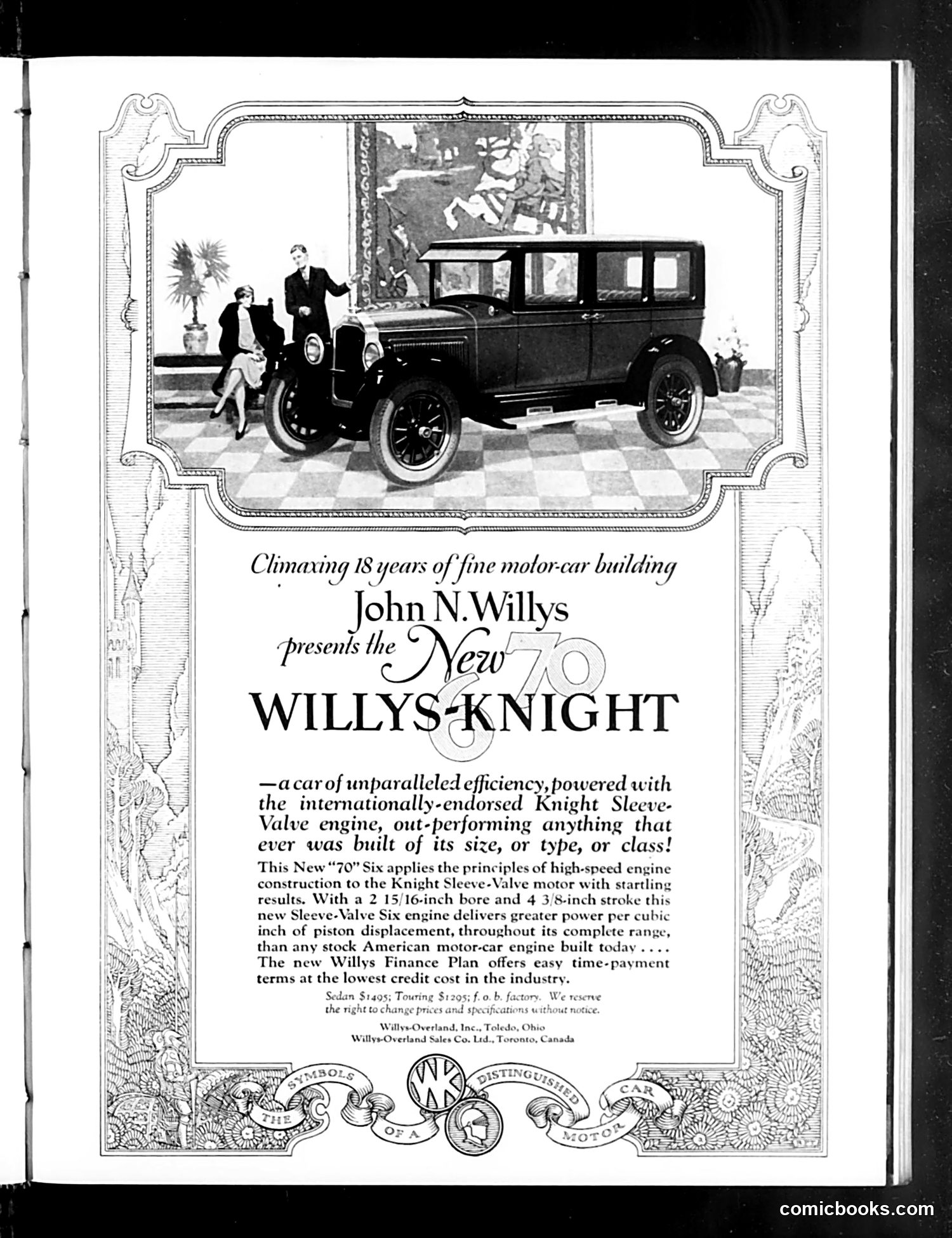
This is primarily a **automobile advertisement**, not a political cartoon. It showcases the new Willys-Knight "70" automobile, presented by manufacturer John N. Willys. The image depicts a luxury sedan with well-dressed passengers and attendants in an elegant interior setting, emphasizing the car's prestige and sophistication. The ad highlights the vehicle's Knight Sleeve-Valve engine technology as superior to competitors, claiming unmatched efficiency and power output. The ornate decorative border and formal typography reflect the era's advertising style—elegant and aspirational. The inclusion of financing options ("Willys Finance Plan") represents early consumer credit marketing, making luxury automobiles accessible to middle-class buyers. This appears to be a **straightforward commercial advertisement** from Life magazine, not satire. The page represents how Life magazine generated revenue through premium advertising alongside its editorial content.
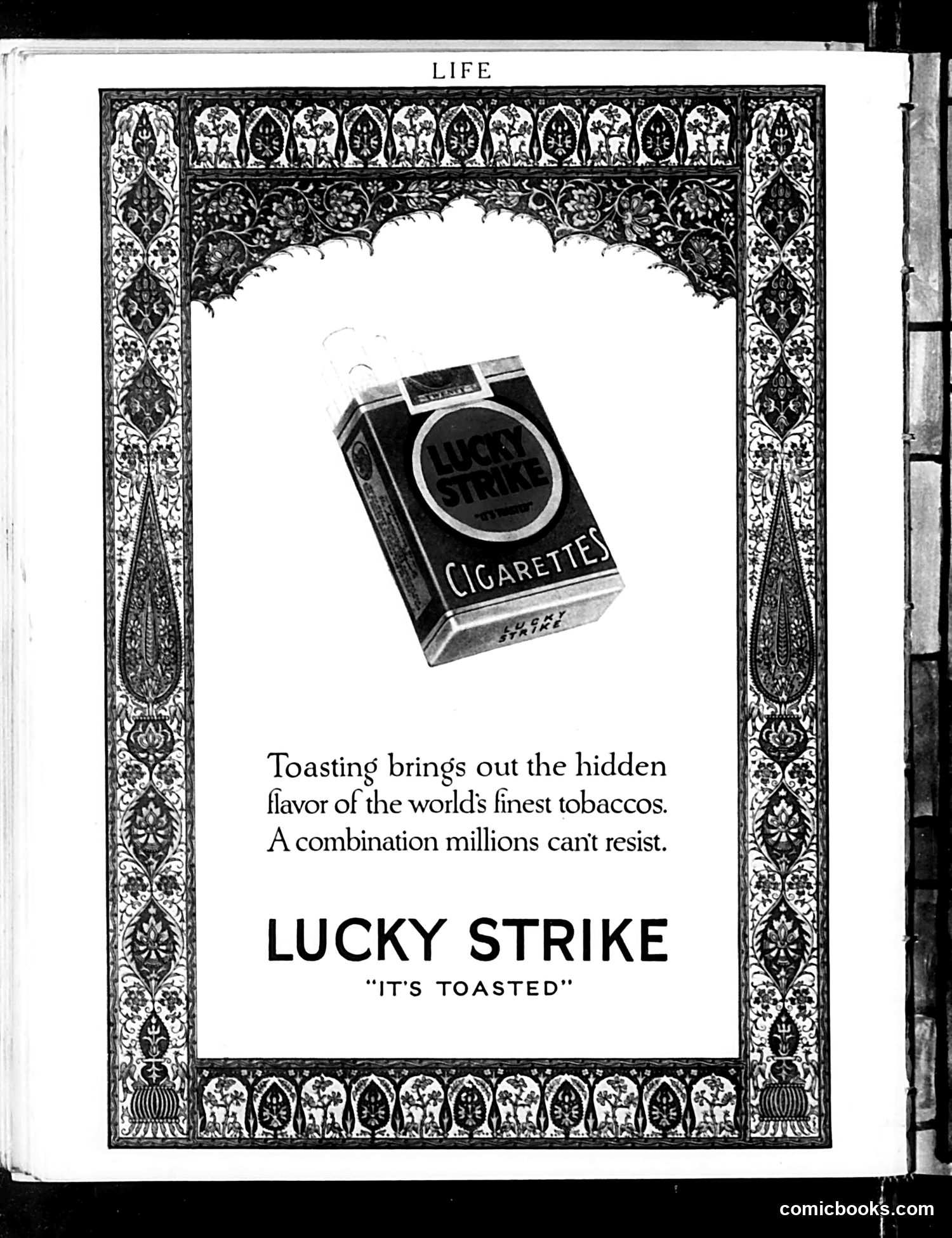
This is a **Lucky Strike cigarette advertisement**, not satire or a political cartoon. The page features a product shot of a Lucky Strike cigarette pack with an ornate decorative border typical of early 20th-century magazine design. The ad's tagline—"It's Toasted"—was Lucky Strike's actual marketing claim, suggesting the toasting process enhanced flavor. The text promises that this combination of tobaccos is irresistible to millions. For modern readers, this represents a stark contrast to today's tobacco regulation: advertisements this prominent and health-claim-forward would be illegal now. The elegant presentation and aspirational language reflect an era when cigarette marketing faced no restrictions. This is straightforward commercial advertising from Life magazine's revenue-generating pages, not editorial content or satire.