
Life, 1926-03-25 · page 20 of 40
Life — March 25, 1926 — page 20: what you’re looking at
What you’re looking at
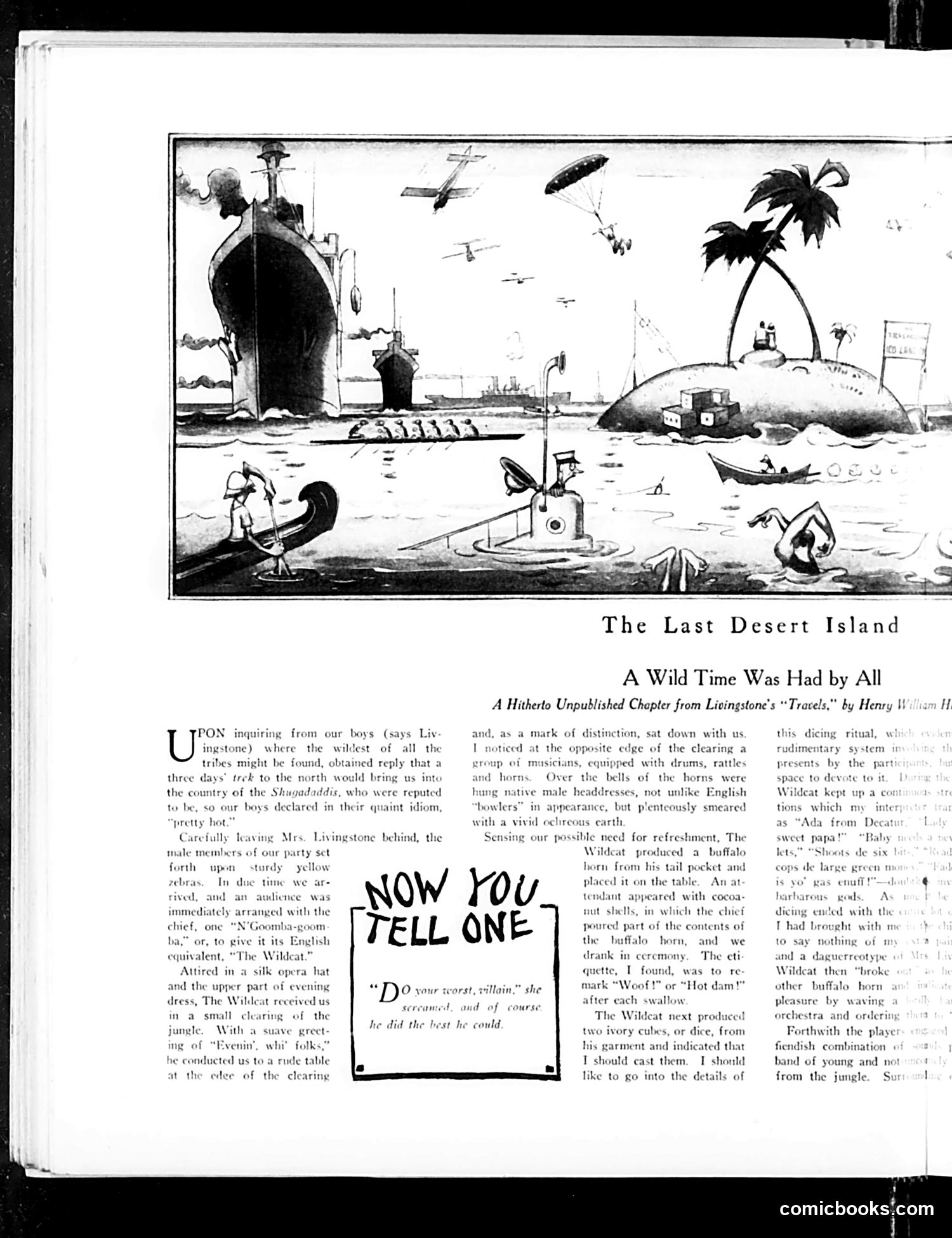
This is a humorous fictional account supposedly extracted from David Livingstone's travels, satirizing Victorian-era colonial attitudes and adventure narratives. The piece mocks the exotic "savage chief" trope by depicting an African tribal leader named "The Wildcat" dressed incongruously in a silk opera hat and evening dress—a visual joke about the absurdity of assuming native peoples are simultaneously "wild" yet susceptible to European civilization markers. The satire targets: - **Colonial superiority**: The patronizing tone describing "quaint idioms" and "suave greeting" - **Explorer mythology**: Exaggerated adventure-story conventions (three-day trek, dangerous tribes) - **Cultural stereotyping**: Reducing complex societies to caricatures of drums, rattles, and ritualistic behavior The "Now You Tell One" sidebar—with its quote about the Wildcat's fearlessness—appears to invite reader participation in tall tales, further mocking how these exploration narratives were consumed as entertainment rather than serious ethnography. The message: these adventure stories were entertaining fiction, not factual accounts of "primitive" peoples.
📄 Transcribed text from this page (OCR, searchable)
Machine-transcribed from the original scan — historical spelling and the odd misread are preserved.
PON inquiring from our boys (says L U ingstone) where the wildest of all the tribes might be found, obtained reply that a three days’ trek to the north would bring us inte the country of the S tu be, so our boys declared in their quaint idiom, yadaddis, who were reputed pretty hot.” Carefully leaving Mrs. Livingstone behind, the male members of our party set forth upon zebras, In due time we ar- ly yellow rived, and an audience was immediately arranged with the chief, one ha,” or, to give it its E equivalent, “The Wildcat.” Attired in a silk opera hat and the upper part of evening dress, The Wild in a small clearing of the t received us jungle. With a suave grect- ing of “Evenin’, whi’ folks,” re conducted us to a rude table at the edee of the clearing group of and hor bowlers” in a T he Last Desert Island A Wild Time Was Had by All A Hitherto Unpublished Chapter from Livingstone’s “Travel: s a mark of distinction, sat down with us. ticed at the opposite edge of the clearing a PF usicians, equipped with drums, rattles « horns were Over the bells of native male headdresses, n arance, but plenteously smeared with a vivid ochreous carth. Sensing our possible need for refreshment, The Wildcat produced a_ buffalo horn from his tail pocket and An ant appeared with cocoa placed it on the tal ter shells, in which the chief poured part of the contents of the drank in ceremony, The eti lo horn, and we quette, I found, was to re mark “Woof!” or “Hot dam!” after each swallow Wildcat next. pre sry cubes, or dice, from his garment and indicated that T should cast them. I shonld like to go into the details of * by Henry Wiliam H this dicing ritual, w rudimentary system presents by the part space to devote to it at kept which my m Decat l dicing ended with the Thad 1 to say reht with m ing of und a daguerreotyyx Wildcat then “broke other buffalo. b pleasure by waving orchestra and orderi Forthwith the playc fiendish combination « band of young and not from the jungle. S$ ! i comicbooksicom