
Life, 1926-03-25 · page 28 of 40
Life — March 25, 1926 — page 28: what you’re looking at
What you’re looking at
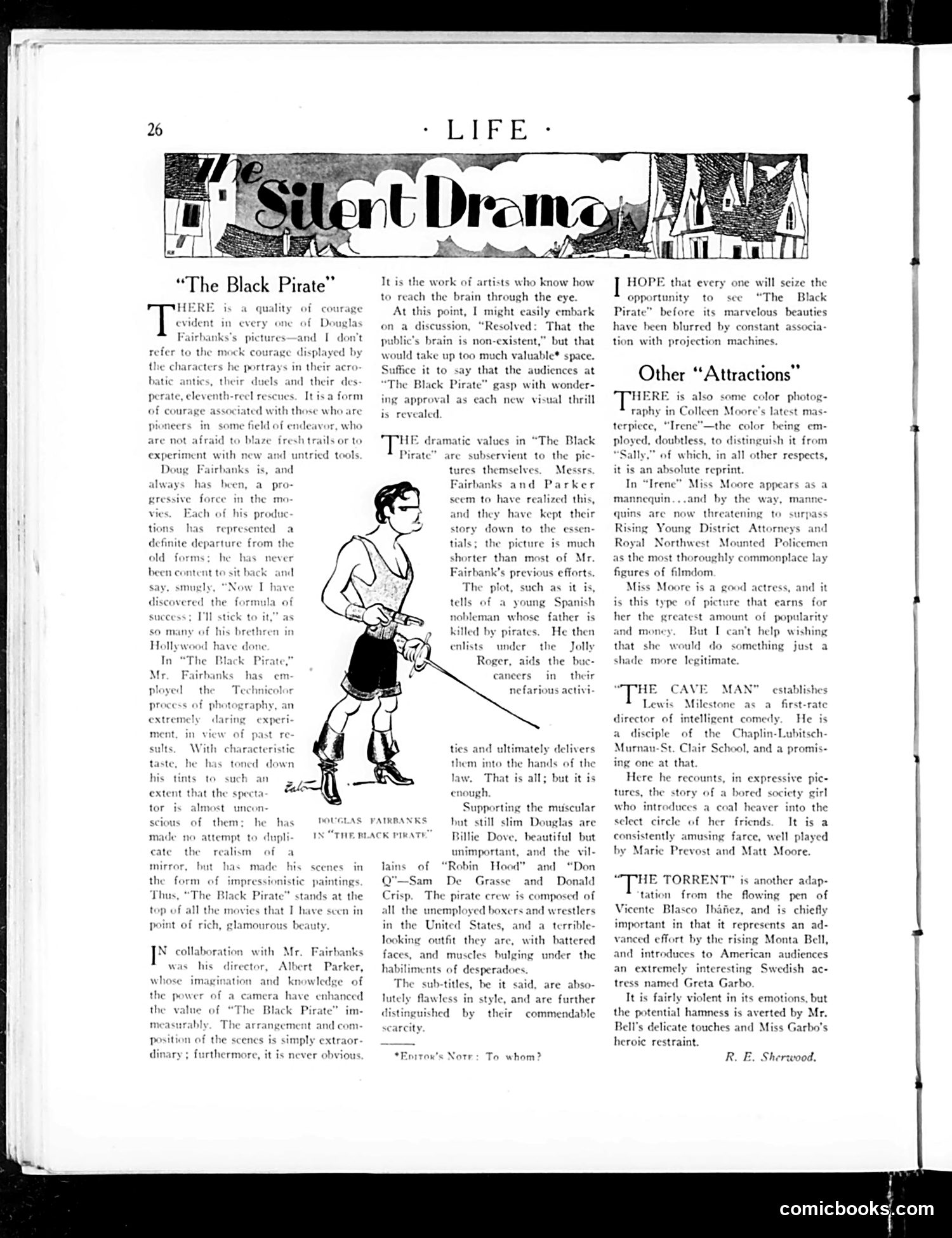
This is a film review from *Life* magazine praising Douglas Fairbanks's silent film "The Black Pirate." The critic highlights Fairbanks's innovative use of the Technicolor process and his skill at visual storytelling—reaching "the brain through the eye." The illustrated figure shows Fairbanks in character as a Spanish nobleman-turned-pirate seeking revenge for his father's death. The critic notes the film's simple plot serves the spectacular visuals rather than vice versa, and praises the supporting cast (Billie Dove, Sam De Grasse, Donald Crisp) while humorously noting the pirate crew consists of "unemployed boxers and wrestlers." The page also briefly reviews other current films: Colleen Moore's color picture "Irene" and "The Cave Man" (directed by Lewis Milestone). The reviews emphasize visual innovation and technical achievement characteristic of 1920s silent cinema criticism.
📄 Transcribed text from this page (OCR, searchable)
Machine-transcribed from the original scan — historical spelling and the odd misread are preserved.
“The Black Pirate” HERE is a quality of co evident in every one of Douglas Id irhanks's pictures—and I « refer to the mock courage displayed by s in their acro the characters he port bat ies, their duels and their des perate, eleventh-reel rescues. It isa form of courage associated with those who are pioneers in some field of endeavor, who are not afraid to blaze fr tra tried tools. orto experiment with new and 1 De Fairbanks ays has bee and gressive force in vies. Each of his produc ti definite departure from the s represented old forms: he has never been ce say, sm discovered the success; I'll stick so many of his bre en in Hollywood have d In “The Black Pirate Mr. Fairbanks has ployed — the process of sraphy, an extremely dar experi- ment, in view of st re- sults. With characte i taste, his ti has toned down to such an extent that the specta tor is t uncon- them; he has GLAS made no attempt to dupl cate realism of a mirror, 1 mac im the Thu: of all th ic yp ings k Pirate” stands at the movies that T have seen in npress t of rich, glamourous beauty. with Mr. Fairbanks Albert Parker, and knowled; collaboration was his d whose imaginati camera have enhanced The Black Pi arrangement and c 1 the te” im- mea ly. T po dinary ; nes is sim extraor- FAIRBANKS THE RLACK PIRATE” It is the work of artists who know how to reach the brain through the eye. At this point, I might easily embark on a discussion, “Resolved: That the xistent,” but that would take up too much valuable® space. fice it to say that the audiences at he Black Pirate” gasp with wonder- ing approval as cach new visual thrill public’s I is non- is revealed. HE d Pirat natic values in “The Black * are subservient to the pic- tures themselves. Messrs. Fa sand Parker seem to have realized this, and they have kept. their irha story down to the essen- tials; the picture is much shorter than most of Mr. "s previous efforts. such as it a young Spanish tells nobleman whose father is killed by pirates. He then enlists under the Jolly Roger, aids the buc- cancers in their ious activi and ultimately delivers m into the hands of the Jaw. That is all; it is enough Suppor g¢ the muscular hut still slim Douglas are Billie Dove, beautiful but unimportant, and the vil- lains of “Robin He and “Don Q’—Sam De Grasse and Donald Crisp. The pirate crew is composed of all the unemployed boxers and wrestlers in the United States, and a_terrible- looking outfit they are, with battered f . and muscles bulging under the liments of desperadoes sub-titles, be it said, are abso- lutely flawless in style, and are further ished by their commendable x's Note: To whom? I HOPE that every one will seize the opportunity to see “The Black Pirate” before its marvelous beauties have been blurred by constant associa- tion with pi Other “Attractions” HERE. is also some color photog- aphy in Colleer ction machines. Moore's latest mas- terpiece, “Irene”—the color being em- ed, doubtless, to distinguish it from plo ally,” of w it is an absc In “Irene” Miss Moor nequin...and by th way, ma: quins are now thre Rising Young District Royal Northwest Mounted as the most thoror figures of filmdom Miss Moore is a good actress, and it e that earns for ly common is this type of atest amount of populs But T can't help wishing at she would do something just a her the g¢ rity and money tl shade more legitimate. HE CAVE MAN Lewis Milestone establishes first-rate gent comedy. He is a disciple of the Chaplin-Lubitsch t. Clair School, and a promis- ing one at that, Here he recounts, director of intel expressive pic- red society girl tures, the story of a who introduces a coal heaver into the select circle of her friends. It is a consistently amusing farce, well played by Maric Prevost and Matt Moore. TH TORRENT” is another adap- tation from the flowing pen of Vicente Blasco Thafiez, and is chiefly important in that it represents an ad- vanced effort by the rising Monta Bell, and introduces to Ameri an audienc: ‘ing Swedish ac- tress named Greta Garbo. It is fairly violent in its emotions, but the potential hamness is averted by Mr. Bell's delicate touches and Miss Garbo's heroic restraint. an extremely inte R. E. Sherwood. 4 comicbooks.com {