
A complete issue · 36 pages · 1925
Life — April 16, 1925
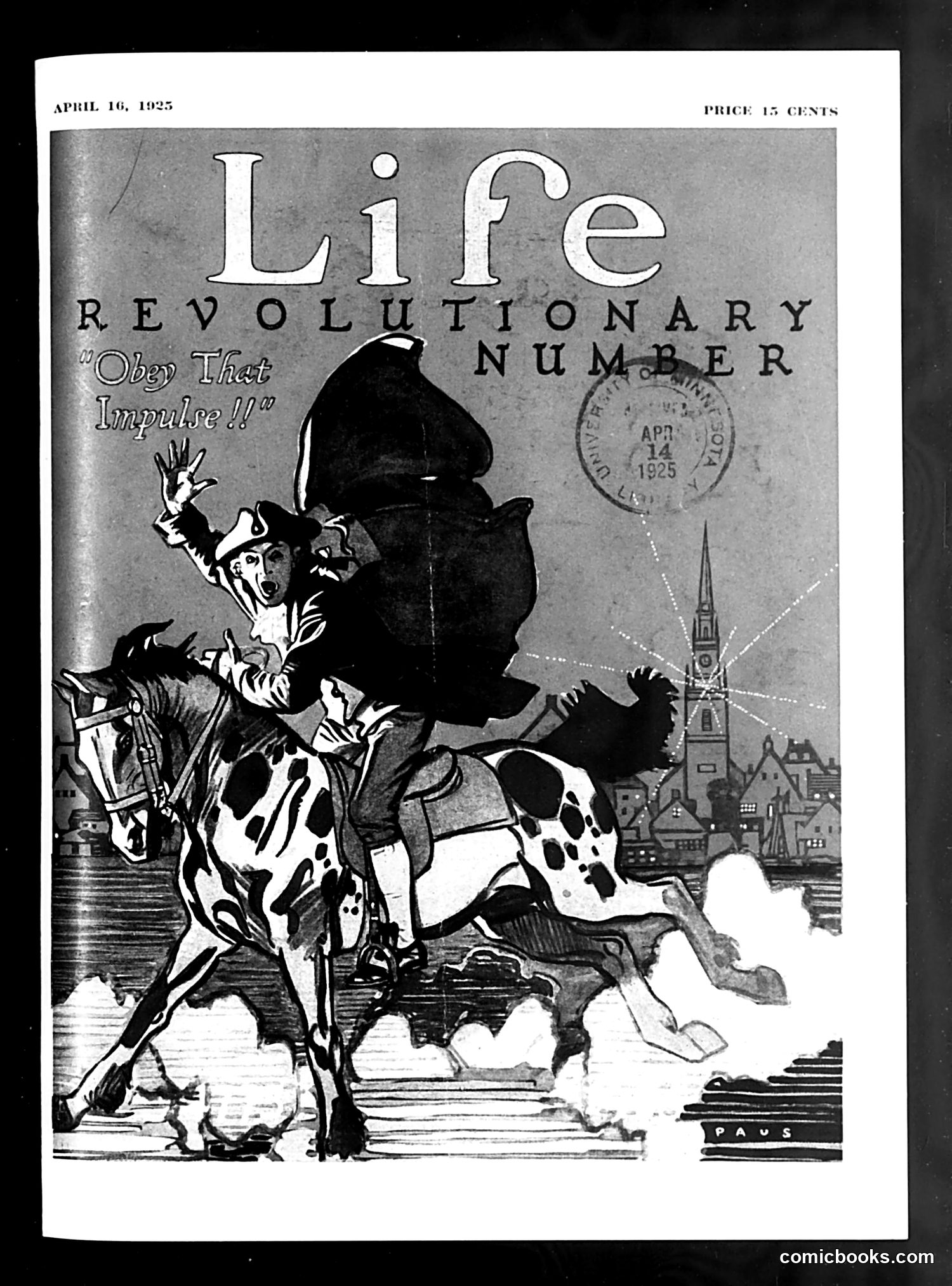
This is the cover of *Life*, a prominent American satirical magazine. The illustration depicts a caricatured revolutionary figure on horseback, wielding a sword and raising his fist with the phrase "Obey That Impulse!!" The shadowy profile looming behind suggests an ominous revolutionary leader or ideology. The cover likely satirizes contemporary revolutionary movements or communist agitation that American publications of the 1920s frequently mocked. The "Revolutionary Number" designation indicates this issue focused on revolutionary themes or current political upheaval. The dramatic imagery—soldier, sword, architectural backdrop—suggests commentary on international political instability or domestic radicalism concerns prevalent in post-WWI America. The specific historical reference remains unclear without additional context.
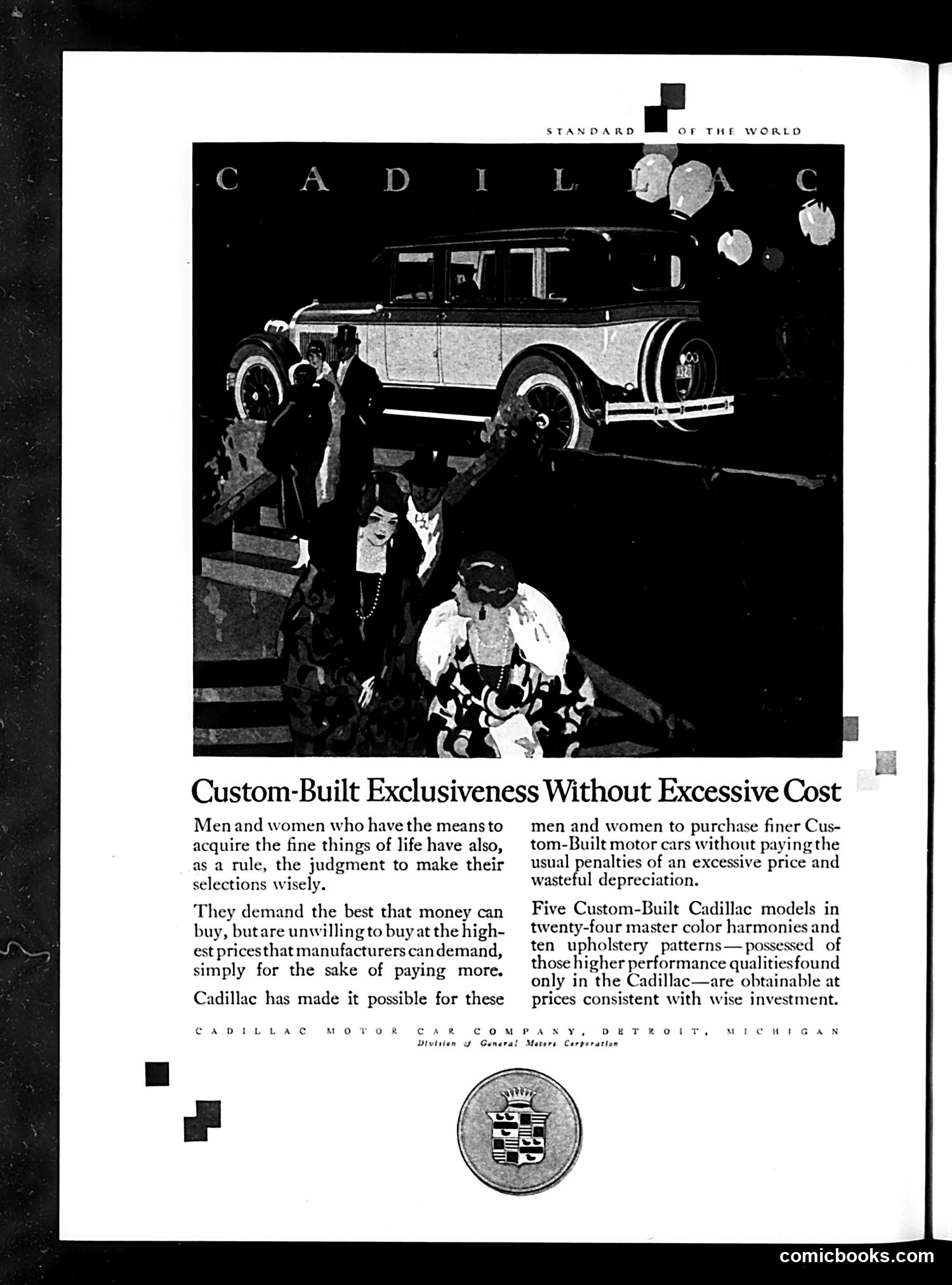
This is actually **advertising, not satire or political cartoon**. It's a Cadillac Motor Car Company advertisement from the 1920s era (based on the vehicle design and styling). The ad uses a aspirational lifestyle image: well-dressed men and women in elegant clothing admiring a Custom-Built Cadillac. The headline "Custom-Built Exclusiveness Without Excessive Cost" positions the car as offering luxury and distinction at reasonable prices—targeting wealthy consumers who want prestige without overpaying. The text emphasizes that Cadillac provides "finer things of life" with five models in "twenty-four master color harmonies," available at prices "consistent with wise investment." This appeals to the luxury market segment of the 1920s—affluent buyers seeking status symbols during the Jazz Age. There is no political satire here; it's straightforward period advertising.
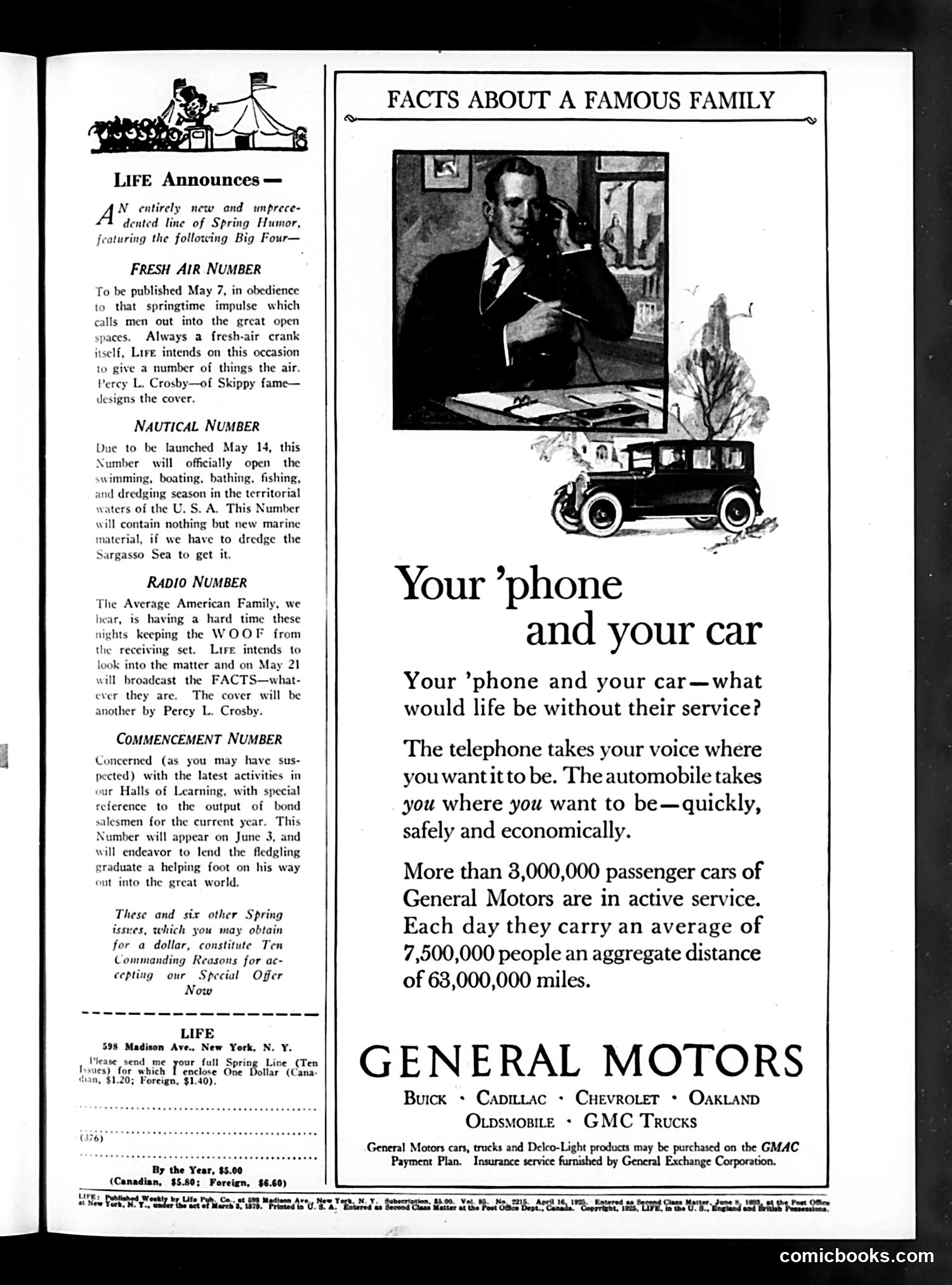
This page is primarily **advertising**, not satire or political commentary. The right side features a General Motors advertisement promoting telephones and automobiles as essential modern services. The ad uses a portrait photograph of a man at a desk (identity unclear from image alone) to represent business and modern life. The left column announces upcoming special issues of *Life* magazine, including a "Fresh Air Number" (May 7) and "Nautical Number" (May 14). Percy L. Crosby is credited as cover designer. There is **no political cartoon or satire** on this page. The content reflects 1920s-era commercial messaging celebrating consumer goods and transportation as markers of American progress and convenience.
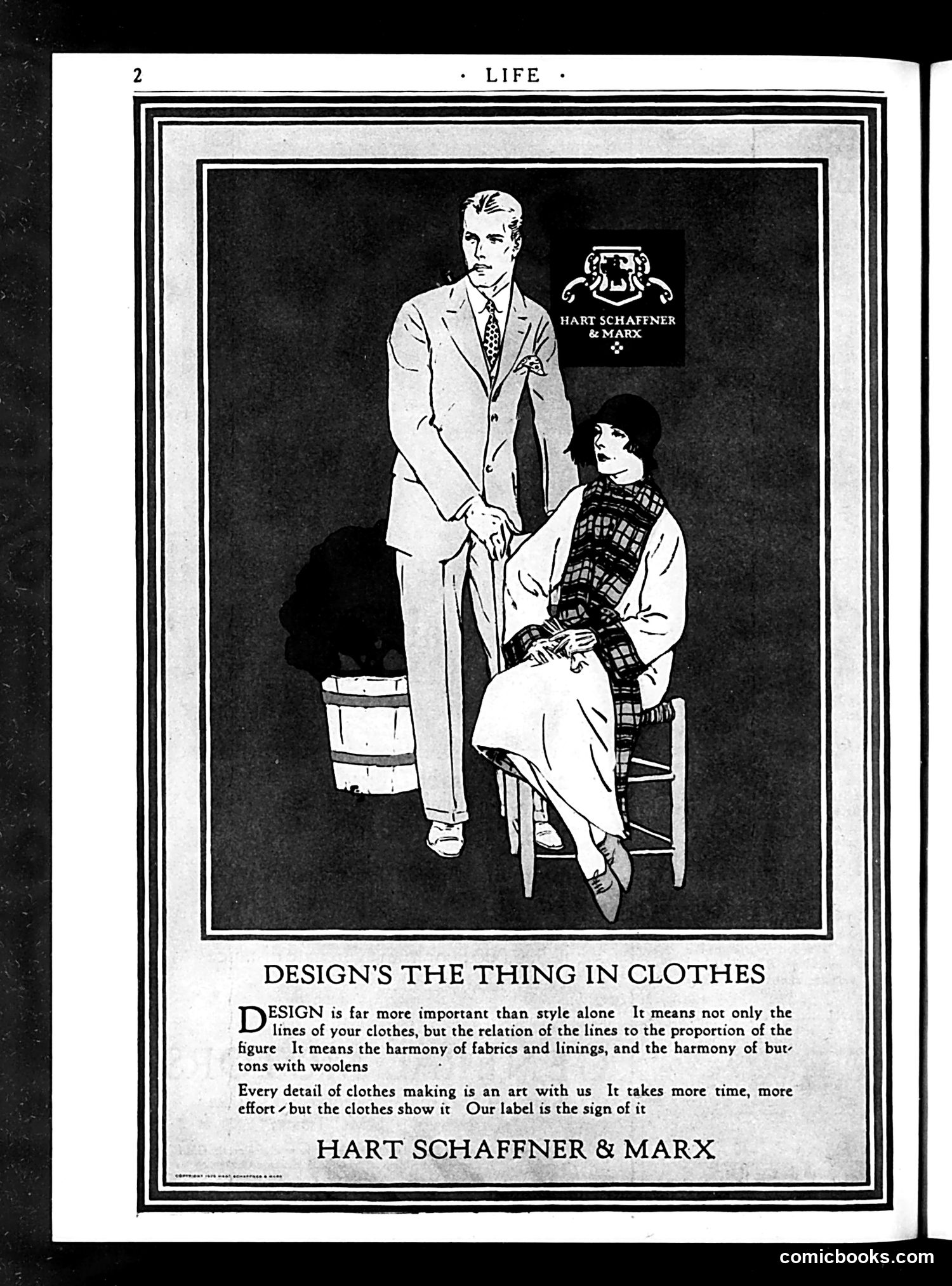
This is a **clothing advertisement**, not political satire. Hart Schaffner & Marx, a menswear company, uses this full-page ad to promote tailored suits by emphasizing "design" over mere style. The illustration shows a well-dressed man in a light suit standing beside a seated woman in a plaid vest and skirt. The ad's argument is that proper clothing design involves understanding fabric harmony, proportion, construction quality, and button placement—not just appearance. The tagline states "Every detail of clothes making is an art with us." This reflects early 20th-century advertising's shift toward promoting craftsmanship and quality as selling points, targeting middle-class consumers concerned with respectability and proper presentation. The inclusion of a woman suggests marketing to couples or highlighting how quality tailoring matters across genders.
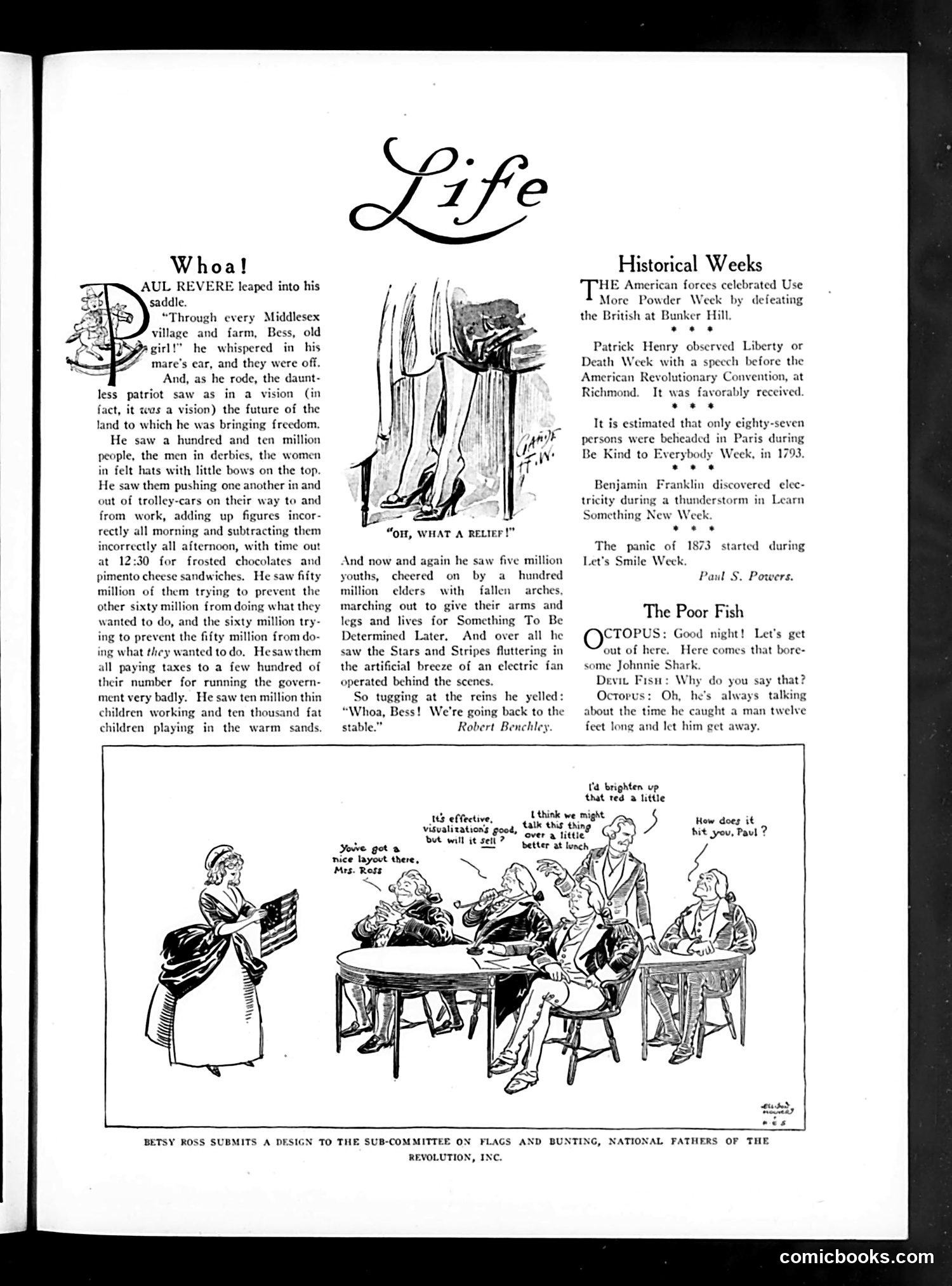
This cartoon satirizes the **Daughters of the American Revolution (DAR)** and their obsession with historical authenticity and committee procedures. The historical figure Betsy Ross presents her American flag design to a group of formal committee members—"National Fathers of the Revolution, Inc." The joke mocks how the DAR bureaucratizes patriotism: even the iconic founding moment of flag design is reduced to committee approval, complete with businessmen's deliberation and nitpicking. One man comments on "layout," another on "visualizations" being "good, but will it sell?"—applying modern advertising language to 18th-century history. The satire targets both the DAR's stuffiness and 1920s corporate culture's infiltration of even patriotic institutions.
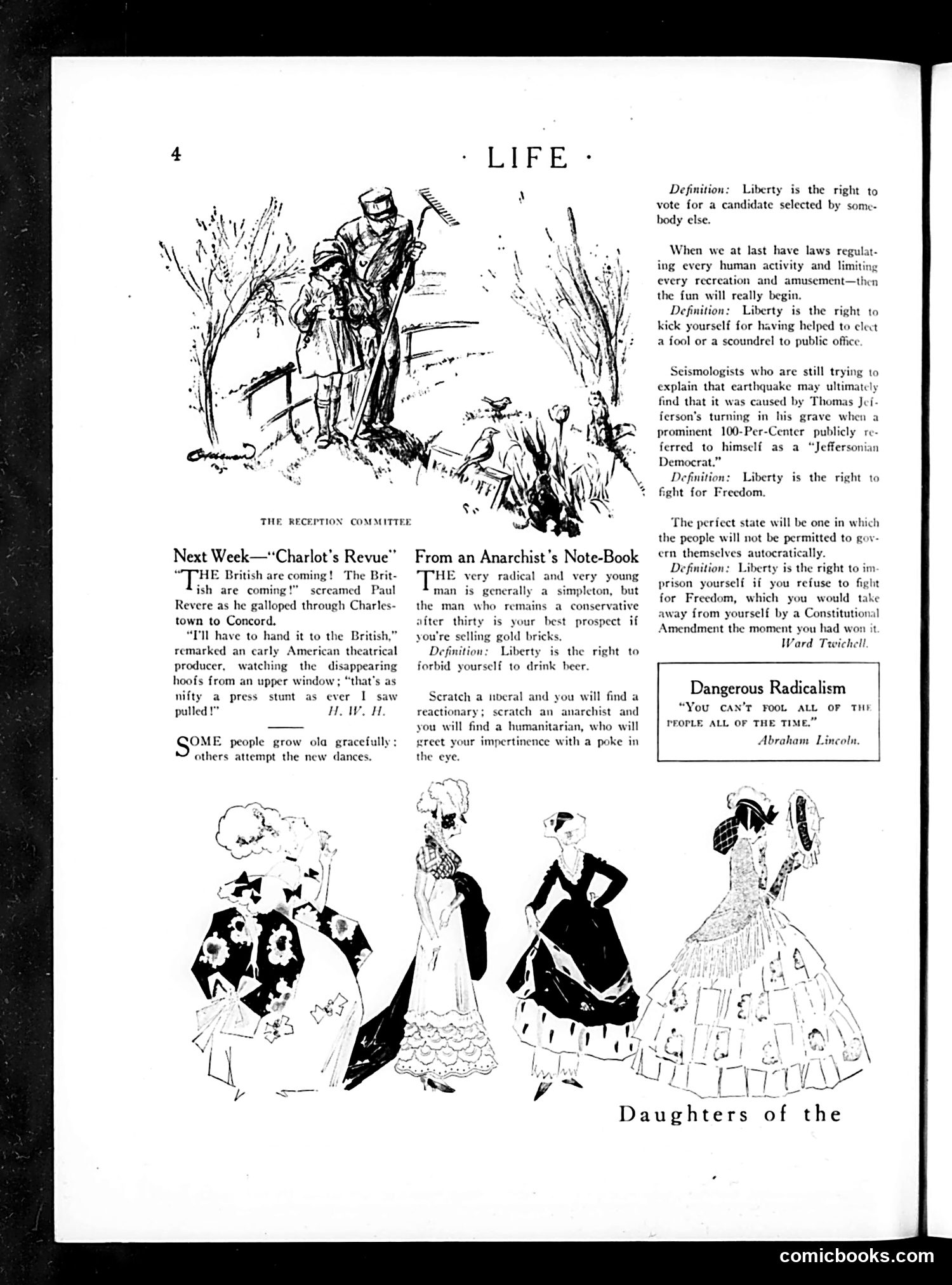
This page satirizes American political liberty and radicalism circa the early 20th century. The top cartoon depicts a soldier or authority figure confronting what appears to be an anarchist or radical, illustrating the tension between order and dissent. The text provides mock "definitions" of liberty—progressively absurd interpretations (voting rights, electing fools, fighting for freedom, drinking beer)—to mock how different Americans define the concept. The "Dangerous Radicalism" box quotes Lincoln, sardonically suggesting that radicals cannot "fool all the people all the time," implying contemporary radicals overestimate their persuasive power. The bottom illustration labeled "Daughters of the" (text cut off) shows fashionably dressed women, likely satirizing a specific women's organization, possibly suffragettes or social activists, suggesting Life's skepticism toward their causes.
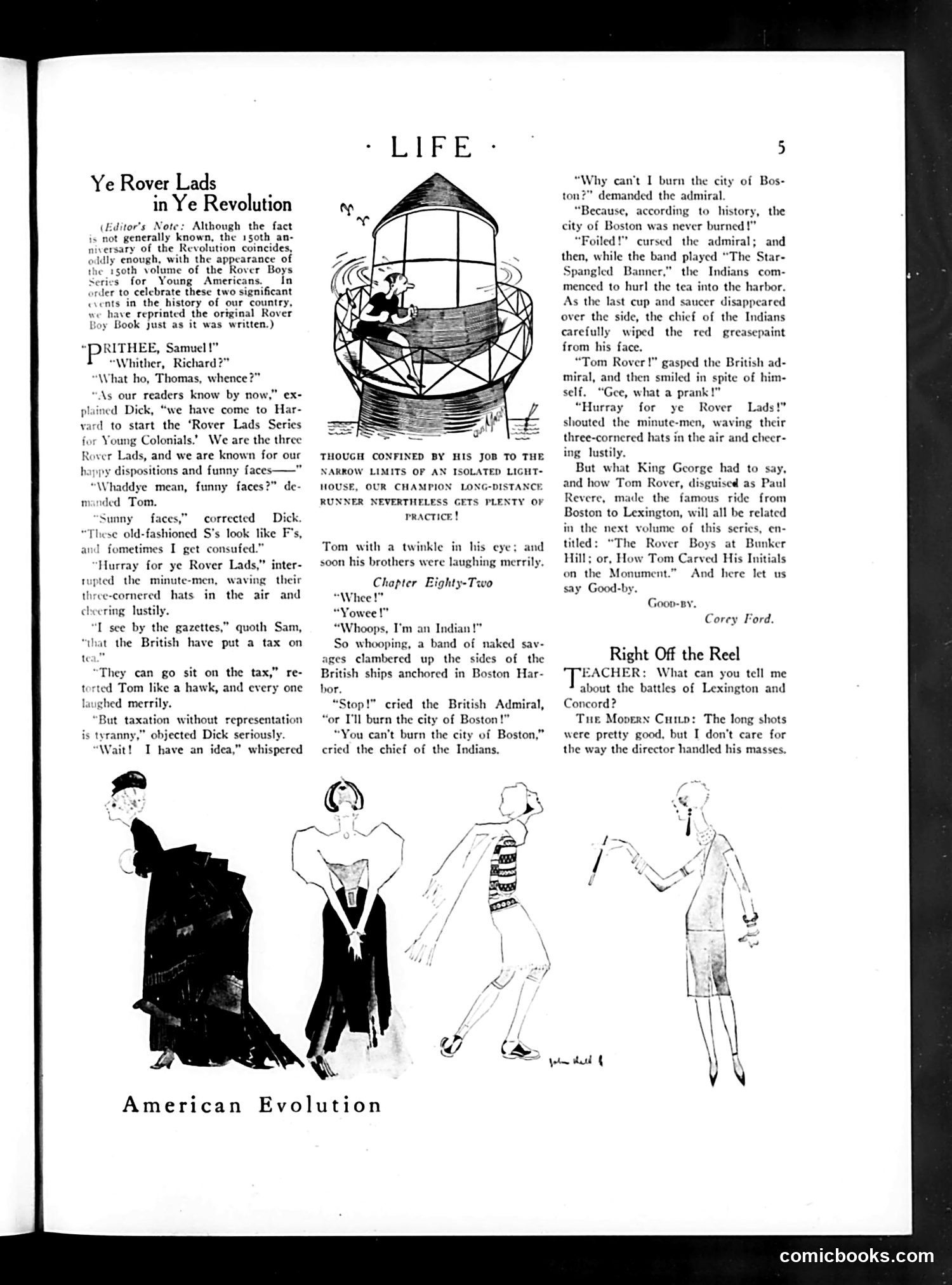
This satirical story mocks young American colonists playing at revolution. The narrative follows Tom Rover and friends who, confined to a lighthouse job during wartime, nonetheless practice their "long-distance running." The humor centers on their theatrical patriotism: they attempt the Boston Tea Party but fail (the tea doesn't actually get thrown), then mock the British Admiral with exaggerated "Indian" costumes and whooping. The satire suggests American revolutionaries were performative and ineffectual—playing at rebellion rather than seriously resisting British rule. The "American Evolution" fashion cartoon below appears unrelated, showing changing women's silhouettes. The overall page uses humor to diminish American revolutionary credibility, typical of British satirical magazines toward colonial independence movements.
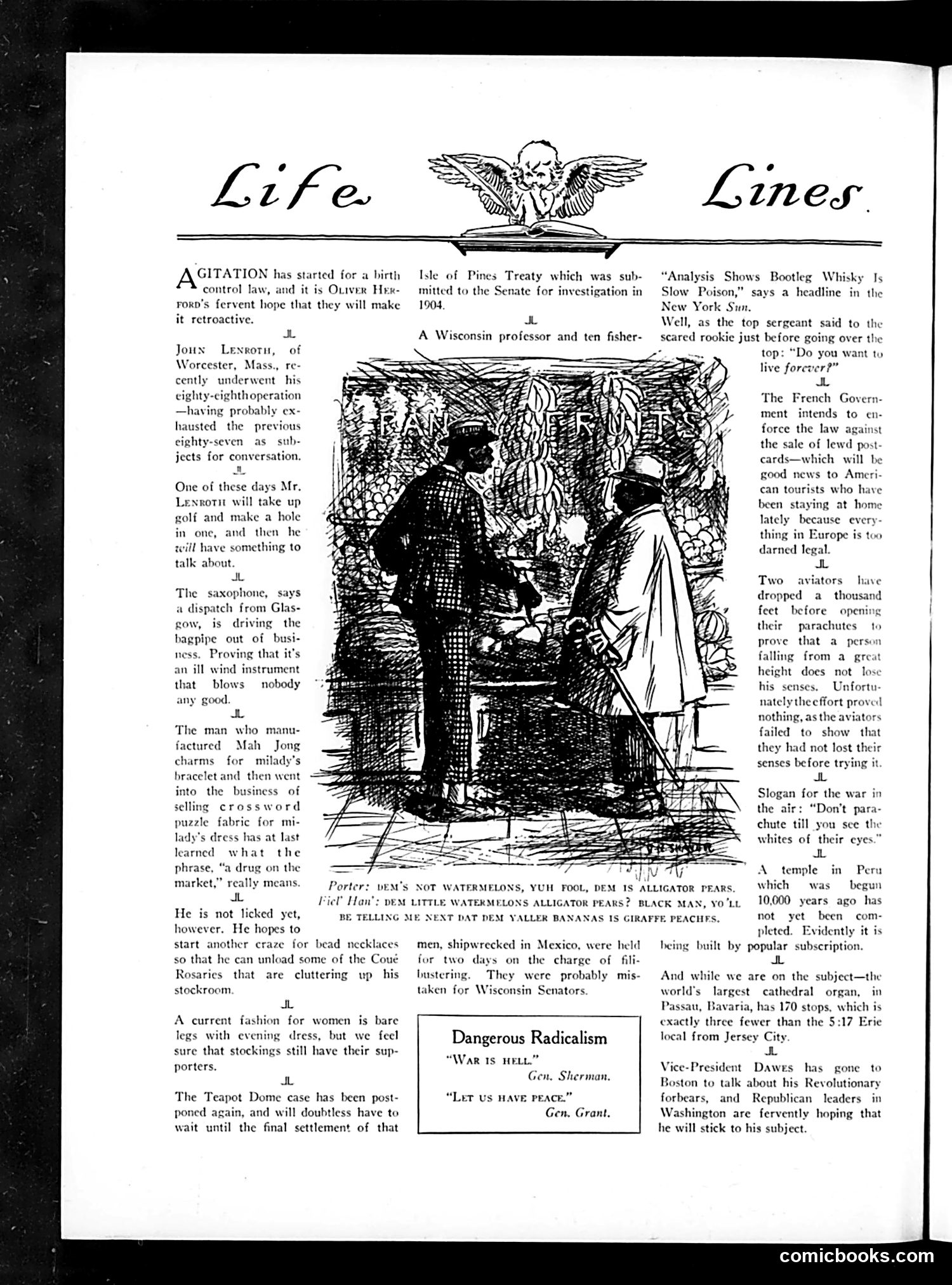
This page from *Life* magazine contains satirical commentary on contemporary issues. The main illustration depicts two men in formal dress examining what appears to be fabric or materials in an interior setting, captioned with a joke about "watermelons" and "alligator pears" — racial stereotypes typical of the era. The text discusses various topics: agitation for a birth control law; a Wisconsin professor's longevity claims; the saxophone as a musical nuisance; and French enforcement against illegal postcard sales. A boxed section titled "Dangerous Radicalism" quotes Gen. Sherman ("War is Hell") and Gen. Grant ("Let us have peace"), likely criticizing contemporary political movements or peace advocacy. The page reflects early 20th-century American satirical humor, mixing social commentary with period-typical racial stereotyping.
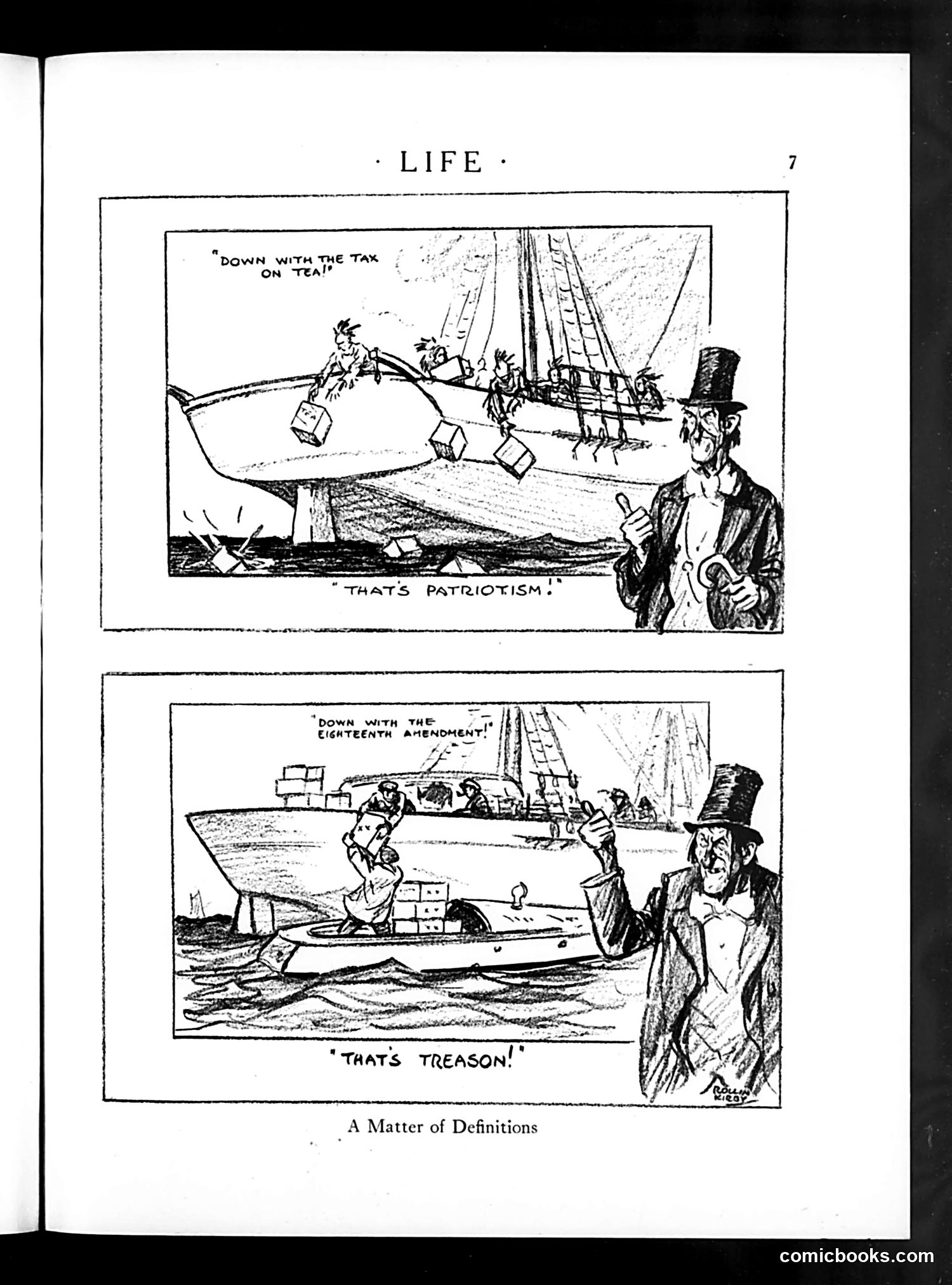
This two-panel political cartoon satirizes the American government's inconsistent application of patriotism versus treason charges. In the first panel, a well-dressed gentleman (likely representing a government official or wealthy industrialist) watches sailors dumping tea overboard from a ship, captioning it "Down with the tax on tea! That's patriotism!" The second panel shows the identical scene, but now captioned "Down with the eighteenth amendment! That's treason!" The cartoon mocks the hypocrisy of defining the same act of civil disobedience—rejecting government policy through direct action—as either patriotic or treasonous depending on which policy is targeted. This appears to critique Prohibition-era (18th Amendment) enforcement policies relative to historical American revolutionary ideals.
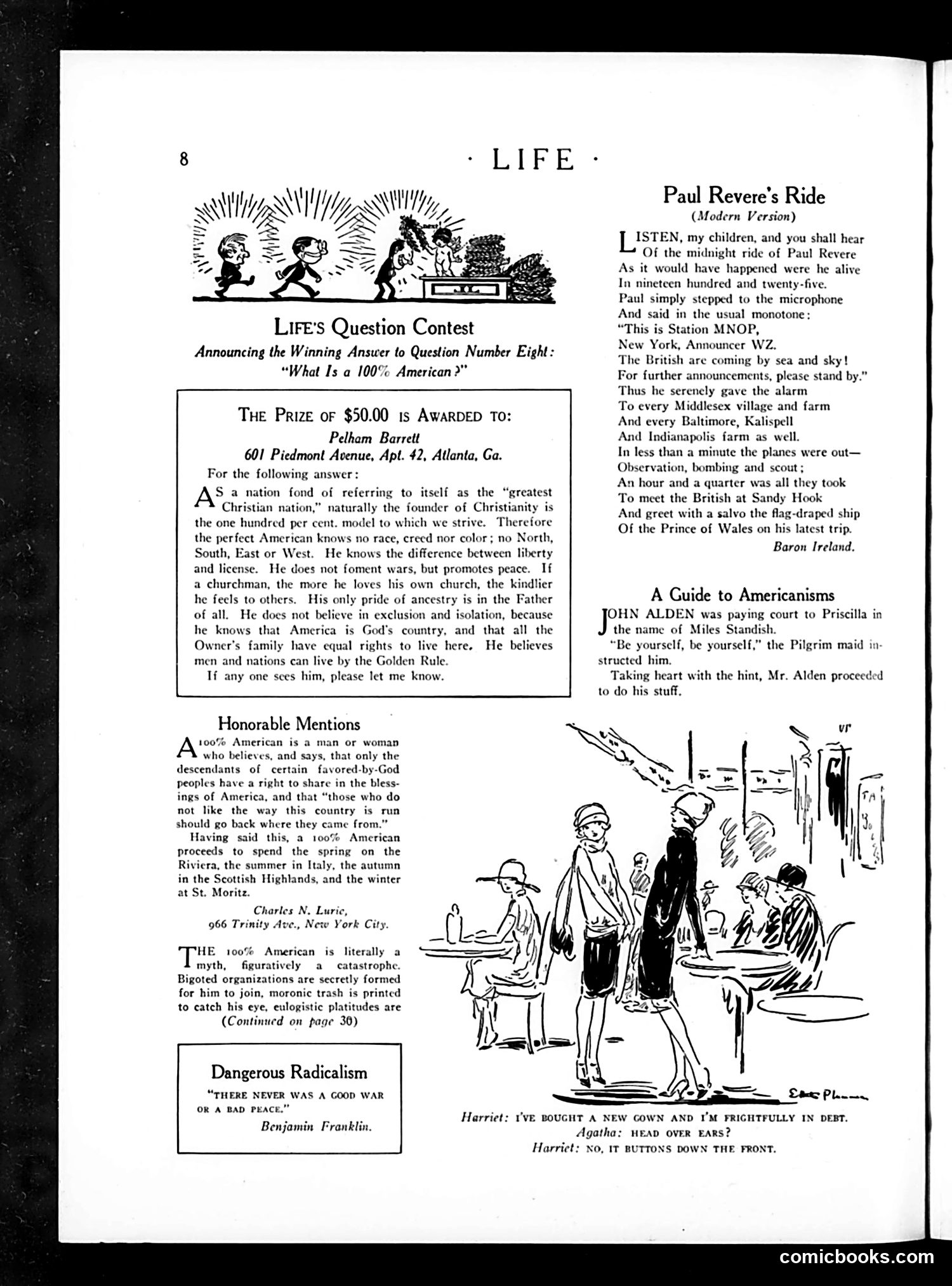
This page from *Life* magazine contains several satirical pieces about American identity and social commentary: **Top Section - "Life's Question Contest"**: A $50 prize was awarded for defining what makes a "100% American." The winning answer emphasizes Christian values, racial/color-blindness, and equality—describing an idealized American who rejects exclusion and believes "all the Owner's family have equal rights." **Right Side - "Paul Revere's Ride (Modern Version)"**: A comedic poem by Baron Ireland updates the famous historical ride to 1925, replacing horses with planes and radio announcements—satirizing how modernization has transformed American institutions. **Bottom Cartoon**: Shows a domestic scene where "Harriet" purchased a new gown while in debt. The joke highlights anxiety about consumer spending and women's financial independence during the 1920s. The page satirizes American ideals, modernization, and changing social norms.
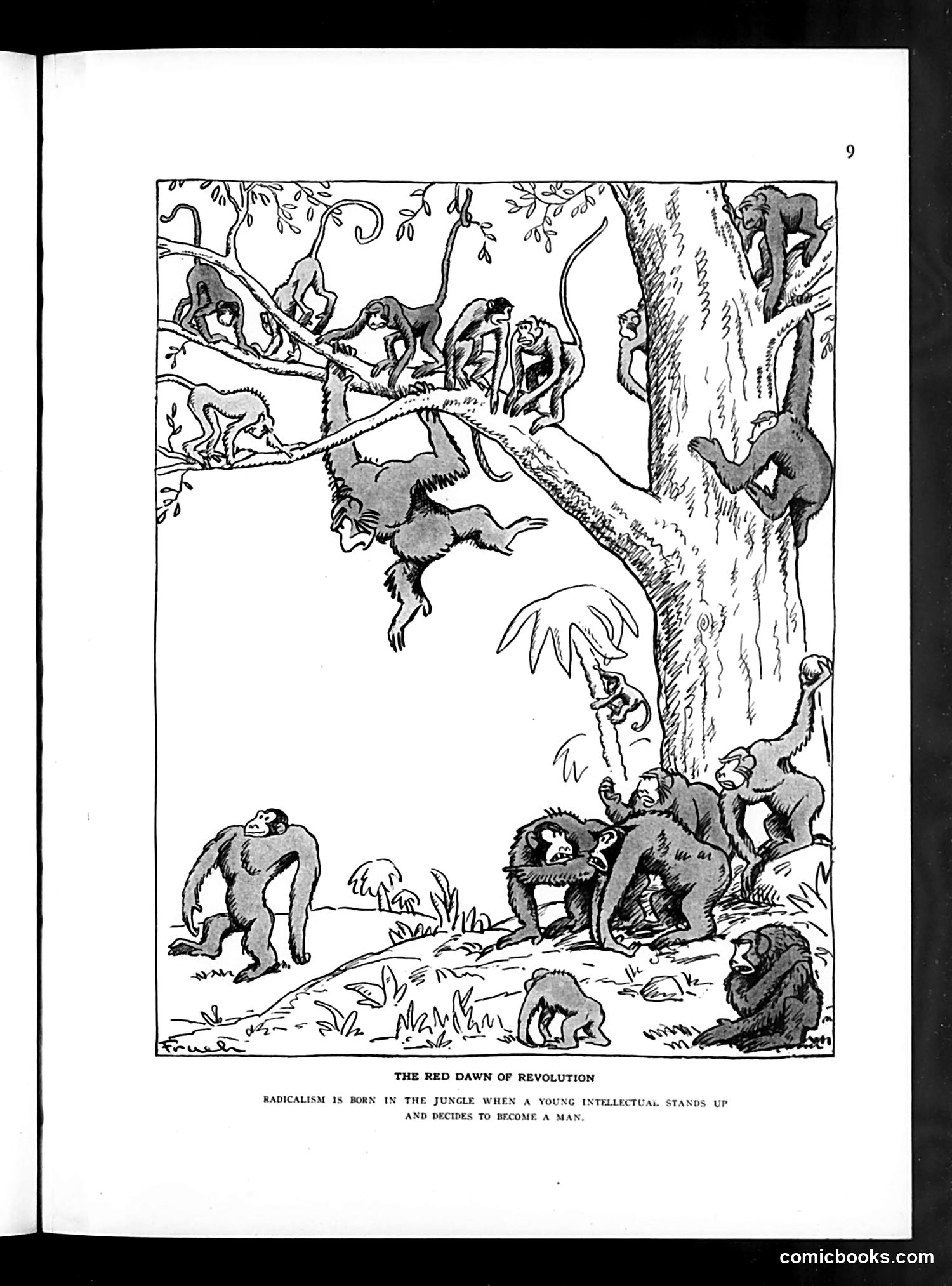
This satirical cartoon depicts radicalism's origins through a Darwinian lens. The image shows primates in a jungle setting, with text asserting: "Radicalism is born in the jungle when a young intellectual stands up and decides to become a man." The satire works through dehumanizing comparison—suggesting radical intellectuals are evolutionarily primitive or ape-like. The cartoon mocks radicals by implying their ideology represents regression rather than progress, and that their claims to intellectual sophistication are false. This reflects early 20th-century anti-radical propaganda common in American publications, using pseudo-scientific evolutionary theory to portray political dissidents as intellectually inferior or base. The "jungle" setting reinforces this primitivist mockery of revolutionary movements.
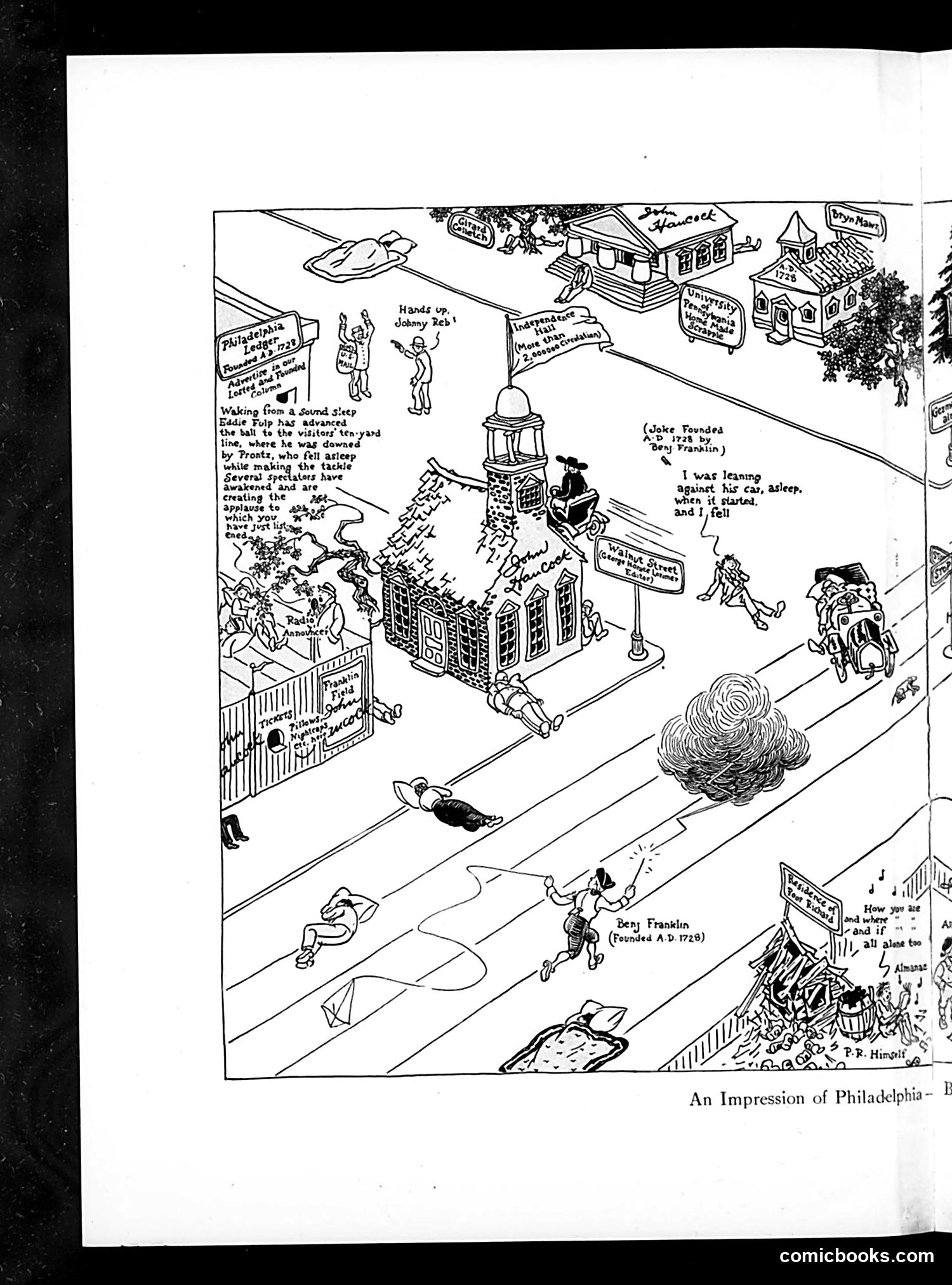
This is a satirical map-style illustration of Philadelphia circa early 20th century. The cartoon depicts various historical and contemporary figures associated with the city: - **Benjamin Franklin** (founded 1728) appears multiple times, reflecting his central importance to Philadelphia's identity - **Jake Founder** (A.D. 1723, Gray Franklin) is referenced - Historical buildings like Christ Church and other colonial-era structures are shown - Various figures engaged in period-appropriate activities populate the streets The satire appears to mock Philadelphia's reliance on its colonial and founding-era identity while depicting contemporary life. The chaotic street scenes with multiple historical references suggest the city's obsession with its Revolutionary War heritage. The humor lies in showing modern Philadelphia as essentially still living in its past, defined entirely by its Founding Fathers rather than current developments.
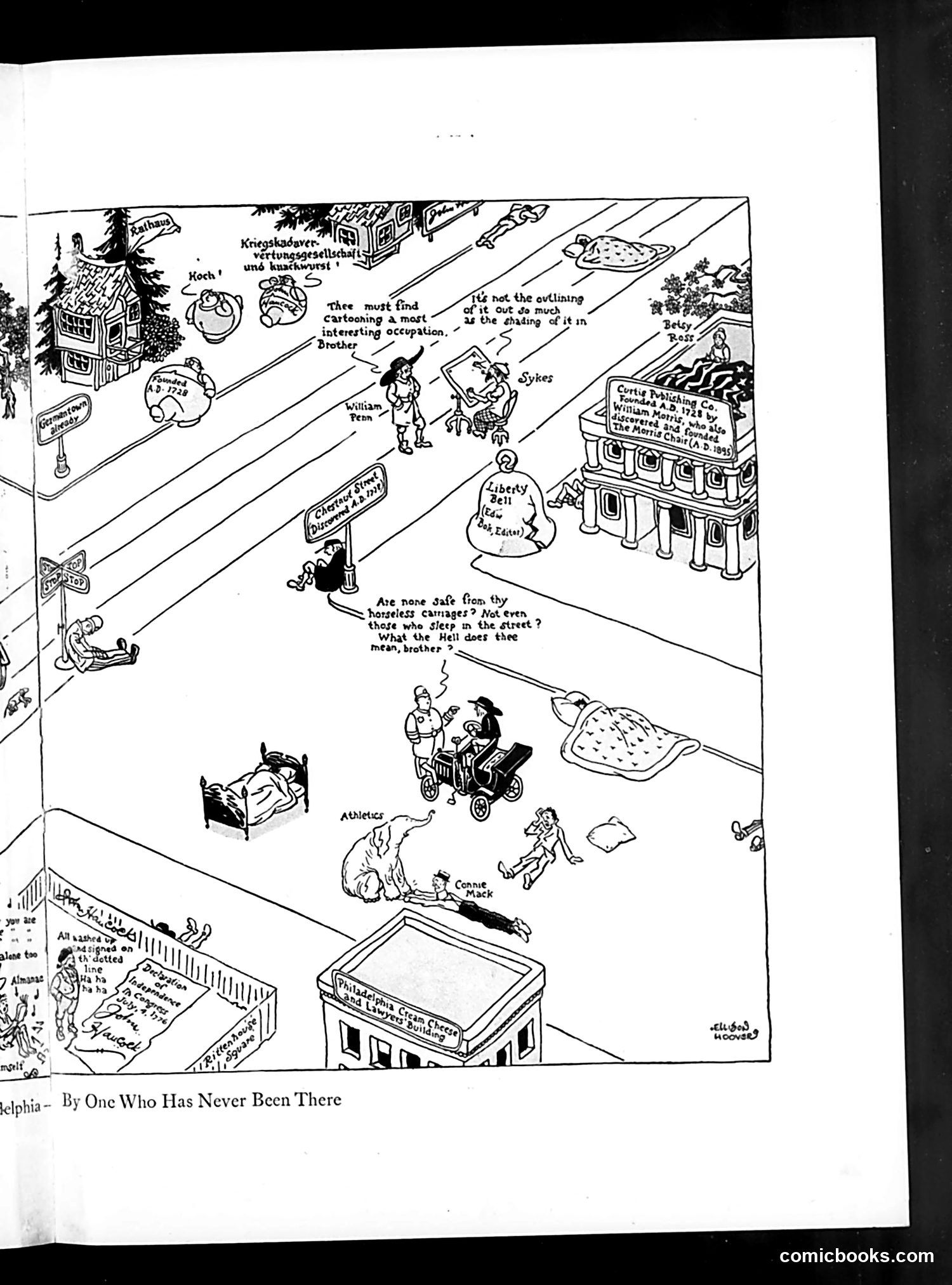
This is a satirical bird's-eye-view cartoon titled "Philadelphia—By One Who Has Never Been There," depicting the city as a chaotic street scene. The cartoon labels various Philadelphia institutions and landmarks: Liberty Bell, Independence Hall, a "Kriegsschadenversicherungsgesellschaft" (German insurance company), and what appears to be a "Zelbes" establishment. The satire centers on social commentary about homelessness and street life. A figure asks pointedly: "Are none safe from thy homeless carriages? Not those who sleep in the street? What the Hell does the mean, brother?" This critiques Philadelphia's visible poverty and vagrancy problems, suggesting the city couldn't escape these urban social issues. The cartoon employs exaggeration and dark humor typical of Life magazine's satirical approach to American social problems of the era.
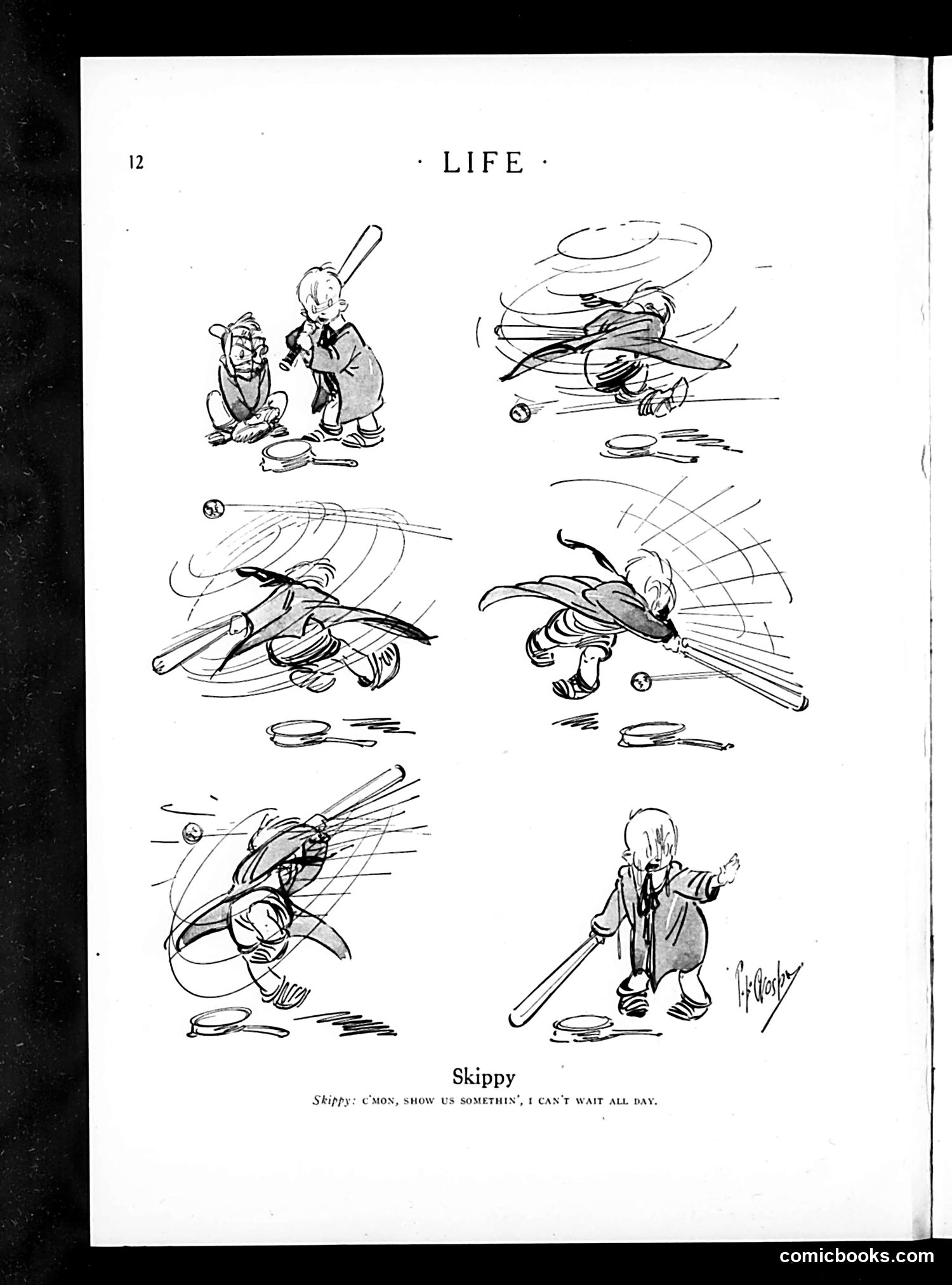
This page shows sequential comic strips featuring "Skippy," a child character engaging in various activities with a baseball bat and ball. The strip's caption reads: "Skippy: C'mon, show us somethin', I can't wait all day." The humor depicts a child's impatience and demands for entertainment or action. The sequential panels show Skippy in different dynamic poses—swinging, playing, moving energetically—capturing the restless energy of childhood. The character appears to be either playing baseball or demonstrating tricks. This appears to be from Life magazine's comics section, likely from the early-to-mid 20th century, showcasing domestic humor about children's behavior rather than political satire. The strip simply captures relatable moments of youthful eagerness and play.
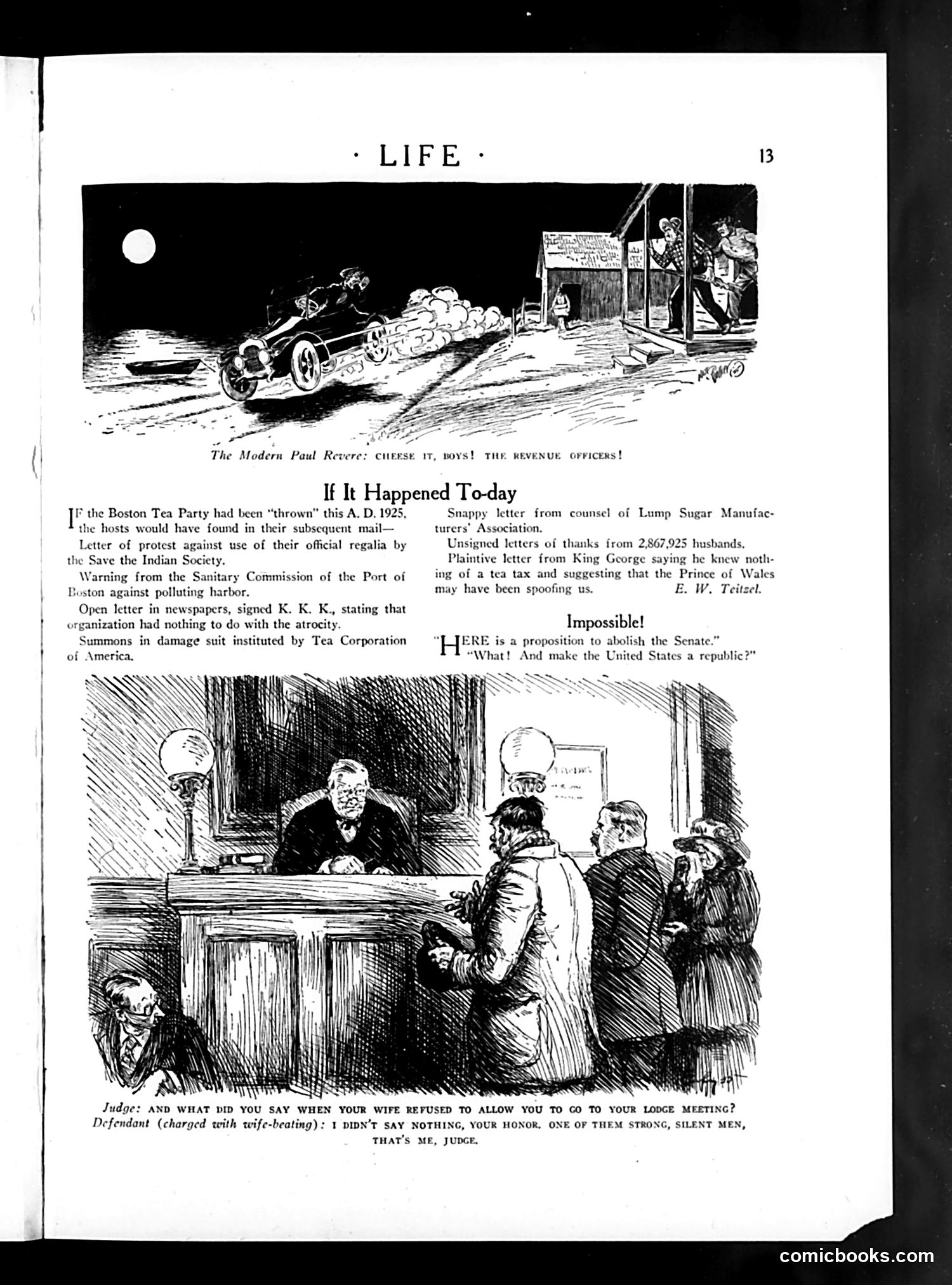
This page contains two satirical pieces mocking hypothetical modern scenarios: **Top cartoon** ("The Modern Paul Revere"): Shows a figure on a motorcycle fleeing revenue officers, satirizing bootleggers during Prohibition—likely referencing alcohol smuggling operations that evaded taxation. **Bottom cartoon** ("Impossible!"): Depicts a courtroom scene where a judge questions a defendant charged with wife-beating. The defendant claims he said nothing when his wife refused to allow him to attend lodge meetings, implying silent acceptance of her authority. The satire mocks the absurdity of a man being unable to control his wife or assert his will in the household—reflecting 1920s gender role anxieties as women's social independence increased post-suffrage. Both pieces satirize contemporary social upheaval: Prohibition enforcement and shifting domestic power dynamics.
The page contains two main editorial pieces critiquing New York Governor Smith's administration and Tennessee's anti-evolution legislation. The **top cartoon** (credited to Dr. Nicholas Murray Butler) appears to show a skeletal or death-like figure, likely representing criticism of Butler's editorial prominence in the *Times*. The **main text** discusses: - Governor Smith's successful reduction of state taxation and waste, earning public backing - Criticism of Tennessee's repeal of evolution law teaching, which the writer views as intellectually backward - Comparison of anti-evolution sentiment to other progressive figures (Rockefeller, Roosevelt, Wilson) who supported scientific advancement The satire targets Tennessee's perceived backwardness in rejecting evolutionary science, positioning it as contrary to modern progress—a reference to Tennessee's famous 1925 "Monkey Trial" controversy.
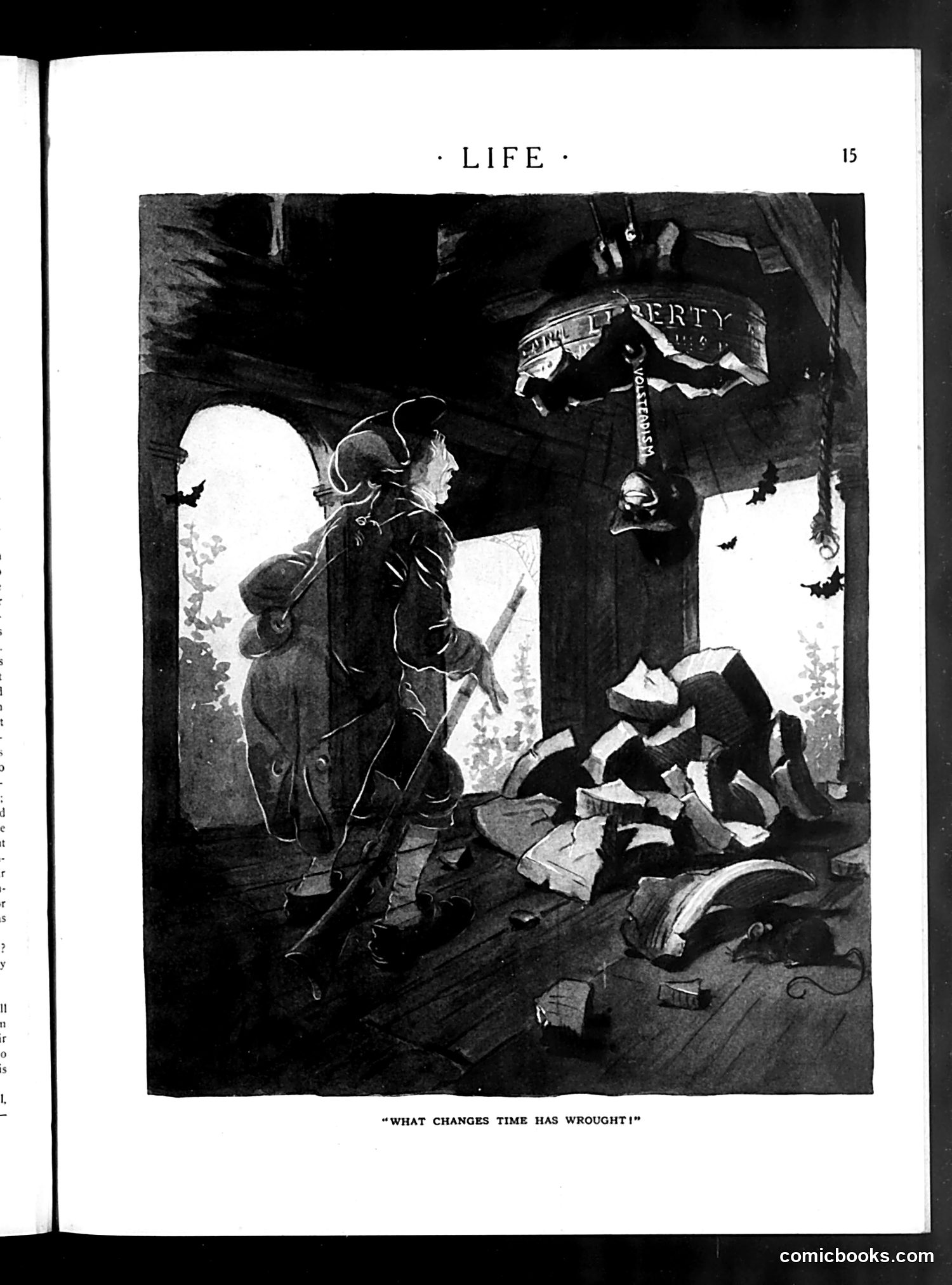
This satirical cartoon contrasts past and present. On the left stands a figure in colonial/revolutionary-era military uniform, representing America's founding period. On the right lie scattered items including what appears to be a torn "Liberty" banner or flag, along with debris and discarded objects on the floor. The caption's question—"What changes time has wrought!"—suggests ironic commentary on American decline or corruption since the nation's founding ideals. The juxtaposition implies that the revolutionary principles of liberty have been abandoned or destroyed, replaced by decay and disorder. The cartoon criticizes how far the nation has strayed from its original values, though the specific historical moment referenced remains unclear without publication date context.
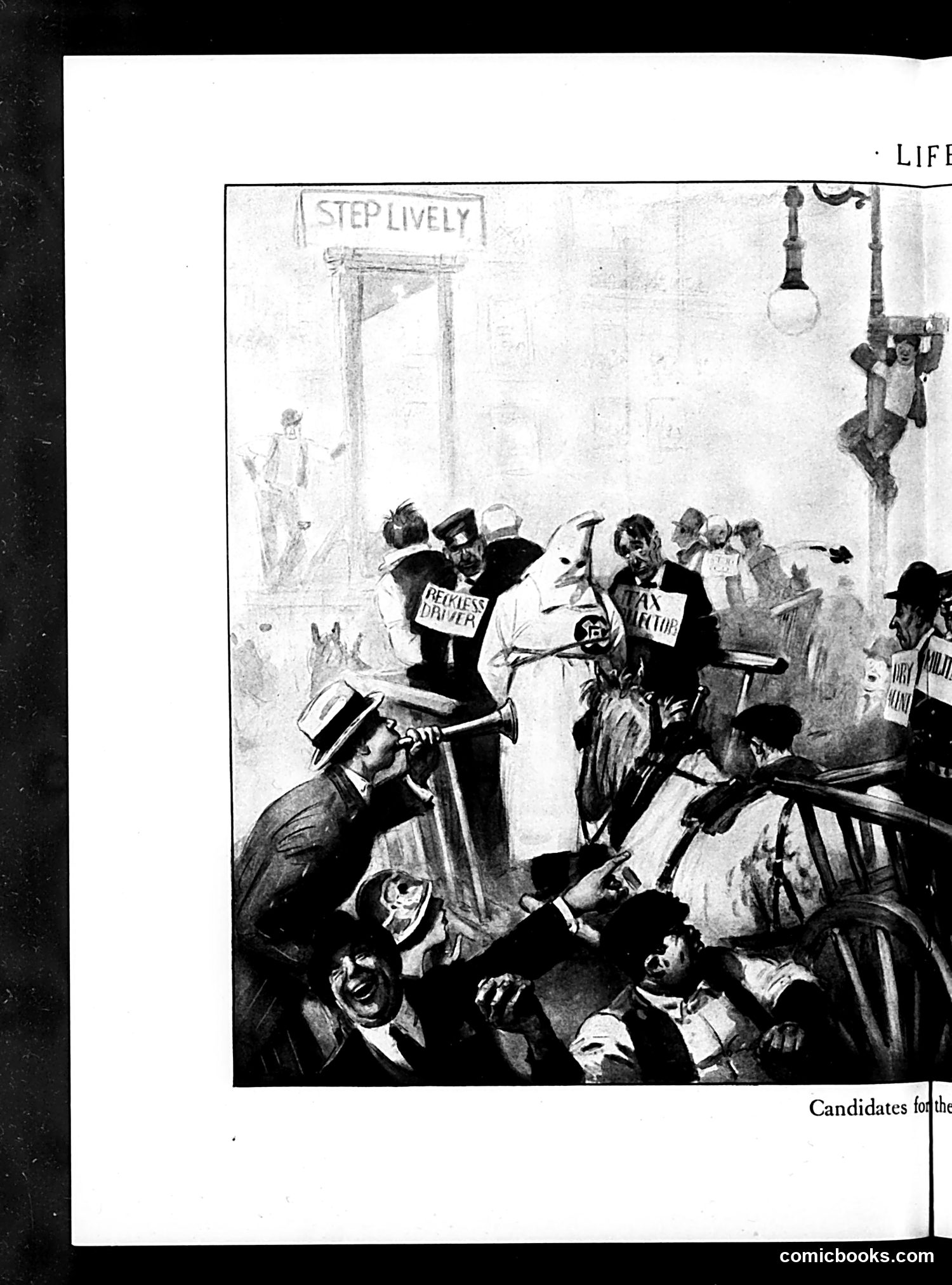
This appears to be a satirical cartoon about political candidates, though the OCR text is incomplete. The image shows a crowded street scene with figures wearing signs reading "RECKLESS DRIVER" and "TAN RETURN"—likely mocking candidates as dangerous or unfit for office. A man with a megaphone appears to be campaigning or making announcements to a gathered crowd. The "STEP LIVELY" sign above suggests urgency or chaos. The cartoon seems to critique candidates as reckless or incompetent, using the visual metaphor of dangerous drivers. Without a complete caption or date, the specific election or figures referenced remain unclear, but the overall satirical point appears to be mocking the quality or fitness of available political candidates for office.
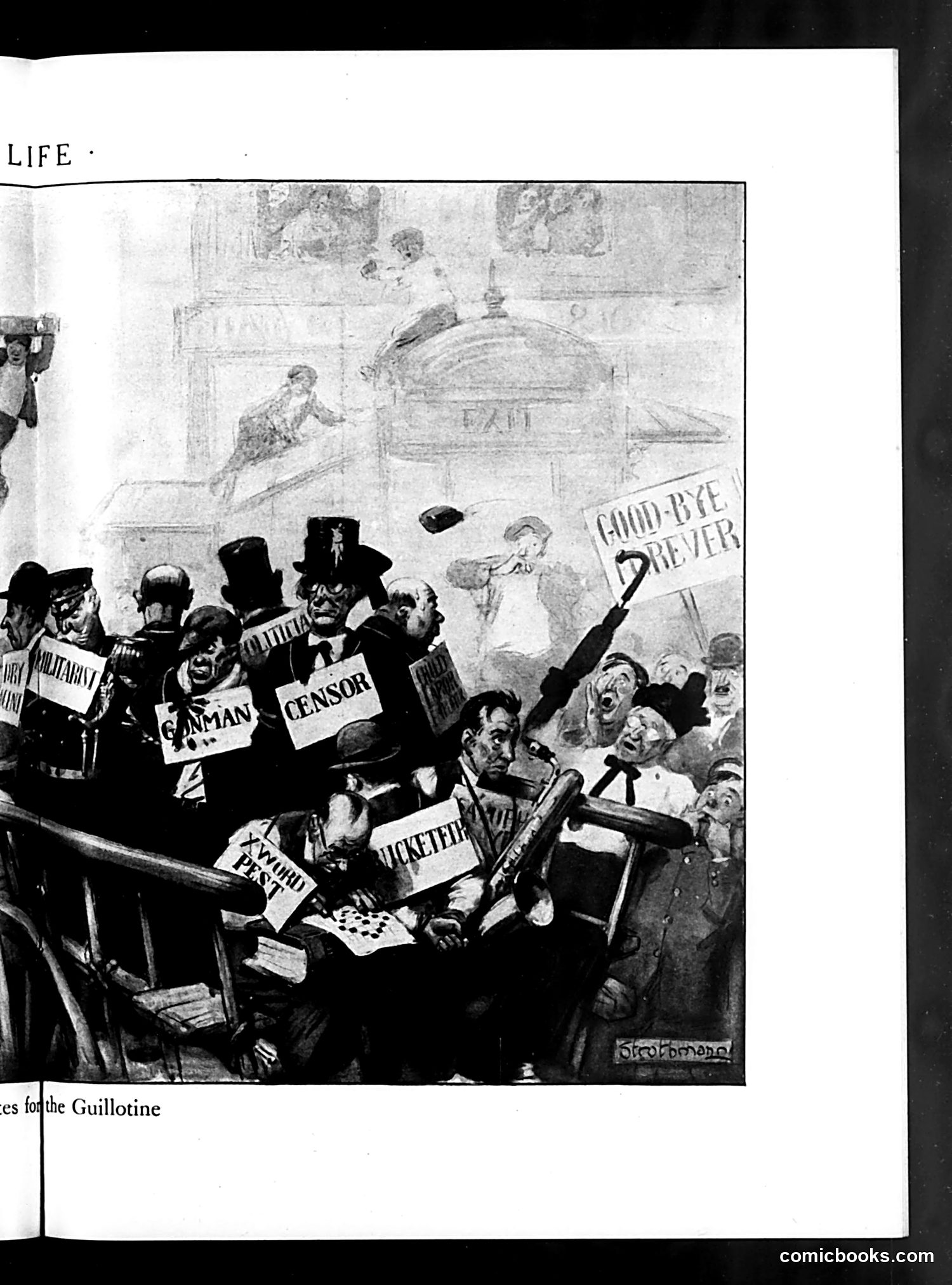
This satirical cartoon depicts figures labeled with censorship and authoritarianism—including one marked "CENSOR"—riding in a cart toward the guillotine. The caricatured characters appear to represent repressive authorities or ideologies. One protester holds a sign reading "GOOD-BYE FOREVER," suggesting public celebration of their removal. The cartoon likely critiques governmental censorship and authoritarian control, depicting them as destined for destruction—a common satirical trope. The guillotine reference evokes revolutionary justice, though the specific historical context (whether WWI-era, 1920s, or another period) isn't entirely clear from the image alone. The artwork style and "LIFE" magazine publication suggest early-to-mid 20th century American political commentary opposing censorship and autocratic governance.
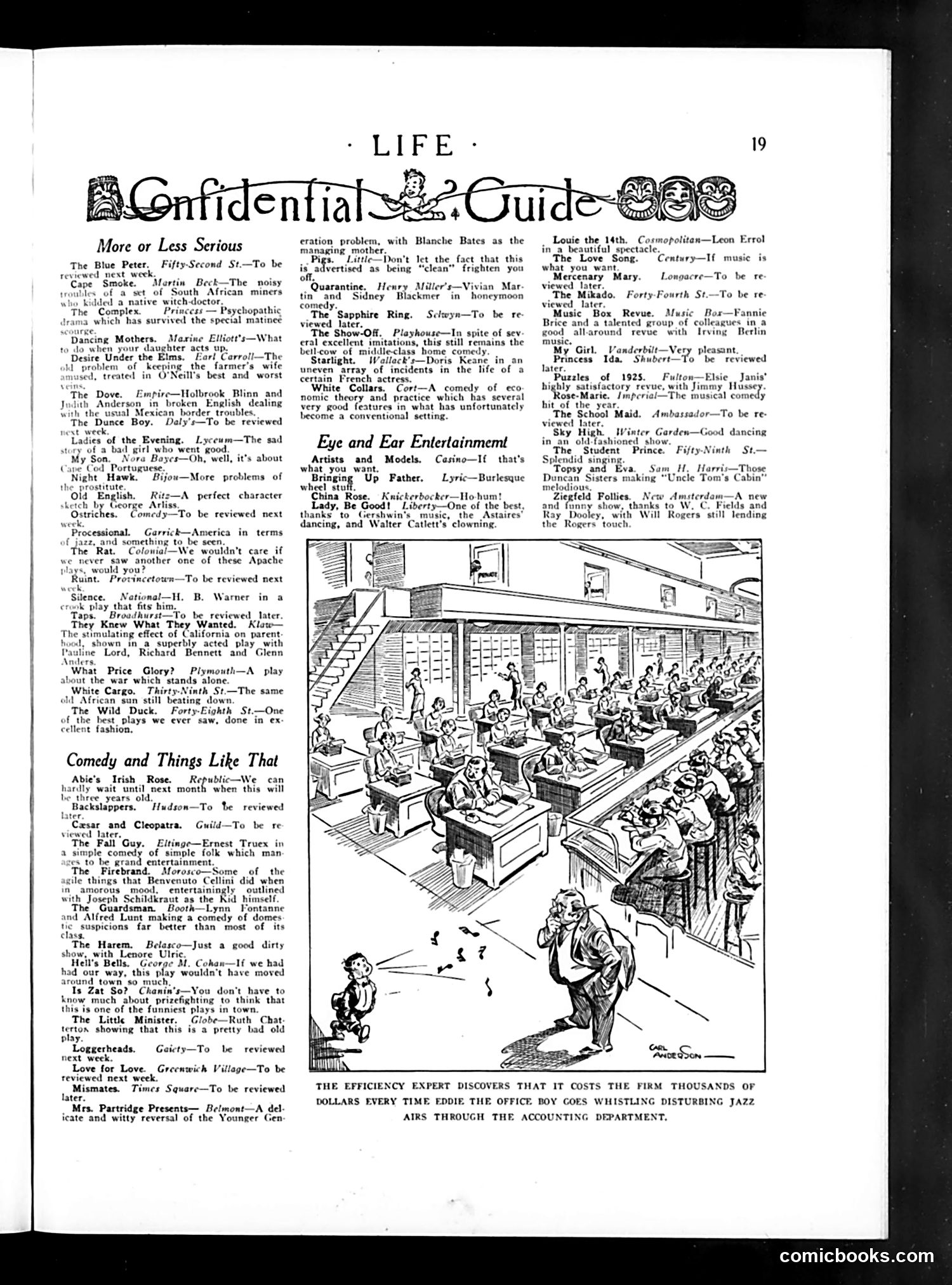
This page is a theater review section listing Broadway productions with brief critical assessments. The accompanying cartoon illustrates a satirical point about office inefficiency. The cartoon depicts an accounting department crowded with workers at desks. In the foreground, a single office boy whistles while walking through, disturbing the concentration of dozens of accountants. The caption reveals the joke: **an "efficiency expert" discovered the firm loses thousands of dollars every time this boy whistles through the accounting department**, disrupting the workers. The satire targets two things: the emerging "efficiency expert" consulting trend of the 1920s, which claimed scientific management could optimize business operations, and the absurdity of blaming minor disruptions for massive financial losses rather than examining actual business practices. It mocks both corporate obsession with cost-cutting and the false precision of early management science.
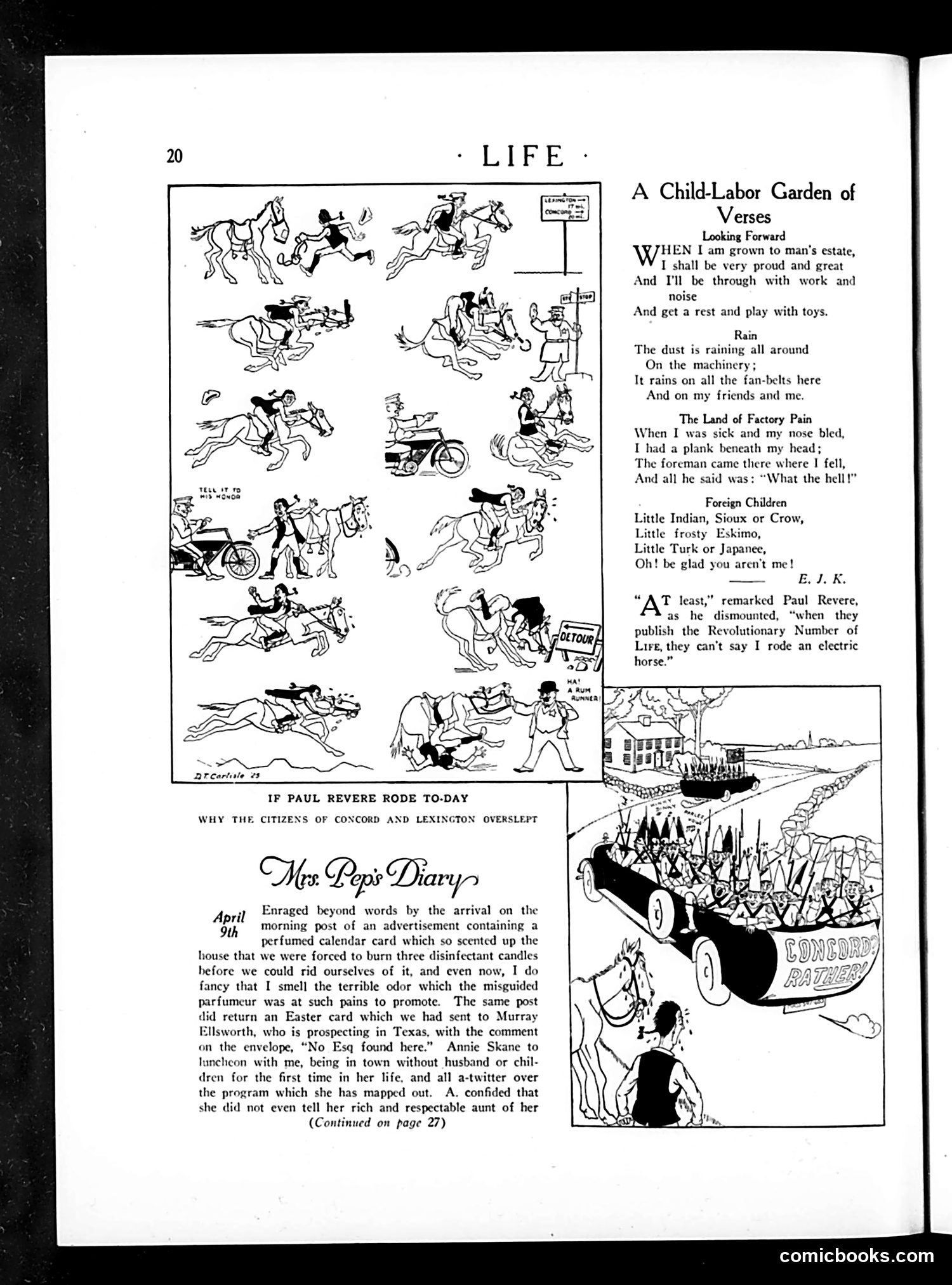
This page satirizes child labor in early 20th-century American factories. The left cartoon depicts children performing dangerous industrial work—operating machinery, riding bicycles as messengers—with dark humor in accompanying verses ("Rain" describes dust raining on machinery and children alike; "Factory Pain" shows a injured child dismissed by an uncaring foreman). The satire's central point: children imagine adulthood as escape from labor, yet foreign children are urged to be grateful they aren't American factory workers—inverting the typical assumption that American childhood is privileged. The Paul Revere section mocks modern advertising's pervasiveness: if Revere rode today, his midnight warning would be drowned out by perfumed calendar advertisements clogging the mail, rendering his historic ride unnoticed. This ridicules how commercial excess undermines civic attention. Together, these pieces critique industrial exploitation and advertising's invasive absurdity in contemporary American life.
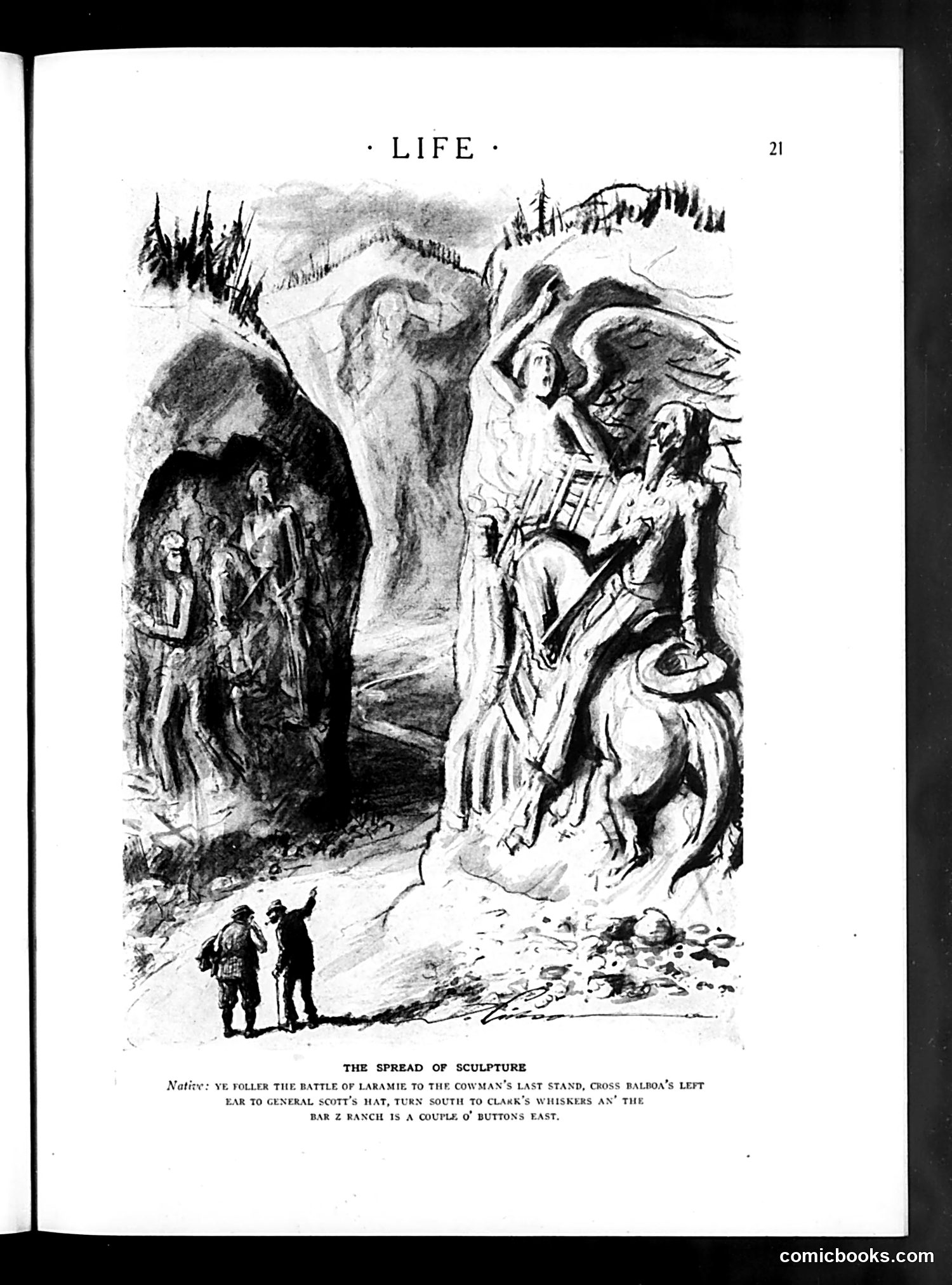
This cartoon mocks the proliferation of public monuments and statues across the American West. The absurdist caption uses landmarks named after historical figures (Laramie, Balboa, General Scott, Clark) as literal directions—treating oversized sculptures as actual geographical features used for navigation. The humor targets how densely these commemorative statues had become scattered across the landscape, treating them as absurd obstacles rather than honored tributes. By presenting them as navigation hazards alongside ranches and natural landmarks, the cartoonist satirizes the monument-building craze as excessive and ridiculous. The two small figures at the bottom emphasize human insignificance against these towering sculptures, reinforcing the visual joke about their overwhelming prevalence in the American frontier landscape.
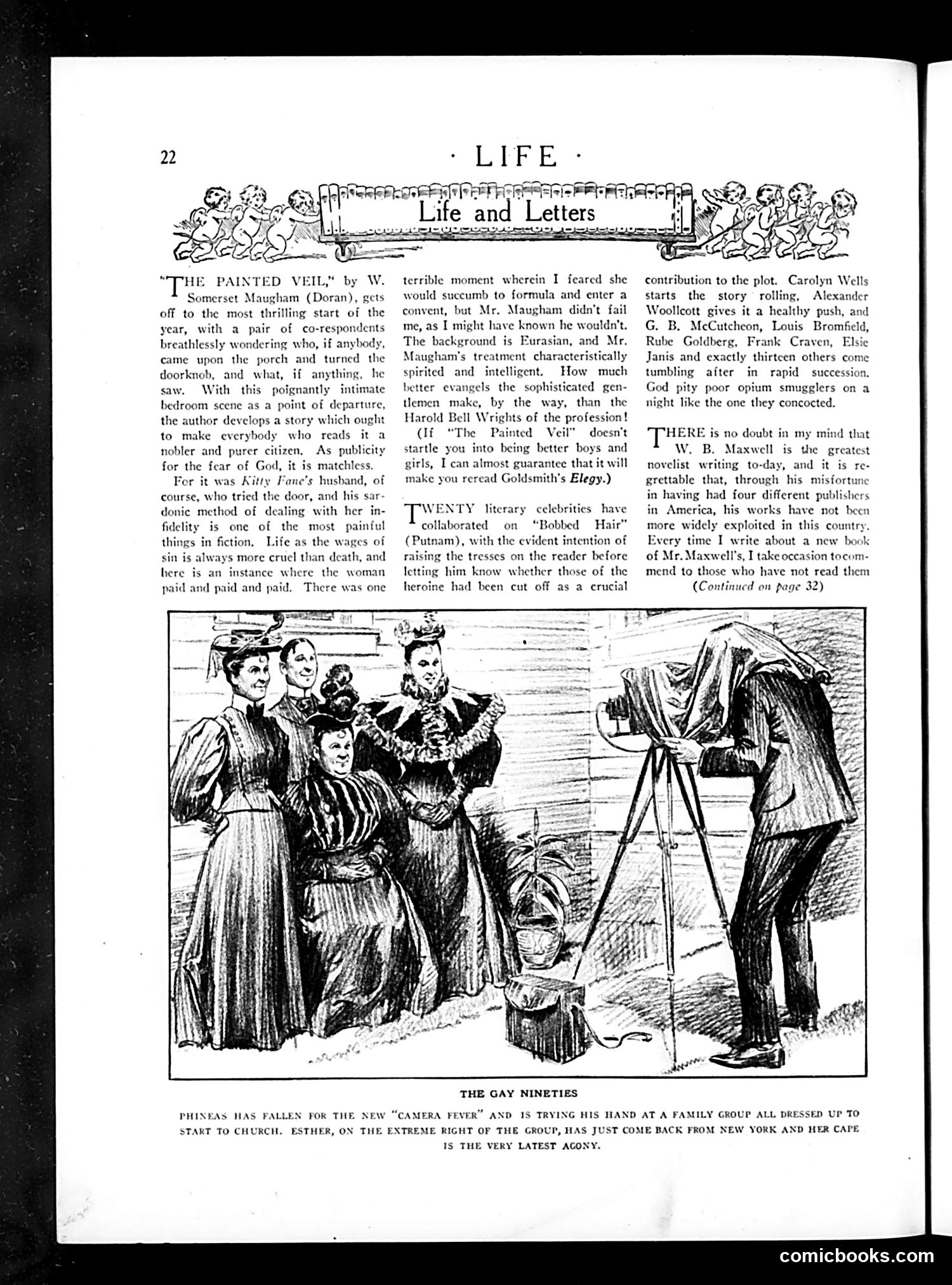
This page from *Life* magazine reviews three contemporary novels and features one cartoon. The reviews are critical commentaries on books by W. Somerset Maugham, a collaborative anthology called "Bobbed Hair," and W.B. Maxwell's work. The cartoon at bottom, titled "The Gay Nineties," satirizes early photography and fashion. It depicts a photographer struggling with an old camera tripod while posing a formally dressed family group. The caption notes that "Phineas has fallen for the new 'camera fever'" and attempts to photograph the family before church. The joke targets the 1920s nostalgia craze for 1890s aesthetics—the "Gay Nineties"—and mocks both the awkwardness of early photography equipment and the pretentiousness of families dressing elaborately for photos. The character "Esther" returning from New York with a fashionable cape represents modern style contrasting with the outdated photography attempt.
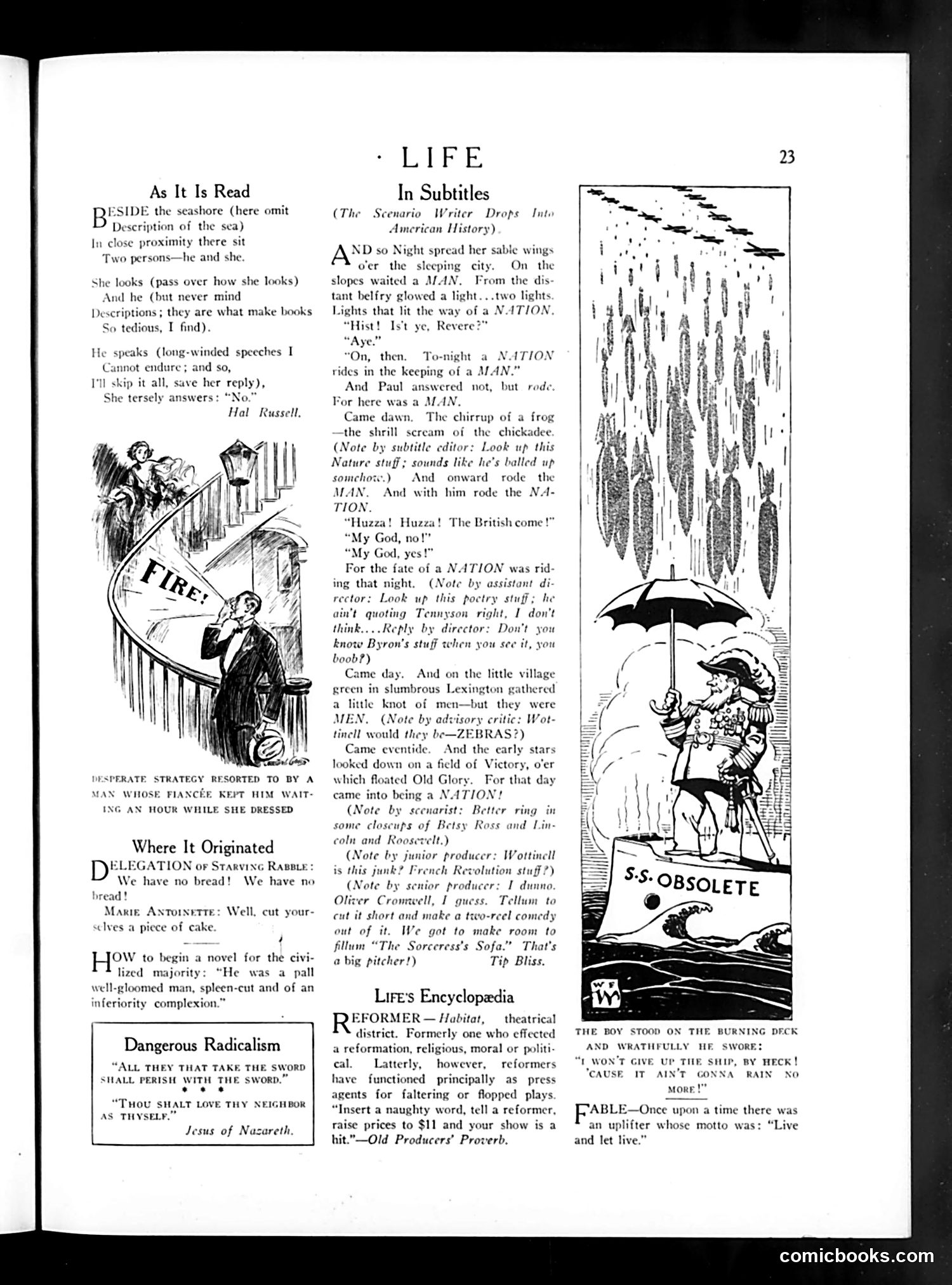
This page satirizes early 20th-century American cultural pretensions and film industry practices. **Main targets:** 1. **"As It Is Read"** – Mocks overwrought literary conventions of the era, where authors laboriously describe trivial details. The joke: a man's desperate attempt to impress his fiancée after waiting an hour while she dressed. 2. **"In Subtitles"** – Parodies silent film melodrama, specifically Revolutionary War narratives. The satirical editors' notes mock filmmakers for misquoting poetry, confusing historical events, and prioritizing spectacle over accuracy. References to "The Sorceress's Sofa" suggest producers care more about box-office gimmicks than quality. 3. **"Life's Encyclopedia"** – Defines "Reformer" as theatre-district figures who exploit moral causes to promote failing plays, raising ticket prices to $11 by inserting "naughty words." 4. **"Dangerous Radicalism"** – Ironically juxtaposes Jesus's pacifist teachings against sword-bearing militarism, critiquing those who cite Scripture selectively. The overall theme: criticism of shallow commercialism masquerading as art and morality in contemporary American culture.
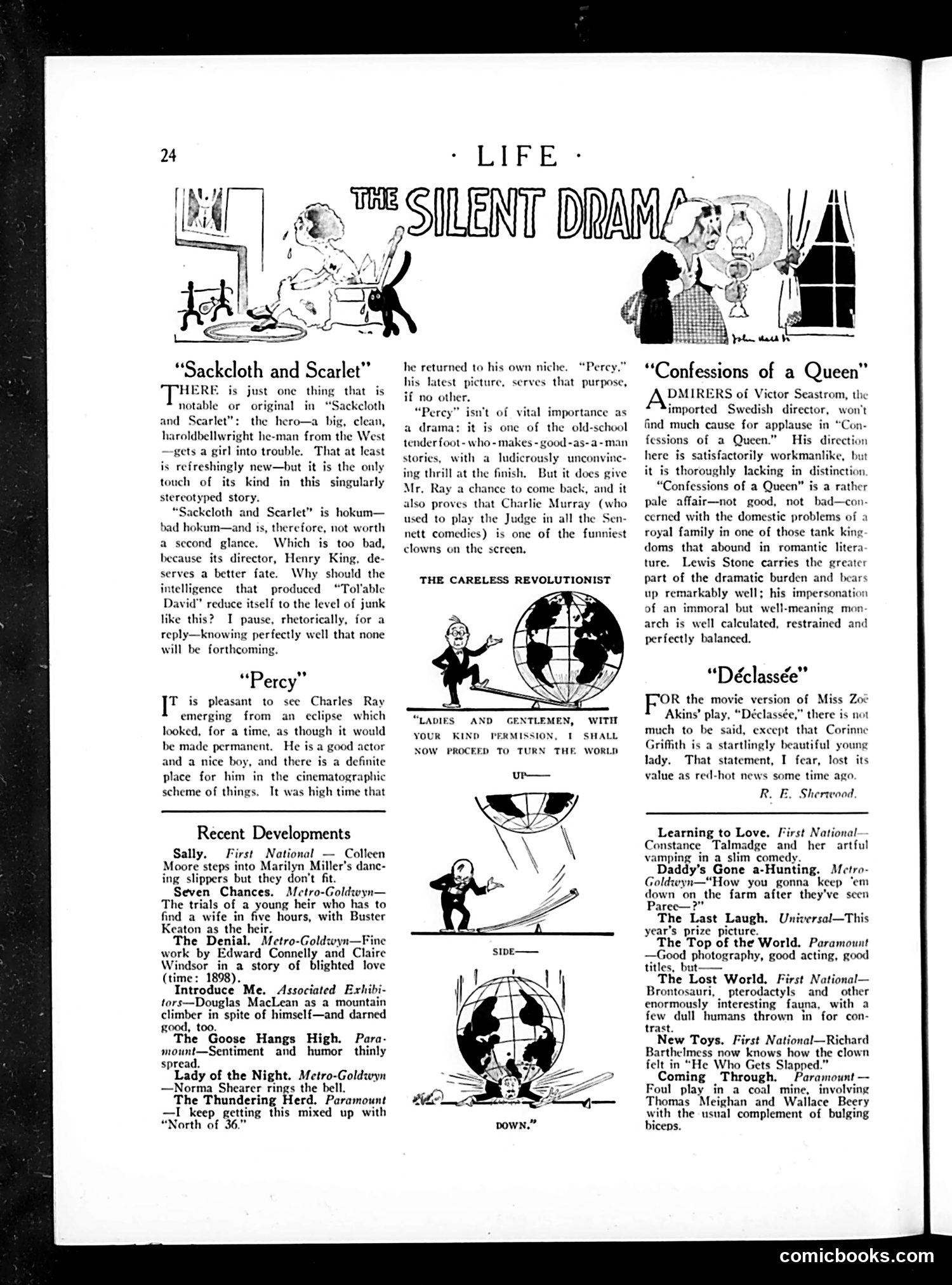
This page reviews silent films from the mid-1920s. The cartoons illustrate movie titles: "The Careless Revolutionist" shows a figure gesturing theatrically at a globe, mocking melodramatic revolutionary plots common in silent cinema. The reviews are notably harsh. "Sackcloth and Scarlet" is dismissed as formulaic hokum despite director Henry King's prior success with "Tol'able David." "Percy" is praised mainly for giving actor Charles Ray comeback work and showcasing comedian Charlie Murray. "Confessions of a Queen" critiques imported Swedish director Victor Seastrom's competent but uninspired direction of a romance involving royalty. "Déclassée" is sarcastically praised solely for actress Corinne Griffith's beauty, suggesting the film itself lacks merit. The "Recent Developments" section briefly notes other releases, praising Buster Keaton's "Seven Chances" and Norma Shearer's performance in "Lady of the Night," while noting Colleen Moore inadequately fills Marilyn Miller's shoes in "Sally." The tone reflects period film criticism's emphasis on star power and directorial reputation over plot.
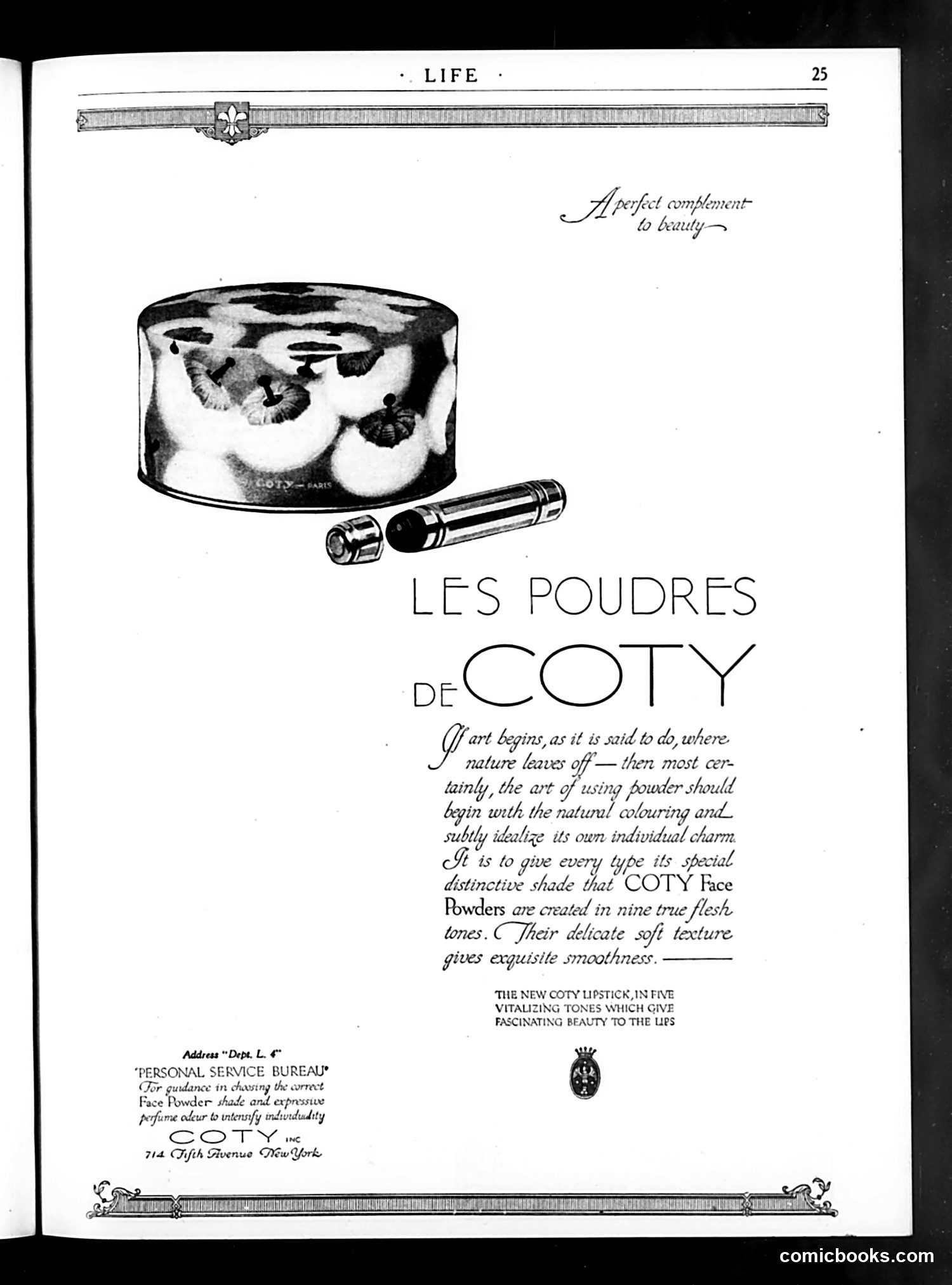
This is a **cosmetics advertisement**, not a cartoon or satire. It promotes Coty brand face powders and lipstick. The ad makes a pitch common to 1920s-era beauty marketing: that cosmetics are an *art form* completing nature rather than deceiving. The copy claims Coty powders come in "nine true flesh tones" to match individual skin, positioning the product as sophisticated and scientifically calibrated rather than artificially mask-like. The image shows a powder compact with a makeup brush. The tagline "A perfect complement to beauty" frames cosmetics as enhancement, not deception—a marketing strategy that helped legitimize makeup use among middle and upper-class women during this era, when heavy cosmetics had previously carried associations with theater or moral impropriety. The "Personal Service Bureau" contact suggests Coty offered shade-matching consultation, emphasizing individualized beauty advice.
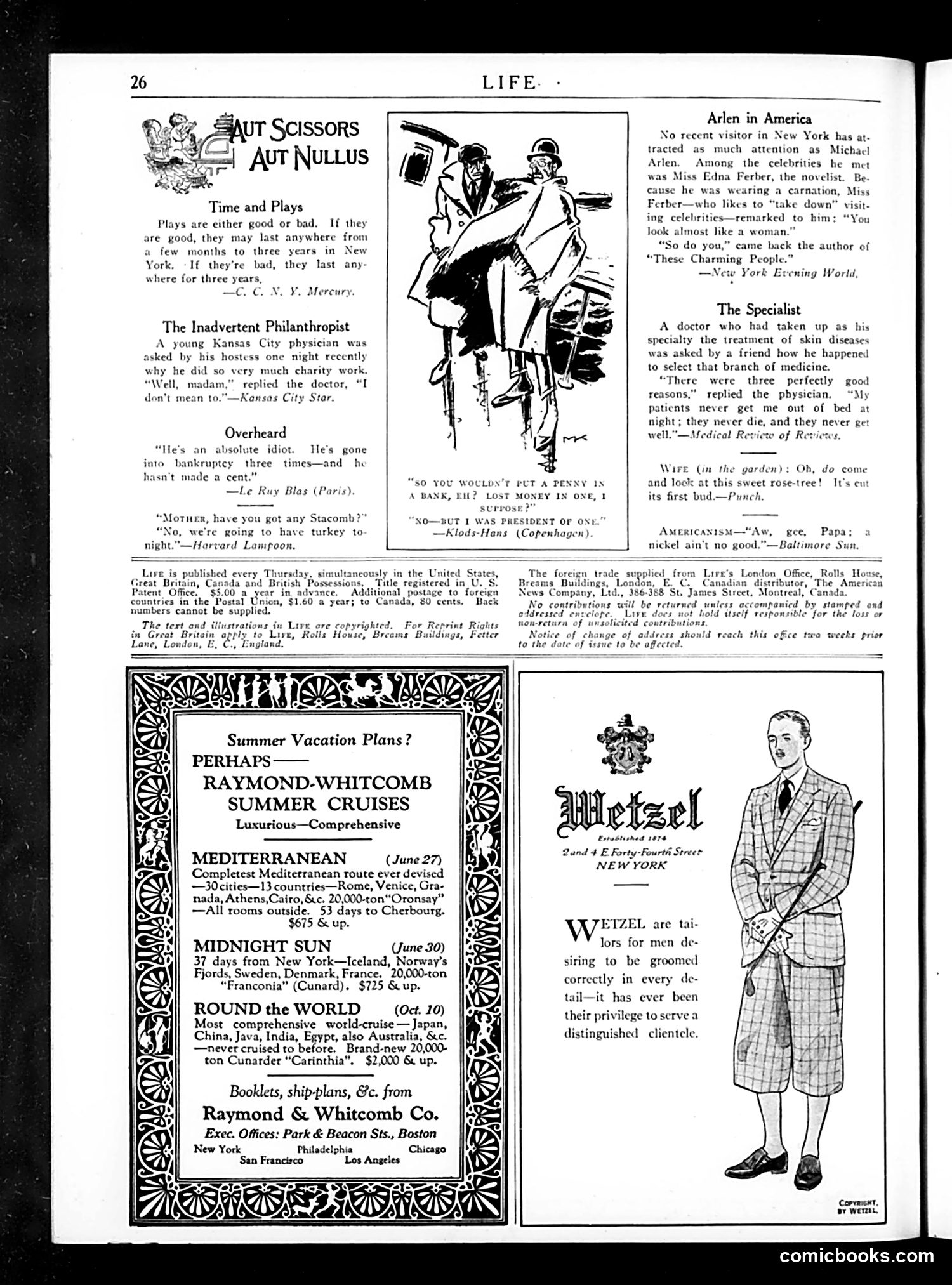
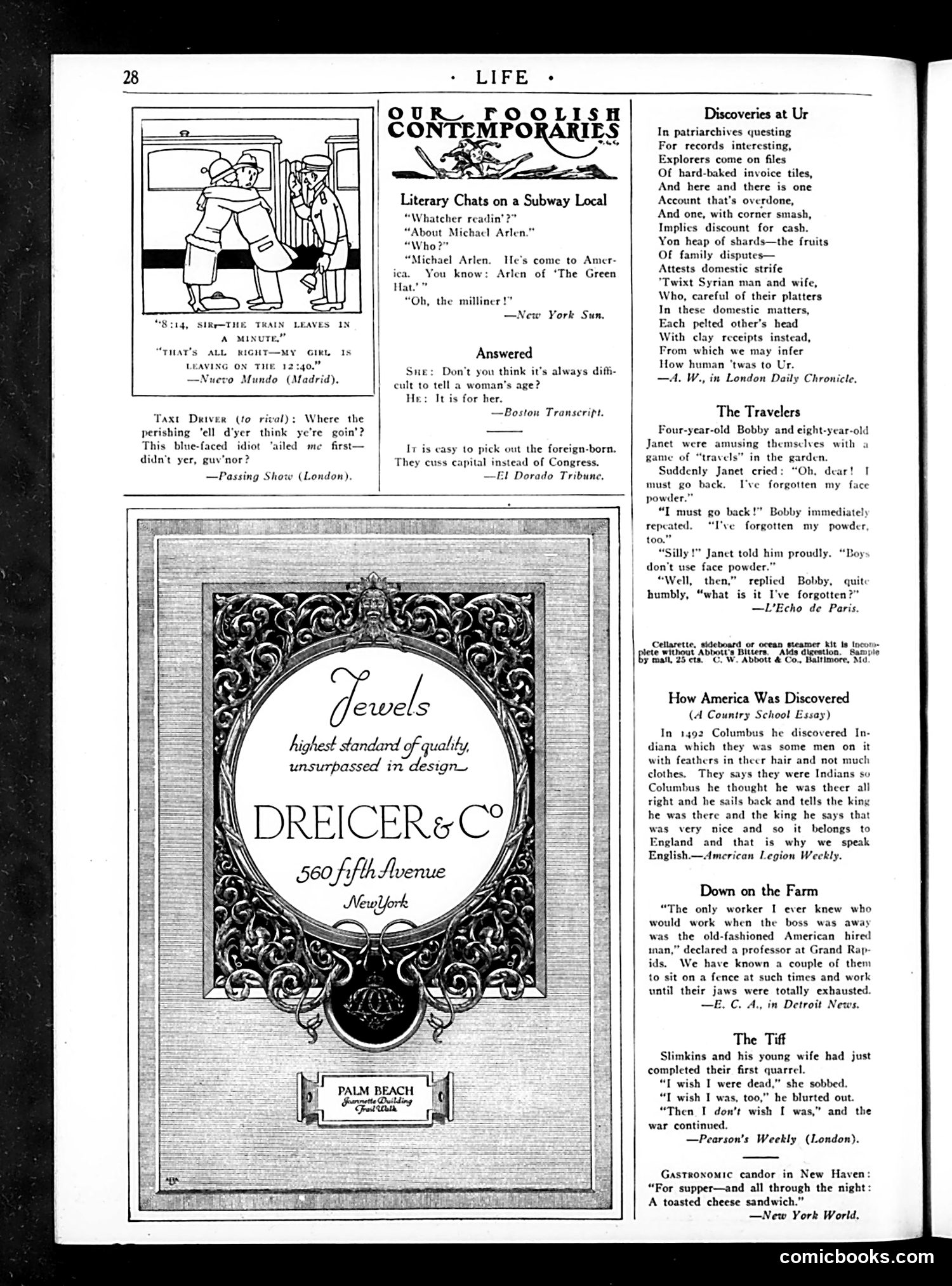
This page from *Life* magazine (circa 1920s) combines satirical short humor pieces with advertisements. **Main Content:** The "Aut Scissors/Aut Nullus" section features brief jokes and anecdotes on topical subjects: - **Arlen in America**: References Michael Arlen, a visiting British-Armenian author of the 1920s who attracted celebrity attention. The joke involves novelist Edna Ferber's witty insult about his appearance ("you look almost like a woman"). - **Overheard jokes**: Quick satirical quips from various international newspapers mocking bankruptcy, financial incompetence, and American materialism (the "nickel ain't no good" closing joke). - **The Specialist/Inadvertent Philanthropist**: Gentle humor about a dermatologist's practical career choice and a physician's accidental charity work. **The Advertising Section** features Raymond-Whitcomb luxury cruise packages—expensive tourist experiences to Mediterranean, Arctic, and world destinations—reflecting the wealthy readership *Life* targeted. The *Wetzel* tailoring advertisement emphasizes refinement and proper grooming for gentlemen.
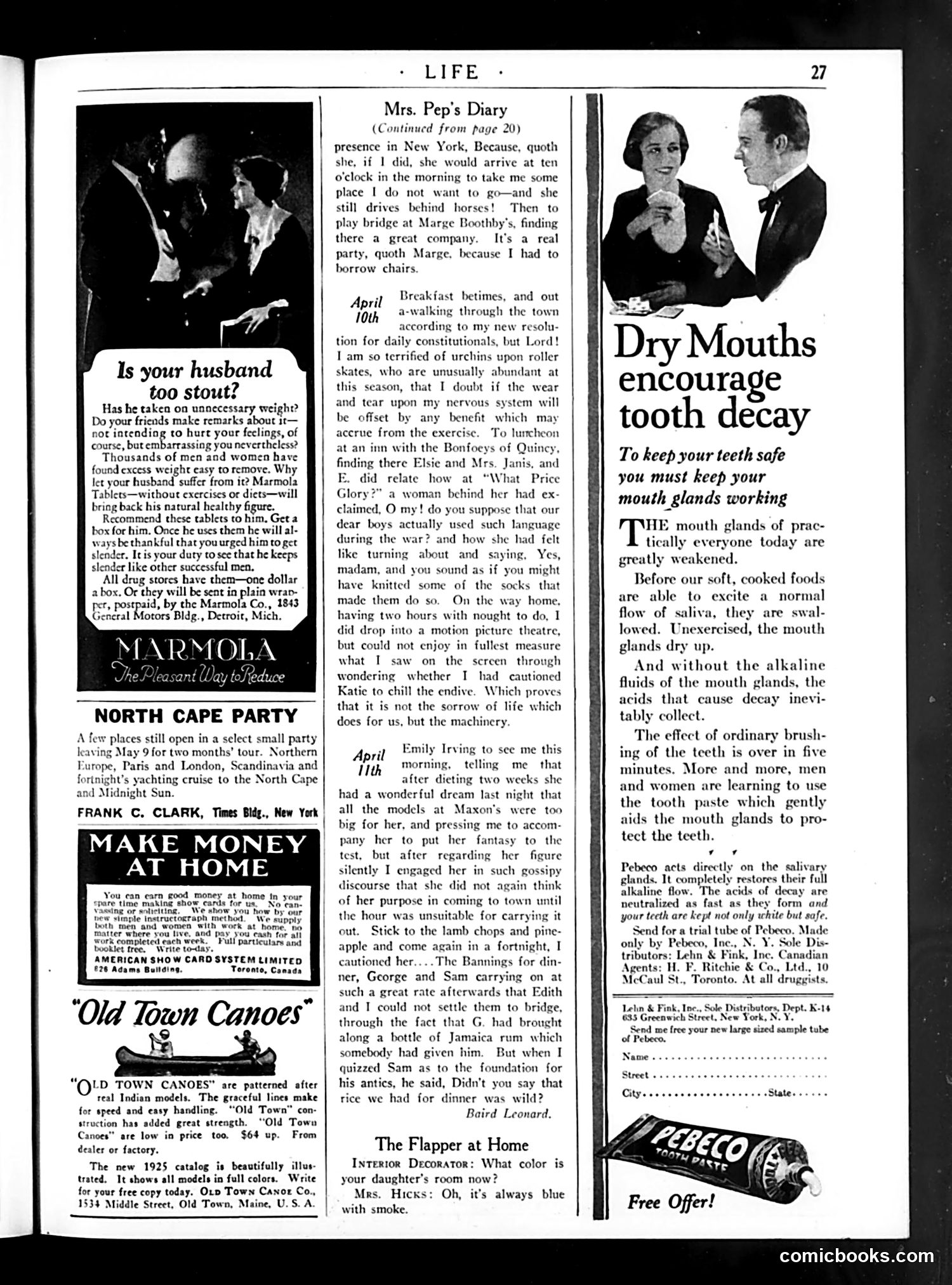
This page mixes editorial content with period advertising reflecting 1920s consumer anxieties. **The Main Cartoon**: The top-left image shows a couple at what appears to be a social gathering. The accompanying advertisement ("Is your husband too stout?") uses shame-based marketing to sell Marmola weight-loss tablets—targeting wives to pressure husbands into slimness. This reflects 1920s anxieties about modern body standards and marriage dynamics, with the implicit message that a woman's social status depends on her husband's appearance. **Mrs. Pep's Diary**: The serialized humor column depicts upper-middle-class social life—bridge parties, restaurant lunches, motion pictures—capturing contemporary concerns: fear of younger generations' slang (references WWI soldiers' language), household management details, and women's leisure activities during the modernizing 1920s. **Right-side content**: "Dry Mouths encourage tooth decay" is a genuine dental health advisory promoting proper oral hygiene, while "The Flapper at Home" offers interior decorating advice—both reflecting Jazz Age modernity and consumer consciousness. The overall effect captures 1920s preoccupations with appearance, consumption, and social conformity.
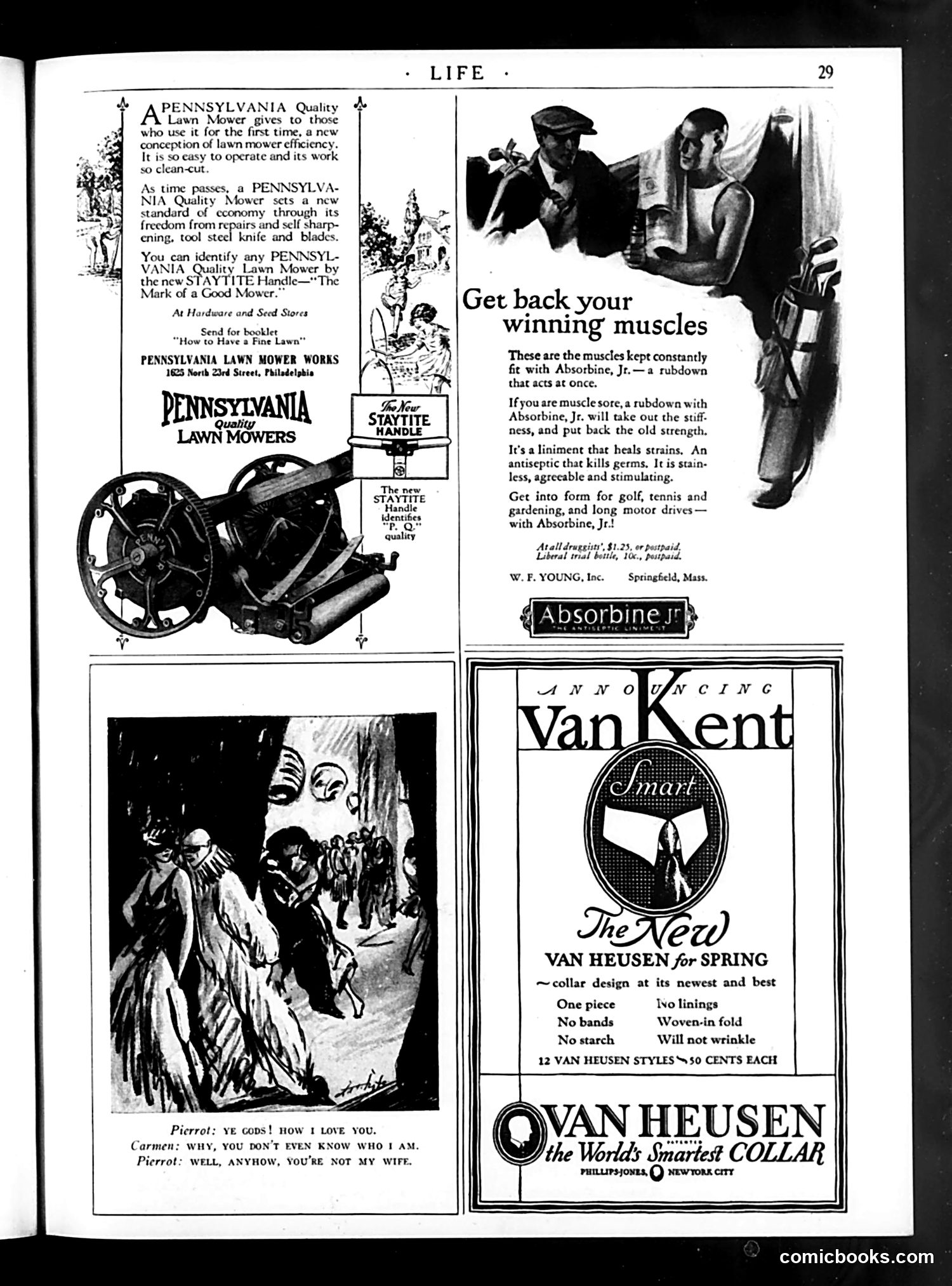
This page consists primarily of **advertisements** rather than satirical content. The three main ads promote: 1. **Pennsylvania Lawn Mowers** — emphasizing durability, ease of operation, and a distinctive "Staytite Handle" 2. **Absorbine, Jr.** — a liniment marketed to athletes and active people (golfers, tennis players) as a remedy for muscle soreness and strains 3. **Van Heusen Collars** — announcing a new "smart" collar design for spring with practical features (no starch needed, won't wrinkle, woven-in folds) The only cartoon element is a small **theatrical sketch** showing two characters—Pierrot and Carmen—in what appears to be a scene from commedia dell'arte or vaudeville. The joke plays on mistaken identity: Pierrot loves the woman before him, but when she protests he doesn't even know who she is, he dismisses this, saying at least she's not his wife. This relies on period humor about marriage and infidelity. The page reflects early 20th-century consumer advertising and popular entertainment rather than political satire.
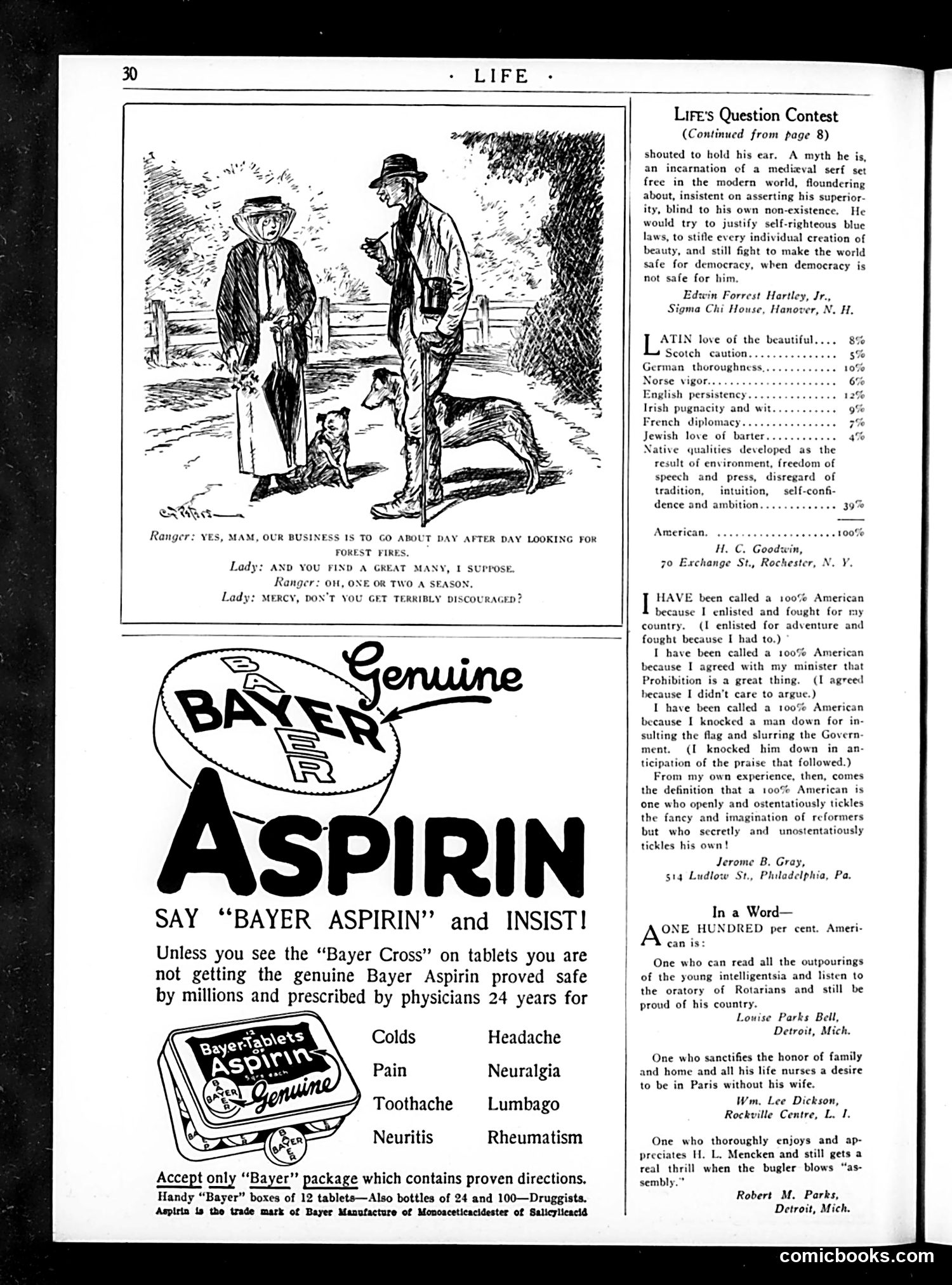
## The Main Cartoon The top cartoon depicts a forest ranger and a lady. He explains his job is searching for forest fires daily but finds only "one or two a season." The lady expresses surprise he isn't "terribly discouraged." The joke is understated irony: the ranger's job seems futile, yet he persists—suggesting either admirable dedication or absurd futility depending on interpretation. ## The Contest Submissions The bulk of the page features "Life's Question Contest" responses defining what makes a "100% American." The entries are satirical critiques of American patriotism and values: - One submission mocks performative patriotism: people called patriotic for enlistment, supporting Prohibition, or defending the flag—yet doing these things superficially or hypocritically. - Another reduces American identity to statistical percentages of ethnic traits (Latin, German, Irish, etc.), suggesting American identity is merely a mixed composite. - Final entries satirize American hypocrisy: valuing family honor while wanting to escape to Paris; enjoying H.L. Mencken's cynical critiques while feeling patriotic. The satire targets hollow patriotic gestures and self-righteous reformism of the era (likely 1920s, given Prohibition reference). ## Advertising The Bayer Aspirin ad occupies lower space—typical period magazine placement.
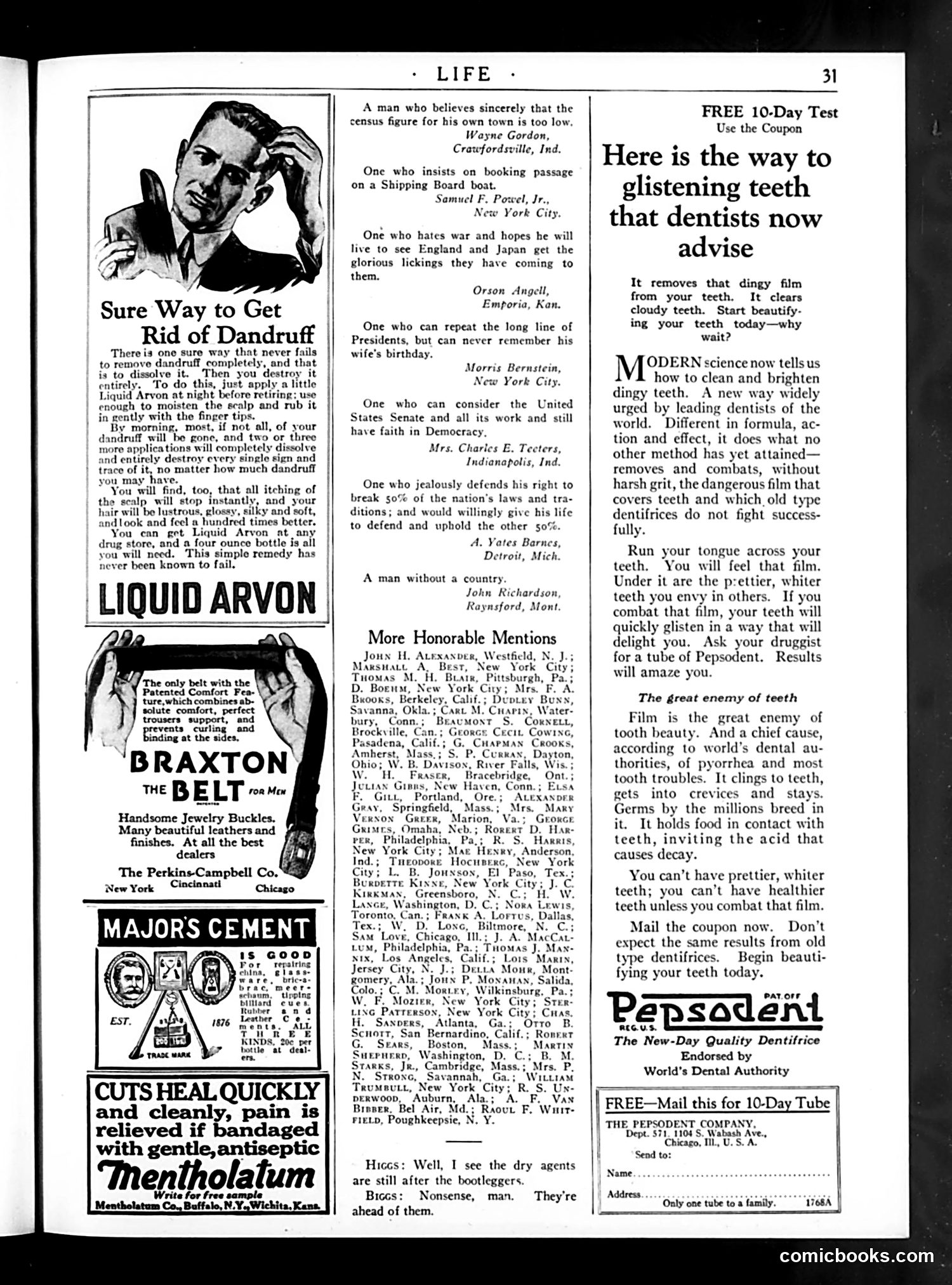
This page features a satirical cartoon titled "Sure Way to Get Rid of Dandruff," but it's actually a humorous list of "impossible men"—people who don't exist or represent absurd contradictions. The caricatured head at top left introduces the joke. Below are definitions of fictional types, including: a man who believes his town's census is undercounted, someone eager to book passage on a Shipping Board vessel (likely referencing unpopular government wartime ships), and a man hoping England and Japan receive "glorious lickings" despite claiming to hate war. The satire targets hypocrites, selective patriots, and illogical citizens. One entry mocks those who defend breaking half of national laws while upholding the other half—poking fun at selective patriotism during the post-WWI era when Prohibition and other contentious regulations divided American opinion. The final joke (between Higgs and Biggs) references Prohibition-era "dry agents" (federal alcohol enforcement officers) pursuing bootleggers, suggesting bootleggers stay ahead of enforcement. The page is primarily advertising, using humor to frame product promotions.
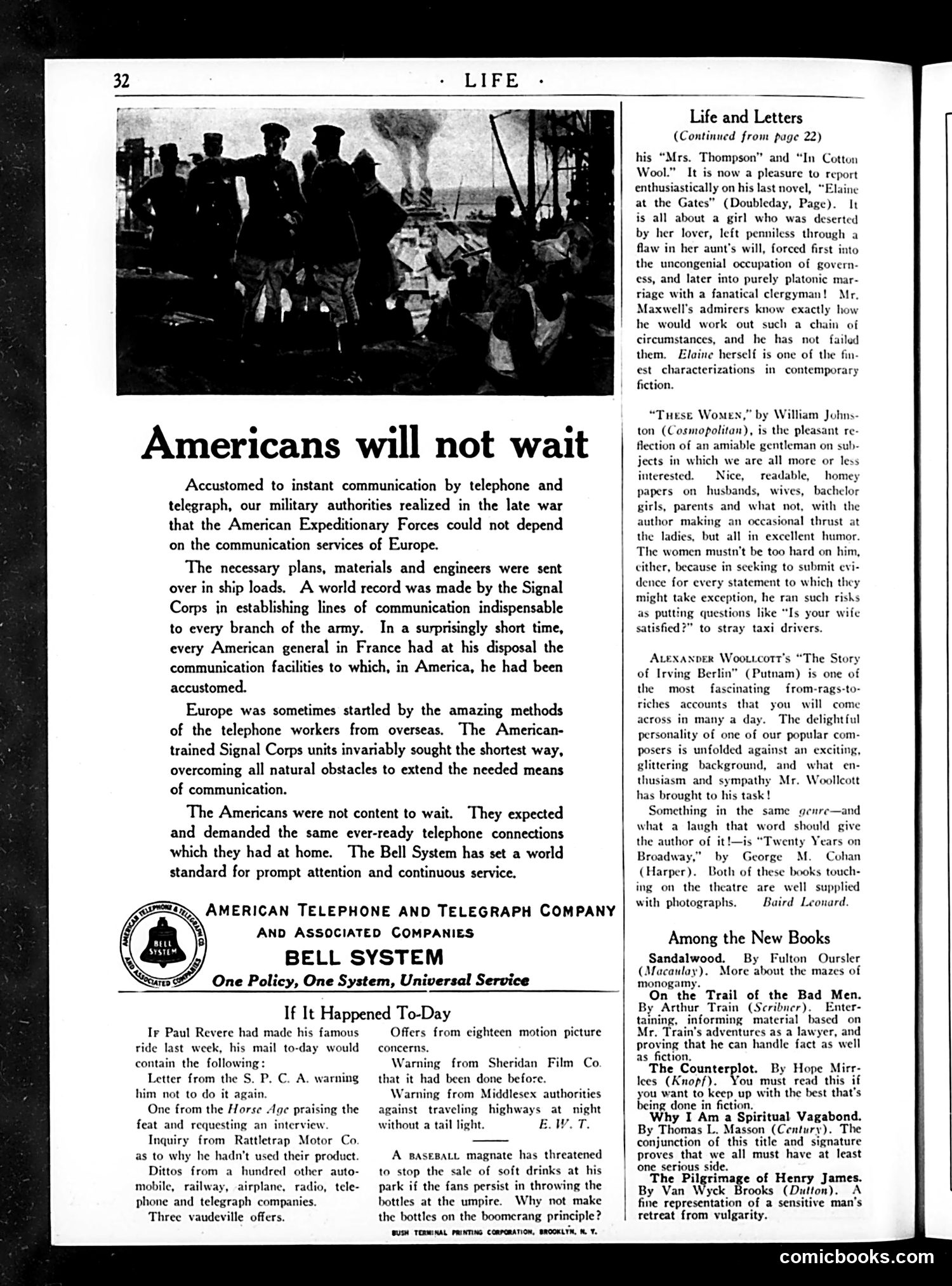
This page combines a Bell System advertisement with period humor and book reviews. **Main Advertisement:** The large illustration shows soldiers communicating via telephone during WWI. The text celebrates American military innovation: the U.S. Signal Corps independently established telephone networks in France rather than relying on European infrastructure. This is presented as evidence of American efficiency and superiority—Americans "will not wait" for outdated European systems. The ad positions Bell System as embodying American expectations for instant, reliable service. **Satirical Content:** The "If It Happened To-Day" section humorously imagines Paul Revere's famous 1775 midnight ride occurring in the modern era. It satirizes contemporary commercialism by showing how he'd be bombarded with letters from motor companies (criticizing his horse travel), film studios (claiming they'd done it first), and vaudeville agents—poking fun at how aggressively American businesses capitalize on newsworthy events. **Context:** Published post-WWI, this reflects American pride in industrial-military accomplishment and the period's confidence in technology and business enterprise.
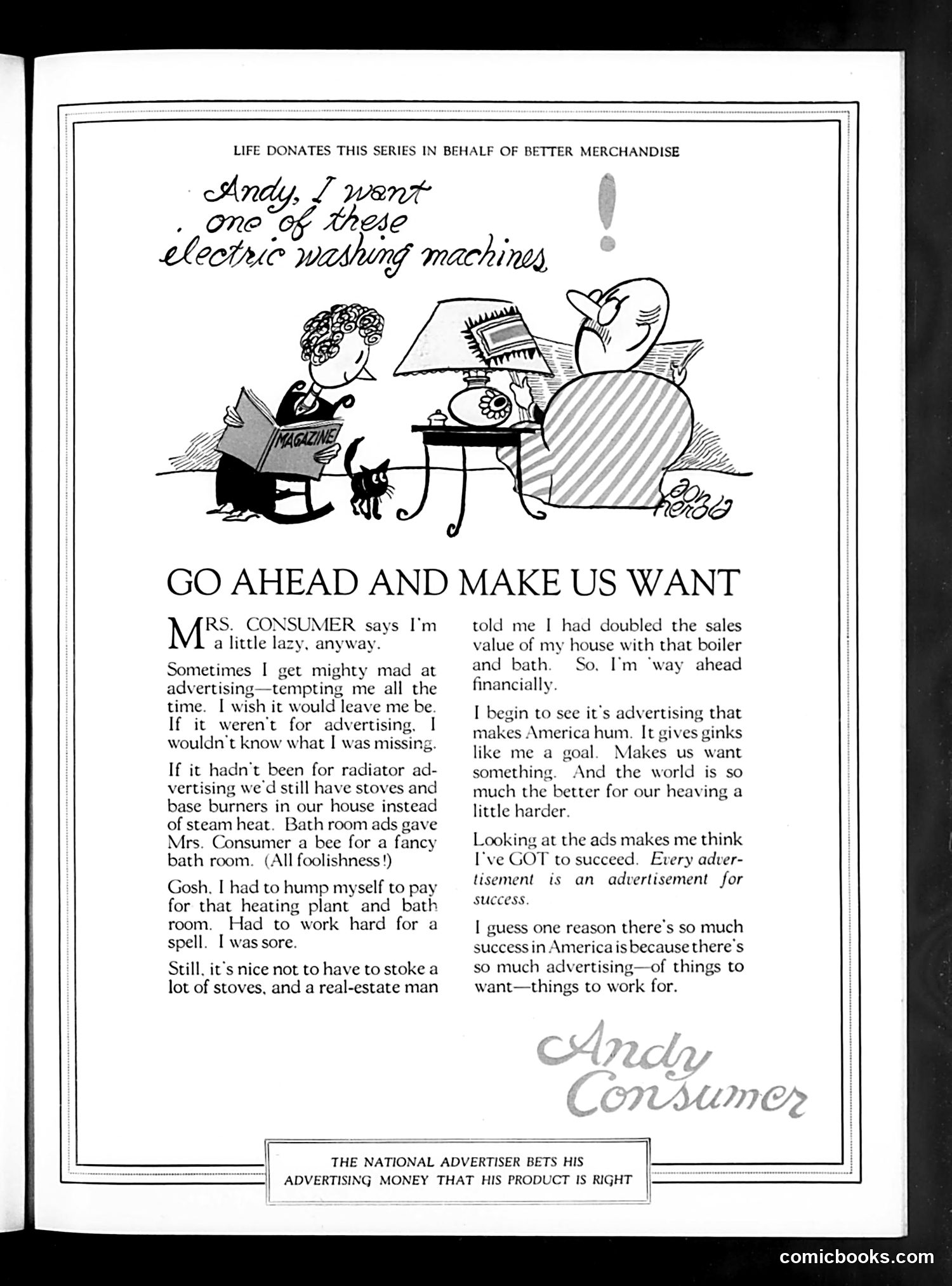
This satirical piece critiques advertising's persuasive power through the character "Mrs. Consumer." The cartoon shows a woman being tempted by an electric washing machine while reading a magazine—visualizing advertising's appeal. The satire works on two levels: Mrs. Consumer admits advertising manipulates her ("tempting me all the time") yet simultaneously defends it as beneficial. She recounts how bathroom and heating ads convinced her to purchase upgrades, claiming these purchases improved her life and property value. The joke is the *irony*: she recognizes advertising makes her want things she didn't originally need, yet concludes this is *good*—that advertising drives American ambition and success. Life's framing ("LIFE DONATES THIS SERIES IN BEHALF OF BETTER MERCHANDISE") itself mocks the self-serving logic: advertising claims to serve consumers while actually serving manufacturers. The piece satirizes how consumers rationalize being persuaded into purchases as personal achievement rather than manipulation.
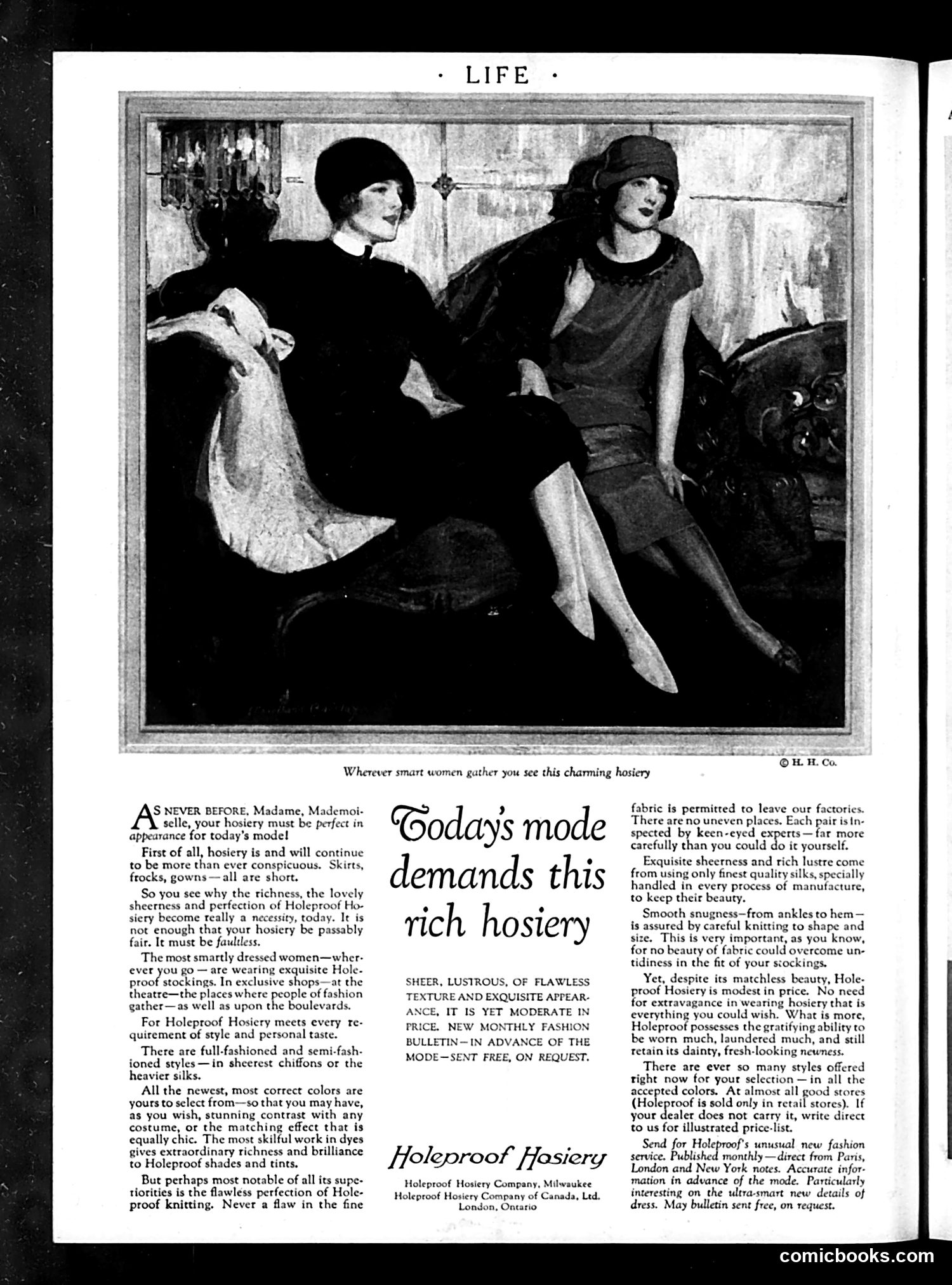
This page is primarily **advertising, not satire or political commentary**. It's a Holeproof Hosiery advertisement from Life magazine. The illustration at top shows three fashionable women in 1920s dress (cloche hats, short skirts) examining hosiery—a visual reinforcement that "smart women" wear this brand. The accompanying text argues that women's stockings have become more visible and important due to shorter hemlines ("Skirts, frocks, gowns—all are short"), making quality hosiery essential to a woman's appearance. The ad emphasizes Holeproof's superior construction, fine silk materials, flawless knitting, and availability in fashionable colors—while reassuring buyers that despite these qualities, the price remains reasonable. This reflects early 1920s fashion anxieties: the cultural shift to shorter skirts made legwear a focal point, and advertisements capitalized on women's concerns about appearing "smartly dressed" and fashionable.