
Life, 1925-04-16 · page 16 of 36
Life — April 16, 1925 — page 16: what you’re looking at
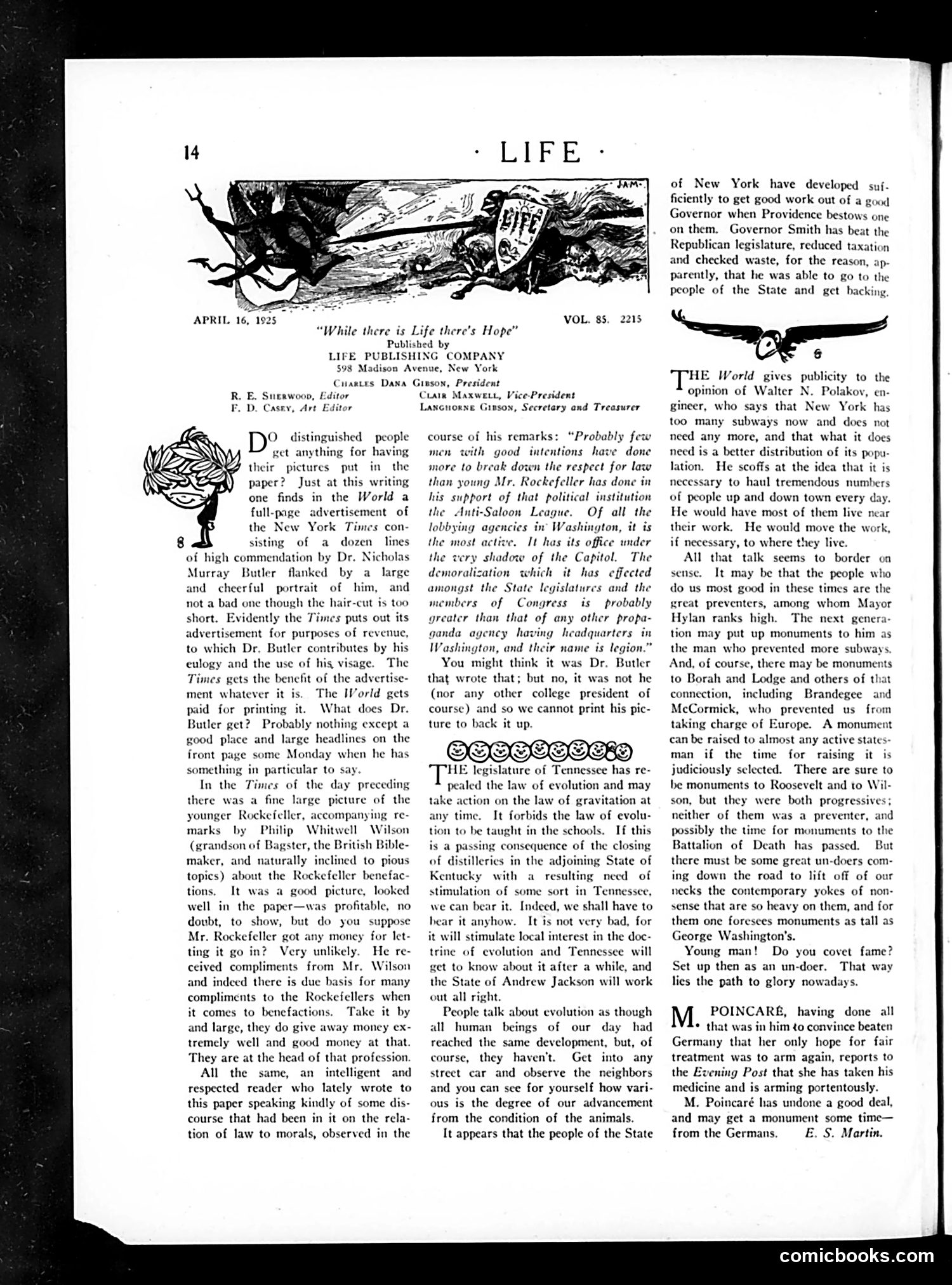
What you’re looking at
The page contains two main editorial pieces critiquing New York Governor Smith's administration and Tennessee's anti-evolution legislation. The **top cartoon** (credited to Dr. Nicholas Murray Butler) appears to show a skeletal or death-like figure, likely representing criticism of Butler's editorial prominence in the *Times*. The **main text** discusses: - Governor Smith's successful reduction of state taxation and waste, earning public backing - Criticism of Tennessee's repeal of evolution law teaching, which the writer views as intellectually backward - Comparison of anti-evolution sentiment to other progressive figures (Rockefeller, Roosevelt, Wilson) who supported scientific advancement The satire targets Tennessee's perceived backwardness in rejecting evolutionary science, positioning it as contrary to modern progress—a reference to Tennessee's famous 1925 "Monkey Trial" controversy.
📄 Transcribed text from this page (OCR, searchable)
Machine-transcribed from the original scan — historical spelling and the odd misread are preserved.
APRIL 16, 1925 “While there is Life there’s Hope” Publish PUBLISH LIFE by COMPANY $98 Madison Avenue, New York Cuartes Dana Ginson, President Editor . D. Casey, Art E O distinguished — people get anything for having their pictures put in the paper? Just at this writing one finds in the World a full-page advertisement of the New York Times con- sisting of a dozen lines of high commendation by Dr. holas Mur: Butler flanked by a_ large and cheerful portrait of him, and not a bad one though the hair-cut is too short. Evidently the Times puts out its advertisement for purposes of revenue, to which Dr, Butler contributes by his eulogy and the use of his visage. The Times gets the benefit of the advertise- ment whatever it is. The World gets paid for printing it. What does Dr. Butler Probably nothing except a good place and large headlines on the front page some Monday when he has something in particular to say. In the the day preceding there was a fine large picture of the younger Rockefeller, accompanying re- marks by Philip Whitwell Wilson (grandson of Bagster, the British Bible- maker, and naturally inclined to pious topics) about the Rockefeller benefac- tions. It was a good picture, looked well in the paper—was profitable, no doubt, to show, but do you suppose Mr. Rockefeller got any money for let- ting it go in? Very unlikely. He re- ceived compliments from Mr. Wilson and indced there is due basis for many compliments to the Rockefellers when it comes to benefactions. Take it by and large, they do give away moncy ex- tremely well and good money at that. They are at the head of that profession. All the same, an_ intelligent and respected reader who lately wrote to this paper speaking kindly of some course that had been in it on the rela- tion of law to morals, observed in the mes of Crate Maxwent, V1 Laxcuornxe Gi e-President x, Secretary and Treasurer of his remarks: “Probably few men with good intentions have done more to break down the respect for law than young Mr. Rockefeller has done in his support of that political institution the Anti-Saloon League. Of all the lobbying agencies in’ Washington, it is the most active. It has its office under the very shadow of the Capitol. The ation which it has effected amongst the State legislatures and the members of Congress is probably greater than that of any other propa- ganda agency having headquarters in Washington, and their name is legion.” You might think it was Dr. Butler that wrote that; but no, it was not he (nor any other college president of course) and so we cannot print his pic- ture to back it up. course legis! Tennessee has re- pealed the law of evolution and may take action on the law of gravitation at any time. It forbids the law of evolu- tion to be taught in the schools. If this is a passing consequence of the closing of distilleries in the adjoining State of Kentucky with a resulting necd of stimulation of some sort in Tennessee, we can bear it. Indeed, we shall have to hear it anyhow. It is not very bad, for it will stimulate local interest in the doc- trine of evolution and Tennessee will get to know about it after a while, and the State of Andrew Jackson will work out all right. People talk about evolution as though all human beings of our day had reached the same development, but, of course, they haven't. Get into any street car and observe the neighbors and you can see for yourself how vari- ous is the degree of our advancement from the condition of the animals. It appears that the people of the State of New York have developed suf- ficiently to get good work out of a good Governor when Providence bestows one on them. Governor Smith has beat the Republican legislature, reduced taxation and checked waste, for the reason, ap- parently, that he was able to go to the people of the State and get hacking. 6 HE World gives publicity to the opinion of Walter N. Polakov, en- gineer, who says that New York has too many subways now and does not need any more, and that what it does need is a better distribution of its popu- lation. He scoffs at the idea that it is necessary to haul tremendous numbers of people up and down town every day. He would have most of them live near their work. He would move the work, if necessary, to where they live. All that talk seems to border on sense, It may be that the people who do us most good in these times are the great preventers, among whom Mayor Hylan ranks high. The next genera- tion may put up monuments to him as the man who prevented more subways. And, of course, there may be monuments to Borah and Lodge and others of that connection, including Brandegee and McCormick, who prevented us from taking charge of Europe. A monument can be raised to almost any active states- man if the time for raising it is judiciously selected. There are sure to be monuments to Roosevelt and to Wil- son, but they were both progressives; neither of them was a preventer, possibly the time for monuments to the Battalion of Death has passed. But there must be some great un-doers com- ing down the road to lift off of our necks the contemporary yokes of non- sense that are so heavy on them, and for them one foresees monuments as tall as George Washington's. Young man! Do you covet fame? Set up then as an un-doer. That way lies the path to glory nowadays. POINCARE, having done all * that was in him to convince beaten Germany that her only hope for fair treatment was to arm again, reports to the ing Post that she has taken his medicine and is arming portentously. M. Poincaré has undone a good deal, and may get a monument some time— from the Germans. E. S. Martin. comicbooks.com