
Life, 1925-04-16 · page 34 of 36
Life — April 16, 1925 — page 34: what you’re looking at
What you’re looking at
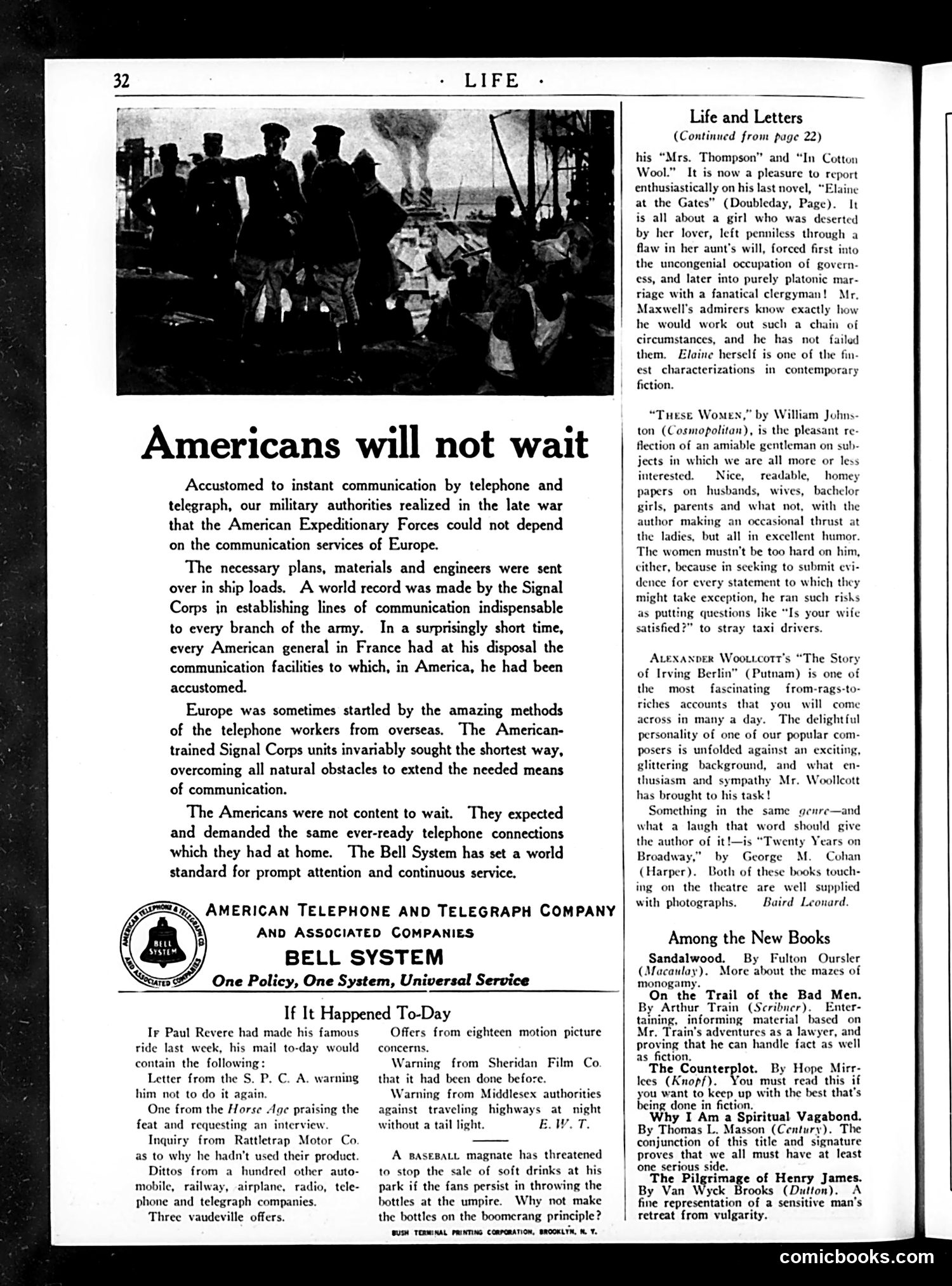
This page combines a Bell System advertisement with period humor and book reviews. **Main Advertisement:** The large illustration shows soldiers communicating via telephone during WWI. The text celebrates American military innovation: the U.S. Signal Corps independently established telephone networks in France rather than relying on European infrastructure. This is presented as evidence of American efficiency and superiority—Americans "will not wait" for outdated European systems. The ad positions Bell System as embodying American expectations for instant, reliable service. **Satirical Content:** The "If It Happened To-Day" section humorously imagines Paul Revere's famous 1775 midnight ride occurring in the modern era. It satirizes contemporary commercialism by showing how he'd be bombarded with letters from motor companies (criticizing his horse travel), film studios (claiming they'd done it first), and vaudeville agents—poking fun at how aggressively American businesses capitalize on newsworthy events. **Context:** Published post-WWI, this reflects American pride in industrial-military accomplishment and the period's confidence in technology and business enterprise.
📄 Transcribed text from this page (OCR, searchable)
Machine-transcribed from the original scan — historical spelling and the odd misread are preserved.
Americans will not wait Accustomed to instant communication by telephone and telegraph, our military authorities realized in the late war that the American Expeditionary Forces could not depend on the communication services of Europe. The necessary plans, materials and engineers were sent over in ship loads. A world record was made by the Signal Corps in establishing lines of communication indispensable to every branch of the army. In a surprisingly short time, every American general in France had at his disposal the communication facilities to which, in America, he had been accustomed. Europe was sometimes startled by the amazing methods of the telephone workers from overseas. The American- trained Signal Corps units invariably sought the shortest way, overcoming all natural obstacles to extend the needed means of communication. The Americans were not content to wait. They expected and demanded the same ever-ready telephone connections which they had at home. The Bell System has set a world standard for prompt attention and continuous service. AMERICAN TELEPHONE AND TELEGRAPH COMPANY AND ASSOCIATED COMPANIES BELL SYSTEM One Policy, One System, Universal Service If It Happened To-Day Ir Paul Revere had made his famous ride last week, his mail to-day would contain the following: Letter from the S. P. C. A. warning him not to do it again. One from the Horse Age praising the feat and requesting an interview. Inquiry from Rattletrap Motor Co. as to why he hadn't used their product. Dittos from a hundred other auto- mobile, railway, airplane, radio, tele- phone and telegraph companies. Three vaudeville offers. Offers from eighteen motion picture concerns. Warning from Sheridan Film Co. that it had been done before. Warning from Middlesex authorities against traveling highways at night without a tail light. E,W. T. A BASEBALL magnate has threatened to stop the sale of soft drinks at his park if the fans persist in throwing the bottles at the umpire. Why not make the bottles on the boomerang principle? BUSH TERMINAL PRINTING CORPORATION, BROOKLYN, MY. Life and Letters (Continued from page 22) his “Mrs. Thompson” and “In Cotton Wool.” It is now a pleasure to report enthusiastically on his last novel, “Elai at the Gates” (Doubleday, Page). It is all about a girl who was deserted by her lover, left penniless through a flaw in her aunt's will, forced first into the uncongenial occupation of govern- ess, and later into purely platonic mar- riage with a fanatical clergyman! Mr. Maxwell's admirers know exactly how he would work out such a chain of circumstances, and he has not failed them. Elaine herself is one of the fin- est characterizations in contemporary fiction. “Tuese Women,” by William Johns- ton (Cosmopolitan), is the pleasant re- flection of an amiable gentleman on sub- jects in which we are all more or less interested. Nice, readable, homey papers on husbands, wives, bachelor girls, parents and what not, with the author making an occasional thrust at the ladies, but all in excellent humor. The women mustn't be too hard on him, cither, because in seeking to submit evi- dence for every statement to which they might take exception, he ran such risks as putting questions like “Is your wife satisfied?” to stray taxi drivers. ALexXANpER Woottcott’s “The Story of Irving Berlin” (Putnam) is one of the most fascinating from-rags-to- riches accounts that you will come across in many a day. The delightful personality of one of our popular com- posers is unfolded against an exciting, glittering background, and what en- thusiasm and sympathy Mr. Woollcott has brought to his task! Something in the same genre—and what a laugh that word should give the author of it!—is “Twenty Years on Broadway,” by George M. Cohan (Harper). Both of these books touch- ing on the theatre are well supplied with photographs. Baird Leonard. Among the New Books Sandalwood. By Fulton Oursler (Macaulay). More about the mazes of monogamy. On the Trail of the Bad Men. By Arthur Train (Scribner). Enter- taining, informing material based on Mr. Train's adventures as a lawyer, and proving that he can handle fact as well as fiction. The Counterplot. By Hope Mirr- lees (Knopf). You must read this if you want to keep up with the best that's being done in fiction. Why I Am a Spiritual Vagabond. By Thomas L. Masson (Century). The conjunction of this title and signature proves that we all must have at least one serious x The Pilgrimage of Henry James. By Van Wyck Brooks (Dutton). A fine representation of a sensitive man’s retreat from vulgarity. comicbooks.com