
Life, 1925-04-16 · page 26 of 36
Life — April 16, 1925 — page 26: what you’re looking at
What you’re looking at
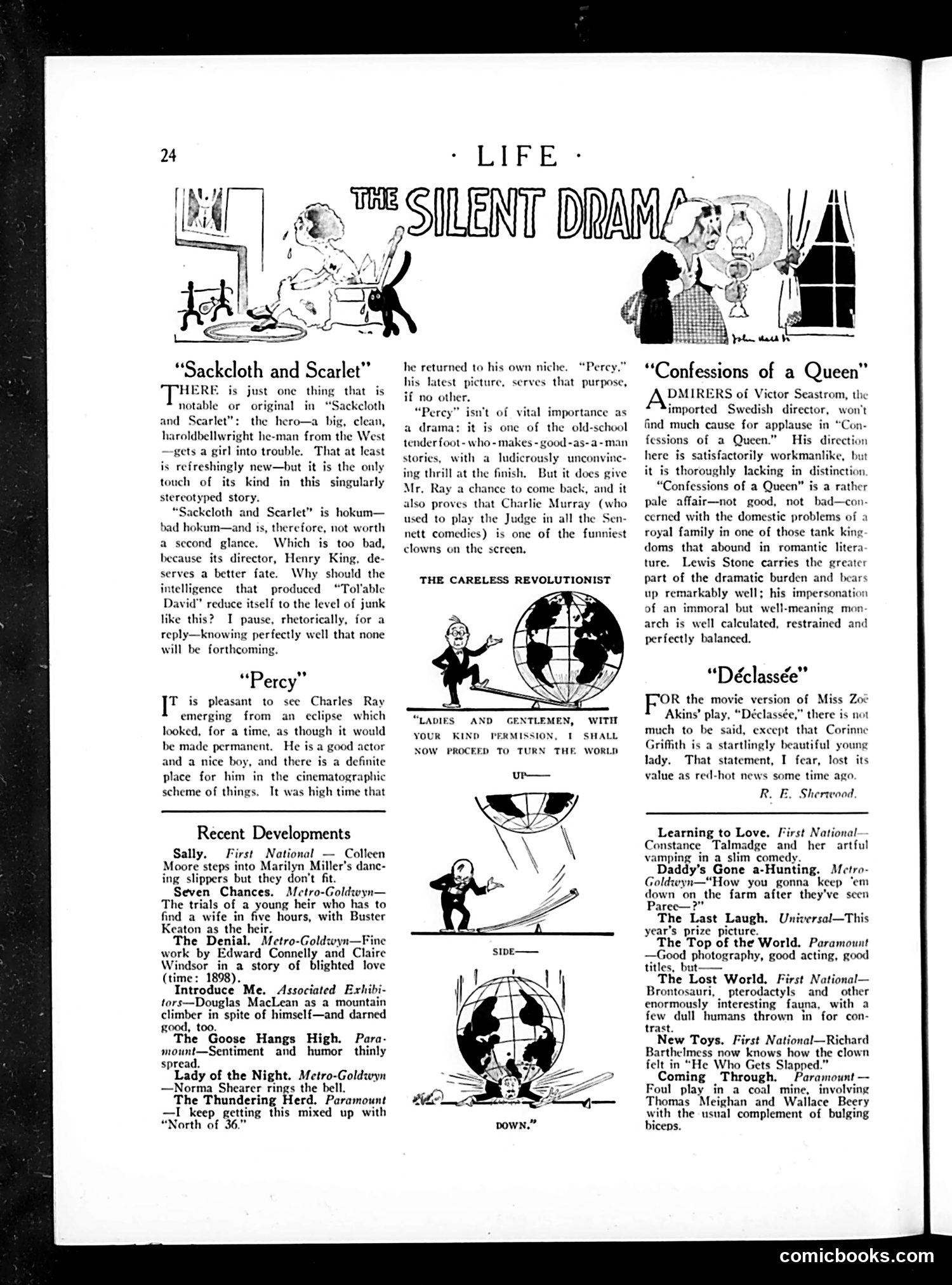
This page reviews silent films from the mid-1920s. The cartoons illustrate movie titles: "The Careless Revolutionist" shows a figure gesturing theatrically at a globe, mocking melodramatic revolutionary plots common in silent cinema. The reviews are notably harsh. "Sackcloth and Scarlet" is dismissed as formulaic hokum despite director Henry King's prior success with "Tol'able David." "Percy" is praised mainly for giving actor Charles Ray comeback work and showcasing comedian Charlie Murray. "Confessions of a Queen" critiques imported Swedish director Victor Seastrom's competent but uninspired direction of a romance involving royalty. "Déclassée" is sarcastically praised solely for actress Corinne Griffith's beauty, suggesting the film itself lacks merit. The "Recent Developments" section briefly notes other releases, praising Buster Keaton's "Seven Chances" and Norma Shearer's performance in "Lady of the Night," while noting Colleen Moore inadequately fills Marilyn Miller's shoes in "Sally." The tone reflects period film criticism's emphasis on star power and directorial reputation over plot.
📄 Transcribed text from this page (OCR, searchable)
Machine-transcribed from the original scan — historical spelling and the odd misread are preserved.
“Sackcloth and Scarlet” HERE. is just one thing that is notable or original in “Sackeloth and Scarlet”: the hero—a big, clean, haroldbellwright he-man from the West —gets a girl into trouble. That at least is refreshingly new—but it is the only touch of its kind in this singularly stereotyped story. ckeloth and Scarlet” is hokum— bad hokum—and 1s, therefore, not worth a second glance. Which is too bad, because its director, Henry King, de- erves a better fate. Why should the telligence that produced “Tol'able David" reduce itself to the level of junk like this? I pause, rhetorically, for a reply—knowing perfectly well that none will be forthcoming. “Percy” I" is pleasant to see Charles Ray emerging from an eclipse which looked, for a time, as though it would be made permanent. He is a good actor and a nice boy, and there is a definite place for him in the cinematographic scheme of things. It was high time that Recent Developments Sally. First National — Colleen Moore steps into Marilyn Miller’s danc- ing slippers but they don’t fit. Seven Chances. Mctro-Goldwyn— The trials of a young heir who has to find a wife in five hours, with Buster Keaton as the heir. The Denial. Metro-Goldwyn—Fine work by Edward Connelly and Claire Windsor in a story of blighted love (time: 1898). Introduce Me. Associated Exhibi- tors—Douglas MacLean as a mountain climber in spite of himself—and darned good, too. The Goose Hangs High. Para- mount—Sentiment and humor thinly spread. Lady of the Night. Metro-Goldwyn —Norma Shearer rings the bell. The Thundering Herd. Paramount —I keep getting this mixed up with “North of 36.” he returned to his own niche. “Percy,” his latest picture, serves that purpose, if no other, “Percy n't of vital importance as a drama: it is one of the old-school tender foot - who- makes - good -as-a-man stories, with a ludicrously unconvine- ing thrill at the finish, But it does give Mr. Ray a chance to come back, and it also proves that Charlie Murray (who used to play the Judge in all the Sen- nett comedies) is one of the funniest clowns on the screen, THE CARELESS REVOLUTIONIST “LADIES AND GENTLEM YOUR KIND PERMISSION, [1 SHALL NOW PROCEED TO TURN THE WORLD “Confessions of a Queen” DMIRERS of Victor Seastrom, the imported Swedish director, won't find much cause for applause in “Con- fessions of a Queen.” His direction here is satisfactorily workmanlike, but it is thoroughly lacking in distinction. “Confessions of a Queen” is a rather pale affair—not good, not bad—con- cerned with the domestic problems of a royal family in one of those tank king doms that abound in romantic litera ture. Lewis Stone carries the greater part of the dramatic burden and bears up remarkably well; his impersonat of an immoral but well-meaning mon- arch is well calculated, restrained and perfectly balanced. “Déclassée” ‘OR the movie version of Miss Zoe Akins’ play, “Déclassée,” there is not much to be said, except that Corinne Griffith is a startlingly beautiful young lady. That statement, I fear, lost its value as red-hot news some time ago R. E, Sherwood, Learning to Love. First National Constance Talmadge and her artful vamping in a slim comedy, Daddy’s Gone a-Hunting. Metro- Goldwyn—“How you gonna keep ‘em down on the farm after they’ve seen Parec—?” The Last Laugh. Universal—This year’s prize picture. The Top of the World. Paramount —Good photography, good acting, good titles, but—— The Lost World. First National— Brontosauri, pterodactyls and other enormously interesting fauna, with a few dull humans thrown in for con- trast. New Toys. First National—Richard Barthelmess now knows how the clown felt in “He Who Gets Slapped.” Coming Through. Paramount — Foul play in a coal mine, involving Thomas Meighan and Wallace Beery with the usual complement of bulging bicens. comicbooks.com