A complete issue · 37 pages · 1925
Life — March 26, 1925
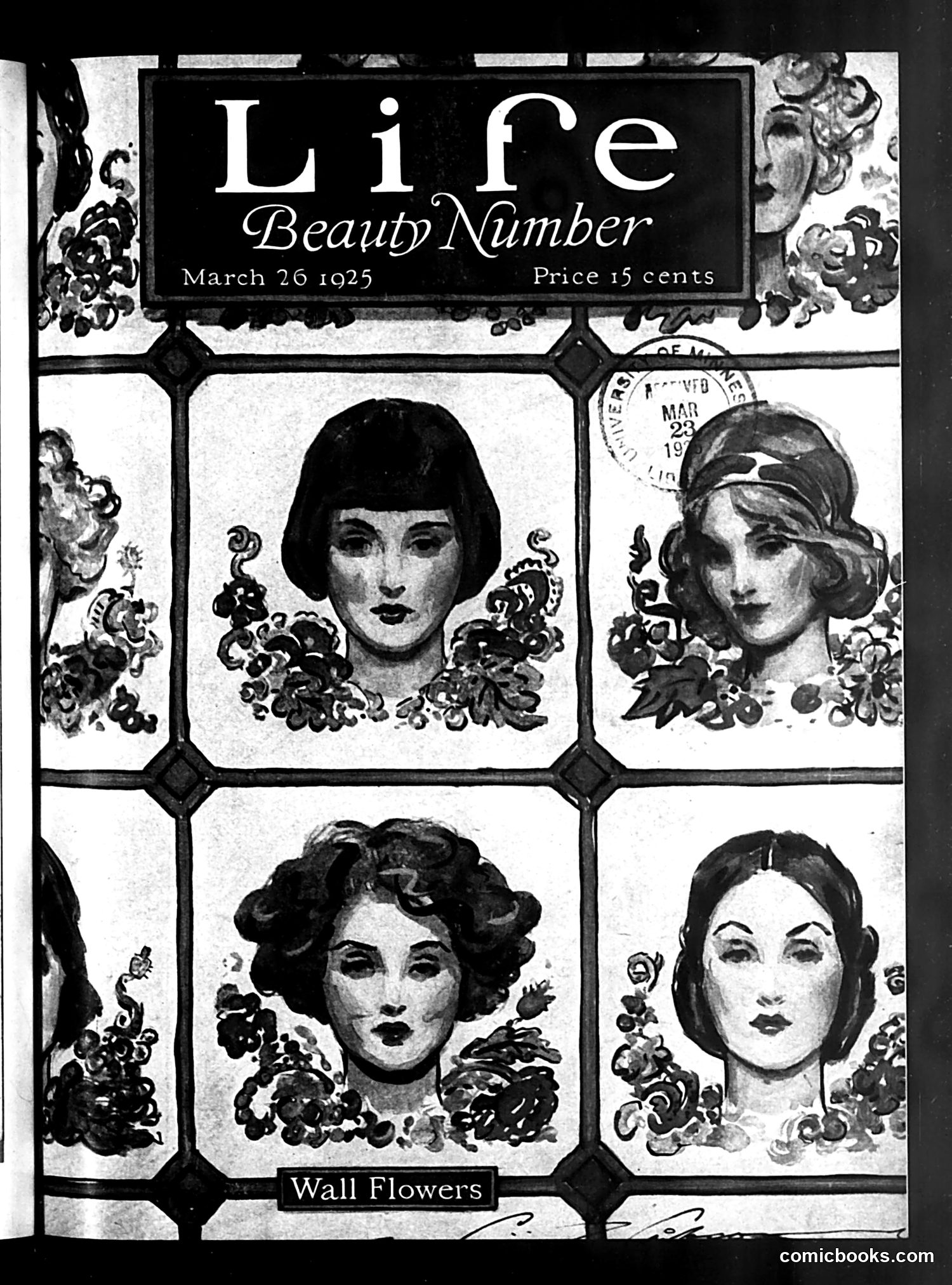
This is the cover of Life's "Beauty Number" special issue, priced at 15 cents. It features four portrait illustrations of women showcasing different 1920s beauty trends and hairstyles—the primary subject matter indicated by "Wall Flowers" at the bottom. The page appears to be primarily a beauty/fashion-focused issue rather than political satire. The four female faces display the fashionable bob hairstyles and makeup aesthetics characteristic of the 1920s flapper era. The decorative floral borders surrounding each portrait were typical of the magazine's design aesthetic. Without additional context or identification of the specific women depicted, I cannot confirm whether these represent celebrities, society figures, or are simply illustrative examples of contemporary beauty standards for the period.
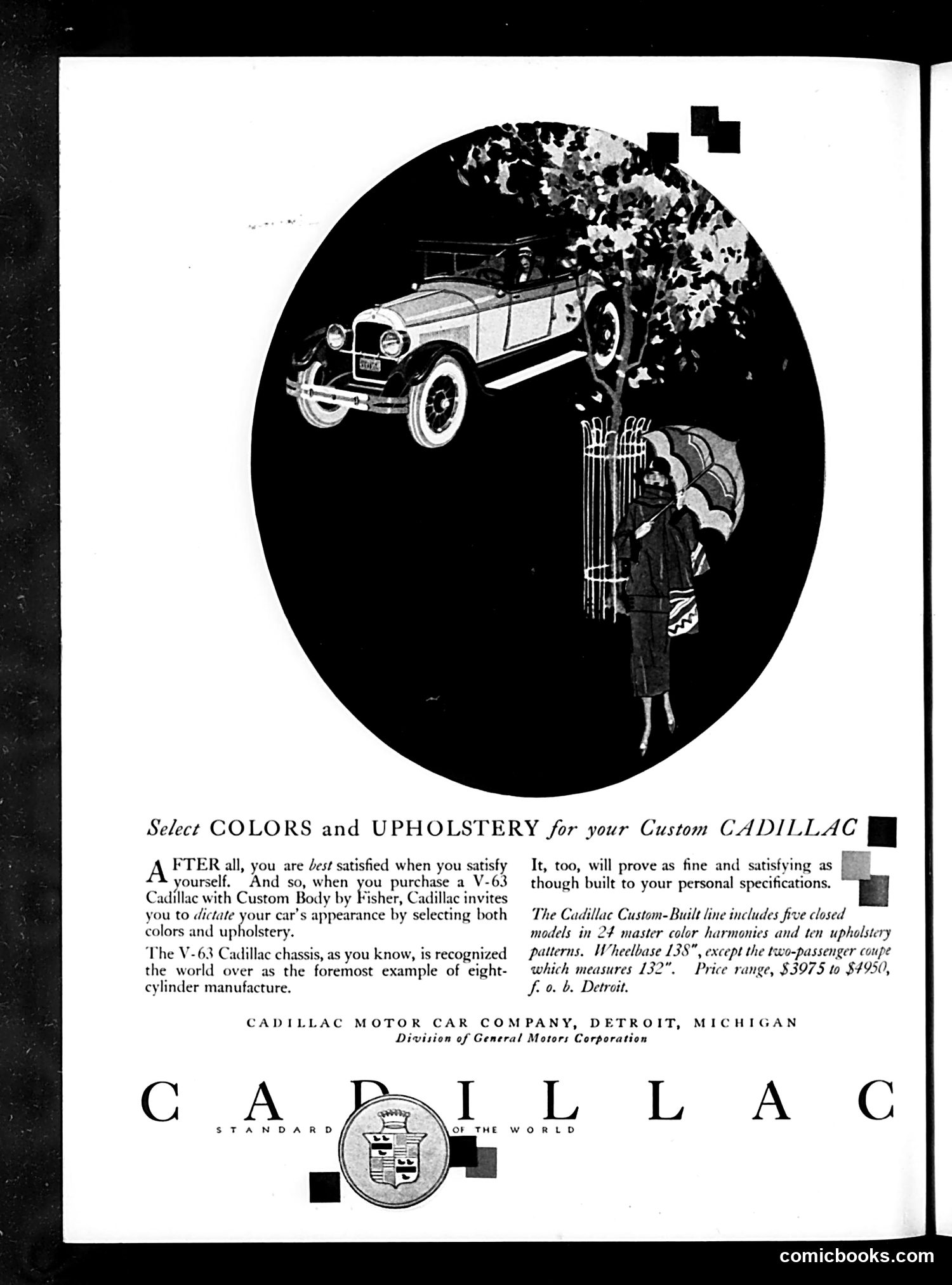
This is **not a political cartoon or satire**—it's a straightforward **automobile advertisement** for Cadillac's custom-built V-63 model. The image shows a stylized scene of a woman with an umbrella admiring a Cadillac parked near flowering vines. The ad emphasizes luxury customization options: buyers could select from "24 master color harmonies and ten upholstery patterns" for their vehicle. The text highlights the V-63 chassis as "the world's foremost example of eight-cylinder manufacture" and notes the price range ($3,975 to $4,950 f.o.b. Detroit). This represents typical 1920s-era lifestyle advertising, positioning Cadillac as aspirational, customizable luxury—appealing to affluent consumers who could personalize their vehicles to reflect individual taste and status.
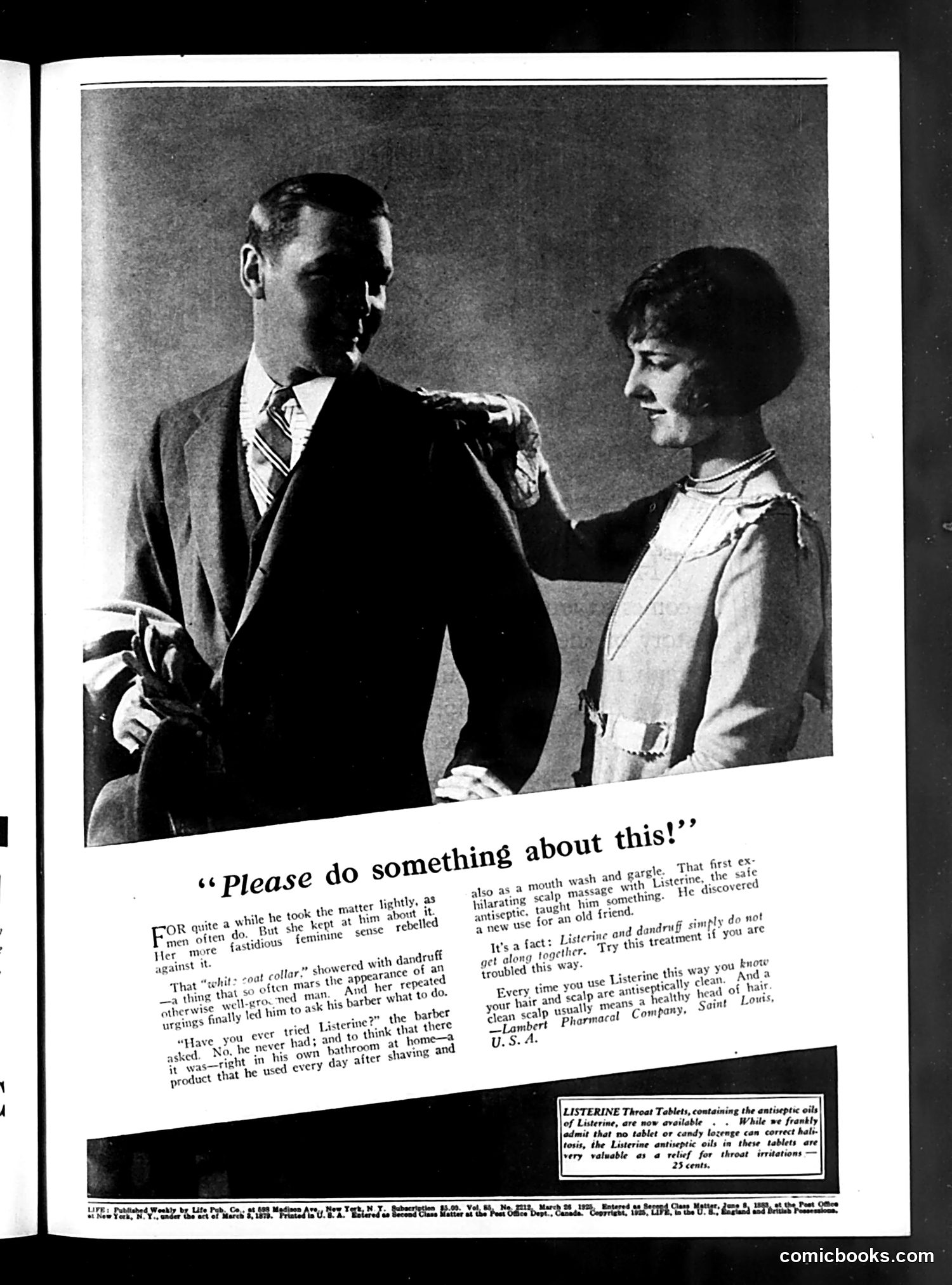
This page is primarily a **Listerine advertisement**, not political satire. The image shows a domestic scene where a woman is speaking to a man about his dandruff problem, urging him to "do something about this!" The ad uses a common marketing approach of the era: creating social embarrassment to sell a product. The narrative suggests the man's dandruff and poor hygiene are causing marital tension and social awkwardness. The solution presented is Listerine, marketed here not just as a mouthwash but as a treatment for scalp issues. The "joke" relies on the implication that his grooming failures are damaging their relationship. This reflects early-to-mid 20th century advertising tactics that weaponized shame about personal hygiene to drive consumer purchases.
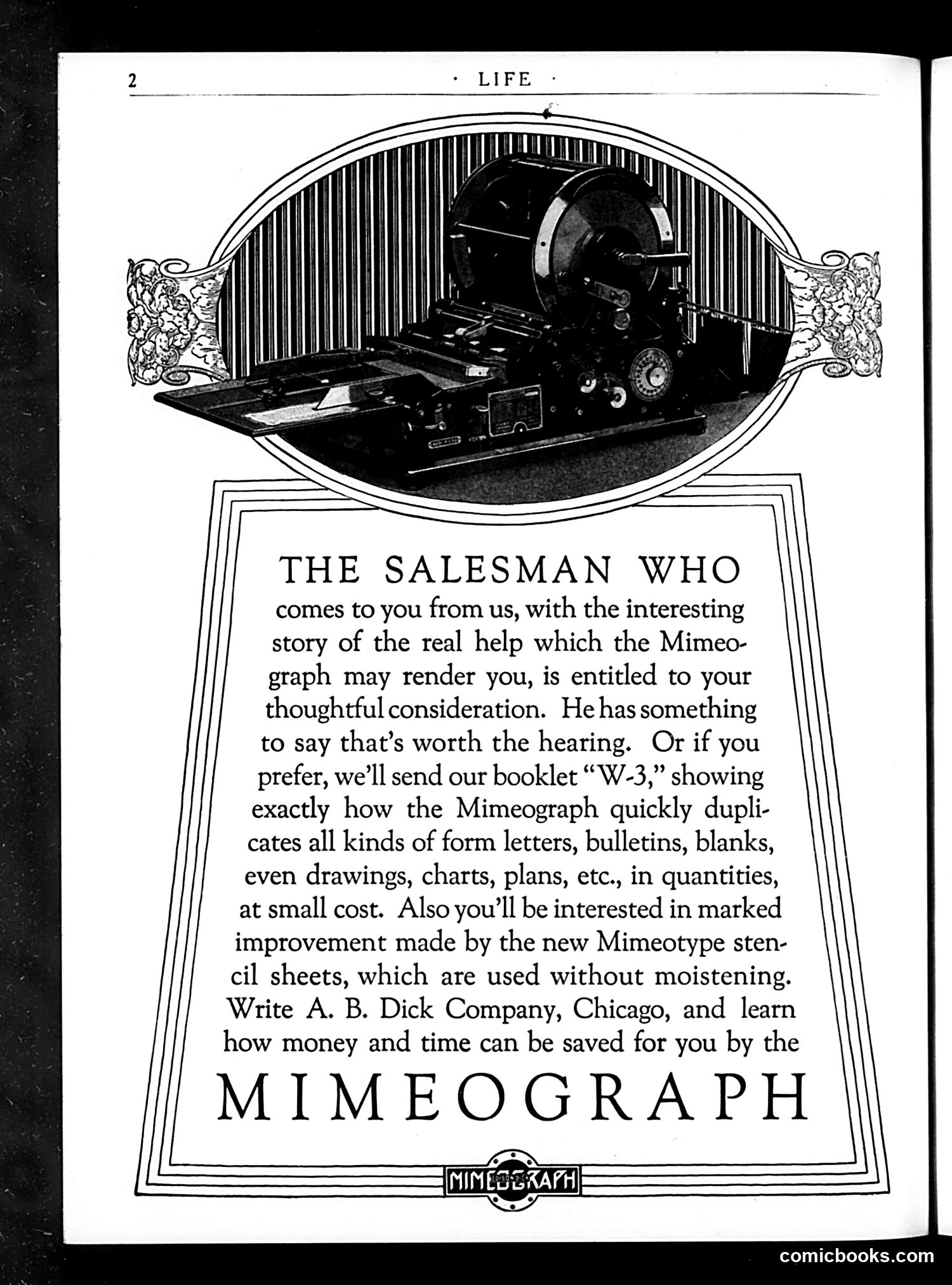
This page is primarily **advertising, not satire or political commentary**. It promotes the Mimeograph machine, a document reproduction device manufactured by the A.B. Dick Company of Chicago. The ad uses a framing device called "The Salesman Who Comes to You," suggesting a sales representative will visit to demonstrate the machine's practical benefits: duplicating form letters, bulletins, drawings, charts, and plans quickly and inexpensively. The copy also touts an improvement—new Mimeotype stencil sheets requiring no moistening. The decorative oval frame with ornamental side elements is typical of early 20th-century advertising design. There is no political satire or cartoon humor present—this is straightforward product promotion appearing in *Life* magazine's pages.
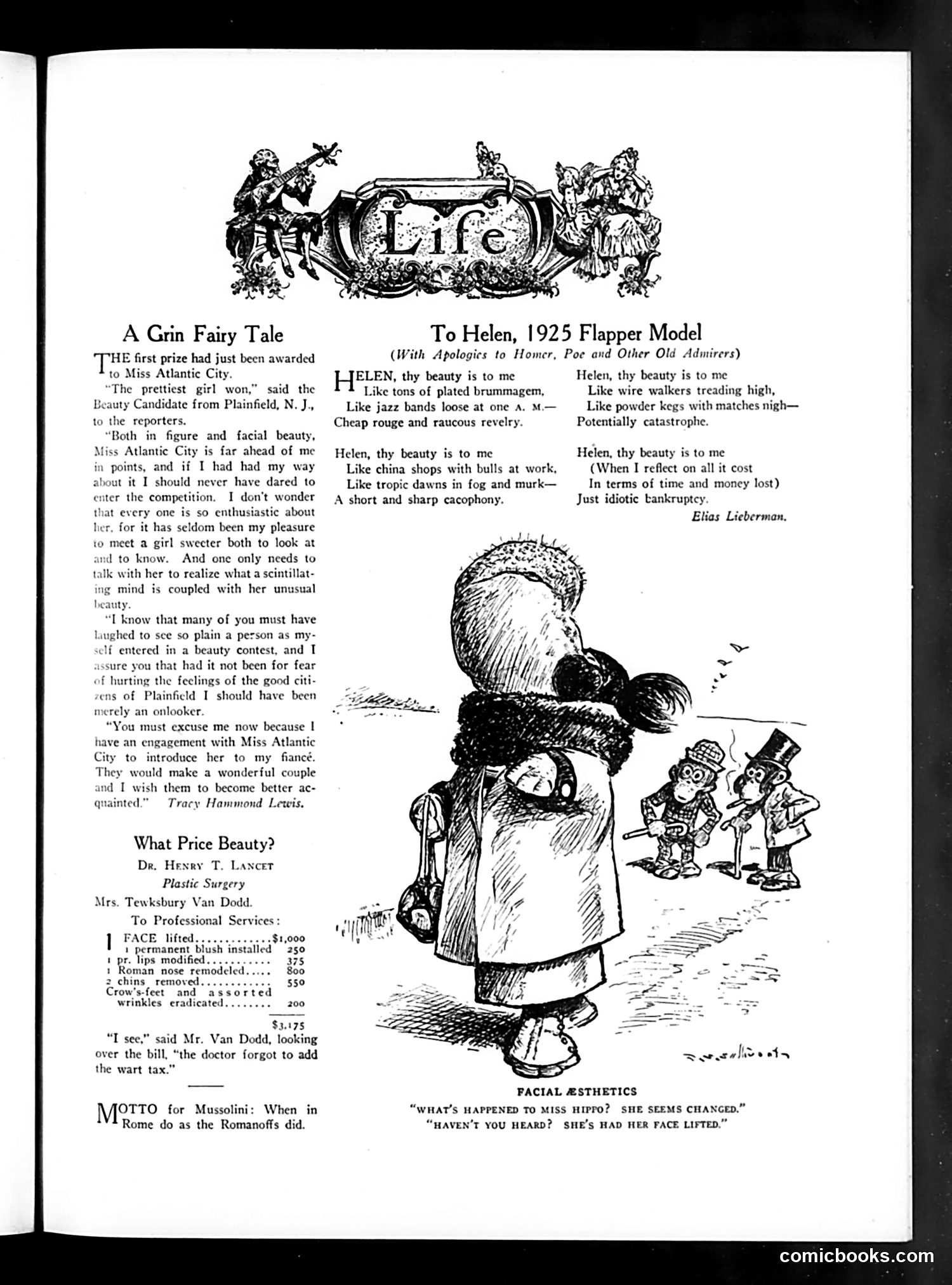
This page satirizes 1920s cosmetic surgery trends among wealthy women. The main cartoon mocks the obsession with facial enhancement procedures, showing a woman who has undergone so much work that she's nearly unrecognizable—her face appears grotesquely altered. The caption "What's happened to Miss Hippo? She seems changed. Haven't you heard? She's had her face lifted" uses the then-novel procedure of face-lifting as a joke. The accompanying price list from "Dr. Henry T. Lancet" (a fictional name) itemizes cosmetic procedures with costs ($1,000 for face lifting, $325 for lip modification, etc.), satirizing how wealthy clients viewed appearance as purchasable commodities. The satire targets vanity culture and the new beauty industry's promise that money could buy perfection.
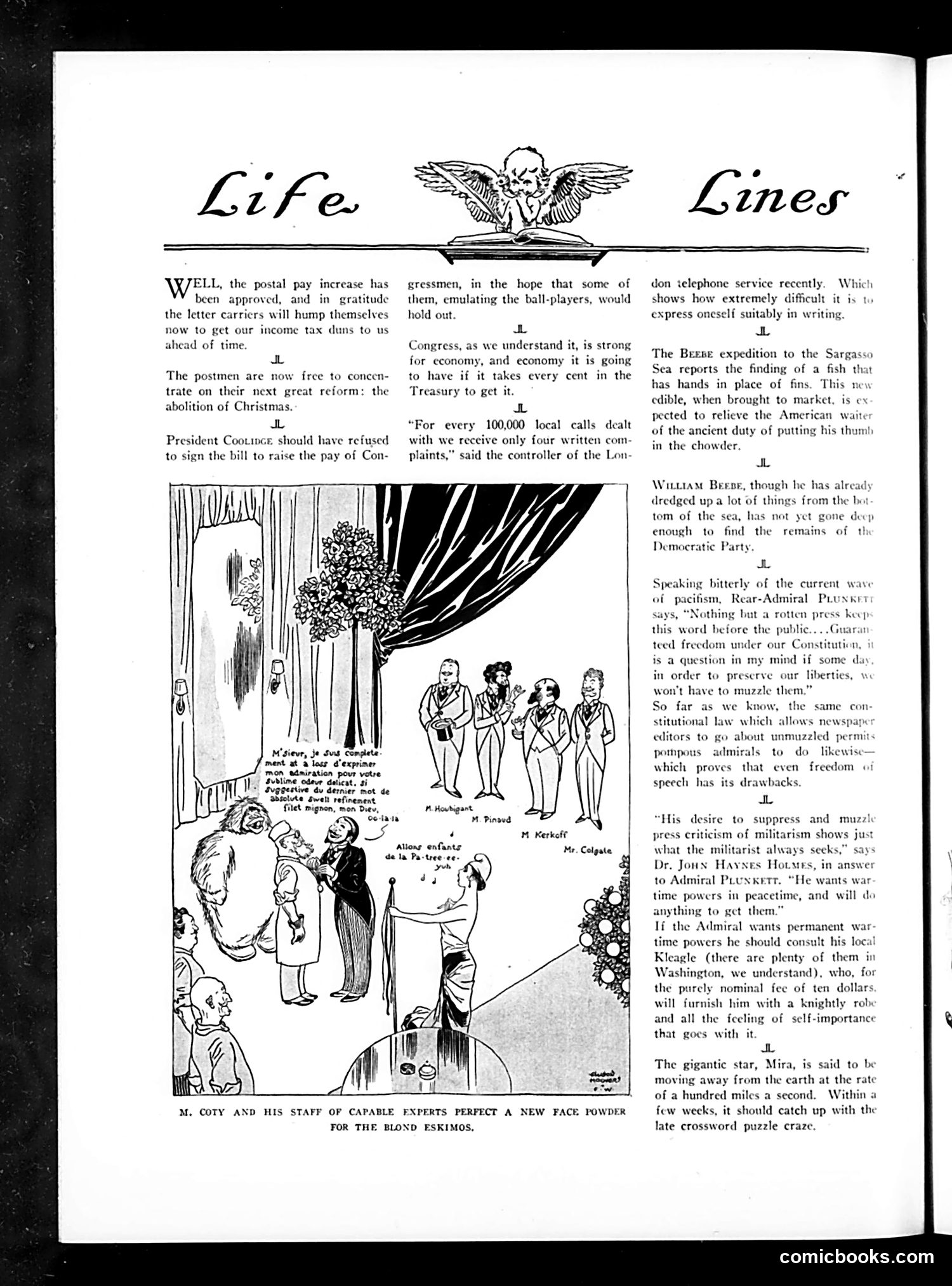
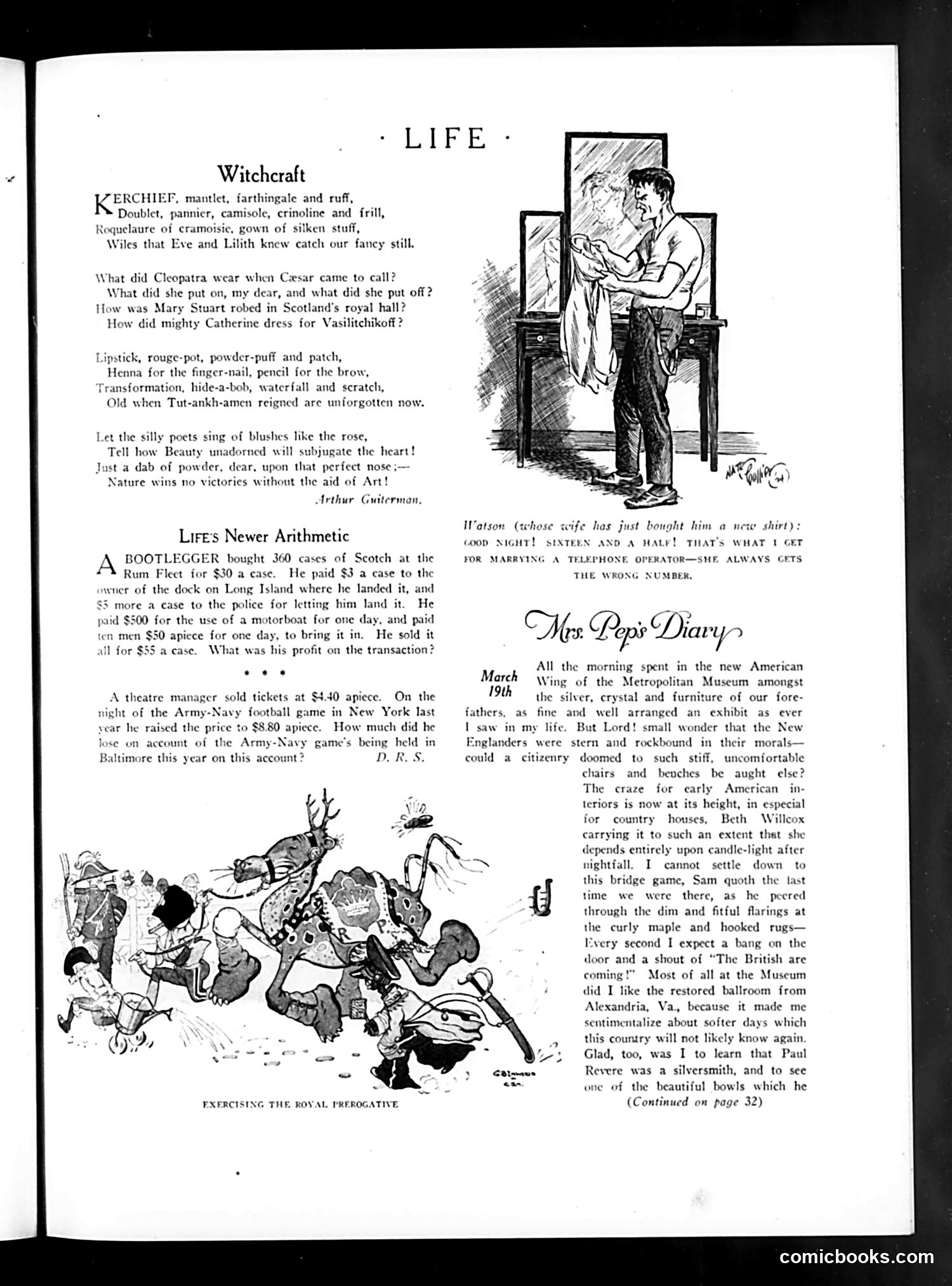
This page contains humor pieces and illustrations typical of early-to-mid 20th century satirical magazine content. **"Witchcraft"** is a poem by Arthur Guiterman mocking women's use of cosmetics and beauty aids (lipstick, rouge, henna, powder, pencil). It sarcastically suggests these are magical "transformations" rivaling historical enchantments. **"Life's Newer Arithmetic"** presents math word problems about commercial transactions—a bootlegger's Scotch whisky profits, theater ticket price increases for an Army-Navy game—reflecting post-WWI American commerce and entertainment. The cartoon **"Exercising the Royal Prerogative"** (artist unclear) appears to depict chaotic animal behavior, likely satirizing aristocratic privilege or upper-class excess, though the specific reference is unclear without more context. **"Mrs. Pep's Diary"** begins a society column about museum visits and early American interiors.
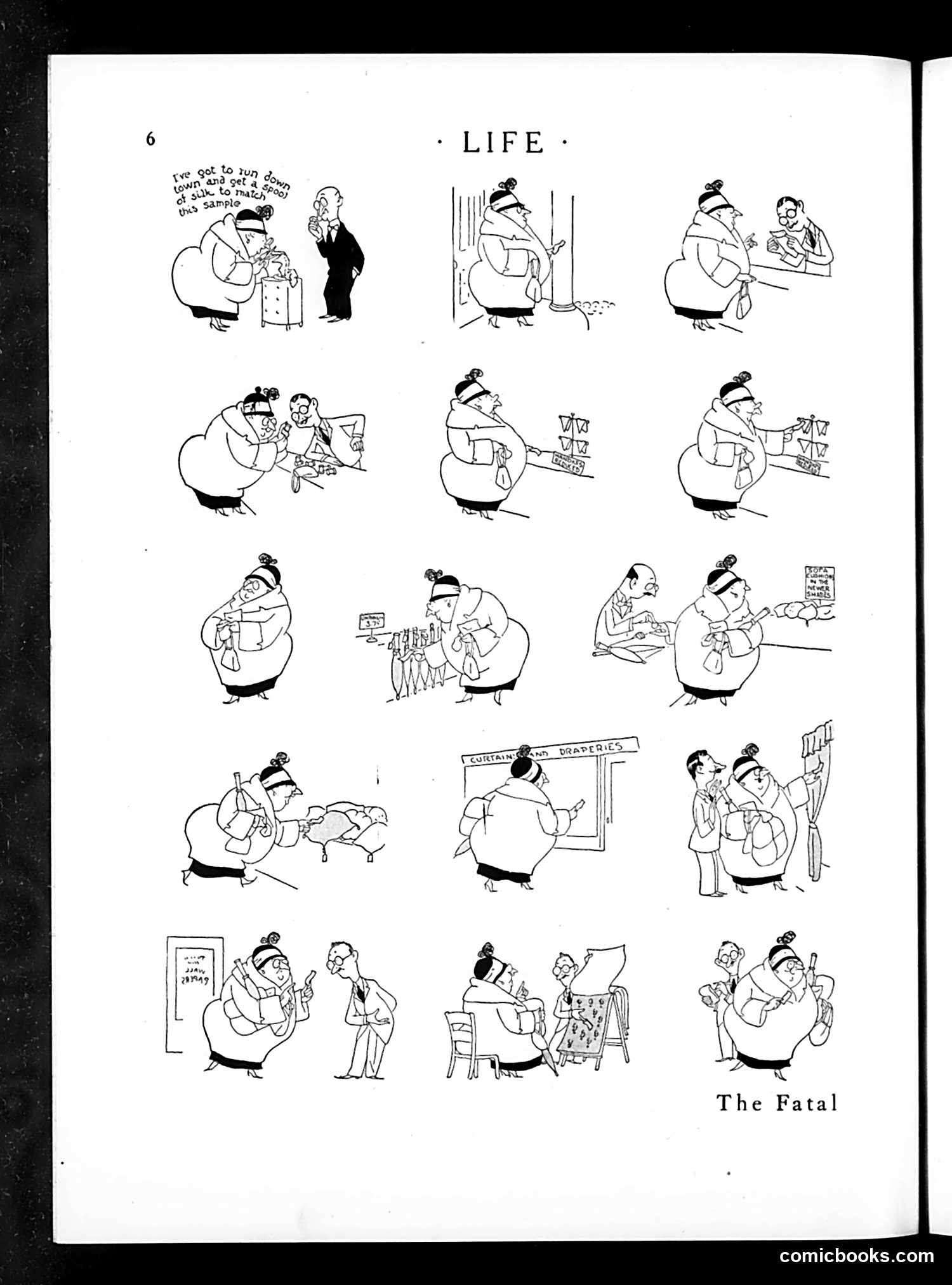
This is a sequential comic strip titled "The Fatal" showing a rotund, well-dressed man with a distinctive hat engaged in various activities throughout his day. The strip appears to be social satire about a wealthy or privileged figure. The opening panel shows him claiming he must "run down town and get a sample" of something, establishing his character as someone pursuing consumption or acquisition. Subsequent panels depict him collecting items, making purchases at a "Curtain & Draperies" shop, gambling or playing cards, and various social interactions. The title "The Fatal" suggests his activities—likely excessive spending, gambling, or hedonistic behavior—lead to some inevitable downfall or consequence. The satire targets wealthy individuals' self-indulgent lifestyles and poor financial judgment characteristic of early 20th-century American social commentary.
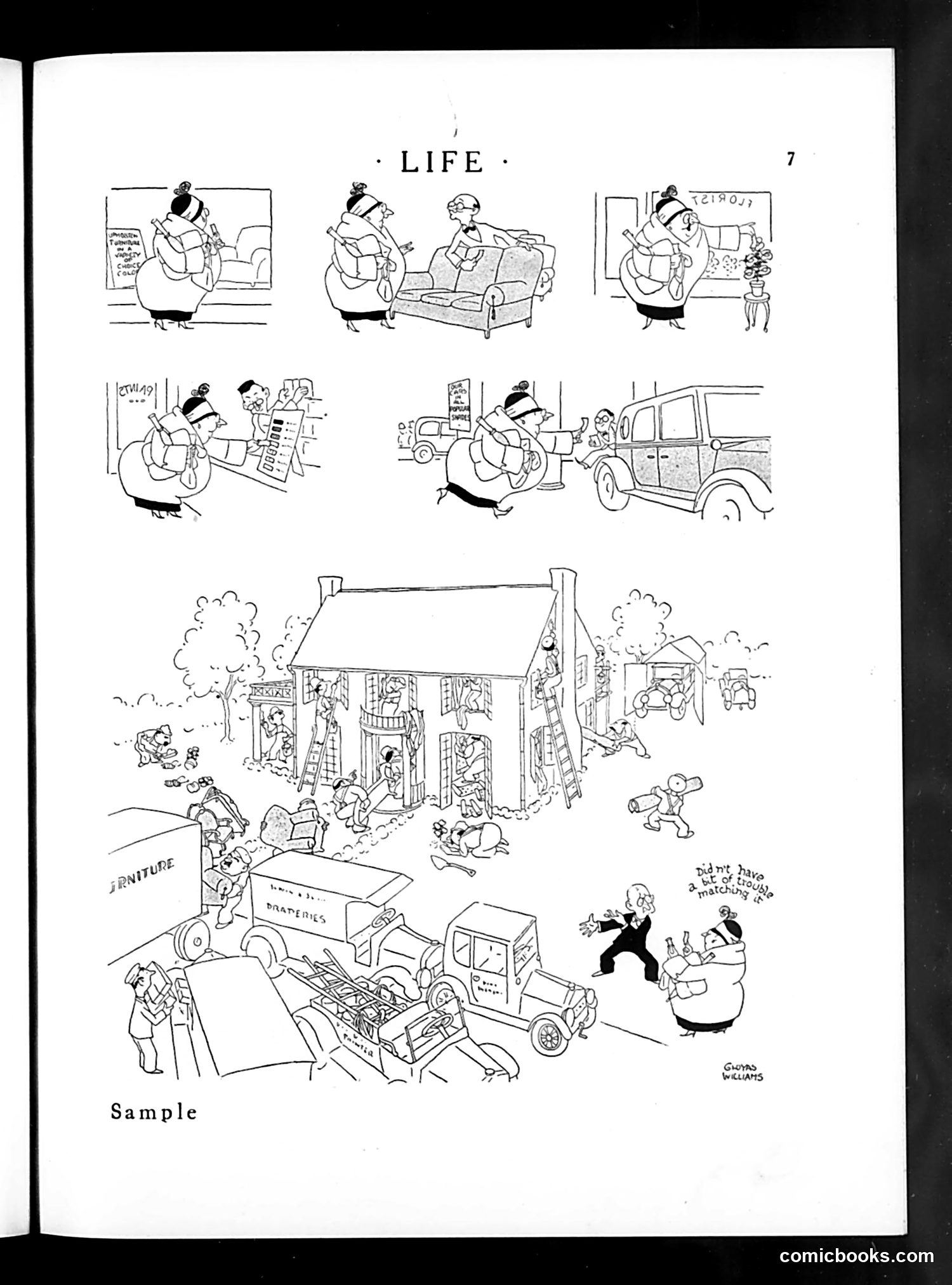
This page contains satirical cartoons about moving day and household chaos. The top five panels show a rotund woman (the main character) managing various aspects of moving—packing, transporting furniture, loading a car—depicting the physical comedy of relocation. The large bottom cartoon illustrates the culmination: a chaotic moving day scene outside a house, with furniture being unloaded, children playing, and moving trucks creating disorder. The satire targets the absurdity and pandemonium of residential moves in early-to-mid 20th century America. The humor relies on visual gags and the character's exaggerated physical comedy rather than political commentary. The cartoonist's signature appears to read "Gluyas Williams," known for domestic humor in Life magazine. The page demonstrates period attitudes toward domestic labor and family logistics.
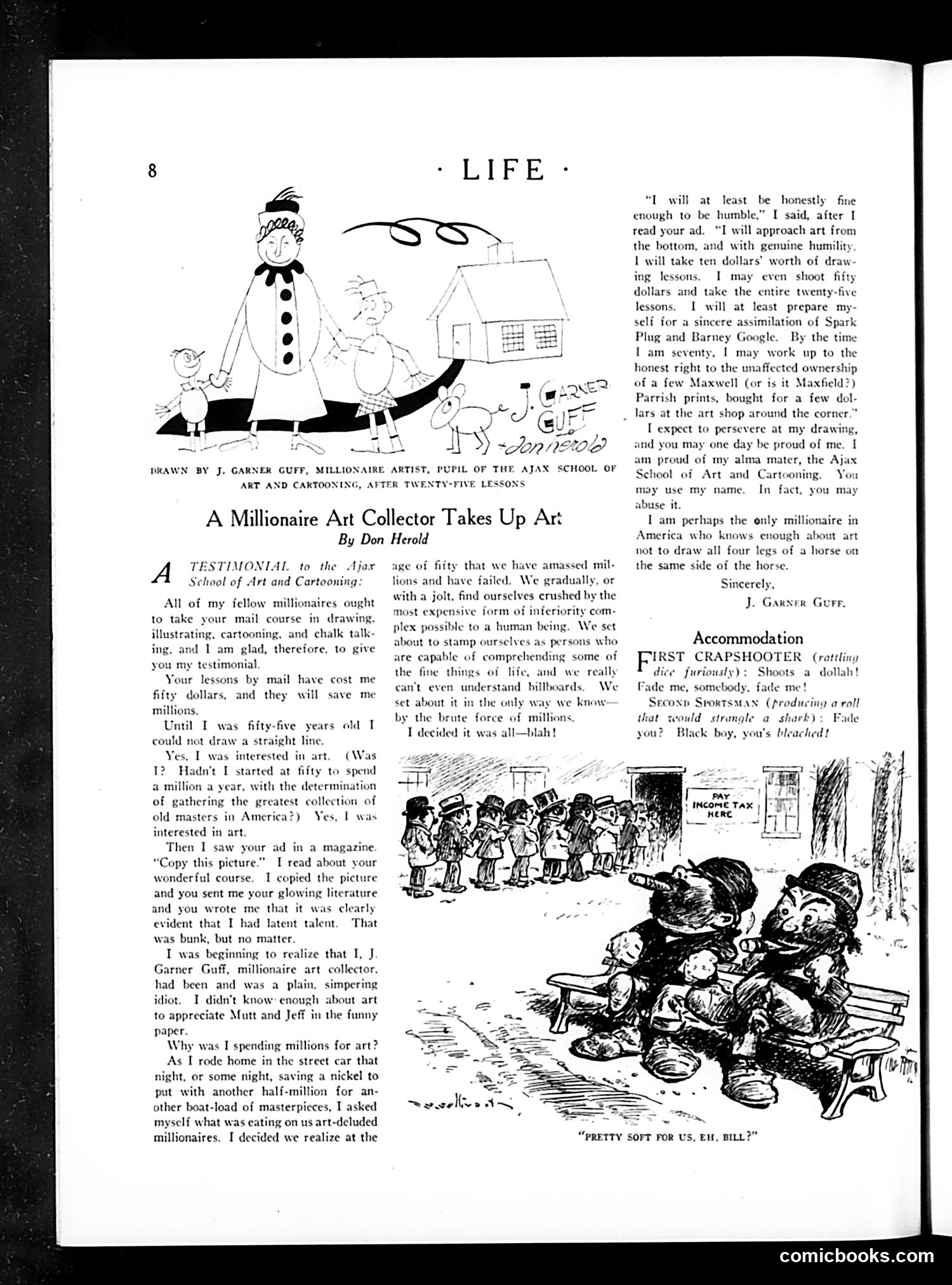
This page satirizes wealthy art collectors through J. Garner Guff, a millionaire who takes mail-order art lessons. The top cartoon shows Guff with children, illustrating his newfound artistic pretensions. The main article by Don Herold mocks Guff's assumption that spending money automatically grants cultural sophistication. Herold describes how Guff, after accumulating wealth, decides to become an art connoisseur—despite admitting he knows nothing about art. The satire targets the common wealthy stereotype: that money can purchase taste and refinement. The bottom cartoon captioned "Pretty soft for us, eh, Bill?" shows unemployed men watching well-dressed figures, likely referencing economic disparity during Depression-era struggles—a sharp contrast to Guff's frivolous art-collecting aspirations.
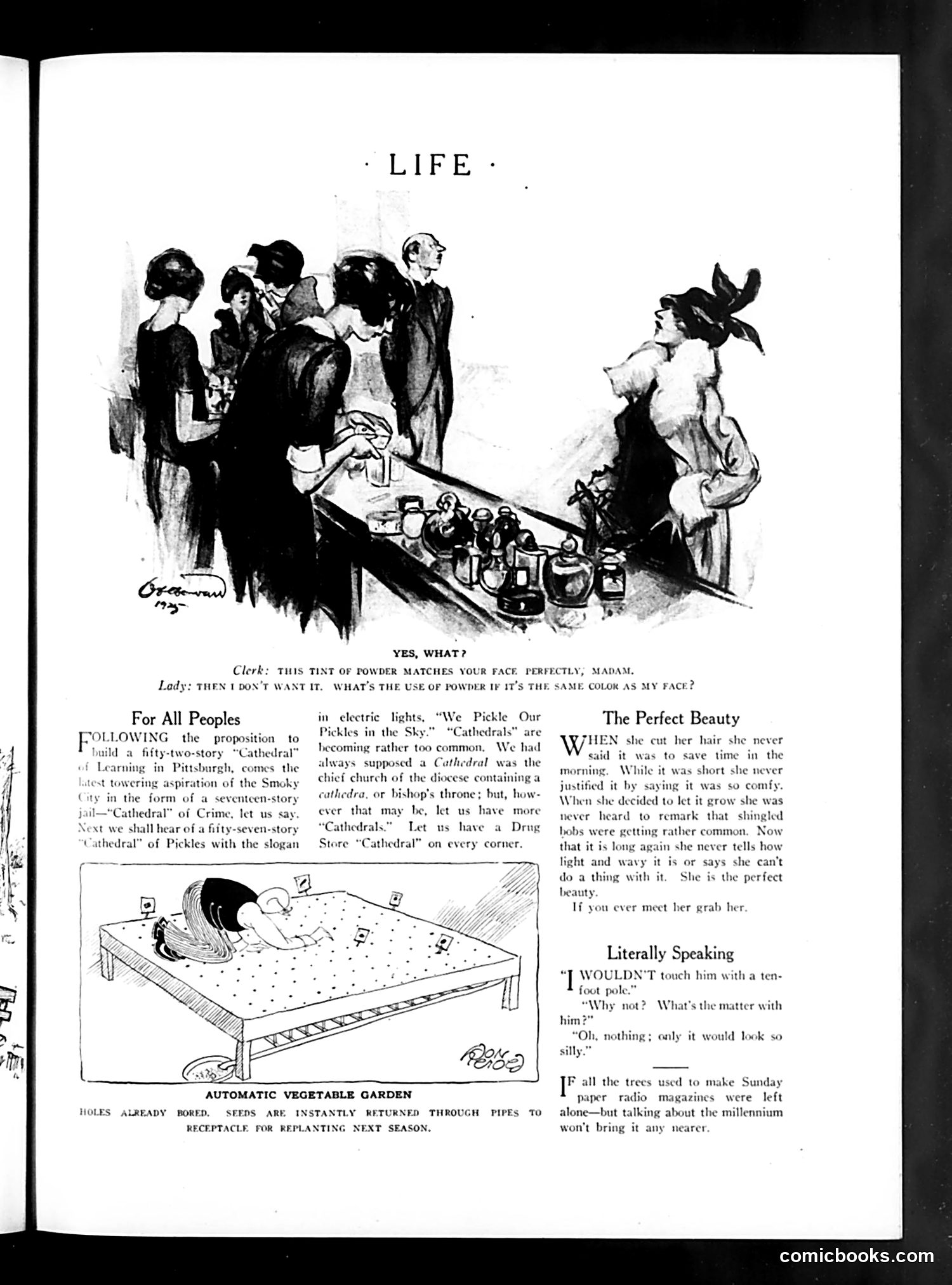
This page contains humorous sketches and brief satirical pieces typical of early 20th-century Life magazine. The top cartoon shows a clerk selling powder makeup, sarcastically suggesting it makes all faces look identical—mocking the standardization of beauty through cosmetics. "Automatic Vegetable Garden" depicts someone in bed while seeds are processed through pipes, satirizing modern automation and labor-saving devices becoming absurdly impractical. The text pieces include "The Perfect Beauty" (mocking a woman who neglects her appearance while claiming indifference), "Literally Speaking" (a mild pun about touching someone with a ten-foot pole), and a joke about trees in Sunday papers. Overall, this represents Life's satirical commentary on contemporary consumer culture, changing beauty standards, mechanization, and domestic life—using exaggeration and absurdity to critique modern American society.
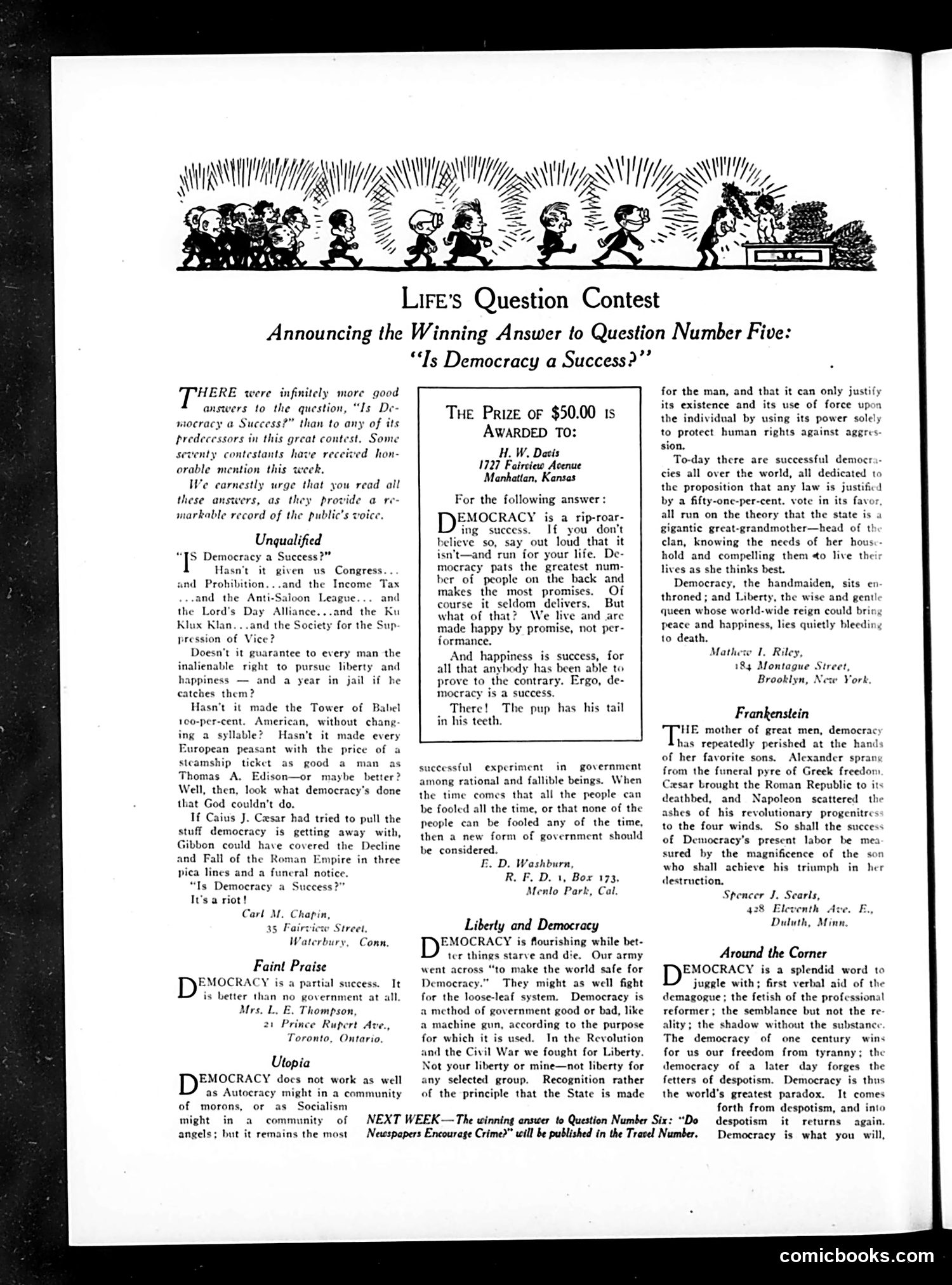
This page presents Life's satirical "Question Contest," announcing the winning answer to "Is Democracy a Success?" The winner, H.W. Davis of Manhattan, Kansas, receives $50 for his answer: "Democracy is a rip-roaring success—believe so, say out loud that it isn't—and run for your life." The satire mocks democracy's fragility and intolerance of dissent. Davis's answer suggests that while Americans *claim* to champion democratic freedoms, they actually suppress unpopular opinions through social pressure and mob mentality. The other responses—titled "Unqualified Success," "Faint Praise," "Utopia," "Frankenstein," "Liberty and Democracy," and "Around the Corner"—offer varied cynical perspectives on democracy's effectiveness, from partial success to inevitable failure.
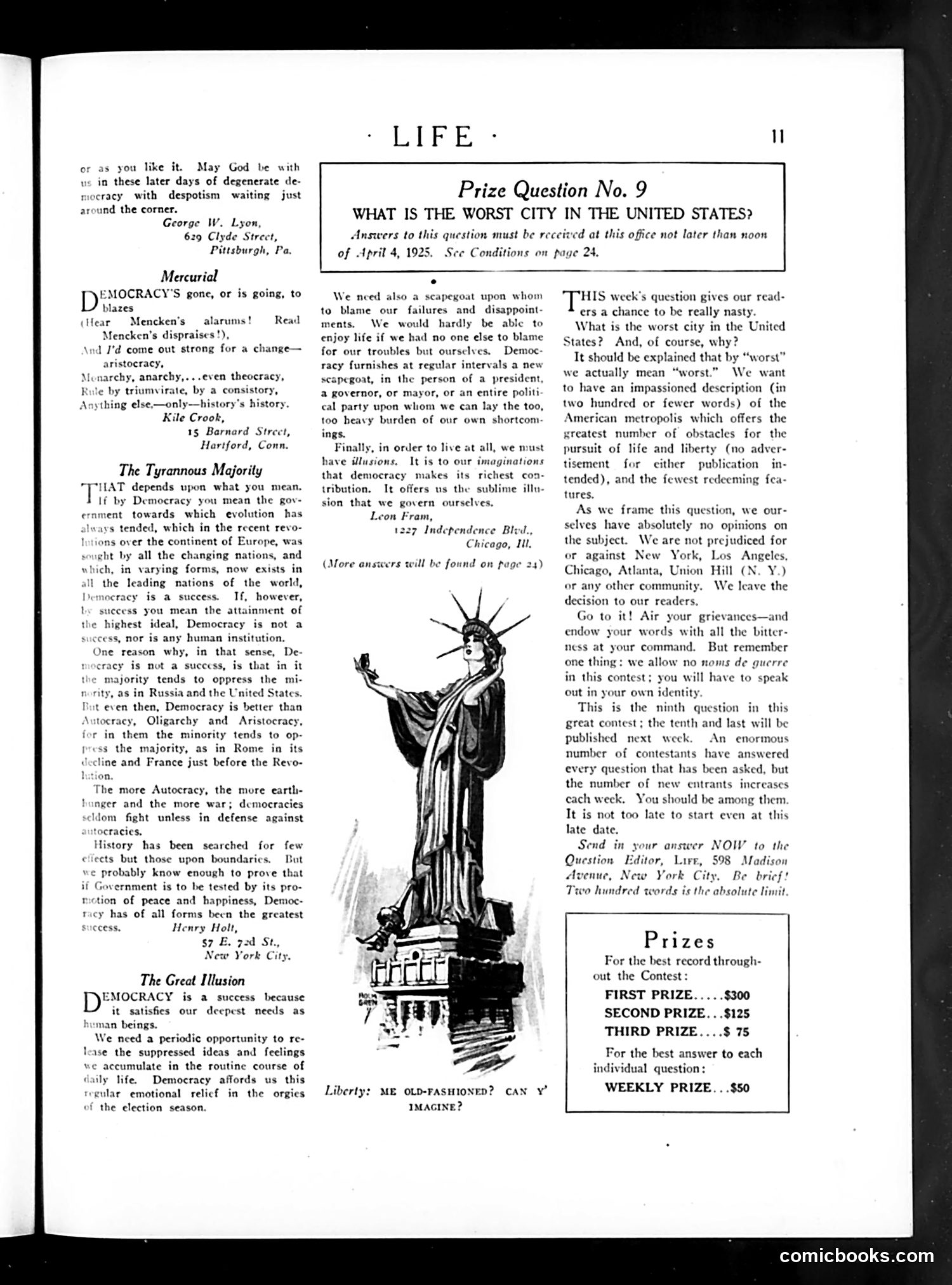
This page features **Prize Question No. 9**: "What is the Worst City in the United States?" The editors invite reader submissions to nominate American cities and explain their choice. The central image is the **Statue of Liberty**, captioned "ME OLD-FASHIONED? CAN Y' IMAGINE?" This appears ironic—Liberty, symbol of American ideals, questions whether she's outdated while the magazine asks readers to criticize American cities. The satire suggests that despite America's founding principles, modern cities have become problematic enough to warrant this critical contest. The Liberty figure's skepticism mirrors the editors' skeptical tone about American urban conditions circa 1925, during the Jazz Age's rapid urbanization and social change. The page also includes essays on democracy's merits, framing the city-criticism contest within broader cultural anxieties about American progress.
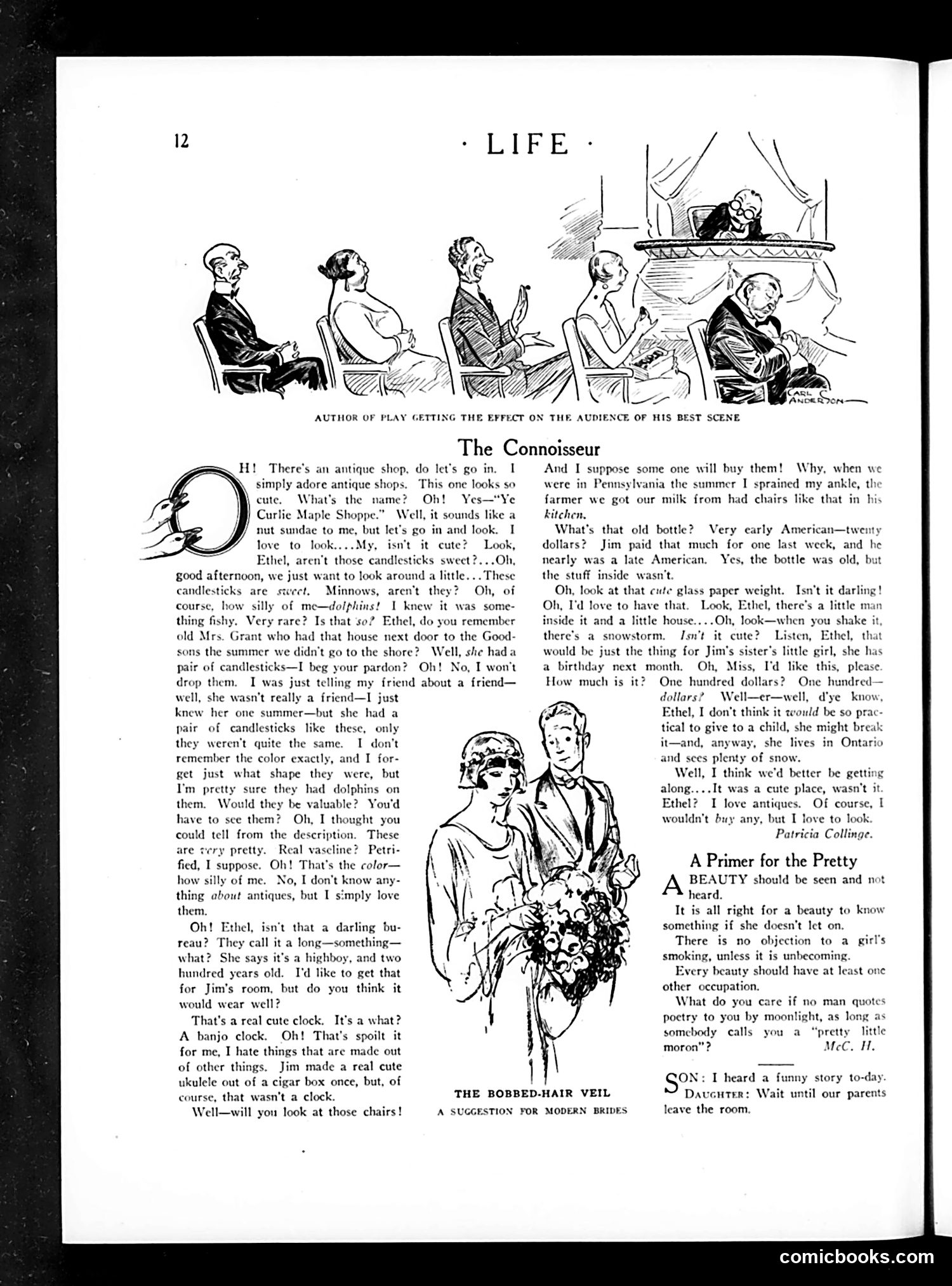
**Top Cartoon:** Shows five men in profile watching a theatrical performance, labeled "Author of Play Getting the Effect on the Audience of His Best Scene." This satirizes playwrights observing their own work—the joke being the author's self-absorbed focus on audience reaction to his material. **"The Connoisseur" Story:** A humorous dialogue between two women in an antique shop. One character (Ethel) loves browsing antiques for aesthetic pleasure but wouldn't actually purchase anything, while her companion advocates for buying. The satire targets wealthy dilettantes who enjoy window-shopping and collecting knowledge about luxury items without genuine commitment to ownership. **Secondary Content:** Includes a brief satirical piece on beauty standards and a father-son joke setup at page's bottom.
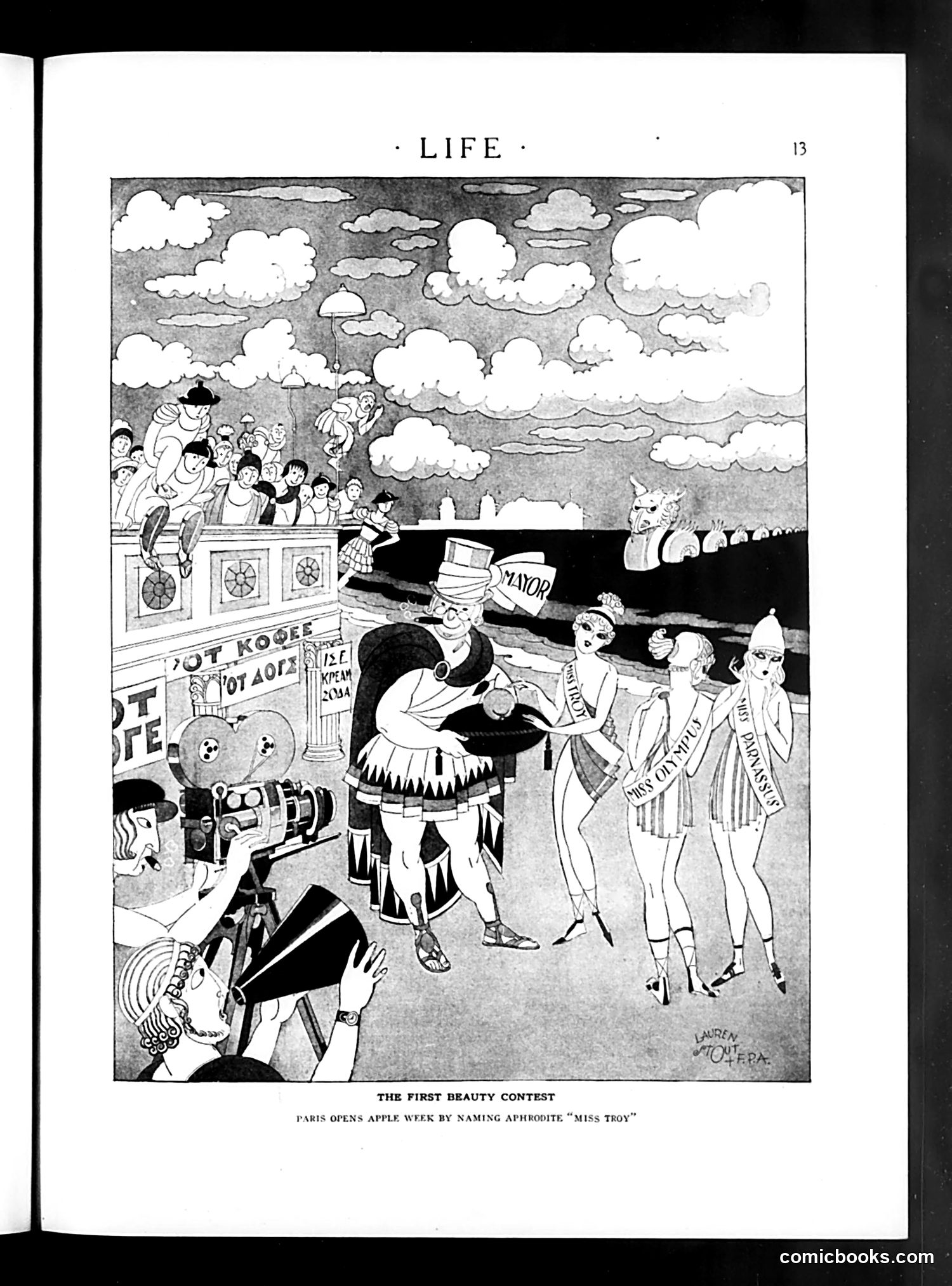
This satirical cartoon depicts Paris opening an "Apple Week" by naming Aphrodite "Miss Troy." The image references the classical myth of the Judgment of Paris, where the Trojan prince Paris awarded a golden apple to Aphrodite as the most beautiful goddess, sparking the Trojan War. The satire appears to mock: 1. **Modern beauty pageants** - treating classical mythology as if it were a contemporary contest, complete with judges and female contestants wearing sashes 2. **Commercial exploitation** - using ancient myths to promote a commercial "Apple Week" event 3. **The absurdity of ranking female beauty** - presenting the mythological judgment as a modern spectacle The cartoon humorously collapses ancient legend with 1920s consumer culture and beauty pageant culture.
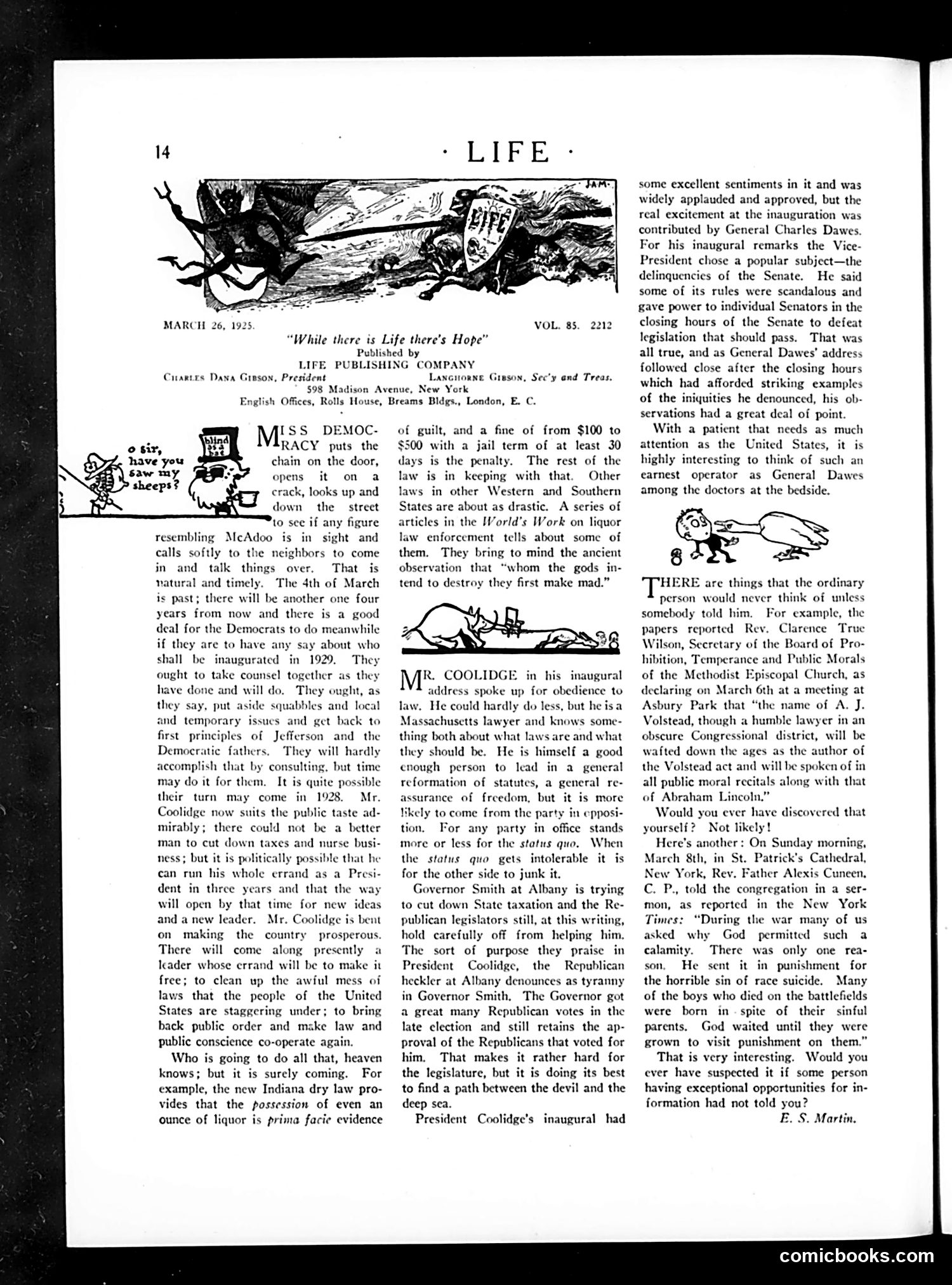
This page contains political commentary on Prohibition enforcement and state governance. The main cartoon depicts "Miss Democracy" as a chained figure, satirizing how Prohibition laws restrict freedoms. The text critiques inconsistent enforcement across states and compares delinquent senators to "McAdoo" — likely William McAdoo, a prominent political figure of the era. The article discusses President Coolidge's inaugural address, praising his call for legal obedience while mocking Republican hypocrisy regarding taxation and state power. References to "Governor Smith at Albany" suggest New York politics. A secondary item mentions Rev. Clarence True Wilson and debates over punishment for moral infractions, reflecting 1920s tensions between Progressive reform movements and individual liberty during the Prohibition era.
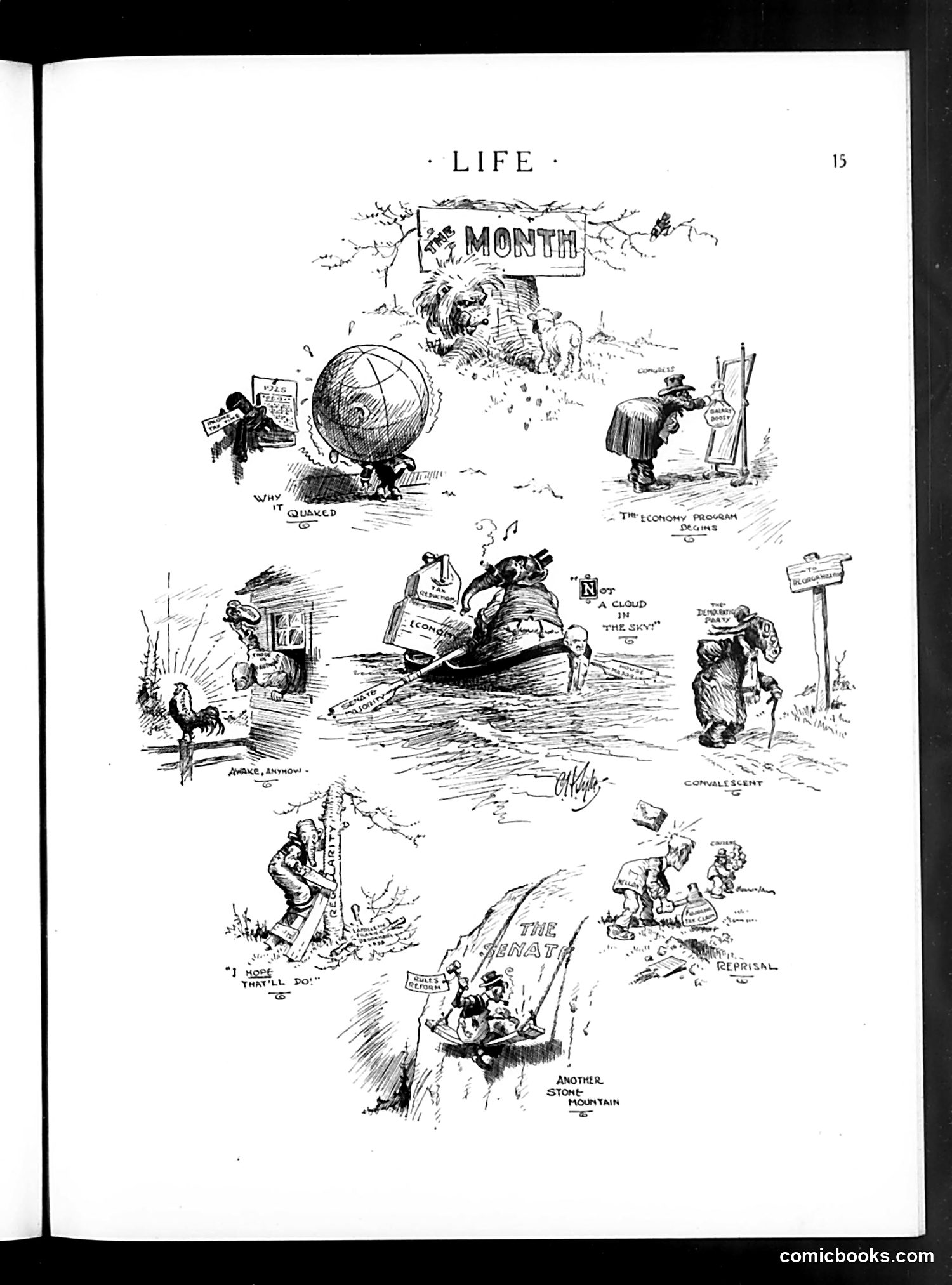
This is a satirical cartoon montage critiquing American political and economic issues, likely from the early 20th century. The central image shows figures struggling with a large globe labeled "Economy Program," suggesting difficulty implementing fiscal policies. Other panels reference "The Senate," "Another Stone Mountain," and phrases like "Why Quaked" and "Not a Cloud in the Sky"—depicting various governmental struggles and failures. The cartoons mock political incompetence, particularly regarding economic management and legislative gridlock. References to "The Senate" and mountainous obstacles suggest obstacles to progress. The overall tone satirizes government's inability to solve practical problems, using exaggerated figures and visual metaphors typical of Life magazine's sharp political humor.
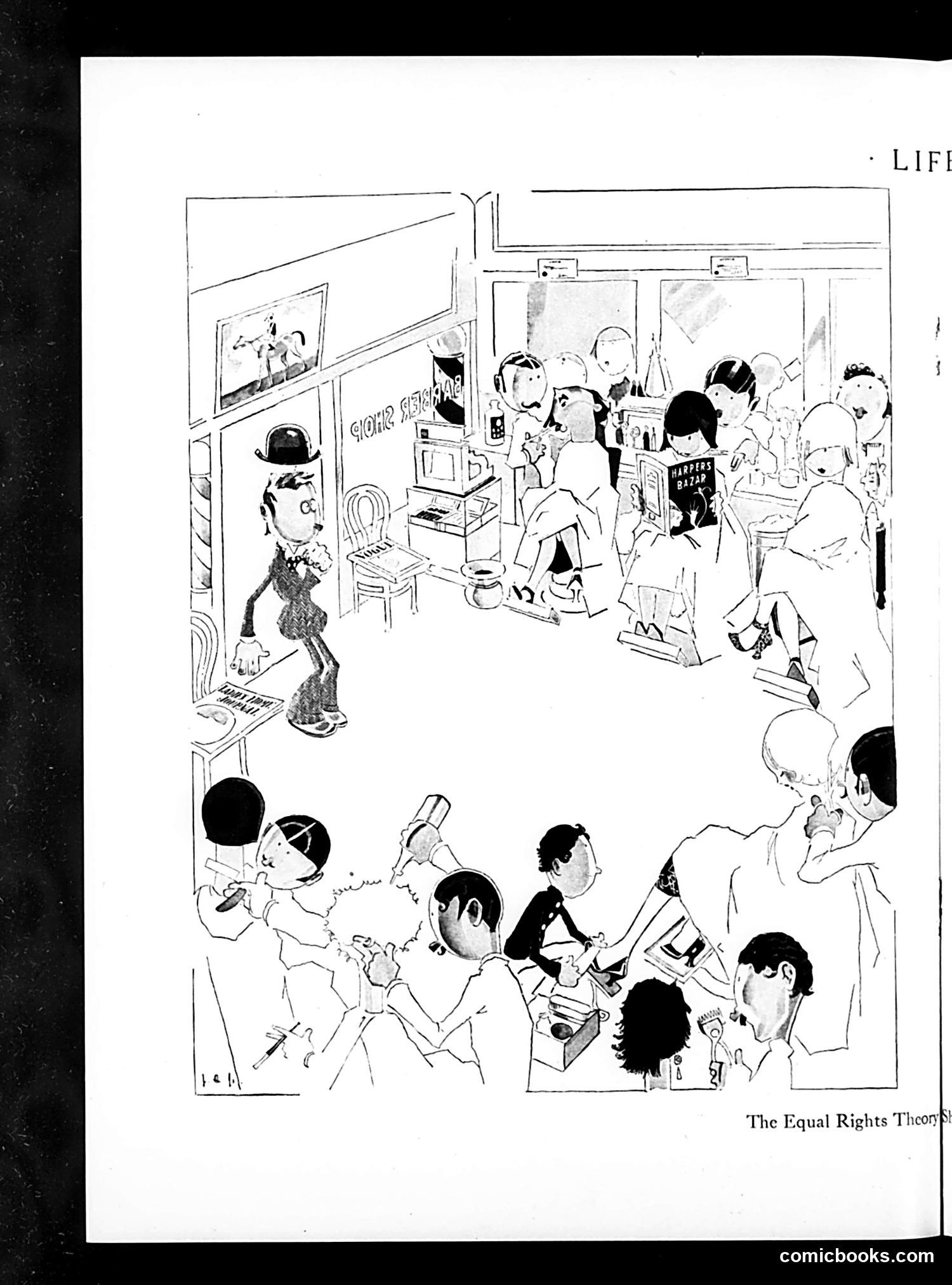
This satirical cartoon depicts a crowded, chaotic interior scene—likely a shop or public space—where numerous figures are jammed together in disorderly fashion. The title "The Equal Rights Theory" suggests the cartoon mocks egalitarian or democratic ideals. The joke appears to be that when "equal rights" are literally applied without hierarchy or organization, the result is pandemonium: people are crammed together, possessions are scattered, and no one can move or function effectively. The well-dressed figure standing apart on the left (in bowler hat) observes this chaos, implying criticism of egalitarian principles from an elitist perspective. The cartoon satirizes progressive equality advocacy by presenting its logical extreme as unworkable disorder—a common conservative critique from this era.
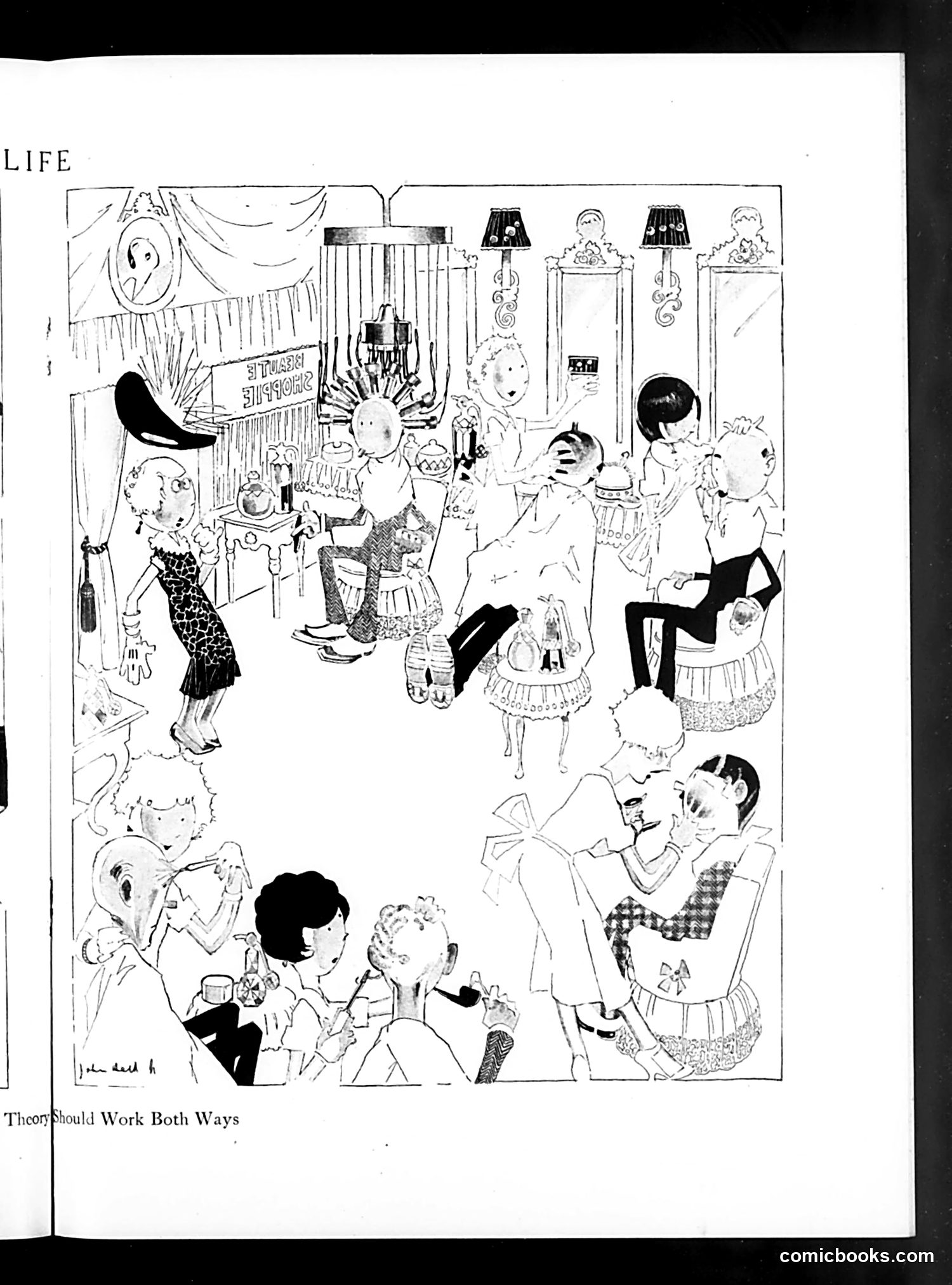
This Life magazine cartoon satirizes gender double standards in domestic labor. The illustration depicts an elaborate 1920s-30s party or social gathering where women perform various household tasks—serving drinks, managing decorations, attending to children—while men relax and enjoy themselves. The title's irony is the key: if the theory of "separate spheres" (women's domestic work, men's public roles) "should work both ways," then men should equally share household responsibilities. Instead, the cartoon shows women doing all the labor while men are pampered guests, exposing how the theory conveniently benefits men while burdening women. This reflects early feminist critiques of unequal domestic expectations in American society.
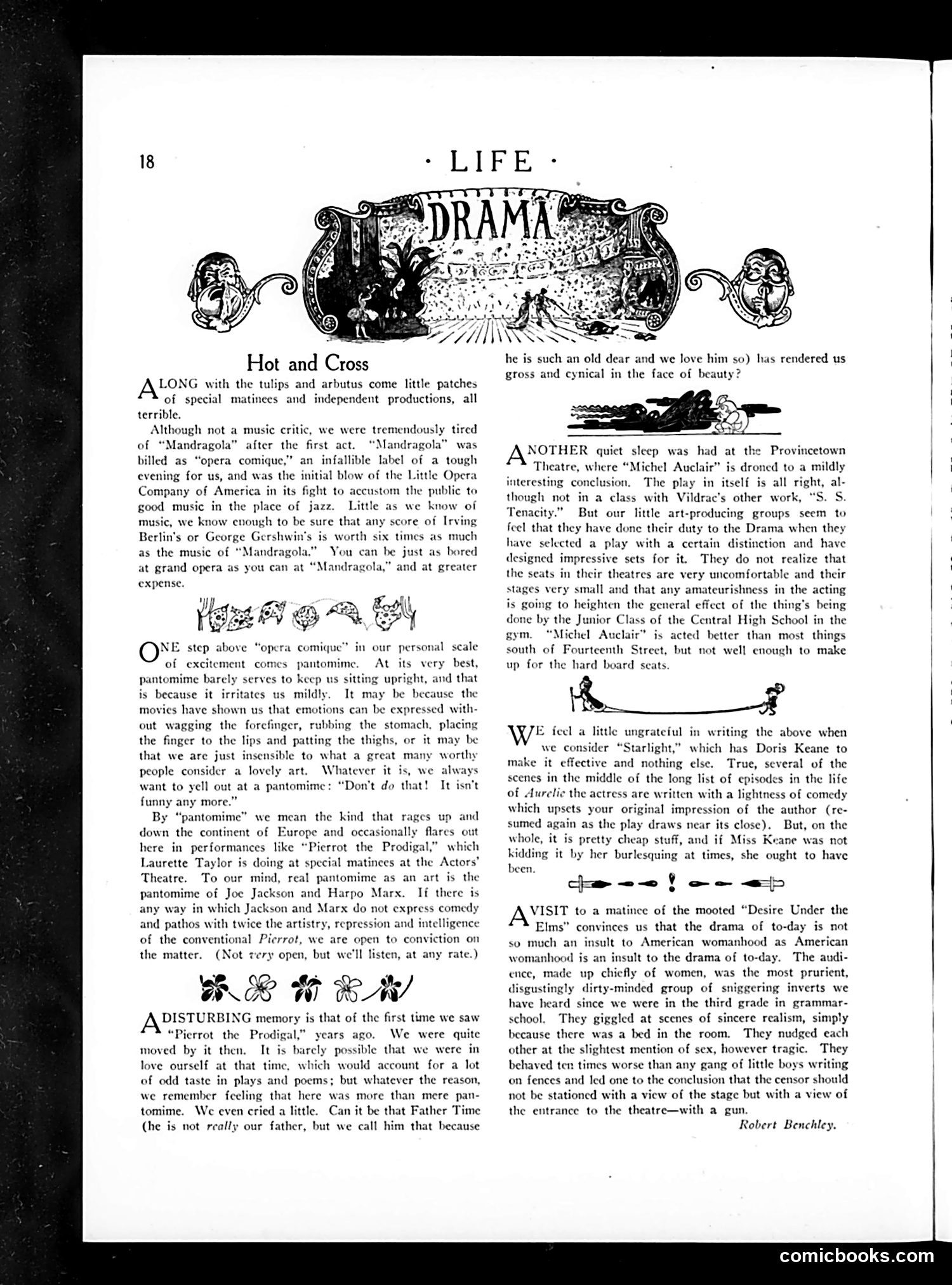
This is a theater review column titled "Hot and Cross," critiquing spring theatrical productions in New York. The author dismisses several performances: **"Mandragola"** — An opera marketed as "opera comique" that the reviewer found tedious, claiming even Irving Berlin or George Gershwin would be superior. **"Pierrot the Prodigal"** — A pantomime starring Laurette Taylor. The reviewer argues that genuine pantomime (citing Joe Jackson and Harpo Marx as exemplars) requires restraint and intelligence, not exaggerated finger-wagging and stomach-patting. They admit being moved by it years ago but attribute that to youthful sentimentality. **"Michel Auclair"** — A play at the Provincetown Theatre criticized for amateurish acting and uncomfortable seating in a tiny theater—suggesting small "art-producing groups" prioritize impressive sets over actual production quality. The column's satiric point: pretentious small theaters and experimental productions often fail because enthusiasm for "distinction" exceeds actual execution and audience comfort.
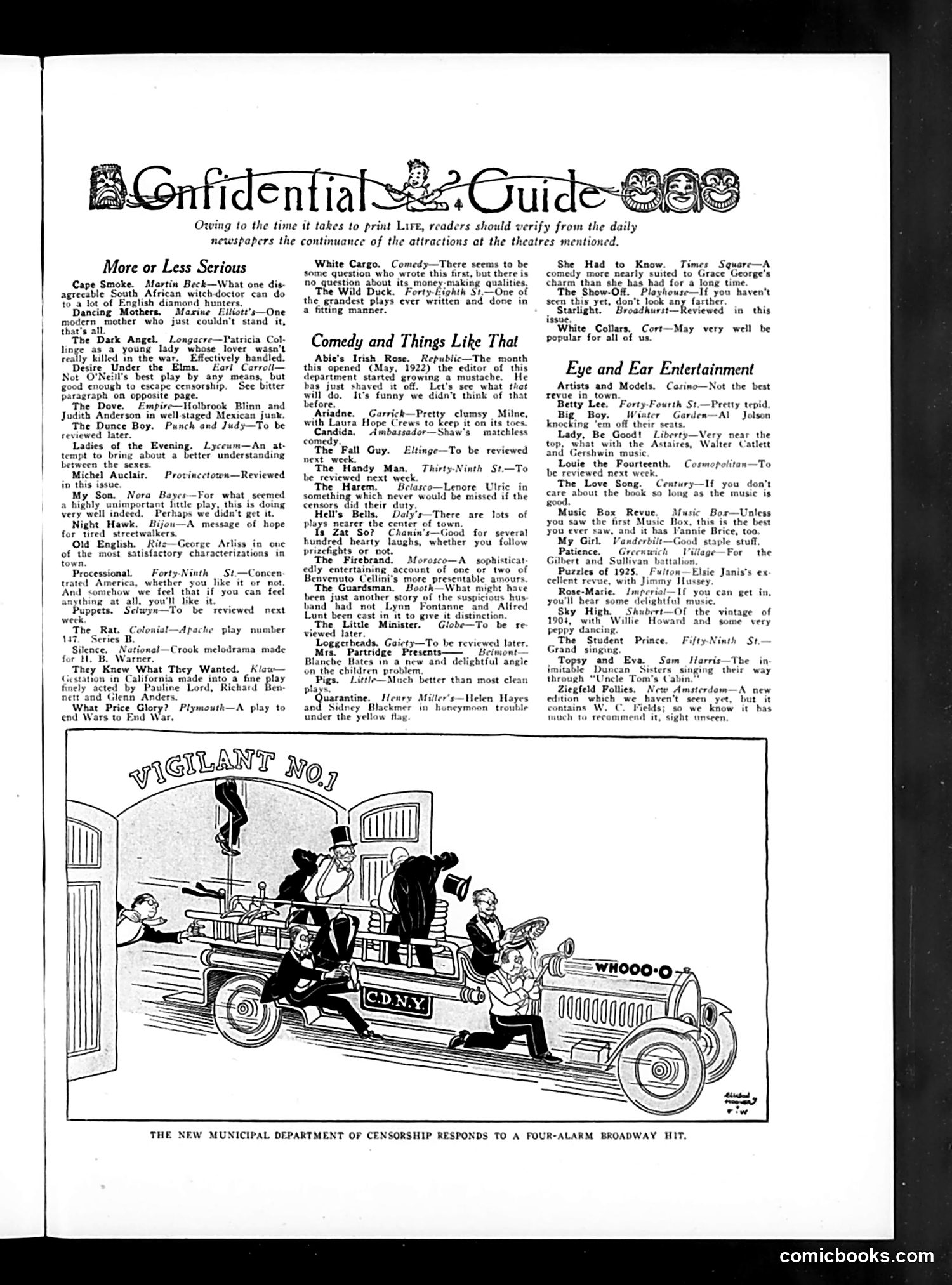
This is a theater review guide from Life magazine covering Broadway shows. The main cartoon depicts "VIGILANT NO. 1"—a satirical response to theater censorship. The cartoon mocks New York City's newly established municipal censorship board. It shows fire trucks and censors responding urgently (with "WHOO-O" sirens) to a "four-alarm Broadway hit"—treating artistic expression like an emergency requiring emergency responders. The censors are portrayed as firefighters controlling potential "moral danger" from stage productions. The accompanying reviews are written with dry wit, often noting which plays narrowly escaped or were subjected to censorship scrutiny. References to "Desire Under the Elms" joke about content that "escaped censorship," while "The Harem" and "Night Hawk" draw criticism for potentially questionable morality. The satire targets the absurdity of treating theatrical content as a public emergency requiring bureaucratic intervention—equating censors with firefighters fighting "dangerous" ideas.
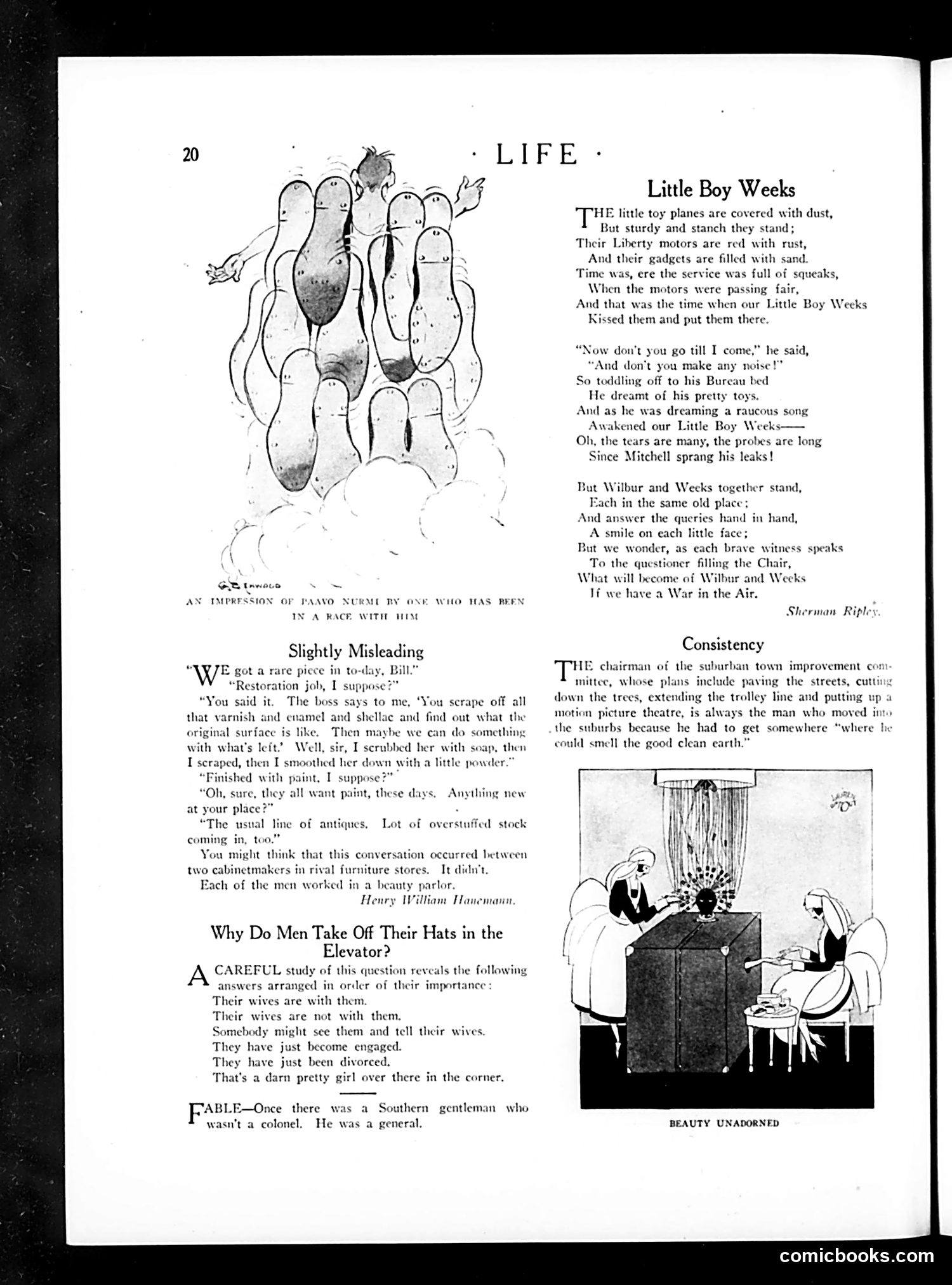
This page contains satirical commentary on 1920s American life: **"Slightly Misleading"**: Mocks the beauty industry's deceptive practices. Two men discussing furniture restoration are revealed to work in a beauty parlor—the joke being that modern beauty treatments resemble aggressive restoration work (scraping, smoothing, painting), not natural enhancement. **"Why Do Men Take Off Their Hats in the Elevator?"**: Humorous pseudo-scientific analysis of male behavior in elevators, listing increasingly absurd reasons (wives present, potential affairs, recent engagements/divorces). The satire targets masculine social anxiety and hypocrisy about propriety. **"Little Boy Weeks"**: A poem referencing the Billy Mitchell court-martial scandal (1925), where the Air Force general was court-martialed for criticizing military aviation policies. The child's toys symbolize damaged military readiness; "Wilbur and Weeks" (likely referring to aviation pioneers and Mitchell) face questioning about future warfare—satirizing bureaucratic hearings over genuine preparedness. **"Consistency"**: Mocks suburban hypocrisy—the improvement committee chairman who wanted to escape to pristine nature now paves streets, cuts trees, and builds theaters, contradicting his original motivation.
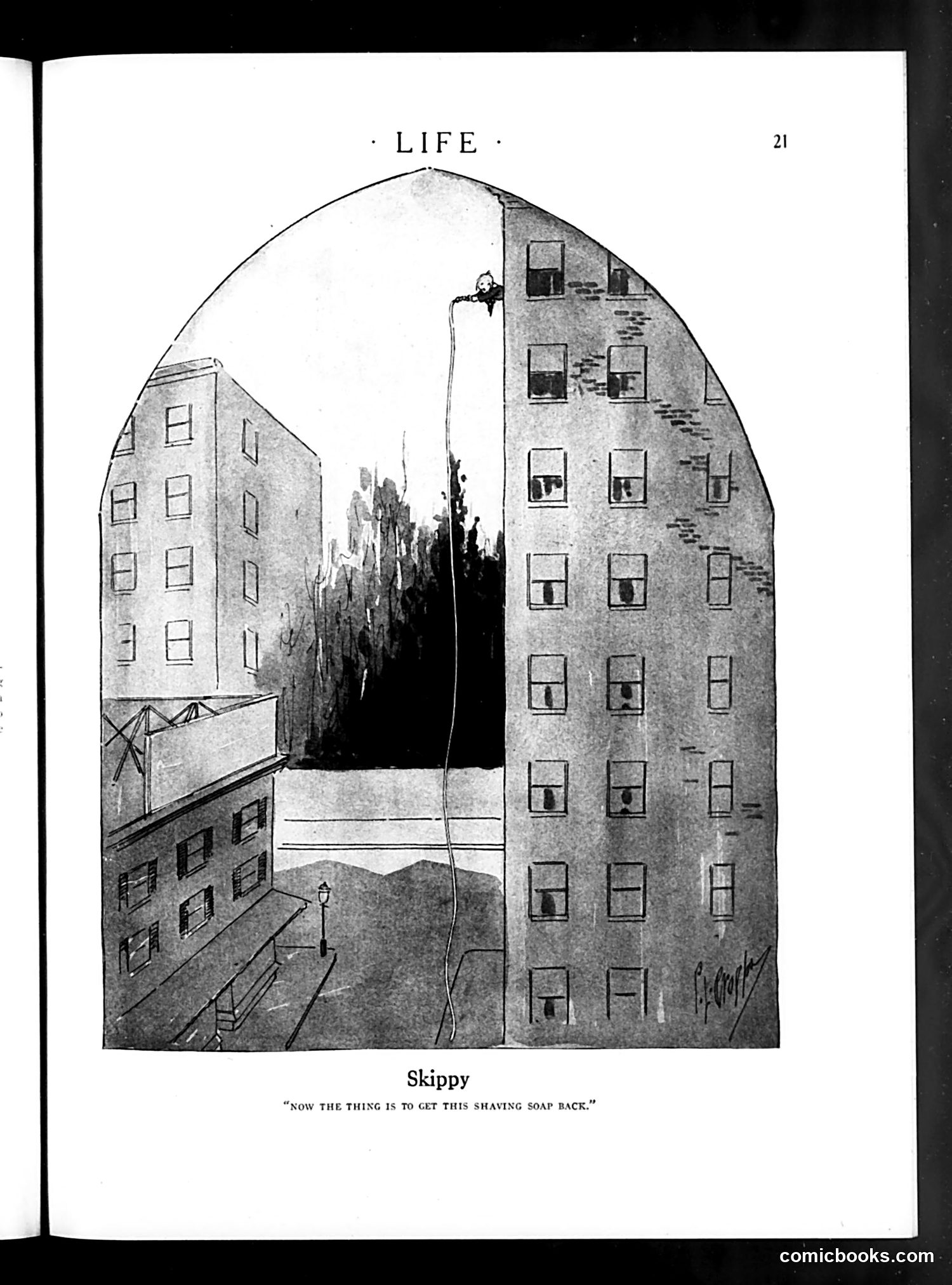
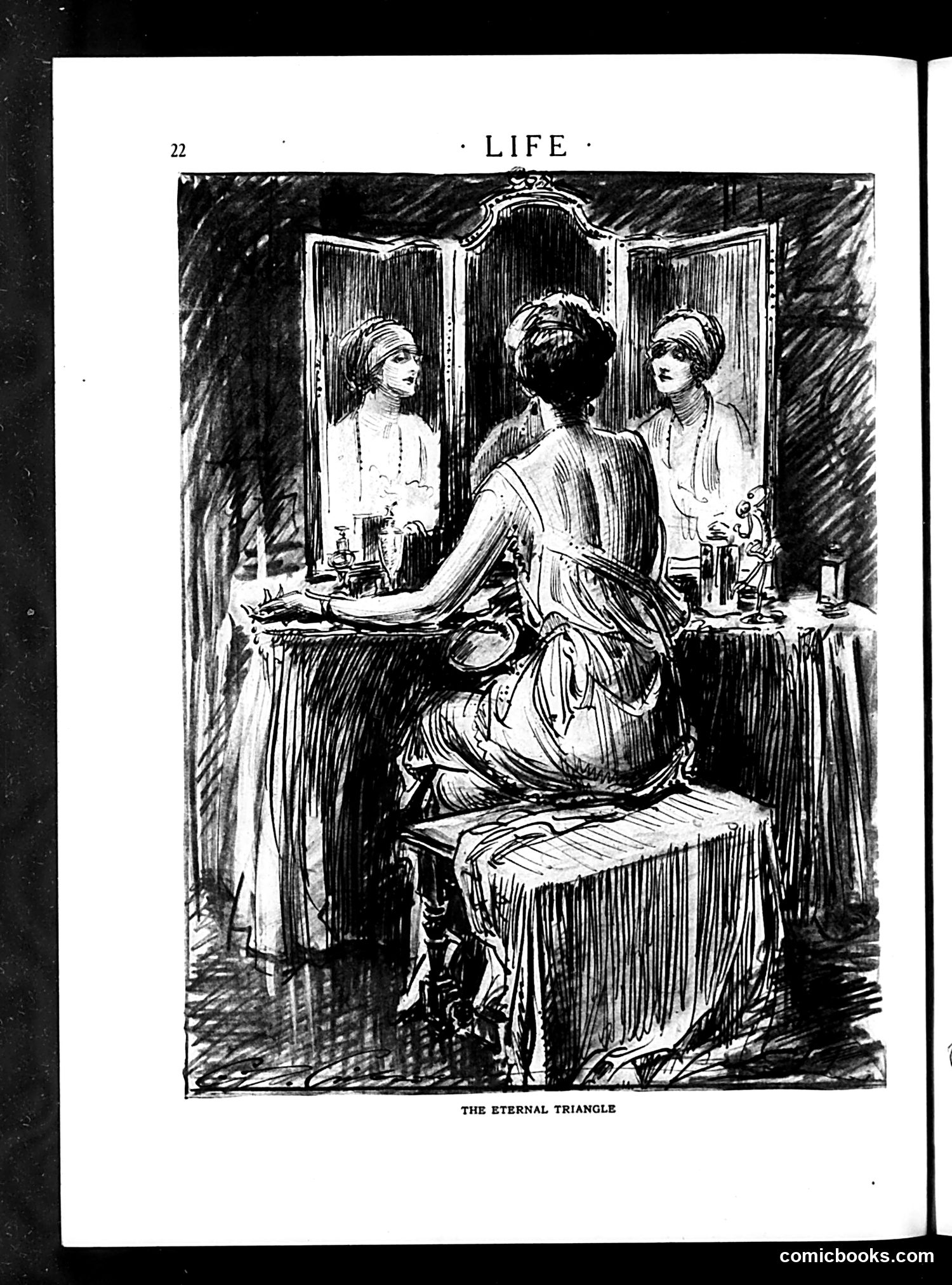
This satirical illustration depicts three women at a vanity mirror—a classic visual pun on the "eternal triangle," a period phrase for romantic entanglement involving three people. However, the satire here appears to comment on vanity and female narcissism rather than romance: all three figures are absorbed in their appearance, gazing at themselves in the mirror with evident self-regard. The title's double meaning—transforming a dramatic love-triangle concept into a trivial scene of women preoccupied with their looks—suggests social commentary on feminine frivolity. The elaborate clothing and salon setting reinforce themes of luxury and self-absorption. This reflects early 20th-century satirical attitudes about women's priorities and the culture of beauty rituals, presented here for comedic effect.
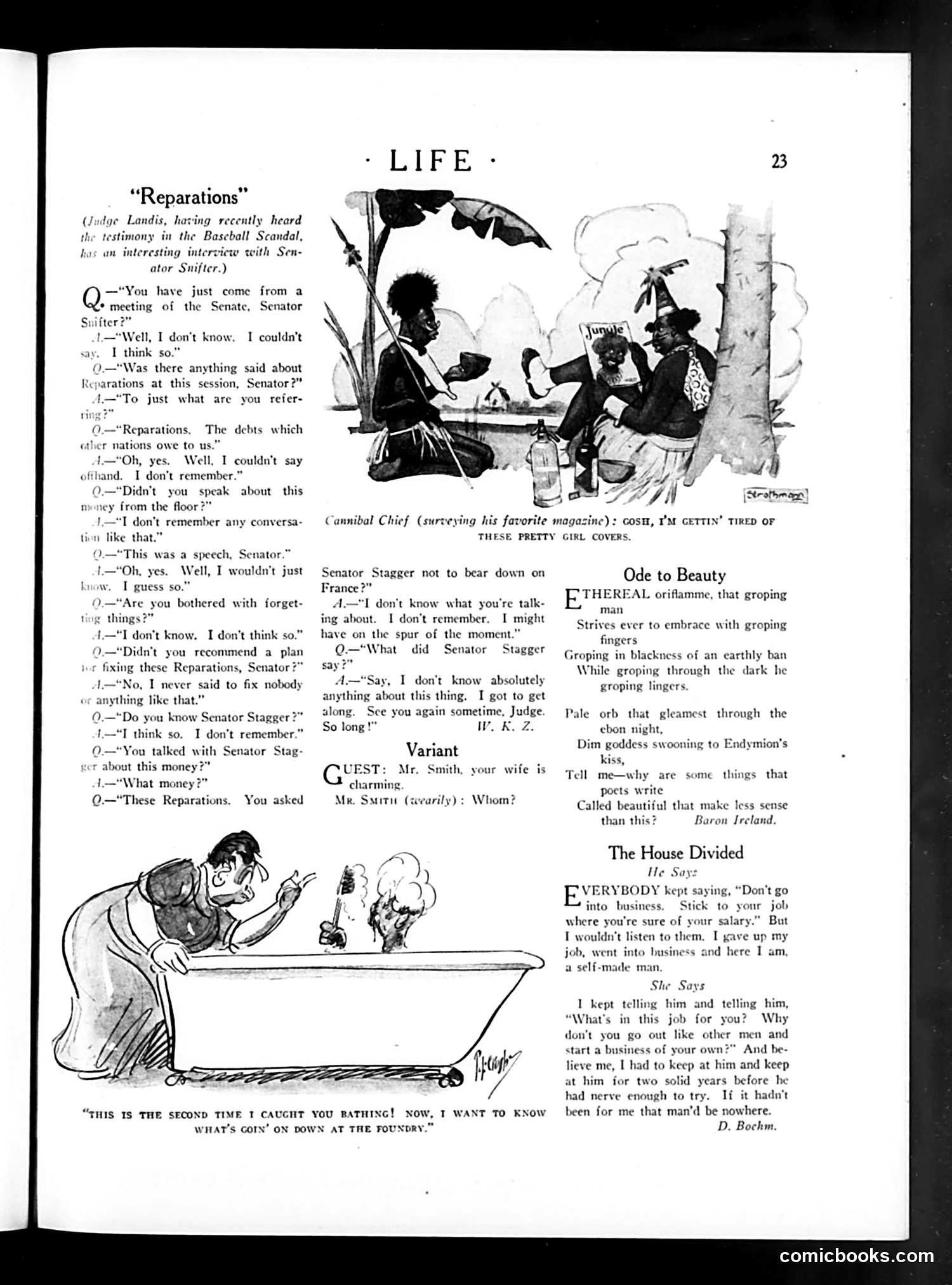
**"Reparations" Dialogue Comic:** A senator is interviewed about post-WWI reparations (war debts owed to the U.S.). The joke targets senatorial incompetence: the senator claims repeatedly not to remember discussing reparations, making speeches about them, or knowing relevant colleagues—despite apparently doing all these things. This mocks Congress's apparent indifference or forgetfulness regarding major foreign policy matters. **"Cannibal Chief" Cartoon:** A caricatured Indigenous chief complains about magazine covers featuring "pretty girl" images, suggesting he's tired of this editorial choice. The humor relies on a racist trope of "primitive" tastes. **Other Content:** The page includes light domestic humor ("The House Divided") and poetry parody ("Ode to Beauty"), typical Life magazine filler satirizing everyday life and literary pretension.
This page presents contest entries answering whether democracy is a success—a pointed critique disguised as a game. **The Satirical Answers:** Two main responses appear. "The Old Army Game" compares democracy to a con, where citizens stake everything in liberty and equality but receive only "empty shells"—a cynical view of broken promises. "A Spectacular Success" takes the opposite approach, sarcastically praising democracy as wonderfully "diverting" despite being founded on flawed premises (incompetent masses, loudmouths driving policy). **"The Gilded Rule"** offers a third perspective: democracy works only for the obedient, the publicly pious (not the genuinely moral), and the honest—a narrow slice of society. **The Context:** This appears post-WWI, when Americans questioned whether democracy had actually delivered on its ideals. The contest format—paying readers to critique their own system—reflects Life's satirical tradition of using reader participation to expose social contradictions. These aren't celebratory answers; they're deeply skeptical of democracy's real-world function versus its theory.
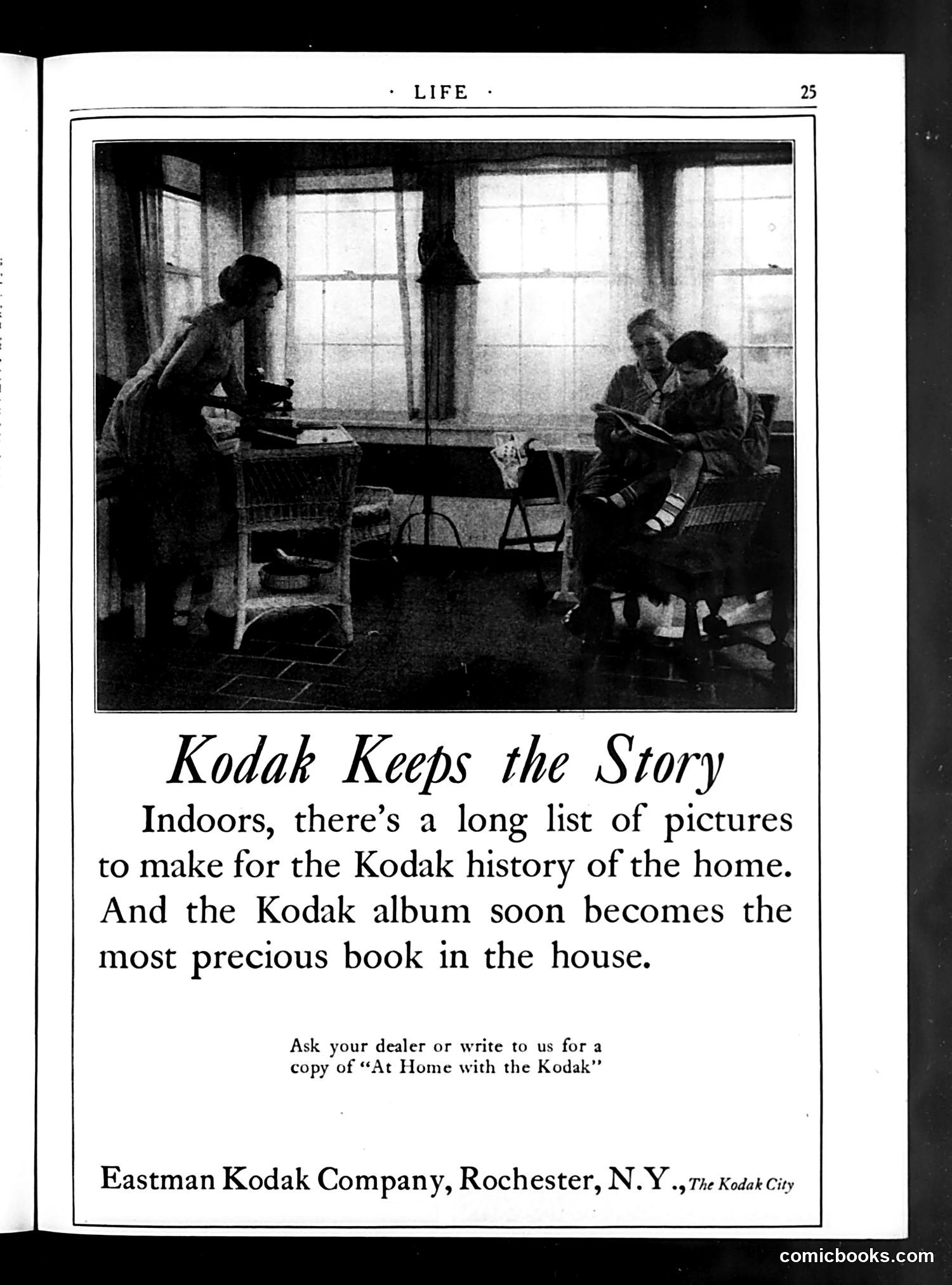
This is a Kodak advertisement, not satire or political commentary. The page shows a domestic scene where a woman photographs two other figures (likely family members) indoors by a window, illustrating photography as a home activity. The ad's message is straightforward: Kodak cameras enable families to create photo albums documenting home life, positioning these albums as treasured keepsakes. The accompanying text emphasizes photography's role in preserving family memories and history. There is no cartoon, caricature, or satirical content here. This represents early-twentieth-century consumer advertising emphasizing personal photography and domestic leisure. The appeal targets middle-class households, promoting the camera as essential for recording family moments.
This page from *Life* magazine comprises primarily **short humorous anecdotes** and advertisements rather than political cartoons. The humor pieces satirize social pretense and marital dynamics. "His Mistake" mocks a woman's claim to join a "Purity League" (likely a temperance-adjacent moral organization) while still drinking champagne—exposing selective morality. "Amateur Night" ridicules a woman's deception about being deaf/dumb for charity. The remaining quips target common comedic targets: spousal finances, tourism boosterism, and 1920s-era concerns (eclipse panic, Prohibition-era "near-beer"). The single **illustration** depicts a ship captain's final request before departure—a visual pun playing on maritime tradition. A **cartoon banner** shows a man declining water, preferring alcohol, commentary on Prohibition-era attitudes. The page is dominated by cruise line advertisements (Raymond-Whitcomb) and a confectionery shop advertisement (Maillard), reflecting typical *Life* magazine content mixing satire with commercial promotion for affluent readers.
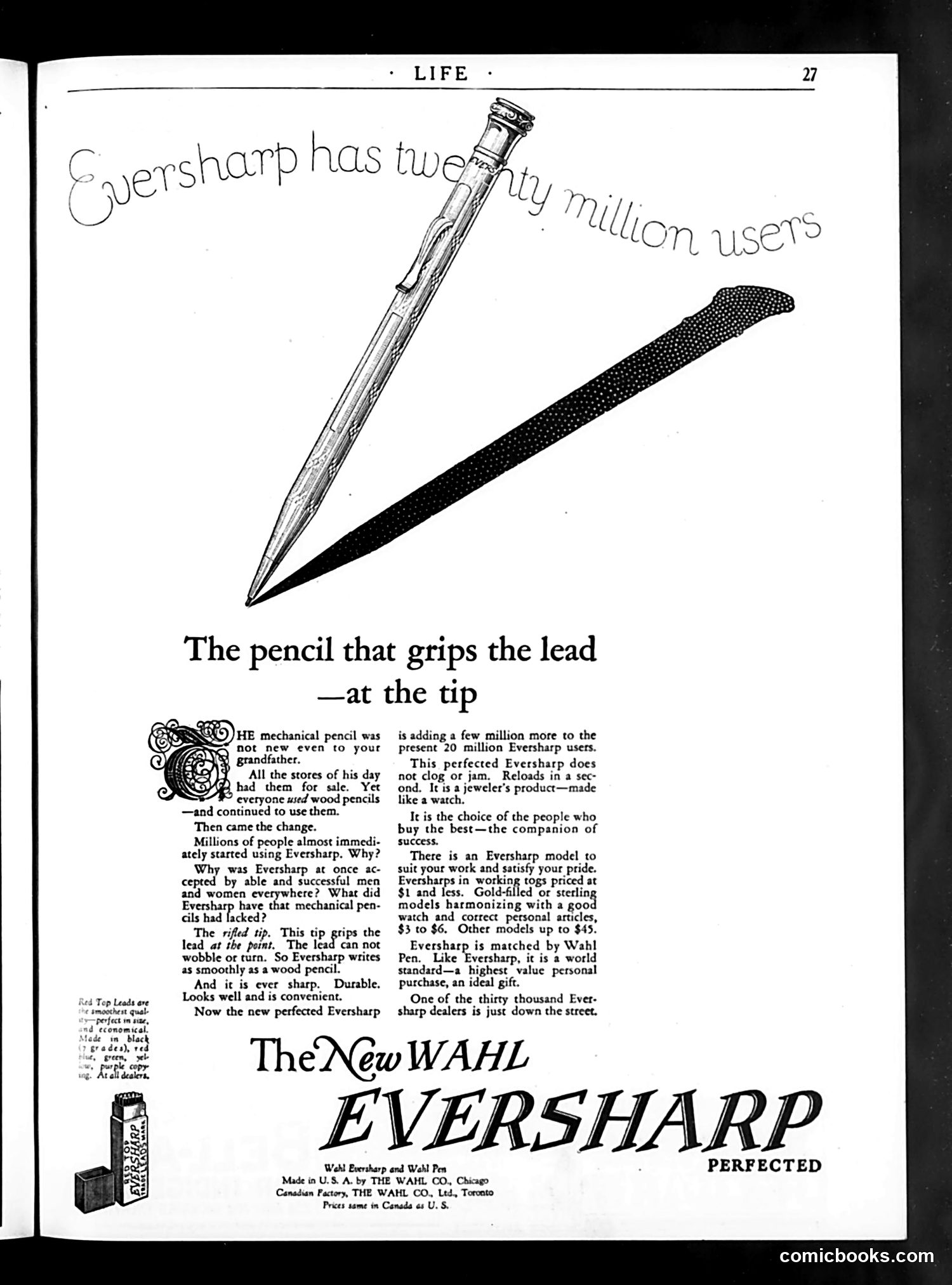
This is a **product advertisement**, not satire or political content. The page promotes the "New Wahl Eversharp" mechanical pencil to a 1920s audience. The key innovation highlighted is the "rifled tip"—a mechanism that grips the pencil lead at its point, preventing wobbling. The ad claims this allows the mechanical pencil to write as smoothly as traditional wooden pencils, addressing the main reason people historically preferred wood pencils despite mechanical alternatives existing "even to your grandfather." The marketing strategy positions Eversharp as a status symbol: "the choice of the people who buy the best—the companion of success." It emphasizes durability, precision engineering ("like a watch"), and availability across price points ($1 to $45). The decorative illustration shows the pencil's tapered design alongside the lead mechanism. This represents a genuinely significant innovation in writing instruments during this period.
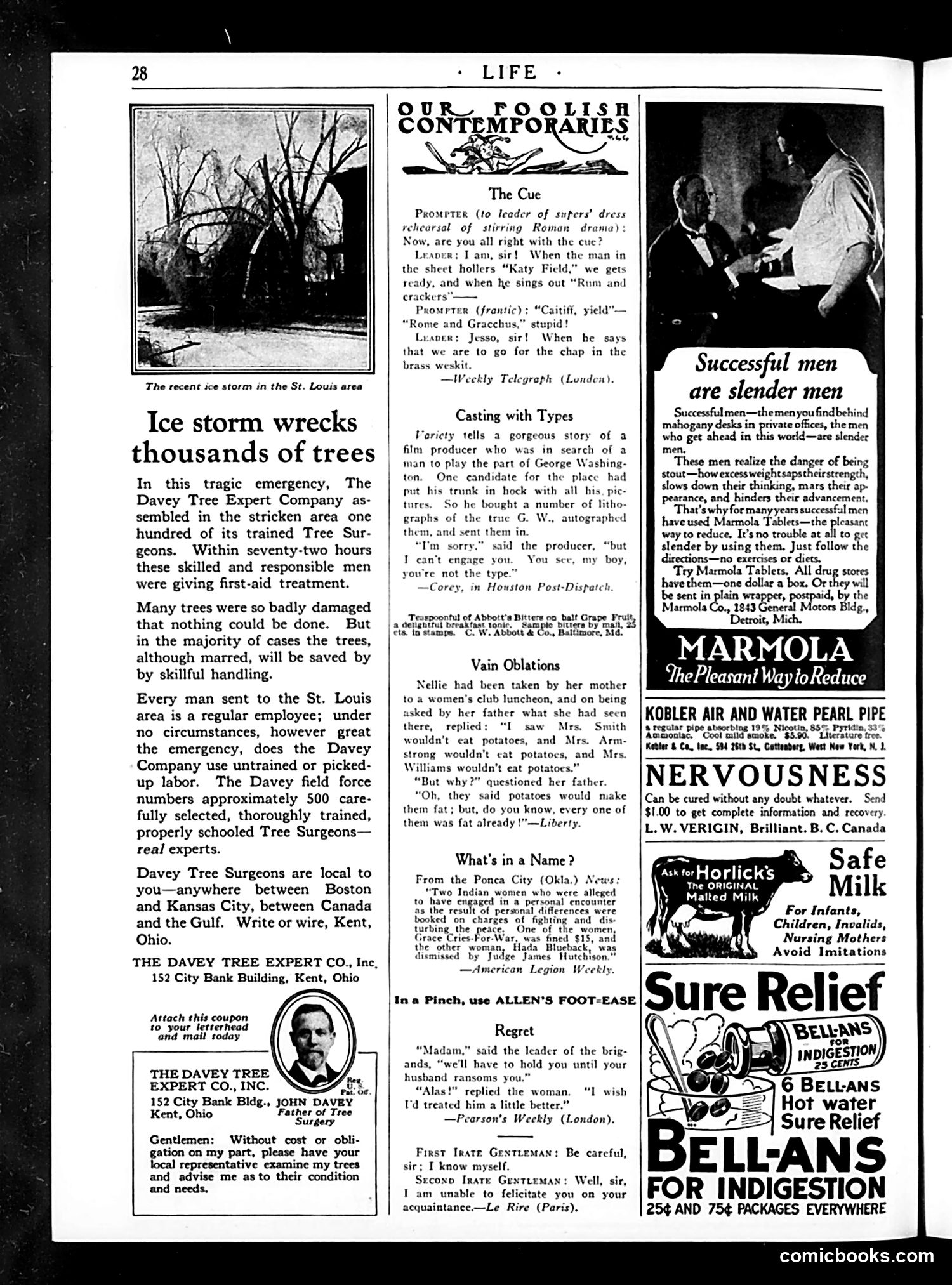
This page is primarily **advertising and humor reprints**, not political satire. The main content includes: 1. **Davey Tree Expert Company ad**: A large advertorial about the company's response to an ice storm in St. Louis, emphasizing their trained professionals and reliability—essentially a publicity piece disguised as news. 2. **Humor cartoons/anecdotes** reprinted from various sources: - "The Cue": A joke about a theater director correcting an actor's mishearing of cues - "Casting with Types": A story about an actor trying to play George Washington by providing fake autographed photos of him - "Vain Oblations": A joke about women denying eating potatoes while being overweight - Various brief witticisms about names, regret, and manners These are light, inconsequential jokes with no political content—typical filler material for a satirical magazine. The page demonstrates how *Life* mixed advertising with reprinted humor from newspapers and magazines to fill space.
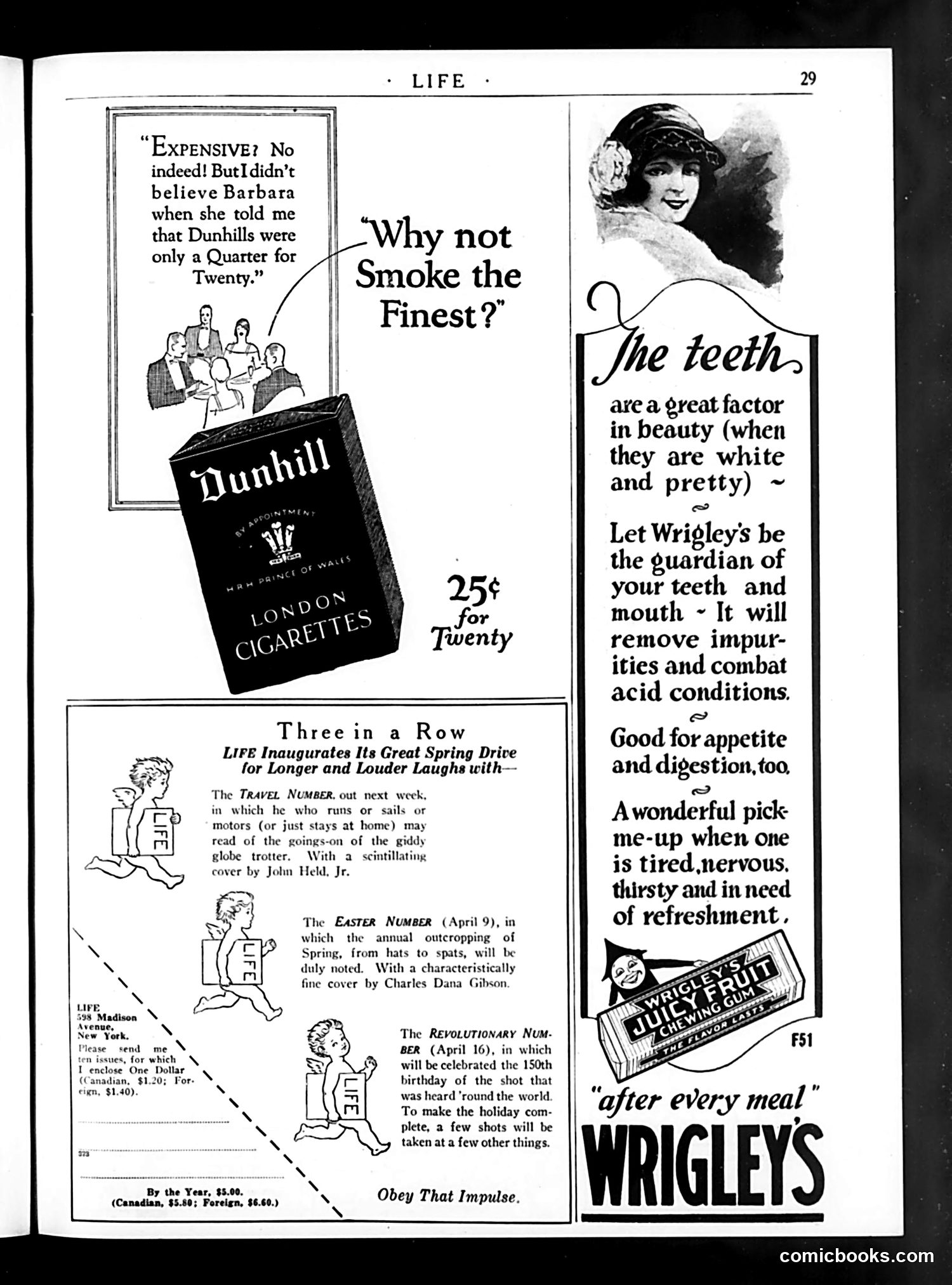
This page mixes advertisements with magazine promotional content. **The Dunhill Cigarette Ad** (upper left): A man discusses affordable luxury—Dunhill cigarettes cost 25 cents per pack of twenty. The humor hinges on his disbelief that quality products could be cheap; his friend Barbara claimed they were "only a Quarter for Twenty," and he's astonished this is true. The satire targets consumer assumptions about price and quality. **The Wrigley's Gum Ad** (right): Features a glamorous woman promoting chewing gum as a beauty aid and digestive aid. The claims—whitening teeth, removing impurities, combating acid—exemplify early 20th-century exaggerated advertising before modern FDA regulations. The phrase "after every meal" became Wrigley's famous slogan. **"Three in a Row"** (center): Life announces upcoming special issues: a Travel Number, Easter Number (April 9), and Revolutionary Number (April 16, celebrating the 150th anniversary of the American Revolution's opening shot). These are subscription promotions. The page reflects 1920s consumer culture and advertising practices.
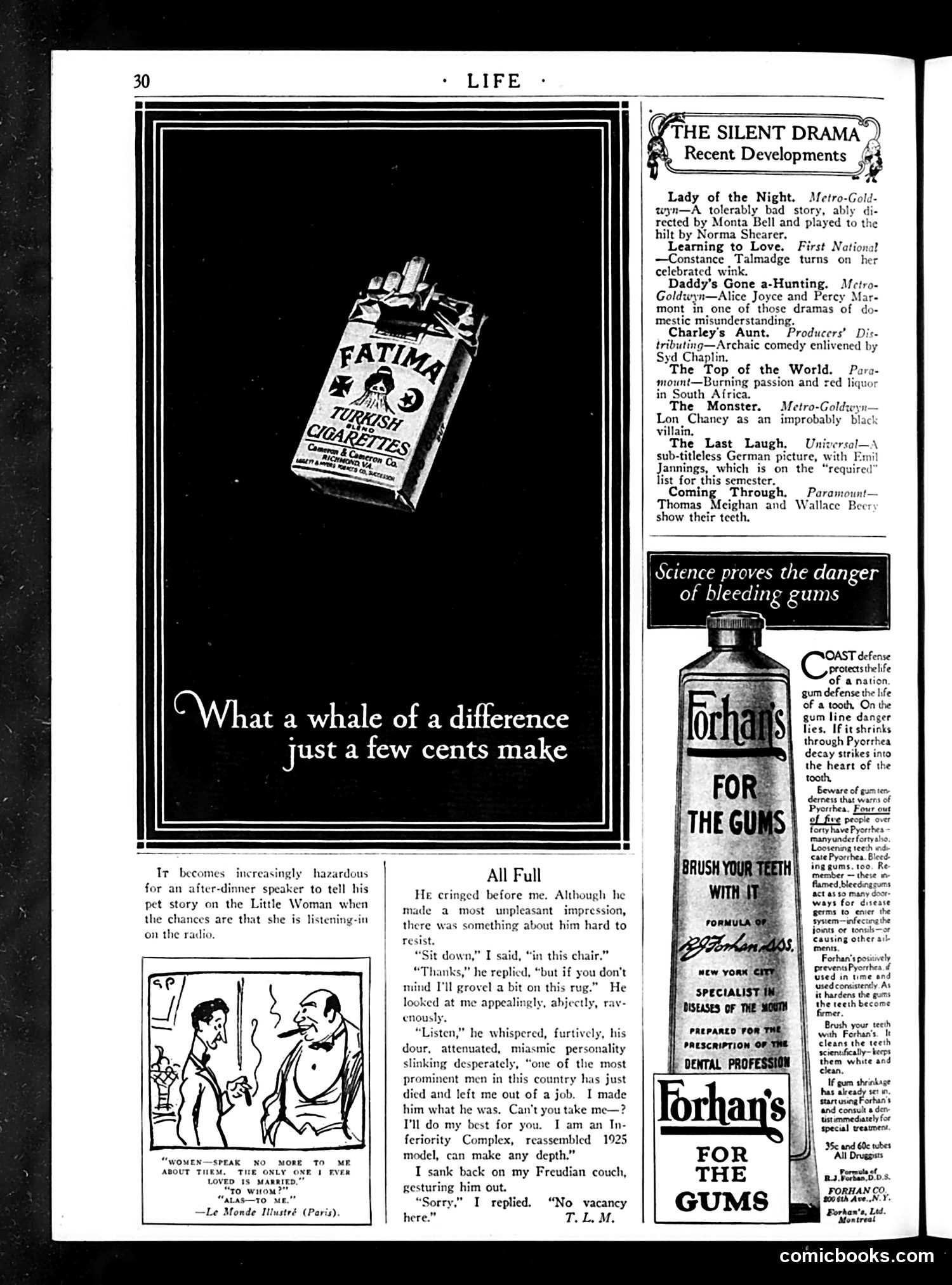
This page contains two distinct elements: **The Cartoon ("All Full"):** A satirical dialogue between a speaker and an increasingly desperate job-seeker. The man represents an "Inferiority Complex, reassembled 1925"—a psychological type fashionable in the 1920s. He pathetically self-deprecates while claiming he made another man's career, begging for employment. The speaker refuses, saying there's "no vacancy." The satire mocks both the man's neurotic self-abasement and perhaps the era's pop-psychology obsession with Freudian concepts like inferiority complexes. **The Advertisements:** A cigarette ad (Fatima) above and a tooth-care ad (Forhan's) below frame the page—typical of period *Life* magazine layout. The cigarette ad uses a simple slogan about product value; the dental ad promotes gum health, reflecting 1920s emerging health consciousness. The small French quote criticizes men for ignoring women, likely satirizing gender relations of the era.
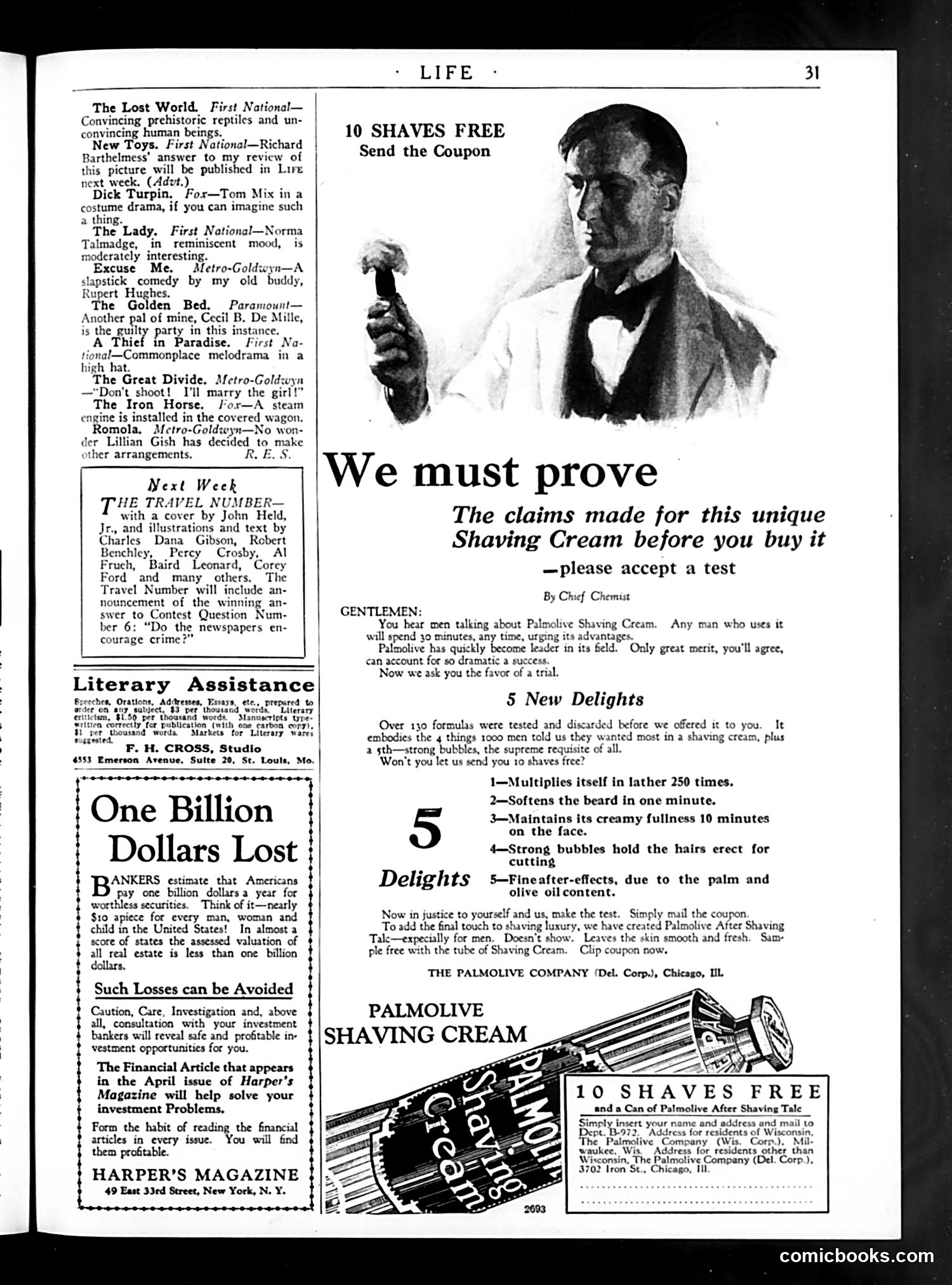
This page is primarily **advertising**, dominated by a large Palmolive Shaving Cream advertisement. The top half contains brief film reviews typical of Life's satirical commentary on contemporary movies—noting actors like Lillian Gish and directors like Cecil B. DeMille with dry, dismissive humor. The advertisement itself uses a testimonial format ("By Chief Chemist"), claiming the product represents merit after rigorous testing. It promises "5 New Delights" with specific performance claims (multiplying lather 250 times, softening beards, etc.). The ad offers free shaves via coupon—a common early-20th-century marketing tactic. A secondary advertisement for Harper's Magazine promotes financial literacy, warning against worthless securities—reflecting post-WWI concerns about investment fraud. **No political satire is present here.** The page represents typical 1920s consumer magazine content: entertainment criticism paired with aggressive product advertising using pseudo-scientific claims and promotional giveaways to drive consumer trial.
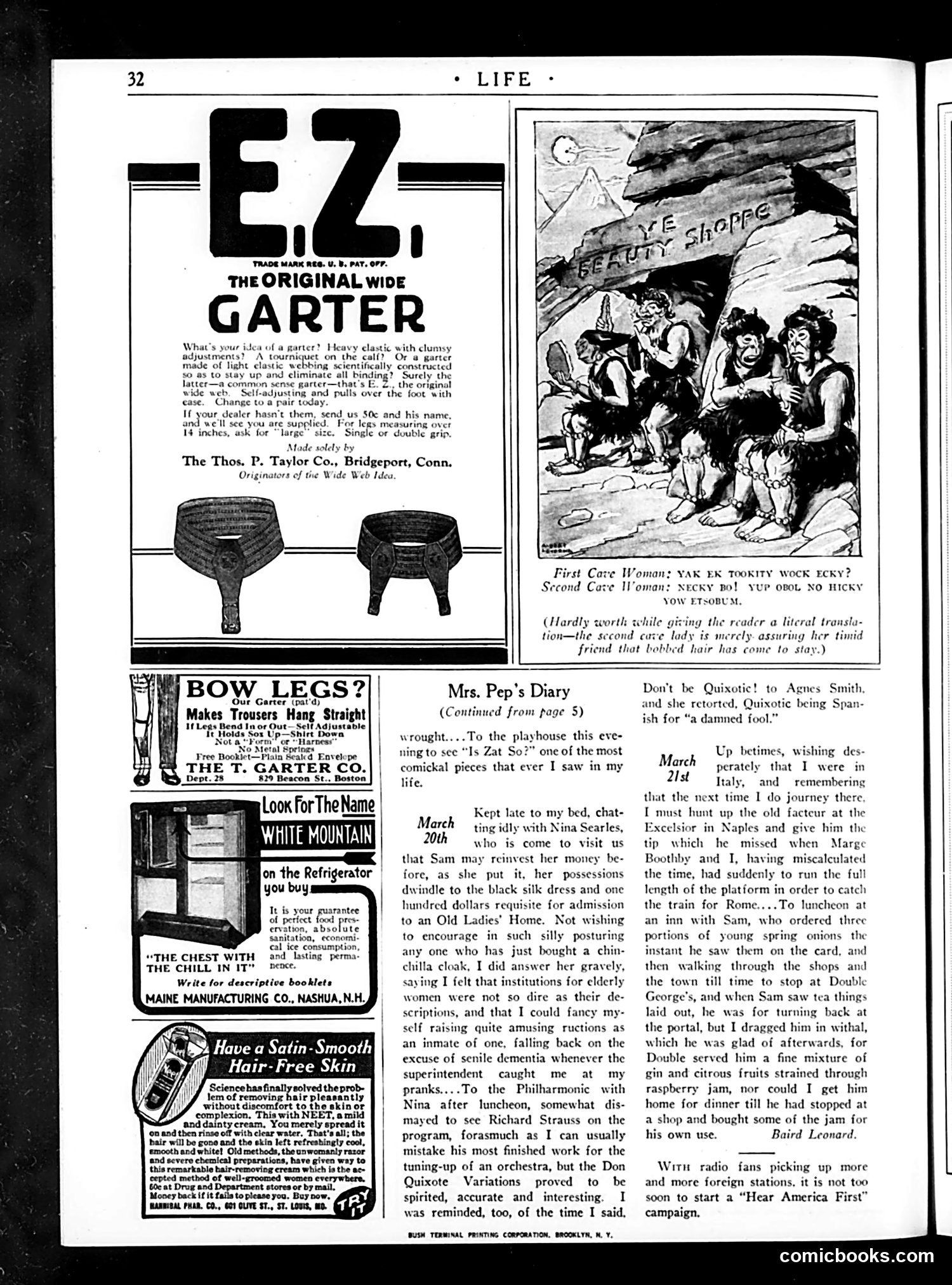
This page is primarily **advertising with one satirical diary entry**. The main advertisements include E.Z. garters (elastic leg wear), remedies for bow legs, a refrigerator, and hair-removal cream—typical 1920s-era products. The satirical content is **"Mrs. Pep's Diary,"** a recurring column mocking upper-class social pretension. The narrator describes visiting a play ("Is Zat So?"), attending the Philharmonic, and gossiping about friends like Nina Searles (who needs money) and Agnes Smith. The humor derives from the diary's affected tone—using phrases like "betimes" and "forasmuch"—while discussing mundane domestic matters and social visits. The inserted cartoon shows **cavemen**, likely satirizing primitive communication (the garbled dialogue suggests uncivilized speech), possibly mocking either early humans or contemporary lower-class behavior as a foil to the refined Mrs. Pep. The page reflects 1920s consumer culture and class-based satire common to Life magazine.
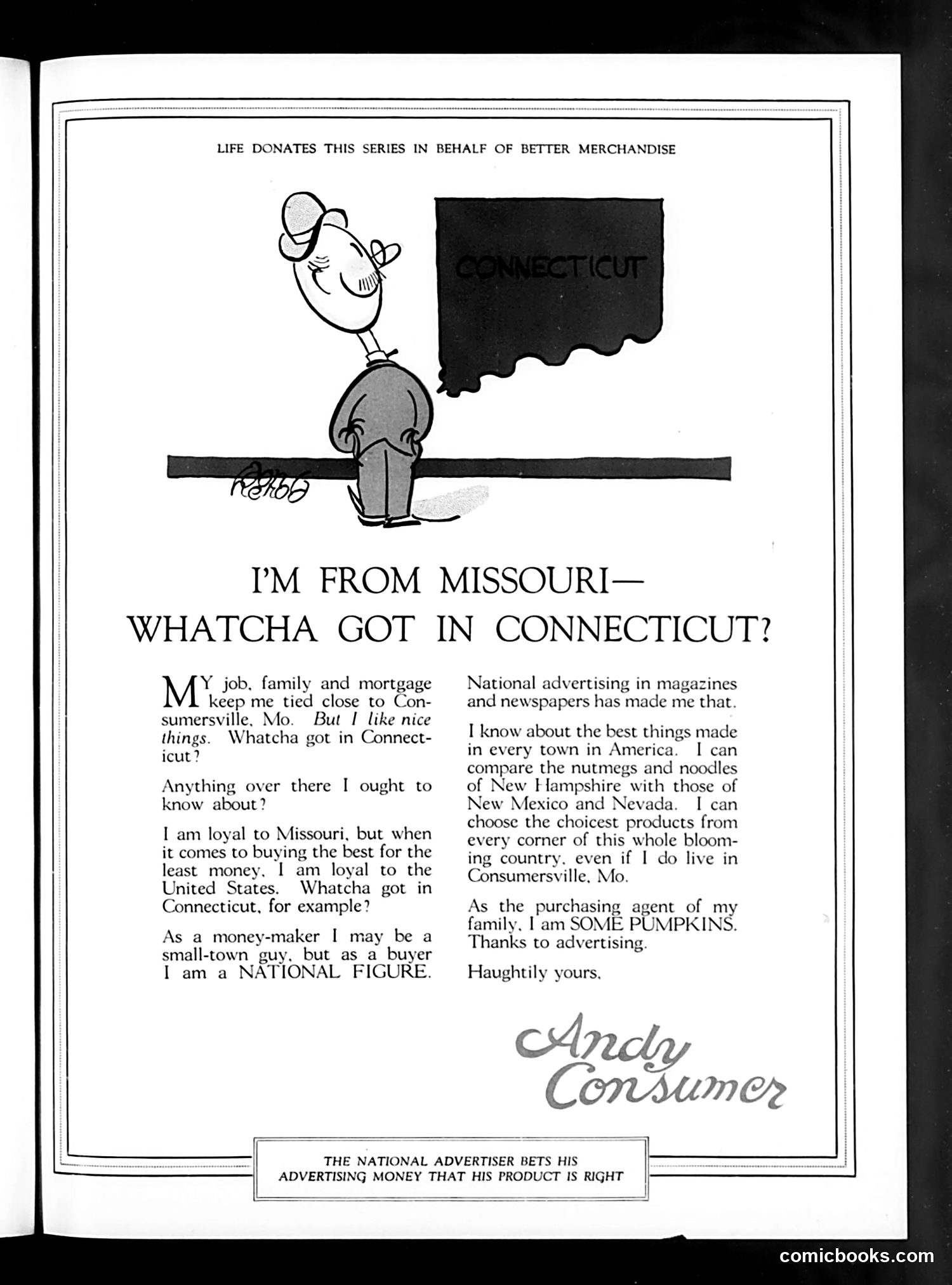
This advertisement celebrates **national advertising's power to create informed consumers**. The cartoon features "Andy Consumer," a small-town Missouri resident who—through national magazine and newspaper ads—has become a "NATIONAL FIGURE" capable of comparing products from across America. The satire's point: traditional local loyalty is obsolete. Andy claims he's "loyal to Missouri" but prioritizes getting "the best for the least money" nationally. As his family's "purchasing agent," he's become important through consumer knowledge that advertising provides. This reflects **early-to-mid 20th century corporate messaging** promoting national brands over local goods. Life magazine itself was publishing this as propaganda for the advertising industry ("donates this series in behalf of better merchandise"). The cartoon depicts the shift from regional economies to a nationalized consumer culture, positioning advertising as the democratizing force enabling small-town Americans to access superior products.
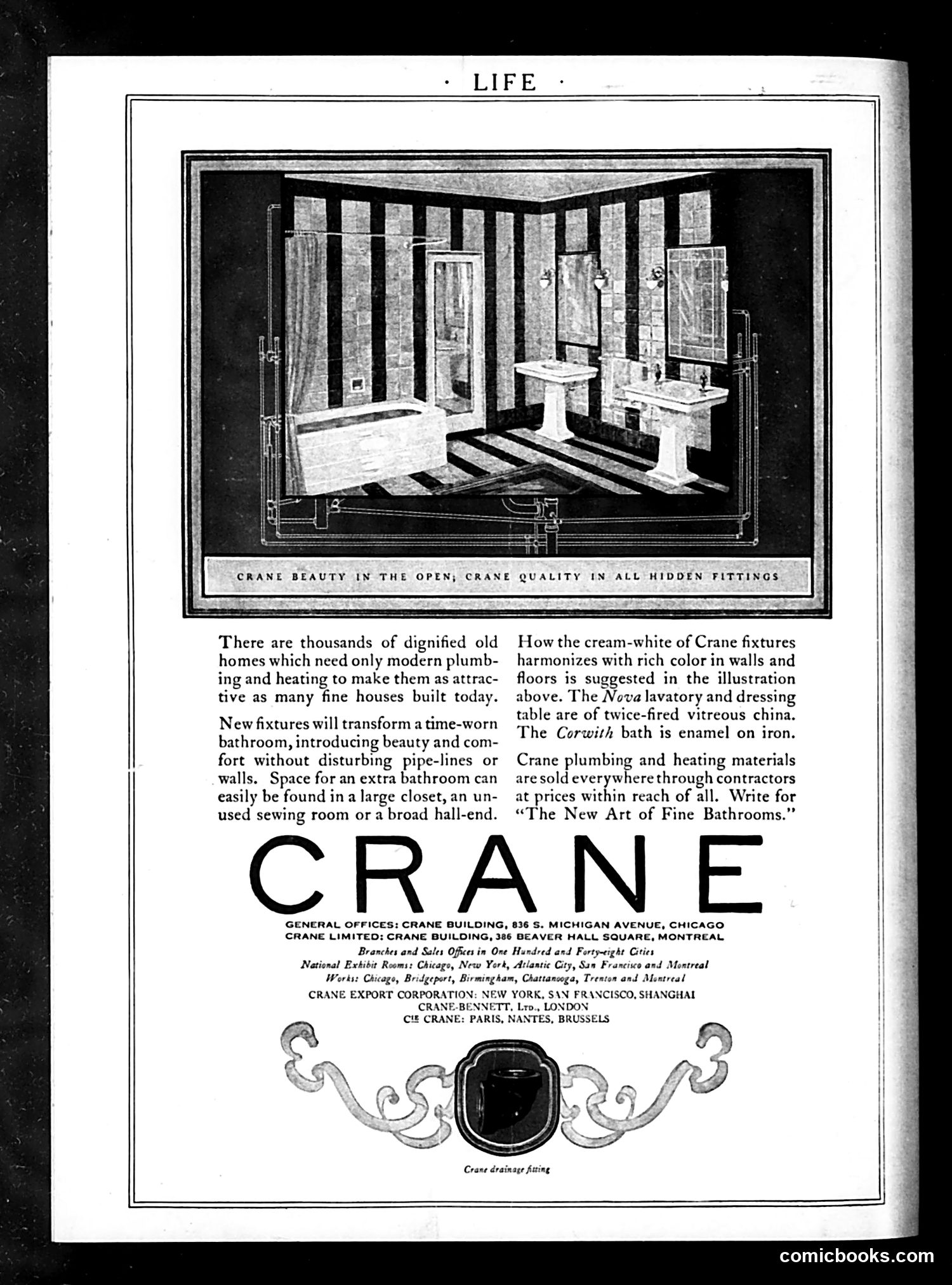
This is **not a cartoon or satire** — it's a straightforward **advertisement for Crane plumbing fixtures**, published in *Life* magazine. The page promotes modernizing old homes by installing new Crane bathrooms and plumbing. The illustration shows an elegant, contemporary bathroom design featuring Crane's "Nova" lavatory and "Corwith" bath, emphasizing that quality fixtures can be discreetly installed without major renovation. The sales pitch targets homeowners of older houses, arguing that modern plumbing and heating make dignified older homes as attractive as newly built ones. The text highlights affordability and availability through contractors nationwide. This represents early 20th-century consumer advertising in a prestigious magazine, positioning bathroom modernization as an accessible luxury upgrade for the middle class.