
Life, 1925-03-26 · page 16 of 37
Life — March 26, 1925 — page 16: what you’re looking at
What you’re looking at
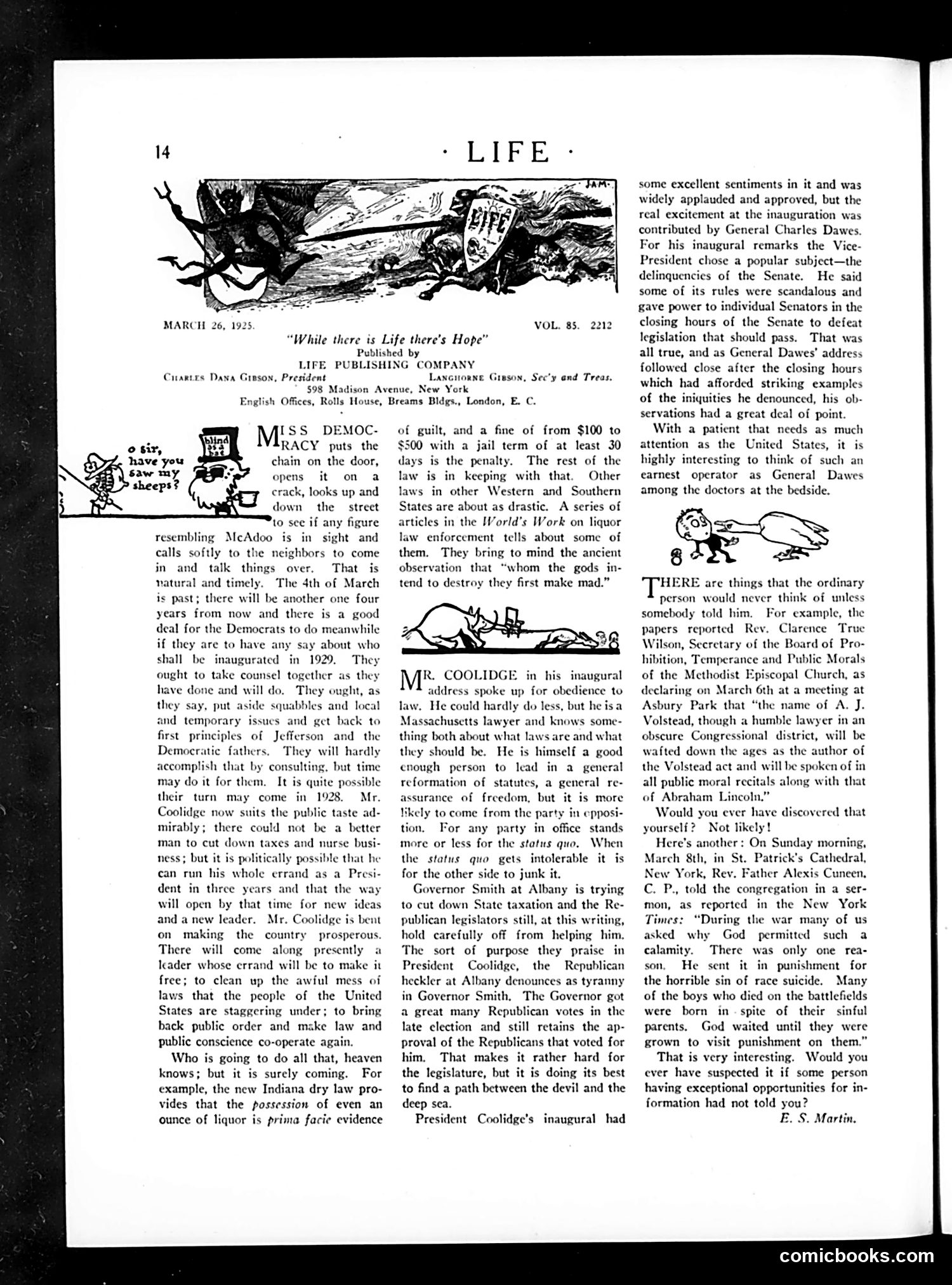
This page contains political commentary on Prohibition enforcement and state governance. The main cartoon depicts "Miss Democracy" as a chained figure, satirizing how Prohibition laws restrict freedoms. The text critiques inconsistent enforcement across states and compares delinquent senators to "McAdoo" — likely William McAdoo, a prominent political figure of the era. The article discusses President Coolidge's inaugural address, praising his call for legal obedience while mocking Republican hypocrisy regarding taxation and state power. References to "Governor Smith at Albany" suggest New York politics. A secondary item mentions Rev. Clarence True Wilson and debates over punishment for moral infractions, reflecting 1920s tensions between Progressive reform movements and individual liberty during the Prohibition era.
📄 Transcribed text from this page (OCR, searchable)
Machine-transcribed from the original scan — historical spelling and the odd misread are preserved.
MARCH 26, 1925. “While there is Life there’s Hope” Published by LIF PUBLISHING COMPANY Cuartts Dana Grnson, President Lancuoane Greson, Sec'y end Treas. $98 Madison Avenue, New York English Offices, Rolls House, Breams Bldgs., London, E. C. ISS DEMOC- RACY puts the chain on the door, opens it on a crack, looks up and down the - street to see if any figure resembling McAdoo is in sight and calls softly to the neighbors to come in and talk things over, That is vatural and timely. The 4th of March is past; there will be another one four years from now and there is a good deal for the Democrats to do meanwhile if they are to have any say about who shall be inaugurated in 1920. They ought to take counsel together as they have done and will do. They ought, as they say, put aside squabbles and local and temporary issues and get back to first principles of Jefferson and the Democratic fathers. They will hardly accomplish that by consulting. but time may do it for them. their turn It is quite possible may come in 1928. Mr. Coolidge now suits the public taste ad- mirably; there could not be a better man to cut down taxes and nurse busi- ness; but it is politically possible that he can run his whole errand as a Presi- dent in three years and that the way will open by that time for new ideas and a new leader. Mr. Coolidge is bent on making the country prosperous. There will come along presently a lIcader whose errand will be to make it free; to clean up the awful mess of laws that the people of the United States are staggering under; to bring back public order and make law and public conscience co-operate agai Who is going to do all that, heaven knows; but it is surely coming. For example, the new Indiana dry law pro- vides that the possession of even an ounce of liquor is prima facie evidence { guilt, and a fine of from $100 to $500 with a jail term of at least 30 days is the penalty. The rest of the law is in keeping with that. Other laws in other Western and Southern States are about as drastic. A series of articles in the World’s Work on liquor law enforcement tells about some of them. They bring to mind the ancient observation that “whom the gods in- tend to destroy they first make mad.” R. COOLIDGE in his inaugural address spoke up for obedience to law. He could hardly do less, but he isa Massachusetts lawyer and knows some- thing both about what laws are and what they should be. He is himself a good cnough person to lead in a general reformation of utes, a general re- assurance of freedom, but it is more likely to come from the party in epposi- tion, For any party in office stands more or less for the status quo. When the status quo gets intolerable it is for the other side to junk it. Governor Smith at Albany is trying to cut down State taxation and the Re publican legislators still, at this writing, hold carefully off from helping him, The sort of purpose they praise in President Coolidge, the Republican heckler at Albany denounces as tyranny in Governor Smith, The Governor got a great many Republican votes in the late election and still retains the ap- proval of the Republicans that voted for him, That makes it rather hard for the legislature, but it is doing its best to find a path between the devil and the deep sea. President Coolidge’s inaugural had some excellent sentiments in it and was widely applauded and approved, but the real excitement at the inauguration was contributed by General Charles Daw For his inaugural remarks the Vice- President chose a popular subject—the delinquencies of the Senate. He said some of its rules were scandalous and gave power to individual Senators in the closing hours of the Senate to defeat legislation that should pass. That was all true, and as General Dawes’ address followed close after the closing hours which had afforded striking examples of the iniquities he denounced, his ob- servations had a great deal of point. With a patient that needs as much attention as the United States, it is highly interesting to think of such an earnest operator as General Dawes among the doctors at the bedside. HERE are things that the ordinary person would never think of unless somebody told him. For example, the papers reported Rev, Clarence True Wilson, Secretary of the Board of Pro- hibition, Temperance and Public Morals of the Methodist Episcopal Church, as declaring on March 6th at a meeting at Asbury Park that “the name of A. J. Volstead, though a humble lawyer in an obscure Congressional district, will be wafted down the ages as the author of the Volstead act and will be spoken of in all public moral recitals along with that of Abraham Lincoln.” Would you ever have discovered that yourself? Not likely! Here's another: On Sunday morning, March 8th, in St. Patrick's Cathedral, New York, Rev. Father Alexis Cuneen, C. P., told the congregation in a ser- mon, as reported in the New York Times: “During the war many of us asked why God permitted such a calamity. There was only one rea- son, He sent it in punishment for the horrible sin of race suicide. Many of the boys who died on the battlefields were born in. spite of their sinful parents. God waited until they were grown to visit punishment on them.” That is very interesting. Would you ever have suspected it if some person having exceptional opportunities for in- formation had not told you? E. S. Martin. comicbooks.com