
Life, 1925-03-26 · page 20 of 37
Life — March 26, 1925 — page 20: what you’re looking at
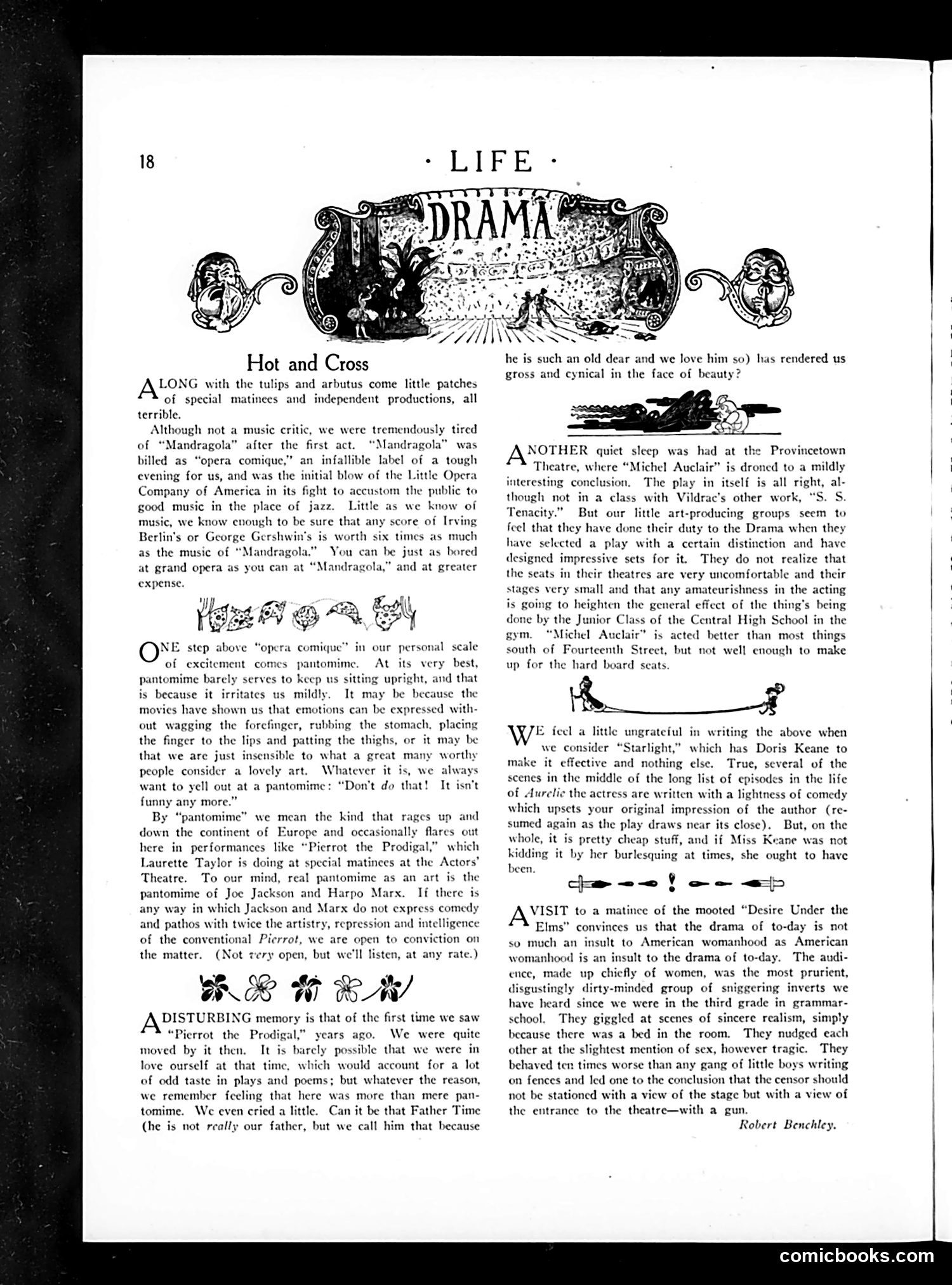
What you’re looking at
This is a theater review column titled "Hot and Cross," critiquing spring theatrical productions in New York. The author dismisses several performances: **"Mandragola"** — An opera marketed as "opera comique" that the reviewer found tedious, claiming even Irving Berlin or George Gershwin would be superior. **"Pierrot the Prodigal"** — A pantomime starring Laurette Taylor. The reviewer argues that genuine pantomime (citing Joe Jackson and Harpo Marx as exemplars) requires restraint and intelligence, not exaggerated finger-wagging and stomach-patting. They admit being moved by it years ago but attribute that to youthful sentimentality. **"Michel Auclair"** — A play at the Provincetown Theatre criticized for amateurish acting and uncomfortable seating in a tiny theater—suggesting small "art-producing groups" prioritize impressive sets over actual production quality. The column's satiric point: pretentious small theaters and experimental productions often fail because enthusiasm for "distinction" exceeds actual execution and audience comfort.
📄 Transcribed text from this page (OCR, searchable)
Machine-transcribed from the original scan — historical spelling and the odd misread are preserved.
Hot and Cross LONG with the tulips and arbutus come little patches of special matinees and independent productions, all terrible. Although not a music critic, we were tremendously tired of “Mandragola” after the first act. Jandragola” was billed as “opera comique,” an infallible label of a tough evening for us, and was the initial blow of the Littlke Opera Company of America in its fight to accustom the public to good music in the place of jazz. Little as we know of music, we know enough to be sure that any score of Irving Berlin's or George Gershwin's is worth six times as much as the music of “Mandragol. You can be just as bored at grand opera as you can at “Mandragola,” and at greater Ke GA NE step above “opera comique™ in our personal scale of excitement comes pantomime. At its very best, pantomime barely serves to keep us sitting upright, and that is because it irritates us mildly. It may be because the movies have shown us that emotions can be expressed with- out wagging the forefinger, rubbing the stomach, placing the finger to the lips and patting the thighs, or it may be that we are just insensible to what a great many worthy people consider a lovely art. Whatever it is, we always want to yell out at a pantomime: “Don't do that! It isn’t funny any more.” By “pantomime” we mean the kind that rages up down the continent of Europe and occasionally flares out here in performances like “Pierrot the Prodigal,” which Laurette Taylor is doing at special matinees at the Actors’ Theatre. To our mind, real pantomime as an art is the pantomime of Joe Jackson and Harpo Marx. If there is any way in which Jackson and Marx do not express comedy and pathos with twice the artistry, repression and intelligence of the conventional Pierrot, we are open to conviction on the matter. (Not very open, but we'll listen, at any rate.) KEW EM DISTURBING memory is that of the first time we saw “Pierrot the Prodigal,” years ago. We were quite moved by it then. It is barely possible that we were in love ourself at that time, which would account for a lot of odd taste in plays and poems; but whatever the reason, we remember feeling that here was more than mere pan- tomime. We even cried a little. Can it be that Father Time (he is not really our father, but we call him that because expense. and ANOTHER quiet sleep was had at the Provincetown Theatre, where “Michel Auclair” is droned to a mildly interesting conclusion, The play in itself is all right, al- though not in a class with Vildrac’s other work, Ss. Tenacity.” But our little art-producing groups seem to feel that they have done their duty to the Drama when they have selected a play with a certain distinction and have designed impressive sets for it. They do not realize that the seats in their theatres are very uncomfortable and their stages very small and that any amateurishness in the acting is going to heighten the general effect of the thing's being done by the Junior Class of the Central High School in the gym. “Michel Auclair” is acted better than most things south of Fourteenth Street, but not well enough to make up for the hard board seats. os fcel a little ungrateful in writing the W bove when tarlight,” which has Doris Keane to make it effective and nothing else. True, several of the scenes in the middle of the long list of episodes in the life of Aurelie the actress are written with a lightness of comedy which upsets your original impression of the author (re- sumed again as the play draws near its close). But, on the whole, it is pretty cheap stuff, and if Miss Keane was not kidding it by her burlesquing at times, she ought to have been. che me J oe <> VISIT to a matinee of the mooted “Desire Under the Elms” convinces us that the drama of to-day is not so much an insult to American womanhood as American womanhood is an insult to the drama of to-day. The audi- ence, made up chicfly of women, was the most prurient, disgustingly dirty-minded group of sniggering inverts we have heard since we were in the third grade in grammar- school. They giggled at scenes of sincere realism, simply because there was a bed in the room. They nudged each other at the slightest mention of sex, however tragic. They behaved ten times worse than any gang of little boys writing on fences and led one to the conclusion that the censor should not be stationed with a view of the stage but with a view of the entrance to the theatre—with a gun. Robert Benchley. we consider comicbooks.com