
A complete issue · 36 pages · 1925
Life — January 22, 1925
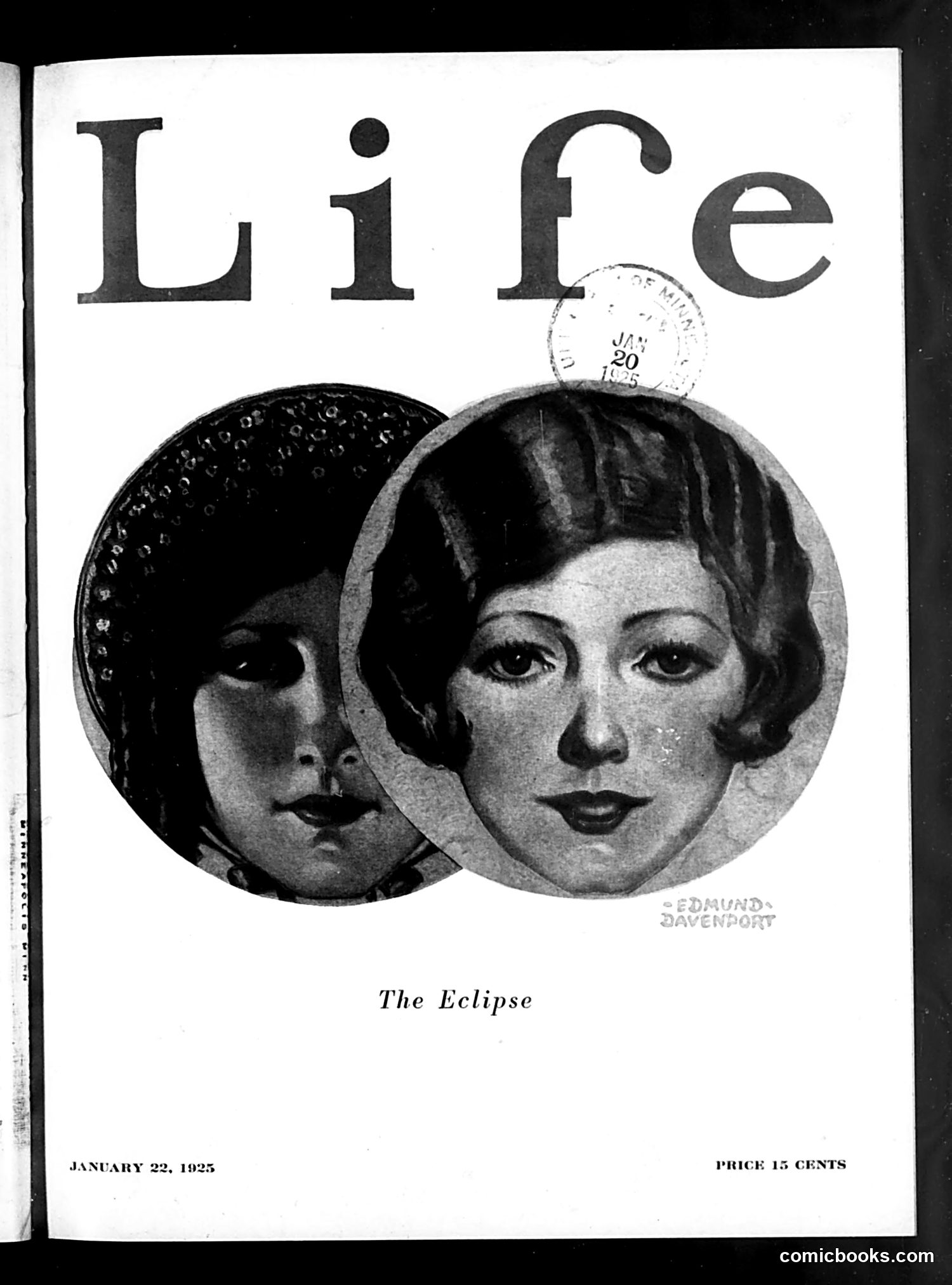
This page features a visual pun titled "The Eclipse," showing two circular portraits of a woman's face—one in profile (left) and one facing forward (right). The overlapping composition creates the optical illusion of one circle eclipsing the other. The artwork is credited to Edmund Davenport. Without additional context from the magazine, the specific identity of the woman depicted is unclear, though the piece appears to be social or entertainment commentary typical of Life's satirical content from this era. The eclipse metaphor likely suggests themes of obscuring, overshadowing, or competing visibility—possibly referencing a contemporary public figure or cultural phenomenon of 1925 that modern readers would need additional sources to fully understand.
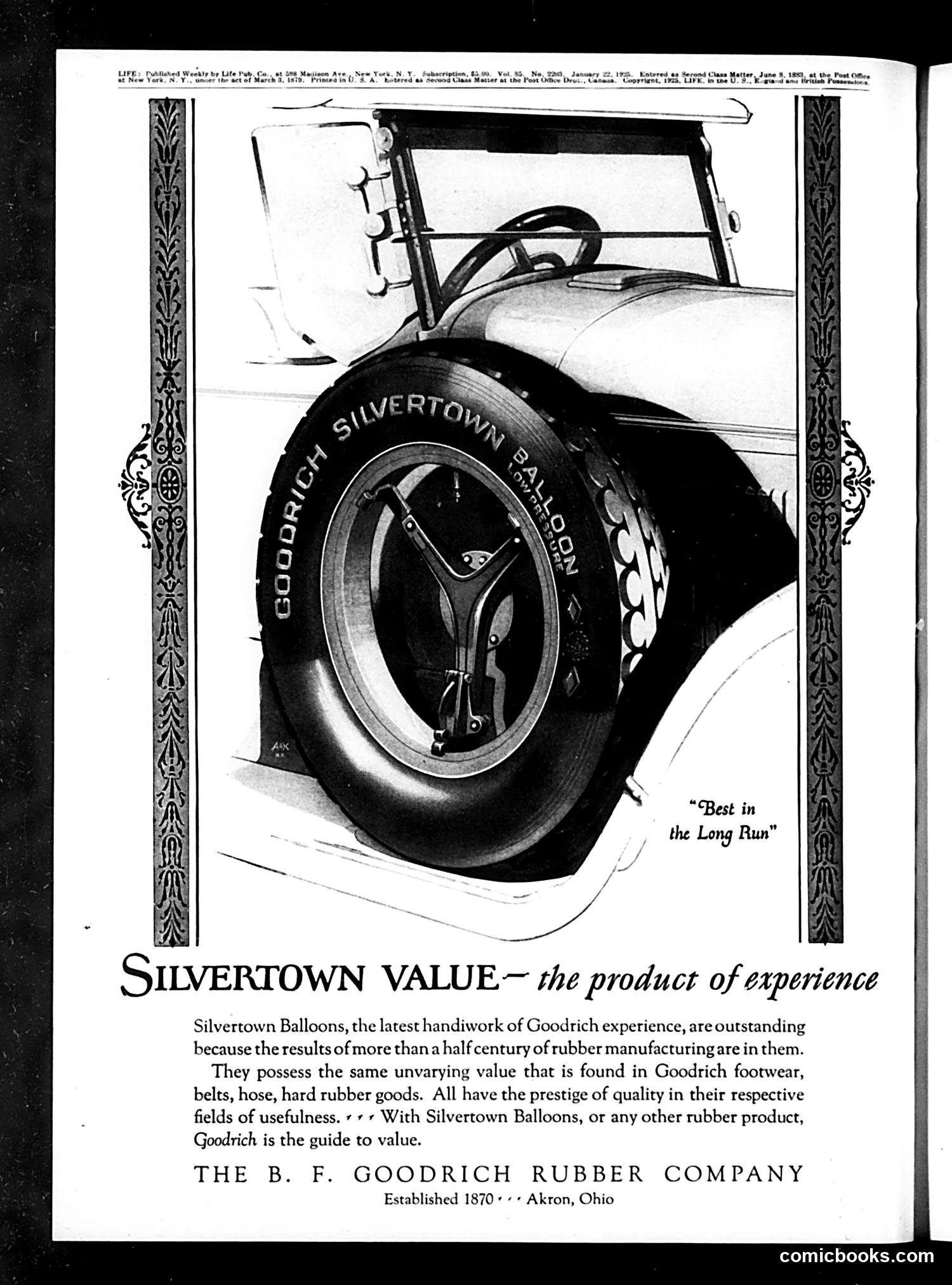
This page is **not a political cartoon or satirical content**—it is a **commercial advertisement** for Silvertown Balloons, a tire product made by the B.F. Goodrich Rubber Company (Akron, Ohio, established 1870). The image shows a detailed illustration of a car tire with the text "SILVERTOWN BALLOON" visible on the sidewall. The ad emphasizes that Silvertown tires represent "the product of experience," citing over half a century of Goodrich's rubber manufacturing expertise. The slogan "Best in the Long Run" suggests durability and reliability. There is no satire, political messaging, or social commentary here—simply a period advertisement marketing automotive tires to consumers.
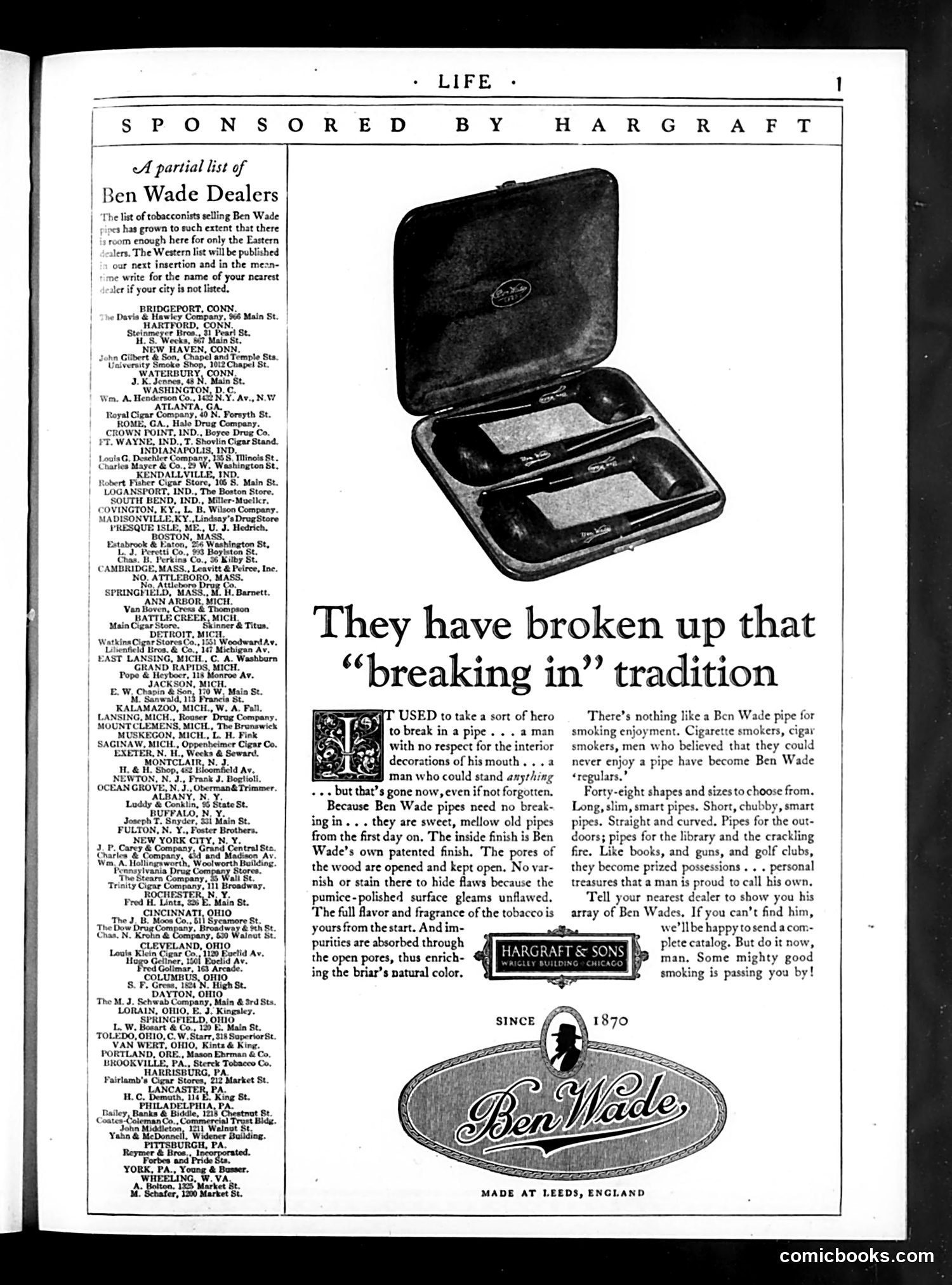
This page is **primarily a Ben Wade pipe advertisement**, not a political cartoon. The left column lists dozens of tobacco dealers across America selling Ben Wade pipes. The main image shows an open pipe case with two pipes. The advertising copy claims Ben Wade pipes have "broken up that 'breaking in' tradition" — meaning they require no break-in period and arrive pre-treated. The ad emphasizes the pipes' quality: forty-eight shapes available, superior wood preparation, and excellent tobacco flavor from the start. The small Ben Wade logo at bottom indicates manufacture in Leeds, England. This is straightforward commercial advertising disguised as editorial content in Life magazine, targeting smokers seeking convenient, ready-to-use pipes.
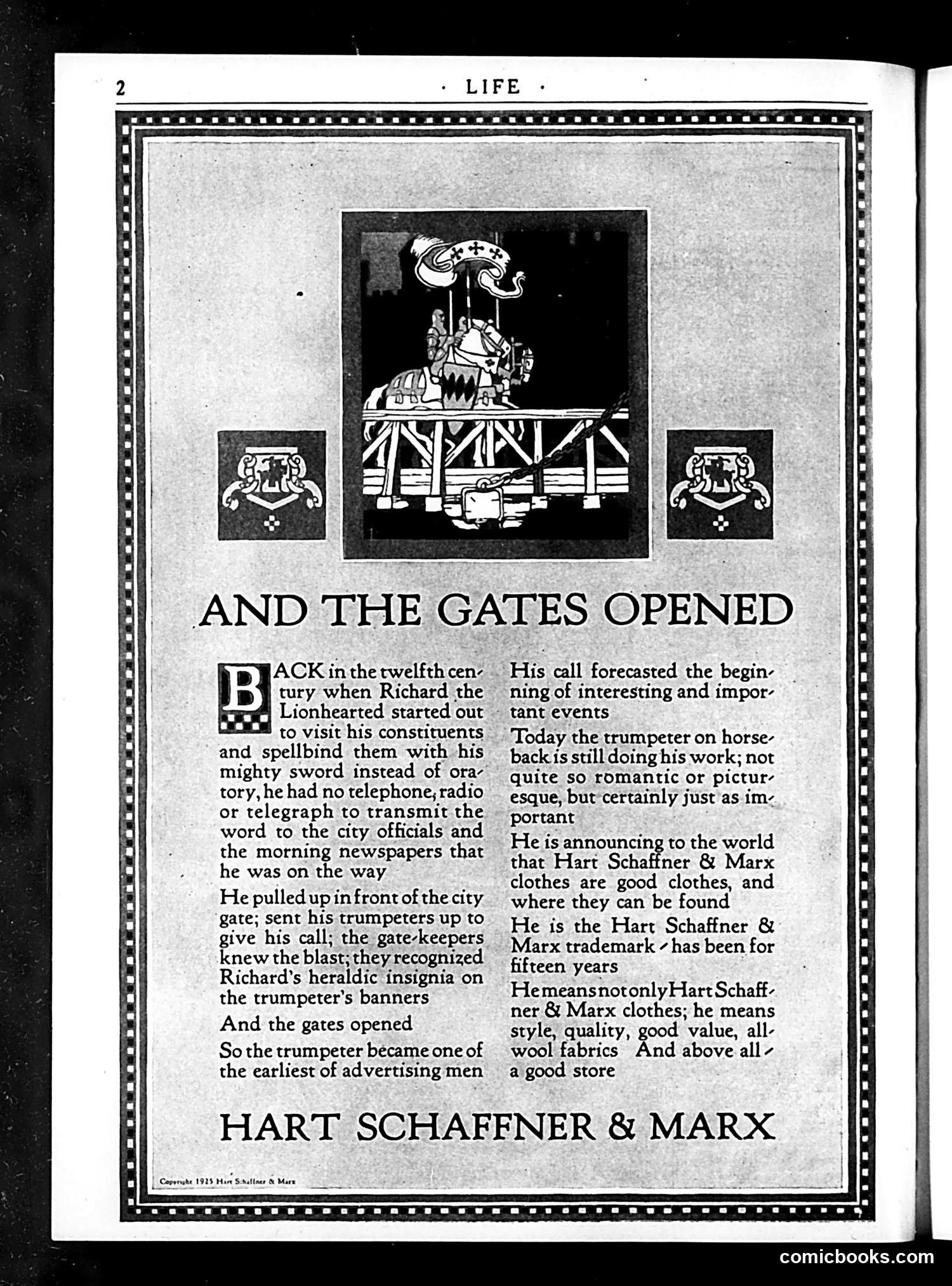
This is primarily a **Hart Schaffner & Marx clothing advertisement** disguised as editorial content—a common early 20th-century advertising technique. The central illustration shows a medieval trumpeter on horseback announcing at city gates, referencing King Richard the Lionhearted's 12th-century travels. The text draws a parallel: just as Richard's herald announced his arrival to city officials, the Hart Schaffner & Marx "trumpeter" (their salesman) announces the company's quality clothing to consumers. The satire is gentle—portraying advertising itself as a modern form of heralding or proclamation. The joke positions the clothing brand as important and legitimate as royal announcements, elevating commercial messaging to historical significance. The trademark heraldic shields flanking the central image reinforce this "official" presentation. This reflects how early 20th-century advertising blurred entertainment and promotion.
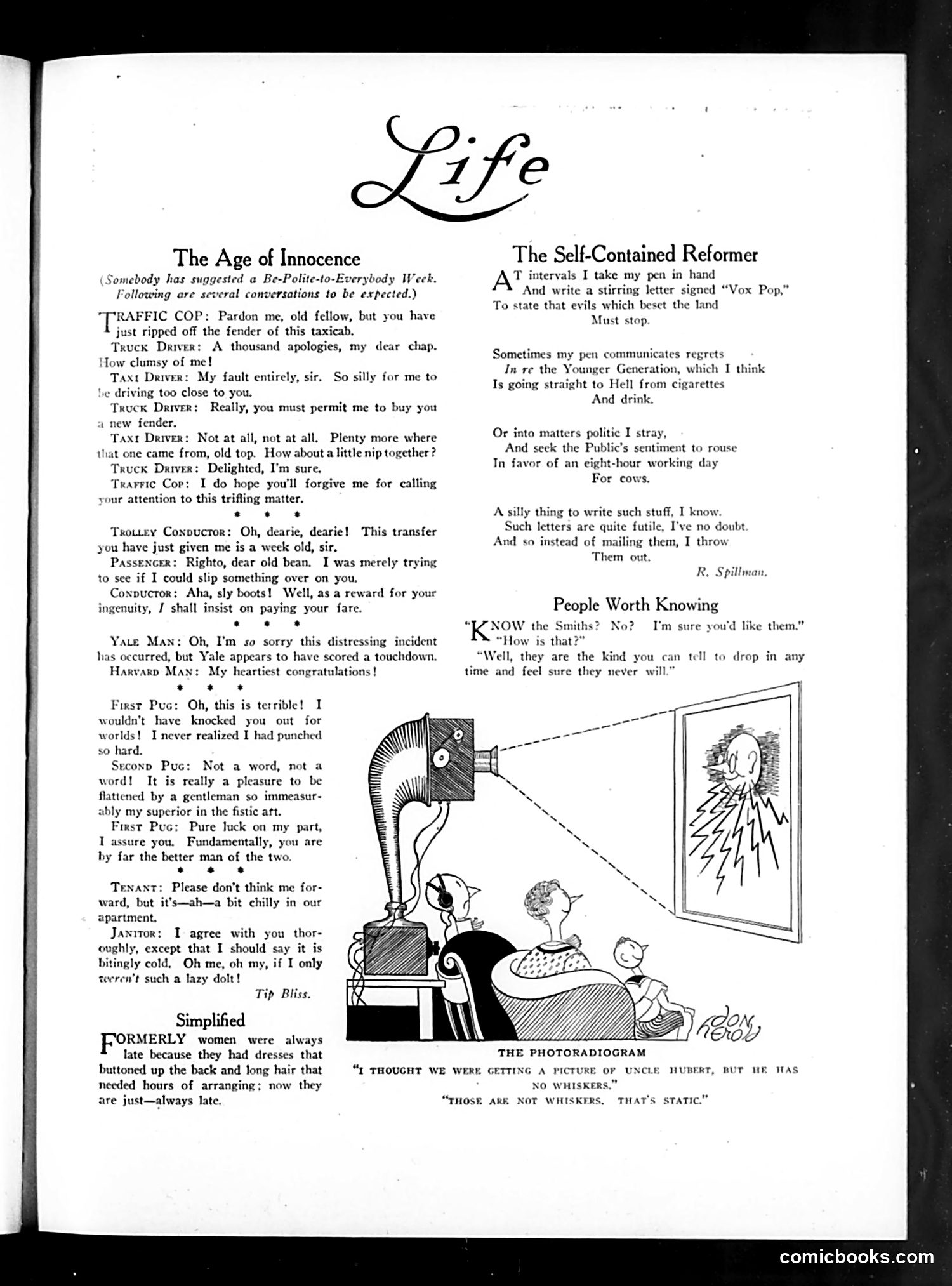
This page contains several satirical pieces typical of early 20th-century Life magazine humor: **"The Age of Innocence"** mocks taxi drivers and traffic incidents through dialogue—likely referencing the chaos of early automobile culture in cities. **"The Self-Contained Reformer"** satirizes self-righteous activists who write indignant letters about social problems (cigarettes, drinking, politics) but take no real action, merely "throwing them out" rather than mailing them. **"People Worth Knowing"** and **"The Photoradiogram"** are light social humor about family photographs and social pretense. **"Simplified"** jokes that women are late because modern simplified clothing eliminates the time once needed for elaborate dressing—a satirical reversal of expectations. The cartoons target common social hypocrisies and the absurdities of modern urban life, typical of Life's satirical approach during this era.
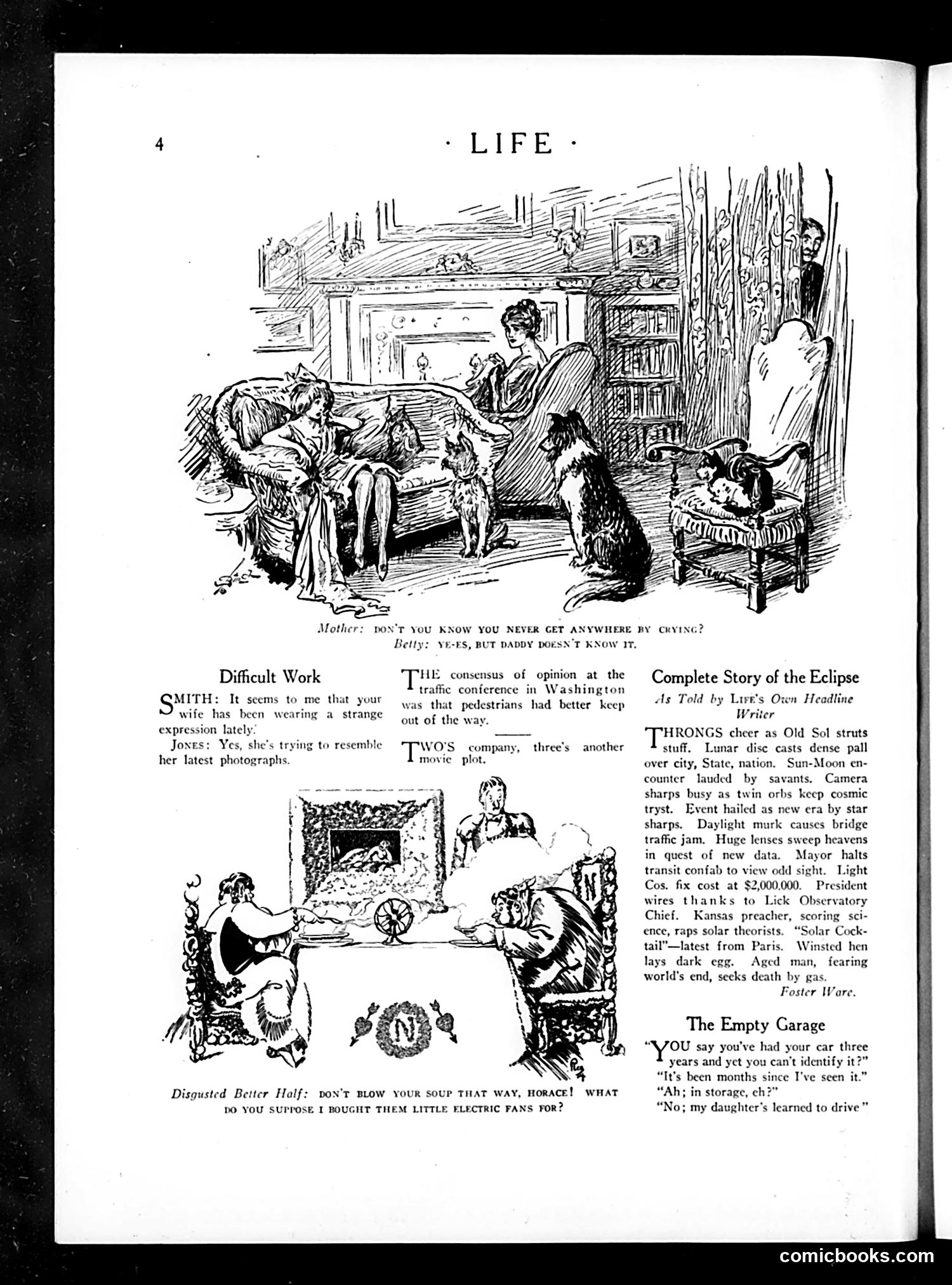
This page contains three separate humor pieces from an early 20th-century issue: **Top cartoon**: A domestic scene where a child cries while parents look on. The joke plays on parental frustration with ineffective child-rearing advice—the mother notes that crying doesn't help, but the father (Daddy) doesn't understand this wisdom. **"Difficult Work"**: A brief dialogue joke about a wife's odd expression in photographs, suggesting she's imitating someone's recent portrait style. **"Disgusted Better Half"**: A couple argues over electric fans purchased unnecessarily, with the husband defending his impulse purchase while the wife mocks the expense. **"Complete Story of the Eclipse"**: A satirical news brief about eclipse observations, poking fun at sensationalized media coverage and astronomical excitement. **"The Empty Garage"**: A joke about forgetting what a car looks like after storage, noting the daughter has learned to drive in the interim. These reflect period humor about domestic life and consumer culture.
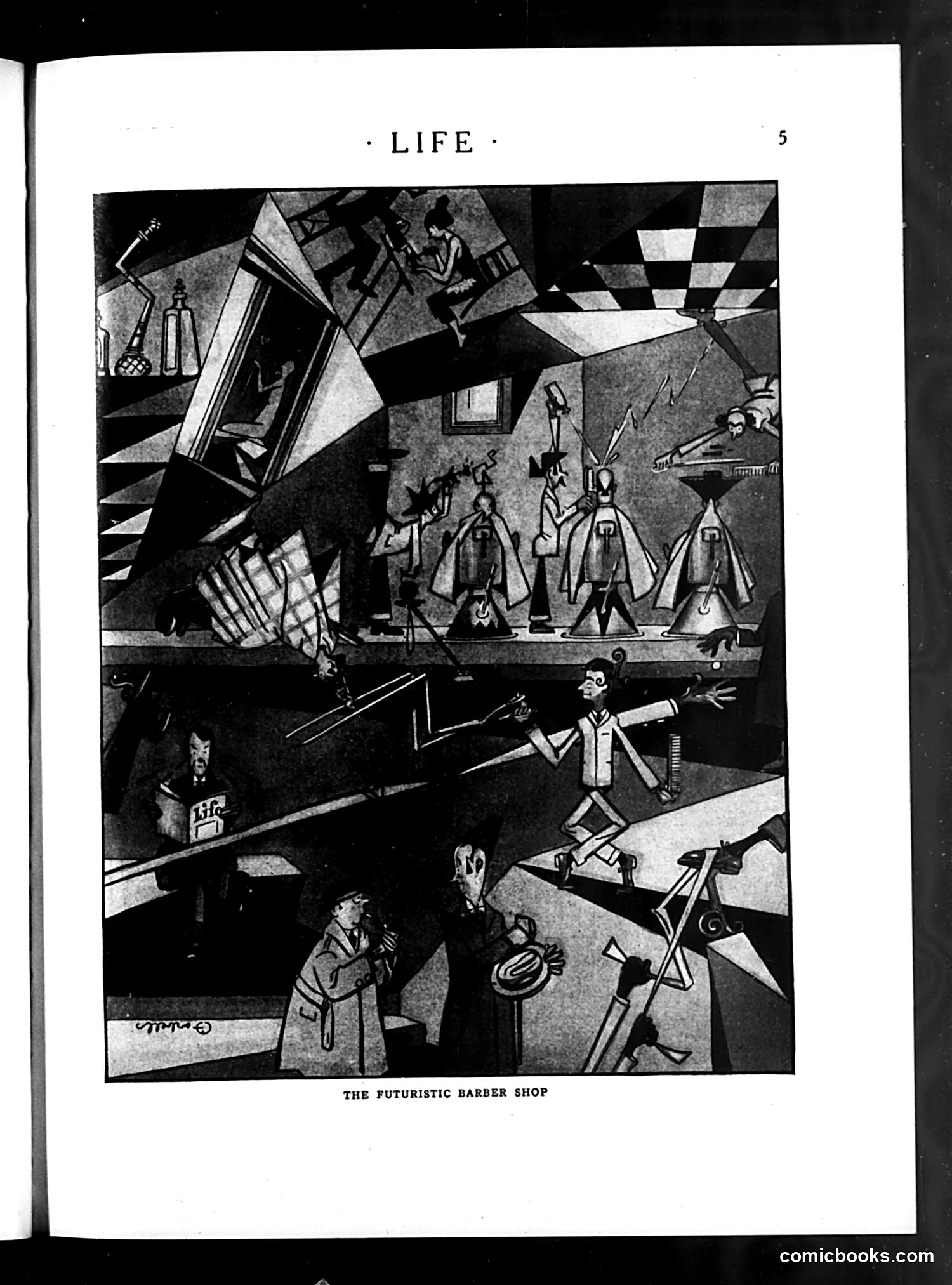
This satirical cartoon depicts an absurdly modernized barbershop rendered in Cubist/Futurist style—a deliberate visual parody of the avant-garde art movement popular in early 20th-century Europe. The image mocks both the Futurist aesthetic and society's uncritical embrace of "progress." The fragmented, geometrically distorted space contains barbers and customers amid angular, impossible architecture and checkered floors. Mechanical apparatus appear to substitute for traditional tools. The exaggeration suggests satire of how far modernism could go while remaining impractical—the cartoon ridicules pretentious artistic movements and the notion that new forms automatically improve everyday life. This represents Life magazine's typical humor: sophisticated critique of contemporary artistic trends through visual comedy accessible to general audiences.
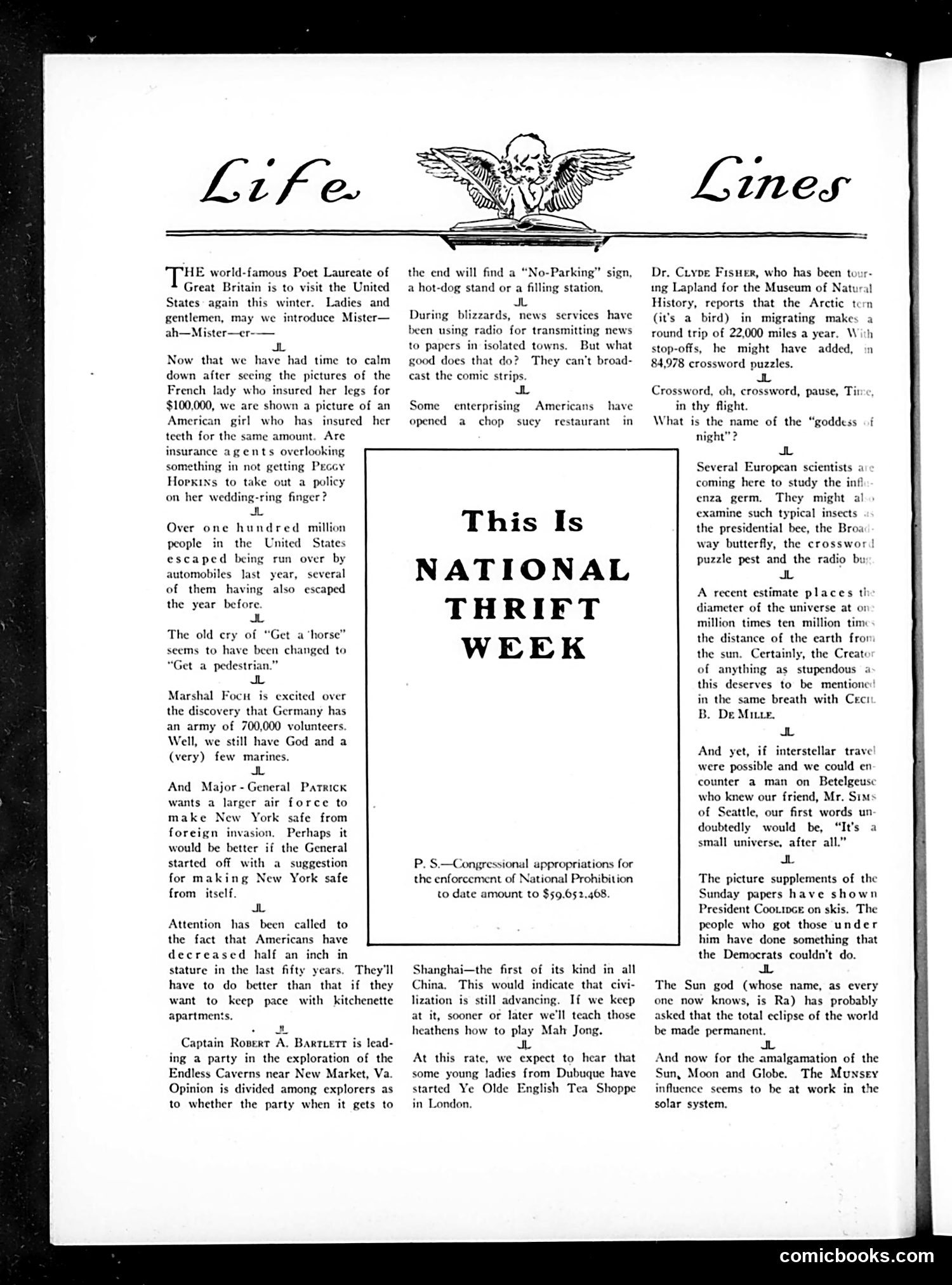
This page is primarily text-based satirical commentary rather than a political cartoon. The central feature is a boxed announcement declaring "This Is NATIONAL THRIFT WEEK," accompanied by a postscript noting Congressional appropriations for Prohibition enforcement totaling $59,643,268. The satire is clear: Life is mocking the government's spending on Prohibition enforcement while simultaneously promoting "thrift." The juxtaposition highlights the hypocrisy—the government wastes enormous sums enforcing an unpopular law while citizens are urged to save money. The surrounding brief humorous anecdotes about insurance, automobiles, and other topics reinforce Life's satirical tone toward contemporary American absurdities and government excess during the Prohibition era.
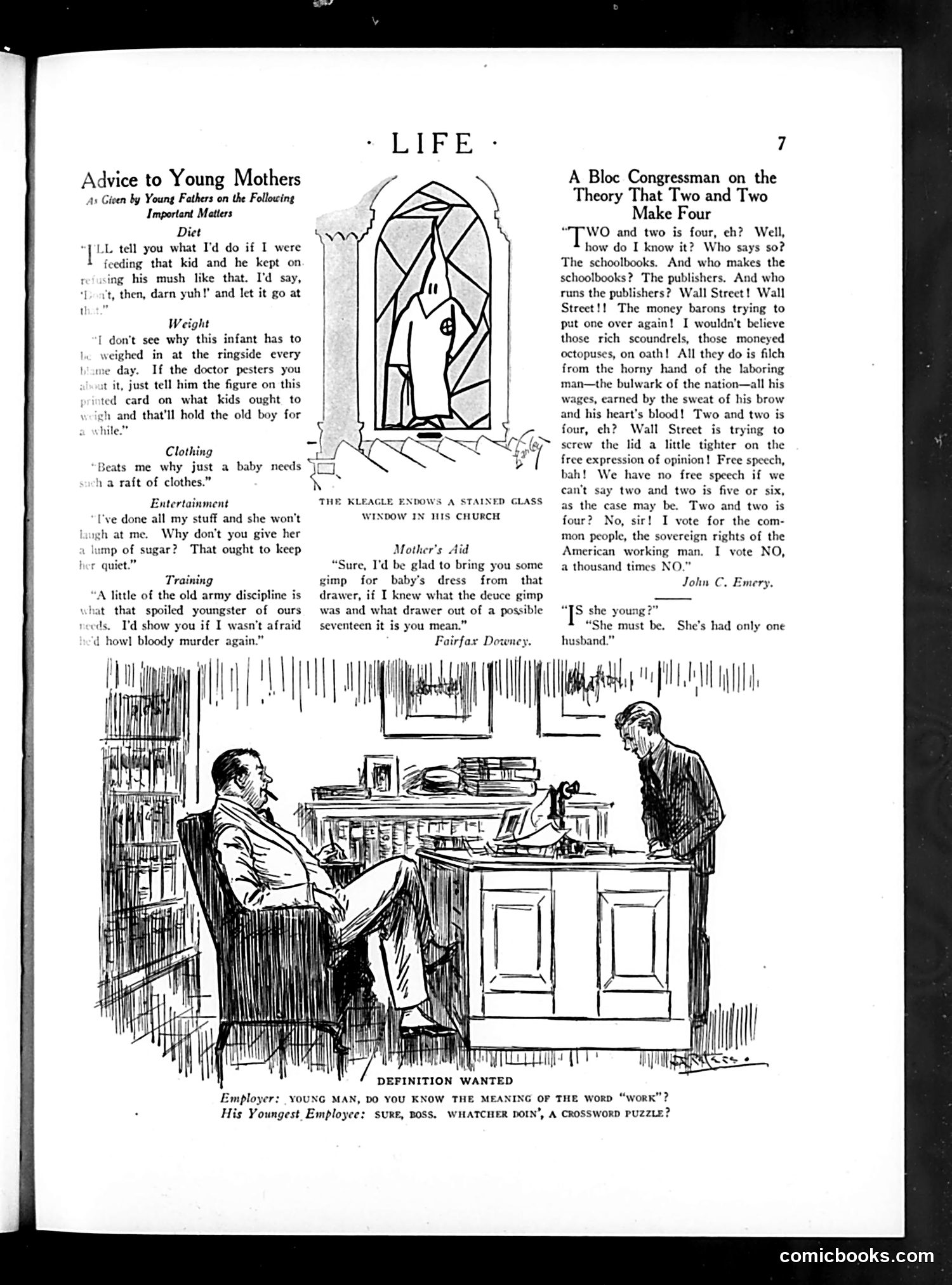
This page from *Life* magazine contains three distinct satirical pieces: 1. **"Advice to Young Mothers"**: Parodies typical parenting advice columns by having fathers offer tongue-in-cheek, impractical suggestions about diet, clothing, entertainment, and training—mocking both new parents and prescriptive advice literature. 2. **"A Bloc Congressman on the Theory That Two and Two Make Four"**: A congressman argues that Wall Street financiers control mathematics itself and suppress free speech. This satirizes populist suspicions of wealthy elites manipulating truth and information—likely referencing Progressive Era anxieties about corporate power. 3. **"Definition Wanted"**: A cartoon showing an employer asking a young employee if he understands the meaning of "work," mocking both generational gaps and naive youth entering employment. The overall tone critiques social hypocrisy and power imbalances of the era.
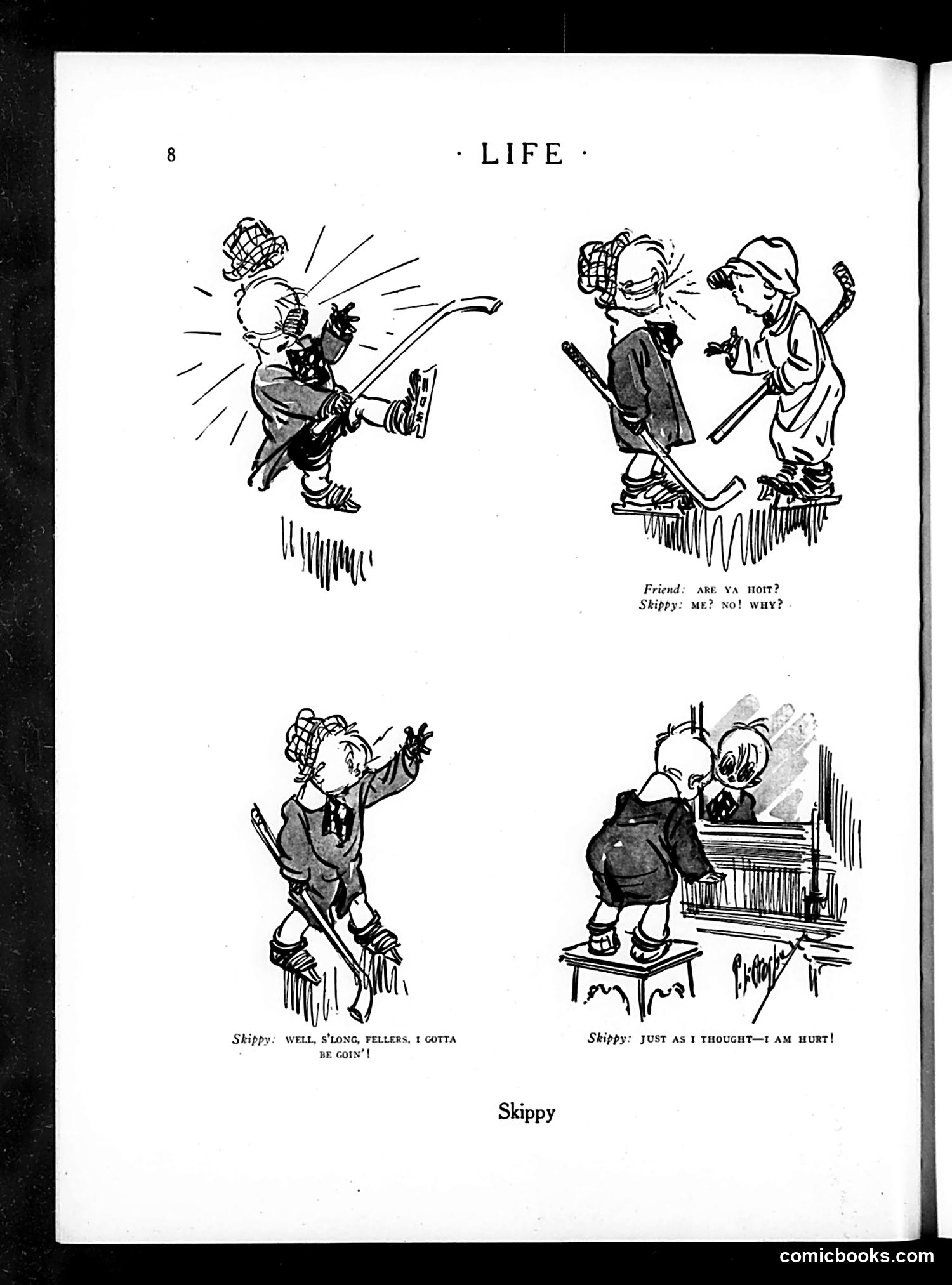
This is a four-panel comic strip titled "Skippy" featuring a young boy character. The humor derives from childhood behavior and mischief rather than political satire. **The sequence:** Skippy enthusiastically plays hockey with friends, then claims he must leave ("I gotta be goin'!"). When questioned why, he insists he's "not hurt"—but the final panel reveals the punchline: he's actually hurt himself ("Just as I thought—I am hurt!"), discovering the injury only after attempting to walk away. The joke plays on childish logic: Skippy denies injury until proven otherwise by his own body. This reflects the comic's focus on relatable childhood experiences rather than social or political commentary. "Skippy" was a popular newspaper comic strip of the era centered on youthful escapades and innocent humor.
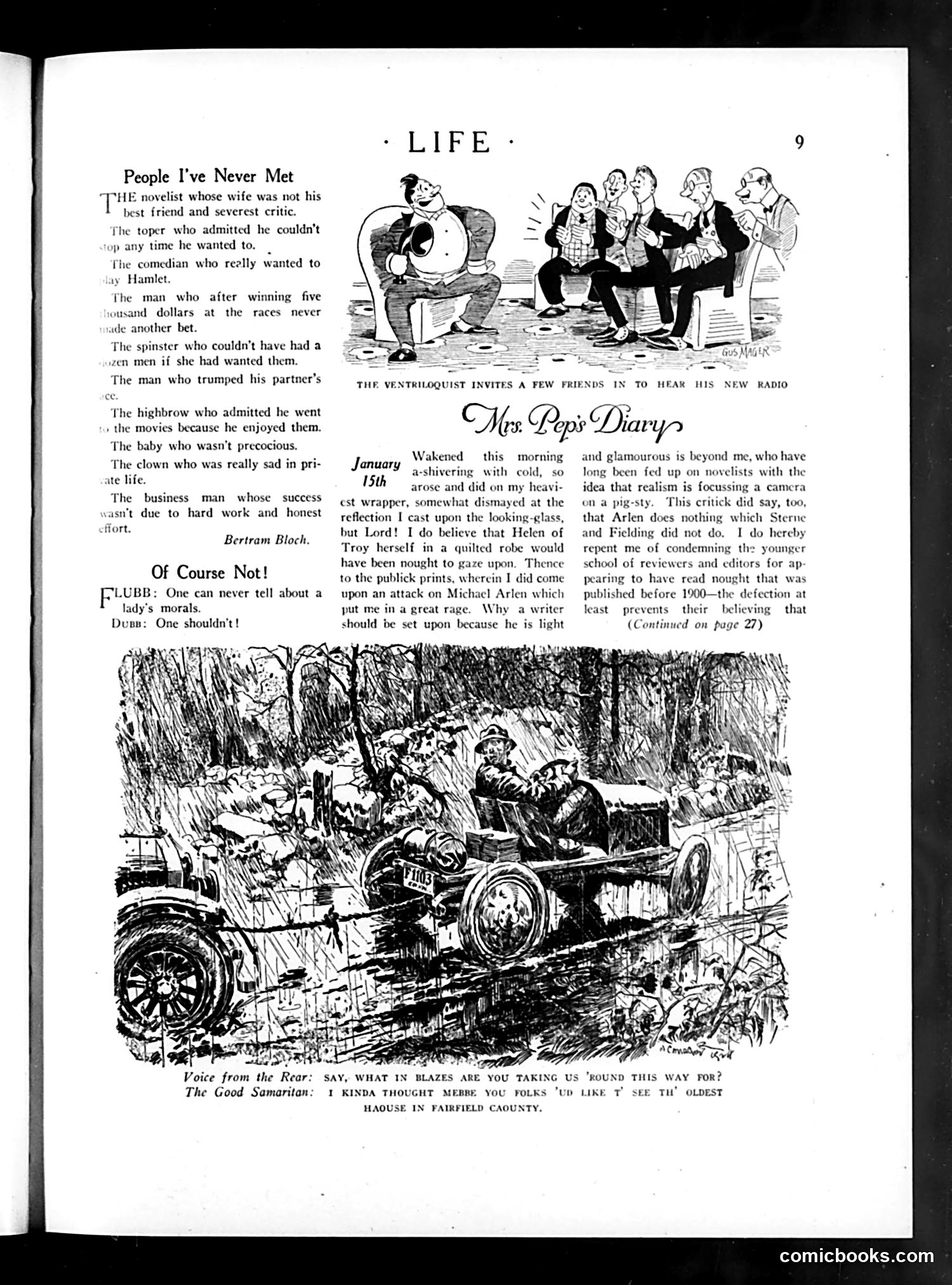
This page contains two distinct satirical pieces: **"People I've Never Met"** (top left) lists fictional character types the author claims not to have encountered—a literary device mocking pretentious claims about human nature. The specific references are unclear without fuller context. **"Mrs. Pop's Diary"** (center-right) presents January 15th entries from what appears to be a society woman critiquing literary critics and reviewing trends. She defends realism in art against dismissive critics, specifically mentioning Michael Arlen (a 1920s-30s novelist) and defending against claims that his work is "light." **The bottom cartoon** shows an automobile stuck in muddy terrain with passengers. The caption's dialogue references "the oldest house in Fairfield County," suggesting rural Connecticut and poking fun at city dwellers attempting country drives—a common 1920s-30s satire theme.
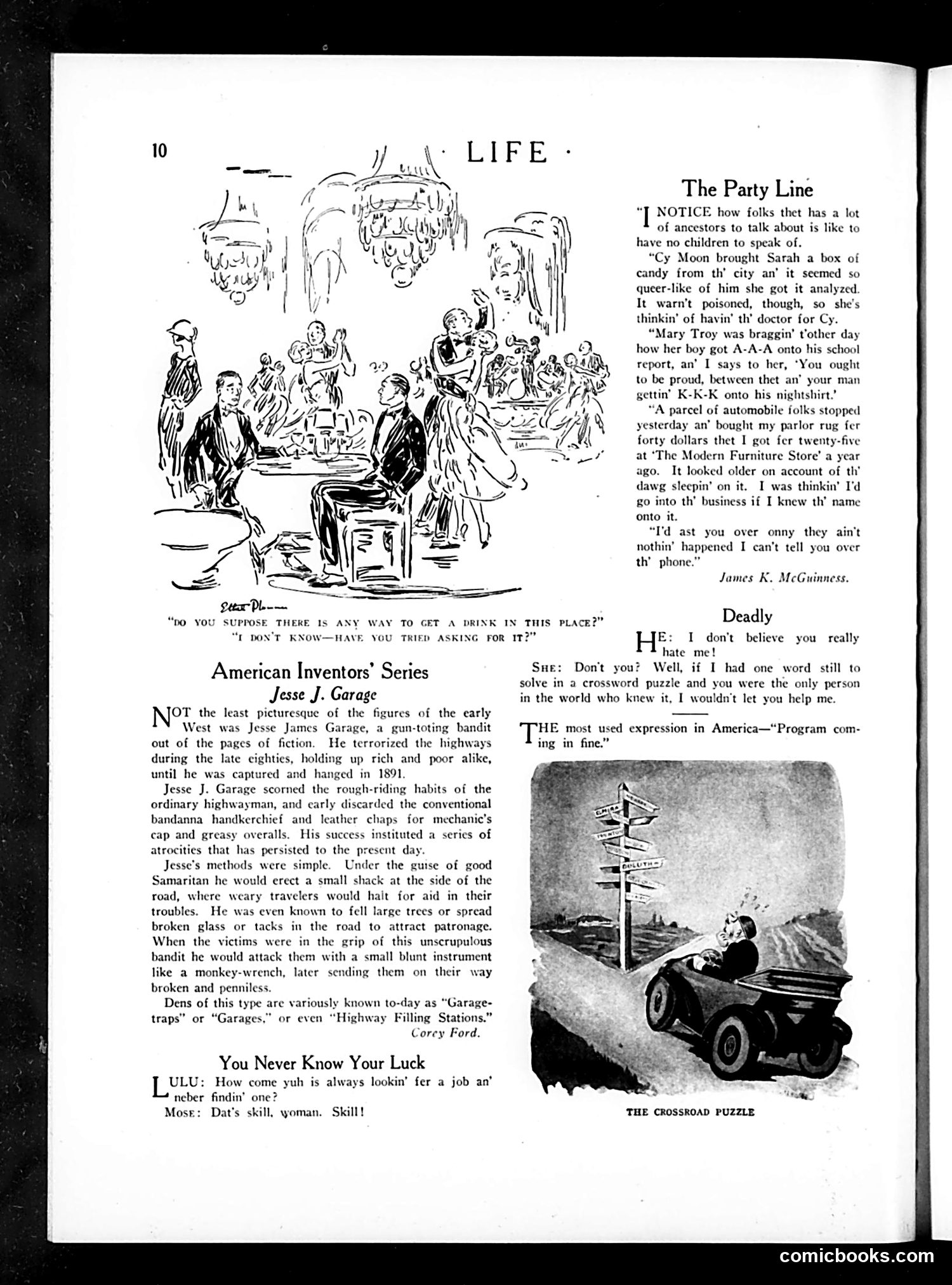
The top cartoon shows a social gathering where someone asks "Do you suppose there is any way to get a drink in this place?" with the response "I don't know—have you tried asking for it?" This satirizes Prohibition-era (1920s-1930s) hypocrisy: the illegal concealment of alcohol in supposedly "dry" venues. The humor lies in the obvious pretense—everyone knows drinks are available under-the-table. The page also features "American Inventors' Series" on Jesse James (presented as a highway bandit who invented "garage traps"), and two joke sections titled "The Party Line" and "Deadly." These contain humorous anecdotes about everyday American life—gossip, family matters, and relationship absurdities. The content reflects typical Life magazine satire: poking fun at social conventions, modern inconveniences, and American cultural peculiarities of the era.
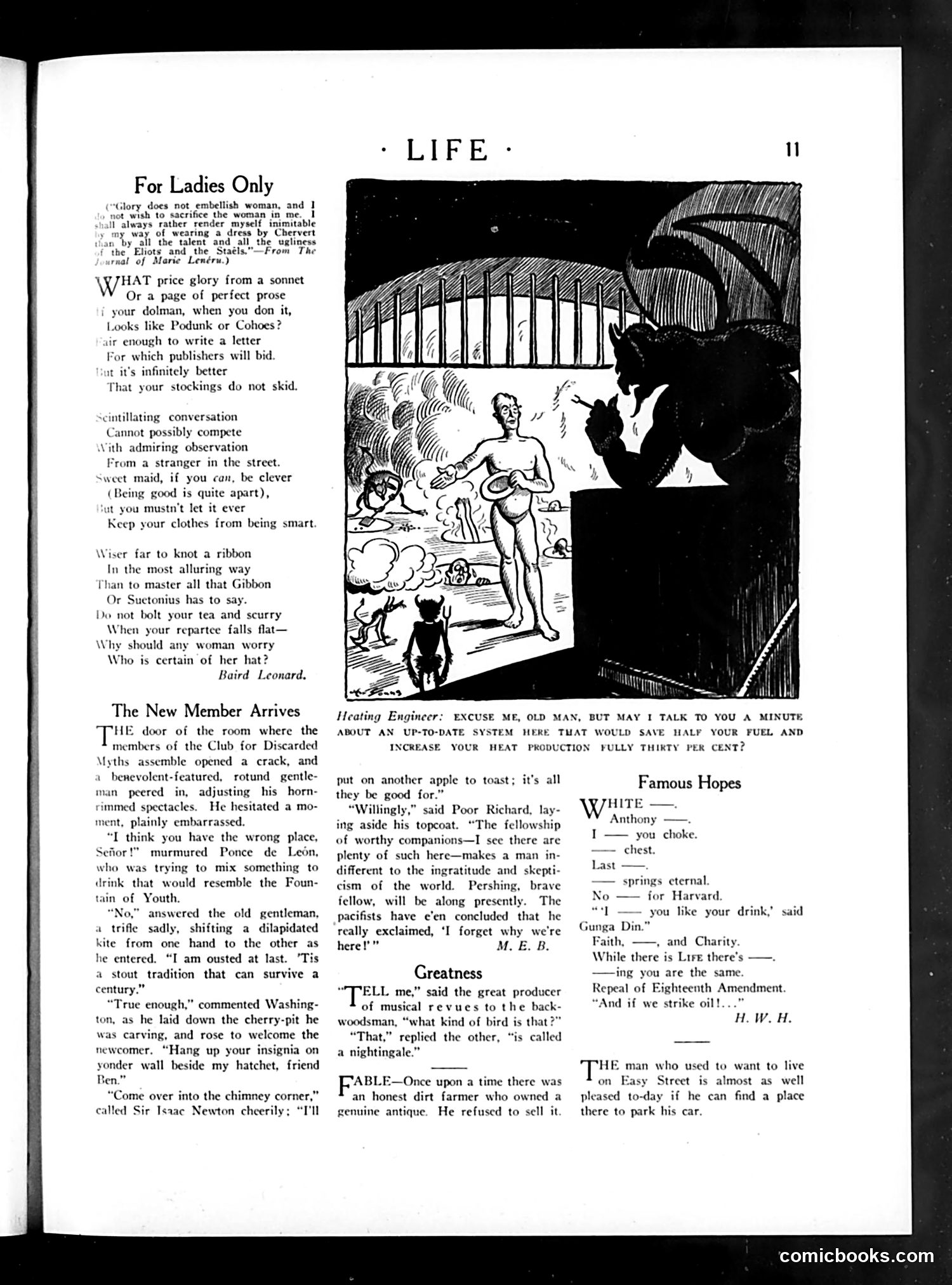
The main illustration depicts a nude or semi-nude man in what appears to be a bedroom or bathing area, surrounded by onlookers peering through windows and doorways. The accompanying text "Heating Engineer" presents this as satire about a dubious energy-conservation pitch—the engineer claims an "up-to-date system" will "save half your fuel and increase your heat production fully thirty per cent." The joke satirizes both fraudulent home-improvement schemes and the absurdity of the proposition itself. The voyeuristic imagery of witnesses watching the "heating engineer" suggests the ridiculous, inappropriate nature of whatever he's proposing. Below are various short humorous pieces including "The New Member Arrives," "Famous Hopes," and "Greatness"—typical satirical content of early 20th-century Life magazine targeting social pretension and human folly.
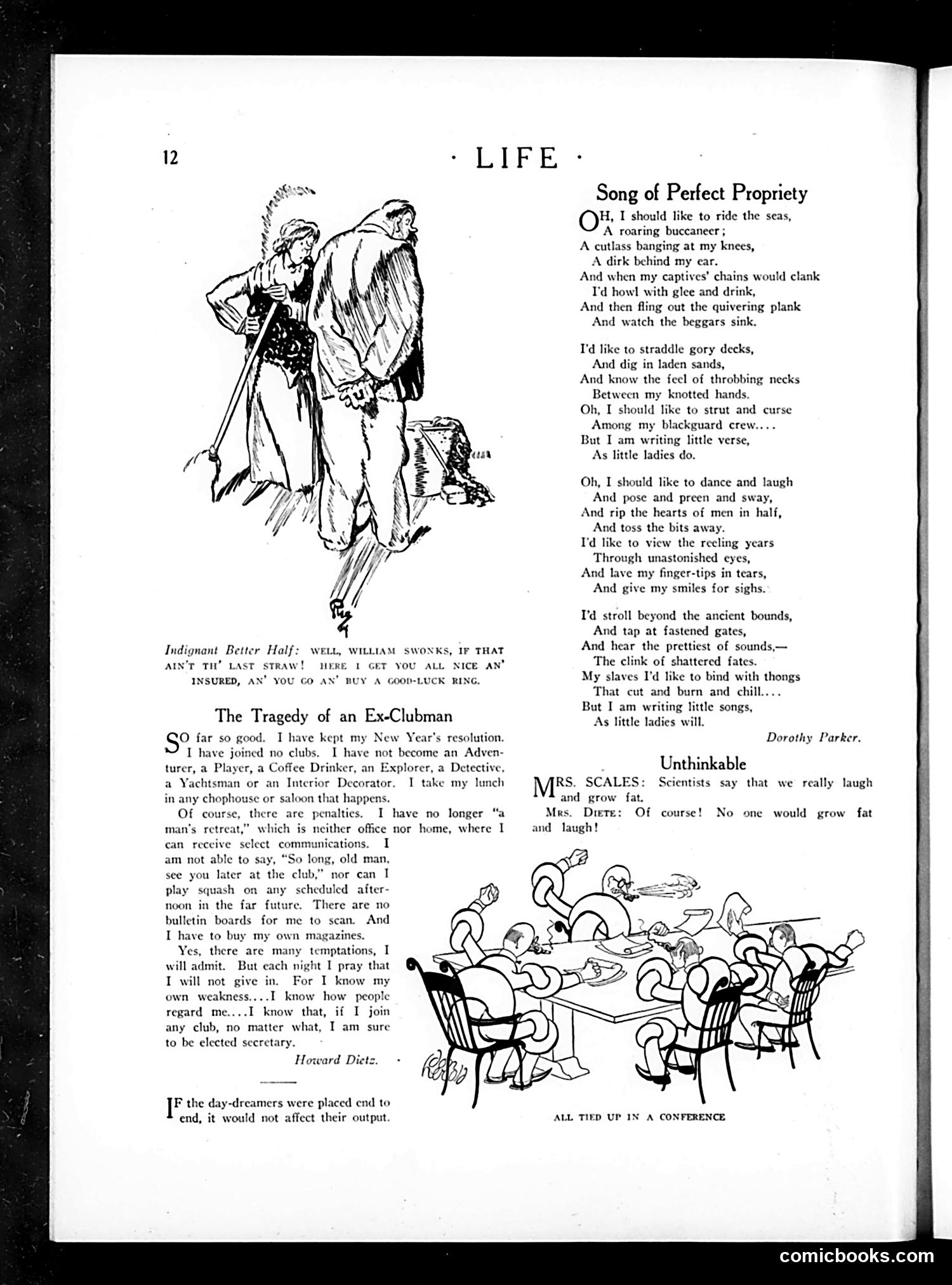
This page contains three separate satirical pieces: 1. **"Song of Perfect Propriety"** by Dorothy Parker: A poem mocking women's constrained social roles. It contrasts what the speaker desires (adventure, dancing, commanding slaves) with her actual life writing "little songs, / As little ladies do"—satirizing how women were expected to limit their ambitions. 2. **"The Tragedy of an Ex-Clubman"** by Howard Dietz: A piece about a man who quit his club and now struggles with enforced propriety—no longer able to receive communications, schedule meetings, or conduct his former life. The satire targets how club membership structured social/professional identity for men. 3. **"Unthinkable"**: A brief joke about laughing and weight gain, with an illustration of tied-up figures at a conference table.
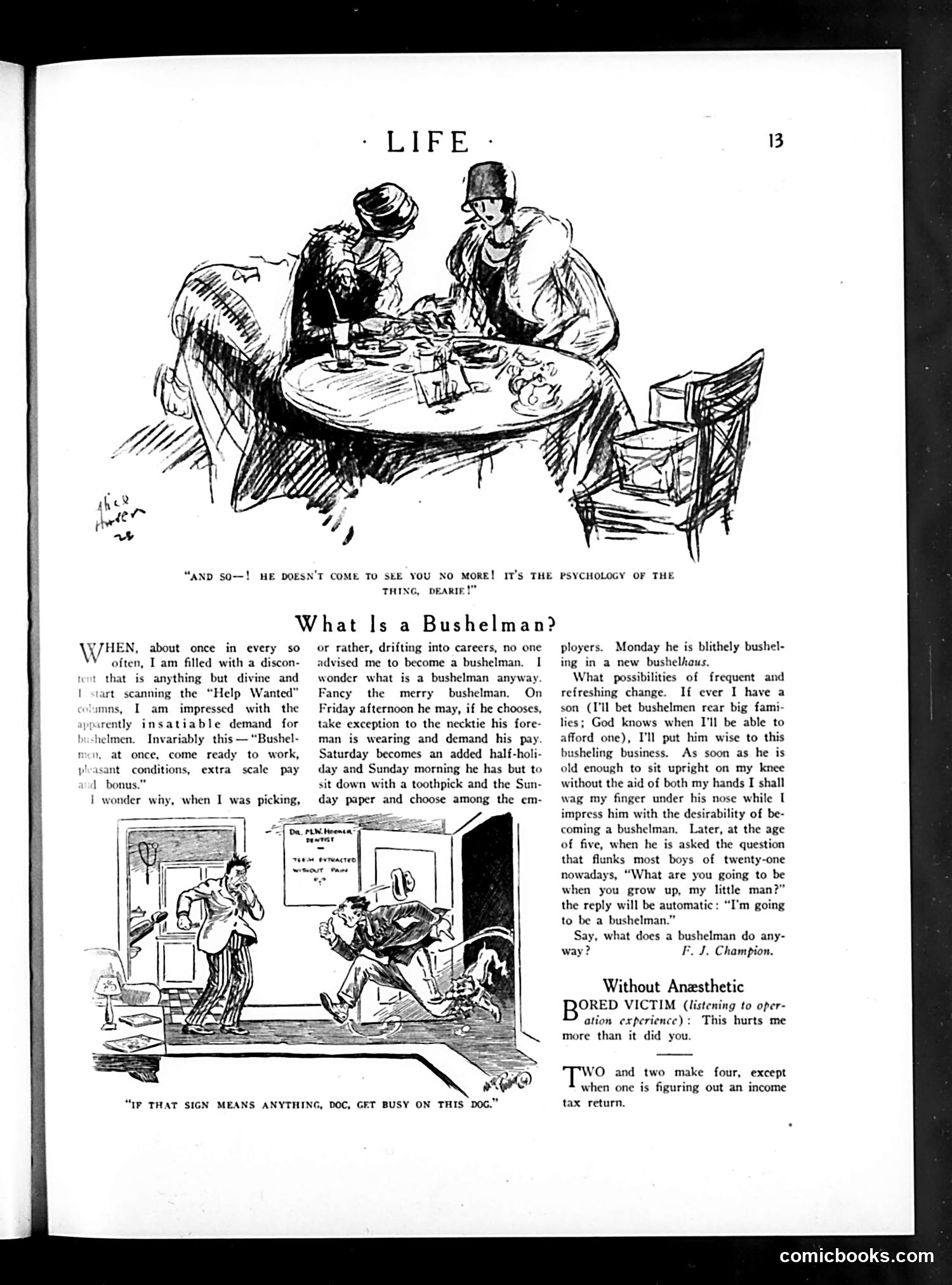
This page satirizes the "bushelman," a term for a tailor's assistant or low-paid garment worker. The article humorously catalogs the bushelman's precarious existence: working without steady employment, earning minimal pay, and living hand-to-mouth. The top cartoon shows two well-dressed people dining while discussing the bushelman's psychology—suggesting dismissive attitudes toward working-class struggles. The bottom cartoon depicts a doctor's office where a figure instructs someone to "get busy on this doc," illustrating the bushelman's constant need to take whatever work appears, no matter the conditions. The satire targets both the exploitative nature of piecework labor and the dismissive attitudes of employers toward struggling workers. It's social commentary on economic precarity and class indifference in early 20th-century America.
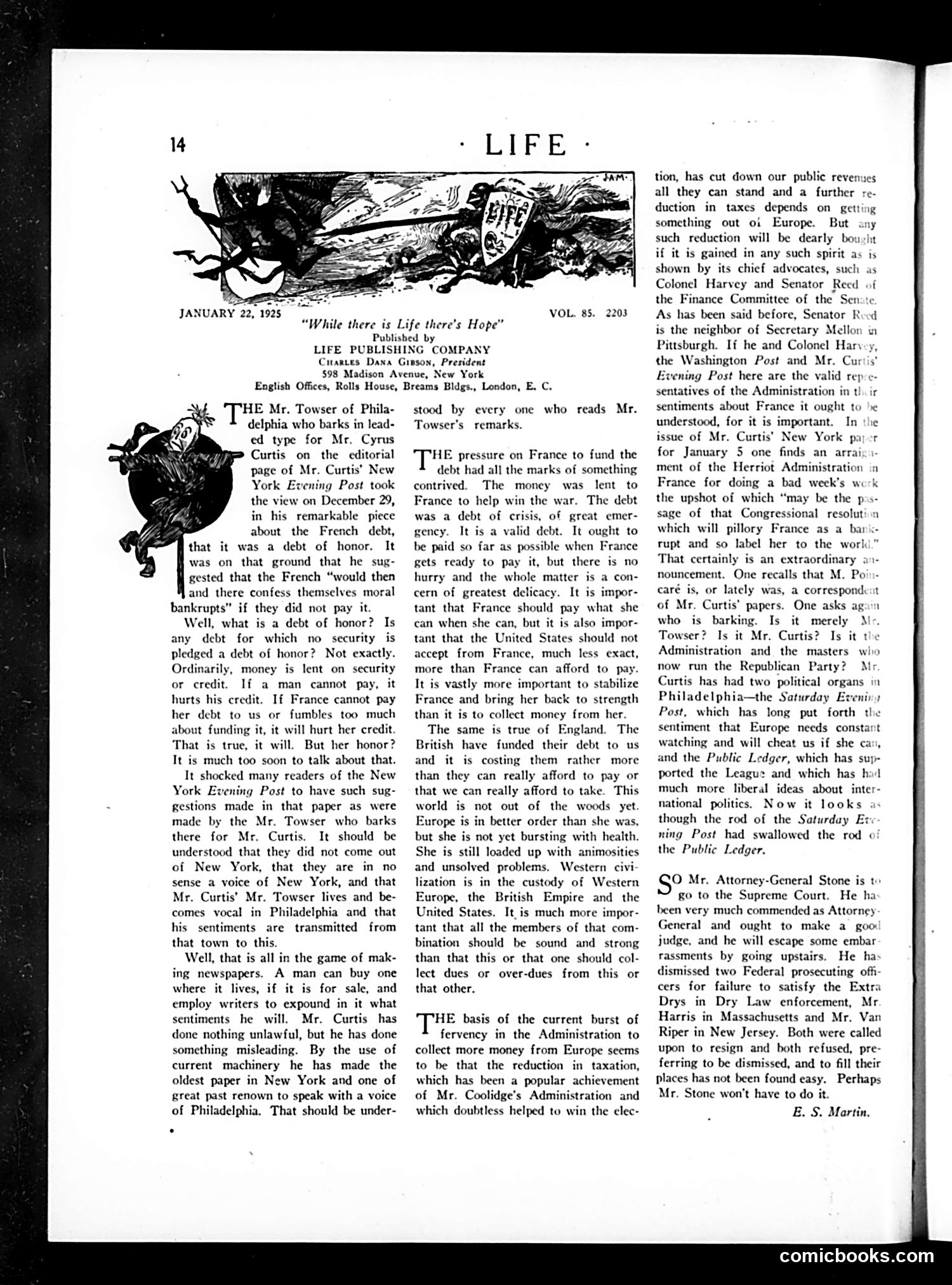
The main cartoon depicts **Mr. Tower of Philadelphia** (identified in the text as a New York *Evening Post* editorial writer) as a skeletal, demon-like figure. The satire mocks Tower's criticism of the French debt situation and his suggestions that France should stabilize itself. The accompanying editorial defends Tower's right to voice opinions while questioning his reasoning about European finances. It criticizes Tower's argument that the U.S. shouldn't accept payment from France, suggesting this position is misleading and poorly reasoned. The cartoon uses grotesque imagery to ridicule what the magazine considers flawed economic reasoning about post-WWI international debt—a major political controversy of the 1920s.
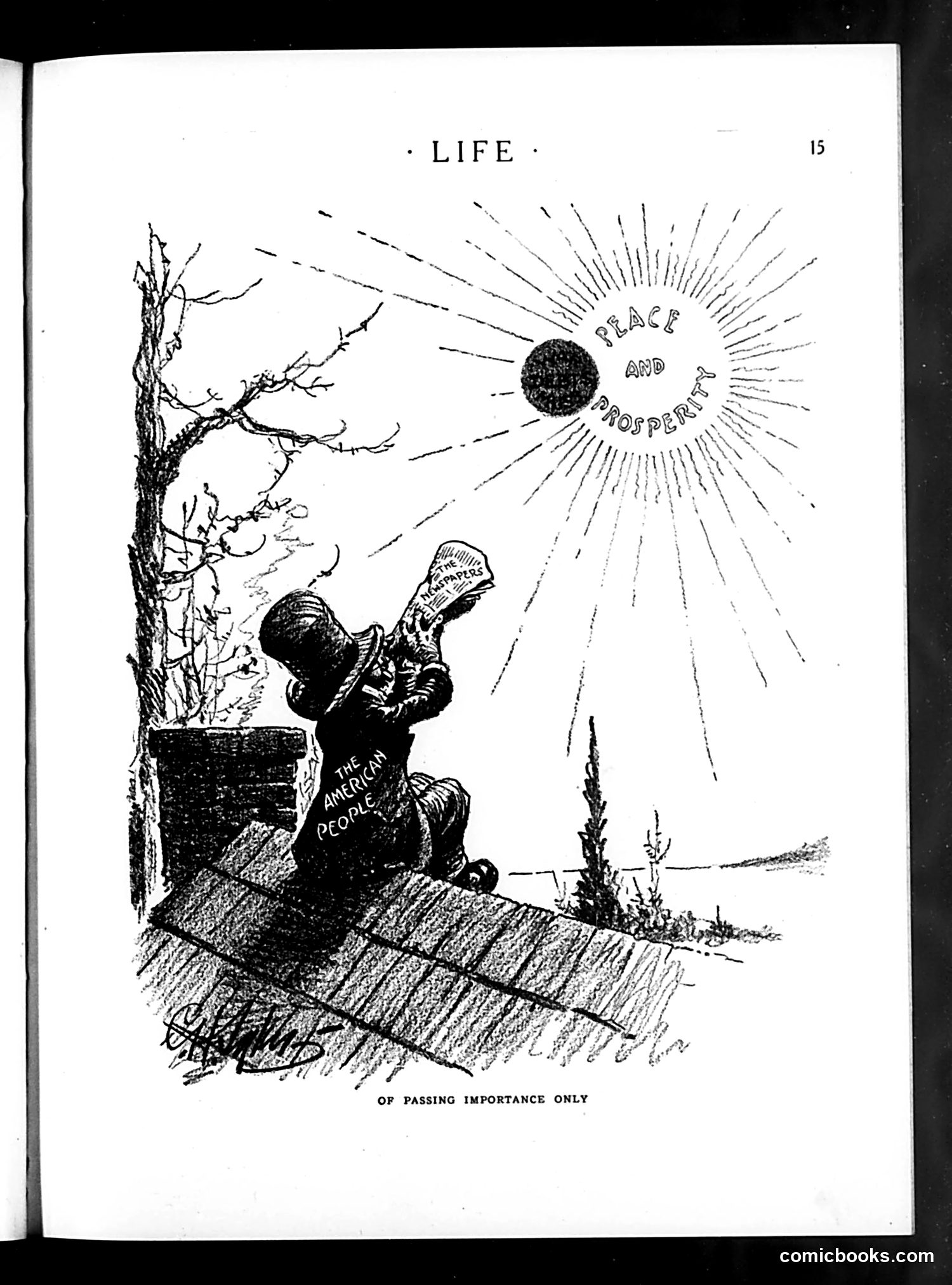
This is a political cartoon from *Life* magazine (page 15) titled "Grace and Prosperity." The central figure represents "The American People," shown reading a document labeled "Grace and Prosperity" while kneeling in a barren landscape. Dead, leafless trees surround the figure, and the sun radiates rays of hope overhead. The satire appears to critique American optimism during economic hardship—likely the Great Depression era. The contrast between the hopeful message the figure reads and the desolate surroundings suggests irony: citizens are being told to have faith in "grace and prosperity" while facing real deprivation. The caption "Of Passing Importance Only" may further mock how such reassurances are treated as temporary concerns rather than serious economic crisis.
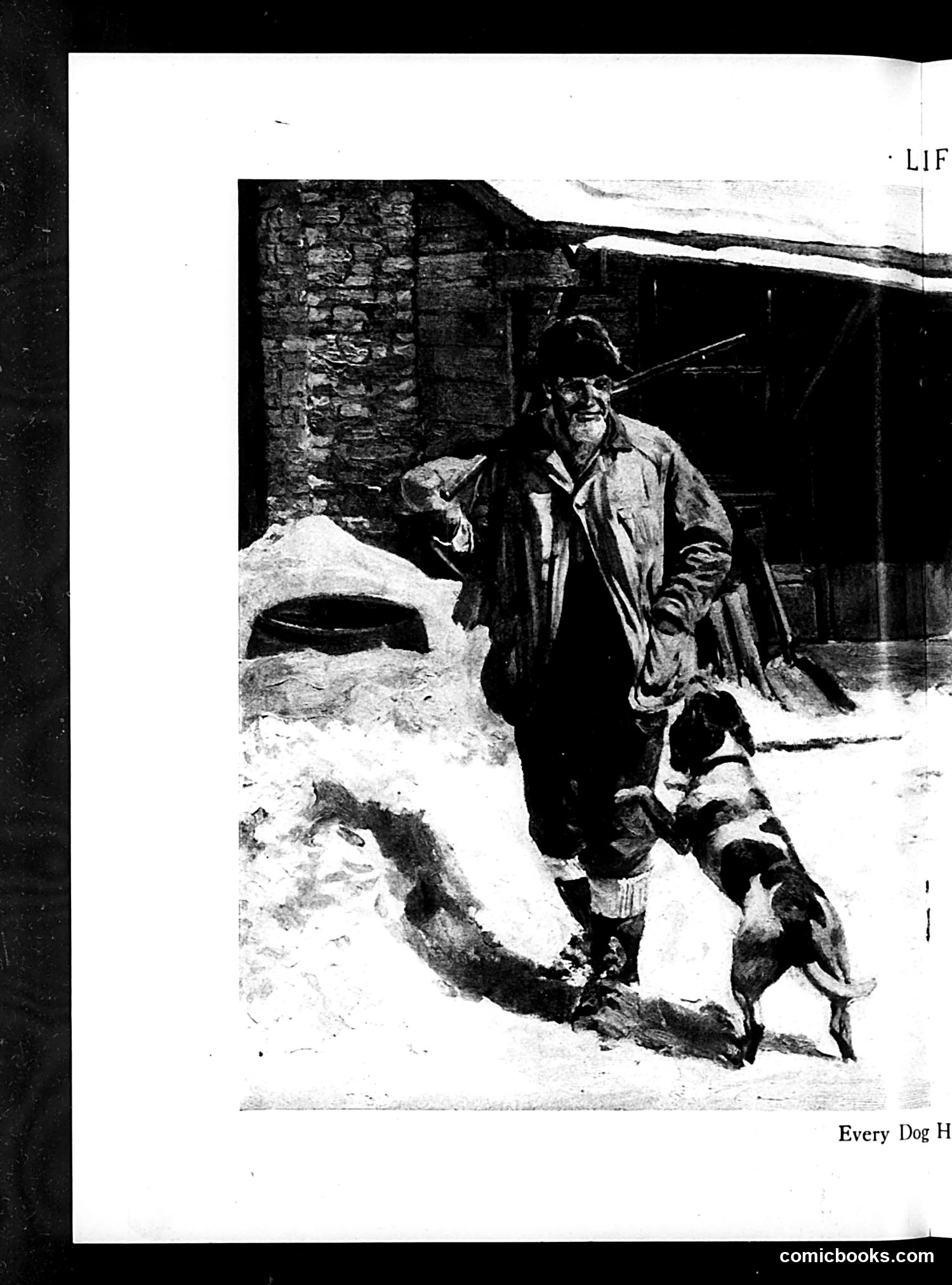
This appears to be a page from Life magazine featuring a black and white photograph rather than a cartoon. The image shows an older man in worn clothing and a cap, holding a rifle, with a hunting dog beside him in a snowy setting. There's a brick structure visible in the background. The OCR'd text at the bottom reads "Every Dog H" (incomplete), suggesting this is likely part of a caption or article title that's cut off. Without the complete text, the specific satirical point or social commentary is unclear. The image itself appears to document rural/working-class life, possibly addressing themes of hunting, rural poverty, or class dynamics common to Life magazine's satirical content—but the exact intent cannot be determined from the visible information alone.
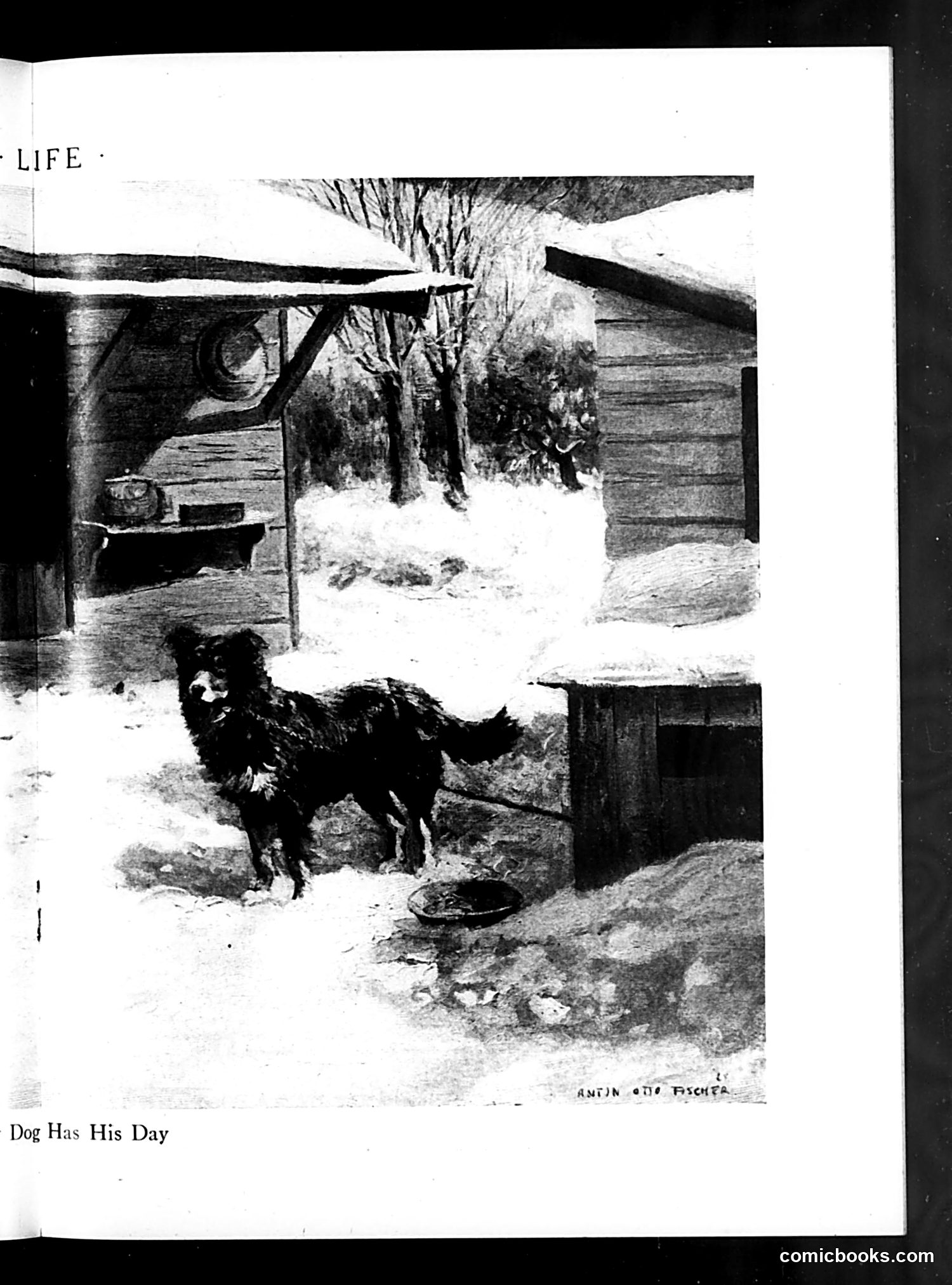
This appears to be a photograph rather than a political cartoon. It shows a dark-colored dog standing in snow outside what looks like a rural homestead, with wooden structures and bare trees visible in the background. There's a food bowl on the ground in front of the dog. The caption "Dog Has His Day" is a play on the proverb "Every dog has his day," meaning everyone gets their moment of importance or luck. Without additional context about when this was published or what specific event it might reference, the image simply documents a dog in a winter setting, possibly illustrating the adage humorously by literally showing a dog having "his day" photographed for the magazine.
This page reviews Molnar's play "Carnival," defending it against critical dismissal. The critic argues that Life's drama department is uniquely susceptible to emotional theater, justifying their positive reception despite the play's flaws. The review compares "Carnival" favorably to Molnar's more successful "The Guardsman" (starring Lynn Fontanne and Alfred Lunt), arguing the latter relies on star power rather than substance. The critic praises "Carnival's" central character—a beautiful but obtuse woman who gains depth and agency when she discovers a lost diamond, attempting to escape her husband. The satire targets both theatrical excess (the repetitive second-act scene) and critics who dismiss emotionally affecting plays as unsophisticated. Small decorative illustrations accompany the text, typical of Life's visual style, but contain no specific caricatures or political references—this is theater criticism rather than political satire.
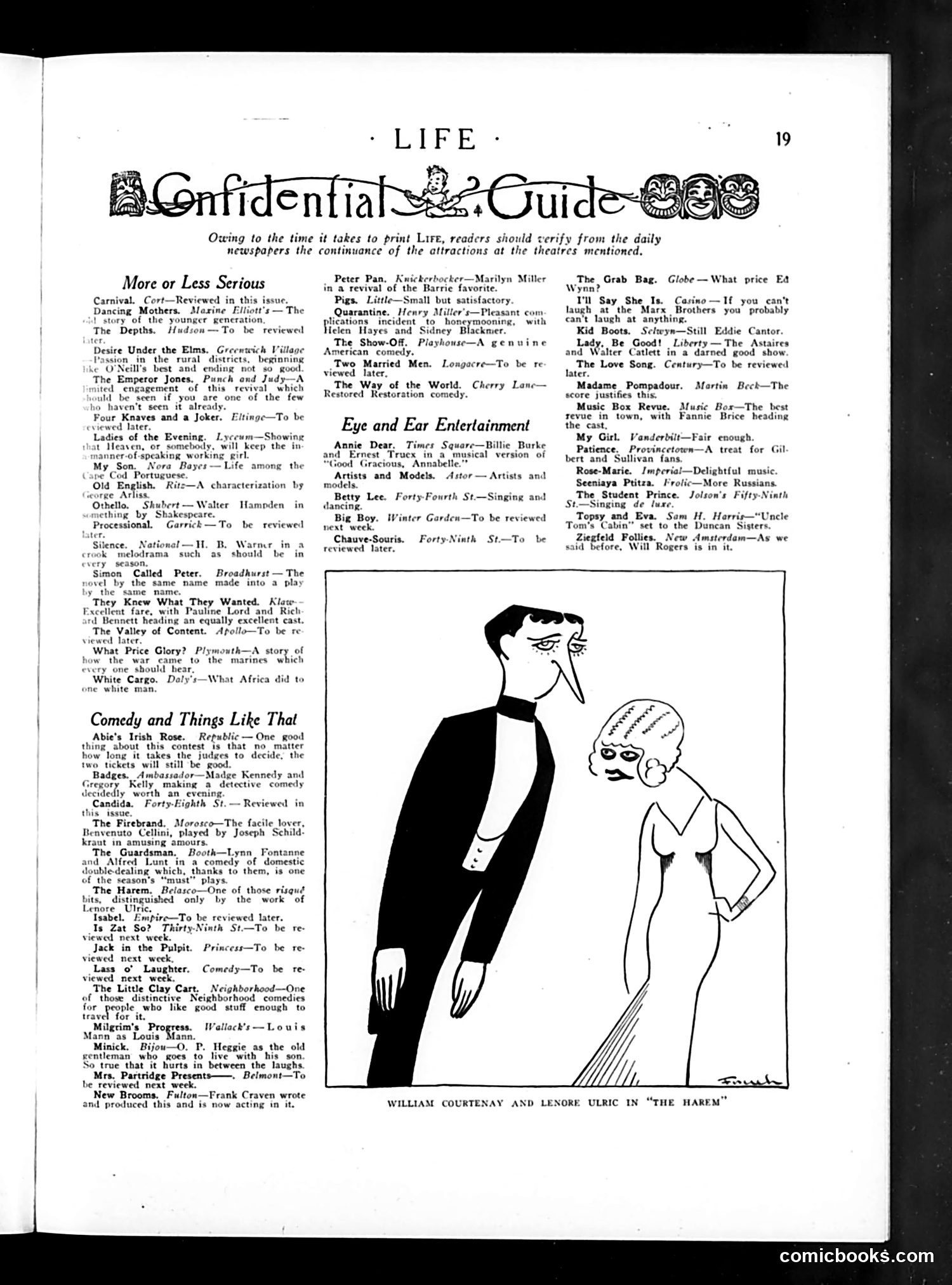
This illustration accompanies a theater review for "The Harem," playing at the Belasco Theatre. The caption identifies the performers as **William Courtenay and Lenore Ulric**. The cartoon depicts a man in formal evening dress (tuxedo) with an exaggerated, somewhat grotesque facial expression gazing down at a woman in a negligee. The woman has an elaborate hairstyle and is posed in a suggestive manner. The joke appears to be a visual pun on the play's title and subject matter: the review describes it as "one of those risqué bits, distinguished only by the work of Ulric"—suggesting the play's appeal rested primarily on its adult humor and Ulric's performance rather than substantial dramatic merit. The cartoon humorously exaggerates the lecherous male gaze and the play's focus on romantic/sexual situations typical of 1920s "bedroom farce" comedies. It's essentially mocking both the play and audience expectations for this type of entertainment.
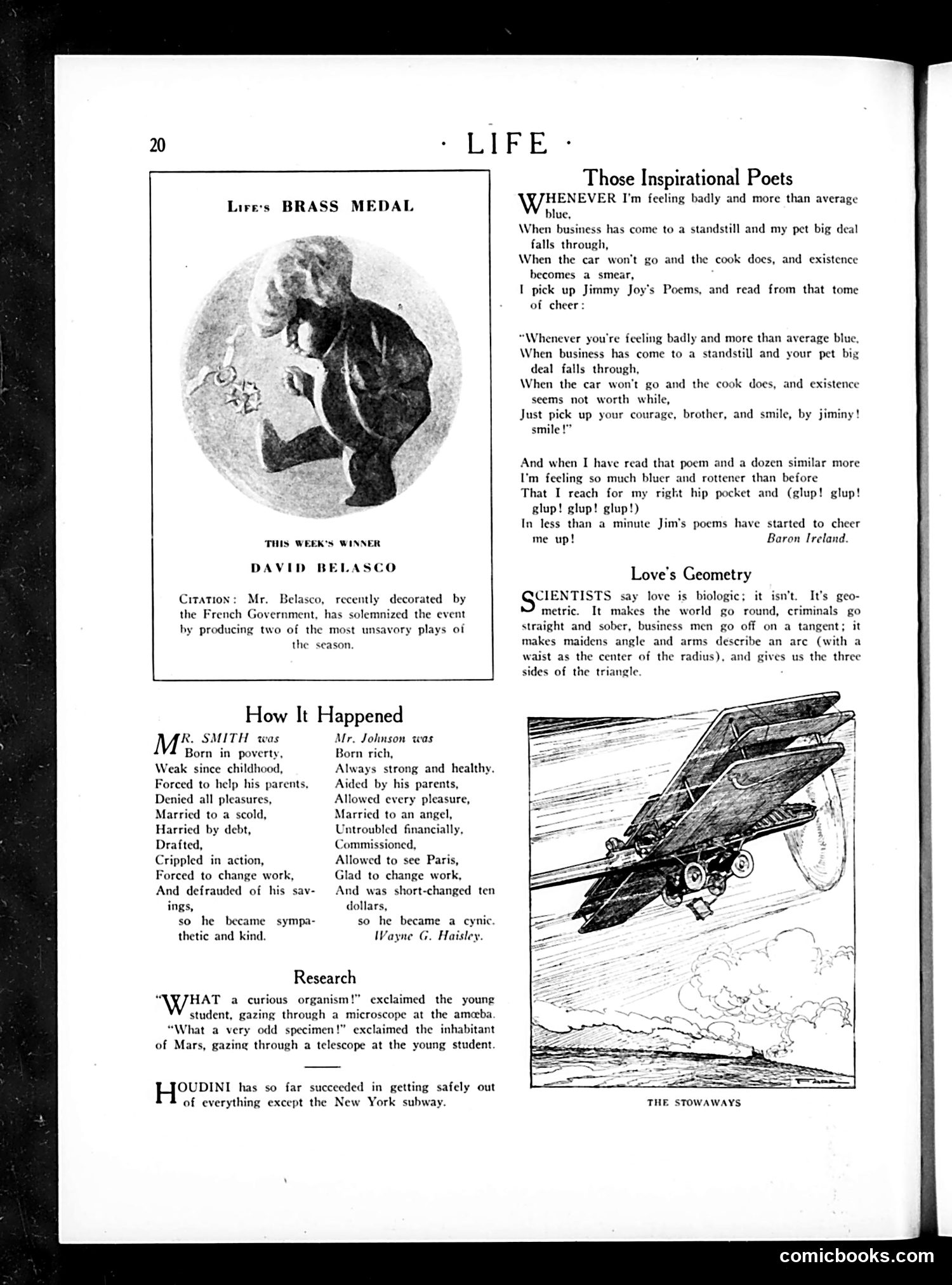
This page from Life magazine contains satirical commentary on early 20th-century American society: **Brass Medal Award**: David Belasco, a famous theatrical producer recently honored by the French government, is mocked for staging two disreputable plays—satire on how official recognition doesn't guarantee artistic merit. **"How It Happened"**: A sharp contrast between two men with opposite life circumstances (Mr. Smith born poor, Mr. Johnson born rich) that paradoxically produces opposite character results—the struggling man becomes sympathetic while the privileged man becomes cynical. This inverts typical expectations and satirizes both class privilege and self-pity narratives. **"Those Inspirational Poets"**: A witty mockery of inspirational verse, particularly Jimmy Joy's uplifting poetry, which ironically makes the reader *more* depressed rather than cheerful—suggesting such inspirational literature is hollow and ineffective. **Other brief items** satirize human nature (the "Love's Geometry" piece), scientific observation, and Houdini's escape artistry, the latter referencing his famous feats while joking he can't escape the NYC subway system.
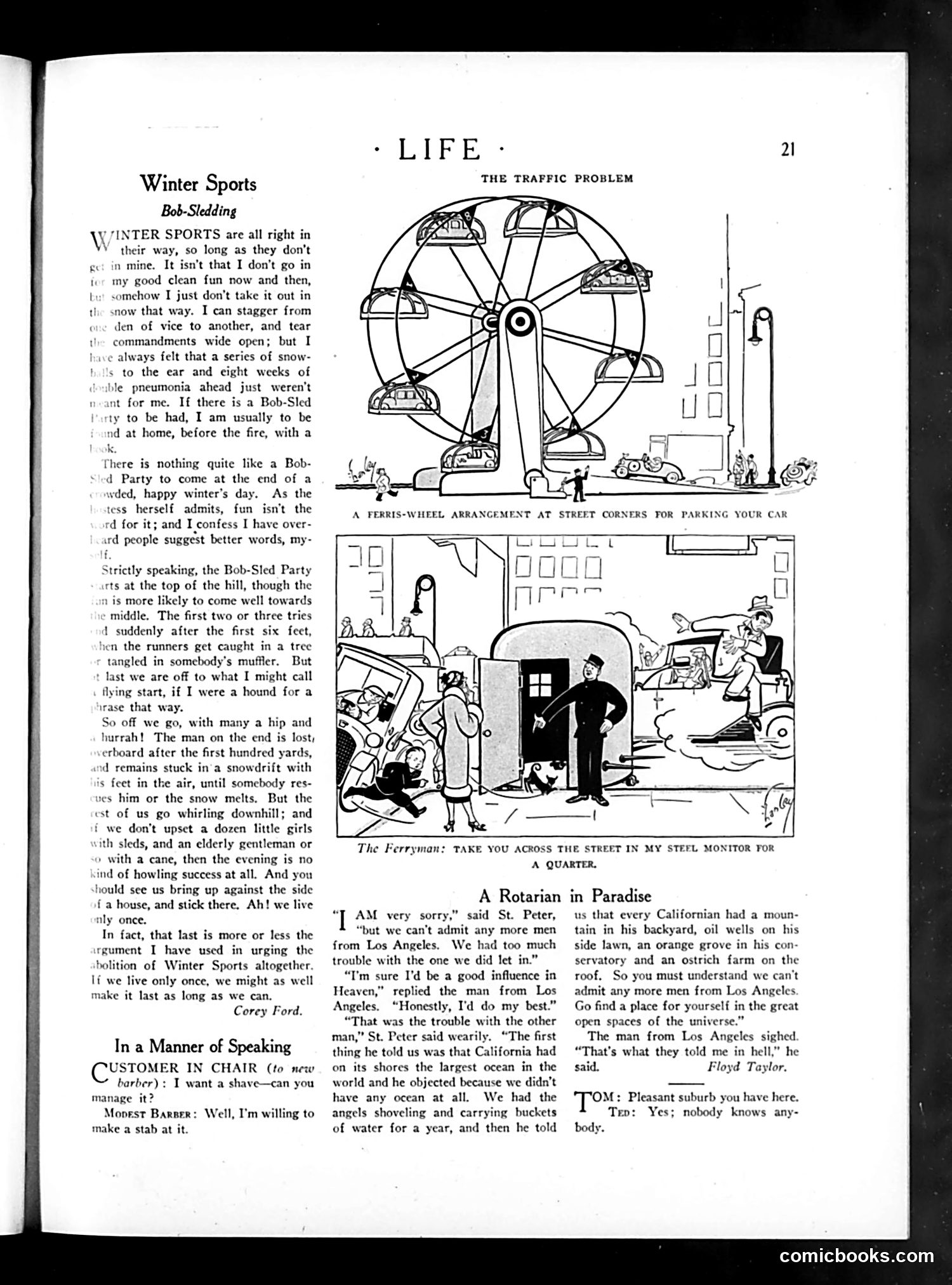
**"The Traffic Problem" cartoon** depicts a Ferris wheel repurposed as a parking solution—a satirical jab at urban congestion. The "ferryman" character operating it suggests cities are so gridlocked that unconventional, absurd measures seem necessary. This reflects 1920s-30s automobile boom anxieties about traffic and parking shortages in American cities. **"A Rotarian in Paradise"** mocks Californians, particularly Los Angeles boosters. St. Peter rejects another LA man because the previous Californian resident complained Heaven lacked California's natural features (ocean, mountains, oil wells, orange groves), forcing angels to labor uselessly. The joke satirizes Californian boosterism and exaggeration about their state's superiority—a common literary target of the era. **The opening essay** humorously critiques winter sports, particularly bob-sledding, describing chaotic, injury-prone recreational outings. It's lighthearted social commentary on wealthy leisure activities. The page exemplifies Life's satirical approach to contemporary American social phenomena: urban modernization problems, regional character types, and recreational culture.
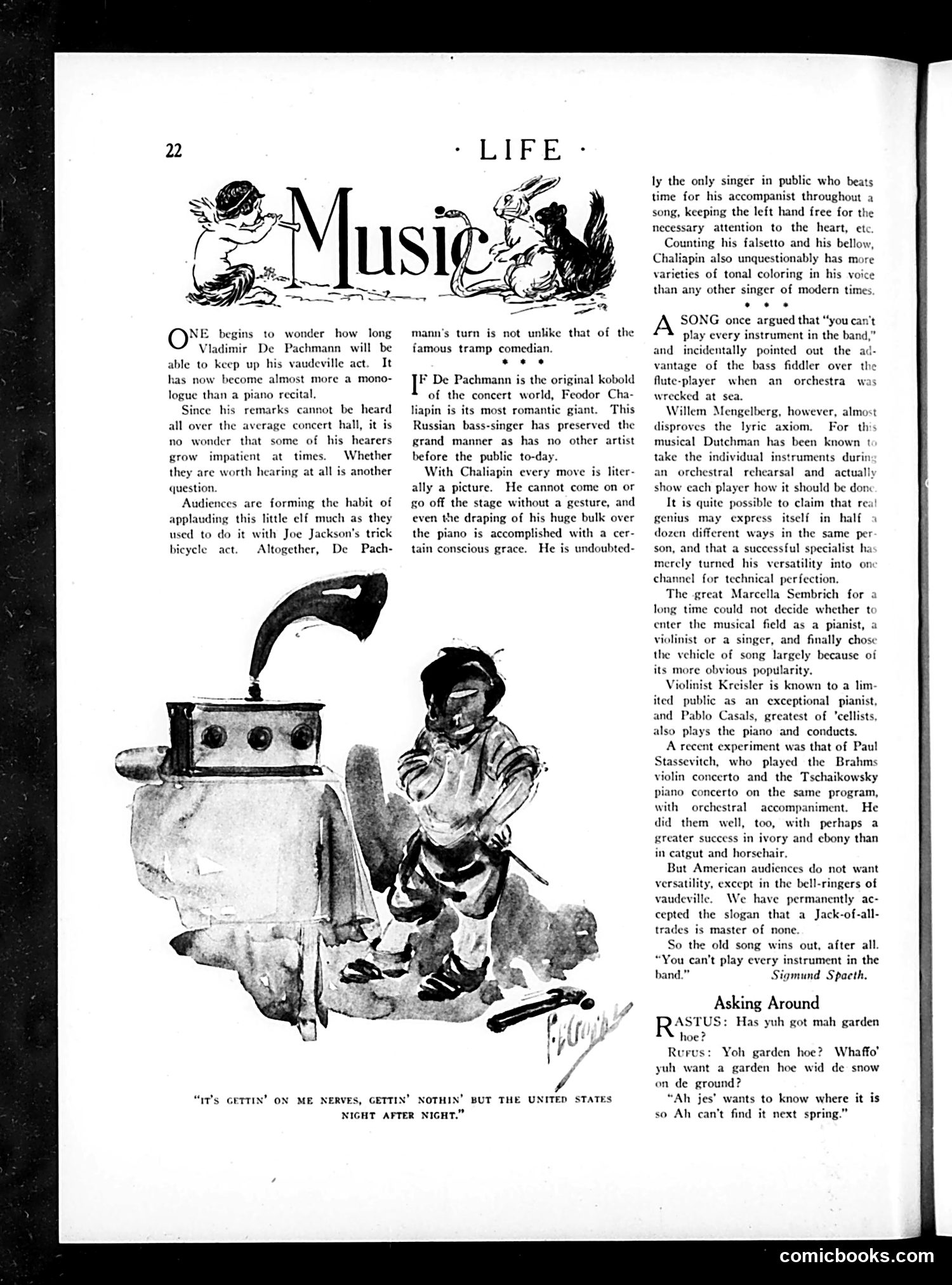
This page satirizes early 20th-century concert performers and American audience preferences. **Main Figures:** - **Vladimir De Pachmann**: A pianist criticized for turning his recitals into comedic monologues, compared to vaudeville performer Joe Jackson's trick bicycle act. The satirist mocks audiences for applauding his antics rather than his musicianship. - **Feodor Chaliapin**: A Russian bass-singer praised as the opposite—a "romantic giant" who commands the stage with deliberate, graceful gestures and vocal versatility. **The Core Satire:** The column argues that American audiences prefer specialists over versatile artists. While European musicians (Kreisler, Casals, Sembrich) excel at multiple instruments, Americans reject versatility except in vaudeville, accepting "a Jack-of-all-trades is master of none." De Pachmann's descent into theatrical showmanship exemplifies this preference for entertainment over artistry. **The cartoon** shows a caricatured performer on a piano with exaggerated gesture, captioned with complaint about constant touring.
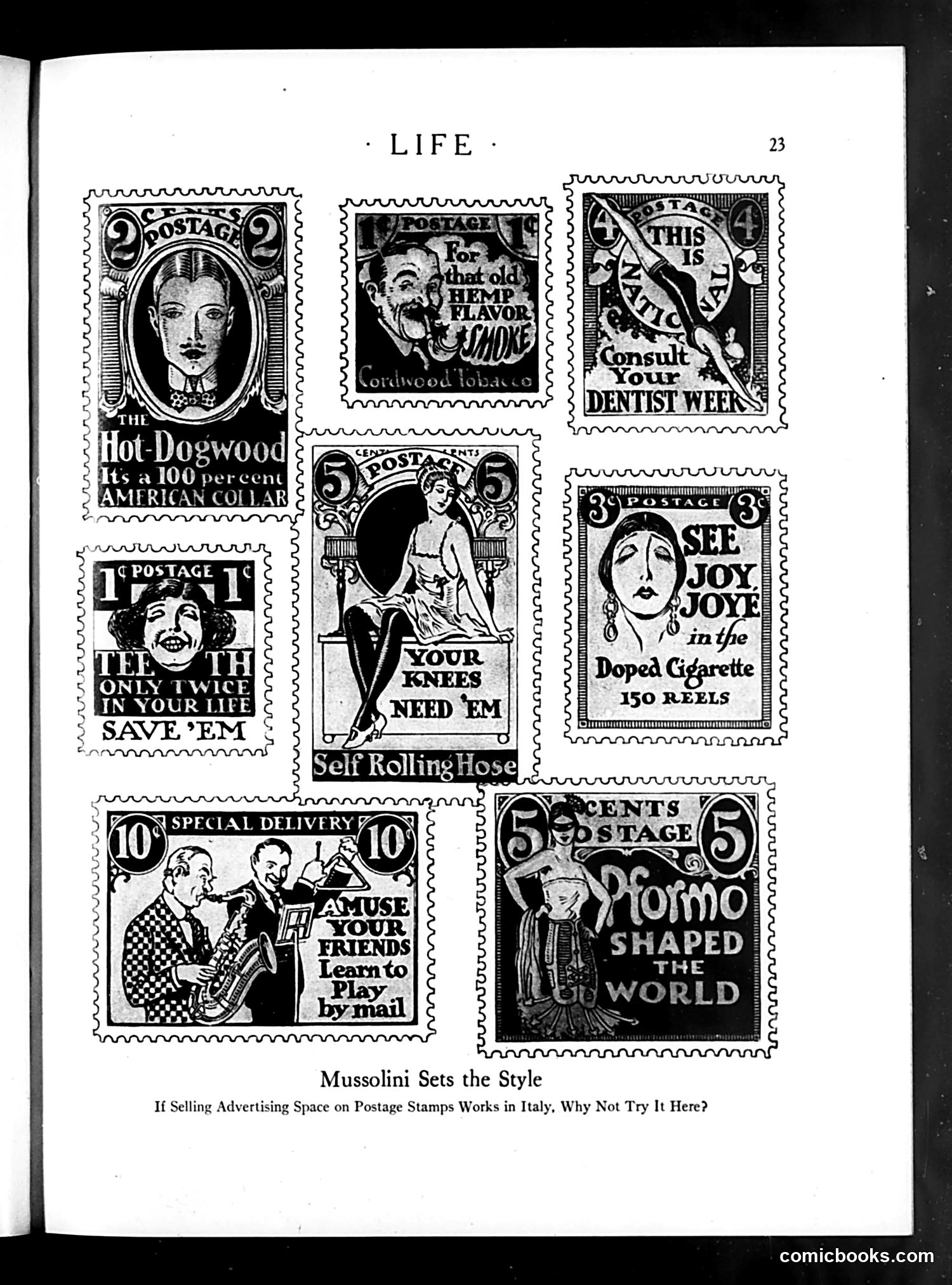
This page satirizes commercialized postage stamps through a series of fake American stamps designed as product advertisements. The caption references Mussolini's Italy, suggesting that fascist regime was selling ad space on stamps—a practice Life's editors find absurd enough to mock by proposing American companies do the same. The mock stamps advertise period products: Hot-Dog brand items, tobacco, dental services, doped cigarettes, self-rolling hose, mail-order music lessons, and more. Each features exaggerated illustrations typical of 1920s advertising. The satire's point: American commercialism has become so aggressive that selling postage-stamp advertising space—something associated with an authoritarian foreign regime—might actually appeal to U.S. businesses. It's social criticism wrapped in absurdist humor, questioning how far corporate advertising will go.
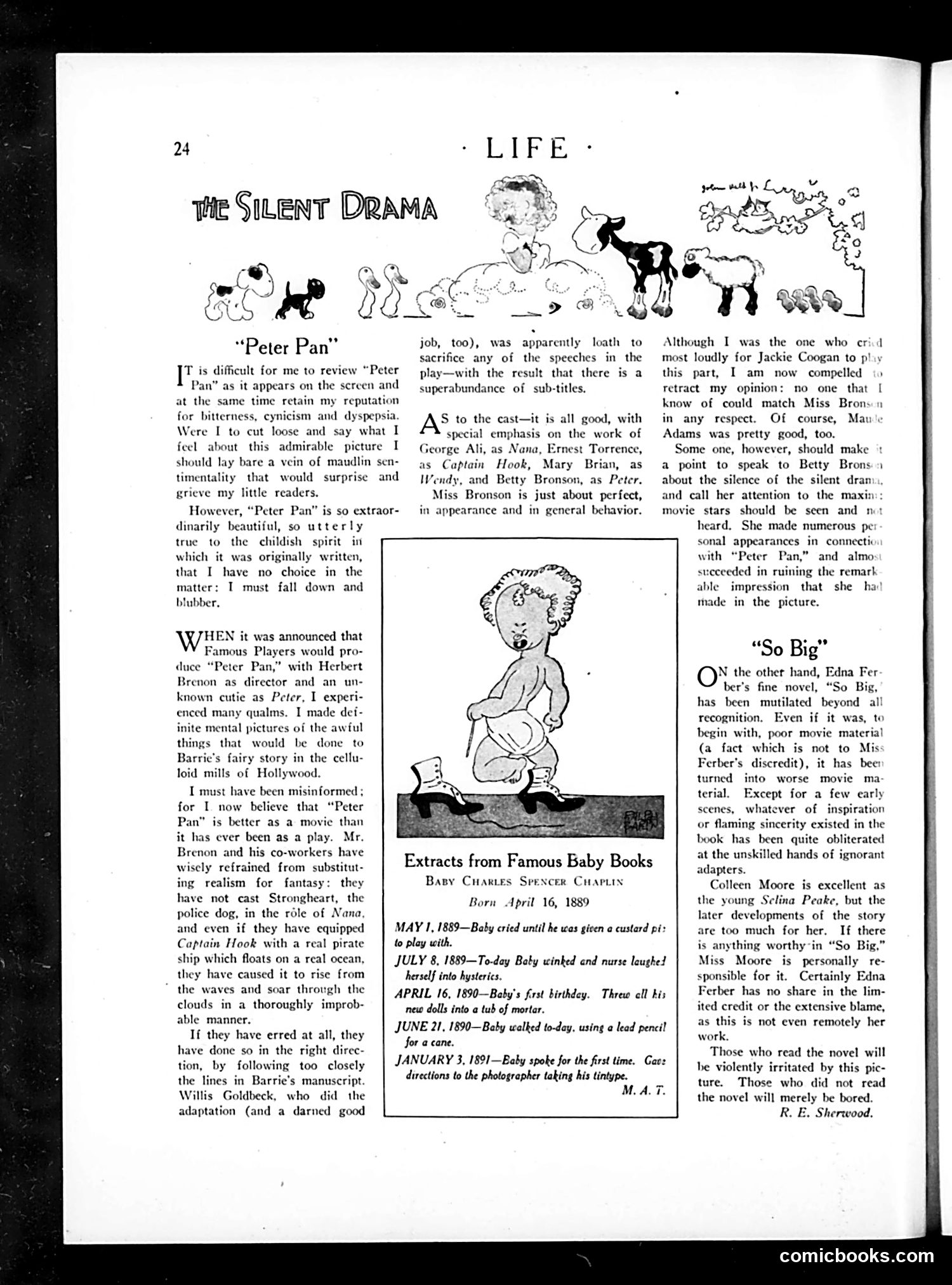
This page reviews two silent films from the early 1920s. The critic praises the "Peter Pan" adaptation (directed by Herbert Brenon, starring Betty Bronson), calling it beautifully faithful to J.M. Barrie's original work. The reviewer admits being emotionally moved—surprising given his self-described "bitterness, cynicism and dyspepsia." The cartoon strip at top humorously depicts Peter Pan's story in visual shorthand, showing the main characters and plot progression. Below, a comedic section mocks "Famous Baby Books" attributed to Charlie Chaplin (born April 1889), with invented entries describing absurd infant behavior—the baby using a custard pie as a toy, walking with a lead pencil as a cane, and giving photographer directions. This satirizes celebrity culture and inflated baby biographies popular at the time. The second review criticizes Edna Ferber's "So Big" as a poorly adapted film that destroyed the novel's merit, though actress Colleen Moore performs well in the lead role.
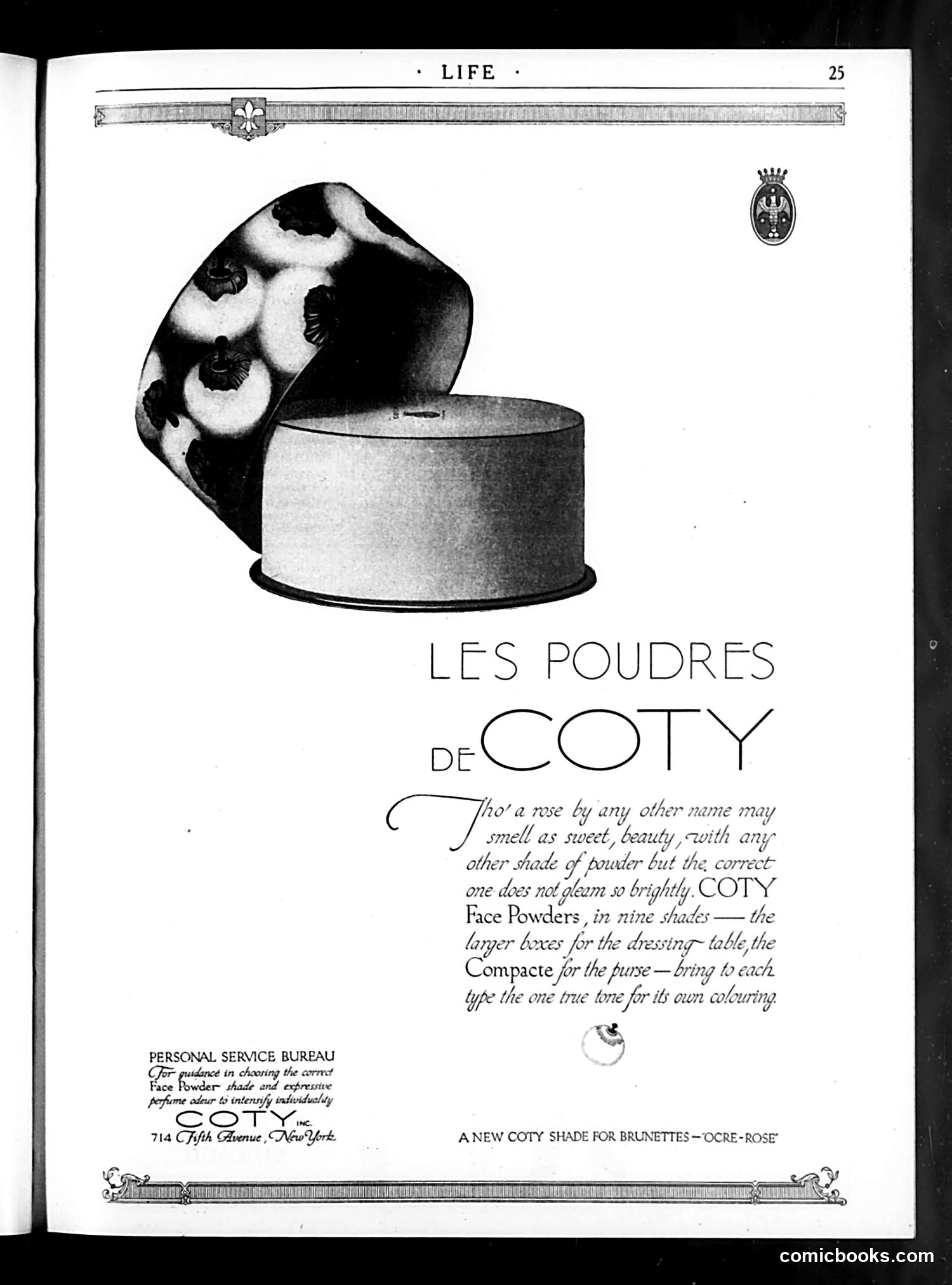
This is a **full-page advertisement**, not satire or political commentary. It promotes **Coty brand face powders** to women readers of *Life* magazine. The image shows an elegant cylindrical powder box with a decorative lid featuring illustrated faces. The ad emphasizes that Coty offers **nine different powder shades** to match various skin tones and complexions—larger boxes for home use, compact versions for purses. The copy references Shakespeare's *Romeo and Juliet* ("a rose by any other name...") to argue that while many powders smell pleasant, only Coty's formula provides the correct glamorous finish. A new shade called **"Ocre-Rose"** is highlighted for brunettes. The **Personal Service Bureau** at Coty's Fifth Avenue location offered guidance on selecting appropriate powder shades and perfumes to enhance individual beauty—reflecting early 20th-century luxury cosmetics marketing that positioned powder selection as both an art and personal service for women.
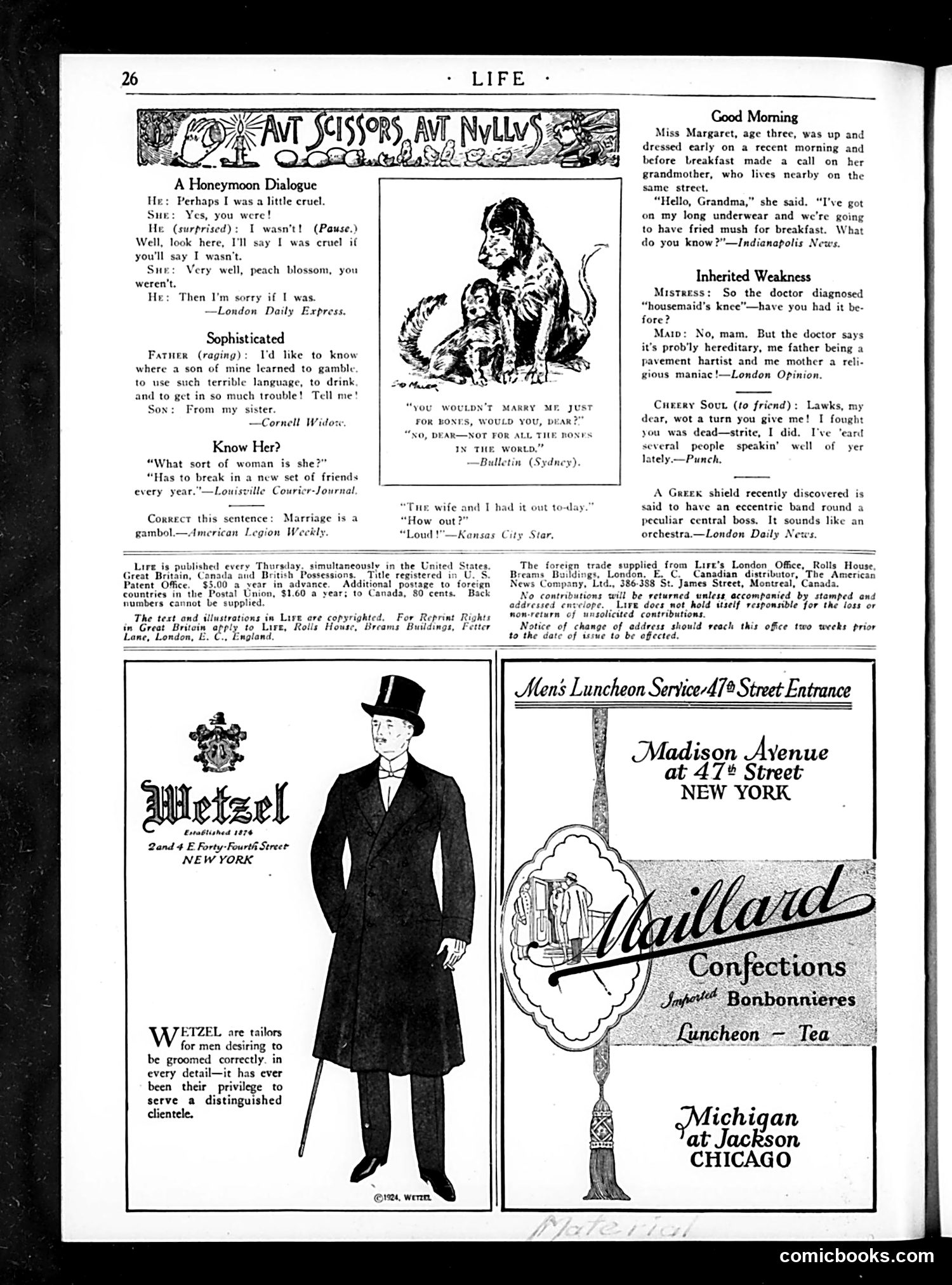
This page from Life magazine (a satirical weekly) consists primarily of **short humor pieces and advertisements**, rather than political cartoons. The humor columns feature brief jokes sourced from various newspapers, playing on domestic situations and wordplay: - **"A Honeymoon Dialogue"** satirizes newlywed reconciliation—a husband admits cruelty only if his wife denies it, resulting in circular logic. - **"Sophisticated"** jokes that a son learned gambling and drinking from his sister, inverting expectations about who corrupts whom. - **"Inherited Weakness"** presents working-class irony: a housemaid's knee ailment is "hereditary" from parents in manual labor and religious mania. The remaining content consists of **period advertisements**: Wetzel tailors (top left), and upscale dining/confectionery establishments (Maillard, Michigan at Jackson). There is **no significant political satire** on this page—it represents Life's lighter content: domestic humor and commercial advertising typical of 1920s American magazines.
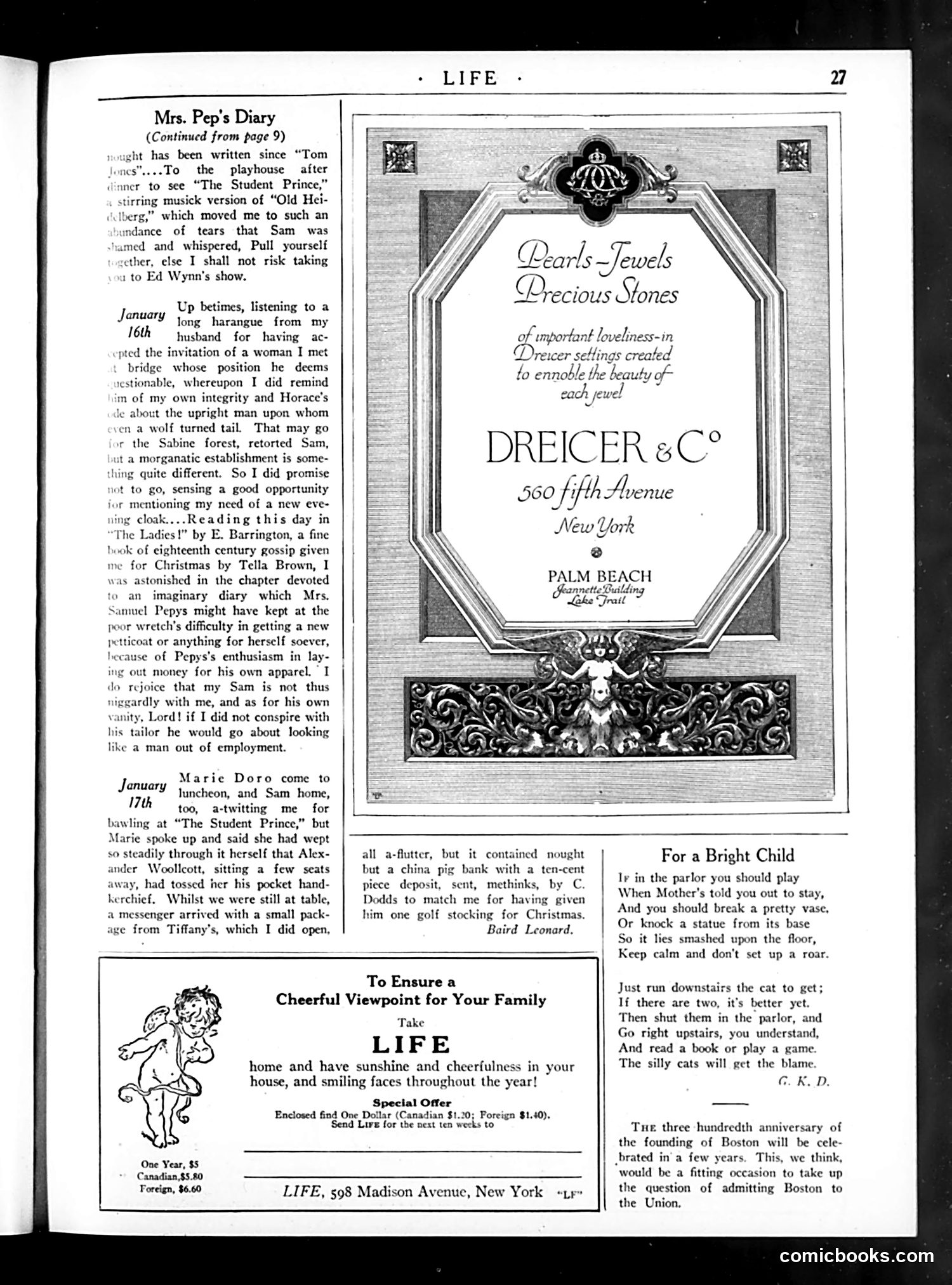
This page combines diary humor with advertisements and social commentary typical of 1920s Life magazine. **"Mrs. Pep's Diary"** is a parody of Samuel Pepys's famous 17th-century diary, reimagined as his wife's account. The satire mocks both marital dynamics and gender politics: Mrs. Pepys struggles with her husband's controlling behavior (forbidding her social activities) while he selfishly spends on himself. The humor lies in her subtle resistance and the absurdity that Pepys would worry about a woman's "morganatic" (socially beneath-station) friendships. The **brief poem "For a Bright Child"** offers darkly comedic parenting advice: blame household damage on the cat instead of accepting consequences—satirizing poor parenting and child psychology. **"To Ensure a Cheerful Viewpoint"** advertises Life magazine itself as a cure for family discontent, promising sunshine through humor. The **Dreicer jewelry advertisement** represents typical luxury marketing of the era. The closing note about Boston's 300th anniversary joining "the Union" is political satire—Boston already belongs to the Union, so this absurdist joke likely mocks some contemporary political debate.
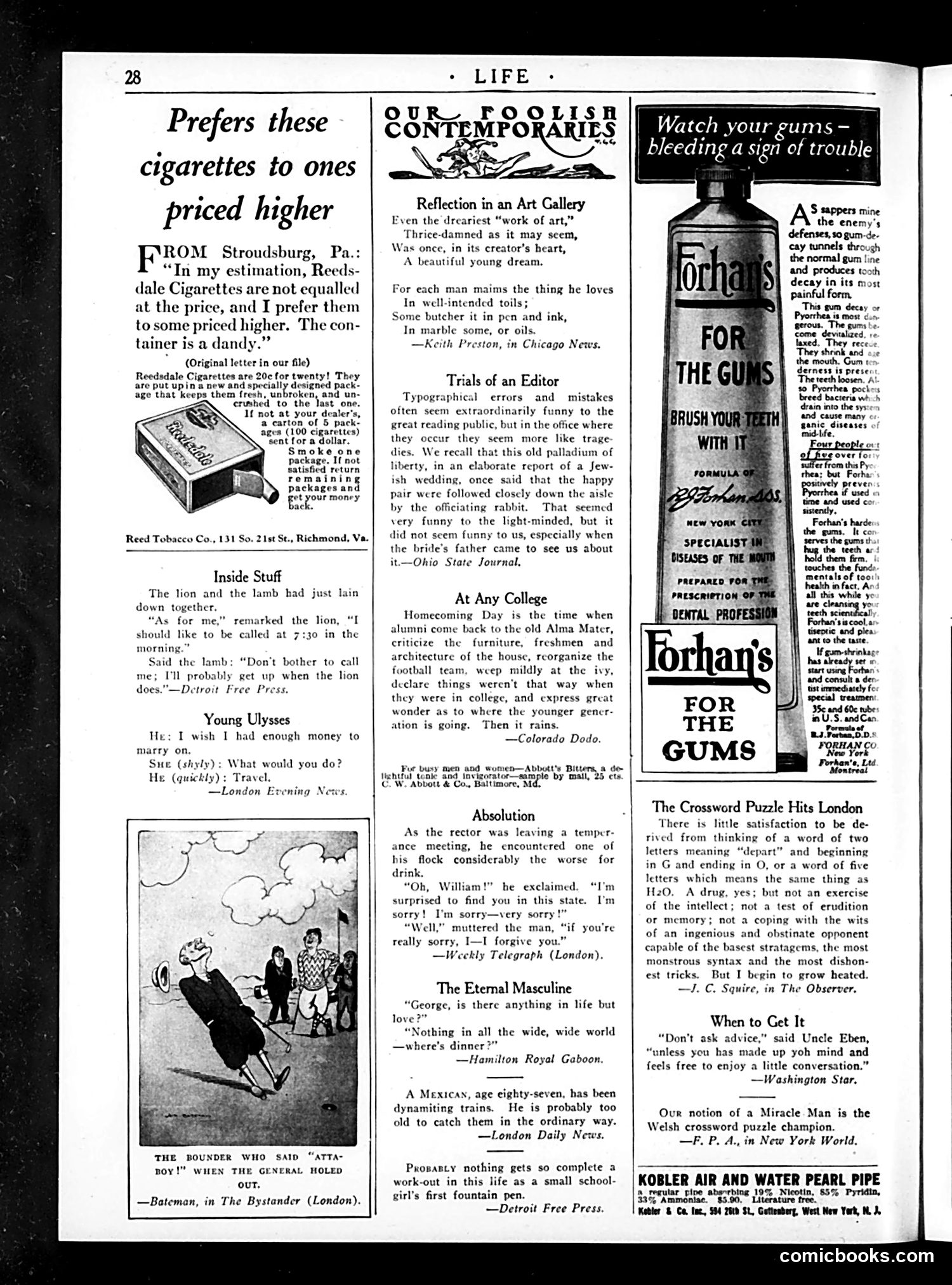
This page is primarily **advertising and humor columns** rather than political cartoons. The content includes: **Main Advertisement**: Reedsdale Cigarettes (20¢ for twenty), promoting affordability and fresh packaging. **Humor Columns**: "Our Foolish Contemporaries" features satirical reprints from other newspapers mocking everyday absurdities: - A lion and lamb joke about wake-up calls (plays on the biblical "lion lies down with lamb" reference) - A young man wanting money to travel rather than marry (social commentary on priorities) - Editorial mistakes in newspapers (the "officiating rabbit" typo at a Jewish wedding) - Alumni homecoming clichés (criticizing everything, then it rains) - A drunk man forgiving the rector (ironic absolution) - A Mexican octogenarian dynamiting trains (absurdist humor) **Other Ads**: Forhan's toothpaste ("For the Gums"), crossword puzzles, and air/water pipes. The page targets middle-class readers with gentle satirical commentary on modern life's ironies and social conventions, typical of early 20th-century Life magazine's style.
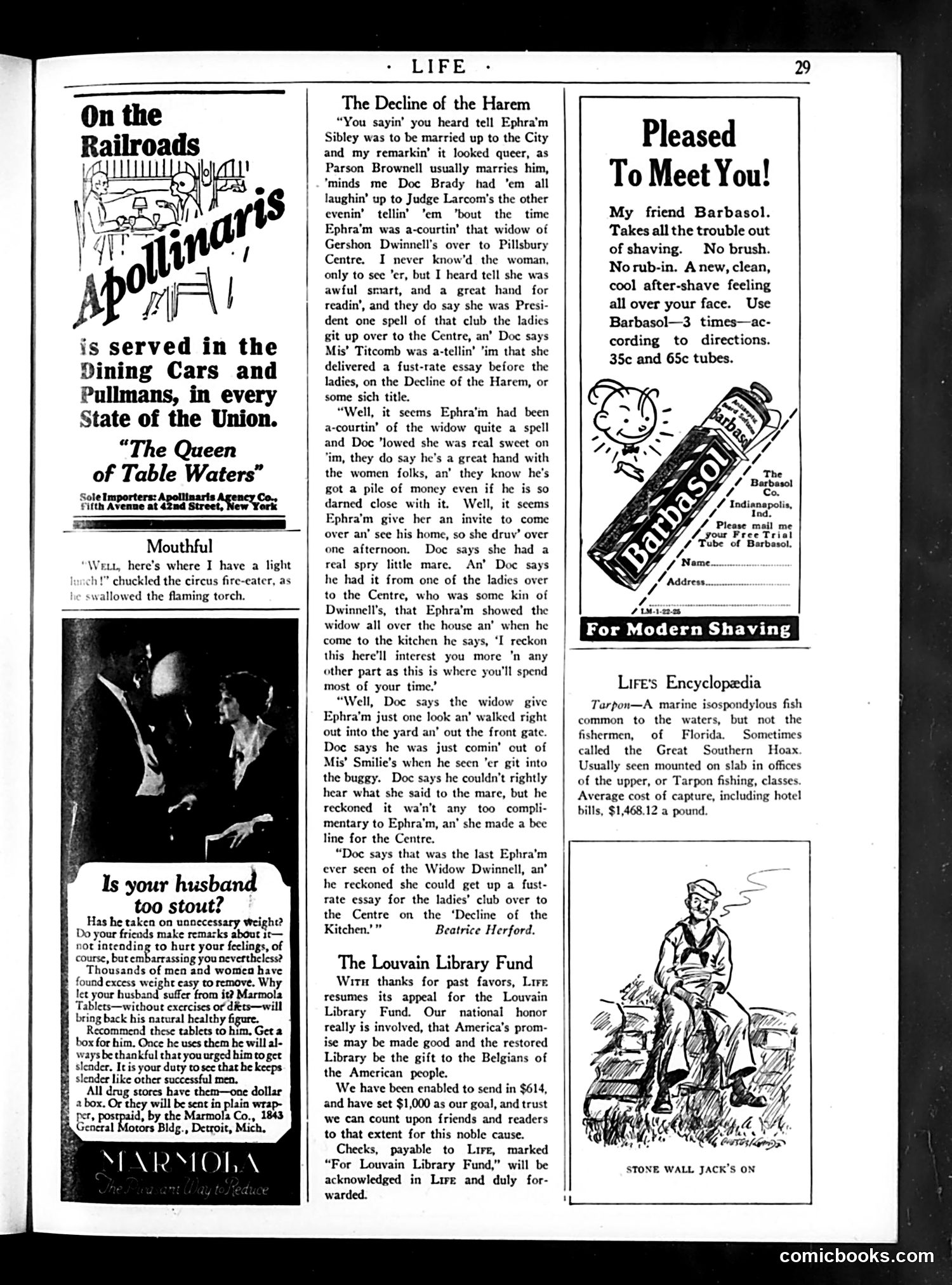
This page contains primarily **advertising and literary content** rather than political cartoons. The main text piece, "The Decline of the Harem" by Beatrice Herford, is a humorous rural anecdote about a man named Ephra'm courting a widow. The joke hinges on gender expectations: the widow, who is educated and has given intellectual lectures to ladies' clubs, becomes offended when Ephra'm shows her his kitchen while remarking that's where she'll "spend most of your time"—implying domestic servitude. She promptly leaves, rejecting the marriage proposal. The satire critiques men who view wives as household servants, while also gently mocking rural courtship customs. The widow's intellectual accomplishments ("Decline of the Harem") contrast ironically with Ephra'm's antiquated assumptions about women's roles. The surrounding advertisements (Marmola weight-loss tablets, Barbaso shaving cream) and notices (Louvain Library Fund) are standard commercial content typical of 1920s Life magazine.
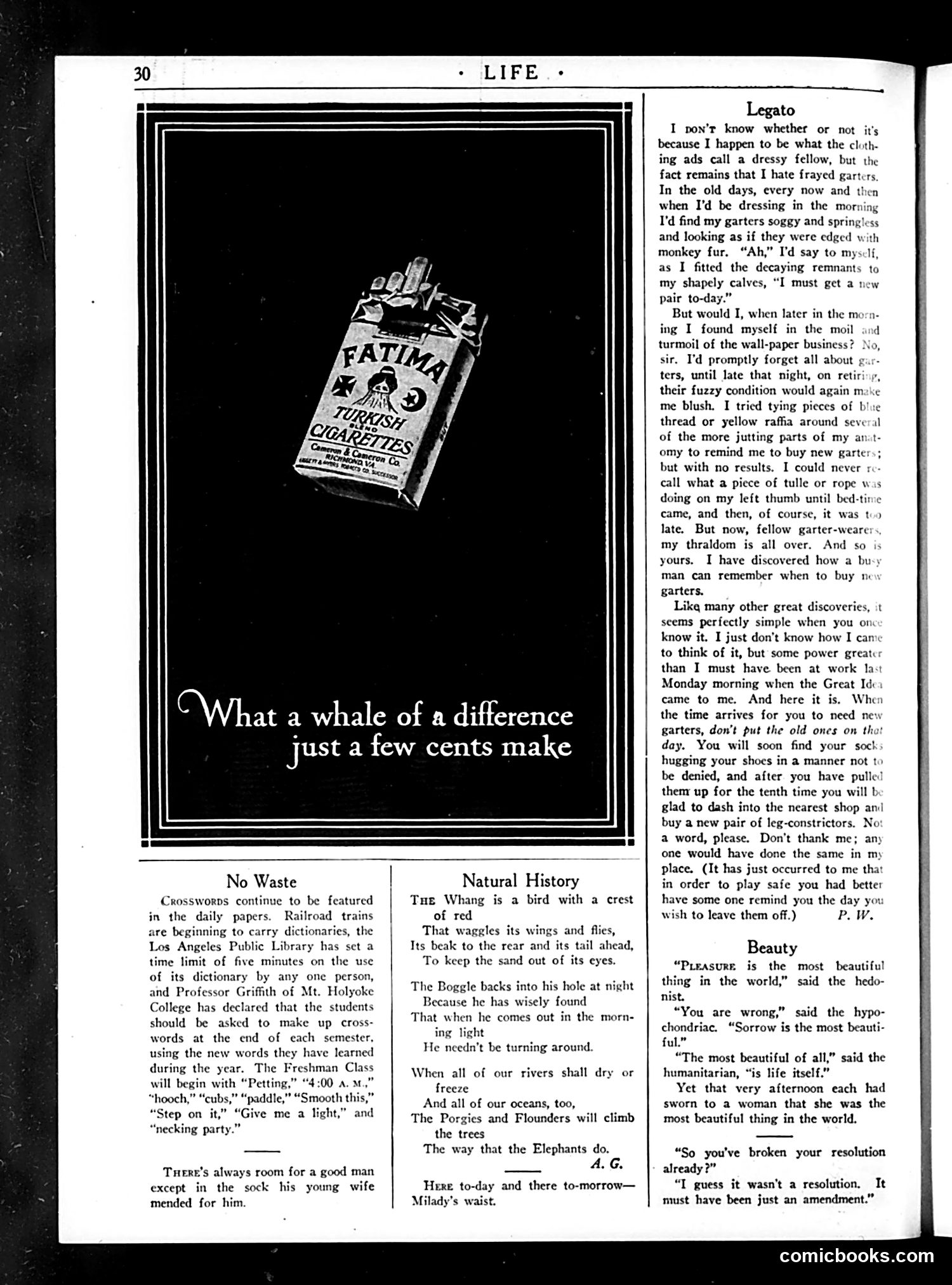
This page features **satirical humor** typical of Life magazine's 1920s content: **Main Advertisement:** A Fatima cigarettes ad dominates the left side, with the tagline "What a whale of a difference just a few cents make"—playing on the modest price difference between cigarette brands. **"No Waste" Section:** Satirizes the crossword puzzle craze sweeping America. It mocks how dictionaries are becoming so heavily used that libraries must limit access, and suggests college students should create crosswords from new vocabulary—including slang terms like "petting," "hooch," and "necking party." **"Natural History":** Humorous fake zoological descriptions of invented creatures (the Whang, Boggle) and absurdist observations about animals climbing trees—pure nonsense comedy. **"Legato" (main essay):** A tongue-in-cheek piece about a man's struggles remembering to buy new garters. The protagonist discovers that simply *not wearing* old garters forces him to remember buying new ones. **"Beauty":** A brief philosophical joke where three men debate what's most beautiful, then admit they've each told a woman *she* is—satirizing romantic dishonesty. The page reflects 1920s concerns: consumer culture, slang, and changing social mores.
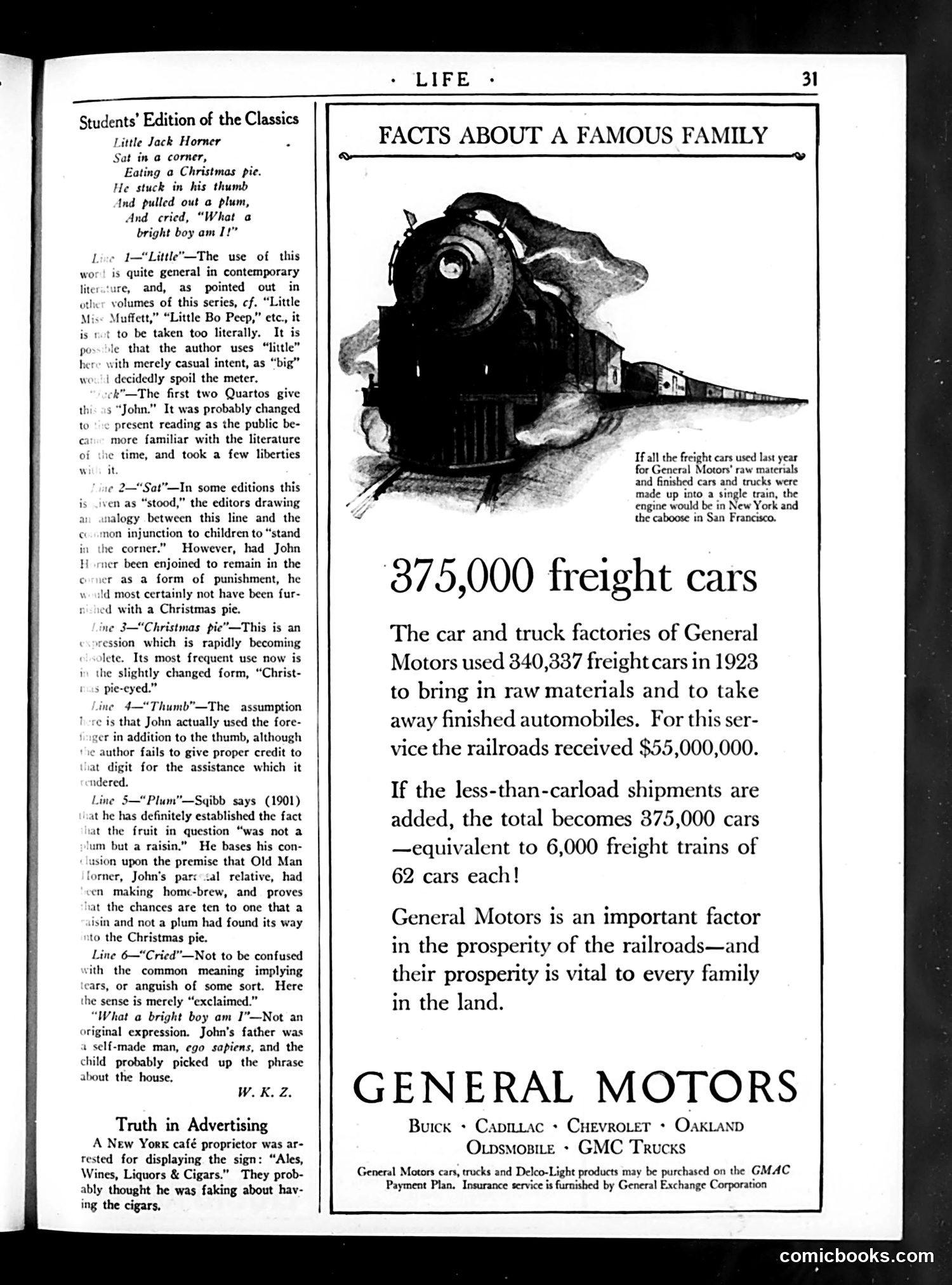
This page contains two distinct elements: **Left side:** A satirical scholarly commentary on the nursery rhyme "Little Jack Horner," written in the style of pedantic literary criticism. The humor lies in treating a simple children's poem with absurdly overwrought academic analysis—debating textual variants, etymology, and even whether the "plum" was actually a raisin, citing fictional scholarly authorities. It's mockery of pretentious literary scholarship. **Right side:** A General Motors advertisement presenting industrial statistics as impressive facts. The visual shows a locomotive, and the text emphasizes GM's massive scale—375,000 freight cars used in 1923—to suggest the company's economic importance and vital role in national prosperity. This was corporate propaganda dressed as impressive information, designed to make readers view GM favorably during an era of rapid industrialization. The page also includes a brief joke about a café falsely advertising cigars, mocking false advertising claims.
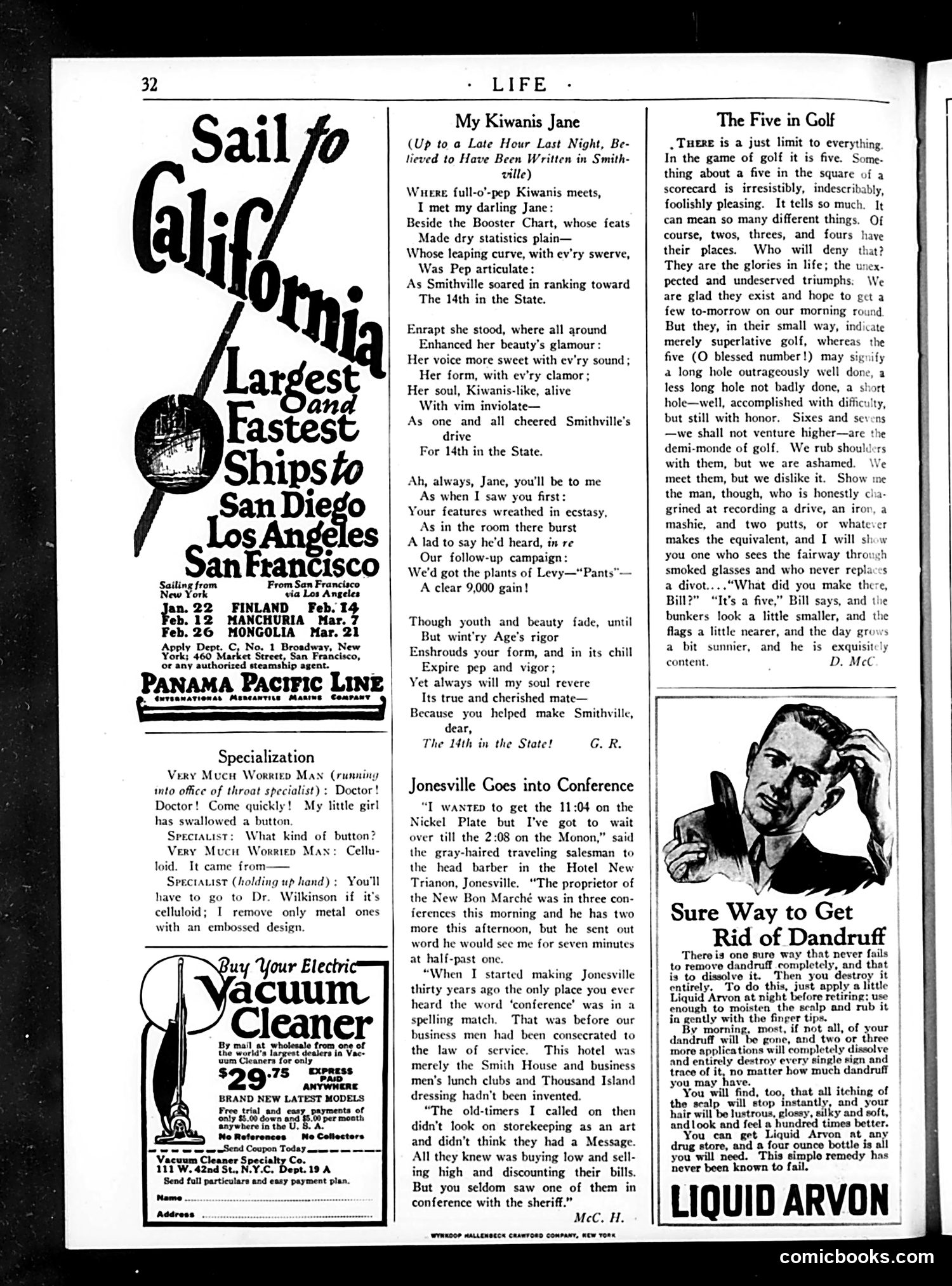
This page contains mostly **advertising and humorous fiction** rather than political cartoons. The notable content includes: **"My Kiwanis Jane"** — A sentimental poem satirizing the Kiwanis Club (a civic booster organization), mocking how a young man's romantic feelings become intertwined with civic pride. The joke: he's as excited about Smithville reaching "14th in the State" as he is about his girlfriend. **"Specialization"** — A brief joke about medical over-specialization: a worried father seeks a throat specialist for his daughter who swallowed a button, but the doctor refuses the case because the button is celluloid, not metal—implying excessive professional narrowness. **"Jonesville Goes into Conference"** — A traveling salesman laments how modern business culture has introduced endless "conferences," contrasting old Jonesville (straightforward commerce) with the new service-oriented business mindset that wastes his time. The **advertisements** (Panama Pacific Line ships, vacuum cleaners, Liquid Arvon dandruff remedy) dominate the page's visual real estate.
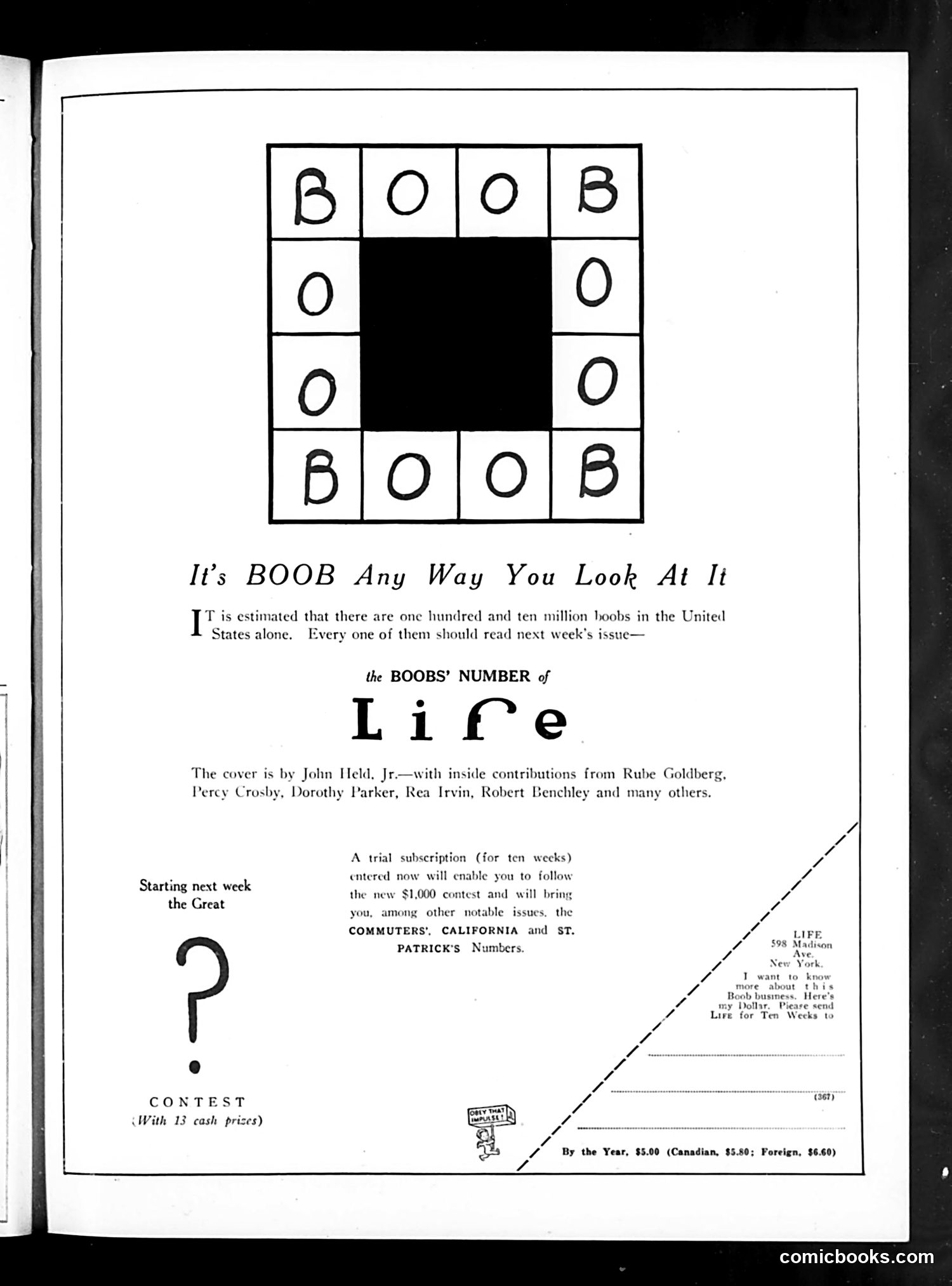
This is a **self-promotional advertisement** for Life magazine's upcoming "Boobs' Number" issue, designed by John Held Jr. (a famous cartoonist of the era). The humor relies on **playful mockery of ordinary Americans**. The grid at top—reading "BOOB" any direction—is a visual pun suggesting widespread foolishness. The text claims 110 million "boobs" (slang for stupid people) exist in the U.S., and sarcastically suggests they should all read this issue. **The satire targets**: Life's own readers, treating them humorously as average, unsophisticated people who would find the magazine entertaining. The page promotes a **$1,000 contest** and trial subscriptions while listing notable contributing writers (Rube Goldberg, Dorothy Parker, Robert Benchley)—lending prestige to what's ostensibly a magazine "for boobs." This reflects Life's identity as a **sophisticated yet accessible satirical weekly** that mocked American mass culture while selling itself to that same audience.
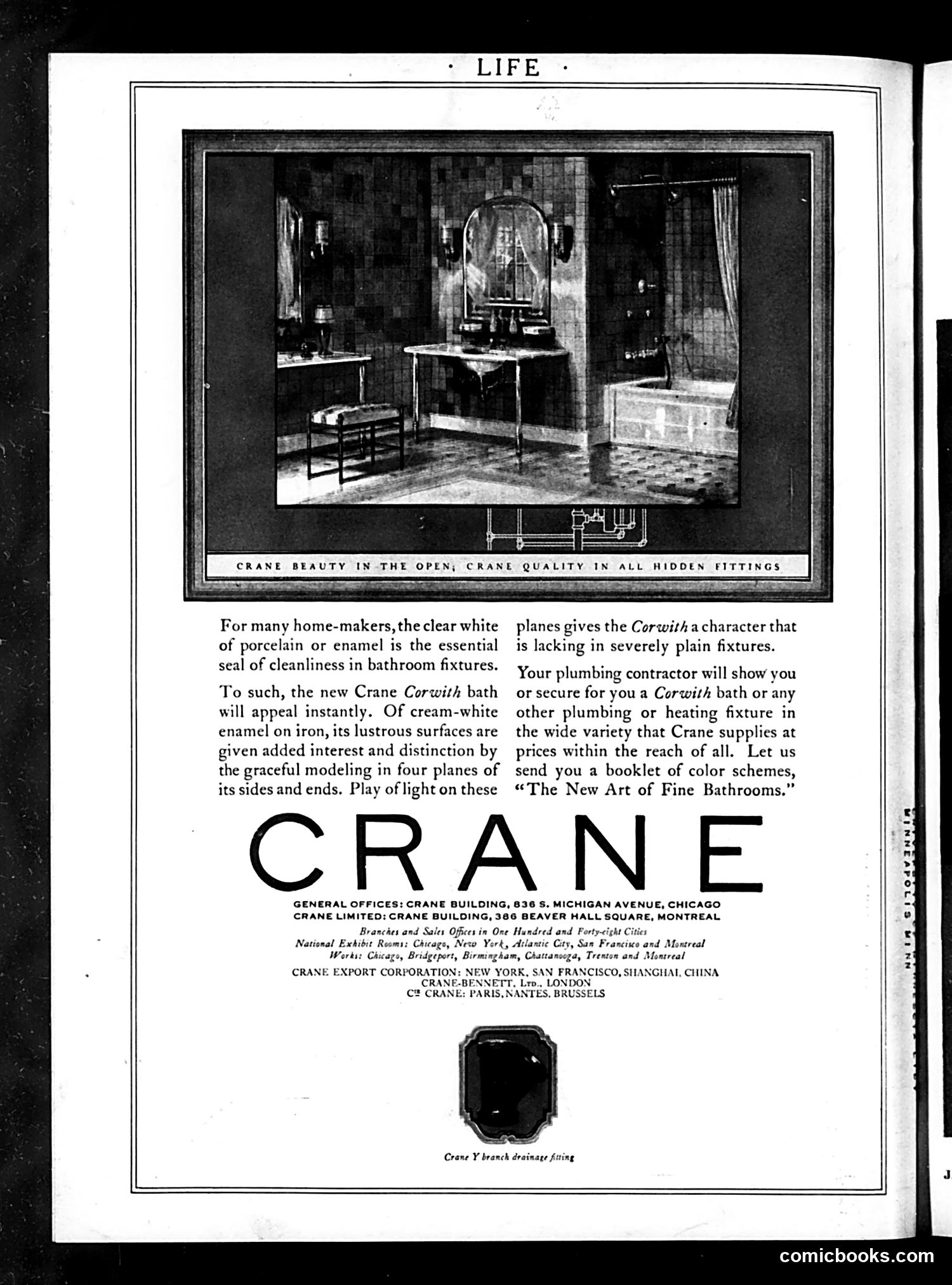
This is not a cartoon or satire page—it's a **full-page advertisement for Crane plumbing fixtures**, published in *Life* magazine. The image shows a luxurious bathroom display featuring the "Corwith" bathtub, designed to appeal to homemakers who equated cleanliness with white porcelain and enamel. The ad emphasizes the tub's aesthetic appeal ("beauty in the open") and hidden quality construction ("quality in all hidden fittings"). The marketing pitch targets aspirational middle-class consumers: the fixtures are described as stylish yet "within the reach of all," offering both elegant design and affordability. The mention of a free booklet, "The New Art of Fine Bathrooms," reflects early 20th-century positioning of bathroom modernization as both a practical and cultural achievement. This represents the era when indoor plumbing was becoming a standard home expectation rather than a luxury.