
Life, 1925-01-22 · page 16 of 36
Life — January 22, 1925 — page 16: what you’re looking at
What you’re looking at
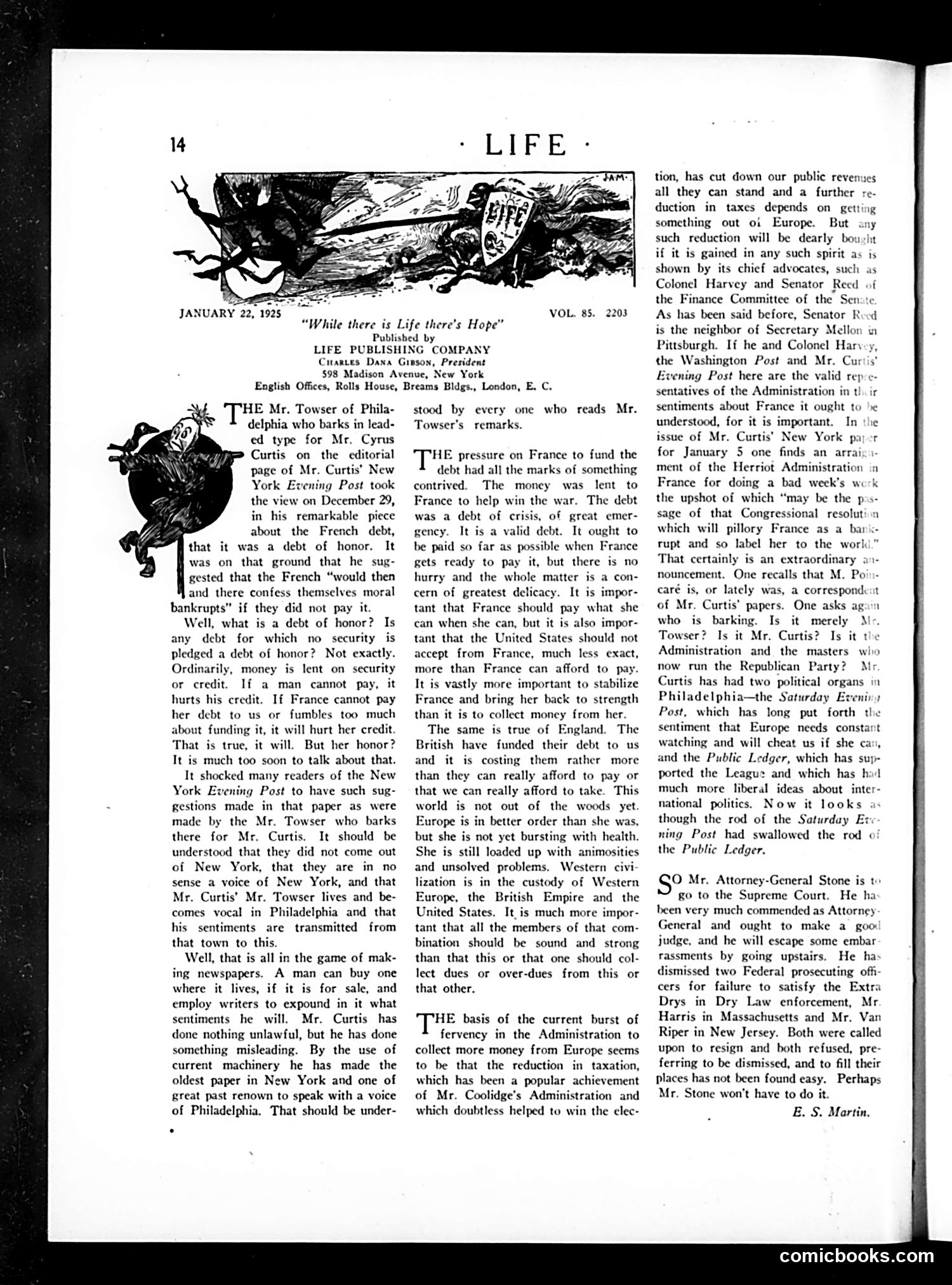
The main cartoon depicts **Mr. Tower of Philadelphia** (identified in the text as a New York *Evening Post* editorial writer) as a skeletal, demon-like figure. The satire mocks Tower's criticism of the French debt situation and his suggestions that France should stabilize itself. The accompanying editorial defends Tower's right to voice opinions while questioning his reasoning about European finances. It criticizes Tower's argument that the U.S. shouldn't accept payment from France, suggesting this position is misleading and poorly reasoned. The cartoon uses grotesque imagery to ridicule what the magazine considers flawed economic reasoning about post-WWI international debt—a major political controversy of the 1920s.
📄 Transcribed text from this page (OCR, searchable)
Machine-transcribed from the original scan — historical spelling and the odd misread are preserved.
S JANUARY 22, 1925 VOL. 85. “While there is Life there's Hope” Published by LIFE PUBLISHING Crartes Dana Gieso: COMPANY President 598 Madison Avenue, New York English Offices, Rolls House, Breams Bldgs., London, E. C. HE Mr. Towser of Phila- delphia who barks in lead- ed type for Mr. Cyrus Curtis on the editorial page of Mr. Curtis’ New York Evening Post took the view on December 29, in his remarkable piece about the French debt, that it was a debt of honor, It was on that ground that he sug- gested that the French “would then and there confess themselves moral bankrupts” if they did not pay it. Well, what is a debt of honor? Is any debt for which no security is pledged a debt of honor? Not exactly. Ordinarily, money is lent on security or credit. If a man cannot pay, it hurts his credit. If France cannot pay her debt to us or fumbles too much about funding it, it will hurt her credit. That is true, it will. But her honor? It is much too soon to talk about that. It shocked many readers of the New York Evening Post to have such sug- gestions made in that paper as were made by the Mr. Towser who barks there for Mr. Curtis. It should be understood that they did not come out of New York, that they are in no sense a voice of New York, and that Mr. Curtis’ Mr. Towser lives and be- comes vocal in Philadelphia and that his sentiments are transmitted from that town to this. Well, that is all in the game of mak- ing newspapers. A man can buy one where it lives, if it is for sale, and employ writers to expound in it what sentiments he will. Mr. Curtis has done nothing unlawful, but he has done something misleading. By the use of current machinery he has made the oldest paper in New York and one of great past renown to speak with a voice of Philadelphia. That should be under- stood by every one who reads Mr. Towser’s remarks. THE pressure on France to fund the debt had all the marks of something contrived. The money was lent to France to help win the war. The debt was a debt of crisis, of great emer- gency. It is a valid debt. It ought to be paid so far as possible when France gets ready to pay it, but there is no hurry and the whole matter is a con- cern of greatest delicacy. It is impor- tant that France should pay what she can when she can, but it is also impor- tant that the United States should not accept from France, much less exact, more than France can afford to pay. It is vastly more important to stabilize France and bring her back to strength than it is to collect money from her. The same is true of England. The British have funded their debt to us and it is costing them rather more than they can really afford to pay or that we can really afford to take. This world is not out of the woods yet. Europe is in better order than she was, but she is not yet bursting with health. She is still loaded up with animosities and unsolved problems. Western civi lization is in the custody of Western Europe, the British Empire and the United States. It is much more impor- tant that all the members of that com- bination should be sound and strong than that this or that one should col- lect dues or over-dues from this or that other. 'HE basis of the current burst of fervency in the Administration to collect more money from Europe seems to be that the reduction in taxation, which has been a popular achievement of Mr. Coolidge’s Administration and which doubtless helped to win the clec- tion, has cut down our public revenues all they can stand and a further re- duction in taxes depends on getting something out oi Europe. But any such reduction will be dearly bousht if it is gained in any such spirit as is shown by its chief advocates, such as Colonel Harvey and Senator Reed of the Finance Committee of the Sen:tc As has been said before, Senator Rood is the neighbor of Secretary Mellon in Pittsburgh. If he and Colonel Hary-y, the Washington Post and Mr. Curtis Evening Post here are the valid rep sentatives of the Administration in th ir sentiments about France it ought to be understood, for it is important. In the issue of Mr. Curtis’ New York paj or for January 5 one finds an arrai ment of the Herriot Administration in France for doing a bad week’s work the upshot of which “may be the pis- sage of that Congressional resolution which will pillory France as a bani- rupt and so label her to the world.” That certainly is an extraordinary a- nouncement. One recalls that M. Po caré is, or lately was, a corresponde:it of Mr. Curtis’ papers. One asks a who is barking. Is it merely Towser? Is it Mr. Curtis? Is it t)< Administration and the masters who now run the Republican Party? Mr Curtis has had two political organs in Philadelphia—the Saturday Eveniny Post, which has long put forth the sentiment that Europe needs constant watching and will cheat us if she car, and the Public Ledger, which has sup- ported the League and which has had much more liberal ideas about int national politics. Now it look though the rod of the Saturday ning Post had swallowed the rod « the Public Ledger. So Mr. Attorney-General Stone is t» go to the Supreme Court. He ha been very much commended as Attorney General and ought to make a goo judge, and he will escape some embar rassments by going upstairs. He has dismissed two Federal prosecuting offi- cers for failure to satisfy the Extra Drys in Dry Law enforcement, Mr Harris in Massachusetts and Mr. Van Riper in New Jersey. Both were called upon to resign and both refused, pre- ferring to be dismissed, and to fill their places has not been found easy. Perhaps Mr. Stone won't have to do it. E. S. Martin, comicbooks.com