
Life, 1925-01-22 · page 33 of 36
Life — January 22, 1925 — page 33: what you’re looking at
What you’re looking at
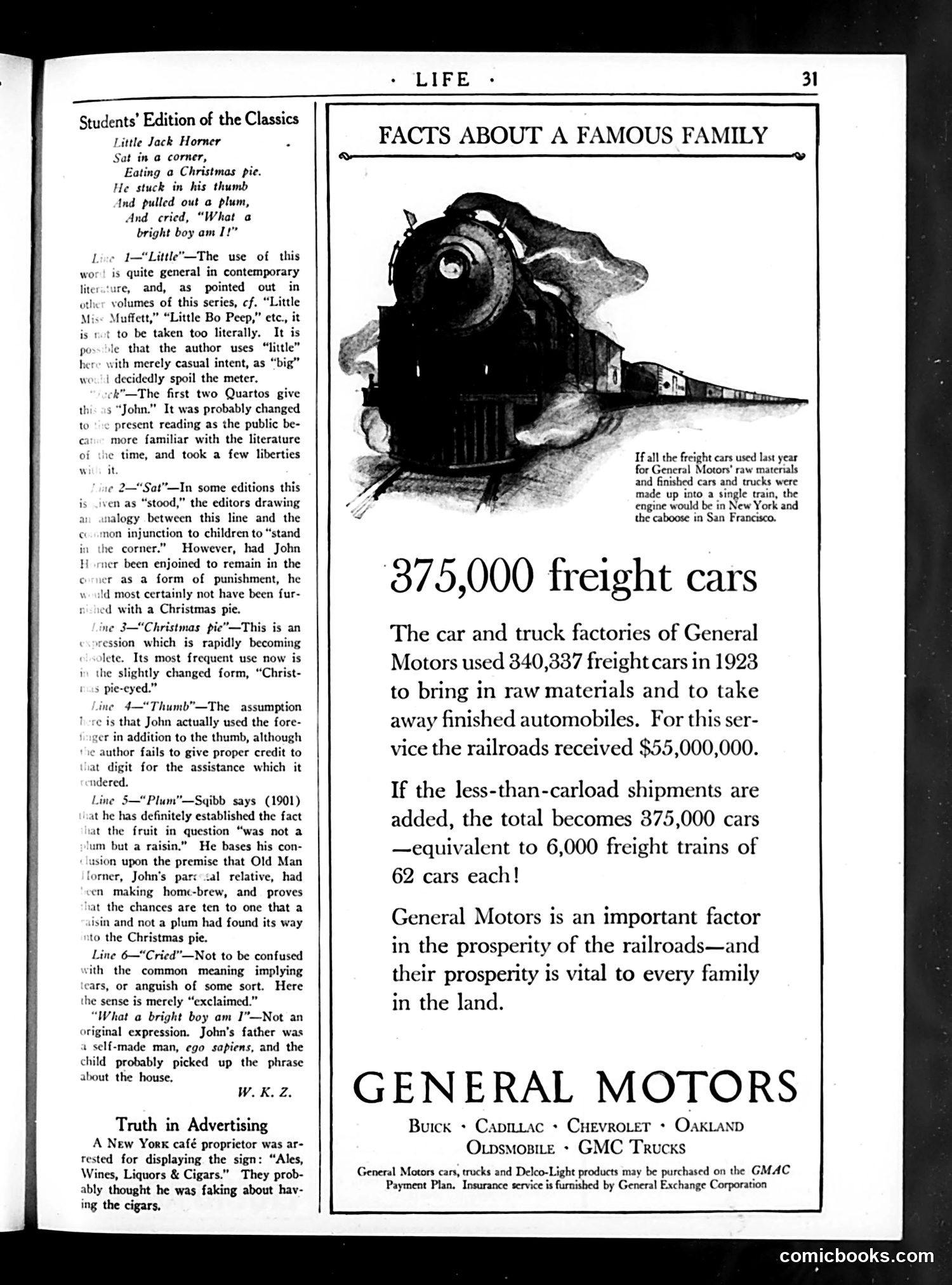
This page contains two distinct elements: **Left side:** A satirical scholarly commentary on the nursery rhyme "Little Jack Horner," written in the style of pedantic literary criticism. The humor lies in treating a simple children's poem with absurdly overwrought academic analysis—debating textual variants, etymology, and even whether the "plum" was actually a raisin, citing fictional scholarly authorities. It's mockery of pretentious literary scholarship. **Right side:** A General Motors advertisement presenting industrial statistics as impressive facts. The visual shows a locomotive, and the text emphasizes GM's massive scale—375,000 freight cars used in 1923—to suggest the company's economic importance and vital role in national prosperity. This was corporate propaganda dressed as impressive information, designed to make readers view GM favorably during an era of rapid industrialization. The page also includes a brief joke about a café falsely advertising cigars, mocking false advertising claims.
📄 Transcribed text from this page (OCR, searchable)
Machine-transcribed from the original scan — historical spelling and the odd misread are preserved.
Students’ Edition of the Classics Little Jack Horner . Sat in a corner, Eating a Christmas pie. He stuck in his thumb 1nd pulled out a plum, And cried, “What a bright boy am I!” > 1—“Little"—The use of this is quite general in contemporary ire, and, as pointed out in volumes of this series, cf. “Little s» Muffett,” “Little Bo Peep,” ete., it t to be taken too literally. It is le that the author uses “little” with merely casual intent, as “big” | decidedly spoil the meter. ck”—The first two Quartos give s “John.” It was probably changed present reading as the public be- more familiar with the literature ie time, and took a few liberties it. ¢ 2—“Sat”—In some editions this ven as “stood,” the editors drawing iunalogy between this line and the non injunction to children to “stand he corner.” However, had John ner been enjoined to remain in the r as a form of punishment, he Id most certainly not have been fur- ed with a Christmas pie. ne 3—“Christmas pie”—This is an ression which is rapidly becoming lete. Its most frequent use now is the slightly changed form, “Christ- s pie-eyed.” ine 4—“Thumb"—The assumption ¢ is that John actually used the fore- zer in addition to the thumb, although ‘ie author fails to give proper credit to at digit for the assistance which it ndered. Line 5—“Plum"—Sqibb says (1901) at he has definitely established the fact at the fruit in question “was not a um but a raisin.” He bases his con- ssion upon the premise that Old Man forner, John’s par: ial relative, had en making homc-brew, and proves sat the chances are ten to one that a 1isin and not a plum had found its way to the Christmas pie. Line 6—“Cried”—Not to be confused vith the common meaning implying cars, or anguish of some sort. Here the sense is merely “exclaimed.” “What a bright boy am I”—Not an original expression. John’s father was 1 self-made man, ego sapiens, and the child probably picked up the phrase about the house, W.K. Z. Truth in Advertising A New York café proprietor was ar- rested for displaying the sign: “Ales, Wines, Liquors & Cigars.” They prob- ably thought he was faking about hav- ing the cigars, If all the freight cars used last year for General Motors’ raw materials and finished cars and trucks were made up into a single train, the engine would be in New York and the caboose in San Francisco. 875,000 freight cars The car and truck factories of General Motors used 840,387 freight cars in 1923 to bring in raw materials and to take away finished automobiles. For this ser- vice the railroads received $55,000,000. If the less-than-carload shipments are added, the total becomes 875,000 cars —equivalent to 6,000 freight trains of 62 cars each! General Motors is an important factor in the prosperity of the railroads—and their prosperity is vital to every family in the land. GENERAL MOTORS Buick + Capmtac + CHEVROLET + OAKLAND Otpsmosite - GMC Trucks General Motors cars, trucks and Delco-Light products may be purchased on the GMAC Payment Plan, Insurance service is furnished by General Exchange Corporation comicbooks.com