
Life, 1925-01-22 · page 24 of 36
Life — January 22, 1925 — page 24: what you’re looking at
What you’re looking at
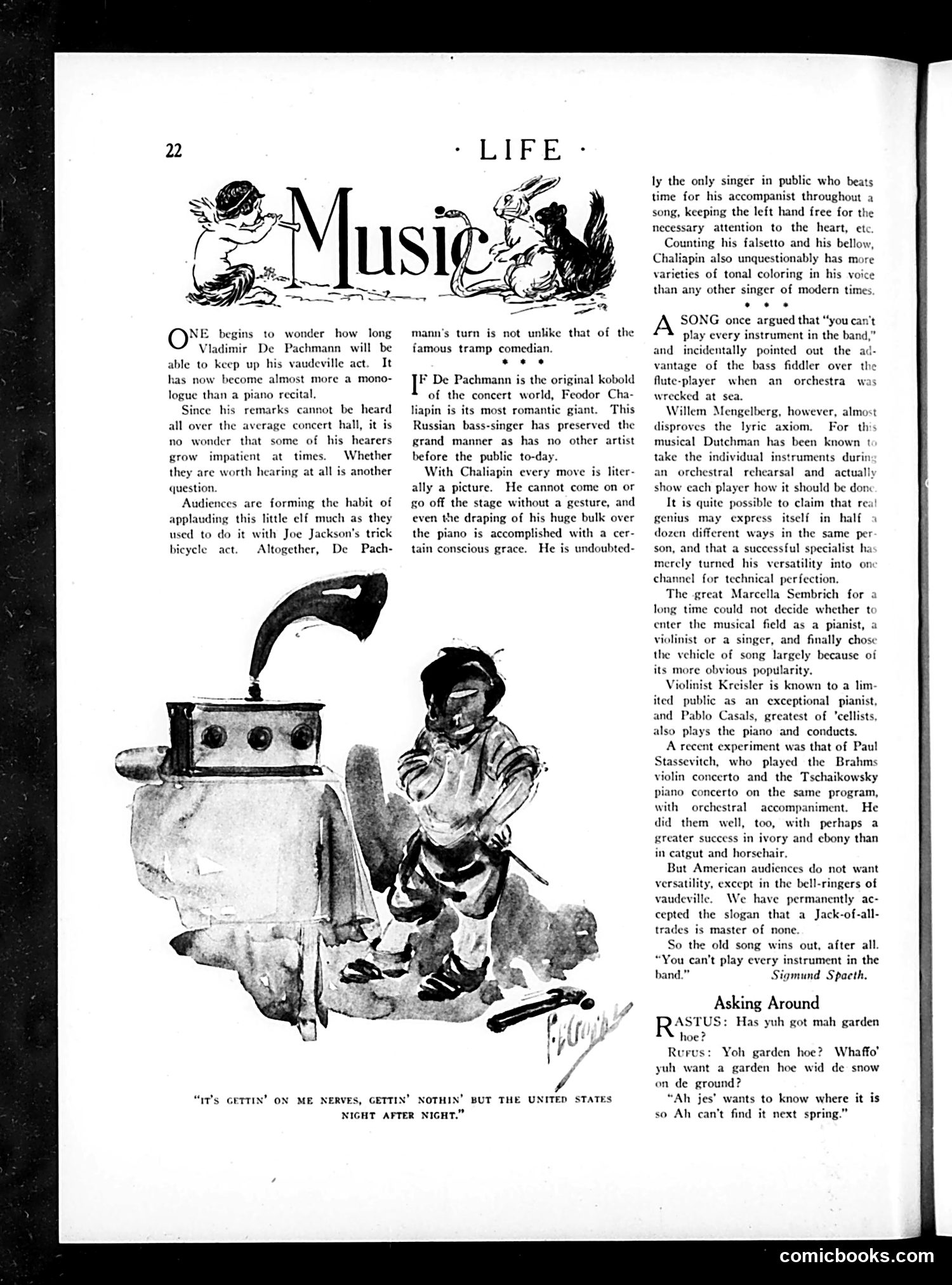
This page satirizes early 20th-century concert performers and American audience preferences. **Main Figures:** - **Vladimir De Pachmann**: A pianist criticized for turning his recitals into comedic monologues, compared to vaudeville performer Joe Jackson's trick bicycle act. The satirist mocks audiences for applauding his antics rather than his musicianship. - **Feodor Chaliapin**: A Russian bass-singer praised as the opposite—a "romantic giant" who commands the stage with deliberate, graceful gestures and vocal versatility. **The Core Satire:** The column argues that American audiences prefer specialists over versatile artists. While European musicians (Kreisler, Casals, Sembrich) excel at multiple instruments, Americans reject versatility except in vaudeville, accepting "a Jack-of-all-trades is master of none." De Pachmann's descent into theatrical showmanship exemplifies this preference for entertainment over artistry. **The cartoon** shows a caricatured performer on a piano with exaggerated gesture, captioned with complaint about constant touring.
📄 Transcribed text from this page (OCR, searchable)
Machine-transcribed from the original scan — historical spelling and the odd misread are preserved.
O*E begins to wonder how long Vladimir De Pachmann will be able to keep up his vaudeville act. It has now become almost more a mono- logue than a piano recital, Since his remarks cannot be heard all over the average concert hall, it is no wonder that some of his hearers grow impatient at times. Whether they are worth hearing at all is another question. Audiences are forming the habit of applauding this little elf much as they used to do it with Joe Jackson's trick bicycle act. Altogether, De Pach- “11's GETTIN’ ON ME NERVES, GETTI mann’s turn is not unlike that of the famous tramp comedian. eee F De Pachmann is the original kobold of the concert world, Feodor Cha- liapin is its most romantic giant. This Russian bass-singer h preserved the grand manner as has no other artist before the public to-day. With Chaliapin every move is liter- ally a picture. He cannot come on or go off the stage without a gesture, and even the draping of his huge bulk over the piano is accomplished with a cer- tain conscious grace. He is undoubted- NOTHIN’ BUT THE UNITED STATES NIGHT AFTER NIGHT.” ly the only singer in public who be: time for his accompanist throughout ; song, keeping the left hand free for the necessary attention to the heart, etc, Counting his falsetto and his bellow, Chaliapin also unquestionably has more varieties of tonal coloring in his voice than any other singer of modern times, see SONG once argued that “you can’t play every instrument in the band, and incidentally pointed out the ad. vantage of the bass fiddler over the flute-player when an orchestra was wrecked at sea. Willem Mengelberg, however, almost disproves the lyric axiom. For this musical Dutchman has been known t take the individual instruments durin an orchestral rehearsal and actually show cach player how it should be dor It is quite possible to claim that re genius may express itself in half a dozen different ways in the same per son, and that a successful specialist ha merely turned his versatility into onc channel for technical perfection, The great Marcella Sembrich for a long time could not decide whether tc enter the musical field as a pianist, a violinist or a singer, and finally chose the vehicle of song largely because of its more obvious popularity. Violinist Kreisler is known to a lim- ited public as an exceptional pianist, and Pablo Casals, greatest of 'cellis also plays the piano and conducts. A recent experiment was that of Paul Stassevitch, who played the Brahms violin concerto and the Tschaikowsky piano concerto on the same program, with orchestral accompaniment. He did them well, too, with perhaps a greater success in ivory and ebony than in catgut and horse’ But American audiences do not want versatility, except in the bell-ringers of vaudeville. We have permanently ac- cepted the slogan that a Jack-of-all- trades is master of none So the old song wins out, after all. “You can't play every instrument in the band.” Sigmund Spaeth. Asking Around STUS: Has yuh got mah garden hoe? Rurvus: Yoh garden hoe? Whaffo’ yuh want a garden hoe wid de snow on de ground? “Ah jes’ wants to know where it is so Ah can't find it next spring.” comicbooks.com