
Life, 1925-01-22 · page 20 of 36
Life — January 22, 1925 — page 20: what you’re looking at
What you’re looking at
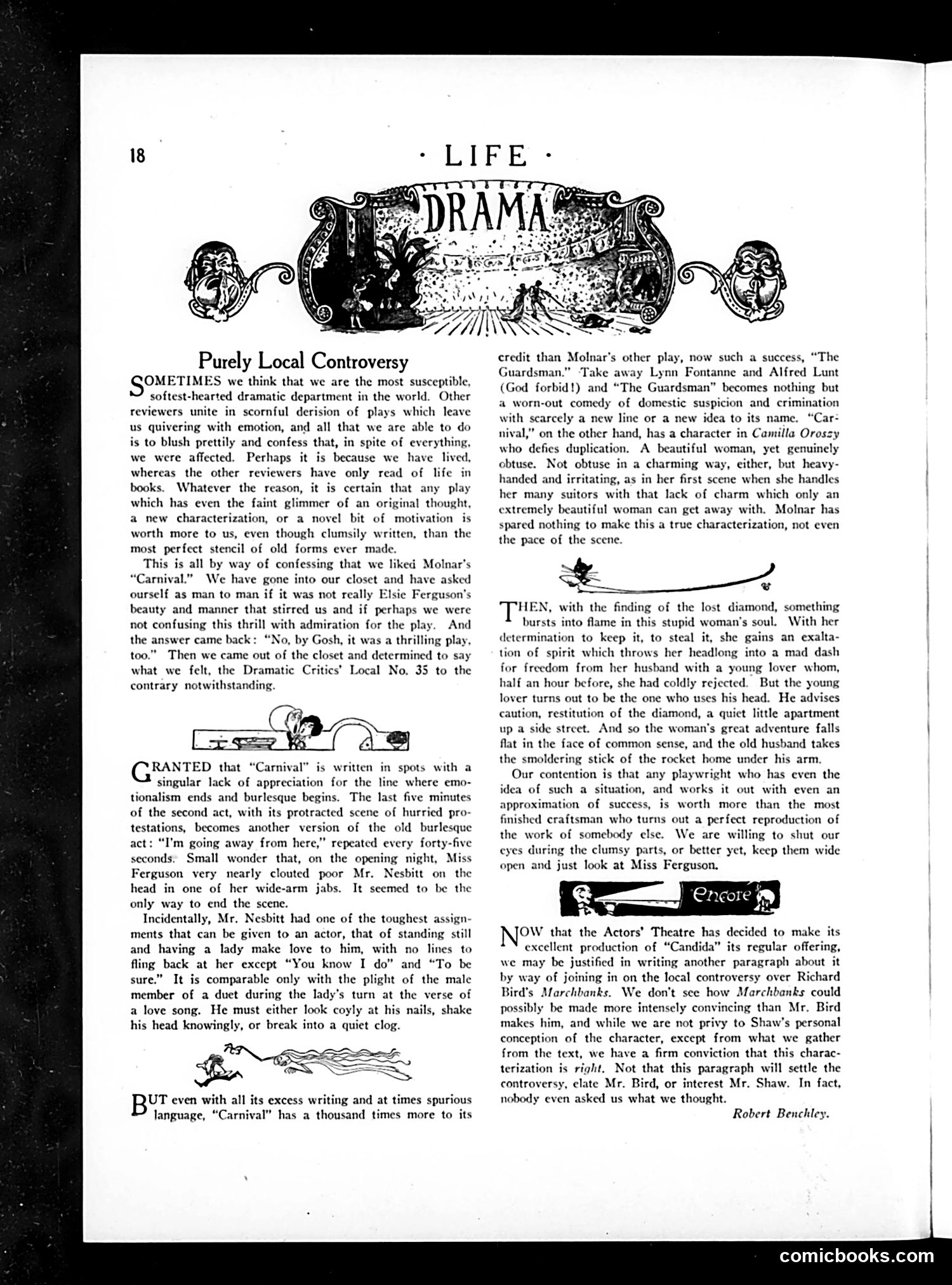
This page reviews Molnar's play "Carnival," defending it against critical dismissal. The critic argues that Life's drama department is uniquely susceptible to emotional theater, justifying their positive reception despite the play's flaws. The review compares "Carnival" favorably to Molnar's more successful "The Guardsman" (starring Lynn Fontanne and Alfred Lunt), arguing the latter relies on star power rather than substance. The critic praises "Carnival's" central character—a beautiful but obtuse woman who gains depth and agency when she discovers a lost diamond, attempting to escape her husband. The satire targets both theatrical excess (the repetitive second-act scene) and critics who dismiss emotionally affecting plays as unsophisticated. Small decorative illustrations accompany the text, typical of Life's visual style, but contain no specific caricatures or political references—this is theater criticism rather than political satire.
📄 Transcribed text from this page (OCR, searchable)
Machine-transcribed from the original scan — historical spelling and the odd misread are preserved.
18 Purely Local Controversy OMETIMES we think that we are the most susceptible, softest-hearted dramatic department in the world. Other reviewers unite in scornful derision of plays which leave us quivering with emotion, and all that we are able to do is to blush prettily and confess that, in spite of everything, we were affected. Perhaps it is because we have lived, whereas the other reviewers have only read of life in books. Whatever the reason, it is certain that any play which has even the faint glimmer of an original thought, a new characterization, or a novel bit of motivation is worth more to us, even though clumsily written, than the most perfect stencil of old forms ever made. This is all by way of confessing that we liked Molnar’s “Carnival.” We have gone into our closet and have asked ourself as man to man if it was not really E! beauty and manner that stirred us and if perhaps we were not confusing this thrill with admiration for the play. And the answer came back: “No, by Gosh, it was a thrilling play, too.” Then we came out of the closet and determined to say what we felt, the Dramatic Critics’ Local No. 35 to the contrary notwithstanding. sic Ferguson's RANTED that “Carnival” is written in spots with a singular lack of appreciation for the line where emo- tionalism ends and burlesque begins. The last five minutes of the second act, with its protracted scene of hurried pro- testations, becomes another version of the old burlesque act: “I'm going away from here,” repeated every forty-five seconds. Small wonder that, on the opening night, Miss Ferguson very nearly clouted poor Mr. Nesbitt on the head in one of her wide-arm jabs. It seemed to be the only way to end the scene. Incidentally, Mr. Nesbitt had one of the toughest assign- ments that can be given to an actor, that of standing still and having a lady make love to him, with no lines to fling back at her except “You know I do” and “To be sure.” It is comparable only with the plight of the male member of a duet during the lady’s turn at the verse of a love song. He must either look coyly at his nails, shake his head knowingly, or break into a quiet clog. UT even with all its excess writing and at times spurious language, “Carnival” has a thousand times more to its credit than Molnar’s other play, now such a success, “The Guardsman.” ‘Take away Lynn Fontanne and Alfred Lunt (God forbid!) and “The Guardsman” becomes nothing but a worn-out comedy of domestic suspicion and crimination with scarcely a new line or a new idea to its name. “Car- i on the other hand, has a character in Camilla Oros: s duplication. A beautiful woman, yet genuinely obtuse. Not obtuse in a charming way, either, but heavy- handed and irritating, as in her first scene when she handles her many suitors with that lack of charm which only an extremely beautiful woman can get away with. Molnar has spared nothing to make this a true characterization, not even the pace of the scene. & HEN, with the finding of the lost diamond, something bursts into flame in this stupid woman's soul. With her determination to keep it, to steal it, she gains an exalta- tion of spirit which throws her headlong into a mad dash for freedom from her husband with a young lover whom, half an hour before, she had coldly rejected. But the young lover turns out to be the one who uses his head. He advises caution, restitution of the diamond, a quict little apartment up a side street. And so the woman's great adventure falls flat in the face of common sense, and the old husband takes the smoldering stick of the rocket home under his arm. Our contention is that any playwright who has even the idea of such a situation, and works it out with even an approximation of success, is worth more than the most finished craftsman who turns out a perfect reproduction of the work of somebody else. We are willing to shut our eyes during the clumsy parts, or better yet, keep them wide open and just look at Miss Ferguson, OW that the Actors’ Theatre has decided to make its excellent production of “Candida” its regular offering, we may be justified in writing another paragraph about it by way of joining in on the local controversy over Richard Bird’s Marchbanks. We don't sce how Marchbanks could possibly be made more intensely convincing than Mr. Bird makes him, and while we are not privy to Shaw’s personal conception of the character, except from what we gather from the text, we have a firm conviction that this charac- terization is right. Not that this paragraph will settle the controversy, elate Mr. Bird, or interest Mr. Shaw. In fact, nobody even asked us what we thought. Robert Benchley. comicbooks.com