
A complete issue · 36 pages · 1924
Life — September 4, 1924
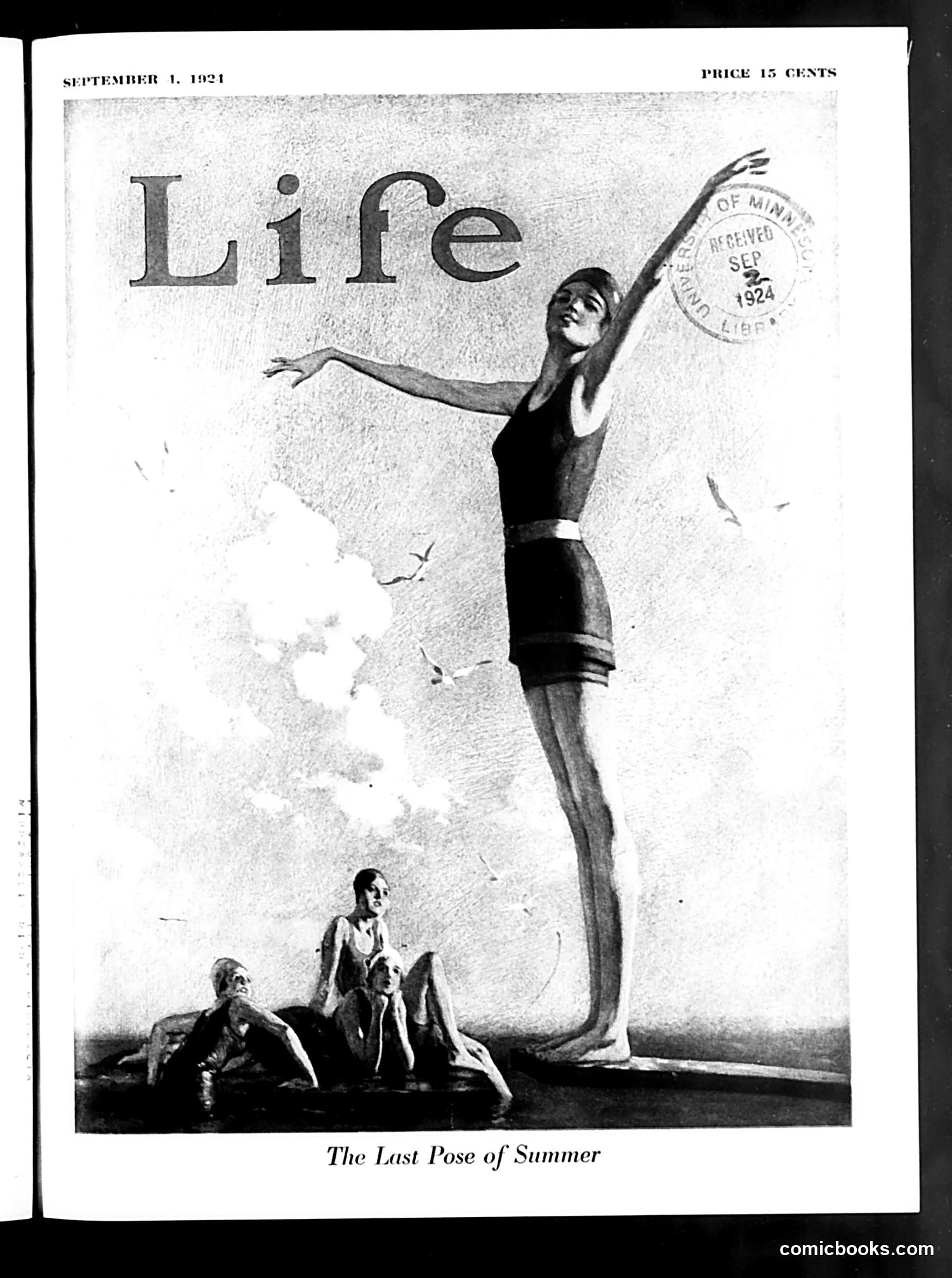
This Life magazine cover from September 1, 1924 presents a satirical theatrical scene titled "The Last Pose of Summer." A woman in a swimming costume strikes an exaggerated, elongated pose—stretching one arm skyward while her body extends unnaturally long—while three figures below (appearing to be men in casual dress) gaze upward at her. The satire likely mocks both the theatrical affectations of 1920s performance culture and the exaggerated poses fashionable women adopted for photographs and public display during this era. The "last pose of summer" suggests summer's end and perhaps the theatrical nature of seasonal leisure activities. The deliberately artificial positioning emphasizes the artificiality and performance inherent in modern social life.
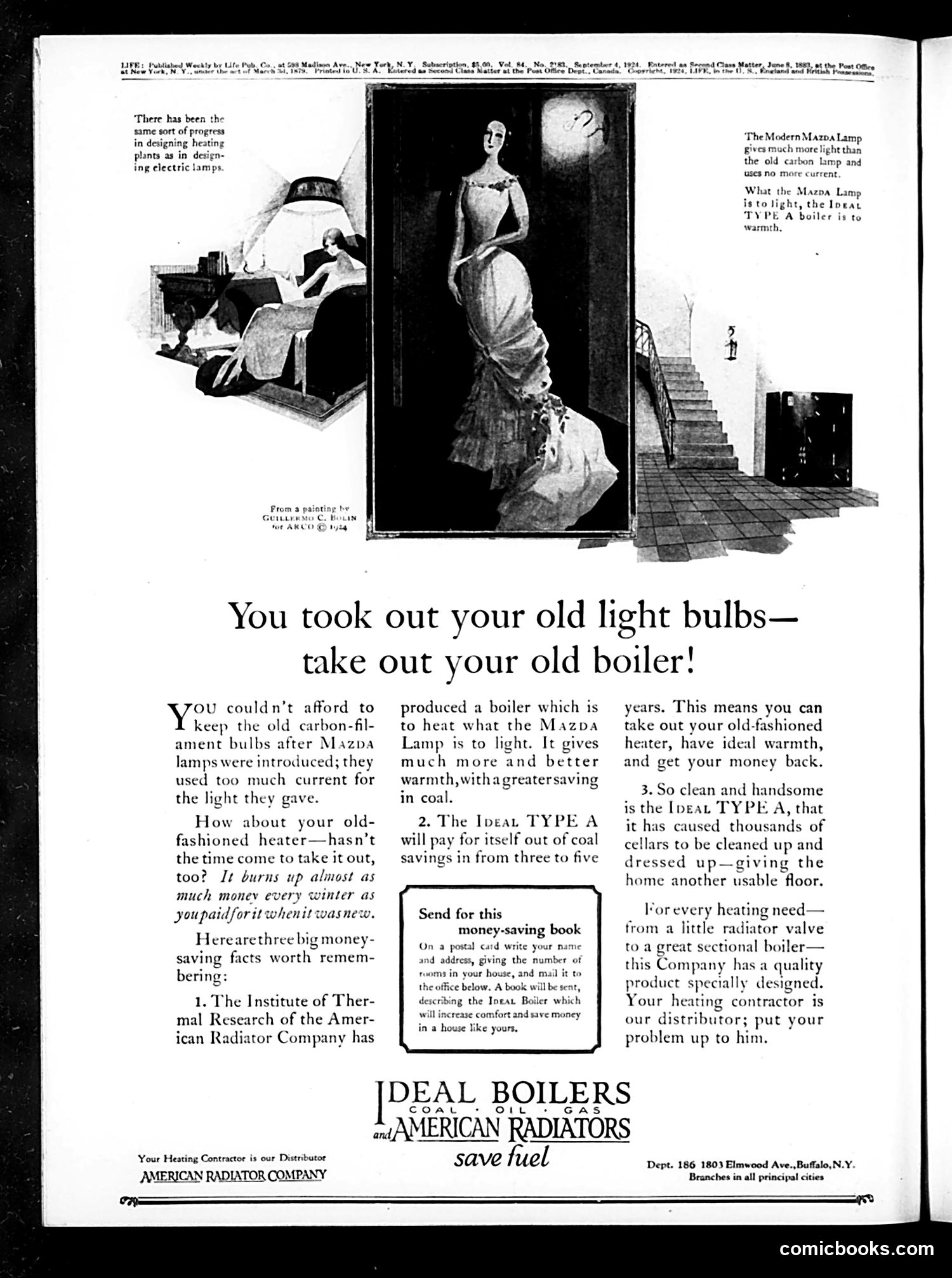
This is primarily a **commercial advertisement**, not political satire. It promotes Ideal Boilers made by American Radiator Company. The ad's central message is a humorous comparison: just as people replaced outdated carbon-filament lightbulbs with modern Mazda lamps, they should replace old, inefficient boilers with the new Ideal Type A boiler. The images show a woman with an old heating system and another with modern comfort, suggesting that upgrading saves money through reduced coal consumption and improved home appearance. The phrase "save fuel" emphasizes wartime or post-war efficiency concerns typical of the 1920s era. The satire is gentle—targeting outdated technology rather than political figures. It's straightforward consumer marketing using contemporary heating and lighting comparisons.
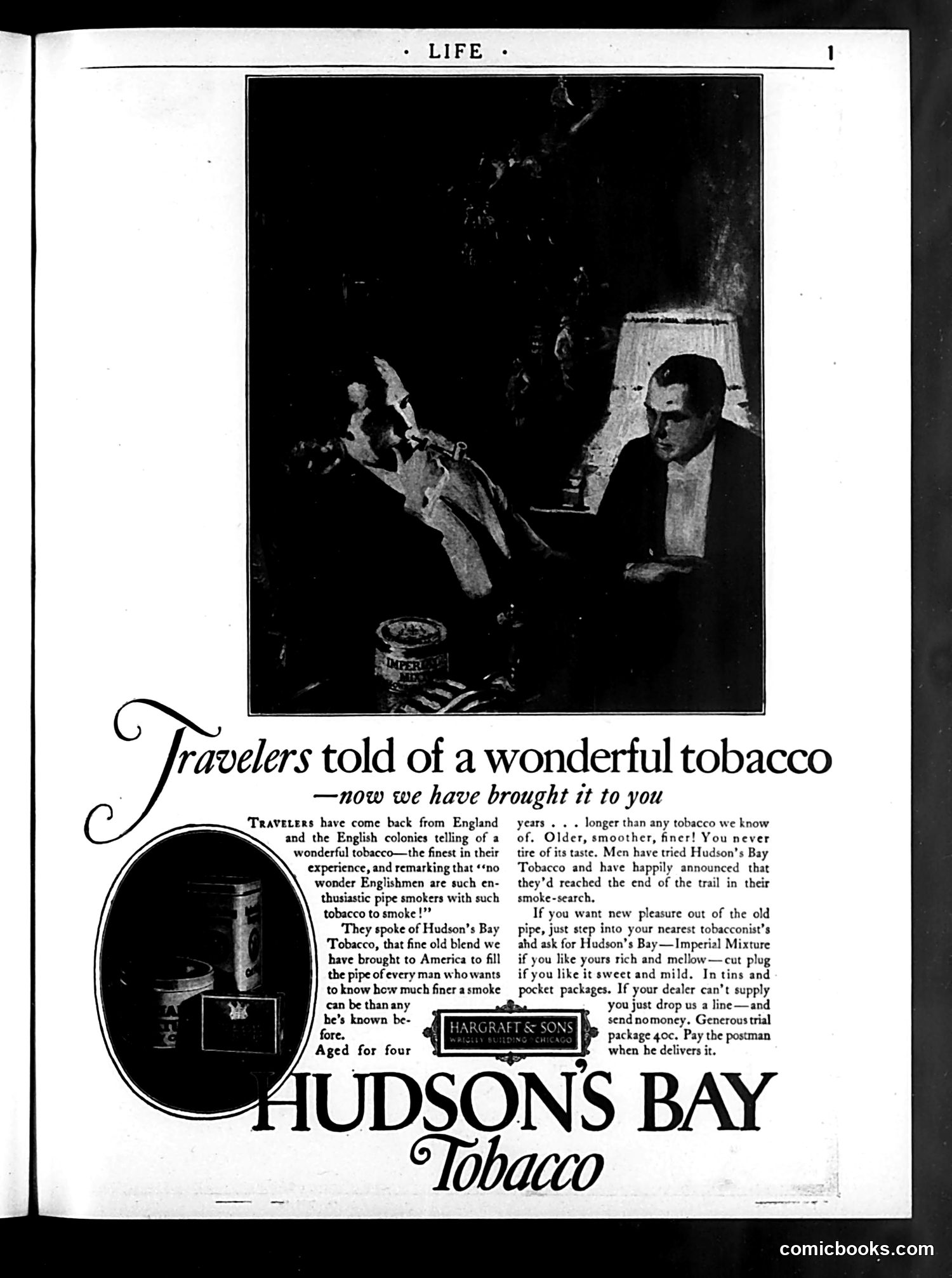
This is primarily a **product advertisement**, not political satire. It promotes Hudson's Bay Tobacco by invoking the romance of exploration and colonial trade. The image shows two men in what appears to be a colonial trading scene—one examining tobacco while the other observes. The ad claims travelers returning from England and English colonies praised this tobacco's quality, describing it as "the finest in their experience." The marketing strategy emphasizes: - Authenticity through "travelers' tales" from distant lands - Historical prestige (aged tobacco, colonial sources) - Superior quality compared to competitors - Convenient availability (multiple formats, mail delivery) This reflects early 20th-century advertising that capitalized on imperial imagery and exotic goods to market consumer products to American audiences.
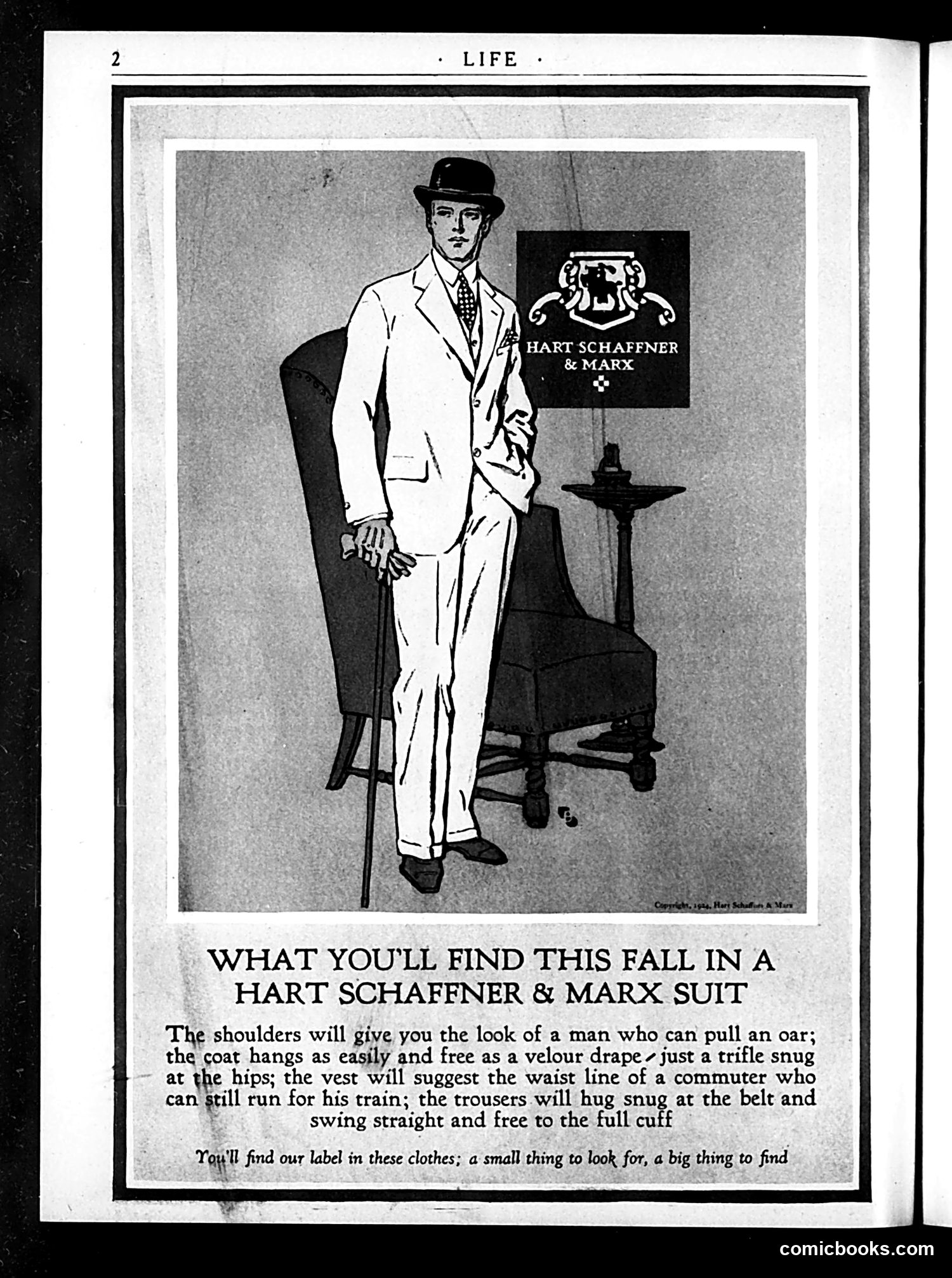
This is a **clothing advertisement**, not political satire. Hart Schaffner & Marx, a menswear company, promotes their fall suit line in *Life* magazine. The ad features an illustration of a well-dressed man in a light-colored suit, bowler hat, and tie, posed confidently. The accompanying text uses vivid language to describe the suit's features—broad shoulders suggesting athletic capability, a comfortable fit for active men, and properly tailored trousers. The phrase "a small thing to look for, a big thing to find" refers to the company's label as a mark of quality. This reflects early 20th-century advertising that equated branded clothing with social respectability and masculine competence. The ad targets middle-class men seeking fashionable, well-made business attire.
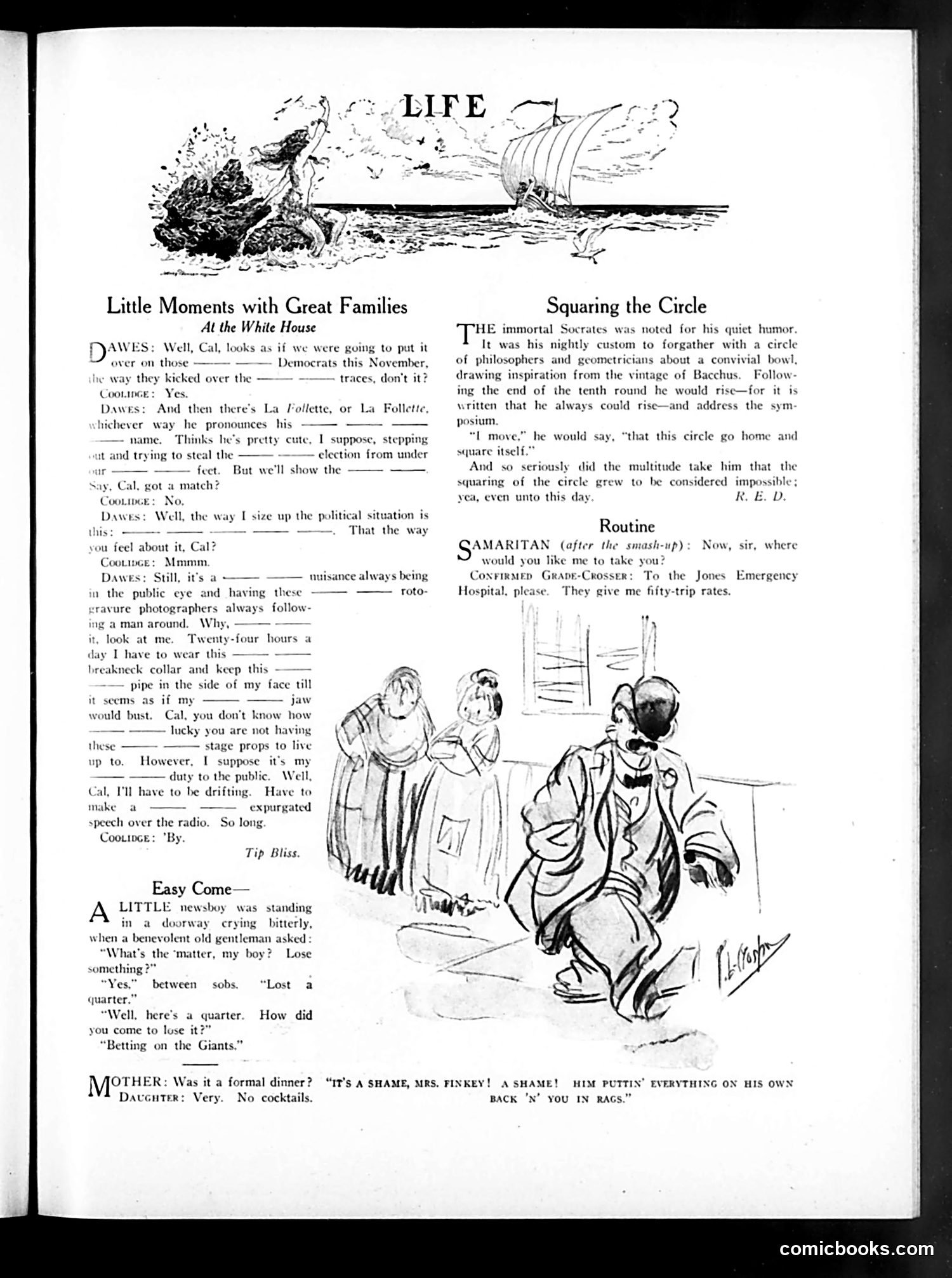
This page contains several unrelated humor pieces rather than unified political commentary. **"Little Moments with Great Families"** satirizes political discourse, with a character named Dawes discussing California politics and the upcoming election, mentioning "La Follette" (likely Robert La Follette, progressive politician). The humor derives from mundane domestic interruptions during serious political discussion. **"Squaring the Circle"** references the classical mathematical impossibility of squaring a circle, using Socrates as a figure of fun for his philosophical obsession with this problem. **"Routine"** depicts a Samaritan directing someone to an emergency hospital, with a joke about receiving "fifty-trip rates." The page concludes with brief comic anecdotes about a newsboy betting on sports and a dinner etiquette joke. These are general humor rather than pointed satire.
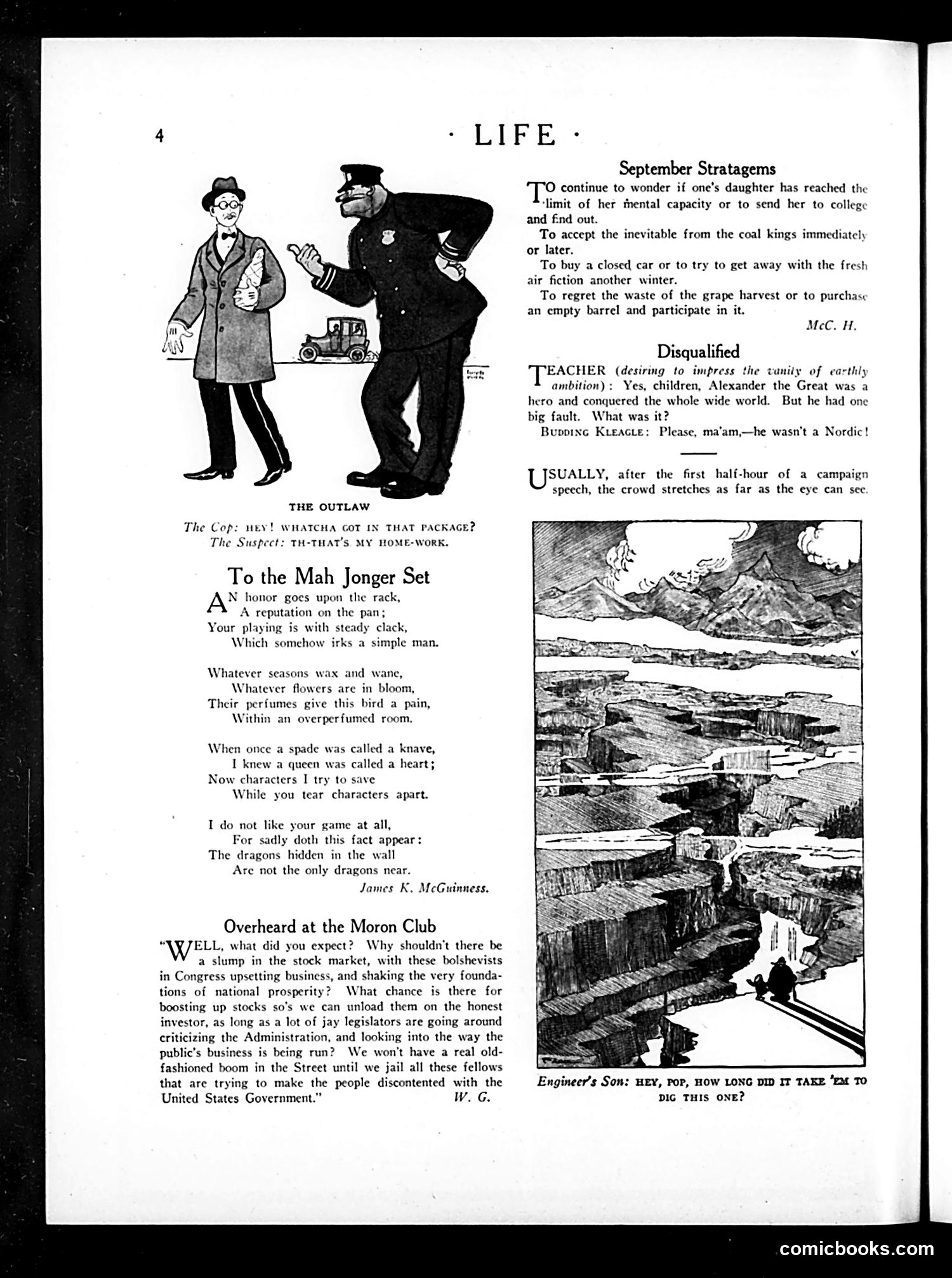
**"The Outlaw" Cartoon:** A police officer confronts a well-dressed man carrying a small toy car, suspecting contraband. The joke plays on Prohibition-era anxiety about hidden alcohol ("home-brew"). The tiny vehicle becomes comic evidence of the era's obsession with detecting illegal liquor. **"September Stratagems":** Lists middle-class concerns of the period—justifying a daughter's education, accepting inevitable labor unrest from coal miners, purchasing cars, and grape harvests (likely referencing home wine-making during Prohibition). **"Disqualified":** A teacher's lesson about Alexander the Great is undercut when a student notes he "wasn't a Nordic"—satirizing contemporary racial pseudoscience popular in 1920s America. The page reflects post-WWI anxieties: Prohibition enforcement, labor tensions, and emerging racial ideology.
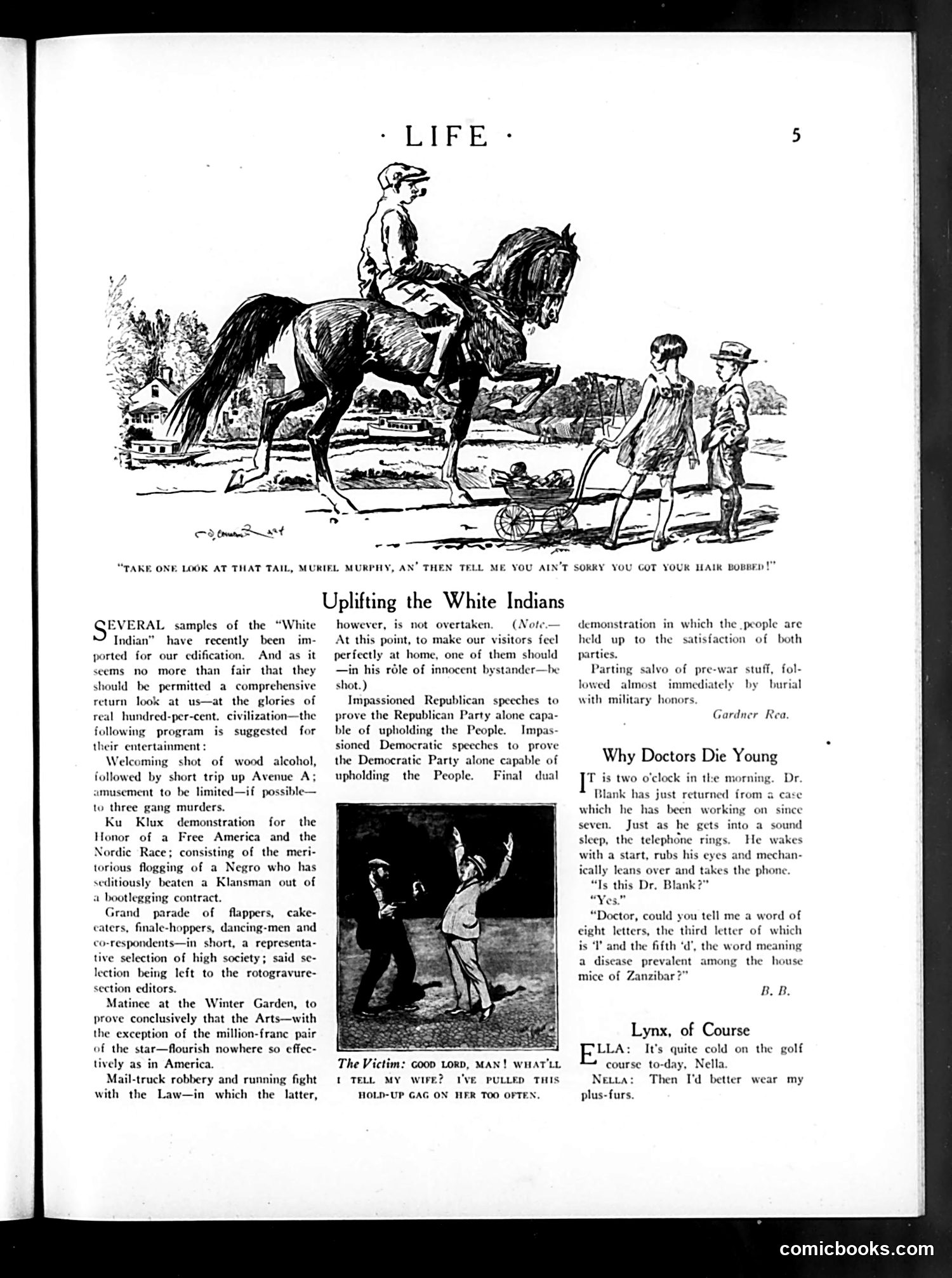
The top cartoon mocks "White Indians"—apparently recent arrivals to America who, the text suggests, need "civilization" through Republican Party programs. The joke plays on their unfamiliarity with American customs (the rider's disheveled appearance, the caption about a haircut). Below, the photograph shows acrobatic performers, with a caption about a wife complaining her husband has been "hold[ing] up gags on her too often"—a domestic humor piece about repetitive joke-telling. The page satirizes both political efforts to "uplift" foreign-born Americans and critiques Republican versus Democratic approaches to assimilation. The humor relies on ethnic/immigrant stereotypes common to early 20th-century American satire.
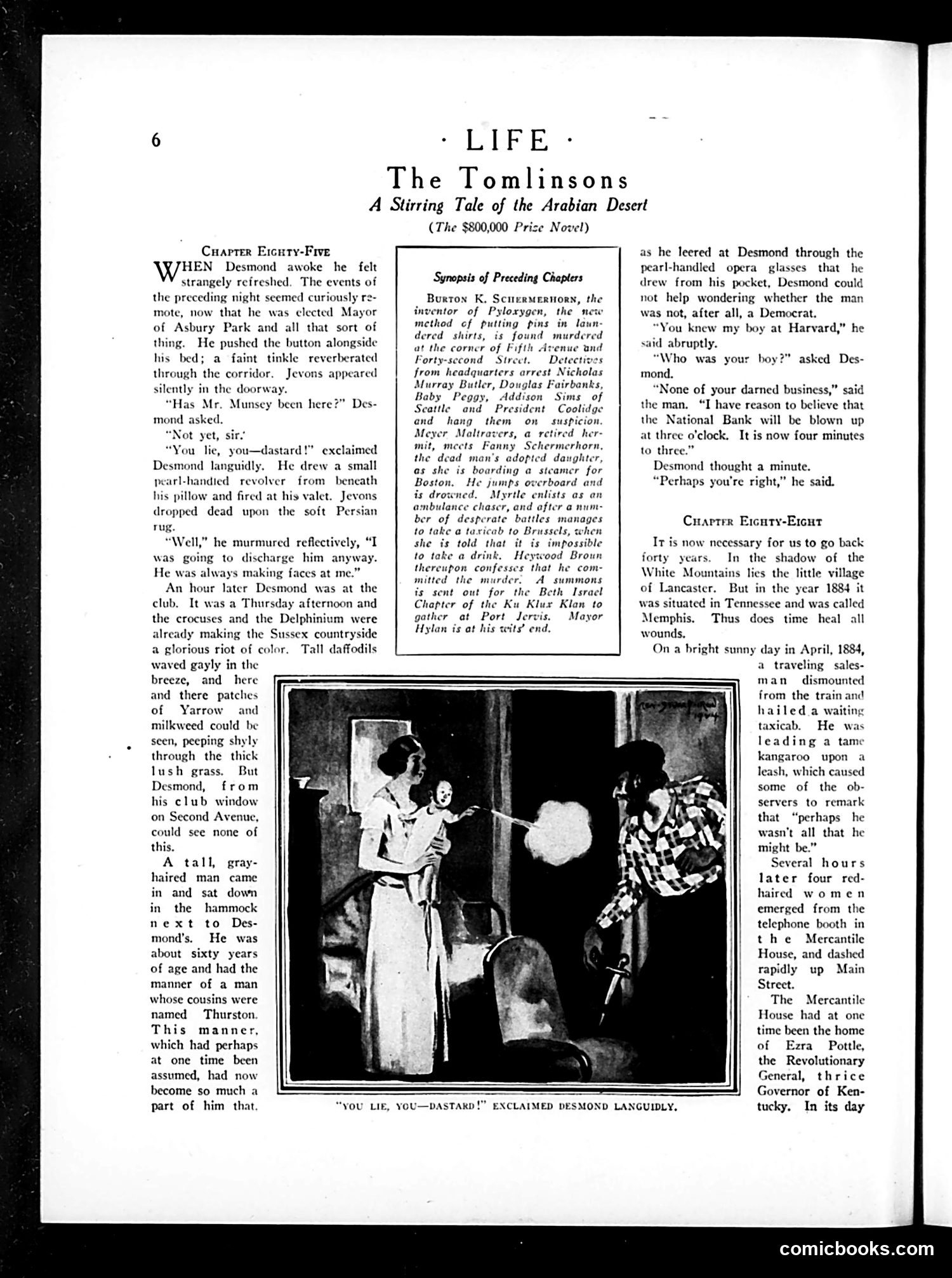
This page features "The Tomlinsons," described as "A Stirring Tale of the Arabian Desert" and a "$800,000 Prize Novel." The central illustration shows a dramatic domestic scene with the caption: "YOU LIE, YOU—BASTARD!" EXCLAIMED DESMOND LANGUIDLY." A man in formal dress confronts a woman holding a child, with another figure visible in the doorway—apparently depicting a moment of accusation or revelation in this serialized melodrama. The accompanying text synopsis reveals plot elements involving murder, embezzlement, and moral transgression typical of early 20th-century popular fiction. This appears to be a serialized novel rather than political satire—a common Life magazine feature of the era designed to attract readers through sensational domestic drama and scandal.
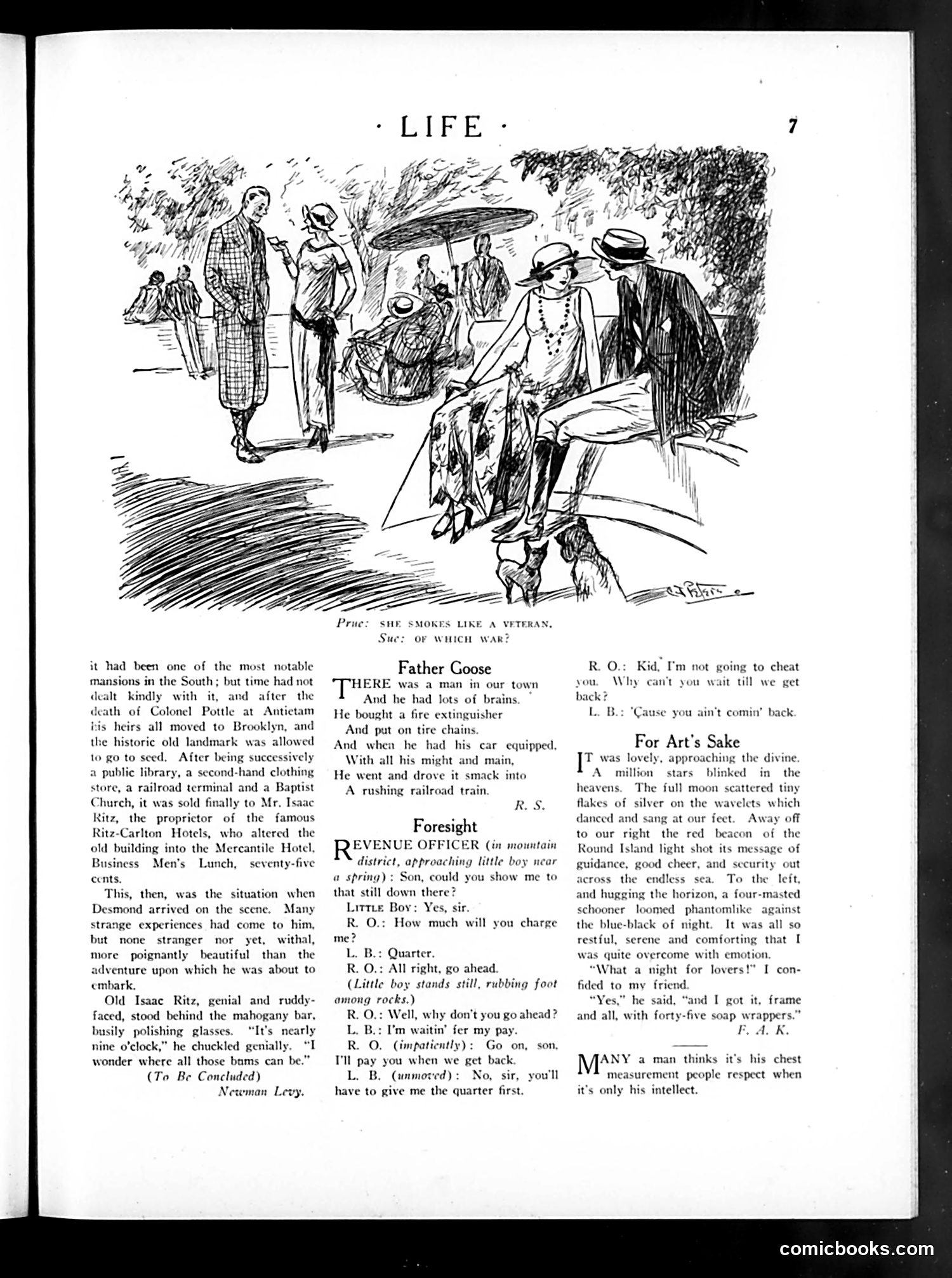
The top illustration depicts an outdoor social scene—likely a park or public gathering—with well-dressed figures of varying social status. The caption reads "SHE SMOKES LIKE A VETERAN. OF WHICH WAR?" This satirizes 1920s social anxieties about women's changing behavior, particularly women smoking in public, which was then considered scandalous and unfeminine. "Veteran" suggests she smokes like a soldier—implying masculine excess or impropriety. The cartoon mocks contemporary discomfort with women's liberation. Below are three comic dialogues ("Father Goose," "Foresight," and "For Art's Sake") featuring wordplay and domestic/social humor typical of the era's satirical magazine style. These appear designed as light entertainment rather than political commentary.
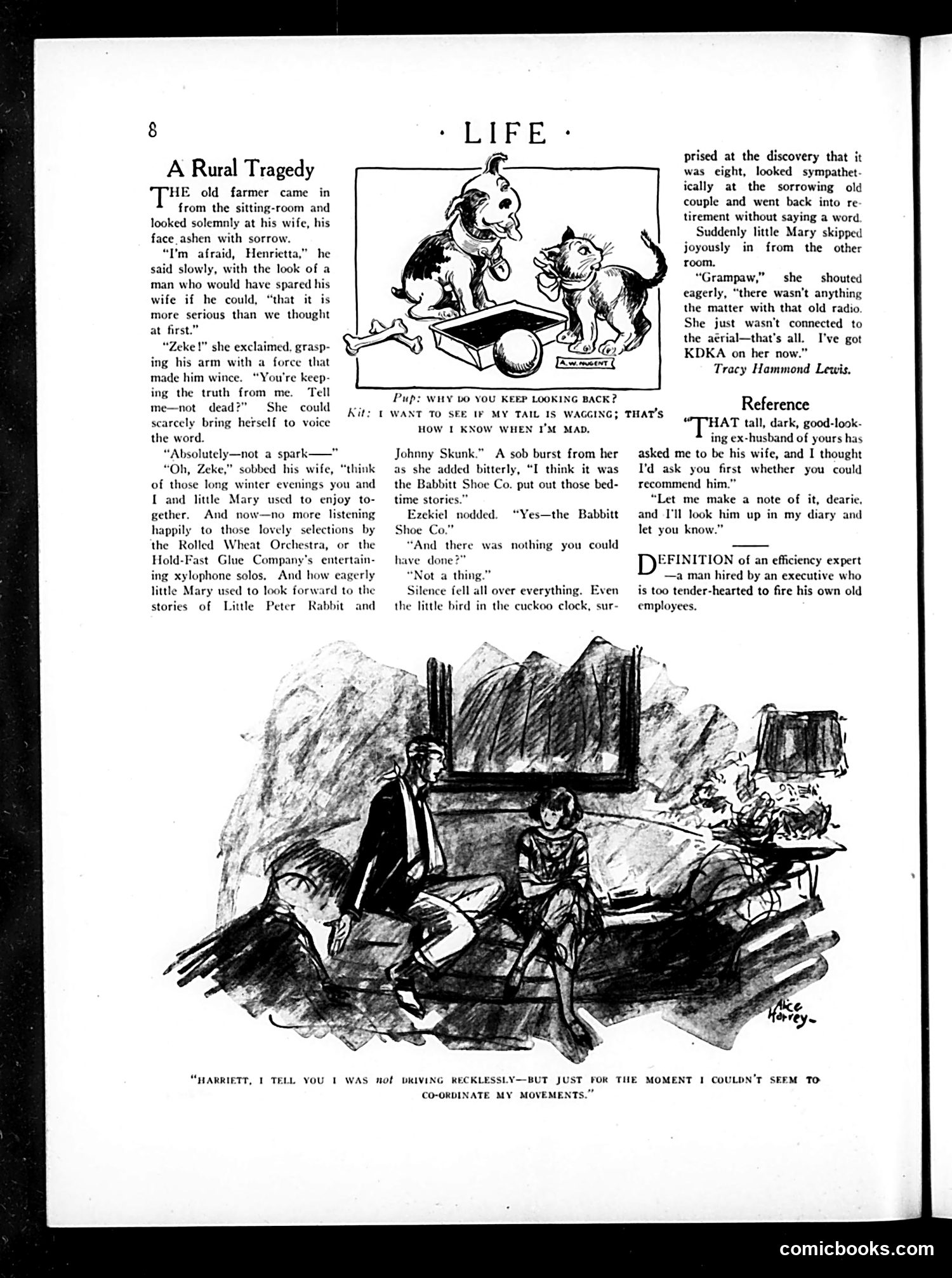
This page contains a humorous domestic story rather than political satire. The narrative depicts a rural couple's marital discord: a husband named Zeke confesses to his wife Henrietta that he fears she'd leave him if she could, prompting her angry response that she won't allow herself to voice her true feelings. The accompanying cartoon shows a man explaining to his wife Harriet that he wasn't driving recklessly but simply "couldn't seem to coordinate [his] movements"—a comedic excuse for poor driving. The cartoons satirize marriage dynamics and domestic incompatibility common to the era, using rural/working-class settings. The humor relies on recognizing the gap between what spouses think but won't say, and absurd male excuses for misbehavior.
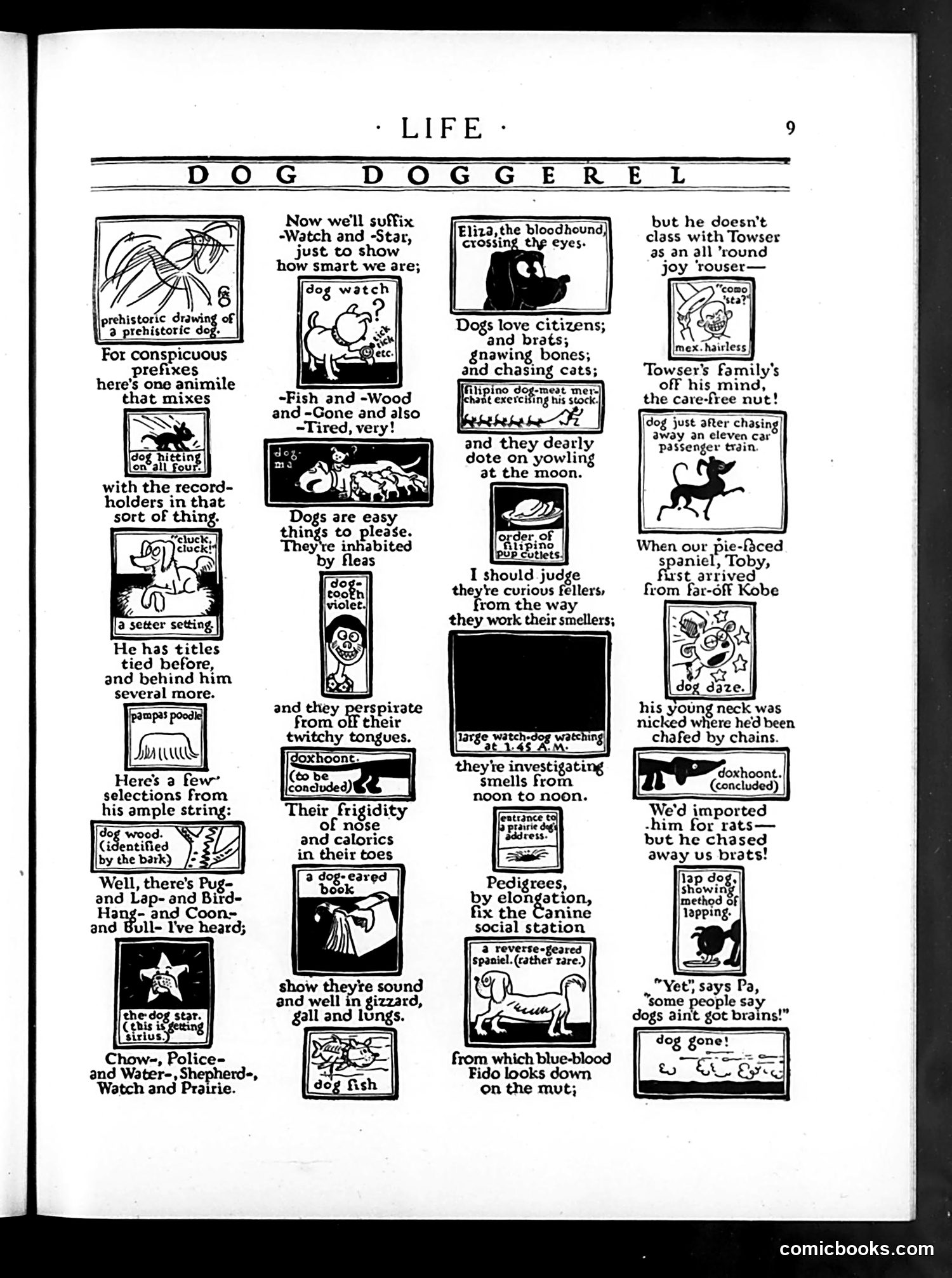
This is a humorous illustrated poem about dogs and their characteristics. The page uses small comic panels to satirize dog breeds and dog ownership culture. The satire targets several things: pretentious dog-naming conventions ("prefixes here's one animile that mixes"), the aristocratic obsession with pedigree and breeding ("Pedigrees, by elongation, fix the Canine social station"), and the gap between dog-owners' romantic notions and reality (dogs chasing cats and eating garbage despite their "blue-blood" heritage). The piece mocks the idea that expensive breeding determines character—dogs behave like dogs regardless of pedigree. There's also gentle satire of the period's class consciousness, where owning certain "pedigreed" dogs signified social status, even though behavior ultimately matters more than lineage. The humor relies on observational comedy about dog behavior contrasted with human pretensions.
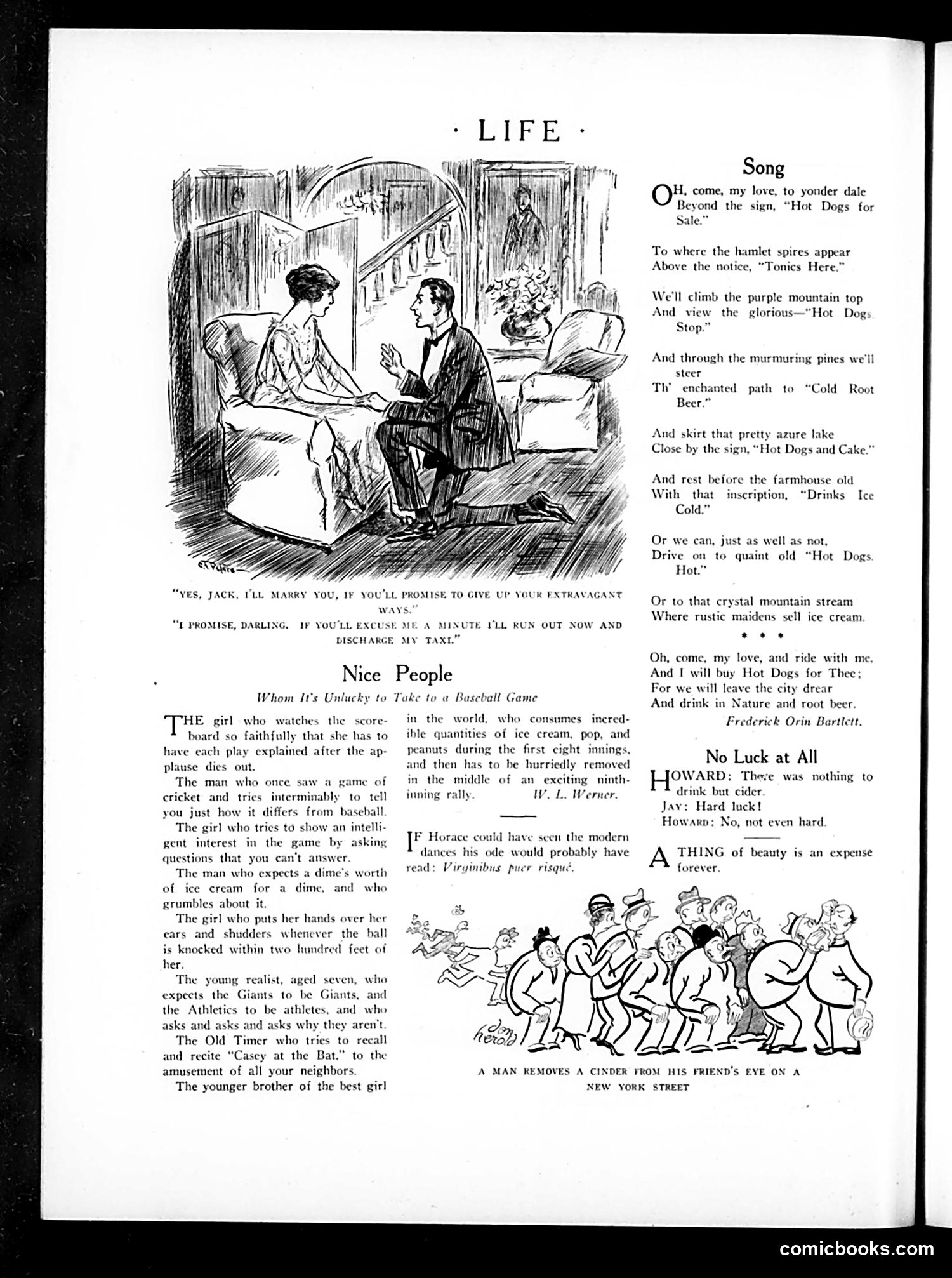
This page contains satirical commentary on social customs and courtship. The main cartoon shows a couple in conversation, with the man promising marriage if the woman will "give up your extravagant ways" and discharge his taxi—a joke about male expectations that women abandon independence upon engagement. The "Nice People" section satirizes baseball fans' behavior, mocking how grown men become invested in games, ask unanswerable questions, and remove their hats excitedly—behavior considered undignified for "nice people." The poem "Song" romantically parodies commercialized tourism, referencing roadside signs for "Hot Dogs," "Cold Root Beer," and ice cream—suggesting modern romance has been replaced by mass-market consumerism and manufactured experiences. The final cartoon humorously depicts men removing cinders from each other's eyes on a New York street, illustrating gallant social behavior.
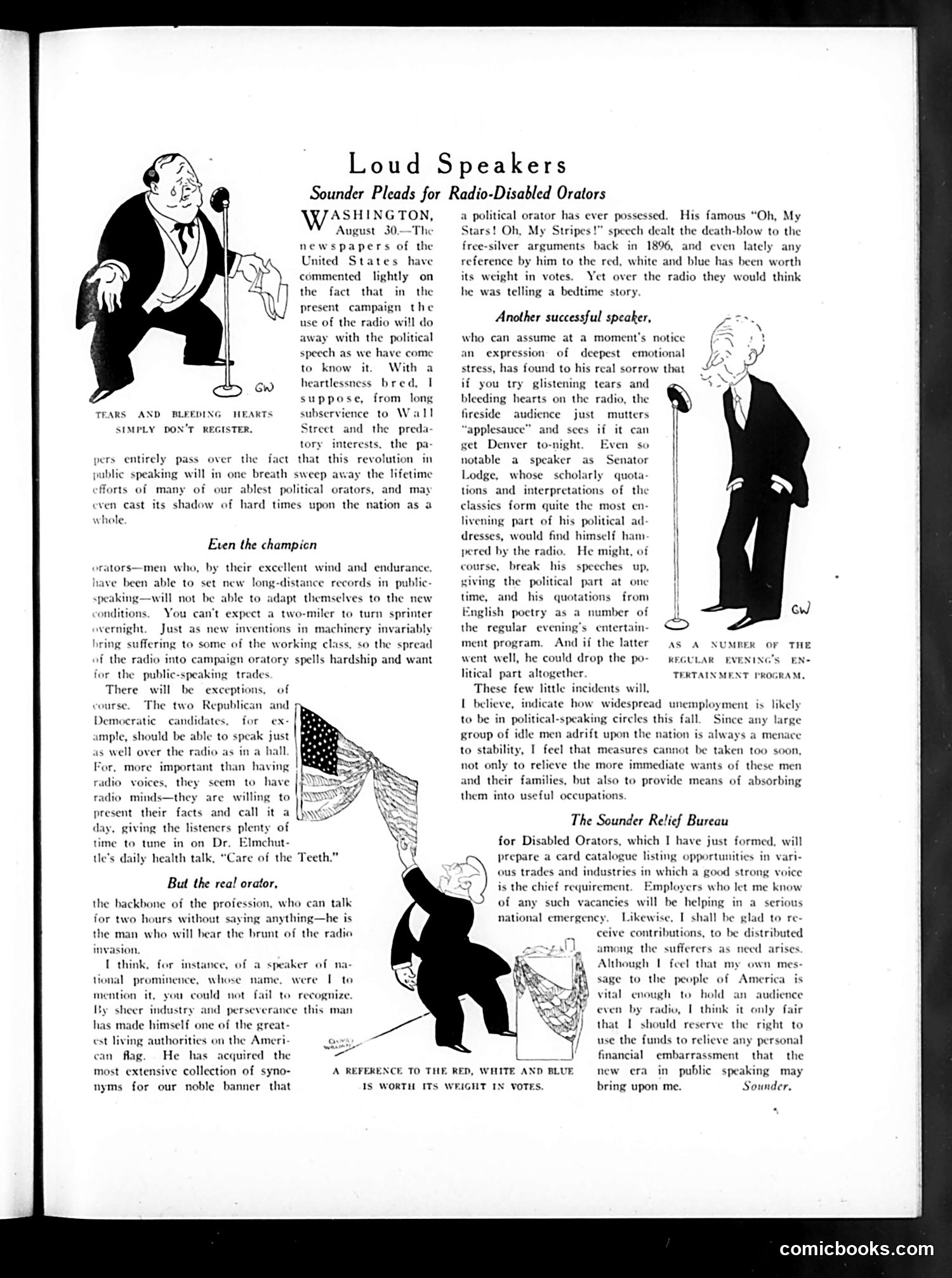
This satirical article discusses how radio broadcasting threatens traditional public speakers. The cartoons depict politicians and orators struggling with this new medium. The main argument: excellent speakers who built reputations through in-person oratory cannot easily adapt to radio's constraints. A two-mile runner cannot suddenly become a sprinter. The piece notes that Republican and Democratic candidates should learn radio technique, but acknowledges the real problem—speakers who lack the adaptability face obsolescence. The author mentions Senator Lodge as an example of a speaker whose scholarly quotes and classical references would suffer on radio's entertainment-focused programming. The satire targets the old guard of public speakers who refuse to evolve with technology, portraying them as dinosaurs unable to survive in broadcasting's new landscape. The "Sounder Relief Bureau" is a tongue-in-cheek proposed aid organization for these displaced orators.
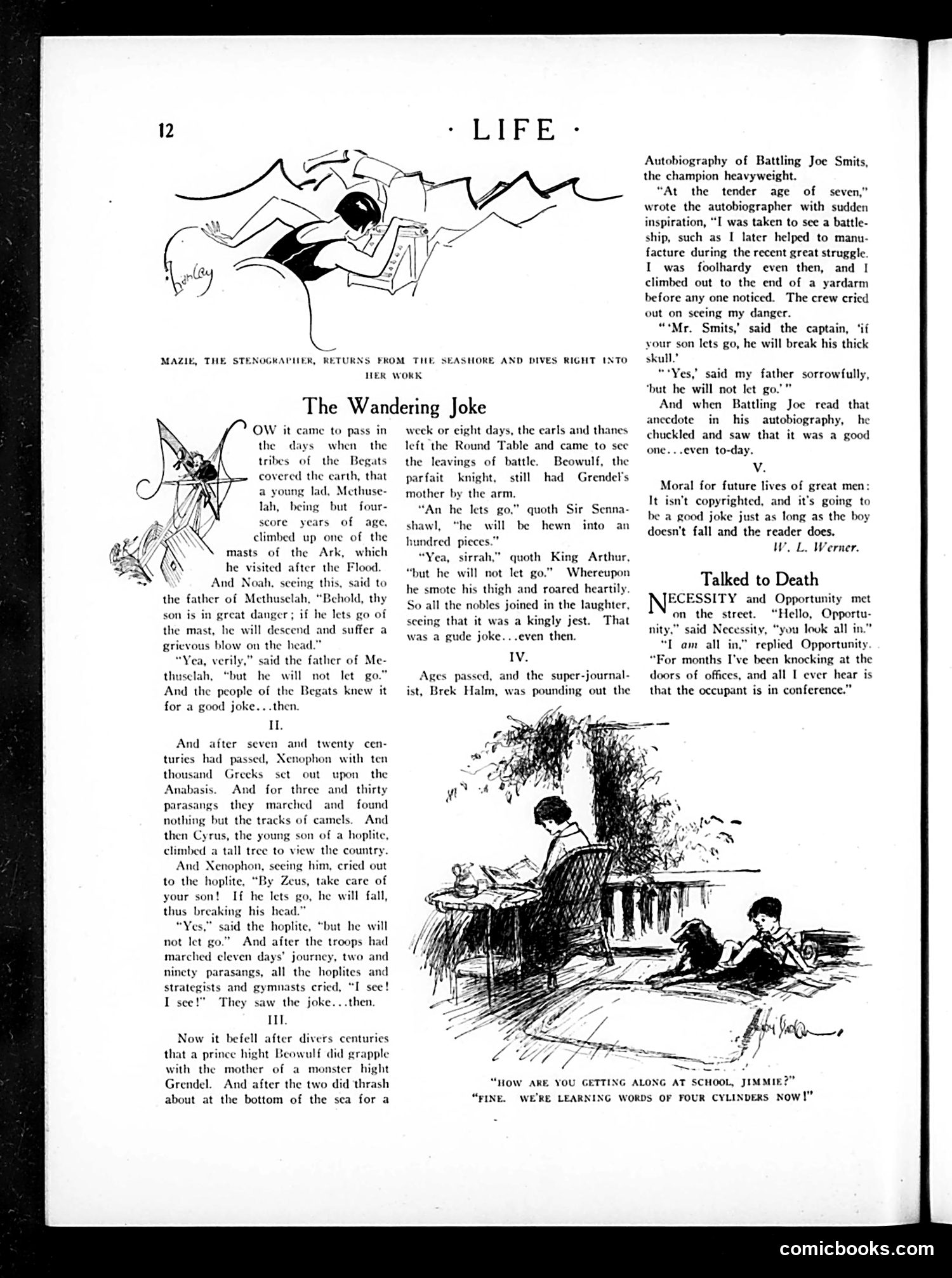
This page contains three distinct pieces: 1. **"Mazik, the Stenographer"** (top illustration): A cartoon showing a woman diving into water, satirizing the modern working woman who balances office work with adventurous leisure activities. 2. **"The Wandering Joke"** (main story): A medieval/fantastical narrative about a joke that spreads across kingdoms—a meta-commentary on how humor and stories circulate through society. 3. **"Talked to Death"** (bottom section): A satirical piece about Opportunity and Necessity meeting, mocking how bureaucratic gatekeepers waste people's time with endless delays and excuses about "conferences." The bottom illustration shows a schoolboy conversation about learning "words of four cylinders"—likely referring to automobiles, satirizing how modern technology vocabulary was entering children's education. The overall theme reflects early 20th-century satire about modernity, bureaucracy, and social change.
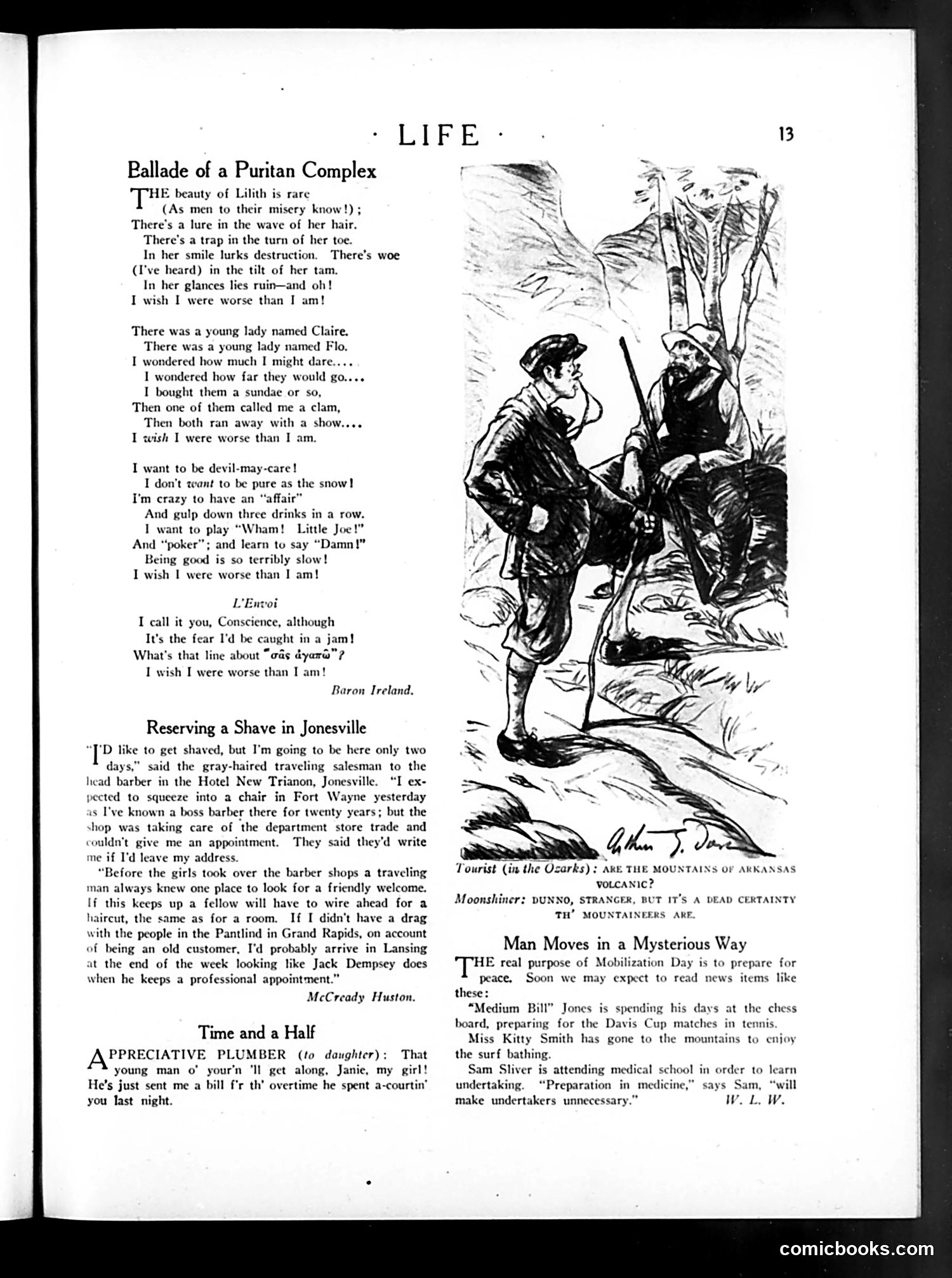
This page contains three separate pieces of light humor writing rather than political cartoons. "Pallade of a Puritan Complex" is a poem by Baron Ireland mocking Puritan sexual repression—the speaker desires to be "bad" and break moral rules, expressing frustration that goodness is "terribly slow." "Reserving a Shave in Jonesville" is a humorous anecdote by McCready Huston about a traveling salesman trying to book a haircut at a hotel barber in Arkansas, satirizing small-town inefficiency and the contrast between rural and urban service standards. "Time and a Half" is a brief domestic joke about a plumber's daughter receiving overtime pay. The page's illustration depicts rural/outdoor life, likely accompanying one of these pieces. There are no political cartoons or caricatures present.
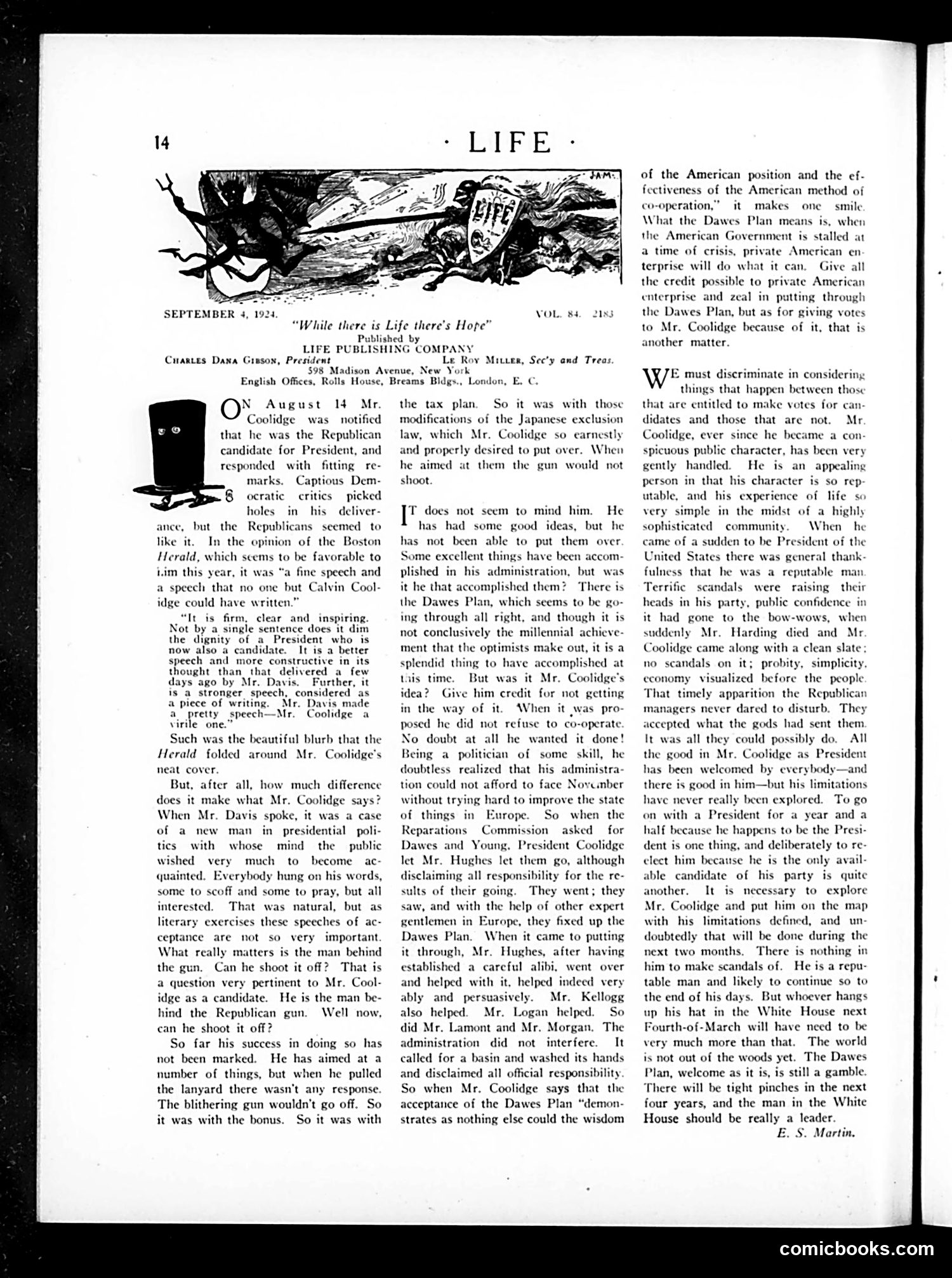
This **Life** magazine page from September 4, 1924, contains editorial commentary (not a cartoon) about President Calvin Coolidge's candidacy. The illustrated header shows a figure labeled "LIFE" observing political turmoil. The article praises Coolidge's handling of the Dawes Plan (a financial restructuring agreement with Europe) and his general competence, while acknowledging his limitations as a leader. The author notes Coolidge lacks the dynamic qualities needed for the presidency but represents stability compared to scandals of previous administrations. The piece reflects 1924 political anxieties: debates over the Dawes Plan, Republican efforts to rebuild credibility after Harding-era corruption, and whether Coolidge possessed sufficient leadership for the role. The tone is cautiously supportive but skeptical of his abilities.
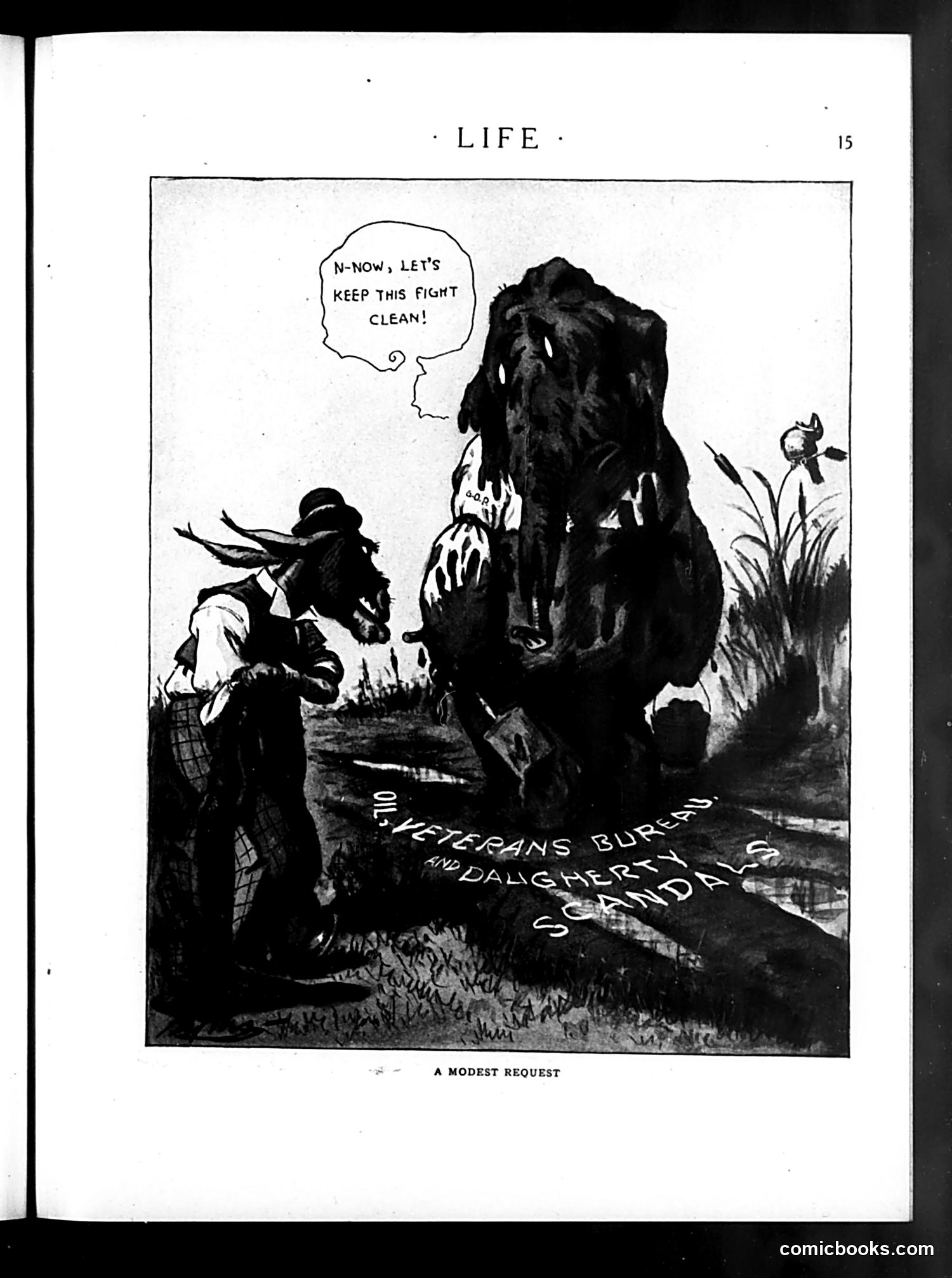
This Life magazine cartoon satirizes the "Veterans Bureau and Daughters Scandal," visible on the ground beneath a monstrous figure. A small person (likely representing an honest citizen or reformer) urges the beast to "keep this fight clean!" The monster represents corruption in the Veterans Bureau—a real 1920s scandal involving misappropriation of funds meant for veterans. The "Daughters" reference appears to involve women's organizations or family members implicated in the controversy. The cartoon's dark irony: asking corrupt officials to conduct their dishonest dealings "cleanly" is absurd—hence "modest request." The satire criticizes both the scandal's severity and the futility of expecting ethical behavior from thoroughly corrupt institutions already devouring veterans' resources.
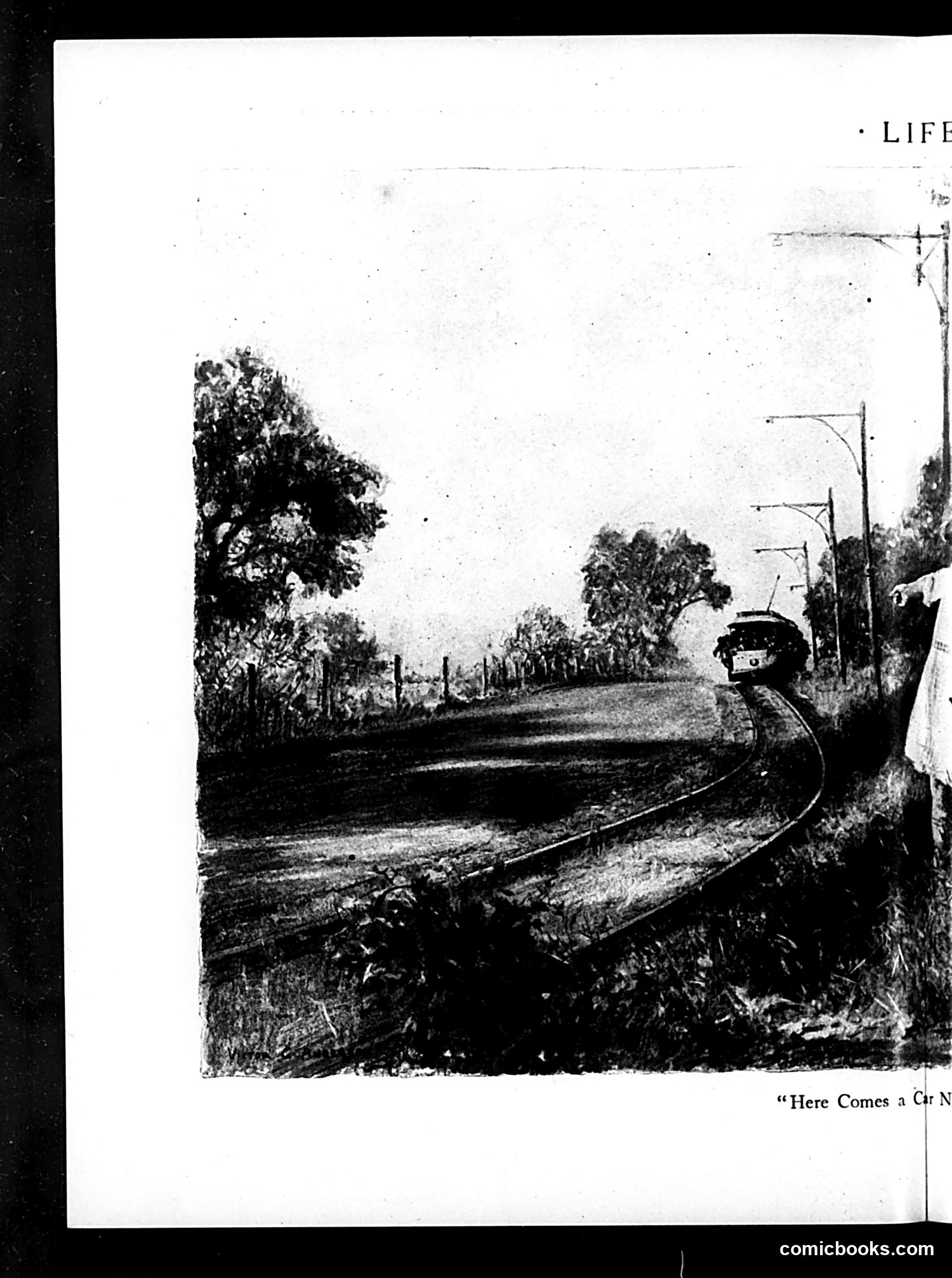
This page from *Life* magazine shows a black and white photograph of a curved railroad track with a streetcar approaching in the distance. Trees line both sides of the rural or semi-rural road, and utility poles are visible on the right. The incomplete caption reads "Here Comes a Cir N[...]" (likely "Here Comes a Circulating..." or similar). Without the complete caption or additional context, the exact satirical point remains unclear. However, given *Life*'s tradition of social commentary, this appears to be either commentary on early 20th-century transportation, urban expansion into rural areas, or possibly a visual joke about streetcar systems. The photograph's composition—emphasizing the track's curve and the approaching vehicle—suggests the humor or critique may involve perspective, movement, or the encroachment of modern technology on the landscape.
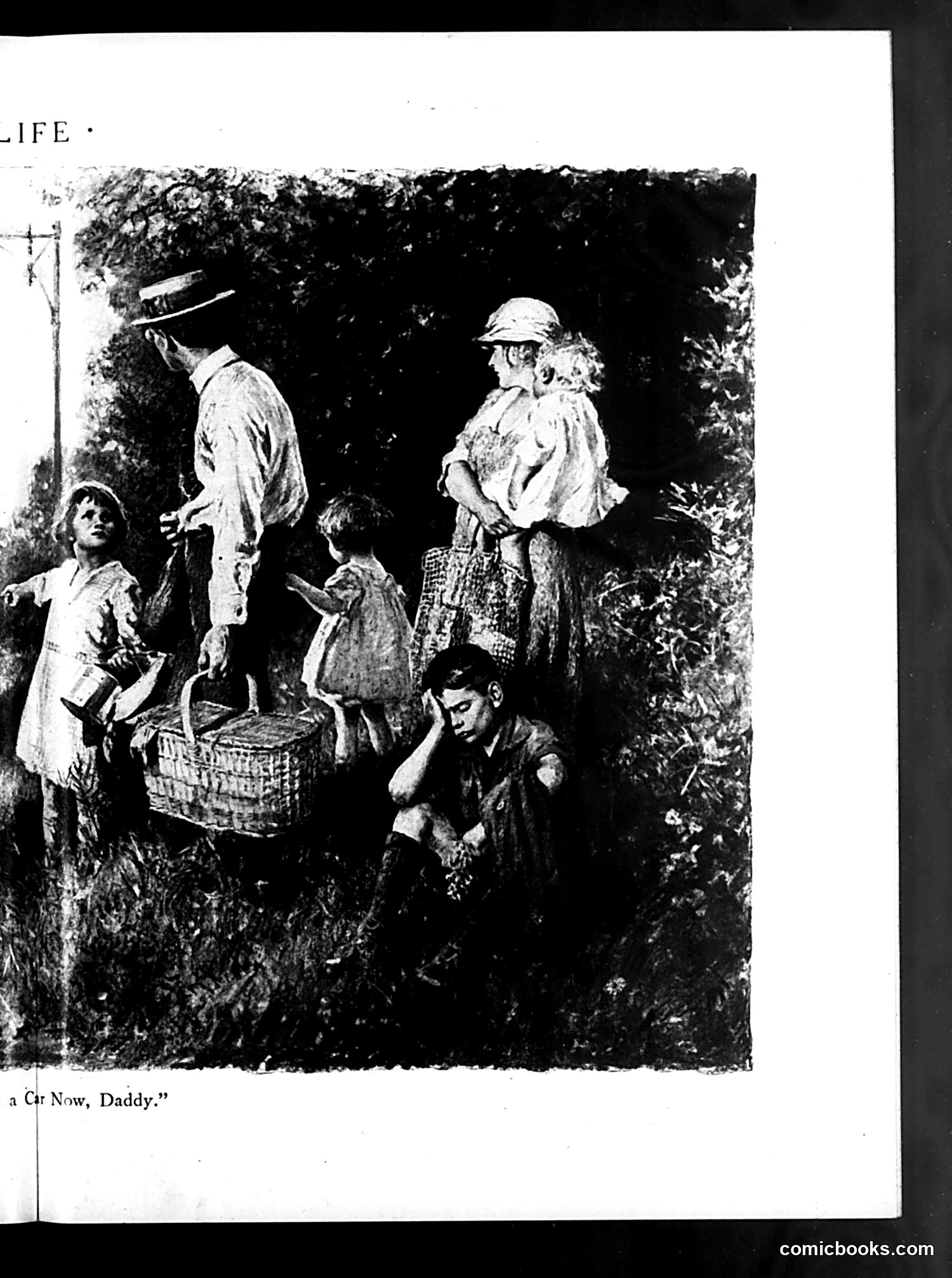
This appears to be a satirical illustration from *Life* magazine depicting a family scene in a garden or outdoor setting. The partial caption visible reads "a Car Now, Daddy," suggesting the image critiques consumer materialism or children's demands for automobiles. The scene shows several figures—adults and children—gathered near what appears to be a vegetable garden or produce area, with a utility pole visible. The composition suggests social commentary on Depression-era economic aspirations, where families might be engaged in subsistence gardening while children demand modern consumer goods like automobiles. The satire likely contrasts practical necessity (growing food) with materialistic desires, reflecting early 20th-century anxieties about American consumerism and family priorities during economic hardship.
This page reviews early-season theatrical productions, employing Life's characteristic satirical tone. The author mocks poorly-conceived plays that open in late August/early September, suggesting they're quickly "buried" after bad reviews—a metaphor for theatrical flops. Two specific plays receive criticism: "Easy Street" (plot details about marital discord and a mysterious book-seller) closed quickly; "Dr. David's Dad," rumored to be a German knockoff of the successful "Abie's Irish Rose," lasted only one week despite the author's deliberate refusal to promote it (contrasting with their earlier opposition to "Abie's Irish Rose"). Two musicals—"Marjorie" (with Elizabeth Hines and Richard Skeel Gallagher) and "No Other Girl" (with Helen Ford)—receive qualified praise. The critic appreciates the performers' talents, particularly praising Hines while gently mocking Ford's tendency toward melodramatic floor-sobbing scenes during orchestral reprises. The satire targets both hackneyed theatrical formulas and audience sentimentality.
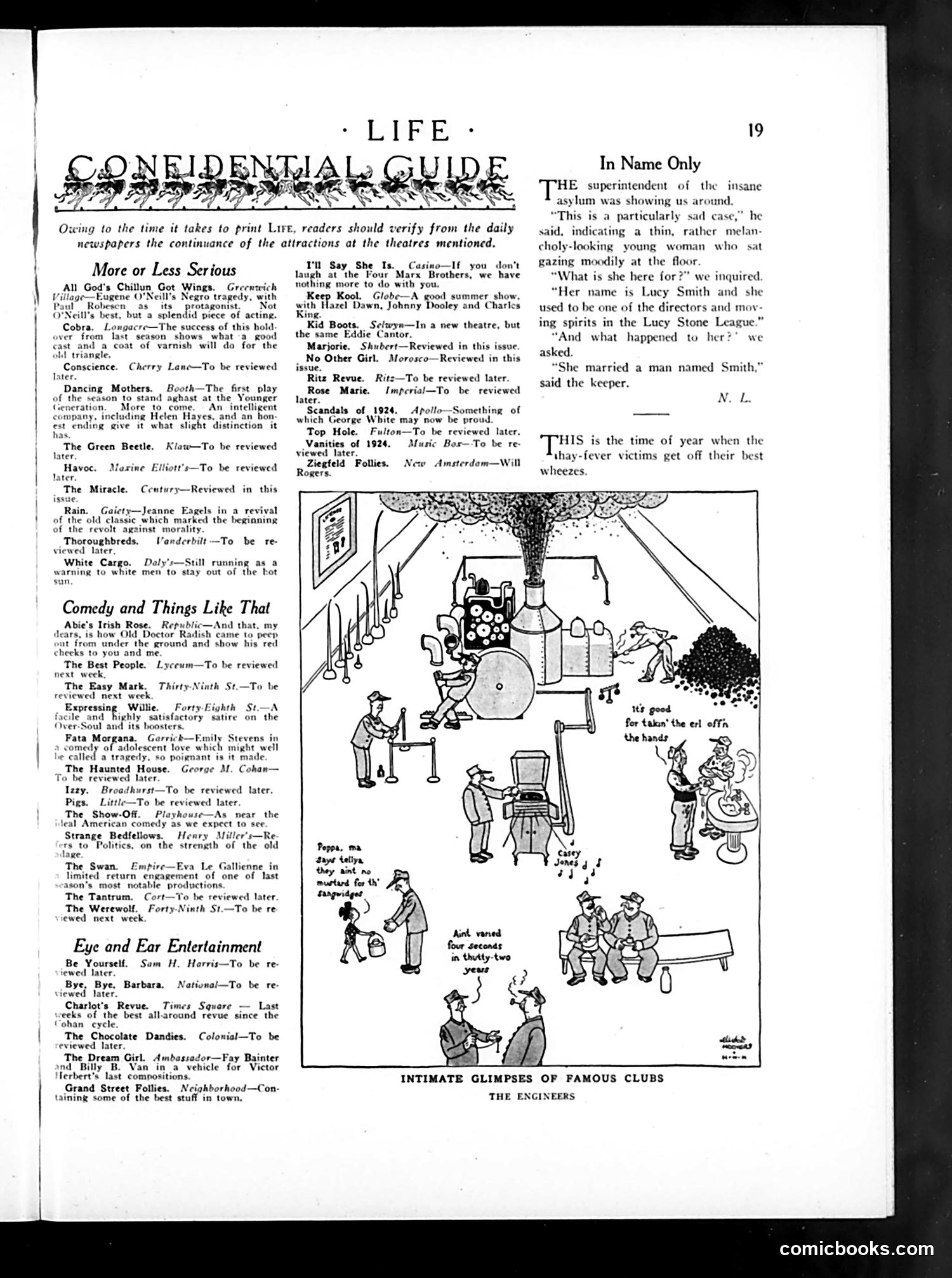
This page from *Life* magazine contains theater reviews and a separate illustrated feature titled "Intimate Glimpses of Famous Clubs: The Engineers." The main cartoon shows a working-class social club (the Engineers) where members engage in leisure activities—playing cards, drinking, socializing. The humor appears satirical: the caption "It's good for takin' the oil offs the hands / the hands" suggests ironic commentary on working men trying to relax and appear refined despite their manual labor origins. The accompanying brief anecdote "In Name Only" presents a darker joke: a young woman in an insane asylum is institutionalized simply because she "married a man named Smith"—implying her only "crime" was marrying someone ordinary or unremarkable. This satirizes arbitrary or cruel institutionalization practices of the era, when asylums warehoused people for minor social transgressions or convenience. The theater listings occupy most of the page, reviewing contemporary Broadway productions including works by Eugene O'Neill and reviews of comedies and musicals.
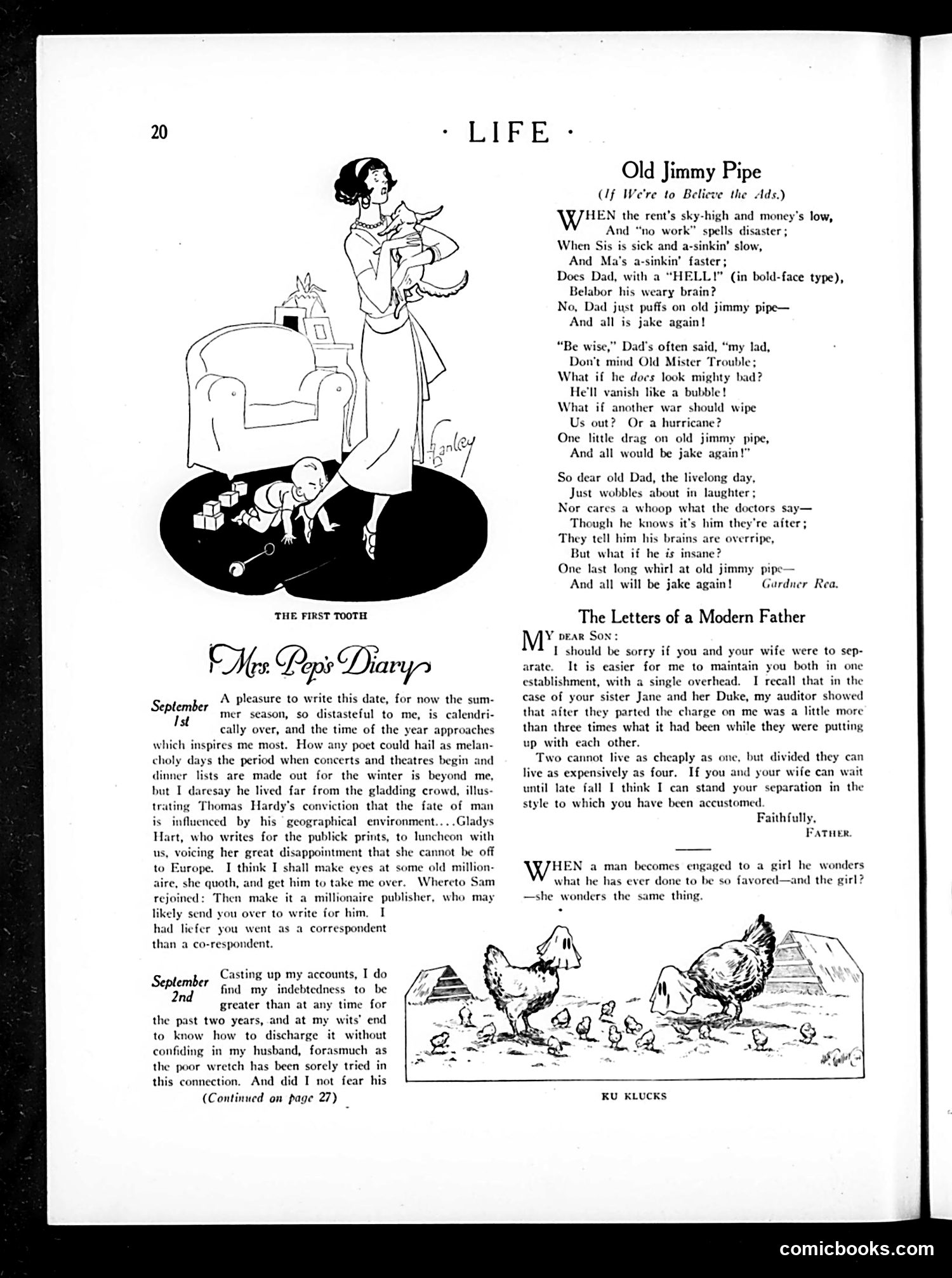
**"Old Jimmy Pipe"** is a satirical poem mocking advertisements' absurd claims about consumer products. The verse ridicules how ads suggest a simple product (a pipe) can solve all life's problems—financial hardship, illness, family crisis, even war or insanity. The humor lies in the exaggeration: Dad faces mounting debts and family sickness yet remains content smoking his pipe, with each problem supposedly resolved by another puff. This attacks the era's misleading advertising culture. **"Mrs. Pep's Diary"** and **"The Letters of a Modern Father"** are satirical prose pieces about upper-class social anxieties and financial concerns—marital separation costs, managing wealthy households, and romantic expectations. **"Ku Klucks"** is an untitled cartoon showing hens with chicks, likely a simple domestic humor piece. The page's overall theme: satirizing modern advertising deception, social pretension, and marital/financial anxieties among the prosperous classes.
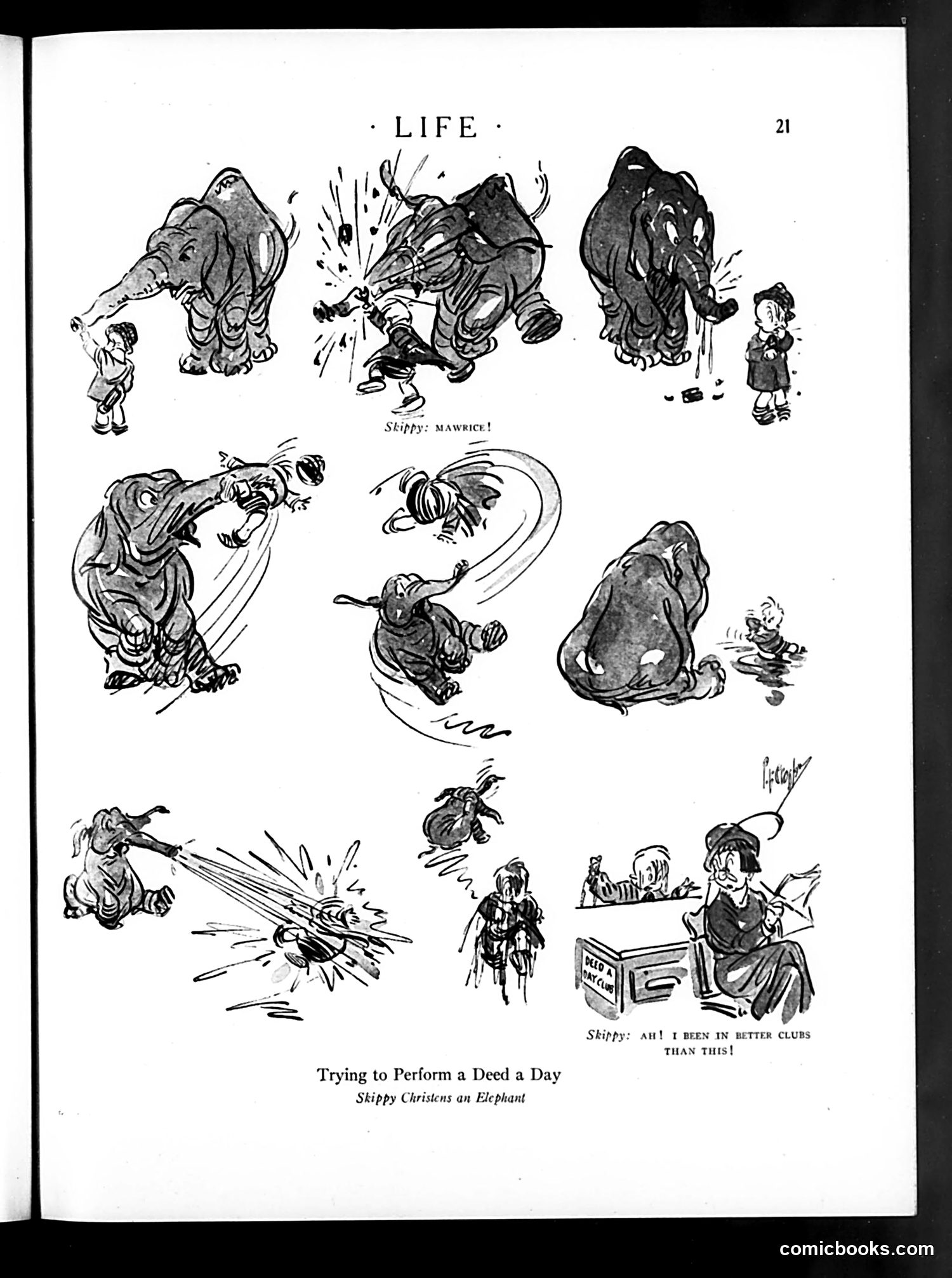
This page features *Skippy*, a popular comic strip character from the 1920s-30s. The series depicts a mischievous child attempting daily good deeds, here involving an elephant. The humor derives from the contrast between Skippy's ambitious intentions and chaotic reality: the child attempts various interactions with the elephant (riding, directing, etc.) that go comically wrong—the elephant bucks, charges, and generally resists cooperation. The final panel's dialogue—"Aw! I been in better clubs than this!"—suggests Skippy's snobbish indignation at the elephant's behavior, anthropomorphizing the animal as if it were a social establishment he could critique. The satire gently mocks both the child's pretentious attitude and the absurdity of his "deed a day" premise when reality intervenes.
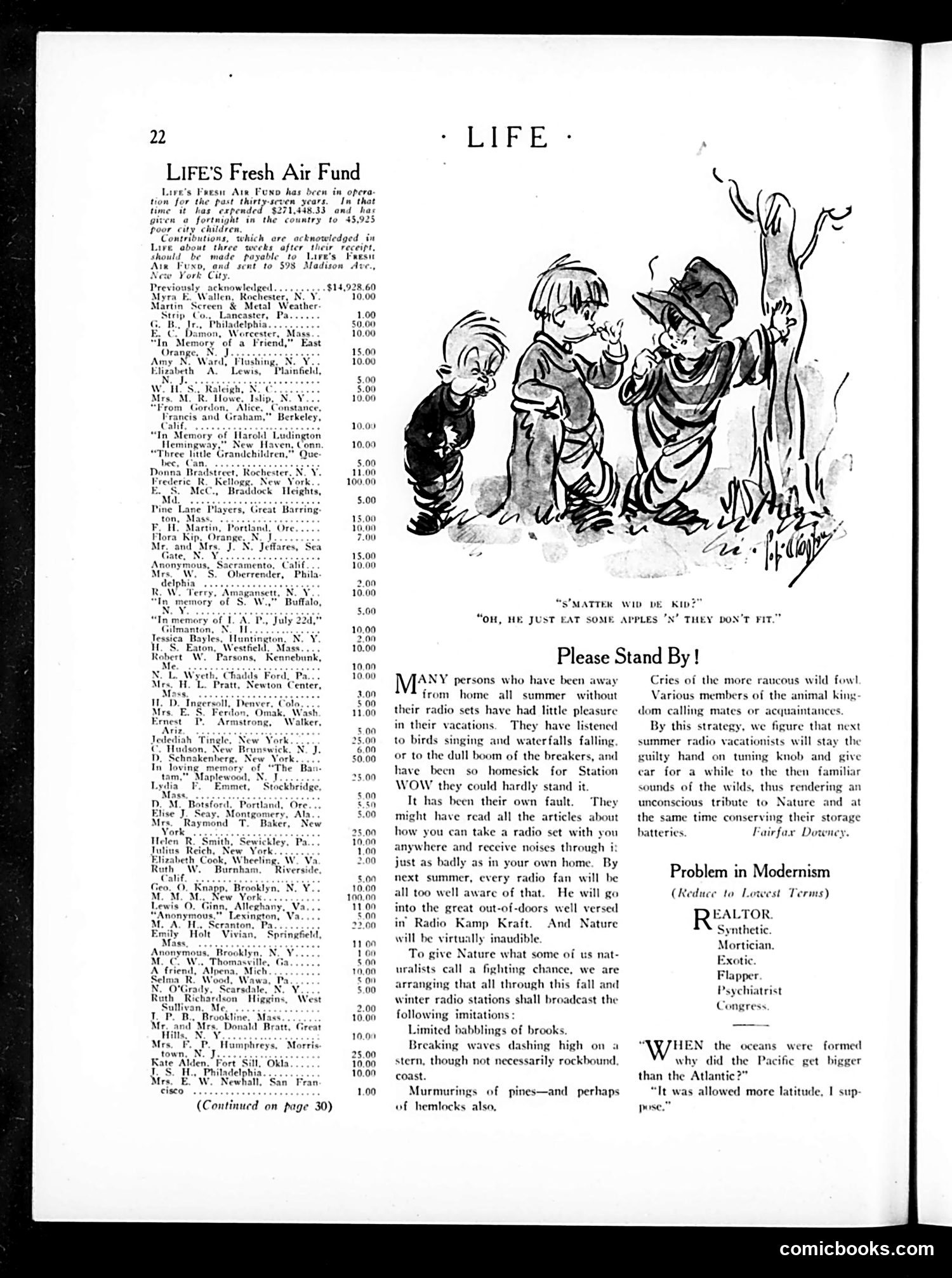
This page contains two satirical pieces mocking modern American life in the early 20th century. **The Cartoon** ("S'matter wid de Kid?"): A child has eaten apples that "don't fit"—likely referring to dentures or false teeth, suggesting modern children are so malnourished or unhealthy they need artificial teeth. The dialect humor was typical of the era's comedy style. **"Please Stand By!"**: This satirizes radio culture's explosive growth and urban Americans' dependency on it. The author mocks vacationers who bring radios to nature, ruining the outdoors experience. The joke is that radio stations will now broadcast *fake* nature sounds (artificial brooks, waves, bird calls) so tourists can continue ignoring actual nature while pretending to experience it. **"Problem in Modernism"**: A word-puzzle mocking contemporary jargon. Terms like "Realtor," "Mortician," "Flapper," and "Psychiatrist" represent newly-coined or popularized words that satirize modern society's increasingly specialized, commercialized language. The overall theme: Life's lampooning how modernity isolates people from authentic experience through technology and artificial substitutes.
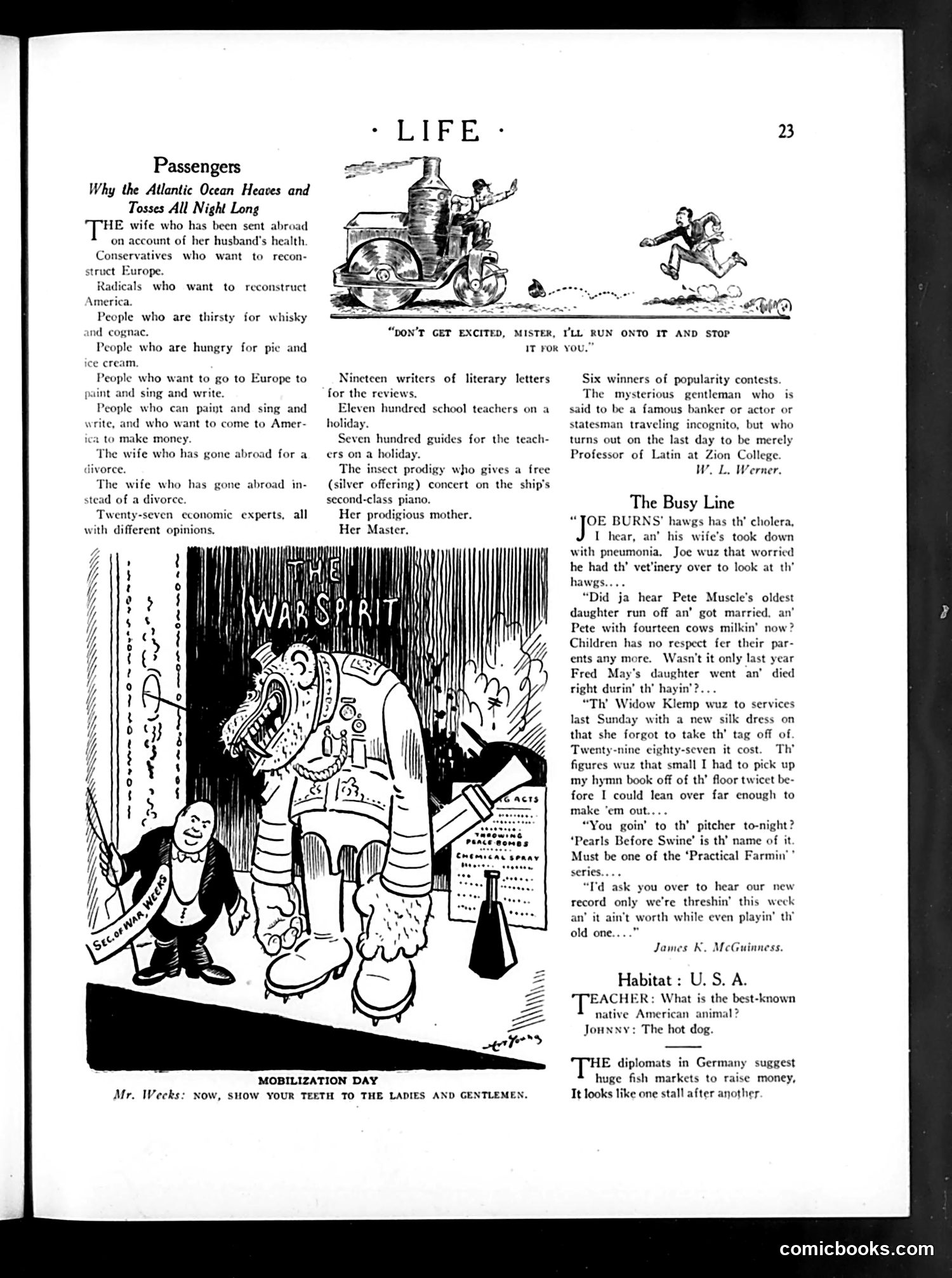
This page contains three distinct satirical pieces from an early 20th-century Life magazine: **"Passengers"** humorously catalogs the diverse, often contradictory types of people aboard Atlantic ocean liners—conservatives and radicals, wealthy travelers and working teachers, divorced wives and economic experts. The joke is that this chaotic mix of conflicting desires and opinions explains why the ship rocks all night. **"Mobilization Day"** cartoon depicts a small man (labeled "Secretary of War") standing beside an enormous military robot or war machine. The caption's joke is that the official must "show your teeth" to demonstrate military strength to the public—satirizing government propaganda during what appears to be WWI-era militarization. **"The Busy Line"** presents rural gossip in dialect, where a farmer discusses neighbors' scandals (illness, elopement, expensive dresses) in a folksy, rambling style—satirizing small-town life and priorities. The final brief jokes mock American culture (hot dogs as the "best-known native animal") and diplomatic incompetence (German fish markets as fundraising).
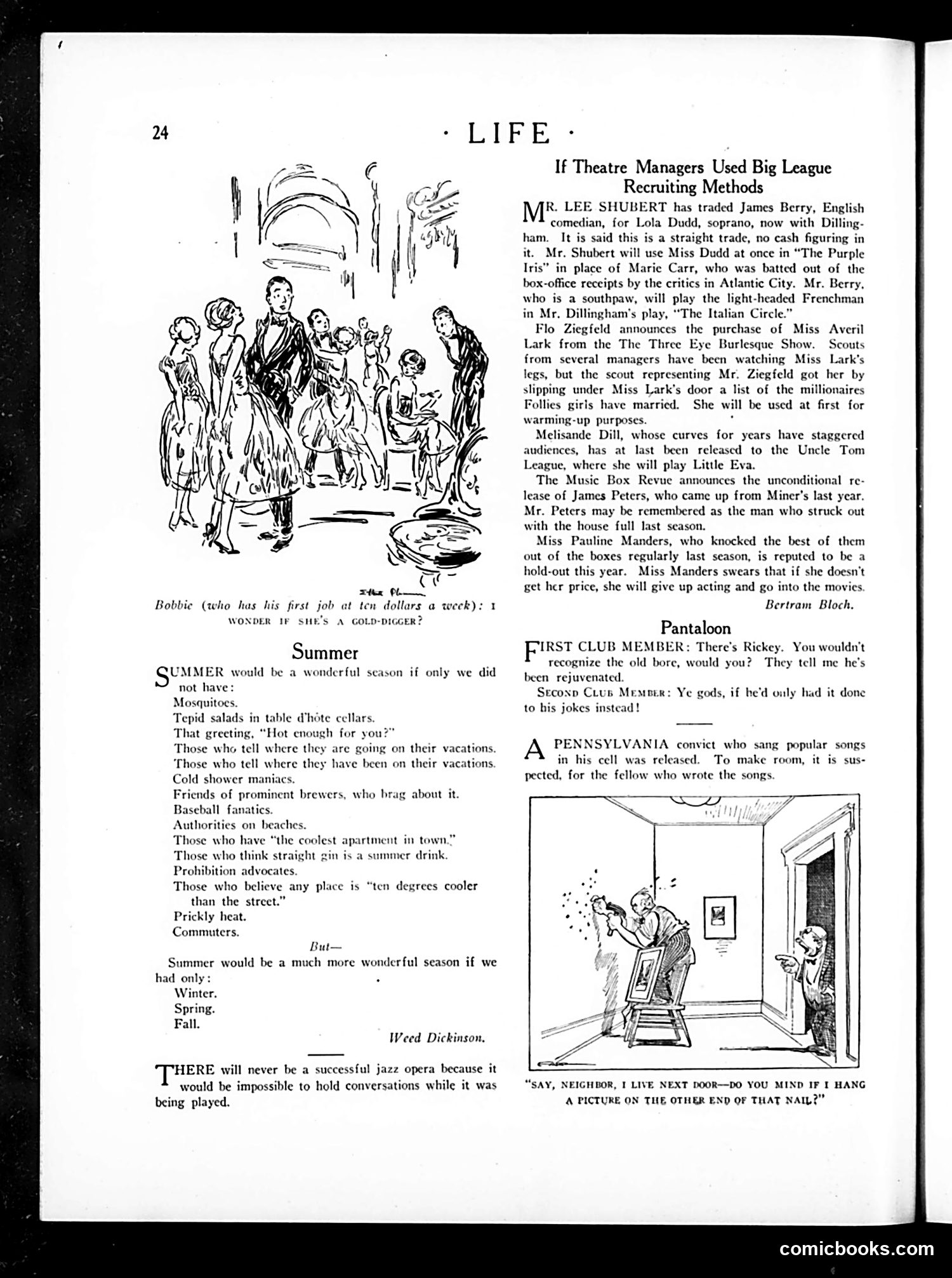
This page contains satirical commentary on early 1920s American life: **"If Theatre Managers Used Big League Recruiting Methods"** (top): This piece jokes about theatrical impresarios (Shubert, Ziegfeld, Dillingham) treating Broadway performers like baseball players—trading, purchasing, and recruiting them using sports terminology. It's satirizing how entertainment executives commodify actors' bodies and talents, with Ziegfeld's scout reportedly seducing an actress by showing her a list of wealthy husbands other Follies girls married. **"Summer"** (left): A humorous list of summer annoyances (mosquitoes, mosquito-related small talk, commuters, prohibition advocates) concluding that the season would be perfect if it were replaced with winter, spring, or fall—absurdist humor about the season being entirely unpleasant. **"Pantaloon" jokes and cartoons** (right): Brief jokes about rejuvenation and a Pennsylvania convict's release, plus a cartoon about a neighborly dispute over picture-hanging. The page reflects 1920s preoccupations: Prohibition, theatrical celebrity culture, and complaints about urban summer discomfort.
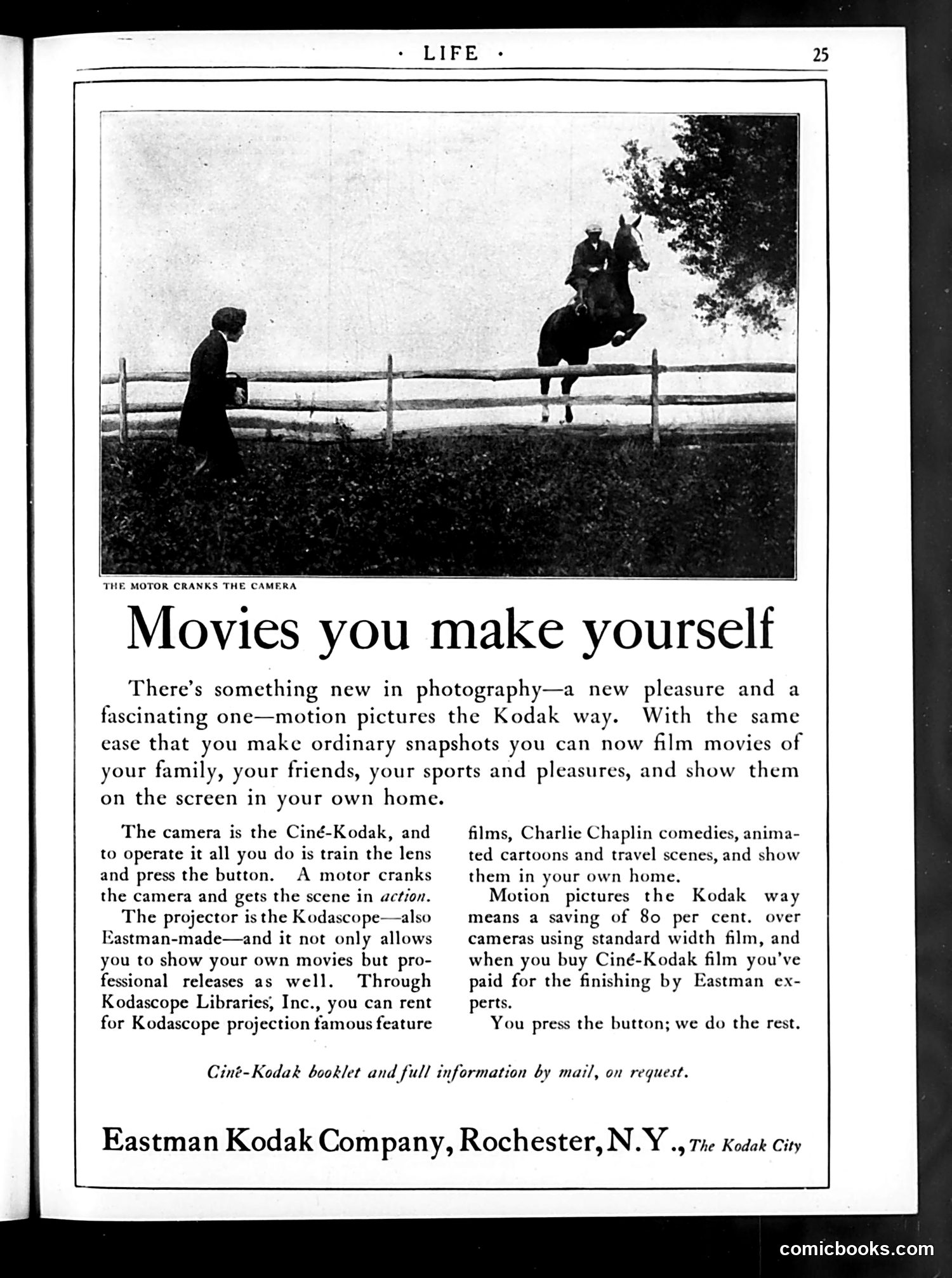
This is a **full-page advertisement** for Eastman Kodak's Ciné-Kodak home movie camera system, not political satire. The image shows a person operating a motor-cranked camera on a tripod while filming a rider on horseback jumping a fence. The ad promotes the revolutionary concept of **amateur home filmmaking**: ordinary people can now record family, friends, and activities, then project them at home using the Kodascope projector. The tagline "You press the button; we do the rest" emphasizes ease of use. Key selling points include: - Simple operation (just aim and press) - 80% cost savings versus standard film cameras - Access to professional content through rental libraries - Finished prints handled by Eastman experts For modern readers: this represents **early consumer video technology** (1920s-era), equivalent to today's smartphones enabling personal content creation and sharing. The novelty was making cinema accessible to everyday people, not professionals.
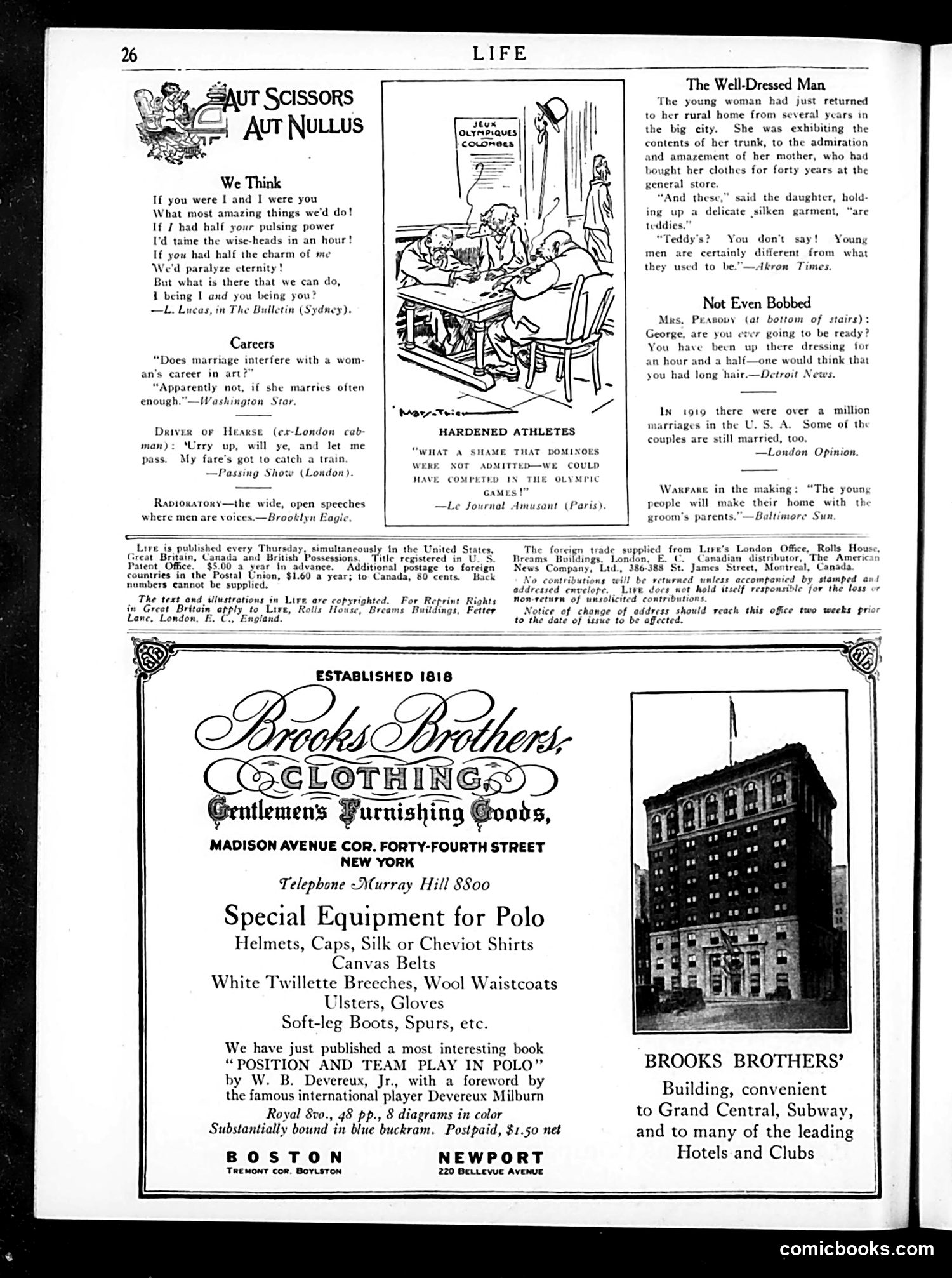
This page contains several brief satirical jokes typical of Life's humor during the early 1920s: **"The Well-Dressed Man"**: A rural mother, unfamiliar with modern city fashion, misunderstands her daughter's mention of "teddies" (a garment) as referring to teddy bears or young men named Theodore. The joke mocks rural ignorance of contemporary urban fashion. **"Not Even Bobbed"**: Mrs. Peabody complains her husband takes an hour dressing, sarcastically suggesting he must have long hair—mocking men who spend excessive time on grooming. The reference to "bobbed" hair (the fashionable short hairstyle of the 1920s) dates this precisely. **"Hardened Athletes"**: References Olympic dominoes competition—unclear satire, possibly mocking either athlete pretensions or Olympic eligibility rules. The remaining items are brief quips about marriage, hearse drivers, and radiologists—standard light humor. The page is primarily advertising (Brooks Brothers clothing), making satire secondary to commercial content.
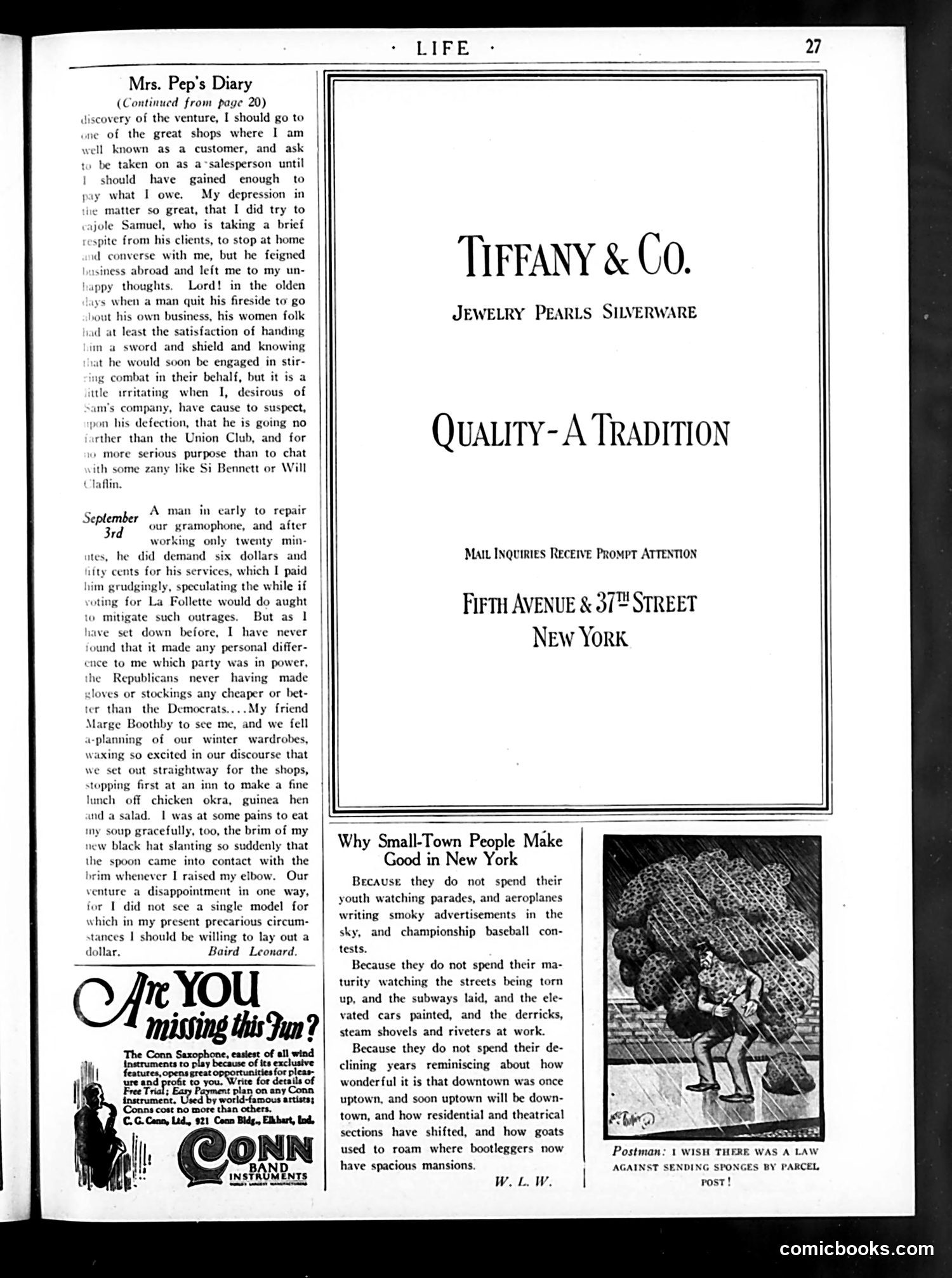
This page combines advertising with satirical commentary typical of Life magazine. The main content includes: **"Mrs. Pep's Diary"** — a serialized humor column where an upper-class woman describes domestic frustrations: her husband frequenting the Union Club instead of home, paying exorbitant repair fees ($6.50 for gramophone work), and lamenting that voting for La Follette (Progressive candidate) doesn't affect consumer prices. The satire targets wealthy women's anxieties about money and marital attention. **"Why Small-Town People Make Good in New York"** — sardonic commentary suggesting rural migrants succeed because they avoid urban distractions: parades, aerial advertisements, construction chaos, and nostalgic reminiscing about neighborhood changes. The final jab about "bootleggers" (Prohibition-era illegal alcohol dealers) replacing goats suggests urban moral decline. **Advertisements** for Tiffany & Co. and Conn Band Instruments occupy the remaining space—standard luxury marketing for Life's affluent readership. The overall tone mocks upper-class preoccupations and urban modernity while celebrating provincial virtue.
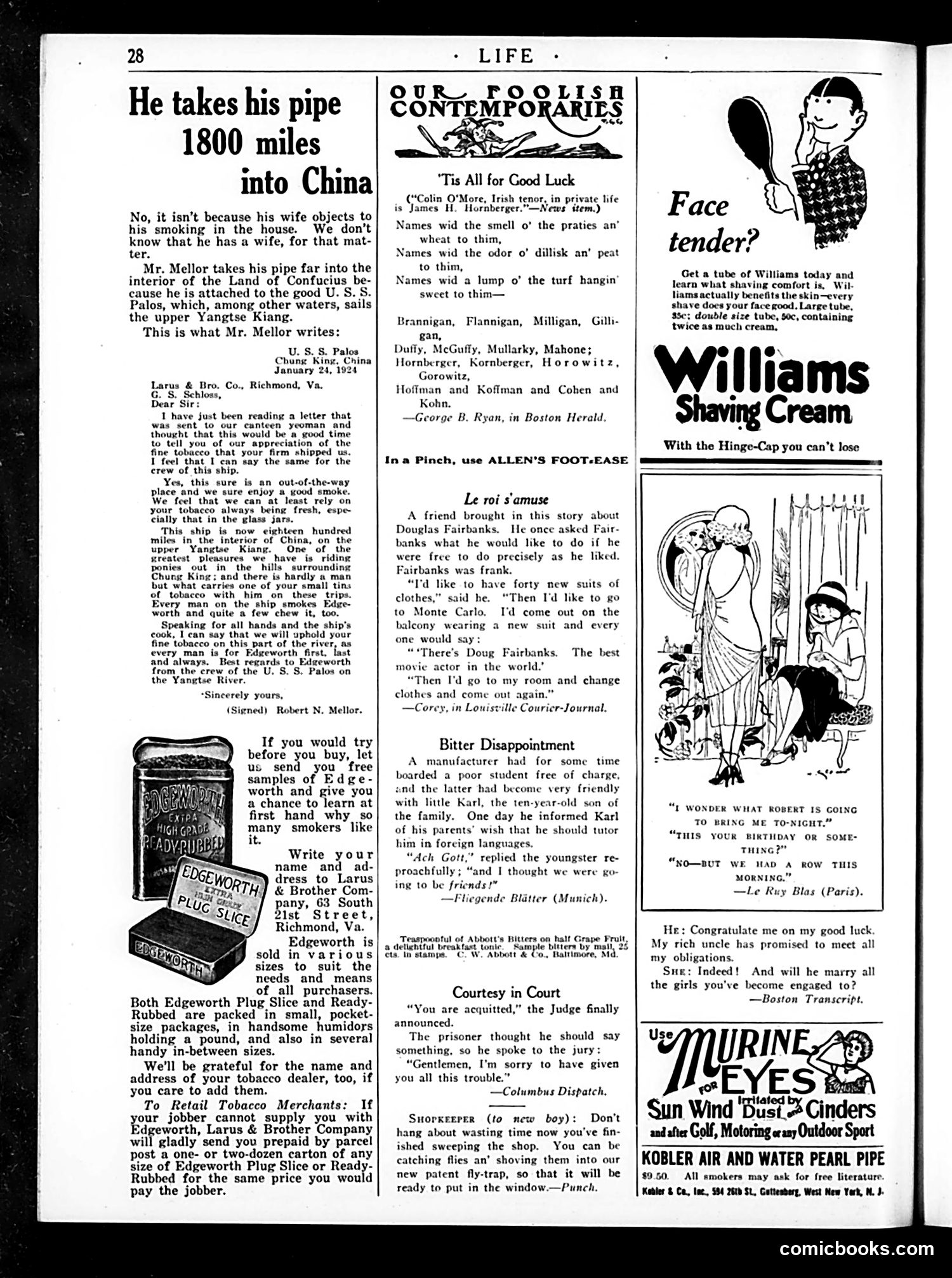
This page is primarily **advertising content** interspersed with humorous anecdotes, not political cartoons. The main feature is a testimonial letter from Robert N. Mellor of the U.S.S. Palos, stationed 1,800 miles into China's interior on the Yangtze River. Mellor praises Edgeworth tobacco, claiming the entire ship's crew relies on it. This functions as corporate advertising disguised as authentic soldier endorsement—a common early-20th-century marketing tactic. The page includes several light humor pieces: a note about Douglas Fairbanks' fantasy of wearing forty new suits at Monte Carlo, and anecdotes about an Irish tenor with immigrant-sounding names, a student tutoring arrangement, and courtroom mishaps. The accompanying advertisements promote Williams Shaving Cream, Marine Eyes (likely eyedrops), and Allen's Foot-Ease. The satire here is gentle and commercial rather than politically pointed—the page uses everyday "human interest" stories to sell products to readers.
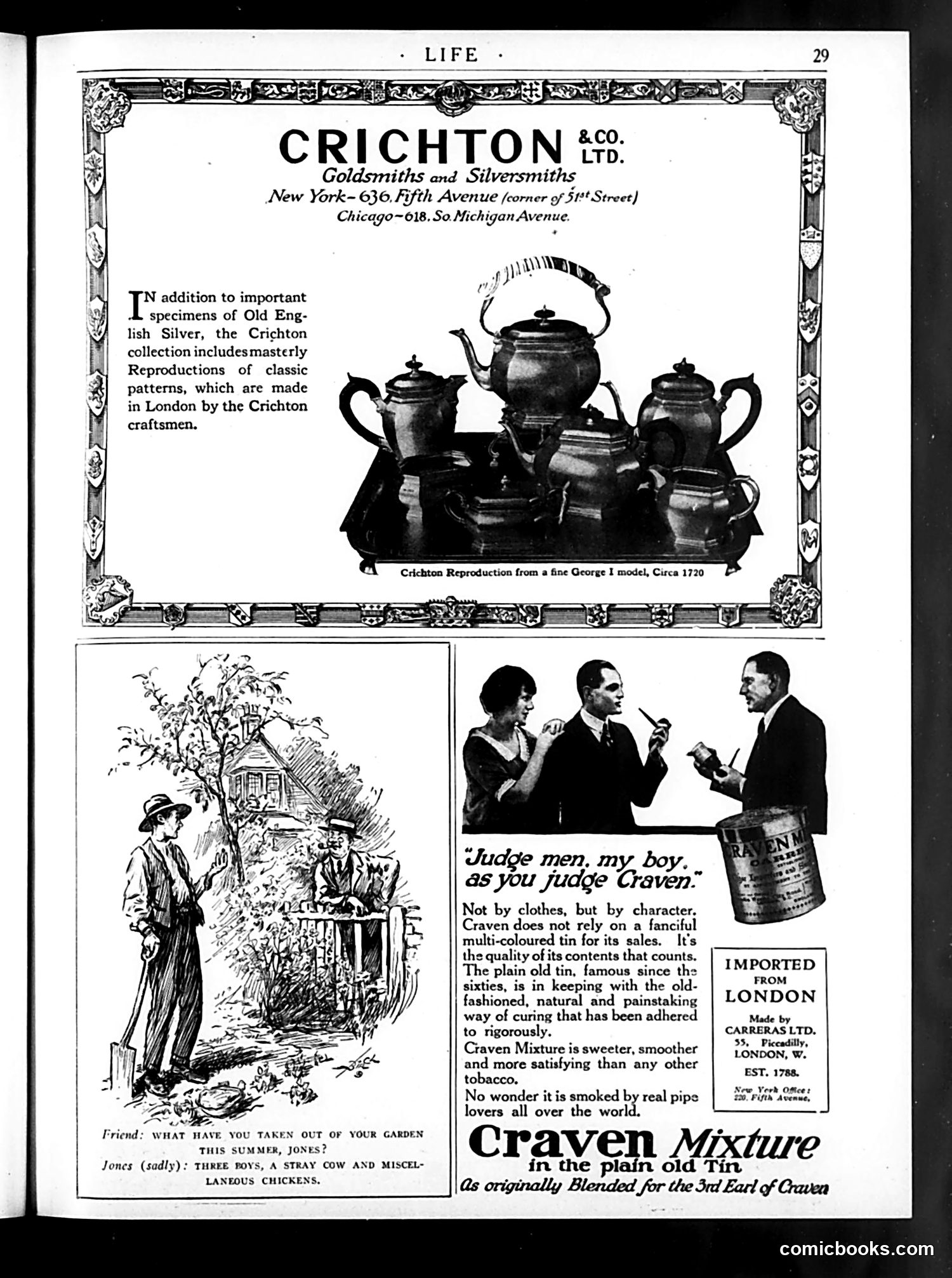
This page contains three separate advertisements rather than political satire: 1. **Crichton & Co.** (top): An upscale silversmith advertisement showcasing teapots and serving pieces, emphasizing their reproductions of classic English designs made by London craftsmen. 2. **Craven Mixture tobacco** (right): An ad using the phrase "Judge men, my boy, as you judge Craven" to argue that quality matters more than appearance. The visual shows three men examining tobacco, emphasizing that Craven's plain tin reflects traditional, rigorous curing methods rather than fancy packaging. 3. **Garden humor** (bottom left): A cartoon joke where "Jones" sadly reports removing "three boys, a stray cow and miscellaneous chickens" from his garden over summer—a humorous complaint about neighborhood nuisances and trespassing animals/children damaging his property. The page is primarily commercial, using humor and appeals to tradition and quality to market luxury goods to Life's affluent readers.
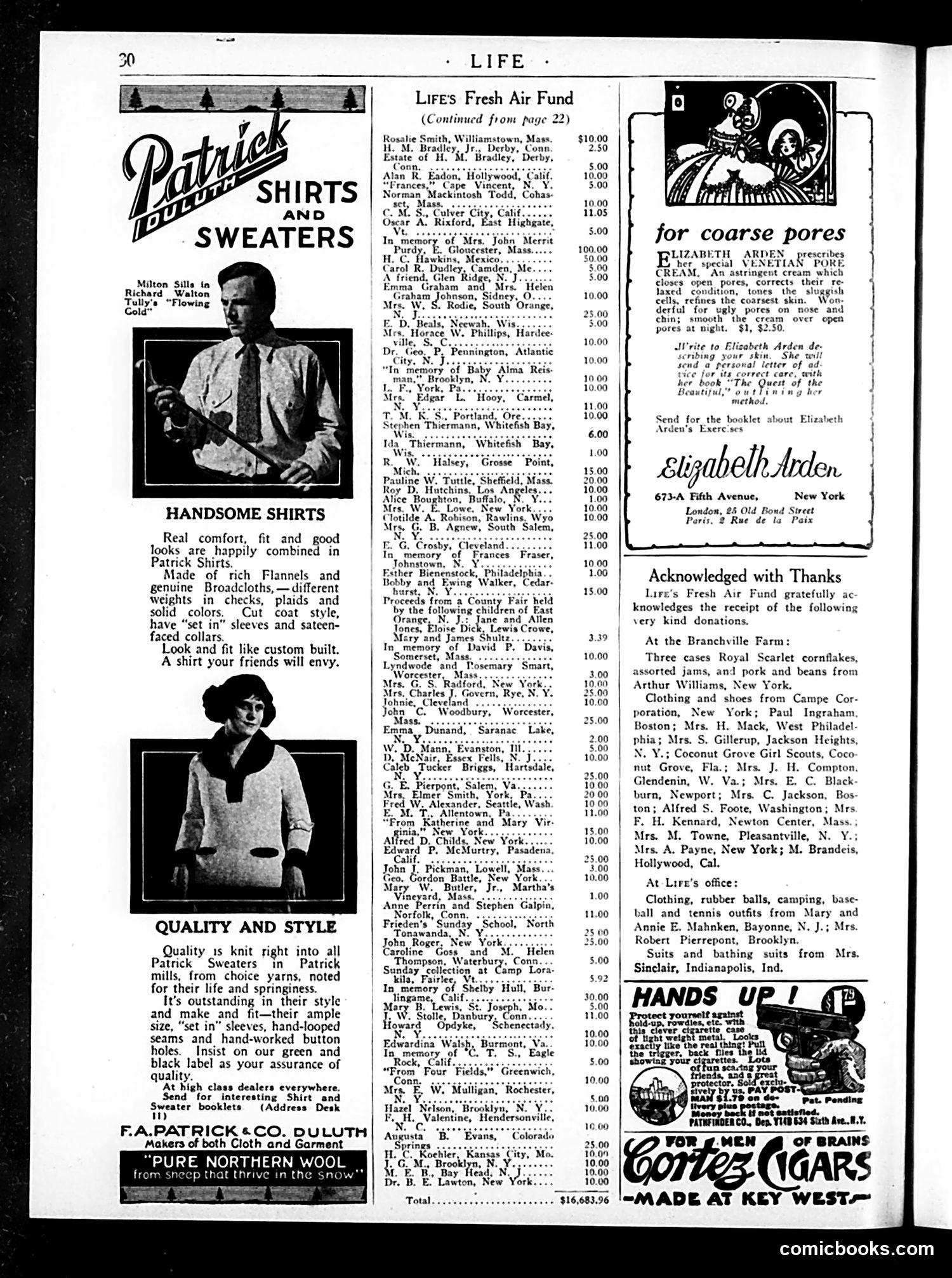
This page is primarily **advertising and charitable acknowledgments**, not political satire. The left side features ads for **Patrick brand shirts and sweaters**, emphasizing quality construction and masculine appeal—typical early-20th-century menswear marketing using the idealized male figure. The center and right columns list donations to **Life's Fresh Air Fund**, a genuine charitable program that sent urban children to the countryside for health and recreation. The listings acknowledge contributors by name and amount donated. The right side includes an **Elizabeth Arden skincare advertisement** promoting "Venetian Pore Cream" for cosmetic concerns—representative of emerging beauty industry marketing to women. At bottom right is an advertisement for **coffee and cigars** from Key West. This is a typical magazine page combining commercial and philanthropic content, with no discernible political cartoon or satire present. The page reflects early-1900s consumer culture and charitable fundraising practices.
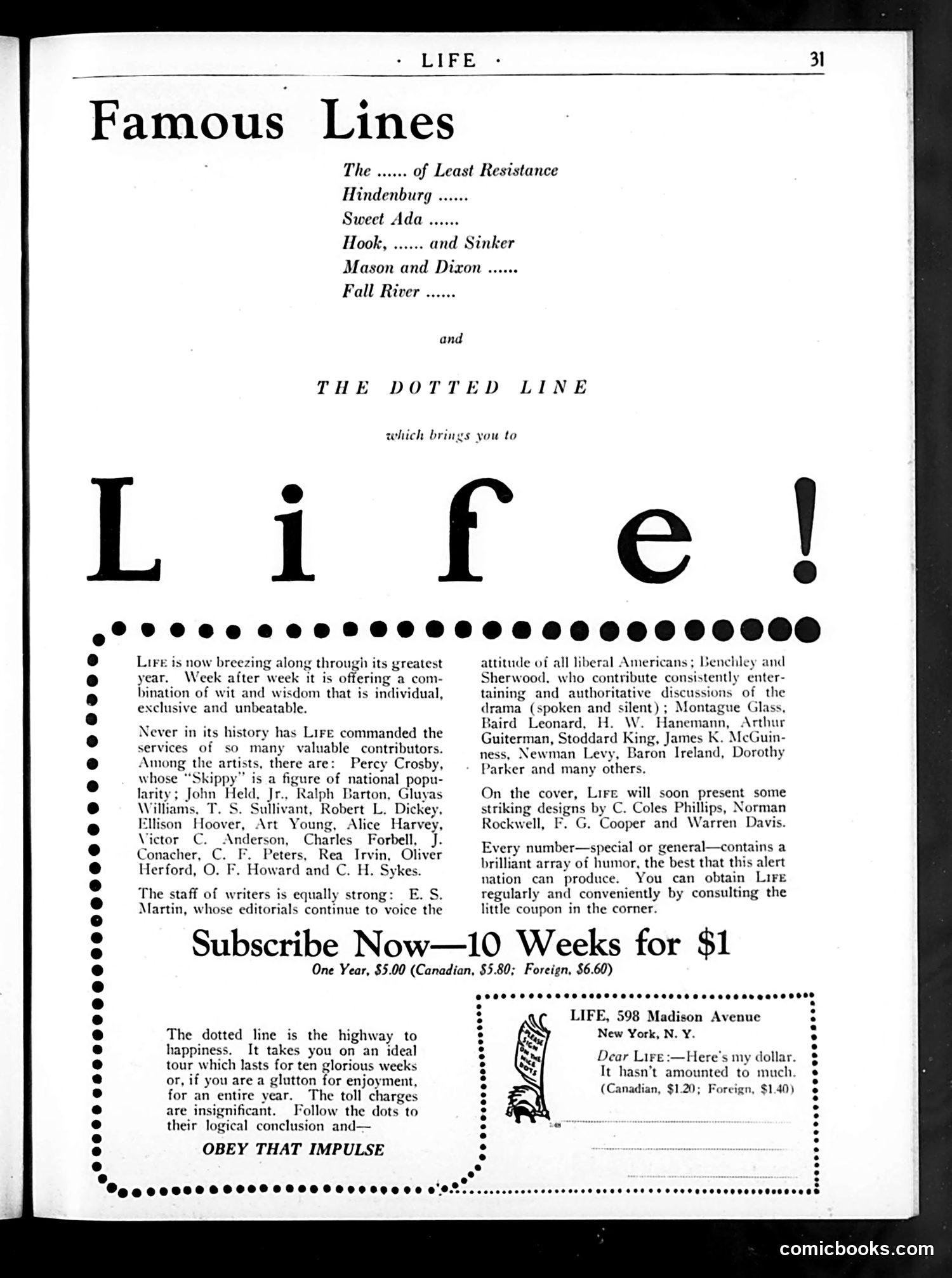
This is primarily a **subscription advertisement** for *Life* magazine, not a political cartoon. The page promotes *Life*'s contributors and offers a discounted subscription ("10 Weeks for $1"). The "Famous Lines" listed at top appear to be references to famous literary quotes or cultural touchstones of the era—"The Path of Least Resistance," "Hindenburg," "Sweet Ada"—though the specific allusions are unclear without more context. The main visual element is the decorative "dotted line" design encouraging readers to "obey that impulse" and subscribe by following the dots to the coupon. This plays on the period's advertising convention of using visual metaphors (the "path" to happiness/satisfaction) to encourage consumer action. The advertisement emphasizes *Life*'s roster of celebrated cartoonists and writers (Benchley, Dorothy Parker, Art Young, etc.) as selling points, positioning the magazine as a premium publication offering sophisticated humor and commentary to educated readers.
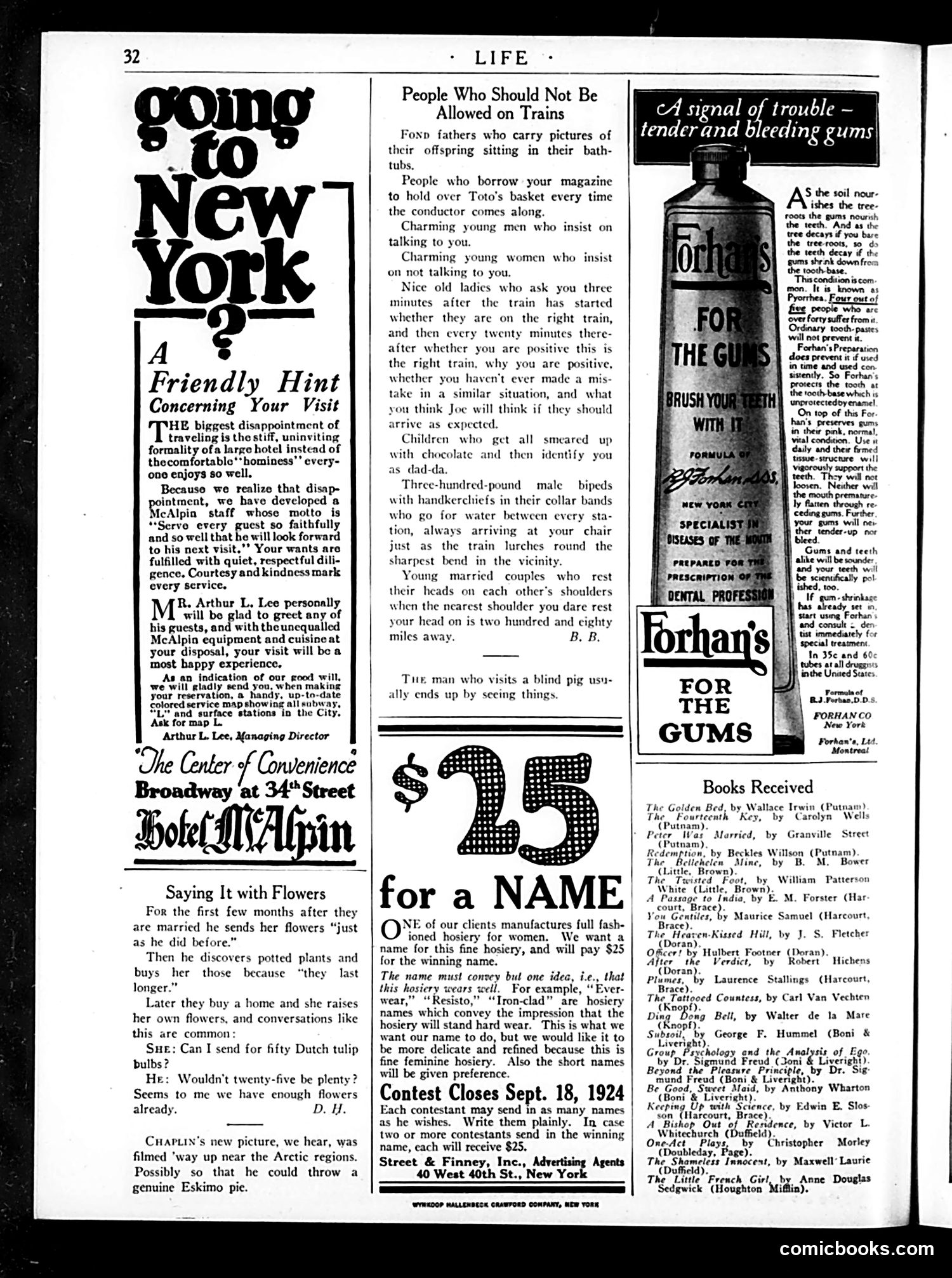
This page from *Life* magazine (circa 1924) contains several humor pieces satirizing everyday annoyances: **"People Who Should Not Be Allowed on Trains"** mocks contemporary train travel irritants: overzealous fathers showing nude baby photos, pet owners, chatty strangers, nervous elderly passengers asking repetitive questions, messy children, large men constantly seeking water, and affectionate couples hogging shoulder space. The humor relies on relatable frustrations with strangers in close quarters—a common complaint in early 20th-century rail travel. **"Saying It with Flowers"** traces the romantic decline in marriage: husbands start with fresh flowers, downgrade to potted plants for longevity, then eventually resent even modest requests for bulbs. It satirizes how marital enthusiasm diminishes over time. The **McAlpin Hotel advertisement** emphasizes personalized service to counter impersonal hotel formality—appealing to travelers' desire for "hominess." A **hosiery naming contest** offers $25 for a brand name suggesting durability while maintaining feminine refinement—reflecting 1920s consumer marketing and gender expectations.
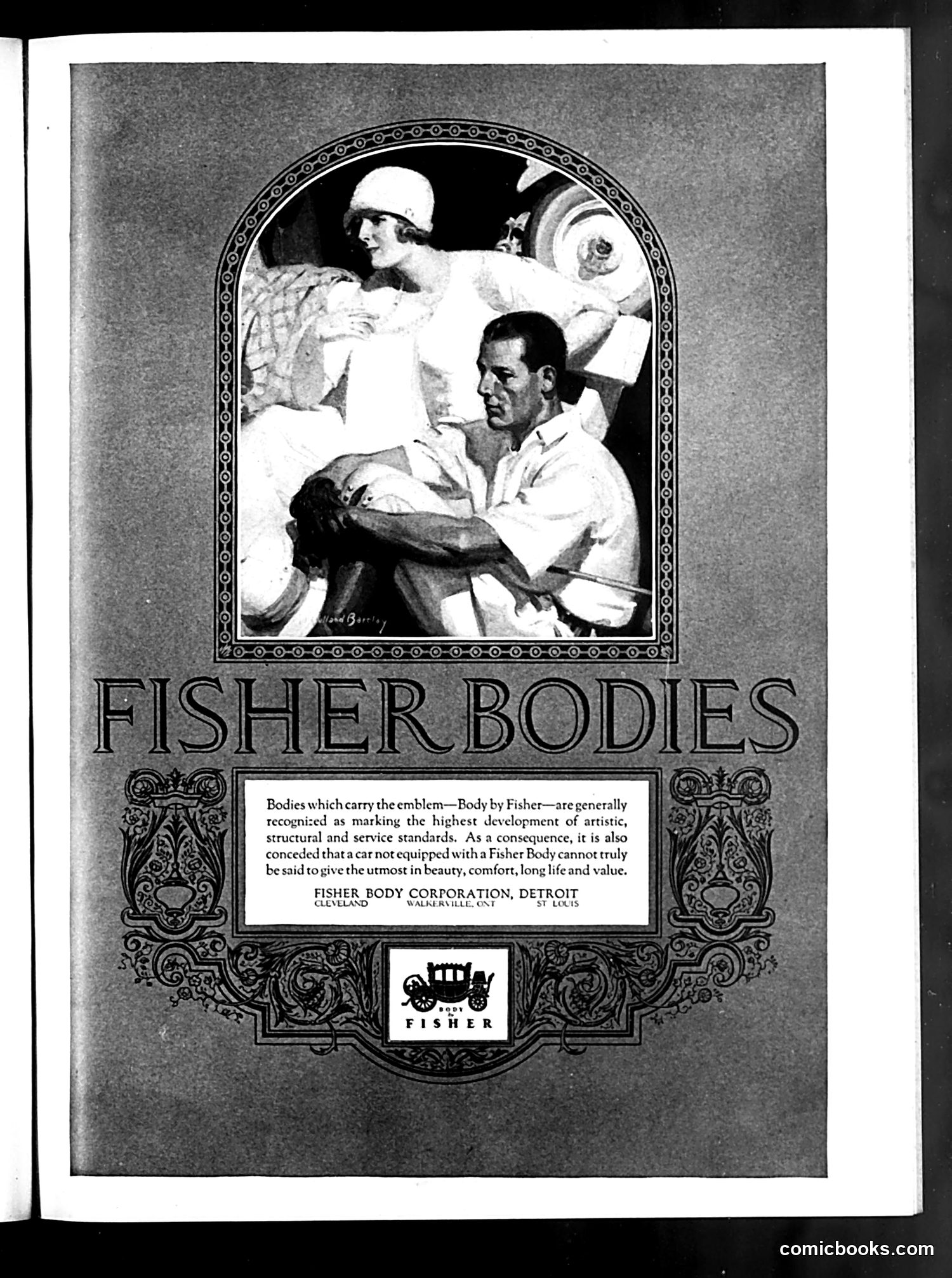
This is a **Fisher Body Corporation advertisement**, not political satire. Fisher Body was a major automobile body manufacturer that supplied car bodies to various automakers. The ad shows a craftsman and woman examining an automobile body, emphasizing Fisher's claims about quality and artisanal standards. The ornate Art Deco framing and the text's assertion that Fisher Bodies represent "the highest development of artistic, structural and service standards" represent typical early 20th-century advertising rhetoric—essentially claiming that cars without Fisher bodies cannot truly deliver "beauty, comfort, long life and value." This is straightforward corporate marketing from Life magazine's advertising pages, designed to promote Fisher Body's prestige and influence purchasing decisions among consumers.
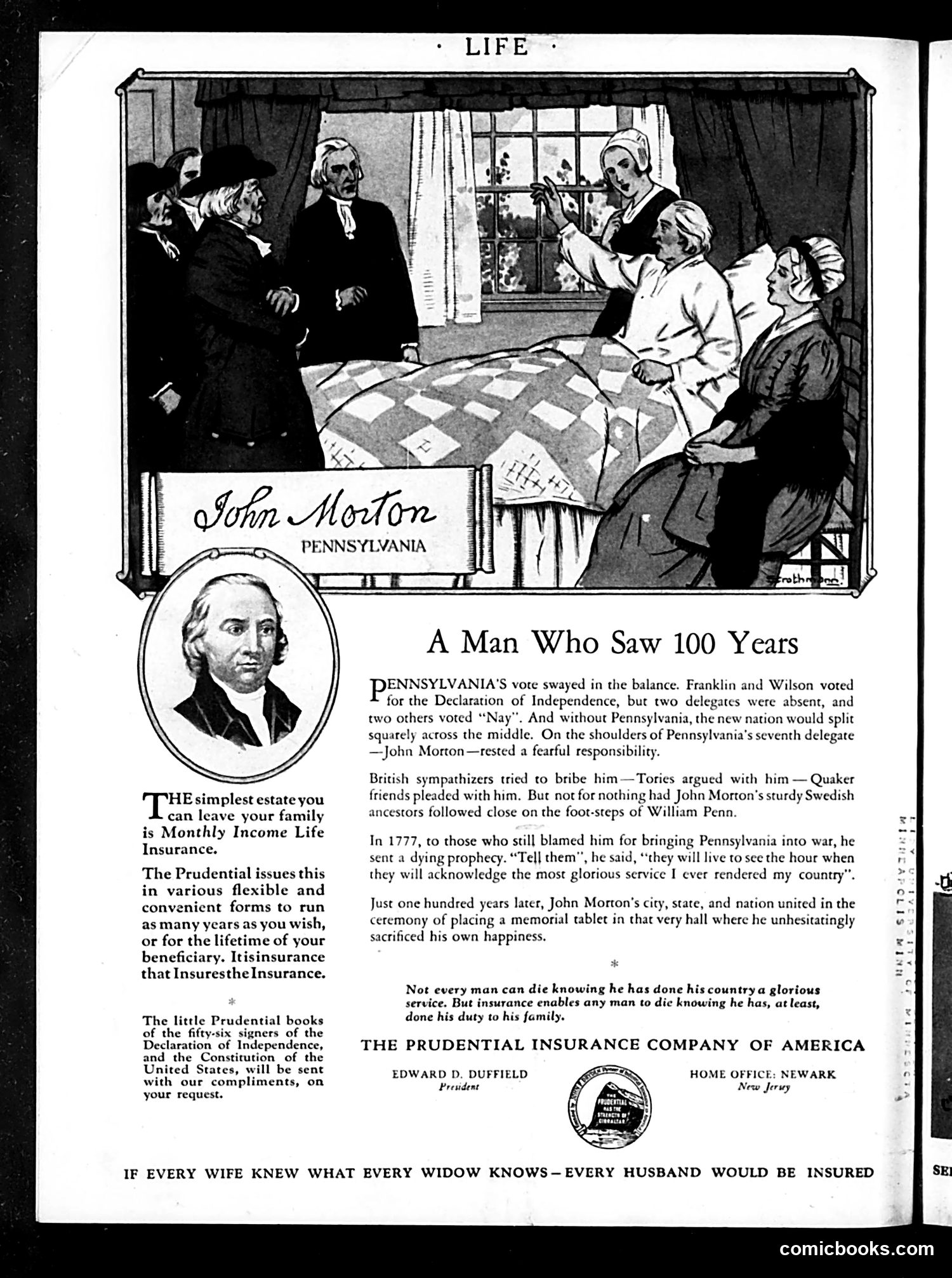
This is a Prudential Insurance advertisement masquerading as historical narrative. The illustration depicts a deathbed scene, likely representing John Morton, Pennsylvania's delegate to the Continental Congress (the text identifies him). **Historical Context:** Morton reportedly cast the deciding vote for Pennsylvania's support of the Declaration of Independence in 1776, despite intense pressure from British sympathizers and Quaker pacifists. The advertisement claims he lived to see vindication "one hundred years later" (around 1876). **The Sales Pitch:** The satire/message conflates Morton's patriotic "sacrifice" with insurance purchases. Just as Morton secured his country's future through personal sacrifice, the ad suggests husbands should secure their families' futures through life insurance. The tagline—"every husband would be insured"—implies that financial responsibility to one's family equals patriotic duty. **The Irony:** The advertisement uses nationalist sentiment and historical gravitas to sell a mundane financial product, suggesting that life insurance represents the modern equivalent of Revolutionary sacrifice.