
Life, 1924-09-04 · page 13 of 36
Life — September 4, 1924 — page 13: what you’re looking at
What you’re looking at
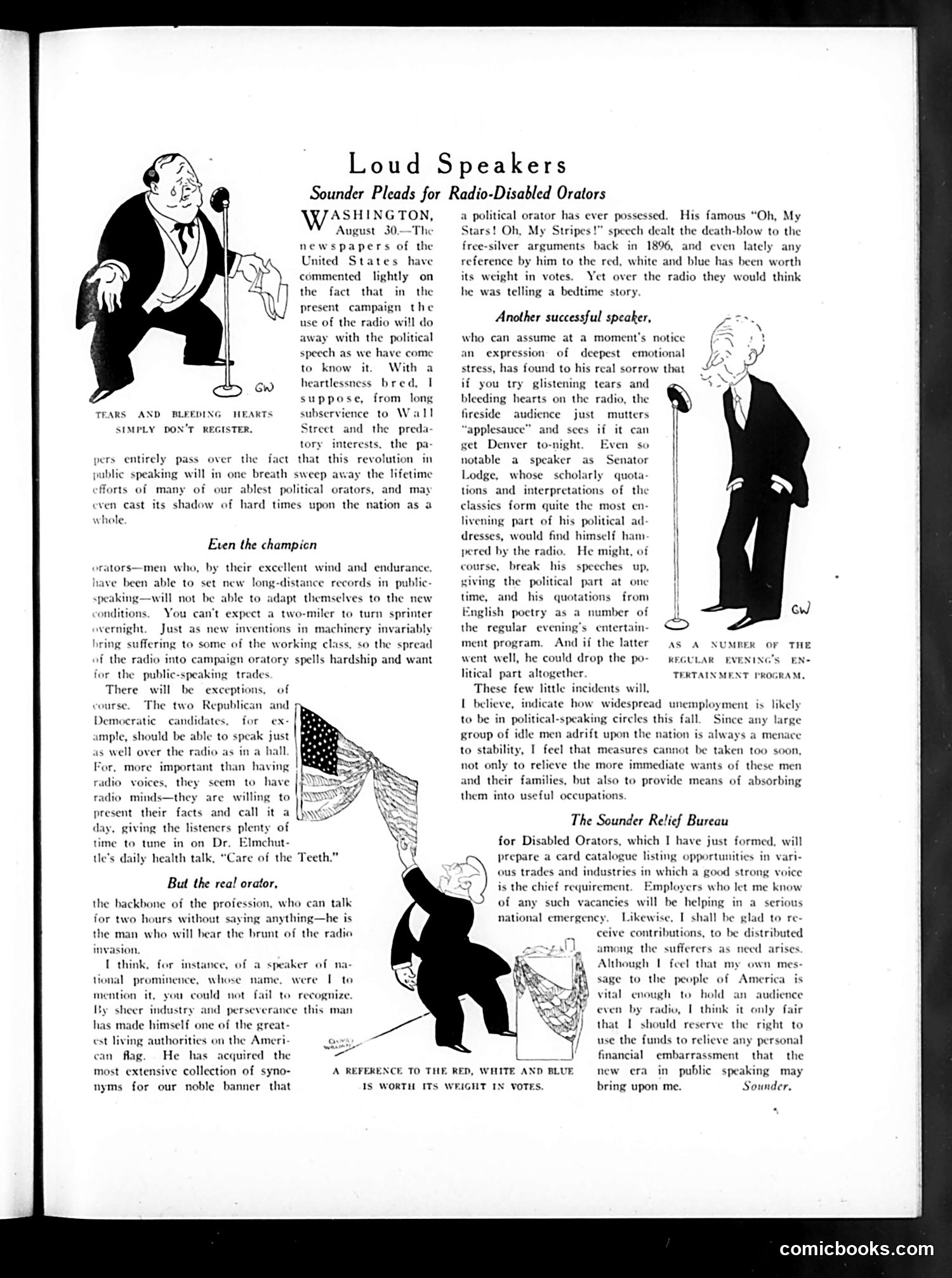
This satirical article discusses how radio broadcasting threatens traditional public speakers. The cartoons depict politicians and orators struggling with this new medium. The main argument: excellent speakers who built reputations through in-person oratory cannot easily adapt to radio's constraints. A two-mile runner cannot suddenly become a sprinter. The piece notes that Republican and Democratic candidates should learn radio technique, but acknowledges the real problem—speakers who lack the adaptability face obsolescence. The author mentions Senator Lodge as an example of a speaker whose scholarly quotes and classical references would suffer on radio's entertainment-focused programming. The satire targets the old guard of public speakers who refuse to evolve with technology, portraying them as dinosaurs unable to survive in broadcasting's new landscape. The "Sounder Relief Bureau" is a tongue-in-cheek proposed aid organization for these displaced orators.
📄 Transcribed text from this page (OCR, searchable)
Machine-transcribed from the original scan — historical spelling and the odd misread are preserved.
Loud Speakers Sounder Pleads for Radio-Disabled Orators \Y/ SSHING TON; August 30.—The newspapers of the United States have commented lightly on the fact that in’ the present campaign the use of the radio will do y with the political speech as we have come to know it. With a heartlessness bred, I suppose, from long TEARS AND BLEEDING HEARTS subservience to Wall SIMPLY DON’T REGISTER. Street and the preda tory interests, the pa- pers entirely pass over the fact that this revolution in lic speaking will in one breath sweep away the lifetime forts of many of our ablest political orators, and may even cast its shadow of hard times upon the nation as a whole. Even the champion itors—men who, by their excellent wind and endurance have been able to set new long-distance records in public- speaking—will not be able to adapt themselves to the new onditions. You can't expect a two-miler to turn sprinter wernight. Just as new inventions in machinery invariably bring suffering to some of the working class, so the spread of the radio into campaign oratory spells hardship and want for the public-speaking trades. There will be exceptions, of The two Republican and ¢ Democratic candidates, for exs| imple, should be able to speak just | course, s well over the radio as in a hall “ more important than having radio voices, they scem to have | radio minds—they are willing to ps present their facts and call it ls day, giving the listeners plenty of time to tune in on Dr. Elmchut- tle’s daily health talk, “Care of the Teeth.” But the rea! orator, the backbone of the profession, who can talk for two hours without saying anything—he is the man who will bear the brunt of the radio invasion. [ think, for instance, of a speaker of na- tional prominenc mention it, you could not fail to recognize. By sheer industry and perseverance this man has made himself one of the great- whose name. were [to est living authorities on the Ameri can flag. He has acquired the most extensive collection of syno- nyms for our noble banner that A REFERENCE TO THE RED, WHITE AND BLUE IS WORTH ITS WEIGHT IN VOTES. a political orator has ever possessed. His famous “Oh, My Stars! Oh, My Stripes!” speech dealt the death-blow to the free-silver arguments back in 1896, and even lately any reference by him to the red, white and blue has been worth its weight in votes. Yet over the radio they would think he was telling a bedtime story. Another successful speaker, who can assume at a moment's notice an expression of deepest emotional stress, has found to his real sorrow that if you try glistening tears and bleeding hearts on the radio, the fireside audience just mutters “applesau if it can get Denver to-night. Even so notable a speaker as Senator Lodge, whose scholarly quota tions and interpretations of the classics form quite the most en- livening part of his political ad dresses, would find himself ham pered by the radio. He might, of course, break his speeches up, giving the political part at one time, and his quotations from English poetry as a number of cw the regular evening's entertain- ment program. And if the latter AS A went well, he could drop the po- litical part altogether. These few little incidents will, and sees NUMBER OF THE REGULAR EVENING'S EN TERTAIN MENT PROGRAM, I believe, indicate how widespread unemployment is likely to be in political-speaking circles this fall. Since any lar; group of idle men adrift upon the nation is always a menace to stability, I feel that measures cannot be not only to relieve the more immediate wants of these men and their families, but also to provide means of absorbing them into useful occupations. The Sounder Relief Bureau for Disabled Orators, which I have just formed, will prepare a card catalogue listing opportunities in vari- en too soon, ous trades and industries in which a good strong voice is the chief requirement. Employers who let me know of any such vacancies will be helping in national emergency. Likewise, I shall be glad to re- ceive contributions, to be distributed serious among the sufferers as need arises. Although [ feel that my own mes- sage to the people of America is vital enough to hold an audience even by radio, | think it only fair that I should reserve the right to use the funds to relieve any personal L financial embarrassment that the new era in public speaking may bring upon me. Sounder, comicbooks.com