
Life, 1924-09-04 · page 16 of 36
Life — September 4, 1924 — page 16: what you’re looking at
What you’re looking at
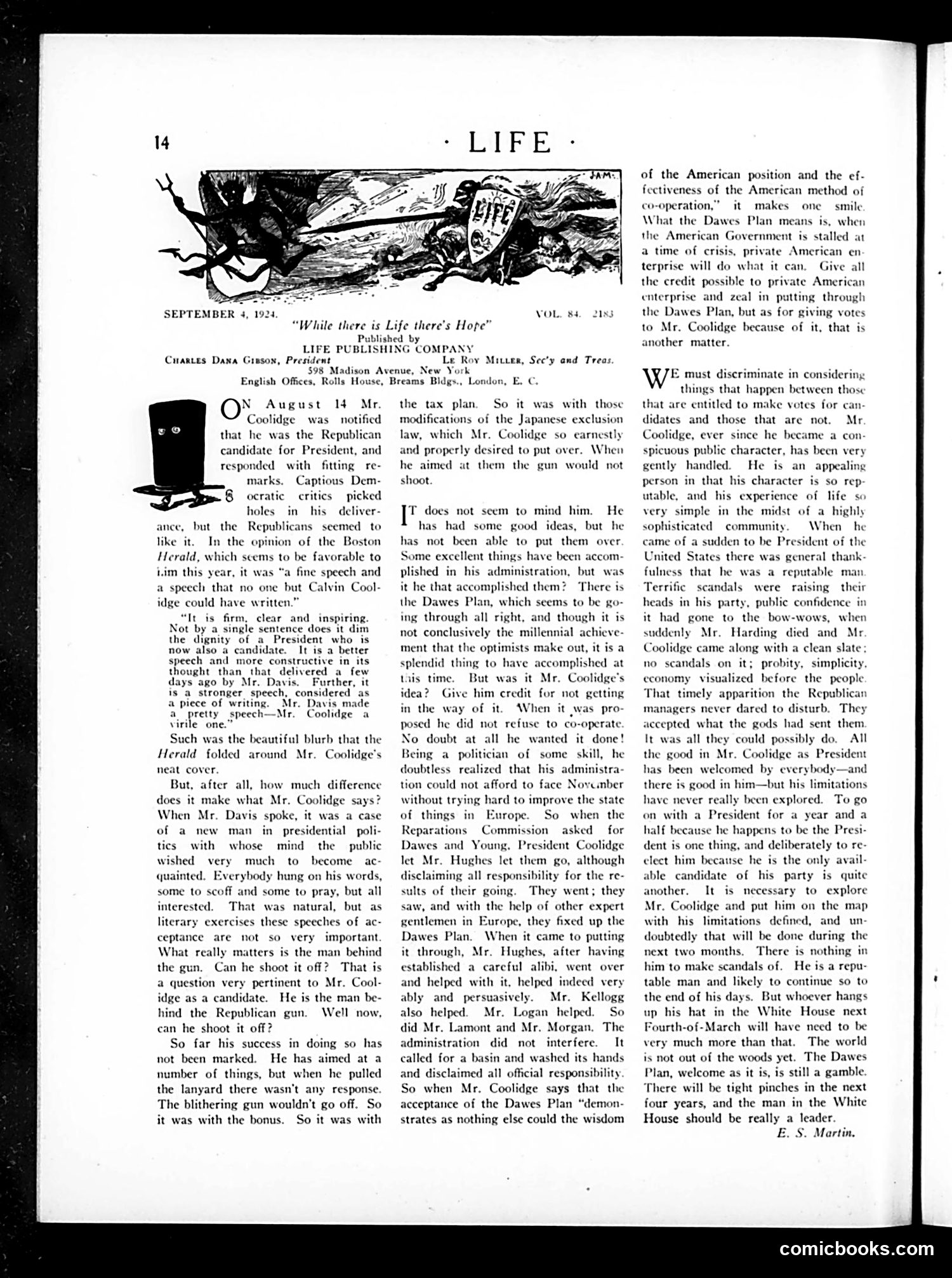
This **Life** magazine page from September 4, 1924, contains editorial commentary (not a cartoon) about President Calvin Coolidge's candidacy. The illustrated header shows a figure labeled "LIFE" observing political turmoil. The article praises Coolidge's handling of the Dawes Plan (a financial restructuring agreement with Europe) and his general competence, while acknowledging his limitations as a leader. The author notes Coolidge lacks the dynamic qualities needed for the presidency but represents stability compared to scandals of previous administrations. The piece reflects 1924 political anxieties: debates over the Dawes Plan, Republican efforts to rebuild credibility after Harding-era corruption, and whether Coolidge possessed sufficient leadership for the role. The tone is cautiously supportive but skeptical of his abilities.
📄 Transcribed text from this page (OCR, searchable)
Machine-transcribed from the original scan — historical spelling and the odd misread are preserved.
SEPTEMBER 4, 1924 VOL, 84. “While there is Life there's Hope” Published by LIFE PUBLISHING COMPANY Cuartes Dana Ginson, President Le Roy Mitter, Sec’y and Treas. 398 Madison Avenue, New York English Offices, Rolls Ho O* August 14 Mr. Coolidge notified that he was the Republican candidate for President, and responded with fitting re- marks. Captious Dem- 6 cratic critics picked holes in his deliver- ance, but the Republicans seemed to like it. In the opinion of the Boston Herald, which scems to be favorable to i.im this year, it was “a fine speech and a speech that no one but Calvin Cool- idge could have written.” “It is firm, clear and_ inspiring. Not by a single sentence does it dim the dignity of a President who is now also a candidate. It is a better speech and more constructive in its thought than that delivered a few days ago by Mr. Davis. Further, it is a stronger speech, considered as a piece of writing. Mr. Davis made ‘a. pretty speech—Mr. Coolidge a virile one.” Such was the beautiful blurb that the Herald folded around Mr. Coolidge’s neat cover. was But, after all, how much difference does it make what Mr. Coolidge says? When Mr. Davis spoke, it was a case of a new man in_ presiden poli- tics with whose mind the _ public wished very much to become ac- quainted. Everybody hung on his words, some to scoff and some to pray, but all interested. That was natural, but as literary exercises these speeches of ac- ceptance are not so very important What really matters is the man behind the gun. Can he shoot it off? That is a question very pertinent to Mr. Cool- idge as a candidate. He is the man be- hind the Republican gun. Well now, can he shoot it off? So far his success in doing so has not been marked. He has aimed at a number of things, but when he pulled the lanyard there wasn't any response. The blithering gun wouldn't go off. So it was with the bonus. So it was with . Breams Bldgs., London, E. C. the tax plan. So it was with those modifications of the Japanese exclusion which Mr. Coolidge so earnestly and properly desired to put over. When he aimed at them the gun would not shoot. I" does not seem to mind him. He has had some good ideas, but he has not been able to put them over Some excellent things have been accom- plished in his administration, but was it he that accomplished them? There is the Dawes Plan, which seems to be go- ing through all right, and though it is not conclusively the millennial achic ment that the optimists make out, it is a splendid thing to have accomplished at tais time. But was it Mr. Coolidge’s idea? Give him credit for not getting in the way of it. When it was pro- posed he did not refuse to co-operate. No doubt at all he wanted it done! Being a politician of some skill, he doubtless realized that his administra- tion could not afford to face Novunber without trying hard to improve the state of things in Europe. So when the Reparations Commission asked for Dawes and Young. President Coolidge let Mr. Hughes let them go, although disclaiming all responsibility for the re- sults of their going. They went; they and with the help of other expert gentlemen in Europe, they fixed up the Dawes Plan. When it came to putting it through, Mr. Hughes, after having established a careful alibi, went over and helped with it, helped indeed very ably and persuasively. Mr. Kellogg also helped. Mr. Logan helped. So did Mr. Lamont and Mr. Morgan. The administration did not interfere. It called for a basin and washed its hands and disclaimed all official responsibility So when Mr. Coolidge says that the acceptance of the Dawes Plan “demon- strates as nothing else could the wisdom of the American position and the ef- fectiveness of the American method of co-operation,” it) makes one smile. What the Dawes Plan means is, when the American Government is stalled at a time of crisis, private American en terprise will do what it can. Give all the credit possible to private American enterprise and zeal in putting through the Dawes Plan, but as for giving votes to Mr. Coolidge because of it, that is another matter. = must discriminate in considering things that happen between those that are entitled to make votes for can- didates and those that are not. Mr Coolidge, ever since he became a con spicuous public character, has been very gently handled. He is an appealing person in that his character is so rep: utable, and his experience of life so very simple the midst of a highly sophisticated community When he came of a sudden to be President of the United States there was general than! fulness that he was a reputable man Terrific were raising their heads in his party, public confidence in it had gone to the bow-wows, when suddenly Mr. Harding died and Mr Coolidge came along with a clean slate: no scandals on it; probity, simplicity, economy visualized before the people That timely apparition the Republic: managers never dared to disturb. They accepted what the gods had sent them. It was all they could possibly do. All the good in Mr. Coolidge as President has been welcomed by everybody—and there is good in him—but his limitations n explored. To go on with a President for a year and a half because he happens to be the Presi- dent is one thing, and deliberately to re- elect him because he is the only avail- able candidate of his party is quite another. It is necessary to explore Mr. Coolidge and put him on the map with his limitations defined, and un- doubtedly that will be done during the next two months. There is nothing in him to make scandals of. He is a repu- table man and likely to continue so to the end of his days. But whoever hangs up his hat in the White House next Fourth-of-March will have need to be very much more than that. The world is not out of the woods yet. The Dawes Plan, welcome as it is, is still a gamble. There will be tight pinches in the next four years, and the man in the White House should be really a leader. E. S. Martin, scandals have never really be comicbooks.com