
Life, 1924-09-04 · page 20 of 36
Life — September 4, 1924 — page 20: what you’re looking at
What you’re looking at
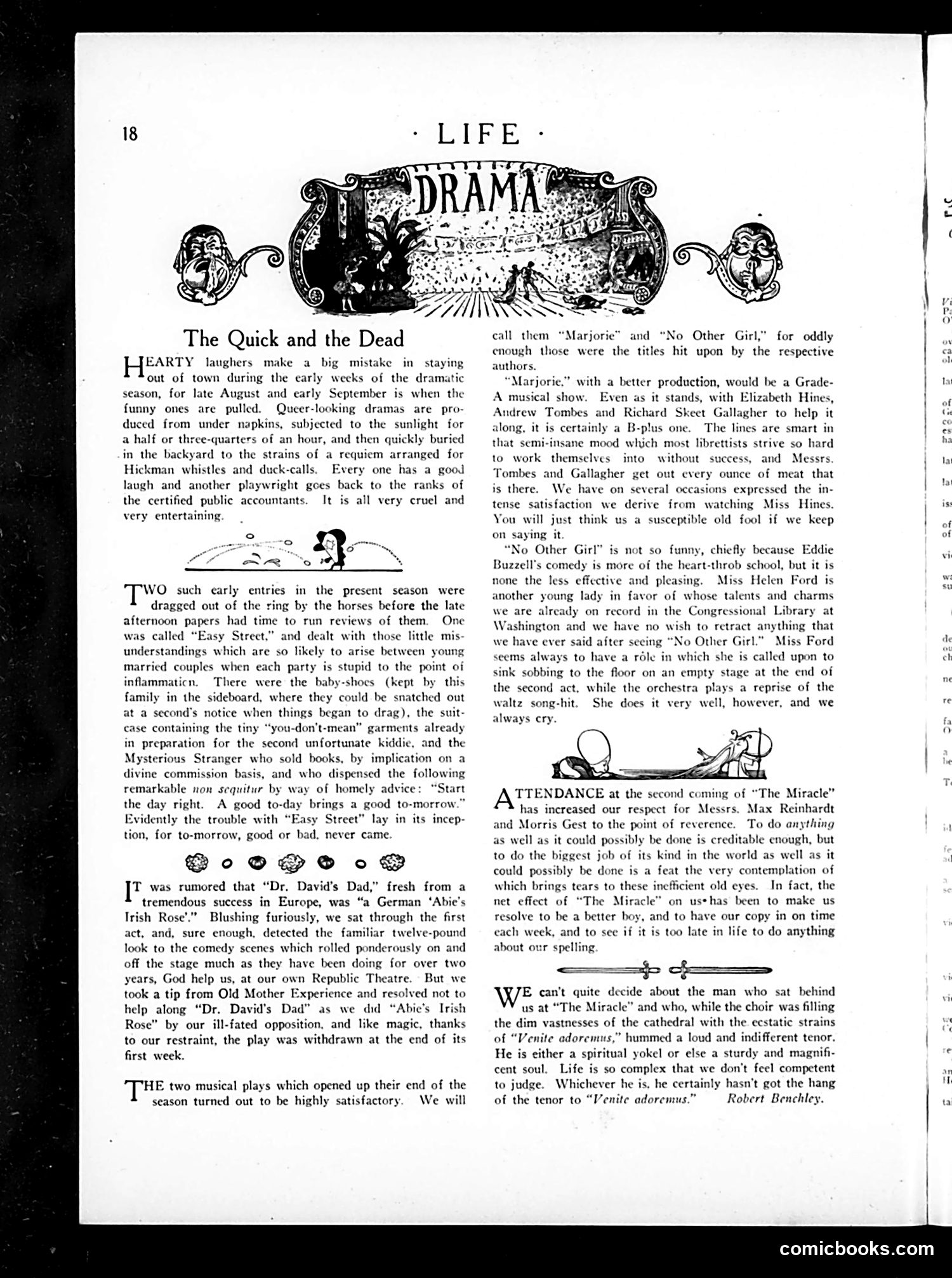
This page reviews early-season theatrical productions, employing Life's characteristic satirical tone. The author mocks poorly-conceived plays that open in late August/early September, suggesting they're quickly "buried" after bad reviews—a metaphor for theatrical flops. Two specific plays receive criticism: "Easy Street" (plot details about marital discord and a mysterious book-seller) closed quickly; "Dr. David's Dad," rumored to be a German knockoff of the successful "Abie's Irish Rose," lasted only one week despite the author's deliberate refusal to promote it (contrasting with their earlier opposition to "Abie's Irish Rose"). Two musicals—"Marjorie" (with Elizabeth Hines and Richard Skeel Gallagher) and "No Other Girl" (with Helen Ford)—receive qualified praise. The critic appreciates the performers' talents, particularly praising Hines while gently mocking Ford's tendency toward melodramatic floor-sobbing scenes during orchestral reprises. The satire targets both hackneyed theatrical formulas and audience sentimentality.
📄 Transcribed text from this page (OCR, searchable)
Machine-transcribed from the original scan — historical spelling and the odd misread are preserved.
The Quick and the Dead EARTY laughers make a big mistake in staying out of town during the carly wecks of the dramatic season, for late August and early September is when the funny ones are pulled. Queer-looking dramas are pro- duced from under napkins, subjected to the sunlight for a half or three-quarters of an hour, and then quickly buried in the backyard to the strains of a requiem nged for Hickman whistles and duck-calls, has a good laugh and another playwright goes back to the ranks of the certified public accountants. It is all very cruel and very entertaining. ery one ‘WO such early entries in the present season were dragged out of the ring by the horses before the late afternoon papers had time to run reviews of them. One was called sy Strect,” and dealt with those little mis understandings which are so like married couples when each party is stupid to the point of inflammaticn. There were the baby-shoes (kept by this family in the sideboard, where they could be snatched out at a second’s notice when things began to drag), the suit- case containing the tiny “you-don't-mean” garments already in preparation for the second unfortunate kiddie, and the Mysterious Stranger who sold books, by implication on a divine commission basis, and who dispensed the following remarkable non sequitur by way of homely advice: “Start the day right. A good to-day brings a good to-morrow.” Evidently the trouble with y Street” lay in its incep- tion, for to-morrow, good or bad, never came. QBorBMme og T was rumored that “Dr. David's Dad,” fresh from a tremendous success in Europe, was “a German ‘Abie’s Trish Rose’.” Blushing furiously, we sat through the first , and, sure enough, detected the familiar twelve-pound look to the comedy scenes which rolled ponderously on and off the stage much as they have been doing for over two years, God help us, at our own Republic Theatre. But we took a tip from Old Mother Experience and resolved not to help along “Dr. David's Dad” as we did “Abie’s Irish Rose” by our ill-fated opposition, and like magic, thanks to our restraint, the play was withdrawn at the end of its first week. to arise between young THE two musical plays which opened up their end of the season turned out to be highly satisfactory. We will call them “Marjorie” and “No Other Girl,” for oddly enough those were the titles hit upon by the respective authors. “Marjorie.” with a better production, would be a Grade- A musical show. Even as it stands, with Elizabeth Hines, Andrew Tombes and Richard Skect Gallagher to help it along, it is certainly a B-plus one. The lines are smart in that semi-insane mood which most librettists strive so hard to work themselves into without ss, and Messrs Tombes and Gallagher get out every ounce of meat that is there. We tense satisfaction we derive from watching Miss Hines. You will just think us a susceptible old fool on saying it “No Other Girl” is not so funny, chiefly because Buzzell’s comedy is more of the heart-throb school, but it is none the less effective and pleasing. Miss Helen Ford is another young lady in favor of whose talents and charms we are already on record in the Congressional Library at Washington and we have no wish to retract anything that we have ever said after seeing “No Other Girl.” Miss Ford seems always to have a réle in which she is called upon to sink sobbing to the floor on an empty stage at the end of the second act, while the orchestra plays a reprise of the waltz song-hit. She does it very well, however, and we always cry. € on several occasions expressed the in- f we keep die TT “The Miracle” has increased our respect for Messrs. Max Reinhardt and Morris Gest to the point of reverence. To do anything as well as it could possibly be done is creditable enough, but to do the biggest job of its kind in the world as well as it could possibly be done is a feat the very contemplation of which brings tears to these inefficient old eyes. In fact, the net effect of “The Miracle” on us*has been to make us resolve to be a better boy, and to have our copy in on time cach week, and to see if it is too late in life to do anything about our spelling. E can't quite decide about the man who sat behind us at “The Miracle” and who, while the choir was filling the dim vastnesses of the cathedral with the ecstatic strains of “Venite adoremus,” hummed a loud and indifferent tenor. He is either a spiritual yokel or else a sturdy and magnifi- cent soul. Life is so complex that we don’t feel competent to judge. Whichever he is. he certainly hasn't got the hang of the tenor to “Venite adoremus.” Robert Benchley. —— comicbooks.com of dc ta