
A complete issue · 36 pages · 1924
Life — July 24, 1924
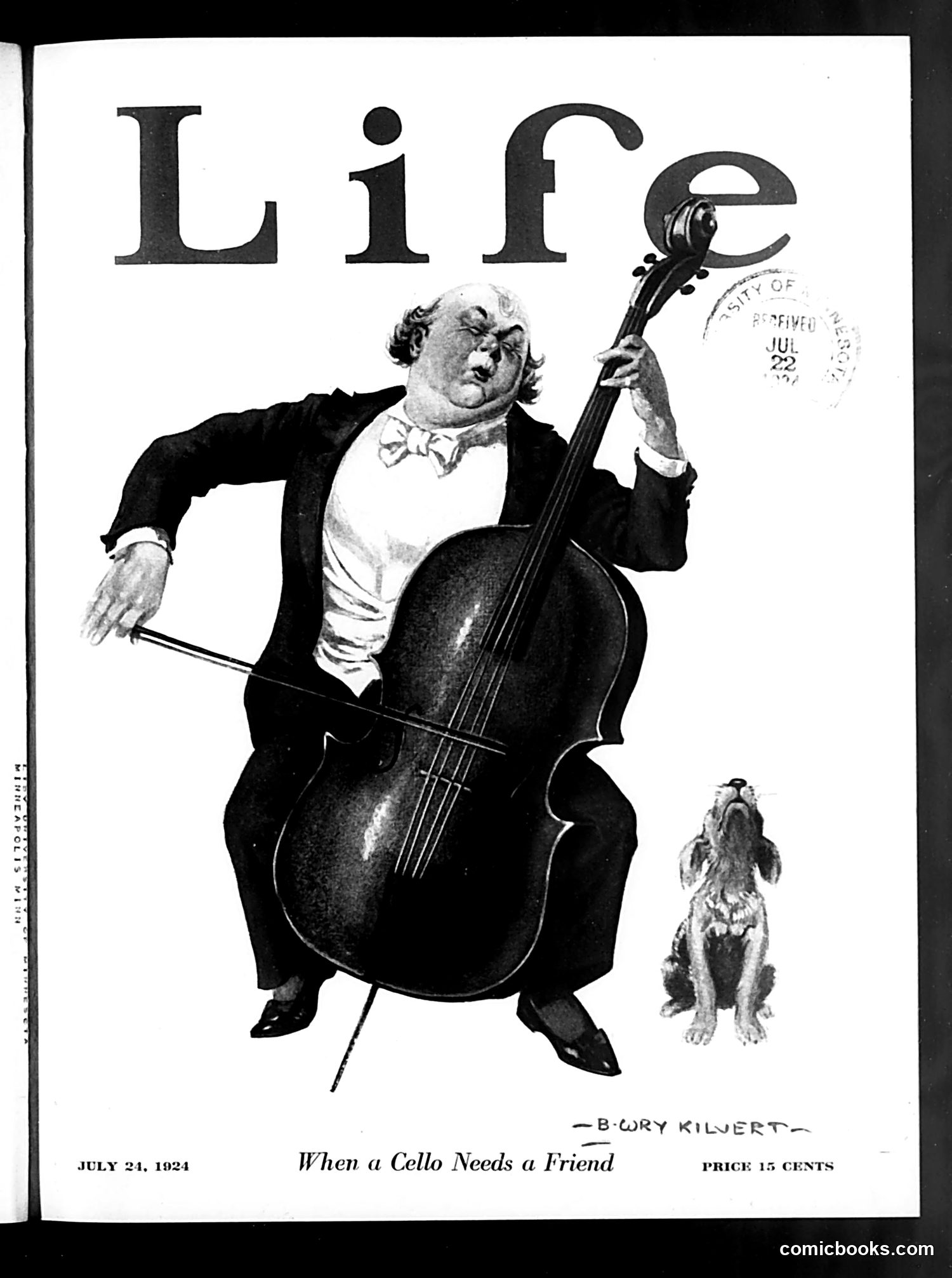
This satirical cover titled "When a Cello Needs a Friend" depicts a rotund man in formal attire playing a cello while a small dog sits nearby. The artist is credited as "B. Lorry Kilvert." The humor appears to be visual rather than tied to a specific political event. The joke likely plays on the phrase "a friend in need"—the man and his cello "need" the companionship of the small dog, creating a sentimental or absurdist image. The exaggerated physical appearance of the cellist and the incongruous pairing with the tiny dog suggest gentle mockery of classical music pretensions or perhaps commentary on human-animal companionship. Without additional context from the magazine's interior, the specific satirical target remains unclear, though it appears to be general social or cultural humor rather than political satire.
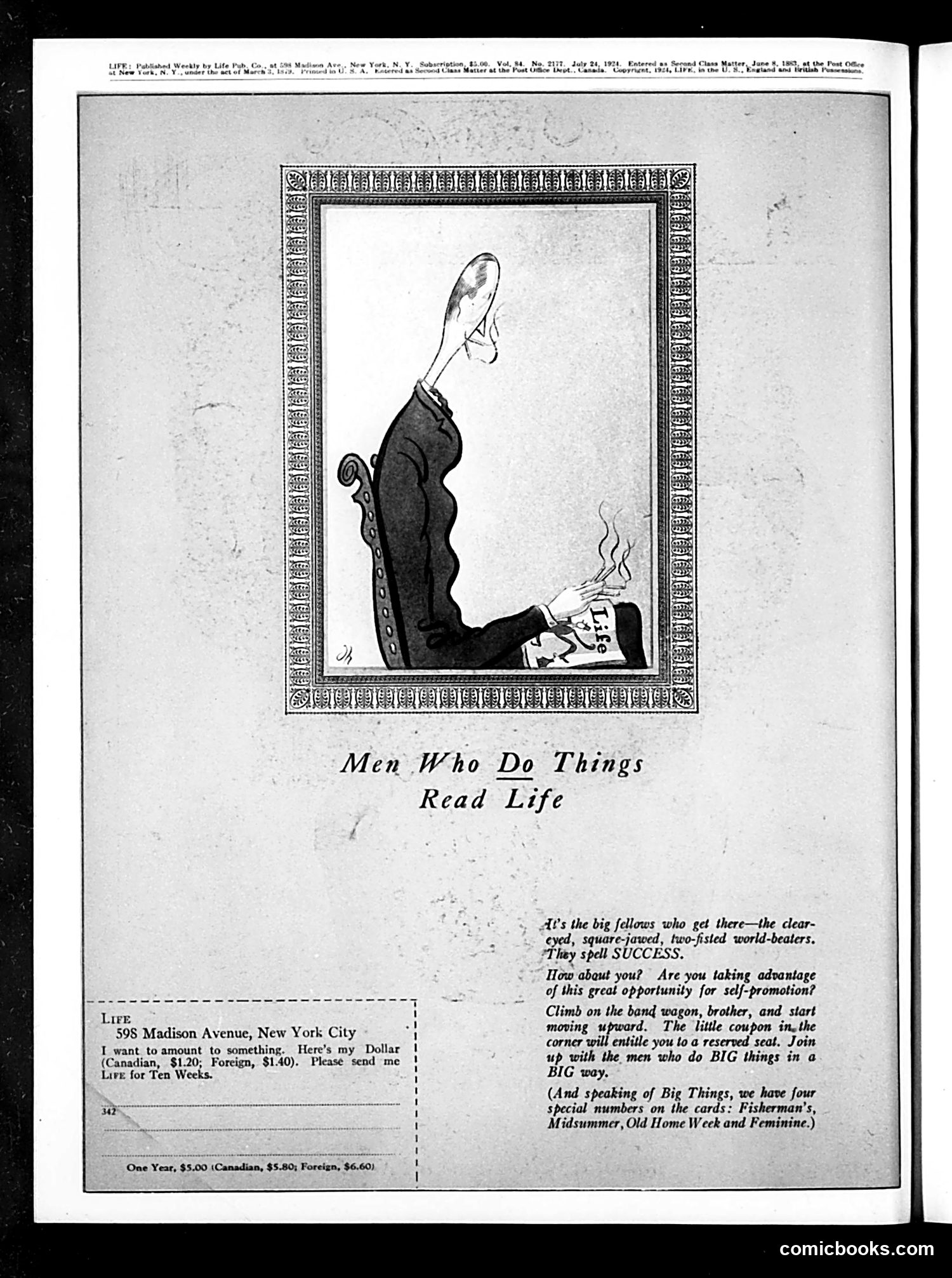
This is a **Life magazine advertisement** promoting subscription, not political commentary. The cartoon depicts a well-dressed man in a suit reading *Life* magazine while relaxing—his leg raised casually, appearing content and successful. The headline "Men Who Do Things Read Life" is a straightforward marketing claim: successful, ambitious men subscribe to the magazine. The accompanying text encourages readers to "climb on the band wagon" and join other "big fellows" and "world-beaters" who read *Life*. The satire here is **self-promotional**: *Life* magazine is essentially claiming that reading it is a marker of success and sophistication. The ornate decorative border and the man's refined appearance reinforce this aspirational messaging—subscribing positions you among society's achievers. This reflects early 20th-century advertising tactics using class aspiration and status anxiety as sales tools.
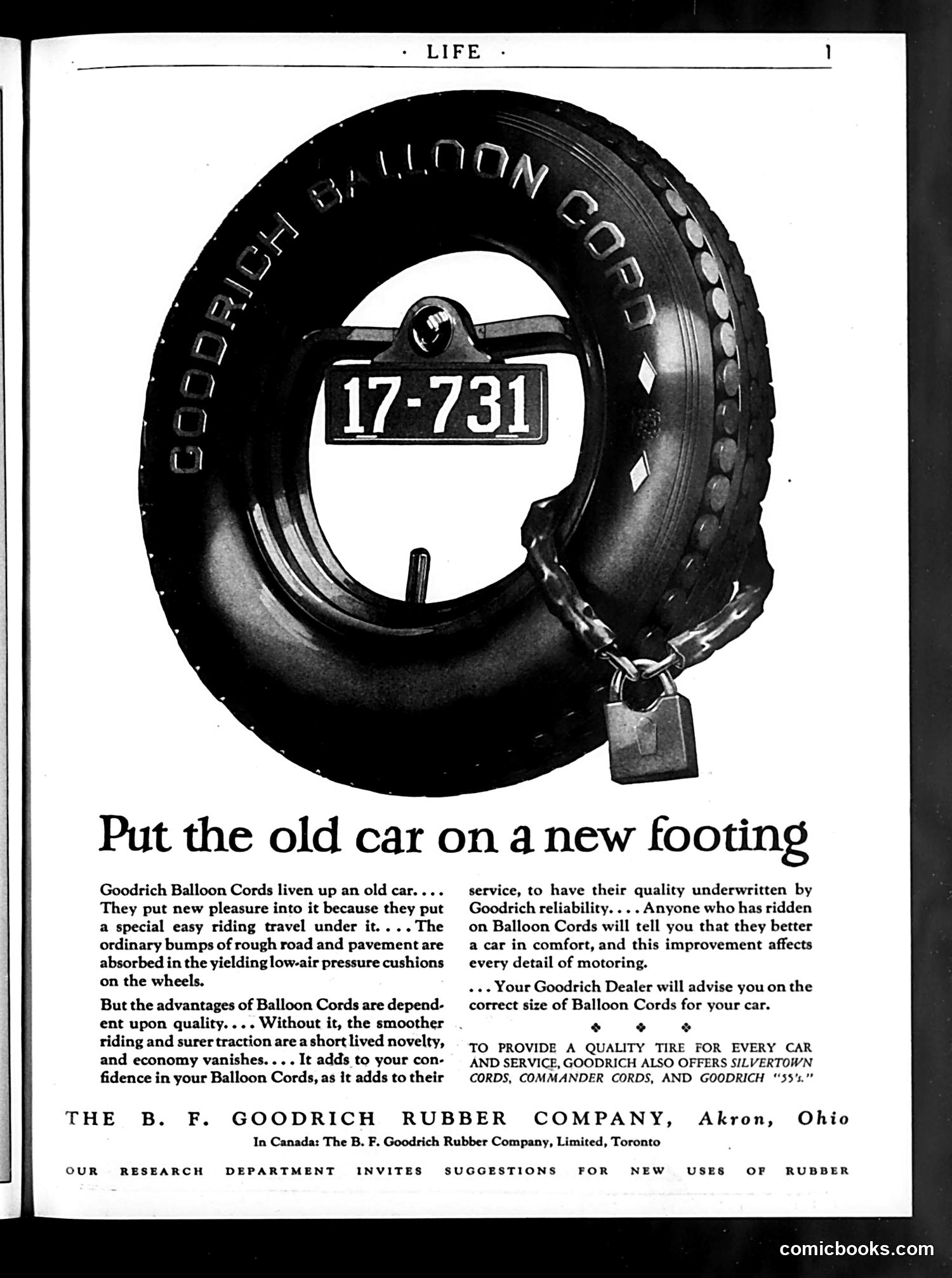
This is **not a political cartoon or satire**, but rather a **straight advertisement** for Goodrich Balloon Cords (tire products) from The B.F. Goodrich Rubber Company of Akron, Ohio. The image shows a tire and inner tube secured with a padlock, labeled "17-731." The ad's message is literal: Goodrich Balloon Cords will revitalize old cars by improving ride quality and comfort through low-pressure cushioned wheels. The headline "Put the old car on a new footing" uses figurative language to suggest tire replacement will restore worn vehicles. The padlock symbolizes security and reliability—key selling points for the product. This appears in *Life* magazine's advertising section rather than editorial content.
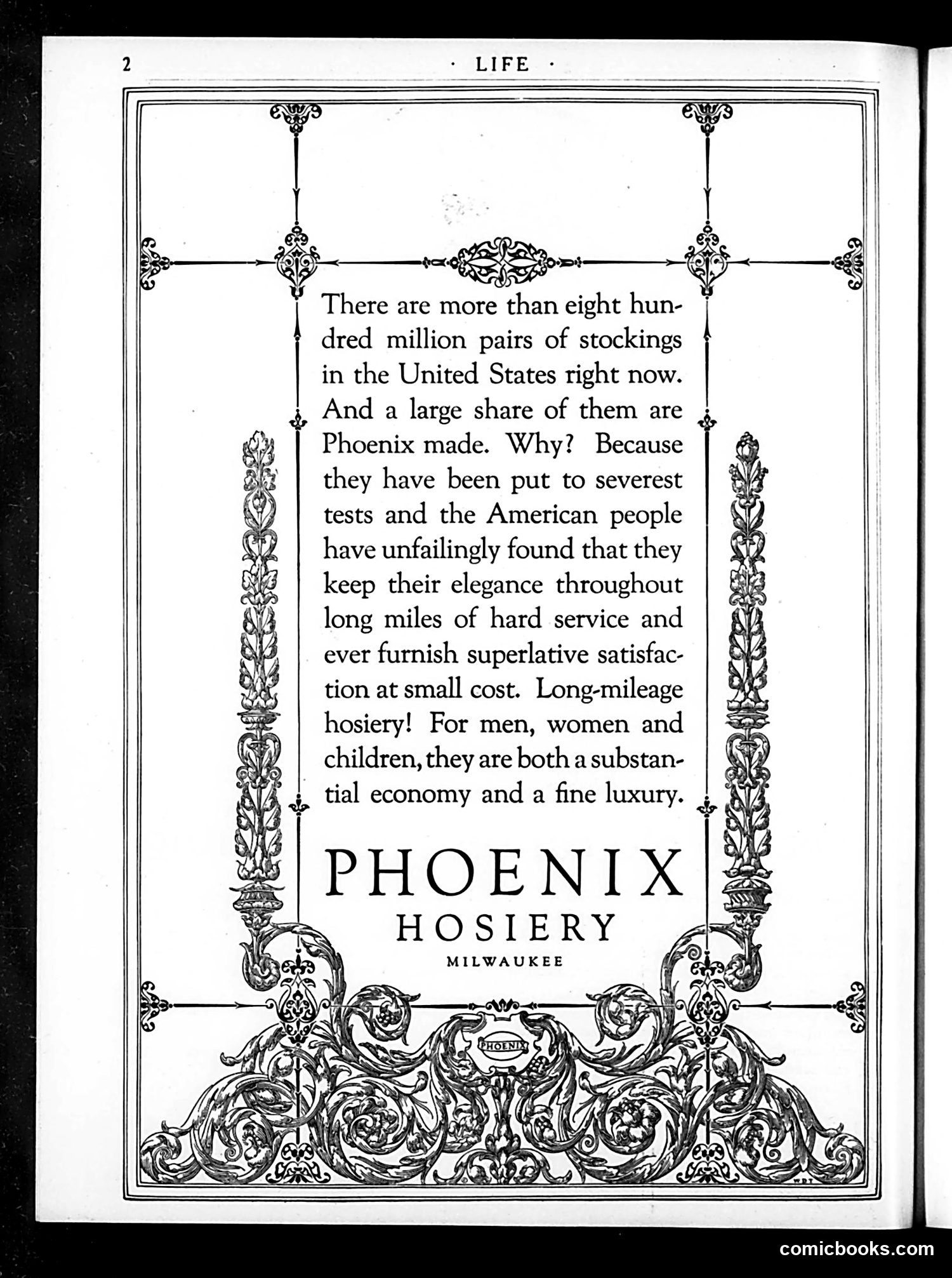
This page is **not a cartoon or satirical content**—it's a straightforward advertisement for Phoenix Hosiery, manufactured in Milwaukee. The ad claims Phoenix stockings are the leading brand in America because they withstand rigorous testing and maintain quality through extended wear. The copywriting emphasizes durability and value: stockings provide both practical economy and refined elegance for "men, women and children." The ornate Art Nouveau-style border and typography reflect early 20th-century advertising aesthetics rather than satire. The ad appears in *Life* magazine's advertising pages, making it commercial content rather than editorial commentary. There are no political references, caricatures, or satirical intent—simply a manufacturer promoting their product's reliability and affordable luxury to contemporary consumers.
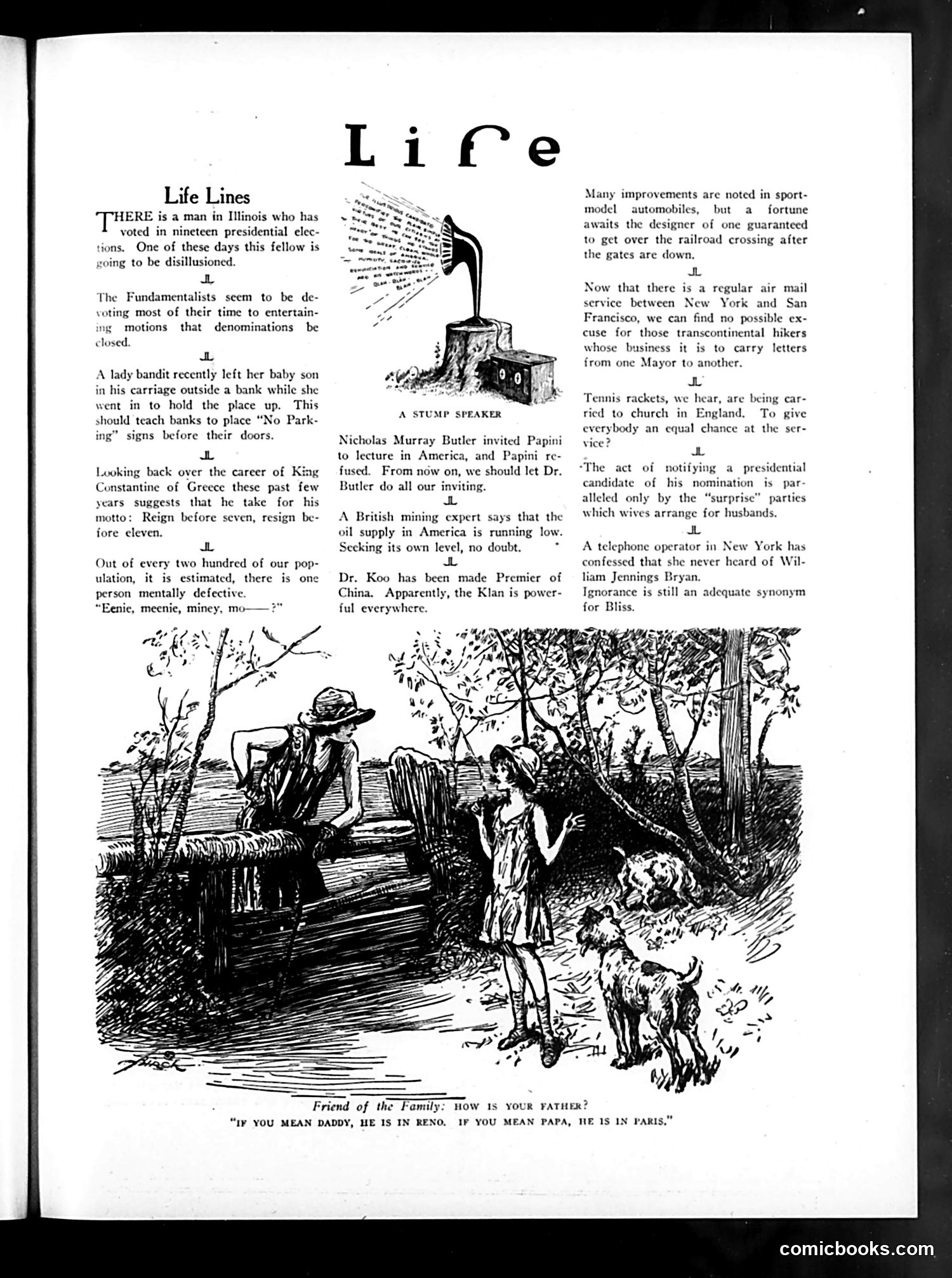
This satirical page from *Life* magazine contains short political and social commentary pieces titled "Life Lines." The top section features a woodcut-style illustration labeled "A STUMP SPEAKER"—a caricature of a politician addressing constituents, with scattered text representing his rhetoric. The jokes target early 20th-century American politics and society: fundamentalist religious movements being "disillusions," political candidates' wives arranging nominations, and ignorance about public figures (referencing someone unfamiliar with William Jennings Bryan). The bottom illustration shows a family scene with the caption: "IF YOU MEAN DADDY, HE IS IN RENO. IF YOU MEAN PAPA, HE IS IN PARIS"—satirizing wealthy Americans' marital infidelity and their habit of maintaining separate residences in fashionable locations during separations. The humor derives from the casual acknowledgment of familial dissolution.
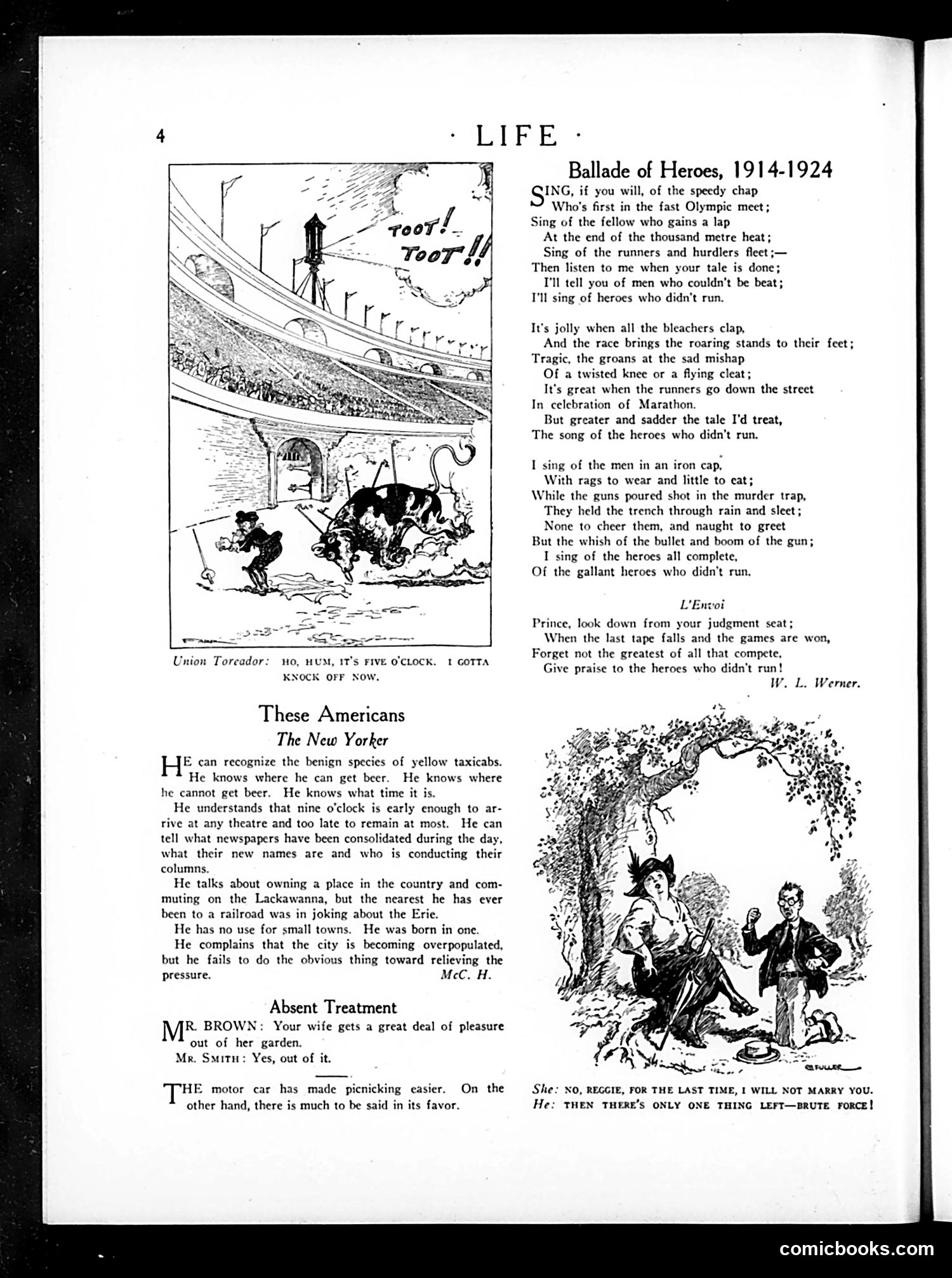
**Top Cartoon**: Depicts a horse racing scene at what appears to be an Olympic stadium. The caption "Union Toreadore: Ho, hum, it's five o'clock. I gotta knock off now" suggests satire about a bullfighter's casual attitude toward his work—treating it as just another job with regular hours, rather than a serious sporting or artistic endeavor. **Main Content**: The page features three literary pieces: a patriotic poem "Ballad of Heroes" honoring WWI soldiers who didn't flee combat, and two short prose pieces ("These Americans" and "Absent Treatment") satirizing everyday American life—taxi drivers, overpopulated cities, and motor cars. The bottom illustration appears unrelated, showing a romantic scene under a tree.
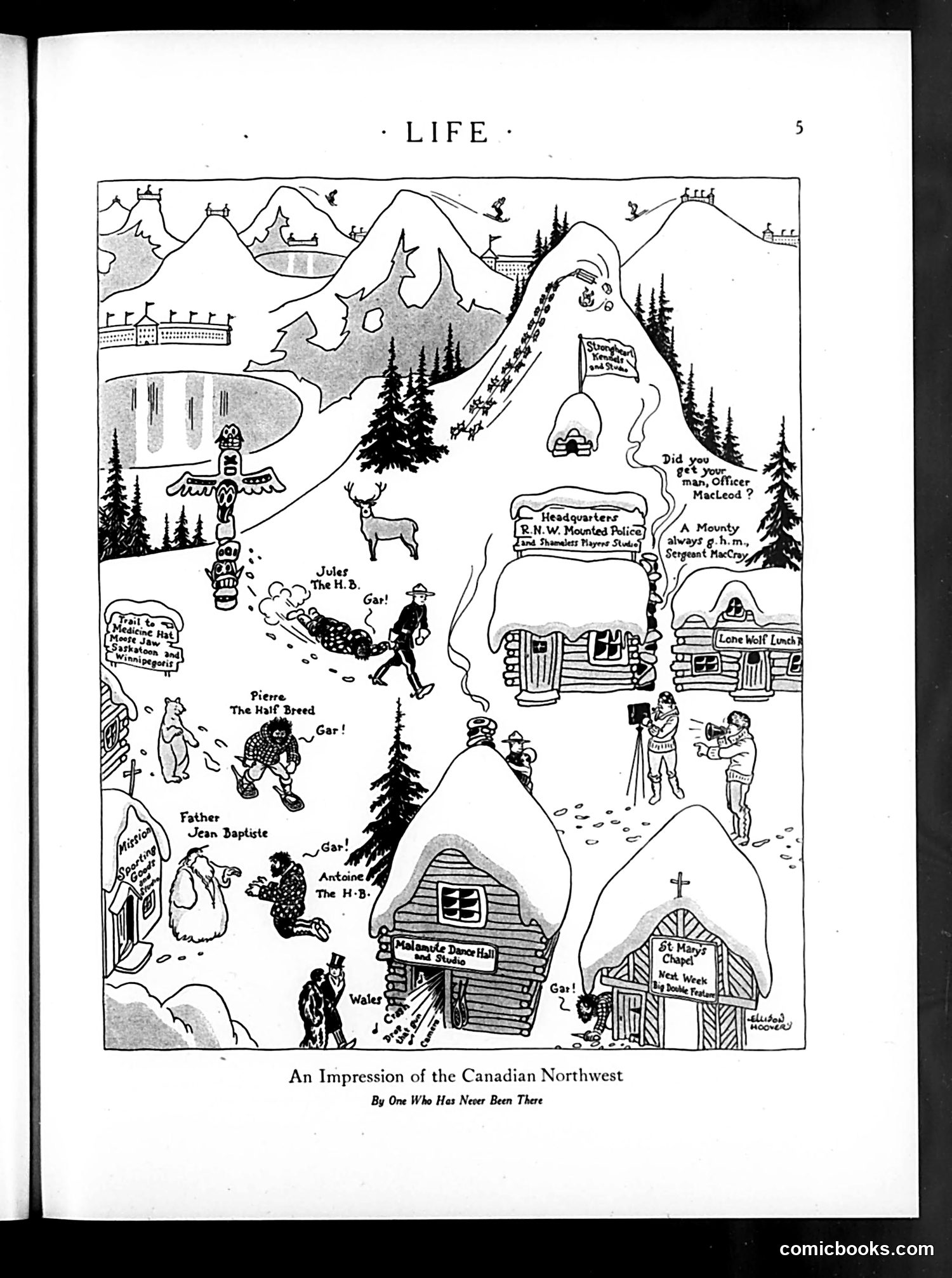
This is a humorous map-cartoon titled "By One Who Has Never Been There," satirizing stereotypical Western Canadian frontier life. The illustration depicts an exaggerated, romanticized vision featuring: - **RCMP Mounted Police headquarters** and officers - **Frontier characters** labeled as French-Canadian types (Pierre "The Half-Breed," Father Jean Baptiste, Antoine "The H.B.") - **Wilderness elements**: deer, log cabins, churches, trading posts - **Comedic captions** with exaggerated accents and situations ("Gar!") - **Hudson's Bay Company references** (H.B.) The satire mocks outsiders' fanciful, clichéd perceptions of Canada's North—treating it as a wild, colorful frontier populated by colorful ethnic characters, rather than as a real, complex region. It's gentle mockery of how distant Americans imagined (or romanticized) Canadian life based on popular fiction.
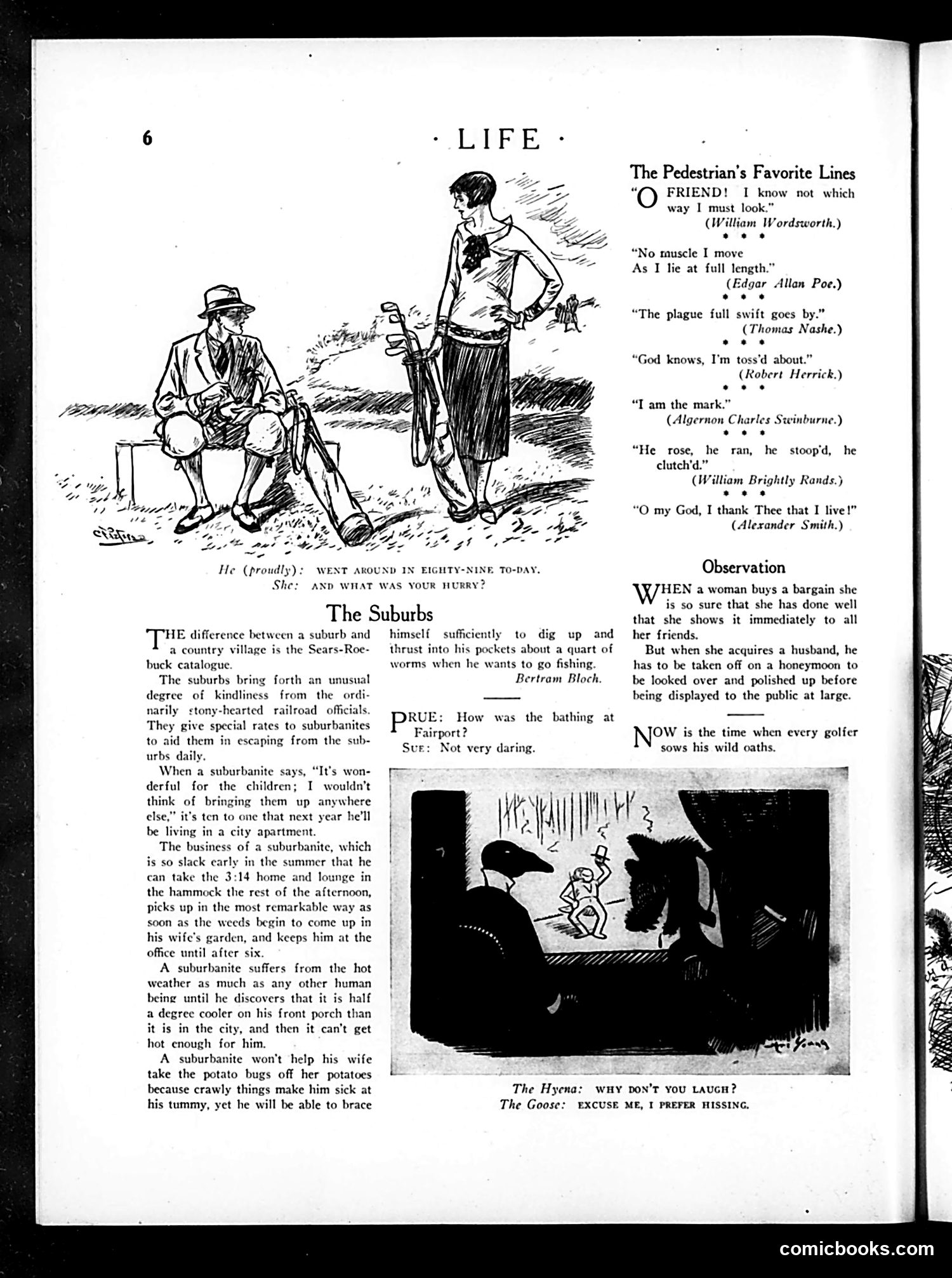
This page contains several satirical pieces typical of early 20th-century Life magazine. **"The Suburbs"** article mocks suburban life, suggesting it's a compromise between city and country living. The text criticizes suburbanites who can't fully commit to either lifestyle—they want urban convenience with rural charm but end up with neither. **"The Pedestrian's Favorite Lines"** collects famous literary quotes about walking and movement, appearing to be a light cultural commentary. The top cartoon shows a man who walked 89 miles in a day, with his wife asking "what was your hurry?"—a simple domestic joke about overexertion. The bottom cartoon labeled "The Hyena" and "The Goose" appears to depict animals refusing to laugh or participate, suggesting reluctance or avoidance of something (the context isn't entirely clear from this page alone).
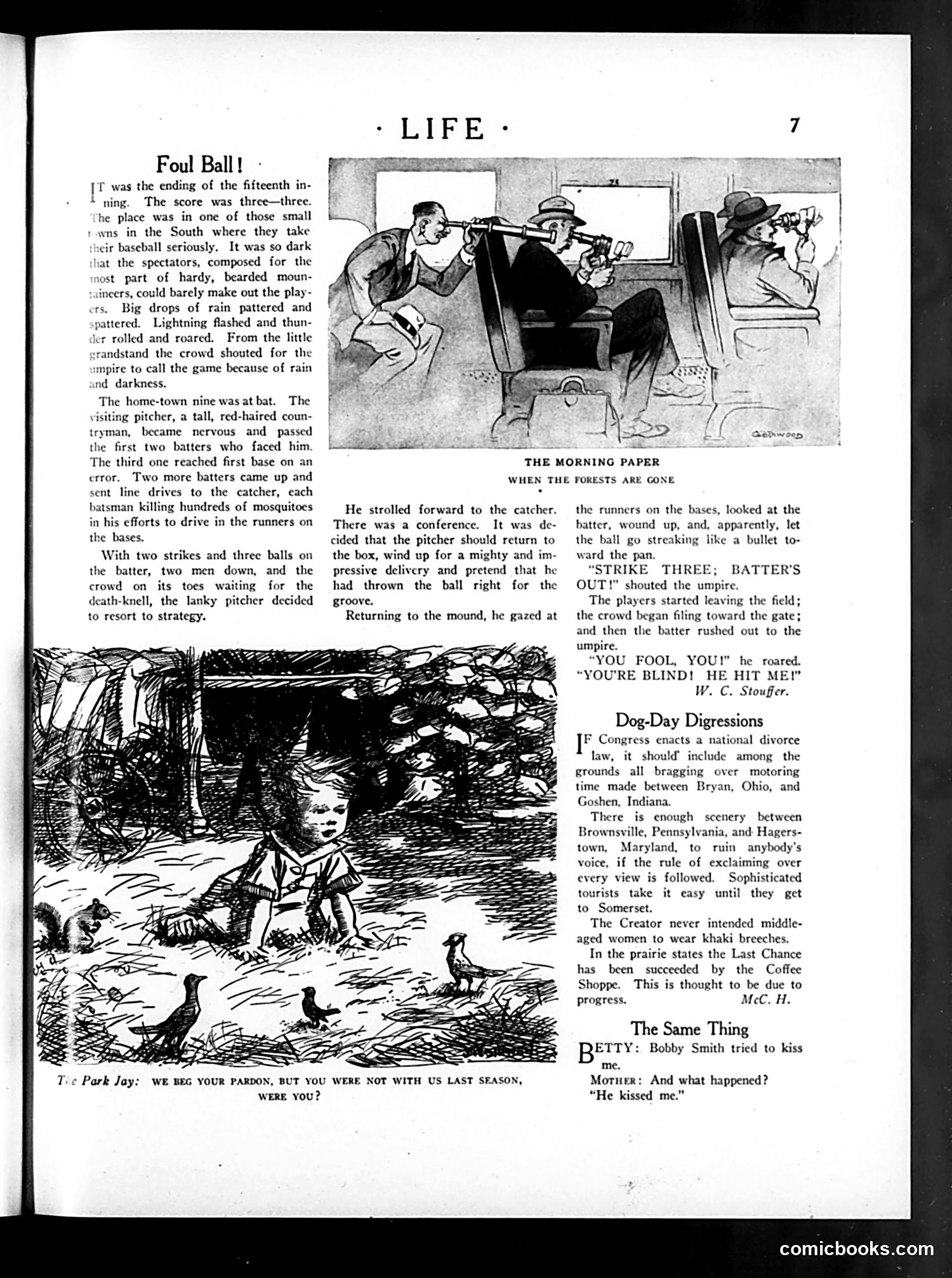
The top cartoon depicts a baseball game during a rainstorm. The umpire has called the batter "out" on a foul ball, but the batter protests vehemently, shouting "YOU FOOL, YOU! YOU'RE BLIND! HE HIT ME!" The satire appears to target umpires' questionable calls during poor weather conditions—the story notes it was so dark the crowd couldn't see play properly. The lower illustration, "The Park Joy," shows a child asking ducks why they weren't present last season, poking gentle fun at parental excuses for family outings. The remaining content includes humorous short pieces like "Dog-Day Digressions" (satirizing motor tourism) and "The Same Thing" (a brief domestic joke about a kiss).
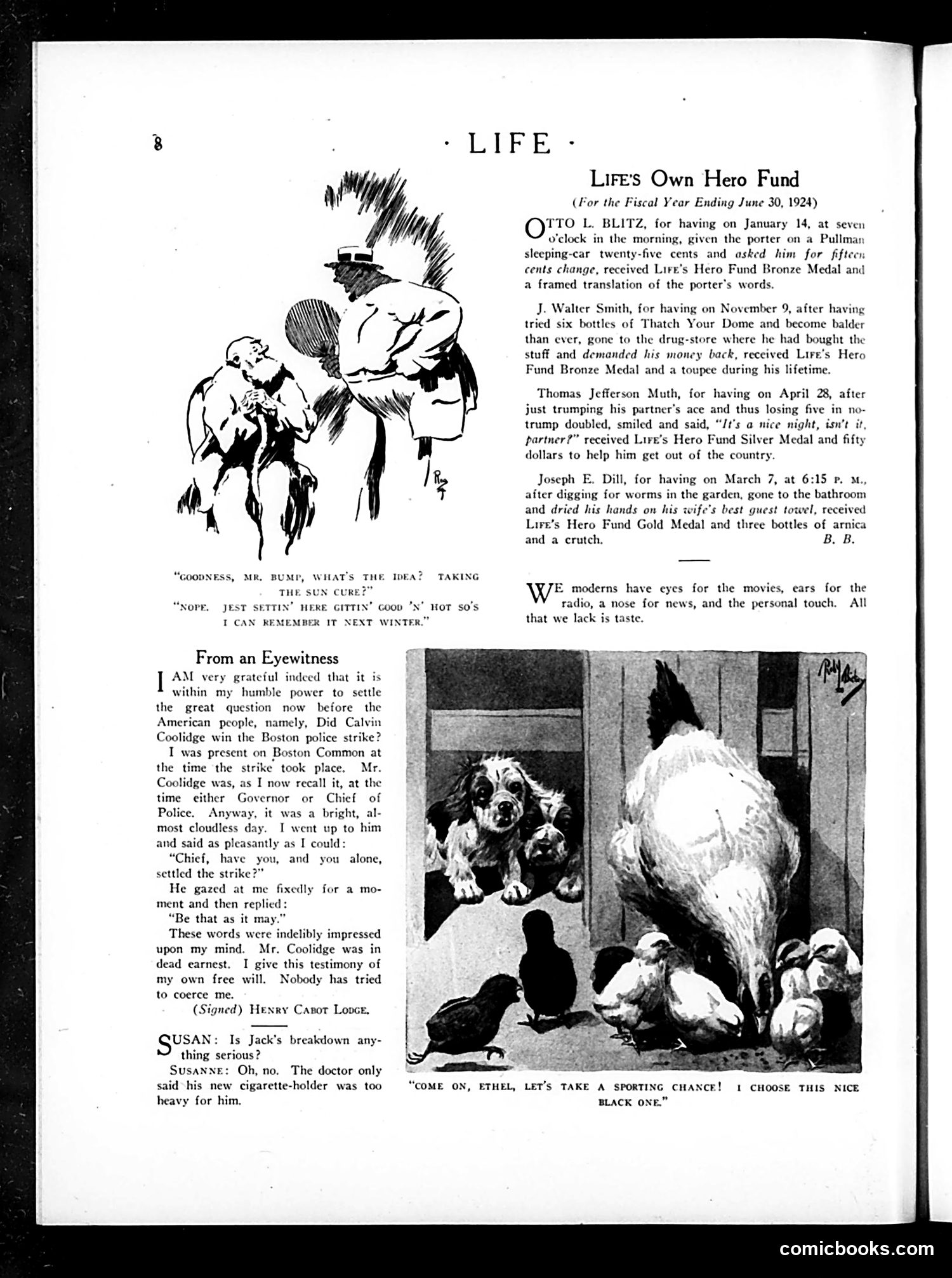
This page contains **Life's Own Hero Fund**, recognizing ordinary people for selfless acts during fiscal year 1924. The recipients include: - **Otto L. Blitz**: gave a porter 25 cents and demanded his money back - **J. Walter Smith**: demanded his money back from a drugstore - **Thomas Jefferson Muth**: complimented his card partner - **Joseph E. Dill**: dried his hands on his wife's guest towel The satire is clear: these are **mock awards for trivial or mildly selfish acts**, inverting the concept of heroism. Life magazine is satirizing American society's tendency to celebrate minor courtesies or self-interested behavior as virtue. The accompanying illustration shows dogs selecting puppies, captioned about choosing a "nice black one"—likely satirizing shallow decision-making. The "From an Eyewitness" section references **Calvin Coolidge and the 1919 Boston police strike**, a significant political event of that era.
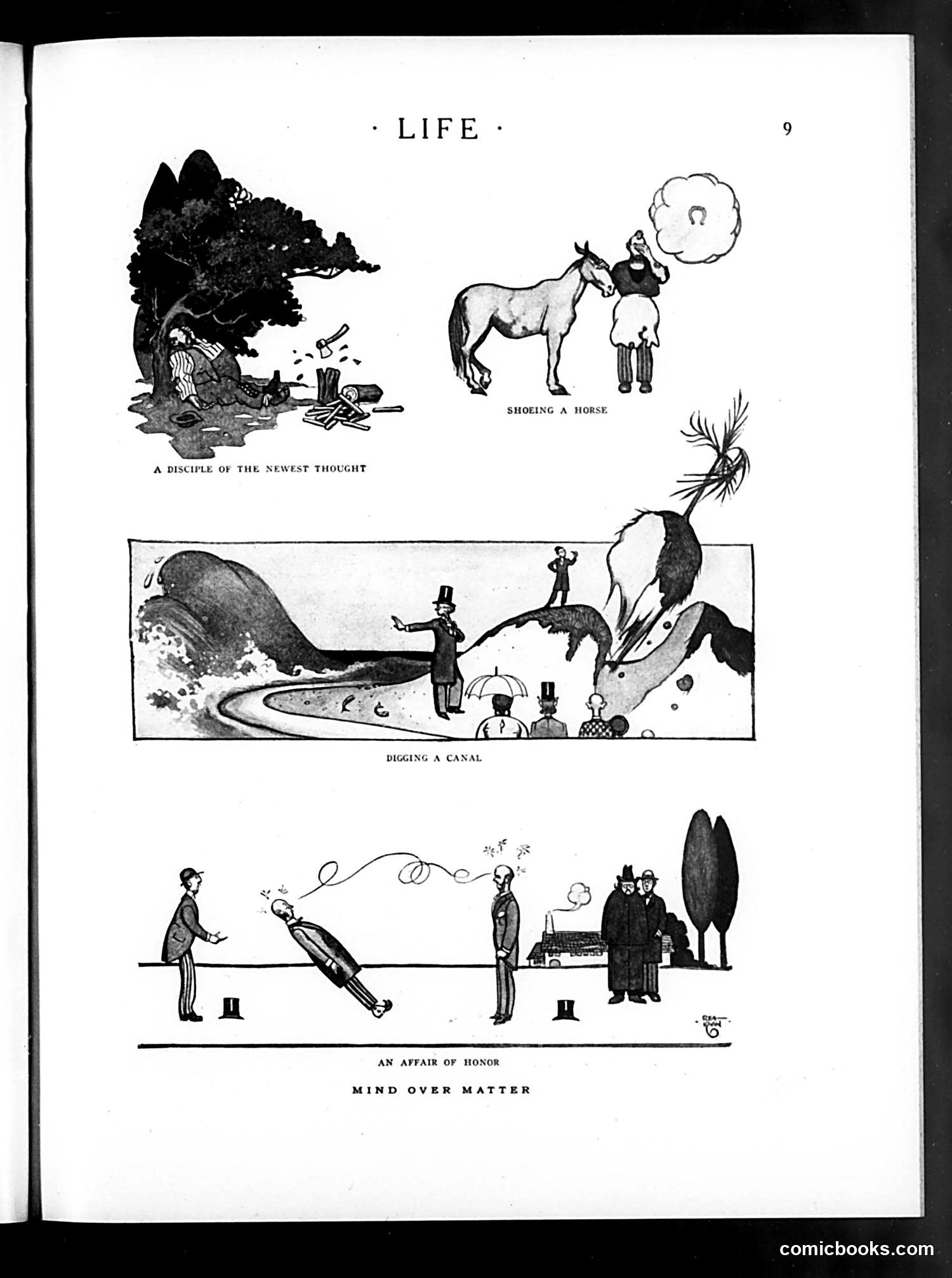
This page presents four satirical illustrations under the heading "MIND OVER MATTER": 1. **"A Disciple of the Newest Thought"** shows a figure meditating beneath a tree, surrounded by scattered tools and materials—likely mocking New Thought or idealist philosophy movements popular in the early 20th century that emphasized mind's power over physical reality. 2. **"Shoeing a Horse"** depicts someone attempting to shoe a horse while holding what appears to be a horseshoe in thought—absurdly applying mental focus instead of practical action. 3. **"Digging a Canal"** shows gentleman overseeing canal work, possibly satirizing ineffective management or impractical planning. 4. **"An Affair of Honor"** illustrates a duel where participants appear to be conducting it mentally rather than physically—the ultimate absurdity of prioritizing thought over action. The satire mocks contemporary idealist philosophies.
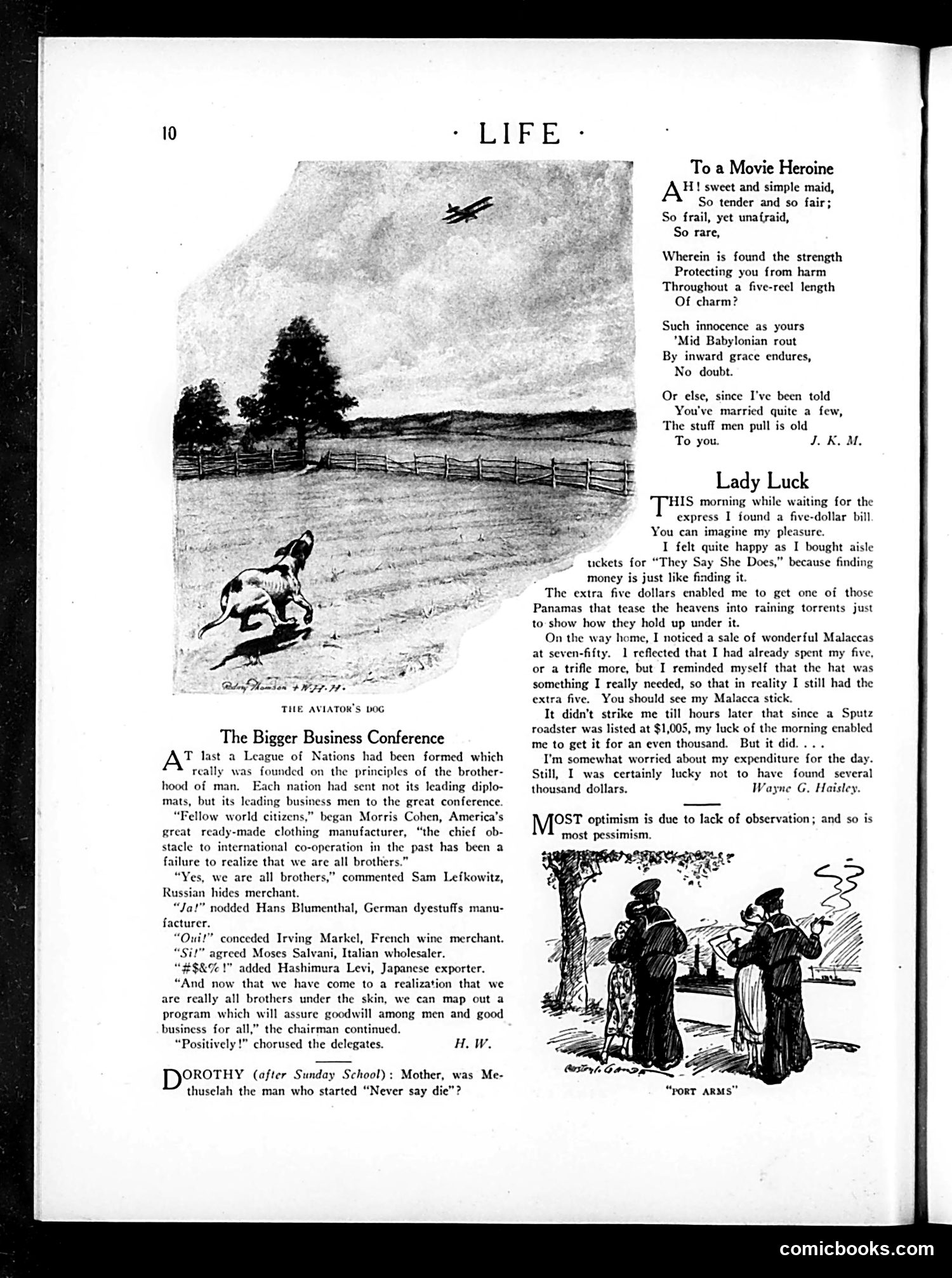
This page contains three distinct pieces: 1. **"The Aviator's Dog"** — An illustration of a dog in a rural landscape with an airplane overhead, likely referencing the novelty and danger of early aviation. 2. **"The Bigger Business Conference"** — A satirical piece mocking an international League of Nations meeting where representatives from various nations (identified by their professions: French wine merchant, Italian wholesaler, Japanese exporter, etc.) claim brotherhood while pursuing commercial self-interest. The satire critiques naive idealism about international cooperation. 3. **"Port Arms"** — A cartoon showing what appears to be military figures, with the caption suggesting commentary on military posturing. The overall theme emphasizes cynicism about stated ideals versus actual human (and national) behavior.
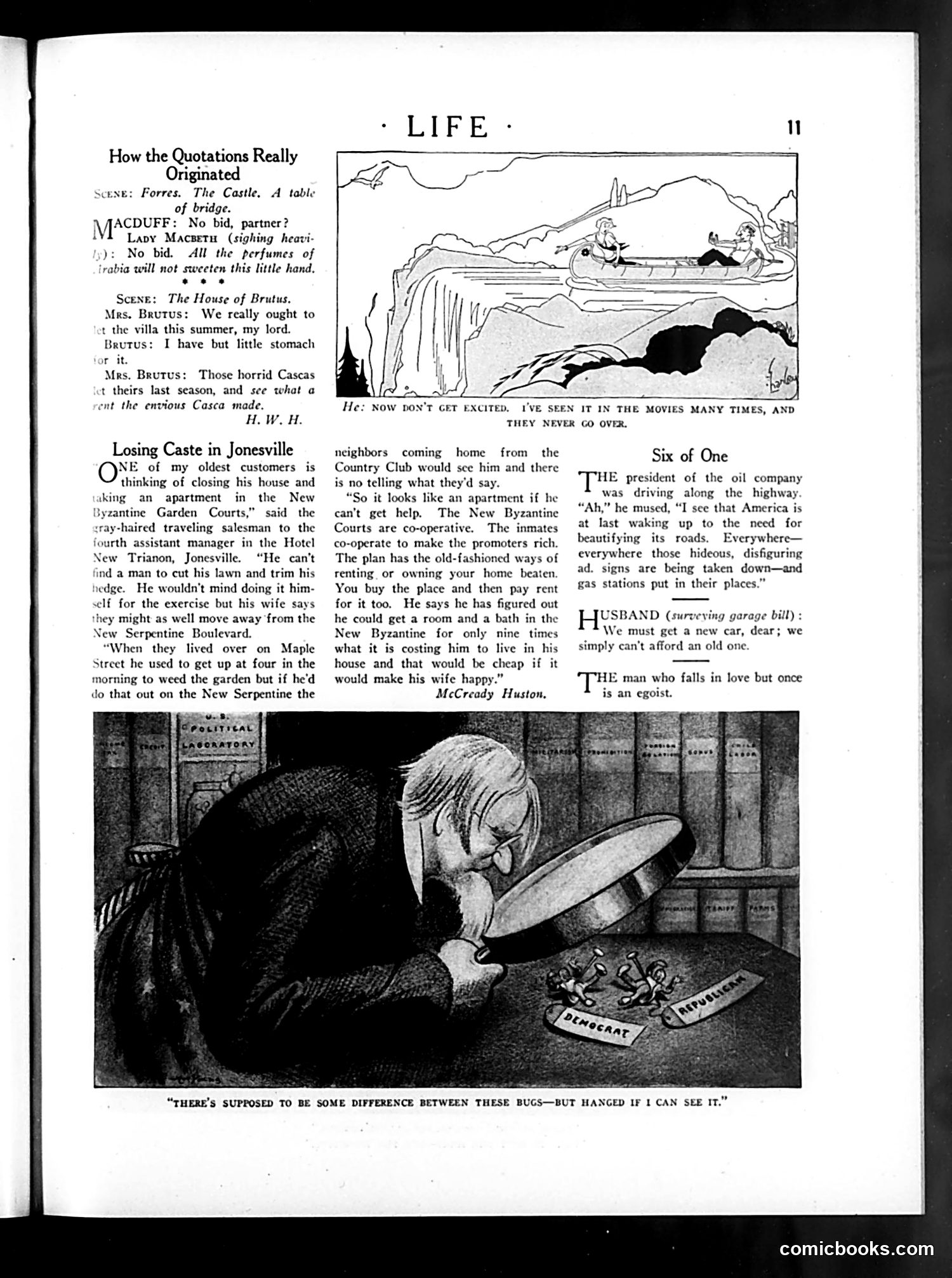
The bottom cartoon depicts a man with a magnifying glass examining documents labeled "Democrat" and "Republican" on a desk surrounded by law books. The caption reads: "There's supposed to be some difference between these bugs—but hanged if I can see it." This is political satire comparing the two major American political parties to indistinguishable insects. The cartoonist suggests that Democrats and Republicans are essentially the same—that meaningful differences between them are invisible or nonexistent. This reflects a common early-20th-century critique of both major parties as serving similar corporate interests despite their nominal differences. The magnifying glass emphasizes the difficulty in finding any real distinction between them.
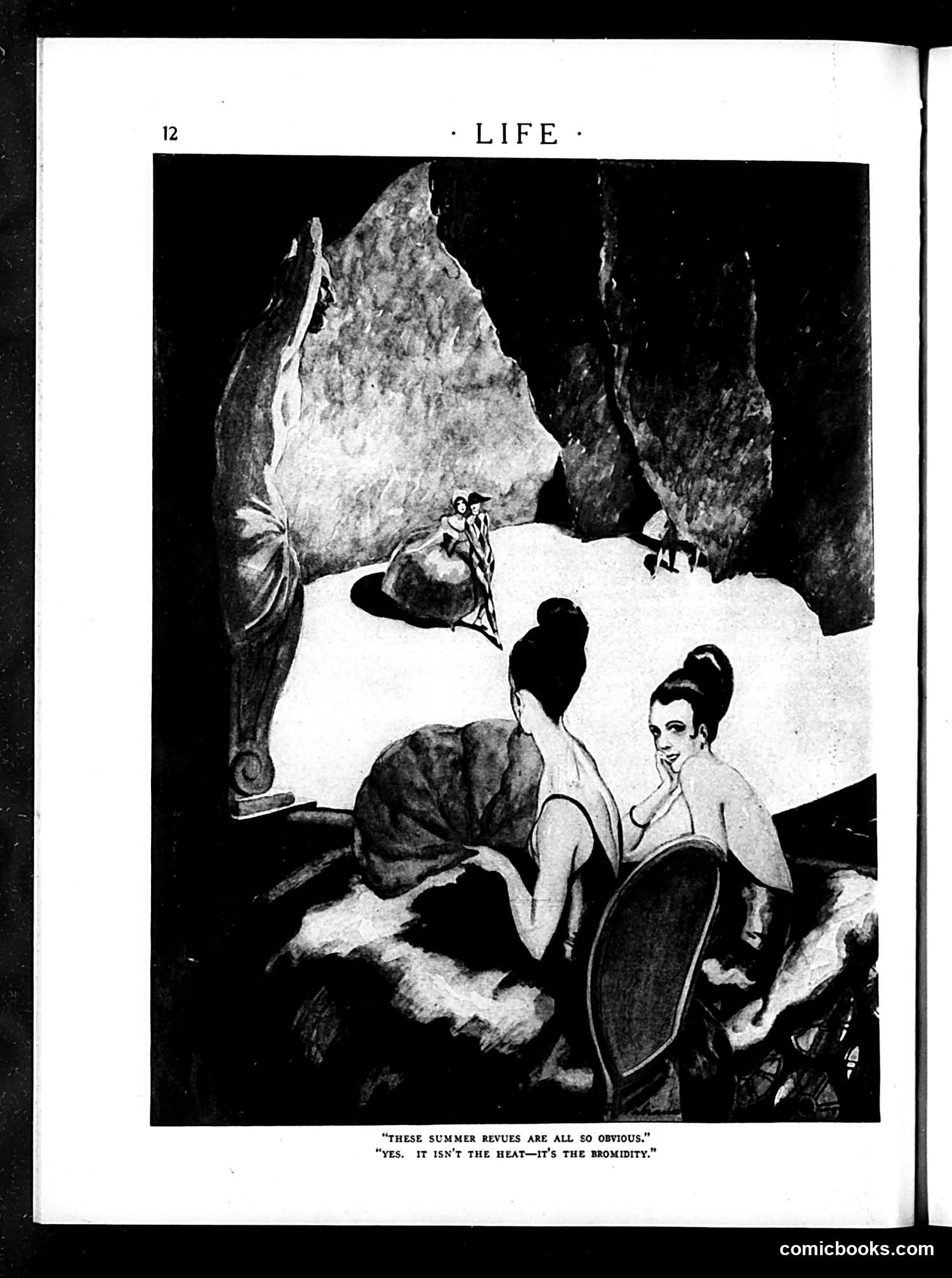
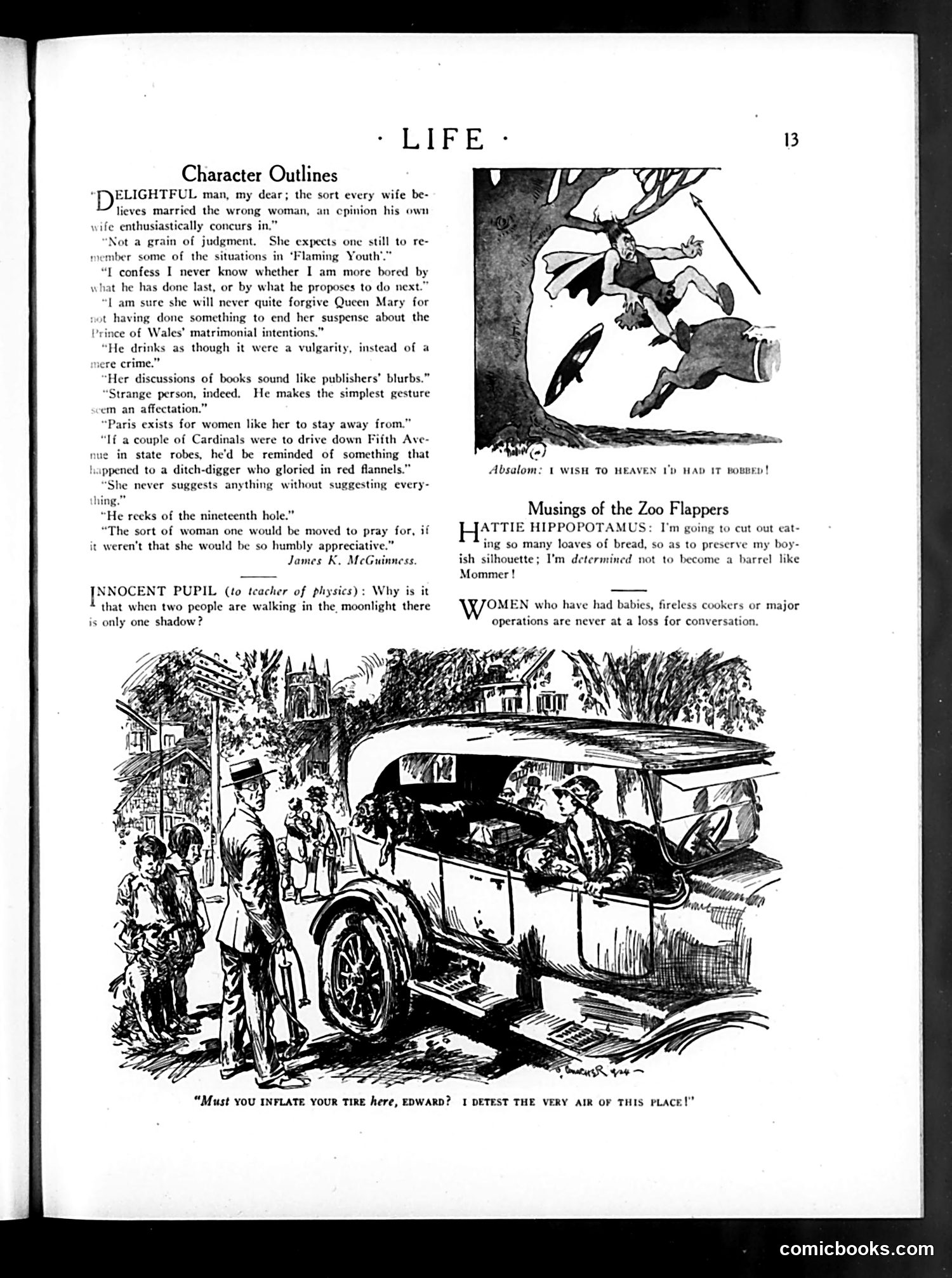
This page contains character sketches and humorous illustrations rather than political cartoons. The top section offers satirical "Character Outlines" mocking various personality types—a delightful but opinionated wife, a boring man, etc. These are social observations rather than political commentary. The main illustration depicts a 1920s automobile scene where a man must inflate a tire while a woman complains about the location's air quality. The humor targets early motorcar culture: the tedious, messy task of tire maintenance and the contrasting vanity of passengers. "Musings of the Zoo Flappers" jokes about young women's social lives and eating habits—typical period commentary on the "flapper" generation's perceived frivolousness and independence.
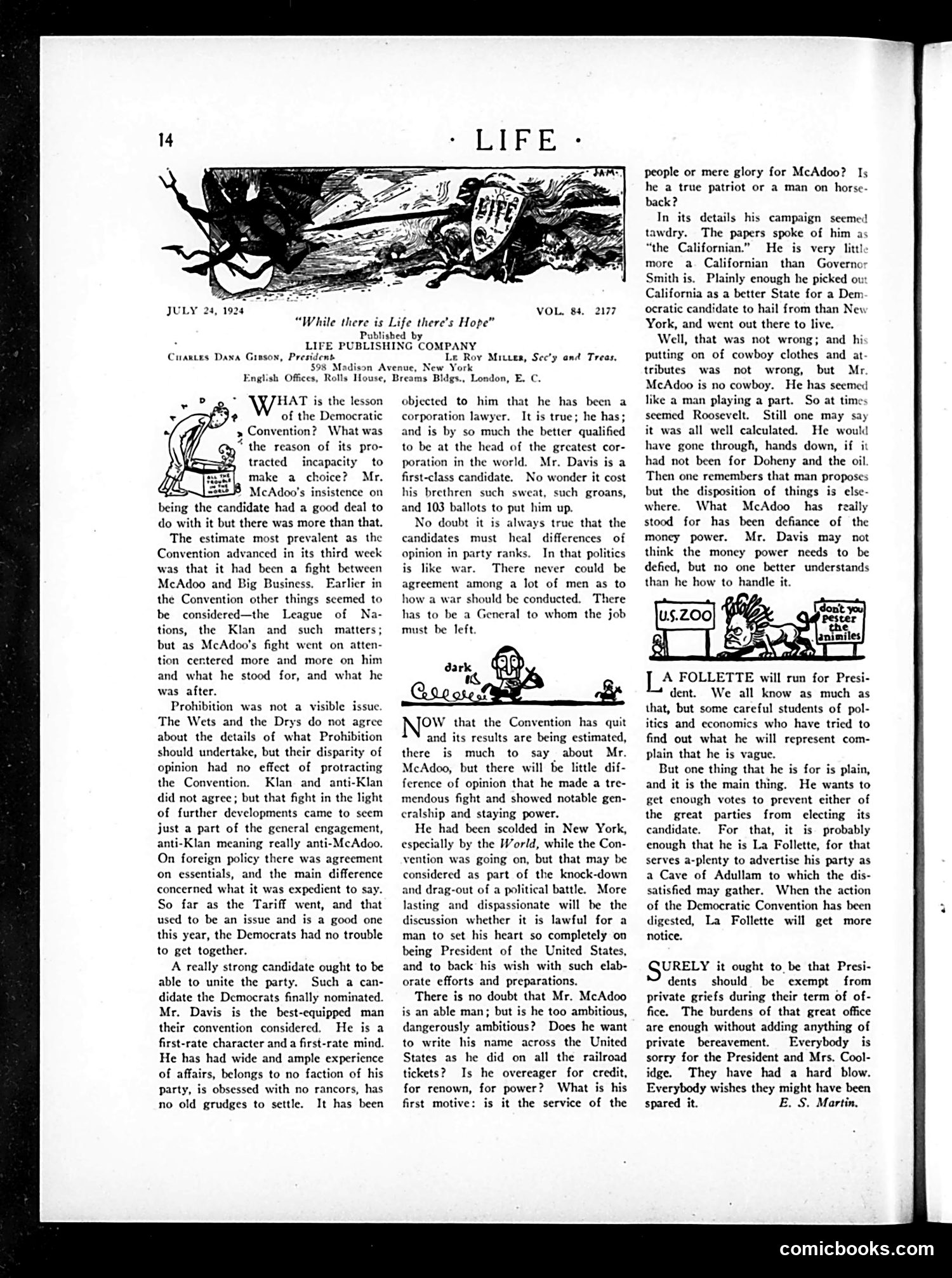
This page discusses the 1924 Democratic Convention and candidate William Gibbs McAdoo. The main cartoon (top) depicts a donkey—the Democratic Party symbol—appearing exhausted or collapsed, labeled "While there is Life there's Hope." The text criticizes McAdoo's candidacy, questioning whether he's a true patriot or merely an ambitious politician. It notes his railroad background and questions his motives: does he seek the presidency for public service or personal glory? The small cartoon (bottom right) shows a zoo visitor considering which animal to follow, satirizing the difficulty voters face in choosing between candidates. The article argues McAdoo is "playing a part" and represents money power over true democratic principles, suggesting the Democratic Party is divided and struggling to find a suitable nominee.
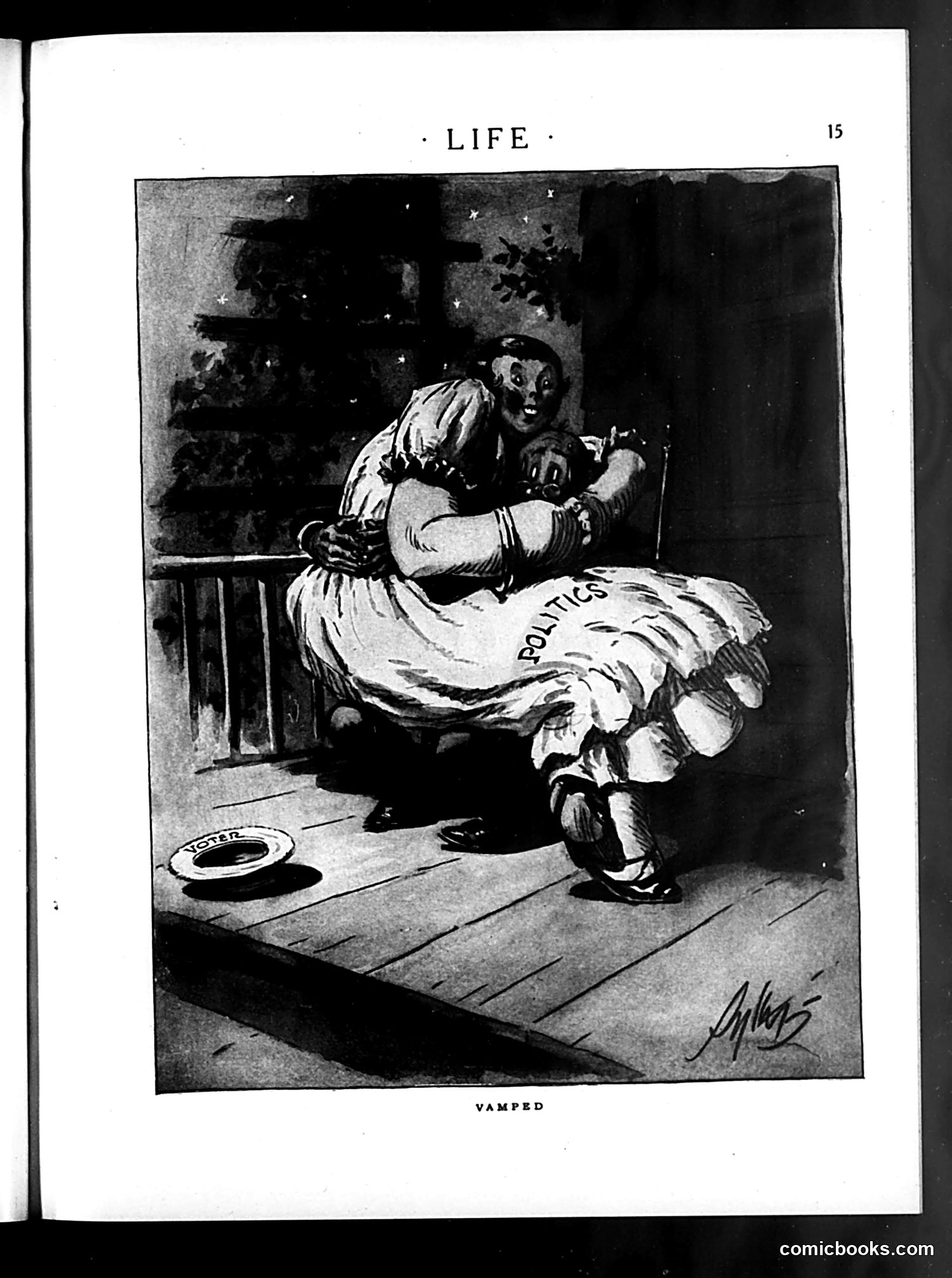
This satirical cartoon from *Life* magazine depicts a woman in a dress labeled "POLITICS" sitting on what appears to be a male figure. The title "VAMPED" suggests the cartoon criticizes how political matters—personified as an attractive woman—have seduced or manipulated male leaders or the public. The woman's aggressive posture and the man's apparent distress convey that politics is portrayed as a dangerous, predatory force. The "vamp" reference alludes to the 1920s cultural figure of the seductive woman who exploits men for personal gain. Without the publication date visible, the specific political context remains unclear, but the cartoon likely critiques how political intrigue or partisan interests manipulate public figures or discourse through deception and charm rather than honest governance.
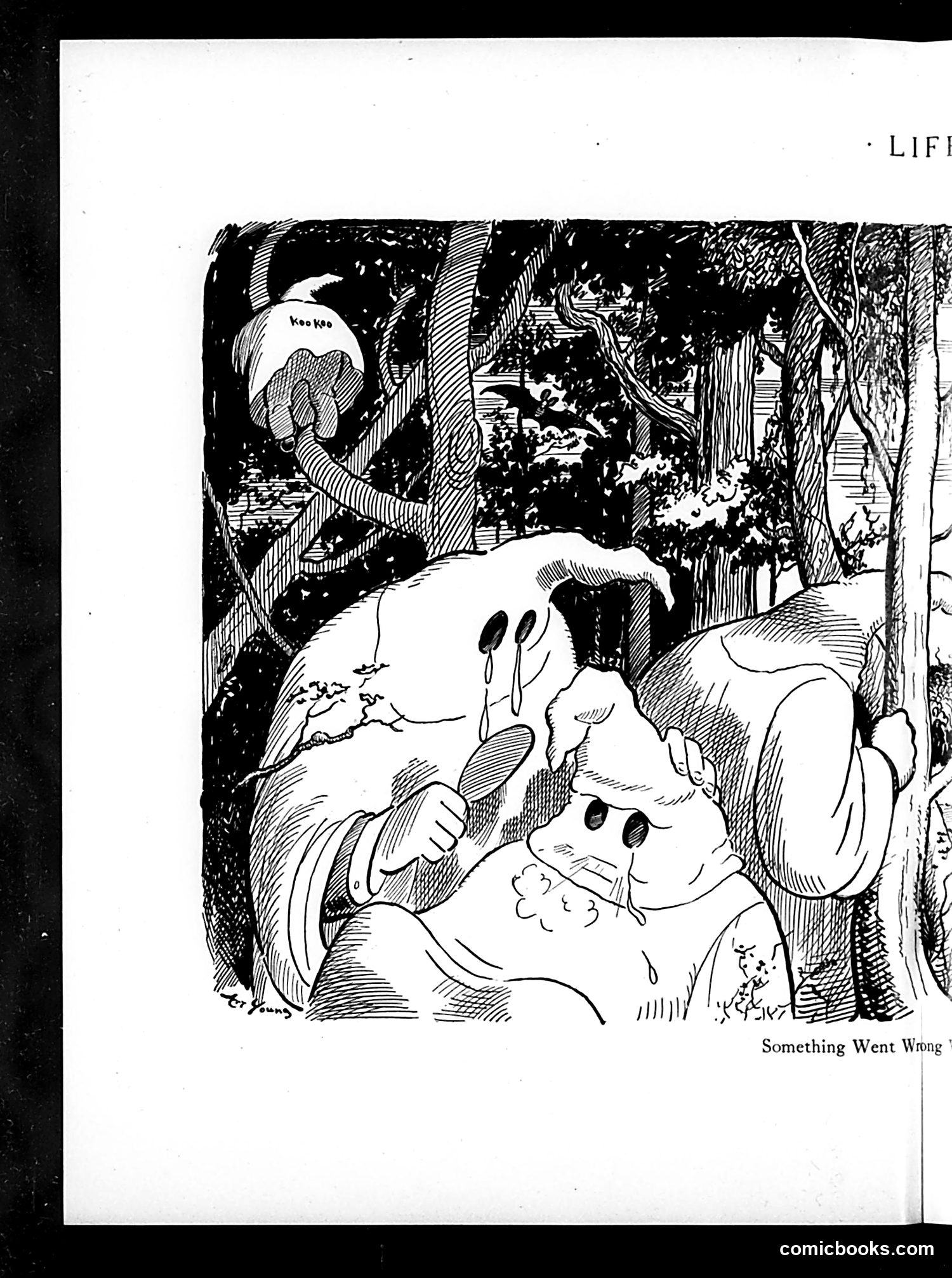
This single-panel cartoon depicts two character figures (appearing to be stylized or caricatured individuals) in what looks like a garden or outdoor setting with foliage in the background. The figures have exaggerated features typical of early-to-mid 20th century satirical illustration. The title "Something Went Wrong" suggests the cartoon comments on a failed plan, relationship, or situation. Without additional context from the magazine's surrounding articles or advertisements, the specific political or social reference remains unclear. The characters' body language and expressions appear to convey disappointment or regret. The sketch style and publication in *Life* magazine indicates this is social commentary, likely addressing contemporary events or human situations of the era, but the exact target of satire cannot be definitively determined from the image alone.
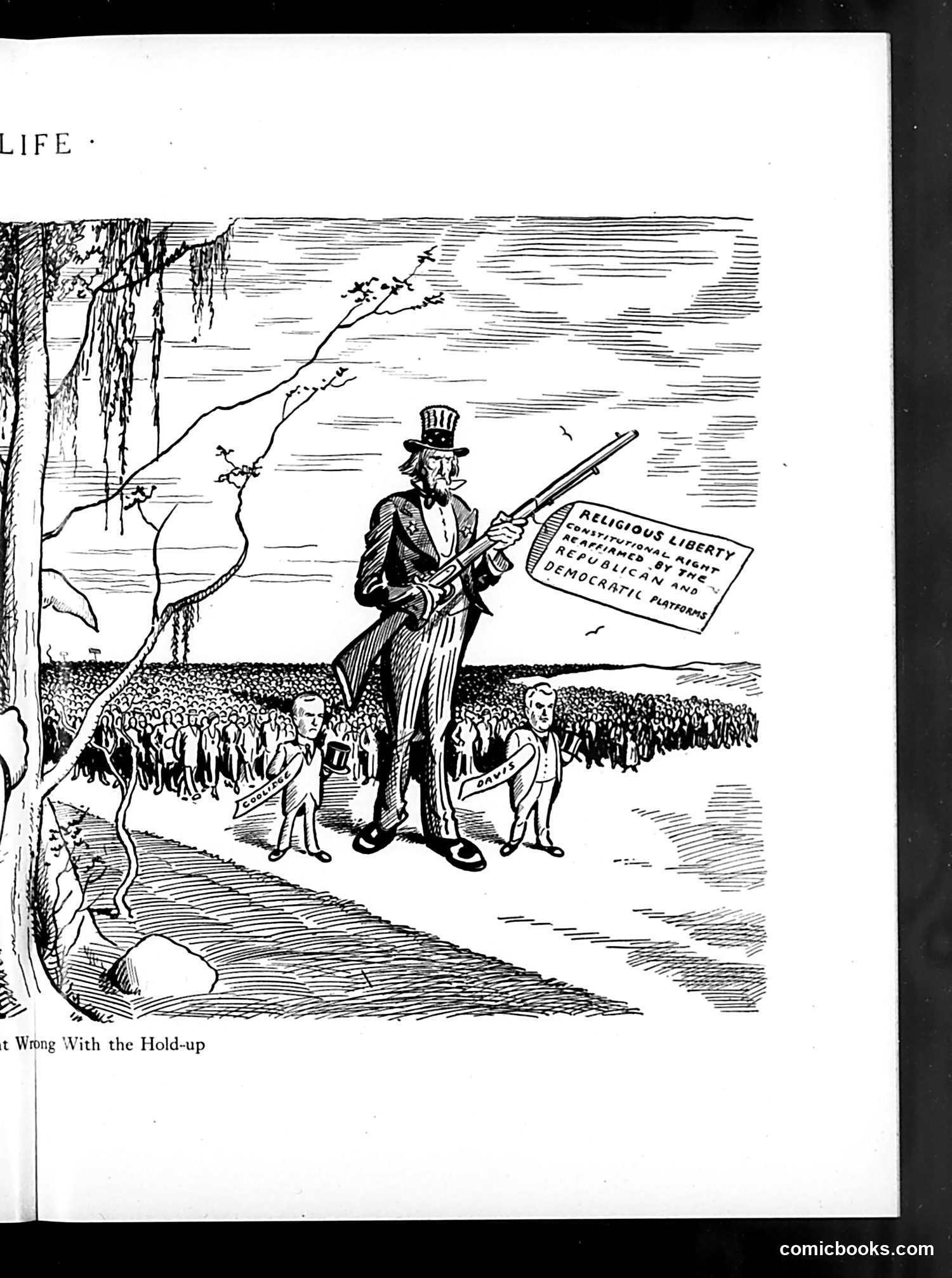
This cartoon depicts Uncle Sam (identifiable by his top hat and facial hair) wielding a rifle labeled with text about "Religious Liberty" and "Democratic Platform" as justification. He confronts two small figures while addressing a large crowd in the background. The title "What's Wrong With the Hold-up" suggests criticism of Uncle Sam's use of stated democratic principles as cover for aggressive action—depicted as an armed robbery or "hold-up." The cartoon satirizes the gap between America's proclaimed ideals (religious liberty, democracy) and its actual conduct, implying these principles are being used as pretexts for coercive or militaristic policies. The exact historical moment is unclear without publication date context, but the satire targets American hypocrisy regarding its stated values versus actions.
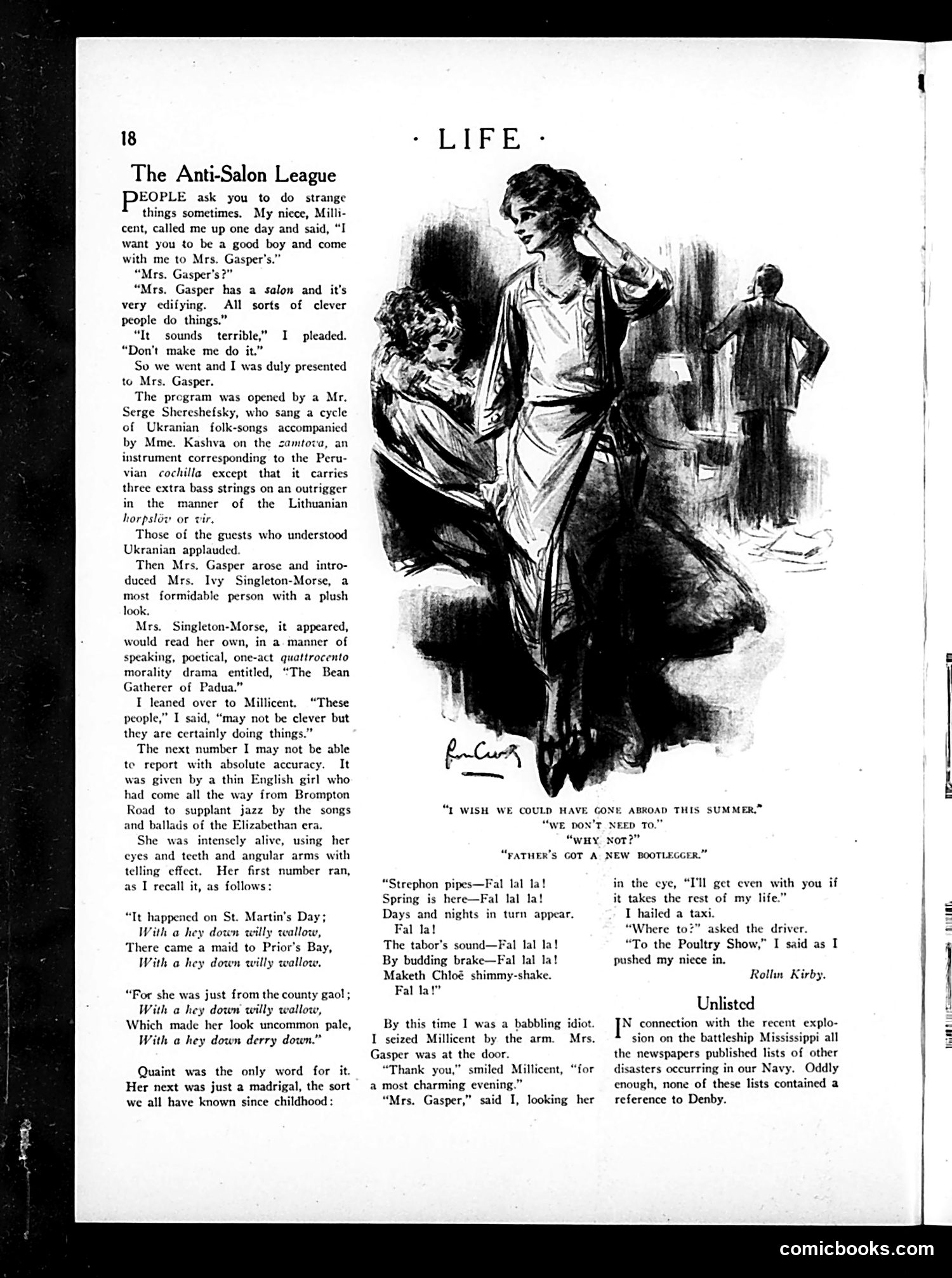
This satirical piece mocks the pretentiousness of early 20th-century artistic "salons"—gatherings where the cultural elite showcased avant-garde performances. The narrator is reluctantly dragged to Mrs. Gasper's salon by his niece Millicent, where he endures deliberately obscure performances: Ukrainian folk songs with made-up instruments, an incomprehensible medieval Italian morality play, and Elizabethan ballads performed with exaggerated theatricality (including one absurdly ending with "shimmy-shake"). The humor lies in exposing salon culture as pretentious nonsense masquerading as sophistication. The final panel's cartoon joke references Prohibition: when the niece suggests they should have vacationed abroad, the response is "Father's got a new bootlegger"—suggesting the only worthwhile "cultural" development is access to illegal alcohol during Prohibition. The author (Rollin Kirby) uses the saloon/salon pun as social criticism.
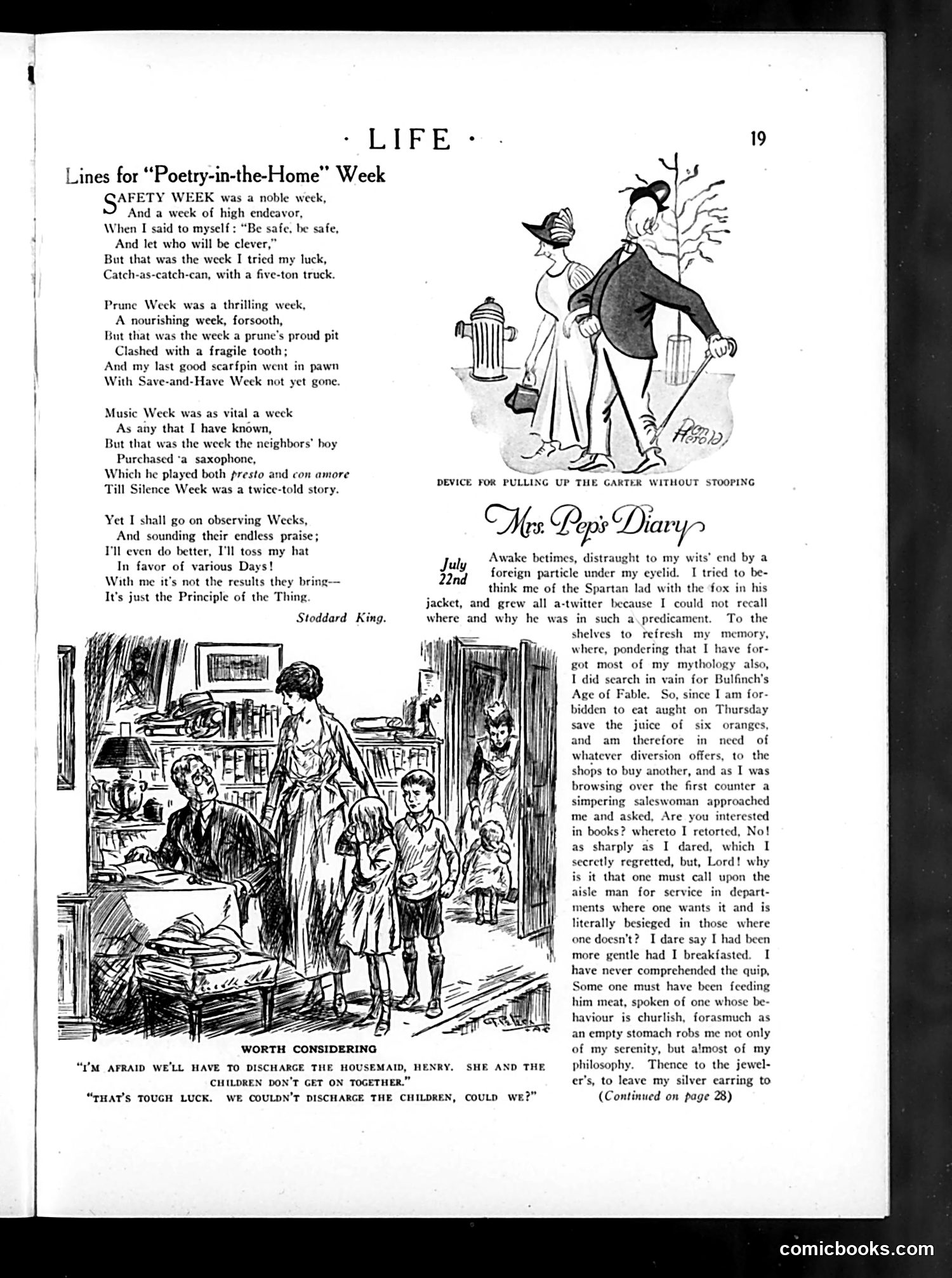
This page contains three distinct satirical pieces: **"Poetry-in-the-Home" Week** (by Stoddard King): Humorous verse mocking the era's proliferation of themed "awareness weeks." The poem catalogs personal disasters during Safety Week, Prune Week, Music Week, etc., suggesting these observances are performative and ineffective—the speaker follows the principle while suffering actual consequences (truck accident, broken tooth, pawned scarfpin, neighbor's saxophone noise). **"Mrs. Pep's Diary" (July 22nd)**: A gossipy first-person account satirizing upper-middle-class domestic life. The diarist complains about minor inconveniences (eyelash, hunger from fasting) while shopping for books and jewelry, revealing self-centered preoccupations and class anxieties. **"Worth Considering"**: A domestic cartoon joke about servants. A couple debates firing their housemaid due to conflict with the children, then realizes they "couldn't discharge the children"—dark humor about the permanence of parenthood versus replaceable household help. All three pieces mock contemporary social pretensions and domestic frustrations with gentle, satirical humor typical of 1920s Life magazine.
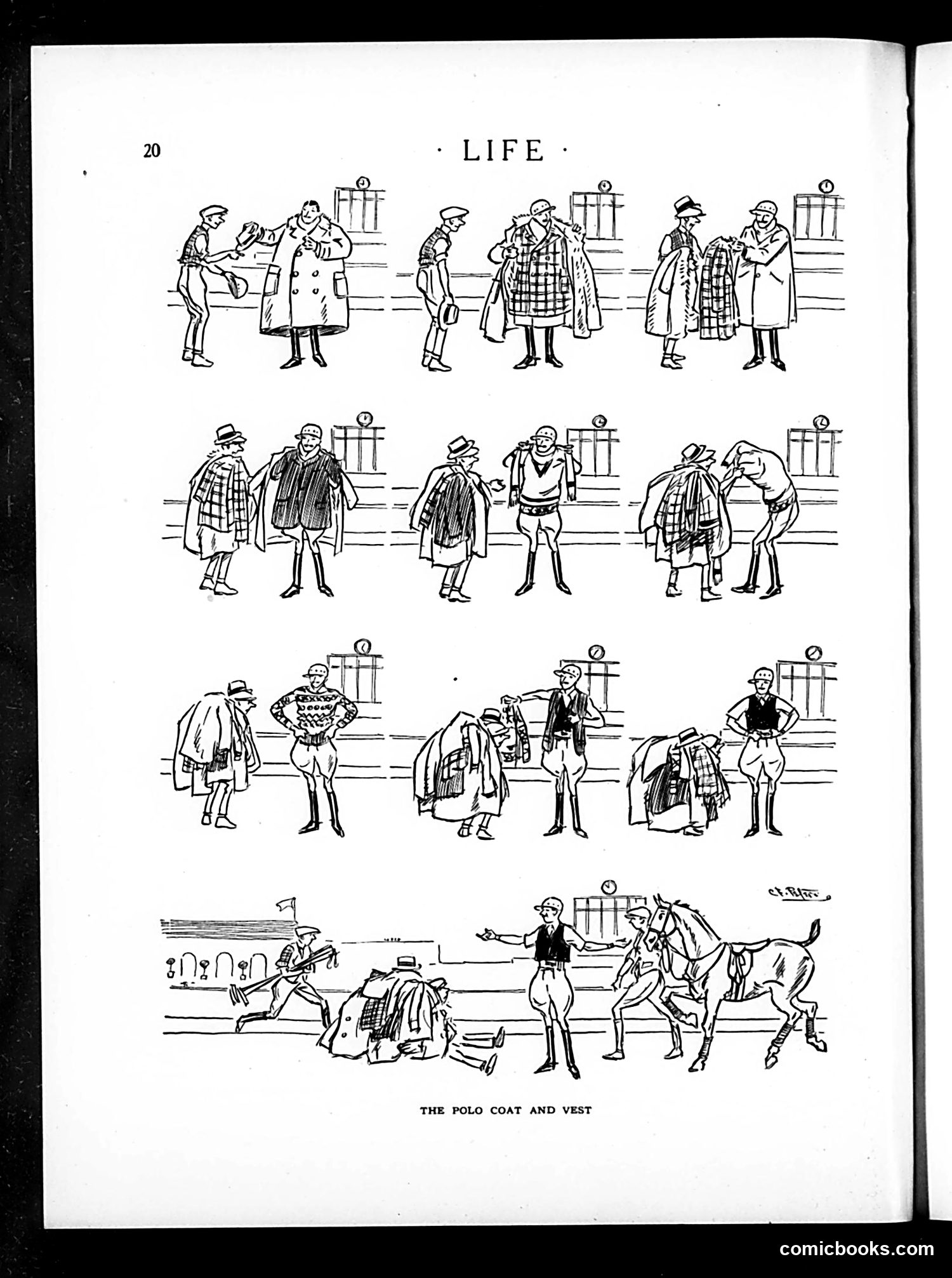
This is a humorous instructional diagram showing how to wear a polo coat and matching vest. The nine panels depict a sequence of scenarios, likely satirizing different social situations and the wearer's attempts to maintain proper appearance with this outfit. The progression appears to show a gentleman in various states of dishevelment—removing the coat, adjusting clothing, interacting with others, and ultimately engaging in active pursuits like polo or horseback riding (shown in the bottom panel). The satire seems to mock the impracticality of maintaining a refined, fashionable appearance while actually *using* the garment for its intended purpose. The final scene shows the coat completely compromised during vigorous activity, suggesting the gap between fashion ideals and real-world practicality—a common theme in Life magazine's social commentary.
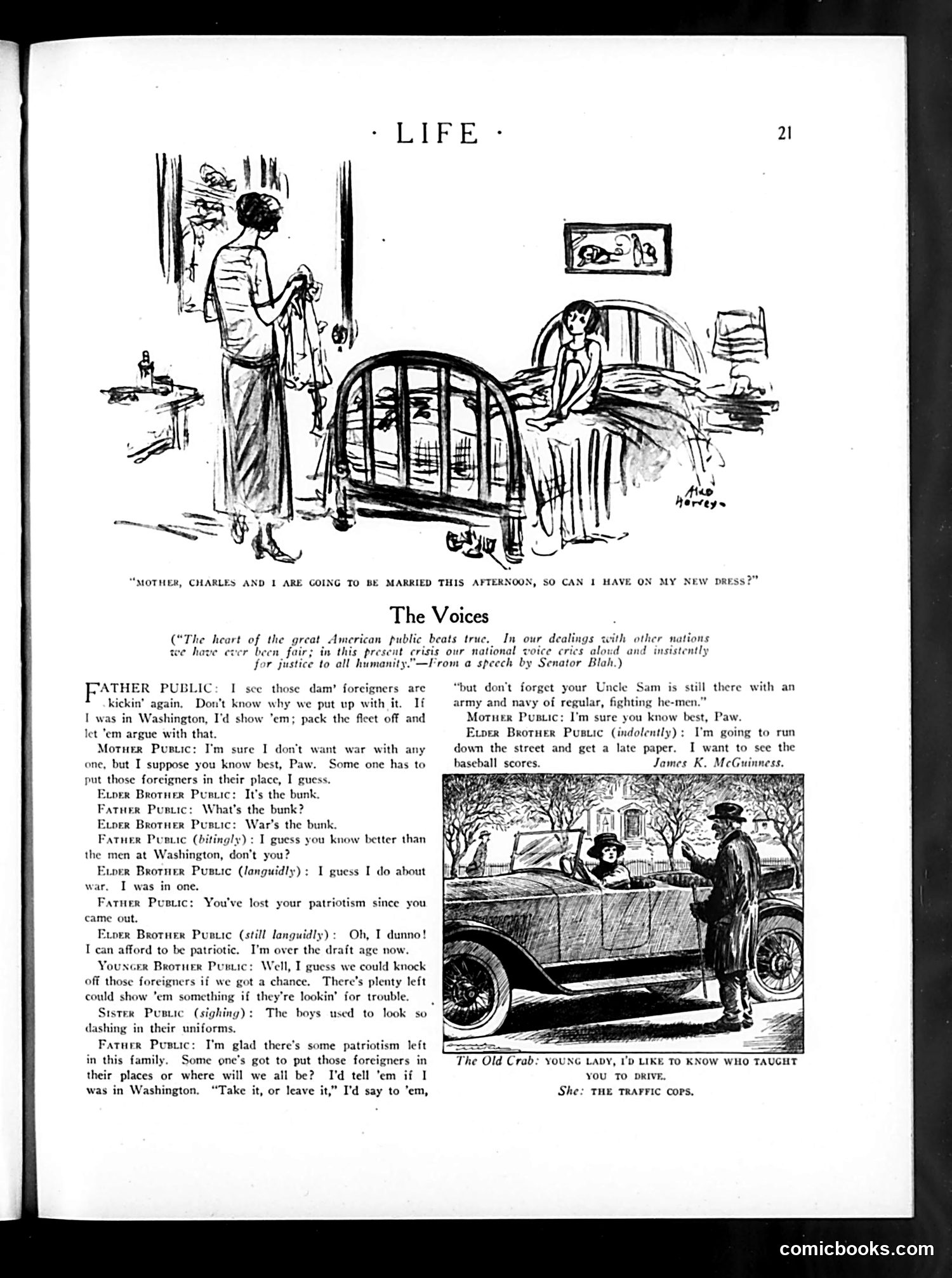
This page satirizes American public opinion during a military crisis (likely WWI era, given references to "the fleet" and draft age). The main cartoon features a family discussion where different generations express contradictory patriotic views: - **Father Public** demands aggressive military action against "foreigners," yet wouldn't serve himself - **Mother Public** defers to his judgment while expressing pacifist doubts - **Elder Brother** (a war veteran) calls war "the bunk" and cynically notes he's "over the draft age" now, undercutting his claimed patriotism - **Younger Brother** eagerly supports war without experience - **Sister** romanticizes soldiers' uniforms The satire exposes hypocrisy: armchair hawks demand action they won't fight in, while actual veterans reject war. The secondary cartoon about driving—where traffic cops taught a woman recklessness—reinforces the theme of unqualified instruction. The epigraph's quote about America's "national voice" demanding "justice" undercuts the petty, self-interested dialogue below.
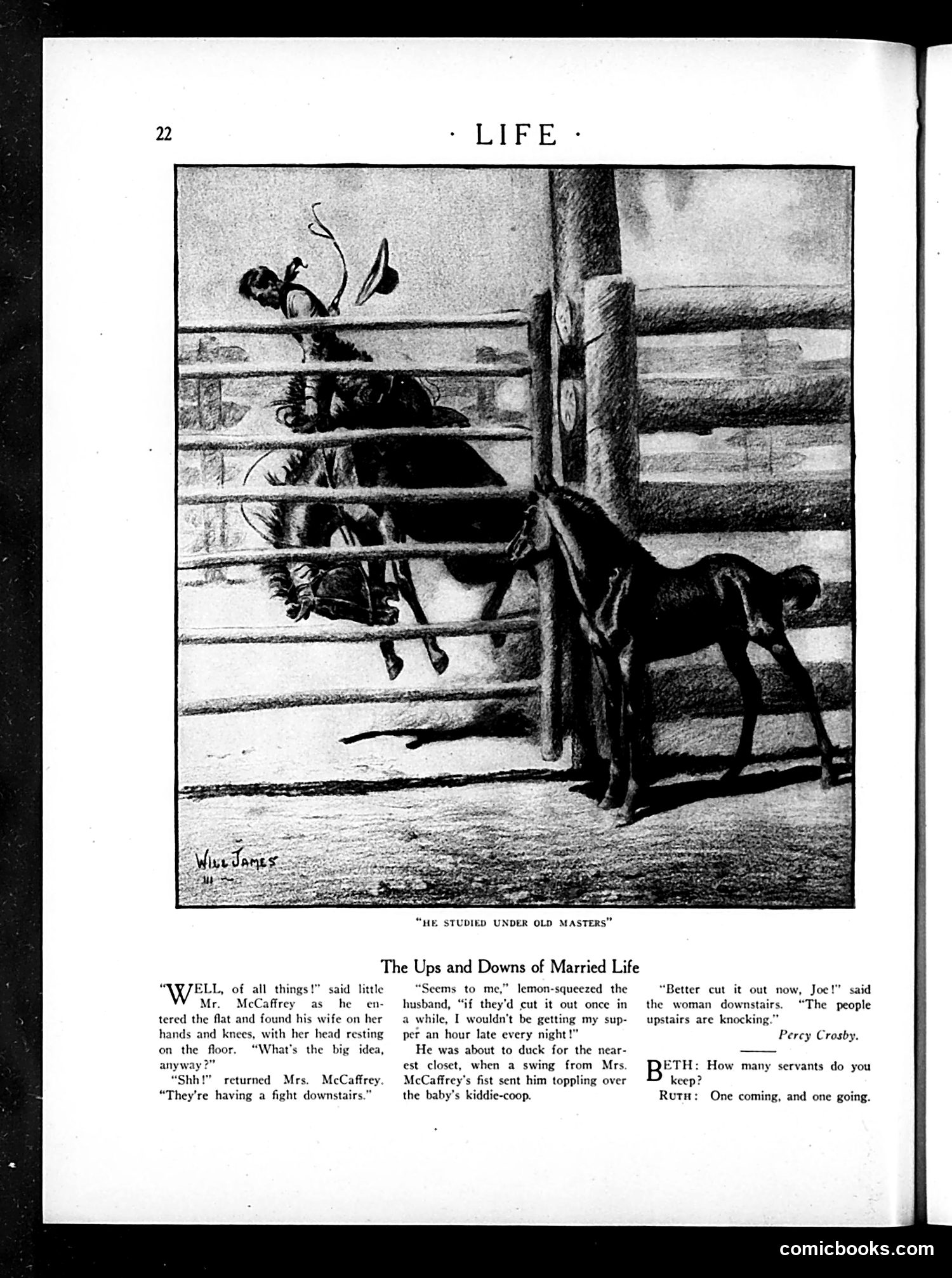
This page contains two separate humorous pieces satirizing domestic life. The main cartoon by Will James (signed lower left) depicts a cowboy being bucked from a fence by a horse, captioned "He Studied Under Old Masters"—a pun suggesting the horse learned bucking technique from experienced predecessors. Below, Percy Crosby's comic strip shows Mr. and Mrs. McCaffrey: she's eavesdropping on neighbors fighting downstairs when he arrives home. When he complains the noise makes supper late, she hits him, sending him over a baby's crib. The neighbors' subsequent complaint about upstairs noise reveals the irony—the McCaffreys are now creating the same disturbance they were enjoying. The final joke between Beth and Ruth plays on servant employment: Ruth keeps "one coming, and one going"—meaning servants constantly arriving and departing (quitting), suggesting poor treatment or pay. These pieces satirize working-class domestic friction and marital discord as mundane entertainment.
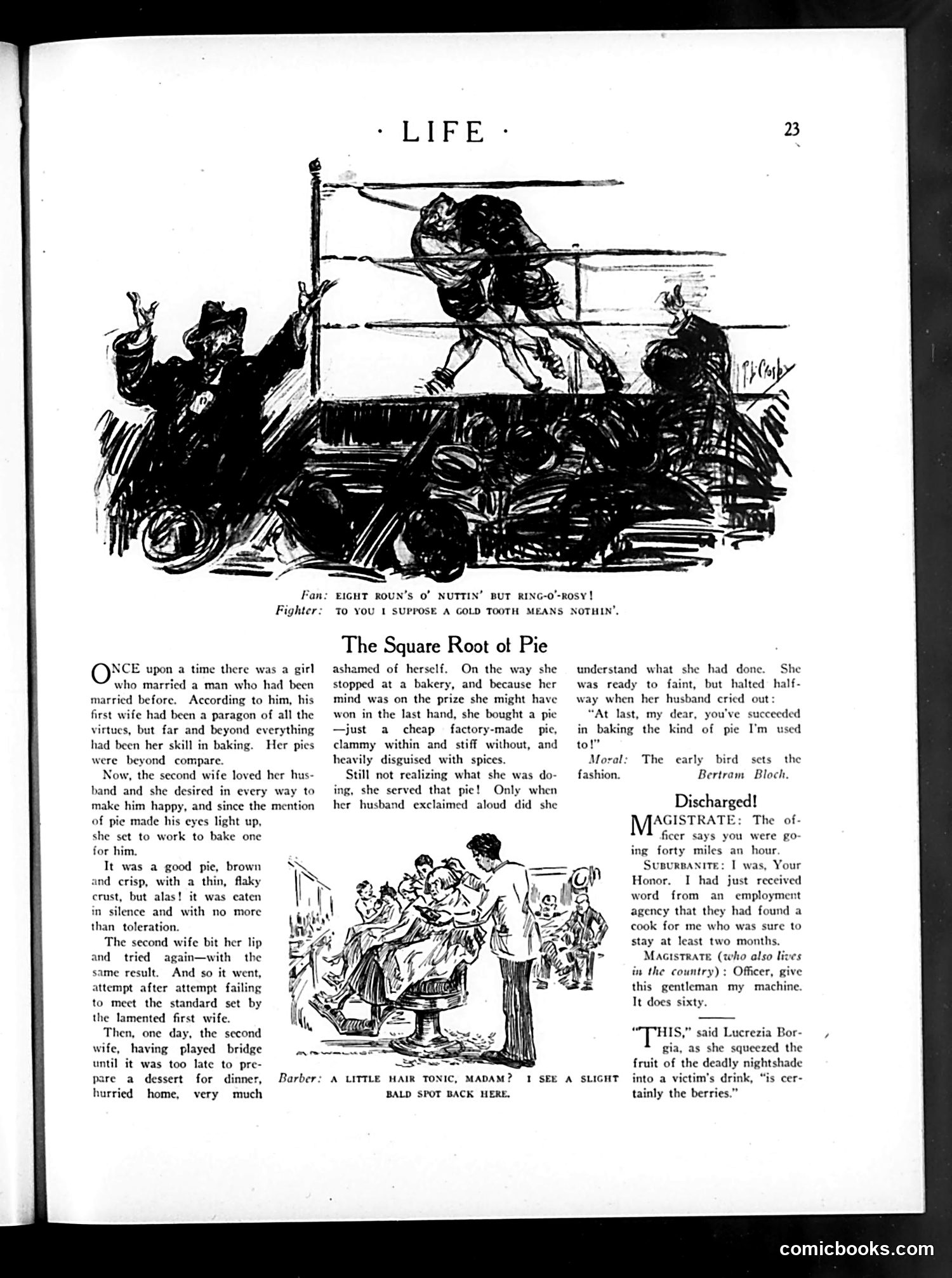
This page contains two satirical pieces from *Life* magazine: **"The Square Root of Pie"** is a humorous short story about a second wife constantly failing to match her predecessor's baking. The twist: when she serves a cheap, store-bought pie, her husband praises it—revealing his complaints were never about quality, only about comparing her unfavorably to his first wife. The satire mocks men who idealize former spouses and set impossible standards. **The top cartoon** depicts a boxing match where spectators cheer. The dialogue suggests crude class commentary about dental work and grooming products—likely satirizing working-class or immigrant concerns about appearance and status symbols (gold teeth). **"Discharged!"** is a brief joke where a magistrate approves of a speeding driver because the driver found a reliable cook—a luxury the magistrate also desperately wants. It satirizes how the servant shortage (likely post-WWI) was so acute that even traffic violations seemed trivial by comparison. The barber cartoon caption references similar working-class preoccupations with hair tonics and appearance.
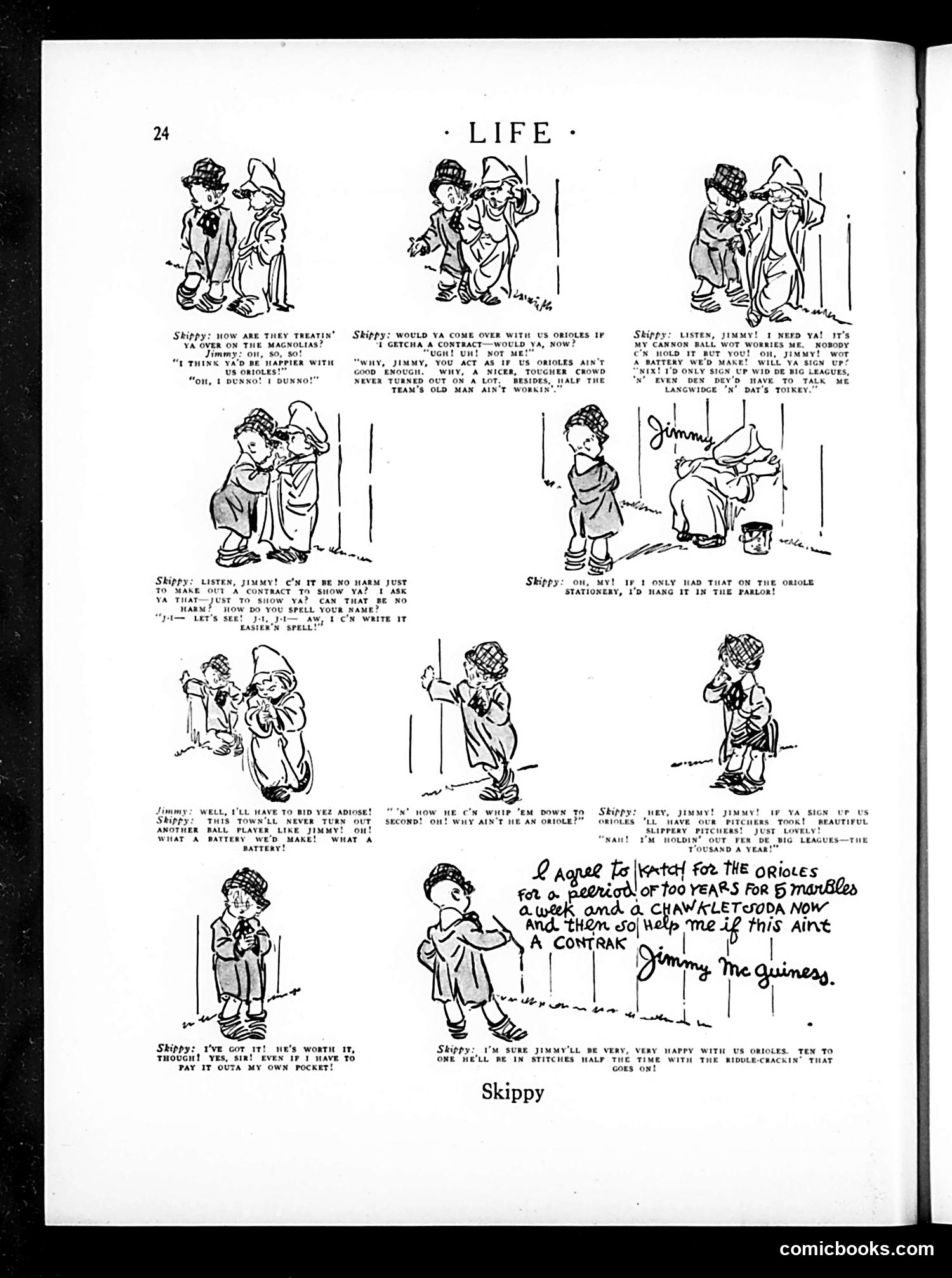
This is a humorous strip about a young baseball enthusiast named Skippy trying to recruit his friend Jimmy to play for a local team called the Orioles. The satire operates on two levels: **Surface level:** Skippy uses increasingly elaborate persuasion tactics—promising contracts, appealing to team pride, offering to put Jimmy's name on official stationery—to convince Jimmy to join. Jimmy resists, claiming he'll only sign with "big leagues." **Deeper social humor:** The strip mocks how minor local baseball teams (the Orioles) competed with major leagues for players. Skippy's desperate sales pitch and promises of legitimacy ("I'd hang it in the parlor!") satirize how small-time operations tried to seem important. The humor lies in the gap between Skippy's earnest efforts and the modest reality of local baseball. The dialect-heavy dialogue ("ain't," "wot," "yer") adds working-class comic flavor typical of early 20th-century American comic strips.
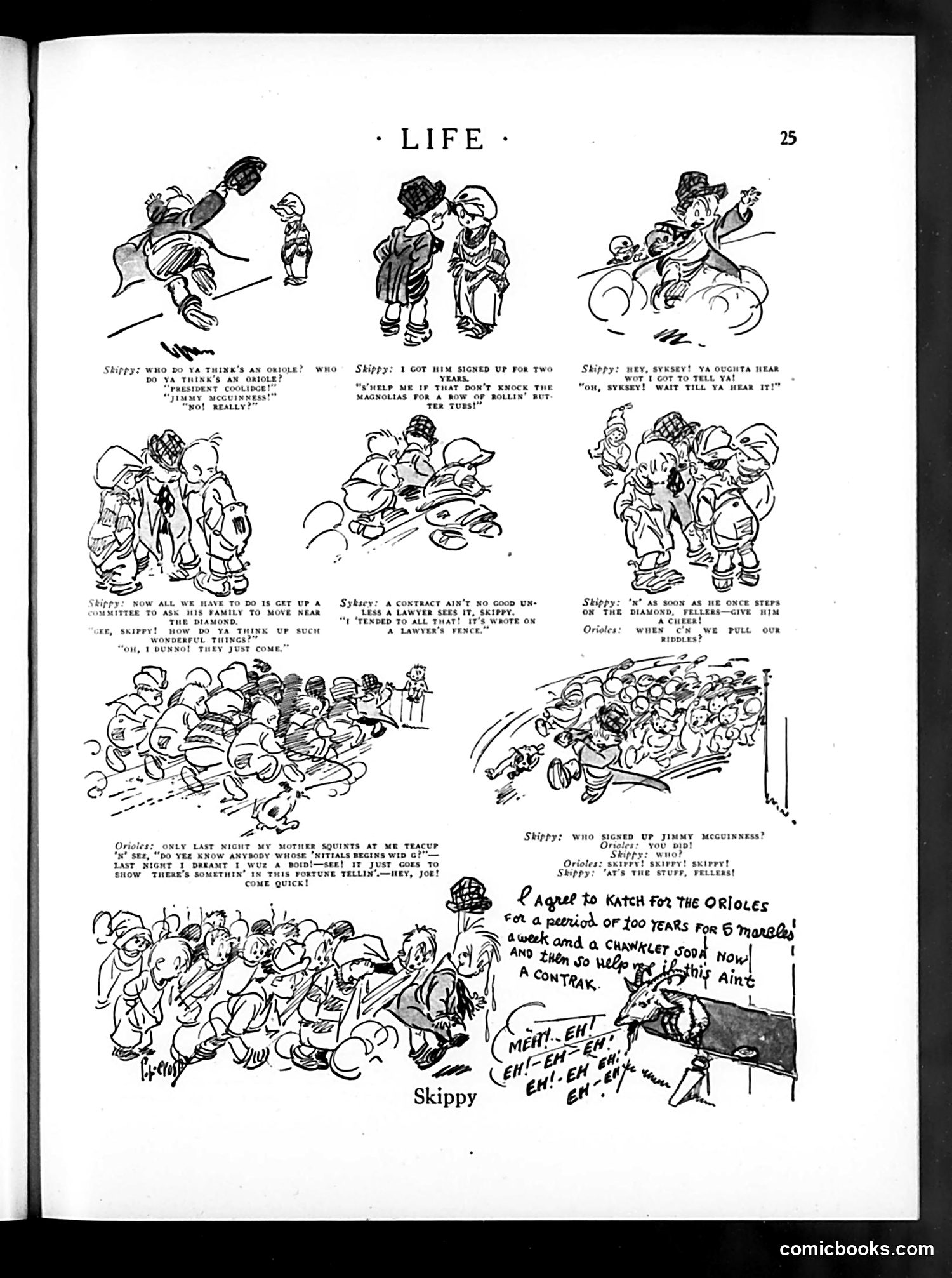
This is a comic strip featuring "Skippy," a popular 1920s-30s character. The humor centers on a baseball bet: Skippy has signed up Jimmy McGuinness to play for the Orioles for two years, and the strip follows the comedic negotiation of this contract. The satire relies on period-specific references: President Coolidge and "Jimmy McGuinness" appear to be humorous name-drops (the OCR suggests these may be garbled). The repeated punchlines about a lawyer's involvement in the contract and the characters' malapropisms ("rolling butter tubs" instead of proper terms) mock how working-class characters struggle with formal legal language. The final panel shows a large crowd celebrating around Skippy, with the payoff being that Skippy has somehow managed this improbable deal. The humor is gentle, character-based comedy rather than sharp political satire—typical of Life magazine's lighter content during this era.
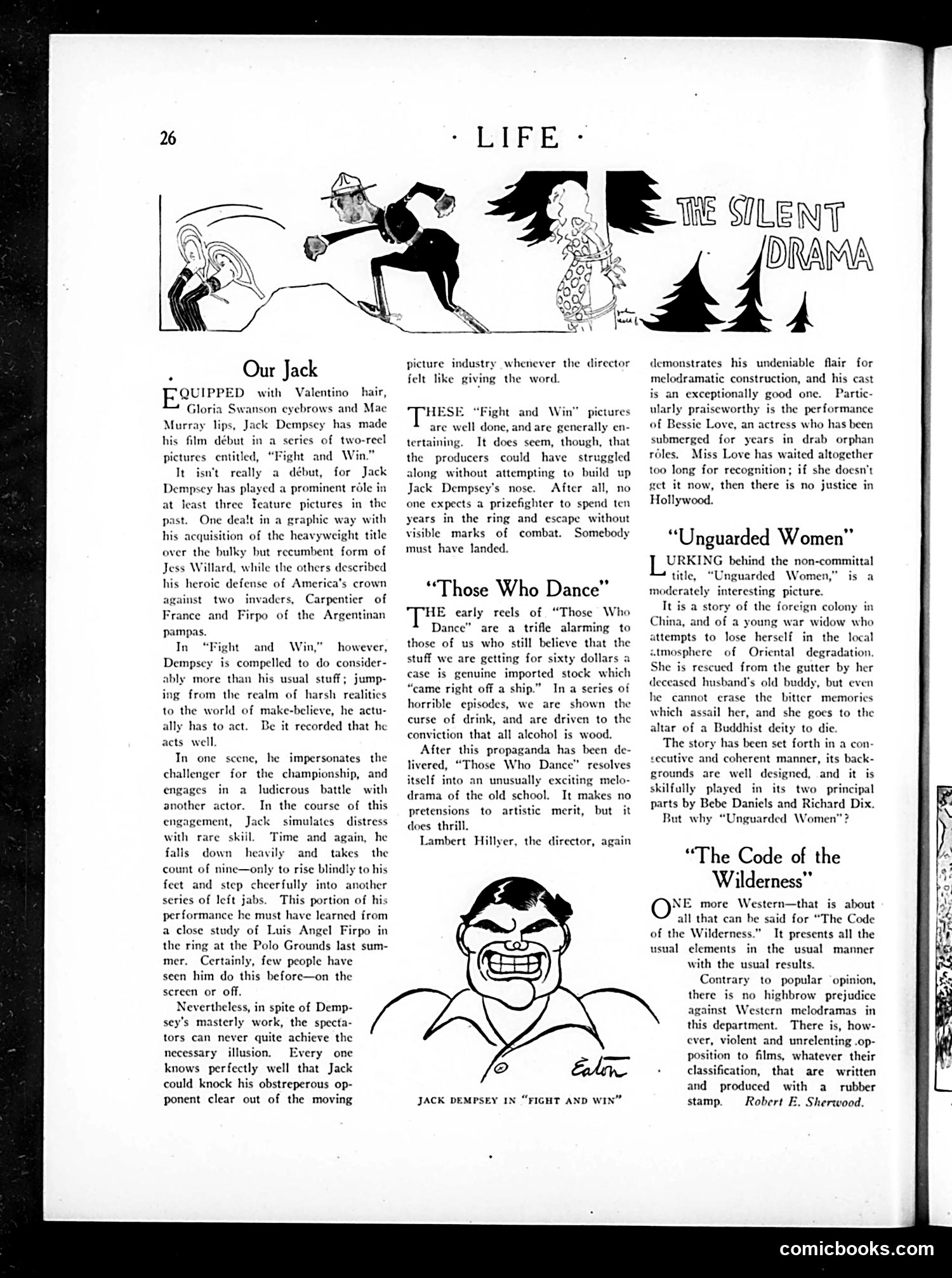
This page from *Life* magazine reviews several silent films, primarily focusing on **Jack Dempsey**, the famous heavyweight boxing champion, making his film debut in "Fight and Win." The satire centers on the incongruity of casting a real boxer as an actor. The text praises Dempsey's actual fighting prowess while gently mocking the film's premise: audiences know Dempsey could genuinely knock out his opponents with ease, yet must pretend the staged battles are genuine dramatic conflict. This undercuts the "necessary illusion" filmmaking requires. The page also reviews "Those Who Dance" (praised for melodrama if not artistic merit) and "Unguarded Women" (a colonial drama). The small cartoon captioned "JACK DEMPSEY IN 'FIGHT AND WIN'" shows a caricatured boxer mid-punch, illustrating the tension between Dempsey's real boxing identity and his attempt at fictional acting. The humor relies on the reader's knowledge of Dempsey's authentic boxing reputation making his cinematic pretense inherently comedic.
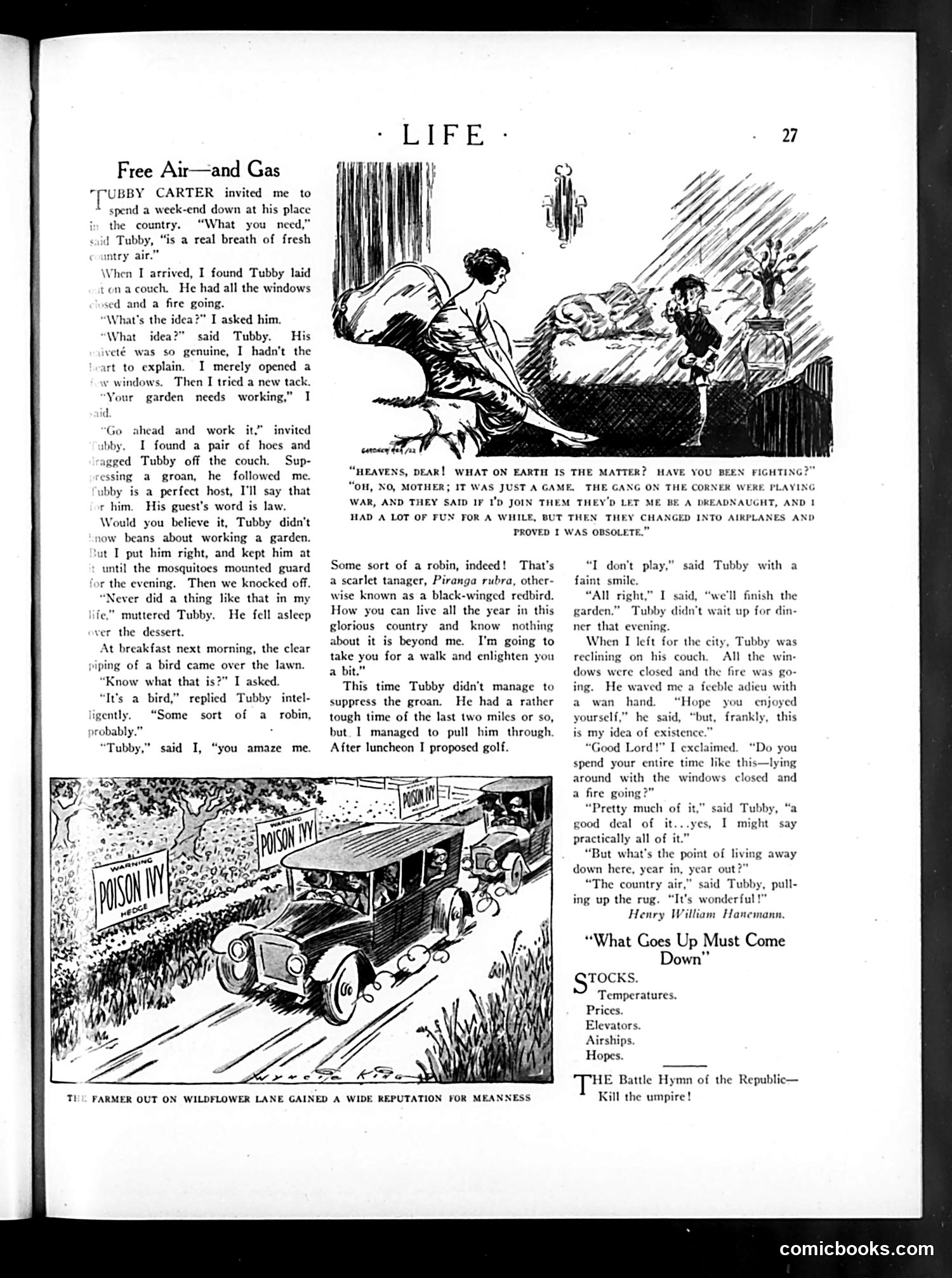
This page contains two satirical pieces mocking early 20th-century American life. **Main Story ("Free Air—and Gas"):** A city dweller visits his country-dwelling friend Tubby Carter for "fresh country air." The joke: Tubby keeps windows sealed and fires burning indoors, completely defeats the purpose of country living through lethargy and ignorance. Despite the guest's efforts to engage him in gardening, bird-watching, and golf, Tubby remains horizontal on his couch. The satire targets wealthy urbanites who romanticize rural life while lacking any actual engagement with nature—they want the *idea* of country living without its substance. **Children's Cartoon (top right):** Shows children playing war games, then switching to "airplanes," with one child declaring himself "obsolete." This likely references pre-WWI anxieties about military technology and changing warfare tactics—warships becoming obsolete as aviation advanced. **Bottom section ("What Goes Up Must Come Down"):** Brief satirical list mocking market speculation and economic instability of the era.
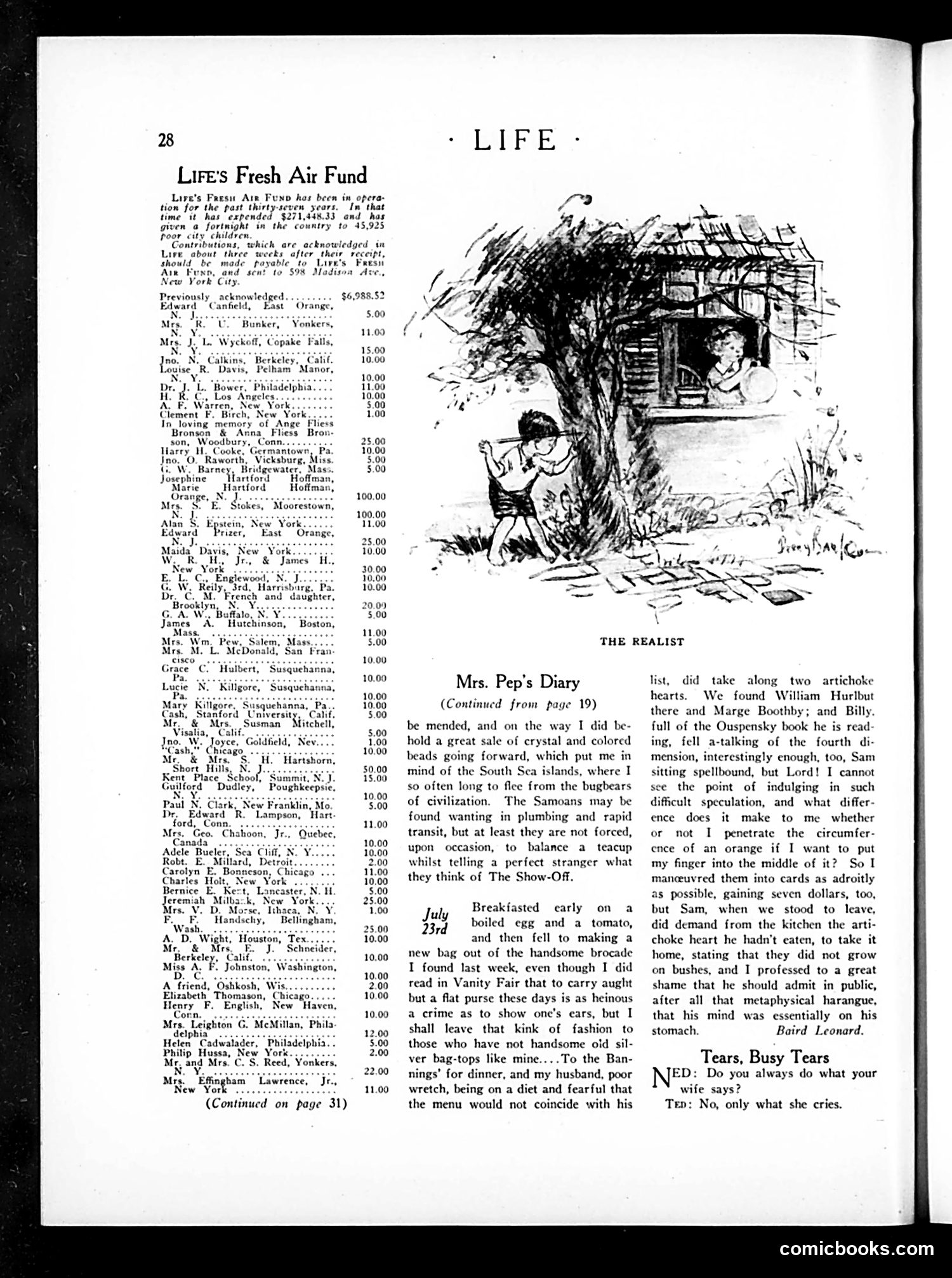
This page contains two distinct sections: **Left side:** A fundraising list for Life magazine's "Fresh Air Fund," a real charitable program (active 1881-1974) that sent poor urban children to the countryside for health and recreation. The names and donation amounts ($2-$100) represent actual contributors acknowledging their support. **Right side:** A satirical column titled "Mrs. Pep's Diary" mocking upper-class social pretension. The excerpt shows a wealthy woman describing her summer activities with affected disdain—complaining about dinner guests discussing esoteric philosophy (Ouspensky's fourth dimension), worrying about fashion rules regarding purses, and humorously ending with her penny-pinching husband demanding she retrieve leftover artichoke hearts from dinner to take home. The cartoon illustration (a child by a tree house) reinforces the Fresh Air Fund's mission. The diary's humor relies on satirizing bourgeois snobbery and gender dynamics of the era.
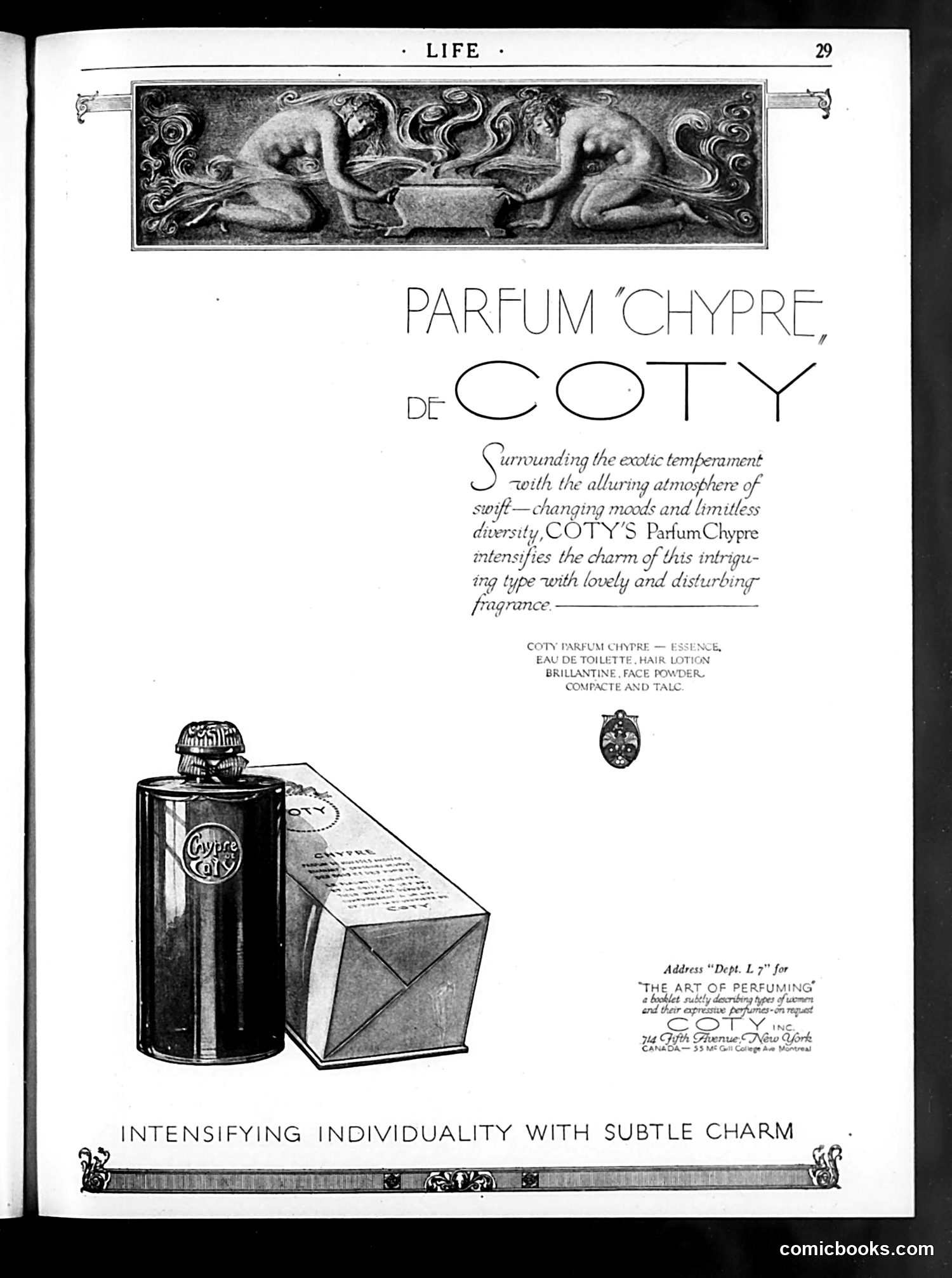
This is a perfume advertisement, not political satire. The page promotes Coty's "Parfum Chypre" fragrance line to a 1920s audience. The decorative header depicts classical female figures, establishing luxury and sophistication. The ad copy uses flowery language typical of the era, describing the perfume as enhancing "exotic temperament" and "intriguing" charm with "lovely and disturbing fragrance." The product image shows an elegant dark bottle with a spherical stopper alongside its packaging box. The ad lists available products: essence, eau de toilette, hair lotion, brillantine, face powder, compact, and talc—a complete beauty line. The tagline "Intensifying Individuality with Subtle Charm" reflects period marketing emphasizing personal allure. This represents mainstream advertising from Life magazine's commercial content, not editorial commentary or satire.
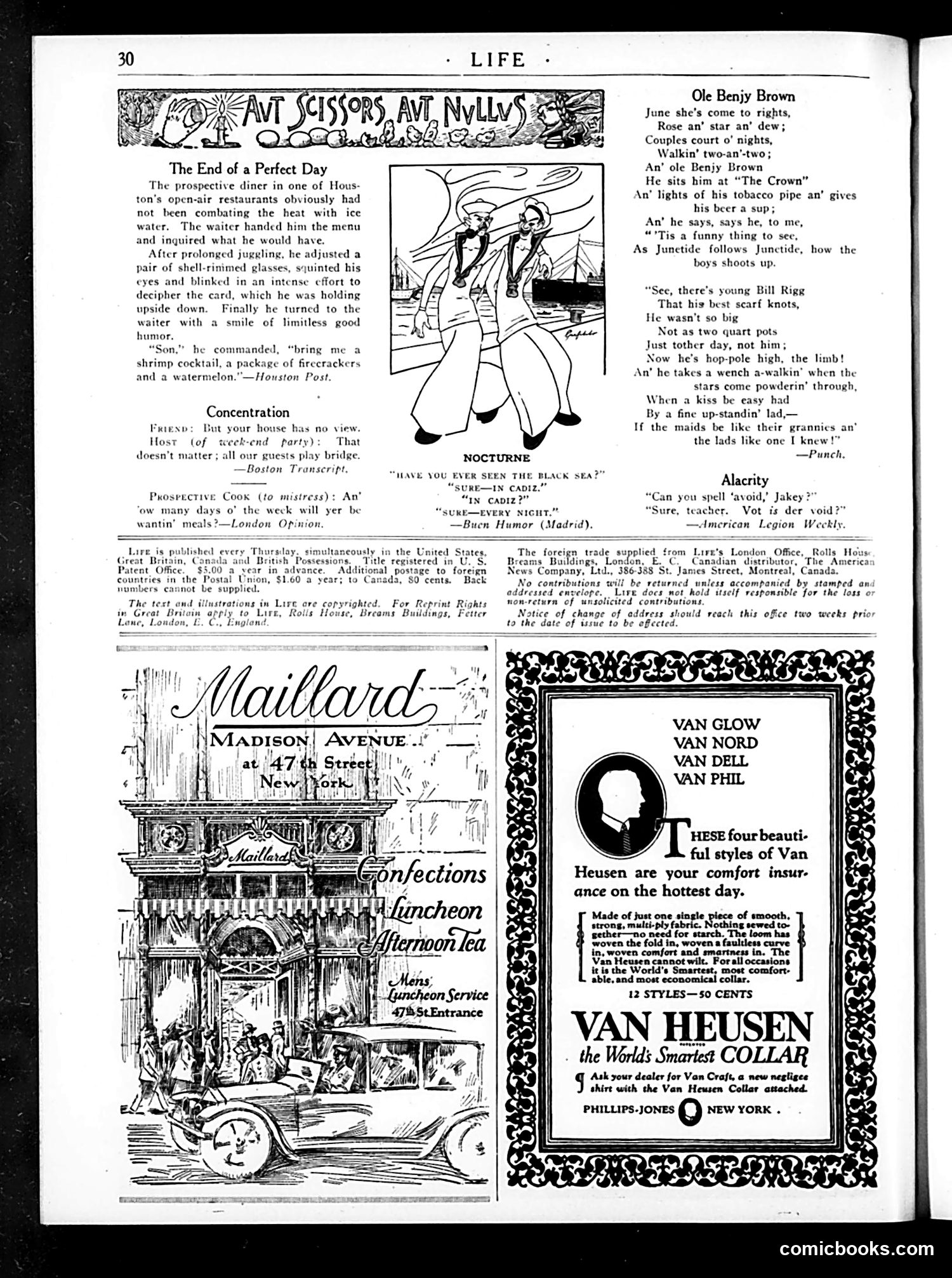
This page contains several brief humorous anecdotes typical of Life's satirical format, plus advertisements. **"The End of a Perfect Day"**: A drunk man in Houston attempts to order from a restaurant menu he's holding upside down, then absurdly requests "a shrimp cocktail, a package of firecrackers and a watermelon." The joke mocks both his intoxication and the improbability of the combination. **"Nocturne"** and **"Ole Benjy Brown"**: A poem (credited to Punch) depicts an older man observing young people courting in June, noting how a young man named Bill Rigg has grown tall. The sentimental piece contrasts youthful romance with middle-aged observation. **"Alacrity"**: A brief schoolroom joke where a student named Jakey, asked to spell "avoid," responds phonetically with a Yiddish accent ("Vot is der void"), playing on immigrant dialect humor common in early 20th-century American comedy. The page is primarily **advertising**, featuring Van Heusen collars and a Maillard confectionery establishment. These reflect period commercial interests in men's fashion and upscale dining.
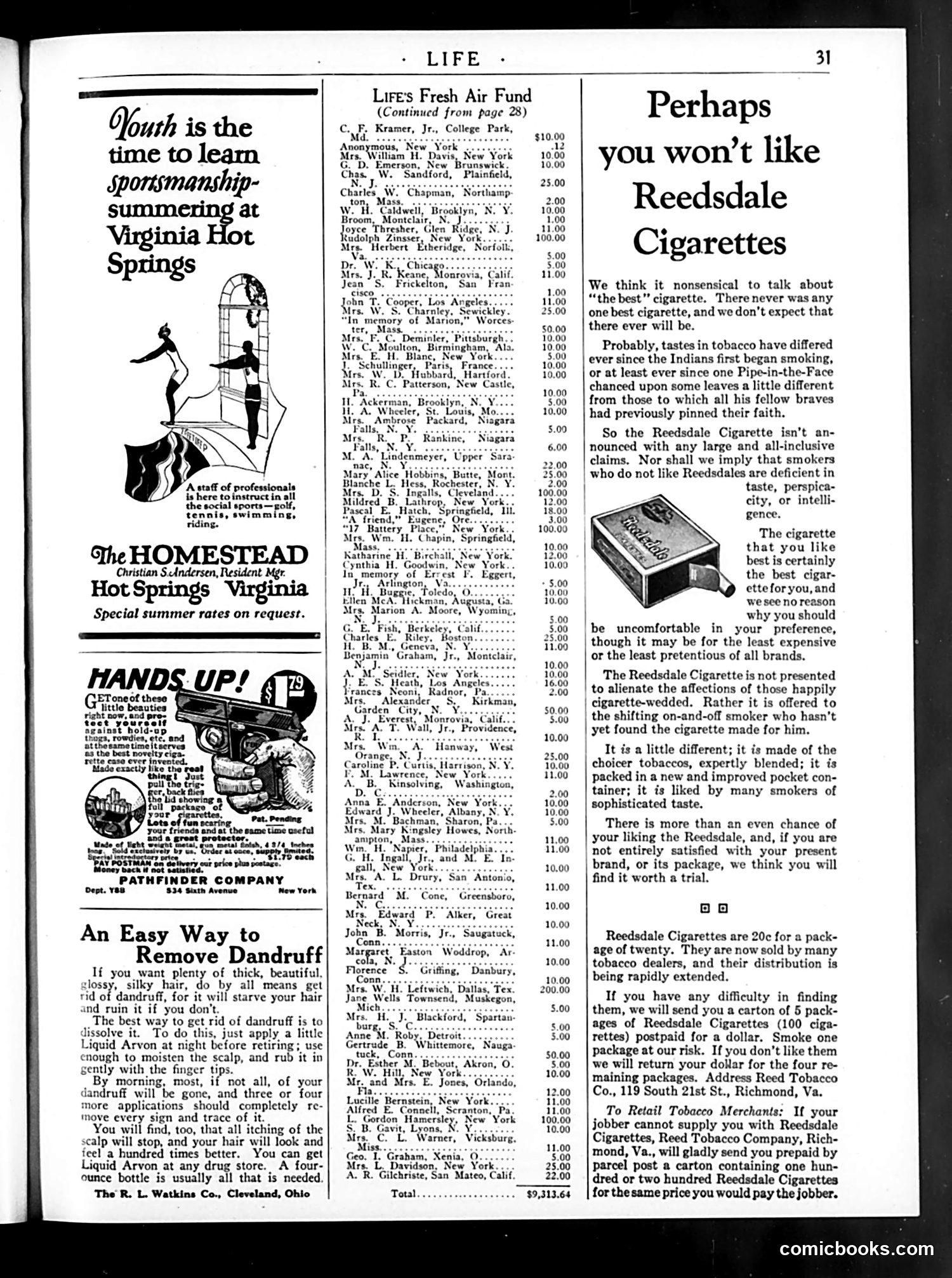
This page is primarily **advertising and charitable fundraising**, not political satire. The left side features ads for vacation resort "The Homestead" in Hot Springs, Virginia (promoting social sports), a "Pathfinder Company" novelty cigarette case, and a dandruff remedy ("Liquid Arvon"). These are standard period advertisements. The center column lists donors to **Life's Fresh Air Fund**—a charitable initiative providing vacations for underprivileged children. This was a genuine philanthropic effort common in early 20th-century publications. The right side contains a lengthy advertisement for **Reedsdale Cigarettes**, which adopts an unusual anti-marketing approach: the ad frankly admits there's no such thing as a "best" cigarette and that tastes differ. Rather than making grand claims, it offers a money-back guarantee and simply invites consumers to try the product. There is no political cartoon or satire here—this is a straightforward magazine page mixing charitable fundraising with commercial advertising typical of the era.
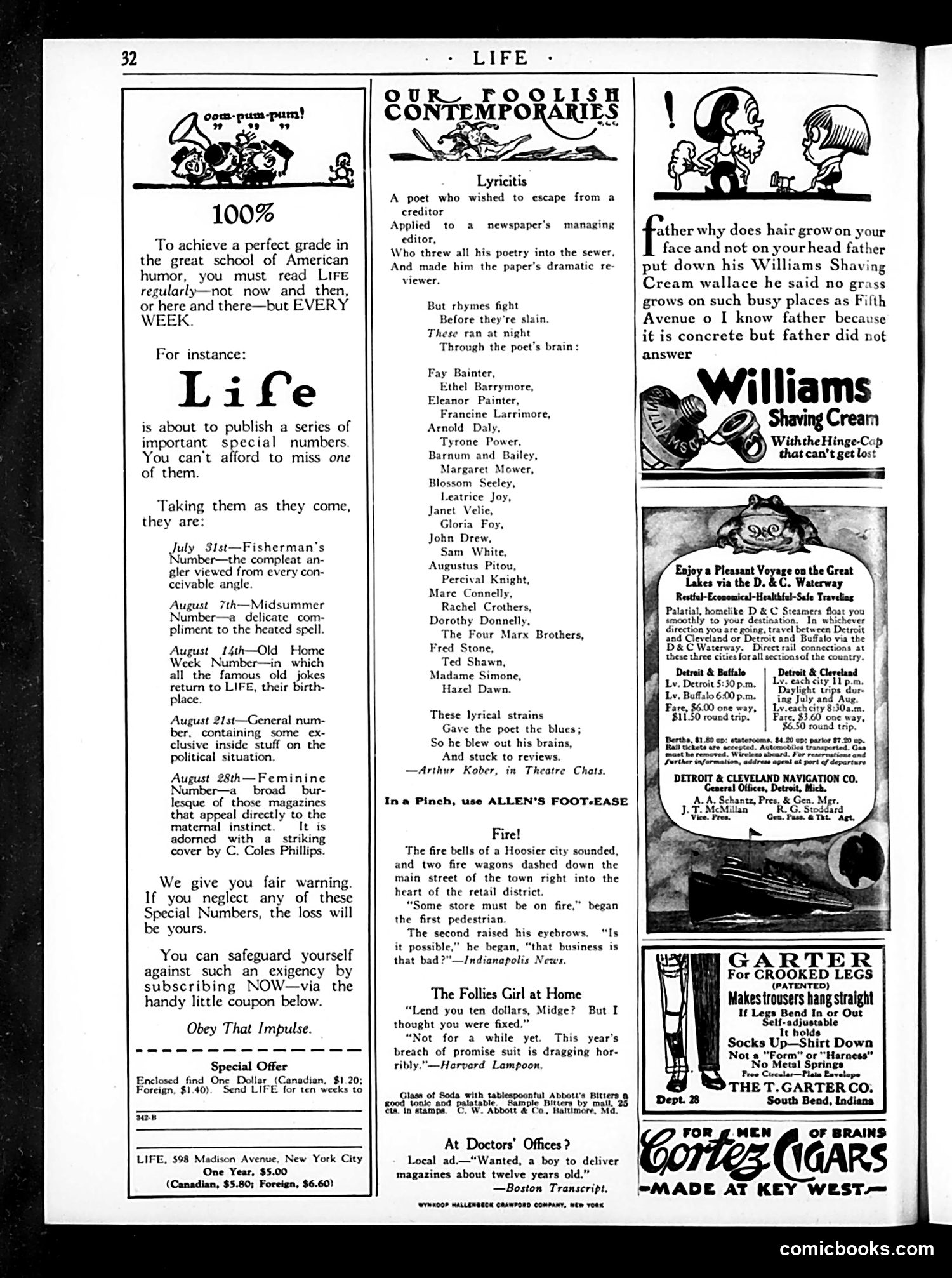
**Left Panel: "Lyricitis"** This satirical poem mocks a struggling poet who, to escape a creditor, threw all his work into a newspaper's sewer. The punch line: his bad poetry became the newspaper's dramatic review—an insult to both the poet and the paper's critical standards. **Right Panel: "Our Foolish Contemporaries"** A child asks why hair grows on a father's face but not his head. When the father explains it's because Fifth Avenue (where they live) is concrete, the child logically counters that father's head isn't concrete either. The joke satirizes a parent giving an absurd non-answer to a reasonable question. Both are light, comedic observations on contemporary life designed for Life magazine's satirical format.
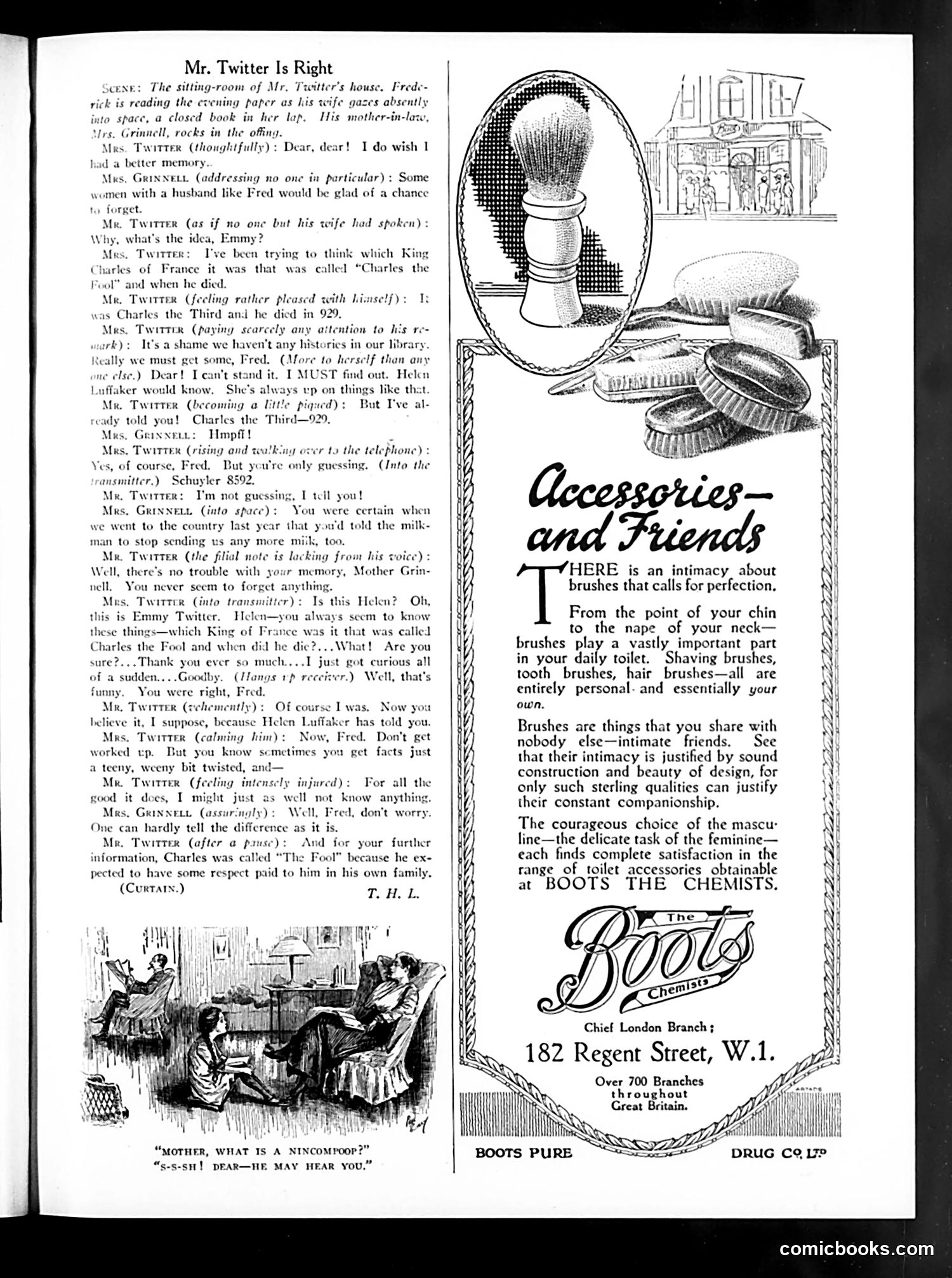
This page contains a humorous one-act play satirizing marital dynamics and male ego. Mr. Twitter confidently states that "Charles the Third" died in 929, but his wife doubts him and calls a friend (Helen Luffaker) to verify. Helen confirms the fact—yet it turns out Mr. Twitter was *wrong*. The joke culminates when he bitterly quips that he's called "The Fool" because he "expected to have some respect paid to him in his own family." The satire targets husbands who assert authority without knowledge, and wives who undermine their spouses by seeking outside validation. The mother-in-law's presence amplifies the domestic tension. A caption cartoon below shows a child asking "Mother, what is a nincompoop?"—reinforcing the play's theme. The right page is a Boots Chemists advertisement for personal grooming brushes, unrelated to the sketch.
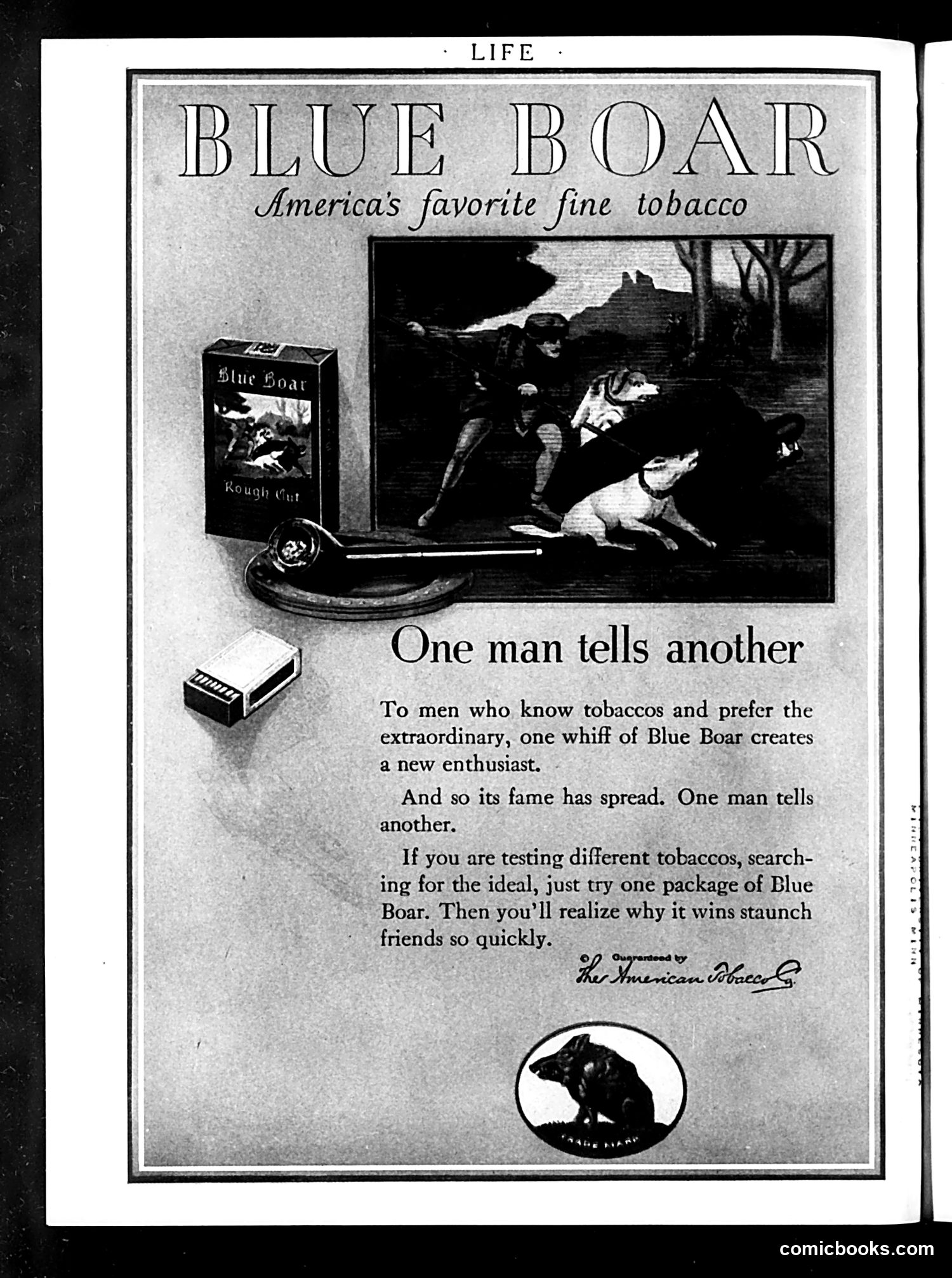
This is a **tobacco advertisement**, not political satire. It promotes Blue Boar brand tobacco to male consumers. The image shows a hunting scene with dogs and men, connecting the product to masculine outdoor pursuits—a common advertising strategy of the era. The tagline "One man tells another" emphasizes word-of-mouth recommendation among men who appreciate quality tobacco. The advertisement uses appeals to discernment ("men who know tobaccos") and exclusivity ("wins staunch friends so quickly") to market the product. The boar logo reinforces masculine association. This reflects early 20th-century advertising norms normalizing tobacco consumption and targeting it specifically at men through imagery of hunting and camaraderie. Modern readers would recognize this as dated promotional content for a now-regulated harmful product.